• About

Seeking and Serving

~ seek and serve Christ in all persons

Seeking and Serving

Tag Archives: journey

Sermon – Luke 24.1-12, ED, YC, April 21, 2019

01 Wednesday May 2019

Posted by jandrewsweckerly in Sermons, Uncategorized

≈ Leave a comment

Tags

celebrate, celebration, church, confusion, doubt, Easter, faith, Jesus, journey, joy, loud, question, quiet, resurrection, Sermon, unbelievable, uncertain, victory

Easter is one of my favorite days in the church year.  I love how no matter whether we come to church every Sunday or if we haven’t been to church in ages, something about Easter draws us to the Church.  I love the celebration:  the Easter outfits, the fragrant flowers, the boisterous music, and the family of faith gathered at the communion table.  I love the sweet feeling of having emerged from the penitential season of Lent, and counting how many times we can say, “Alleluia.”  There is a loudness to Easter, an unbridled joy, a sense of victory.

What is funny about our experience today though is very little of the boldness of this day is present in Holy Scripture.  In fact, Luke tells a story that is quite the opposite of our experience today.  While we sing loud alleluias and hosannas, all of the characters in our gospel lesson today are in a totally different place.  They are mired in grief, lost in confusion, unsure about what has happened to them.  In a quiet, almost mechanical, numb way, the women who have been beside Jesus his entire ministry and were the only ones remaining at his death, come to the tomb in the fog of dawn, to do the work of tending to the dead body.  In their haze, no sense of closure comes.  Instead, more confusion comes.  Not only is the tomb empty, the angelic figures tell them Christ is risen.  The angels remind them Jesus had explained this to them, and things start to make sense.  But when the women return to tell the men, the men are so resigned and defeated, they mock the women.  Peter goes to check out the story, but even he does not come back with profound clarity.  He is lost in amazement – in awed confusion.  This story tells us very little about what this all means, what we should do, or how we should respond.  Very little about the gospel today is loud, triumphant, or jubilant.

Though I have been begging our musician for years now for more sound at Easter – a timpani to accompany the brass – the truth is, I kind of like how our gospel lesson today takes us in another direction.  Much of what we boldly proclaim today – that Christ is risen, his resurrection brings eternal life, and everything we know has changed – is pretty difficult stuff to believe.  Any of you who has spent time around an inquisitive child or a doubtful friend knows how difficult explaining the resurrection can be.  For our rational, twenty-first century selves, the theology of Easter is not only difficult to articulate, Easter is almost unbelievable.  And when we are really honest with ourselves, in the quiet of our own homes, we sometimes have moments when we are not really sure why we believe what we believe about Christ.

That’s why I love today’s gospel.  Today’s gospel reminds us of how unbelievable the resurrection of our Lord really was.  Sure, Jesus had said he would be handed over to sinners, be crucified, and on the third day rise again.  But his words sounded crazy at the time.  Now that Jesus’ words have come true, the women are perplexed, terrified, and rejected when they share their truth.  The men are paralyzed, doubtful, and downright mean.  On this early morning, the followers of Jesus only have their experiences of Jesus, their uncertainty of faith, and their attempts to believe the unbelievable.

To me, that is very good news indeed.  On this day as we sing songs about Jesus’ resurrection, and as we hear Peter preach with certainty in the book of Acts, and as we, with joy, proclaim, “Christ is risen!  The Lord is risen indeed!” our gospel story reminds us faith is a journey full of doubt, questions, and confusion.  We come on this festival day not because we are absolutely certain about Jesus.  We come on this festival day because in our foggy dawns, we have had encounters with the risen Lord – even when we did not know how to articulate the encounters.  We come to this festival day because in our pain, suffering, and questioning about life – we have had moments when something from scripture or our faith life suddenly connected and made sense.  We come to this festival day because even in our doubts, there is some small part of us that cannot extinguish hope, that suspects Christ might have actually changed the world.

On this day, the Church does not want our theological explanations of the resurrection.  On this day, the Church invites us to recall those moments, however fleeting or miniscule, where we have encountered, or suspected we encountered, the risen Lord.  Our bold singing of alleluias only needs that small flicker of hope – or maybe our desire for that flicker of hope.  Our celebrating today only needs our presence – our willingness to be here, encouraged by others walking through the fog.  Our proclamation today that the Lord is risen, only needs our willingness to say the words.  The community gathered here today will do the rest.  We will say with you, “The Lord is risen indeed,” until someday we can all claim the astounding love and grace of our Lord Jesus Christ ourselves.  Amen.

On Invitations to Compassion…

30 Wednesday Jan 2019

Posted by jandrewsweckerly in Uncategorized

≈ Leave a comment

Tags

barriers, compassion, empathy, God, invitation, journey, margins, sacred, share, suffering, sympathy, walk

compassion_1200x627

Photo credit:  https://www.ted.com/topics/compassion

This past week I have been pondering the notion of compassion.  The notion first struck me as I visited one of our parishioners at the hospital several times.  Each time I have visited, someone else had already visited or was on their way to visit.  Having been to many a hospital room, I know this is not the norm.  Often, people in the hospital are there without much support.  To see the community rally around this parishioner – both fellow parishioners and personal friends – was such a potent witness to the power of compassion.

Midweek, our own parish began to wonder how we might show compassion to our neighbors in need who were struggling due to government shutdown furloughs.  As we shared ideas as a community, and as we checked on our own parishioners, we discovered that several of our parishioners were already acting on behalf of our neighbors in need.  In fact, several parishioners were quietly gathering funds to support our local Coast Guard members.  I was so proud to learn about the quiet, unassuming compassion of our church.

Finally, my daughter and I paid a visit to a Children’s hospital for some routine checkups.  As we were waiting in three different waiting rooms, we watching families pass us by with children who were much sicker, or who had challenges that I will never face with my children.  I found myself humbled by journeys I could not imagine, and wondering how I might move from sympathy to compassion.

My ponderings reminded me of something Father Gregory Boyle articulated in his book Tattoos on the Heart.  Father Gregory teaches a class in the local prisons, and in one of the classes they talked about the difference between sympathy, empathy, and compassion.  As the inmates discussed the topic, they agreed that sympathy is the expression of sadness for something someone is experiencing.  They defined empathy as going a step further and sharing how your own similar experience makes your sympathy more personal.  But compassion was a bit harder to define.  Father Gregory argues, “Compassion isn’t just about feeling the pain of others; it’s about bringing them in toward yourself.  If we love what God loves, then, in compassion, margins get erased. ‘Be compassionate as God is compassionate,’ means the dismantling of barriers that exclude.”[i]

I wonder how God is inviting you this week to step beyond sympathy and empathy, and step into compassion. That kind of work is not easy, and will likely mean getting a bit messy.  But I suspect that same kind of work takes us from looking at the world around us and saying, “That’s too bad,” or “I’m so sorry,” to “Let me walk with you.”  That is the sacred spot where we experience God between us.  I look forward to hearing about your experiences of accepting God’s invitation to compassion this week.

[i] Father Gregory Boyle, Tattoos on the Heart: The Power of Boundless Compassion (New York:  Free Press, 2010), 75.

On Finding and Sharing Joy…

19 Wednesday Sep 2018

Posted by jandrewsweckerly in Uncategorized

≈ Leave a comment

Tags

children, church, faith, formation, fun, God, invite, Jesus, journey, joy, parent, share

IMG_2901

Photo credit:  Robin Razzino; permission required for reuse.

This past Sunday, I was ready to head off for church bright and early.  My younger daughter was still asleep, so I went in to her room to give her a kiss goodbye.  She stirred and very sleepily asked me, “Is today Sunday School?  And Children’s Chapel?”  I almost giggled that this was her first thought upon arousal from sleep.  When I told her, “Yes,” she would be going to Sunday School and Children’s Chapel, she groggily replied, “It’s going to be fun.”

As I have been thinking about my child’s simple question and sense of joy about church, I had two thoughts.  The first was, I am so happy to know that my child is finding joy, happiness, and fun at church.  As a parent, you hope your child will find as much joy in Jesus as you do, but you learn pretty quickly that every child is an individual with their own passions and sources of joy.  To see my child develop a love for church and the experiences she has there has been so thrilling.  And even more importantly to me (especially as a clergy person), I am so grateful that her positive church experiences are almost totally independent of me.  Other adults are guiding her faith journey.  The community is raising her up in the faith.  Our church family is helping her find joy in God that is all her own.  That reality is one that I have deeply desired for my own children, and I am so proud that my church is a place that does the same for so many other children and families.

The second thought I had about my daughter’s early morning pronouncement was that I want adults to have that same sense of anticipatory joy about church too.  Sometimes we struggle to get ourselves to church because our lives are so over-scheduled that church feels like just one more burden.  Sometimes we go to church out of habit, but go through the motions without much joy or food for our souls for the week.  What I long for is church to be a place that when we first awake on Sunday mornings we think of church and we think, “This is going to be fun!”  We can do that at Hickory Neck because we know we will see people who have given us so much joy in our spiritual journey.  We can do that at Hickory Neck because the worship, preaching, and learning will give us new insights and renewed energy and passion for God.  We can do that at Hickory Neck because we know, somewhere during the morning, we will encounter God – and it’s going to be awesome!

This past Sunday at our Rector’s Forum, someone asked about how we invite people to church, how we share the Good News with others.  Where we start is sharing those stories of how, when we wake up on Sundays, we think about Hickory Neck and think, “This is going to be fun.”  When you tell the story of how your church brings you joy, your countenance changes, your energy shifts, and your enthusiasm is contagious.  The only thing left for you to do is say, “Hey, you want to come with me next time?  It’s really fun!”

On Paths Not Taken…

25 Wednesday Apr 2018

Posted by jandrewsweckerly in Uncategorized

≈ Leave a comment

Tags

abandon, call, celebrate, Christ, God, invitation, journey, light, mission, missionary, path, proclaim, progression, shame, St. Mark

Walking-Gravel-Feet-Sneakers-Free-Image-Path-Male--4740

Photo credit:  https://www.pixcove.com/walking-bases-gravel-grit-feet-sneakers-path-trail-male-shoes-walk-man-legs/

Today is the feast of St. Mark the Evangelist.  Typically, this is the day we honor the author of the gospel of Mark.  Who Mark was is a little uncertain, as there are several references to Marks in scripture.  If we are to believe that they all point to the same person, we have some clues about his identity.  In Colossians, Paul refers to Mark, the cousin of Barnabas, who joined Paul and Barnabas on their first missionary journey.  At some point in the journey, Mark turned back, abandoning the mission.  Later, when the three are ready to journey again, Paul refused to travel with Mark because of his earlier abandonment.  Later, the two reconcile and Mark and Paul journey to Rome together.

St. Mark’s Basilica in Venice honors the fullness of Mark’s progression from turning back on his missionary journey with Paul and Barnabas, to proclaiming the gospel of Jesus Christ as Son of God, to bearing witness later in life as companions of Peter and Paul.  So often, when someone disappoints us or seems like a failure, we turn an eye of judgment upon them.  We may welcome them back in the fold if they repent or correct their ways, but we always remember in the back of our minds how once upon a time they disappointed us.  But the Basilica seems to claim Mark’s entire journey is a journey to be celebrated.

I wonder what those times have been when you have abandoned your own missionary journey.  Perhaps you felt an initial call and sense of passion, but then you got scared, or you started to doubt yourself or the call, or you just could not pull your life together to follow Christ’s invitation.  So often when we talk about faith journeys, we talk about forks in the road, or new paths, but we rarely admit those times when we did an about-face, and just let go of what God had called us to do.  Perhaps we are ashamed or fear the judgment of others.

What I like about St. Mark’s story is that God is present throughout Mark’s journey and God uses Mark no matter what.  Whether it was a vocation we quit, a relationship with a faith community we left, or a personal relationship we cutoff, God is ever present with us, using our actions for good.  Some of us will never return to the same path like Mark did.  But we certainly take something powerful from that experience of walking away.  I invite you to consider those turns on your journey which you have been holding in shadow and consider letting God’s light to shine on them.  My guess is you will find more people who want to celebrate your path than judge.

On Making Mary Moments…

31 Wednesday Jan 2018

Posted by jandrewsweckerly in Uncategorized

≈ 2 Comments

Tags

beauty, closure, death, goodbye, grandmother, holy, Jesus, journey, Martha, Mary, meaningful, presence, sit, visit

IMG_9482

Photo Credit:  Jennifer Andrews-Weckerly, January 26, 2018

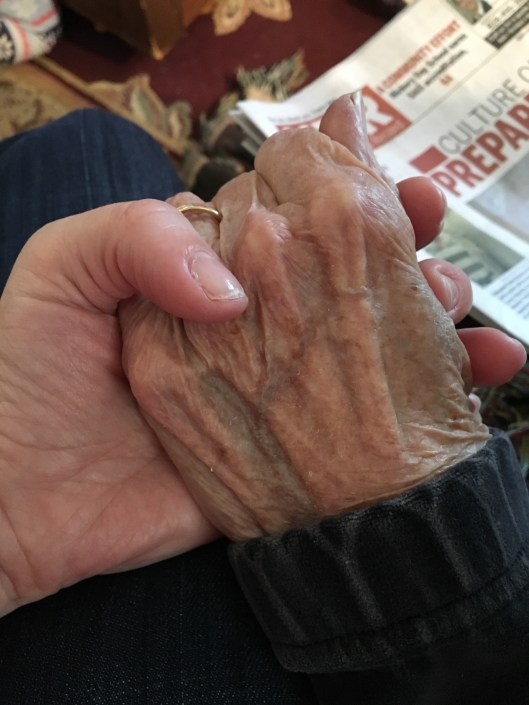
Over a week ago, I received a call that my grandmother was approaching death.  The suggestion was if I wanted a last visit, I should come sooner rather than later.  Looking at the week ahead, I realized I could go with my children last weekend with minimal impact to their school schedule or my own work obligations.  I was not sure what to expect – whether I would be able to have meaningful conversation or even eye contact with her, or especially how my three- and eight-year olds would respond to her in her current state.  At some point, a family member pastorally suggested I not come, knowing how hard such a long journey for such a brief visit would be.  But something kept pushing me to go, even if the journey seemed fraught with potential difficulty.

There were things that did not happen.  We did not have one last, long, meaningful conversation as I had with my other grandmother.  My grandmother was much too weak and her thoughts much too confused to answer any of my lingering questions about our family.  My children did not get to interact with my grandmother extensively.  They had beautiful moments of tenderness with her, and they played nearby, but they also needed to be kids and move.  I did not leave with a sense of real closure.  No one really knows how long she will be able to thrive.

What did happen was a much clearer understanding of why Mary chose to sit at Jesus’ feet, while her sister Martha busied herself with the duties of the home.  For full confession’s sake, I am much more like Martha most days – I am always washing one more dish or finishing one more piece of laundry instead of playing with my kids or hanging out with my husband.  But sitting beside my grandmother, holding her hand, realizing all the things I was not getting, I came to see the beauty of presence.  I do not think I have ever just been still with my grandmother.  I have never looked into her eyes for an extended period of time without saying anything.  I am pretty sure I have never just held her hand.  In the midst of all that could not be said, I felt a different kind of closure.  I could finally see in my larger-than-life grandmother her vulnerability, her desire to love, her humanity.

I left my grandmother last weekend wondering if I might be able to create more space for Mary-type moments in everyday life.  Whether I might put my phone away more often at home and be more present with my family.  How I might stop worrying about my to-do list, and spend more open time with our staff and parishioners.   Whether I might write that note to a suffering friend instead of letting the thought pass.  What Mary-type moments have been missing in your life lately?  When was the last time you sat at the feet of Jesus, or sat at the feet of the holy in others, and stayed for a while?  What might you need to do this week to find your own Mary moment?  I look forward to hearing about your reflections.

Sermon – Mark 1.14-20, Jonah 3.1-3, 10, EP3, YB, January 21, 2018

24 Wednesday Jan 2018

Posted by jandrewsweckerly in Sermons, Uncategorized

≈ Leave a comment

Tags

adventure, brothers, call, community, disciple, discipleship, faithful, follow, God, gospel, immediately, Jesus, John, Jonah, journey, Mark, moment, Nathaniel, Sermon

What is fun about our lessons from last week and this week is we get two different gospellers’ versions of Jesus’ first call to the disciples.  Last week, in John’s gospel, we got that great story of Philip and Nathaniel.  When Philip is asked to follow Jesus, he runs to find Nathaniel.  They have this great conversation about whether anything good can come from Nazareth.  Nathaniel reluctantly comes, and when he finally speaks with Jesus, he is amazed at what Jesus knows about him.  In the midst of community, conversation, and collaboration, both Philip and Nathaniel are able to say yes to Jesus’ invitation to discipleship.  On the other hand, Mark’s gospel paints a very different picture of the calling of the disciples.  Mark tells us Jesus passes two sets of brothers by the seashore, and instructs them to follow him.  Both sets of brothers drop what they are in the middle of doing.  In fact, the second set of brothers wordlessly abandon their father to follow Jesus.  No conversations or discernment; no collaboration or goodbyes.  In Mark’s gospel, Jesus invites, and disciples drop everything immediately and go.

I do not know about you, but I am actually in the John camp when we are talking about discipleship.  As an extrovert, I tend to process things aloud.  I need to talk through a problem with others to figure out what the best option might be.  I like to get input from others, using them as sounding boards to make sure my decision will have a positive impact.  I like to marinate on the feedback, pray a bit, share my leanings with a confidant or two, and then act.  So the idea of Nathaniel hemming and hawing, expressing his initial doubt with Philip, and then challenging Jesus when he seems to have some insight about Nathaniel seems totally relatable to me.  I need conversation, community, and collaboration, especially if I am going to drop everything important in life and follow someone in a new direction.

In some ways, I may even be closer to Jonah when we are talking about discipleship.  We hear only a small part from Jonah’s riveting story today, but what we might all remember is Jonah is a terrible follower of God.  The first two chapters of Jonah are filled with Jonah saying “yes” to God, and then totally running in the opposite direction.  He even endangers some total strangers when he boards a boat in the opposite direction of Nineveh.  He needs to be swallowed by a large fish, facing death and shame before he is willing to do what God has asked Jonah to do.

Many of you have heard this before, but my own call narrative was neither immediate nor direct.  When I first sensed a call to ministry in college, I avoided it.  I figured, maybe I could just volunteer for a year instead.  I loved working at a Food Bank that year, but figured, maybe I should work at a faith-based non-profit instead.  That would certainly count as serving God, right?!?  And then, when that did not feel totally right, I started to look at going to school – not for a Masters in Divinity, but maybe to study theology.  You know, try to learn about God, but not to be a minister.  Even when my priest suggested ordination it took me another whole year of talking to other people, reading countless books, prayer, and going on retreat before I could say yes.  Clearly, my identification with Nathaniel and Jonah is not unfounded.

But today’s lessons are nothing like my tendencies.  The portion of Jonah that we get today does not highlight any of Jonah’s dramatic avoidance and foibles.  Instead, when Jonah offers the shortest sermon ever, “Forty days more, and Nineveh shall be overthrown,” immediately, the people of Nineveh believe God, proclaim a fast, and everyone – everyone great and small – puts on sackcloth.  To understand the significance of this response by Nineveh, we need to remember that Nineveh is no saint.  They are a great kingdom of people who have been oppressing God’s chosen for ages.  They are tyrants, powermongers, and bullies.  No one scares Nineveh.  And yet, with Jonah’s sermon of judgment, they stop immediately, take on a fast, and repent of their ways.  No debates, no town hall meetings, no consultation with the king.  In fact, in the verses we do not read today, the king even proclaims that the livestock need to be put in sackcloth.  The repentance of Nineveh is total and immediate.

We see the parallels in Mark’s gospel today.  The two sets of brothers we read about, Simon and Andrew and James and John sound very similar.  They are both in the fishing industry, they are both working on nets, and they both respond immediately to Jesus’ invitation to follow him.  But there are some subtle differences that make their stories even more powerful.  You see, Simon Peter and Andrew are fishing from the shore with leaded nets.  They are fishermen, but not very wealthy ones.  Meanwhile James and John are from a higher socioeconomic status.  James and John have a boat and hired workers.  They are fishing by dragnet method, which means they are able to harvest much larger catches.[i]  Their father is also mentioned, which likely means their family has been at this business for generations.  And yet, despite the fact that James are John are in the midst of a long-standing, thriving business, both James and John and Simon Peter and Andrew have the same response to Jesus.  They drop everything immediately and go.

I wonder when you have similarly acted with immediacy to God’s call on you.  The moments do not have to be as dramatic as walking out of the classroom, office, or house without a word to anyone.  Maybe they were moments around giving to the church or a cause.  Maybe they were moments when you offered help to a stranger, knowing full well you were going to be late to your next engagement.  Maybe you called a Congress member or State Representative because your faith could no longer tolerate inaction on an issue.  Maybe you heard the volunteer sexton was retiring, and you said, “Here I am.”  Or maybe your immediacy was in getting out of bed one day and finally stepping in the doors of a church – because you needed a community to help you figure out this voice that was calling you to something new.  At some point all of us hear Jesus say, “Follow me.”

Now you may be sitting there thinking, “I have never said yes to that voice,” or “Most of the time I feel like a failure in following Jesus.”  The good news is that you are not alone.  Despite the fact that Simon Peter, Andrew, John, and James all behave exemplary today, we know as we read more of Mark’s gospel, that these are the same men who will fail time and again in their faith.  These are the same men who will deny Jesus, will argue about feeding five thousand people, will try to hold on to Jesus, and will vie for favor with Jesus.  Yes, today, they say yes immediately and they drop everything they have ever known and step out and follow Jesus.  But tomorrow they stumble, and keep stumbling their entire journey with Christ.

What our texts remind us of today is, as one scholar puts it, “Becoming a faithful Christian disciple takes both a moment and a lifetime.”[ii]  We are not going to feel emboldened to follow Jesus every day.  We are not going to abandon our families and our way of life every day.  There will be moments, hard days when we need courage and reassurance.  On those days, we can remember the moments when we said yes and answered the call.  We can recall with encouragement, on those days when we do not feel very faithful, the days when in fact we were entirely faithful.  And if we are struggling to hold onto those “yes” moments, we remember that we are called in community.[iii]  Whether the entire city of Nineveh was acting together, or disciples were called in pairs, our ability to answer God faithfully is usually done within the context of community – within a group of people who can remind us of our faithful days, and let us go when we need follow.  We are not alone in this adventure of following Jesus.  And that is good news!  Amen.

[i] Daniel J. Harrington, ed., The Gospel of Mark, Sacra Pagina Series, vol. 2 (Collegeville, MN:  The Liturgical Press, 2002), 76.

[ii] Elton W. Brown, “Pastoral Perspective,” Feasting on the Word, Year B, Vol. 1 (Louisville: Westminster John Knox Press, 2008), 286.

[iii] Karoline Lewis, “You are Never Alone,” January 14, 2018, as found at http://www.workingpreacher.org/craft.aspx?post=5044 on January 18, 2017.

On Repentance, Joy, and Journey…

06 Wednesday Dec 2017

Posted by jandrewsweckerly in Uncategorized

≈ Leave a comment

Tags

Advent, Christ Child, Jesus, journey, joy, love, prepare, repent, repentance, sinfulness

IMG_7647

Photo by Jennifer Andrews-Weckerly

One of the long-standing debates among clergy and scholars is whether or not Advent is a penitential season or not – a mini-Lent, if you will.[i]  There are arguments both ways, some saying absolutely yes; to prepare our hearts for the birth of Christ, our job is certainly to repent of our sinfulness.  Others who disagree with Advent being a season of penitence argue the season is more about joyful expectation and anticipation, and is distinct from the penitential season of Lent.  Meanwhile others argue that the both Lent and Advent are for both penitence and joy.

I am not sure I have made up my mind about these debates.  What I can tell you is that in the decluttering of my heart in preparation for the Christ Child, and in listening to the lesson appointed each Sunday, I know I am, and the world around me is, in need of some repentance.  As case after case pours in of sexual harassment and abuse, I am aware of how far we have drifted from the ways in which Christ longs for us to treat one another.  From the ways that we eviscerate one another online, or talk behind our neighbor’s backs, I know that we have lost a groundedness in Christ Jesus’ message of love.  From the ways in which we have stormed away from the communion table, I feel how deeply broken we are as a world.  I play a part in not correcting those sins, and sometimes actively participating in them.

And so, this Advent, my preparation feels a bit like a journey.  The first step is going to involve a bit of grief – for every woman or man who felt shamed or silenced by a society who would not affirm that they are created in the image of God, and should never suffer bodily violation; for the loss of an ability to see shades of gray instead of seeing black and white; for the hateful things we say and do to one another.  The second step is going to be some real repentance – not just naming the grief, but claiming my role in the degradation of others.  And then, hopefully, by the time we get to Christmas Eve, I expect to arrive at the manger, not with an armful of gifts, but the open arms of humility, repentance, and renewal.  I may not have words, but I long for the evening when I can bow in front of the Christ Child, rejoicing in the gift of love, forgiveness, and transformation that Jesus is for all of us.  Whether that means this Advent is a season of penitence or not, I am not sure.  All I know is this year, I am grateful for the journey.

[i] https://livingchurch.org/covenant/2016/11/29/is-advent-a-penitential-season/

Sermon – Deuteronomy 34.1-12, P25, YA, October 29, 2017, 8 AM

01 Wednesday Nov 2017

Posted by jandrewsweckerly in Sermons, Uncategorized

≈ Leave a comment

Tags

anniversary, future, God, history, Israelites, Joshua, journey, Kingdom, Moses, past, present, Promised Land, Sermon

This morning our community is celebrating our past, present, and future.  We celebrate the community of Hickory Neck, who one hundred years ago, came together to consecrate this historic church, which had been dormant of worship since the Revolutionary War, used varyingly as a school and hospital.  We celebrate a community who committed itself this year to paying off our debt which covered the cost of our New Chapel, as well as renovations to existing buildings.  And we celebrate our commitments to financially support Hickory Neck in the year ahead through our pledges of offerings.  In each celebration, we see glimpses of who Hickory has been, is, and is becoming.

We are not unlike our ancestors, the Israelites, as we find them on the brink of the Promised Land.  Today’s lesson from Deuteronomy tells the story of the last days of Moses and the beginning of Joshua’s leadership.  In their mourning over Moses’ death, the community remembers the profound ways in which God, through Moses, changed their lives.  They were exiles by famine from their land, enslaved by the Egyptians, and indebted to Pharaoh.  But Moses became their advocate, leading them out of slavery, across the Sea of Reeds, and through the long years of the wilderness.  Moses took all their complaints and whining, and advocated for food, water, and safety.  Moses took their metaphorical wandering, and delivered a new law from the Lord.  Moses organized their community and empowered the next generation to lead.  Moses’ death reminds the people of Israel all they have been through.  Their mourning is where they find themselves in the present:  no longer wandering, but not yet into their next phase of life.

And yet, Moses’ death also points them to their future.  Moses has already blessed Joshua as their next leader, and Joshua will take them into the Promised Land.  Moses is even given the gift of seeing the beauty of that land, as far as the eye can see.  Though Moses knows he is not to cross over, God shows him all that is to come.  The vision is vast, abundant, and blessed.  We suspect Moses can die in peace having seen the land of milk and honey, even if he himself will not experience the land.  And Moses has already seen Joshua receive the spirit of wisdom.  There is nothing left to do but join God in the heavenly kingdom.

On days of introspection about the past, present, and future, we can easily gloss over all the hard stuff.  Though today the people of Israel honor their esteemed leader, and they have the Promised Land ahead of them, we do not often get a sympathetic retelling of the Israelite story.  For the last several weeks, we have heard stories of the Israelites complaining about water and food, but we forget how debilitating hunger and thirst can be.  We read the story of the construction of the golden calf recently, but we rarely wonder about what waiting blindly at the foot of the mountain for Moses to return felt like or the doubt his absence created.  We also recently heard the story of the Passover, but we rarely imagine how terrifying that night must have been and what being saved meant.

I have wondered what stories linger behind our own history.  I have asked our historians about the Hickory Neck community one hundred years ago.  I have wondered who the members were, what their feelings were about the old church that was no longer theirs, or what inspired them to regather.  But we have no record of their story:  their passion that lead to us worshiping here today.  We can only imagine the negotiating they did, the partnerships they forged, the strain they underwent in those early years.  And though many of you were here when we built our New Chapel, I was not.  I imagine there were lingering doubts and concerns about whether a capital campaign, and taking on a mortgage was a good idea.  I am sure there were anxieties about church growth and identity.  And I already know some of that same labor is true today.  We wonder where the Holy Spirit is guiding us, what ministries will define us, and what people will join our community and change us for the better.  The future is always ambiguous and daunting.

That is why I appreciate our parallel story of the Israelites, Moses, and Joshua today.  As one scholar writes, what our ancient story and our modern story reminds us of is “Building the realm of God is a process, and we each have our part to play, even if we will not be around to see all our hopes come to fruition.  Even if we will not be present for the final outcome, it is important that we build the realm of God in the here and now, trusting God to work through each of us to bring about God’s vision for the world.  Furthermore, God assures us in [today’s Old Testament reading] that there will be people to continue leading us to the promised land and building God’s kingdom after we are gone.  The emergence of Joshua as the new leader of the Israelite people shows us that the work to be done is bigger than any one individual, and God will continue to provide prophetic presence through different people and voices.”[i]

In both the stories of our biblical and historical ancestors, we are reminded that we are a part of a greater narrative – each phase of the journey filled with challenges, hard times, and anxious moments.  But each phase is also filled with successes, celebratory times, and joyful, life-giving moments.  That is why we have been talking about journeys this month.  As we have reflected on our personal journeys to generosity during stewardship season, we have heard countless stories of how our journey has evolved, changed, and deepened.  We have also heard of the fellow pilgrims along the way who taught us about generosity and shaped our journey along the way.  What we have been doing this month, and what our Old Testament lesson and our current celebrations remind us of is “there is value in the journey.  The value lies in the growth, the relationships, and the spiritual development we experience along the way, not to mention the incremental progress we make toward creating the just and peaceable world that God desires for all of creation.”[ii]

Our invitation this week, is to continue to invest in the journey.  Each of you have shared with me the innumerable ways that Hickory Neck has influenced your journey.  I cannot tell you the countless times that this building alone has played a powerful part of your experience here.  I cannot tell you the multiple times I have heard about the passion and excitement that enlivened your faith life as we built a new worship space after hundreds of years on this land.  I cannot tell you the hundreds of times I have heard dreams and vision whispered in my ear as you have envisioned what the next steps of our journey together at Hickory Neck will be.  There will be hard moments and joyful moments, times of struggle and times of celebration.  Today we are reminded of the God who journeys in each phase with us, and empowers us as partners on the journey to change the kingdom of God here on earth.  God will empower us to stay on the journey together.  I cannot wait to see where the journey leads!  Amen.

[i] Leslie A. Klingensmith, “Homiletical Perspective,” Feasting on the Word, Supplement to Yr. A, Proper 25 (Louisville:  Westminster John Knox Press, 2011), 4.

[ii] Klingensmith, 6.

On Generations of Generosity…

25 Wednesday Oct 2017

Posted by jandrewsweckerly in Uncategorized

≈ Leave a comment

Tags

abundance, celebration, church, commitment, compassion, faithful, future, generations, generosity, giving, God, journey

KonstantinChristian_ChildParent_Generosity

Photo credit:  https://www.psychologytoday.com/blog/the-athletes-way/201510/small-acts-generosity-and-the-neuroscience-gratitude

This past week, my daughter and I were out shopping for a birthday gift for a friend.  As we were doing the self-checkout, the computer asked us if we would like to donate to charity.  I quickly tapped “no,” and my daughter was incensed.  “Don’t you want to help, Mommy?!?”  As we walked back to our car, I explained how we do help others.  She seemed incredulous, so I detailed our charitable giving, starting with what we give to the church.

Though she seemed mildly satisfied, our conversation made me realize a couple of things.  First, I could stand to have more explicit conversations with our children about our giving to church.  We already talk about budgets, treats, and how we spend money otherwise.  I realize now that our eldest may be ready to understand the commitment we make to church too.  Second, my daughter’s initial indignation is really good thing.  Her frustration with me reveals a sense of compassion and generosity that I was not sure she had fully developed.

This Sunday in church, we are celebrating lots of things.  We are celebrating the 100th anniversary of the consecration of our historic church.  After hundreds of years of our church being used as a school and hospital, a faithful community gathered once again in 1917 for the original purpose of the building – to worship the Lord in the beauty of holiness.  We are also celebrating the paying off of our mortgage on our newest worship space.  After one final push this summer, and years of generosity before, we are able to be debt free!  We are also celebrating In-Gathering Sunday: a day where we offer our pledge cards for blessing.  These pledge cards indicate our commitment to the upcoming year of ministry, and reflect our journey toward generosity.

As these three celebrations combine into one day, I am ever aware of Hickory Neck’s own journey to generosity.  From the faithful who worked to reestablish our church after years of dormancy, to the faithful who saw a vision of a more modern, spacious place of worship just over ten years ago, to the faithful who see the new things budding at Hickory Neck and want to be a part of that growing community, we are a community who has always been on a journey to generosity.  I am grateful for the chance to celebrate together, especially for the ways in which our celebration is an example for the future generations who are also being shaped into faithful servants of compassion and generosity.  From the past and present, and into the future, I see God’s abundance all around us!

A Journey to Generosity…

04 Wednesday Oct 2017

Posted by jandrewsweckerly in Uncategorized

≈ Leave a comment

Tags

bless, evangelism, generosity, giving, God, gratitude, Holy Spirit, idea, inspire, journey, life, light, stewardship, vision

tens_nodate_logovertical (1)I am always amused when I discover the Holy Spirit at work because the discovery usually happens when I am in the thick of executing something I thought I had planned myself.  Ideas come to me, I test out the idea with others, I do the planning to implement the idea – basically the whole process involves a great deal of self-direction.  But when an idea really blows me away is when the idea takes off in even better ways than I planned.  When I finally realize how inspired the idea is, I realize that the idea could not have possibly come from me alone.  The only way those incredible moments of confluence occur is through the Holy Spirit.

I had one of those moments this week.  On Sunday we kicked off our stewardship campaign entitled “Journey to Generosity.”   All sorts of activities are a part of that campaign:  inspirational materials from our Stewardship Committee explaining the campaign, reflections from fellow parishioners, Parish Parties, sermons from the clergy, and meditations from national church leaders.  All of those experiences would be enough to situate us in a place of profound gratitude.  But then other things started happening.

The first has been attending our adult formation series.  The series is about evangelism, so I had expected our energies to be focused on the work of spreading the good news.  But the first sentence from the book we are using says, “Evangelism is your natural expression of gratitude for God’s goodness.”[i]  While I thought our conversations about gratitude and generosity would be limited to stewardship, here gratitude was permeating other areas of church life.  The second thing that happened was welcoming the first of three babies due this month at church.  As I held the first one yesterday, especially after a rough twenty-four hours of mourning another massive shooting in Las Vegas, I looked at that tiny child and felt a profound sense of gratitude for the gift of life.

Our “inspired” idea to talk and pray about our Journey to Generosity has already morphed into something much bigger.  I find myself being grateful not just for the generosity of parishioners who are passionate about our church and support its work through financial giving.  I am also grateful for a community of people who are so enthusiastic about their gratitude that they want to go out and share the good news with others.  I am grateful for a church community so generous in spirit that they can take tragedy and find rays of light and hope all around.  I am grateful for a community whose gratitude is so powerful that they have a vision of making our community a better place:  through our Fall Festival, through our visioning work with our Vestry, and through daily service to others.  What seemed like a catchy campaign slogan has actually been naming a way of life at Hickory Neck:  a life rooted in gratitude and generosity.  Thank you for letting me be a part of this journey with you all.  You inspire me every day and you transform my relationship with God every week.  God bless you on your journey to generosity!

[i] David Gortner, Transforming Evangelism (New York:  Church Publishing, 2008), 1.

← Older posts
Newer posts →

Recent Posts

  • On the Myth and Magic of Advent…
  • On Risking Failure and Facing Fear…
  • Sermon – Luke 23.33-43, P29, YC, November 23, 2025
  • On Inhabiting Gratitude…
  • Sermon – Luke 20.27-38, P27, YC, November 9, 2025

Archives

  • December 2025
  • November 2025
  • October 2025
  • September 2025
  • August 2025
  • July 2025
  • June 2025
  • March 2025
  • February 2025
  • December 2024
  • November 2024
  • October 2024
  • September 2024
  • August 2024
  • July 2024
  • June 2024
  • May 2024
  • March 2024
  • February 2024
  • January 2024
  • December 2023
  • November 2023
  • October 2023
  • September 2023
  • August 2023
  • July 2023
  • June 2023
  • May 2023
  • March 2023
  • February 2023
  • January 2023
  • December 2022
  • November 2022
  • October 2022
  • June 2022
  • May 2022
  • January 2022
  • December 2021
  • November 2021
  • October 2021
  • September 2021
  • August 2021
  • June 2021
  • May 2021
  • April 2021
  • March 2021
  • February 2021
  • January 2021
  • December 2020
  • November 2020
  • October 2020
  • September 2020
  • August 2020
  • July 2020
  • June 2020
  • May 2020
  • April 2020
  • March 2020
  • February 2020
  • January 2020
  • December 2019
  • November 2019
  • October 2019
  • September 2019
  • August 2019
  • July 2019
  • June 2019
  • May 2019
  • April 2019
  • March 2019
  • February 2019
  • January 2019
  • December 2018
  • November 2018
  • October 2018
  • September 2018
  • August 2018
  • July 2018
  • June 2018
  • May 2018
  • April 2018
  • March 2018
  • February 2018
  • January 2018
  • December 2017
  • November 2017
  • October 2017
  • September 2017
  • August 2017
  • July 2017
  • June 2017
  • May 2017
  • April 2017
  • March 2017
  • February 2017
  • January 2017
  • December 2016
  • November 2016
  • October 2016
  • September 2016
  • August 2016
  • July 2016
  • June 2016
  • May 2016
  • April 2016
  • March 2016
  • February 2016
  • January 2016
  • December 2015
  • November 2015
  • October 2015
  • September 2015
  • August 2015
  • July 2015
  • June 2015
  • May 2015
  • April 2015
  • March 2015
  • February 2015
  • January 2015
  • December 2014
  • November 2014
  • October 2014
  • September 2014
  • August 2014
  • July 2014
  • June 2014
  • April 2014
  • March 2014
  • February 2014
  • January 2014
  • December 2013
  • November 2013
  • October 2013
  • September 2013
  • August 2013
  • July 2013
  • June 2013
  • May 2013
  • April 2013
  • March 2013
  • February 2013
  • January 2013
  • December 2012
  • November 2012
  • October 2012
  • September 2012

Categories

  • reflection
  • Sermons
  • Uncategorized

Meta

  • Create account
  • Log in
  • Entries feed
  • Comments feed
  • WordPress.com

Blog at WordPress.com.

  • Subscribe Subscribed
    • Seeking and Serving
    • Join 394 other subscribers
    • Already have a WordPress.com account? Log in now.
    • Seeking and Serving
    • Subscribe Subscribed
    • Sign up
    • Log in
    • Report this content
    • View site in Reader
    • Manage subscriptions
    • Collapse this bar
 

Loading Comments...