• About

Seeking and Serving

~ seek and serve Christ in all persons

Seeking and Serving

Tag Archives: Kingdom

Sermon – Luke 5.1-11, EP5, YC, February 9, 2025

12 Wednesday Feb 2025

Posted by jandrewsweckerly in Sermons

≈ Leave a comment

Tags

abundance, baptism, change, empower, feelings, gospel, Jesus, Kingdom, same, Sermon, wisdom, with, work

On occasions of big life milestones, we tend to be a people who like to offer sage advice.  Whether the advice is about how to approach retirement after decades of work, how to handle parenting to a first-time parent, how to manage marriage, how to navigate divorce, or, like today, how to approach full membership in the body of Christ through the act of baptism.  As parents and godparents tentatively offer their children to the Church, in turn, we as a community offer advice and counsel – sometimes formally through things like the baptismal covenant, and sometimes informally over coffee and cake from our own lived experiences.

As I was reading our gospel lesson this week, I was thinking about one of those loved bits of wisdom that often comes up in the life of the Church.  I cannot tell you the number of times I have heard a parishioner say to me, “You know what they say the definition of insanity is, Jennifer?  Insanity is doing the same thing over and over again and expecting different results.”  Sometimes, when we just cannot get some momentum to overcome a problem at church, I find myself doing an “insanity check” because of that old adage.  So, imagine my surprise when I read today’s gospel and hear Jesus basically asking the disciples to do the exact opposite of what that bit of wisdom suggests about how doing the same thing over and over again never leads to meaningful change. 

Here we are, meeting Simon, James, and John in Luke’s gospel for the first time.  These career fishermen have had a rough day on the job.  They have been out on the water all night long, using all their normal tricks, fishing in all the right spots, and have come to shore, exhausted, disappointed, and likely more than a bit irritated to have nothing to show for their labor.  Into this despondency and frustration, this guy, Jesus, inserts himself and basically says the complete opposite of what that old saying says about doing the same thing over and over.  Jesus says to the soon-to-be disciples, “Go back and fish again.”  To weary, disheartened men, who have just spent all night doing this work, Jesus says, “Do the work again.” 

We do not know why Peter agrees.  But we do know the feeling Peter describes when he basically tells Jesus this is a terrible idea.  We may not be fishermen, but we know “what it’s like to work really hard at something that matters, and have nothing to show for [our] efforts when [we’re] done.  …I imagine we all know what’s it’s like to pour ourselves into a job, a relationship, a ministry, a dream — and come away exhausted, frustrated, thwarted, and done.”[i]  For that matter, after the last month we may be having those feelings right now.  Whether we are weary from watching the chaos and upheaval of these first few weeks of a new administration, or we are weary from having big conversations about church, we know how resistant we would be if Jesus were to tell us, “Just go back out into the world (or to Hickory Neck) and keep doing the same thing!”

But here is the thing:  Jesus doesn’t actually ask Peter to keep doing the same thing.  Though the physical action Jesus is suggesting is the same, something dramatic changes in the scene.  Yes, Peter, James, and John, are using the same nets, in the same waters, in the same location, using all their same gifts.  But this time, this time the text tells us that Jesus gets in the boat with them.  Jesus does not shout from the shore what the disciples should do.  Jesus gets on that weary boat with them, and heads out into the deep, trouble waters with them.  As scholar Debie Thomas says, “This is a promise to cultivate us, not to sever us from what we love.  It’s a promise rooted in gentleness and respect — not violence and coercion.  It’s a promise that when we dare to ‘go deep,’ to do what we know and love with Jesus at our side, God will enliven our efforts in ways we couldn’t have imagined on our own.”[ii]

As I have been looking at the chaos in the political sphere right now, and even as I have been looking at pretty big changes at Hickory Neck, I have been wondering if Jesus’ only words of encouragement are going to be, “Just get back out in the deep waters and keep doing the good work of the Gospel.”  Because lately that has just felt more like “insanity work.”  Instead, what our gospel lesson tells us that when we get back to the work Jesus has given us to do, knowing that Jesus is in the boat with us, it means not only will we not get the same results, we are going to be surprised with abundance.  Now, I’m not saying you have to accept the promise of abundance enthusiastically.  Even Peter protests and then acquiesces half-heartedly.  “Yet if you say so, I will,” Peter tepidly commits.  So Debie Thomas tells us we can commit too.  “Yet if you say so, I will try again.  Yet if you say so, I will be faithful to my vocation.  Yet if you say so, I will go deep rather than remain in the shallows.  Yet if you say so, I will trust that your presence in the boat is more precious than any guarantee of success.  Yet if you say so, I will cast my empty net into the water, and look with hope for your kingdom to come.”[iii]

When we baptize little Arthur today, and we decide what bit of wisdom we want to pass along to him, forget about that whole “insanity” advice.  Maybe instead, our advice can be something more akin to our gospel.  We can tell him, “Sometimes Jesus is going to invite you to do some crazy stuff – to do something that you are certain will lead to the same old results.  But just remember, Jesus does not send without getting in the boat with you.  Jesus does not send you without empowering you to do the work.  Jesus does not send you without the promise that abundance will come.”  Our invitation today is to not to just give the advice to little Arthur – but to hear and embrace the advice for ourselves too.  Amen.


[i] Debie Thomas, “Same Old Same Old,” February 3, 2019 as found at https://www.journeywithjesus.net/essays/2075-same-old-same-old on February 7, 2025.

[ii] Thomas.

[iii] Thomas.

Sermon – Mark 6.14-29, P10, YB, July 14, 2024

17 Wednesday Jul 2024

Posted by jandrewsweckerly in Sermons

≈ Leave a comment

Tags

death, disciple, Good News, gospel, Herod, Jesus, John the Baptist, Kingdom, politics, scripture, Sermon, terror, together, work

Today’s gospel lesson contains one of those iconic stories that is so vivid the story is seared in our minds.  In short, John the Baptist is decapitated by Herod Antipas who serves John’s head on a platter.  On the one hand, the brutal scene, depicted in art for centuries, is one we prefer to acknowledge and move on.  Certainly, this is a cautionary tale for the prophetic life.  John is now dead, and Jesus takes the reins.  But there is so much more to this story.  There is John’s faithfulness to making a way for the inbreaking of the kingdom – including the criticism of Herod Antipas’ marriage to his brother’s wife.  There is the king’s imprisonment of John mingled with his fascination with John, leaving him sitting at John’s feet enthralled by John’s teachings.  There is the vengeance of Herodias, the criticized wife of Antipas, who manipulates her daughter into asking for John’s head.  There is the proud Herod Antipas who makes ridiculous promises to his daughter and spinelessly agrees to kill John despite his knowing better – just to save face in front of his friends.  This is a story so woven in political and ethical intrigue that we do not like to look too closely for fear of seeing modern-day parallels.

But what is perhaps more intriguing about trying to avert our eyes from this brutal, shameful scene is that John’s beheading is not the first time scripture hands us a story like this.   “The story looks like a reprise of 2 Kings 16-21, the story of Queen Jezebel, the enemy of Elijah.  Just as Jezebel manipulated her husband, King Ahab, so Herodias manipulates Antipas.  Just as Elijah indicts Ahab and Jezebel, so John the Baptizer indicts Antipas and Herodias.”[i]  Furthermore, there are parallels to Esther’s story, whose husband also promises her anything she wants, up to half of his kingdom.  Esther uses her promise for good, able to thwart the villain Haman’s plan to kill off her fellow Jewish brothers and sisters.  Reflecting on the canon of scripture, we cannot avoid the ugly truth that scholar Amy-Jill Levine uncovers:  that “Death at the hands of corrupt authorities is the fate of John, and Jesus, and of countless others who have done the right thing, at the cost of their own lives.”[ii]

So, what do we do with this tale of terror laid at our feet today – a tale told time and time again in scripture?  I am intrigued by scholar Matt Skinner’s instruction look at the disciples.[iii]  In the very last line of our text today, Mark says, “When his disciples heard about [John the Baptizer’s murder], they came and took his body, and laid it in a tomb.”[iv]  If you remember, in the text last week, Jesus was shut down in his hometown and unable to perform miracles, instead sending out the twelve in pairs to cast out demons and to heal the sick.  For Jesus and his disciples, they got back to work.  And if we kept reading Mark’s gospel, in the verses that follow today’s story, we will hear how Jesus and disciples go on about their work, with Jesus miraculously feeding five thousand people.  John’s death is horrific, brought about by evil and sinfulness.  And yet, his disciples boldly come forward and bury his body.  Jesus sees John’s death and must know a similar fate awaits him.  And yet, he and his disciples get back to work, doing the good news of God in Christ.

Stories like John’s beheading are indeed graphic, sobering stories of what awaits those who live in the light of God.  And yet, time and again, Elijah, Esther, John the Baptizer, Jesus, and Jesus’ disciples keep going.  They keep doing the next good thing.  There is part of that model that feels unjust – surely, we should be fighting for justice, standing up to those who abuse power, who manipulate authority, whose self-centeredness and pride promote evil.  We revere plenty of saints who did just that kind of work.  And yet today, in the face of brutality, hopelessness, and injustice, the disciples of John and the disciples of Jesus just keep going.  They keep doing the work of the kingdom.

We are in an unprecedented time of political turmoil.  And in the coming weeks and months, given our diverse political backgrounds in this community, we will likely disagree about what our country can and should be doing.  But what brings us to this common table every week is a commitment to the life and ministry of Christ – the bringing about of a kingdom that is not of this world.  We will need each other – sometimes to figure out what the next best thing is, sometimes for the encouragement to do the next best thing, and always as a reminder that we disciples of Jesus need each other to do the next best thing.  We know from John, Jesus, Elijah, and others that doing the next best thing may end in personal suffering.  But we also know that continuing to do that next best thing helps bring us just a little bit closer to that kingdom here on earth.  We go together.  Amen.


[i] Amy-Jill Levine, The Gospel of Mark:  A Beginner’s Guide to the Good News (Nashville:  Abingdon Press, 2023), 38-39.

[ii] Levine, 42.

[iii] Matt Skinner, “Commentary on Mark 6:14-29,” July 14, 2024, as found at https://www.workingpreacher.org/commentaries/revised-common-lectionary/ordinary-15-2/commentary-on-mark-614-29-6 on July 12, 2024.

[iv] Mark 6.29.

Sermon – Mark 1.29-39, EP5, YB, February 4, 2024

14 Wednesday Feb 2024

Posted by jandrewsweckerly in Sermons

≈ Leave a comment

Tags

bishop, calling, comfort, deacon, discernment, Jesus, Kingdom, ministry, motherhood, ordain, redirected, Sermon, serve, work

You may or may not know about me that I became a mom and was ordained at the same time.  I was seven months pregnant when the bishop ordained me.  Needless to say, there is ongoing debate about whether Simone is also a deacon since she was in utero at the ordination.  But what becoming a mom and becoming ordained at the same time has meant is the patterns of the two vocations are interwoven for me.  So just like on any given day in ministry, my plan for the day can get upended with a phone call, a drop-in visit, or a text, so is the precarious nature of parenting.  I can be in the middle of preparing dinner when a friend-crisis erupts at home for one of the kids.  I can be driving a kid to practice, only to learn from the backseat that the kid is struggling with a bully.  I can be trying to write a sermon, and another kid bursts inside with a bloody knee.  Some folks might see those parenting and pastoring moments as “interruptions” to a day.  But as someone who became a pastor and parent at the same time, that constant feeling of pushed and pulled, interrupted while trying to charge ahead, and even rerouted entirely is part and parcel of living my vocations faithfully.

I think that is why I find our gospel lesson today so compelling.  Jesus has just come off the casting out of demons in the temple that we heard about last week, with everyone awe-struck by his teaching with authority.  Then, today he just tries to go to Simon’s house to chill out, when he is immediately notified about Simon’s sick mother-in-law.  After healing her, Jesus tries to settle back down, but by sundown, the whole town is at the door, asking for healing and cures – which Jesus graciously offers.  In the wee hours of the morning, Jesus goes out to a deserted place for a moment of peace and prayer, and Simon and the others interrupt his moment for more work.  Jesus rallies the troops and off they go, proclaiming the gospel and casting out demons.  Even Simon’s mother-in-law, as soon as she is healed, begins serving Jesus and his disciples.  Not to be confused with some sort of subservient, sexist expectation that women should serve men – no, the word used for what Simon’s mother-in-law does is the same word used for what deacons do:  she serves.  In fact, she is the first deacon in the New Testament[i], and as such, teaches us that life following Jesus is just like following along in this story about a day in the life for Jesus – you are constantly pulled and pushed, invited into service in whatever ways that service shows up on your doorstep.

Yesterday I was a part of a bishop’s election.  Sometimes I think the way we elect bishops is almost cruel – for the community where the candidate serves, they are both incredibly proud of their priest, but also incredibly anxious that they may lose their priest.  All sorts of emotions and concerns get stirred:  maybe my priest doesn’t want to be here anymore, maybe my priest is neglecting her job here, maybe my priest doesn’t care about me or our church.  But getting lost in those anxieties misses what is happening in a bishop’s search.  The priest is simply doing what he or she does everyday:  listening and responding to the call of ordained life, wherever that call pushes and pulls.  Sometimes that means hopping in a car to get to the hospital immediately; sometimes that means stopping the crafting of a report, article, or sermon to listen to a hurting soul; sometimes that means talking for an extended time with a stranger at the grocery store, the gym, or the bus stop because your priesthood doesn’t belong just in the church walls.  But sometimes that means saying yes to serving on a board for workforce housing, saying yes to a bishop’s request that you serve the diocese in a particular way, saying yes to raising funds for your seminary – and even saying yes to discernment to the episcopacy.  Just like there are countless balls to juggle in parenting, there are countless balls to juggle in ordained life.  That’s just what we do when Jesus calls us – we serve.

As we settle into the idea that I will in fact being staying in ministry with you, I see this “Day in the life of Jesus” from Mark’s gospel today as an invitation.  As Debie Thomas describes, our invitation today is to “spend our days as Jesus spent his…living graciously and compassionately in this vast and often terrible in-between.  To offer the comfort of our steady presence to those who suffer.  To encourage those in pain to hang on, because the work of redemption is ongoing.  To create and to restore community, family, and dignity to those who have to walk through this life sick, weak, and wounded – without cures.  To make sure that no one who has to die – and that’s all of us in the end – dies abandoned and unloved, if we can help it.”[ii]  That means as we at Hickory Neck step away from this time of discernment, we do the work of that first deacon, Simon’s mother-in-law.  We get up and we get back to work:  caring for one another, serving our neighbors, sharing the good news with those who need a good word.  Though this call to serve may feel like a frustratingly interrupted time of prayer, in fact, the interruption today is the perfect reminder of the life of Jesus:  being pushed and pulled, interrupted and redirected, and in moments like this – seeing the beautifully sacred in the midst of all our very human feelings.  I invite you today to take my hand, so we can get back to the work of the kingdom.  Amen.


[i][i] Gary W. Charles, “Exegetical Perspective,” Feasting on the Word, Yr. B, Vol. 1 (Louisville: Westminster John Knox Press, 2008), 335.

[ii] Debie Thomas, Into the Mess & Other Jesus Stories:  Reflections on the Life of Christ (Eugene, OR:  Cascade Books, 2022), 75.

On Grace, Love, and Humor…

14 Wednesday Aug 2019

Posted by jandrewsweckerly in Uncategorized

≈ Leave a comment

Tags

attention, beloved, God, grace, health, humor, Kingdom, love, pattern, push, sick, unconditional, vacation, well

FeverFighters

Photo credit:  https://www.unitypoint.org/livewell/article.aspx?id=f76749ae-debc-43f3-8168-7969460772cf

One of the things I typically do before a vacation is frantically try to get as much done as possible, working late nights until basically throwing my weary self into a car before letting myself slip into vacation mode.  I run hard partly because I want to have as much done before I leave as possible, setting others up for success; but I run hard partly because I know the to-do list will be even bigger when I return.  The down side to this model is I sometimes push so hard part of my vacation is recovering from the cold I catch in wearing my body down.

But this week, something comical happened.  I had been toying with working on my day off to make sure everything got done before vacation.  And then, days before, my daughter got a fever.  For those of you familiar with childcare, you know a child has to be 24-hour fever free to return to care.  Not only did her fever not ease on my day off, the fever didn’t break until the next day – leaving me precious little time to accomplish my to-do list.

At that point, I just started chuckling.  God has a tremendous sense of humor – and a somewhat mischievous way of getting my attention.  After years of the repeated pattern, if I was unwilling to change my behavior, something stepped in my way (a fever, namely) to force me to break the pattern.  Suddenly, all that stuff that just had to get done would have to wait.  The abruptness was frustrating, and I still squeezed in a few things between videos and meals, but my usually hidden, under the surface high-stress levels just could not continue.  However, it is hard to be frustrated when the roadblock is a red-cheeked, clammy little one who just wants to cuddle and falls asleep at strange times.

I began to wonder yesterday how I might be more measured with my own health and the generosity of a God who loves our hard work for the kingdom, but also loves us unconditionally.  What are some of the patterns you find yourself falling into that disregard the reality that you are made in God’s image and are loved unconditionally?  How might you receive that grace more gracefully this week?  In what ways is God inviting you to shift that grimace to a smirk to a smile?  My hope for you this week is you allow God’s love to wash over you, breathe in God’s unconditional grace, and then share that love with someone else who is pushing so hard they forgot their belovedness too.

Sermon – Luke 23:33-43, Meditation on Jesus’ Second Last Words, March 13, 2019

27 Wednesday Mar 2019

Posted by jandrewsweckerly in Sermons, Uncategorized

≈ Leave a comment

Tags

Christ, clarity, criminal, crisis, future, God, inclusion, Jesus, Kingdom, paradise, penitent, present, remember, Sermon, Seven Last Words

I preached the following sermon as part of a seven-week ecumenical preaching series on the Seven Last Words of Christ.  This sermon was offered at New Zion Baptist Church, one of the fellow members of the Upper James City County Ministerium, of which Hickory Neck Episcopal Church is a member.  

One of the funny things about life is that when left to our own devices, we can become consumed with things that do not have ultimate significance.  Whether our coworkers are counting on us to fill a shift, we have an important meeting, or we have a long to-do list to get accomplished, we can easily begin to think that the agenda we have set for ourselves is of ultimate importance.  We know this to be a falsehood though:  one phone call from the school nurse saying our child has a fever, or one appointment with the doctor telling us the test results came back positive, or one loved one experiences a car crash, and suddenly everything we thought was so important takes a backseat.  Crisis has a funny way of creating clarity in our lives when nothing else will.

I think that is what happens to the penitent criminal next to Jesus.  In the text we hear tonight, he is called a criminal, but in Matthew and Mark he is called a thief.  The distinction matters because crucifixion was not a crime for petty larceny.  Crucifixion was “…reserved for enemies of the state.  Crucifixion was saved for people the Roman Empire wanted to make examples of – people who had committed crimes like insurrection – civil disobedience – treason.  It’s why Jesus was crucified.”[i]  So presumably, our penitent criminal has been fighting the state too.  I suspect he has been so focused on his work, he sees nothing else, he sees no other way.  Only upon finding himself on a cross – in the midst of crisis – does he find clarity.

In that clarity, the penitent criminal doesn’t ask to be remembered on earth – to have a legacy that lives on.  He asks instead to be remembered – to have his body be re-membered – to be brought along with Jesus to that place that really matters.  The criminal does not ask to be remembered because he fears being nothing.  He confidently asks to be remembered, “because he recognizes the One who can remember.  …[He] is able to see and acknowledge that this is indeed the One to redeem Israel.”[ii]  This criminal could have been fighting the same empire, the same kingdom, that Jesus was fighting.  Except Jesus was bringing about a kingdom that threatens all the kingdoms of this world.[iii]  And in this moment on his cross, the criminal could see the Way.

I worry for us, here in Williamsburg, Virginia, among our ecumenical friends, even during Lent, we do not always have that same clarity.  Two thousand years after Christ’s death, we slip into assumptions that we can control the world around us.  We may even be trying to change our community – fighting injustice, organizing for the poor, rallying for the disenfranchised, and resisting the evil of this kingdom.  But if we are not rooted in Christ’s cross – rooted in helping to bring about the heavenly kingdom – perhaps we too are sitting on our own crosses, not having gained the clarity to simply ask, “Jesus, remember me when you come into your kingdom.”

In college, I spent ten days on a mission trip to Honduras.  We were in a rural village for most of the visit, needing to hike from the main road for about an hour before we arrived.  The week was filled with humbling experiences – seeing the sacrifices the village made to host us, learning about the plight of subsistence farmers who cannot own their land, trying to make an impact, but realizing how little power we really had.  During our ten days together, one of the songs we frequently sang was the Taizé chant, “Jesus, remember me.”  If you do not know the song, the song simply repeats the phrase, “Jesus, remember me, when you come into your kingdom; Jesus, remember me, when you come into your kingdom.”  The song is also quite easily translated into Spanish due to its simplicity.  On one of our last nights as a team, in our closing worship, one of the team leaders was so overwhelmed by our experience that he began to change the words, “Jesus, forget me…” he sang.  His words shocked us.  For him, I think his changing of the words was his way of expressing how unworthy he would ever be to be remembered by Jesus.  Not in a world of such deep injustice.

What my teammate’s version of that song did though was forget what happens in Luke’s gospel when the criminal asks Jesus to remember him.  Jesus says the words we honor tonight, “Truly I tell you, today you will be with me in Paradise.”  As Peter Gomes reminds us, “Jesus doesn’t say, ‘There, there, there, it will be all right, just hold on a little tighter.’  He doesn’t say that; he says, ‘Today’ – now, this instant, as soon as I’m there – ‘you will be there also.’  Jesus claims lordship of the future.”[iv]

Jesus says something powerful today.  This Paradise that Jesus points to is not a place they will go someday, but “a relationship that they entered today…Paradise is whenever, wherever you are with Jesus.”[v]  Now I don’t know about you, but that sounds like Good News to me.  When we get those moments of clarity – hanging from a cross, in the face of our sinfulness that makes us want to be forgotten, Jesus says, right now, right here, you are with me.  Last week, we heard Jesus’ promise of forgiveness, “Father, forgive them, for they do not know what they are doing.”  Today, Jesus moves beyond forgiveness to full inclusion in the kingdom – full, reconciled relationship that changes the here and now.

A few weeks ago, our parish hosted the Emergency Winter Shelter.  We partnered with many of you here, and I know many of you host your own weeks, or partner with other parishes that do.  When we host Winter Shelter Week, we often encourage our people to witness Christ’s love through service of others – to bring Christ’s light to the guests of our shelter.  But what I remembered this year, is that as much as we think of our selves as bearers of God’s light into the darkness, I think what we actually do is not bring Christ’s light, but discover Christ’s light is already there – because that is where God is – at the heart of suffering, illness, and oppression.  We do not bring God to our guests.  God is already with our guests.  We just get to be witnesses to the inbreaking of the kingdom.  When we serve the homeless in our community, we are asking Jesus to remember us – and Jesus reminds us that we are there with him in Paradise.

As much as I love singing “Jesus remember me,” during Lent, I confess that as I reflect on these last words of Jesus, I wonder if instead singing the Taizé song “Ubi Caritas,” might capture the spirit of what Jesus is saying.  The English translation of Ubi Caritas is “Where love and charity are, there is God.”  I think if my friend who simply wanted to be forgotten that night in Honduras had remembered Jesus’ response to those words, he would have remembered that Jesus does not care if we are worthy.  Our acts of charity, of love, of kindness, are where God is.  Today.  Not in the future.  Today, we are in God’s kingdom.  As that defeated revolutionary is hanging on the cross wanting to be remembered, as he and Jesus both long for justice, into that darkness, Jesus proclaims the light already present.  In our community, the light is present too.  Into the face of racism, sexism, xenophobia, homophobia, hatred, hunger, poverty, and oppression; into our divisions right here in Williamsburg, when we fail to love our neighbor; into the denominational differences that pull us apart on Sunday mornings, Jesus’ light is already here.  “Truly I tell you, today…today…TODAY… you…and you…and you…YOU… will be with me in Paradise.”  Amen.


paradise

Photo credit:  https://www.eyekons.com/img/Church/Beerhorst_Cross-Shattered-Christ-CD_Contents.pdf

[i] The Rev. Linda Pepe, “Today You Will Be with Me in Paradise: Luke 22.33-43,” 2013, as found at  http://www.theologicalstew.com/today-you-will-be-with-me-in-paradise-luke-23-33-43.html on March 1, 2019.

[ii] Stanley Hauerwas, Cross-Shattered Christ:  Meditations on the Seven Last Words (Grand Rapids:  Brazos Press, 2004), 42.

[iii] Hauerwas, 42.

[iv] Peter J. Gomes, The Preaching of the Passion:  The Seven Last Words form the Cross (Cincinnati:  Forward Movement, 2002), 27.

[v] William H. Willimon, Thank God It’s Friday:  Encountering the Seven Last Words form the Cross (Nashville:  Abingdon Press, 2006), 20.

GC79: Kingdom Work

26 Thursday Jul 2018

Posted by jandrewsweckerly in Uncategorized

≈ Leave a comment

Tags

Episcopal Church, General Convention, God, heaven, hope, Jesus Christ, Kingdom, liberating, life-giving, loving, people

IMG_5342

Photo credit:  Ruth Beresford (reuse only with permission)

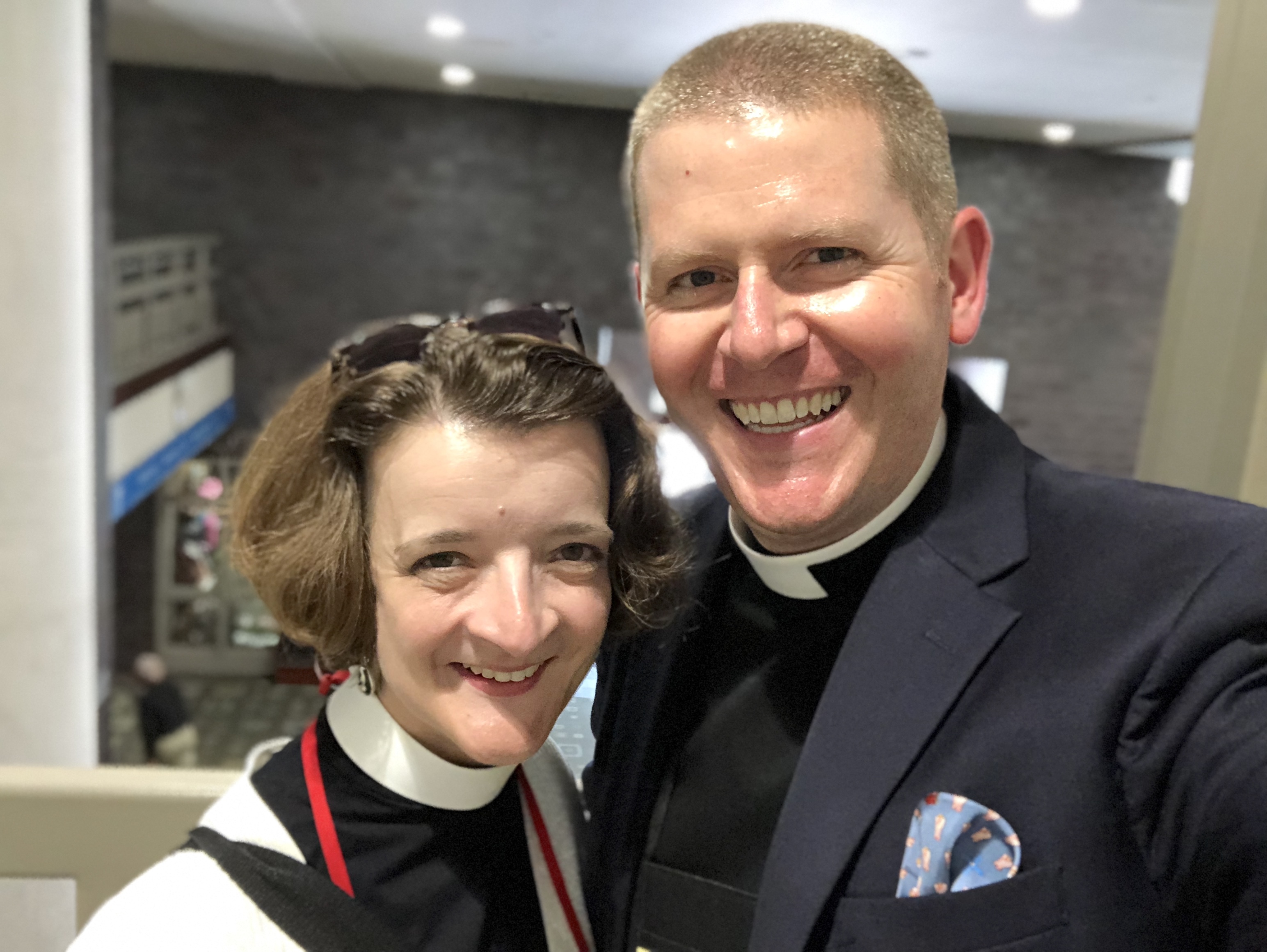
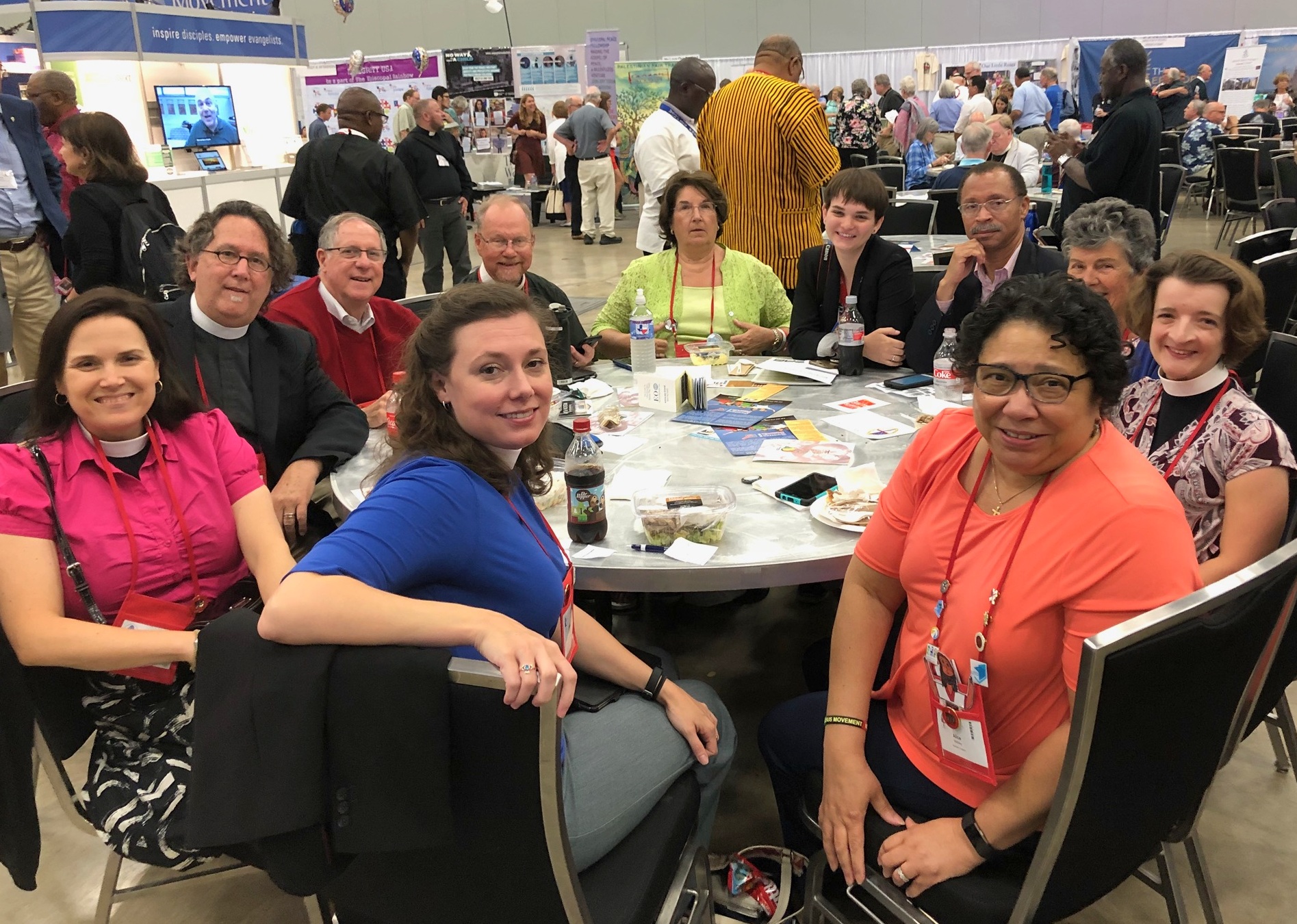
One of the questions I have received about General Convention is what it is like.  What you notice right away is General Convention’s impressive scale.  Every one of the 110 dioceses of the Episcopal Church is able to bring four clergy and four lay deputies.  They may also bring four alternate clergy and four alternate lay deputies.   In total, that’s over 800 people on the floor of the House of Deputies.  All bishops are also present, meeting in the House of Bishops.  Each diocese can have 1 – 3 bishops in place (Diocesan, Suffragan, and Assisting/Assistant).  Visitors from near and far can also attend, as well as media from dioceses, youth observers, and distinguished guests.  The Exhibit Hall also has an extraordinary number of staff and volunteers, and in addition to booths, the seminaries regularly bring in staff or faculty for seminary reunions.  Meanwhile, the entire Convention Center is run by massive amounts of volunteers – covering everything from check-in, monitoring the floor, helping with worship, to the exhibits.  Meanwhile, the ECW holds its annual triennium at the same time, which involves representatives, organizers, and volunteers.  Needless to say, Episcopalians take over the host city (this year coined as the Episcapocalypse).  Even Austin, Texas, which prides itself in being “weird,” I think was a little overwhelmed by our numbers.

IMG_1950

Photo credit:  Chris Girata (reuse only with permission)

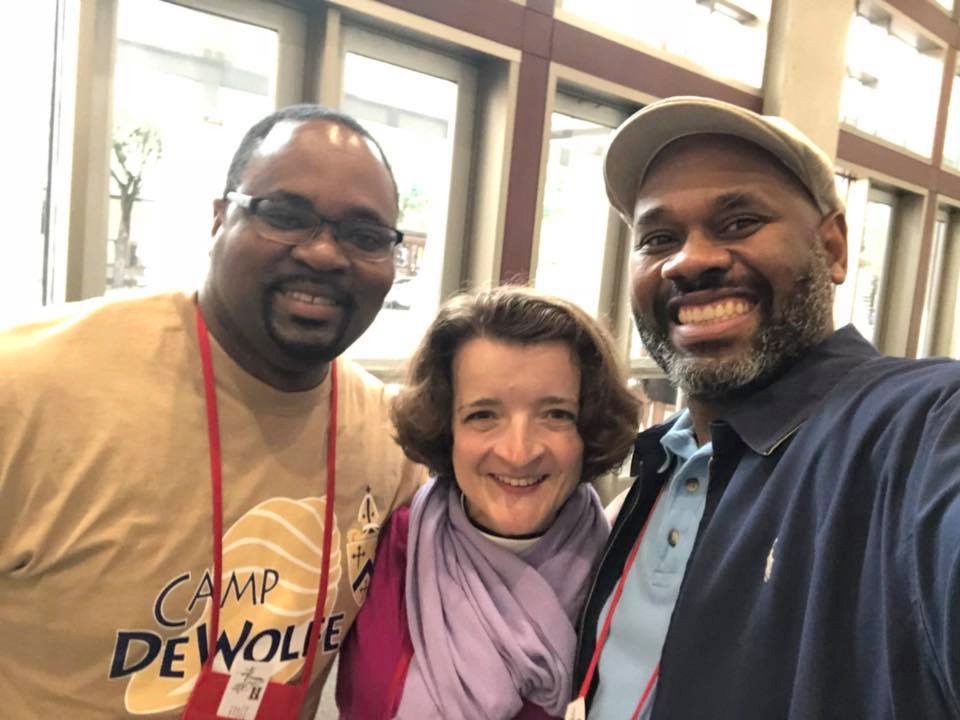
What I particularly enjoyed was getting a taste of what it might be like to enter God’s heavenly kingdom.  People from all walks of my life were present at Convention.  There were people from my time in undergraduate campus ministry, my time working as a lay person, my time in seminary, my time as a curate, my first time as a rector, and my current position.  The joy of greeting one longtime friend or colleague after another was heartwarming.  It also reminded me of how incredibly blessed my life has been to be full of incredible people who have shaped, influenced, and sometimes directed my faith life.  God’s abundance was all around me in the faces of God’s children.

IMG_1885

Photo credit:  Hickman Alexandre (reuse only with permission)

But you could not be at General Convention without meeting other people.  A conversation about something mundane would lead to the realization that we had friends in common.  Waiting in line for something would lead to a conversation about a shared passion.  People you have “met” online through vocational networking you could finally meet in person.  Suddenly, you realized you were making connections from all over the world.  The family of the Episcopal Church is deep and wide.  I leave General Convention feeling hopeful for the future of the Episcopal Church, knowing that it is full of passionate people, doing their part to create a loving, liberating, life-giving world through Jesus Christ.  Thanks be to God!

IMG_1749

Photo credit:  Ann Turner (reuse only with permission)

Sermon – Deuteronomy 34.1-12, P25, YA, October 29, 2017, 8 AM

01 Wednesday Nov 2017

Posted by jandrewsweckerly in Sermons, Uncategorized

≈ Leave a comment

Tags

anniversary, future, God, history, Israelites, Joshua, journey, Kingdom, Moses, past, present, Promised Land, Sermon

This morning our community is celebrating our past, present, and future.  We celebrate the community of Hickory Neck, who one hundred years ago, came together to consecrate this historic church, which had been dormant of worship since the Revolutionary War, used varyingly as a school and hospital.  We celebrate a community who committed itself this year to paying off our debt which covered the cost of our New Chapel, as well as renovations to existing buildings.  And we celebrate our commitments to financially support Hickory Neck in the year ahead through our pledges of offerings.  In each celebration, we see glimpses of who Hickory has been, is, and is becoming.

We are not unlike our ancestors, the Israelites, as we find them on the brink of the Promised Land.  Today’s lesson from Deuteronomy tells the story of the last days of Moses and the beginning of Joshua’s leadership.  In their mourning over Moses’ death, the community remembers the profound ways in which God, through Moses, changed their lives.  They were exiles by famine from their land, enslaved by the Egyptians, and indebted to Pharaoh.  But Moses became their advocate, leading them out of slavery, across the Sea of Reeds, and through the long years of the wilderness.  Moses took all their complaints and whining, and advocated for food, water, and safety.  Moses took their metaphorical wandering, and delivered a new law from the Lord.  Moses organized their community and empowered the next generation to lead.  Moses’ death reminds the people of Israel all they have been through.  Their mourning is where they find themselves in the present:  no longer wandering, but not yet into their next phase of life.

And yet, Moses’ death also points them to their future.  Moses has already blessed Joshua as their next leader, and Joshua will take them into the Promised Land.  Moses is even given the gift of seeing the beauty of that land, as far as the eye can see.  Though Moses knows he is not to cross over, God shows him all that is to come.  The vision is vast, abundant, and blessed.  We suspect Moses can die in peace having seen the land of milk and honey, even if he himself will not experience the land.  And Moses has already seen Joshua receive the spirit of wisdom.  There is nothing left to do but join God in the heavenly kingdom.

On days of introspection about the past, present, and future, we can easily gloss over all the hard stuff.  Though today the people of Israel honor their esteemed leader, and they have the Promised Land ahead of them, we do not often get a sympathetic retelling of the Israelite story.  For the last several weeks, we have heard stories of the Israelites complaining about water and food, but we forget how debilitating hunger and thirst can be.  We read the story of the construction of the golden calf recently, but we rarely wonder about what waiting blindly at the foot of the mountain for Moses to return felt like or the doubt his absence created.  We also recently heard the story of the Passover, but we rarely imagine how terrifying that night must have been and what being saved meant.

I have wondered what stories linger behind our own history.  I have asked our historians about the Hickory Neck community one hundred years ago.  I have wondered who the members were, what their feelings were about the old church that was no longer theirs, or what inspired them to regather.  But we have no record of their story:  their passion that lead to us worshiping here today.  We can only imagine the negotiating they did, the partnerships they forged, the strain they underwent in those early years.  And though many of you were here when we built our New Chapel, I was not.  I imagine there were lingering doubts and concerns about whether a capital campaign, and taking on a mortgage was a good idea.  I am sure there were anxieties about church growth and identity.  And I already know some of that same labor is true today.  We wonder where the Holy Spirit is guiding us, what ministries will define us, and what people will join our community and change us for the better.  The future is always ambiguous and daunting.

That is why I appreciate our parallel story of the Israelites, Moses, and Joshua today.  As one scholar writes, what our ancient story and our modern story reminds us of is “Building the realm of God is a process, and we each have our part to play, even if we will not be around to see all our hopes come to fruition.  Even if we will not be present for the final outcome, it is important that we build the realm of God in the here and now, trusting God to work through each of us to bring about God’s vision for the world.  Furthermore, God assures us in [today’s Old Testament reading] that there will be people to continue leading us to the promised land and building God’s kingdom after we are gone.  The emergence of Joshua as the new leader of the Israelite people shows us that the work to be done is bigger than any one individual, and God will continue to provide prophetic presence through different people and voices.”[i]

In both the stories of our biblical and historical ancestors, we are reminded that we are a part of a greater narrative – each phase of the journey filled with challenges, hard times, and anxious moments.  But each phase is also filled with successes, celebratory times, and joyful, life-giving moments.  That is why we have been talking about journeys this month.  As we have reflected on our personal journeys to generosity during stewardship season, we have heard countless stories of how our journey has evolved, changed, and deepened.  We have also heard of the fellow pilgrims along the way who taught us about generosity and shaped our journey along the way.  What we have been doing this month, and what our Old Testament lesson and our current celebrations remind us of is “there is value in the journey.  The value lies in the growth, the relationships, and the spiritual development we experience along the way, not to mention the incremental progress we make toward creating the just and peaceable world that God desires for all of creation.”[ii]

Our invitation this week, is to continue to invest in the journey.  Each of you have shared with me the innumerable ways that Hickory Neck has influenced your journey.  I cannot tell you the countless times that this building alone has played a powerful part of your experience here.  I cannot tell you the multiple times I have heard about the passion and excitement that enlivened your faith life as we built a new worship space after hundreds of years on this land.  I cannot tell you the hundreds of times I have heard dreams and vision whispered in my ear as you have envisioned what the next steps of our journey together at Hickory Neck will be.  There will be hard moments and joyful moments, times of struggle and times of celebration.  Today we are reminded of the God who journeys in each phase with us, and empowers us as partners on the journey to change the kingdom of God here on earth.  God will empower us to stay on the journey together.  I cannot wait to see where the journey leads!  Amen.

[i] Leslie A. Klingensmith, “Homiletical Perspective,” Feasting on the Word, Supplement to Yr. A, Proper 25 (Louisville:  Westminster John Knox Press, 2011), 4.

[ii] Klingensmith, 6.

Sermon – Acts 1.6-14, E7, YA, May 28, 2017

31 Wednesday May 2017

Posted by jandrewsweckerly in Sermons, Uncategorized

≈ 2 Comments

Tags

ambiguity, Ascension, church, community, disciples, discomfort, God, Jesus, Kingdom, liminal, Pentecost, pray, promise, Sermon, Spirit, together, wait, waiting

We do it all the time:  waiting.  Waiting is perhaps one of the cruelest experiences of life.  Waiting for the test results that will tell us whether or not we have cancer.  Waiting for a call back after interviewing for our dream job.  Waiting all summer long after graduating high school before we can start new life in college.  The trouble with waiting is that we can feel lost – we are between two realities – the one we know and the one that is to come.  In some ways, simply by finding out we need the test, by applying for the job, or by making the deposit at college, life can never be the same.  Something is changed in our lives by stepping into the unknown.  And yet, we do not have the answer, we have not started the job, and school has not begun.  We are not the new person we know we will be.  We are in-between, in limbo, in no-man’s land.

Scholars call this in-between time liminal time.[i]  Liminal time is the time in which we are in the middle of a transition.  Native cultures experienced liminal time most famously in the journey to adulthood.  When young men or young women reached a certain age and maturity, they were sent away from their families and out into the wilderness for a time.  When their time in the wilderness was done, they returned with full adult status, respect, and responsibility.  They leave a child and return a man or a woman.  Liminal time is that time in the wilderness – where they are no longer children, and not yet adults.  Their identity is in flux, their purpose is ambiguous, and their life is on pause.  Liminal time is a time fraught with anxiety, frustration, and confusion.  Liminal time is a time when things are happening to you, and you have no agency.  Moments of liminality are some of the hardest moments in life.  The comfort of what has been and promise of what is to come is rarely soothing.  All that is left is ambiguity.

That kind of transition is where we find our disciples today.  They have spent forty glorious days feeling the victory of Christ’s resurrection, being blessed with further teachings, and being comforted by Christ’s presence.  They are ready.  They confidently ask Jesus today, “Lord, is this the time when you will restore the kingdom to Israel?”  This has to finally be the time!  Jesus’ answer is anything but satisfying.  Jesus makes a promise – that they will receive power when the Holy Spirit comes upon them, and they will be empowered to do their work of witnessing.  But for now, at this moment of climax, confidence, and courage, Jesus says, quite simply, “Wait.”

The trouble is that when the disciples ask that final question to Jesus, expecting to hear when Jesus will restore the kingdom of Israel, and effectively assume his place on the earthly throne, initiating the reign of the kingdom of God, the answer they get is a bit different.  As N.T. Wright explains, they are asking when “Israel will be exalted as the top nation, with the nations of the world being subject to God through his vindicated people.”  In one sense, that vindication already happened in the death and resurrection of Jesus.  In another sense, we are still waiting for the “time when the whole world is visibly and clearly living under God’s just and healing rule.”  Jesus is not a future king, but the one who has already been appointed and enthroned.  What the disciples are waiting for now is the empowering of the Spirit to go witness this reality.[ii]  The disciples find they are going to have to wait, but what they are waiting for has shifted dramatically.  Their waiting will be fraught with even more ambiguity than expected.

That’s the funny thing about waiting.  Not only do you find all the discomfort that comes from liminal time – the stripping of identity which leaves you naked for a time before you don your new armor.  But also, we all know that in waiting unexpected things happen.  Like the disciples who may have expected one thing to come at the end of their waiting, only to realize something quite different is coming, we too learn that reality shifts while waiting.  Things we thought would matter when we were done waiting stop mattering.  Truths we held to be unshakeable get shaken up while waiting.  Once unappreciated certainties and clarity become longed for realities when we wait.

So what are we to do?  What are we to do in our periods of waiting, in our liminal times?  Karl Barth called the waiting between the Ascension and Pentecost, the days we are experiencing now, the “significant pause…a pause in which the church’s task is to wait and pray.”[iii]  Now, I know what you are thinking.  That’s all you’ve got?  I should wait and pray?  Telling us to wait and pray seems like a classic platitude, what we say to someone who is hurting in ambiguity, and we have no real solace to offer.  Will Willimon explains, “Waiting, an onerous burden for us computerized and technically impatient moderns who live in an age of instant everything, is one of the tough tasks of the church.  Our waiting implies that the things which need doing in the world are beyond our ability to accomplish solely by our own effort, our programs and crusades.  Some other empowerment is needed, therefore the church waits and prays.”[iv]  For the disciples, their waiting is not empty-handed.  Though Jesus has left them, Jesus has left them to sit at the right hand of God.  There is confidence in that knowledge about Jesus.  And though they are facing the “significant pause,” the promise of the empowering Spirit is a promise of hope, empowerment, and companionship.  So their waiting and prayer is not for personal comfort during this time of ambiguity, but for empowerment to be obedient.  They are praying because they know that the coming work of witnessing will be hard work.  Instead of praying out of self-pity, they are praying out of determined expectation.

Perhaps that is why they stay together and pray.  By going to that upper room together, the disciples teach us that community is central to the life of the church and to the practice of prayer – is central to helping us get through those times of waiting.  Like the disciples, “we need each other’s witness and support, challenge and care, in order to live into the possibilities and expectations of God’s realm.”[v]  Now for those of you who have waited for the diagnosis, call back from the potential employer, or start date of college, you know that waiting and praying in community can be hard.  Answering for the fortieth time, “Any news yet?” can be as torturous as your own longing for answers or change.  Perhaps that is why some cultures spend their liminal time alone – so they can avoid all of that communal pressure.  But that is not what the disciples do.  They see this liminal time as a time for all of them – not even just the eleven left, but also the women and others gathered.  If they are going to have to face this significant pause, full of uncertainty and change, they will pray and wait together.

That is our invitation today too – to pray and wait together.  You may not be facing an obvious period of liminal time.  You may not even feel as though you are waiting for something.  But the reality is that we are all waiting.  As David Lose reminds us, “We have no idea of what the remainder of 2017 will bring, let alone 2018.  There will be accomplishments and setbacks, victories and defeats, joys and sorrows, triumphs and tragedies on a personal, communal, national, and global scale.  And in all these things, God will be with us, comforting, celebrating with, strengthening, and accompanying us in and amid whatever may come.  And God will also be preparing us, preparing us to be God’s emissaries of good news, preparing us to comfort others, preparing us to work for peace, preparing us to live with less fear and more generosity, preparing us to look out for the rights of others, preparing us to strive for a more just community and world.”[vi]  I do not know about you, but I would much rather face that ambiguity with a community who can remind me of God’s promise and helping me see the work of the Spirit.  That is what we do when we pray and wait together.  Our invitation is accept the gift of this community, and to wait and pray with together.

[i] Liminal time is a concept that has been developed by many scholars.  Arnold van Gennep, Victor W. Turner, and Gordon Lathrop all developed the idea of incorporating liminal time into liturgical practice.

[ii] N.T. Wright, Acts for Everyone, Part 1 (Louisville: Westminster John Knox Press, 2008), 9-10.

[iii] William H. Willimon, Acts, Interpretation:  A Bible Commentary for Teaching and Preaching (Atlanta:  John Knox Press, 1988), 20.

[iv] Willimon, 21.

[v] Randle R. Mixon, “Pastoral Perspective,” Feasting on the Word, Yr. A, Vol. 2 (Louisville:  Westminster John Knox Press, 2010), 524.

[vi] David Lose, “Easter 7A:  Important Interludes,” May 25, 2017, as found at http://www.davidlose.net/2017/05/easter-7-a-important-interludes/ on May 26, 2017.

Sermon John 4.5-42, L3, YA, March 19, 2017

22 Wednesday Mar 2017

Posted by jandrewsweckerly in Sermons, Uncategorized

≈ Leave a comment

Tags

brokennes, change, conflict, conversation, disagreement, holy, holy conversation, Jesus, judgment, Kingdom, questions, Samaritan woman, Sermon, surprise, time, transformation, vulnerable, well

This past week I was invited to attend a conversation and action meeting with local clergy.  I was not looking forward to the meeting.  In fact, I almost did not go to the meeting.  We were going to be talking about a controversial topic, and based on the invitation, I knew I would be on the opposing side.  What I did not know was whether I would be the only voice of opposition, which made the meeting all the more scary.  The thing is, I have been in those types of conversations before – where two interpretations of Holy Scripture seem diametrically opposed, and one or both parties feel so passionate about their understanding that they say really nasty, awful things to one another.  The very validity of one’s faith can even be questioned.

So I began to do what we always do in those situations.  First, I thought I could just send an email.  Then I thought that maybe I could just not attend the meeting, and engage in oppositional advocacy instead.  I even thought not going might be a valid form of protest.  But the Holy Spirit, and a few good friends, had other things to say.  They were not going to let me skip this meeting.  And so I went, rehearsing in my head the biblical roots and theology behind my positions.  I put on my New York tough exterior, bracing myself for whatever was thrown at me.  And just in case, I made sure to wear my best outfit and a smile so as to throw people off their game.  But my stomach was still in knots as I opened the door – full of what-ifs, worrying about consequences, and feeling extremely vulnerable.

A little over two thousand years ago, a woman – an outcast among her own people, getting water alone at midday, encounters a man at Jacob’s well.  He, a Jew with sociopolitical power, asks her for water.  She has a choice.  She can walk away.  But she engages in a conversation between unequals.  At first, Jesus tells her some extraordinary things – about thirst and living water, about his own powers, about his identity.  But then the conversation shifts.  Jesus exposes her vulnerability to its core.  Not only is this a woman with power differential, this woman is an outcast in her culture.  She is a double outsider, having had five husbands and living with a man who is not her husband.  Now, Jesus does not point out this reality as a way of telling her she is sinful – in fact, Jesus says nothing about sin.[i]  Scholars seem to think her marital history would have nothing to do with her sinfulness either.  It could have been that she was a multiple-time widow, passed down through levirate marriage, or it could be that she was barren, and multiple husbands abandoned her.[ii]  We do not know.  But we do know how we feel when someone exposes our deepest places of insecurity and self-doubt.  And this is the woman’s second opportunity to walk away.

But she stays.  I imagine she squares her shoulders, swallows a hard gulp, takes in a deep breath, and keeps talking.  And so does Jesus.  Ever so gently, they engage in a pretty hefty conversation, about prophesy, proper worship, the Messiah, and identity.  Not bad for a Jewish male and a Samaritan woman in broad daylight, for everyone to see.

At my meeting this week, a curious thing happened.  We read scripture together.  We prayed together.  And we talked – sharing openly about our own theologies and biblical interpretations.  But also, we listened – listened for commonality, listened for God’s guidance, and listened in respectful disagreement.  The conversation did not go at all how I expected.  The responses were not what I expected.  My own spirit was not at all in the place I expected my spirit to be in the end.

There is a lot going on in the story between Jesus and the Samaritan woman – probably enough for multiple sermons.  But today, in light of my experience this week, and in light of our country’s currently political climate, I am mostly drawn to the power of conversation.  Biblical scholar Karoline Lewis argues, “…frequently overlooked is that this interaction is a conversation.  Jesus suggests that conversation matters for theology.  That conversation is essential for faith.”  She goes on to say, “The church can be the place that shows society what theological conversation can sound like. The church can be the place that demonstrates how dialogue about faith and the Bible might result in religious respect and tolerance.”[iii]

So how do we do that?  Lewis proposes a method based on the interaction between Jesus and the Samaritan woman.  She gleans five key elements of holy conversation.  First, holy conversations begin with mutual vulnerability.  Jesus is thirsty, and the Samaritan woman needs the living water he provides.  Truthful conversations begin with reciprocal vulnerability because that is at the heart of God.  Second, questions are critical to holy conversations.  Of course, these cannot be questions for which we already have answers – these are true, curious questions.  The woman’s questions lead Jesus to reveal his identity.  God wants us to ask questions because they strengthen relationship.  Third, holy conversations involving intentional, genuine interest in the other take time.  The sheer length of the gospel text today tells you that this was not a quick conversation on the way to coffee hour.  But over the course of the long conversation, misunderstandings are clarified, lives reformed, and God’s abundant love is revealed.  Fourth, when we are talking about conversations with Jesus, be prepared to be surprised.  The woman at the well receives the first I AM statement in John’s gospel – Jesus reveals himself not to an insider, but to an outsider!  Finally, expect to be changed in holy conversations.  As Lewis says, “The woman at the well goes from shamed to witness.  From dismissed to disciple.  From alone to being a sheep of Jesus’ own fold.”[iv]  So holy conversations involve mutual vulnerability, questions, time, surprise, and change.

This week, no one gathered changed their minds on the presenting issue.  I doubt we ever will.  But something else did happen.  Through our conversation, something holy emerged.  Two groups, opposed to each other, were able to stay in the room, were able to articulate their own theologies, and were able to see Christ in the other.  What I took from that meeting was that maybe, just maybe, there is hope for us after all.  Maybe the church can do what the church has needed to do for some time – model what holy, Christ-like conversations look like for the good of the community.  Now, that does not mean holy conversations are easy.  Though I stayed in my seat, there were certainly times I wanted to get up and leave.  Though they were subtle, there were several clear digs at my ability to interpret scripture and the will of God.  There were several arguments that I disagreed with and had to bite my tongue to maintain the openness of the conversation.  But as I left the meeting, I knew something holy had happened.  Glimpses of the kingdom of God were breaking into that room.

Our invitation this week is to look around our own lives and examine where we have been avoiding holy conversations:  those times when we have run when someone pointed out the brokenness of our lives; when we have made quick judgments and assumptions about others without ever taking the time to ask the curious questions; when we have cut off opportunities for connection without remembering the surprise and change at the end.  The promises are tremendous.  Look at the healing the woman at the well receives – not just the lifting of societal shaming, but a position of power as a witness and disciple of Christ.  Look at the affirmation the woman receives – not only does Jesus validate her through an engaging, respectful conversation, the whole town responds to her without question.  Look at how the commitment to stay in the conversation leads the woman to a place of deep transformation and change.  But also look at how Jesus is changed too – he finds a surprisingly worthy partner in ministry, to whom he can confess his deepest identity.  I am not saying holy conversations will ever be easy.  In fact, sometimes the rejection we experience from attempts at those conversations will linger for a long time.  But when we keep putting ourselves out there, keep listening for those opportunities for holy conversation, the rewards are tremendously life giving.  The well is waiting for you!  Amen.

[i] Karoline Lewis, “Exegetical Perspective,” Feasting on the Word, Yr. A, Vol. 2 (Louisville:  Westminster John Knox Press, 2010), 95.

[ii] Osvaldo Vena, “Commentary on John 4:5-42” March 19, 2017, as found at http://www.workingpreacher.org/preaching.aspx?commentary_id=3189 on March 16, 2017.

[iii] Karoline Lewis, “Holy Conversations,” March 12, 2017, as found at http://www.workingpreacher.org/craft.aspx?post=4839#comments on March 15, 2017.

[iv]Lewis, “Holy Conversations.”

On dignity and solidarity…

14 Friday Aug 2015

Posted by jandrewsweckerly in Uncategorized

≈ Leave a comment

Tags

baptismal covenant, community, dignity, food, God, human being, Kingdom, ministry, solidarity, vow

This past year, St. Margaret’s read the book Take This Bread, by Sara Miles.  In it, Miles describes a food ministry that she began at her Episcopal Church in San Francisco.  At St. Gregory’s, their worship is open – roles are more open, the Eucharistic Table is open, and idea flow in the open.  Like Miles was welcomed to the Eucharistic Table without barrier, she wanted to create a food ministry that was without barriers.  She didn’t want to have people register or keep records of how often they had received food.  She just wanted people to come, get what they need and let them go about their lives.  She wanted them to find a sense of dignity and welcome when so few of them experience that in other parts of their lives.

Photo credit:  https://www.finedininglovers.com/blog/news-trends/waste-food-project/

Photo credit: https://www.finedininglovers.com/blog/news-trends/waste-food-project/

I was reminded of her ministry today when I heard an NPR story about a program in Spain called the Solidarity Fridge.  The idea was to create a communal fridge where people who are hungry can come and get what they need.  Local restaurants pack up their leftovers in plastic containers and put them in the Fridge each night.  Even local grandmas make food for those in need.  There are standards in place, including the fact that food cannot stay more than four days.  But the organizers insist that it has never been a problem.  Tapas come in at night and they are gone by the next morning.  There is no monitoring process for the Fridge.  Whomever needs food can just come and get it.  And the food is really good.  Those who are in need find dignity in not being dehumanized by red tape and by being fed superior quality food.

Their program is not unlike a ministry we support at St. Margaret’s called Food Not Bombs.  An empty parking lot is suddenly transformed when volunteers arrive with carloads of food from restaurants, grocery stores, churches, and neighbors.  People fill grocery bags with what they need and leave to feed their families.  When everything is gone, the parking lot empties, without a soul around.  The idea from Food Not Bombs is that there is enough food for everyone – and the only reason people go hungry is because of waste and greed.  So they work to remedy the situation.

As I was thinking about the confluence of these three ministries, I was thinking of how they are living into the baptismal covenant we make – to respect the dignity of every human being.  There are passive ways we can do that – trying not to be judgmental or racist.  There are active ways that we can do that – giving money to charities that feed the hungry.  But there are intentional ways we can do that too – investing ourselves in ministries that specifically want to honor the dignity in others and that will encourage us to do the same.  That is why we make those baptismal promises in the context of community – because we need the community to hold us accountable to the covenant.  This Sunday, we will baptize a child of God and renew our own baptismal covenant.  I encourage you this week to prayerfully consider what ways you might be more intentional about fulfilling those vows.  And if you are struggling, find a member of the community and ask them to work with you.  Together, we can transform this world into the kingdom of God here on earth.

← Older posts

Recent Posts

  • On the Myth and Magic of Advent…
  • On Risking Failure and Facing Fear…
  • Sermon – Luke 23.33-43, P29, YC, November 23, 2025
  • On Inhabiting Gratitude…
  • Sermon – Luke 20.27-38, P27, YC, November 9, 2025

Archives

  • December 2025
  • November 2025
  • October 2025
  • September 2025
  • August 2025
  • July 2025
  • June 2025
  • March 2025
  • February 2025
  • December 2024
  • November 2024
  • October 2024
  • September 2024
  • August 2024
  • July 2024
  • June 2024
  • May 2024
  • March 2024
  • February 2024
  • January 2024
  • December 2023
  • November 2023
  • October 2023
  • September 2023
  • August 2023
  • July 2023
  • June 2023
  • May 2023
  • March 2023
  • February 2023
  • January 2023
  • December 2022
  • November 2022
  • October 2022
  • June 2022
  • May 2022
  • January 2022
  • December 2021
  • November 2021
  • October 2021
  • September 2021
  • August 2021
  • June 2021
  • May 2021
  • April 2021
  • March 2021
  • February 2021
  • January 2021
  • December 2020
  • November 2020
  • October 2020
  • September 2020
  • August 2020
  • July 2020
  • June 2020
  • May 2020
  • April 2020
  • March 2020
  • February 2020
  • January 2020
  • December 2019
  • November 2019
  • October 2019
  • September 2019
  • August 2019
  • July 2019
  • June 2019
  • May 2019
  • April 2019
  • March 2019
  • February 2019
  • January 2019
  • December 2018
  • November 2018
  • October 2018
  • September 2018
  • August 2018
  • July 2018
  • June 2018
  • May 2018
  • April 2018
  • March 2018
  • February 2018
  • January 2018
  • December 2017
  • November 2017
  • October 2017
  • September 2017
  • August 2017
  • July 2017
  • June 2017
  • May 2017
  • April 2017
  • March 2017
  • February 2017
  • January 2017
  • December 2016
  • November 2016
  • October 2016
  • September 2016
  • August 2016
  • July 2016
  • June 2016
  • May 2016
  • April 2016
  • March 2016
  • February 2016
  • January 2016
  • December 2015
  • November 2015
  • October 2015
  • September 2015
  • August 2015
  • July 2015
  • June 2015
  • May 2015
  • April 2015
  • March 2015
  • February 2015
  • January 2015
  • December 2014
  • November 2014
  • October 2014
  • September 2014
  • August 2014
  • July 2014
  • June 2014
  • April 2014
  • March 2014
  • February 2014
  • January 2014
  • December 2013
  • November 2013
  • October 2013
  • September 2013
  • August 2013
  • July 2013
  • June 2013
  • May 2013
  • April 2013
  • March 2013
  • February 2013
  • January 2013
  • December 2012
  • November 2012
  • October 2012
  • September 2012

Categories

  • reflection
  • Sermons
  • Uncategorized

Meta

  • Create account
  • Log in
  • Entries feed
  • Comments feed
  • WordPress.com

Blog at WordPress.com.

  • Subscribe Subscribed
    • Seeking and Serving
    • Join 394 other subscribers
    • Already have a WordPress.com account? Log in now.
    • Seeking and Serving
    • Subscribe Subscribed
    • Sign up
    • Log in
    • Report this content
    • View site in Reader
    • Manage subscriptions
    • Collapse this bar
 

Loading Comments...