• About

Seeking and Serving

~ seek and serve Christ in all persons

Seeking and Serving

Tag Archives: life

More…

25 Wednesday Nov 2015

Posted by jandrewsweckerly in Uncategorized

≈ 1 Comment

Tags

clergy, God, Good News, interfaith, Jesus, life, love, mercy, ministry, more, Thanksgiving, Transgender, wideness, witness, worship

Every once in a while, I have experiences in ministry when I think, “Well I never would have imagined that happening!”  I admit that the experience is rare.  There is not a lot that surprises me anymore in this line of work.  Though I am relatively young, I still feel like I have seen it all.

But that has not been the case this week.  This week I found myself in two situations I would have never anticipated.  On Sunday night, our parish hosted the Long Island Transgender Day of Remembrance.  I had no role in crafting the liturgy or planning the evening.  I simply offered our space and was asked to give an opening and closing prayer.  In fact, the planning committee warned me that this would not be like a “church service” – so I should not get my hopes up!  But as I sat in my pew, watching testimonial after testimonial, listening to over eighty names of those who were murdered because of their transgender identity, and hearing beautiful music about the wideness of God’s love and the call to love “the other” – I tell you, I experienced “Church.”  You see, Church is supposed to be about worshiping our God who shows mercy and compassion, who calls us to love the outcast and the oppressed, and who compels us to go out and witness the Good News of God in Christ.  Sunday night, I felt like the Good News came back inside and witnessed to me.

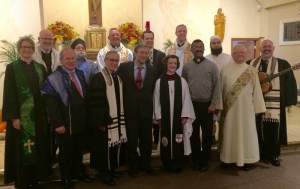
Plainview-Old Bethpage Interfaith Clergy, November 24, 2015

On Tuesday night, I participated in my fourth Plainview-Old Bethpage Interfaith Thanksgiving Service.  Every year I find the service moving. I am grateful for a holiday that we can all honor without fear of stepping on each other’s toes.  But as I sat there last night, I became acutely aware of my surroundings.  On my left sat the Mufti from the local Muslim community and on my right sat the priest from the local Roman Catholic parish.  It occurred to me in that moment that the Mufti usually only says prayers with men.  The women pray separately.  And yet, there we were, side by side, giving thanks to God.  It also occurred to me that although the priest has been warm and affirming, his Church does not recognize my ordination as appropriately apostolic – especially given my gender.  And yet, there we were, as equal leaders in our respective communities.  Despite having had long relationships with the fellow clergy leaders, this was the first time I realized how radical our relationships are – to sit next to each other despite profound differences – and yet still be able to praise, lead, and worship together.

Truthfully, I do not know what God is doing this week.  On a basic level, I suspect God is reminding me that I am not even close to having “seen it all.”  But on a deeper level, I also suspect that God is inviting me to go further, to delve deeper, and to see more widely.  Perhaps a disadvantage to my profession is a naïve sense that I have a hold on who this God is that we worship and serve.  This week, God has humbled me by reminding me that God is so much more. As I anticipate celebrating Eucharist on Thanksgiving Day, I expect to approach the Table with keener sense of wonder, gratitude, and awe for the ways in which God is so much more.  What a blessed gift this week has been.  Thanks be to God for being more than I could ask for or imagine!

Sermon – John 11.32-44, AS, YB, November 1, 2015

04 Wednesday Nov 2015

Posted by jandrewsweckerly in Uncategorized

≈ Leave a comment

Tags

All Saints, dead, death, Jesus, Lazarus, life, light, live, new life, reborn, resurrection, Sermon

There is a lot about the Lazarus story that I do not understand.  I do not understand why Jesus allows Lazarus to die if he is only going to bring him back to life anyway.  I do not understand why Jesus weeps when he knows he can fix things.  I do not understand why Jesus raises Lazarus from the dead when eventually Lazarus will have to die again.  But mostly I do not understand why we never hear from Lazarus about how he feels about all of this.  The text tells us Lazarus has been dead for three days.  We do not know much about the afterlife, but presumably, after three days, one’s body and soul have already moved beyond this earthly life.  For all we know, Lazarus is at peace, already enjoying eternal rest with God.  Whatever pain and suffering he has endured in life is gone.  Maybe he is relieved to be free of the stress and battles of earthly life, and to be released to enjoy the peace of eternal life.  When he has reached that point of peaceful bliss, why would he want start over – knowing he will eventually have to go through death all over again?[i]

I used to watch the television show Buffy the Vampire Slayer.  For those of you who are unfamiliar with the show, the premise is that throughout time there has always been one young woman in the world chosen to be the Vampire Slayer – a young woman trained and “called” to protect the world from vampires.  In season five, after having prevented at least five apocalypses, Buffy faces one more.  In the episode, the only way to stop the end of the world is for her to sacrifice herself.  She dies and the world is saved.  Of course, the next season, her friends use magic to bring her back from the dead.  But the rest of that season, Buffy struggles.  She finally confesses that she did not want to be brought back from the dead.  She had been happy and at peace.  All of the fighting and struggling against evil was over, and she was finally free from all obligation and strife.  Being brought back was even worse than before.  Not only did she have to continue fighting evil, but also she was now aware of the freedom she could have had.  She didn’t want to be resurrected.

What Buffy eventually discovered, and I am sure Lazarus did too, was that there was still some purpose left in her life.  In fact, she was able to transform the entire vampire slaying industry.  Unfortunately, we never really get to hear what happens to Lazarus – how his resurrection transforms his life.  We eventually read that the chief priests plot against Lazarus because people are beginning to follow Jesus after he raises Lazarus from the dead.  Perhaps there were times when Lazarus would have preferred to have stayed dead than to be raised again and face all the controversy.  But perhaps, Lazarus found new purpose and was able to use whatever additional earthly time he had to do something good.[ii]

When Scott and I first moved to Delaware after graduating from college, we found a church home at the Cathedral.  The Cathedral was a special place for us.  The Cathedral was where we were both confirmed as adults.  The Cathedral was where we had our first experiences serving on Vestry, leading Bible Study, officiating Morning Prayer, and teaching a Rite 13 class.  The Cathedral was the place where I fell in love with Anglican Choral Music and chant.  The Cathedral was where I was ordained as a Deacon in the Church.  So, a few years ago, when the Cathedral closed because the congregation could no longer support the cost of ministry in that space, you can imagine that I and hundreds of others were devastated.  Those pews, those stone walls, that altar rail was the site of transformation and holiness in our lives.  Now, the fate of that sacred space would depend on who bought the Cathedral and what they decided to do with it.

This past week, a story broke about the Cathedral.[iii]  Another non-profit in the same town purchased the property and would be converting the church and all the office and classroom spaces into housing for moderate- to low-income elderly persons.  When the project is done, there will be 53 housing units, housing over 116 residents.  Though I never wanted the Cathedral to die – in fact, I was devastated by its death – I also must admit that the news of the resurrection of this church into a powerful new ministry brought me infinite happiness this week.  What I could see was that something good would be coming out of the Cathedral’s death.  The Cathedral had always been a place of service and mission, bringing Christ’s light into the community.  Once this new residence is completed, the Cathedral will continue its work of bringing Christ’s light into the community.

As I was thinking about the Cathedral and Lazarus this week, what I began to wonder is whether earthly death was necessary for each of them to be reborn into new life.  In many ways, when we do a baptism, that is what we say happens.  As we enter into the waters of baptism, the old self dies and a new self emerges from the waters on the other side.  We die to earthly life and are reborn into the life of faith.  In fact, in ancient days, baptism happened in a pool of water so that the whole body could be immersed in water, signifying the old self being washed away and the new self emerging out of the watery womb of Christ.  But in order to be baptized, in order to have new life, death must first happen.

When we think about All Saints Day, which we celebrate today, that pattern is quite familiar.  Most of the saints that we honor today experienced a death of sorts before their earthly deaths.  I can think of countless saints who renounced their wealth or their privilege in order to begin a new life:  St. Francis, Mother Teresa, and Oscar Romero.  And we know everyday modern saints who experience the same thing:  that young adult who spent thousands of dollars on a University education to go spend two years in the Peace Corps; that person who worked on Wall Street, making millions, who left to start a non-profit; or that well-paid doctor who spends weekends at the community clinic and summers traveling with Doctors Without Borders.  What those ancient saints, famous saints, and everyday saints teach us is that sometimes a part of us has to die in order for us to truly experience resurrection life.

I imagine each of us here has something we have been holding on to – or even clinging on to – that needs to die before something can be reborn in us.  Maybe we need to let go of a memory – the memory of that perfect long-tenured rector or the memory of that painful experience with a rector – so that we can reassess what new life is blooming right in front of us.  Maybe we need to let go of a resistance to change – letting the familiar die so that something new and fresh (and perhaps, just maybe, shockingly better) can be born anew in our community.  Or maybe we need to let go of a theology of scarcity – that fear that I or my church will not have enough – so that we can allow a theology of abundance to grow in us.  In many ways, I see that new life already budding here at St. Margaret’s.  I see those glimpses of resurrection life pushing their way out of our protective arms.  The invitation from the saints today is to let go.  Let death happen so that new life can emerge.  Let that new hope spring out of the tightly sealed containers in which we have hidden budding hope.  And maybe, like Lazarus, when Jesus calls for us to come out of the tomb, we won’t be afraid to take off those binding cloths and to embrace whatever new, scary, uncomfortable, and awesome new life awaits.  Amen.

[i] Suzanne Guthrie, “Back to Life,” Christian Century, vol. 122, no. 5, March 8, 2005, 22.

[ii] Henry Langknecht, “Commentary on John 11.32-44,” November 1, 2009, as found at https://www.workingpreacher.org/preaching.aspx?commentary_id=429 on October 29, 2015.

[iii] Robin Brown, “Historic church complex set to continue ‘Lord’s work’,” October 29, 2015 as found at http://www.delawareonline.com/story/news/2015/10/22/historic-church-complex-set-continue-lords-work/74269674/?hootPostID=ab06f2224fc6ba16ac4e81312a021ffa.

Homily – Matthew 11.25-30, St. Francis, October 4, 2015

07 Wednesday Oct 2015

Posted by jandrewsweckerly in Uncategorized

≈ Leave a comment

Tags

burden, comfort, crazy, discomfort, easy, give up, holy, homily, imitate, impossible, inspire, Jesus, life, light, missions, Pope Francis, saint, sanitized, St. Francis, uncomfortable, yoke

I once led a book group that read the book The Prison Angel.  The Prison Angel is the story of Mother Antonio, a woman of privilege from California who had a mid-life crisis, took on the role of a nun, went to the largest prison in Tijuana, Mexico, and began a ministry of transforming guards, inmates, and families connected to the prison.  Her work was amazing – the way that she was able to love everyone equally, the way that she was able to harness resources and get them where they needed to be, and the way that she was able to devote her life to this system – even living in her own prison cell for a while – were all examples of her awesome witness.  As we finished the book, I had hoped that people in our book group would be inspired, and might even consider their own contribution to a prison ministry.  Instead, the response was more like this:  Mother Antonio is truly amazing.  But let’s be honest.  I can’t be like her.  I’m not going to drop everything – my family and life – and become totally devoted to a ministry.  And just like that, I lost them.  No longer was Mother Antonio inspiring.  She was impossible.  And once she was impossible, no one felt compelled to do anything.  I definitely felt like I failed my mission of inspiration leading to action.

As I was preparing for today’s celebration of St. Francis, I ran across this quote:  “Of all the saints, Francis is the most popular and admired, but probably the least imitated.”[i]  You see, we have a sanitized version of Francis in our minds.  He was nice to animals and took care of the poor.  He devoted his life to Christ as a monk.  We even put up statues of Francis in our gardens and outside our churches.  When we think of Francis, we think of a gentle man gingerly allowing a bird to perch on his finger, and we smile.  We like our sanitized version of Francis because the real version is a little scary.  When Francis renounced his rather significant wealth, he stripped naked in front of his father and the bishop.  Francis didn’t just help the poor, he became poor, begging on the streets.  He worked with lepers – people no one wanted to touch, touching them with his bare hands and kissing them.  Barefoot, he preached in the streets about repentance.  He preached to the birds, and is rumored to have negotiated with a wolf.  If we met St. Francis today, most of us would not imitate or venerate him.  We would just see him as another homeless beggar with a serious case of mental illness.

That is the challenge for us when trying to live a holy life.  St. Francis is the obvious example today.  Though we love and admire St. Francis, few of are comfortable with his total identification with poverty, suffering, and care for our creation.  The same can be said of Jesus.  Though we profess that Jesus is our Lord and Savior, we regularly fail to live in the ways that Jesus taught – in fact, some of us have given up even trying.  Even looking toward a modern-day example of holy living trips us up.  When we watched Pope Francis come through last week, we marveled at his radical witness.  We loved what he had to say – except when he had something to say that made us uncomfortable or that we disagreed with.  When thinking about the radical life that is following Jesus – whether through the Pope, through St. Francis, or Jesus himself – most of us stumble and feel like giving up.

Luckily Jesus offers us a promise today.  Jesus says, “Come to me, all you that are weary and are carrying heavy burdens, and I will give you rest.  Take my yoke upon you, and learn from me; for I am gentle and humble in heart, and you will find rest for your souls.  For my yoke is easy, and my burden is light.”  My yoke is easy and my burden is light.  When we look at St. Francis’ witness and we think about the poverty, the preaching, and the penitence, we get nervous.  We like our stuff, we like being comfortable, and we like being Christians without having to be too loud about it.  When we think about St. Francis, we think of a yoke – but not a light one – one that is heavy and onerous.  But Jesus harkens us back to his original words.  My yoke is easy and my burden is light.

One of the reasons I am a proponent of international missions is that they help you experience reality in a totally different way.  When we go on local missions, we can keep our smart phones, we have access to clean, accessible health care, and we can always find a McDonalds for a burger fix.  But when we are in a rural town in a third world country, things change.  We may not get to shower everyday, we may have to boil our water before drinking it, we will eat food that you are not so sure about, and we pray that we don’t get too sick while abroad.  And forget about a cell phone and internet access.  Most of us don’t even take a watch or jewelry to ensure they do not get lost.  Now that may sound like torture to most of you.  But here is what we learn when we are stripped of comforts and living and working in a foreign setting:  We learn to appreciate your massive wealth comparable to the poor in the third world; we learn what hospitality – real hospitality in the face of nothing – really feels like; we forget about email, phone calls, and even stop obsessively checking the time, because those things do not really matter that week; we hear birds and other creatures in a way that we never have before – maybe because of their proximity, or maybe because we normally distract ourselves with a hundred other things; and – now this is the crazy one – we talk about Jesus and no one is uncomfortable (well, except maybe us because we haven’t done that very much).  When stripped of everything familiar, we discover that Jesus’ burden really is easy and his yoke truly is light.  And sometimes we need to be stripped of the familiar so that when we are back in our comfort zone, we can more tangibly remember how easy that burden was and how light that yoke felt.

You may not be able to go on an international mission trip.  But each of you has some experience – a heartfelt expression of gratitude when you cared for the poor, a prayer with someone who was really hurting, or surprisingly easy conversation in a coffee shop about church and your faith.  Though Jesus, St. Francis, and even the Pope sometimes go to extreme measures, they all ultimately are trying to do the same thing.  To remind us that Jesus’ burden is easy and his yoke is light.  And then they all invite us to get comfortable with discomfort or even with the label of being crazy – and to go and do likewise.  Amen.

[i] Holy Men, Holy Women:  Celebrating the Saints (New York:  The Church Pension Fund, 2010), 622.

Sermon – Acts 8.26-40, E5, YB, May 3, 2015

07 Thursday May 2015

Posted by jandrewsweckerly in Uncategorized

≈ Leave a comment

Tags

Acts, Baltimore, Christ, conversion, Ethiopian, eunuch, familiarity, Holy Spirit, life, listen, listening, Philip, race, Sermon, story, together

Have you ever heard a story so many times that you feel like you could recite it from memory?  There was a time in my life when I read the book Good Night Moon so many nights in a row that I could probably have told the story without even turning the pages.  But rereading books is not just a habit of young readers.  Adults do the same thing – we love a book so much that we may read the book again and again.  The familiarity of a story and knowing how the story will end can be quite comforting.  The same could be said of Bible stories too.  Though the Bible is a huge book with tons of stories, we tend to have our favorites that we read again and again.  We read and reread them because they give us a sense of comfort and they steady us in a world of chaos.

The challenge with a familiar story is that we sometimes get so used to hearing the story over and over that we stop really listening to the details.  That is especially true in our story from Acts today.  Philip, the educated evangelist graciously approaches the foreign, outcast eunuch and asks if he needs help interpreting scripture.  He then teaches the eunuch about Jesus, and graciously accepts him into the community of faith by baptizing in a nearby body of water.  In essence, this is a story about how the Jewish followers of Christ graciously open up the community to those who have traditionally been seen as outcasts.

At least that is how the story goes in my memory.  But as I reread the story this week, I began to realize that the comforting tale I had memorized is not quite as simple as I had remembered.  I had always thought of Philip as one of the educated disciples who graciously takes in the eunuch.  But Philip is actually an outsider in this story.  The Philip in our story is not the Philip from Bethsaida, one of the twelve disciples of Jesus.  This Philip is a Greek in Jerusalem, who is one of the seven appointed by the disciples to run the food pantry, the clinic, and the hospice program in Jerusalem so that the Twelve did not need to do that work.[i]  He is not necessarily well-educated, and in fact, is probably pretty disheveled and unseemly, given the relief work he has been doing with the outcasts of society.  The Ethiopian eunuch is an outsider too – in fact he is a double outsider of sorts because of his race and his sexuality.[ii]  Because of his dark skin and the fact that he is a eunuch means he would not have been allowed into the temple.  But this is no ordinary foreigner.  Yes, he is a double outsider, but he is also a highly educated, wealthy, powerful man.  He is in charge of the Queen mother’s treasury, he is prominent enough to ride in a chariot, and he is wealthy enough to own a scroll.[iii]  And although he is not allowed into the temple, he is returning from a time of worship in Jerusalem – so in some ways he is both a double outsider and a faithful follower.  When the eunuch invites Philip into his chariot, Philip is not the one being gracious – the eunuch is the one graciously allowing this disheveled man of faith into his pristine chariot.

Not only is there more complexity to the socio-economic status of these two men, there is also more to the interaction between the two men.  In my mind, Philip was the gracious imparter of wisdom in this story.  But in fact, the Ethiopian does not ask Philip to teach him – as if acknowledging that the two men are unequals.  The Ethiopian asks Philip to guide him – in other words, to journey with him into the Scriptures, and even eventually into baptism, as the two men go down into the water together.[iv]  These two strangers sit side-by-side and together read scripture and talk about what that scripture means.  Philip is on as much of a spiritual journey as the Ethiopian.  This is not a story about a well-educated follower of Christ taking in a marginalized outsider and converting him to Christ.  This is a story about two outsiders, unlikely to ever be sitting together, pondering the word of God together, and finding new life in Christ.

That’s the funny thing about stories – if we do not really pay attention and listen, we tend to fill in the blanks ourselves, often missing the big details.  As I have been watching the riots and racial unrest in Baltimore this week, I keep returning to that theme – that perhaps this is one of those instances where we have not done a very good job of listening.  I suppose I should not be surprised that we are not very good at listening.  We are a culture that talks over each other, that tries to force our version of truth upon one another.  I have listened to countless reporters this week argue with Baltimore residents and protests about their experiences.  I have read countless Facebook posts expressing anger and frustration about the civil unrest.  This whole week has felt like people are competing to have their own version of the truth being seen as the “Truth,” with a capital “T.”  In fact, just the mention of Baltimore probably has you thinking about your own feelings on the subject, mentally blocking any other narratives from your mind

When I lived in Delaware many years ago, I joined a group run through the YWCA that was meant to help foster healthy conversations about race.  One of the main rules of the group was that when an individual shared their story, we were not supposed to be in true conversation.  Each of us was to take turns telling our truths – without interruption or questions.  And the others in the group were to listen.  The method was so counterintuitive that the facilitator’s main job was to enforce the speaking and listening rules.  Although I struggled with the method, I must admit that I learned more in that group than I ever could have imagined.  When I listened – truly listened without assuming I knew how the story would end – I learned things about the experiences of black Americans that I had never known, and had certainly never experienced myself.  Truth unfolded for me like a blooming flower.

Those groups, and my experience this week of trying to prayerfully listen to the oppressed in Baltimore, reminded me of the interaction between Philip and the eunuch.  Back then, God’s chosen people and foreign, black, castrated men did not sit together and study scripture.  God’s chosen people were not accustomed to guiding people instead of teaching them.  God’s chosen people were not only not used to be called to accountability, they were also not likely to accept the criticism and change.  And yet, that is what these two men do.  And the only way any of this story happens is because both men listen – really listen to one another.

This winter I read a book called Toxic Charity.  The premise of the book is that much of the charity work that churches and communities do is flawed because that work is posed as work we do for others as opposed to with others.  The author criticizes communities that enter into impoverished areas, assuming they know what is best for the community.  Instead, the author suggests that those who want to help do so under the direction of those in need.  The main role of those who want to help is to assist the community in articulating their needs, and then empowering the community to make the systemic changes needed for long-term, sustainable change.  That kind of shift in charity work involves a lot more listening, humility, and a willingness to follow instead of lead.

In the case of Baltimore, in the case of Plainview, and really in the case of all Christianity, today’s story reminds us that there may not be simple answers to the world’s ills.  We cannot always fix what is wrong in our society – and in fact, perhaps we can never fix the wrongs without first being prayerful listeners.  As soon as we assume we know someone else’s story, or we know all there is to know about an issue, we have already shut down the movement of the Spirit.  And that is what this story is really all about.  This is not a story about how Philip converted a eunuch.  This is a story about how the Holy Spirit moved among strangers who had nothing in common and created commonality, love, and faith.[v]  The amazing work of Philip and the eunuch journeying to the baptismal waters together is only possible because both agree to vulnerably, honestly, prayerfully listen to one another, to learn together, and to be converted together.[vi]  Their story today invites us to go and do likewise.  Amen.

[i] William Brosend, “Unless Someone Guides Me,” Christian Century, vol. 117, no. 15, May 10, 2000, 535.

[ii] Barbara Brown Taylor, “Homilietical Perspective,” Feasting on the Word, Yr. B, vol. 2 (Louisville:  Westminster John Knox Press, 2008), 457.

[iii] Paul W. Walaskay, “Exegetical Perspective, Feasting on the Word, Yr. B, vol. 2 (Louisville:  Westminster John Knox Press, 2008), 457.

[iv] Brosend, 535.

[v] Taylor, 459.

[vi] Nadia Bolz-Weber, “The Conversion of the Ethiopian Eunuch,” April 20, 2012 as found at http://thq.wearesparkhouse.org/yearb/easter5nt-2/ on April 29, 2015.

Sermon – 1 John 3.16-24, E4, YB, April 26, 2015

01 Friday May 2015

Posted by jandrewsweckerly in Uncategorized

≈ Leave a comment

Tags

action, comfort, discomfort, Good Shepherd, Jesus, lay down one's life, life, love, Sermon

This Sunday, informally touted as “Good Shepherd Sunday,” is a favorite of many churchgoers.  The words of the 23rd Psalm remind us of the many times we have turned to God for comfort – whether at a loved one’s bedside, at a funeral, or in our own desperate prayers.  Or maybe we associate the image of Jesus as the Good Shepherd with our gospel lesson today.  Jesus says, “I am the good shepherd.  I know my own and my own know me…”  As we hear Jesus declare how he lays down his life for his sheep, perhaps we imagine the various artistic depictions of Jesus – with a staff in his hand or with a lamb draped over his shoulders.  Many churches love the image so much that they even use this image as their namesake – much like our partner in ministry, Good Shepherd Lutheran here in Plainview.  Imagining our Lord as the Good Shepherd is one of the more comforting, assuring, life-giving experiences of our faith.

Despite the ways this Sunday is meant to be a Sunday of assurance and affirmation, I find myself a bit unsettled.  Though our psalm and gospel lesson offer us comfort, our epistle lesson does not let us stay there long.  After telling us that Jesus lays down his life for us, the very next line in the epistle reminds us that the Good Shepherd’s actions have consequences.  “…and we ought to lay down our lives for one another,” says First John.  “How does God’s love abide in anyone who has the world’s goods and sees a brother or sister in need and yet refuses help?  Little children, let us love, not in word or speech, but in truth and action.”

Instead of being comforting, these words have been discomforting me all week.  Every sentence leaves me feeling more and more convicted.  Yes, the Lord is your shepherd who lays down his life.  Now go and do likewise.  Yes, God’s love abides in you and blesses you with more goods than most of the world has.  Now go and help your brother and sister in need – do not refuse to help anyone that you see.  And certainly the Lord your shepherd is proud when you speak or sing about loving your neighbor.  Now stop talking about love and go do loving things.  Be love to your neighbor.  If the gospel and psalm today are about comforting images of a loving Shepherd, our epistle lesson reminds us that our Good Shepherd loves us, but loves us so that we can similarly be a loving shepherd to others in the world.

In 2011, Egypt erupted in what we have now come to call the Arab Spring.  Hundreds of people died and thousands were injured when protestors took to the streets to protest the corruption of President Mubarak’s regime.  Though the protestors tried to be peaceful, calling for justice, freedom, and governmental reform, they were met with brute force.  One of the most striking images to me from this time was a picture of Egyptian Christians, surrounding a group of fellow Muslim protestors as they prayed.  As the Muslim protestors knelt down in prayer, the Christians protestors held hands, creating a human wall of protection around those in prayer.[i]  When I saw that image four years ago, my immediate thought was, “That is what laying down one’s life looks like.”  The Christian protestors knew how vulnerable their Muslim brothers and sisters would be if they knelt down in prayer in the public square.  The brutal police force would take advantage of any vulnerability they could find.  The Christians became like the Good Shepherd, risking their lives because they saw their neighbors in need.  Their actions showed their love better than any words could have.

That is what love looks like.  We can talk about love in sermons or in Sunday School.  We can sing about love in our hymns and make speeches in the square.  We can write an op-ed or a letter to our congressman expressing our concerns for our neighbors in need.  But today, our epistle lesson does not let us rest there.  Our epistle says that our love must be shown in truth and action.  We must lay down our lives for one another like the Good Shepherd does.

That charge today may seem hard, or even impractical and imprudent.  Many of us cannot even imagine an opportunity to lay down our lives for someone else.  And yet, that is the instruction for us in our epistle – not just to talk about injustice, but to love so greatly, to care so deeply for other children of God that we are willing to put ourselves aside in love and care for the other.  I do not know what that looks like for each one of us here.  But here is what I can tell you.  In 2011, those Christians in Egypt surrounded Muslims in prayer, willing to give their lives for their Muslim brothers and sisters.  In 2013, two years later, Muslims in Pakistan returned the favor.  When a Christian church in Peshawar was attacked, and over 100 Christians were killed, over 200 Muslims formed a human chain around the church to enable the Christians to celebrate Mass in a show of unity and love.[ii]  Just two years later, in 2015, after terrorist attacks in Copenhagen, Muslims stood up for their Jewish brothers and sisters, forming a human ring around the perimeter of the synagogue to protect them while they prayed.  The teenager who organized the ring called for 30 volunteers – and at least 630 showed up in an act of love and peace.[iii]

This is why Jesus laid down his life for us – to show us the life giving force of love.  When the Good Shepherd laid down his life for us, the disciples spread that love over the entire world.  When we show love to others, that love keeps moving beyond us in ways that we will likely never know.  That is the beauty of our God.  God loved us so much that God sent God’s Son.  God’s Son loved us so much that he laid down his life.  And we love others because we have known the love of the Good Shepherd.[iv]  The action of our love – not just the words and speeches – but the action of our love can transform the world.  When we love in action and truth, we continue the work begun in the Good Shepherd – and we give others their own loving image to hold on to and to harness for change in the world.  Amen.

[i] Daily Mail Reporter, “Images of solidarity as Christians join hands to protect Muslims as they pray during Cairo protests,” February 3, 2011, as found at http://www.dailymail.co.uk/news/article-1353330/Egypt-protests-Christians-join-hands-protect-Muslims-pray-Cairo-protests.html on April 24, 2015.

[ii] Aroosa Shaukat, “Pakistani Muslims Form Human Chain To Protect Christians During Mass,” October 8, 2013, as found at http://www.huffingtonpost.com/2013/10/08/muslims-form-human-chain-pakistan_n_4057381.html on April 24, 2015.

[iii] Hana Levi Julian, “Young Muslims to Protect Oslo Synagogue as Jews Pray in Norway,” February 18, 2015, as found at http://www.jewishpress.com/news/breaking-news/young-muslims-organize-to-protect-oslo-synagogue-as-jews-pray-in-norway/2015/02/18/ on April 24, 2015.

[iv] Ronald Cole-Turner, “Theological Perspective,” Feasting on the Word, Yr. B, vol. 2 (Louisville:  Westminster John Knox Press, 2008), 442.

Homily – John 15.1-11, Martin Luther, February 19, 2015

11 Wednesday Mar 2015

Posted by jandrewsweckerly in Uncategorized

≈ Leave a comment

Tags

fruit, God, homily, Jesus, life, Martin Luther, pruning, Reformation, vine

Today we honor Martin Luther.  Born in 1483, Luther’s intellectual abilities were evident at an early age.  Though his father wanted him to go into law, Luther at age 22 entered a monastery and was ordained a priest two years later.  After five years, Luther became professor of biblical studies at the University of Wittenberg.  His academic work led him to question the selling of indulgences by the Roman Catholic Church.  On October 31, 1517, he posted on the door of the castle church in Wittenberg the notice of an academic debate on indulgences, listing 95 theses for discussion.  The Pope and Luther went back and forth, but Luther refused to recant.  Three years later, Martin was excommunicated.  When Luther was threatened with arrest, his own prince put him in a castle for safekeeping.  There Luther translated the New Testament into German and began to translate the Old Testament.  He also worked on worship and education for the church. He introduced congregational singing of hymns, composed hymns, and put together liturgies.  He also assembled catechisms for education.  He wrote prodigiously and died more than 20 years later.

A lot of us think of Luther today and remember him as being victorious.  Luther was a key leader of the Reformation and we think of him only as a winner.  But we forget that much of his life was lived under threat.  Though excommunication might seem like no big deal to us today, Luther’s very life was in danger because he stood up to the corrupt church.  And even though he evaded the authorities, the only “life” he had was while being hidden away in a castle – basically an imprisoned life without the ill treatment.  We remember Luther as being the victorious reformer, but that work was not without some suffering.

What Luther learned was that life is a constant time of pruning.  Jesus says in our gospel lesson, “I am the true vine, and my Father is the vinegrower.  He removes every branch in me that bears no fruit.  Every branch that bears fruit he prunes to make it a bear more fruit.”  Branches that are not bearing fruit, God removes.  But even those branches that are producing are trimmed back.  No branch is free from the cutting process – all will be affected.

In many ways, that is what Lent invites us into today:  a time of clearing and pruning.  There are certainly things in our lives that are not bearing fruit.  Though it may feel painful, those parts of our lives need to be cut off.  But even where we see hints of growth, we need to do some uncomfortable trimming to get to real productivity.  We many not write songs, produce liturgies or write education catechisms like Luther did in his pruning time in the castle.  But if we can endure the clearing and trimming, imagine how much greater our flourishing can be!  Amen.


In the midst of life…

19 Wednesday Nov 2014

Posted by jandrewsweckerly in Uncategorized

≈ 3 Comments

Tags

birth, blessing, church, death, Diocese, God, joy, life

Courtesy of http://www.glogster.com/deathhangel/death-and-life/g-6l1p46td8m4d3uhesabrba0

Courtesy of http://www.glogster.com/deathhangel/death-and-life/g-6l1p46td8m4d3uhesabrba0

Maybe it is because today is my birthday or maybe it is because we just lost a dear family member to cancer, but life and death have been on my mind a lot lately.  The funny thing about being a priest is that those two things are almost always held in tension.  In the course of one week, I can hold the hand of a dying person and then bless a baby at the communion rail.  I can celebrate a funeral and baptize a child in the course of two days.  I can officiate a wedding and offer counsel to someone getting a divorce in a matter of weeks.  And so, with the death of our family member so fresh in my mind, I took a deep breath on the way to work today and thanked God for this wonderful life that I have been given.  Many days I grumble and complain about the little stuff of life – but today, both life and death are giving me perspective.

The same has been true about my work lately.  This past weekend, The Diocese of Long Island held its Annual Convention.  In the Bishop’s address, he told us about the many churches around the diocese that had closed or merged with other parishes.  Though he ran through the list relatively quickly, I knew all too well how painful each of those closures must have been.  I have been a part of churches that have had to close and it is a brutal process – it feels very much like the death of a loved one.

But just like in the death of a loved one, life slowly springs up.  The Bishop told us about a particular parish in Brooklyn that had to close due to “life-safety issues.”  Located near the Barclays Center, the sale of the property netted almost $20 million for the Diocese – all of which is being invested and distributed.  Some of the proceeds will go to support local churches and ministries while others will be used for international missions.  But out of that death is coming tremendous life.  Though we mourn with that community, through the death of that stage of their ministry they are birthing incredible new life.

And such is life – a continual cycle of life and death, suffering and blessing, mourning and celebrating.  Today, I turn toward celebration and life.  I can do that with deep joy because the sobering reality of death sets me free to appreciate every blessing of this life.  My cup runneth over – thanks be to God!

Sermon – Matthew 25.1-13, P27, YA, November 9, 2014

12 Wednesday Nov 2014

Posted by jandrewsweckerly in Uncategorized

≈ Leave a comment

Tags

abundance, choice, choices matter, forgive, God, growth, life, rigidity, scarcity, Sermon, trust, unforgiving

I am fortunate in that I do not have a long commute to work.  But there have been a few times when I have needed to take the Long Island Railroad during morning rush hour.  What I found fascinating about those trips is how people use their time on the train.  Most people are on their phones, probably doing any number of things:  scanning email, sending a few quick texts, checking Facebook, reading the news.  Some people are reading the paper:  catching up on the headlines, reading the sports page, or checking the financial reports.  Others use their hour on the train to catch up on sleep.  That one always scares me – how people sleep lightly enough not to miss their stop is beyond me.  And I suppose there are a few people like me, who enjoy the people watching.  But those are rarely the morning regulars – they got over that fascination a long time ago and chose some other way to spend their time.

We make choices every day:  how we spend our money, what we will do with free evenings, what groups we want to be involved in, and with whom we want to spend our time.  What we do while commuting is just one example of the myriad choices available to us on a given day.  But over time, those choices begin to shape who we are.  Those choices begin to define whether we are an avid reader, someone who is connected to the goings-on of the world, someone who is physically fit, or someone who is known for their volunteer work.  What seem like inconsequential decisions, like regularly watching a TV show, a standing appointment with a friend for dinner, or joining a civic group, slowly begin to shape a life.  Those little choices we make day in and day out shape who we are and what our life is really about.  In my line of work, I go to a lot of funerals, and that is one of the consistent things I see:  the choices a person makes over time informs who they are.  So in a eulogy, someone is described a devoted mother, or an avid sailor, or an advocate for the poor.

Our gospel lesson today is all about how our choices matter.[i]  The most obvious choice we see is the choice by the foolish bridesmaids not to bring extra oil.  Actually, the foolish bridesmaids make two choices.  First, they choose not to bring extra oil, perhaps assuming the groom will not be long.  Second, once they realize they are out of oil and the others are not going to share, they choose to go buy more.  Neither of their choices is illogical really.  Based on the customs of the time, the maids should not have needed extra oil.[ii]  Their choice not to bring extra oil is a perhaps presumptuous, but not scandalous.  The second choice is reactionary.  The wise bridesmaids tell them to go and they do – in the middle of the night, the foolish maids make an impetuous decision that ends up costing them greatly.  The foolish maids’ choices create a world fraught with risk – where split-second decisions leave the maids with little footing in a world that is constantly throwing choices at them

But the foolish bridesmaids are not the only ones making choices in our parable today.  The wise ones make choices too.  When faced with the needs of the oil-less bridesmaids, the wise bridesmaids send the foolish ones away to get their own oil.  They do not consider sharing their oil or allowing the foolish ones to stand with them.  Quite frankly, they should not have to share.  They have thoughtfully constructed a world in which careful planning and preparation pay off in great rewards.  Their choices have lead to a world in which everyone fends for themselves, where pity is not necessary, and boundaries are clear and concise.

And of course, the bridegroom makes a choice too.  When the foolish bridesmaids knock at the door, the groom has a choice:  he can justifiably send them away since they were not considerate enough to be ready and waiting for him; or he can be forgiving and graciously allow them into the celebration.  The choice of the groom to close the door leads to a world in which mistakes are severely punished and there are no second chances.

This parable is one of those parables that does not leave us feeling good about the world.  In fact, the choices of the characters in the parable depict a world that is marked by rigidity, scarcity, and lacking in forgiveness.  We know this world all too well.  All we have to do is listen to the current debate in the United States about immigration.  Whenever we debate the issue of what to do with illegal immigrants, the arguments are similarly marked by rigidity, scarcity, and a lack of forgiveness.  We worry about the drain on our resources with illegal immigrants – the health care, education, and social services needed for them.  We worry about the jobs they will be taking from legal citizens.  And we worry about our capacity for compassion – I have heard many argue that we cannot save every child in the world by welcoming them here.  All of those fears are valid.  And so we draw boundaries, we put up limits, and we say no.  We make choices that shape our experience as Americans.  And like the bridesmaids with extra oil, our decisions could probably be labeled as wise.

Although that wisdom is usually praiseworthy, and is clearly praised in our lesson today, for some reason, that wisdom does not sit well with me this week.  Instead, I have found myself wondering what other choices the three characters in this story could have made. [iii]  The foolish bridesmaids could have simply chosen to stay.  Sure, they would have had to risk being in the dark for a while, and leaning into the light of others.  They may even have had to plead their case with the groom once he arrived.  But at least they would have been there.  They could have stayed.  Staying would have been scary and made them vulnerable.  But they could have chosen to stay.  Meanwhile, the wise bridesmaids could have chosen to either share their oil, or stand side-by-side with the foolish ones, letting their light shine the way for both of them.  Sure, they were within their right to refuse.  They are the ones who thought ahead and did the right thing.  But they could have chosen another way.  They could have chosen to share their abundance with the foolish.  The bridegroom had a choice too.  The groom had every right to refuse entry to the foolish maids – based on what he knew, they were late and unprepared.  He had no obligation to let in people to his celebration who do not care enough about him to be prepared to wait for him.  But the groom could have chosen to let them in anyway.  He could have chosen gracious hospitality, even to the undeserving maids.

I recently had a conversation with another parent about creating healthy eating habits for children.  She was explaining to me a philosophy in which parents let children guide their own eating choices.  So instead of serving children the healthy food first and then bringing out the dessert, the parent is to put everything out on the table and allow the child to serve themselves.  The argument is that through experience, the child will eventually learn that loading up a plate with dessert leaves the child unsatisfied, if not sick.  Over time, the child will learn what foods make her feel good, what portions she needs to feel full, and how to plan her plate accordingly.  Truthfully the idea sounded crazy to me – like some hippy, permissive parenting that would lead to malnourished, unruly children and wasted healthy food.  But then again, I tend to choose a world guided by structure and order imposed from an authority.  This parent was suggesting a different kind of world guided by trust, that makes room for growth through mistakes, and that leads by example.

That is the funny thing about choices.  Our choices shape our world.  Most people read today’s gospel and think:  Okay, the moral of the story is to choose preparedness and alertness and when Jesus returns, we will be ready.  But instead, the moral of this story might be that the choices that we make shape our world – and our choices may not be as obvious as we think.  So yes, we can choose to live lives with strict boundaries and rules, lives that are guarded and have limits, and lives that are grounded in consequences.  We can also choose to live lives that are grounded in forgiveness, that make room for mistakes, and that make us uncomfortable, but also make room for joy.  Sometimes those choices will be obvious: when we actively decide to forgive someone who has wronged us or when we purposefully decide to share our resources even though the other does not deserve our generosity.  But sometimes the choices will not be so obvious:  when we commit to a new ministry, even if we are not sure where that ministry will take us or what that ministry will demand of us; when we choose to give up some of our disposable income to support the work of this church, even if we are not sure we can spare the money; or when we give up some of our family’s outside commitments so that we can be more present in the life and work of the church.  Those choices demand sacrifice, vulnerability, and work.  But those choices might also be the choices that make someone say at our funeral, “He loved the Lord, he loved the church, and he boldly lived a life of trust and abundance.  And look where his life led.”  Amen.

[i] Anthony B. Robinson, “Choices that Matter,” Christian Century, vol. 110, no. 29, October 20, 1993, 1011.

[ii] John M. Buchanan, “Pastoral Perspective,” Feasting on the Word, Year A, Vol. 4 (Louisville: Westminster John Knox Press, 2011), 286.

[iii] David R. Henson, “The Breaking of the Bridesmaids: Rethinking a Problematic Parable” as found at http://www.patheos.com/blogs/davidhenson/2014/11/the-breaking-of-the-bridesmaids-how-scripture-undermines-a-parable/ as posted on November 3, 2014.

All shall be well…

19 Wednesday Mar 2014

Posted by jandrewsweckerly in Uncategorized

≈ Leave a comment

Tags

All shall be well, blessing, life, maternity leave, prayer, present

This week marks the beginning of my maternity leave.  My life has already dramatically shifted from getting ready to be away from church for twelve weeks, to getting our family and home ready for a new baby.  It is a time of anticipation, busyness, excitement, and a bit of anxiety.  As I assured my parish, I assure myself:  “All shall be well, all shall be well, and all manner of things shall be well,” as Julian of Norwich would say.

Courtesy of https://www.etsy.com/listing/78048300/inspirational-quote-all-shall-be-well?ref=market

Courtesy of https://www.etsy.com/listing/78048300/inspirational-quote-all-shall-be-well?ref=market

Many of you have asked if I will still be writing while on maternity leave.  I have pondered this myself for quite a while, and I have decided that I will be applying my Lenten discipline to this area of life as well.  This year for Lent, I decided to give myself a break – not to push too hard, but to just try to be present in the moment, knowing that this Lent and Eastertide will be a time of dramatic change for our family and that God is in the midst of it all.  And so I may decide that I need the creative outlet, and will in fact be posting on the blog.  Or I may decide that I just need to be present with my daughter in the limited time that we have before I go back to work.  Either way, I am not putting pressure on myself.  So I suppose my answer is, “I don’t know.  We will see.”

In the meantime, I hope that you will hold me and my family in your prayers.  I know that new life is a sacred gift, and I look forward to sharing that gift with you…eventually.  Many blessings on your journey in the meantime.  I’ll see you soon!

Homily – Galatians 2.19-20, Mark 8.34-38, Martyrs of Japan, February 6, 2014

12 Wednesday Feb 2014

Posted by jandrewsweckerly in Uncategorized

≈ Leave a comment

Tags

cross, death, Jesus, life, martyrs, Martyrs of Japan, witness

Today we celebrate the martyrs of Japan.  Christianity was first introduced in Japan in the 1500’s, first by the Jesuits and then by the Franciscans.  By the end of the 1500’s, there were about 300,000 baptized believers in Japan.  But the successes were compromised by both rivalries among religious orders and the interplay of colonial politics.  Eventually, all Christians suffered cruel persecution and suppression.  The first victims, whom we honor today, were six Franciscan friars and 20 converts who were crucified in Nagasaki in 1597.  By 1630, what was left of Christianity was driven underground; yet 250 years later, many men and women, without priests, persevered with their faith.

I have been thinking a lot about those martyrs.  First, I am still a little shocked by the idea of someone being actually crucified almost 1,600 years after Jesus’ death.  I didn’t even think people would do that anymore.  Second, I am astounded by the idea of someone using that form of murder on Christians – crucifixion seems like the ultimate form of insult and torture one could commit that would certainly intimidate and dissuade followers.  What is so sobering to me about the martyrs’ deaths is that the murderers almost seem to be using the faith against the followers, as if to say, “You want to follow Jesus Christ?  Then do what Jesus says in Mark’s gospel and take up your cross.  We may think of “taking up one’s cross” as a description of the suffering for following Jesus – but we often forget that the cross ultimately points to death.  That is an extreme form of witness that few of us would be comfortable assuming.

I think where the gospel, the epistle and even the martyrs are trying to get us to is an emptying of the self and an assuming of total dedication to Christ.  Now we may not be literally crucified in our age, but if we fully embrace the idea of taking up a cross, we fully submit our lives to God.  Certainly there will be dramatic moments – I always remember those kids in Columbine who at gun point were asked to deny their faith.  But more likely, the moments will be small, but tremendous.  Seeing God in the homeless man; saying something uncomfortable among a group of friends because your faith compels you to challenge the direction of the conversation, re-examining your life patterns to assess the ways you have already put your cross down.  Though taking up our crosses now may seem ambiguous, when we take on that work, we will find death – death to our old way of being and life in a new way of being.  Amen.


This homily, along with the several posted immediately after date from December 2013 – February 2014.  When we celebrate Eucharist each Thursday morning at St. Margaret’s, I preach a short homily to celebrate the feast day of whatever saint falls nearest to that day (as appointed by Lesser Feasts and Fasts and Holy Men, Holy Women).  A parishioner helps me to transcribe the homilies so that others can enjoy them too.  We seem to have finally caught up now – enjoy!

← Older posts
Newer posts →

Recent Posts

  • On Politics, Football, and Love…
  • On Sharing the Love…
  • Sermon – Micah 6.1-8, Matthew 5.1-12, EP4, YA, January 30, 2026
  • On Justice, Kindness, Humility, and the Messy Middle…
  • Feast of the Rev. Dr. Martin Luther King, Jr., January 18, 2026

Archives

  • February 2026
  • January 2026
  • December 2025
  • November 2025
  • October 2025
  • September 2025
  • August 2025
  • July 2025
  • June 2025
  • March 2025
  • February 2025
  • December 2024
  • November 2024
  • October 2024
  • September 2024
  • August 2024
  • July 2024
  • June 2024
  • May 2024
  • March 2024
  • February 2024
  • January 2024
  • December 2023
  • November 2023
  • October 2023
  • September 2023
  • August 2023
  • July 2023
  • June 2023
  • May 2023
  • March 2023
  • February 2023
  • January 2023
  • December 2022
  • November 2022
  • October 2022
  • June 2022
  • May 2022
  • January 2022
  • December 2021
  • November 2021
  • October 2021
  • September 2021
  • August 2021
  • June 2021
  • May 2021
  • April 2021
  • March 2021
  • February 2021
  • January 2021
  • December 2020
  • November 2020
  • October 2020
  • September 2020
  • August 2020
  • July 2020
  • June 2020
  • May 2020
  • April 2020
  • March 2020
  • February 2020
  • January 2020
  • December 2019
  • November 2019
  • October 2019
  • September 2019
  • August 2019
  • July 2019
  • June 2019
  • May 2019
  • April 2019
  • March 2019
  • February 2019
  • January 2019
  • December 2018
  • November 2018
  • October 2018
  • September 2018
  • August 2018
  • July 2018
  • June 2018
  • May 2018
  • April 2018
  • March 2018
  • February 2018
  • January 2018
  • December 2017
  • November 2017
  • October 2017
  • September 2017
  • August 2017
  • July 2017
  • June 2017
  • May 2017
  • April 2017
  • March 2017
  • February 2017
  • January 2017
  • December 2016
  • November 2016
  • October 2016
  • September 2016
  • August 2016
  • July 2016
  • June 2016
  • May 2016
  • April 2016
  • March 2016
  • February 2016
  • January 2016
  • December 2015
  • November 2015
  • October 2015
  • September 2015
  • August 2015
  • July 2015
  • June 2015
  • May 2015
  • April 2015
  • March 2015
  • February 2015
  • January 2015
  • December 2014
  • November 2014
  • October 2014
  • September 2014
  • August 2014
  • July 2014
  • June 2014
  • April 2014
  • March 2014
  • February 2014
  • January 2014
  • December 2013
  • November 2013
  • October 2013
  • September 2013
  • August 2013
  • July 2013
  • June 2013
  • May 2013
  • April 2013
  • March 2013
  • February 2013
  • January 2013
  • December 2012
  • November 2012
  • October 2012
  • September 2012

Categories

  • reflection
  • Sermons
  • Uncategorized

Meta

  • Create account
  • Log in
  • Entries feed
  • Comments feed
  • WordPress.com

Blog at WordPress.com.

  • Subscribe Subscribed
    • Seeking and Serving
    • Join 391 other subscribers
    • Already have a WordPress.com account? Log in now.
    • Seeking and Serving
    • Subscribe Subscribed
    • Sign up
    • Log in
    • Report this content
    • View site in Reader
    • Manage subscriptions
    • Collapse this bar
 

Loading Comments...