• About

Seeking and Serving

~ seek and serve Christ in all persons

Seeking and Serving

Tag Archives: light

Holding on to Joy in Lent…

06 Wednesday Mar 2019

Posted by jandrewsweckerly in Uncategorized

≈ Leave a comment

Tags

Ash Wednesday, Christ, discipline, earthy, holy, identity, joy, kindness, Lent, life, light, love, repent, virtue

IMG_6748

Photo credit:  Jennifer Andrews-Weckerly; reuse only with permission

Last night I had one of the most fun Shrove Tuesday/Mardi Gras celebrations I have ever had.  We had a great crowd, there was a spirit of joy and celebration, the Kensington School hosted an awesome kids’ corner with fun activities, and best of all was the Hickory Neck Talent Show.  I have not laughed so hard and smiled so much in a long time.  I even woke up this morning with an uplifted spirit, the smile still lingering on my face.

While I am so grateful for that blessing, as a priest, it does make entering into Ash Wednesday a bit tricky.  Here I am still coming down from the high of last night, and now I need to enter into a worship service where I tell people to fast, to repent, and to remember their mortality.  It almost feels like emotional or spiritual whip-lash, and I have been struggling this morning to know how to help others with that same abrupt shift.

Where I have landed is that I think the best way to enter into Ash Wednesday and the season of Lent is with that same lingering sense of celebration.  You see, when you have experienced the highs of life, talking about the “lows” of life seems a bit more bearable.  Yes, we are mortal, and yes, we will return to the dust.  But while we are still mortal, we can make this life here on earth one of great joy and love – one of laughter, of community, of togetherness.

I wonder if this might be a way to enter Lent in a healthier way.  Instead of lamenting our sinful nature (and believe me, we do need to lament our sins), perhaps our Ashes today might remind of us the earthy nature of being humans and encourage us to strive for the ways we might live that earthy life in a more holy way.  I plan to do that today by entering into a season of kindness.  I am taking the joy from my community of faith last night and channeling it into forty days of kindness – where my repentance becomes a practice of demonstrating my identity – of living more faithfully the virtue of kindness.  What Lenten discipline are you taking up?  What might be a way for you to joyfully grasp onto this fleeting life and make it a witness to Christ’s light and love?  I can’t wait to hear all about it!!

Ash-Wednesday-1

Photo credit:  https://saintvincents.org/2019/02/25/ash-wednesday-march-6/

Homily – Luke 2.8-20, Blue Christmas, December 21, 2018

02 Wednesday Jan 2019

Posted by jandrewsweckerly in Sermons

≈ Leave a comment

Tags

angels, Blue Christmas, Christmas, hope, Jesus, joy, life, light, Mary, peace, rest, sad, Sermon, shepherds, slow, weary

One of the Christmas songs we do not sing tonight is “It Came Upon a Midnight Clear.”  Up until this year, I was mostly familiar with the first verse, which says, “Peace on the earth, good will to men,” and “The world in solemn stillness lay to hear the angels sing.”  Those words have always felt more like an aspiration than my reality.  I do not know about you, but the holidays are rarely a time of stillness and peace for me.

But this year, I stumbled on a verse of this song that is not in our hymnal.  The verse says, “And you, beneath life’s crushing load, whose forms are bending low, who toil along the climbing way with painful steps and slow; look now, for glad and golden hours come swiftly on the wing; oh, rest beside the weary road and hear the angels sing!”

One of the challenges about Christmas is that we can sometimes lose our place.  When we listen to the old carols, we either hear songs of peaceful silence or we hear songs of beautiful, glorious praise.  The same is true of our secular experiences of Christmas.  We are filled with retouched nostalgic memories, with songs that tell us we should be rockin’ around Christmas trees, or cozying up with loved ones.  But sometimes Christmas is none of those things.  Instead Christmas is a time when the gap between our reality and the projection of all the things we should be feeling grows ever wider.

I think that is why I was captivated by this extra verse of “It Came Upon a Midnight Clear.”  “And you, beneath life’s crushing load, whose forms are bending low, who toil along the climbing way with painful steps and slow; look now, for glad and golden hours come swiftly on the wing; oh, rest beside the weary road and hear the angels sing!”  Suddenly, the otherworldliness of the angels are there for us too.  Whether life feels like a crushing load, whether your daily toil is bringing you down, or whether you are just weary, the song invites us rest by the weary road – because the angels have a song for us too.

I used to serve at a church where Christmas was the pinnacle of events.  Families would wear evening gowns and tuxedos to church, they would send their servants to reserve rows of seats, and the coat rack was full of fur coats.  Christmas was another soiree in their perfectly formed lives, and church was host of their glamorous party.  But what always amused me about that experience was the contrast between their polished, perfect lives, and the rustic, imperfect story of the angels and shepherds.  I wondered if they understood the ironic contrast of their experience and scripture’s experience.  What did they know of being crushed beneath life’s load, the toil of taking painful, slow steps, and the weary road?

Not until many years later did I realize that the weariness of life can infect anyone.  Those in tuxedos and evening gowns were struggling with broken marriages, estranged family members, and the grief of death as much as someone gathered in a candlelit historic chapel.  Those whose servants went to reserve a seat in church were just as lonely, unfulfilled, and afraid as those who are servants.  Those whose fur coats lined the coat racks were experiencing a sense of failure, a lack of fulfillment, and a longing for meaning as much as someone slipping quietly into a service like tonight.  Weariness affects the donkey who carries a pregnant Mary; the shepherds who keep watch all night; the innkeeper who feels pulled in many directions with no vacancies to accommodate need; with Josephs who are on a path they did not choose, but who feel obligated to be faithful; and with Marys who say yes and hold hope, even though the dread of impending suffering is almost palpable.[i]

You see the angels came not to a perfect world, to a perfect people, delivering perfectly good news.  The angles came to a weary world, with weary people, delivering good news that would not dismiss our weariness, but relieve our weariness.  That is why I love this service so much.  I love our Blue Christmas service because Christmas is all about a wearied people, with a crushing load, with painful steps, welcoming a savior who gives us hope that we will not be weary forever, that God will walk our weary roads alongside us.

On this night, I share this blessing for all of us:  “May the world slow down enough this season for you to catch a glimpse of a star in the sky and a light on the horizon.  May the earth pause enough for you to catch the faint sound of a baby’s cry on the wind and the song of the angels through the trees.  May the slow time of Christmas night bring joy to you, and hope, and light, and more than anything else, rest to your waiting spirit.  All you, beneath life’s crushing load, whose forms are bending low, who toil along the climbing way with painful steps and slow; look now, for glad and golden hours come swiftly on the wing; oh, rest beside the weary road and hear the angels sing!”[ii]  Amen.

[i] Melissa Bills, “All This Weary World,” December 18, 2018, as found at https://youngclergywomen.org/all-this-weary-world/ on December 18, 2018.

[ii] Bills.

Sermon – Luke 4.7-18, A3, YC, December 16, 2018

19 Wednesday Dec 2018

Posted by jandrewsweckerly in Sermons, Uncategorized

≈ Leave a comment

Tags

asking, bully, call, calling, church, clergy, fair, God, John the Baptist, light, love, loving kindness, share, simple, spiritual gifts, unique, vocation

Today we are honoring the beginning of Bob Gay’s diaconal ministry with Hickory Neck.  We do not arrive at this day lightly.  Bob and his family had to discern if coming out of retirement was what God was calling him to do.  Bob had to confirm that call with church leaders, church members, and Diocesan staff.  Bob had to prayerfully consider what a diaconal ministry at Hickory Neck would look like and how that ministry might be different than at other churches.  And today, Bob and our community make commitments to not only support his call, but also recommit to our own senses of call.  Though our celebration of Bob’s ministry may feel brief in relation to all we do today, the gravity of what we do in and through Bob is serious.

Although I am thrilled to honor Bob’s new ministry among us, sometimes these types of days can leave us with the impression that “calling,” is something that happens to those with collars – people are called to be priests, deacons, and bishops.  Sometimes we are willing to expand the notion of calling to certain helping professionals – people are called to be nurses, social workers, fire fighters, and teachers.  But we get a little tripped up imagining being called to be other things – a lawyer, an engineer, a stay-at-home parent, an investment banker, or a business owner.  And when we are younger, we almost never hear people saying we are called to be a student, a babysitter, a friend, or a sibling.  We might think we are good at some of those things, or we enjoy those jobs or roles, but we do not always say we are “called” to do them.

I met a retired priest once, and he said his greatest joy in retirement was in helping parishioners experience God on Mondays.  In partnership with the clergy of his church, his “calling” in retirement was to set up what he called “Sunday-Monday Appointments” with church members.  He would go visit members of Church on Mondays in their places of employment and talk about where they see God in their everyday life – how they make the connection between what they do on Sundays and what they do on Mondays.  Those conversations are meant to help the parishioners name how they experience “calling” in their work place.  For some parishioners, that conversation is quite easy.  But for others, that conversation is much more difficult.  Many of them have never had a priest visit them at work, and they have certainly never prayed aloud at the end of a meeting at work.  When the retired priest asks them about their Sunday-Monday connection, sometimes he finds parishioners do not really have a connection.  Those two days feel very separate in their minds.

Part of what is challenging in claiming that we are “called” to a role outside of church is we feel intimidated declaring what God would want us to do outside of church.  We imagine something a bit like what happened to those around John the Baptist in our gospel lesson today.  We do not like the idea of being called a “brood of vipers.”  We do not like the idea of being told our ancestry does not matter – that being a descendant of Abraham does not hold sway with God.  We do not like hearing about repentance, or axes lying at the root of trees who do not bear fruit.  Perhaps if we had been one of those gathered around John the Baptist, we might have simply concluded that the whole baptism thing was not for us.  Baptized living sounds hard as John describes baptism.

But before we get too far down the path of defeatism, something interesting happens in our gospel story.  Instead of walking away with their heads hung low when John starts calling them broods of vipers, the crowd asks a question, “What then should we do?”  After being called broods of vipers, you might expect the eccentric John to tell them to sell all their possessions, eat insects, and live in rags.  Instead, John says something quite simple, “Whoever has two coats must share with anyone who has none; and whoever has food must do likewise.”  Basically, John says, share your stuff when you have more than you need.  That is all:  share your stuff.  We can tell John’s answer is pretty benign because the tax collectors jump in, “Teacher, what should we do?”  They ask because although the others get off pretty easy, the tax collectors know they are in a bit of hot water, resembling broods of vipers more than they might like to admit.  But John is mild again, “Collect no more than the amount prescribed for you.”  In other words, John says, “Just do your job fairly.”  The soldiers are emboldened now too, asking, “And we, what should we do?”  John gives them an easy out too, “Do not extort money from anyone by threats or false accusation, and be satisfied with your wages.”  That one is pretty basic too:  appreciate what you have, and don’t be a bully.

What scholar David Lose appreciates “is how mundane, if not downright obvious, John’s admonition proves.  I mean, this is not rocket-science; indeed, [John’s admonition] is the logic of the classroom and playground most of us first heard in kindergarten: share, be fair, don’t bully.  But if somewhat obvious, [John’s admonition] is at least also within their reach.  John does not tell the crowds to join him out in the wilderness, he does not ask the tax-collectors to abandon or betray Rome, and he does not urge soldiers to a life of pacifism.  Instead, he points them to the very places in which they already live and work, love and laugh, struggle and strive, and suggests that these places are precisely where God calls them to be, where God is at work in them and through them for the sake of the world.”[i]

This month in our Sunday Forum series we are talking about our spiritual gifts.  We are hearing diverse voices talk about what gifts each of us have and how we can use those gifts in our various callings.  The idea is not simply to discover what gifts we have so that we can use them in the world; the idea is also to name how we are already using our gifts in the world, and to understand the use of those gifts out in the world and within this community as our calling.  You know as well as I do that some of us are called to teach children, some to read scripture in worship, some to advise the church about financial decisions, some to plan parties, and others to find and stop leaks in water pipes.  And some of us are not called to do any of those things.  But each of us has spiritual gifts unique to ourselves, and each of us are invited to use those gifts in the church and the world.  Those spiritual gifts can be as simple as the fidelity of a parent or spouse, the attentiveness of a friend, the hard work of an employee, the honesty of an employer, the steadfastness of a volunteer, the generosity of participating in an outreach ministry, or the compassion of visiting the sick or homebound.[ii]

What Bob’s new ministry and John’s invitation in our gospel lesson today do is not send us home thinking we must be ordained or be some crazy wilderness prophet to be faithful to God and live out our calling.  What we do liturgically and hear scripturally today is remember that the connection from Sunday to Monday matters.  The things we do in our everyday lives are opportunities to stop seeing work, home, school, and community as simply work, home, school, and community, but instead as our mission field – as the places where we live out the calling we discern here on Sundays.  And if we are not certain what that calling is, the crowd surrounding John encourage us to ask the same question they ask, “And me, what should I do?”  I promise the answer will not be overwhelming.  The answer will be simple:  show God’s loving-kindness in the workplace, at home, at school, and in the community; be Christ’s light in the grocery store, on the playground, with your loved one, and with the stranger; share the Holy Spirit’s love while driving, while emailing, while eating, and while playing on a team.  Our job each Sunday is to keep asking, “And me, what should I do?” and then trust on Monday the answer will be unique to our gifts, within our reach, and fulfilling beyond measure.  Amen.

[i] David Lose, “Advent 3C:  Beyond Scolding,” December 11, 2018, as found at http://www.davidlose.net/2018/12/advent-3-c-beyond-scolding/ on December 14, 2018.

[ii] Lose.

Homily – Mt. 11.25-30, St. Francis Feast, YB, October 21, 2018

24 Wednesday Oct 2018

Posted by jandrewsweckerly in Sermons, Uncategorized

≈ Leave a comment

Tags

blessing, easy, healing, homily, hurt, Jesus Christ, light, love, pets, reconciliation, relationship, rest, sabbath, Sermon, St. Francis, village, wolf, yoke

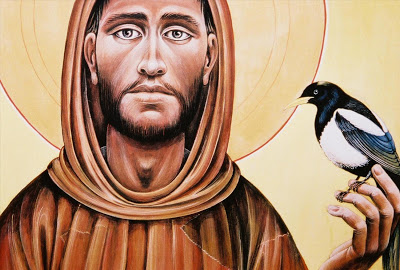
FrancisOfAssisi

Photo credit:  http://thewildreed.blogspot.com/2007/10/st-francis-of-assisi-dancer-rebel.html

Today we honor the life of St. Francis of Assisi.  Francis is one of the most popular and admired saints of all time.  Most of us know the highlights of his story: born the son of a wealthy man in 1182; had a conversion experience and devoted his life to Lady Poverty; shaped monastic and lay devotion; was a friend to all God’s creatures – being known to have preached to the birds.  But the story I like most is the story about St. Francis and the Wolf.

According to legend, there was a wolf that was terrorizing a nearby town, killing and eating animals and people.  The villagers tried to fight back, but they too died at the jaws of the wolf.  Francis had pity on the people and went out to meet the wolf.  When Francis found the wolf, he made the sign of the cross, and said, “Come to me, Brother Wolf.  In the name of Christ, I order you not to hurt anyone.”  The wolf calmly laid down at Francis’ feet.  Francis then went on to explain to the wolf how the wolf was terrorizing the people and other animals – all who were made in the image of God.  The wolf and Francis then made a pact that the wolf would no longer harm the town and the town would no longer try to hurt the wolf.  The two traveled into town to explain the pact they had formed.  The people were amazed as Francis and the wolf walked side-by-side into town.  Francis made the people pledge to feed the wolf and the wolf pledge not to harm anyone else.  From that day on, the wolf went door to door for food.  The wolf hurt no one and no one hurt the wolf; even the dogs did not bark at the wolf.[i]

What I love about this story of St. Francis is that the story is about reconciliation and relationship.  At the beginning of the story the town and the wolf are at an impasse – the wolf is hungry and getting attacked; the people are afraid and are lashing out.  What Francis does for both parties is shock them out of the comfortable.  For the wolf, no one has addressed the wolf kindly – they have either shut the wolf out or actively tried to kill the wolf.  For the people, the wolf has not asked for help – he has simply and violently taken what he needed and wanted.  Francis manages to shock the wolf first – not through violence or force, but with the power of love and blessing.  By giving a blessing in the name of God, Francis is then able to implore the wolf to reciprocate with love.  Francis also manages to shock the village – not with a violent victory, but with a humble display of forgiveness and trust.  By walking into town with a tamed wolf at his side, Francis is able to encourage the town to embrace, forgive, and care for the wolf.  Francis’ actions remind both parties that unless their relationships are reconciled, unrest and division will be the norm.

The funny thing about this story is that the story is pretty ridiculous.  I mean, how many of us go around talking to wild animals, blessing them with the sign of the cross, expecting anything other than being attacked?  We will never really know whether the story is true.  But like any good Biblical story, or even any good midrash, whether the story is true is hardly the point: the point is that the stories point toward “Truth” with a capital “T.”  What this story teaches is that peace and reconciliation only happen through meeting others where they are.  We cannot expect great change unless we are willing to get down in the trenches – to go out and meet that destructive wolf face-to-face.  The other thing this story teaches is relationships are at the heart of reconciliation.  Only when the wolf and the town began to get to know each other and began to form a relationship with one another could they move forward.

This is the way life is under Jesus Christ.  In our gospel lesson today, Jesus says, “Come to me, all you that are weary and are carrying heavy burdens, and I will give you rest.  Take my yoke upon you, and learn from me; for I am gentle and humble in heart, and you will find rest for your souls.  For my yoke is easy, and my burden is light.”  Jesus’ words have layered meaning.  The first meaning we all catch is that Jesus offers us rest and refreshment.  Jesus encourages us to come to him, to cast our burdens and cares upon him, and to take rest, to take Sabbath in Christ.  Our souls will find peace in Christ Jesus.  The second meaning is that peace in Christ Jesus is not without work.  Jesus does not say come unto me and relax forever in happy retirement.  Jesus says we will still have to take on a yoke – the burden of disciple living.  But luckily, that burden of being Christ’s disciple will not be burdensome – it will be light.  Finally, not only will Jesus make the workload “light,” as in not heavy:  Jesus will also make us “light” – as in lights that shine into the darkness and refuse to allow the shadow to overwhelm[ii]; as in lights that shine on this very Holy Hill where Hickory Neck rests.  We become the light when we work for reconciliation in our relationships with others.

That is why we do so many special things today.  Today, we ask for prayers and then exchange signs of peace – that God might help us reconcile the relationships in our life that need healing.  Today, at our 9:00 am service, we ask for blessing on our animals – that God might help our relationship with our pet be one of blessing and light.  Today, we come to Jesus for Sabbath rest – that God might renew us on this Sabbath day, use the rest to fill us with light, and renew our commitment to be agents of reconciliation, gladly putting on Christ’s yoke.  Amen.

[i] John Feister, “Stories about St. Francis and the Animals,” October 4,2005, as found at https://faith32.livejournal.com/61897.html on October 18, 2018.

[ii] Mel Williams, “Let it go…and rest” Faith and Leadership, July 6, 2014 as found at http://www.faithandleadership.com/sermons/mel-williams-let-it-go%E2%80%A6and-rest  on October 18, 2018.

On Paths Not Taken…

25 Wednesday Apr 2018

Posted by jandrewsweckerly in Uncategorized

≈ Leave a comment

Tags

abandon, call, celebrate, Christ, God, invitation, journey, light, mission, missionary, path, proclaim, progression, shame, St. Mark

Walking-Gravel-Feet-Sneakers-Free-Image-Path-Male--4740

Photo credit:  https://www.pixcove.com/walking-bases-gravel-grit-feet-sneakers-path-trail-male-shoes-walk-man-legs/

Today is the feast of St. Mark the Evangelist.  Typically, this is the day we honor the author of the gospel of Mark.  Who Mark was is a little uncertain, as there are several references to Marks in scripture.  If we are to believe that they all point to the same person, we have some clues about his identity.  In Colossians, Paul refers to Mark, the cousin of Barnabas, who joined Paul and Barnabas on their first missionary journey.  At some point in the journey, Mark turned back, abandoning the mission.  Later, when the three are ready to journey again, Paul refused to travel with Mark because of his earlier abandonment.  Later, the two reconcile and Mark and Paul journey to Rome together.

St. Mark’s Basilica in Venice honors the fullness of Mark’s progression from turning back on his missionary journey with Paul and Barnabas, to proclaiming the gospel of Jesus Christ as Son of God, to bearing witness later in life as companions of Peter and Paul.  So often, when someone disappoints us or seems like a failure, we turn an eye of judgment upon them.  We may welcome them back in the fold if they repent or correct their ways, but we always remember in the back of our minds how once upon a time they disappointed us.  But the Basilica seems to claim Mark’s entire journey is a journey to be celebrated.

I wonder what those times have been when you have abandoned your own missionary journey.  Perhaps you felt an initial call and sense of passion, but then you got scared, or you started to doubt yourself or the call, or you just could not pull your life together to follow Christ’s invitation.  So often when we talk about faith journeys, we talk about forks in the road, or new paths, but we rarely admit those times when we did an about-face, and just let go of what God had called us to do.  Perhaps we are ashamed or fear the judgment of others.

What I like about St. Mark’s story is that God is present throughout Mark’s journey and God uses Mark no matter what.  Whether it was a vocation we quit, a relationship with a faith community we left, or a personal relationship we cutoff, God is ever present with us, using our actions for good.  Some of us will never return to the same path like Mark did.  But we certainly take something powerful from that experience of walking away.  I invite you to consider those turns on your journey which you have been holding in shadow and consider letting God’s light to shine on them.  My guess is you will find more people who want to celebrate your path than judge.

On homes, humanity, and our hands…

17 Wednesday Jan 2018

Posted by jandrewsweckerly in Uncategorized

≈ Leave a comment

Tags

baptismal covenant, common, dehumanize, dignity, Habitat for Humanity, home, humanity, Jesus, light, other, poor, preferential, respect, story

Web_handsopen

Photo credit:  https://www.mncatholic.org/advocacy-areas/option-for-the-poor-and-vulnerable/

Yesterday, I attended the dedication of a Habitat for Humanity house for which our church had been a financial and volunteer sponsor.  As I watched the family celebrate, it struck me how everyone has a story.  Before becoming a priest, I worked at a Habitat affiliate in Delaware, and I remember that each homeowner’s story varied.  Some had grown up in poverty, and were the first to buy homes in their extended families; some had a health crisis that led to financial and housing problems; some were living in substandard conditions, while others had squeezed their entire families into a friend’s living room.  I do not know the full story of the Fletcher family, except that the matriarch has been working as a nurse for years, has three children, and could not afford to buy a home without Habitat.

What struck me about the Habitat event is how strong our common humanity is.  Get a new Habitat homeowner in the room with a wealthy, privileged person, and I suspect within ten minutes they will be sharing stories of their common humanity.  But get either of them outside of that room, and either person could be seen as an enemy:  someone who oppresses others and does not share their wealth or someone who does not work hard enough and relies too much on outside assistance.  Neither of these characterizations are fair – but we make them all the time.  We forget the story of each individual, and instead create categories that we can then use to generalize – to dehumanize.

I do not usually talk about politics on my blog, but our President’s recent characterization of other countries and their citizens, whom I love, has broken my heart.  The incident itself was not all that surprising.  What put me over the edge was how the comment was so brazenly said and affirmed by others, and how the comment highlighted the ways our country seems to have embraced the practice of dehumanizing others enough that they are able to say things that they would not otherwise say to another human if they were face-to-face.

Our Lord and Savior, Jesus Christ, advocated for a preferential option for the poor.  Time and again, Jesus took the stranger, the outcast, the downtrodden, and healed them, helped them, and loved them.  In fact, “the other,” is a recurring theme in scripture that invites us to examine our own modern designations of “insiders” and “outsiders.”  Our country’s current practice of demonizing and subjugating the “other” is an action in direct conflict with Holy Scripture and the Gospel of Jesus Christ.  We are not living into our baptismal covenant promises of respecting the dignity of every human being, and seeking and serving Christ in all persons.

This week, I invite you to examine our current treatment of the “other” – those for whom Jesus had a particular preference and priority.  Whether you need to spend some time in prayer, have a conversation with someone unlike you, volunteer some time with a charitable organization, write to your governmental representatives, or donate your money to an agency that can affect change – do something.  Do not let your light be hidden under a bushel.  And then share your story with me here, or with a friend on the journey.  I cannot wait to hear how the Holy Spirit uses you.

Sermon – John 1.6-8, 19-28, A3, YB, December 17, 2017

20 Wednesday Dec 2017

Posted by jandrewsweckerly in Sermons, Uncategorized

≈ Leave a comment

Tags

Advent, delight, evangelism, Jesus, John, John the Baptist, light, listen, point, Sermon, voice, witness

I have been thinking a lot this week about the faith witnesses in my life.  There have been dozens of them: some who were in my life for a short while, and some who still serve as a witness to me today; some who flipped my world upside down by a single observation; and some whose entire life journey has served as a witness.  One who stands out for me was a mentor I met as I came into adulthood.  She was not particularly flashy or dramatic, but her entire life became a living witness to me.  Her witness started in the context of talking about Jesus.  There were things she said that had never occurred to me, and yet made a great deal of sense.  She slowly awakened in me a passion for justice:  teaching me about our country’s impact on the world’s poor; asking hard questions, such as where my clothes were made and what my clothing said about my concern for the least of these; helping me see how incredibly privileged I was even when I did not feel privileged compared to others.  I watched her risk arrest through political protest.  I saw her offer up the spare room in her house time and again to those in transition and trying to find their way.  She even revealed to me at some point that instead of accepting an engagement ring from her husband, they had agreed a more appropriate sign of their commitment to one another would be exchanging rocking chairs – so that they could grow old together in them.

What was telling about my experience with her witness was I knew she would never have wanted me to say, “I want to be just like her.”  In fact, with all my revelatory interactions with her, I was not in awe of her; I was in awe of her attempt to live a life in line with the gospel – to live a life that reflected the light of Jesus.  Her words, our conversations, her decisions were ways of pointing me back to a living relationship with Christ.  Her witness to me was not unlike John’s witness in our gospel lesson today.  Now, if you were here last week, you may be wondering, “Didn’t we just hear this story about John the Baptist last week?”  The answer is yes; and no.  Last week we read Mark’s account of John the Baptist.  Typical of Mark, the text we heard was short, and jam-packed with action.  John the Baptist is preaching a baptism of repentance, people are flocking to him, he wears weird clothes, and he tells everyone someone more powerful is coming.  But that is pretty much all Mark gives us.

This week, we read the gospel of John’s account of John.  We know right away John’s gospel is different because he does not call John, “John the Baptist.”  In fact, some scholars say John’s version of John the Baptist would be called, “John the Witness,” or “John the Voice.”  John’s gospel tells us that John the Witness is just that:  a living witness to the light of Christ.  John’s gospel slows us down so we can talk about who this John the Witness really is.  Temple leaders come to John asking him all sorts of questions:  who he is, whether he is a prophet, under what authority he is baptizing people.  John’s gospel slows us down because the gospeller wants to be very clear who John the Witness is and who he is not.  In these thirteen verses, John the Witness uses ten negatives to distinguish himself from Jesus; ten “nots,” “neithers,” and “noes.”[i]  You see, the religious leaders come to John the Witness because he is showing himself to be a compelling leader.[ii]  But what the religious leaders have missed is John is not trying to attract people to himself; hence all the “not me” language.  John is simply preparing the way – pointing people toward someone even more compelling.

I do not know about you, but there is some small part of me that has always been a tad annoyed that the majority of Advent is spent talking about John.  Even though I am on board with not singing Christmas carols or hearing the birth narratives until Christmas Eve, I have often secretly wanted more of a preview in the weeks preceding Christmas than we get.  I have wondered why we cannot spend all four weeks on the more dramatic pregnancy stories:  Mary’s annunciation, Joseph’s interaction with the angel, the Elizabeth and Mary encounter, and the Magnificat.  Spending two weeks on the crazy cousin who eats locusts and wild honey feels tangential to what is coming, and hardly gets me in the mood for singing Away in a Manger.

But this year, something shifted for me.  John the Baptist, or the Witness, or the Voice, or whatever we are going to call him became more compelling for me this Advent.  If you remember, John had a miracle beginning too.  His mother had been long barren, and when the news came to his father that his wife would bear a son, his disbelief meant that he was struck with the inability to speak for nine months until the baby came.  Then, while John was still in the womb, he leapt inside Elizabeth’s womb when Elizabeth came near Jesus in Mary’s womb.  He clearly had the gift of discernment from before birth.  But what strikes me most is his clarity in identity and purpose.  Despite his miraculous and impressive beginnings, he always understands his giftedness is not about him.  His giftedness is in pointing people to God.  He is not lured in by fame or followers; he is not caught up in the hype; he is not even tempted to claim the authority of someone like Elijah.  He is single-minded in his purpose and vocation, and longs to help people find their way to God.  His delight is in helping people find their delight in Christ.

That is one of our invitations today:  to recall someone who has helped you find your delight in Jesus.  Maybe you will adopt someone new like John the witness today.  Maybe his story and his single-mindedness about purpose and vocation is an inspiration.  But maybe you are recalling someone else in your life who did that for you.  Maybe the person was a relative, a mentor, a friend, or a historical figure.  Recall how that person pointed you to Jesus time and again; how he or she awakened in you a longing for a similar single-mindedness about Jesus.  Remember his or her words or actions, giving thanks today for their inspiration and witness in your life.  Meditate with the baptizer, witness, or voice in your life as we journey in these last days of Advent.

But do not stop there.  John’s witness today is not just for you, meant to help you center your own life.[iii]  John’s witness today offers you a second invitation:   to be a baptizer, a witness, a voice for others.  For some of you, the invitation to be a witness may sound overwhelming.  How can we possibly inspire others in the powerful ways others have witnessed to us?  The main way we serve as witnesses is to listen.  David Gortner talks about evangelism not as being about preaching from a street corner, but as being about meeting people where they are – in the grocery store line, at the coffee shop, at a community event – and listening to their story.  The first step in witnessing is not about telling someone how to live their life, but listening to their life stories.  The next step is where witnessing happens.  After hearing someone’s life story – whether a friend, an acquaintance, or even a stranger – we prayerfully reflect back where we hear the Holy Spirit in their story.  We name where we hear and see God in their daily journey.  We point to Jesus in the conversation.[iv]

One of my favorite stories of Habitat for Humanity founder Miller Fuller was a story of a retiree who was busy volunteering on a roof.  He was the kind of person who liked to work alone, mostly so that he could monitor and maintain quality control.  But on this particular day, a kid kept bothering the volunteer.  He wanted to help, and the man kept suggesting he find someone else.  The kid kept appearing throughout the day, bringing tools, bringing snacks, or just hanging nearby to talk.  Despite his efforts to shoo away the boy, he kept finding him underfoot.  By the afternoon, the volunteer gave up and allowed the boy to help him – under strictest supervision, of course.  Much to his surprise, the boy was quite good.  By the end of the day, they were laughing and finishing most of the work.  As they were leaving, the volunteer apologized for his brusqueness and asked the boy his name.  “My name is Jesus,” said the boy.

Jesus is all around us, all the time.  But most of us struggle to see him or name him because we either do not have a witness nearby or we have not honed our witnessing skills.  John the witness invites us to reclaim our witness today; to listen for the movement of Jesus in others’ lives and to be the witness who points to Jesus.  We are not the light; we are not the Messiah; we are not the prophet.  But we do come to testify to the light – to point others toward the goodness, the holy, the Jesus in their life, and invite them to the light.  God has given you witnesses to shape your journey.   And God enables you to share the gift of witness with others.  Our job is to simply listen and point.  Amen.

[i] Barbara Brown Taylor, “Homiletical Perspective,” Feasting on the Word, Yr. B, Vol. 1 (Louisville:  Westminster John Knox Press, 2008), 71.

[ii] David Lose, “Advent 3 B:  Sacred Leadership,” December 15, 2017, as found at http://www.davidlose.net/2017/12/advent-3-b-sacred-leadership/ on December 15, 2017.

[iii] David L. Bartlett, “Pastoral Perspective,” Feasting on the Word, Yr. B, Vol. 1 (Louisville:  Westminster John Knox Press, 2008), 68, 70.

[iv] David Gortner, Transforming Evangelism (New York:  Church Publishing, 2008).

On Seeing Sacred Moments…

18 Wednesday Oct 2017

Posted by jandrewsweckerly in Uncategorized

≈ Leave a comment

Tags

blessing, church, compassion, fellowship, God, holy, laughter, light, love, moment, outreach, sacred, support, witness, work

In general, my children are pretty typical in many ways – they have their good days and their bad days.  They tattle on each other, try to sneak in a hit or shove, and one will occasionally shout how she “hates her life.”  But then, every once in a while, totally unprompted and seemingly “out of sight,” I will overhear the love, care, and affection they have for one another.  One child will walk over the other who is crying, and she will give a hug and offer reassuring words.  Or the two children will gleefully play with one another without arguing or fussing.  Or best of all, I will hear them laughing pure, innocent laughs together.  In these holy moments, they show me the light of God’s presence, and reveal their best qualities – that they are individuals full of love and compassion.

These last few weeks at our church, I feel like I have been able to see similar holy moments.  We are preparing for our Annual Fall Festival, from which all the proceeds go to support local ministries.  As we lead up to the event, I have seen countless tasks being done by parishioners:  from making up food order forms and staffing tables for pre-orders, from cleaning out closets to pricing and sorting donations, from recruiting donations from local businesses to developing the silent auction booklet, from breaking down our worship space to setting up parking space.  As the weeks and days have gotten closer to our festival, I have seen hard work, commitments of time, generosity of spirit, and joy in participation.  Most of the work could go unnoticed; even those of us who volunteer do not always see all the other work that is happening somewhere else.

But today, I want to say, “I see you.”  I see you, Hickory Neck, giving your cherished time to support the church.  I see you, sharing in fellowship as you work together on projects.  I see you, passionate about your neighbors in need and working a little bit harder.  I see you in holy moments, individually and collectively, and I am so proud of you.  Your laughter together is a sweet, sacred sound.  Your labor is a witness to me and to our community of God’s abundant love for all.  Well done, good and faithful servants!  You are a blessing!!

laughter_625x350_41474366938

Photo credit:  food.ndtv.com/health/10-surprising-health-benefits-of-laughter-1464095

Sermon – Matthew 21.33-46, P22, YA, October 8, 2017

11 Wednesday Oct 2017

Posted by jandrewsweckerly in Sermons, Uncategorized

≈ Leave a comment

Tags

balm, comfort, covenant, darkness, forgiveness, generosity, God, goodness, grace, Jesus, Journey to Generosity, light, love, mass shooting, mercy, parable, scripture, Sermon, tenants, vineyard, violence

One of the things I love about coming to church week in and week out is the practice setting time aside to discern how Holy Scripture is speaking to our everyday life.  Whether I have had a stressful week or a week of celebration, whether I am struggling in life or am experiencing a time of joy, or whether I am pained by the world around me or encouraged by the world around me, the Holy Scripture that we hear on Sunday always finds a way of speaking to me – of comforting, encouraging, challenging, and journeying with me.

But I confess to you I have been struggling to hear a good word from God through Holy Scripture this week.  You see, six days ago, we awoke to the news of the deadliest mass shooting in our modern history.  I cannot seem to shake the awful images and sounds of that night – the rapid sound of gunfire, the screams of terror in the crowd, the panic created in a crowd who had no idea how to escape the unseen shooter, and the sheer volume of deaths, injuries, and psychological trauma.  A week later, having no real leads on motive, all I am left with is the reality of violence in our society that seems inescapable – of one more city to add to the growing list of instances of mass violence:  Columbine, Blacksburg, Aurora, Newtown, Charleston, Orlando.

With the weight of the sinfulness of our violence upon one another, what I really wanted from Holy Scripture was a balm or a promise from God that love would win.  Instead, our gospel lesson today feels more like a mirror of our modern violence.  Jesus tells the leaders of the faithful a parable about a landowner who plants a vineyard and entrusts the tending of the vineyard to tenants.  When the time comes for the tenants to proudly show the landowner the fruits of their labor, instead the tenants do something awful.  They beat, kill, and stone the servants sent by the landowner.  And their action is not a one-time occurrence.  The landowner sends even more of his servants to the tenants, and they beat, kill, and stone them too.  The landowner even sends his own son; but filled with greed, entitlement, and violence, they kill the landowner’s son too.  Instead of redemption at the end of the parable, Jesus says, “Therefore I tell you, the kingdom of God will be taken away from you and given to a people that produces the fruits of the kingdom.”

Because this is a parable, we know that Jesus is trying to tell the people of Israel something about themselves.  Stanley Hauerwas interprets the parable in this way, “The parable of the wicked tenants can serve as an outline of Matthew’s understanding of the life of Israel.  God [calls] Israel to be his vineyard fenced by the law, grounded in the land, and protected by worship of God in the temple.  God [sends] his prophets to call the people to faithfulness, but the people beat, [stone], and [kill] them.  Finally God [sends] his very Son, but even he [is] rejected…Jesus [leaves] no ambiguity about how this parable is to be understood.  The chief priests and the Pharisees [realize] that they are the ‘rejected.’  Yet they are not in any fashion to repent.”[i]

The starkness of Jesus’ parable has left me wondering whether we have become like the tenants in this story.  Not knowing the motive of the shooter in Las Vegas, we can somewhat distance ourselves from him – perhaps blaming mental illness or labeling him as an outlier in an otherwise healthy society.  But what concerns me more is that this is not an isolated event.  This is not the first time I have had to talk about a mass shooting from the pulpit.  We have not just beaten, killed, and stoned a couple of servants.  We keep committing awful violence, and what is worse is I fear we are becoming desensitized, accepting violence as the status quo – a consequence we are willing to live with in order to have the things we want in life.

In the spiral of darkness between our news feed and Holy Scripture, I had to take a deep breath, praying for some glimmer of hope.  So I started with where we started in worship today – with our collect.  We prayed, “Almighty and everlasting God, you are always more ready to hear than we are to pray, and to give more than we either desire or deserve: Pour upon us the abundance of your mercy, forgiving us those things of which our conscience is afraid, and giving us those good things for which we are not worthy to ask, except through the merits and mediation of Jesus Christ our Savior…”  The collect today reminded me that no matter how dark things seem, there is always light to be found.

With the encouragement of the collect, I was able to go back to the parable.  I realized that perhaps the tenants, or perhaps even ourselves, are not going to be the origin of our hope.  Instead, our hope in darkness rests on God.  The landowner in the parable is marked by goodness.  The landowner plants the vineyard, puts a fence around it, digs a wine press, and builds a watchtower.  Then the landowner allows tenants to use the land, having given them the tools they need, trusting them to care for the land.  Heard another way, we hear all the good news of our creative God.  God creates this beautiful land which we are given the privilege to tend – our own breathtaking vineyard.  And because tending vineyards is hard work, God gives us the “fence” of the law – a set of guidelines to order our common life.  God gives us the tools for work, protection, and worship, knowing we will need those things too.  God even sends us prophets, knowing we will likely go astray.  Eventually, God sends us God’s Son.  This parable is the story of God’s covenantal relationship with us – a relationship marked by love, forgiveness, and grace.  And just like the whole of our Christian story, there will be moments of faithfulness, and moments of repentance.  There will be moments of honor and moments of shame.  In spite of the winding nature of our journey, God is ever present, pouring out love, abundance, mercy, and grace.  Even on our darkest days, when we crucify God’s Son, God does not answer violence with violence.  As one scholar conveys, “… rather than return violence for violence, in the cross of Jesus God absorbs our violence and responds with life, with resurrection, with Jesus triumphant over death and offering, not retribution, but peace.”[ii]

In the midst of stewardship season, I have been wondering all week how in the world I could talk about stewardship today.  But I think stewardship might be the perfect response to the seeming hopelessness of the world and this parable.  A Journey to Generosity is just that:  a journey.  Each one of us has been gifted a vineyard to tend, is surrounded by the gift of God’s word to root us in love, is given the tools needed to tend the vineyard, and is promised that even when we are pretty terrible farmers, Jesus will redeem our darkest days.  God has given us all we need, walks with us in the darkness, and makes a way for us toward light.

The invitation for us today is two-fold.  The first is to go back to the beginning – whether we go back to the collect we heard today, go back to the covenantal stories of our walk with God, or go back to our own vineyard to look around at the abundance in which we find ourselves.  Sometimes in order to appreciate where we are in our Journey to Generosity, we have to look back at the faithfulness of God that is often only evident in the rearview mirror.  After we have immersed ourselves in the abundance of love, grace, mercy, and forgiveness offered by our God, then we take the next step on our journey.  What that next step is will be different for each person in this room.  But if we can envision each person in this room as agents of God’s light and love, imagine the collective power we have to drive out darkness, and transform the world into goodness.  We do not do this work alone.  We are encouraged today by fellow companions on the Journey to Generosity.  I cannot wait to hear the stories from your adventures in generosity.  God is doing great things through you.  And that is reason enough for hope.  Amen.

[i] Stanley Hauerwas, Matthew:  Brazos Theological Commentary on the Bible (Grand Rapids:  Brazos Press, 2006), 186-187.  Verbs in quotation changed to present tense for preaching purposes.

[ii] David Lose, “Pentecost 18A: Words and Deeds,” October 6, 2017, as found at http://www.davidlose.net/2017/10/pentecost-18-a-words-and-deeds/ on October 6, 2017.

A Journey to Generosity…

04 Wednesday Oct 2017

Posted by jandrewsweckerly in Uncategorized

≈ Leave a comment

Tags

bless, evangelism, generosity, giving, God, gratitude, Holy Spirit, idea, inspire, journey, life, light, stewardship, vision

tens_nodate_logovertical (1)I am always amused when I discover the Holy Spirit at work because the discovery usually happens when I am in the thick of executing something I thought I had planned myself.  Ideas come to me, I test out the idea with others, I do the planning to implement the idea – basically the whole process involves a great deal of self-direction.  But when an idea really blows me away is when the idea takes off in even better ways than I planned.  When I finally realize how inspired the idea is, I realize that the idea could not have possibly come from me alone.  The only way those incredible moments of confluence occur is through the Holy Spirit.

I had one of those moments this week.  On Sunday we kicked off our stewardship campaign entitled “Journey to Generosity.”   All sorts of activities are a part of that campaign:  inspirational materials from our Stewardship Committee explaining the campaign, reflections from fellow parishioners, Parish Parties, sermons from the clergy, and meditations from national church leaders.  All of those experiences would be enough to situate us in a place of profound gratitude.  But then other things started happening.

The first has been attending our adult formation series.  The series is about evangelism, so I had expected our energies to be focused on the work of spreading the good news.  But the first sentence from the book we are using says, “Evangelism is your natural expression of gratitude for God’s goodness.”[i]  While I thought our conversations about gratitude and generosity would be limited to stewardship, here gratitude was permeating other areas of church life.  The second thing that happened was welcoming the first of three babies due this month at church.  As I held the first one yesterday, especially after a rough twenty-four hours of mourning another massive shooting in Las Vegas, I looked at that tiny child and felt a profound sense of gratitude for the gift of life.

Our “inspired” idea to talk and pray about our Journey to Generosity has already morphed into something much bigger.  I find myself being grateful not just for the generosity of parishioners who are passionate about our church and support its work through financial giving.  I am also grateful for a community of people who are so enthusiastic about their gratitude that they want to go out and share the good news with others.  I am grateful for a church community so generous in spirit that they can take tragedy and find rays of light and hope all around.  I am grateful for a community whose gratitude is so powerful that they have a vision of making our community a better place:  through our Fall Festival, through our visioning work with our Vestry, and through daily service to others.  What seemed like a catchy campaign slogan has actually been naming a way of life at Hickory Neck:  a life rooted in gratitude and generosity.  Thank you for letting me be a part of this journey with you all.  You inspire me every day and you transform my relationship with God every week.  God bless you on your journey to generosity!

[i] David Gortner, Transforming Evangelism (New York:  Church Publishing, 2008), 1.

← Older posts
Newer posts →

Recent Posts

  • On the Myth and Magic of Advent…
  • On Risking Failure and Facing Fear…
  • Sermon – Luke 23.33-43, P29, YC, November 23, 2025
  • On Inhabiting Gratitude…
  • Sermon – Luke 20.27-38, P27, YC, November 9, 2025

Archives

  • December 2025
  • November 2025
  • October 2025
  • September 2025
  • August 2025
  • July 2025
  • June 2025
  • March 2025
  • February 2025
  • December 2024
  • November 2024
  • October 2024
  • September 2024
  • August 2024
  • July 2024
  • June 2024
  • May 2024
  • March 2024
  • February 2024
  • January 2024
  • December 2023
  • November 2023
  • October 2023
  • September 2023
  • August 2023
  • July 2023
  • June 2023
  • May 2023
  • March 2023
  • February 2023
  • January 2023
  • December 2022
  • November 2022
  • October 2022
  • June 2022
  • May 2022
  • January 2022
  • December 2021
  • November 2021
  • October 2021
  • September 2021
  • August 2021
  • June 2021
  • May 2021
  • April 2021
  • March 2021
  • February 2021
  • January 2021
  • December 2020
  • November 2020
  • October 2020
  • September 2020
  • August 2020
  • July 2020
  • June 2020
  • May 2020
  • April 2020
  • March 2020
  • February 2020
  • January 2020
  • December 2019
  • November 2019
  • October 2019
  • September 2019
  • August 2019
  • July 2019
  • June 2019
  • May 2019
  • April 2019
  • March 2019
  • February 2019
  • January 2019
  • December 2018
  • November 2018
  • October 2018
  • September 2018
  • August 2018
  • July 2018
  • June 2018
  • May 2018
  • April 2018
  • March 2018
  • February 2018
  • January 2018
  • December 2017
  • November 2017
  • October 2017
  • September 2017
  • August 2017
  • July 2017
  • June 2017
  • May 2017
  • April 2017
  • March 2017
  • February 2017
  • January 2017
  • December 2016
  • November 2016
  • October 2016
  • September 2016
  • August 2016
  • July 2016
  • June 2016
  • May 2016
  • April 2016
  • March 2016
  • February 2016
  • January 2016
  • December 2015
  • November 2015
  • October 2015
  • September 2015
  • August 2015
  • July 2015
  • June 2015
  • May 2015
  • April 2015
  • March 2015
  • February 2015
  • January 2015
  • December 2014
  • November 2014
  • October 2014
  • September 2014
  • August 2014
  • July 2014
  • June 2014
  • April 2014
  • March 2014
  • February 2014
  • January 2014
  • December 2013
  • November 2013
  • October 2013
  • September 2013
  • August 2013
  • July 2013
  • June 2013
  • May 2013
  • April 2013
  • March 2013
  • February 2013
  • January 2013
  • December 2012
  • November 2012
  • October 2012
  • September 2012

Categories

  • reflection
  • Sermons
  • Uncategorized

Meta

  • Create account
  • Log in
  • Entries feed
  • Comments feed
  • WordPress.com

Blog at WordPress.com.

  • Subscribe Subscribed
    • Seeking and Serving
    • Join 394 other subscribers
    • Already have a WordPress.com account? Log in now.
    • Seeking and Serving
    • Subscribe Subscribed
    • Sign up
    • Log in
    • Report this content
    • View site in Reader
    • Manage subscriptions
    • Collapse this bar
 

Loading Comments...