• About

Seeking and Serving

~ seek and serve Christ in all persons

Seeking and Serving

Tag Archives: love

On Peter, Paul, and Michael…

23 Wednesday May 2018

Posted by jandrewsweckerly in Uncategorized

≈ 1 Comment

Tags

church, disciple, Episcopal, Good News, Jesus, Jesus Movement, love, power, Presiding Bishop Michael Curry, Royal Wedding, Sermon

In seminary, each third-year student preaches a “senior sermon” in front of the entire seminary.  It’s a bit nerve-wracking because seminarians and priests are a pretty tough crowd.  Add that on top of professors who have molded you for three years, and the pressure is pretty intense.  I remember talking to a professor about my nerves and he assured me, “Well, you know what the old hymn says:  If you cannot preach like Peter, if you cannot pray like Paul, you can tell the love of Jesus and say, ‘He died for all.’”

That hymn to which he was referring is, “There is a Balm in Gilead,” which is the same hymn that Presiding Bishop Michael Curry quoted in his sermon at the Royal Wedding.  Of course, preaching after Bishop Curry the next day felt equally daunting.  Lord knows, I cannot preach like Peter, and I certainly cannot preach like Bishop Curry.  But as I was thinking about it, I think what people have loved so much about Bishop Curry’s preaching at the Royal Wedding is:  1) he was authentically himself (which is obviously a bit different culturally from those gathered in the royal family, but his authenticity was infectious), 2) he was passionate about the love of Jesus and its ability to change the world, and 3) he gave the world a glimpse of what is so awesome about the Episcopal Church – a Church who understands the radical power of love and brings together people from all walks of life to thoughtfully, willfully, beautifully engage in doing powerful work in the world through love.

What has been fascinating to me about Bishop Curry’s sermon and the way it has been described as “stealing the show,” is that Bishop Curry was just doing what the Episcopal Church does every Sunday, at every wedding, and at every funeral – we worship God in the beauty of holiness, we teach those gathered, and we equip them to go out into the world sharing the good news of God in Jesus Christ.  What Bishop Curry’s success does is embolden us to live into our identity as disciples of Christ and members of the Episcopal Church.  I suspect you have talked to someone about Bishop Curry’s sermon in the last few days.  How about instead of just marveling about Bishop Curry’s talent as a preacher, you use this event to talk to someone about how you are inspired to be a follower of Jesus?  Keep it authentic:  “He was awesome, wasn’t he?  He reminds me of my church and the amazing things we are doing to harness the power of love.  I’d love to show you!”

What Bishop Curry did on Saturday at the Royal Wedding was be himself – a member of the Jesus Movement, sharing the Good News of God in Christ.  Your invitation is to be yourself and do the same.  You may not preach like Peter, and you may not pray like Paul.  But you can tell the love of Jesus, and say, “He died for all.”  I can’t wait to hear about your adventures!!

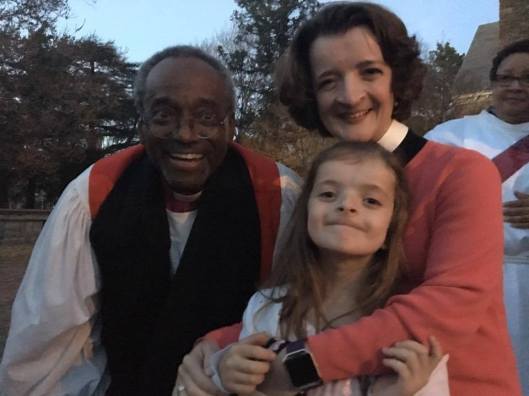
17426137_10155645675302565_2278358373496741633_n

With Presiding Bishop Curry in 2017, Photo credit:  Jennifer Andrews-Weckerly (use only with permission)


Homily – Acts 2.1-21, Pentecost, YB, May 20, 2018

23 Wednesday May 2018

Posted by jandrewsweckerly in Sermons, Uncategorized

≈ Leave a comment

Tags

baptism, baptismal covenant, cacophony, chaos, church, community, God, Jesus, languages, love, Pentecost, Sermon

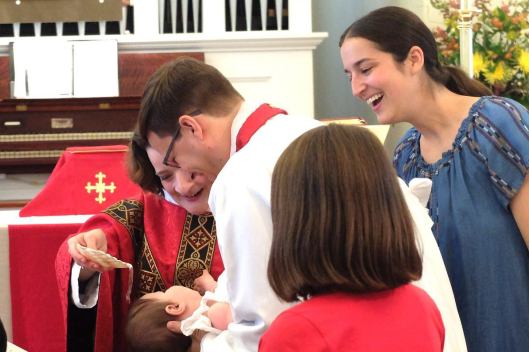
33092215_1843823495673902_5618488268858327040_o

Photo credit:  John Rothnie (permission to reuse required)

I have been looking forward to this baptism for months.  Olive is one of four babies born at Hickory Neck within a month of each other, and one of five within a five-month period.  Not only did I enjoy watching Olive grow in her mom’s belly, I knew how fun welcoming her to the community would be, and especially how special her baptism would be.  So when the Bauer Family finally settled on Pentecost, I was thrilled – baptizing a baby on feast day adds excitement to an already festive day.

But as the liturgy planning staff met about a month ago, I realized we may have made a huge mistake.  We were talking about the needs for today, and remembered we needed to recruit all our foreign language speakers because Pentecost is the one feast of the year where we really try to simulate the experience of the historically significant day in the life of the faith.  And as we were talking about rotas, translations, and participants, a sudden sense of dread hit me.  “Um, Charlie?” I said.  “Are you sure you want to baptize Olive on Pentecost?  I mean, I love Pentecost, but, especially for strangers to our community, Pentecost is a little weird.  Do you want us to just skip the whole languages part?”  To his credit, Charlie didn’t hesitate.  “What better day to baptize?!?” he said, as though my question were silly.

I have been encouraged by Charlie’s enthusiasm, but the more I thought about his response, the more I questioned his logic.  Don’t get me wrong – I love what we do at Pentecost.  Pentecost is one of the few days of the liturgical year that our scripture really comes to life.  Hearing the cacophony of languages helps you to really imagine yourself there.  But this is the kind of service that I would also say to first-time visitor, “Just so you know, we don’t always do this!”  Because, although I love the cacophony, I wouldn’t want anyone to think today is the norm – that we always break into tongues in the service or that we always like to shock your senses.  Surely if we were going to baptize Olive, we should find a tamer way to welcome her to the community, and not freak out her family and friends from all the ends of the country.

We do this all the time with Church.  If we get the nerve up to ask a friend to Church, and they take us up on the offer, we want them to experience the best of Hickory Neck:  a welcoming environment, beautiful liturgy, a sense of belonging, and a deep connection to the immanent and transcendent God.  But just like when you introduce a new romantic interest to your family, you don’t have them meet everyone in the family at the beginning.  You save crazy Uncle Joe until at least the second or third Christmas, when you know your boy or girlfriend is already in love with you enough to make allowances for the crazy in your family.  The same is true for church – we would much rather you see the beauty of Hickory Neck on a regular Sunday or even on a day like Easter.  There is no need for us to show you some of the really weird parts of our faith, like Pentecost, until you have at least been here for a while.

So why was Charlie so enthusiastic about bringing his extended family to celebrate baptism on this one, crazy, bizarre day in the life of the church?  Was he not thinking this through?  Or was he secretly hoping to ensure his family never comes back?  I started working through why this might be the perfect day for a baptism, thinking through what we learn about the church and membership within.  First, we learn the power of the gospel, of the good news of God in Christ, to reach all peoples, no matter who they are.  Although practically speaking, today’s multilingual reading sounds jarring, what we know about this piece of scripture is that despite the din of noise, everyone heard the good news in their own language.  The gospel is not limited to one group of people or to one tribe or nation; the gospel speak truth to all.  Second, we learn that Jesus’ story is not just for us – Jesus’ story is for all.  Up until this point in our story, Jesus has been keeping his resurrection and ascension to a limited group of people.  But today, that norm implodes.  Jesus’ story is no longer for those nearest and dearest to Jesus – Jesus’ story is for everyone.  Third, we are reminded of our commission from Jesus – to go out into all the world, sharing the good news of God in Christ.  Not just the English-speaking places, not just the places where people look and act like us, not just the places that make us comfortable.  And finally, Pentecost affirms the ways in which God loves us, no matter what.  No matter how loud, crazy, or chaotic our lives become, God is with us, breaking through the din of noise we create and making that noise holy.

Perhaps instead of finding the most proper, polished day to baptize a child of God, today may be the perfect day to teach us all what the life of faith is about.  We all know that when our romantic interest or dear friend finally meets Crazy Uncle Joe, or finally sees us when we are sick or not looking our best, or finally realizes we have some pretty awful flaws, and LOVES US ANYWAY – those are the people we want to keep around.  The same is true for those new to the church or those being initiated into the community of faith – we want you to see us on our craziest days so that you know, no matter what God loves you anyway.  God sees your craziness, your chaos, those parts of yourself that you hide from others, and God not only loves you, God commissions you and makes a way you share that love to the ends of the earth.

That is what we affirm today in our baptismal covenant.  Given the promise of unconditional love from God, we promise in return to live a life in accordance with that unconditional love.  To seek and serve all persons, to strive for justice, to respect the dignity of every human being, to proclaim by word and example the good news of God in Christ, to resist evil and repent, and to keep coming back to the community, breaking bread and joining in the prayers.  The chaos of today, the beauty of baptism today, the reminder of God’s love today are all meant to build us up so that we can get back out into the world.  What better day than today to baptize?!?  Amen.

Sermon – John 15.9-17, E6, YB, May 6, 2018

09 Wednesday May 2018

Posted by jandrewsweckerly in Sermons, Uncategorized

≈ Leave a comment

Tags

Christ, church, fail, forgive, God, hurt, Jesus, life, love, pain, pretty, profound, redefine, Sermon, share

Jesus’ words today from John’s gospel have been beckoning me all week.  “As the Father has loved me, so I have loved you; abide in my love…I have said these things to you so that my joy may be in you, and that your joy may be complete…You are my friends…You did not choose me but I chose you.”  These are words that our weary souls need to hear.  We long for the wide, open embrace of God, the unconditional acceptance, the assurance that everything will be okay.  Jesus’ words today are a warm blanket we crawl into and wrap around ourselves, draping over our feelings of sadness, loneliness, doubt, insecurity, and uncertainty.  Jesus’ invitation to abide in his love is the fulfillment of every longing, aching need in our lives, and today Jesus offers that love freely, abundantly, joyfully, completely.

For some of here today, that is your sermon:  Jesus loves you, chooses you, befriends you, and completes your joy.  The humbling, overwhelming love of God invites you into that warm blanket, and you do not need to speak – just accept the gift and abide with God this week.[i]

For others of us, we may be a little too hardened to fully receive the invitation to abide in God’s love.  I used to serve with a priest whose main sermon, no matter what the text, was God loves us.  She said those words so often I remember I would sometimes stop listening.  My cynical self would start the diatribe, “Yeah, yeah, yeah.  God is love.”  The problem for many of us is love has failed us.  We have been in love, been loved by family or friends, or even have felt God’s love.  But we have also been hurt, rejected, or felt abandoned by all those parties.  And if we feel the failure of love too often, “Abide in my love,” sounds too shallow to have meaning, too romantic to last, too wonderful to be sustained.

For those of us who might roll our eyes at the saccharine nature of love we have experienced in the world, we may need a different sermon today.   Part of our challenge is we have defined love in such a way that we will be disappointed every time.  We watch movies, read books, even gaze at couples in those first dreamy weeks of new love, and think we know what love is.  Love becomes two people who agree all the time, who are always able to look lovingly at another never noticing imperfections, who never experience conflict, and who are always happy.  And if that is our expectation of love, we will always be disappointed.  For those of us in this camp, our sermon today is to redefine love.

A few years ago, Paul and Lucy were such a couple.  They had a romantic beginning – meeting in medical school, Paul was funny, smart, and playful.  As they built a life together, they began to dream and to plan.  When Paul finished his 90-hour workweek rotations, and life got back to normal, they would try to have a baby.  Everything was perfect – at least everything was perfect if you did not look too closely.  And then Paul got the diagnosis – a cancer that would give him two more years of life.  And suddenly everything changed.  Lucy’s life began to become about taking care of Paul, walking him through treatments, holding him in pain.  And Paul’s life became about making sure Lucy could enjoy life beyond him.  At one point, Paul assured Lucy he wanted her to remarry after he died.  The two even agreed to have that baby they had been planning.  Lucy worried having a child would make dying worse for Paul.  “Don’t you think that saying goodbye to a child would make your death more painful?” she asked Paul.  He replied, “Wouldn’t it be great if it did?”[ii]

What Paul and Lucy show us is love is not some sappy, sentimentalized emotion best captured by a romantic comedy with a great soundtrack.  Love is beautiful not because love is perfect, pretty, polished.  Love is beautiful because love is “all in,” ready for the ugliness of life, willing to take on pain and suffering and see that pain as a blessing.  Of course, Jesus describes love in the same way in today’s gospel lesson if we are paying attention.  We find ourselves so tarrying in the comforting love language and we sometimes miss the other love language in the text.  “Keep my commandments…love one another as I have loved you…lay down one’s life for one’s friends…go and bear fruit, fruit that will last.”  Jesus shows us what love looks like throughout his life.  He kneels down and tenderly washes the dirty, worn feet of his companions.  He accepts and welcomes adulterers, oppressors, and outcasts of every kind.  He loves and forgives, even when betrayed by his closest friends.  He gives up his life in the most gruesome, humiliating way.  Jesus’ love is not pretty or polished.  But Jesus’ love is profound.

That kind of love is the kind of love that drove most of us to Hickory Neck.  Maybe we came thinking we wanted a perfect, polished, pretty loving community that would make us feel loved too.  And many times, Hickory Neck is just that.  But other times we find a different kind of love at Hickory Neck – a love that stands by us when spouses die, when marriages fail, and when children stumble into dark places; a love that stands by us when diagnoses come, when tragedy strikes, and when sinfulness overcomes us; a love that stands by us when we disagree, when we hurt one another, and when we fail to meet each other’s expectations.  That kind of love sits next to us when we cry, even when no words are exchanged; that kind of love receives awful news and is able to simply say, “this is awful,”; that kind of love prays for us even when we do not realize we are receiving or need prayer.  The love we often find at Hickory Neck may seem to others to be messy, imperfect, and even difficult.  But the love we find at Hickory Neck is much more akin to the kind of love that mimics God’s love for us, that lays down our lives for one another.

The challenge for us today is in four tiny words from Jesus, “Go and bear fruit.”  Both the unconditional blanket of Christ’s love and the messy, ugly, beautiful love of Christ are for us today.  But that gift of love becomes fullest when shared.  We practice that sharing of love every week here at Hickory Neck – with the people we like, and even the people we may not like as much.  But our practicing is preparation for sharing that love beyond these walls – with the family member who drives us crazy, with the neighbor whose annoying habits reveal a lack of love, with the stranger who makes us uncomfortable.  Now, you may go home today and start thinking to yourself, or your friend might say to you, or even Satan himself may start asking you, “Yeah, but won’t that kind of love hurt?  Won’t you be risking pain and hurt by giving that kind of love?”  Today, Jesus invites you to say, “Wouldn’t it be great if it did?”  Amen.

[i] Karoline Lewis, “Abide in my Love,” April 29, 2018, as found at http://www.workingpreacher.org/craft.aspx?post=5142 on May 2, 2018.

[ii] David Greene, “Inside A Doctor’s Mind At The End Of His Life,” February 12, 2016, as found at https://www.npr.org/templates/transcript/transcript.php?storyId=466189316 on May 3, 2018.

Homily – Mark 11.1-11, 14.1-15.47, PS, YB, March 25, 2018

28 Wednesday Mar 2018

Posted by jandrewsweckerly in Sermons, Uncategorized

≈ Leave a comment

Tags

complicit, God, Holy Week, homily, Jesus, love, Mary, Palm Sunday, participate, physicality, relationship, senses, Sermon, silence, sin, tomb, uncomfortable, visceral

When I did my AmeriCorps year of service at a food bank in North Carolina, the warehouse manager was from Liberia.  Eugene and I talked about a lot of things, but one favorite topic was the church.  When Holy Week rolled around, I remember Eugene telling me about Good Friday in Liberia.  On the way to church on Good Friday in Liberia, the children lead a procession.  The children carry an effigy of Jesus, and all the children take turns flogging the effigy of Jesus all the way to the church.  I remember being mortified when I learned about this tradition, wondering who in their right mind would invite children to participate in worship in such a gruesome, grotesque way.

The weird thing is, this mortifying tradition is not all that dissimilar to the physicality of our own worship today.  Today, we invite everyone to vigorously wave palms hailing Jesus Christ the king; then we have voices from our parishioners narrate the text, sometimes taking roles of people like Judas, Pilate, or denying Peter; and if that were not bad enough, then we put the words, “Crucify him!” in bold in our bulletins, reminding everyone to shout the words together.  The practice is so visceral that I often notice many people resist participating.  I cannot tell you how many photos I had to scroll through to find a good Hickory Neck Palm Sunday processional photo this year.  In what is supposed to be replica of joyously welcoming the Messiah, Hickory Neck-ers rarely take more than one palm, we hold them upright so as not to seem too zealous, and forget about a smile or look of excited victory.  I do not know if we feel silly or if we know all too well what comes next so we resist, but we struggle to engage in even the joyful part of today’s liturgy.

And I have rarely found an Episcopal Church anywhere who wholeheartedly joins in the chant, “Crucify him!”  We are so uncomfortable with that part of the liturgy.  More often people do not say the words at all, or they embarrassingly mumble the words.  Sometimes I see people tense up if those beside them enthusiastically participate too much.

Our resistance is futile though.  As if we hesitantly wave palms, or if we stay silent while the crowd demands we crucify Christ, we somehow avoid complicity with this humiliating atrocity.  But we are complicit with sin every day, in the most heinous ways.  We are complicit as our neighbors decide between housing, health care, and child care costs.  We are complicit as racism creates separate, unequal experiences for our citizens.  We are complicit as our God invites into a new way and we say “no.”

That is why the church offers us this very tactile, primal service today.  We wave the palms with fervor today because we remember the ways in which we see in part – the ways in which we manage to follow Christ, even if we do not understand what Christ is doing, even if we do not catch how Jesus inverts his triumphal entry on the back of a young donkey.  We fully participate in the words of today’s passion in order to remind us to “stop abusing the image of God revealed in the dignity of every human being.”[i]  And then we let those final words soak in today, as we stand with Mary Magdalene and Mary the mother of Joses, silently at the tomb, seeing where Christ’s body is laid.

What we do in worship today is actually the perfect entry into this most Holy Week in Church.  Now some priests will tell you that we combine the liturgy of the palms with the passion narrative today because the designers of the Prayer Book knew that many of you would come on Palm Sunday, skip the days of worship during Holy Week, and then show up on Easter Sunday without having walked from this triumphal entry into Jerusalem through the cross and tomb.  And maybe they were right (though I know most of you rearranged your schedules this week for Holy Week services).  But more importantly, even if you walk through this journey with Christ this week, the reason we pair the Palms with the Passion is that we could never go from the Palms to the Resurrection without the connection to the cross.  The triumphal entry into Jerusalem makes no sense without the cross; the irony of that festive procession only makes sense when you are standing silently and bleakly at the tomb.

I know today is uncomfortable.  I know today is confusing, and oddly visceral, and may even be a bit overwhelming.  But today, and perhaps all this week if you are able to join us, allow the senses to take over.  Allow the sights, and smells, and touches, and sounds, and tastes to overwhelm you this week.  Allow the ache of standing with Mary Magdalene and Mary the mother of Joses to sink deep into the same body that has waved palms and shouted awful things today.  Because only when our senses are that overwhelmed are we able to see that the cross is not about suffering and death, but rather is about a relationship that holds.  Only then will we find a “love stronger than death, that can withstand whatever the forces of evil do against [love], and that can hold suffering even as [love] struggles to alleviate [suffering].”[ii]  What feels like an empty, guilty ache today instead becomes a sign of how God overcomes terror, enfolds us in Life, and dwells with us forever.[iii]  But until then, stand with the Marys and with one another at the tomb in silence.

[i] Michael Battle, “Pastoral Perspective,” Feasting on the Word, Year B, Vol. 2 (Louisville:  Westminster John Knox Press, 2008), 182.

[ii] Margaret A. Farley, “Theological Perspective,” Feasting on the Word, Year B, Vol. 2 (Louisville:  Westminster John Knox Press, 2008), 182.

[iii] Farley, 184.

On the Timelessness of Scripture…

23 Friday Mar 2018

Posted by jandrewsweckerly in Uncategorized

≈ Leave a comment

Tags

#metoo, Apocrypha, Christ, Daniel, dignity, harassment, kingdom of God, love, men, power, respect, scripture, sin, Susanna, women

This reflection is from a book of devotions that our youth group at Hickory Neck created for our parish’s use this Lent.  Each day, parishioners offer their reflections on the text assigned for that day in Lent.  This is my reflection on an apocryphal writing, Susanna 1-9, 15-29, 34-62.  If it is unfamiliar to you, I highly recommend reading it first.  You can find the text here.

**********

I am struck by the timeliness of Susanna’s story.  Because Susana is a book from the Apocrypha, most Christians do not know her story.  But her story joins the chorus of the many #metoo stories of sexual assault and harassment we have discovered in the last six months.  Susanna’s story is a story of the abuse of power.  Though the two elders purport to give Susanna a choice, either choice will leave her devastated.  Though she chooses the option that feels free from sin, her choice will lead to her condemnation and death.  In truth, she has no choice – the men sinfully exert power of her.

What encourages me about Susanna’s story is that there is a man who uses his power for good.  We are told that God stirs up the holy spirit of Daniel, and Daniel (a man of power in his own right), responds, eventually proving Susanna’s innocence.  Daniel’s role in this story reminds us that God longs for us to use our power for good.  The #metoo stories of our day are not just the stories of women.  They are stories about all of us – stories of how we, men and women, are to love as Christ loves, and to respect the dignity of every human being.  How might we be agents of love, using our power today to help those without power?  How might we be agents in bringing about the kingdom of God?

Sermon – Luke 2.1-14, CE, YB, December 24, 2017

10 Wednesday Jan 2018

Posted by jandrewsweckerly in Sermons, Uncategorized

≈ Leave a comment

Tags

chaos, Christmas Eve, church, God, holy, Holy Family, Jesus, life, love, manger, peace, silent, story, worship

Sometimes arriving at the manger on Christmas Eve feels a bit like just barely sliding into home plate.  When little ones are around, you have scurried about, making sure their tights and bowties are on, while trying to squeeze in one last family picture while everyone still looks nice.  By now, you have probably served or been served a meal, purchased and wrapped gifts, prepped or cooked food for tomorrow, sent out cards, decorated the house, and run countless errands.  And none of that includes the four hundred things that will be done in the next twenty-four hours.  Arriving here and semi-put together is a minor victory, with the promise of a peaceful, beautiful hour of worship, before preparing for the chaos to resume tomorrow.

The unfortunate thing is that the story of tonight is not all that much less chaotic.  Though we sing songs like Silent Night or Away in a Manger, or though we exchange cards with pastoral, peaceful settings, nothing about that night is silent.  And I am pretty sure the little Lord Jesus makes lots of cries.  The chaos of the holy family is not unlike the chaos in which we sometimes find ourselves.  Remembering how scandalous Mary’s pregnancy and relationship with Joseph are, the chaos continues as Emperor Augustus sends out a decree that forces a very pregnant, uncomfortable Mary away from her hometown to the crowded city of Bethlehem.  Before they can secure housing, Mary goes into labor.  Not only is she dealing with the drama of delivering a child for the first time ever, she is delivering without so much as the comfort of a home.  And then, just as they are trying to figure out nursing, and soothing, and the fear and wonder of parenting, along come some rowdy, likely filthy, shepherds, who have also not had a silent night.  In fact, they have heard the terrifying chorus of the heavenly host and been told a most preposterous story – so much so, they gather up their livestock and come to see.

With all the chaos of our own lives, and with all the mayhem of that holy night, why do we do it?  Why do we come to church at all?  Maybe we come to church on this night specifically because on this night, more than perhaps any night ever, we find the wonderful revelation that God can take the messy chaos of life and make our mess holy.  You see, as much as we love tonight’s beautiful story, what happens this night is beyond the chaos of registrations, no vacancies, angelic revelations, and messy encounters with strangers.  In order to understand the enormity of what is happening tonight, we broaden our scope.  Tonight’s event – the nativity of our Lord –  is the culmination of a much larger story.  The story started when there was no earth or humankind, when God formed the earth from the formless void.  When we first sinned against God and were cast out of the garden, to when we kept sinning and God flooded the world, to our deliverance from the hands of pharaoh and our arrival in the promised land, to our sinful desires for a king that led to the eventual confiscation of our land.  We are a people who have been oppressed so many times and rescued so many times we can barely count.  And in that rollercoaster of a relationship with our God, as we failed time and again, God, who never gives up and never cedes love, does something unheard of:  takes on human flesh, comes to us in the form of a vulnerable child, with the plan of redeeming us forever and granting us eternal life.

Maybe we come to church tonight because tonight is about God’s unending, undying, unfailing, uncompromising love for us.  Despite centuries of chaos, disobedience, and failures, God shows up tonight in a mighty way.  Despite the chaos of the times and of this night, God shows up among the outcast.  Despite the chaos of our own times, in our seeming inability to tend to those most outcast, God comes once more to redeem us.  We come to church tonight because we long to grasp the enormity of God’s love for us, the extents to which God will go for us, and the hope which only God can give to us.

But the news is even better than that.  I do not believe the beauty of tonight is in trying to find a holy moment, where God’s love speaks to us in an otherwise chaotic life.  In fact, you might not find that moment tonight because despite the fact that you were physically able to get here, your mind may still be somewhere else.  The good news is that is okay.  The deep, lasting peace of this night is not found in a single church service (though I must say, the service certainly helps).  The deep, lasting peace we are looking for comes from the reality that we do not find God’s love and peace in spite of the chaos of life.  Tonight teaches us that God hallows the chaos of life.

Based on our standards, God should have placed this precious child – the God incarnate – in the wealthiest, most well-guarded palace, where a person of great wealth could have given the baby everything the baby needed.  A person of power could have protected the child, brought honor to the child, raised the child up to assume the power of a Messiah.  If we had something so precious, we certainly would have worked to find the best of what we have to protect that preciousness.  And yet, God takes on flesh in an unmarried, inconsequential woman of little means.  God takes on flesh amidst the common people, being born in the lowliest of estates.  God takes on flesh and announces the news not to kings and rulers, but to shepherds – those disregarded by society as being of little import.  From the very beginning, the extraordinary thing God does is done in the midst of the ordinary – worse yet, among the marginalized and outcast.

God takes the mess of life:  our divisions, our stratifications by class, gender, and race, our subjugation of the poor, our inability to refrain from sin, our messes and chaos – and God makes our mess holy.  God sanctifies our chaos, reminding us that in the midst of chaos, God is present.   In the midst of chaos, God is doing a new thing through us.  In the midst of chaos, God is love and makes us agents of love.  I cannot promise that the chaos will not try to overtake you when you walk out the church door tonight.  But just like you will find small glimpses tonight of the overwhelming love God has for you, you can find God present in the chaos of life too.  God is continually breaking through, birthing in you Christ’s light and love, using you to make room in the world for the Christ child, using you to announce good news of great joy for all people.  If that doesn’t break though the chaos, I don’t know what will!  Amen.

On Repentance, Joy, and Journey…

06 Wednesday Dec 2017

Posted by jandrewsweckerly in Uncategorized

≈ Leave a comment

Tags

Advent, Christ Child, Jesus, journey, joy, love, prepare, repent, repentance, sinfulness

IMG_7647

Photo by Jennifer Andrews-Weckerly

One of the long-standing debates among clergy and scholars is whether or not Advent is a penitential season or not – a mini-Lent, if you will.[i]  There are arguments both ways, some saying absolutely yes; to prepare our hearts for the birth of Christ, our job is certainly to repent of our sinfulness.  Others who disagree with Advent being a season of penitence argue the season is more about joyful expectation and anticipation, and is distinct from the penitential season of Lent.  Meanwhile others argue that the both Lent and Advent are for both penitence and joy.

I am not sure I have made up my mind about these debates.  What I can tell you is that in the decluttering of my heart in preparation for the Christ Child, and in listening to the lesson appointed each Sunday, I know I am, and the world around me is, in need of some repentance.  As case after case pours in of sexual harassment and abuse, I am aware of how far we have drifted from the ways in which Christ longs for us to treat one another.  From the ways that we eviscerate one another online, or talk behind our neighbor’s backs, I know that we have lost a groundedness in Christ Jesus’ message of love.  From the ways in which we have stormed away from the communion table, I feel how deeply broken we are as a world.  I play a part in not correcting those sins, and sometimes actively participating in them.

And so, this Advent, my preparation feels a bit like a journey.  The first step is going to involve a bit of grief – for every woman or man who felt shamed or silenced by a society who would not affirm that they are created in the image of God, and should never suffer bodily violation; for the loss of an ability to see shades of gray instead of seeing black and white; for the hateful things we say and do to one another.  The second step is going to be some real repentance – not just naming the grief, but claiming my role in the degradation of others.  And then, hopefully, by the time we get to Christmas Eve, I expect to arrive at the manger, not with an armful of gifts, but the open arms of humility, repentance, and renewal.  I may not have words, but I long for the evening when I can bow in front of the Christ Child, rejoicing in the gift of love, forgiveness, and transformation that Jesus is for all of us.  Whether that means this Advent is a season of penitence or not, I am not sure.  All I know is this year, I am grateful for the journey.

[i] https://livingchurch.org/covenant/2016/11/29/is-advent-a-penitential-season/

On Seeing Colors…

08 Wednesday Nov 2017

Posted by jandrewsweckerly in Uncategorized

≈ Leave a comment

Tags

beautiful, color, creation, dignity, fall, God, hatred, hope, leaves, love, peace, respect, violence

IMG_7493For those of you who read here regularly or know me personally, you know that fall is my favorite season.  Though I know many people love the flowers and the vibrancy of greens in spring, I find the turning of leaves in fall much more beautiful.  There is something poignantly graceful about a tree making a vibrant show of color before losing everything and going bare for the winter.  Whether it’s an entire tree that is vividly yellow, orange, or red, or whether it’s stumbling across a particularly beautiful fallen leaf, I find my breath being taken away time and again in the fall.

Fall just finally began to show in force this past week where I live.  The colors could not have come sooner.  In a time filled with anger, hatred, and violence, I have found myself struggling to see beauty around me.  Instead of the vibrant red of love, I have seen the ugly color of abuse and subjugation.  Instead of flaming orange of peace, I have seen the frightening colors of war and gun violence.  Instead of the brilliant yellow of respect and dignity, I have seen demoralizing color of sexism and racism.  In such times, I have longed to stumble on a stray leaf of hope.

As my mind has reeled with yet another mass shooting in Texas, more women coming forward to protest assault and harassment, and legislation that seems to value personal gain over the relief of the suffering of the poor, I have been wondering if fall would come at all.  And then I realized, perhaps the leaves of hope I have been looking for are everyday people who come into my path and show me vibrant signs of hope.  I see hope in a neighboring pastor who told me about the prayer tent he set up in a nearby neighborhood after a shooting that occurred the night before.  Children were overjoyed to see his presence as they got off the school bus the next day.  I see hope in the yoga teacher who, sensing a need in our community, approached our church to see if we could provide space for a sliding-fee yoga class for people of all income levels.  I see hope in children who teach me a profound sense of empathy instead of the reverse.

This week, I invite you to take a look around you in God’s creation to see the signs of hope and love that God is giving you to revive your spirit.  And I also invite you to take a look around you at the people who are offering you signs of hope and love this week – even in the small gestures of kindness, generosity, and love.  I suspect you will be overwhelmed by the beauty you see, and hopefully inspired to unfurl your own beautiful colors of love, peace, respect, and dignity.

Sermon – Matthew 5.1-12, AS, YA, November 5, 2017

08 Wednesday Nov 2017

Posted by jandrewsweckerly in Sermons, Uncategorized

≈ Leave a comment

Tags

All Saints, Beatitudes, blessed, blessedness, extraordinary, God, grace, Jesus, love, martyr, ordinary, saints, Sermon, Sermon on the Mount, souls, unattainable, virtues

Today we honor All Saints Sunday, one of the major feasts of the Episcopal Church.  We recall this day all the faithful departed who lives were marked by heroic sanctity and whose deeds have been recalled and emulated from one generation to the next.  The celebration of these saints began as early as the late 200s, as churches began to honor those who gave up their lives for their faith, as well as those who lives were particularly exemplary.  Later, in the Roman Catholic and Eastern Orthodox traditions, sainthood became reserved for a select few who meet a certain set of requirements, which could include the performance of miracles or a particularly virtuous life.

On such a day of reverence for those whose virtuous lives remind us of God, our gospel lesson from Matthew is an intriguing choice.  Today’s gospel lesson is the beginning of what we call the Sermon on the Mount, that ministry-defining sermon by Jesus that tells us what we can expect from the Messiah.  He begins his long sermon with what we call The Beatitudes:  the famous listing of those whom we define as blessed.  The last two beatitudes make a lot of sense for today’s celebration:  Blessed are those who are persecuted for righteousness’ sake…Blessed are you when people revile you and persecute you and utter all kinds of evil against you falsely on my account.  Certainly martyrs fall into the category of sainthood.  But what about the other beatitudes?  What about those who mourn, who are poor in spirit, are meek?  Those characteristics seem much more passive than martyrdom, or even the actions I associate with most saints.

I think what has always challenged me about honoring the saints or even reading The Beatitudes is that they feel unattainable.  If Jesus is associating being blessed with grief, meekness, poverty, purity, peacemaking, and mercy, I am not sure I can attain those things.  In my mission travels, I have visited with a couple of L’Arche communities.  Founded by Jean Vanier, L’Arche communities are communities for people with developmental disabilities.  Some of those disabilities are quite severe, and others are so mild that the individuals are highly functional.  Rooted in The Beatitudes, L’Arche communities flip the notion of most group homes.  Those with developmental disabilities are called “core members.”  They are the center of the community, the most elevated and honored members of the community.  The people who are there to help them are called “assistants,” and they live among the core members.  Though society labels abled-bodied people as more valuable, in L’Arche communities, the able-bodied members are seen as mere helpers for the more revered members.

The use of The Beatitudes in shaping L’Arche communities only heightened my sense of inadequacy when reading those beautiful words.  Reading those words have often made me feel like an outsider – that unless I suffer grief, pain, persecution, I will never come close to God.  Unless I give up my life in the ways that many assistants do at L’Arche, or unless I give up my life as the martyrs do, my life will only be one of mediocrity.  I will never be able to achieve the checklist of virtues that The Beatitudes provide.

Luckily, I found some relief from the scholars this week. Stanley Hauerwas says about Jesus’ words today, “The sermon, therefore is not a list of requirements, but rather a description of the life of a people gathered by and around Jesus.  To be saved is to be so gathered.  That is why the Beatitudes are the interpretive key to the whole sermon – precisely because they are not recommendations.  No one is asked to go out and try to be poor in spirit or to mourn or to be meek.  Rather, Jesus is indicating that given the reality of the kingdom we should not be surprised to find among those who follow him those who are poor in spirit, those who mourn, those who are meek.”[i]  N.T. Wright concurs.  He says, “These ‘blessings,’ the ‘wonderful news’ that [Jesus is] announcing, are not saying ‘try hard to live like this.’  They are saying that people who already are like that are in good shape.”[ii]

Taking the pressure off a sense that I need to work harder to be like the saints or that I need to seek out ways to be mournful or meek, I found the text opened up something else this week.  Another scholar suggests we look at the beatitudes in this way, “Perhaps [Jesus is] challenging who we imagine being blessed in the first place.  Who is worthy of God’s attention.  Who deserves our attention, respect, and honor.  And by doing that, he’s also challenging our very understanding of blessedness itself and, by extension, challenging our culture’s view of, well, pretty much everything.  Blessing.  Power.  Success.  The good life.  Righteousness.  What is noble and admirable.  What is worth striving for and sacrificing for.  You name it.  Jesus seems to invite us to call into question our culturally-born and very much this-worldly view of all the categories with which we structure our life, navigate our decisions, and judge those around us.”[iii]

At our worship service on Wednesday night of this week, we shared who the saints are in our lives – the everyday people who taught us something about God.  There were all sorts of people named – mothers, fathers, grandparents.  One that struck me the most was the description of one such mother.  “She simply did her duty every day:  being a wife, being a mom, structuring the home.”  Though I have come to use saints in my prayer life as vehicles for deeper prayer and connection with God, more often, the people whose lives motivate me are just like that mom:  everyday people whose everyday lives point to the sacred – who reveal God to me in the basic ways they live their lives.

In the Episcopal Church, the day after All Saints’ Day is called All Souls’ Day.  This day was established in the tenth century as an extension of All Saints’ Day.  All Souls’ Day is the day the Church remembers the vast body of the faithful who, though no less members of the company of the redeemed, are unknown in the wider fellowship of the Church.  All Souls’ Day is a day for particular remembrance of family members and friends who, though no icon has ever been painted, showed us the beautiful life of holiness and righteousness.

The honoring of these lesser known saints seems to go much more richly with The Beatitudes to me.  If we know those who are meek, grieving, and poor in spirit are just as righteous as those who thirst and hunger for righteousness, we get to the heart of Jesus’ sermon today.  I imagine you all have a story.  Our family has been following a family whose ten-year old daughter had an awful case of cancer.  She has been fighting and fighting, and just last week Hospice was finally called in for support.  At dinner on Tuesday night, our eldest, just two years younger than our friend, said, unprompted, “I feel bad for kids with cancer who cannot trick-or-treat.”  The next morning, we found out that our little friend had passed that very night.  Lord knows, my child is not often a saint.  But that confluence of grief, suffering, and loss, brought us a little closer to blessedness.

Today, we will tie ribbons on our altar for all the saints and souls who have gone before us.  Maybe you will be tying your ribbon for a canonized saint, whose religious fervor has motivated you in your spiritual journey.  Maybe you will be tying your ribbon for a family saint, whose small, everyday witness taught you about the vastness of God’s love and grace.  Maybe you will be tying your ribbon for the random person you encountered who said something so profound you knew God was speaking right through them to you.  The saints we honor today are exemplary and ordinary.  The saints we honor today are people marked by action and advocacy, and people marked by everyday suffering.  The saints we honor today are people completely unlike us and just like us.  God has certainly inspired us by a host of other witnesses.  But God is also using each of you to inspire others in their journey.  Amen.

[i] Stanley Hauerwas, Matthew:  Brazos Theological Commentary on the Bible (Grand Rapids:  Brazos Press, 2006), 61.

[ii] N.T. Wright, Matthew for Everyone, Part 1 (Louisville:  Westminster John Knox Press, 2004), 36.

[iii] David Lose, “All Saints A:  Preaching a Beatitudes Inversion,” November 1, 2017, as found at http://www.davidlose.net/2017/11/all-saints-a-preaching-a-beatitudes-inversion/ on November 3, 2017.

On Seeing Sacred Moments…

18 Wednesday Oct 2017

Posted by jandrewsweckerly in Uncategorized

≈ Leave a comment

Tags

blessing, church, compassion, fellowship, God, holy, laughter, light, love, moment, outreach, sacred, support, witness, work

In general, my children are pretty typical in many ways – they have their good days and their bad days.  They tattle on each other, try to sneak in a hit or shove, and one will occasionally shout how she “hates her life.”  But then, every once in a while, totally unprompted and seemingly “out of sight,” I will overhear the love, care, and affection they have for one another.  One child will walk over the other who is crying, and she will give a hug and offer reassuring words.  Or the two children will gleefully play with one another without arguing or fussing.  Or best of all, I will hear them laughing pure, innocent laughs together.  In these holy moments, they show me the light of God’s presence, and reveal their best qualities – that they are individuals full of love and compassion.

These last few weeks at our church, I feel like I have been able to see similar holy moments.  We are preparing for our Annual Fall Festival, from which all the proceeds go to support local ministries.  As we lead up to the event, I have seen countless tasks being done by parishioners:  from making up food order forms and staffing tables for pre-orders, from cleaning out closets to pricing and sorting donations, from recruiting donations from local businesses to developing the silent auction booklet, from breaking down our worship space to setting up parking space.  As the weeks and days have gotten closer to our festival, I have seen hard work, commitments of time, generosity of spirit, and joy in participation.  Most of the work could go unnoticed; even those of us who volunteer do not always see all the other work that is happening somewhere else.

But today, I want to say, “I see you.”  I see you, Hickory Neck, giving your cherished time to support the church.  I see you, sharing in fellowship as you work together on projects.  I see you, passionate about your neighbors in need and working a little bit harder.  I see you in holy moments, individually and collectively, and I am so proud of you.  Your laughter together is a sweet, sacred sound.  Your labor is a witness to me and to our community of God’s abundant love for all.  Well done, good and faithful servants!  You are a blessing!!

laughter_625x350_41474366938

Photo credit:  food.ndtv.com/health/10-surprising-health-benefits-of-laughter-1464095

← Older posts
Newer posts →

Recent Posts

  • On Redefining Community…
  • On Parenting, Milestones, and Community…
  • Sermon – Acts 2.42-47, E4, YA, April 26, 2026
  • On Seasons of Discernment…
  • Sermon – Luke 24.13-35, E3, YA, April 19, 2026

Archives

  • May 2026
  • April 2026
  • February 2026
  • January 2026
  • December 2025
  • November 2025
  • October 2025
  • September 2025
  • August 2025
  • July 2025
  • June 2025
  • March 2025
  • February 2025
  • December 2024
  • November 2024
  • October 2024
  • September 2024
  • August 2024
  • July 2024
  • June 2024
  • May 2024
  • March 2024
  • February 2024
  • January 2024
  • December 2023
  • November 2023
  • October 2023
  • September 2023
  • August 2023
  • July 2023
  • June 2023
  • May 2023
  • March 2023
  • February 2023
  • January 2023
  • December 2022
  • November 2022
  • October 2022
  • June 2022
  • May 2022
  • January 2022
  • December 2021
  • November 2021
  • October 2021
  • September 2021
  • August 2021
  • June 2021
  • May 2021
  • April 2021
  • March 2021
  • February 2021
  • January 2021
  • December 2020
  • November 2020
  • October 2020
  • September 2020
  • August 2020
  • July 2020
  • June 2020
  • May 2020
  • April 2020
  • March 2020
  • February 2020
  • January 2020
  • December 2019
  • November 2019
  • October 2019
  • September 2019
  • August 2019
  • July 2019
  • June 2019
  • May 2019
  • April 2019
  • March 2019
  • February 2019
  • January 2019
  • December 2018
  • November 2018
  • October 2018
  • September 2018
  • August 2018
  • July 2018
  • June 2018
  • May 2018
  • April 2018
  • March 2018
  • February 2018
  • January 2018
  • December 2017
  • November 2017
  • October 2017
  • September 2017
  • August 2017
  • July 2017
  • June 2017
  • May 2017
  • April 2017
  • March 2017
  • February 2017
  • January 2017
  • December 2016
  • November 2016
  • October 2016
  • September 2016
  • August 2016
  • July 2016
  • June 2016
  • May 2016
  • April 2016
  • March 2016
  • February 2016
  • January 2016
  • December 2015
  • November 2015
  • October 2015
  • September 2015
  • August 2015
  • July 2015
  • June 2015
  • May 2015
  • April 2015
  • March 2015
  • February 2015
  • January 2015
  • December 2014
  • November 2014
  • October 2014
  • September 2014
  • August 2014
  • July 2014
  • June 2014
  • April 2014
  • March 2014
  • February 2014
  • January 2014
  • December 2013
  • November 2013
  • October 2013
  • September 2013
  • August 2013
  • July 2013
  • June 2013
  • May 2013
  • April 2013
  • March 2013
  • February 2013
  • January 2013
  • December 2012
  • November 2012
  • October 2012
  • September 2012

Categories

  • reflection
  • Sermons
  • Uncategorized

Meta

  • Create account
  • Log in
  • Entries feed
  • Comments feed
  • WordPress.com

Blog at WordPress.com.

  • Subscribe Subscribed
    • Seeking and Serving
    • Join 391 other subscribers
    • Already have a WordPress.com account? Log in now.
    • Seeking and Serving
    • Subscribe Subscribed
    • Sign up
    • Log in
    • Report this content
    • View site in Reader
    • Manage subscriptions
    • Collapse this bar

Loading Comments...