• About

Seeking and Serving

~ seek and serve Christ in all persons

Seeking and Serving

Tag Archives: love

Seeds of hope…

22 Wednesday May 2013

Posted by jandrewsweckerly in Uncategorized

≈ Leave a comment

Tags

change, garden, God, hope, love

Planting This weekend our parish will plant the vegetables in our Garden of Eatin’ – a Grow to Give Garden that will feed our neighbors in need.  As we prepare for the day, I am overwhelmed with emotion – pride, satisfaction, joy, and hope.  A garden to feed others may seem simple enough, but this project has been a bit of a microcosm of what our parish is facing in general.  We are a tough parish that has survived some hard times.  The tenor of our parish has been transformed in the last couple of years into a place of hopefulness and joy, but our history has not left us unscarred.  Out of our history, and perhaps with a little human nature sprinkled in, change has become something to dread rather than to eagerly anticipate.  Of course every church, and probably every individual, does not actually like change, but I believe our tenacious will to survive has resulted in a deeper desire to control, and therefore a fear of change.

From that perspective then, you can see why I am so excited about this garden.  This garden represents the best and the worst of us.  At our worst, we worry about using our property in an alternative and perhaps detrimental way.  If there is to be change, we want to make sure every single detail has been considered by every single person.  We fear the long-term impact of taking on a project that will need long-term care.  But at our best, we see the wealth of our eleven acres and want to share that wealth in a new way.  We see neighbors who need food that we can grow.  We know we will get to know each other a lot better with dirty hands and sweaty brow than we might in our Sunday best.  And we dream that our labor might be a tangible witness to the power of God’s love in our community.

So for me, digging into that dirt, and planting those seeds and seedlings this weekend, is a proclamation that we will be the best version of ourselves.  We will take the uncertain road, we will submit to change, and we will open our hands to our God who will use those hands for good.  A garden may not seem like a big deal to others, but to me, this garden is a bold statement about who we have been, who we are, and who we want to be.

Sermon – John 20.19-31, E2, YC, April 7, 2013

10 Wednesday Apr 2013

Posted by jandrewsweckerly in Uncategorized

≈ Leave a comment

Tags

afraid, ashamed, fear, forgiveness, Jesus, love, peace, resurrection, Sermon

As Christians who just celebrated Easter last week, rejoicing in Jesus’ resurrection and all that his resurrection means in our lives, you would think our gospel lesson would be a little more victorious.  You would think the next step after the angels appear saying Christ is not in the tomb but is risen would be the disciples hitting the ground running, doing the work of spreading the good news or at least throwing a raucous party.  Instead, we find the disciples huddled in a locked room, cowering in fear.  They have not taken the good news from Mary Magdalene as reason to celebrate.  Instead, they are paralyzed by fear.

I have often wondered what the disciples were afraid of.  The text says they are afraid of the Jews, perhaps afraid that the same people who killed Jesus would try to kill them too.  But I think there is more to their fear.  I think they are afraid to face others, because they feel as if they have failed.  Perhaps they believe that their pick for Messiah did not seem to be the Messiah after all.  I think they are also behind those locked doors because they are ashamed that they failed to protect Jesus, to keep him alive.[i]  Those locked doors are not just for safety – those locked doors are for hiding the shame, the disappointment, and the fear of facing others that the disciples have.

We know a little about what the disciples feel like.  We all have things about ourselves for which we are ashamed.  There are things about ourselves that we lock away, praying that no one every finds out because we are not who we fully want to be or even who we pretend to be.  Garrison Keillor once said, “We always have a backstage view of ourselves.”[ii]  Most people only see the carefully arranged stage we have assembled for others to see.  But behind the curtain, in that backstage view that only we have, there are all sorts of things hiding: old failures, hurts, guilt, and shame.  And Eastertide is one of the most difficult times for this dichotomy because we feel like we should be at our best – wearing our best clothes, coming to church as perfectly functioning families, showing forth nothing but happy alleluias.  We are working overtime to ensure that our stage is especially carefully arranged at church.

But to this frenzied, harried behavior, what does Jesus say?  Peace be with you.  Jesus comes to those fearful, ashamed, embarrassed disciples, finding them behind their locked doors of protection and offers them peace.  Jesus barges backstage and says, “I see you in your fullness, and I offer you peace.  So forgive yourselves and now go and forgive others.”  This is why Jesus died on the cross – that their sins might be forgiven.  And so, before the disciples get too mired in wallowing in fear, shame, and self-pity, Jesus demands they recognize that they are forgiven – and that they share that good news with others.  For no one should be locked inside a room of shame and fear.  The peace Jesus offers is not some “greeting-card platitude about the sun behind the clouds.  [Jesus’ peace] is the beginning of a new world, the long-awaited world of God’s shalom.  [His peace] comes with freedom from fear, sin, and death.  Jesus opens the door that the disciples had locked…and he shows the way to resurrection reality.”[iii]

This is our invitation today as well.  Our invitation is to offer the same forgiveness to one another that Christ unabashedly offers to us.  In so doing, we invite not only ourselves, but others, to take down the pretty stage trappings, and to recognize that we all have backstage versions of ourselves, which are all in need of Jesus’ love and forgiveness.  This is good news for which we can really shout alleluia.  This is the kind of good news that makes us want to be in church.  Because this sacred space is not sacred because we made our stages look sacred; this sacred space is sacred because we are fully ourselves, and fully forgiven.  Peace be with you.  Amen.


[i] M. Craig Barnes, “Crying Shame,” Christian Century, vol. 121, no. 7, April 6, 2004, 19.

[ii] Barnes, 19.

[iii] Kristen Bargeron Grant, “No Joke,” Christian Century, vol. 120, no. 9, April 19, 2003, 18.

Sermon – John 13.1-17, 31b-35, MT, YC, March 28, 2013

29 Friday Mar 2013

Posted by jandrewsweckerly in Uncategorized

≈ Leave a comment

Tags

disciples, foot washing, Jesus, love, Maundy Thursday, Sermon

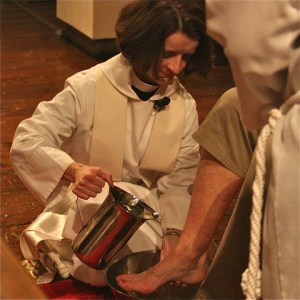
IMG_2898_2Tonight our actions mirror the actions of our gospel lesson.  Like the disciples, we gather around the table.  I imagine our potluck meal was not unlike the meal the disciples had with Jesus that night – an intimate meal with friends who feel like family, sharing stories, laughter, and woes.  We too are a ragtag team of followers, gathered at a meal, who seek to know our Savior better, and who lean on a community of faith to join us in the journey.  As the disciples did that night, we will also have our feet washed.  I imagine our discomfort in having our feet washed, and even our wondering what the foot washing means, are not that different from Peter’s struggles.  Finally, we too will come to the Eucharistic table.  This night was the night that Jesus instituted the sacrament of Eucharist.  Like Jesus shared his last meal with the disciples that night, we too receive the sacred body and blood of Christ for the last time until the Easter Vigil.

In observing the patterns of our gathering this night, we could feel pretty good about ourselves.  We could look at the synchronicity between us and the disciples that night and feel like we have joined them in a great memorial of our brothers in Christ.  But tonight is not just about imitating manual acts.  The entire point of that night – the table fellowship, the washing of feet, the sharing in Christ’s body and blood – is not about the actions themselves.  The point of that night was establishing a way of being.  Jesus establishes the way that the community will be together:  “I give you a new commandment, that you love one another.  Just as I have loved you, you also should love one another.  By this everyone will know that you are my disciples, if you have love for one another.”

This command to love one another is perhaps one of the most difficult commands of Jesus.  All we have to do is look at two people in the room that night to see what Jesus means.  Both Judas and Peter are in the room when Jesus says that they are to love one another.  That means when Judas hands Jesus over to die, and when Peter embarrasses them by three times denying the Savior he claimed to be willing to die for, that the other disciples will have to find a way to love both Judas and Peter later.

For us, that means when our family members, friends, fellow parishioners, and even strangers betray us, we too will have to love each of those individuals.  Love is not an easy act.  Love means that we have to accept the role of servant, the one who kneels down on the floor and washes the dirty feet of another, even a betrayer.  But we also have to be the person who allows him or herself to be cared for in a similar way.  Margaret Guenther once said, “If we love one another as Jesus loves us, we must be ready to put aside our grudges, hurts, and righteous anger.”  Guenther admits, “I tend to love with my fingers crossed.  I’m ready to love almost everyone, but surely I can’t be expected to love the person who has harmed me.  Or who does not wish me well.  Or who seems hopelessly wrong-headed.  Surely I am allowed one holdout, one person whom I may judge unworthy of love.  But the commandment has no loopholes; it demands that we let go of our pet hates, the ones we clutch like teddy bears.”[i]

NPR does a series called StoryCorps.  I will never forget one story I heard about a woman who befriend the boy who killed her son.  At first she was filled with anger at her son’s murderer, but then twelve years later, she went to visit the young man in prison and everything changed.  “He became human to me,” explained the woman.  They departed that day with a hug.  Twenty years after the murder of her son, the woman and the murderer now are neighbors, caring for one another like a mother and son.  She demands the same attention from him a mother would, and he always strives to care for her and earn her approval.  She plans to see him graduate from college – something her own son never got to do.  And maybe someday go to his wedding.[ii]  This is the kind of love that Jesus is talking about on this sacred night.

Luckily, the Church gives us our liturgy tonight to encourage us on the way.  If we want to love as Jesus commands, we can come forward, and be willing to be loved through the washing of our feet.  If we want to love as Jesus commands, we can earnestly confess our sins before others, recommitting ourselves to love.  If we want to love as Jesus commands, we can come to the table one more time, perhaps kneeling by someone with whom we have a grudge, and being renewed into the way of love.  And if we want to love as Jesus commands, we will take all the strength that we gain from this night, and we will walk out those doors a people transformed – transformed into beings who love with abandon, not caring on whom we waste the love or how or whether the love is returned to us.  When we love in this way, we love like Jesus – and everyone will know that we are Jesus’ disciples by our love.  Amen.


[i] Margaret Guenther, “No Exceptions Permitted,” Christian Century, vol. 112, no. 15, May 3, 1995, 479.

[ii] Story found at http://www.npr.org/2011/05/20/136463363/forgiving-her-sons-killer-not-an-easy-thing as of March 25, 2013.

Homily – Matthew 24.9-14, Perpetua and her Companions, March 7, 2013

14 Thursday Mar 2013

Posted by jandrewsweckerly in Uncategorized

≈ Leave a comment

Tags

faith, homily, love, martyrs, Perpetua, risky

Today we honor Perpetua and her companions, martyrs at Carthage in 202.  Petpetua was a young widow with a small child and several slaves.  Along with other Christians preparing for baptism, they were arrested when they refused to offer sacrifice to the divinity of the Emperor.  They suffered under miserable conditions in a prison.  But Perpetua had these incredible dreams about heaven that encouraged her in her resolve and her insistence on declaring her Christianity.  She and her companions were put in an arena with a leopard, boar, bear, and savage cow.  Perpetua encouraged them, but eventually all were put to death by a sword.

Our lessons today all warn of a similar fate for us.  Jesus tells his disciples they will be tortured and put to death; hated, betrayed and abused.  We know from people like Perpetua and the disciples that this was the reality for many Christians and for many years.  But today, I think martyrs are always a little hard to relate to.  Who among us in risking our lives by telling someone we are Christian?  Who among us will be tortured for our faith or even for being here in this church today?  The life of a martyr is so foreign that we rarely feel connected.

But I think what Pepetua invites us to do today is to consider the ways that our faith puts us in risky situation:  the racist joke someone makes that we refuse to laugh at because we know all people to be children of God; the gun-control march we walk in because we see the violent ways we have turned on one another and we refuse to allow one more child of God to be killed so that we have the right to accumulate assault weapons.  These may not lead to death or even suffering.  If anything, they may lead to disagreements, exclusion from certain social circles, or embarrassment.

When Perpetua and her companions were being mangled by animals, she stated to her friends, “Stand fast in the faith and love one another.”  In order to truly love one another, we will have to take risks, we will have to face discomfort.  Perpetua died in suffering, but her love of God and love of neighbor never died.  We too can let go of our selves and love God and neighbor, even when it is uncomfortable.  Amen.

Homily – 1 John 4.13-21, John Henry Newman, February 21, 2013

14 Thursday Mar 2013

Posted by jandrewsweckerly in Uncategorized

≈ Leave a comment

Tags

church, homily, John Henry Newman, love, pope

Today we celebrate the life of John Henry Newman.  Newman was ordained a priest in the Church of England in the 1820s.  He was one of the founders of the Oxford Movement, that movement in the Church of England that sought to get us back to some of our more Roman liturgical heritage.  They were the ones who started what we would call the Anglo-Catholic or High Church movement.  Newman produced many tracts and was an avid scholar, but eventually the church infighting got to him and he left the Church of England to become a Roman Catholic priest and eventually a Cardinal. 

What is interesting is that we get this epistle lesson today about love appointed for Newman’s day: “God is love … we love because he first loved us.  Those who say ‘I love God,’ and hate their brothers and sisters, are liars.”  We often like to focus on the God of love – we say, “it’s all about love.”  But so rarely do we act like it is all about love.  Like the Church of England in the 1800s, we still have denominational infighting.  We have seen how tense things still are in the conversations about a new Pope.  The last couple of weeks, I have heard more trash talk between Romans and Anglicans than I like to admit.

The challenge that Newman and our epistle lesson give us is the challenge to love one another.  The collect for this day says, “God of all wisdom, we thank you for John Henry Newman, whose eloquence bore witness that your church is one, holy, catholic and apostolic …”  We confess this in our profession of faith, but I am not sure we always believe it.  Whatever denomination life has landed us in, Newman and our epistle remind us of the centrality of love.  This is most important in our conversations, our actions, our prayers, and our witness.  The world is not only watching the Roman Catholic Church in this new election of a Pope – the world is watching how all Christians behave, especially toward one another during this process.  For as our epistle says, “those who love God must love their brothers and sisters also.”  Our invitation today is to be a church of love.  Amen.

Sermon – Luke 4.21-30, 1 Corinthians 13.1-13, EP4, YC, February 3, 2013

06 Wednesday Feb 2013

Posted by jandrewsweckerly in Uncategorized

≈ Leave a comment

Tags

Christ-like, Christianity, conflict, God, Jesus, love, reputation, witness

I have been thinking these last couple of weeks that Christianity could really use a new Public Relations campaign: not just the Episcopal Church, or even St. Margaret’s, but Christianity in general.  This past week a receipt from an Appleby’s restaurant was circulated worldwide on the internet.  The receipt was from a table of about ten Christians.  When the waitress picked up the receipt, the automatic 18% gratuity for groups was crossed out, and the tip read “0,” with a note that said, “I give God 10%, why do you get 18?”  The signer signed her name and wrote “pastor,” on the receipt.  I do not know your tipping policies, but most wait staff make well below minimum wage and make up the difference with tips.  So for a pastor to so rudely deny a person their livelihood is embarrassing to all of us.  Now, you may argue this was an isolated incident, but as anyone who has ever waited tables knows, Christians are widely known as being the worst tippers at restaurants.  Even our Wednesday night study group has reflected on the author’s negative experiences with Christians.  This is not exactly a reputation we can be proud of, especially when we are to be caring for the poor – which many wait staff are.

The Church in Corinth was struggling with a similar PR campaign.  We have been hearing the last couple of weeks how the Church there was fighting over who had the best spiritual gifts.  Finally fed up, Paul breaks down the issue at hand.  No matter what gifts a person possesses – speaking in tongues, prophecy, or wisdom – if that person does not have love, they are a noisy gong, or worse, they are nothing.  Paul is a lot like the marketing director who has come in to clean up the Corinthians terrible PR problem.  Love is the answer.  Many of us hear Paul’s words today and we think of the hundreds of weddings where we have heard this text.  But Paul is not really talking about romantic love.  Paul is talking about the way Christians need to behave in order for others to see Christ in us.

Of course, love sounds easy – almost like a cheesy seventies slogan or that Beatles hit, “All You Need is Love.”  But the kind of love Paul is talking about is not easy at all.  The love Paul is talking about is patient; is not envious, boastful, arrogant, or rude; allows others to have their way; is not irritable or resentful.  This kind of love means letting going of the importance of self – which is perhaps one of the most difficult tasks we can accomplish.  We have all seen glimpses of this kind of love in others.  This weekend, our “Movies with Margaret” film was a movie called Saved.  In the film, a girl accidently becomes pregnant, and when she most needs someone who can express Paul’s kind of love, she does not receive that love from the most pious students at her Christian High School.  Instead, the characters who are seen as rebellious heathens are the ones who show Paul’s love most beautifully.  They are the ones who embrace the pregnant girl when she is at her lowest point – when she is lost and utterly alone in her trials.  Those widely acknowledged as un-Christian at her Christian High School are the ones who behave in the most Christ-like way of all:  by showing deep, kind, sacrificial love.

As we slowly begin to wrap our heads around this concept of Paul’s love and how that love might help our own PR campaign, we hit a bit of a snag when we get to our gospel lesson.  Jesus, who has just proclaimed that he is the Messiah in his hometown synagogue, where people are stunned into silence, suddenly is found today speaking so harshly to the synagogue that they angrily rush to throw him off a cliff.  Jesus words do not sound full of love, but instead sound the opposite – rude, arrogant, and irritable.  His anger today may have us wondering if Paul has romanticized Jesus’ life and witness.

The truth is that Jesus’ actions, as harsh as they sound, still exhibit love.  The love Jesus shows is perhaps what we might call “tough love” today.  Despite the fact that the people are outwardly praising Jesus for his words, Jesus sees through their words to their intentions.  The people of Nazareth hear Jesus’ words and wheels start churning.  If Jesus is the Messiah, then they have the honor of being the town that raised him.  And if they have such an honor, then surely they will benefit from all of Jesus’ power and teachings.  Instead of looking on the people of Nazareth with pity, Jesus gets angry.  Jesus knows that his hometown is instantly becoming greedy, wanting to not only keep the Messiah to the people of Israel, but especially to keep him in their own town.  And so Jesus reminds them that God’s love is bigger than them – in fact, God’s redemption will extend to even the Gentiles – Gentiles like that widow at Zarephath in Sidon and Naaman the Syrian.[i]  Jesus’ words sound more like a slap in the face than the patient, kind love that Paul describes.

I have a friend who has many times complained to me about the differences in fighting styles between her and her husband.  She tends to avoid conflict.  Having been raised in a conflict-avoidant household, she totally shuts down in the face of conflict.  Her husband, on the other hand, was raised in a household where conflict was a normal, and sometimes very loud, part of life.  Unlike her busy behavior to squash conflict, he lets the tension build up until he explodes.  Neither of them handles conflict perfectly.  She does not recognize the ways in which she is not loving or caring for him, and so her behavior does often create the slow buildup.  Meanwhile, by not expressing his frustration early on, her husband gets to the point where his only recourse is this last explosion of emotion.  They both could use some work on the Pauline love we hear about today – both needing to be more sacrificial, less irritable, and more patient.  But that work does not eliminate conflict.  In fact, if we really look at what Jesus does in the gospel lesson today, sometimes the deepest love can only happen in conflict.  As one scholar explains, “Sometimes we love our people in the name of Christ, enduring just about everything with them, and sometimes we love them by throwing the Book at them.”[ii]

Paul, Jesus, waitresses, and movies are all pointing us toward a basic reality today.  We are Christians, and as such, we live life differently.  We love differently.  In a culture that says we should be self-centered, boastful, arrogant, and envious, the Church proclaims a different truth.  Living in this love-centered way is not easy.  Sometimes we will have the kind of conflict that Jesus has with his family.  But even in conflict, we hold on to the self-sacrificing love that “bears all things, believes all things, hopes all things, endures all things.”  Why do we strive for this kind of living?  Because people are watching.  We are the PR campaign that our neighbors see when they wonder what Christianity is all about.  As St. Francis of Assisi said, “The deeds you do may be the only sermon some persons will hear today.”  Jesus and Paul invite us to live our lives as sermons that illustrate love – not in the gooey romantic sense, but in the ways that both sacrifice the self, and love through conflict.

The good news is that the rest of our liturgy today gives us the opportunity to reorient ourselves toward love.  In a few moments, we corporately confess the myriad ways we do not show love to our neighbors.  The section of our service that invites us forward for healing is also meant to be a place where we can come forward for healing for ourselves, for our unloving relationships, and our unloving witness in the world.  And finally, at the Eucharistic table, we come not for solace only but for strength; not for pardon only, but for renewal.  This liturgy today can renew and strength you so that your life might be a powerful witness of love and Christian faith.  Amen.


[i] Gay L. Byron, “Exegetical Perspective,” Feasting on the Word, Yr. C, Vol. 1 (Louisville: Westminster John Knox Press, 2009), 311.

[ii] William H. Willimon, “Book ‘em,” Christian Century, vol. 121, no. 2, January 27, 2004, 20.

Sermon – Luke 3.15-17, 21-22; Isaiah 43.1-7, E1, YC, January 13, 2013

16 Wednesday Jan 2013

Posted by jandrewsweckerly in Uncategorized

≈ Leave a comment

Tags

approval, baptism, baptismal covenant, Jesus, love, Sermon, spiritual journey

A few months ago, the Vestry and I did a spiritual exercise.  We drew a straight line on a piece of paper, dividing the line into either five- or ten-year increments.  Then we drew dots above and below our line, marking major life moments.  The happy ones went above – births, marriages, graduations.  The sad ones went below – deaths, divorces, bouts of depression.  We connected the dots and saw what looked like a hilly landscape – with peaks and valleys.  Then, we took a different colored pen, and we mapped the highs and lows in our relationship with God – times when we felt close to God and times when we felt far from God.  That line too was filled with peaks and valleys.  Some of us found that two the lines moved together – when happy things were happening in our lives, we felt very close to God; when difficult things were happening, we felt distant from God.  Others had the opposite experience.  In the difficult times, they felt God’s presence the most, and while in happy times their connection to God lessened.  Each of us began to see that our spiritual life and our everyday life are connected, perhaps in unexpected ways.

What was interesting about all of our graphs was that all of us had times in the middle – where nothing dramatic was happening, and our relationship with God was pretty neutral – not particularly strong, but also not particularly distant.  Those were the times when life was simply ordinary – where life just chugged along.  Nothing remarkable stood out in that time, and that was okay.

Sometimes when we look at Jesus life – this God incarnate who took on flesh like ours – we begin to wonder if Jesus’ life is anything like ours.  If you step back and recall the lectionary texts we have heard since Christmas Eve, you might begin to wonder if Jesus’ life is not some action-adventure movie.  First he is born dramatically in manger; then we hear of fantastic angels and visiting shepherds; then John’s majestic words proclaim, “In the beginning was the Word…”; and then we hear the vivid story of the magi seeking and finding Jesus.  Today, some years later, we hear of Jesus’ baptism – yet another extraordinary event in which the Holy Spirit descends upon Jesus proclaiming him to be the Son of God.  To be honest, for a man who is supposed to be God incarnate, who is supposed to experience this world as we do and through that experience redeem us, Jesus’ life feels very little like ours.  We cannot imagine someone telling our life story and finding nearly as many dramatic tales and mountain-top experiences.  And yet, this is the way we hear about Jesus – drama, drama, drama!

What we miss in our gospel’s retelling of Jesus’ life is the ordinary.  There are all sorts of gaps in the story that we never really get to see.  Though we imagine the magi coming to the manger, in fact, Jesus was probably no longer an infant when they finally arrived.  And yet, we hear no details of the time between shepherds and wise men.  Then, after these magi do arrive, we find ourselves suddenly with an adult-version of Jesus today.  Luke’s gospel does give us an account of the pre-teen Jesus in the temple, scaring his parents with his disappearing act; but otherwise, we know very little about the ordinary time of Jesus’ life.  The omission of the ordinary can make us feel distant from Jesus.  Unlike our spiritual maps, Jesus’ map would be one long plateau of highs where the everyday and the spiritual are constantly in sync, without many low valleys.

Luckily, there is much more incarnation today in our texts than there seems to be at first glance.  The way that Luke tells Jesus’ story today makes Jesus’ baptism quite ordinary.  He is baptized along with many other people.  He is not first in line, and the world does not stop at the moment of his baptism.  In fact, when the Holy Spirit does descend upon Jesus, Jesus’ baptism is over, and he is found praying – another ordinary spiritual practice we do almost everyday.  Then, Jesus hears those wonderful words, “You are my Son, the Beloved; with you I am well pleased,” By simply having those words spoken, we see that the incarnation is a fleshy, human experience.  Jesus needs to hear those words just like any of us need to hear those words from God.[i]  Jesus needs to know God’s approval, God’s love, and God’s claim on him – needs that we all experience.

Of course, Jesus is not the first person who needed to hear that loving approval.  We also hear today of God’s love and care for the people of Israel in our passage from Isaiah.  As a people in exile, who have suffered a great deal and who may wonder if they will ever find favor with God again, we hear this lovely passage for them.  God’s words for Israel are a healing salve, “When you pass through the waters, I will be with you; and through the rivers, they shall not overwhelm you; when you walk through fire you shall not be burned, and the flame shall not consume you…  You are precious in my sight, and honored, and I love you…”  These are words we long to hear throughout life:  certainly in those valleys of our spiritual timeline, but honestly, even in the highs and in the normal time.  We are all riddled with insecurities and doubts, and we long for the kind of love that can love us no matter what.  We need to know that we are fully accepted – something that other humans can rarely express.  As one pastor says, “Our sense of belonging comes not from the acceptance of our peers or the status of our communities but from the One who claims us and will never let us go.  What makes us worthy is…God’s gracious love.”[ii]

I love you.  You are my beloved.  With you I am well pleased.  These are words that we need to hear no matter where we are on that up and down journey of our spiritual life.  And these are words that even Jesus needs to hear.  That this affirming love comes at Jesus’ baptism is no surprise.  In the waters of baptism, “God seals God’s love for us, no matter what we might have done and what might happen.  In the waters of our baptism, God gives evidence of what God says to Jesus…  ‘You are my [child], the Beloved; with you I am well pleased.’”[iii]

But like the fact that we need to hear over and over again that we are loved, we also need to remember again and again our baptism:  that time when we, as beloved children, covenant together to fully love all God’s children.  Throughout the Church year, we reaffirm our baptismal covenant because we need the reminder that not only are we beloved children of God, but also we are beloved children who behave a certain way:  proclaiming the Good News, seeking and serving Christ, and striving for justice and peace.

After Jesus’ baptism and the proclamation that he is beloved, Jesus goes out into the wilderness to be tempted.  This will be the first of many trials for Jesus.  But Jesus holds on tightly to his beloved status – the rock that helps him seek, serve, and share during his lifetime.  We too hear those words from God afresh today:  I love you.  You are my beloved.  With you, I am well pleased.  Now go out there and love as I love you.  Amen.


[i] P. C. Enniss, Jr., “The Power of Approval,” Journal for Preachers, vol. 32, no. 3, Easter 2009, 15.

[ii] W. Carter Lester, “Pastoral Perspective,” Feasting on the Word, Yr. C, Vol. 1 (Louisville: Westminster John Knox Press, 2009),222.

[iii] Lester, 222.

Homily – 1 John 4.7-14, Feast of St. Nicholas, December 6, 2012

12 Wednesday Dec 2012

Posted by jandrewsweckerly in Uncategorized

≈ Leave a comment

Tags

gift, giving, God, love, St. Nicholas

As Simone becomes older, I have been wondering what to tell her about Santa Claus.  I have been worried about creating an “I want” monster, especially when I want her to think about giving, not receiving.  I am also aware of how Santa Claus has become the icon for secular Christmas, a holiday whose focus is to be the Christ child.  What is a mother to do, who simply wants to raise a happy, humble child but also help her navigate being a Christian in a secular world?

I wonder how Santa Claus, or Nicholas, Bishop of Myra, would feel about the modern challenges of Christmas.  Even though today is St. Nicholas’ feast day, the details about St. Nicholas’ life are a bit unclear.  Living in Asia around the 300s, what seems to be agreed upon is his care for sailors and seafarers, for children and the poor.  There are legends of him being a gift bearer – whether the gifts were small coins in children’s shoes or bags of gold for poor women.  What does seem certain is that Nicholas had a love of people, and he expressed that love through tokens of affection – unexpected gifts for all.

Our challenge 1700 years later is that gift giving and the sharing of love has become tainted by our consumerist society.  Now we often give gifts because we feel like we have to; we don’t want to leave someone out or not reciprocate in gift giving; we may feel pressure to buy or to get just the right thing – especially on tight budgets; and we don’t want to be embarrassed by getting a smaller gift for someone than they give us.  We can get so stressed about gift giving that we forget why we wanted to give something in the first place.

We get some encouragement today from our Epistle lesson.  “Beloved, let us love one another, because love is from God; … if we love one another, God lives in us, and his love is perfected in us.”  This is where the gift giving started – out of love. But love doesn’t have to be expressed in gifts – we love because loving is holy work.  Loving transforms others and transforms us.  God is made manifest in those expressions of love.

I think St. Nicholas got this.  He didn’t give gifts because of some cute letter from a child.  He gave because he was so filled with love that he could not live another way.  The gifts were an expression of the God who was transforming him and others.

So this year, find a way to make this Christmas about love.  Presents aren’t inherently bad – St. Nicholas gave with the best of them.  But remember why you are giving them – a full heart that witnesses the exorbitant love of God for all.

Reflections on the Storm…

09 Friday Nov 2012

Posted by jandrewsweckerly in Uncategorized

≈ 1 Comment

Tags

anxiety, Christ, grace, hurricane, love, serve, stress, suffering

I have been pondering for the last ten days what to say about the experience of Hurricane Sandy.  I think I felt overwhelmed because I knew that my experience was not as bad as thousands of others in our area.  My experience felt superficial somehow, as if I did not earn enough credit to have something to say about all of this.  But what I realized these last couple of days is that although I cannot speak for places that were utterly devastated by this horrible storm, I can speak for what life has been life for the rest of us, tied to those who are suffering more while suffering ourselves.

As background, we lost power for seven days.  We have a fireplace (although it took us several days to secure wood) and we had hot water.  But we did not have heat, the ability to cook, or the other conveniences of electricity.  We had filled our cars with gas before the storm, but we knew we had to be careful about the number of trips out of the house.  We also have a three year old daughter.  We had several trees fall on the property, one damaging the church, but mostly we were spared significant damage.

Over the last ten days, several reflections have occurred to me.  First, I used to work with Habitat for Humanity, and in our work there, we told personal stories of homeowners to potential volunteers and funders.  I remember telling stories of families whose only heat source was their gas oven, who could not afford their electric bill and just went without power, or whose children suffered in school because of poor heat, comfort, and nutrition at home.  I told those stories and my heart broke as I imagined the faces of each of those homeowners.  But I had never experienced those realities, especially as a parent.  As we struggled this past week to warm our child by bringing her into our bed; as I slept by the dying fire (making sure to avoid accidents), realizing that although my body was warm, the frigid air around my head was keeping me awake; or as I found that despite my two layers of clothes, long robe, and a blanket, I still could not keep warm during the day, I began to see those Habitat stories in a whole new way.  There are neighbors who suffer this pain everyday, and yet we are blind because they are hidden in homes we do not notice, in sections of town we do not frequent, or in coworkers whom we do not know well.  Despite our suffering for seven days, or the continued suffering for people up to ten days so far, there are people who live this suffering everyday.

Second, there is a way in which the varied experiences of a disaster make you feel like that if you do not suffer in a particular way, your experience of suffering is not valid.  You feel shallow or weak or insensitive for complaining if your experience is less burdensome than others.  And in a way, I think that is appropriate.  We should always be grateful for our blessings and recognize that there are many ways in which things could have been worse for all of us.  But stifling our pain for the sake of honor others’ pain has begun to feel corrosive to me.  Despite the fact that my suffering or even the suffering of my parishioners was milder compared to other areas of Long Island, our suffering is still hard.  The experience of long periods of cold, of worrying about the health of yourself and your child who cannot stop coughing and wiping running noses, of worrying if the mental health benefits of getting out of the house are worth the anxiety of the uncertain gasoline situation, of feeling cut off from the rest of the world, of worrying about those whose suffering is worse, of being frustrated about not being able to reach those without power to see if they are okay – all of that takes a toll on the psyche.  And even when we got power a week later, about half of my parishioners were still without power.  So any sense that things just go back to normal is false.  The frustration of just wanting to get back to work without the ability to get back to work can be overwhelming.  It was not until the snow hit and the schools closed yet again that I realized how much of this emotion and anxiety I have been stuffing.

Finally, I have been struck by the overwhelming ways in which this storm has brought out the goodness in others.  My parishioners have been running extension cords across the street to share power with others.  I observed all of us talking to one another more – learning more of each others’ stories – caring more about the welfare of each other.  People without power themselves have bent over backwards to make sure my family was okay.  Friends and parishioners have taken us in for hot meals and for washing laundry or for simple camaraderie.  People long to help others even when they are suffering.  There is a sense of abundance in the face of devastation.  There is joy watching a toddler find creative ways to entertain herself.  And the outpouring of love from all over the region is even more overwhelming.  I have felt like that wall that keeps us from sharing Christ with one another has been decimated, and Christ is found all around us as we love and care for one another.

This last week and a half has been an emotional rollercoaster, and the end is not necessarily in sight.  I ask that you pray for one another.  I ask that you seek and serve Christ in all persons.  I ask that you love and give yourself grace the same way that you are loving and giving grace to others.  And I ask that you remember the ways in which you are opening yourself to others and not to forget that new way of being when we finally do get back to “normal.”

We are Family

03 Wednesday Oct 2012

Posted by jandrewsweckerly in Uncategorized

≈ 1 Comment

Tags

church, community, family, love

One of the most common ways that St. Margaret’s parishioners describe ourselves is that we are a family.  When parishioners say that, I think they mean it in a good way.  But “family” is a loaded word to me.  When you hear the word “family” you might think of a Norman Rockwell painting where everyone is happily and peaceably eating a family meal – maybe even a meal on Sunday afternoon, like the good ol’ days.  You may imagine happy times with your biological family – times of laughter, playing games, celebrating life milestones, and times of love and support.  Family can be a place where you are truly yourself and accepted fully.

For others, though, “family” brings up other reactions.  All of our families have some level of dysfunction.  We have had bitter fights over the years, times of alienation, and periods of estrangement.  Families somehow have a way of bringing out the worst in us, as if we automatically regress to our immature teenage selves.  If you have ever spent a holiday with a friend’s family, you may have seen your best friend transform into a different version of herself.  If you are married, you may have found some comfort in the fact that your family is no more dysfunctional than your spouse’s.

As I have been integrated into the St. Margaret’s community, I have begun to see that we are in many ways like a family – in the best and worst ways.  We seem to know each others “buttons,” and at times push them when we should not.  We know each other well enough that we let go of pretenses – and yes, we have been known to snap at each other in an impatient moment.  But we also have grown to love one another, to appreciate the funny quirks of each person, to laugh with and at one another, and we certainly have learned to celebrate life together.  We love each other the way that we love our family – in the blessed ways and the challenging ways.

As we celebrated our 15th Annual Fall Festival this past weekend, I was ever aware of all the ways that we were embodying family.  As I watched you help one another, laugh together, and enjoy yourselves, I realized that I too have come to see St. Margaret’s as my family.  I love our quirks, the ways that we tease one another, and the ways we welcome others into our crazy family.  I looked around last Saturday, and I was quite proud to be not only your rector, but also your family member.  As we continue to spread the word about the good work that Christ is doing in our community, I hope we can embrace that word, “family,” fully.  Come to St. Margaret’s.  We are a family – a fun-loving, Spirit-filled, flawed family.  Your fun-loving, Spirit-filled, flawed self is welcome!

Newer posts →

Recent Posts

  • On Politics, Football, and Love…
  • On Sharing the Love…
  • Sermon – Micah 6.1-8, Matthew 5.1-12, EP4, YA, January 30, 2026
  • On Justice, Kindness, Humility, and the Messy Middle…
  • Feast of the Rev. Dr. Martin Luther King, Jr., January 18, 2026

Archives

  • February 2026
  • January 2026
  • December 2025
  • November 2025
  • October 2025
  • September 2025
  • August 2025
  • July 2025
  • June 2025
  • March 2025
  • February 2025
  • December 2024
  • November 2024
  • October 2024
  • September 2024
  • August 2024
  • July 2024
  • June 2024
  • May 2024
  • March 2024
  • February 2024
  • January 2024
  • December 2023
  • November 2023
  • October 2023
  • September 2023
  • August 2023
  • July 2023
  • June 2023
  • May 2023
  • March 2023
  • February 2023
  • January 2023
  • December 2022
  • November 2022
  • October 2022
  • June 2022
  • May 2022
  • January 2022
  • December 2021
  • November 2021
  • October 2021
  • September 2021
  • August 2021
  • June 2021
  • May 2021
  • April 2021
  • March 2021
  • February 2021
  • January 2021
  • December 2020
  • November 2020
  • October 2020
  • September 2020
  • August 2020
  • July 2020
  • June 2020
  • May 2020
  • April 2020
  • March 2020
  • February 2020
  • January 2020
  • December 2019
  • November 2019
  • October 2019
  • September 2019
  • August 2019
  • July 2019
  • June 2019
  • May 2019
  • April 2019
  • March 2019
  • February 2019
  • January 2019
  • December 2018
  • November 2018
  • October 2018
  • September 2018
  • August 2018
  • July 2018
  • June 2018
  • May 2018
  • April 2018
  • March 2018
  • February 2018
  • January 2018
  • December 2017
  • November 2017
  • October 2017
  • September 2017
  • August 2017
  • July 2017
  • June 2017
  • May 2017
  • April 2017
  • March 2017
  • February 2017
  • January 2017
  • December 2016
  • November 2016
  • October 2016
  • September 2016
  • August 2016
  • July 2016
  • June 2016
  • May 2016
  • April 2016
  • March 2016
  • February 2016
  • January 2016
  • December 2015
  • November 2015
  • October 2015
  • September 2015
  • August 2015
  • July 2015
  • June 2015
  • May 2015
  • April 2015
  • March 2015
  • February 2015
  • January 2015
  • December 2014
  • November 2014
  • October 2014
  • September 2014
  • August 2014
  • July 2014
  • June 2014
  • April 2014
  • March 2014
  • February 2014
  • January 2014
  • December 2013
  • November 2013
  • October 2013
  • September 2013
  • August 2013
  • July 2013
  • June 2013
  • May 2013
  • April 2013
  • March 2013
  • February 2013
  • January 2013
  • December 2012
  • November 2012
  • October 2012
  • September 2012

Categories

  • reflection
  • Sermons
  • Uncategorized

Meta

  • Create account
  • Log in
  • Entries feed
  • Comments feed
  • WordPress.com

Blog at WordPress.com.

  • Subscribe Subscribed
    • Seeking and Serving
    • Join 395 other subscribers
    • Already have a WordPress.com account? Log in now.
    • Seeking and Serving
    • Subscribe Subscribed
    • Sign up
    • Log in
    • Report this content
    • View site in Reader
    • Manage subscriptions
    • Collapse this bar
 

Loading Comments...