• About

Seeking and Serving

~ seek and serve Christ in all persons

Seeking and Serving

Tag Archives: love

On Humanity, Anxiety, and God’s Love…

09 Wednesday Sep 2020

Posted by jandrewsweckerly in Uncategorized

≈ Leave a comment

Tags

anxiety, care, God, humanity, Jesus, letting go, love, parenting, reassurance, school, stress

Photo credit: https://www.coloradodepressioncenter.org/new-anxiety-program-resource/stress-anxiety-emotion-fear-wooden/

This week has been the week I have been dreading for months:  back to school.  Initially I was dreading it because we had no idea what would happen – whether school would be virtual or some hybrid of virtual and in-person.  Then, I was anxious about how to actually help a first grader and sixth grader do virtual school at the same time – all while working myself.  Because this would all be new, I felt like I was staring into a black hole of knowledge, with no way to know what to really expect.  On the one hand, not knowing meant I had no choice but to, “Let go, and let God.”  On the other hand, I’m really terrible at letting go.

Our first day finally arrived yesterday, and some of the anxieties I had felt were founded.  The first few hours were spent dashing up and down the stairs of our home, juggling one child on the second floor and the other on the first floor, or tag-teaming with my spouse.  Fortunately, the two girls started school an hour apart, so I could manage the stress of one child at a time.  However, there were moments when Zoom meetings started at the same time – and some of those times were times when the technology was just not working.  Knowing full well that calm can produce more calm, I put on my “Zen face.”  But on the inside, I kept thinking there was no way this would be sustainable.

But by midday, both girls had found a rhythm.  The elder was especially becoming more independent and her usual confident self, and the younger quickly learned how to go with the flow, finding educational things to fill empty holes, and navigate new systems.  I was even able to find ways to squeeze in my own work throughout the day, do a livestream set of prayers, and catch up on pastoral care calls.  Despite the initial chaos, the day went so well, I felt confident we could do this!

Throughout the day, images and verses from scripture kept popping up in my mind:  Jesus asking Peter why he doubted while walking across water; Jesus reminding us how if the flowers of the field and the birds of the air are cared for, how much more are we loved and valued; or angels at the tomb telling Mary Magdalene and the other women not to be afraid.  Time and time again in scripture, we hear the refrain, “Do not be afraid.”  We hear that phrase not because we should try to become perfect, anxiety-free humans.  We hear that phrase because anxiety is normal – but so is God’s love and care for us.  I do not know what anxieties you are holding today, but my hope is you can remember God’s abundant love and care for you – whether you hear those words from God, whether you feel that in your heart through the Spirit, or whether a friend, family member, or a stranger is God’s messenger of hope to you today.  Wherever the reassurance comes from, do not be afraid – you are loved and cared for – and you’ve got this!!

On God, Scripture, and Politics…

02 Wednesday Sep 2020

Posted by jandrewsweckerly in Uncategorized

≈ Leave a comment

Tags

abundant, Bible, challenge, covenant, disciple, forgiving, God, love, neighbor, politics, question, reading, relationship, scripture, witness

heart-light-bible_si

Photo credit:  https://www1.cbn.com/teaching/bible-verses-love

This week, our church will finish our summer 90-Day Bible Reading Challenge.  At the beginning of the summer, I wanted to find something we could do as a community.  I was also aware the Bible was being used as a prop and as a symbol for certain political opinions.  I figured if Hickory Neck is helping form faithful disciples who can participate fully in civic life, we should know what is in the Bible – all of it!  And so, we began a reading journey.

The days and nights were long.  Twelve pages a day does not sound like much, but for anyone who got behind (or who like me, is still behind), we learned that twelve daily pages of biblical text was no simple feat.  We journeyed through fun, familiar stories, we drudged through laws and genealogies, we read stories that were repeated in other books.  We asked questions, we struggled with cultural differences, and we found some surprises.  We realized the Hebrew Scriptures (Old Testament) comprises two-thirds of the Bible.  We fell in love with new books, laughed, and found modern parallels to life today.

This summer, I realized the gift of the 90-Day Bible Challenge was not just a reading journey – it was a journey into deeper relationship with God.  The Challenge did not allow us to dive deeply into our questions, particular stories, or even cultural issues.  Instead, the Challenge reminded us of who God is – a loving, forgiving, graceful God, whose commitment to covenantal relationship with God’s people is of utmost importance – even when we fail to be faithful over and over and over again.  In fact, watching the people God fail so many times helps us understand the tremendous depth of God’s love for us.  And seeing that overarching covenantal relationship from God’s perspective inspires in us a desire to reflect that abundant, forgiving, graceful love out in the world.

Thank you, Hickory Neck, for reminding me why the Bible is not a book that is to collect dust on the shelf or to only be consumed in small pieces during Sunday services, but a collection of books that speaks powerfully to this time – in ways that cannot be coopted by political agendas of the day, but whose witness of love does have powerful political consequences.  I am grateful for the reading journey that became a journey into deeper relationship with God and with neighbor.

Sermon – Matthew 16.21-28, P17, YA, August 30, 2020

02 Wednesday Sep 2020

Posted by jandrewsweckerly in Sermons, Uncategorized

≈ Leave a comment

Tags

control, cross, follow, God, Jesus, life, listen, love, Messiah, pandemic, Peter, resurrection, Sermon, suffering

I have to tell you, I have been dreading this gospel text all week.  We are in a season of life that feels completely out of our control:  whether we direct our attention to the looming presidential election in just ten weeks, the fires and hurricanes bearing down on our neighbors, the impending start of a new school year – whose daily schedule is still unclear, or the ever pervasive global pandemic and the way the pandemic has disrupted our physical, emotional, spiritual, and financial lives.  Even planning this year’s church calendar with our Vestry this past month felt like a game of pin the tail on the donkey – as we tried to guess where our lives would be in two, four, or even six months.

As experts in living an out-of-control life, we can totally understand Peter’s actions in our gospel lesson today.  An impending sense of doom and the anxiety-provoking lack of control lead Peter to rebuke Jesus, declaring vehemently that Jesus must never experience the great suffering and death Jesus predicts for himself.  Peter, who literally two verses before this text is praised for his bold proclamation of Jesus’ identity as the Messiah, is severely scolded by Jesus.  “Get behind me, Satan!” Jesus yells.  Peter, who has just been called the rock on which Jesus would build his Church, is now a stumbling block, getting in the way of Christ’s mission.  We understand Peter’s actions though.  When Peter declares Jesus the Messiah, he means a triumphal, redeeming Messiah, not one heading to death.  Peter’s Messiah is not supposed to behave this way, and Peter will not stand idly by and let his Messiah self-destruct.

Our tendency is to look at Peter and shake our heads.  Poor Peter – always getting things wrong:  sinking in the water when walking to Jesus, misunderstanding what Messiahship means, getting confused at the Transfiguration, insisting he will never abandon Jesus at the end.  But we have to be really careful with Peter because Peter is not that much different than each of us.  We have all had those instances where we rebuked God for one reason or another.  We too have faced hurricane forecasts and have rebuked God.  As we have watched our political life crumble, we have rebuked God.  As colleges close, mandated technology gets delayed two weeks after school starts, and school schedules are still unknown, we have rebuked God.  As friends are infected, lose jobs, or die from the pandemic, we have rebuked God.  Like Peter, we too have yelled out, “God forbid it!”  We have seen the darkness and pain looming ahead and have desired with every inch of our being to stop the suffering.

And yet, suffering is what Jesus predicts for all of us.  Jesus says, “If any want to become my followers, let them deny themselves and take up their cross and follow me.  For those who want to save their life will lose it, and those who lose their life for my sake will find it.”  Jesus’s words make us very uncomfortable and confuse our notions of a loving, grace-filled God who beckons us to come to God when we are weary.  We hear these words about suffering, recalling all of the pain in our lives – the loss, the heartache, the loneliness – and we cannot imagine that God plans for us to suffer in these ways.  Predestined suffering does not fit our understanding of who God is.  And yet, here we are with Jesus’ words today.

What helps me with this text is to go back to Peter.  What is interesting about Peter’s rebuking of Jesus is that he seems to rebuke all of what Jesus says without actually listening to all of what Jesus says.  Jesus says he, “must go to Jerusalem and undergo great suffering at the hands of the elders and chief priests and scribes, and be killed, and on the third day be raised.”  Peter hears the suffering and the killing part and seems to totally miss the part about being raised on the third day.  If Peter had been listening, he would have heard the good news imbedded in Jesus’ words.  He would have heard the promise of resurrection, the promise of everlasting life, the promise of resurrection life for all of us.  Yes, the road will be dark and painful – maybe even unbearable – but there is goodness at the end of that road.  God’s promise of salvation, of resurrection on the third day, is good news for Peter.  Suddenly Jesus’ scolding of Peter seems much more justified.

The invitation for us today the same:  to listen.  Listen to the entirety of what Christ is saying to us.  If we get lost in the words about suffering and death, then we become like Peter.  Now I am not arguing Jesus is encouraging us to go recklessly surfing in this hurricane of life.  Instead, Jesus is inviting us into a life that matters – a life lived not inwardly guarding our own comfort, but a life that lets go of control, not worrying about the cost for self, but a life that is poured out for others.  We can enter into that ambiguous place because God promises us that even if our lives end in the process, God has more life in store for us.  Jesus’ invitation to take up our crosses is not an invitation into death, but an invitation into life.[i]  This week, boldly take up your cross; knowing that on the third day, Christ will be raised.  Resurrection life awaits!  Amen.

[i] Barbara Brown Taylor, The Seeds of Heaven: Sermons on the Gospel of Matthew (Louisville: Westminster John Knox Press, 2004), 80.

Sermon – Matthew 15.10-28, P15, YA, August 16, 2020

19 Wednesday Aug 2020

Posted by jandrewsweckerly in Sermons, Uncategorized

≈ Leave a comment

Tags

abundance, boundary, Canaanite woman, Elijah, faith, humble, loud, love, mercy, persistence, quiet, scarcity, Sermon, story, talking

If you joined us last Sunday, or saw the archived video of church, you know we talked about how Elijah spent a lot of time talking at God instead of listening to God.  In the cave, wind, earthquake, and fire passed by, but only in the sound of sheer silence could Elijah hear God.  What’s funny is today’s Gospel seems to say the complete opposite.  Instead of the Canaanite woman needing to be silent to hear God, her persistent talking to Jesus is what seems to be the instruction of the gospel.  So, either Holy Scripture has completely lost her mind, your preacher is highly confused (or did not look ahead), or something else is going on here.

Taking a closer look at the texts might help.  You see, when Elijah keeps talking and talking, Elijah has turned in on himself, is wallowing in fear, and cannot see out of his desperation.  And instead of looking to God for relief, he gets caught up in blaming others, self-pity, and an inflated sense of ego.  The Canaanite woman is completely different.  She is an outsider on every level – she’s from Tyre and Sidon – regions who are oppressing the Israelites; historically, she a Canaanite, the land Joshua conquered with the Israelites; she is a Gentile, who does not worship God and is not a part of God’s redemptive plan; she is not only a woman, but also an unnamed woman, with lower social status, whose daughter is unclean and tormented by a demon; and she is not just talking to a man in public, but shouting and making a scene.  Despite all the things that societally should keep her from pursuing Jesus, and despite the ways Jesus ignores her and insults her, she will not stop talking until she gets a blessing.  And in this instance, Jesus rewards her persistent talking.

So what is happening?  Why is Elijah’s persistence shut down, and the Canaanite woman’s persistence encouraged?  Here is the real difference between Elijah and the Canaanite woman.  Elijah looks at his life and sees scarcity.  The Canaanite woman looks at her life and sees abundance.  Now, we would need about an hour to talk about the dialogue between Jesus and the Canaanite woman, because I have a lot to say about Jesus’ behavior.  But since we are limited today, I want to shift our focus on the woman.  You see, despite the fact Jesus ignores her, and despite the fact Jesus seems to think Israelite election means Gentiles are excluded from his attention, this woman sees abundance in Israel’s election for all.  “While mercy may begin with Israel, she knows [that mercy] cannot end there, because of the very nature of Israel’s God.  [That mercy] overflows to others in the house – even to the ‘the dogs’.”[i]  And so she keeps talking, violates boundaries set up because of ethnicity, heritage, religion, gender, and demon possession.[ii]  Unlike last week when Jesus says Peter is of little faith, this woman’s persistence leads Jesus to say, “Great is your faith!”  Elijah and the Canaanite woman both are looking at a bleak situation.  But whereas Elijah sees scarcity, the Canaanite sees abundance – and she is willing to talk, to verbally engage God until God allows justice and unrestrained abundance.

So, which is the way?  Are we to be silent and humble before our God, or are we to keep coming at God until God’s mercy overflows?  The answer is, “it’s complicated.” Truthfully, the differences between Elijah and the Canaanite woman say more about the individuals than they say about God.  What happens to each character is the same:  when Elijah is able to stand in the sheer silence of God, Elijah slowly sees the abundance God has already provided for Elijah;  when the Canaanite woman persists with Jesus, the abundance she identifies is provided for her.  Either way, the answer is the same – God’s love and mercy is overflowing, obliterates manmade boundaries of ethnicity, faith, gender, and power, and can transform the world.

Our invitation this week is to ponder our own place in God’s story.  Maybe we are Elijahs who are going to need some TLC and some humbled silence to experience God’s abundance.  Maybe we are Canaanite women who need to shout from the mountaintop for justice and grace to experience God’s abundance.  Or maybe we will experience God’s abundance another way – through the stranger, the innocence of a child, or an intentional relationship with someone many may see as an enemy.  But the invitation is not just to consider where you are in God’s story.  The invitation is to acknowledge where you are in God’s story, and consider what you will do when you finally come to terms with God’s abundant mercy and love all around you.  That is where your story begins.  Amen.

[i] Iwan Russell-Jones, “Theological Perspective,” Feasting on the Word, Year A, Vol. 3 (Louisville: Westminster John Knox Press, 2011), 360.

[ii] Jae Won Lee, “Exegetical Perspective,” Feasting on the Word, Year A, Vol. 3 (Louisville: Westminster John Knox Press, 2011), 361.

On New Songs…

29 Wednesday Jul 2020

Posted by jandrewsweckerly in Sermons, Uncategorized

≈ Leave a comment

Tags

God, grace, gracious, Holy Spirit, Jesus, light, Lord, love, moving, new song, praise, Psalm, reflection, Sermon, sing, suffering

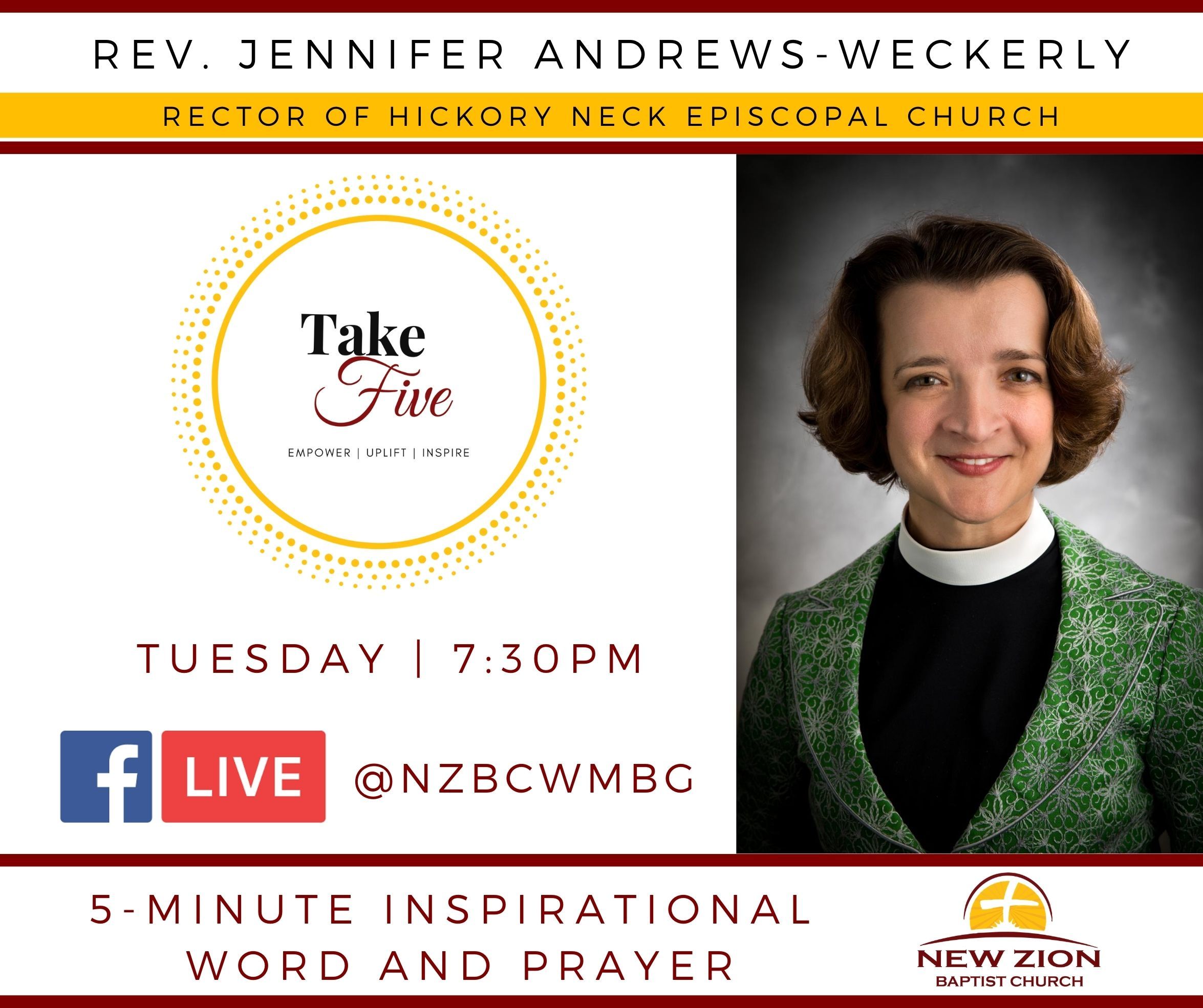
Take Five Speakers-Rev. Jennifer Andrews-WeckerlyThis reflection was offered through the livestream program called “Take Five” at New Zion Baptist Church on July 28, 2020.  This is the text from that talk.

Tonight we turn to Psalm 149, which says, “Praise the Lord.  Sing to the Lord a new song, his praise in the assembly of the saints.  Let Israel rejoice in their Maker; let the people of Zion be glad in their King.  Let them praise his name with dancing and make music to him with tambourine and harp.  For the Lord takes delight in his people; he crowns the humble with victory.  Let the saints rejoice in this honor and sing for joy on their beds.”

Now I know what you may be thinking.  Really?  You want us to talk about praising God?  We’ve got a worldwide pandemic, which our country is becoming one of the worst handlers of in the world, which disproportionately is affecting people of color, and has become so politicized that we are no longer worried about the sanctity of human life, but are instead arguing about rights and the ethics of sacrificing life for some contrived greater good.  Not only that, we are in a crucible around racism, that alternatively gives us great hope for change and makes us despondent about how far we really have to go.  Add to that the emotional, spiritual, financial, and physical toll of this time, a time when we seem incapable of respecting the dignity of every human being, and you want to talk about singing to the Lord a new song?

I don’t know about you, but when I am feeling the weight of the world, and when I am longing for a word from God, an old song is usually where I return.  Every once in a while, when I slow down enough not to just to pray to God, but to actually listen to God, those old timey hymns from my childhood come back.  Their words speak to my ache, or let me wallow in my despair.  They talk about sweet, sweet Spirits, and walks through garden alone with Jesus, and balms in Gilead.  When I talk to Jesus, I want an old song.

But that is not what the psalmist says.  We are not asked to recall the old songs; we are invited to sing a new song.  In fact, seven times in the psalms, we are invited to sing a new song to the Lord.  As a fellow pastor says, “New songs of praise are appropriate for new rescues and fresh manifestations of grace.  As long as God is gracious toward us, as long as he keeps showing us his power, and wowing us with his works, it is fitting that we not just sing old songs inspired by his past grace, but also that we sing new songs about his ever-streaming, never-ceasing grace.”[i]

In this time of utter upheaval, unrest, and unevenness, two things are happening.  One, God is still moving.  The Spirit’s movement may be hard to see or hear in the cacophony of noise.  But I know in talking to New Zion’s leadership, talking to the folks at Hickory Neck Church, and talking to our neighbors here in James City County, Jesus is still moving.  I know that you are finding moments of grace, even in the darkness of this time.  I know that you are seeing shreds of hope, even in what feels like the disappointing failures of our nation.  Two, despite how comforting those old songs are, I am guessing the Holy Spirit has whispering some new songs in your ear.  You may not be sure of the words, and you may be straining to hear the tune.  But in the depths of your heart, where we fear change and we harbor anxiety, we know that only a new song can help get us out of this mess.

So, here’s the good news.  We are not on our own to birth these new songs.  Psalm 40 says, “I waited patiently for the Lord; he turned to me and heard my cry.  He lifted me out of the slimy pit, out of the mud and mire; he set my feet on a rock and gave me a firm place to stand.  He put a new song in my mouth, a hymn of praise to our God.  Many will see and fear the Lord and put their trust in him.”  God put a new song in my mouth, says the psalmist.  Not I, out of my genius, wrote a new song.  Not, I worked hard and put in the time, and out of my labor created a new song.  Not, I listened to what others were singing and sang their songs.  No, the psalmist says, God put a new song in my mouth.  Our invitation tonight is to open ourselves to that new song.  Our invitation is to concede that during this time – a time unlike anything any of us has experienced – God is providing something new – new grace and new songs (which might be even better than that old favorite).  Our invitation tonight is to sing the new song God gives us out in the world – to trust in the wisdom of the words and notes Jesus is giving us and shout them out to a world that desperately needs to hear that new song.

Let us pray.  Holy and creative God, we know that you see our suffering and our cries.  We know that you see us patiently waiting on you to lift us up out of the mud and mire, to put us on a firm place to stand.  Help us to trust that you will put a new song in our mouths – a song to give voice to your ever-streaming, never-ceasing grace.  When we finally hear your new song, help us to sing that song – help us to praise your name with dancing, and make music with tambourine and harp.  Help us to remember that when we sing your new song, we shine your light into the world, helping your transformative, life-giving love take root, and disrupt the injustice of our day.  We praise you, Lord, and we bless you, and we sing a new song with you.  Amen.

[i] David Mathis, “Sing a New Song,” May 4, 2014, as found at https://www.desiringgod.org/articles/sing-a-new-song on July 27, 2020.

Sermon – Matthew 10.40-42, P8, YA, June 28, 2020

01 Wednesday Jul 2020

Posted by jandrewsweckerly in Sermons, Uncategorized

≈ Leave a comment

Tags

Bible, Christ, covenant, disciple, God, hospitality, Jesus, love, mirror, missionary discourse, pandemic, power, presence, Sermon, vulnerability

This summer, several parishioners are participating in our 90-Day Bible Reading Challenge.  In supporting each other in our reading, one of the patterns we have noticed is the break-neck pace of reading twelve pages a day means we do not have a lot of time for traditional Bible Study – looking at the original Hebrew or Greek, discerning the historical context of the book, studying the cultural norms of the community, or even delving into the literary devices of the book.  Instead we are drinking from the fire hose of Scripture – capturing the larger narrative God’s covenantal relationship with humankind, but not indulging in the intriguing details.

With a passage like the one we hear in today’s gospel from Matthew, we could easily do the same.  There are only three verses in the text, and they are somewhat repetitive in pattern.  A quick skim brings up an old adage we have learned by heart – welcome the stranger because you may be welcoming Christ himself.  Maybe your mind immediately leapt to a time you saw Christ in a stranger.  Maybe you began thinking about the ministry of hospitality, particularly how strong that ministry is at Hickory Neck.  Maybe you even started to wonder what you could do to be more hospitable, especially during this time of social distancing.

But here’s the thing:  when we slow down our reading, we realize Jesus does not say, “whoever welcomes the stranger welcomes me.”  Jesus says, “Whoever welcomes you welcomes me…”  Often when we think of hospitality, we think of hospitality from the perspective of the host.  Whether we acknowledge the reality or not, we are people of power and privilege, and our notion of hospitality is rooted in how we can offer hospitality to others.[i]  There is nothing inherently wrong with this dynamic – in fact, our sense of obligation to offer hospitality is an answer to Jesus’ call to love neighbor.  But Jesus is not talking about offering hospitality to others from a position of power.  Instead, Jesus is inviting us to give up power and receive others’ hospitality.

If you remember, we have been in the midst of Jesus’ Missionary Discourse[ii] the last several weeks.  Jesus told the disciples to go out, without resources, to do the work of discipleship.  He warned them they would face persecution, and family members would turn against one another.  And today, as Jesus concludes his discourse, he tells them whoever welcomes them, welcomes Jesus.  So not only are the disciples to make themselves vulnerable to the hospitality of others, they will be mirroring Jesus to others.  In other words, in every moment, every interaction, every relationship, encounter, conversation, and conflict among the disciples –the disciples will be witnessing Jesus.[iii]

I do not know about you, but that is a lot of pressure.  Making oneself vulnerable is hard enough.  Making oneself vulnerable means opening up all our flaws, weaknesses, and doubts.  And now, Jesus is saying while we are vulnerable, our homes, our marriages, our workplaces, our extended families, even our friendships are windows into Christ for others.  As Debie Thomas asks, “When we know Jesus is visible in and through us at every moment…[will] we tread more lightly on the earth?  Speak less and listen more?  Reconsider our grudges and grievances?  Choose our words with greater care?  Examine our motivations more closely?”[iv]

There is a lot about this pandemic that has been absolutely awful – devastating, painful, and full of death.  But one of the things that has happened to Hickory Neck in this pandemic represents new life too.  Before we closed our buildings in March, we offered hospitality from our comfort zone – hospitality unparalleled once you walked in those doors – hospitality that made most of us join this church.  But once we moved everything online, the doors and walls of this place lowered – we went out, showing who we are and what we are about to a much broader audience.  Here in this exposed setting, we are carefully, thoughtfully, intentionally showing others what Jesus looks like.  The work is hard and scary, but the reward is great too.  In letting down our walls, we are helping people to see Christ – the same Christ who redeems us, gives us strength, and makes us whole.  But the work of discipleship is not just happening on livestream.  I see this work happening in you – as you call to check in on people in the parish you have not met before because you attend a different service, as you don a mask and attend a rally in support of our African-American brothers and sisters during this raw time, and as you have socially-distanced conversations with neighbors about the power of Christ in your life.  The promise Jesus made at the beginning of his Discourse is still lingering today.  Christ is with us always, even to the end of the age.  His promised presence will allow us to keep letting down walls and being Christ’s mirror in the world.  Our job is to take up the challenge we will hear in our dismissal today:  Go.  Receive God’s love and hospitality.  Serve the Lord as Christ’s mirror.  Amen.

[i] Debie Thomas, “Welcome the Prophet,” June 21, 2020, as found at https://www.journeywithjesus.net/lectionary-essays/current-essay on June 26, 2020.

[ii] Eugene Eung-Chun Park, “Exegetical Perspective,” Feasting on the Word, Year A, Volume 3 (Louisville:  Westminster John Knox Press, 2011), 189.

[iii] Thomas.

[iv] Thomas.

On Race, Earthquakes, and Action…

17 Wednesday Jun 2020

Posted by jandrewsweckerly in Uncategorized

≈ 2 Comments

Tags

action, African-American, beauty, blindness, compassion, complacency, confederate, earthquake, harassed, Jesus, learn, listen, love, power, protest, racism, senses, uncomfortable, value

Kehinde Wiley

Photo credit:  https://www.npr.org/2015/05/22/408558234/the-exquisite-dissonance-of-kehinde-wiley

A few years ago, the Virginia Museum of Fine Arts had an exhibit of the works of Kehinde Wiley.  I had not seen his work before, and found his pieces in the exhibit shocking to the eye.  Wiley managed to take traditional poses and settings from art history and infuse them with images of modern African-Americans.  The pieces were jarring to the senses.  As I made my way through the exhibit, it began to dawn on me why my senses were so jarred. By consistently seeing classical art featuring people with light-colored skin, I had been enculturated to expect certain images in art.  The prominence of one kind of subject also created unspoken messages about value, beauty, and power.  Wiley’s vibrant pieces were like an earthquake.  And as someone who considers herself fairly self-aware, I found myself humbled by his work, and sorrowful for my ignorance.

I think that is why I was so surprised by an experience last week.  Last Tuesday night, our family went up to Richmond to take a look at the Robert E. Lee statue and the surrounding damage to businesses and monuments.  For those of you who have not been following the story, as part of the protests about George Floyd’s death and the Black Lives Matter cause, the prominent Confederate monuments in Richmond have come under fire.  The statue of Robert E. Lee’s large stone plinth has been covered in graffiti, protesting George’s death, the treatment of African-Americans by the police, and systemic racism.  As I took in the visceral, pain-filled cries of graffiti, as I looked at pictures of black victims of police violence surrounding the statue, whose names I have prayed for over the years, as I watched families of color take pictures in front of this once pristine, but ever-controversial, statue with a new sense of pride and defiance, what I began to understand is those who are harassed and feel helpless have been begging for our compassion for a long time – cries that could no longer be ignored when staring at that powerfully altered statue.

But mostly, I mourned again for my complacency and blindness.  As a descendant of Confederate veterans, student of African-American history and politics, and pastor of a church built long before the Civil War, I know the issue of Confederate statues and monuments is sensitive.  But watching what was happening at the Robert E. Lee statue created the same feeling as Kehinde Wiley’s art work:  an earthquake for all in positions of privilege and power.  Standing there with my family, I felt like I was on unstable ground, my complicity in systemic racism exposed, and the weight of the question pressing on my chest:  what are you going to do about it?

For my brothers and sisters of color, I am sorry.  I am sorry that you have had to do the work to awaken my senses instead of doing that work myself.  For my brothers and sisters of European descent, we have work to do.  Hickory Neck Church has been posting ways for you to engage this issue – not necessarily telling you what to do, but inviting you into the position of making yourself vulnerable to listening, learning, and acting.  This is our work to do.  It is hard and uncomfortable, and this post may even make you defensive.  Please know that I am here – here to walk with you, here to encourage you, and here to hold us all to Jesus’ message of love.  What you do next will vary widely.  Maybe you can only do one small thing to start.  Our invitation is do something – and keep doing something until we find ourselves doing the work of the kingdom Jesus has desired for a long time.

IMG_8253

Photo credit:  Jennifer Andrews-Weckerly; reuse with permission only.


Sermon – Matthew 9.35-10.23, P6, YA, June 14, 2020

17 Wednesday Jun 2020

Posted by jandrewsweckerly in Sermons, Uncategorized

≈ Leave a comment

Tags

African-American, compassion, disciples, empower, God, harassed, helpless, Jesus, justice, love, mercy, police, protest, racism, rally, Sermon, Spirit, truth, witness

Last Sunday afternoon, I attended a rally in Colonial Williamsburg to renew the covenant between our Historical area police departments and the African-American community.  Established just three years ago, initiated by faith leaders in the African-American community, the covenant was established to proactively create collaborative relationships with our local police in order to prevent some of the racial divides that have occurred in other cities.  Although I was there to witness the support of the local clergy for this covenant, what I heard was the testimony of a community of people who have been harassed and feel helpless right here in our community.  Though we may have avoided some of the violence we have seen elsewhere in our country, the African-American community here in Williamsburg still feels the heel of racism pushing down on her neck.

Last week, we heard Matthew’s Great Commission, and we talked about the juxtaposition of civil unrest exploding around the issue of systemic racism and Jesus’ call to go out into the world doing works of justice, mercy, and love.  As some of the heat from protests simmered down a bit this past week, we could easily come to church today and long to turn down the heat too.  But our collect appointed for today, which you will hear later, holds our feet to the fire.  The collect says, “Keep, O Lord, your household the Church in your steadfast faith and love, that through your grace we may proclaim your truth with boldness, and minister your justice with compassion…”  Now the Collect of the Day is not just a random prayer, meant to sound good.  The Collect of the Day pulls themes from the scripture lessons appointed for the day – in essence, the Collect of the Day tries to articulate the thesis of our lessons.

After watching weeks of protests (maybe attending some yourself), hearing countless stories about unrest, reading articles or starting books about systemic racism, and praying diligently for peace, you may have come to church today hoping for some respite or reassurance.  But Jesus’ message to “Go!” from the Great Commission last week does not fade today.  Instead, Jesus’ words from Matthew’s gospel from almost 20 chapters earlier shows us our work is ever before us, beckoning us out into the world.

Years before his cross, resurrection, and ascension, we find Jesus teaching, healing, and proclaiming the good news to crowds of people.  In the midst of this work, we are told Jesus looks at the crowd and has compassion for them because they are harassed and helpless.  When Jesus sees the harassed and helpless, he does not simply fix the problem or strike down the system with godly power.  Instead, he turns to his disciples with a charge.  Jesus calls the twelve disciples by name (Simon Peter, Andrew, James, John, Philip, Bartholomew, Thomas, Matthew, James, Thaddaeus, Simon, and Judas), those who have been following him, learning from him, studying and praying with him, and sends them out, telling them how hard the work of showing compassion will be:  they will go without financial support, will be dependent upon the hospitality of strangers – some of whom will show them scorn rather than hospitality, will be persecuted and beaten, and will be betrayed even by their closest relatives.  This is the sobering work of love – of proclaiming God’s truth with boldness, and ministering God’s justice with compassion.

So how do the disciples hear such a sobering commission and still take the first step?  They take the first step because Jesus empowers the disciples.  Jesus gives the disciples power to heal and care for the oppressed; Jesus teaches them how to dust off their feet when they are scorned; Jesus promises when they need words, the Spirit of God will speak through them.  In other words, they just need to go, and God will take care of the rest.

Several of you have reached out to me over these last two weeks, longing for something to do in the midst of this important moment.  We have exchanged ideas and resources, and many of you have already begun to take specific action.  The content of how we respond in the coming weeks and months will vary widely, given our different gifts and abilities.  But our Collect today is not a prayer asking God to empower others to do the work of love or for God to just “fix it.”  Our Collect today is a request to God to help each one of us – called by name (Sue, John, Linda, Bob, Lisa, Bill, Tori, Don, Terri, Jim, Beth, and Dave) – to proclaim God’s truth with boldness, and minister God’s justice with compassion.  Jesus has already given us everything we need to do this work.  God is already keeping us in God’s steadfast faith and love; through God’s grace we can proclaim God’s truth with boldness, and minister God’s justice with compassion.  Amen.

Sermon – Matthew 28.16-20, TS, YA, June 7, 2020

17 Wednesday Jun 2020

Posted by jandrewsweckerly in Sermons, Uncategorized

≈ Leave a comment

Tags

Christian, connect, Coronavirus, danger, disciples, engage, Episcopal, God, Great Commission, Jesus, love, pandemic, protest, relationship, Sermon, witness

We have had a week.  For most of us, the Coronavirus alone would be enough – the suffering of those infected, the over 100,000 deaths in our country from the virus, the economic hardship on our communities, and the chafing reality of staying distanced from one another.  But in the midst of a pandemic, our country has also exploded with civil unrest as we grapple with the death of another man of color under the hands of a police officer.  We have witnessed daily peaceful protests, violent, destructive rioting, unsettling debates about the extent of national executive power over state’s rights, renewed conversations about systemic racism, and vivid images of police officers and National Guard members trying to balance their genuine support for the content of the protests with needing to keep crowds safe.  And whether he meant to our not, by the aggressive clearing of peaceful protesters in order to take a photograph in front of an Episcopal Church with a Bible in hand, our President has forced Episcopalians and all Christians to take a hard look at what being a Christian means and what Christian witness looks like.  Like I said, it has been a week.

At the end of a week like this, I had been hoping for a comforting word from scripture – maybe something about the Good Shepherd, or some pastoral scene of Jesus gathered in loving community.  Instead, our gospel lesson today from Matthew is the Great Commission – the very last words of Matthew’s gospel – which are not words of comfort and rest, but words of sending out.  Jesus says, “Go therefore and make disciples of all nations, baptizing them in the name of the Father and of the Son and of the Holy Spirit, and teaching them to obey everything that I have commanded you.”  These are not words of retreat and rest.  In these last words of Jesus, Jesus sends us out into the world, encourages us to do work that requires relationship-building, listening, and teaching.[i]  These are words of engagement, witness, and connection.

I do not know about you, but I was not ready to hear these words today.  The idea of venturing out in public still feels fraught with danger in this time of pandemic.  The idea of witnessing Christ’s love, particularly with our brothers and sisters of color, feels fraught with danger because of the volatility and justified anger of many of the protestors.  The idea of relationship building required in the act of “making disciples” feels fraught with hypocrisy as our brothers and sisters of color remind us how deeply our own racism runs.  When Jesus says, “Go!” to us today, I find myself hesitating at the door.  Go how?  Go where?  Go to whom?

So how do we go?  The good news is that Jesus tells us how we will go.  After the words of the Great Commission, Jesus says, “And remember, I am with you always, to the end of the age.”  We can cross that threshold because Jesus is with us – always – to the end of the age.  And where shall we go?  Jesus says we should go to all the nations.  In other words, everyone needs God’s message of love and hope.  The good news today is going to the nations is, surprisingly, still possible.  Even in this pandemic’s limitations on our movement, we can still share God’s love – in our prayers from home, in our words to our neighbors, in our letters to elected officials, in our public witness on social media, and in our calls of support to police officers trying to do the work of reconciliation in their own sphere.  And to whom shall we go?  To our neighbors of color who need our support, to our political opponents (and yes, I recognize those opponents are different for each of us) who need us to stay engaged in honest, calm, productive relationship, to our political allies, who need us to not be an echo chamber, but need us to hold up a mirror to ensure we are actually sharing truth with love.

I know many of you may be thinking, “I can’t.  Even with Jesus’ promise to be with me, I just can’t.  It’s too hard.”  But here’s what I can tell you:  you already are.  I watched this week as over twenty parishioners reclaimed the gospel message of love on the front porch of our historic chapel.  I watched this week as many of you offered up your prayers – for peace, for understanding, for love.  I watched this week as many of you joined peaceful protests – witnessing Christ’s love for all.  I watched this week as many of you searched for reading materials – whether you were looking for books and articles about race, or whether you were ordering your Bibles to join in our 90-day Bible Reading Challenge, looking for ways to hone your ability to make disciples, to build relationships.  Jesus’ Great Commission today may feel like more work instead of the salve you were hoping for today.  But I can tell you the fact that you are already living the Great Commission in your own way, with your own gifts, and your own abilities, is your salve today.  Keep going.  Keep building relationships.  Keep witnessing God’s love.  It’s not too hard – because Jesus is with you always, even to the end of the age.  Amen.

[i] Thomas G. Long, Matthew (Louisville: Westminster John Knox Press, 1997), 326.

On Glimpses of Love…

20 Wednesday May 2020

Posted by jandrewsweckerly in Uncategorized

≈ Leave a comment

Tags

children, conflict, crisis, fight, fragile, frustration, God, grace, humanity, love, mercy, pandemic

822890

Photo credit:  https://www.dayspring.org.uk/Articles/490488/Dayspring_Church/Community/Sundays/Walking_in_the.aspx

It finally happened.  We had established a weekly routine for this bizarre time, and the kids seemed to have adjusted to the new rhythm.  But this week, something finally broke.  From sunrise to sunset the day was full of arguments, timeouts, tantrums, and tears.  For the life of me, I cannot recall the content of the conflict, but I am still recovering from the rollercoaster of emotions from that day.

Late that night, once the house was finally quiet, I tried to figure out what in the world had happened.  After my own frustration and fatigue began to settle down, a moment from the day percolated up in my mind.  During our midday quiet time, I was working diligently, trying to maximize my precious work time.  My older daughter had asked to quietly read beside me, and I had hesitantly agreed.  Soon, I realized her breathing had become regular and her booked had slipped down.  She was sleeping, something she never does midday at her age.  In that brief time, without her anger, arguments, and attitude, her peaceful face reminded me of how very fragile she is.  Just for a moment, I was able to remember that as much as our children are resilient, creative, and strong during the new reality this pandemic has created, our children are also frustrated, confused, and lost as they try to make meaning out of the chaos.  All of my anger about how the day had unfolded evaporated in that moment, and a wave of sympathy consumed me.  In seeing all of the “fight” leave my daughter’s body, I was able to see the fragile child left behind.

As I processed the day with a fellow parent that night, I began to wonder if that moment of insight is perhaps the way God sees all of us in this time.  We adults are struggling too – trying to make sense of this terrible time, trying to control the chaos enough to function, trying not to be overcome by the grief of all we have lost in this time.  Most days we succeed, being resilient, creative, and strong ourselves.  But we too have our days where we lose it – lose control over our carefully constructed hold on this new normal.  I imagine God journeys with us in those strong days and those weak days, overflowing with love for us – loving pride for the ways we are trying our best, and loving sympathy for the fragility of our humanity.  And although I only got a glimpse of that love on that rough day this week, that glimpse was just a tiny portion of the massive well of love God has for us.

I do not know what kind of week you are having.  I do not know what stressors are creating small chinks in your armor or big cracks in your façade.  I do not know whose burdens you are carrying in addition to your own.  Whether you are hitting your stride, or stumbling along the path, know that you are loved this week.  Know that God is right there with you, offering grace, mercy, and fortitude whenever you need it.  And if you have it within your capacity this week, or next, I invite you share that same love with those you encounter this week – whether with your family, the essential workers you encounter, or your neighbors.  Getting a glimpse of how God loves you makes it a lot easier to see others with God’s loving eyes.  And we could all use a dose of that love today.

← Older posts
Newer posts →

Recent Posts

  • On the Myth and Magic of Advent…
  • On Risking Failure and Facing Fear…
  • Sermon – Luke 23.33-43, P29, YC, November 23, 2025
  • On Inhabiting Gratitude…
  • Sermon – Luke 20.27-38, P27, YC, November 9, 2025

Archives

  • December 2025
  • November 2025
  • October 2025
  • September 2025
  • August 2025
  • July 2025
  • June 2025
  • March 2025
  • February 2025
  • December 2024
  • November 2024
  • October 2024
  • September 2024
  • August 2024
  • July 2024
  • June 2024
  • May 2024
  • March 2024
  • February 2024
  • January 2024
  • December 2023
  • November 2023
  • October 2023
  • September 2023
  • August 2023
  • July 2023
  • June 2023
  • May 2023
  • March 2023
  • February 2023
  • January 2023
  • December 2022
  • November 2022
  • October 2022
  • June 2022
  • May 2022
  • January 2022
  • December 2021
  • November 2021
  • October 2021
  • September 2021
  • August 2021
  • June 2021
  • May 2021
  • April 2021
  • March 2021
  • February 2021
  • January 2021
  • December 2020
  • November 2020
  • October 2020
  • September 2020
  • August 2020
  • July 2020
  • June 2020
  • May 2020
  • April 2020
  • March 2020
  • February 2020
  • January 2020
  • December 2019
  • November 2019
  • October 2019
  • September 2019
  • August 2019
  • July 2019
  • June 2019
  • May 2019
  • April 2019
  • March 2019
  • February 2019
  • January 2019
  • December 2018
  • November 2018
  • October 2018
  • September 2018
  • August 2018
  • July 2018
  • June 2018
  • May 2018
  • April 2018
  • March 2018
  • February 2018
  • January 2018
  • December 2017
  • November 2017
  • October 2017
  • September 2017
  • August 2017
  • July 2017
  • June 2017
  • May 2017
  • April 2017
  • March 2017
  • February 2017
  • January 2017
  • December 2016
  • November 2016
  • October 2016
  • September 2016
  • August 2016
  • July 2016
  • June 2016
  • May 2016
  • April 2016
  • March 2016
  • February 2016
  • January 2016
  • December 2015
  • November 2015
  • October 2015
  • September 2015
  • August 2015
  • July 2015
  • June 2015
  • May 2015
  • April 2015
  • March 2015
  • February 2015
  • January 2015
  • December 2014
  • November 2014
  • October 2014
  • September 2014
  • August 2014
  • July 2014
  • June 2014
  • April 2014
  • March 2014
  • February 2014
  • January 2014
  • December 2013
  • November 2013
  • October 2013
  • September 2013
  • August 2013
  • July 2013
  • June 2013
  • May 2013
  • April 2013
  • March 2013
  • February 2013
  • January 2013
  • December 2012
  • November 2012
  • October 2012
  • September 2012

Categories

  • reflection
  • Sermons
  • Uncategorized

Meta

  • Create account
  • Log in
  • Entries feed
  • Comments feed
  • WordPress.com

Blog at WordPress.com.

  • Subscribe Subscribed
    • Seeking and Serving
    • Join 394 other subscribers
    • Already have a WordPress.com account? Log in now.
    • Seeking and Serving
    • Subscribe Subscribed
    • Sign up
    • Log in
    • Report this content
    • View site in Reader
    • Manage subscriptions
    • Collapse this bar
 

Loading Comments...