• About

Seeking and Serving

~ seek and serve Christ in all persons

Seeking and Serving

Tag Archives: Mary

On Cellos, Love, and the Incarnation…

18 Wednesday Dec 2019

Posted by jandrewsweckerly in Uncategorized

≈ Leave a comment

Tags

awe, cello, child, Christmas, God, good, incarnation, Jesus, love, Mary, parent, wonder

cello-v4r-1483624458-editorial-long-form-0

Photo credit:  https://www.classicfm.com/discover-music/instruments/cello/

Yesterday, my elder child performed in the school’s Christmas concert.  She had been pretty excited and anxious about the concert for weeks.  They worked very hard in class, and she had been practicing daily at home.  She was determined to learn the special songs so she could play them.  Over these last months, she has asked me to sit nearby occasionally and listen; other times, I could hear the songs of the cello floating down the stairs.  But none of that prepared me for what I saw yesterday.  Yesterday, she sat tall in her chair, attentive, and calm.  Suddenly, her arms look graceful and light.  Her movements were like that of a dancer, able to beautifully coax out a tune from her curved instrument.  I was stunned by her beauty, having never fully seen it before as she plugged away at home.  My heart warmed, and was filled with love for the nimble creature – a child who certainly gives me a run for my money in fierceness, stubbornness, and independence, but also who I keep discovering I love more than I even understand.

As I have been thinking about that surge of love and awe for my child, I began to wonder if that was what Mary felt on that night Jesus was born.  Her pregnancy was so fraught.  From her bizarre conception story, to working out marital details with Joseph, to the encounter with her cousin Elizabeth, to the government’s census that forced her to travel while very pregnant, to replaying the conversation with the Angel Gabriel, knowing wondrous, awful, amazing things were to happen with her child.  Though she seemed to embrace her role fully, I sometimes wonder whether she was able to feel love for the child who had brought so much chaos to her life – at least not until she laid eyes on him.  I suspect only then, did her sense of purpose become intertwined with a sense of deep love – a sense of awe bigger than herself.

I think that is how God loves us.  At times, I suspect God, like any parent, has a wicked eye roll and has mastered a deep sigh in response to our behavior.  But I also imagine God has this deep sense of awe, wonder, and love for us – for the ways in which we can be beautiful to one another, the ways in which we use our gifts for good, and the ways in which we glorify God.  I believe the entire Incarnation is due to this deep love – a love even deeper than we experience in those fleeting moments of insight with our children and one another.  That realization is how I head into Christmas this year.  Not thinking about cute babies, or crazy birth narratives necessarily, but in humbled awe of how much God loves us.  When we catch a glimpse of that love, we do not really need anything else this Christmas.  In this last week before Christmas, I invite you to consider the best gift that is waiting for you this year.  Everything else is just trimming.

incarnation

Photo credit:  https://thefellowshipoftheking.net/2015/12/24/lovely-lady-dressed-in-blue-marys-role-in-the-incarnation/

Sermon – Luke 2.8-20, CD, YC, December 25, 2018

02 Wednesday Jan 2019

Posted by jandrewsweckerly in Sermons, Uncategorized

≈ Leave a comment

Tags

birth, chaos, Christmas, forgiveness, God, holy, incarnate, intimate, Jesus, marriage, Mary, normal, quiet, Sermon, shepherds, vows, wisdom

On Christmas Eve and Christmas Day, we split up the gospel of Luke.  On Christmas Eve we hear about the registration, and how all the families have to travel to be taxed.  That part of the story is when we learn about there being no room in the inn, and Mary giving birth, wrapping her child in bands of cloth, lying him in a manger.  But today, we get the part of the story I love.  I know the multitude of the heavenly host has inspired many a Christmas carol, but I like the very last part of the story:  the part where the shepherds have gathered with Mary, Joseph, and baby Jesus, where others gather with them to marvel at the shepherd’s story and Mary ponders everything in her heart.

I like this last part, because this last part is the most normal, intimate moment we get in the birth narrative of Jesus.  Everything else is so chaotic – people migrating, hustling for space to stay, likely arguing about who gets to stay where.  Then there is the birth of Jesus itself, not only without modern medicine, but in the roughest of conditions.  Birthing children is hard enough as is – I cannot imagine the messy, loud scene of childbirth under such conditions.  And finally, the shock of not only an angel of the Lord, but also the chorus of the heavenly host in the middle of the night where there is usually no sound is mind-blowing.

Instead, I prefer the quiet scene at the end.  That is a kind of scene I can imagine.  Of outcasts thrown together, sharing stories, bonding over the craziness of the night.  Of an exhausted mother and father and shepherds lounging around, wondering what all this means.  Of the moments of silence when everyone’s eyes settle on baby Jesus who has finally drifted off to sleep, watching his chest rise and fall, wondering what else might rise and fall because of this tiny baby.  I imagine the bonding that can only happen at three in the morning, that can only happen through a people filled with hope in a hopeless world, that can only happen when God sweeps through your life in a bold way.

That’s why I love today’s service so much.  Last night was the night of holy chaos – of kids with pent up excitement for Christmas day, of dinners being prepared, trumpets leading us in song, and the loud chatter of old friends and family greeting one another.  But today, we enter the church in quiet, with no music to distract us, perhaps having left behind piles of wrapping paper or needy family members, having turned off our radios so that we can tell the old, old story.  On Christmas Day, I like to imagine we recreate that holy, intimate night, where old friends and strangers gather around the mystery of the incarnation, wondering what Jesus has in store for us today.  All we need is a little straw and sleep deprivation, and we can almost imagine ourselves there.

That is why when Margaret and Jim asked if we could renew their wedding vows on Christmas Day, wanting something quiet and sacred to mark their sixtieth wedding anniversary, I said an emphatic, “Yes!”  Marriage is a sacred institution too – where we welcome friend and stranger alike, where we sometimes meet people who change our lives but we never see again, where we share intimate time, and where we ponder what God is doing in our lives.  So, gathering again, sixty years later, we too gather like a band of misfits, sharing stories of marriage, of Jesus, and of community.  We let down our hair and marvel at the holy mystery of God, holding holy moments of silence like gifts, and giving thanks for the God who makes sixty years possible.

The other reason I love the idea of renewing wedding vows on a day like today is because today is a day of hope.  When God incarnate comes into the world, we are given the gift of hope – the promise that life will change dramatically.  As we ponder the baby Jesus with those in that quiet room, we also slowly fill with hope, knowing that God is doing great things.  The same is true of marriage.  When I marry two people, I never know how the marriage will go.  I am hopeful that the two will get to do things like celebrate sixtieth wedding anniversaries, but honestly, hardship and separation are equally likely.  But we marry people anyway because we have hope – hope that God is doing a new thing between two people, and will make those people better through God.  As Margaret and Jim recommit themselves to one another today, we again claim hope that God will do amazing things through their marriage, bringing blessing to all of us, not just to the two of them.

Our prayers for Margaret and Jim today are not just for them.  They are for all of us.  We need wisdom and devotion in the ordering of our common lives as much as they do.  We need to recognize and acknowledge our fault when we hurt others, and seek forgiveness of others just as they do.  We need to make our lives a sign of Christ’s love to this sinful and broken world, and reach out in love and concern for others as much as they do.  All of that ordering of our lives is made possible by what happens today.  When God becomes incarnate in Christ, everything changes.  In that intimate space where strangers, exhausted, afraid, and full of hope, came together in the mystery of a miracle, life is changed.  Our gathering here today, to honor the incarnation, to celebrate the blessing of long marriage, and to create a sacred moment of intimate community, is the way we take the first step in living life differently – living a life of sacred incarnation.  Thanks be to the God who showed us the way in the incarnation of God’s only, begotten Son.  Amen.

Homily – Luke 2.8-20, Blue Christmas, December 21, 2018

02 Wednesday Jan 2019

Posted by jandrewsweckerly in Sermons

≈ Leave a comment

Tags

angels, Blue Christmas, Christmas, hope, Jesus, joy, life, light, Mary, peace, rest, sad, Sermon, shepherds, slow, weary

One of the Christmas songs we do not sing tonight is “It Came Upon a Midnight Clear.”  Up until this year, I was mostly familiar with the first verse, which says, “Peace on the earth, good will to men,” and “The world in solemn stillness lay to hear the angels sing.”  Those words have always felt more like an aspiration than my reality.  I do not know about you, but the holidays are rarely a time of stillness and peace for me.

But this year, I stumbled on a verse of this song that is not in our hymnal.  The verse says, “And you, beneath life’s crushing load, whose forms are bending low, who toil along the climbing way with painful steps and slow; look now, for glad and golden hours come swiftly on the wing; oh, rest beside the weary road and hear the angels sing!”

One of the challenges about Christmas is that we can sometimes lose our place.  When we listen to the old carols, we either hear songs of peaceful silence or we hear songs of beautiful, glorious praise.  The same is true of our secular experiences of Christmas.  We are filled with retouched nostalgic memories, with songs that tell us we should be rockin’ around Christmas trees, or cozying up with loved ones.  But sometimes Christmas is none of those things.  Instead Christmas is a time when the gap between our reality and the projection of all the things we should be feeling grows ever wider.

I think that is why I was captivated by this extra verse of “It Came Upon a Midnight Clear.”  “And you, beneath life’s crushing load, whose forms are bending low, who toil along the climbing way with painful steps and slow; look now, for glad and golden hours come swiftly on the wing; oh, rest beside the weary road and hear the angels sing!”  Suddenly, the otherworldliness of the angels are there for us too.  Whether life feels like a crushing load, whether your daily toil is bringing you down, or whether you are just weary, the song invites us rest by the weary road – because the angels have a song for us too.

I used to serve at a church where Christmas was the pinnacle of events.  Families would wear evening gowns and tuxedos to church, they would send their servants to reserve rows of seats, and the coat rack was full of fur coats.  Christmas was another soiree in their perfectly formed lives, and church was host of their glamorous party.  But what always amused me about that experience was the contrast between their polished, perfect lives, and the rustic, imperfect story of the angels and shepherds.  I wondered if they understood the ironic contrast of their experience and scripture’s experience.  What did they know of being crushed beneath life’s load, the toil of taking painful, slow steps, and the weary road?

Not until many years later did I realize that the weariness of life can infect anyone.  Those in tuxedos and evening gowns were struggling with broken marriages, estranged family members, and the grief of death as much as someone gathered in a candlelit historic chapel.  Those whose servants went to reserve a seat in church were just as lonely, unfulfilled, and afraid as those who are servants.  Those whose fur coats lined the coat racks were experiencing a sense of failure, a lack of fulfillment, and a longing for meaning as much as someone slipping quietly into a service like tonight.  Weariness affects the donkey who carries a pregnant Mary; the shepherds who keep watch all night; the innkeeper who feels pulled in many directions with no vacancies to accommodate need; with Josephs who are on a path they did not choose, but who feel obligated to be faithful; and with Marys who say yes and hold hope, even though the dread of impending suffering is almost palpable.[i]

You see the angels came not to a perfect world, to a perfect people, delivering perfectly good news.  The angles came to a weary world, with weary people, delivering good news that would not dismiss our weariness, but relieve our weariness.  That is why I love this service so much.  I love our Blue Christmas service because Christmas is all about a wearied people, with a crushing load, with painful steps, welcoming a savior who gives us hope that we will not be weary forever, that God will walk our weary roads alongside us.

On this night, I share this blessing for all of us:  “May the world slow down enough this season for you to catch a glimpse of a star in the sky and a light on the horizon.  May the earth pause enough for you to catch the faint sound of a baby’s cry on the wind and the song of the angels through the trees.  May the slow time of Christmas night bring joy to you, and hope, and light, and more than anything else, rest to your waiting spirit.  All you, beneath life’s crushing load, whose forms are bending low, who toil along the climbing way with painful steps and slow; look now, for glad and golden hours come swiftly on the wing; oh, rest beside the weary road and hear the angels sing!”[ii]  Amen.

[i] Melissa Bills, “All This Weary World,” December 18, 2018, as found at https://youngclergywomen.org/all-this-weary-world/ on December 18, 2018.

[ii] Bills.

Homily – Mark 11.1-11, 14.1-15.47, PS, YB, March 25, 2018

28 Wednesday Mar 2018

Posted by jandrewsweckerly in Sermons, Uncategorized

≈ Leave a comment

Tags

complicit, God, Holy Week, homily, Jesus, love, Mary, Palm Sunday, participate, physicality, relationship, senses, Sermon, silence, sin, tomb, uncomfortable, visceral

When I did my AmeriCorps year of service at a food bank in North Carolina, the warehouse manager was from Liberia.  Eugene and I talked about a lot of things, but one favorite topic was the church.  When Holy Week rolled around, I remember Eugene telling me about Good Friday in Liberia.  On the way to church on Good Friday in Liberia, the children lead a procession.  The children carry an effigy of Jesus, and all the children take turns flogging the effigy of Jesus all the way to the church.  I remember being mortified when I learned about this tradition, wondering who in their right mind would invite children to participate in worship in such a gruesome, grotesque way.

The weird thing is, this mortifying tradition is not all that dissimilar to the physicality of our own worship today.  Today, we invite everyone to vigorously wave palms hailing Jesus Christ the king; then we have voices from our parishioners narrate the text, sometimes taking roles of people like Judas, Pilate, or denying Peter; and if that were not bad enough, then we put the words, “Crucify him!” in bold in our bulletins, reminding everyone to shout the words together.  The practice is so visceral that I often notice many people resist participating.  I cannot tell you how many photos I had to scroll through to find a good Hickory Neck Palm Sunday processional photo this year.  In what is supposed to be replica of joyously welcoming the Messiah, Hickory Neck-ers rarely take more than one palm, we hold them upright so as not to seem too zealous, and forget about a smile or look of excited victory.  I do not know if we feel silly or if we know all too well what comes next so we resist, but we struggle to engage in even the joyful part of today’s liturgy.

And I have rarely found an Episcopal Church anywhere who wholeheartedly joins in the chant, “Crucify him!”  We are so uncomfortable with that part of the liturgy.  More often people do not say the words at all, or they embarrassingly mumble the words.  Sometimes I see people tense up if those beside them enthusiastically participate too much.

Our resistance is futile though.  As if we hesitantly wave palms, or if we stay silent while the crowd demands we crucify Christ, we somehow avoid complicity with this humiliating atrocity.  But we are complicit with sin every day, in the most heinous ways.  We are complicit as our neighbors decide between housing, health care, and child care costs.  We are complicit as racism creates separate, unequal experiences for our citizens.  We are complicit as our God invites into a new way and we say “no.”

That is why the church offers us this very tactile, primal service today.  We wave the palms with fervor today because we remember the ways in which we see in part – the ways in which we manage to follow Christ, even if we do not understand what Christ is doing, even if we do not catch how Jesus inverts his triumphal entry on the back of a young donkey.  We fully participate in the words of today’s passion in order to remind us to “stop abusing the image of God revealed in the dignity of every human being.”[i]  And then we let those final words soak in today, as we stand with Mary Magdalene and Mary the mother of Joses, silently at the tomb, seeing where Christ’s body is laid.

What we do in worship today is actually the perfect entry into this most Holy Week in Church.  Now some priests will tell you that we combine the liturgy of the palms with the passion narrative today because the designers of the Prayer Book knew that many of you would come on Palm Sunday, skip the days of worship during Holy Week, and then show up on Easter Sunday without having walked from this triumphal entry into Jerusalem through the cross and tomb.  And maybe they were right (though I know most of you rearranged your schedules this week for Holy Week services).  But more importantly, even if you walk through this journey with Christ this week, the reason we pair the Palms with the Passion is that we could never go from the Palms to the Resurrection without the connection to the cross.  The triumphal entry into Jerusalem makes no sense without the cross; the irony of that festive procession only makes sense when you are standing silently and bleakly at the tomb.

I know today is uncomfortable.  I know today is confusing, and oddly visceral, and may even be a bit overwhelming.  But today, and perhaps all this week if you are able to join us, allow the senses to take over.  Allow the sights, and smells, and touches, and sounds, and tastes to overwhelm you this week.  Allow the ache of standing with Mary Magdalene and Mary the mother of Joses to sink deep into the same body that has waved palms and shouted awful things today.  Because only when our senses are that overwhelmed are we able to see that the cross is not about suffering and death, but rather is about a relationship that holds.  Only then will we find a “love stronger than death, that can withstand whatever the forces of evil do against [love], and that can hold suffering even as [love] struggles to alleviate [suffering].”[ii]  What feels like an empty, guilty ache today instead becomes a sign of how God overcomes terror, enfolds us in Life, and dwells with us forever.[iii]  But until then, stand with the Marys and with one another at the tomb in silence.

[i] Michael Battle, “Pastoral Perspective,” Feasting on the Word, Year B, Vol. 2 (Louisville:  Westminster John Knox Press, 2008), 182.

[ii] Margaret A. Farley, “Theological Perspective,” Feasting on the Word, Year B, Vol. 2 (Louisville:  Westminster John Knox Press, 2008), 182.

[iii] Farley, 184.

On Making Mary Moments…

31 Wednesday Jan 2018

Posted by jandrewsweckerly in Uncategorized

≈ 2 Comments

Tags

beauty, closure, death, goodbye, grandmother, holy, Jesus, journey, Martha, Mary, meaningful, presence, sit, visit

IMG_9482

Photo Credit:  Jennifer Andrews-Weckerly, January 26, 2018

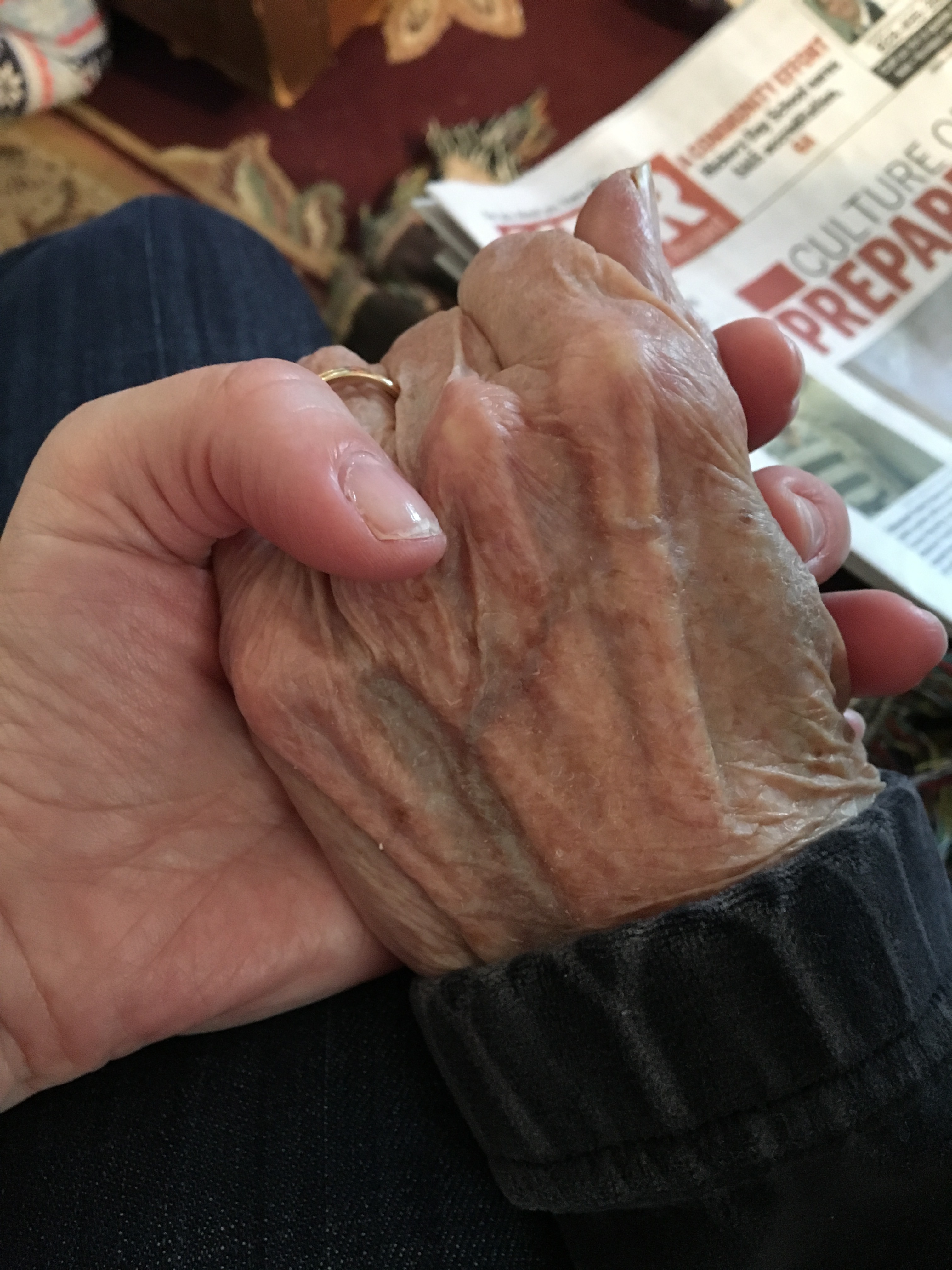
Over a week ago, I received a call that my grandmother was approaching death.  The suggestion was if I wanted a last visit, I should come sooner rather than later.  Looking at the week ahead, I realized I could go with my children last weekend with minimal impact to their school schedule or my own work obligations.  I was not sure what to expect – whether I would be able to have meaningful conversation or even eye contact with her, or especially how my three- and eight-year olds would respond to her in her current state.  At some point, a family member pastorally suggested I not come, knowing how hard such a long journey for such a brief visit would be.  But something kept pushing me to go, even if the journey seemed fraught with potential difficulty.

There were things that did not happen.  We did not have one last, long, meaningful conversation as I had with my other grandmother.  My grandmother was much too weak and her thoughts much too confused to answer any of my lingering questions about our family.  My children did not get to interact with my grandmother extensively.  They had beautiful moments of tenderness with her, and they played nearby, but they also needed to be kids and move.  I did not leave with a sense of real closure.  No one really knows how long she will be able to thrive.

What did happen was a much clearer understanding of why Mary chose to sit at Jesus’ feet, while her sister Martha busied herself with the duties of the home.  For full confession’s sake, I am much more like Martha most days – I am always washing one more dish or finishing one more piece of laundry instead of playing with my kids or hanging out with my husband.  But sitting beside my grandmother, holding her hand, realizing all the things I was not getting, I came to see the beauty of presence.  I do not think I have ever just been still with my grandmother.  I have never looked into her eyes for an extended period of time without saying anything.  I am pretty sure I have never just held her hand.  In the midst of all that could not be said, I felt a different kind of closure.  I could finally see in my larger-than-life grandmother her vulnerability, her desire to love, her humanity.

I left my grandmother last weekend wondering if I might be able to create more space for Mary-type moments in everyday life.  Whether I might put my phone away more often at home and be more present with my family.  How I might stop worrying about my to-do list, and spend more open time with our staff and parishioners.   Whether I might write that note to a suffering friend instead of letting the thought pass.  What Mary-type moments have been missing in your life lately?  When was the last time you sat at the feet of Jesus, or sat at the feet of the holy in others, and stayed for a while?  What might you need to do this week to find your own Mary moment?  I look forward to hearing about your reflections.

Sermon – Luke 2.8-20, CD, YB, December 25, 2017

10 Wednesday Jan 2018

Posted by jandrewsweckerly in Sermons, Uncategorized

≈ Leave a comment

Tags

birth, Christ, Christmas, contemplate, God, incarnate, Mary, miracle, ponder, quiet, sacred, Sermon, silence, wonder

Eight years ago, while serving as a curate in my first position out of seminary, I experienced Christmas Day worship for the first time.  Though I had often gone to Christmas Eve services before ordination, I suppose it never occurred to me to go to church on Christmas Day.  I was probably still in my pajamas or on the road to see family.  So imagine my surprise when the Rector told me there would be no music at the Christmas Day service.  I was shocked!  After all this time, patiently waiting through Advent music, on the actual day of Christmas, we were not going to hear any music?!?  I threw what some might consider a bit of a temper tantrum, and was told I should talk to the people who normally go to Christmas Day services.

Of course, my Rector knew what she was talking about.  As I talked to Christmas Day attendees, I discovered one universal truth:  they loved the spoken Christmas Day service.  First, they all went to a Christmas Eve service, so they got their carols fix the night before.  Second, they loved the quiet respite in an otherwise chaotic day.  A quiet service on Christmas Day was a godsend.  And third, they loved the Christmas Day service because it was a small, intimate service of what they called the “faithful;” much like what happens when you throw a party at your home and everyone but your close friends go home at the end of the night.  You kick off your shoes, find a warm beverage, and enter into quiet, meaningful conversation with your friends.  Music, in those parishioners’ minds, would have hindered the intimate, contemplative, peaceful vibe they loved.

In a lot of ways, having a quiet Christmas Day service is like taking a cue from Mary in our gospel lesson today.  After the chaos of travel and birthing a child in less than ideal accommodations, after shepherds have seen blinding lights and hear the triumphant chorus of the multitude of heavenly host, when everything quietens down, all that is left is a mother, father, and child, and some shepherds who seem like old friends.  I have always imagined the shepherds bursting through the doors, talking on top of each other to tell the story of the angels.  But I wonder if perhaps the scene was a little different.  Knowing full well the baby has arrived in less than ideal circumstances, and that babies are notorious for crying when disturbed, maybe the shepherds were whispering their intimate tale to the holy family.  Maybe they were those gathered at the end of the party, sharing in quiet, meaningful conversation.

I wonder if this might be true because we get one short line about Mary at the end of our text today, “But Mary treasured all these words and pondered them in her heart.”  Exhausted, fatigued, weary Mary takes the enormity of what has happened:  to her, when Gabriel came to her; with Elizabeth, who further revealed the angel’s proclamation; with Joseph, as he shared his own angelic story; and now with the shepherds who tell of yet another angelic encounter.  Mary takes all the bits of information – all the encounters she is privy to – and ponders them.  She takes a personal moment to sit quietly in the enormity of it all to ponder.  In some ways, she is a mother like anyone else – one who has carried a child in her womb with all the normal doubts and concerns that come from every ache, pain, and discomfort.  But in other ways, she is nothing like other mothers.  She is an instrument – pregnant without her own doing, carrying a child who will be bigger than anything before, and mothering someone who will never fully belong to her, but to the greater world he will soon save.

The funny thing is, pondering is an activity that would hardly ever make an appearance on our Christmas to-do lists.  We have been scurrying about this past month:  decorating homes, sending cards, attending parties, planning liturgies, hosting guests or finding hostess gifts.  We have either been caught up in the joy of the season, reveling in the 24-7 Christmas radio stations, or maybe we have been lost in our grief of all that is not this Christmas season.  Regardless of whether you are off to a Christmas celebration with twenty or more people, or having a quiet day alone or with one other, there is likely to be little true quiet:  our minds are way too noisy for quiet today.

And yet, quiet pondering is exactly what Mary does today.  She takes all the noise and chaos – both outward and inward – and she pauses for pondering.  She hits the pause button on the movie called life, takes a deep breath, and drinks in the miracle of Christ’s birth.  She stops talking, turns off her internal conversation, and listens.  She makes room for God in that rustic, foreign room, with people who are not her own, letting her body and soul contemplate the enormity of the nativity:  God incarnate; Messiah arrived; Eternal life made possible.  The wonder of that moment is enough to silence Mary, giving her much to ponder.

That is our invitation today too.  I know today is the least likely day for a moment of wonder, pondering, and contemplation.  But you are here.  You took a moment away from whatever today will be to sit at the manger with Mary and ponder.  Drink in the miracle of Christ’s birth, the gift of God incarnate.  Stand before our God in holy quiet and reverence as we pray and eat a different meal.  Remember “how God became one of us, remember how Christ still joins us at the Table, remember how we are fed by him in order that we might live as his body in the world.”[i]  These kinds of sacred moments are so rare in life.  Receive the gift of pondering at the manger with Mary today, and take that quiet out into the world with you, giving your heart the gift of true celebration and joy.  Amen.

[i] Kimberly Bracken Long, “Homiletical Perspective,” Feasting on the Word, Yr. B, Vol. 1 (Louisville:  Westminster John Knox Press, 2008), 121.

On Finding a Hand…

20 Wednesday Dec 2017

Posted by jandrewsweckerly in Uncategorized

≈ Leave a comment

Tags

Blue Christmas, broken, Christmas, church, grief, hand, joy, loneliness, Mary, sadness, sorrow, walk, winter solstice

stock-old-couple-holding-hands-wintersmall1

Photo credit:  https://sinceileft.com/2014/06/11/118/

Tomorrow night is the longest night of the calendar year in the northern hemisphere – the winter solstice, when the earth reminds us how little light these days have.  We mark the longest night at our church with a service called Blue Christmas, acknowledging the ways in which Christmas can also be devoid of light for many of us.  For some, the reasons are obvious:  grief over the loss of a loved one, broken marriages or other relationships, illness, or loneliness.  For others, the reasons are a bit more ambiguous:  a recognition that the world around you seems filled with happiness, and yet, there is a dull sadness or pain aching inside that is oddly out of place.

What is interesting about the Blue Christmas service is that there are years when I feel like I really need the service, and there are years that I do not realize how much I needed it until I am there.  I think that is because there is a way in which our culture romanticizes Christmas, creating inevitable shortcomings.  Even when you are happy, have created the perfect meal, are enjoying a long-held tradition, there is someone who is not there, some hurt that is not addressed, some bit of life that is unresolved.  All of that is true most days – but the expectations of Christmas are unrealistic that cannot be met fully.

I think that is why I cling to Mary so much this time of year.  Mary always lived in a world of joy and sorrow, of blessings and curses.  The news of her pregnancy made her shout for joy, but also reminded her of how broken the world was to need such a savior.  The joy she experienced of new birth was matched by the promise of sacrificial death.  Mary lived in the “both-and;” the ambiguity always present in life.  I like to suppose she cherished the joys as much as she could:  the joys of a baby kicking in her womb, even as the neighbors stared and judged her unwedded state; the thrill of holding a new baby, even in the most rustic of accommodations; the miracle of new life, even if the miracle can only really happen in his death.  It is in times like this time of year I long to hold Mary’s hand and walk with her for a while.

If you need a place to put your messy feelings this year, or you need a Mary to walk with you, I invite you to join us for our Blue Christmas service.  But if you cannot make it tomorrow, know that Hickory Neck is a place that always has an open hand, ready to walk with you whatever the time of year is, and whatever you are facing.  You are not alone.

Sermon – John 20.1-18, ED, YA, April 16, 2017

27 Thursday Apr 2017

Posted by jandrewsweckerly in Sermons, Uncategorized

≈ Leave a comment

Tags

affirmation, belonging, call, church, clarity, despair, Easter, Good Shepherd, grief, identity, Jesus, love, Mary, name, purpose, Sermon

Every generation has a baby name that is popular.  In my generation, that name was Jennifer.  As I was growing up, every grade had tons of Jennifers.  I became quite accustomed to the experience of eagerly looking up when someone called my name, only to be disappointed to see they were calling out to someone else.  The name was so common that by the time I got to college, I learned to ignore people calling out my name because more likely than not, they were not actually calling me.  They were calling one of the other twenty Jennifers nearby.  Although the practice helped me save face, the practice was a bit of a hindrance when someone actually was trying to get my attention.

The solution, of course, was a nickname – something to distinguish me from the sea of other Jennifers.  So in college, most of my buddies just started calling me “Andrews.”  It may sound silly, but having a name that was distinct, that when called, I knew I could answer, gave me a sense of belonging and identity.  When someone shouted, “Andrews” across the quad, I knew a friendly face would be looking for me when I raised my eyes.  Though seemingly simple, that nickname made me feel known, especially at a time when everyone is trying to figure out their new identity, where they belong, and who they will be.

I suspect that Mary was the common name in Jesus’ generation.  All we need to do is read through the New Testament to know that there are more Marys than we can count.  Sometimes I even have to look back when I come across a Mary to be sure I am thinking of the right one.  So when Jesus calls Mary Magdalene by name, I imagine there must have been some way she knows not only that this is Jesus, but also that he is talking to her.

Easter morning has been a rough morning for Mary.  She comes in the tomb before the first light of dawn has broken.  She is probably still a bit bleary eyed – that kind of haze one has in the days after a death of a beloved one.  She comes to halt before she gets all the way to the tomb though.  The stone that is supposed to be covering the tomb, protecting Jesus’ body, is gone.  Before even going in to assess the situation, Mary runs – runs hard to find the disciples, demanding that they get up and help her.  Two of them, the beloved disciple and Peter, sprint ahead of Mary.  She is too tired from her first run to keep up.  By the time she reaches the tomb, the two disciples are already stepping out of the tomb, Peter looking perplexed and the other disciple with an enigmatic smile.  And without so much as a word to her, they leave – just like they left Jesus on that fateful day.[i]  Mary, overcome with the memories of Jesus’ crucifixion and the continued emotion of this morning, breaks into tears.  When she finally checks inside the tomb herself, she not only sees two angels, she also has an encounter with a supposed gardener.  Frustrated by their insensitive questions, she exasperatedly asks the gardener to just tell her where the body is.

That is when the big news today happens.  The supposed gardener calls her by name.  Not the common name that everyone has.  The supposed gardener calls her by the name that only Jesus calls her.  The haze dissipates.  The tears halt.  The cloud of despair vanishes.  And she calls Jesus by the name that only a few call him, “Rabbouni!”  This is a tremendous moment in our text today.  In the flurry of running, and confusion, and questions, and tears, and despair, two people see each other crystal clearly.  Mary is called by her name – Jesus communicates to Mary that she is known, the she is beloved, that she has an identity and a purpose unique to her.  She is his sheep who knows and recognizes the voice of the shepherd – the Good Shepherd.[ii]  Her relief is palpable.  The return of her confidence is immediate.  Her sense of celebration is ready to explode!

When I was in high school, I had a summer where I attended both a short conference and then a long summer program.  Both were residential.  The conference was the Hugh O’Brian Youth Leadership conference, or HOBY for short.  I made a few fast friends, but was there just a few days.  A week or so later, I was off to a six-week residential program.  It was my first time staying away from home that long, and I was admittedly a bit nervous since no one else from my high school was going.  After I unloaded my bags, and was getting ready to say goodbye to my parents, someone behind my shouted, “Hey, HOBY!”  Without even looking at who it was, I knew I did not need to worry about belonging.  I was already known here.  I had a place here.  I could have a purpose for those six weeks.

We have all had those moments of clarity around identity, belonging, and purpose.  Whether we are returning to our home town after a long time away, whether we develop good friends at school or in a civic group, and whether that happens at a reunion, we all know the deep, profoundly affirming feeling that comes from being known.  For those of you with a church home, and especially for those of you who have found a home here at Hickory Neck, you most likely found that feeling here.  Perhaps the liturgy was what brought you a sense of identity – either the liturgy reminded you of a practice from your earlier life, or the liturgy offered something to you that you did not even know you were missing.  Perhaps a ministry at church brought you a sense of identity – those little sacred moments that come when you realize that you are actually really good at inspiring people to serve the world, making beautiful music, or teaching children about the love of God.  Or perhaps the community brought you a sense of identity – that first time when someone remembered your name or a part of your story, when someone came to you for expert advice, or when someone knew just by looking at you that you were hurting – and then offered to take you to lunch or coffee.  The church is a place where both Christ and the community call you by name.

Now I would love to tell you that the wonderfully affirming and life-giving feeling of being known is an end unto itself.  I would love to send you home on this beautiful Easter Day with simply a sense of love and affirmation.  And that is certainly part of the gift I am giving you today – to tell you that you can be known and loved here.  But something else happens to Mary at that tomb.  After that profound moment of affirmation, Jesus tells her to go and be a witness to the disciples.  Jesus always gives his beloved homework.  He is that teacher that even on a Friday will give you an assignment for the weekend!  But Mary does not see this as a burden.  Even though Jesus will not let her cling to him – cling to the way things used to be, Jesus’ affirmation this day propels her to go out and share the good news of the risen Lord with the disciples.  In this way, Jesus not only recognizes and honors her identity; Jesus also gives her purpose – a call.

That is your homework on this Easter Sunday.  I know you want to go eat those big Easter meals ,go find those Easter eggs, and find what Easter chocolate awaits at home.  But remember that while this place is a place that calls you by name and affirms your beautiful identity, this is also a place that commissions you to go out and share the good news.  That wonderful sense of affirmation is not for you to bottle up and keep for yourself.  That sense of affirmation is meant to embolden you to share that affirmation with others – to meet people where they are, to hear their stories, and to share how this day of resurrection, love, and affirmation is for them too.  In the same way that you have a vocation, a call on your life, you also are to affirm vocation and call in others.  So this week, as you bask in the warmth and beauty of this day, go out and share that good news with others.  Someone may be waiting for you to call them by name.  Amen.

[i] Richard B. Hays, “Do Not Cling to Me,” Christian Century, vol. 109, no. 10, March 18-25, 1992, 299.

[ii] Karoline M. Lewis, John:  Fortress Biblical Preaching Commentaries (Minneapolis:  Fortress Press, 2014), 241.

Homily – Luke 2.15-21, Holy Name, YA, January 1, 2017

05 Thursday Jan 2017

Posted by jandrewsweckerly in Sermons, Uncategorized

≈ Leave a comment

Tags

alone, community, dependence, elders, Good News, Holy Name, homily, independence, Jesus, Joseph, Mary, need, share, shepherds

Our gospel today picks up where we left off a little over a week ago.  On Christmas Eve, we heard how Mary and Joseph journeyed to Bethlehem to be registered.  We learned of how there was no room for them in the inn, and how they ended up delivering little Jesus, the savior of the world, in a room designated for animals.  Exhausted, they placed him in a manger, in bands of cloth, making the best of an awful situation.  We also learned of some unsuspecting shepherds who experienced an angelic encounter.  An angel appeared to them in the fields and told them of the messiah who had been born, where they could find the messiah, and what they could look for – that manger and those bands of cloth.

Today we pick up where we left off.  The angels leave, and the shepherds decide to check out the story.  They visit with Mary and Joseph, confirm the story, and then share their experience with the tired couple.  We are told Mary treasures the words, but ponders them too.  She is clearly still figuring all this out.  Meanwhile, the shepherds go back to work, praising God.  And Mary and Joseph go back to work too – following the circumcision customs, but perhaps, more importantly, following through with what they were asked to do – naming Jesus as the Angel commanded.[i]

What I love about this story is that no one acts alone.  Mary gets the bizarre news of her pregnancy alone, but then her cousin Elizabeth affirms her and confirms the good news.  Shepherds are minding their business when the angels appear to them.  They could have stayed at home that night, but they go and share the news.  Mary and Joseph go on a scary journey that seems to be making one bad turn after another.  But then shepherds come and give them a good word.  Even the naming of Jesus takes place in community – at least a rabbi or priest comes and performs the naming right, knowingly or not, naming the child the same name the angel gave Mary – Jesus, or “Joshua, meaning salvation”[ii].

Going at things alone is part of our contemporary mindset.  We place a value on people being able to fend for themselves.  The number one goal of parents is to teach their children independence.  And Lord knows we hear a lot of, “I do it by myself!” at our house these days.  In and of itself, independence is not a bad thing.  We have gifts and talents of which God expects us to be good stewards.  But going at life alone can have the opposite effect of what we think.  By glorifying independence we forget the inherent dependence we all have.  If nothing else, we are certainly dependent upon our Lord and Savior, without whom nothing would be possible.  But Jesus teaches us that community is equally important.  Jesus was never a lone ranger in his ministry. He understood the people of faith to be a community – to need each other for learning and understanding.  Unlike what the world might have us believe, life is not all about independence.  Quite the opposite, we need each other in this crazy journey of faith – to learn from each other, to challenge each other, to support each other, and cheer each other on when we get weary.

As our children and I were reading our Advent and Christmas devotional this week, we learned about Simeon and Anna, whose story comes in the verses just following the passage we read today.  If you remember Simeon and Anna are elder members of the faith, living and working in the temple when Jesus is to be presented.  The devotional asked us what elderly people we know and what they teach us.  I was surprised to hear my seven-year old jump in with all sorts of idea about what our elders teach us.  She said that our elders have lived a lot longer and so they have a lot to teach us about the world.  She said they can help teach the children how to live and what they can do in the world.  When I asked the question about what our elders teach us, I had expected the standard, “I don’t know.”  Instead, I got a response that showed a great deal of insight into how much we need each other – young and old, rich and poor, male and female, liberal and conservative – if we are going to survive in this journey of faith and life.

All the parts of our Christmas story are a bit like a puzzle.  Each piece is important in its own right, but once you put the pieces together, the puzzle reveals something much more valuable.  Though the parts we hear about during Christmastide are some of our favorite parts, they are just pieces in the puzzle.  The story of Jesus would not be complete without angelic appearances, shared stories between cousins, and tired, weary people sharing good news together.  Mary would have nothing to treasure and ponder without the ragtag community that has gathered around her.

The same is true for us.  Our Christmas story is a beautiful story.  But unless we share the story in community, unless we share our story in community, we only get a partial glimpse into the good work Christ is doing in our lives.  We need each other to encourage and support each other in the faith journey.  We need each other to interpret God’s movement in our lives, and to teach us wisdom.  We need each other in those moments of treasuring and pondering our own story.  Today we give thanks for the tremendous community of faith who help us in our journeys toward Christ.  Thanks be to God!  Amen.

[i] Fred B. Craddock, Luke, Interpretation:  A Bible Commentary for Teaching and Preaching (Louisville:  John Knox Press, 1990), 36-37.

[ii] Craddock, 36.

Sermon – Luke 2.1-14, CE, 8/11 PM, December 24, 2016

04 Wednesday Jan 2017

Posted by jandrewsweckerly in Sermons, Uncategorized

≈ Leave a comment

Tags

Christmas, create space, fast, inn, Jesus, Joseph, making room, Mary, presents, room, Sermon, stuff

In our house, we are still in the stage where Christmas is a big deal.  With a seven- and a two-year old under foot, there are Christmas presents galore.  We try not to go too crazy ourselves, but once you add in faraway grandparents, aunts and uncles, and friends, the tree is bombarded with gifts.  This year I have been staring at that tree and wondering where in the world all that “stuff” is going to go.  The kids already have quite a bit of toys and games.  I look around at our full house and wonder where everything will fit.

That is why I was excited when a friend of mine shared a great new find this year.  Called a “Christmas Sack,” the large cloth bag is meant to filled with toys, games, or clothing the children (and adults!) no longer need and would like to share with someone who does.  They fill up the bag before Christmas, and put the bag by the tree on Christmas Eve.  The next morning, the bag is empty, and in the bag’s place are new things for the kids to enjoy.  The idea was brilliant, and reminded me of an old adage another parent had once given me – for everything that comes in, something must go out.  What I love about the idea of that bag is the bag makes room – makes room for the house to not feel cluttered, makes room for the kids to play and really enjoy their new things, and makes room for whatever might come.  I want our children to grow up in a home where there is that kind of room.

Mary and Joseph run into a similar problem on that fateful night over two thousand years ago.  Their problem is not so much houses overrun with presents.  Their problem is homes and guesthouses overrun with people.  The tyranny of living under the Roman thumb is that the Roman emperor is always looking for ways to squeeze the people – to live in prosperity no matter whether others suffer or not.  In our story tonight, the emperor has gone to extremes – making people return to hometowns to be registered.  He wants to make sure he has not missed any opportunities to tax his people, and so he degradingly corrals people into towns to count them like animals.  By the time Mary and Joseph roll into town, all the homes of their relatives and friends are full – even the guestrooms are full.[i]  There is no room for them.  No space has been left over for hospitality.  No room has been left for whatever might come.

And so, in the midst of a dehumanizing governmental reign, at the tail end of an already scandalous marriage and pregnancy, Mary and Joseph are squeezed into the section of a home that is reserved for animals.  Alone, denigrated, shamed, and weary, they bring into this world a savior for people just like them – a savior for the poor, oppressed, marginalized, dehumanized, and victimized.  In a vulnerable little package arrives the Godhead, in the most vulnerable of situations, to be a light to all who are vulnerable.  What should have been a party of epic proportions becomes a gathering of misfits, who are the only ones who get to see the miracle of Christ’s birth.

As I have been thinking about how there was no room for the Holy Family, I have wondered what it would have been like for someone to make room for this vulnerable family.  Had someone, anyone, said yes to Mary and Joseph, imagine the wonder they could have experienced that night.  Might they have seen something different in this Christ Child?  Might they have been awake when the shepherds came and heard their tale?  Might they have been given first row seats to the most holy of nights?  I wonder if one of the reasons that no one makes room that night is that no one is ready for the Messiah.  In the midst of their own travel and cramped accommodations, the sense of persecution by their government, and perhaps a loss of hope about what could be, no one makes room for the possibility of a Messiah who can make things different.  No one makes room for whatever might come.

Of course, I am not sure any of us is prepared to make room for Jesus tonight either.  I do not know about you, but I have been running to the store all week because my brain is so scattered that I keep forgetting small things like milk, and worrying that we will run out when the stores are closed.  I keep remembering one more person I wanted to send a greeting to or for whom I wanted get a gift.  A week ago, I gave up on getting out my Christmas cards (which I decided could be Epiphany cards to give myself a break).  When you are running at full speed, tending to the mundane of life, professional or familial obligations, and making sure you have laundered enough clothing, we can easily forget to make room for Jesus in our lives.

This week I was reading about a custom in Russia.  On the eve of Christmas, Christians fast all day until the first star appears that night.  Of course, fasting until the first star reminds them of the star that led the magi to Bethlehem.  But the custom is also meant to be a fast for the soul – as one monk puts it, to “abstain from bad or useless thoughts and speech, and await in silence and composure the savior who is coming to us.”[ii]  Truthfully, I cannot imagine anyone fasting and staying silent all day on Christmas Eve, but the idea is certainly intriguing.  The physical fasting alone might make us savor our Christmas meals a bit more.  But the spiritual fasting might be just what we need in these days of noise, suffering, and chaos – a quieting of the soul to make room for the voice of Christ, and whatever else might come.

Now, the first star has most certainly appeared by now.  But you have done an incredible thing by coming here tonight.  In some ways, this service is your mini-fast.  You chose to take a break in the family festivities, the hubbub of preparations, and the noise of life to come to church.  You have gathered with a community of people who have made that same choice.  And we certainly will not be breaking our fast until we eat the holy meal.  I invite you to use this special time that you have chosen to set apart as a time to take in a deep breath, to savor the quiet of this night, and to invite Jesus in – to either help you make room in your heart for him, or to invite Jesus in to the room you have already made.

The gift of this service tonight is to help you create that room and give you eyes to see what God is up to when you create space.  I often find that when I create room for Jesus, I remember how fortunate I am to have family, friends, and food, and then can pray for those who lack those things.  When I create room for Jesus, I can look around my community and see Marys and Josephs all around me who need a little hand – a literal room, or at least my compassion and grace.  When I create room for Jesus, I see all the tiny interruptions in my day not as hurdles to accomplishing tasks, but as moments with Jesus as each person reveals to me a facet of Jesus for which I had not been listening or looking.  I look forward to hearing what you do with the room you create for Jesus tonight and for whatever else might come.

[i] Douglas R.A. Hare, “Exegetical Perspective,” Feasting on the Word, Yr. A, Vol. 1 (Louisville:  Westminster John Knox Press, 2010), 121.

[ii][ii] A monk of the Easter Church, “Christmas Eve,” A Christmas Sourcebook, Mary Ann Simcoe, ed. (Chicago:  Liturgy Training Publications, 1984), 13.

← Older posts
Newer posts →

Recent Posts

  • On the Myth and Magic of Advent…
  • On Risking Failure and Facing Fear…
  • Sermon – Luke 23.33-43, P29, YC, November 23, 2025
  • On Inhabiting Gratitude…
  • Sermon – Luke 20.27-38, P27, YC, November 9, 2025

Archives

  • December 2025
  • November 2025
  • October 2025
  • September 2025
  • August 2025
  • July 2025
  • June 2025
  • March 2025
  • February 2025
  • December 2024
  • November 2024
  • October 2024
  • September 2024
  • August 2024
  • July 2024
  • June 2024
  • May 2024
  • March 2024
  • February 2024
  • January 2024
  • December 2023
  • November 2023
  • October 2023
  • September 2023
  • August 2023
  • July 2023
  • June 2023
  • May 2023
  • March 2023
  • February 2023
  • January 2023
  • December 2022
  • November 2022
  • October 2022
  • June 2022
  • May 2022
  • January 2022
  • December 2021
  • November 2021
  • October 2021
  • September 2021
  • August 2021
  • June 2021
  • May 2021
  • April 2021
  • March 2021
  • February 2021
  • January 2021
  • December 2020
  • November 2020
  • October 2020
  • September 2020
  • August 2020
  • July 2020
  • June 2020
  • May 2020
  • April 2020
  • March 2020
  • February 2020
  • January 2020
  • December 2019
  • November 2019
  • October 2019
  • September 2019
  • August 2019
  • July 2019
  • June 2019
  • May 2019
  • April 2019
  • March 2019
  • February 2019
  • January 2019
  • December 2018
  • November 2018
  • October 2018
  • September 2018
  • August 2018
  • July 2018
  • June 2018
  • May 2018
  • April 2018
  • March 2018
  • February 2018
  • January 2018
  • December 2017
  • November 2017
  • October 2017
  • September 2017
  • August 2017
  • July 2017
  • June 2017
  • May 2017
  • April 2017
  • March 2017
  • February 2017
  • January 2017
  • December 2016
  • November 2016
  • October 2016
  • September 2016
  • August 2016
  • July 2016
  • June 2016
  • May 2016
  • April 2016
  • March 2016
  • February 2016
  • January 2016
  • December 2015
  • November 2015
  • October 2015
  • September 2015
  • August 2015
  • July 2015
  • June 2015
  • May 2015
  • April 2015
  • March 2015
  • February 2015
  • January 2015
  • December 2014
  • November 2014
  • October 2014
  • September 2014
  • August 2014
  • July 2014
  • June 2014
  • April 2014
  • March 2014
  • February 2014
  • January 2014
  • December 2013
  • November 2013
  • October 2013
  • September 2013
  • August 2013
  • July 2013
  • June 2013
  • May 2013
  • April 2013
  • March 2013
  • February 2013
  • January 2013
  • December 2012
  • November 2012
  • October 2012
  • September 2012

Categories

  • reflection
  • Sermons
  • Uncategorized

Meta

  • Create account
  • Log in
  • Entries feed
  • Comments feed
  • WordPress.com

Blog at WordPress.com.

  • Subscribe Subscribed
    • Seeking and Serving
    • Join 394 other subscribers
    • Already have a WordPress.com account? Log in now.
    • Seeking and Serving
    • Subscribe Subscribed
    • Sign up
    • Log in
    • Report this content
    • View site in Reader
    • Manage subscriptions
    • Collapse this bar
 

Loading Comments...