
• About

Seeking and Serving

~ seek and serve Christ in all persons

Seeking and Serving

Tag Archives: ministry

Sermon – Luke 10.38-42, P11, YC, July 20, 2025

24 Thursday Jul 2025

Posted by jandrewsweckerly in Sermons

≈ Leave a comment

Tags

better, dichotomy, discipleship, gender roles, God, hospitality, Jesus, life-giving, Martha, Mary, ministry, Sermon, work

Professor Jennifer Wyant describes “…a famous legend told about Martha of Bethany that was popular in the Middle Ages.  In this story, which takes place after the resurrection of Jesus, she becomes a traveling preacher and ends up in a small town in France that, unfortunately, has a chronic dragon problem.  She manages to slay the dragon and, in doing so, wins the whole town over to Christianity.  In that same story, her sister Mary, on that same trip, ends up starting a monastery in the wilderness, meaning they both live out the roles assigned to them in Christian history:  Martha acts and Mary studies.  Martha represents an active faith, while Mary represents a contemplative faith.”  Wyant goes on to explain that “This dichotomy comes in many ways from Luke 10:38–42 [that we read today], in which Martha shows Jesus hospitality while Mary sits at his feet.  The two women embody different aspects of Christian discipleship in Luke’s Gospel, and both are lifted up as positive characters.  They are both doing good things.  There is no villain in this story.  But ultimately, Jesus tells Martha that Mary has chosen the better part, and this represents a tension point for most readers.”[i]

Now like any good Episcopalian, I am not big on dichotomies.  I am not a fan of either-or options – I am more of a both-and Christian.  So, I am not sure if this story gets my hackles up because I think dichotomies can be dangerous, or if I am defensive because both this story and the Old Testament lesson have women hustling around in stereotypically gendered roles, or if Jesus’ lack of support and criticism of Martha is so biting, or if I just see too much of myself in Martha.  If Martha and Mary’s story today has you similarly anxious, uncomfortable, or defensive, or if this story has you feeling a bit affirmed and self-righteous, then we all need to dig a bit more deeply into this story. 

Starting with the text will help.  On the surface, this is a story about an older sibling, Martha, taking on all the household work while the younger sister, Mary, sits with Jesus, enjoying the luxury of learning from Jesus while Martha does all the work.  But in verse 40, the translation we have says Martha is distracted by her many tasks.  Now according to scholars, the Greek translation says something more like, “Martha is ‘distracted by much ministry.’”[ii]  This is not a critique of stereotypically gendered work women must do.  Martha is not just distracted by preparing food, cleaning the house, and making beds for disciples.  Martha is doing the sacred, faithful work of hospitality – a crucial act of ministry.  Later, Jesus says Martha is “worried and distracted by many things…”  Here, the Greek word for “worry” is “‘strangle’ or ‘seize by the throat’ and ‘tear.’  The root meaning of the word ‘distraction’ is a dragging apart of something that should be whole.  These are [two] violent words.  Words that wound and fracture.  States of mind that render us incoherent, divided, and un-whole.”[iii]

This story is not about who is the better sibling, whether women’s work is inferior to men’s work, or even about judgment of identity for us Marthas in the room.  This is a story about how all of us have ministries – ministries of discipleship that involve learning and action, of studying the Word and showing Christian hospitality to strangers, of speeding up and slowing down.  What Jesus is really concerned about is our intention around our discipleship.  The question is not if we are doing God’s work, but how we are doing God’s work.[iv]  According to Debie Thomas, Martha is in “such a state of fragmentation, a condition in which she cannot enjoy [Jesus’] company, savor his presence, find inspiration in her work, receive anything he wishes to offer her, or show him genuine love.  Instead, all she can do is question his love…fixate on herself…, and triangulate.”  Martha seems to think she can “invite Jesus into her life – and then carry on with that life as usual, maintaining control, privileging her own priorities, and clinging to her long-cherished agendas and schedules.”  And unfortunately, “That’s not how discipleship works.”[v]

So maybe instead of getting some either-or clarity today, we need to ask some both-and questions.  How are we approaching our ministry these days?  Are we so wrapped up in our assumptions about other people’s behaviors that we have forgotten to look at our own?  Have we invited Jesus into our lives, but only under our own set of requirements and strictures?  Once we refocus our questions, some clarity comes into view[vi].  Maybe we need to take some more time at Jesus’ feet, praying, reading scripture, coming to church, or joining something like Faith and Film or Sunday morning Bible Study.  Maybe we need to look at those metaphorical dinner plates as an invitation to prayer, holding dear the bodies that will be fed by our labor.  Maybe we need step out of our controlled kitchens and go serve up a meal at Meals on Wheels or at From His Hands.  Jesus loves us and affirms us in our varied ministries.  And Jesus also knows that when we start looking at how we are doing our ministries, the real, life-giving, whole-making discipleship will come.  Amen.


[i] Jennifer S. Wyant, “Commentary on Luke 10:38-42,” July 20, 2025, as found at https://www.workingpreacher.org/commentaries/revised-common-lectionary/ordinary-16-3/commentary-on-luke-1038-42-6 on July 19, 2025.

[ii] Amy-Jill Levine and Ben Witherington, III, The Gospel of Luke: New Cambridge Bible Commentary (Cambridge:  Cambridge University Press, 2018), 297.

[iii] Debie Thomas, Into the Mess & Other Jesus Stories:  Reflections on the Life of Christ (Eugene, Oregon:  Cascade Books, 2022), 51.

[iv] Matthew L. Skinner, “Exegetical Perspective,” Feasting on the Word, Yr. C., Vol. 3 (Louisville: Westminster John Knox Press, 2010), 265 and 267.

[v] Thomas, 51.

[vi] James A. Wallace, “Homiletical Perspective,” Feasting on the Word, Yr. C., Vol. 3 (Louisville: Westminster John Knox Press, 2010), 265.
Sermon – Acts 9.36-43, E4, YC, May 11, 2025

18 Wednesday Jun 2025

Posted by jandrewsweckerly in Sermons

≈ Leave a comment

Tags

called, Christians, disciple, Dorcas, Good Shepherd, Jesus, ministry, name, normal, Peter, Sermon, Tabitha

A couple of weeks ago I was at a dinner with some new friends, one of whom had brought his wife to the dinner.  As we made our introductions, the wife told me, “Actually I have met you before.”  I immediately started scanning my brain for a recollection of our previous meeting when she told me a story.  She said, “Many years ago, I was at the library with my young daughter.  She can be a bit much sometimes, and most of the other kids were uncomfortable engaging her in play.  But then she found your two girls building with some big blocks.  Your girls had built a tall wall with the blocks, and my daughter knocked the wall down, giggling with joy.  I sat and watched your girls rebuild the wall just so she could knock it down over and over again.  They were such a gift to my daughter and me that day.”

I was shocked by this woman’s story because I only vaguely remember that day at the library.  The thing I remember most distinctly is one of my daughters looking to me with a question in her eyes – as if she knew this was not the “normal” way we play with others, but also subtly seeking affirmation to engage in play in a way that might be normal for this specific girl.  The moment was so infinitesimally small that I almost forgot the moment – until this mom described how incredibly momentous the moment was for her and her child.

We never hear Tabitha (or Dorcas) speak in the reading from Acts today.  But we do learn a lot about her.  We know that she is labeled as a disciple – the only time the feminine form of the word “disciple” is used in the New Testament.[i]  We know that she is named – with not one name but two names – possibly denoting the breadth of her ministry to people who speak different languages.  People being named in scripture, especially women, demonstrates their significance in the biblical narrative.  Usually women are just called, “the woman at the well” or the “the hemorrhaging woman.”  We also learn that she made tunics for the widows in town.  Most people in this time-period only had one or two tunics at a time in their wardrobe – they were handmade, custom fit to bodies, and a symbol of the deeply personal, intimate care Tabitha offered to these widows[ii] – women who were the “least of these” in their town.  As the weeping widows show Peter these tunics, we come to know that Tabitha was a deeply faithful servant – a disciple and leader – in her community.  We can only imagine this tremendous servanthood is why the disciples send two men to get Peter and tell him to come to them without delay.

The fourth Sunday in Eastertide is traditionally called Good Shepherd Sunday.  We pull that language from the gospel of John.  Over the course of three years, we hear the three parts of John’s Gospel that talk about Jesus being the Good Shepherd – today’s being the least obvious one, as Jesus talks about his sheep who hear his voice and follow him.  But if you recall last week’s gospel, Jesus commissioned Peter three time to feed his sheep – basically telling Peter that he is passing the mantle of being a shepherd to Peter.  And now, we find Peter acknowledging another disciple who has been carrying that same mantle as shepherd, and whom he raises from the dead so that she can continue the good work God has begun in her. 

This is where things get a little heavy for me in scripture today.  What we see in the passing of the baton (or maybe the passing of the shepherd’s staff) is that in our baptism into the faithful, in our claiming of ourselves as Christians, or maybe just in our tiptoeing into the waters of Christian community, we are each given staffs of shepherds too.  While being a part of Christian community is one of the most affirming, life-giving, and supportive experiences we will find, being a part of Christian community is also one of commission.  We become disciples – regardless of gender, or age, or location – disciples with a commission to show forth the love of the Good Shepherd we have experienced.  The ministries will not look the same:  we may be sewers of tunics, or builders of cardboard walls for community play with other children, or developers of process-management worksheets, or singers of life-giving song, or feeders of lambs. 

Now, you might not know what ministry you will be called to do and how that ministry will likely bloom and evolve over time.  But you will be called by name.  Peter last week was called to feed Jesus’s sheep three times by name.  Tabitha or Dorcas was called by her name in two languages by grieving widows.  And you are called by name too.  Sometimes that call will be from a Vestry or clergy member who will literally call you on the phone and ask you to help.  Sometimes you will hear God speaking something to your heart – even if you are uncomfortable with that kind of spiritual expression or label that calling as “self-talk.”  And sometimes, the people whose lives you will touch through your Christ-like love and service will call you by name – occasionally by nasty names but more often by loving descriptions – even years later than your acts of love and grace, and sometimes not to you, but about you in your absence.  Our invitation this week is to pick up our shepherding staffs, to listen to the Good Shepherd’s voice, and then to go feed Jesus’ sheep.  You are called – by name.  Because you can go and feed God’s sheep.  Amen. 


[i] Robert W. Wall, “Exegetical Perspective,” Feasting on the Word, Yr. C, vol. 2 (Louisville:  Westminster John Knox Press, 2009), 429.

[ii] Matt Skinner and Rolf Jacobson, “Sermon Brainwave:  #1022: Fourth Sunday of Easter – May 11, 2025,” April 29, 2025, as found at https://www.workingpreacher.org/podcasts/1022-fourth-sunday-of-easter-may-11-2025 on May 7, 2025.

On the Road to Getting It Right…

03 Wednesday Jul 2024

Posted by jandrewsweckerly in reflection

≈ Leave a comment

Tags

Communion Table, Episcopal Church, exclusion, faith, Holy Spirit, love, ministry, ordination, Philadelphia 11, Philadelphia Eleven, priesthood, question, women

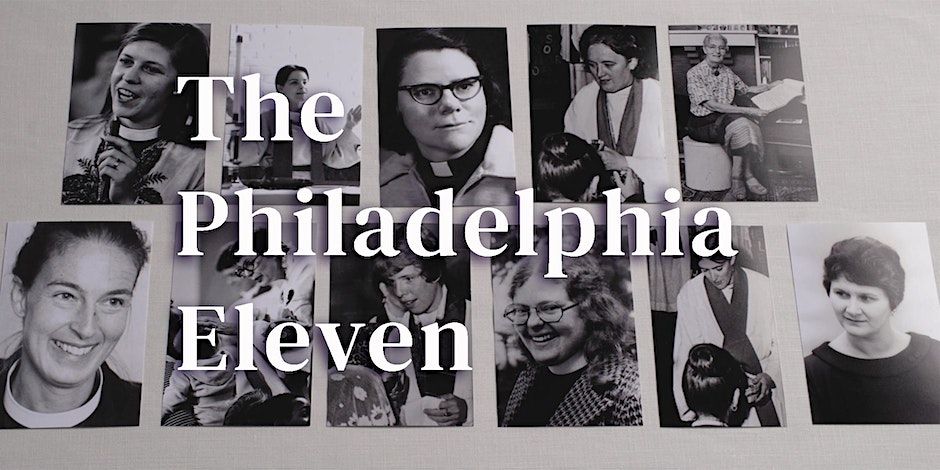
Photo credit: https://azdiocese.org/2023/11/the-philadelphia-eleven-screenings-in-arizona/

This past Sunday, the local Episcopal parishes in my town gathered to watch the documentary, The Philadelphia Eleven.  The film details the history of women’s ordination in the Episcopal Church, and the first eleven women who were “irregularly ordained” in 1974 (i.e. ordained by Episcopal Bishops, but without the church’s General Convention sanctioning the ordination of women).  The question of women’s ordination had come before General Convention many times before, but was always defeated.  So, fifty years ago, a handful of women, along with male allies, decided they could not wait any longer.  The film tells the story of the outrage the eleven women created, the abuse and death threats they faced, and the way that their diverse ministries led to the sanctioning of women’s ordination by General Convention in 1976. 

I came into the Episcopal Church later in life.  Although deeply involved in the United Methodist campus ministry at my college, an ecumenical trip with the Episcopal campus minister was my first real exposure to the liturgy and polity of the Episcopal Church.  That campus minister was a woman, and at that point in my development, that did not seem abnormal.  Then, a couple of years after college, I stumbled into the Episcopal Cathedral, whose dean was a woman.  One of her assisting priests was also a woman.  Those early mentors did not just normalize women’s ordination – it never occurred to me that there was a time when women were not priests.  In fact, I remember an occasion when one of my own daughters as a young child asked me, “Can boys be priests?”

At this year’s General Convention of the Episcopal Church, we took the first steps to authorize the honoring of the Philadelphia Eleven in our set of honored saints we celebrate at weekday Eucharists.  In the same city, where 51 years earlier the General Convention had denied women’s right to ordination, we agreed to honor the saints who pushed us to be better versions of the Church.  All female clergy in the room were invited to stand to a roar of applause.  I looked at the other women, many of whom I know and love, and I looked at the male clergy and laity whose eyes and smiles were full of admiration and respect, and I realized a couple of things.  One, it is always a joy to celebrate when the Church gets something right – even if it takes a long time for the Church to get there.  And two, I can be in ministry as my most authentic self is due to the suffering and courage of men and women I may never meet. 

I share all this not to brag on the Episcopal Church – in fact, we still have a long way to go.  Income disparity between male and female clergy is still a problem, as well as access to comparable positions.  I have been the first female rector both times I have served as rector, and both times, people left the church when a woman was hired.  But I share this story more because I wonder who else have we excluded from the Table.  I share this story because I found myself wondering whether I would have risked being one of the Philadelphia Eleven, knowing the suffering that would come.  I share this story because as someone who really appreciates rules and boundaries, I wonder which of those rules and boundaries the Holy Spirt keeps bumping against.  While these may seem like big questions, or super-Church-nerdy questions, I think these questions are for all of us – an invitation to wonder who we have excluded in the communities of faith we love so much.  The Philadelphia Eleven seem to be still asking us these questions fifty years later.    

Sermon – John 2.13-22, Exodus 20.1-17, L3, YB, March 3, 2024

15 Friday Mar 2024

Posted by jandrewsweckerly in Sermons

≈ Leave a comment

Tags

body, enfleshed, flesh, God, good, Jesus, Lent, ministry, Sermon, temple

Today’s gospel lesson is one of those lessons in Scripture that is so vivid we find looking away difficult.  All four of the gospels have this story, and three of the gospels use this story to convey Jesus’ righteous anger about how the practice around temple worship and obligatory sacrifice has led to monetary abuses.  Matthew and Luke even have Jesus calling the whole enterprise a den of robbers.  The story evokes images of Jesus flipping tables, or in today’s version, swinging around a whip like Indiana Jones.  We often recall this text when looking for evidence of Jesus’ righteous anger at injustice. 

But John’s version of this story takes us down a different path from the other three gospels.  First, John places this story in a very different place in his narrative.[i]  Unlike the other gospels who place this story toward the end of Jesus’ earthly ministry, John places this incident in the second chapter, right after the miracle in Cana.  And in John’s version, Jesus does not lay into the moneychangers in quite the same way.  Instead of financial injustice, Jesus seems more concerned that those gathered have missed something critical – in the obligatory administering of sacrifices at the physical temple, they have missed the fact that God is no longer tied to the location of the temple – and instead is found in the temple of Jesus’ body.  For John, the incarnation, the word becoming flesh and dwelling among us, is central to the entirety of the good news and in this story specifically. 

We are in a season of flesh.  Lent is that season when we experience Jesus in deeply enfleshed ways.  What our Lenten disciplines or practices do for us is help us remember that we are a people of flesh and our God was willing to take on that flesh to transform our lives.  We do not often talk about the profound reality of an enfleshed God, but I recalled a hymn this week that opens up the reality.  Brian Wren’s hymn Good is the Flesh says, “Good is the flesh that the Word has become, good is the birthing, the milk in the breast, good is the feeding, caressing and rest, good is the body for knowing the world, Good is the flesh that the Word has become.”  The hymn goes on to say, “Good is the body, from cradle to grave, growing and aging, arousing, impaired, happy in clothing, or lovingly bared, good is the pleasure of God in our flesh, Good is the flesh that the Word has become.”[ii]  Now I do not know about your own spiritual language, but I cannot think of anything that talks about Jesus’ flesh so vividly.  The closest I have come has been in imagining the vulnerability of that enfleshed body in the cradle.  But capturing what being enfleshed means for all of life – from cradle to grave – somehow opens up John’s words about the temple of Jesus’ body.  God takes something we often associate with sinfulness – and transforms that flesh into something good.  “Good is the pleasure of God in our flesh,” are powerful words that shift how we experience the fullness of Christ’s humanity.

Once we reconnect with the goodness of God’s flesh – the incarnation of Christ – then we begin to see all of Jesus’ ministry immersed in the flesh of life.  Scholar Karoline Lewis reminds us Jesus’ fleshy life was important, “Because a woman at a well, whose body was rejected for the barren body it was, experiences the truth of neither on this mountain nor in Jerusalem; because a man ill for 38 years, his entire life to be exact, whose body has only known life on the ground, is now able to imagine his ascended life; because a man born blind, is then able to see, and to see himself as a sheep of Jesus’ own fold; because Lazarus, whose body was dead and starting to decay, found himself reclining on Jesus, eating and drinking, and with his sisters, sharing a meal once again.”[iii]  Not only is Jesus’ incarnation good, making flesh good, Jesus’ ministry is about blessing, healing, and restoring physical bodies. 

Once we connect with the goodness of God’s flesh, and the power of Jesus’ fleshy ministry, we are forced to see something we do not always feel comfortable with – the goodness of our own flesh.  I do not know about your journey, but my experience in church has not been one in which the church tells me how good my body is.  In fact, today’s inclusion of the ten commandments, not once, but twice, usually reminds me of the opposite – of the myriad ways my body is sinful:  from the words that come out of my mouth, to the ways in which I hurt others and take things with my body, to the ways in which I covet things and other bodies.  And those sins do not even touch the ways in which I hear the message that my body is imperfect – how my body is not the right height or shape or gender, how my body is not fit or strong enough, how my skin color, hair, or nails are not quite the ideal.  But if God takes on flesh and says, “Good is the flesh,” and if that enfleshed God engages in a ministry of blessing flesh, then surely part of what we remember today is how good and blessed our own flesh is – how God made our flesh for good. 

Now, here comes the tricky part.  Once we realize “Good is the flesh,” that ministered to the flesh, that our flesh is beautiful and revered, then we are forced to make yet another leap – that the flesh of others is also beautiful.  Those bodies we would like to subjugate, regulate, and decimate are no longer able to be separated from the goodness of God’s flesh or our own flesh.  Barbara Brown Taylor argues in An Altar in the World, “‘One of the truer things about bodies is that it is just about impossible to increase the reverence I show mine without also increasing the reverence I show yours.’  In other words, once I value my own body as God’s temple, as a site of God’s pleasure, delight, and grace, how can I stand by while other bodies suffer exploitation, poverty, discrimination, or abuse?”[iv]

This week at Hickory Neck has been all about that kind of work.  As we welcomed guests through the Winter Shelter, we affirmed the goodness of all flesh – of God’s flesh, of our flesh, and especially the flesh of those who have no shelter, who work hard all day but cannot secure housing, who live lives of uncertainty, of insecurity, of scarcity.  Once we recall the incarnation of Christ, the dignity of our own incarnation, our work immediately becomes to honor the incarnation of others.  We certainly accomplished the work of honoring flesh this week through the Winter Shelter.  But as we keep walking our Lenten journey, we will struggle with our bodies.  Even our collect today says, “we have no power in ourselves to help ourselves: Keep us both outwardly in our bodies and inwardly in our souls, that we may be defended from all adversities which may happen to the body, and from all evil thoughts which may assault and hurt the soul.”  Our invitation this Lent is to struggle with claiming our body as good – and using the goodness of our flesh to bless other flesh.  Our repentance this week is not just of the sinfulness of the flesh, but we repent this week of the ways in which we do not honor how “Good is the flesh that the Word has become.”  Amen.


[i] Joseph D. Small, “Theological Perspective,” Feasting on the Word, Year B, Vol. 2 (Louisville:  Westminster John Knox Press, 2008), 92.

[ii] I found this hymn in the commentary by Debie Thomas, “The Temple of His Body” in Into the Mess & Other Jesus Stories:  Reflections on the Life of Christ (Eugene, OR:  Cascade Books, 2022), 63. 

[iii] Karoline Lewis, “Body Zeal,” February 26, 2018, https://www.workingpreacher.org/dear-working-preacher/body-zeal as found on March 1, 2024.

[iv] Debie Thomas, “The Temple of His Body” February 28, 2018, https://www.journeywithjesus.net/lectionary-essays/current-essay?id=1675 as found on March 1, 2024.

Sermon – Mark 1.29-39, EP5, YB, February 4, 2024

14 Wednesday Feb 2024

Posted by jandrewsweckerly in Sermons

≈ Leave a comment

Tags

bishop, calling, comfort, deacon, discernment, Jesus, Kingdom, ministry, motherhood, ordain, redirected, Sermon, serve, work

You may or may not know about me that I became a mom and was ordained at the same time.  I was seven months pregnant when the bishop ordained me.  Needless to say, there is ongoing debate about whether Simone is also a deacon since she was in utero at the ordination.  But what becoming a mom and becoming ordained at the same time has meant is the patterns of the two vocations are interwoven for me.  So just like on any given day in ministry, my plan for the day can get upended with a phone call, a drop-in visit, or a text, so is the precarious nature of parenting.  I can be in the middle of preparing dinner when a friend-crisis erupts at home for one of the kids.  I can be driving a kid to practice, only to learn from the backseat that the kid is struggling with a bully.  I can be trying to write a sermon, and another kid bursts inside with a bloody knee.  Some folks might see those parenting and pastoring moments as “interruptions” to a day.  But as someone who became a pastor and parent at the same time, that constant feeling of pushed and pulled, interrupted while trying to charge ahead, and even rerouted entirely is part and parcel of living my vocations faithfully.

I think that is why I find our gospel lesson today so compelling.  Jesus has just come off the casting out of demons in the temple that we heard about last week, with everyone awe-struck by his teaching with authority.  Then, today he just tries to go to Simon’s house to chill out, when he is immediately notified about Simon’s sick mother-in-law.  After healing her, Jesus tries to settle back down, but by sundown, the whole town is at the door, asking for healing and cures – which Jesus graciously offers.  In the wee hours of the morning, Jesus goes out to a deserted place for a moment of peace and prayer, and Simon and the others interrupt his moment for more work.  Jesus rallies the troops and off they go, proclaiming the gospel and casting out demons.  Even Simon’s mother-in-law, as soon as she is healed, begins serving Jesus and his disciples.  Not to be confused with some sort of subservient, sexist expectation that women should serve men – no, the word used for what Simon’s mother-in-law does is the same word used for what deacons do:  she serves.  In fact, she is the first deacon in the New Testament[i], and as such, teaches us that life following Jesus is just like following along in this story about a day in the life for Jesus – you are constantly pulled and pushed, invited into service in whatever ways that service shows up on your doorstep.

Yesterday I was a part of a bishop’s election.  Sometimes I think the way we elect bishops is almost cruel – for the community where the candidate serves, they are both incredibly proud of their priest, but also incredibly anxious that they may lose their priest.  All sorts of emotions and concerns get stirred:  maybe my priest doesn’t want to be here anymore, maybe my priest is neglecting her job here, maybe my priest doesn’t care about me or our church.  But getting lost in those anxieties misses what is happening in a bishop’s search.  The priest is simply doing what he or she does everyday:  listening and responding to the call of ordained life, wherever that call pushes and pulls.  Sometimes that means hopping in a car to get to the hospital immediately; sometimes that means stopping the crafting of a report, article, or sermon to listen to a hurting soul; sometimes that means talking for an extended time with a stranger at the grocery store, the gym, or the bus stop because your priesthood doesn’t belong just in the church walls.  But sometimes that means saying yes to serving on a board for workforce housing, saying yes to a bishop’s request that you serve the diocese in a particular way, saying yes to raising funds for your seminary – and even saying yes to discernment to the episcopacy.  Just like there are countless balls to juggle in parenting, there are countless balls to juggle in ordained life.  That’s just what we do when Jesus calls us – we serve.

As we settle into the idea that I will in fact being staying in ministry with you, I see this “Day in the life of Jesus” from Mark’s gospel today as an invitation.  As Debie Thomas describes, our invitation today is to “spend our days as Jesus spent his…living graciously and compassionately in this vast and often terrible in-between.  To offer the comfort of our steady presence to those who suffer.  To encourage those in pain to hang on, because the work of redemption is ongoing.  To create and to restore community, family, and dignity to those who have to walk through this life sick, weak, and wounded – without cures.  To make sure that no one who has to die – and that’s all of us in the end – dies abandoned and unloved, if we can help it.”[ii]  That means as we at Hickory Neck step away from this time of discernment, we do the work of that first deacon, Simon’s mother-in-law.  We get up and we get back to work:  caring for one another, serving our neighbors, sharing the good news with those who need a good word.  Though this call to serve may feel like a frustratingly interrupted time of prayer, in fact, the interruption today is the perfect reminder of the life of Jesus:  being pushed and pulled, interrupted and redirected, and in moments like this – seeing the beautifully sacred in the midst of all our very human feelings.  I invite you today to take my hand, so we can get back to the work of the kingdom.  Amen.


[i][i] Gary W. Charles, “Exegetical Perspective,” Feasting on the Word, Yr. B, Vol. 1 (Louisville: Westminster John Knox Press, 2008), 335.

[ii] Debie Thomas, Into the Mess & Other Jesus Stories:  Reflections on the Life of Christ (Eugene, OR:  Cascade Books, 2022), 75.

On Celebrating Life, Death, and Movies…

04 Wednesday Oct 2023

Posted by jandrewsweckerly in reflection

≈ Leave a comment

Tags

bless, celebration, change, community, death, end, Episcopal Church, eternal life, finality, grace, growth, Holy Spirit, Jesus, joy, life, ministry, movies, new, past

Photo credit: https://www.cnn.com/2023/09/28/tech/netflix-dvd-rental-movies-ending/index.html

Well, it finally happened.  Netflix’s DVD business closed last Friday.  Now I recognize that acknowledging I still received DVDs from Netflix may make me seem old-fashioned.  Even a contemporary exclaimed recently, “Do people even have the equipment to play DVDs anymore?!?”  I took a good ribbing, but the truth is I love movies, and Netflix’s DVD business allowed me to watch movies that were not available via streaming services.  I was constantly finding new gems, and still had over 100 movies in my queue that I hoped to watch some day.

For those of us old-timers still watching DVDs, the closing of Netflix’s DVD branch has been tinged with nostalgia and a tiny bit of grief.  Over the course of 18 years, I watched 667 films, each story sparking my imagination, eliciting pleasure, sorrow, excitement, indignation, laughter, and hope.  Obviously there will be other ways for me to revel in the artistry of filmmaking, but there is a certain finality to the closing of this chapter. 

Despite my wistfulness, I commend Netflix for the way they have handled this change.  Instead of wallowing in grief, or attempting to apologize for market changes beyond their control, instead, they have handled this “death” with grace and joy.  Knowing the closing was coming, this year they used their iconic mailing envelopes to feature celebratory artwork honoring how a whole generation has been shaped by their service.  On the week of their closure, the sent a “gift” to every member – a summary of the highlights of our membership – what movies we had watched each year, milestones in our membership, and even the list of movies in our queue in case we want to find another way to see them.  Instead of a death, it has felt like a celebration of life.

In a lot of ways, it has reminded me of the ways the Episcopal Church approaches death.  When someone we love passes, we use the burial office to celebrate life – certainly the life of the one who has died, but especially the promise of eternal life promised in Jesus Christ.  But I’ve been thinking about it over this last week, and the Church honors “mini-deaths” all the time:  the ending of a ministry that is no longer needed or effectively utilized, the retirement of a ministry leader after a successful tenure, or the blessing of a parishioner or staff member who moves away from the community.  All those transitions can be hard because they make us remember fondly the ways ministry blessed us in the past.  But those transitions are also often the source of new life:  a new ministry we could never have imagined five years ago, a new leader whose fresh ideas opens up new opportunities, and new members who shape and mold us into a new community.

I wonder what things feel like they are dying in your life right now – what things you thought would always be there are undergoing change.  Where might the Holy Spirit be inviting you to see new shoots of growth in the midst of something withering on the vine?  How might those “mini-deaths,” be tremendous gifts to you or your community?  How might we take a cue from Netflix, and find ways to celebrate those endings with dignity and joy?  I am grateful for the ways a secular business is helping me see the sacred in our own life cycles.  Let’s celebrate together!

Sermon – 2 Thessalonians 1.1-4, 11-12, P26, YC, October 30, 2022

03 Thursday Nov 2022

Posted by jandrewsweckerly in Sermons

≈ Leave a comment

Tags

affliction, boast, challenges, church, community, God, Holy Spirit, Jesus Christ, love, ministry, opportunities, persecution, Sermon, suffering, thankful, thanks, unity

I spent the last week at Princeton Theological Seminary, concluding an Executive Leadership certificate program called Iron Sharpening Iron.  For the past two years, the clergy participants and I have journeyed together, all facing the unique challenges of this liminal time for the Church, but also all hopeful that God is doing a new thing in the Church.  In the spirit of camaraderie that has developed over that time, we found ourselves asking each other this week, “So, how are you really doing?  How is your church?”  This is the kind of setting where clergy feel comfortable enough to let down their guard and share life with an honesty that we might not in other settings.  And I confess to you, every time that question was asked of me, and I took a moment to really think about the question, the answer was the same, “Things are actually really good.”  In truth, I think I was just as surprised by my answer as every other clergy person was.  I had no reason in that space to posture or try to make myself or our ministry look good, especially since most of the participants were not even Episcopalians.  I just knew when pondering how we are really doing, at the core of all that has happened in the last two to three years, we at Hickory Neck are doing really well.

I suppose I could have talked about how many of our longtime parishioners and many of our new members are online participants exclusively.  I suppose I could have talked about how many ministries are having shortages of volunteers, causing us to rethink what is possible because we cannot sustain the volunteer leadership.  Or I suppose I could have talked about how we stepped out on faith by hiring two part-time clergy associates this year, knowing that our financial giving would need to grow to support the programmatic needs of our growing church.  But those are realities I do not see as challenges; instead, I see them as opportunities to be the Church in new and creative ways as invited by the Holy Spirit.  Certainly, I want our in-person attendance in worship to grow – but I want our online ministry to grow and thrive concurrently.  Certainly, I would love some of our ministries to return to how we experienced them pre-pandemic – but I also see sacred invitations into new forms of ministry that may mean letting go of other forms.  Certainly, I want to be fiscally judicious within our budget – but I also want to create enough space in our budget to grow ministries that matter and make an impact both inside these walls and outside these walls. 

Perhaps what I mean is I look at Hickory Neck the same way that Paul, Silvanus, and Timothy look at their church in Thessalonians.  The writer of second Thessalonians, which some debate could be Paul or someone within the Pauline community, is writing to a community of believers facing persecution and afflictions.  The text is not clear what those persecutions and afflictions are, but we know the church of the Thessalonians is suffering.  In those days, persecutions and afflictions were often seen as signs of the end times, likely leading to a great deal of fear and anxiety.[i]  And so, we hear this letter meant to commend, encourage, and thank the community, and help them interpret meaning in the midst of suffering.  But the writer does not have to struggle too much to find that encouragement because what the writer has seen about this church is that they have developed an uncommon unity and love for one another.[ii]  And that gift of unity and love is a gift to be celebrated and honored.  That gift is something for which to give thanks.

And that is what we are doing today on this In-Gathering Sunday.  We are giving thanks for the ways in which Hickory Neck has experienced uncommon unity and love for one another, especially as we emerge from what has been a tumultuous couple of years in our community and the world.  We are giving thanks for the ways in which God has sustained us through afflictions and persecutions.  We are giving thanks for the bountiful abundance in our lives, when the world around us would want us to see scarcity, and we are returning that abundance in the form of our time, talent, and treasure.  And, so, friends, as we give thanks, I read to you our letter from second Thessalonians, paraphrased for today:

To the church of Hickory Neck:  Grace to you and peace from God our Father and the Lord Jesus Christ.  I must always give thanks to God for you, brothers and sisters, as is right, because your faith is growing abundantly, and the love of everyone of you for one another is increasing.  Therefore, I myself boast of you among the churches of God for your steadfastness and faith during all your persecutions and the afflictions that you are enduring…To this end, I always pray for you, asking that our God will make you worthy of God’s call and will fulfil by God’s power every good resolve and work of faith, so that the name of our Lord Jesus may be glorified in you, and you in him, according to the grace of our God and the Lord Jesus Christ.  Amen.


[i] Guy D. Nave, Jr. “Exegetical Perspective,” Feasting on the Word, Yr. C, Vol. 4 (Louisville:  Westminster John Knox Press, 2010), 257.

[ii] Robert E. Dunham, “Homiletical Perspective,” Feasting on the Word, Yr. C, Vol. 4 (Louisville:  Westminster John Knox Press, 2010), 257.

On the Ministry of Coffee…

05 Wednesday Oct 2022

Posted by jandrewsweckerly in reflection

≈ Leave a comment

Tags

coffee, Jesus, love, ministry, parenting, relationship, witness

Photo credit: https://www.pexels.com/search/coffee%20cup/

In the Book of Common Prayer, the Catechism answers the question, “What is ministry?”  It defines ministry by orders:  lay, deacon, priest, and bishop.  For the laity, the Catechism says, “The ministry of lay persons is to represent Christ and his Church; to bear witness to him wherever they may be; and, according to the gifts given them, to carry on Christ’s work of reconciliation in the world; and to take their place in the life, worship, and governance of the Church.” (BCP, 855)  Sometimes, we get caught up and think ministry is only when we are serving the poor or leading worship.  But, in fact, the Catechism reminds us that our ministry is to represent Christ and the Church, bearing witness to Jesus wherever we may be.

Several years ago, we welcomed a childcare center onto our property.  The relationship was a beautiful one of getting to know one another, of building relationships with strangers, and bearing witness to Christ’s love.  When the center moved to a neighboring town to accommodate more students, our Church knew we wanted to keep the relationship going.  And so, we have sent cards, supported teachers, and once a month, we bring coffee and snacks for what we call “Joe to Go.” 

For some, this may seem like an odd form of ministry.  If we are going to use our resources and time, shouldn’t we be helping those hurting the most?  Unfortunately, that question creates a false dichotomy.  We should be helping those who are hurting most.  And, as our Catechism says, we also should be bearing witness to Christ wherever we find ourselves.  For this ministry, that means seeing the everyday burdens of families – the nights without sleep, the struggles to work to support the cost of childcare, the strain of raising up children to be well-adjusted, loving members of society.  If we learned anything in the pandemic, it was that the struggles of parenting in today’s economy are real, and hard, and regularly unnoticed.

And so, we bear witness to Jesus’ love with every snack and cup of coffee.  We represent Jesus when we offer an encouraging word to a weary parent.  We are being the Church when we show lovingkindness wherever we may be.  This is what ministry is.  How are you bearing witness to Christ’s love today?  How have you experienced Christ’s love today through someone else’s ministry?  I can’t wait to hear your stories of coffees, shared stories, and encouraging words. 

Sermon – Luke 10.38-42, P11, YC, July 17, 2022

05 Wednesday Oct 2022

Posted by jandrewsweckerly in Sermons

≈ Leave a comment

Tags

breathe, comfort, defensive, discipleship, feelings, fragmentation, gracious, Jesus, Martha, Mary, ministry, Sermon

Sean is the primary income earner for his family, and his wife cares for their two small children.  Sean came home after a long day at work to find the house in utter chaos.  Out of exhaustion and disappointment, he asked his wife what she had been doing all day.  She curtly responded, “Keeping our children alive.”  Sean, properly chided, went to the kitchen to start making dinner.  Hannah had been sitting in the staff meeting listening to her supervisor being praised for the success of the PR event last week.  She had put in hours on that event, and her supervisor did not mention her creative and physical input at all during the meeting.  Susan complained to a fellow co-worker on the way back to her office, rolling her eyes about how self-centered her supervisor can be.  That afternoon, her supervisor sent her an email that apologized for not mentioning her name at the staff meeting; he had been distracted by a death in the family.  Sam had been working at the Habitat construction site for a couple of months, and rarely saw the homeowner who was supposed to be putting sweat equity hours into her home.  One day, Sam complained to the site supervisor about how the homeowner must be falling behind on her sweat equity hours.  The site supervisor explained that the homeowner had a rare disease the prevented her from doing physical labor, so she had been doing her hours in the Habitat office.  In fact, the supervisor had heard that she had been so productive, that the office staff was struggling to find enough work for her to do. 

Just like Sam, Hannah, and Sean, holy scripture today is going to, as pop singer Lizzo would say, get us into our feelings.  I am not sure if Martha and Mary’s story gets me into my feelings because the story involves women arguing about stereotypical gender roles, or if Jesus’ lack of support and criticism of Martha is so biting, or if I just see too much of myself in Martha, but this story puts all my defenses on high alert.  If Martha and Mary’s story today has you similarly anxious, uncomfortable, or defensive, do me a favor and take a deep breath. 

Starting with the text will help.  On the surface, this is a story about an older sibling, Martha, taking on all the household work while the younger sister, Mary, sits with Jesus, enjoying the luxury of learning from Jesus while Martha does all the work.  But in verse 40, the translation we have says Martha is distracted by her many tasks.  Now according to scholars, the Greek translation actually says something more like, “Martha is ‘distracted by much ministry.’”[i]  This is not a critique of stereotypically gendered work women must do.  Martha is not just distracted by preparing food, cleaning the house, and making beds for disciples.  Martha is doing the sacred, faithful work of hospitality – a crucial act of ministry.  Later, Jesus says Martha is “worried and distracted by many things…”  Here, the Greek word for “worry” is “‘strangle’ or ‘seize by the throat’ and ‘tear.’  The root meaning of the word ‘distraction’ is a dragging apart of something that should be whole.  These are [two] violent words.  Words that wound and fracture.  States of mind that render us incoherent, divided, and un-whole.”[ii]

Now let’s take another breath.  This story is not about who is the better sibling, whether women’s work is inferior to men’s work, or even about judgment of identity for us Marthas in the room.  This is a story about how all of us have ministries – ministries of discipleship that involve learning and action, of studying the Word and showing Christian hospitality to strangers, of speeding up and slowing down.  What Jesus is really concerned about is our intention around our discipleship.  The question is not if we are doing God’s work, but how we are doing God’s work.[iii]  According to Debie Thomas, Martha is in “such a state of fragmentation, a condition in which she cannot enjoy [Jesus’] company, savor his presence, find inspiration in her work, receive anything he wishes to offer her, or show him genuine love.  Instead, all she can do is question his love…fixate on herself…, and triangulate.”  Martha seems to think she can “invite Jesus into her life – and then carry on with that life as usual, maintaining control, privileging her own priorities, and clinging to her long-cherished agendas and schedules.”  And unfortunately, “That’s not how discipleship works.”[iv]

Perhaps after we have taken one last long breath, we can let go of our feelings and start to ask some questions.  How are we approaching our ministry these days?  Are we so wrapped up in our assumptions about other people’s behaviors that we have forgotten to look at our own?  Have we invited Jesus into our lives, but only under our own set of requirements and strictures?  After we have gotten into our feelings, Martha, Mary, and Jesus invite us today to take that breath and refocus[v].  Maybe we need to take some more time at Jesus’ feet, praying, reading scripture, coming to church, or joining something like Faith and Film.  Maybe we need to look at those dinner plates as an invitation to prayer, holding dear the bodies that will be fed by our labor.  Maybe we need step out of our controlled kitchens and go serve up a meal at Meals on Wheels or at From His Hands.  Jesus graciously handles our feelings every day.  But Jesus also knows that when we start looking at how we are doing our ministries, the real, life-giving, whole-making discipleship will come.  Amen.


[i] Amy-Jill Levine and Ben Witherington, III, The Gospel of Luke: New Cambridge Bible Commentary (Cambridge:  Cambridge University Press, 2018), 297.

[ii] Debie Thomas, Into the Mess & Other Jesus Stories:  Reflections on the Life of Christ (Eugene, Oregon:  Cascade Books, 2022), 51.

[iii] Matthew L. Skinner, “Exegetical Perspective,” Feasting on the Word, Yr. C., Vol. 3 (Louisville: Westminster John Knox Press, 2010), 265 and 267.

[iv] Thomas, 51.

[v] James A. Wallace, “Homiletical Perspective,” Feasting on the Word, Yr. C., Vol. 3 (Louisville: Westminster John Knox Press, 2010), 265.

Sermon – John 21.1-19, E3, YC, May 1, 2022

25 Wednesday May 2022

Posted by jandrewsweckerly in Sermons

≈ Leave a comment

Tags

coping mechanism, discipleship, discomfort, follow, Jesus, ministry, pandemic, Peter, Sermon, transform

One of the things I found fascinating about the pandemic was the coping mechanisms people developed.  For some coping took the form of fitness or wellness – instead of exercising a couple days a week, a daily run or walk was the way many kept their sanity.  For others, picking up new hobbies, like baking bread, did the trick.  We even had shortages of flour and yeast so many people were baking.  For others they turned to less healthy outlets – shopping (online, of course), drinking one more glass of wine, or binge watching one more show, sacrificing sleep and anything else productive.  All those coping mechanisms did just that – helped us cope with a world that was falling apart around us.  And since we could not control the availability of vaccines, the mandates for masks, the requirements to isolate, what we could do was the familiar – go for a run, use our baking skills, escape into the familiar.

Coping is exactly what Peter does in our gospel lesson today.  His world has been upended, his hope destroyed, his shame irrecoverable.  The finality of the cross breaks him, the empty tomb leaves him dumbfounded, and the resurrected Lord standing with his wounds before him has him in shock.  And so, he mumbles to the other disciples, “I am going fishing.”  The other disciples go with him – likely relieved for the sense of familiarity, grateful for something to do that they are actually good at, and likely a bit afraid to stay where they are doing nothing. 

We did a similar thing here at Hickory Neck during the pandemic.  In March of 2020, as the bishop was closing all church campuses for the first time, I was in a hospital waiting room, cancelling a Vestry Meeting, messaging our staff, and trying to listen to post-operation care for my daughter from the nurse.  The world was imploding and like a dazed Peter I said, “Let’s worship anyway.  I mean, I know how to use Facebook Live.”  And so that is what we did:  we worshipped online – not just one day, but every day; we offered pastoral care – not in person, but on the phone, by text, by email, and by card; eventually, we figured out how to help others and began offering to pick up groceries, care for the sick remotely, and deliver prescriptions. 

But a funny thing happened along the way.  As we dove into our coping mechanisms, albeit in creative ways, we started reaching new people.  When Pop-Up Prayers started, people we had never met before – sometimes people who are literal next-door neighbors – started tuning in to our prayers.  People who had always wondered about us were finally able to take a peek without having to cross our threshold; and they liked what they saw so much they started coming in person long before our longtime members ever did.  People who moved here during the pandemic and were longing to find a new community of support were able to come here – either virtually or masked and distanced.  They were willing to sacrifice discomfort just to find a sliver of comfort here.  What initially felt like a coping mechanism suddenly transformed our ministry altogether.

One of the more dramatic parts of today’s gospel is the conversation between Peter and Jesus over a charcoal fire.  The only other time a charcoal fire is mentioned in John’s gospel is the one Peter warms himself by as he denies Jesus three times.  In the synoptic gospels of Matthew, Mark, and Luke, Peter denies that he knows Jesus; in John’s gospel, he denies his very discipleship.[i]  “Aren’t you one of his disciples?” was the question they had asked him three times.  And so, Jesus asks Peter three questions as a mirror to those three questions Peter was asked.  Many scholars argue this interaction is Jesus’ way of forgiving Peter, or Jesus’ way of reinstating Peter as a disciple, or even Peter’s rehabilitation after a failure of loyalty.  But as Karoline Lewis argues, “None of these summaries adequately recognizes the significance of Jesus’ request of Peter.  Peter is not simply restored to his role as disciple, but he will have to imagine discipleship in an entirely different way.”[ii]

Our work this week is to figure out how, in the midst of a post-pandemic Eastertide, how are we being invited to redefine our discipleship.  I know as we have returned to the altar rail and begun to share the common cup, many of us have sighed with relief.  Some of us have been begging to drop the annoying gift of Zoom, and some have wondered if we really have to keep thinking about livestreaming everything.  And yet, when Jesus asks Peter to feed his sheep, “Jesus essentially asks Peter to be the good shepherd for the sake of God’s love for the world when Jesus cannot be…the demands of discipleship take on a more acute and critical role.”  In other words, as Lewis says, “Jesus is asking Peter to be the ‘I AM’ in the world.”[iii]

That is our invitation too.  Just this week I experienced two church and diocesan meetings where people would not be able to participate without Zoom.  Just this week, I visited and spoke with suffering parishioners who said the livestreamed services are their lifelines right now.  And just last week, a visitor explained how perusing our website helped in the decision to take the next step through our door.  This pandemic has stretched us, challenged us, and invigorated us.  But the reward of getting through to the other side is not to go back to “normal.”  The reward is we have learned a new way to be disciples of Jesus – and Jesus is asking us to consider how we – corporately and individually – can be the “I AM” in a world that wants to know God.  Jesus promises today to help us along the way – showing us where to cast our nets again, feeding us abundantly, and reminding us again and again how to be love in the world.  Our invitation is to consider how Jesus is already transforming our coping mechanisms into gifts of love for the world.  And then, in our discomfort, to stand up and follow him.  Amen.


[i] Karoline M. Lewis, John: Fortress Biblical Preaching Commentaries (Minneapolis:  Fortress Press, 2014), 255.

[ii] Lewis, 256.

[iii] Lewis, 256-257.

← Older posts

Recent Posts

  • On the Myth and Magic of Advent…
  • On Risking Failure and Facing Fear…
  • Sermon – Luke 23.33-43, P29, YC, November 23, 2025
  • On Inhabiting Gratitude…
  • Sermon – Luke 20.27-38, P27, YC, November 9, 2025

Archives

  • December 2025
  • November 2025
  • October 2025
  • September 2025
  • August 2025
  • July 2025
  • June 2025
  • March 2025
  • February 2025
  • December 2024
  • November 2024
  • October 2024
  • September 2024
  • August 2024
  • July 2024
  • June 2024
  • May 2024
  • March 2024
  • February 2024
  • January 2024
  • December 2023
  • November 2023
  • October 2023
  • September 2023
  • August 2023
  • July 2023
  • June 2023
  • May 2023
  • March 2023
  • February 2023
  • January 2023
  • December 2022
  • November 2022
  • October 2022
  • June 2022
  • May 2022
  • January 2022
  • December 2021
  • November 2021
  • October 2021
  • September 2021
  • August 2021
  • June 2021
  • May 2021
  • April 2021
  • March 2021
  • February 2021
  • January 2021
  • December 2020
  • November 2020
  • October 2020
  • September 2020
  • August 2020
  • July 2020
  • June 2020
  • May 2020
  • April 2020
  • March 2020
  • February 2020
  • January 2020
  • December 2019
  • November 2019
  • October 2019
  • September 2019
  • August 2019
  • July 2019
  • June 2019
  • May 2019
  • April 2019
  • March 2019
  • February 2019
  • January 2019
  • December 2018
  • November 2018
  • October 2018
  • September 2018
  • August 2018
  • July 2018
  • June 2018
  • May 2018
  • April 2018
  • March 2018
  • February 2018
  • January 2018
  • December 2017
  • November 2017
  • October 2017
  • September 2017
  • August 2017
  • July 2017
  • June 2017
  • May 2017
  • April 2017
  • March 2017
  • February 2017
  • January 2017
  • December 2016
  • November 2016
  • October 2016
  • September 2016
  • August 2016
  • July 2016
  • June 2016
  • May 2016
  • April 2016
  • March 2016
  • February 2016
  • January 2016
  • December 2015
  • November 2015
  • October 2015
  • September 2015
  • August 2015
  • July 2015
  • June 2015
  • May 2015
  • April 2015
  • March 2015
  • February 2015
  • January 2015
  • December 2014
  • November 2014
  • October 2014
  • September 2014
  • August 2014
  • July 2014
  • June 2014
  • April 2014
  • March 2014
  • February 2014
  • January 2014
  • December 2013
  • November 2013
  • October 2013
  • September 2013
  • August 2013
  • July 2013
  • June 2013
  • May 2013
  • April 2013
  • March 2013
  • February 2013
  • January 2013
  • December 2012
  • November 2012
  • October 2012
  • September 2012

Categories

  • reflection
  • Sermons
  • Uncategorized

Meta

  • Create account
  • Log in
  • Entries feed
  • Comments feed
  • WordPress.com

Blog at WordPress.com.

  • Subscribe Subscribed
    • Seeking and Serving
    • Join 394 other subscribers
    • Already have a WordPress.com account? Log in now.
    • Seeking and Serving
    • Subscribe Subscribed
    • Sign up
    • Log in
    • Report this content
    • View site in Reader
    • Manage subscriptions
    • Collapse this bar
 

Loading Comments...