• About

Seeking and Serving

~ seek and serve Christ in all persons

Seeking and Serving

Tag Archives: ministry

Ecumenical Thanksgiving Homily – Ruth 2.2-9, Matthew 22.34-40, November 20, 2016

23 Wednesday Nov 2016

Posted by jandrewsweckerly in Uncategorized

≈ Leave a comment

Tags

active, Boaz, community, ecumenical, God, gratitude, Great Commandment, homily, Jesus, love, mercy, ministry, neighbor, Ruth, Thanksgiving, worship

When I learned we would be gathering for worship as ecumenical brothers and sisters to celebrate a service of Thanksgiving, I could not have been happier.  But when I realized we would be reading from the book of Ruth, I was thrilled!  Ruth has always held a special place in my heart.  This woman, a complete stranger to our faith, teaches us more about faithful living than most of our ancestors. She marries a foreigner, quickly becoming a widow with no support, following her widowed mother-in-law to a foreign land.  In her abandonment, she pledges allegiance to a God who in many ways has felt absent.  And when they return the foreign land of Bread, and she sees Naomi may not be able to support her, she takes it upon herself to go sweat in the fields, and secure them a livelihood.  She even eventually permanently ensures their security by somewhat scandalously approaching Boaz for not only food, but marriage, and progeny.  Ruth puts all others before herself, and she is faithful to God and her family.  If anyone is a beacon of living into the Great Commandment to love neighbor as self, Ruth is that beacon of light.

But the more I thought about our text today, the more I realized that despite the fact that I love Ruth, we gathered here today are more like Boaz.  You see, we are people of privilege and power.  Though we can certainly name countless people who may have more wealth and influence than we do, most of us know where our next meal is coming from, have a roof over our heads, and have our basic needs met.  Some of us are even comfortable enough to enjoy much more than our basic needs.  In that way, we are much more like Boaz, a man with power and influence, who can use that power for good or for evil.

Boaz has little obligation to Ruth, the foreigner.  He knows she is connected to Naomi, making her adopted family, but allowing her to glean with the other gleaners would have been enough.  He didn’t have to give her tips about how to be safe from the men, give her access to drinking water, feed her his bread at mealtime, and tell his men to make sure she got extra grain to glean.  He did not have to say yes when she asked for his help in taking her in.  He did not have to negotiate with the next-of-kin to have her hand.  Boaz takes God’s command to love neighbor beyond what anyone would expect.

I have been thinking about Boaz as I have been thinking about our ministry together.  Though you may not know about each case, each of the clergy here work with families in need through the use of discretionary or alms funds.  Each church here has ministries that we support – whether food pantries, homeless shelters, elder care, medical clinics, or assistance with basic needs like back-to-school supplies, clothing drives, or holiday support.  And all of us collectively have taken that a step further and agreed to help provide more food assistance by starting up a local food distribution outlet through our partners at House of Mercy.  But just because we do that work does not mean that we do that work like Boaz.

My husband is a social worker in Richmond and he was recently telling me about a client’s experience with a church.  The client reached out to a church for assistance, and instead of pastorally working with the client, the church representative gave them a hard time, wanting to know what poor decisions the client had made that brought them to the church doors.  Now, I know we all screen the clients we help.  We have to be smart about how we help those in need.  But that client experienced a loss of dignity at that church that Boaz never exerts.  In fact, Boaz knows how degrading poverty can be.  He sees Ruth, and knows simply by her gender and foreignness that she is at risk for assault and manipulation.  And so, not only does he help her, but he looks at all those around him and hold them accountable for caring for the disadvantaged too.  He does not act alone in his mercy – he makes his whole community merciful.

As we head into a holiday marked for Thanksgiving, the church invites us to look at our ancestors for the best ways to fulfill Jesus’ Great Commandment.  Want to know how to love God and our neighbors?  Look at our sister Ruth.  Want to know how to show love, dignity, and compassion?  Look at our brother Boaz.  Though many of us spend this time of year reflecting on what we have to be grateful for, the church invites us also to use this time as a time of action.  Our gratitude is not passive.  Our gratitude is active – a call to action to love God and love neighbor.  I know many families who have a tradition of going around the Thanksgiving table, enumerating those things for which they are grateful.  Perhaps this year, our families can also enumerate what we are going to do in response to those things for which we are grateful.  Our ancestors, our Savior, and our faith communities are here to embolden us in that response.  Thanks be to God!

Getting Real and Giving Generously…

26 Wednesday Oct 2016

Posted by jandrewsweckerly in Uncategorized

≈ Leave a comment

Tags

budget, church, giving, journey, Living Generously, ministry, money, motivation, passion, pledge, real, resources

budget

Photo credit:  www.associationserviceswa.com/2016/08/value-of-a-well-prepared-budget/

The year after I graduated from college, I volunteered fulltime through the AmeriCorps program at a Food Bank in North Carolina.  In addition to working in the warehouse and monitoring agencies, my fellow volunteers and I also had monthly classes on a variety of topics.  My favorite was a budgeting class.  Though most of us were scraping by our living stipend, we still had income and expenses like everyone else.   Our homework was to track our expenses and income for a month and then come back to class to talk about what we noticed.  After that month, I realized that I had picked up a terrible habit.  I had worked very hard to save money during that year.  As a reward for saving money, every week I would treat myself to something small.  But when I did the math, I realized the amount I had saved was much less than the amount with which I was treating myself.  The realization was shocking and wildly disappointing.

On Sunday, we are submitting our pledge commitments for the coming year at Hickory Neck.  Part of our Living Generously campaign has been talking about the powerful ministries at Hickory Neck that mean so much to us.  We have read parishioner reflections, biblical reflections from national church leaders, and a great narrative budget that helps us see how our finances function.  My husband and I are inspired and expectant about the future of Hickory Neck, and we are overjoyed to join the pledging effort to support our ministry.

Inspiration has not been a problem.  In fact, my husband and I talked about how we want to increase our pledge this year.  But as we looked at the numbers, we realized in order to align our budget with our passion, we were going to have to adjust some things.  For us, that means at least a few less meals out each month.  It also may mean being a bit more discerning about wants versus needs.  It will certainly mean keeping an eye on making sure that we are able to keep our pledge next year by saving the amount needed for our increase and not “treating” ourselves disproportionally to our increased pledge.

As the Vestry talked about Stewardship, the Vestry all realized our church giving was motivated by different things.  For some of us, understanding the mission of the church and how our pledge would be used was critical.  For others of us, we needed our giving to be rooted in a theological or spiritual understanding of resources and our stewardship of those resources.  While for others of us, our giving was more motivated by looking around us, taking stock of all the things we like about church, and calculating how much those things cost.  My hope is that our campaign has addressed all of those approaches and that our journey through stewardship season has inspired and rooted you.  I look forward to hearing your story of our journey together and kicking off another great year!tens2016logo7x12webonly

Being on Stick Patrol…

05 Wednesday Oct 2016

Posted by jandrewsweckerly in Uncategorized

≈ Leave a comment

Tags

benefit, cleaning, Jesus, ministry, overlook, play, privilege, see, sticks, teaching, tend

twigs

Photo credit:  www.green-talk.com/spring-gardening-maintenance-tips/

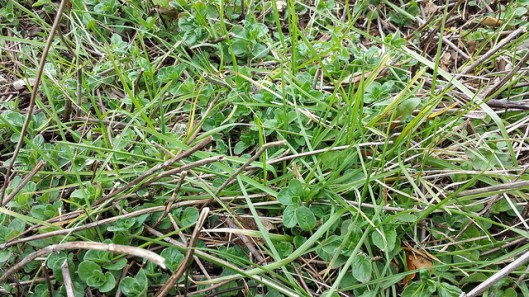
This weekend was the big fall cleanup of our property at church.  We trimmed trees and hedges, put down mulch in flower beds and around trees, cleared out debris, and pulled weeds.  Because I had one of the youngest workers with me that day, we were put on “stick patrol,” clearing out the sticks that had fallen from the enormous trees in the front of the property.  When I first glanced at the area, I was not too worried.  You could see some sticks, but not a large amount.  I remember thinking the project would not take long.  But all too quickly I realized that the more I got down in the grass, the more small sticks I saw.  A scan of the grass from a distance was totally different from getting down in the dirt and seeing what was really there.

I have been thinking about how my quick scan of the grass that day is a lot like living with the benefit of privilege.  I realize that talking about privilege makes many of us anxious.  We feel like we are being blamed for something we cannot control and we can probably name multiple hurdles we have had to overcome in life that do not make us feel privileged at all.

While all of that may be true, one the signs of benefiting from privilege is that we are able to scan the grass without really looking through the blades for sticks.  Just today, on what was an otherwise beautifully wooded drive, I passed by a community of mobile homes, a nursing home, and a domestic violence shelter.  If I had wanted to, my privilege could have allowed me to keep on driving and listening to music without thinking about the poverty and its impact on the individuals and families in the mobile homes.  If I had wanted to, I could have smiled at the lovely sign of the nursing home without thinking about those inside who are homebound, lonely, or sick.  If I had wanted to, I could have driven by the unmarked domestic violence shelter, never once thinking about the emotional, physical, psychological, and spiritual effects of violence on the women and children who live there.  My privilege in life, whether racial, socioeconomic, or age, allows me to scan the grass without seeing the sticks.

Jesus ministry was all about seeing the sticks:  the Samaritan woman at the well, the blind man by the road, the hemorrhaging woman who touched the hem of his cloak, the demoniac on the hill.  Jesus could have easily passed all of these by, staying focused on teaching and preaching.  But Jesus rarely scanned the grass – he was always rooting around for the sticks.  In fact, he was rarely interested in how pretty the lawn looked.  He wanted to tend between the blades.  That is the kind of attention that Jesus invites us into every week.  Jesus invites us to let go of the comfort and satisfaction that comes from scanning the lush lawn, and instead, invites us to get down on our knees, to get dirty rooting around in the blades, and to always hold in tension how our privilege lures us into much more comfortable work.  I look forward to hearing what you find as you cede some of your privilege and start playing in the grass.

Sermon – Jeremiah 1.4-10, P16, YC, August 21, 2016

07 Wednesday Sep 2016

Posted by jandrewsweckerly in Uncategorized

≈ Leave a comment

Tags

called, calling, church, God, Jeremiah, ministry, priest, prophet, Sermon, vocation

“What do you want to be when you grow up?”  I have lost count of how many times we have asked that question to our oldest daughter.  The answer varies widely depending on what phase she is in or what they have been talking about in school.  I confess that there have been times when I was disappointed when she changed her mind – “author and illustrator” was my favorite, though “engineer” was a pretty good one recently.  But my all-time favorite conversation about what she wanted to be when she grew up was actually a conversation about priesthood.  I asked her my typical question, “So have you decided what you want to be when you grow up?”  She replied thoughtfully, “I can’t decide.  There are too many options.”  Sympathetically I said, “I totally understand.  It took me years to decide what I wanted to be.”  And without a beat, she replied, with disgust, “And you decided to become a priest?!?”

The thing is, I do not think my daughter’s reaction is all that different than most people.  Very few people ever imagine themselves being ordained.  The vocation seems too foreign, to require some mysterious amount of holiness, or to just be too weird.  All of that makes sense to me – not everyone feels called to the priesthood.  But too often acknowledging we do not want to be a priest means that we stop using “call” language altogether.  Instead of being able to talk about what we feel called to do in life, we instead talk about what we want to be when we grow up.  A calling, a ministry, or even a vocation is something that clergy people do, not what we all do.

At least, that is what the secular world would have us believe.  The church says something a bit different.  Throughout our liturgies and Prayer Book, we talk about the ministry of all people.  Our Catechism defines the ministers of the Church as lay persons, bishops, priests, and deacons.  The Catechism further states that the ministry of lay persons is to represent Christ and his Church; to bear witness to him wherever they may be; and, according to the gifts given them, to carry on Christ’s work of reconciliation in the world; and to take their place in the life, worship, and governance of the Church.”[i]  In the baptismal covenant, we all promise to proclaim, by word and example, the Good News of God in Christ, to seek and serve Christ in all persons, and to strive for justice and peace.  Now some of you may argue that you do those things – just not as your daily work.  You are happy to be involved in church, but you do not see your life as a student, a secular worker, or a retiree as a vocation.

And stories like the one we hear in Jeremiah do not help us in this distinction.  You see, we hear Jeremiah’s call today like we hear the call of most prophets – and rightly so, since Jeremiah is so similar to other prophets.  Like Moses, Isaiah, and Ezekiel, Jeremiah balks at the idea that God may be calling him to do something.  Jeremiah protests that he is too young.  Similarly, Moses tried to argue he was unskilled, Isaiah that he was unworthy, and Ezekiel that he did not know what to say.[ii]  When God calls people to do big things, they often push back and seek an out.  In most cases, their fear is legitimate.  Being a prophet is often a thankless job – which can certainly lead to suffering, if not death.  But invariably, God reassures the person being called.  In Jeremiah’s case, God tells Jeremiah that he was born for this job.  “Before I formed you in the womb I knew you; and before you were born I consecrated you; I appointed you a prophet to the nations.”

All of that sounds nice. In fact, many of us love this verse from scripture because the verse gives us a sense of comfort, belonging, and affirmation – a sense that we are all known by God.[iii]  But what we forget is that in knowing Jeremiah so deeply, God also knows that Jeremiah will have to do a really hard job.  The touchy-feely part of the text starts to wane when we hear the part about being a prophet – especially a prophet who will need to fear others.  But here’s the real problem with Jeremiah’s call:  we do not think God similarly calls us.  Not even all priests see themselves as prophets.  Prophets, priests, deacons – those are jobs that other people do.  Those are not jobs we do.  We go to school everyday.  We are teachers, financial consultants, government workers, stay-at-home parents, or journalists.  We are retired and are done with the “job” part of our lives.  We hear stories like the call narratives of Jeremiah, Moses, Ezekiel, and Isaiah, and we can keep ourselves at a safe distance because those are the jobs that those people do.

But remember that catechism and baptismal covenant?  The truth is we are all called to something.  We all have a vocation.  That calling or vocation may be our jobs or what we do every day.  We may live out our vocation as a student when we stand up to a bully, play with the new kid who seems lonely, or help tutor the troublemaker clearly needs help.  We live out our vocations at work when we advocate for justice for our coworkers, when we offer an ear to a coworker who is struggling, or when we organize a volunteer day for our company.  We live out our vocations as retirees when we volunteer at the local homeless shelter, when we treat with dignity the workers we encounter who provide us services, and when we use our time to advocate for the poor.

But vocation is sometimes found outside of those typical confines.  Sometimes living into our vocation means calling that person who has been on our minds – only to discover how much they needed a word of encouragement.  Sometimes living into our vocation means helping the mom in front of us in the grocery store line who is clearly juggling children, groceries, and dealing with a cashier who has never handled food stamps or WIC benefits.  Sometimes living into our vocation means praising and giving thanks to a preschool teacher who just got chewed out by a parent who thinks their child is just fine (when you suspect the child is actually really hard for the teacher to manage).

This fall, we will be starting up an adult education series called Discovery Class.  The class is for newcomers and members alike, who want to learn more about our Episcopal Identity, the work of Hickory Neck, and how we can connect to a ministry.  In the final session, participants will take a survey to help us discern how our gifts might best tie in with a ministry at Hickory Neck.  The survey is a great resource because sometimes teachers are the best matches for Sunday School and Youth Group leadership.  But sometimes, best matches for Sunday School and Youth Group are retirees who have been around the block and get how hard the teenage years are.  Likewise, someone may have been may have been in construction or administration during their career, but really want to learn how to arrange flowers with the Flower Guild, or play with babies in the nursery.  Though many of us have vocations and callings out in the world, sometimes the church is another place where our vocations and callings feed us and others.

So if we are willing to agree that we all have a calling or vocation, recognizing that some vocations can change and evolve over time, how do we know if we are living into our calling?  The true test of a vocation might be something like this:  whatever in your life is the most intimidating, daunting, or even terrifying task (be it teaching teenagers, asking for money for church, or praying in front of a group), and yet, when you try doing that task gives you an odd sense of deep satisfaction and meaning, is probably your vocation.  Prophets would not go kicking and screaming if being a prophet was easy.  And yet, prophets would not say yes without the assurance that God is with them, empowering them to be God’s agents.[iv]

This fall, I hope we will all prayerfully consider what ministry God is calling us to do.  Paul says in his letter to the Ephesians, “I therefore, the prisoner in the Lord, beg you to lead a life worthy of the calling to which you have been called, …The gifts he gave were that some would be apostles, some prophets, some evangelists, some pastors and teachers, to equip the saints for the work of ministry, for building up the body of Christ, until all of us come to the unity of the faith and of the knowledge of the Son of God, to maturity, to the measure of the full stature of Christ.”[v]  Though Church is certainly meant to give us comfort and encouragement each week, Church is also the place that strengthens us and sends us out into the world to do the work Christ has given us to do.  One of my favorite church signs looked simple enough from the road – with the name of the church emblazed on front, as you drove into the parking lot.  But on the backside, as you were leaving church each week, the sign had a separate message.  The sign read, “Go in Peace to Love and Serve the Lord.”  That is our dismissal this and every week – to not just consume Church, but to use Church as our foundation to go out into the world to love and serve.  And our response is, as always, “Thanks be to God!”  Amen.

[i][i] BCP, 855.

[ii] Bruce C. Birch, “Exegetical Perspective,” Feasting on the Word, Yr. C, Vol. 3 (Louisville: Westminster John Knox Press, 2010), 367.

[iii] John t. DeBevoise, “Pastoral Perspective,” Feasting on the Word, Yr. C, Vol. 3 (Louisville: Westminster John Knox Press, 2010), 364.

[iv] Thomas R. Steagald, “Theological Perspective,” Feasting on the Word, Yr. C, Vol. 3 (Louisville: Westminster John Knox Press, 2010), 366, 368.

[v] Ephesians 4.1, 11-13.

Putting Paint to Canvas…

27 Wednesday Jul 2016

Posted by jandrewsweckerly in Uncategorized

≈ Leave a comment

Tags

art, calendar, church, collaborate, community, masterpiece, ministry, mission, paint, priorities

paintbrush

Photo credit:  www.colortheorypainting.com/color-theory-blog/

This past winter, my church at the time held a “Paint Nite,” as a fundraising event.  As someone who has very little artistic skill, I was skeptical that I would come away with anything of worth.  Just sitting in front of the blank canvas seemed daunting.  When we took our first strokes to prepare the canvas for more color, I was convinced I would ruin the whole thing.  But as our teacher for the night slowly guided us through the exercise, breaking down each step of the process, the blank canvas slowly transformed.  First, into blocks of color; then with odd shapes inserted here and there; and finally, a picture emerged.  When I finished for the night, I sat back and thought to myself, “That’s not actually all that bad.”  As I looked around the room, all of our once blank canvases were transformed into unique, yet similar, works of art.

In some ways, that is the work of Hickory Neck this summer.  Committee leaders and Vestry liaisons have been gathering these past couple of months to prepare for our Vestry’s retreat/workday on Saturday.  Each Vestry member is assigned to be a liaison to a ministry area of the church and has been asked to assemble a calendar of the work each ministry area would like to do this year.  The Vestry and clergy will come together on Saturday to put that work together on a blank calendar and see what work of art emerges.

To some, working on calendars for a whole day may sound dull.  But I am convinced that our work this Saturday is important work for the life of the community.  By taking a holistic look at our calendar, we get a sense of our priorities, our strengths, and our challenges.  Instead of each ministry area doing what they do in isolation, we can step back and look at the fuller tapestry of life at Hickory Neck and discern whether the picture our calendar presents is the image we really want.  This is exciting work, full of possibility and potential.

I ask that you hold our Vestry in prayer this weekend as we do this collaborative work.  If you have already spent time working with your Vestry liaison, reflecting on goals and plans, thank you for the work you have already done.  If your ministry area has not yet had a chance to offer your dreams and goals with your Vestry liaison, please reach out to them this week.  This weekend we will be painting a beautiful picture together and I look forward to sharing the masterpiece with each of you as we kickoff our program year in September.  Great things are already happening at Hickory Neck.  Your Vestry and clergy are excited to make that work even better!

Is this me?

20 Wednesday Jul 2016

Posted by jandrewsweckerly in Uncategorized

≈ Leave a comment

Tags

adventure, bold, challenge, change, comfort zone, confidence, creativity, fashion, God, goodness, identity, ministry, new, trust

Changing room

Photo credit:  www.womansday.com/style/fashion/a6531/dressing-room-tips/

Those of you who know me well know that I am not a fashionista.  Though I manage to look pulled-together, that comes with a lot of help – mostly from my patient, much more fashionable husband.  I am constantly asking if things match, if certain shoes go with a particular outfit, or if certain accessories are right.  Over the years, my husband has learned to push me out of my comfort zone (as much as I will allow).  But in trying new looks or styles, invariably the question arises, “Is this me?”

As I have gotten older, I have begun to realize that I am the only one who can answer that question, “Is this me?”  Sometimes the answer is an obvious, “No!”  If I do not like the message the outfit sends, or if I know I will be fidgeting from discomfort, then I will never be confident in the look.  But sometimes the answer is, “It could be – if you want it to be.”  An outfit that obviously fits into your comfort zone does not need analyzing.  It is safe.  But one that is neither safely in the comfort zone nor way out of the comfort zone is in that sweet spot where you have to decide how bold and creative you want to be.  Because sometimes those new shoes bring out something adventurous in you.  Sometimes that new dress makes you a bit more self-assured.  And sometimes that accessory pulls out something inside of you that you did not realize was there.

That question, “Is this me?” is the same question Hickory Neck has been asking in these last months.  We have been through a pretty tremendous transition in leadership and identity.  When I started in April, many of you wondered what having a female rector with young children would look like.  Holding on to the memories of our two most recent rectors, and looking at this new rector, many of us wondered, “Is this me?”  And, then, just this past Sunday, we tried on something else – a Curate.  Now, Hickory Neck has been a two-clergy parish for many years in its past.  But the financial strain of transition and the uncertainty about identity has caused many to wonder if being a two-clergy parish is who we are now.

As our new curate has been settling into his office, I have been thinking that sometimes, the only way to answer the question, “Is this me?” is to just go for it.  Part of the equation will necessitate us being bold enough to live into a new identity under new leadership.  Like with a bold new outfit, we have to put our minds to living fully into the path we have chosen for our future.  But the other part of the equation is remembering how, like putting on a bold new outfit, sometimes our confidence will rise in spite of ourselves.  Just by living into our new identity, our sense of adventure, creativity, and confidence will grow.  Change is hard, and I know many of us this week may be wondering, “Is this me?”  For those of you asking that question, I encourage you to trust that God is at work for goodness among us – pushing us into that sweet spot where tremendous ministry can happen.  I don’t know about you, but I am pretty excited to live into our new look!

Sermon – Acts 9.36-43, E4, YC, April 17, 2016

20 Wednesday Apr 2016

Posted by jandrewsweckerly in Sermons, Uncategorized

≈ 1 Comment

Tags

charity, Dorcas, first Sunday, gestating, God, good works, health, hibernation, Hickory Neck, Holy Spirit, ministry, miracle, new life, Peter, Sermon, servant, Tabitha, work

This morning I want start with some thanksgiving.  I would like to thank the members of the Search Committee and the Vestry for being so faithful in prayerful discernment with me and the other candidates for Rector of Hickory Neck Episcopal Church.  My interactions with them gave me a sense of hope and joy about what lies ahead for us as a community of faith.  Though I know he has moved on to his next cure, I would also like to thank Henry for being such a faithful shepherd among us, especially during a time of transition and upheaval while still being new to the priesthood.  He paved the way for us to be ready for this next phase of ministry.  And finally, I would like to thank each one of you.  You have put a tremendous amount of prayer and trust into this process, and I am grateful for your support of this parish.  I am looking forward to learning about your ministries in this place and helping bolster your good work in the world.

The people of Hickory Neck are in good company today.  In our reading from Acts this morning, we hear about another faithful servant of God.  Tabitha, also known in her community by the name Dorcas, is a disciple renowned for her good works and acts of charity.  We know that she is an adept seamstress, who uses her sewing prowess to clothe the needy in her community.  We know that her witness and work are so powerful that the widows who benefit from her charity are found weeping by her deathbed.  We know that her discipleship is so profound that two men journey to a nearby town to find Peter in the hopes that he might be able to do something miraculous for the woman who was a miracle for so many others.[i]

As I prayed with Tabitha this week, I realized how many similarities her witness shares with Hickory Neck’s witness and ministry.  One of the reasons I was attracted to Hickory Neck during the discernment process was the vibrancy of ministry and the health of the congregation.  I was impressed to learn that thousands of dollars raised by your annual Fall Festival go directly to supporting local outreach ministries.  I have enjoyed hearing stories about making meals, visiting prisoners, and collecting goods for our neighbors in need.  But even more impressive to me is the desire among parishioners to do more:  to dream bigger dreams about how not only we can use our hands to more directly serve the poor, but also how we might use the gift of this property more creatively to be a living witness of the love of Jesus in our community.  What I saw in the discernment process was a church who is healthy and vibrant and who is poised for new and exciting work.

Now what is funny about all those good vibrations is that juxtaposed with that percolating vision is a community who has been treading water.  After the decline of your last rector, a shortened interim period, and making due with only an assistant, many of you have also shared with me your sense that these last few years have also been a time of getting by, but maybe not necessarily thriving.  I would never suggest that these last years have been like a death – but maybe like a time of hibernation.  Like an animal who lives off their stored up energy and fat over the winter, Hickory Neck has been getting by with the things that she learned long ago:  good worship and music, solid pastoral care and welcome, and powerful outreach ministries and educational opportunities.

Now Tabitha is not hibernating.  According to Luke’s writing in Acts, Tabitha is not just sleeping.  She becomes quite ill and dies.  Truthfully, if Tabitha had been in a deep sleep, her story might be a little easier to believe.  I do not know about you, but miracle stories like Tabitha’s are always a little strange to me.  Whether the story is the one from First Kings, where Elijah brings the son of the widow back to life after a strange ritual of laying himself over the dead boy’s body three times[ii]; or whether the story is of Jesus raising his friend Lazarus from the dead after four days in the tomb[iii]; or whether the story is this strange one where Peter prays over a dead disciple and simply says, “Tabitha, get up,” and she does, these stories always seem strange to me.  One, I do not really understand the mechanics of raising someone from the dead.  Having never seen such a miracle myself, I cannot imagine how or why such a thing happens.  Perhaps I am too jaded by modern science, but part of me just does not understand raising people from the dead.  Two, I do not understand why people are raised from the dead.  The idea sounds great in principle.  I am sure the mourning families and friends are incredibly relieved.  But, with the exception of Jesus, all of the people who are raised from the dead must have to die again eventually.  I’m not sure why people even bother.  Finally, what I really do not understand about these stories is what they mean for us today.  Though we love these biblical stories, I know plenty of people who would like to see their loved ones raised from the dead.  Many of them might even have a case based on the good works they have done, like Tabitha.  Surely people like Tabitha deserve another chance to keep making a difference in the world!

Regardless of the fact that the text does not tell us how, or why, or even why not someone else, what the text does tell us is that Tabitha is in fact dead, Peter in fact raises her from the dead, and then the alive Tabitha is presented to her people, presumably to get back to doing all the good works and charity she had been doing before – or perhaps even better works of charity.  Implicit in Peter’s words, “Tabitha, get up,” is the notion that Tabitha’s work is not done yet.  In fact, Tabitha must have even greater works to do.  God is not done with Tabitha yet.

That is what I love about this story for Hickory Neck.  God is not done with us yet either.  As I was reading up about hibernation, one of the things I learned is that some species, like polar bears, hibernate while gestating their young.  I was blown away by that realization.  Pregnancy is that time when the host is usually taking on more calories, building up muscles to prepare for the birth, and dealing with the activity of a developing fetus – especially once the kicking begins.  I cannot imagine sleeping through that whole process or storing up enough sustenance to help both bodies grow and thrive during hibernation.

But the more I thought about the hibernating polar bear, the more I realized that is exactly what has been happening with Hickory Neck.  Perhaps these last couple of years have felt like a hibernation period – a time of lower energy and output.  But I wonder if Hickory Neck is not unlike a hibernating mama polar bear.  Though we have been keeping things steady, we have also been working hard on nurturing and producing new life.  We have not been sleeping to survive a cold spell.  We have been resting to cultivate and grow new life – a new life which is about to be born.

Today, Peter’s words and actions are for us too.  The text tells us that when Peter arrives he sends everyone outside, kneels down, and prays.  We have been praying too.  We have been praying that God guide us through a time of turbulence and transition, we have been praying that Jesus nurture us during our time of hibernating, and we have been praying that the Holy Spirit help us explode with renewed energy and life.  After Peter prays, his words to Tabitha are simple, “Tabitha, get up.”  Hickory Neck has received a similar charge.  When the Holy Spirit led us to one another, we heard the same words.  “Hickory Neck, get up.”  God is not done with us yet either.  That new life we have been gestating is eager to be born in and through us.  Finally, one more thing happens in our text.  The text says, “Peter gave Tabitha his hand and helped her up.”  Though Peter’s words are unambiguous to Tabitha, Peter does not expect Tabitha to get up and get to work alone.  He offers her a hand.  The same is true for us.  Though we are charged to get up and start caring for this new life we have been nurturing, we do not do the work alone.  The Holy Spirit is reaching out to us to help guide us to our feet.  I will be reaching out my hand to each of you, but I will also need you to reach your hand out to me.  And, more importantly, we will also need to reach out our hands to those not yet in our midst, who will be a part of the new life we have been gestating.  I do not know about you, but I cannot wait to see what our new growing family looks like.  So, Hickory Neck, get up!  Amen.

[i] Stephen D. Jones, “Homiletical Perspective,” Feasting on the Word, Year C, Vol. 2 (Louisville:  Westminster John Knox Press, 2009), 429.

[ii] 1 Kings 17.17-24

[iii] John 11.1-44

The gift of presence…

17 Wednesday Feb 2016

Posted by jandrewsweckerly in Uncategorized

≈ Leave a comment

Tags

discipline, gift, journey, Lent, ministry, presence, transition

My six-year old is at the stage where she is becoming her own person.  She dresses herself, can mostly bathe herself, and can do quite a lot independently.  With that independence comes a lot of letting go on my part.  She only occasionally wants to hold my hand – she is too busy running ahead.  She no longer likes to snuggle for naps – in fact she refuses naps unless they accidently happen on road trips.  She usually gets annoyed when I tell her I love her – she insists she knows already.

One of those sweet practices that passed away over a year ago was rocking her to sleep at night in her rocking chair.  I even remember rocking her when I was pregnant with my almost two-year old.  But last night, out of the blue, she asked me to rock her.  I had a list a mile long of things I needed to attend to last night, and the awkwardness of rocking my lanky 45-inch child seemed challenging.  But those thoughts only took me a nanosecond to process.  “Sure!” I told her.  She somehow managed to curl her long body into my lap, resting her head on my chest.  Time stood still for a moment as we rocked.  I remembered how small her body had once been and I thought how incredible it was to have her back in my arms again.  What a gift from my child.

Last week I announced to my parish that I had accepted a call to another parish.  It has been a hard week, full of all sorts of reactions.  Though I am excited about where God is calling me, I am also quite sad to leave a group of people who have loved me like family.  It colors Lent for all of us, as we prepare to say goodbye on Easter Sunday.

Thinking about my experience with my daughter and all that is happening at St. Margaret’s, I decided that my Lenten discipline this year is to just be present:  be present to those who need to express their anger at my leaving; be present to those who want to express their anxiety and concern; and be present to those who want to take a quiet moment to reflect on the goodness and tenderness of these last years.  It may sound simple or ambiguous, but for me, that is the gift I can give St. Margaret’s as I take my leave – the gift of my presence.  Please know that I am here – to meet you where you are and walk with you during this Lenten journey.

presence

Photo credit:  https://shannanparker/wordpress.com/tag/truth

More…

25 Wednesday Nov 2015

Posted by jandrewsweckerly in Uncategorized

≈ 1 Comment

Tags

clergy, God, Good News, interfaith, Jesus, life, love, mercy, ministry, more, Thanksgiving, Transgender, wideness, witness, worship

Every once in a while, I have experiences in ministry when I think, “Well I never would have imagined that happening!”  I admit that the experience is rare.  There is not a lot that surprises me anymore in this line of work.  Though I am relatively young, I still feel like I have seen it all.

But that has not been the case this week.  This week I found myself in two situations I would have never anticipated.  On Sunday night, our parish hosted the Long Island Transgender Day of Remembrance.  I had no role in crafting the liturgy or planning the evening.  I simply offered our space and was asked to give an opening and closing prayer.  In fact, the planning committee warned me that this would not be like a “church service” – so I should not get my hopes up!  But as I sat in my pew, watching testimonial after testimonial, listening to over eighty names of those who were murdered because of their transgender identity, and hearing beautiful music about the wideness of God’s love and the call to love “the other” – I tell you, I experienced “Church.”  You see, Church is supposed to be about worshiping our God who shows mercy and compassion, who calls us to love the outcast and the oppressed, and who compels us to go out and witness the Good News of God in Christ.  Sunday night, I felt like the Good News came back inside and witnessed to me.

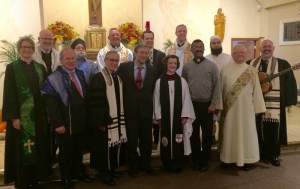
Plainview-Old Bethpage Interfaith Clergy, November 24, 2015

On Tuesday night, I participated in my fourth Plainview-Old Bethpage Interfaith Thanksgiving Service.  Every year I find the service moving. I am grateful for a holiday that we can all honor without fear of stepping on each other’s toes.  But as I sat there last night, I became acutely aware of my surroundings.  On my left sat the Mufti from the local Muslim community and on my right sat the priest from the local Roman Catholic parish.  It occurred to me in that moment that the Mufti usually only says prayers with men.  The women pray separately.  And yet, there we were, side by side, giving thanks to God.  It also occurred to me that although the priest has been warm and affirming, his Church does not recognize my ordination as appropriately apostolic – especially given my gender.  And yet, there we were, as equal leaders in our respective communities.  Despite having had long relationships with the fellow clergy leaders, this was the first time I realized how radical our relationships are – to sit next to each other despite profound differences – and yet still be able to praise, lead, and worship together.

Truthfully, I do not know what God is doing this week.  On a basic level, I suspect God is reminding me that I am not even close to having “seen it all.”  But on a deeper level, I also suspect that God is inviting me to go further, to delve deeper, and to see more widely.  Perhaps a disadvantage to my profession is a naïve sense that I have a hold on who this God is that we worship and serve.  This week, God has humbled me by reminding me that God is so much more. As I anticipate celebrating Eucharist on Thanksgiving Day, I expect to approach the Table with keener sense of wonder, gratitude, and awe for the ways in which God is so much more.  What a blessed gift this week has been.  Thanks be to God for being more than I could ask for or imagine!

On dignity and solidarity…

14 Friday Aug 2015

Posted by jandrewsweckerly in Uncategorized

≈ Leave a comment

Tags

baptismal covenant, community, dignity, food, God, human being, Kingdom, ministry, solidarity, vow

This past year, St. Margaret’s read the book Take This Bread, by Sara Miles.  In it, Miles describes a food ministry that she began at her Episcopal Church in San Francisco.  At St. Gregory’s, their worship is open – roles are more open, the Eucharistic Table is open, and idea flow in the open.  Like Miles was welcomed to the Eucharistic Table without barrier, she wanted to create a food ministry that was without barriers.  She didn’t want to have people register or keep records of how often they had received food.  She just wanted people to come, get what they need and let them go about their lives.  She wanted them to find a sense of dignity and welcome when so few of them experience that in other parts of their lives.

Photo credit:  https://www.finedininglovers.com/blog/news-trends/waste-food-project/

Photo credit: https://www.finedininglovers.com/blog/news-trends/waste-food-project/

I was reminded of her ministry today when I heard an NPR story about a program in Spain called the Solidarity Fridge.  The idea was to create a communal fridge where people who are hungry can come and get what they need.  Local restaurants pack up their leftovers in plastic containers and put them in the Fridge each night.  Even local grandmas make food for those in need.  There are standards in place, including the fact that food cannot stay more than four days.  But the organizers insist that it has never been a problem.  Tapas come in at night and they are gone by the next morning.  There is no monitoring process for the Fridge.  Whomever needs food can just come and get it.  And the food is really good.  Those who are in need find dignity in not being dehumanized by red tape and by being fed superior quality food.

Their program is not unlike a ministry we support at St. Margaret’s called Food Not Bombs.  An empty parking lot is suddenly transformed when volunteers arrive with carloads of food from restaurants, grocery stores, churches, and neighbors.  People fill grocery bags with what they need and leave to feed their families.  When everything is gone, the parking lot empties, without a soul around.  The idea from Food Not Bombs is that there is enough food for everyone – and the only reason people go hungry is because of waste and greed.  So they work to remedy the situation.

As I was thinking about the confluence of these three ministries, I was thinking of how they are living into the baptismal covenant we make – to respect the dignity of every human being.  There are passive ways we can do that – trying not to be judgmental or racist.  There are active ways that we can do that – giving money to charities that feed the hungry.  But there are intentional ways we can do that too – investing ourselves in ministries that specifically want to honor the dignity in others and that will encourage us to do the same.  That is why we make those baptismal promises in the context of community – because we need the community to hold us accountable to the covenant.  This Sunday, we will baptize a child of God and renew our own baptismal covenant.  I encourage you this week to prayerfully consider what ways you might be more intentional about fulfilling those vows.  And if you are struggling, find a member of the community and ask them to work with you.  Together, we can transform this world into the kingdom of God here on earth.

← Older posts
Newer posts →

Recent Posts

  • On the Myth and Magic of Advent…
  • On Risking Failure and Facing Fear…
  • Sermon – Luke 23.33-43, P29, YC, November 23, 2025
  • On Inhabiting Gratitude…
  • Sermon – Luke 20.27-38, P27, YC, November 9, 2025

Archives

  • December 2025
  • November 2025
  • October 2025
  • September 2025
  • August 2025
  • July 2025
  • June 2025
  • March 2025
  • February 2025
  • December 2024
  • November 2024
  • October 2024
  • September 2024
  • August 2024
  • July 2024
  • June 2024
  • May 2024
  • March 2024
  • February 2024
  • January 2024
  • December 2023
  • November 2023
  • October 2023
  • September 2023
  • August 2023
  • July 2023
  • June 2023
  • May 2023
  • March 2023
  • February 2023
  • January 2023
  • December 2022
  • November 2022
  • October 2022
  • June 2022
  • May 2022
  • January 2022
  • December 2021
  • November 2021
  • October 2021
  • September 2021
  • August 2021
  • June 2021
  • May 2021
  • April 2021
  • March 2021
  • February 2021
  • January 2021
  • December 2020
  • November 2020
  • October 2020
  • September 2020
  • August 2020
  • July 2020
  • June 2020
  • May 2020
  • April 2020
  • March 2020
  • February 2020
  • January 2020
  • December 2019
  • November 2019
  • October 2019
  • September 2019
  • August 2019
  • July 2019
  • June 2019
  • May 2019
  • April 2019
  • March 2019
  • February 2019
  • January 2019
  • December 2018
  • November 2018
  • October 2018
  • September 2018
  • August 2018
  • July 2018
  • June 2018
  • May 2018
  • April 2018
  • March 2018
  • February 2018
  • January 2018
  • December 2017
  • November 2017
  • October 2017
  • September 2017
  • August 2017
  • July 2017
  • June 2017
  • May 2017
  • April 2017
  • March 2017
  • February 2017
  • January 2017
  • December 2016
  • November 2016
  • October 2016
  • September 2016
  • August 2016
  • July 2016
  • June 2016
  • May 2016
  • April 2016
  • March 2016
  • February 2016
  • January 2016
  • December 2015
  • November 2015
  • October 2015
  • September 2015
  • August 2015
  • July 2015
  • June 2015
  • May 2015
  • April 2015
  • March 2015
  • February 2015
  • January 2015
  • December 2014
  • November 2014
  • October 2014
  • September 2014
  • August 2014
  • July 2014
  • June 2014
  • April 2014
  • March 2014
  • February 2014
  • January 2014
  • December 2013
  • November 2013
  • October 2013
  • September 2013
  • August 2013
  • July 2013
  • June 2013
  • May 2013
  • April 2013
  • March 2013
  • February 2013
  • January 2013
  • December 2012
  • November 2012
  • October 2012
  • September 2012

Categories

  • reflection
  • Sermons
  • Uncategorized

Meta

  • Create account
  • Log in
  • Entries feed
  • Comments feed
  • WordPress.com

Blog at WordPress.com.

  • Subscribe Subscribed
    • Seeking and Serving
    • Join 394 other subscribers
    • Already have a WordPress.com account? Log in now.
    • Seeking and Serving
    • Subscribe Subscribed
    • Sign up
    • Log in
    • Report this content
    • View site in Reader
    • Manage subscriptions
    • Collapse this bar
 

Loading Comments...