
• About

Seeking and Serving

~ seek and serve Christ in all persons

Seeking and Serving

Tag Archives: money

Sermon – Luke 16.1-13, P20, YC, September 18, 2016

21 Wednesday Sep 2016

Posted by jandrewsweckerly in Uncategorized

≈ Leave a comment

Tags

debt, dishonest, economics, friends, God, Jesus, kingdom friendships, loyalty, manager, master, money, parable, relationship, Sermon, shrewd, steward, tango, wealth

Often when we talk about Jesus, we marvel at his parables, and we encourage each other to follow his teachings.  We ask questions like, “What would Jesus do?” as if the answers are obvious.  We describe Jesus as illuminating God, helping us to understand God in an incarnate way.  We even say that all things necessary for salvation are found in Holy Scripture.  And for the most part, all of those things are true – until we get to today’s parable.  Most of us listen to the lesson for today and can only say, “Wait….what?”

Here’s the problem.  Unlike many of Jesus’ parables and sayings, most of us come away from this one completely confused.  Jesus starts off simply enough.  A rich man has a manger, or steward, and the manager is accused of squandering the master’s property.  The master threatens to fire the manager, and so the manager goes off and talks to all the debtors of his master.  Knowing he is about to be fired, the steward strikes deals with the debtors, decreasing their debts, in the hopes of making some friends who will feel indebted to him and may take him in once he is fired.  But what happens next is where the parable gets confusing.  When the master finds out what the steward has done, instead of being angry, he commends the manager for being shrewd.  And to top off this odd response, Jesus completes this whole parable with an instruction that all of us should be like the shrewd manager, making friends by means of dishonest wealth.  Jesus concludes the story by telling us that no one can serve God and wealth.

Confused yet?  You are in good company!  Even most scholars disagree about what the parable is trying to do.  Though we all might understand the part about our loyalties being torn between God and money, the parable hardly helps us get there.  The manager is a schemer – he is about to be fired because he has mismanaged things.  But instead of righting the situation with his master, he confesses that he is both lazy and proud.  He sneakily makes deals with the master’s debtors in the hopes that the debtors will see him as an ally and will help take care of him when he is fired.  But what is most confusing about the whole story is that Jesus says we should go and do likewise.

What might be helpful in getting our heads around Jesus’ strange parable is to understand the economics of “Roman-occupied Galilee in the first century.  Rich landlords and rulers were loan-sharks, using exorbitant interest rates to amass more land and to disinherit peasants of their family land, in direct violation of biblical covenantal law.  The rich man … along with his steward or debt collector, were both exploiting desperate peasants.”  Wealthy landlords of the day would hide interest charges in the money owed by the peasants.  According to scholars, someone like the wealthy steward could be charging the average peasant anywhere from 25-50% for the landlord, an additional cut for the himself, and then a Roman tax on top of all that.[i]

Now before we get too self-righteous about the injustice of the Roman economic system, we have to remember the economic system we operate under today.  Think about modern college students, who not only attend colleges with soaring tuitions, but also are being offered student loans with higher interest rates that ever before.  Add on top of that a weak economy and you see our young people being buried under unfair debt.  Or think about predatory payday loans.  Those scraping by to make ends meet start slipping behind.  Bills are due and they do not have enough to make ends meet, so they get lured in by the immediacy of a pay-day loan.  But by the time all is said and done, they lose more of their paychecks to the interest charged by loan sharks than if they had just kept their money.  And just in case we think we can get away with blaming student loan and payday lenders, we cannot forget our own country’s lending policies with impoverished countries.  Leaders of third world countries agree to harshly austere loans we make, but the poor of the country end up bearing the brunt of the burden.  In fact, “the Lutheran World Federation calls oppressive debt terms imposed on Honduras and other Latin American countries ‘illegitimate debt’ and likens such debt itself to ‘violence,’ because of its crushing effects on people’s futures.”[ii]  Though we may not have everyday contact with stewards or managers, their economic system is more familiar than we may realize.

What is unclear about the steward’s actions is how he is able to forgive some of the debtors’ debts.  In forgiving the debts of the debtors, the manager may have been forgiving his own cut of the interest being charged.  In that way, his actions seem a bit more noble.  Obviously, he is cutting out his own salary, but he is doing so in a way that seems to, at least outwardly, condemn the system.  Or, the steward could have been eliminating all the hidden and prohibited interest in the contracts.[iii]  This would have been a bolder move, as he would have been denying the master his typical amount due.  But because he is enforcing Jewish laws around interest, he would have ingratiated himself to the local Jewish peasants.   This is why the steward may receive commendations from the landlord and Jesus – not because he is noble per se, but because he manipulates the unjust system to curry favor with his neighbors – the very ones who might lend him a hand when he is fired for doing something supposedly just.[iv]  Whatever the self-interest of the steward is, what he is able to do, and perhaps why his master calls him shrewd, is use an unjust system against itself.  Just or not, the steward is able to see that the power of mutuality, of relationship, is the better bedfellow than the unjust economic system of the day.

One of my favorite classes in college was a class called “Social Dance.”  We spent the semester learning the Fox Trot, Waltz, Tango, Cha-Cha, and Swing.  My class happened to have more men than women, so I never had to sit out a dance.  I just switched from partner to partner, trying to adjust as each lead learned the steps.  There were many hard lessons in that class, not least of which was learning how to let the man lead.  But the hardest lesson was learning that no matter what dance we were doing, and no matter how intertwined our bodies were, my frame was a vital component to the dance.  Even in a dance like the Tango, where bodies seem to be intertwined, each partner is holding on to their frame, protecting their space.   I was fascinated to see how two bodies could function in such unison, looking like one unit, and yet, be two differentiated, separate units.

As I studied our gospel lesson this week, I wondered if Jesus’ lesson about wealth is not unlike a couple dancing the Tango.  Living in the world that we do, there is no way for us to escape the dancing partner of wealth.  Given that wealth has the power to corrupt, we will always need to keep our frame in place – keeping the dance going in unison, but never letting ourselves forget to be differentiated from dishonest wealth.  Though the steward seems unseemly and self-interested, he shows us an intricate tango with wealth – how to manipulate wealth so that wealth only hurts itself, not those most in need.

The way that we keep that firm frame is by being in relationship – by making friends as Jesus tells us.[v]  When we invest in friendships (not just friendships with people we like, but kingdom friendships[vi] – the kind of relationships that are unexpected, but feed us more than any wealth can), then wealth begins to lose its power to weaken our frame.  Kingdom friendships are those friendships with people at church or in the world with whom you thought you would never have anything in common.  Kingdom friendships are those relationships you develop with those who are different – either socioeconomically, racially, or ethnically.   Kingdom friendships are those relationships that develop when you realize that despite the fact that you are trying to help someone else, they are actually helping you.  The steward may have made kingdom friendships out self-interest, but the results are the same.  He realizes once he sees the humanity in those he is oppressing – once he makes kingdom friendships, the wealth he is pursuing no longer matters.  That is what Jesus invites us into today – that is how Jesus knows that we can hold onto our frame when dealing with the master of wealth.  Jesus invites us to nurture our kingdom friendships because when we nurture those friendships, we strengthen our sense of self, ensuring our frame never slips in our tango with wealth.  Amen.

[i] Barbara Rossing, “Commentary on Luke 16:1-13,” September 18, 2016, as found at http://www.workingpreacher.org/preaching.aspx?commentary_id=2982 on September 14, 2016.

[ii] Rossing.

[iii] Rossing.

[iv] G. Penny Nixon, “Homiletical Perspective,” Feasting on the Word, Yr. C, Vol. 4 (Louisville: Westminster John Knox Press, 2010), 95.

[v] David Lose, “Pentecost 18C:  Wealth and Relationships,” September 14, 2016, as found at http://www.davidlose.net/2016/09/pentecost-18-c-wealth-and-relationships/ on September 15, 2016.

[vi] Thomas Long, “Making Friends,” Journal for Preachers, vol. 30, no. 4, Pentecost 2007, 57.

Sermon – Luke 12.13-21, P13, YC, July 31, 2016

03 Wednesday Aug 2016

Posted by jandrewsweckerly in Sermons, Uncategorized

≈ Leave a comment

Tags

accountability, barn, community, financial management, God, greed, Jesus, money, relationship, rich, rich toward God, self-centeredness, Sermon, wealth

One of the last things that happens when you graduate from seminary is the staff from the Church Pension Group comes to talk to you about money management.  They help you understand how retirement funds work for clergy, encourage you to make sure you are doing some additional savings and investment planning, and remind you that, like tithing, how you manage your finances is a witness to your congregation for being good stewards.  That lesson is reiterated each year, as the priest is encouraged to be a smart investor through email reminders.  We even go to a wellness conference a few times over the course of our ministry to make sure we are tending to our financial wellness in addition to vocational, spiritual, and bodily wellness.  The lesson to clergy again and again, is to be good stewards of our financial resources.

So imagine my discomfort with the parable from Jesus today.  At first glance, this is a story about smart financial investments.  A man has a bumper crop – the land produces so abundantly he cannot fit the excess crops into his current barns.  Knowing that the land is fickle, maybe even having taken some notes from our ancestor Joseph who prevented a seven-year famine by stockpiling during a seven-year boon, the man decides he will just have to build a bigger barn to hold all the extra crops.  Quite frankly, his actions do not sound that far off from what any investment counselor who might tell us to do – store the excess away so that when a rainy day comes, or even when retirement comes, we can still “eat, drink, and be merry.”  All in all, his logic sounds pretty spot-on to me.

Here is the kicker though:  the day the newly enlarged barn is finished is the same day that the man will die.  All those plans, hopes, and dreams for a secure retirement are gone.  He never gets to enjoy the fruits of his labor.  He never gets to retire in comfort.  He never gets to eat, drink, and be merry.  Our immediate reaction to this tragedy might be to proclaim how life or God is not fair.  But into our disappointment, Jesus says, “So it is with those who store up treasures for themselves but are not rich toward God.”

In these last words from Jesus, Jesus takes the wind out of our sails.  Jesus reminds us that being a good steward of our resources means lots of things:  being smart with our money, saving for times of famine, giving to the church, and caring for our neighbor.  But most importantly, being a good steward of our resources is not just about sound financial practices.  Being a good steward of our resources is also managing our relationship with our money – and more specifically, managing our relationship with God in relation to our money.

Now some of you may be thinking, “Here she goes.  She’s going to tell me how I need to give more money to the church to right my relationship with God.”  No need to get too anxious today.  I do not think Jesus is looking for a specific action today – as if to say, “Do not be like the man with the barns.  Give your full ten percent to the church and all will be well.”  No, what Jesus is trying to do is help us see that our relationship with money matters.  Unlike a polite dinner guest, Jesus never shies away from talking about money.  He is constantly warning us about the potential of riches to corrupt our relationship with God.  So the answer to what the rich man should do may not be a clear-cut formula, but we get some obvious clues about what Jesus means about being rich toward God.

Going back to the story is particularly helpful.  The most obvious thing that we see happening in the parable is that the wealthy man has become completely self-absorbed and ego-centric.  Listen again to the words of the parable, “And he thought to himself, ‘What should I do, for I have no place to store my crops?’ Then he said, ‘I will do this: I will pull down my barns and build larger ones, and there I will store all my grain and my goods. And I will say to my soul, ‘Soul, you have ample goods laid up for many years; relax, eat, drink, be merry.’”  The list is long:  What should I do?  My crops, my barns, my grain, my goods, my soul.  All the words of the wealthy man are self-referential.[i]  Nowhere does he talk to God.  Nowhere does he talk to his family or a trusted friend.  Nowhere does he consult his property manager, or the local priest.  He never praises God for the abundance.  He never acknowledges that the land has provided.  He never even considers sharing his abundance.  He is self-interested, self-protecting, and self-centered.  And all of that focus on the self comes from a relationship with money and with God that is out of whack.

So how do we avoid the slippery slope that leads to self-centeredness and greed, luring us to constantly redefine how much is “enough”?  What exactly is being rich toward God?  Jesus tells us the answer to our quandary throughout Luke’s gospel.  As one scholar explains, “Being rich toward God entails using one’s resources for the benefit of one’s neighbor in need, as the Samaritan did (10:25-37).  Being rich toward God includes intentionally listening to Jesus’ word, as Mary did (10:38-42).  Being rich toward God consists of prayerfully trusting that God will provide for the needs of life (11:1-13, 12:22-31).  Being rich toward God involves selling possessions and giving alms as a means of establishing a lasting treasure in heaven (12:32-34).”  In other words, “Life and possessions are a gift of God to be used to advance God’s agenda of care and compassion, precisely for those who lack resources to provide for themselves.”[ii]

Last year, while serving on the board of the Episcopal Ministries of Long Island in New York, we were surprised by a bequest of about 1.3 million dollars.  The bequest came from a woman who had seemed to be of little consequence.  Each year she had probably given the charitable group about $25 a year.  We assumed that was about all she could do.  So when the gift came in, we were stunned.  After some prayerful discernment, we elected to put one million into our endowment, to ensure that we could keep helping ministries on Long Island.  But the three hundred thousand would be for us to try new and innovative ministries – and luckily for us, there was already a proposal on the table that we thought we could not afford:  a food truck that would take food around to the homeless in Brooklyn, and maybe even host a social worker and or nurse.  I do not know what sort of life this woman led or how she managed her money.  But even in death, her richness toward God was obvious to us all.

The challenge of Jesus this week to be rich toward God is not just a challenge for self-centered men of means.  Though we may be tempted to finger-point, Jesus and we know that money has the power to corrupt all of our relationships with God.  And unfortunately, the consequences are not limited to our relationships with God – our ability to live lives rich toward God impacts our neighbors too.  The good news is that we have a community of faith sitting right next to us who can be our support system as we work to turn our hearts and our riches to God.  Now I know we all value being respectful dinner guests, but this time, we are going to need to follow Jesus’ lead.  In order to really turn our hearts and riches toward God, we are going to need to start talking with our friends about the place of money in our lives and in our relationship with God.  We are going to need to talk about our struggles and failures.  And we are going to need to celebrate our victories and successes.  We are basically going to need to become a giant support group for becoming rich toward God.

I once heard about a “congregation who invited families to not buy any unnecessary new thing for six months in order to break the culturally-induced habit of trying to buy happiness.  But they didn’t just invite people to do this, they formed a culture in which they supported each other.  They read and talked about a common book on abundant life, they kept in touch via small groups and email, they shared where they were succeeding and struggling and what they were learning.  In short, the formed a community so that they could stand against the all-too-human and culturally supported belief that if we just had a little more we’d be happy.”[iii]

I do not know what model or what goals are going to work for each of you.  But I do know that just by our very citizenship in this country, we face more temptation toward greed than in probably any other country.  If we are going to follow Jesus, to avoid a life of self-centeredness, and claim a life of being rich toward God, we are going to need each other.  Whether you want to form a small group or just find a trusted friend, this is the important work Jesus invites us into today.  My guess is that building up a community of support that is rich toward God will create much more opportunities to eat, drink, and be merry, than any bigger barn could ever give us.  Amen.

[i] Audrey West, “Theological Perspective,” Feasting on the Word, Yr. C, Vol. 3 (Louisville: Westminster John Knox Press, 2010), 312.

[ii] Richard P. Carlson, “Exegetical Perspective,” Feasting on the Word, Yr. C, Vol. 3 (Louisville: Westminster John Knox Press, 2010), 315.

[iii] David Lose, “What Money Can and Can’t Do,” July 29, 2013, as found at http://www.workingpreacher.org/craft.aspx?post=2668 on July 27, 2016.

Giving and Sharing…

28 Wednesday Oct 2015

Posted by jandrewsweckerly in Uncategorized

≈ Leave a comment

Tags

church, Episcopal, grow, home, memories, money, stewardship, talent

This week we continue a series of guest blog posts by parishioners at the Episcopal Church of St. Margaret in Plainview, NY.  They are reflecting on what stewardship means to them, and how God the Giver has been a part of their lives.  Our guest post this week is from parishioner Mike Hadden.

In this latest season of stewardship, I reflect on the things that I can do to give back to the Episcopal Church that has provided me many fond memories; camps, dances, youth groups, just to name a few. I’ll share one memory. There was a point when I was a kid, growing up in Shelby, NC (Church of the Redeemer), that my father was out of work for an extended period of time. Mom and Dad were always active members in church (they later went on to found an Episcopal Church in Mooresville, NC – St. Patrick’s Mission). They had good friends through church, and participated in many activities. Deep into that employment transition for my Dad, the church vestry had apparently decided to use a portion of the discretionary funds available to cut a check to them, to help pay for our expenses. I’ll never forget the tears rolled down my Dad’s face when he accepted it.

However, stewardship isn’t just about money. It’s about what you can give back to the church through use of your talents – fundraising, maintenance work, etc. My family certainly doesn’t pledge a tremendous amount of money to the church annually. We can’t afford to. What we can – and do – do is give of our time; Mari on the Altar and Flower Guilds and teaching Sunday school; me on Vestry and Stewardship/Fundraising Committee. I firmly believe this Parish has the potential to be great. To grow back into one of the more prominent Episcopal churches on Long Island. We have lots of activities available, and are starting new ones all the time. What we need now is to use that positive momentum to drive forward in growth. The “Town Hall” meeting this Sunday felt like another step forward. Let’s continue that forward push, together.

Thank you all for everything you already do to make St. Margaret’s a great place to call my church home.

Respectfully,  Michael Hadden


Sermon – Matthew 5.1-12, All Saints Sunday, YA, November 2, 2014

05 Wednesday Nov 2014

Posted by jandrewsweckerly in Uncategorized

≈ Leave a comment

Tags

Beatitudes, blessed, discipleship, God, Jesus, journey, money, path, road, Sermon, stewardship, walking the way

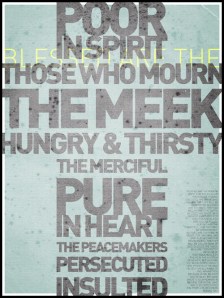
Courtesy of http://firecatching.blogspot.com/2011_04_01_archive.html

Courtesy of http://firecatching.blogspot.com/2011_04_01_archive.html

Today we hear one of the most beloved pieces of scripture.  The Beatitudes from Matthew’s gospel have been the source of inspiration for Christians for centuries, for artists and musicians, for entire ministries, and even for comedians like Monty Python.  As soon as we hear that phrase, “Blessed are…” our eyes close and we let the words flow over us.  We nod in assent, and maybe even whisper, “Yes!”  And as the preacher for In-Gathering Sunday, getting the Beatitudes in the lectionary is like being handed a silver platter.  What other inspiration can we need on a Sunday like this than to think about blessings?  That is what our Stewardship Committee has been encouraging us to do for weeks: to think about the ways that we are blessed and to return that blessing to this community through the gift of our financial resources.  That message could not be better captured than in the Beatitudes from our gospel lesson today.

Or at least that is what I thought before I started really working with the Beatitudes this week.  The more I poured over the text, the more I became confused.  Then the questions came pouring in:  What does it mean to be poor in spirit?  How do we know if we are pure in heart?  I might prefer peace, but could any of us in our everyday lives be considered peacemakers?  And those are just the surface level questions.  When we read at a deeper level, ethical questions begin to emerge.  Our news outlets have been flooded lately with people who are reviled, persecuted, and having evil uttered against them.  All we have to remember are Christians in Iraq, Palestine, or Burma whose very faith means a life of oppression and sometimes death.  Is the word for them today, “You are blessed”?  Many a liberation theologian has balked at the idea of Holy Scripture being used to keep down oppressed peoples.

Luckily, I stumbled on two things this week that opened up the Beatitudes for me in a fresh way.  First I began to look at what the word translated as “blessed” really means.  There are a couple of words in scripture that are translated in English as “blessed,” but they do not necessarily have the same meaning.  In our Beatitudes today, one scholar argues that the phrase translated as “blessed are you when…” is more rightly translated as “You are on the right road when…”  For example, “You are on the right road when you are poor in spirit.”[i]  So blessed does not really mean, “Happy are you when people persecute you,” but instead, “You are on the right road when people persecute you.”  Somehow this translation makes for a much more sober, honest rendering of Jesus’ words.  Jesus is not saying that these things are cause for happiness in a superficial way.  Jesus is saying that we are fortunate in those experiences because they point us to a deeper truth:  that we are heading in the right direction, making the right decisions, and living a meaningful life.

The other source of insight I found this week was from The Message’s translation of this text.  If you are not familiar with The Message, The Message is a paraphrase of the Bible:  not a literal translation of the Biblical language, but a modern rephrasing of the text to make the text more accessible.  Of course, biblical scholars often cringe when they hear certain paraphrases of key texts, but in the case of the Beatitudes, I found this paraphrase quite useful.

I have taken the two ideas – The Message’s paraphrase and the new introduction of “You are on the right road when…” and want to read for you my hybrid rephrasing of the Beatitudes.  Our text now goes like this:

You are on the right path when you’re at the end of your rope.  With less of you there is more of God and God’s rule.  You are on the right path when you feel you’ve lost what is most dear to you.  Only then can you be embraced by the One most dear to you.  You’re on the right path when you’re content with just who you are—no more, no less.  That’s the moment you find yourselves proud owners of everything that can’t be bought.  You’re on the right path when you’ve worked up a good appetite for God.  God’s food and drink in the best meal you’ll ever eat.  You’re on the right path when you care.  At the moment of being ‘care-full,’ you find yourselves cared for.  You’re on the right path when you get your inside world—your mind and heart—put right.  Then you can see God in the outside world.  You’re on the right path when you can show people how to cooperate instead of compete or fight.  That’s when you discover who you really are, and your place in God’s family.  You’re on the right path when your commitment to God provokes persecution.  The persecution drives you even deeper into God’s kingdom.  Not only that— You’re on the right path every time people put you down or throw you out or speak lies about you to discredit God.  What it means is that the truth is too close for comfort and they are uncomfortable.  You can be glad when that happens—give a cheer, even!—for though they don’t like it, God does!  And all heaven applauds.  And know that you are in good company.  God’s prophets and witnesses have always gotten into this kind of trouble.

This Stewardship Season, we have been talking about “Walking the Way.”  Certainly Walking the Way is a metaphor for our journey into a time of reflection about the value our money holds for us and how our relationship with that money is connected to our relationship with God.  But the Walking the Way metaphor is one that goes beyond just our money too.  Walking the Way is a metaphor for our entire journey with God – a path that is ever winding, has steep slopes at times, is sometimes full of potholes and rocks, and at other times is as smooth as a freshly paved road.  Our entire life is a journey – one in which we mature in faith from the time of our birth and baptism to the time of our old age and death.  We are constantly Walking the Way with Christ, growing, learning, messing up, and returning to a loving God.

What I like about this reworded rendition of the Beatitudes is the affirmation in them.  When we are on a journey, Walking the Way, we sometimes struggle to know whether we are on the right path.  We wonder if we are where we should be and whether God is really with us.  This rendition of the Beatitudes gives us a tiny glimpse into that affirmation:  You are on the right path when…  Of course, the description is not all roses.  Mourning, persecution, and making peace are not easy roads.  But a sign of true discipleship, of Walking the Way, are those times when the path is in fact quite rocky.  Then we know that we are on the right path, and Jesus is walking right beside us.  Amen.

[i] Earl F. Palmer, “Pastoral Perspective,” Feasting on the Word, Year A, Vol. 4 (Louisville: Westminster John Knox Press, 2011), 238.

A Lifelong Process…

14 Thursday Nov 2013

Posted by jandrewsweckerly in Uncategorized

≈ Leave a comment

Tags

alive, church, dreams, flourish, God, hope, living, money, stewardship

This stewardship reflection is offered by St. Margaret’s Parishioner, Kim Irvine.  

Courtesy of http://www.churchleaders.com/pastors/pastor-articles/156872-don-linscott-why-i-m-glad-my-church-needs-money.html

Courtesy of http://www.churchleaders.com/pastors/pastor-articles/156872-don-linscott-why-i-m-glad-my-church-needs-money.html

It seems that people often associate stewardship with feelings of dread, awkwardness, and anxiety, when in fact the goal of a stewardship campaign is to generate excitement and energy about the achievements our church has experienced, and share the hopes and dreams for the future.  We as a community in Christ need to have intentional discussions about the financial standing of our church.  How can we know what the needs of the church are, without having these crucial conversations?  This year let’s try not to view stewardship as a time we have to “get through”, but instead embrace stewardship as a way of life; living each day knowing that all we have is a gift from God, and we are responsible to use what we have been given to the glory of God.

I believe we at St. Margaret’s are witnessing first hand how stewardship results in helping not only the members of our congregation, but also those in our community and beyond.  New programs are being developed, we’ve seen new initiatives launched, and the buildings and grounds we are blessed with are being maintained and improved.  None of this would be possible without your stewardship.  Your pledges and generous contributions are facilitating growth and change within and outside our church.

In doing some research for this blog post I came upon the following quote:

“Have you ever heard anyone say, ‘My church is always asking for money.  I wish I could belong to a church that never needed any money.’  Surely they don’t mean that.  Any church that is alive needs money.  Only dead churches do not call on their members for support.  If anyone should accuse your church of always needing and calling for money, regard it as a compliment.  Invite this person to rejoice with you that you both belong to something that is living and productive for Jesus Christ rather than a dead, stagnant organization from which glory of Christ has departed.”[1]

For me, these words were really eye opening; they made me grateful to be part of a church that is “alive,” and full of God’s love.

Please prayerfully consider your pledge for this year; your continued financial support of St. Margaret’s will propel us to do the amazing things God has planned for us, and keep us flourishing in faith!

Respectfully submitted by Kim Irvine


[1] http://www.tonycooke.org/free_resources/articles_leadership/pastoral_helps/quotes_thoughts.html

Flourishing in Faith…

18 Friday Oct 2013

Posted by jandrewsweckerly in Uncategorized

≈ Leave a comment

Tags

church, generosity, goodness, gratitude, Jesus, money, stewardship

This month, I have offered space on the blog to members of our Stewardship Committee to reflect on their experiences of flourishing in faith.  This week, Debbie McGee offers her reflections.

Thanks for stopping by to check out St. Margaret’s blog today. I wanted to take this opportunity to chat a bit about what “Stewardship” means and how it relates to my life.

Yesterday, my 20-something son received the St. Margaret’s Stewardship letter and enclosure in the mail. His response was, “They want my money!” I replied, “Who wants your money?” He responded, “The Church!” It was soon apparent that my son did not understand what Stewardship is about and that we needed to spend some time talking about it – but how about you? Would you have experienced the same reaction?

As a member of St. Margaret’s stewardship committee for the past two years, I have traveled a long road in coming to terms with what stewardship is truly about. This is not something that occurs overnight but becomes clearer as one deepens their spirituality. I remember as a kid, watching my dad leave home at night to “go visit” other parishioners to talk about stewardship, and hopefully come back with a new pledge card. It did not make much sense to me back then, but my dad was always happy when he received a new pledge commitment!

Courtesy of http://www.kihealing1.com/tag/gratitude-365

Courtesy of http://www.kihealing1.com/tag/gratitude-365

Today, I find myself as one of God’s stewards and have a much better understanding of what stewardship is all about. Firstly, it is NOT about paying dues or membership to an organization. Stewardship is about responding to God’s generosity in your life with a glad, grateful and generous heart. “It is important to look around each day and recognize we are blessed. It is important to live with an attitude of gratitude. People who are grateful see the good side of life more often and have a tendency to perceive their glass as half full, not half empty. Living with such an attitude also makes us more realistic, for we realize that nothing just is, and everything is a blessing.”[1]

I am a faithful follower of Jesus Christ. Being a good steward brings me closer to God. It has become a journey for my family and me as we intentionally make a choice to give and give generously. We experience such joy with our giving. We are part of St. Margaret Church’s commitment to mission and have seen firsthand the positive change our giving has made. We have tremendous community in our parish and I have witnessed the generosity displayed toward one another. St. Margaret’s continues to be transformed as we seek out and explore new kinds of outreach due to a groundswell of stewardship.

God designed us for goodness and generosity. It is a privileged role we can play as his stewards. Jesus Christ challenged his disciples about their relationship with money and possessions. And so I challenge you! What do you value and how will you walk in the steps of Jesus Christ? Your stewardship is both a gift and a response to God’s boundless and unending grace. God is calling us to be faithful supporters; so give generously from your heart for all the blessings you have received.

How will you respond?


[1] Cutie, Albert R. (2013) Forward Day by Day. 1:76.

Sermon – Luke 16.1-13, P20, YC, September 22, 2013

26 Thursday Sep 2013

Posted by jandrewsweckerly in Uncategorized

≈ 1 Comment

Tags

dishonest, friends, Jesus, manager, master, money, relationship, Sermon, wealth

If you were following today’s gospel lesson closely, you are most likely wondering whether you heard Jesus correctly, as his words make little sense.  Jesus tells another one his parables about money.  When a scheming, dishonest, self-serving manager is about to get fired, he goes and does the unthinkable.  He forgives debts which are not his debts to forgive, hoping in the end to make enough friends who might support him once he is out of a job.  And so when the master returns and finds out what has happened, we expect judgment to reign down on him even greater than before.  But in a shocking turn, the master commends the manager for acting shrewdly.  In response to this turn in the story, Jesus says to the disciples, “I tell you, make friends for yourselves by means of dishonest wealth so that when it is gone, they may welcome you into the eternal home.”  We hear Jesus basically telling the disciples to use dishonest wealth in the same way as this manager, and our response is confusion, disbelief, and maybe even disappointment.

After years of economic downward spiral, after watching banks and individuals cheat their way to the top while pushing down the poor and middle-class, many of us find Jesus’ words confusing if not altogether offensive.  We want nothing to do with a life that encourages scheming and plotting behavior and the embracing of dishonesty.  Some part of us feels a bit betrayed by Jesus’ strange advice and we are not entirely sure how to proceed.

So for those of us stuck in a bit of a confused haze about dishonesty, money, and relationships, we are going to take a step back and look at what is actually happening in the parable so that we can understand Jesus’ comments a bit better.  First, we have a poorly-behaving manager.  The manager has squandered away the master’s money.  When he is caught, the manager takes a good look at himself and admits some honest truths – he is not capable of doing manual labor and he is too embarrassed to beg for money.  Having been honest about who he is, he connives his way into a solution:  he will engender goodwill among his neighbors by doing financial favors for each of them – forgiving portions of their debts in the hopes that they will sometime very soon return the favor.  Both the master and Jesus recognize the shrewdness or wisdom in the manager’s behavior because the manager uses his wits to get out of a devastating position.

After understanding exactly what Jesus is complimenting, next we need to understand what Jesus is saying about money.  When Jesus says to “make friends for yourselves by means of dishonest wealth,” Jesus is not saying to start behaving unethically.  Jesus is claiming that money itself is inherently a means, not an end.  This point is a little tricky for us.  We all have varying philosophies about money.  Some of us manage to care very little about money, with money holding very little power over us.  Some of us struggle with money, sometimes remembering how money can be used for good, but most times feeling like money creates stress and anxiety in our lives that we cannot seem to shake.  And others of us become narrowly focused on money – either in how we can acquire more or what ways we can spend and enjoy money more.  What Jesus knows that we often forget is that money is inherently “dishonest.”  Money creates systems of injustice and hierarchies of power; money can destroy marriages and friendships; and money can be the ruin of many a person.  So when Jesus says to make friends through dishonest wealth, he does not mean to become a dishonest people; he means that money is inherently luring us into dishonesty, and we can either throw our hands up in the air in resignation and a refusal to be associated with that dishonesty, or we can use that dishonest wealth as a means to something much more important – relationship with others.

So if we understand what the manager is actually doing, and we can see money as a means to an end, how do we get to the step of being comfortable with using something bad for good?  Jesus is not telling us to manipulate people with money in order to be in relationship with others.  Most of us believe the old adage that you cannot buy friends – or at least not good ones anyway.  But Jesus is not suggesting we try to buy friends.  Jesus is suggesting that instead of categorizing everything into good and evil, honest and dishonest, we become a bit shrewder in our thinking.  Jesus encourages his disciples to learn from the dishonest manager because the dishonest manager takes a pretty awful situation and manipulates the situation into something good.  The kind of shrewdness Jesus is encouraging is the kind of activity that we might call, “thinking outside of the box.”  If the disciples are to live in this world and thrive, they are going to have to think outside of the box and get creative not only with money, but all sorts of things.

As I have been struggling with this text this week, I did one of the things that I often do in Bible Study.  I started looking at other translations to see if I could make more sense of Jesus’ words.  This week, I found the most help from a translation called, The Message.  Now as ample warning, The Message is a very contemporary paraphrase of the Bible, which takes a lot of theological liberties that I am often uncomfortable with; but I do often find that the language from that paraphrase opens up the biblical text enough for me to start seeing the text with fresh eyes.  The Message translates Jesus words in this way:  “Now here’s a surprise:  The master praised the crooked manager!  And why?  Because he knew how to look after himself.  Streetwise people are smarter in this regard than law-abiding citizens.  They are on constant alert, looking for angles, surviving by their wits.  I want you to be smart in the same way—but for what is right—using every adversity to stimulate you to creative survival, to concentrate your attention on the bare essentials, so you’ll live, really live, and not complacently just get by on good behavior.”

What Jesus is trying to say to us today is layered.  First, money has a corrupting force in our lives.  Jesus talks about money incessantly in scripture, from telling people to give away all their money, to scolding people about storing up their money in larger barns, to reminding people not to stress about money, to this odd text about money.  As Luke concludes today, Jesus tells us that we cannot serve God and money, because of the all-consuming way that money can corrode our relationship with God.

Second, we cannot escape money.  Money is a part of our everyday lives, and as we all know is necessary for functioning – for food, for shelter, for clothing, for comfort.  Even those monks and nuns who take on a vow of poverty still rely on the money of others for support.  Money, with all its potential for corruption, is inescapable in our lives.

Finally, once we understand the power and place of money in our lives, Jesus reminds us that when we are wise, keeping God at the center, we can use money as a means to goodness in our relationship with God and with one another.  The manager “transforms a bad situation into one that benefits him and others.  By reducing other people’s debts, he creates a new set of relationships based not on the vertical relationship between lenders and debtors (rooted in monetary exchange) but on something more like the reciprocal and egalitarian relationship of friends.”[i]  This kind of work is not about charity per se, but about making friends.[ii]

A commercial has been circulating around the internet lately.[iii]  In the video, a boy is caught red-handed trying to steal a bottle of medicine and a soda.  A woman is berating him in front of a marketplace, wanting to know why he would take these things.  He confesses that the items are for his mother.  A local merchant steps forward, and hands the woman a handful of money to cover the cost of the stolen items.  The man then quietly asks the boy if his mother is sick.  When the boy nods yes, the merchant has his daughter also bring a container of vegetable broth and other items, and sends the boy on his way.  The next clip of the commercial shows the merchant thirty years later, still working in his shop.  He collapses and is taken to the hospital.  The daughter becomes completely overwhelmed as the medical bills add up, even selling the shop they had once run together.  As she is found crying near her father’s bedside, she finds a revised copy of her bill.  The amount due is zero.  We find out through the video that the doctor who forgives the bill is that same boy who stole medicine thirty years ago.  He writes at the bottom of the bill, “All expenses paid thirty years ago with three packs of painkillers and a bag of veggie soup.”

Jesus knows how money corrupts our world.  But Jesus also knows that we can shrewdly utilize our money as a tool to create relationships that glorify God.  This is Jesus’ invitation for you today:  to examine how your relationship with dishonest wealth can be used for goodness.  Amen.


[i] Lois Malcolm, “Commentary on Luke 16.1-13,” as found on http://www.workingpreacher.org/preaching.aspx? commentary _id= 1783 on September 18, 2013.

[ii] Thomas G. Long, “Making Friends,” Journal for Preachers, vol. 30, no. 4, Pentecost 2007, 55.

[iii] As found at http://www.youtube.com/watch?v=TUM4Mb9rUTU on September 20, 2013.

Sermon – Luke 12.32-40, P14, YC, August 11, 2013

18 Sunday Aug 2013

Posted by jandrewsweckerly in Uncategorized

≈ Leave a comment

Tags

blessing, Jesus, money, possessions, Sermon, stuff, treasure, uncomfortable

A few weeks ago, a parishioner told me about how he had run into a guy in the parking lot of a grocery store he frequents.  He knew the man to be homeless, and as he was doing his own grocery shopping, he purchased a couple of bags of food for the man.  When he stopped by the car to deliver the bags, the man was overcome with gratitude.  The homeless man’s gushing evoked something in this parishioner, and he found that he just opened his wallet and gave the man all the cash he had too.  That is the funny thing about generosity.  Generosity is kind of addictive.  When we see how much something small means to someone else, we find we want to do more.  And in some strange way, our entire perspective shifts.  Those pennies we were pinching now just seem like pennies:  their value and meaning shift.

This is what Jesus has been trying to get at these last two weeks.  If you remember, last week, Jesus told the parable of a man who was scolded for storing up his excess produce in larger barns, especially since that man would die that very night.  Today, Jesus talks more about the “stuff,” of life.  Jesus says, “Sell your possessions, and give alms.  Make purses for yourselves that do not wear out, an unfailing treasure in heaven, where no thief comes near and no moth destroys.  For where your treasure is, there your heart will be also.”  Now I know:  most of us check out when Jesus says, “Sell your possessions.”  There are very few of us who can truly part with all of our possessions.  But what Jesus is really trying to get at is in the last sentence.  “For where your treasure is, there your heart will be also.”  Jesus wants his followers to see that the stuff of life is neither important nor unimportant.  But our attitude toward our stuff is what is important.

I worked at a parish when I was in seminary that was planning a remodeling of their building.  As different schematics were presented, the number one complaint I heard was, “We need more storage space.”  No matter how many different ways the architect and priest presented new layouts, the complaint about storage space kept arising.  When I finally asked the priest why they did not just put in more storage space into the plans, the priest told me this:  “You know what, Jennifer?  I do not want to put in more storage space because I know they will fill it.”  I was confused at first, wondering whether that might be the point – the parish had stuff they needed to store, hence the request for more space.  But eventually, what I came to see the priest as arguing was that no matter how much space they created, the parish would simply accumulate more stuff to keep storing.  Anyone who has upgraded from a smaller living space to a larger one knows how true this can be.  The more space we have, the more we tend to fill the space with stuff.

The trouble is not inherent in the stuff.  Our stuff is not necessarily evil.  The trouble with our stuff is that much like the land owner last week, when we get so focused on storing and maintaining stuff, our focus or our heart becomes fixed on the stuff and not the potential for the stuff.  Seven years ago, Scott and I moved to a one-bedroom apartment at seminary.  We had more things than could move with us, so we got a storage unit back in Delaware.  When we finally moved to Long Island, we emptied that storage unit.  As I was looking for something in the basement the other day, I realized I have a ton more dishes in the basement than I ever use.  Part of me wanted to get them out and start using them.  But then part of me wondered whether if I could survive for seven years without those casserole dishes and extra glassware, maybe I did not actually need them.  That conclusion has led to some challenging thoughts about the potential for our stuff.

Now I know these texts the last two weeks make us feel uncomfortable.  We do not like talking about money or our stuff in church.  We do not even like talking about those topics in stewardship season, let alone in the comfort of summer!  But we get these texts this time of year because their message is important for us to hear everyday.  When we are so burdened with stress or anxiety about money or our stuff, or even the stuff we want to have but do not have, then our bodies become tense, and our hands tightly closed.  The trouble with those tightly closed hands is that we cannot receive God in the ways that God desires to come to us.  The warnings later in today’s text about being ready are not to “‘Be ready so that you will avoid punishment,’ but, rather, ‘Be ready so that you will receive blessing.’”[i]

That is why Jesus wants us to be aware about where our treasure is.  In fact, we hear his longing in his first words today, “Do not be afraid, little flock, for it is your Father’s good pleasure to give you the kingdom.”  In other words, you do not need store up things or tarry in anxiety about the earthly stuff.  Our God, that loving father, is pleased to give you all the blessings of the kingdom; and not just in the heavenly kingdom, but here and now.

The question for us this week, then, is what “stuff” is getting in our way of receiving God’s blessing?  What are our arms so full of that we cannot have open arms to receive God’s blessing?  For me, I have been working on letting go not just of the physical stuff of life, but more my own emotional stuff.  Just last week, Simone and I went away for a week at the beach where we would share an 11-room house with other families.  I spent the weeks leading up to the trip worrying about what to bring, how I would haul all the beach “stuff” to and from the beach by myself, what toys or videos we would need for entertainment, and how I would manage the different meal schedule – since meals were served about two hours later than in the Andrews-Weckerly house.  Now certainly my weeks of preparation meant that I was well prepared.  But what I missed in all that preparation was that there would be ten other families present.  My concerns about being the sole parent for the week and how I would manage became all about me.  I forgot that God was giving me the blessing of ten other parents and at least two other sets of siblings to help me cope.  People chipped in with entertaining my child, by aiding with discipline, and with finding creative alternatives when the rains came.  I spent weeks trying to figure all this out by myself, when if I had just heard God’s word for me today, “Do not be afraid, little flock, for it is your Father’s good pleasure to give you the kingdom,” I might have been able to open my arms a lot sooner for God’s blessing.

The question is the same for all of us.  We all can stand to think about where our treasure is today.  Because God longs for our hearts to be in the blessings that God already decided to give to us.  What do you need to let go of today in order to open your arms for God’s blessing?  Amen.


[i] Audrey West, “Theological Perspective,” Feasting on the Word, Yr. C, Vol. 3 (Louisville: Westminster John Knox Press, 2010), 336.

Sermon – Ruth 3.1-5; 4.13-17, Mk. 12.38-44, P27, YB, November 11, 2012

12 Monday Nov 2012

Posted by jandrewsweckerly in Uncategorized

≈ Leave a comment

Tags

blessing, dependence, God, independence, money, Sermon, stewardship

This week, once our power was finally restored, Simone and I caught an episode of our favorite show, Sesame Street.  Typically I am running around the house getting us ready for school and work during Sesame Street, but this week, I found myself glued to the television.  In this particular episode, Sesame Street experienced a hurricane, and Big Bird’s home was destroyed.  All the neighbors of Sesame Street came out to help Big Bird.  But Big Bird struggled with their help.  Although he appreciated all their hard work, he was so fraught with sadness and despair that he could hardly focus on their generosity.  Although they put him up for the night, their houses were not the same as his.  Although they fed him meals, the food was not quite as he would want.  You could tell that he appreciated their efforts, but what he truly missed was his independence.  He did not like depending on others, especially because their care took him out of his comfort zone.

To be honest, I almost could not watch the episode.  The story was a little too close to home.  We have all been struggling with the battle between independence and dependence these last two weeks.  We have been dependent on the generosity of our neighbors and friends who have given us breaks from the cold, a space to recharge our electronics, a warm meal, or a place to clean laundry.  We have been dependent of the workers of LIPA and electrical workers from around the country to help us get our electricity restored.  We have been dependent on the availability of gasoline for transportation and for the few of us with generators.  Almost all of us have experienced episodes of dependence over the last two weeks, and we do not like it!  Receiving help feels awkward, throwing off the balance of power that we have with others.  We do not like the lack of control that dependence creates.  In fact some of us have stayed in cold homes, avoiding shelters or the offers of friends and neighbors just because we want some modicum of control over our disrupted lives.

With this internal struggle with dependence, our lectionary lessons today then are almost salt in our wounds.  First we hear from the concluding chapters of Ruth.  Ruth is often seen as one of the most independent, strong-willed women in scripture.  But in the portion of text we hear today, we hear the other reality of Ruth’s life – Ruth’s life is marked by dependence.  Ruth is dependent upon Naomi, who conceives of a plan to save them both; she is dependent upon Boaz, who can support her and sustain her; and she is dependent upon the community, who understands the roles of women and community in very different ways than we do in modern America.  In some ways, Ruth goes from being the central woman of fierce independence, to the dependent wife, mother, and daughter-in-law who fades into the life of the community.

Then we get the widow in our gospel lesson today.  Here is a woman, who barely has anything, who, as a widow, is inherently dependent upon others for support, and who is found putting the two final coins in her possession in the treasury.  Jesus praises her because she gives not out of her abundance like the others, but because she recognizes her total dependence upon God, and freely gives away everything.  The lesson we hear from Jesus today about this woman is that we are to be “dependent on nothing but the grace of God.  We are to be people without any resources except the riches of God’s mercy.”[i]

And this is where we all get more than a little bit uncomfortable with Jesus’ words and Ruth’s actions.  We replay these past two weeks and worry that if we cannot get comfortable depending on our neighbors, how are we ever to get comfortable with depending fully on God?  Or our practical brains kick in and we immediately begin to argue with God.  How are we supposed to function on our own without a penny to our name?  Are we just supposed to walk away from everything, standing on the street, saying, “Okay God, I am dependent upon you.  Take care of me.”  In our independent American culture, the idea of dependence is uncomfortable and almost feels impossible to us.

For guidance, I go back to our lessons.  First, I listen again to Ruth.  Instead of imagining Ruth as the woman oppressed by a patriarchal system, I like to imagine the joy that comes from Ruth’s life – the joy that is found when an entire community comes together for the sake of survival.  When Obed is born, everyone rejoices, everyone wins.  Maybe Ruth is not a liberated, independent woman – but are any of us truly so liberated that we do not need others in our lives?  Ruth chooses dependence – she willingly chooses dependence because she trusts that God will make everything right.  In fact, her independent self chooses dependence throughout her blessed story.

Next, I look back at the widow.  She irrationally gives everything to God – her very last pennies.  But we should be honest.  When all you have are pennies left, those little coins are not going to dramatically change your life anyway.[ii]  Her utter poverty and dependence upon others who care for widows allow her to see what the wealthy cannot – that everything belongs to God anyway.  What she teaches us is not to feel guilty or irrational about wealth and giving, but to realize that we will have to choose dependence upon God – because dependence never comes naturally.

When I worked at Habitat, I remember having a conversation with the financial consultant to our homeowner families.  In looking at one homeowner’s budget, she saw that the homeowner was giving about ten percent of her income to her Church.  The consultant was frustrated, because she knew that all that giving to the Church was hurting the homeowner’s children.  But the homeowner would not budge on the issue.  The homeowner insisted they would just have to find another way to balance the budget, because God was getting that ten percent.

The truth is that our lessons are not condemning wealth or independence.  What the lessons are trying to teach us is that both wealth and our own egos can trick us into thinking that we can truly be independent.  They can trick us into thinking that we do not really need God.  That is why the Stewardship Committee and I have been talking about our relationship with money this past month.  We have not been talking about money because we need to bring in enough to pay the bills, or because we want us to feel guilty about our wealth.  We have been talking about money because we want us all to see how our relationship with money can impact our relationship with God.  When we cling to our money or our independence so tightly that we blind ourselves to the blessings that can bubble out of letting go of those things, we miss out on opportunities for the Holy Spirit to work on us, to help us see through the lens of Christ.  Although some may connect dependence with oppression and depression, Ruth and Jesus show us that our dependence on God leads to joy and thanksgiving.[iii]

As I think back on these past two weeks, I will also remember the blessings.  I will remember how a hot bowl of soup or a warm pot of spaghetti warmed not only my insides, but also warmed my spirits.  I will remember the camaraderie of people gathered at the public library, charging electronics and helping kids blow off steam.  I will remember the ways in which our mutual dependence led to conversations with people that normally would have been superficial but were now full of meaning and shared support.  I will remember the great comfort of sharing an impromptu coffee hour with those of us who could spare the gasoline to get here last week, and how overjoyed I was just to see your faces and hear your stories.  If anything, this horrible storm has shown how we are more dependent than we all might like, but also how that dependence has led to incredible blessings.  Our invitation today is to embrace our dependence on God in the same way that we are embracing our dependence on one another.  Amen.


[i] Mary W. Anderson, “Widow’s Walk,” Christian Century, vol. 20, no. 22, Nov. 1, 2003, 18.

[ii] Anderson, 18.

[iii] Anderson, 18.

Sermon – Mark 10.17-31, P23, YB, October 14, 2012

15 Monday Oct 2012

Posted by jandrewsweckerly in Uncategorized

≈ Leave a comment

Tags

faith, God, money, Sermon, stewardship, wealth

For those of you paying attention to the gospel lesson today and who realize we are kicking off Stewardship Season this week, I promise I did not pick the lessons today!  We are blessed by a lectionary that guides us through our sacred scripture every year, and the use of the lectionary is one of the many things that attracted me to the Episcopal Church.  That being said, since Jesus so conveniently brought up the subject of money, it only seems fitting that we talk about money today.

We know that the issue of money was important to Jesus.  All three of the synoptic gospels tell a version of the story we hear today.  We know the story well, and tend to avoid the story like the plague.  At some point or another, we have convinced ourselves that this text does not really apply to us.  We do not see ourselves as rich – we can all think of someone who has more than we do and we all struggle with our finances at times.  But in the depths of our hearts, we know that Jesus is talking to us.  As Americans, we constitute five percent of the world’s population, but consume twenty-four percent of the world’s energy.  Americans eat roughly 200 billion more calories a day than we need, which is enough to feed 80 million people every day.  We consume about 159 gallons of water a day, while more than half of the world’s population lives on 25 gallons.  We have more shopping malls than high schools.[i]  Whether we prefer to admit the truth or not, we are the rich person that today’s gospel lesson is addressing.  And if Jesus is talking to us, Jesus is also asking us to give up our wealth because otherwise, we, the camels, have no chance of getting through that needle’s eye.

But before we go too far down the road to guilt or panic, let’s look at what Jesus is really saying in our gospel lesson today.  This young man is a righteous man who approaches Jesus with a genuine desire to ensure he is on the right path to eternal life.  He approaches Jesus humbly, racing to Jesus and kneeling before him like so many other sick people have.[ii]  He must have been fairly certain that his life was not whole to pursue Jesus like this.  What he may not have expected is what Jesus tells him.  Jesus tells him that he is living a righteous life – with one small exception.  His wealth, his possessions, his “stuff” is getting in the way of salvation.  His possessions and wealth have become a source of separation from God.  This is what Jesus is really after today.  Having money is not in and of itself evil.  We need money to survive.  But our relationship with money has the potential to separate us from God.

Wealth can separate us from God in one of two ways.  When we have abundant resources, we eventually assume that whatever needs to be done, we can do.  But this kind of self-sufficiency and self-produced security cuts us off from grace.  Life becomes an achievement earned or a commodity purchased rather than a gift gratefully received and shared.  God becomes unnecessary or simply another commodity.  And if security and worth are rooted in achievements and resources, amassing more becomes our driving motivation.  We cannot let up.  We cannot relax.  We cannot give sacrificially.  Wealth becomes addictive.[iii]

The other way that wealth can separate us from God is that wealth can separate us from those who are impoverished.  Our wealth makes avoiding the poor possible, keeping them out of sight and mind.  As we have been working through our hunger curriculum on Wednesday nights, we have all said at one point or another that we simply do not run into the poor that often in our daily lives.  As one bishop explains, the reason why that socioeconomic divide separates us from God is because, “We cannot know the God of Jesus Christ apart from relationships with the poor and the powerless.  God has chosen the poor, the least, the most vulnerable, those whom the world considers ‘the weak’ as special friends.”[iv]  If we want to grow closer to God, we must grow closer to those whom Jesus cared for the most.  And in order to grow close to the poor, we must examine our relationship with our own wealth.

Now all of this is not to say that Jesus is mad at the wealthy man or sees him as lost.  Mark’s gospel tells us that, “Jesus, looking at him, loved him…”  Now if you remember, Mark is usually the most succinct of the gospel writers.  Neither Matthew nor Luke includes this small detail.  So if Mark is including this detail, the detail is important.[v]  We need to know that Jesus loves this young man because in his loving gaze we learn that Jesus believes the young man has a chance.  The young man has a chance not because he can achieve this new life style.  In fact, when the disciples ask Jesus about this very issue of who can overcome the hurdles of wealth, Jesus says, “For mortals it is impossible, but not for God; for God all things are possible.”  The young man cannot change his relationship between wealth and God alone.  That relationship can only be changed with God – because with God, all things are possible.

Today we kick off our stewardship season at St. Margaret’s.  For the next several weeks, we will be examining our own relationship between wealth and God.  In order to help us with that discernment, the Stewardship Committee has chosen the theme, “Blessed to be a Blessing.”  We chose this theme because we do not want us to have a guilty or conflicted relationship with wealth.  We want to see our individual wealth as a blessing that enables each of us to be a blessing to others.  All of us at St. Margaret’s have been blessed.  We have our basic needs met – a place to live, food to eat, and clothes to wear.  Most of us have been blessed beyond our basic needs – with cars, entertainment, and technology.  And we have been blessed spiritually by this community.  We have a community of faith where we can come and seek a deeper knowledge and understanding of God.  We have a community that engages us in the faith journey, challenging us to grow into the love of God.  And we have a community that sends us out in the world, showing us the real meaning of God’s love through our service of others.

This stewardship season is not a season to wallow in guilt and beat up ourselves.  But this season is a season to act.  God blesses us so that we can be a blessing.  So where do we start this work of being a blessing?  We start that work by righting our relationship between God and our wealth – our blessings.  As you are pondering your own experience of that relationship, I want you to consider how your pledge this year might be a spiritual discipline that rights that relationship; how this community might help each other right our relationships with wealth and God together.  Now I know we do not like to talk about money with other people.  But if this is a place of spiritual discipline, prayer, teaching, formation for our children and adults, and reaching out and loving our neighbors, where else is a better place to talk honestly about our relationship with money.  This community is forming each of us to be faithful disciples; but we cannot be fully formed unless we are willing to work on our whole being, including our relationship with wealth.  Our discipline of giving more generously and sacrificially – more out of blessing than obligation – can help us to loosen our grip on a relationship with wealth that separates us from God.  Your financial giving to Church is as much of a discipline as your prayer, your study, your serving, your seeking, and your worshiping in this place.  If we can put energy in those areas, we can put some work into our financial stewardship.

In the coming weeks, you will hear from every member of the Stewardship Committee about their own struggles with wealth.  You will hear about how looking at their relationship with money and God is transforming that relationship into one of blessing.  You will see Message articles, blog posts, and updates on our new stewardship bulletin board.  This committee of seven people is intentionally looking at how they feel blessed to be a blessing, examining the quality of their own relationship between wealth and God.  Their invitation to us is to engage in this reflection with them, to discern how God is moving in our lives, and to act.  We can do this work together, because with God, all things are possible.  Amen.


[i] Frank Thomas, “Can Rich People Be Saved?” Ex Auditu, vol. 22, 2006, 219.

[ii] Barbara Rossing, “Healing Affluenza:  A Sermon on Mark 10:17-27,” Currents in Theology and Mission, vol. 22, no. 4, August 2006, 300.

[iii] Kenneth L. Carder, “The Perils of Riches,” Christian Century, vol. 114, no. 26, Sept. 24 – Oct. 1, 1997, 831.

[iv] Carder, 831.

[v] Stacey Elizabeth Simpson, “Who Can be Saved?” Christian Century, vol. 117, no. 26, Sept. 27 – Oct. 4, 2000, 951.

Newer posts →

Recent Posts

  • On the Myth and Magic of Advent…
  • On Risking Failure and Facing Fear…
  • Sermon – Luke 23.33-43, P29, YC, November 23, 2025
  • On Inhabiting Gratitude…
  • Sermon – Luke 20.27-38, P27, YC, November 9, 2025

Archives

  • December 2025
  • November 2025
  • October 2025
  • September 2025
  • August 2025
  • July 2025
  • June 2025
  • March 2025
  • February 2025
  • December 2024
  • November 2024
  • October 2024
  • September 2024
  • August 2024
  • July 2024
  • June 2024
  • May 2024
  • March 2024
  • February 2024
  • January 2024
  • December 2023
  • November 2023
  • October 2023
  • September 2023
  • August 2023
  • July 2023
  • June 2023
  • May 2023
  • March 2023
  • February 2023
  • January 2023
  • December 2022
  • November 2022
  • October 2022
  • June 2022
  • May 2022
  • January 2022
  • December 2021
  • November 2021
  • October 2021
  • September 2021
  • August 2021
  • June 2021
  • May 2021
  • April 2021
  • March 2021
  • February 2021
  • January 2021
  • December 2020
  • November 2020
  • October 2020
  • September 2020
  • August 2020
  • July 2020
  • June 2020
  • May 2020
  • April 2020
  • March 2020
  • February 2020
  • January 2020
  • December 2019
  • November 2019
  • October 2019
  • September 2019
  • August 2019
  • July 2019
  • June 2019
  • May 2019
  • April 2019
  • March 2019
  • February 2019
  • January 2019
  • December 2018
  • November 2018
  • October 2018
  • September 2018
  • August 2018
  • July 2018
  • June 2018
  • May 2018
  • April 2018
  • March 2018
  • February 2018
  • January 2018
  • December 2017
  • November 2017
  • October 2017
  • September 2017
  • August 2017
  • July 2017
  • June 2017
  • May 2017
  • April 2017
  • March 2017
  • February 2017
  • January 2017
  • December 2016
  • November 2016
  • October 2016
  • September 2016
  • August 2016
  • July 2016
  • June 2016
  • May 2016
  • April 2016
  • March 2016
  • February 2016
  • January 2016
  • December 2015
  • November 2015
  • October 2015
  • September 2015
  • August 2015
  • July 2015
  • June 2015
  • May 2015
  • April 2015
  • March 2015
  • February 2015
  • January 2015
  • December 2014
  • November 2014
  • October 2014
  • September 2014
  • August 2014
  • July 2014
  • June 2014
  • April 2014
  • March 2014
  • February 2014
  • January 2014
  • December 2013
  • November 2013
  • October 2013
  • September 2013
  • August 2013
  • July 2013
  • June 2013
  • May 2013
  • April 2013
  • March 2013
  • February 2013
  • January 2013
  • December 2012
  • November 2012
  • October 2012
  • September 2012

Categories

  • reflection
  • Sermons
  • Uncategorized

Meta

  • Create account
  • Log in
  • Entries feed
  • Comments feed
  • WordPress.com

Blog at WordPress.com.

  • Subscribe Subscribed
    • Seeking and Serving
    • Join 394 other subscribers
    • Already have a WordPress.com account? Log in now.
    • Seeking and Serving
    • Subscribe Subscribed
    • Sign up
    • Log in
    • Report this content
    • View site in Reader
    • Manage subscriptions
    • Collapse this bar
 

Loading Comments...