• About

Seeking and Serving

~ seek and serve Christ in all persons

Seeking and Serving

Tag Archives: pandemic

On the Awkward and the Sacred…

14 Wednesday Oct 2020

Posted by jandrewsweckerly in Uncategorized

≈ Leave a comment

Tags

awkward, church, creative, gratitude, Holy Spirit, human, new, open, pandemic, sacred, tradition, virtual, worship, Zoom
Phot Credit: Jennifer Andrews-Weckerly; permission to reuse required

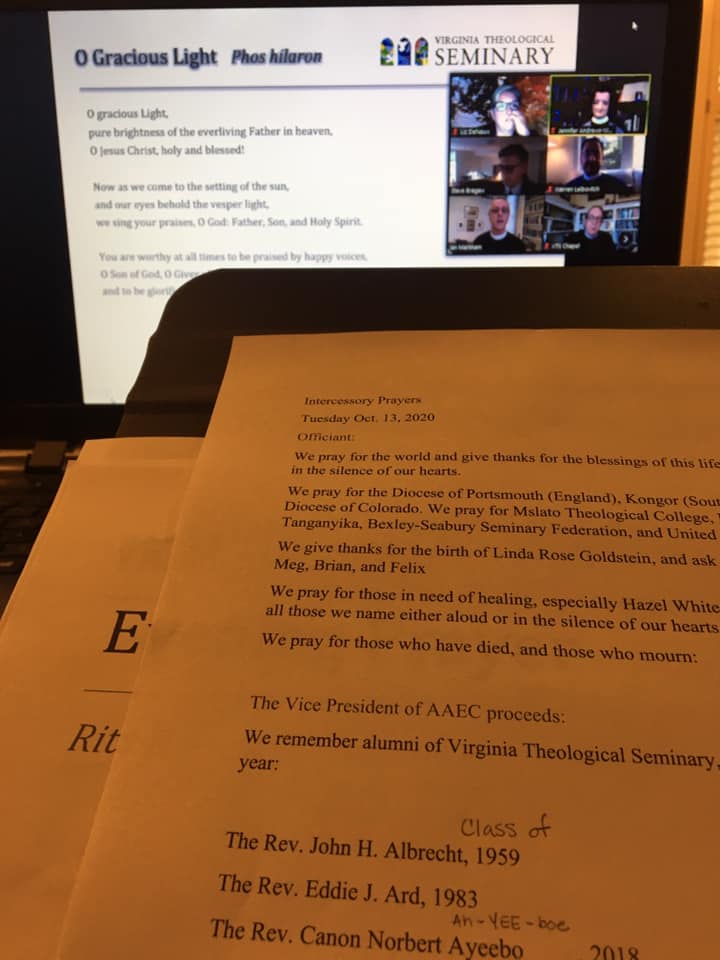
One of the disadvantages of leading virtual worship is that you do not get to participate in worship.  Of course, I can always go back and watch later, but I never get the “live” experience of watching prayers.  That all changed this week.  My seminary held their annual Convocation yesterday.  It was entirely virtual, with webinars, Zoom meetings, breakout rooms, and Zoom worship.  Our worship at Hickory Neck Church is via Facebook Live, so this was my first time worshiping with a community via Zoom, and I was curious to see how it would feel.

My initial response was dissatisfaction.  Although I could see there were about 50 people gathered, once slides were used on the shared screen, I could only see six people without constantly scrolling.  Although the sermon was close to my normal experiences with preaching, watching faces that seemed spaced out was a bit odd (Do the faces look that spaced out when I preach??).  And of course, when I joined in speaking the italicized words (those words “the people” are supposed to say), because we were all on mute, I felt like only the officiant and I were participating.

But that was just the initial reaction.  As I said more and more of the unison readings, I felt less and less awkward.  And even though I could only see a few faces, I loved knowing I was not alone in the worship experience.  And as I became less paranoid about what my own video screen was showing, I was able to relax into my chair, and transport myself to an imaginary pew.  The worship experience was not the same – but it was also familiar, human, holy, and lovely.

Looking back on that experience, I want to offer major kudos to all who are “making it work” with virtual church.  I know it is not the same.  I know it is hard staying positive when all you want is something more familiar.  I am so grateful for all of you who are sticking with it, making the awkward become sacred.  I hope that you are having moments of grace and blessing.  And I also hope you are noticing all the names (and faces if you’re Zooming) you do not recognize:  those folks who find it harder to harken the doors of the church than to hop on Facebook for worship – whether when you are live, or at 10:00 pm, as you watch the archived video while you ease off to sleep.   This may not be church as we have always known it.  But we are also fashioning something new, flexible, and creative, while rooting ourselves in the traditions we know and love that ground us.  This week, you have my gratitude for all the ways you are staying open to the Holy Spirit.  And if you have not found a place to experience the Spirit, I’ve got just the place for you!!

On Things Hidden and Things Seen…

07 Wednesday Oct 2020

Posted by jandrewsweckerly in Uncategorized

≈ Leave a comment

Tags

empathy, God, grace, grief, hidden, journey, pain, pandemic, seen, strength, struggle, suffering

Photo credit: https://psychcentral.com/blog/how-to-sit-with-painful-emotions/

October is reserved for awareness about many issues:  infertility and child loss; breast cancer; domestic violence; and mental health.  What I noticed about all these issues is they are hidden – issues we do not talk about, have shame about, or are labeled as “private” and therefore off-limits.  And while I always like to respect people’s privacy or private grief, when we do not talk about these issues, we end up ignoring people’s pain or worse, robbing them of our empathy and support.  By hiding these issues away, we can do more damage than the issue itself.

I have seen a similar pattern with the Coronavirus.  Because we are physically isolated, we struggle to make space to honor the physical, emotional, spiritual, and financial strain of this time.  In my pastoral conversations, I have heard the grief of people who are physically or financially secure but are overcome with anxiety and depression.  I have talked with those who have lost jobs and are struggling with a sense of failure that has nothing to do with their abilities, effort, or achievements.  And I have reflected with others on how things slowly returning to a semblance of normalcy as we progress forward in phases of regathering in our communities makes them feel even more stress – as if they should feel normal too, but cannot seem to operate at full capacity.

In times like these –in infertility, infant loss, breast cancer diagnoses, domestic violence events, and mental health strains – but also most certainly during this pandemic, many of us are trying to show strength or an ability to power through, so much so that we avoid taking our suffering to God.  But that is not the kind of God we worship.  God does not expect an ability to be stronger than the pain and suffering of this world.  Instead, God longs to be invited into our pain, journeying with us, giving a comfort the world cannot provide.  This kind of relationship involves vulnerability and honesty – something that may be difficult for us.  If you find yourself in the midst of that struggle to trust God enough to show your weakness, or if you are feeling shame for your lack of empathy lately, I invite you to pray Psalm 139 with me this week, especially the first twelve verses.  I leave them here for your prayers, inviting you to be gracious with yourself, with your neighbor, and with the stranger.  Even if we do not know their struggles, God does.

Psalm 139.1-12

1 O Lord, you have searched me and known me.

2 You know when I sit down and when I rise up;

    you discern my thoughts from far away.

3 You search out my path and my lying down,

    and are acquainted with all my ways.

4 Even before a word is on my tongue,

    O Lord, you know it completely.

5 You hem me in, behind and before,

    and lay your hand upon me.

6 Such knowledge is too wonderful for me;

    it is so high that I cannot attain it.

7 Where can I go from your spirit?

    Or where can I flee from your presence?

8 If I ascend to heaven, you are there;

    if I make my bed in Sheol, you are there.

9 If I take the wings of the morning

    and settle at the farthest limits of the sea,

10 even there your hand shall lead me,

    and your right hand shall hold me fast.

11 If I say, “Surely the darkness shall cover me,

    and the light around me become night,”

12 even the darkness is not dark to you;

    the night is as bright as the day,

    for darkness is as light to you.

On Seeing Goodness…

30 Wednesday Sep 2020

Posted by jandrewsweckerly in Uncategorized

≈ Leave a comment

Tags

creation, gathering, God, good, goodness, grace, gratitude, pandemic, sacred, seeing, worship

Photo credit: http://www.dirtyandthirty.com/dirt-of-the-day/finding-good-world/

After six months of waiting, planning, praying, and organizing, my parish finally held our first in-person socially distanced worship service.  We had prepared our members and guests for how different Socially Distanced (SD) Worship would be, even producing an instructional video.  And when the day finally came, our volunteers were amazing – sanitizing, directing, monitoring, and executing a beautiful morning of worship. 

I have been reflecting on the experience of finally being back in the worship space with other people, and I realized what we have been saying all along was true:  it was not the same as worship before the pandemic.  Certainly, the service was familiar:  the liturgy, beautiful music, the physical patterns of standing and sitting, and the reception of communion.  But the little things were different:  the inability to physically embrace or shake hands (something that felt sorely needed after such a long separation), the absence of touch during the Eucharist (an act that has always felt intimately and sacredly physical), the general tentativeness of all gathered (the desire to keep each other safe creating an underlying tension).  We had said SD Worship would be different, and it was.

But SD Worship was also good.  You could feel the palpable relief of everyone to finally be back in the space we love.  I watched as our deacon became much more animated while preaching with people in the room.  I heard sounds I had not heard in the last six months – a familiar lector reading the lesson, the organ and a violin making an otherwise spoken service feel whole, and voices responding in a room that has been mostly empty on Sundays.  It was definitely not the same.  But it was certainly good.

One of the things that has impressed me during this pandemic is the ability of parishioners, neighbors, and friends to see goodness.  When a health crisis occurs, in the stress of restarting schools virtually, in the inconveniences of wearing masks and staying home, I still encounter people who can name goodness in this time.  My invitation for you this week is to find something good and holy about this most unusual time each day.  Try to imagine the way God responds in creation at the end of each day, saying, “It was good.”  What is good in your day today?  Where are the moments of grace, the occasions of gratitude, the sacred for you this week?  I hope you will share them, as your moment of goodness may be what someone needs to help them see goodness in their life too. 

On Grief, Fairies, and Grace…

17 Thursday Sep 2020

Posted by jandrewsweckerly in Uncategorized

≈ Leave a comment

Tags

abnormal, coping, fairy, feelings, gentle, God, grace, grief, light, lost, normal, pandemic, virus

Photo credit: https://childrengrieve.org/resources/about-childhood-grief

A dear friend of mine once talked about the experience of a “grief fairy.”  This fairy was the metaphorical way she explained how grief was not a simple, linear process from tragic event through grief to wholeness.  Instead, she imagined grief as a fairy who would, out of nowhere, lighten upon your shoulder and all of a sudden you went from fine, or at least managing, to not fine at all.

In some ways, I feel like this pandemic has become the same way.  We have begun to convince ourselves that we had our chance to be sad in the first few months of the virus, or even in these last six months.  But by now we should be adjusted, used to the “new normal,” and ready to get moving.  All the markers are there:  Summer has pretty much ended; the children are back to school – if not in person, certainly online; some employers are expecting workers to return to the workplace; churches kicked off their program years – even if they were missing the normal parish parties and picnics; and things like elections are rapidly approaching.  For all intents and purposes, we should be putting on our game faces and getting back to “normal.”

The problem is nothing is truly normal.  And every time we run into anything abnormal, we are reminded of our grief over what has been lost during this time.  We have become quite good at coping, to be sure, but somehow, that fairy keeps landing on our shoulder, reminding us of our grief in big and small ways:  when the kid’s back to school photos are missing pictures of the school bus; when a visit to someone sick is either not allowed, or has enough restrictions that we do not even bother; when the church year begins, but we’re still watching online; when we go to run a quick errand and realize we left our mask at home.   

My prayer for all of us is that we be a bit gentler – with each other, but especially with ourselves.  If you are feeling frustrated about your inability to keep your game face on, take the game face off and let yourself acknowledge the grief still lingering among us.  If you are surprised by a sudden surge of feelings about something seemingly small, remember that grief during this time is not linear, and that the fairy will keep on visiting.  If you are feeling alone in your ability to keep it all together, lean into your faith community to remember God’s grace for all of us.  We are all in this together.  We will have days of strength and days of weakness.  But God is present in all of it, always holding out the light to get us through the darkness. 

Sermon – Matthew 16.21-28, P17, YA, August 30, 2020

02 Wednesday Sep 2020

Posted by jandrewsweckerly in Sermons, Uncategorized

≈ Leave a comment

Tags

control, cross, follow, God, Jesus, life, listen, love, Messiah, pandemic, Peter, resurrection, Sermon, suffering

I have to tell you, I have been dreading this gospel text all week.  We are in a season of life that feels completely out of our control:  whether we direct our attention to the looming presidential election in just ten weeks, the fires and hurricanes bearing down on our neighbors, the impending start of a new school year – whose daily schedule is still unclear, or the ever pervasive global pandemic and the way the pandemic has disrupted our physical, emotional, spiritual, and financial lives.  Even planning this year’s church calendar with our Vestry this past month felt like a game of pin the tail on the donkey – as we tried to guess where our lives would be in two, four, or even six months.

As experts in living an out-of-control life, we can totally understand Peter’s actions in our gospel lesson today.  An impending sense of doom and the anxiety-provoking lack of control lead Peter to rebuke Jesus, declaring vehemently that Jesus must never experience the great suffering and death Jesus predicts for himself.  Peter, who literally two verses before this text is praised for his bold proclamation of Jesus’ identity as the Messiah, is severely scolded by Jesus.  “Get behind me, Satan!” Jesus yells.  Peter, who has just been called the rock on which Jesus would build his Church, is now a stumbling block, getting in the way of Christ’s mission.  We understand Peter’s actions though.  When Peter declares Jesus the Messiah, he means a triumphal, redeeming Messiah, not one heading to death.  Peter’s Messiah is not supposed to behave this way, and Peter will not stand idly by and let his Messiah self-destruct.

Our tendency is to look at Peter and shake our heads.  Poor Peter – always getting things wrong:  sinking in the water when walking to Jesus, misunderstanding what Messiahship means, getting confused at the Transfiguration, insisting he will never abandon Jesus at the end.  But we have to be really careful with Peter because Peter is not that much different than each of us.  We have all had those instances where we rebuked God for one reason or another.  We too have faced hurricane forecasts and have rebuked God.  As we have watched our political life crumble, we have rebuked God.  As colleges close, mandated technology gets delayed two weeks after school starts, and school schedules are still unknown, we have rebuked God.  As friends are infected, lose jobs, or die from the pandemic, we have rebuked God.  Like Peter, we too have yelled out, “God forbid it!”  We have seen the darkness and pain looming ahead and have desired with every inch of our being to stop the suffering.

And yet, suffering is what Jesus predicts for all of us.  Jesus says, “If any want to become my followers, let them deny themselves and take up their cross and follow me.  For those who want to save their life will lose it, and those who lose their life for my sake will find it.”  Jesus’s words make us very uncomfortable and confuse our notions of a loving, grace-filled God who beckons us to come to God when we are weary.  We hear these words about suffering, recalling all of the pain in our lives – the loss, the heartache, the loneliness – and we cannot imagine that God plans for us to suffer in these ways.  Predestined suffering does not fit our understanding of who God is.  And yet, here we are with Jesus’ words today.

What helps me with this text is to go back to Peter.  What is interesting about Peter’s rebuking of Jesus is that he seems to rebuke all of what Jesus says without actually listening to all of what Jesus says.  Jesus says he, “must go to Jerusalem and undergo great suffering at the hands of the elders and chief priests and scribes, and be killed, and on the third day be raised.”  Peter hears the suffering and the killing part and seems to totally miss the part about being raised on the third day.  If Peter had been listening, he would have heard the good news imbedded in Jesus’ words.  He would have heard the promise of resurrection, the promise of everlasting life, the promise of resurrection life for all of us.  Yes, the road will be dark and painful – maybe even unbearable – but there is goodness at the end of that road.  God’s promise of salvation, of resurrection on the third day, is good news for Peter.  Suddenly Jesus’ scolding of Peter seems much more justified.

The invitation for us today the same:  to listen.  Listen to the entirety of what Christ is saying to us.  If we get lost in the words about suffering and death, then we become like Peter.  Now I am not arguing Jesus is encouraging us to go recklessly surfing in this hurricane of life.  Instead, Jesus is inviting us into a life that matters – a life lived not inwardly guarding our own comfort, but a life that lets go of control, not worrying about the cost for self, but a life that is poured out for others.  We can enter into that ambiguous place because God promises us that even if our lives end in the process, God has more life in store for us.  Jesus’ invitation to take up our crosses is not an invitation into death, but an invitation into life.[i]  This week, boldly take up your cross; knowing that on the third day, Christ will be raised.  Resurrection life awaits!  Amen.

[i] Barbara Brown Taylor, The Seeds of Heaven: Sermons on the Gospel of Matthew (Louisville: Westminster John Knox Press, 2004), 80.

On God’s Humming…

05 Wednesday Aug 2020

Posted by jandrewsweckerly in Uncategorized

≈ 1 Comment

Tags

anxiety, calm, faith, giraffe, God, Holy Spirit, pandemic, peace, relax

giraffe

Photo credit:  https://dailyhive.com/seattle/zoom-call-animal-visitors

On vacation last week, my family and I visited a “safari park” – basically a drive-through petting zoo where you can roll down your window and feed the animals.  I confess, I was not looking forward to this part of our vacation adventures.  In general, animals make me a little nervous.  They are usually bigger than me, and I find them to be unpredictable and capable of causing harm, intentionally or not.  So, the idea of one of those, sometimes very large, animals poking its head in my safe space terrified me.  But I bit my tongue and took one for the team as we drove into the park.

It turned out most of the family had a good time on the safari, especially as we got further into the park.  But the anxiety in my gut never relaxed.  For a solid 30-45 minutes, I was on edge, trying to put on my “everything’s fine” face for the kids.  It was not until we made our way to the walking zoo section of the park and were feeding a giraffe that the tension in my body slowly eased.  The giraffe’s head was huge, but his eating was calm and collected.  And after all the lettuce was gone, he just hung out – not looking for more food.  My daughter, who is obsessed with giraffes, held a full nonverbal conversation with the giraffe, and even I found my muscles slowly relaxing as I gazed into his calm, soothing eyes.

Later, as we were reading about giraffes, I learned giraffes make a soothing humming-type noise inaudible to the human ear but meant to help them stay connected to their young and fellow giraffes.  Even though I did not hear the noise, I am convinced the giraffe must have been humming for us that day – sensing our anxiety, and longing to offer us a calming peace.

As we journey through this time of pandemic life, I am increasingly aware of the low (and sometimes high) level of anxiety within which we are all operating.  Over time, that anxiety wears on you – whether you find yourself snapping at someone, bursting into tears unexpectedly, or distancing from emotional connections.  In this time of ongoing anxiety, I have been thinking we all need a soothing sound that can help us let go of the tensions in our shoulders, relax the muscles in our jaw, and release the tightness in our chest.  For some of us that happens through yoga, through a phone call to a friend, or through watching a funny movie.  Lately, I have been wondering if God is not providing that soundless, soothing hum we have not acknowledged.  Perhaps God is placing people, animals, or encounters (even virtual ones) in our path that can help us let go of some of our anxiety, take a deep breath of the Spirit’s calming peace, and allow us to refocus on our faith – a faith which can feel adrift in the sea of closed church buildings, social distancing, and self-quarantines. My prayer for you is you hear God’s humming this week as we turn the page on another pandemic week.

On Haircuts, Darkness, and Light…

15 Wednesday Jul 2020

Posted by jandrewsweckerly in Uncategorized

≈ 1 Comment

Tags

anxiety, Bible, darkness, excitement, God, haircut, light, pandemic, prayer, vanity, weight

bob-haircut-lede

Photo credit:  https://www.allure.com/story/getting-haircut-after-hair-loss-confidence

One of the inconveniences of this pandemic was that I was due for a haircut right as salons were closed.  I decided quickly this was a superficial, somewhat vain, concern, and I could simply wait until things reopened.  As the months passed, my growing hair became a symbol of this time – our need to stay-in-place, to stay socially distanced, and to make sacrifices for the sake of the community.  Eventually, as I did daily online prayers, it became a running joke that people were measuring the length of quarantine by the length of my hair.

So, when my hairdresser finally came back to work last week, I was equal parts thrilled and nervous.  My hair had not grown that long since college, and I longed for the ability to look properly groomed.  But I also was anxious – there is no way to stay six feet away from someone cutting your hair, and even with us both wearing masks, getting my hair cut was taking on a risk.  I tentatively booked the appointment, feeling both relief and guilt.

That tension did not dissipate during the experience.  My nervousness made my entire body tense.  I realized half-way through the cut I was subconsciously praying for both of us – that neither of us would get sick (then, guiltily realizing I probably ought to be praying for my hairdresser daily!).  As three-inches curls of hair fell to the ground, I had flashes of the Sampson story we had just read in our 90-day Bible Reading Challenge.  Had this been a mistake?  Was shedding all this hair a symbol of my failed ability to lead others with the example of compassion and care?

As I got back into my car though, the lightness of the weight of my hair created a lightness on my spirit too.  I suddenly realized that in addition to all of the suffering and death this pandemic has brought, it has also given us an invisible weight on our shoulders – the angst of making decisions about communal versus personal behavior, the load of constant cycles of grief, and the burden of a system crumbling around us.  Losing my hair was akin to losing a bit of the weight on my shoulders – remembering that despite all of the bad that has come out of this pandemic, so has a lot of good.  For me, cutting my hair (done with all the safety precautions possible) was a reminder of the light in the darkness of this time.  I say that not as an endorsement of getting one’s hair cut in general.  I say that because we all need reminders of the light trying to shine through during this time of darkness.  If you are finding you need help finding that light, I am here.  If you need help finding that light, Hickory Neck Church is here.  If you need help finding that light, God is surrounding you with light on every side, even if you cannot see it yet.  My prayer for you is you find hints of light today to sustain you in this darkness!

Sermon – Matthew 11.16-19, 25-30, P9, YA, July 5, 2020

15 Wednesday Jul 2020

Posted by jandrewsweckerly in Sermons, Uncategorized

≈ Leave a comment

Tags

abdication, comfort, delightful, God, Jesus, light, meaning, pandemic, purpose, reckless, refreshment, rest, satisfying, Sermon, weary, yoke

In Compline, one of the prayers is for “we who are wearied by the changes and chances of this life.”[i]  I have been feeling that prayer these last several weeks – or even months.  The longer we stay in our homes, the longer this pandemic wages illness and death upon us, the longer the spread of virus takes away the everyday privileges we never fully appreciated, and the longer civil unrest forces us to look at our demons and sinfulness, we become more and more weary.  We do not have to ponder too long why cases of the pandemic are soaring this summer.  People who are wearied by the changes and chances of this life are so grief-stricken they are becoming reckless, self-centered, and indignant.

So, you can imagine my full-bodied relief when I heard the last verses of our Gospel lesson today.  “Come to me, all you that are weary and are carrying heavy burdens, and I will give you rest.”  Those words from Jesus are sweet comfort to us, who just want a break, who just want some semblance of normalcy, who just want peace.  Jesus’ words are a warm embrace in a time of touchlessness.  Jesus’ words are a balm to our country who this very weekend honors a liberty that many of our neighbors are reminding us is not felt by all our citizens.

But as scholar Thomas Long says, “What Jesus offers, however, is not a hammock, but a yoke.”[ii]  I know we want to linger on verse 28, but immediately after that comforting embrace, Jesus says, “Take my yoke upon you, and learn from me; for I am gentle and humble in heart, and you will find rest for your souls.  For my yoke is easy, and my burden is light.”  In the shift between these last verses, Jesus does a bit of a bait and switch.  He beckons us into his comforting arms, but also places a burden on our shoulders.

I confess, I have been a bit cranky about that switch.  Can’t we just have one week, one Sunday, one moment, where we abdicate responsibility, where we take a sabbath from all this work, where we binge watch television and eat crappy food?  Isn’t that what Jesus means when he says he will give us rest?!?

Fortunately for all of us, I had my tempter tantrum early in the week, and have had some time to sit with this yoke of Jesus’.  You see, when I am being honest, I know binge watching television or eating junk food is not actually restorative.  I feel stiff and tired after sitting for hours.  And when I eat unhealthily, the lingering stomachache or sluggishness is not actually as comforting as the comfort food implies.

What Jesus is suggesting today is not a restful, self-centered, time of abdication.  What Jesus is suggesting is we find rest in the things of life that matter.  As one scholar suggests, “we will find rest for carrying the burden of the gospel by living out the unique mission to which Jesus calls each of us.”[iii]  That yoke we may be skeptical of this week, is not actually a ploy or a trick by Jesus.  The reason Jesus says his yoke is easy and his burden is light is “because [his yoke] is the way of God, and [his yoke] is profoundly satisfying to the human soul.”[iv]

Jesus uses some strong imperatives today:  come to me, take my yoke, learn from me.  But Jesus is not being bossy.  Jesus is reminding us, in his ever so firm, but pastoral way, that the ways we are seeking rest and relief from weariness are not the ways to life.  The way to life, of true refreshment, of renewed spirits is through the yoke of Christ.  How is that possible?  As one scholar reminds us, “The easy yoke means having something to do:  a purpose that demands your all and summons forth your best.  [The easy yoke] means work that is motivated by a passionate desire to see God’s kingdom realized.  [The easy yoke] means work toward a certain future in which all of God’s dreams will finally come true.  To accept the yoke of the gentle and humble Lord is to embrace the worthy task that puts the soul at ease.”[v]  Jesus reminds us today that the rest we seek is not mind-numbing, emotion-numbing, spirit-numbing relief, but purposeful, meaning-filled, reward-making clarity.  When we harness ourselves to Christ, the burdens no longer feel like burdens, the work no longer feels like work, and the desire to be done turns to a desire for God’s delightful sense of purpose and meaning.  That is the kind of profound satisfaction Jesus offers today.  Thanks be to God!

[i] Book of Common Prayer, 133.

[ii] Thomas G. Long, Matthew (Louisville:  Westminster John Knox Press, 1997), 132.

[iii] Emilie M. Townes, “Theological Perspective,”  Feasting on the Word, Year A, Volume 3 (Louisville:  Westminster John Knox Press, 2011), 214.

[iv] Long, 132.

[v] Lance Pape, “Homiletical Perspective,” Feasting on the Word, Year A, Volume 3 (Louisville:  Westminster John Knox Press, 2011), 217.

On Refreshment in a Parched Land…

01 Wednesday Jul 2020

Posted by jandrewsweckerly in Uncategorized

≈ Leave a comment

Tags

care, comfort, communion, Coronavirus, grieve, Holy Eucharist, pandemic, parched, prayer, reassurance, refreshment, salve, wilderness

70038647_10158090008257565_6128712585278652416_n

Photo credit:  Jennifer Andrews-Weckerly; resuse with permission only.

Over three months ago, when we closed our church’s doors because of the Coronavirus pandemic, we had to make some quick, difficult decisions.  We knew we wanted to offer a livestream service, but we also knew we did not feel comfortable consuming the holy meal without the community of faith gathered.  Fortunately, we have a rich traditional of prayers from our Book of Common Prayer, so we switched to Morning Prayer on Sundays.  In seminary, I attended Morning Prayer daily, so in some ways, the last many months has been like visiting an old friend.  As the officiant, I have often worn my seminary cross as a sign of gratitude for the formation I receive at Virginia Theological Seminary to be able to confidently officiate the service.

But as our diocese gave us permission to begin the regathering process, the liturgical team began to realize we had a conundrum.  For the limited number of people who would be able to gather in the space, would we keep offering Morning Prayer, or would we offer communion under the new guidelines?  If we offered communion to some, would those watching online feel left out if the livestream was different from the in-person offering?  So, like we often do at Hickory Neck, we decided to try an experiment.  We still did not want the altar party to consume on screen if no one else could consume with us.  But perhaps we could try an offering of “Spiritual Communion”:  a service identical to the familiar Holy Eucharist we normally celebrate, but with a special shared prayer instead of actual reception of the body and blood of Christ.

This past Sunday, we gave the experiment a go.  Shifting types of services is more complicated than it sounds, especially given the challenges of working with limited technology.  My brain was so jumbled with details that when we hit the livestream button, I had not processed the significance of the morning.  I put on vestments I have not worn in over three months – vestments I used to wear every week.  As the celebrant, I was saying words that I have said countless times in the last ten years.  It was only when I elevated the elements, recognizing the muscle memory of my body, that the power of what we were doing hit me.  Holy Eucharist is just one of the myriad things that have been taken away from us during this time of social distancing – one of the many comforts that I have grieved in these last months.  Despite the fact we were not actually receiving communion, despite the fact the room was still empty minus a camera, despite the fact a hundred little things were different, all of a sudden, I found myself overwhelmed with emotion.

Celebrating Spiritual Communion was not the same as celebrating Holy Eucharist.  But celebrating Spiritual Communion felt like a sip of water in a parched land.  It was not complete refreshment, but it was reassurance, comfort, and care.  It was an unexpected gift from the Holy Spirit in the wilderness of this pandemic.  I do not know what our community will decide to do going forward – whether we will keep Morning Prayer or Spiritual Communion, or some combination of the two.  In fact, I am hoping our parishioners and viewers will let us know their feedback.  This week I am just grateful for a community that is willing to experiment – to try, to fail, to learn, and to grow.  That commitment to playful creativity has always been a joy; during this pandemic it is salve to our open wounds.  Thanks be to God!  And thank you, Hickory Neck!

Sermon – Matthew 10.40-42, P8, YA, June 28, 2020

01 Wednesday Jul 2020

Posted by jandrewsweckerly in Sermons, Uncategorized

≈ Leave a comment

Tags

Bible, Christ, covenant, disciple, God, hospitality, Jesus, love, mirror, missionary discourse, pandemic, power, presence, Sermon, vulnerability

This summer, several parishioners are participating in our 90-Day Bible Reading Challenge.  In supporting each other in our reading, one of the patterns we have noticed is the break-neck pace of reading twelve pages a day means we do not have a lot of time for traditional Bible Study – looking at the original Hebrew or Greek, discerning the historical context of the book, studying the cultural norms of the community, or even delving into the literary devices of the book.  Instead we are drinking from the fire hose of Scripture – capturing the larger narrative God’s covenantal relationship with humankind, but not indulging in the intriguing details.

With a passage like the one we hear in today’s gospel from Matthew, we could easily do the same.  There are only three verses in the text, and they are somewhat repetitive in pattern.  A quick skim brings up an old adage we have learned by heart – welcome the stranger because you may be welcoming Christ himself.  Maybe your mind immediately leapt to a time you saw Christ in a stranger.  Maybe you began thinking about the ministry of hospitality, particularly how strong that ministry is at Hickory Neck.  Maybe you even started to wonder what you could do to be more hospitable, especially during this time of social distancing.

But here’s the thing:  when we slow down our reading, we realize Jesus does not say, “whoever welcomes the stranger welcomes me.”  Jesus says, “Whoever welcomes you welcomes me…”  Often when we think of hospitality, we think of hospitality from the perspective of the host.  Whether we acknowledge the reality or not, we are people of power and privilege, and our notion of hospitality is rooted in how we can offer hospitality to others.[i]  There is nothing inherently wrong with this dynamic – in fact, our sense of obligation to offer hospitality is an answer to Jesus’ call to love neighbor.  But Jesus is not talking about offering hospitality to others from a position of power.  Instead, Jesus is inviting us to give up power and receive others’ hospitality.

If you remember, we have been in the midst of Jesus’ Missionary Discourse[ii] the last several weeks.  Jesus told the disciples to go out, without resources, to do the work of discipleship.  He warned them they would face persecution, and family members would turn against one another.  And today, as Jesus concludes his discourse, he tells them whoever welcomes them, welcomes Jesus.  So not only are the disciples to make themselves vulnerable to the hospitality of others, they will be mirroring Jesus to others.  In other words, in every moment, every interaction, every relationship, encounter, conversation, and conflict among the disciples –the disciples will be witnessing Jesus.[iii]

I do not know about you, but that is a lot of pressure.  Making oneself vulnerable is hard enough.  Making oneself vulnerable means opening up all our flaws, weaknesses, and doubts.  And now, Jesus is saying while we are vulnerable, our homes, our marriages, our workplaces, our extended families, even our friendships are windows into Christ for others.  As Debie Thomas asks, “When we know Jesus is visible in and through us at every moment…[will] we tread more lightly on the earth?  Speak less and listen more?  Reconsider our grudges and grievances?  Choose our words with greater care?  Examine our motivations more closely?”[iv]

There is a lot about this pandemic that has been absolutely awful – devastating, painful, and full of death.  But one of the things that has happened to Hickory Neck in this pandemic represents new life too.  Before we closed our buildings in March, we offered hospitality from our comfort zone – hospitality unparalleled once you walked in those doors – hospitality that made most of us join this church.  But once we moved everything online, the doors and walls of this place lowered – we went out, showing who we are and what we are about to a much broader audience.  Here in this exposed setting, we are carefully, thoughtfully, intentionally showing others what Jesus looks like.  The work is hard and scary, but the reward is great too.  In letting down our walls, we are helping people to see Christ – the same Christ who redeems us, gives us strength, and makes us whole.  But the work of discipleship is not just happening on livestream.  I see this work happening in you – as you call to check in on people in the parish you have not met before because you attend a different service, as you don a mask and attend a rally in support of our African-American brothers and sisters during this raw time, and as you have socially-distanced conversations with neighbors about the power of Christ in your life.  The promise Jesus made at the beginning of his Discourse is still lingering today.  Christ is with us always, even to the end of the age.  His promised presence will allow us to keep letting down walls and being Christ’s mirror in the world.  Our job is to take up the challenge we will hear in our dismissal today:  Go.  Receive God’s love and hospitality.  Serve the Lord as Christ’s mirror.  Amen.

[i] Debie Thomas, “Welcome the Prophet,” June 21, 2020, as found at https://www.journeywithjesus.net/lectionary-essays/current-essay on June 26, 2020.

[ii] Eugene Eung-Chun Park, “Exegetical Perspective,” Feasting on the Word, Year A, Volume 3 (Louisville:  Westminster John Knox Press, 2011), 189.

[iii] Thomas.

[iv] Thomas.

← Older posts
Newer posts →

Recent Posts

  • On the Myth and Magic of Advent…
  • On Risking Failure and Facing Fear…
  • Sermon – Luke 23.33-43, P29, YC, November 23, 2025
  • On Inhabiting Gratitude…
  • Sermon – Luke 20.27-38, P27, YC, November 9, 2025

Archives

  • December 2025
  • November 2025
  • October 2025
  • September 2025
  • August 2025
  • July 2025
  • June 2025
  • March 2025
  • February 2025
  • December 2024
  • November 2024
  • October 2024
  • September 2024
  • August 2024
  • July 2024
  • June 2024
  • May 2024
  • March 2024
  • February 2024
  • January 2024
  • December 2023
  • November 2023
  • October 2023
  • September 2023
  • August 2023
  • July 2023
  • June 2023
  • May 2023
  • March 2023
  • February 2023
  • January 2023
  • December 2022
  • November 2022
  • October 2022
  • June 2022
  • May 2022
  • January 2022
  • December 2021
  • November 2021
  • October 2021
  • September 2021
  • August 2021
  • June 2021
  • May 2021
  • April 2021
  • March 2021
  • February 2021
  • January 2021
  • December 2020
  • November 2020
  • October 2020
  • September 2020
  • August 2020
  • July 2020
  • June 2020
  • May 2020
  • April 2020
  • March 2020
  • February 2020
  • January 2020
  • December 2019
  • November 2019
  • October 2019
  • September 2019
  • August 2019
  • July 2019
  • June 2019
  • May 2019
  • April 2019
  • March 2019
  • February 2019
  • January 2019
  • December 2018
  • November 2018
  • October 2018
  • September 2018
  • August 2018
  • July 2018
  • June 2018
  • May 2018
  • April 2018
  • March 2018
  • February 2018
  • January 2018
  • December 2017
  • November 2017
  • October 2017
  • September 2017
  • August 2017
  • July 2017
  • June 2017
  • May 2017
  • April 2017
  • March 2017
  • February 2017
  • January 2017
  • December 2016
  • November 2016
  • October 2016
  • September 2016
  • August 2016
  • July 2016
  • June 2016
  • May 2016
  • April 2016
  • March 2016
  • February 2016
  • January 2016
  • December 2015
  • November 2015
  • October 2015
  • September 2015
  • August 2015
  • July 2015
  • June 2015
  • May 2015
  • April 2015
  • March 2015
  • February 2015
  • January 2015
  • December 2014
  • November 2014
  • October 2014
  • September 2014
  • August 2014
  • July 2014
  • June 2014
  • April 2014
  • March 2014
  • February 2014
  • January 2014
  • December 2013
  • November 2013
  • October 2013
  • September 2013
  • August 2013
  • July 2013
  • June 2013
  • May 2013
  • April 2013
  • March 2013
  • February 2013
  • January 2013
  • December 2012
  • November 2012
  • October 2012
  • September 2012

Categories

  • reflection
  • Sermons
  • Uncategorized

Meta

  • Create account
  • Log in
  • Entries feed
  • Comments feed
  • WordPress.com

Blog at WordPress.com.

  • Subscribe Subscribed
    • Seeking and Serving
    • Join 394 other subscribers
    • Already have a WordPress.com account? Log in now.
    • Seeking and Serving
    • Subscribe Subscribed
    • Sign up
    • Log in
    • Report this content
    • View site in Reader
    • Manage subscriptions
    • Collapse this bar
 

Loading Comments...