• About

Seeking and Serving

~ seek and serve Christ in all persons

Seeking and Serving

Tag Archives: practice

On Inhabiting Gratitude…

12 Wednesday Nov 2025

Posted by jandrewsweckerly in reflection

≈ Leave a comment

Tags

act, barriers, God, gratitude, incarnate, practice, stewardship, tangible, Thanksgiving

Photo credit: https://www.southernliving.com/culture/what-to-write-in-thank-you-card

November is regularly a month when I talk about gratitude with my parish.  Most of that push comes from the confluence of things that happen in November.  We are almost always closing up our stewardship season in November – a season when we encourage parishioners to let their giving reflect their gratitude toward God.  We are also preparing for the Thanksgiving holiday – which although a secular holiday comes pretty close to being a sacred time of thanksgiving and praise.  And just yesterday we took the day to thank Veterans, honoring the sacrifices their vocations require and the blessings we enjoy because of their work.

This year, to help cultivate my own sense of gratitude, I picked up a calendar one of my favorite non-profits produced call “30 Days of Gratitude.”  Though some of the “activities” are to think about something I am grateful for, like a good memory in my home, most of the “activities” are more hands-on – like expressing gratitude to every member of the household or greeting a neighbor.  What I have loved about the calendar is the shift the calendar has created. 

Often when we talk about gratitude, we feel burdened – like we’re supposed to force ourselves into an emotion.  But what the calendar has done is make gratitude tangible – to act on my gratitude.  What’s beautiful about that shift is that the action is something I can do that has the unintended consequence of feeling gratitude instead of trying to manufacture gratitude out of thin air.  The calendar has made gratitude incarnate – allowed me to inhabit gratitude instead of simply emoting gratitude.  It’s a subtle change, but one that feels much more freeing.

I wonder how you are navigating gratitude during this season.  What are the barriers to you inhabiting gratitude?  What burdens are clouding your gratitude practices, making you more cranky than grateful?  Gratitude is not easy.  If it were, folks wouldn’t be producing gratitude calendars and journals.  I invite you to find the tool, the person, or the community who can help make your gratitude incarnate.

On Measuring What Matters…

09 Wednesday Oct 2024

Posted by jandrewsweckerly in reflection

≈ Leave a comment

Tags

blessing, celebration, complain, discipline, God, gratitude, Jesus, measuring, negative, positive, practice, Thanksgiving

Photo credit: https://texasleansixsigma.com/measure-what-matters/

This week we’ve been working intentionally on shifting my daughter’s propensity to complain.  She can have the best of days or afternoons, but at some point in the retelling of what happened, she’ll inevitably find something to complain about – what someone said, what someone did, or how she perceived something.  This week I threatened to start a daily tally of everything that came out of her mouth, putting her words in two columns:  positive things and negative things.  I told her we would see which column won at the end of the day.  I was honestly making an empty threat (who has time to monitor every word that comes out of a kid’s mouth?!?), but something about my threat registered with her.  The next morning, she was all positives – thanking me for mundane things, celebrating small victories, noticing the good.  When I picked her up from school that day, she proclaimed, “Actually, today’s been a really good day!”  We celebrated what a wonderful experience both she and I had had that day, noticing what her intentionality had done.

I’ve been thinking about our experiment and have been recalling all the times I have taken on a discipline of gratitude – all the times I have fallen into the very same patterns as my child.  There have been times when I have used my prayer beads, only praying prayers of thanksgiving instead of petition.  There have been times when I have used my journal to find at least three things at the end of the day for which I can give thanks (some days that was harder than others!).  And there have been times when I have read books or heard testimonies about the powerful transformative practice of gratitude.

These last weeks, gratitude has been challenging to come by.  I have been watching helplessly as countless homes, businesses, churches, roads, and whole towns have been washed away by hurricanes – only to be bracing for the impact of another one today.  I have been praying with friends and community members recovering from freakish events:  being hit by car, road rage gun violence, and random violent targeting.  I have listened to the anxieties of parishioners, completely consumed by worry about the presidential election less than a month away. 

This Sunday, our church will kick of stewardship season, as we ponder what really matters in our lives.  As we have already been reflecting this year, we are a community blessed with abundance.  We could certainly go down the road of scarcity, detailing all the things we are longing for or missing.  But instead, we are entering an intentional time of noticing:  noticing the abundance around us, noticing the blessings that embrace us, noticing the goodness and love of God in our lives.  I am looking forward to the gift of a season of gratitude – of celebrating the good and honoring the abundance of our Lord and Savior, Jesus Christ.  I am hopeful that each day in this stewardship season, we can begin to turn our hearts from pain, and find the way, even if in something miniscule, to be able to say, “Actually, today’s been a really good day!”  I invite you to join us in the celebration of what matters!

Sabbatical Journey…On Weariness and Gratitude

01 Saturday Jul 2023

Posted by jandrewsweckerly in reflection

≈ Leave a comment

Tags

antidote, cranky, God, gratitude, Holy Spirit, invitation, Jesus, journey, perspective, practice, tired, weary

Montana Driving (reuse with permission)

Today was a driving day for our cross-country trip – perhaps the longest driving day of the trip.  All told, we were on the road, with multiple stops, for about 10-11 hours.  By the last hour, I was engaged in an inner complaint fest:  the trip felt like forever, I was stiff from the ride, and I just wanted to be in the next location and stretch my legs.  But when we arrived, I was glad I had kept my complaining to myself.  First my younger child exclaimed, “That wasn’t so bad!  It went by kind of quickly!”  My husband agreed, “Yeah, that was an easy drive!”  My elder child confessed, “I kind of like driving days.  They’re like ‘chill’ days.” 

Their comments helped me reflect on the day a little differently.  I tried to remember all the good things about the day:  the way the heavy fog slowly lifted to reveal beautifully green mountain scenery with rivers and tall pines; how fun it was to drive along winding road, hugging the curves; the pops of color that wildflowers brought to the drive; the fun road trip games we played, where everyone was winning at different points; the laughter, the naps, and adding a new state to our list of visited states.

Today, I am grateful for the invitation into gratitude.  It’s a practice I encourage all the time, but one that is easily forgotten when we are tired, weary, and cranky.  But the funny thing is that gratitude is the best antidote to us who are tired, weary, and cranky.  When we give thanks, we see all the good things that made us tired.  When we offer gratitude to God, our weariness is held like soft mattress.  When we give ourselves to thankfulness, crankiness is melted into praise.

I would love to hear what you are grateful for today.  How has God shown up in surprising ways?  How has the Holy Spirit spoken grace through people in your life?  How is Jesus inviting you into a new interpretation of the day?  I’m grateful for you and our journey together in gratitude!

On Delight and Sabbatical…

06 Tuesday Jun 2023

Posted by jandrewsweckerly in reflection

≈ Leave a comment

Tags

delight, family, friends, God, harmony, intentional, practice, rest, sabbatical, tension

Photo credit: https://www.linkedin.com/pulse/why-you-need-help-schedule-sabbatical-asap-kadi-cole-rn-ms/

Toward the end of my second week of sabbatical, it dawned on me what a different space sabbatical creates from vacation.  The beginning is quite similar:  a flurry of activity, trying to tie up loose ends, ensuring all systems and coverage are in place, and maybe, clearing off your desk.  But at the end of the second week of sabbatical, I noticed a distinction from vacation.  Usually at the end of vacation, even a two-week vacation, tension in my body begins to return.  The wheels in my mind start to churn, even if I know they shouldn’t.  “Work mode” creeps into vacation mode and spoils any deep relaxation I have established.  I was delighted to realize that creep is not happening as I enter week three of sabbatical.

Part of my delight in this realization is how restorative these last two weeks have been.  It’s been such a joy to slow down and reconnect with God, with my family, and with friends.  When I was on retreat at the monastery, I turned off the notifications on my phone, and I was amazed at how much tension released from my body.  In times of quiet, I have been able to stop talking so much, and be more focused on listening:  to God, to my family, to those around me.  And in the differently paced time of sabbatical, I am finding so much love:  finding “space” to remember how powerfully life-giving the loving relationships are in my life.

I am not likely to have twelve weeks of sabbatical again for at least another seven years, which has left me wondering how to hold on to moments of sabbatical time in “real life.”  How might I find harmony between my natural full-speed self and my intentional sabbatical self?  It is my hope in the coming weeks to learn that harmonic practice.  I would love to hear what tricks you have developed for that harmony in your own life!

Sermon – Matthew 4.1-11, L1, YA, March 1, 2020

04 Wednesday Mar 2020

Posted by jandrewsweckerly in Sermons, Uncategorized

≈ Leave a comment

Tags

cosmic, devil, evil, good, immature, Jesus, journey, Lent, mature, practice, Sermon, spiritual discipline, temptation

There is an ongoing debate among people who have way to much time on their hands about  the efficacy of most spiritual disciplines during Lent:  whether we are giving up chocolate, alcohol, or swear words; whether we are taking up health improvements, like getting more sleep, walking daily, or practicing yoga; or whether we are committing to something more traditional like fasting, daily prayer, or the reading of scripture.  The argument is that these disciplines domesticate Lent, making Lent akin to New Year’s resolutions instead of the sacred practices the ancient church intended.  There’s even a book entitled, A Grown-up Lent: When Giving Up Chocolate Isn’t Enough, whose title alone insinuates that most of our disciplines are immature, are not “grown-up” enough to be considered worthy of Lent.

Now there are myriad articulations about why our practices are not enough, but one of the reasons articulated uses today’s gospel lesson as their defense.  In today’s gospel, we hear Matthew’s version of Jesus’ temptation in the wilderness.  On the surface, Matthew describes three temptations:  the temptation to satiate a physical need (after forty days, Jesus is hungry and could turn stones to bread to satisfy this physical hunger), the temptation to prove God loves us (Jesus might want to know that God has his back before he takes on this whole savior role), and the temptation to gain political power (any messiah might assume their cause is always better aided by powerful force).  By reading about Jesus’ temptation today, we might easily deduce the reason we assume Lenten disciplines is because we are mimicking Jesus’ temptation for these next forty days.  Like Jesus was tempted by hunger, a desire for comfort, and a desire for power, our disciplines highlight our daily temptations and our desire to not submit to the forces of evil.

But this gets to the heart of why so many are critiquing our spiritual disciplines during Lent.  Theologian Stanley Hauerwas argues, “…the temptation Jesus endures is unlike the temptation we endure, for the devil knows this is the very Son of God, who has come to reverse the history initiated by Adam and Eve’s sin in the garden and continued in the history of revolt by the people whom God loves as his own, namely, Israel.”[i]  In other words, although we are surely tempted by Satan in our own time, today’s temptation of Jesus is about a cosmic battle – the very battle between good and evil, the very evil that is wreaking havoc on the civility and humanity of our country today, making us turn against one another and abandon our baptismal promises to respect the dignity of every human being.  Some would argue that our giving up chocolate, or our eating fish on Fridays in Lent does not get us any closer to routing out the evil seeking to destroy the fabric of our church, our community, and our country; our focusing on physical health does not battle the things we confessed in the Great Litany today:  pride, vainglory, hypocrisy, deceits of the flesh, and dying suddenly and unprepared.

Now, while I get the academic protest about the simplistic nature of our disciplines, here is what I know.  A week ago, after a wonderful celebration of the end of Epiphany, and after a glorious honoring of the spirituals of our religious tradition, I lost my voice.  Despite my croaking despair with my doctor, he told me, rather unsympathetically, no matter what my job was, no matter if a big event, like, say Ash Wednesday with its three services, one ecumenical potluck, and Ashes to Go, were on my agenda, in no way was I to use my voice.  In essence, I was forced into silence on a week where I needed to lead.  Or, I suppose put more spiritually, I was gifted the opportunity to truly embrace the classic invitation of Lent: fasting (in this case from speaking) and meditating on God’s holy word (since I certainly could not speak God’s word).  The irony of this gift was not lost on me – an extrovert prone to powering through any challenge being forced to slow down and keep quiet is what Lenten disciplines are all about, right?  Take our biggest spiritual struggles, and then use disciplines to help ourselves correct behavior and get right with God – this is classic Lenten stuff!

I can tell you, this past week has been a profound week of learning.  All of those things we confessed in the Great Litany were in my face this week.  Nothing attacks one’s pride, vanity, and envy like watching other people do the job I was made to do but could not do in my weakness.  And while I was able to patiently be silent, working alone from my home office on the day before Ash Wednesday, I realized about half-way through Ash Wednesday my vocal chords were hurting not from physically trying to speak, but from tensing them in the desire to speak – my longing to speak manifested itself in a anticipatory tension of use, which became dangerously close to having the same effect of actually using my voice.  When I finally realized what was happening, why I was feeling worse, I had to mentally force my throat to relax, my shoulders to release their tension, and my mind to accept I could not simply do everything I normally do, simply removing one minor part – that of speaking.  No, being mute on Ash Wednesday would mean taking on another way of being.

I tell you all this not because Lent is all about me and my laryngitis.  I tell you all this because although I understand the academic critique of Lenten disciplines, I also see with fresh eyes the very blessing of Lenten disciplines.  Perhaps the critique is true that giving up meat, or taking up Pilates, or even reading a devotion is not going to help us battle the spiritual forces of evil; but taking on those practices will shake up our senses in really meaningful ways.  Daily resisting of patterns, or daily assumptions of new patterns, creates in us a retraining of our bodies so we can begin to see, hear, taste, smell, and touch God in new ways.  And that shaking – whether big or small – shakes up other things in our lives.  We begin to see more clearly where we have had a blindness of heart; where we have delighted in inordinate and sinful affections; where we have hardened our hearts again our black, Latino, young, old, Republican, and Democrat neighbors; where we have even held in contempt God’s word and commandments.  These disciplines are not juvenile – these disciplines, when embraced and practiced open up renewed relationship with Christ, with ourselves, and with our neighbor.

In essence, what spiritual disciplines do is help us fight the devil.  Now I know that might sound extreme, but stick with me a bit.  Hauerwas argues, “The devil is but another name for our impatience.  We want bread, we want to force God’s hand to rescue us, we want peace – and we want all this now.  But Jesus is our bread, he is our salvation, and he is our peace.  That he is so requires that we learn to wait with him in a world of hunger, idolatry, and war to witness to the kingdom that is God’s patience.  The Father will have the kingdom present one small act at a time.  That is what it means for us to be an apocalyptic people, that is, a people who believe that Jesus’ refusal to accept the devil’s terms for the world’s salvation has made it possible for a people to exist that offers an alternative time to a world that believes we have no time to be just.”[ii]

So, I say, give up chocolate.  Read your devotional.  Play Lent Madness.  Pray before the kids or pets wake up or after they go to sleep.  Commit daily acts of kindness.  Take that daily walk.  You may feel like you are doing something simple.  But in our simplicity, we are participating in the cosmic work of Christ.  In bringing intentionality into those things we can control, we bring intentional focus on those things we cannot control – those things only God can fight for us.  Our forty-day journey is not the same as Christ’s.  But taking this journey aligns us with the work of Christ, and helps us claim the light in a world overwhelmed by darkness.  May God bless our Lent, and make our Lent holy.  Amen.

[i] Stanley Hauerwas, Matthew (Grand Rapids:  Brazos Press, 2006), 51.

[ii] Hauerwas, 55.

On Prayer and Connection…

07 Wednesday Mar 2018

Posted by jandrewsweckerly in Uncategorized

≈ Leave a comment

Tags

church, community, connection, God, intentional, petitions, practice, prayer, worthy

39753-women-praying-1200.1200w.tn

Photo credit:  https://www.crosswalk.com/slideshows/10-issues-your-church-should-be-praying-together-about.html

When I was in college, I was involved in the Wesley Fellowship, the United Methodist Campus Ministry.  We gathered every Sunday night for fellowship, a program, and worship.  One of the student leadership roles was the “student pastor” – basically a student who volunteered to be a pastoral presence in the community.  One of the student pastors during my time in Wesley would always carry a small notebook to our Sunday gatherings.  When we got to the time of open prayer requests during worship, he would write notes in his notebook.  Initially, the practice struck me as odd.  What was he writing?  What did he do with those notes?  Assuming he used the notes for his personal prayers that week, did he use them as a checklist?  I never got up the courage to ask any of my questions, so I was left with a bit of skepticism and suspicion.  But also, a little bit of hope – even if he did not use the notes for his prayer life, at least whatever requests were mentioned seemed worthy of his writing them down.

This Lent, I realized that I have basically and unintentionally started doing something similar.  We are trying a new ministry this year at Hickory Neck where each week, 3-6 parishioners or parish families received a postcard from the clergy.  The postcard basically says “I am praying for you this week, and if you want to talk or have coffee, I would love to meet with you.”  Knowing how caught up in the busyness of life I can get, I decided to put the names of those for whom I am praying as an appointment on my calendar.  Everyday, I get a little ping on my phone, reminding me to pray for a specific set of people.  Meanwhile, our church is also hosting a Facebook Live broadcast of compline, or evening prayers, once a week.  In the morning, we put a post on our page, asking for prayer requests, and during the broadcast, people can also submit requests through the website.  This week, I have been using those petitions as another addition to my metaphorical prayer journal.

What I am learning from the two practices, and also incorporating into my prayer life in general, is a more intentional practice of prayer.  When a parishioner tells me about a concern during coffee hour, or when someone drops by my office with a concern, instead of just praying for those concerns as they come in, I incorporate them into my prayers throughout that week.  These practices are having the consequence of making me feel much more connected with my faith community, with the community beyond our church, and with God.  What are some of the practices you have picked up lately – intentional or not – that have brought you closer to God, the church, and the community?  Is there some small change you can make in your daily routine that might help you strengthen those connections?  I look forward to hearing your reflections.


Sermon – Luke 17.11-19, P23, YC, October 9, 2016

12 Wednesday Oct 2016

Posted by jandrewsweckerly in Sermons, Uncategorized

≈ 1 Comment

Tags

church, compliment, duty, generously, giving, grateful, gratitude, guilt, Jesus, joy, leper, living, obligation, pledge, practice, praise, Sermon, stewardship, Thanksgiving, transformation, turning

I once knew a man who was impossible to compliment.  Whether you wanted to compliment a job well done or good deed, his response was always the same, “It’s not me.  All the glory goes to God.”  His response always left me feeling like I just offered a present that was rejected.  Of course, I totally agreed with what he was saying – none of us is able to do good without the God who empowers us to do so.  And truly, Jesus was not that great at accepting compliments either, especially if you recall all the times he asked people to keep a healing secret or to just go back to work.  But upon receiving a compliment, a simple, “Thank you,” would not have hurt this man.  After a while, I just stopped trying to praise his work or good deeds.

I think that is why I relate to the nine lepers who do not return to Jesus to give him thanks and praise.  There were ten lepers originally – nine who were Jewish and one who was a Samaritan.  We are not sure why the ten are together – the Jews and the Samaritans were enemies and rarely spent time together.[i]  We are told at the beginning of the text that Jesus was passing through a borderland between Samaria and Galilee, so there is a possibility that then ten men banded together through their disease instead of culture.  You see, both Samaritans and those of Galilee would have been seen as impure due to their leprosy.  Being exiled to the borders of their land, they may have found more in common than divided them.  And so, as a group, they shout out to Jesus for healing – careful not to approach him, of course, which would have been improper in their condition.  Respecting their distance, Jesus does not insist they come forward, but instead tells them to go to the priest to show themselves to be healed.  Along the way, they are healed, but they still would have needed to show a priest in order to be restored to their families and friends.[ii]

The Samaritan among them returns and gives praise to God, but the others do not.  We do not know how their journey unfolds.  Presumably they are faithfully doing what Jesus told them to do – going to the priest for restoration.  Perhaps they give praise to God once the priest restores them.  Perhaps they give praise when they are reunited with their families.  Maybe they even show their praise through helping lepers later.  But that is all supposition.  All we get today is Jesus’ criticism of the nine because they neglect to turn and give God praise and thanksgiving.

I have been reflecting on Jesus’ words this week, and what rubs me the wrong way may be the same thing that rubbed me the wrong way when that man I knew always refused praise.  In both cases, whether Jesus, or the man I knew, there is both implicit and explicit criticism of my own practice of gratitude and thanksgiving.  What irritated me about the man’s responses to me was that they made me feel guilty – that perhaps I was not grateful enough to God for the goodness in my life.  The same thing irritates me about Jesus this week – his judgment of the nine makes me feel guilty about the ways I have walked away healed and not given praise to God.

This week we are kicking off our stewardship season in a campaign called, “Living Generously.”  After the service, you will be receiving a packet of information about how you can support the ministry of Hickory Neck, and a pledge card that we will collect in a celebratory ingathering in just four weeks.  Most preachers would have read the text today and thought, “Yes!  The perfect Stewardship text!”  But the more I sat with Jesus’ words, the more I realized that his words actually bring up feelings of dread rather than joy.  Most people associate stewardship with the same sense of guilt that this reading brings up.  We feel guilted into showing gratitude, and so we guiltily look at our budgets and see if we can increase our pledge this year.

The first time I experienced the concept of pledging was when I started regularly attending an Episcopal Church.  In the churches where I grew up, you never had to tell anyone what you were going to give.  The preacher might have talked about a tithe – ten percent of your income.  But the preacher never wanted you to say exactly what you were going to give.  So when the warden of this church started explaining how he wanted us to pledge, I was aghast.  I remember thinking, “That’s private!  I don’t have to tell you how much I am going to give!”  Now, I knew we would probably tithe that year, but the idea of telling someone else about my giving seemed to go against every cultural norm I knew.  Fortunately, I stayed to hear the rest of the warden’s talk.  He explained that the way the church formed the church’s budget was through the knowledge of what income they could expect.  The Vestry would adjust expenses accordingly and try to get the budget balanced.  My outrage faded as I realized how responsible that model seemed.  Thus began my adult journey into pledging.

But that journey into pledging experienced a transformation about eight years later.  We were at a new church, and the priest asked to hold our pledge cards until a particular Sunday.  We did and the funniest thing happened.  In the middle of the service, a banner appeared.  The banner was processed down the aisle, joyful music started playing, and people started following the banner forward.  We placed our pledge in a basket, and I felt something stirring in me.  The priest blessed the pile of pledge cards, and something about stewardship turned in my heart – the pledging, the monthly giving was no longer an obligation or burden – something to be guilted into.  My pledge was a joyful sign of gratitude – a sign blessed by God and affirmed by the community.  And I have to say – it felt good!

In the gospel lesson today, the text says that the Samaritan turns back to Jesus.  That word for turns back is more than just a physical description – the action of turning back is a sign of deep transformation – a reorienting of the Samaritan’s life from duty to gratitude.[iii]  I do not think Jesus was looking for a guilty admission of thanks from the other nine lepers.  What Jesus is looking for is a transformation of the heart – a turning of one’s life away from obligation and duty to joyful gratitude and thanksgiving.

I was reading this week about a woman with an interesting habit.  Whenever someone asked her how she is – that basic question we always ask and anticipate the answer being, “Fine,” – instead she would say, “I’m grateful.”  No matter what is on her plate – stress at work or school, an illness that kept plaguing her, strife at home – her response is always the same, “I’m grateful.”[iv]  As I thought about her response this week, I realized that her response is probably one that took willful practice.  I am sure there were weeks when she really felt grateful.  But there were also probably weeks when she had to say she felt grateful even if she was not sure what there was to be grateful about.  But slowly, slowly, I imagine the practice cultivated a spirit of gratitude.  A practice like that can do exactly what Jesus wants for us all – a turning of the heart to praise and thanksgiving.  I know I will never be able to shift toward the kind of response that the man I knew always gave, rejecting praise altogether.  But learning to say, “I’m grateful,” might be a way for me to get a little closer to the same sentiment.

What that woman is doing, what Jesus is encouraging, and even what our Stewardship campaign is inviting is not a sense of guilt or burden, but a genuine invitation into a life that turns our heart to gratitude and transforms the way we see the world.  Now that does not mean that every time you write the check to fulfill your pledge you will part from that treasure with a joyful heart.  But that practice is a small invitation, every time, for us to turn our hearts and to see not only the God from whom all blessings flow, but to even see the blessings in the first place.  Jesus is not mad at those lepers because they are ungrateful – he is sad for them because they have denied themselves the gift of transformation.  That is the gift that he and the Church offer us every week – the gift of a transformed heart that can change everything.  For that, I’m grateful.  Amen.

[i] Audrey West, “Commentary on Luke 17.11-19,” October 9, 2016, as found at https://www.workingpreacher.org/preaching.aspx?commentary_id=3029 on October 5, 2016.

[ii] Oliver Larry Yarbrough, “Exegetical Perspective,” Feasting on the Word, Yr. C, Vol. 4 (Louisville: Westminster John Knox Press, 2010), 169.

[iii] Margit Ernst-Habib, “Theological Perspective,” Feasting on the Word, Yr. C, Vol. 4 (Louisville: Westminster John Knox Press, 2010), 166.

[iv] David Lose, “Pentecost 21C:  Gratitude and Grace,” October 3, 2016, as found at http://www.davidlose.net/2016/10/pentecost-21-c-gratitude-and-grace/ on October 5, 2016.

Namaste…

31 Wednesday Jul 2013

Posted by jandrewsweckerly in Uncategorized

≈ 1 Comment

Tags

God, Namaste, practice, prayer, yoga

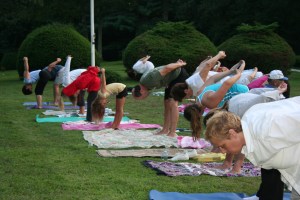
IMG_7618Tonight our parish is having Yoga on the Lawn.  This was an event we tried last year and loved, and so we decided to get outdoors again this year.  Though I am not always consistent in my practice, yoga has been a formative part of my health and spirituality.  Some may wonder whether yoga and Christianity can go together, but I found a link very early in life.  A priest at the Cathedral in Delaware was a yoga instructor, and I remember how his language completely transformed my experience.  Instead of bowing to the “light” in one another when we said, “Namaste,” this priest would have us bow to the “Christ” in one another.  Suddenly, my enjoyment of yoga made a lot more sense.

Having just preached on Luke’s version of the Lord’s Prayer this past Sunday, I find the practice of yoga fortuitous tonight.  Prayer is one of those things that we all struggle with, and in many ways, the challenges in yoga are very similar.  When practicing yoga, I have sometimes found that it took me the entire class to finally clear my head and just be present with my practice.  Our prayer life can be like that too.  We can be “praying” for quite some time before we are actually engaged in the prayer or listening for God.  We are very good at filling silence when it comes to our prayer life.

Our entering into yoga with a longing for connection to God can be much the disciples’ longing for Jesus to teach them to pray.  The first step is showing up.  The next step is committing to being present.  And the final step is keeping a forgiving heart that can quietly let intrusive thoughts go when they interrupt us.  In yoga, as in prayer, we work to clear the way for God.  The rest happens in spite of us.  Namaste.

Recent Posts

  • On the Myth and Magic of Advent…
  • On Risking Failure and Facing Fear…
  • Sermon – Luke 23.33-43, P29, YC, November 23, 2025
  • On Inhabiting Gratitude…
  • Sermon – Luke 20.27-38, P27, YC, November 9, 2025

Archives

  • December 2025
  • November 2025
  • October 2025
  • September 2025
  • August 2025
  • July 2025
  • June 2025
  • March 2025
  • February 2025
  • December 2024
  • November 2024
  • October 2024
  • September 2024
  • August 2024
  • July 2024
  • June 2024
  • May 2024
  • March 2024
  • February 2024
  • January 2024
  • December 2023
  • November 2023
  • October 2023
  • September 2023
  • August 2023
  • July 2023
  • June 2023
  • May 2023
  • March 2023
  • February 2023
  • January 2023
  • December 2022
  • November 2022
  • October 2022
  • June 2022
  • May 2022
  • January 2022
  • December 2021
  • November 2021
  • October 2021
  • September 2021
  • August 2021
  • June 2021
  • May 2021
  • April 2021
  • March 2021
  • February 2021
  • January 2021
  • December 2020
  • November 2020
  • October 2020
  • September 2020
  • August 2020
  • July 2020
  • June 2020
  • May 2020
  • April 2020
  • March 2020
  • February 2020
  • January 2020
  • December 2019
  • November 2019
  • October 2019
  • September 2019
  • August 2019
  • July 2019
  • June 2019
  • May 2019
  • April 2019
  • March 2019
  • February 2019
  • January 2019
  • December 2018
  • November 2018
  • October 2018
  • September 2018
  • August 2018
  • July 2018
  • June 2018
  • May 2018
  • April 2018
  • March 2018
  • February 2018
  • January 2018
  • December 2017
  • November 2017
  • October 2017
  • September 2017
  • August 2017
  • July 2017
  • June 2017
  • May 2017
  • April 2017
  • March 2017
  • February 2017
  • January 2017
  • December 2016
  • November 2016
  • October 2016
  • September 2016
  • August 2016
  • July 2016
  • June 2016
  • May 2016
  • April 2016
  • March 2016
  • February 2016
  • January 2016
  • December 2015
  • November 2015
  • October 2015
  • September 2015
  • August 2015
  • July 2015
  • June 2015
  • May 2015
  • April 2015
  • March 2015
  • February 2015
  • January 2015
  • December 2014
  • November 2014
  • October 2014
  • September 2014
  • August 2014
  • July 2014
  • June 2014
  • April 2014
  • March 2014
  • February 2014
  • January 2014
  • December 2013
  • November 2013
  • October 2013
  • September 2013
  • August 2013
  • July 2013
  • June 2013
  • May 2013
  • April 2013
  • March 2013
  • February 2013
  • January 2013
  • December 2012
  • November 2012
  • October 2012
  • September 2012

Categories

  • reflection
  • Sermons
  • Uncategorized

Meta

  • Create account
  • Log in
  • Entries feed
  • Comments feed
  • WordPress.com

Blog at WordPress.com.

  • Subscribe Subscribed
    • Seeking and Serving
    • Join 394 other subscribers
    • Already have a WordPress.com account? Log in now.
    • Seeking and Serving
    • Subscribe Subscribed
    • Sign up
    • Log in
    • Report this content
    • View site in Reader
    • Manage subscriptions
    • Collapse this bar
 

Loading Comments...