• About

Seeking and Serving

~ seek and serve Christ in all persons

Seeking and Serving

Tag Archives: prayer

Saintly Shout Out

05 Wednesday Aug 2015

Posted by jandrewsweckerly in Uncategorized

≈ Leave a comment

Tags

God, gratitude, humility, important, lost, prayer, saints, St. Anthony

Yesterday I lost something very dear to me.  Normally, I am not that passionate about material possessions.  I try to stay detached so that I don’t get fixed on the “stuff” of life.  But there are a few things that mean a great deal to me, and this was one of them.  There was a lot of weeping and gnashing of teeth yesterday (literally!), and ultimately, I remembered one of my favorite saints – St. Anthony.

Photo credit:  http://www.stanthonyoakley.com/our-patron-saint.html

Photo credit: http://www.stanthonyoakley.com/our-patron-saint.html

I know a lot of you are not familiar with or even in favor of praying with saints.  It was a practice I discovered in college.  Not having grown up in a tradition that prays with saints, it seemed mildly like praying to idols.  But once someone explained to me that the saints are more like companions in our prayer life – much like a dear friend who you ask to pray for you – I was able to ease my way into praying with saints.  I still think there is a bit of superstition to some of the saints.  St. Anthony is a classic example – he’s the patron saint of lost things.  I mean, it seems a little fishy to expect a saint to magically make your stuff appear.  But when you are desperate, you will try anything.  Hence, the prayers to St. Anthony last night and this morning.

The truth is, I am not sure praying with St. Anthony really helps you find things.  What I do know is that St. Anthony reminds you to pray – which is always a good thing.  If nothing else, when we slow down enough to pray, we find a sense of peace, and are reminded that God is with us, even when we are devastated and may never find the lost things that belong to us.  That prayer time also brings perspective about what is important in life, makes us question why we had not tended to prayer life in so long, and reconnects us with a real sense of gratitude – even in the midst of loss.  And my prayer time with St. Anthony also reminded me of how he might be helpful the next time I lose more important things – “things of the spirit,” as you will see in the prayer below.

The good news is that the item reappeared today and all the angst I felt is gone.  Now, I don’t know if St. Anthony helped.  All I know is that my gratitude is deeper and more humble today, and that I am grateful for a God who sits with me in the ashes.  Whether you pray with saints, with friends, or you just pray the old fashioned way, know that God longs to be in conversation with you.  Slow down, pull up a chair, and draw nearer to your God.

O blessed St. Anthony, the grace of God has made you a powerful advocate in all our needs and the patron for the restoring of things lost or stolen.  I turn to you today with childlike love and deep confidence.  You have helped countless children of God to find the things they have lost, material things, and, more importantly, the things of the spirit: faith, hope, and love.  I come to you with confidence; help me in my present need.  I recommend what I have lost to your care, in the hope that God will restore it to me, if it is His holy Will.  Amen.[i]

[i] http://www.catholicdoors.com/prayers/english/p00557.htm

On prayer and listening…

01 Friday May 2015

Posted by jandrewsweckerly in Uncategorized

≈ Leave a comment

Tags

authenticity, Baltimore, God, humility, listen, oppression, prayer, privilege, race

As Christians, there are many things we say out of habit.  We say, “God bless you,” when someone sneezes, even if we do not actually mean to invoke a blessing on the person.  We say, “Peace be with you,” in church without necessarily thinking about what offering the peace really means for our relationship with the other person.  And we regularly say, “I’ll keep you in my prayers,” even if we do not really keep a practice of diligent prayers.

And yet, as I have thought about the chaos that has erupted in Baltimore this past week, the only thing I can say with confidence is that I am holding Baltimore in my prayers.  Everything else I have tried to say has been muddled mess.  If I talk too long about my sorrow around the violence, I find that I too easily slip into blaming – a slippery slope at best.  If I try to talk about race, I find myself getting tangled up in the ways that race is invariably tied to socio-economic status and the inability I have as a white person to speak authority on the experience of my minority brothers and sisters.  No matter what philosophical argument I try to make, I find myself entangled in a very complicated system of oppression and favor.

And so although “I am holding Baltimore in prayer,” sounds like what a person of faith says as a throw-away statement, I really mean it.  I mean it because that is all I feel like I can do with authenticity and humility.  I mean it because it feels like something I can actively do when I feel powerless in so many ways.  And I mean it because what I know in the depths of my heart is that the situation in Baltimore is making me more upset about my own privilege and power than anything.  And I can only work that out through prayer.  God and I need to talk – and I need to listen.

Photo credit:  https://listeningprayer.wordpress.com/

Photo credit: https://listeningprayer.wordpress.com/

My hope is that prayer will open up a listening heart not just for God’s word, but also a listening heart to my brothers and sisters.  When prayer is at its best, it is an exercise in listening – and if anything, I am acutely aware of how much listening we need to do right now.  The listening this week started for me with this article.  After it brought me to my knees in prayer, I stumbled on this article about what Martin Luther King, Jr. once said about riots.  These pieces and many more have reminded me once again of my obligation as a person of privilege to shut my mouth, and open my eyes and ears.  Though a posture of prayer does not excuse us from action, as Desmond Tutu once said, we cannot accomplish much without it.

God and cell phones…

03 Wednesday Dec 2014

Posted by jandrewsweckerly in Uncategorized

≈ Leave a comment

Tags

Advent, connection, disconnected, God, prayer, relationship, technology

To see me now, you might not guess the initial reluctance I experienced with using a cell phone.  My progress was slow from owning one at all, to learning to text, to using a smart phone, to now using my agile phone.  Part of my reluctance was what such usage would mean – being able to be reached at all times; work emails invading “down time,” making me feel like I am never truly off; decreased patience with others who are not as technologically savvy; and constant usage for everyday needs.  I still try to resist looking at my phone constantly – I put it down during dinner time, I try not to respond to emails on my day off, I sometimes wait to look up something until I am at my computer.  But I still have those moments when my daughter impatiently waits while I finish one quick text or email to someone.  Though I ask her to hold on while I finish, I worry that I am becoming what I feared.

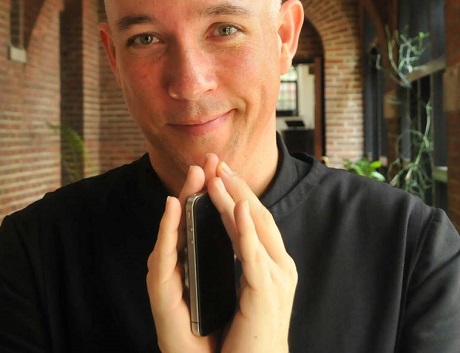
But there are also days when I am really grateful for my phone.  I currently have a parishioner who in the last stages of life.  The family and I know that the parishioner could go at any time, and so we are keep watch, spending time together, and holding each other in prayer.  I am keeping my phone especially close, checking for texted updates or for the dreaded call.  I even keep my phone on my nightstand in case I need to run to the hospital overnight.  That may sound unpleasant to some, but what I have come to see these last few weeks is that my phone is becoming not just a tool for pastoral care (a way for parishioners to reach me for emergencies), but it is also becoming a tool for my prayer life.  When I check my phone and there are no messages about this parishioner, I use the moment as a reminder to pray – pray for the parishioner, the parishioner’s family, and talk with God about the hard stuff of life.  Who would have thought that this little phone – a thing which I had once associated with menace, annoyance, and disconnectedness – could also be a tool for deep connection, prayer, and blessing?

Courtesy of http://episcopaldigitalnetwork.com/ens/2014/11/12/anglicans-invited-to-celebrate-advent-using-your-camera-phones/

Courtesy of http://episcopaldigitalnetwork.com/ens/2014/11/12/anglicans-invited-to-celebrate-advent-using-your-camera-phones/ Check out their website for a concrete way of using technology this Advent!

What I love about this tiny revelation is that it points to a larger truth.  God is constantly working through us in the current age.  It may sound silly, but I think God can work through our technology – through my little cell phone – for good, inviting me back into relationship with God, and working through it to connect us to one another.  The trick is keeping a watchful eye for God when it could otherwise be easy to miss God.  Of course, that is not a new problem.  God has been inviting God’s people into relationship from the beginning of time – and we have regularly been resistant.  The trick for staying connected is finding those things that help us return to the LORD:  whether it is a cell phone, a strategically placed Prayer Book that reminds us to pray, a set of prayer beads that you keep in your pocket, or a regular commitment to church attendance.  I wonder what things in your life might be repurposed to help you reconnect with the holy this week.


Walking the Way…

15 Wednesday Oct 2014

Posted by jandrewsweckerly in Uncategorized

≈ Leave a comment

Tags

God, prayer, stewardship, walking the way

This past Sunday, St. Margaret’s kicked off its Stewardship Campaign, “Walking the Way.”  As part of the campaign, we have distributed information packets that include a pledge card.  You will be seeing guest blog posts from our parishioners here on this blog.  There will be articles written in our newsletter.  This promises to be a fun and engaging campaign.

But one of the things I am most excited about is an idea that one of our Stewardship Committee Members had.  The Walking the Way logo has both a cross and a stone path.  When we first looked at the logo, the path symbolized for us the “way” that we walk with God – our own spiritual journey with God.  But as we continued to look at the logo, the image became richer for us.  We began to imagine the stones as representative of each parishioner at St. Margaret’s, as we journey together on this walk with God.  Finally, as we played with the image of a walk and stones, we began to wonder whether actual stones might be a wonderful tool for us this year as we pray about our own stewardship this year.

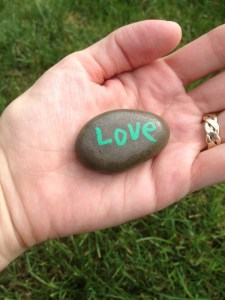
And so an idea was born.  This year, in addition to our letter, narrative budgets, and pledge cards, we each received a stone.  The stone is meant to be a gift during this time for us to use during our prayer time – a tangible invitation into times of prayer in the coming weeks.  For those of you who have used prayer beads before, you know how useful tangible tools for prayers can be.  The tactile nature of something like a stone helps us focus our prayers, work through our anxieties, and ultimately cling to something that reminds us of our gracious Lord and Savior – as well as the community of faith who prays with us.

If you did not get your prayer stone on Sunday, don’t worry: there are more.  If you did get your prayer stone, I hope you will start using it, and discover what gift awaits you in your prayer time.  Each rock has a word painted on it to help encourage your prayers.  Mine happens to say, “Love.”  I look forward to meditating on how God’s love is a blessing to me, and how I hope to bless others through that same love.  Happy prayers!

The Vulnerable Village…

05 Friday Sep 2014

Posted by jandrewsweckerly in Uncategorized

≈ 1 Comment

Tags

children, community, God, kindergarten, prayer, scary, trust, village, vulnerable

Today is the big day.  Our oldest child’s first day of kindergarten.  As background, we are used to our child being in the care of others.  Since she was eighteen months, she has been doing four days a week of full-day care.  Though that was hard at first, we quickly saw how she thrives on the routine and the stimulation.  And we have also embraced the idea of our child being raised by a village.  In fact, our second child started a similar schedule at eleven weeks.  So we are no strangers to the hand-off experience.

Courtesy of http://www.dot.gov/fastlane/school-bus-safety-be-prepared-not-scared

Courtesy of http://www.dot.gov/fastlane/school-bus-safety-be-prepared-not-scared

But I must admit that today was quite different.  Our kindergarten program asked the parents not to deviate from how drop-off will normally occur.  So instead of passing her off at the school itself, our daughter boarded a bus that then drove away.  In fact, the whole transaction took all of a minute or so.  As the bus turned the corner, driving out of sight, I was left standing there with a pit in my stomach.  As I have thought about it since she went to school, I realized that what my daughter did today – stepping on to a bus with people she has never met, going to a school she has never attended, meeting a new teacher she has never met, and experiencing a totally new routine – takes a tremendous amount of courage.  And yet she boldly stepped onto that bus, with a big grin on her face.

Though I have often talked about the village that raises our children, and in some ways have had to embrace that model out of necessity, I rarely admit how wonderful and also scary that whole concept is.  The truth is that I have to trust many people with shaping and forming my child into an amazing person.  Though my husband and I do a lot of that formation, her formation comes from teachers, school staff, church parishioners, friends, and family.  I have seen in person how helpful that can be (like that time when we were arduously trying to teach her to use a spoon – a habit she picked up in minutes once she saw the other kids doing it at school).  But today, I was aware of how vulnerable relying on the village makes one feel.  There is really no getting around that sense of vulnerability – it is a necessary part of life.  But that vulnerability can certainly be unsettling.

This morning, as I have been sorting through that unsettled feeling, the only thing I have been able to “do” is to give that feeling back to God through prayer.  God knows how much I dislike that feeling of being out of control, and so I am sure my prayer is familiar to God.  But I have also found myself praying my daughter through her day – the other kids on the bus she met, the staff who walked her to her classroom, her teacher and new classmates, the staff who works in the cafeteria, her time learning and at play, and her time in after-care.  I pray that the village will be good to her, that she will feel God’s loving arms surrounding her, and that she too will be God’s light to others.  That is my small contribution to the village today – my prayers and my trust.  God bless our village and give us peace.

On prayer and parenting…

10 Thursday Apr 2014

Posted by jandrewsweckerly in Uncategorized

≈ Leave a comment

Tags

child, conversation, desperate, God, grace, Jesus, love, methods, parent, prayer, sustains

Courtesy of http://marklovefurniture.com/blog/2013/08/30/prayer-is/

Courtesy of http://marklovefurniture.com/blog/2013/08/30/prayer-is/

One of the more regular inquires I get as a priest is about how to pray.  The truth is there are so many different ways to pray – ranging from formal methods to totally unstructured methods – that our conversations usually have to include what they have tried already and some teaching about what other options are available.  I usually send the person off with a couple of new things to try and encourage them to let me know how it is going.

Since the arrival of my second child, I have been thinking a lot about prayer – or rather, I have been doing a lot of it.  I delivered my child by caesarean section, and I found myself really nervous going into the operating room.  I am not entirely sure why, but I as I sat behind that tall white sheet, with my lower body numb, waiting for the doctors to prep for surgery, I could feel my stress level rising.  That nervousness only heightened once the operation began.  And then, suddenly, before I was even conscious that I was doing it, I found myself praying the Trisagion.  The Trisagion is a prayer found in the Book of Common Prayer.  The words are, “Holy God, Holy and mighty, Holy Immortal One, Have mercy upon us.”  The prayer is traditionally sung or said three times.  I lost count of how many times I said the prayer, but it became a way for me to focus all my nervousness and give it back to God.  Later, I remember thinking about how many times I have taught about mantra prayers, and yet this might have been the first time I really “got” how mantra prayers can be a source of connection to God.

Later, about the time that my daughter was a week old, and I was stealing as much sleep as I could on the couch, I noticed that the blanket I had blindly found in the middle of the night was one that had been gifted to us.  It is a throw blanket with the Lord’s Prayer stitched on it.  As I looked at the words, I started praying the words.  I have always loved the Lord’s Prayer because I can pray it when I have nothing left.  When I am bone-tired, weary, or just feeling overwhelmed, those words have a power over me and whatever situation I find myself in.  It occurred to me, as that blanket was wrapped around my body, how I was metaphorically enveloped in prayer during this unique time.

But to be fully honest, much of my prayer life these last two weeks has included prayers of desperation.  “Please, dear God, let her fall asleep this time.”  “Sweet Jesus, help her to stop crying.”  In my mind, these are not what I have traditionally called prayers that “count.”  They are more calls of despair and bargaining, which is not really how I imagine things “work” with God.  But as I have thought about it this week, I think these are totally legitimate prayers.  Part of a healthy prayer life is an honest, vulnerable conversation with God.  My being honest about how sleep deprived and frustrated I might be at 2 a.m. is not unreasonable – and in fact, God already knows how I am feeling and what I need.  Though I would not argue that this kind of prayer is the only kind of prayer one should utilize in their relationship with God, I think these prayers open up a path to more honest conversation – and hopefully more honest listening to God.

As I think back to all those times I have “taught” others about prayer, these last couple of weeks have certainly shifted some of my thinking about prayer.  The beauty of prayer is that the variety of options is truly a gift to us, and there are certainly different times that different forms of prayer will sustain us.  Whether we pray beautiful, ancient prayers or we offer up desperate ramblings to God, our loving, gracious God is simply happy that we are there – for once remembering Who sustains us, feeds us, and gives us strength.  Thanks be to God!

All shall be well…

19 Wednesday Mar 2014

Posted by jandrewsweckerly in Uncategorized

≈ Leave a comment

Tags

All shall be well, blessing, life, maternity leave, prayer, present

This week marks the beginning of my maternity leave.  My life has already dramatically shifted from getting ready to be away from church for twelve weeks, to getting our family and home ready for a new baby.  It is a time of anticipation, busyness, excitement, and a bit of anxiety.  As I assured my parish, I assure myself:  “All shall be well, all shall be well, and all manner of things shall be well,” as Julian of Norwich would say.

Courtesy of https://www.etsy.com/listing/78048300/inspirational-quote-all-shall-be-well?ref=market

Courtesy of https://www.etsy.com/listing/78048300/inspirational-quote-all-shall-be-well?ref=market

Many of you have asked if I will still be writing while on maternity leave.  I have pondered this myself for quite a while, and I have decided that I will be applying my Lenten discipline to this area of life as well.  This year for Lent, I decided to give myself a break – not to push too hard, but to just try to be present in the moment, knowing that this Lent and Eastertide will be a time of dramatic change for our family and that God is in the midst of it all.  And so I may decide that I need the creative outlet, and will in fact be posting on the blog.  Or I may decide that I just need to be present with my daughter in the limited time that we have before I go back to work.  Either way, I am not putting pressure on myself.  So I suppose my answer is, “I don’t know.  We will see.”

In the meantime, I hope that you will hold me and my family in your prayers.  I know that new life is a sacred gift, and I look forward to sharing that gift with you…eventually.  Many blessings on your journey in the meantime.  I’ll see you soon!

Homily – Colossians 4.2–6, John of the Cross, December 12, 2013

19 Thursday Dec 2013

Posted by jandrewsweckerly in Uncategorized

≈ Leave a comment

Tags

Advent, darkness, God, homily, John of the Cross, light, prayer

Today we honor Juan de la Cruz, or John of the Cross.  Though he died in 1591, John was widely unknown until more recently.  Born in 1542 in Spain, his father died when he was three.  His mother and siblings were thrown into poverty.  He received early education in an orphanage, but by 17 he had learned carpentry, tailoring, sculpting, and painting through apprenticeships.  He was able to do his university studies with the Jesuits; after school he joined the Carmelite order.  In 1567, he was ordained to the priesthood and recruited by Teresa of Avila to reform the Carmelite order.  He studied extensively, was a spiritual director, and devoted himself to the search for God.  Because of his attempts to dramatically reform the Carmelites, he was eventually imprisoned.  There he wrote poetry as a comfort.  His “Dark Night of the Soul” became his most famous piece.  As John of the Cross has been rediscovered, he has become known as “the church’s safest mystical theologian” and “the poet’s poet.”

I was thinking John must have known a lot about the dark night of the soul.  He had a rough childhood, fought to get an education, and then found incredible resistance when he tried to make the devotion of the Carmelites better; his prison cell must have felt like a dark night.  I am reading an Advent devotional right now, and it has felt pretty dark at times.  I can tell the author has experienced some rough times, though she never specifies what they are in her poetry.  But the darkness of her soul pervades her writing.  I have wondered as I read why she is putting such darkness in our Advent devotional – a season of light.  But then I thought about the realities of this season – the pain the season can bring of lost loved ones, of unfulfilled dreams, of unmet expectations, of pressure and anxiety.  Perhaps the author, like John of the Cross, is willing to expose the dark night that can live in the soul.

So where is the light for us to grasp in Advent?  I appreciate those words of instruction in Colossians: “Devote yourselves to prayer.”  Prayer is one of the places that we can dump darkness and discover light.  Prayer is the conversation in which we can struggle vulnerably and honestly with God, and eventually end up on the other side renewed and refreshed.  This is one of our Advent invitations:  devote yourselves to prayer.  Whether you already feel bathed in light or you are longing for the light, prayer is the place where we meet God and we find strength for the journey.  Amen.

Sermon – Luke 18.1-8, P24, YC, October 20, 2013

06 Wednesday Nov 2013

Posted by jandrewsweckerly in Uncategorized

≈ Leave a comment

Tags

God, Jesus, judge, persistence, prayer, Sermon, transformation, widow

“Then Jesus told them a parable about their need to pray always and not to lose heart.”  From the very beginning of our gospel lesson, Luke tells us what this funny little parable is all about:  persistent prayer.  That message sounds simple enough, but once we hear the actual parable, the realities of persistent prayer sound like a lot more work than most of us care to think about, let alone do.  The parable today is about an unjust judge, who has no fear of God or respect for people, who is constantly harassed by a widow demanding justice.  The translation we hear today says that the judge finally decides to give the widow her way because he does not want the widow to wear him out by continually coming.  But the literal translation of the original Greek is a little stronger.  One translation reads that the judge gives the widow her way for fear that the widow will “slap me in the face.”[i]  Another translation reads that the judge gives the widow her way because he does not want to “end up beaten black and blue by her pounding.”[ii]  There is something about these more figurative translations that help us see that when Jesus says the disciples’ prayers need to be persistent, he means knock-down-drag-out, stubborn-headed, unrelenting, radically-vigilant persistence.

I don’t know about you, but most people I know do not approach their prayer life with this kind of rigor.  Many people who keep up this type of persistence for any amount of time eventually lose heart, finally concluding that prayer just does not work – or they are not praying the right way.  For those who have prayed without ceasing for months and years only to watch a child, a spouse, a friend, or a mother die, may have begun to question whether prayer is not just what people do to fill the time – not an effective means of healing.  And for those who have faced horrible atrocities, who can find no sense in a world that abuses, oppresses, and starves its people, may have given up not only on prayer, but on God too.

I remember the first time Scott and I tried to get pregnant.  We had been trying for almost a year, when I finally brought the subject up with my spiritual director.  I had not wanted to talk about the issue, but I think my distance from God was too obvious for the spiritual director to ignore.  When she pushed me on the issue, asking whether I had been giving my pain and suffering to God, I admitted to her that God felt dead to me.  I had nothing more to say to God because, quite frankly, God felt absent from my life at the time.  When I shared that sense of absence in my life, my spiritual director suggested another way.  She suggested I start praying through Mary instead.  My first reaction to her suggestion was rage and indignation.  How insensitive could this woman be to suggest that I, unable to conceive, try praying through a woman who was able to conceive without even trying?!  Though I left my session angry with my spiritual director, a few days later, I gave her suggestion a try.  Two things stuck with me about that experience.  One, Mary now holds a very special place for me in my faith and prayer life.  Two, what I realized was that my spiritual director never suggested I stopped being persistent in prayer.  She simply suggested prayer in a different way.

In some ways, I think we lose this understanding of persistence when we hear Jesus telling us to be like a woman who will physically fight her way through prayer.  We imagine Jesus telling us to keep doing the same thing over and over again until that thing works.  But I do not think that is exactly what Jesus means.  Staying persistently in the prayer relationship is essential, yes.  But that does not mean that relationship does not evolve and change over time.  I think about that widow in our parable today.  I am guessing that her approach with the judge was not the same everyday.  I imagine her starting with the traditional way of begging for justice as anyone would.  But when she is refused, I imagine her trying everything else possible.  From just being a constant presence as the judge was judging other cases; to interrupting the judge’s walk to work in the morning; to following behind him on the way home, pleading her case; even situating herself at a nearby table at his favorite lunch spot – maybe even loudly pleading her case in front of other people, so as to embarrass the judge in front of his friends and colleagues.  Perhaps this is what the judge means when he says the widow is wearing him out.

If we think about the widow’s persistent actions, they are not all that different from the actions of God with God’s people.  As our Thursday morning Bible Study group works its way through Genesis, I have been thinking about the persistent pursuit of God toward God’s people.  Adam and Eve sin, and yet God stays in relationship with them.  The whole earth falls into abominable sin, and even after flooding the earth, God forms a new covenant with humanity.  God’s people break covenant after covenant, and God continues to pursue them.  God’s people disrespect, dishonor, and disparage God, and yet God tries again and again to redeem God’s people.  God is so persistent in God’s relationship with us that God even sends a Son to redeem us from our sinful ways – allowing Jesus to die on a cross for us.  If the widow is the consummate example of persistence in prayer, she learned this persistence from the God is ever pursuing us.

So how do God and the woman do it?  How do they manage this kind of vigilant persistence?  I think what both of them experience is that they are changed in the process.  We have heard many times in scripture how God changes God’s mind – how the flood leads God to vow to never destroy the earth again, or how the argument of Abraham makes God tone down God’s judgment, or how the repentance of the people of Nineveh changes God’s mind about punishment.  I imagine the widow is changed too.  With each attempt at convincing the judge she must have become more and more bold.  In the story, she is transformed from a woman who is likely powerless about her own future and the future of her orphaned children to a woman who is almost feared by a powerful judge.  She is transformed through her persistence.

That transformation is what happens in the life of persistent prayer.  “Repeated, habitual prayer gradually tests and sifts what you believe is really important and what is of ephemeral value.”[iii]  I think about the many times I have prayed and prayed over a particular issue, fully aware of how, when, and why I wanted God to intervene.  But slowly, over time, my prayer about the same issue changes.  I may go from wanting a particular outcome, to being willing to accept a positive outcome, to accepting the defeat and being open to God’s will, to simply wanting God to be present in the midst of it all.  That is why persistent prayer is so important.  Our one-time prayers or our perfunctory prayers do not really open us up to God.  Those rote prayers are just our lips moving without our hearts being equally moved.  But when we are persistent in our prayers, constantly evolving our conversation with God, constantly amending our approach toward God, constantly leaning on others to inform our prayer life, slowly our prayers become transformed, leading us to that God who responds to the deepest, most vulnerable versions of ourselves.

I remember a story of a seminarian who studied at General Theological Seminary.  Desmond Tutu was on campus and the seminarian was excited to watch Tutu in action.  He was happy to see Tutu join the students and faculty at Morning Prayer.  Later, on his way to class, he noticed Tutu in the chapel again, praying on his own.  That afternoon, he saw Tutu in the chapel once more praying.  He watched this pattern again and again over three days.  Finally, at evening prayer one day, the seminarian got up the nerve to approach Tutu and ask Tutu how he ever got any work done when he spent so much time praying in the chapel.  Tutu’s response was simple, “Oh I could never do any of my work if my work were not first rooted in prayer throughout the day.”  This is the kind of persistence in prayer Jesus invites us into today:  prayer that takes us out of ourselves, transforms our desires and actions, and reshapes our relationship with God.  Jesus’ instruction to the disciples is the same for us:  pray always and do not lose heart.  Amen.


[i] New Jerusalem Bible.

[ii] The Message.

[iii] Maggi Dawn, “Prayer Acts,” Christian Century, vol. 124, no. 2, October 2, 2007.

Homily – Isaiah 11.1-10, Vida Dutton Scudder, October 10, 2013

06 Wednesday Nov 2013

Posted by jandrewsweckerly in Uncategorized

≈ Leave a comment

Tags

activism, Congress, homily, Jesus, Kingdom, politics, prayer, Vida Dutton Scudder

Today we honor the work of Vida Dutton Scudder.  Born in 1861 to Congregationalist missionaries in India, Scudder and her mother were later confirmed in the Episcopal Church in the United States.  She studied English Literature in college and eventually became a professor at Wellesley.  But her love of scholarship was matched by her social conscience and deep spirituality.  She joined both Christian Socialist groups and the Society of the Companions of the Holy Cross, a community devoted to intercessory prayer.  As s socialist, she supported immigrants, workers’ strikes, and eventually, after WWI, became a pacifist.  But her activism was also deeply rooted in prayer.  She said, “If prayer is the deep secret creative force that Jesus tells us it is, we should be very busy with it.”  She added there was one sure way “of directly helping out the Kingdom of God.  That way is prayer.  Social intercession may be the mightiest force in the world.”

As our Congress continues to shut down government, arguing over debt and health care, while crumbling all sorts of services and parts of the economy, I have been wondering where God is in all this.  We get caught up in labels like Democrat, Republican, Tea Party, and heaven forbid, Socialist, and we use those labels as curse words.  But I have always thought Jesus was not only a man of prayer, but a bit of a socialist – probably not unlike Scudder.  You can imagine how excited I was this week when prayer and Congress started colliding in the news.  The chaplain for the Senate has been offering some fiery prayers these last weeks, and his words seem to be not only reaching our Representatives, but also reaching across America.

What this chaplain, Scudder and Jesus all point to is the hope we see in our vision from Isaiah:  a world where the wolf can live with the lamb, the cow and bear can graze together, and a nursing child can play over the hole of the asp.  This is the Kingdom vision.  But we do not have to wait for the Kingdom after death.  Scudder’s witness reminds us that we can take steps to realize the Kingdom here and now.

Now, how we get there is a bigger question.  We could be here all day fighting over whose party can do that best.  But that is where Scudder’s life points us most helpfully – to the life of prayer.  Scudder invites us to stop name-calling or stewing and to start praying.  If we can be very busy with prayer, as Scudder suggests, perhaps we might liberate our feet to take those first steps toward the Kingdom here and now.  Amen.

← Older posts
Newer posts →

Recent Posts

  • On Redefining Community…
  • On Parenting, Milestones, and Community…
  • Sermon – Acts 2.42-47, E4, YA, April 26, 2026
  • On Seasons of Discernment…
  • Sermon – Luke 24.13-35, E3, YA, April 19, 2026

Archives

  • May 2026
  • April 2026
  • February 2026
  • January 2026
  • December 2025
  • November 2025
  • October 2025
  • September 2025
  • August 2025
  • July 2025
  • June 2025
  • March 2025
  • February 2025
  • December 2024
  • November 2024
  • October 2024
  • September 2024
  • August 2024
  • July 2024
  • June 2024
  • May 2024
  • March 2024
  • February 2024
  • January 2024
  • December 2023
  • November 2023
  • October 2023
  • September 2023
  • August 2023
  • July 2023
  • June 2023
  • May 2023
  • March 2023
  • February 2023
  • January 2023
  • December 2022
  • November 2022
  • October 2022
  • June 2022
  • May 2022
  • January 2022
  • December 2021
  • November 2021
  • October 2021
  • September 2021
  • August 2021
  • June 2021
  • May 2021
  • April 2021
  • March 2021
  • February 2021
  • January 2021
  • December 2020
  • November 2020
  • October 2020
  • September 2020
  • August 2020
  • July 2020
  • June 2020
  • May 2020
  • April 2020
  • March 2020
  • February 2020
  • January 2020
  • December 2019
  • November 2019
  • October 2019
  • September 2019
  • August 2019
  • July 2019
  • June 2019
  • May 2019
  • April 2019
  • March 2019
  • February 2019
  • January 2019
  • December 2018
  • November 2018
  • October 2018
  • September 2018
  • August 2018
  • July 2018
  • June 2018
  • May 2018
  • April 2018
  • March 2018
  • February 2018
  • January 2018
  • December 2017
  • November 2017
  • October 2017
  • September 2017
  • August 2017
  • July 2017
  • June 2017
  • May 2017
  • April 2017
  • March 2017
  • February 2017
  • January 2017
  • December 2016
  • November 2016
  • October 2016
  • September 2016
  • August 2016
  • July 2016
  • June 2016
  • May 2016
  • April 2016
  • March 2016
  • February 2016
  • January 2016
  • December 2015
  • November 2015
  • October 2015
  • September 2015
  • August 2015
  • July 2015
  • June 2015
  • May 2015
  • April 2015
  • March 2015
  • February 2015
  • January 2015
  • December 2014
  • November 2014
  • October 2014
  • September 2014
  • August 2014
  • July 2014
  • June 2014
  • April 2014
  • March 2014
  • February 2014
  • January 2014
  • December 2013
  • November 2013
  • October 2013
  • September 2013
  • August 2013
  • July 2013
  • June 2013
  • May 2013
  • April 2013
  • March 2013
  • February 2013
  • January 2013
  • December 2012
  • November 2012
  • October 2012
  • September 2012

Categories

  • reflection
  • Sermons
  • Uncategorized

Meta

  • Create account
  • Log in
  • Entries feed
  • Comments feed
  • WordPress.com

Blog at WordPress.com.

  • Subscribe Subscribed
    • Seeking and Serving
    • Join 391 other subscribers
    • Already have a WordPress.com account? Log in now.
    • Seeking and Serving
    • Subscribe Subscribed
    • Sign up
    • Log in
    • Report this content
    • View site in Reader
    • Manage subscriptions
    • Collapse this bar

Loading Comments...