• About

Seeking and Serving

~ seek and serve Christ in all persons

Seeking and Serving

Tag Archives: reconciliation

Sermon – Matthew 6.1-6, 16-21, AW, YC, March 5, 2025

18 Wednesday Jun 2025

Posted by jandrewsweckerly in Sermons

≈ Leave a comment

Tags

alms, Ash Wednesday, both-and, community, confess, fasting, honest, Jesus, Lent, prayer, real, reconciliation, redemption, reflection, repentance, Sermon, sin, solo, vulnerable

If I were to say to you that there are two services that attract the most non-members each year, which two services would you guess?  Christmas and Easter?  In part, you could be right – there are definitely a lot of guests at Christmas and Easter.  But proportionately, when talking members and non-members, I notice we get more guests at Blue Christmas and Ash Wednesday – especially if we include Ashes to Go in our Ash Wednesday count. 

So what about Blue Christmas or Ash Wednesday is so appealing to someone who doesn’t regularly attend church?  Having just been a part of Ashes to Go in our parking lot with lots of guests, I think there is something very real, honest, and vulnerable about services on Ash Wednesday that do not always happen on a Sunday or especially on festivals like Christmas and Easter.  On Ash Wednesday, the church gives us permission to bring our real, broken, hurting, mortal selves to a space, to acknowledge our fragility and hurt, and to bless the fullness of our selves – the good, the bad, and the ugly. 

Now to some, this may feel a little too self-centered.  As we impose ashes, the choir will chant from Psalm 51 tonight:  “Wash me through and through from my wickedness and cleanse me from my sin.  For I know my transgressions, and my sin is ever before me.  Against you only have I sinned and done what is evil in your sight.  And so you are justified when you speak and upright in your judgment.”  Perhaps that is the appeal of this day – the opportunity to take a moment for the self and really ponder where we are with God and this life.  Those ashes will be grittily spread on my forehead, the penitence and fasting are my work to do, and death is mine alone to face.  Everything about today is about my own journey with God.

Stephen and I were just debating about this reality for Lent in general.  We are making plans for Holy Week and we have a service with gospel songs and meditations.  I was excited about the possibility of the service and Stephen quipped, “It’s a little self-centered, don’t you think?  What about worrying about others and the rest of the world?!?”  The truth is, the season of Lent that we start today and end on Good Friday is sort of a both-and experience.  This is a season we are called into self-examination and repentance.  AND, this is also a season where we examine the sinfulness in the world in which we are complicit.

That both-and experience is what Jesus was worried about in our gospel lesson today.  Jesus talks a great deal about personal piety and not showing off in front of others – to not to let others seeing you give alms, pray, or fast.  But as I studied Matthew again this year, I reread something that brought me up short.  All those warnings Jesus makes, “Beware of practicing your piety before others…whenever you give alms, do not sound a trumpet…when you pray, do not be like the hypocrites…whenever you fast, do not look dismal…”, all of those warnings are not in the singular.  They are actually in the plural.[i]  So the words are more like, beware of practicing you all’s piety.  Or maybe in southern speak, “when all ya’ll pray…” Jesus is not criticizing or singling out you or you or me.  Jesus is singling out the community of the faithful.

That may sound like semantics, but there is something quite dramatic about Jesus speaking in the plural versus the singular.  Every week in Sunday services, we confess our sins.  But we confess them communally.  Communal confession is an extraordinary event.  While we may feel lost or despondent about our inability to live in the light of Christ as individuals, when we communally confess, a room of voices is saying with you, “Me too!”

One of the things I grieved during the pandemic was our inability to gather in person.  I loved that we had and continue to have an online community – especially for our homebound, our busy members, or for those meeting Hickory Neck for the first time.  But our necessary isolation during the pandemic naturally led to a pattern of looking inward – sometimes so much so that we forgot we are not alone – that there is a whole community of faith who is walking this journey with us and struggling just as we are.  There is something quite powerful about listening to the voices of the 7-year-old next to the 77-year-old – the person who looks so put together next to the person who is clearly struggling – the dad with children next to the widow – all confessing together.  Week in and week out, those myriad voices remind us we are not alone.

Tonight’s service very much calls us into reflection and repentance.  But our invitation tonight as we enter Lent is to remember that the act of reconciliation and redemption does not only happen alone.  We all are invited into a holy Lent.  We all are invited into prayer, fasting, and alms giving.  We all are invited to remember we are dust.  In person, online, and hybrid together, we are not only invited into solo, parallel journeys.  But also, our journeys are strengthened and made possible through the companionship of community.  You are not alone.  We are in this together – all y’all.  And Jesus lights the way for us all.  Amen.


[i] Karoline Lewis, as described on the podcast, “Sermon Brainwave:  #889: Ash Wednesday –Rebroadcast from February 22, 2023,” February 25, 2025, as found at https://www.workingpreacher.org/podcasts/889-ash-wednesday-rebroadcast-from-february-22-2023 on March 4, 2025.


On Finding Our Way to Reconciliation…

03 Wednesday Jan 2024

Posted by jandrewsweckerly in reflection

≈ Leave a comment

Tags

children, creation, God, incarceration, land, legacy, lynching, parent, racial reconciliation, reconciliation, segregation, sin, slavery

Photo credit: https://orionmagazine.org/article/this-land-was-made/

This past week, my family was able to visit The Legacy Museum in Montgomery, Alabama.  The museum artfully and comprehensively presents the “history of the destructive violence that shaped our nation, from the slave trade, to the era of Jim Crow and racial terror lynchings, to our current mass incarceration crisis.”  We have made a point as a family to visit various museums focusing on civil rights, but this museum was the first to tie those four actions in history (slavery, segregation, lynchings, and modern incarceration) so intentionally, powerfully, and succinctly. 

One of the more moving sections for our family was a wall of jars of dirt, of varying colored soil.  As we moved closer, we learned the story of the project through the Equal Justice Initiative.  Family members, researchers, and volunteers worked have worked together to trace every known lynching, visit the site, collect dirt in a large jar, and then label the jar with the name of the victim, the date, and the location of the lynching.  Something about the varying colors of soil from around our country, and the sheer volume of jars was mesmerizing – as though you could see the variation in the victims’ stories, while being reminded of the ways the earth bears witness to the sins of her inhabitants.

As we left the museum, we soberly began talking about impact the museum had on us and what we might like to do differently to be a part of breaking the cycle of violence in our own day.  Inspired by leaders in the closing “Reflection Room,” we realized we all could do something – in our way, in our own place, in our own time.  As a parent, part of my work is exposing my children to the awfulness of our humanity that we do not always discuss – especially recognizing the inherent privilege we have to determine when and how our children know this part of our nation’s story.   But I especially appreciated the invitation to begin wondering where God was uniquely inviting each of us to play a part in the shaping of the future.

I often say the work of racial reconciliation can never be “done” or completed.  Racial reconciliation is lifelong work for us as a country.  But sometimes I worry that the reality that we could never “accomplish” racial reconciliation creates a disincentive to even try – to do anything because it feels so very big.  As we begin a new year, and as we add many resolutions to our plans for 2024, I invite you to pick just one thing you can do to be a part of work of reconciliation – in your own way, your own place, your own time.  God and God’s created order have shown us vividly how far we have to go.  Together, we can find our own place in the history of reconciliation. 

Sermon – Matthew 18.15-20, P18, YA, September 10, 2023

20 Wednesday Sep 2023

Posted by jandrewsweckerly in Sermons

≈ Leave a comment

Tags

avoidance, Christian, church, community, conflict, conflict resolution, discipleship, gift, Jesus, reconciliation, relationship, Sermon, transform, witness

I have been looking forward to this Sunday for weeks!  Although we just had our post-sabbatical gala last night, there are still several parishioners who I expect to see for the first time in months today.  Our staff finally reunited for the first time since sabbatical began this week.  Our choir is back in action at the 10:00 am service and our Sunday School and Adult Formation teams are doing open houses today.  Our Parish Life Committee has brewed up fresh coffee – which is no small feat after transforming the New Chapel for last night’s festivities.  Church members have been inviting friends to join them for church, or maybe you yourself decided today was the day to search for a new church home – either in person or online.  I have felt the anticipation building as this has day approached. 

Into my excitement to kick off a new program year, to invite people to engage in their faith journey, and to share an invitation to others to discover the beauty of this vibrant community, what does the gospel lesson from Matthew offer us?  A text about fighting within the church.  Jesus does not just admit that sometimes, every once in a while, people in the church might experience conflict.  No, Jesus goes into great detail about what to do when you face conflict in the church:  embrace conflict directly, repeatedly, and publicly.  To those of us who were raised in the South, or at least to those of us who were raised in conflict-avoidant families, this text is our worst nightmare!  And this is certainly not the joyful text I was looking for when anticipating this festive day.

Part of what bothers us about this text from Holy Scripture is many of us come to church looking for a break from the conflict that surrounds our everyday life.  Whether we experience conflict in our families, conflict in our workplaces, schools, or service organizations, or conflict in our political lives, the last thing we want to do when we come to church on Sundays is deal with more conflict.  A friend of mine once confessed to me that he was thinking about leaving his current church home over a conflict within the church.  We were both young adults, on our own for the first time since college, and we had images in our minds about what church should be and what we wanted from our church communities.  But instead of bucolic communities of peace, harmony, and justice, we were both finding churches riddled with conflict and disunity.  As we were talking about his frustration, my friend finally confessed, “When I go to church, I just want everyone to get along.  I go to church to escape what is going on in my everyday life, not relive it!”

Now, I could spend the next hour deconstructing his complaint, but there is something powerful at the heart of his complaint, and perhaps at the heart of our own experience of church.  When we talk about church as being like a family, or being like home, what we really mean is we want a place that is a bit unlike our families or homes.  We want a place that is always happy, loving, nurturing, sometimes challenging, but more often comforting.  When we think about the warm, fuzzy feeling we have, the feeling we find at a place like Hickory Neck, the last thing we think is, “Man, I love the way we handle conflict at church!” 

Unfortunately, that is exactly what our text is inviting us to do – to celebrate the way that the church teaches us to fight – or to phrase it a little differently, how the church teaches us to deal with conflict in healthy ways.  In order to get to the point where we can see the gift of healthy conflict resolution as a good thing, we need to do a few things.  First, we need to get to the point where we can embrace the inevitability of conflict in the church community.  For some of us, that is not a big hurdle.  For others of us, the assumption of conflict is difficult.  Perhaps you were raised in a family who treated conflict as something to be avoided at all costs.  Or perhaps you grew up in an environment where conflict was so aggressive you created patterns of conflict-avoidance later in life.  Regardless, if we have come to see conflict as the enemy, accepting the inevitability of conflict is going to be our first task.  In Matthew’s gospel today, Jesus says, “For where two or three are gathered in my name, I am there among them.”  But what he implies is that when two are three are gathered in his name, there will be conflict.  Jesus himself is so sure there would be conflict that he develops a whole conflict management plan.  So, repeat after me, “Conflict is unavoidable in church.” 

Now that you are accepting the unavoidable, the next thing we need to do is honor the gift of conflict management Jesus gives us in scripture today.  For those of us who are conflict avoidant, Jesus’ conflict management plan is going to seem daunting.  The good news is scholars agree with you.  Many of the scholars who have written about this text say the step-by-step instructions do not necessarily need to be read as a step-by-step guide to solving conflict within a church.[i]  What is most important is what the instructions convey:  conflict in the church is not to be ignored, hidden, or buried.  Theologian Stanley Hauerwas has this to say about conflict, “[Jesus] assumes that conflict is not to be ignored or denied, but rather conflict, which may involve sins, is to be forced into the open.  Christian discipleship requires confrontation because the peace that Jesus has established is not simply the absence of violence.  The peace of Christ is nonviolent precisely because it is based on truth and truth-telling.  Just as love without truth cannot help but be accursed, so peace between the brothers and sisters of Jesus must be without illusion.”[ii] 

As Christians, Jesus wants us to behave differently.  Jesus wants us to be truthful with one another.  Jesus wants us to deal with one another face-to-face instead of talking behind each other’s backs.  Jesus wants us to work on reconciliation of relationships instead of letting hurt and pain fester and erode relationships.  For Jesus, being right or wrong is much less important than being in relationship.  Being in right relationship, keeping the family together is much more important.[iii]  Jesus wants us to repeat after him, “Conflict is not the enemy.  Letting conflict ruin relationships is the enemy.”

Finally, once we have accepted the inevitability of conflict, and once we have agreed to value relationships over the avoidance of discomfort, we are ready to embrace the gift of our gospel lesson today – and perhaps even claim that this might be the perfect lesson for a Kickoff Sunday.  If you came to church to escape conflict or enter some bubble of blissfully ignorant happiness, Hickory Neck is probably not the right place for you.  But, if you came to Hickory Neck to learn how to transform conflict into something holy, then you may have just found a real home – not a home based on illusion, but a home based on truth, dignity, and respect.  When you accept the inevitability of conflict and the value of meaningful relationship, you receive the tools to work through conflict and land in the reality of reconciliation. 

But here is the best part of Jesus’ Conflict Resolution Class today.  If we can stay on the journey through conflict to reconciliation, gaining the tools that this community has to offer us, then we as a community create something much more powerful than can be contained in these walls.  We create a witness for our community.  We create disciples capable of not only working through conflict within the community, but also capable of modeling reconciliation beyond our community.  Anyone who has read a headline in our country in the last several years knows that our country needs more models for healthy conflict engagement.  That is what Jesus offers us today:  tools to work on our own issues around conflict, tools to become a loving, honest, and reconciling community, and tools to teach reconciliation beyond these walls.  Jesus has promised to be with us as we do our work.  In fact, Jesus is here with us now as we anxiously try to step on that path toward reconciliation.  So, repeat after me, “Conflict is a blessing my church teaches me to embrace.  Thank you, Jesus, for the blessing of conflict and the promise of reconciliation.  Help me to share that gift with others.”  Amen. 


[i] David Lose, “Pentecost 14 A – Christian Community,” September 6, 2017, as found at http://www.davidlose.net/2017/09/pentecost-14-a-christian-community/ on September 8, 2023.

[ii] Stanley Hauerwas, Matthew:  Brazos Theological Commentary on the Bible (Grand Rapids:  Brazos Press, 2006), 165-166.

[iii] Barbara Brown Taylor, The Seeds of Heaven: Sermons on the Gospel of Matthew (Louisville:  Westminster John Knox Press, 2004), 88-89.

Sermon – Matthew 11.25-30, St. Francis Feast, YC, October 2, 2022

05 Wednesday Oct 2022

Posted by jandrewsweckerly in Sermons

≈ Leave a comment

Tags

animals, blessing, Jesus Christ, light, peace, reconciliation, relationship, rest, sabbath, Sermon, St. Francis, truth, wolf, work, yoke

Today we honor the life of St. Francis of Assisi.  Francis is one of the most popular and admired saints of all time.  Most of us know the highlights of his story:  born the son of a wealthy man in 1182; had a conversion experience and devoted his life to Lady Poverty; shaped monastic and lay devotion; was a friend to all God’s creatures – being known to have preached to the birds.

But the story I like most is the story about St. Francis and the Wolf.  According to legend, there was a wolf that was terrorizing the town of Gubbio, killing and eating animals and people.  The villagers tried to fight back, but they too died at the jaws of the wolf.  Francis had pity on the townspeople and went out to meet the wolf.  When Francis found the wolf, he made the sign of the cross, and said, “Come to me, Brother Wolf.  In the name of Christ, I order you not to hurt anyone.”  In response, the wolf calmly laid down at Francis’ feet.  Francis then went on to explain to the wolf how he was terrorizing the people and other animals – all who were made in the image of God.  The wolf and Francis then made a pact that the wolf would no longer harm the townspeople and the townspeople would no longer try to hurt the wolf.  The two traveled into town to explain the pact they had formed.  The people were amazed as Francis and the wolf walked side-by-side into town.  Francis made the people pledge to feed the wolf and the wolf pledge not to harm anyone else.  From that day on, the wolf went door to door for food.  The wolf hurt no one and no one hurt the wolf; even the dogs did not bark at the wolf.[i]

What I love about this story of St. Francis is that the story is about reconciliation and relationship.  At the beginning of the story the town and the wolf are at an impasse – the wolf is hungry and getting attacked; the people are afraid and are lashing out.  What Francis does for both parties is shock them out of the comfortable.  For the wolf, no one has addressed the wolf kindly – they have either shut the wolf out or actively tried to kill him.  For the people, the wolf has not asked for help – he has simply and violently taken what he needed and wanted.  Francis manages to shock the wolf first – not through violence or force, but with the power of love and blessing.  By giving a blessing in the name of God, Francis is then able to implore the wolf to reciprocate with love.  Francis also manages to shock the village – not with a violent victory, but with a humble display of forgiveness and trust.  By walking into town with a tamed wolf at his side, Francis is able to encourage the town embrace, forgive, and care for the wolf.  Francis’ actions remind both parties that unless their relationships are reconciled, unrest and division will be the norm. 

The funny thing about this story is that the story is pretty ridiculous.  I mean, how many of us go around talking to wild animals, blessing them with the sign of the cross, expecting anything other than being attacked?  We will never really know whether the story is true.  But like any good Biblical story, whether the story is true is hardly the point: the point is that the stories point toward “Truth” with a capital “T.”  What this story teaches is peace and reconciliation only happen through meeting others where they are.  We cannot expect great change unless we are willing to get down in the trenches – to go out and meet that destructive wolf face-to-face.  The other thing this story teaches is relationships are at the heart of peace work.  Only when the wolf and the town begin to get to know each other and begin to form a relationship with one another can they move forward. 

This is the way life is under Jesus Christ.  In our gospel lesson today, Jesus says, “Come to me, all you that are weary and are carrying heavy burdens, and I will give you rest.  Take my yoke upon you, and learn from me; for I am gentle and humble in heart, and you will find rest for your souls.  For my yoke is easy, and my burden is light.”  Jesus’ words have layered meaning.  The first meaning we all catch is that Jesus offers us rest and refreshment.  Jesus encourages us to come to him, to cast our burdens and cares upon him, and to take rest, to take Sabbath in Christ.  Our souls will find peace in Christ Jesus.  The second meaning is that peace in Christ Jesus is not without work.  Jesus does not say come unto me and relax forever in happy retirement.  Jesus says we will still have to take on a yoke – the burden of disciple living.  Luckily, that burden of being Christ’s disciple will not be burdensome – it will be light.  Finally, not only will Jesus make the workload “light,” as in not heavy.  Jesus will also make us “light” – as in lights that shine into the darkness and refuse to allow the shadow to overwhelm.   We become the light when we work for reconciliation in our relationships with others. 

That is why we do a couple of special things today.  First, we ask for blessing on our animals – that God might help our relationship with our pet be one of blessing and light.  Second, we come to Jesus for Sabbath rest – that God might renew us on this Sabbath day, use the rest to fill us with light, and renew our commitment to be agents of reconciliation, gladly putting on Christ’s yoke.  Amen.


[i] Jack Wintz, “St. Francis and the Taming of the Wolf,” as found at https://www.franciscanmedia.org/franciscan-spirit-blog/st-francis-and-the-taming-of-the-wolf on September 30, 2022. 

Sermon – Matthew 18.21-35, Genesis 50.15-21, P19, YA, September 13, 2020

17 Thursday Sep 2020

Posted by jandrewsweckerly in Sermons

≈ Leave a comment

Tags

cross, defensive, forgiven, forgiveness, God, heal, Jesus, messy, Peter, reconciliation, Sermon, sins, time, unforgiveable

Forgiveness is a funny thing.  Forgiveness is at the heart of our gospel proclamation.  We regularly talk about how Jesus the Christ died for the forgiveness of our sins.  We spend six whole weeks in Lent repenting of our sins, making the long journey toward Good Friday and the empty tomb, where our sins are forgiven.  We want to be forgiven.  We admire others’ displays of forgiveness – retelling stories of victims who should never have to forgive, but somehow valiantly do.  We sometimes condescendingly tell others they should forgive.  We even ardently require our children to accept apologies, without really explaining what forgiveness is.  But when we are facing an injustice, an injury, an event that pierces our heart when remembered, and we are told to forgive, our immediately response is, “Whoa, now!”

Perhaps that reaction is at the heart of Peter’s inquiry today.  The disciples and Jesus have been talking about reconciliation within the community of faith when someone has harmed another.  At the end of that conversation, Peter wisely asks, “Yeah, but how many times do I actually need to forgive someone.  Seven times should be plenty right?  That’s a good, holy number.”  And Jesus says, “Seventy-seven times,” or as some translators say, seventy times seven.[i]  Whichever number we use, Jesus is not just setting some higher number to track; Jesus is saying forgiveness must be offered constantly, in an ongoing way.

The problem when we talk about forgiveness is we can think of endless examples of things that should be unforgiveable.  In our news streams this week, we saw conversations about institutional racism, stemming from the centuries-long practice of slavery in our country; we remembered the horror of September 11th and the thousands of people who died, were traumatized by, or whose health was permanently impacted by that event; we saw cases of abuse by spouses or those in positions of power.  And that is just on the meta-level.  In truth, even on the micro-level, we struggle.  We struggle with those instances where someone hurt us personally – the breaking of our trust or the hurtful things said and done by friends, family, or even strangers.  When we need to be the agents of forgiveness, somehow our gilded concept of forgiveness begins to crack.

Part of the problem is our definition of forgiveness.  When we talk about forgiveness, we forget to talk about what forgiveness is not.  Debie Thomas does an amazing job of walking us through what forgiveness is not.  Forgiveness is not denial:  pretending an offense does not matter, the wound does not hurt, we should just forget, or our merciful God cannot be angered or grieved.  Forgiveness is not a detour or shortcut:  forgiveness cannot be offered without repentance, discipline, and confession – there is no grace without the cross.  Forgiveness is also not synonymous with healing or reconciliation:  healing can take a long time and sometimes reconciliation is not possible – in this way, forgiveness is a beginning, not the end.  Finally, forgiveness is not quick and easy:  forgiveness is a non-linear, messy process, that takes time.[ii]

When we let down our defensiveness about forgiveness, we can see those same lessons in Holy Scripture today.  In our Old Testament lesson, Joseph’s brothers come to him after their father’s death, fearing Joseph will finally enact justified revenge for them selling him into slavery.  Now, Joseph has already forgiven the brothers before his father’s death – and is explicit about his forgiveness.  But the brothers know what we just talked about – forgiveness is not quick and easy.  They fear Joseph’s forgiveness has limits.  And in our Gospel lesson, when Jesus uses a parable to talk to Peter about forgiving seventy times seven, he does not tell a story about someone forgiving again and again.  Instead he tells the story of a man forgiven an unimaginable debt – one he could never have paid off in his lifetime, who then refuses to show forgiveness to another in a much smaller, manageable debt.  The parable highlights how forgiveness is not denial – how God is merciful, but can still be angered by our actions.

As one scholar reminds us, “Forgiveness is hard, really hard.  But the good news is that where God calls, God also equips.  God gives us in Christ the gift of forgiveness and helps us to share that gift with others.  And in doing so, God opens doors that are shut.  God opens a future that is shut.  By forgiving those who have sinned against us, we do not allow the past to dictate our future.  Forgiveness breaks the chains of anger and bitterness and frees us to live new lives.”[iii]  The hard work of forgiveness is no joke.  Forgiveness takes time, is hard, and is a winding path.  But the cross of Christ enables us to keep going, enables us claim love – not a love that relativizes evil or negates the justice that is also of God – but a love that can transform both the oppressor and the oppressed – can heal both us and them.  And Jesus tells us today that despite the fact forgiveness is hard, forgiveness is also work we can do through him.  Thanks be to God.


[i] Lewis R. Donelson, “Exegetical Perspective,” Feasting on the Word, Year A, Vol. 4 (Louisville: Westminster John Knox Press, 2011), 69.

[ii] Debie Thomas, “Unpacking Forgiveness,” September 6, 2020, as found at https://www.journeywithjesus.net/lectionary-essays/current-essay?fbclid=IwAR1uTVaenGNYgJX-mpph8V_97k_S-kIWEbuuSMwkzJKLohX0XbYvuveEk9k on September 11, 2020.

[iii] Kathryn M. Schifferdecker, “Forgiveness is at the Core,” Setpember 6, 2020, as found at http://www.workingpreacher.org/craft.aspx?post=5454 on September 11, 2020.

The Pilgrim’s Way…Day 4

10 Monday Feb 2020

Posted by jandrewsweckerly in Uncategorized

≈ Leave a comment

Tags

Christ, claim, Coventry, faith, forgive, God, inspire, love, Oxford, persecution, pilgrimage, reconciliation, witness

85028394_2887868867936021_715629181731340288_n

Photo credit:  Jennifer Andrews-Weckerly; reuse with permission only

Sixteen pilgrims from Hickory Neck Church traveled to England for 8 days of pilgrimage.  Our focus was on choral music, hearing Evensong or Choral Mass at a Cathedral, Minster, or college everyday.  This is the fourth entry, initially posted on our church Facebook page.  For those of you who do not follow us on Facebook, I am repeating the journey’s daily entries here.  Enjoy!

Coventry/Oxford

Today I was struck by the notion of our lives as “witness.” Following the bombing of the medieval Cathedral in 1940, Provost Howard had the words “Father Forgive,” inscribed on the wall behind the altar of the ruined building. Howard had many ways he could have pastored the community. But by asking God to forgive, he led his people to forgive their enemies, but also forgive themselves who were complicit in war too. His witness of forgiveness inspired a community to embrace reconciliation over retaliation, love over hate, life over death.

Meanwhile, Bishops Cranmer, Ridley, and Latimer had the option renounce their new Protestant identity and return to their Catholic roots – the only identity they had ever known. Instead, they bravely faced fire over their faith. Their witness inspired countless others to hold fast to their faith, to choose what is right, to trust God even until persecution and death.

I wonder what witness you are embracing today. How are you claiming Christ in a way that inspires others? I can’t wait to hear about it!

84686777_2887868871269354_7932178037292924928_n

Photo credit:  Jennifer Andrews-Weckerly; reuse with permission only

On Relationships and Lunch…

05 Wednesday Dec 2018

Posted by jandrewsweckerly in Uncategorized

≈ Leave a comment

Tags

collaboration, God, health, inspiration, liturgy, lunch, productivity, reconciliation, relationship, respect, retiree, tedning, transformation

LSSLiving_SeniorLivingCommunities-1

Photo credit:  https://www.lssliving.org/communities/

Today we are hosting our second Retiree Lunch with the Rector at Hickory Neck Episcopal Church.  We kicked off this new event last month.  I threw together the event rather quickly, and expected only 10-15 people to show.  When RSVPs hit 60, I was floored – and ever so grateful for our Parish Life Committee who offered to make some more batches of chili, since my one or two Crock Pots would no longer suffice.  The idea for the lunches came out of my annual review with our Personnel Committee.  They were concerned about longtime and older parishioners feeling a sense of connectivity with me and with one another.  No need for a program, worship service, or class; just some time for all of us to be together.

As I thought about the feedback initially, I was not entirely convinced.  Surely gathering that many people was a lost opportunity for formation or enrichment.  But the more I thought about the feedback, the more I could understand the feedback.  One of the dangers of thinking Sunday worship is sufficient for connectivity is realizing how little personal relationship building happens.  Sure, the liturgy and shared experience of reflecting on scripture and sharing the meal is a central part of shaping our identity.  But the handshake, and the “Everything’s fine!” I get in the receiving line is hardly conducive to relationship building.  Some times you need to just spend time together, and that is what our lunches are trying to do.

I am in the midst of reading Simon Sinek’s Leaders Eat Last.  He argues relationships are core to healthy systems.  Setting visions, doing tasks, and sharing responsibility is great, but in order to get anything done, the members of the system need to be in relationship – to spend time together, simply getting to know each other.  He uses the example of the shift in Congress that happened under Newt Gingrich.  It used to be that Congress members lived in DC, played sports together, ate together, and got to know each other’s families, no matter party differences.  But the shift that happened under Gingrich meant more of a focus on spending time back in the home districts for fundraising.  Once the members weren’t spending time together, they gradually began to be more divided, rallying against “the enemy” – the members of the other party with whom they had little to no relationship.  The absence of relationship led to the absence of collaboration, respect, and productivity – a pattern that continues today.

For some, Retirees with the Rector may feel like a simple lunch.  For me, they feel like a dramatic statement about who and how we are going to be as a community.  We are going to make time to be together – to talk to church members from other services whom we rarely, if ever, see.  We are going to sit with parishioners who have very different political opinions from us and talk about the awesome apple pie someone made.  We are going to share stories, build camaraderie, and reconnect with who we are.  And hopefully we will find ways to take that model beyond our doors.

Who do you need to have lunch with today?  What relationships need tending, conversations need to be had, and laughter needs to be shared?  I suspect that that when we gather with others, with the sole intention of relating, we might find that God is working among us for transformation, reconciliation, and inspiration!

Homily – Mt. 11.25-30, St. Francis Feast, YB, October 21, 2018

24 Wednesday Oct 2018

Posted by jandrewsweckerly in Sermons, Uncategorized

≈ Leave a comment

Tags

blessing, easy, healing, homily, hurt, Jesus Christ, light, love, pets, reconciliation, relationship, rest, sabbath, Sermon, St. Francis, village, wolf, yoke

FrancisOfAssisi

Photo credit:  http://thewildreed.blogspot.com/2007/10/st-francis-of-assisi-dancer-rebel.html

Today we honor the life of St. Francis of Assisi.  Francis is one of the most popular and admired saints of all time.  Most of us know the highlights of his story: born the son of a wealthy man in 1182; had a conversion experience and devoted his life to Lady Poverty; shaped monastic and lay devotion; was a friend to all God’s creatures – being known to have preached to the birds.  But the story I like most is the story about St. Francis and the Wolf.

According to legend, there was a wolf that was terrorizing a nearby town, killing and eating animals and people.  The villagers tried to fight back, but they too died at the jaws of the wolf.  Francis had pity on the people and went out to meet the wolf.  When Francis found the wolf, he made the sign of the cross, and said, “Come to me, Brother Wolf.  In the name of Christ, I order you not to hurt anyone.”  The wolf calmly laid down at Francis’ feet.  Francis then went on to explain to the wolf how the wolf was terrorizing the people and other animals – all who were made in the image of God.  The wolf and Francis then made a pact that the wolf would no longer harm the town and the town would no longer try to hurt the wolf.  The two traveled into town to explain the pact they had formed.  The people were amazed as Francis and the wolf walked side-by-side into town.  Francis made the people pledge to feed the wolf and the wolf pledge not to harm anyone else.  From that day on, the wolf went door to door for food.  The wolf hurt no one and no one hurt the wolf; even the dogs did not bark at the wolf.[i]

What I love about this story of St. Francis is that the story is about reconciliation and relationship.  At the beginning of the story the town and the wolf are at an impasse – the wolf is hungry and getting attacked; the people are afraid and are lashing out.  What Francis does for both parties is shock them out of the comfortable.  For the wolf, no one has addressed the wolf kindly – they have either shut the wolf out or actively tried to kill the wolf.  For the people, the wolf has not asked for help – he has simply and violently taken what he needed and wanted.  Francis manages to shock the wolf first – not through violence or force, but with the power of love and blessing.  By giving a blessing in the name of God, Francis is then able to implore the wolf to reciprocate with love.  Francis also manages to shock the village – not with a violent victory, but with a humble display of forgiveness and trust.  By walking into town with a tamed wolf at his side, Francis is able to encourage the town to embrace, forgive, and care for the wolf.  Francis’ actions remind both parties that unless their relationships are reconciled, unrest and division will be the norm.

The funny thing about this story is that the story is pretty ridiculous.  I mean, how many of us go around talking to wild animals, blessing them with the sign of the cross, expecting anything other than being attacked?  We will never really know whether the story is true.  But like any good Biblical story, or even any good midrash, whether the story is true is hardly the point: the point is that the stories point toward “Truth” with a capital “T.”  What this story teaches is that peace and reconciliation only happen through meeting others where they are.  We cannot expect great change unless we are willing to get down in the trenches – to go out and meet that destructive wolf face-to-face.  The other thing this story teaches is relationships are at the heart of reconciliation.  Only when the wolf and the town began to get to know each other and began to form a relationship with one another could they move forward.

This is the way life is under Jesus Christ.  In our gospel lesson today, Jesus says, “Come to me, all you that are weary and are carrying heavy burdens, and I will give you rest.  Take my yoke upon you, and learn from me; for I am gentle and humble in heart, and you will find rest for your souls.  For my yoke is easy, and my burden is light.”  Jesus’ words have layered meaning.  The first meaning we all catch is that Jesus offers us rest and refreshment.  Jesus encourages us to come to him, to cast our burdens and cares upon him, and to take rest, to take Sabbath in Christ.  Our souls will find peace in Christ Jesus.  The second meaning is that peace in Christ Jesus is not without work.  Jesus does not say come unto me and relax forever in happy retirement.  Jesus says we will still have to take on a yoke – the burden of disciple living.  But luckily, that burden of being Christ’s disciple will not be burdensome – it will be light.  Finally, not only will Jesus make the workload “light,” as in not heavy:  Jesus will also make us “light” – as in lights that shine into the darkness and refuse to allow the shadow to overwhelm[ii]; as in lights that shine on this very Holy Hill where Hickory Neck rests.  We become the light when we work for reconciliation in our relationships with others.

That is why we do so many special things today.  Today, we ask for prayers and then exchange signs of peace – that God might help us reconcile the relationships in our life that need healing.  Today, at our 9:00 am service, we ask for blessing on our animals – that God might help our relationship with our pet be one of blessing and light.  Today, we come to Jesus for Sabbath rest – that God might renew us on this Sabbath day, use the rest to fill us with light, and renew our commitment to be agents of reconciliation, gladly putting on Christ’s yoke.  Amen.

[i] John Feister, “Stories about St. Francis and the Animals,” October 4,2005, as found at https://faith32.livejournal.com/61897.html on October 18, 2018.

[ii] Mel Williams, “Let it go…and rest” Faith and Leadership, July 6, 2014 as found at http://www.faithandleadership.com/sermons/mel-williams-let-it-go%E2%80%A6and-rest  on October 18, 2018.

GC79: Reconciliation in Real Time

20 Friday Jul 2018

Posted by jandrewsweckerly in Uncategorized

≈ Leave a comment

Tags

anxiety, bishops, change, cheer, concern, Cuba, Episcopal Church, family, General Convention, God, home, House of Bishops, humbling, mercy, reconciliation, right, wrong

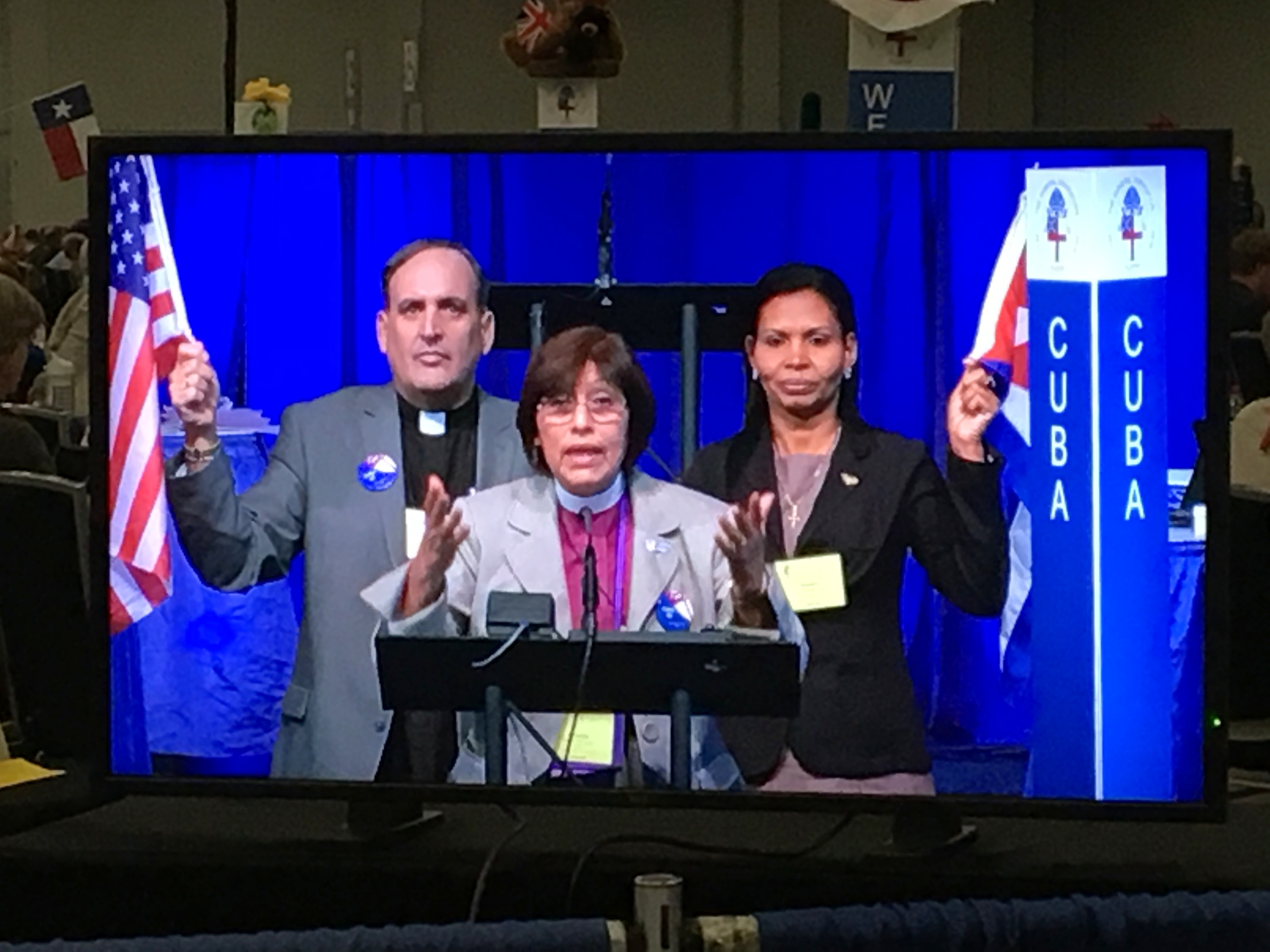
IMG_1927In 1966, in light of the Cuban Revolution and the political response of the United States, the House of Bishops voted to separate from the Diocese of Cuba from the Episcopal Church, leaving it an autonomous diocese without a provincial home.  The clergy scattered, some returning or immigrating to the US, but some who remained in Cuba were imprisoned, executed, or disappeared; priests lost their pensions, and they operated in isolation from the Church.  Cuba officially requested to be reaffiliated with the Episcopal Church and was given a list of requirements before admission.  As of GC79, all of those conditions had been met.  However, leading up to the resolution coming to the floor of both the Deputies and Bishops, there was controversy on what it would mean, how this admission might impact the admission of other Dioceses (or their exit), how to affirm already elected bishops (assuming they had not followed the current practices of approval for bishops in the Episcopal Church), among other concerns.  In other words, there was a desire to right the wrong done 52 years ago, but some anxiety about the implications of the decision.

As an alternate deputy, I had the leisure of observing either House.  On Tuesday, I happened to be observing the House of Bishops when resolution A238 came to the floor.  Each testimony pleaded for righting the wrong done by the House of Bishops in 1966.  Retired bishop Leo Frade from the Diocese of Southeast Florida spoke passionately about the resolution.  As a Cuban American who had been a part of the Church in Cuba, he got quite emotional in his plea for the bishops to do the right thing.  When it came time for the vote, the vote was a unanimous approval for readmittance.  The entire house – bishops and visitors – exploded.  Cheers and clapping filled the room, and the standing ovation lasted several minutes.  Unbeknownst to me, the Bishop of Cuba was present and was invited to approach the platform to address the House.  Bishop Curry embraced her.  The House broke into singing the Doxology.

Bishop Griselda Delgado’s speech was the most humbling.  Despite every reason to feel resentful or hurt, Bishop Delgado communicated nothing but forgiveness and reconciliation.  “We are family,” she insisted.  And although we severed the relationship so many years ago, she insisted, “Cuba never left.”  Her sentiments struck me as the exact way that God sees us.  When we reject God, God never leaves us.  When we abandon God, we do not abandon our familial ties with God.  Bishop Delgado’s profound sense of right relationship, reconciliation, and forgiveness brought the House to tears.  We did not deserve her mercy, and yet there she was, offering mercy.  When Bishop Delgado said, “The Holy Spirit is here,” I knew she was right.  In response, Presiding Bishop Curry said, “The Bishop may take her seat at Table 7.”  Those words were words of righting a wrong – fully, completely, unconditionally.

The experience the next day was equally powerful in the House of Deputies.  They too needed to approve the resolution, and it also passed unanimously.  Bishop Delgado spoke there too, but equally powerful was the triangular sign with the word, “Cuba” written on it.  It was processed to a table, and the deputies from Cuba were seated in the House of Deputies.  “Welcome home,” pronounced President Jennings.

What I loved about the approval of this resolution was seeing how legislation can powerfully effect change.  Sometimes, in the weeds of parliamentary procedure, and canonical revisions, one can wonder if all we are doing is navel gazing.  But on these days, we watched first-hand the commitment to change, the willingness to boldly repent, and the receiving of mercy.  Surely the presence of this Lord has been in this place!

On Searching for Hope…

06 Wednesday Jun 2018

Posted by jandrewsweckerly in Uncategorized

≈ Leave a comment

Tags

Christ, church, division, God, hope, politics, reconciliation, redemption, scripture, sustain, today, walk

e4c08c2a8201dc34bbae76b2c5b2a0b3_how-to-break-sunlight-through-the-clouds-sun-rays-through-clouds-drawing_1450-1024

Photo credit:  https://clipartxtras.com/categories/view/8acee3134d57ecf959eedd985d89984fd9af8e11/sun-rays-through-clouds-drawing.html

One of my favorite podcasts has become “Stayed Tuned with Preet,” a podcast hosted by Preet Bharara, former U.S. Attorney, that addresses issues of justice and fairness.  The topics vary pretty widely – from law enforcement, to the psychology of leadership, to the opioid crisis, to gun control, to the #metoo movement.  What I appreciate about his podcast is he breaks down a lot of the complicated legal matters in the news into terms I can understand, he shares his passion for justice, and he tries to frame a current specific issue in the broader context of justice in society.  Admittedly, there are times when I listen to Preet’s podcast and begin to wonder if there is any hope.  But what Preet always does at the end of his podcast is tell a story of hope – sometimes entirely unrelated to the current episode, but always life-giving.

What Preet does is what I try to do in preaching.  I am always looking for the problem in the scriptural text assigned for the day (and the related problem in our modern lives), and the hope in the text (and the related hope in our everyday lives).  Sometimes finding the hope is harder than others.  This Sunday, we get the text from I Samuel where the people finally ask God for a king.  That may not sound like an unreasonable request, but you have to remember that God just spent a generation’s lifetime liberating the people from an overlord – from Pharaoh.  And despite God’s faithfulness, and the warning God’s prophet gives them about what life will be like under a king (spoiler alert:  it’s not good!), the people stubbornly demand a king anyway.  In Samuel’s warning, he says, “And in that day you will cry out because of your king, whom you have chosen for yourselves; but the Lord will not answer you in that day.”  As I have been praying on this text this week, I have been wondering where the hope is.

Last night, I sat in on a conversation on racial reconciliation, and we wondered the same thing too.  As we look at the world around us, and see the deep divisions among us (on every issue!), and see the ongoing prejudice among us, many of us found ourselves wondering where the hope is.  We spent time talking openly and vulnerably about where our hope is being dashed and the moments that seem irredeemable in life.  But after some time, our conversation shifted – from the moments that were irredeemable to the ones that were redemptive.  We began to talk about how and where we find hope.  And each bit of hope shared brought more hope into the room.  Though we all come from different backgrounds, we seemed to conclude the night convinced that God, through the instrument of the Church, was going to be the source of hopeful change in the world.

I am wondering where you are finding hope today.  Whatever is going on your life, whatever is dragging you down today, what are the glimmers of hope that are sustaining you?  I could preach to you about how God is always our source of “big picture” hope, but I think more often God provides us with little glimmers of hope that leads us on the path to that big picture hope.  Those glimmers are our food for the daily walk with Christ that nourish our souls and keep us out of the dark and searching for the light.  If you have not found the hope today, keep looking.  And if you get to the close of the day and are still not convinced, reach out for support.  You are not alone.

← Older posts

Recent Posts

  • On the Myth and Magic of Advent…
  • On Risking Failure and Facing Fear…
  • Sermon – Luke 23.33-43, P29, YC, November 23, 2025
  • On Inhabiting Gratitude…
  • Sermon – Luke 20.27-38, P27, YC, November 9, 2025

Archives

  • December 2025
  • November 2025
  • October 2025
  • September 2025
  • August 2025
  • July 2025
  • June 2025
  • March 2025
  • February 2025
  • December 2024
  • November 2024
  • October 2024
  • September 2024
  • August 2024
  • July 2024
  • June 2024
  • May 2024
  • March 2024
  • February 2024
  • January 2024
  • December 2023
  • November 2023
  • October 2023
  • September 2023
  • August 2023
  • July 2023
  • June 2023
  • May 2023
  • March 2023
  • February 2023
  • January 2023
  • December 2022
  • November 2022
  • October 2022
  • June 2022
  • May 2022
  • January 2022
  • December 2021
  • November 2021
  • October 2021
  • September 2021
  • August 2021
  • June 2021
  • May 2021
  • April 2021
  • March 2021
  • February 2021
  • January 2021
  • December 2020
  • November 2020
  • October 2020
  • September 2020
  • August 2020
  • July 2020
  • June 2020
  • May 2020
  • April 2020
  • March 2020
  • February 2020
  • January 2020
  • December 2019
  • November 2019
  • October 2019
  • September 2019
  • August 2019
  • July 2019
  • June 2019
  • May 2019
  • April 2019
  • March 2019
  • February 2019
  • January 2019
  • December 2018
  • November 2018
  • October 2018
  • September 2018
  • August 2018
  • July 2018
  • June 2018
  • May 2018
  • April 2018
  • March 2018
  • February 2018
  • January 2018
  • December 2017
  • November 2017
  • October 2017
  • September 2017
  • August 2017
  • July 2017
  • June 2017
  • May 2017
  • April 2017
  • March 2017
  • February 2017
  • January 2017
  • December 2016
  • November 2016
  • October 2016
  • September 2016
  • August 2016
  • July 2016
  • June 2016
  • May 2016
  • April 2016
  • March 2016
  • February 2016
  • January 2016
  • December 2015
  • November 2015
  • October 2015
  • September 2015
  • August 2015
  • July 2015
  • June 2015
  • May 2015
  • April 2015
  • March 2015
  • February 2015
  • January 2015
  • December 2014
  • November 2014
  • October 2014
  • September 2014
  • August 2014
  • July 2014
  • June 2014
  • April 2014
  • March 2014
  • February 2014
  • January 2014
  • December 2013
  • November 2013
  • October 2013
  • September 2013
  • August 2013
  • July 2013
  • June 2013
  • May 2013
  • April 2013
  • March 2013
  • February 2013
  • January 2013
  • December 2012
  • November 2012
  • October 2012
  • September 2012

Categories

  • reflection
  • Sermons
  • Uncategorized

Meta

  • Create account
  • Log in
  • Entries feed
  • Comments feed
  • WordPress.com

Blog at WordPress.com.

  • Subscribe Subscribed
    • Seeking and Serving
    • Join 394 other subscribers
    • Already have a WordPress.com account? Log in now.
    • Seeking and Serving
    • Subscribe Subscribed
    • Sign up
    • Log in
    • Report this content
    • View site in Reader
    • Manage subscriptions
    • Collapse this bar
 

Loading Comments...