• About

Seeking and Serving

~ seek and serve Christ in all persons

Seeking and Serving

Tag Archives: repent

On Letting the Dust Settle…

21 Wednesday Feb 2024

Posted by jandrewsweckerly in reflection

≈ Leave a comment

Tags

buzz, church, comsume, details, dust, God, journey, Lent, neighbor, rejoice, repair, repent, self

Photo credit: https://ymi.today/2015/04/when-dust-settles-in-the-sunlight/

Oftentimes, I think are two version of church:  the version that is consumed and the version that is fully knowledgeable of all the details and intricacies that it takes to create the consumable experience.  In the former, one comes to church, prays prayers, sings beautifully written songs, hears scripture, engages with a sermon, consumes communion, and is commissioned to go out and live the Gospel.  Of course, there may also be the juggling of children, the scramble to get there on time, and the focus needed to fully engage all that is “church,” and not be distracted by life whispering in the background. 

For the latter – the version of church that is fully knowledgeable, the experience of church happens through a filter.  In that experience, you are juggling the personnel details (did the lector show up, how the procession should line up based on who is serving, whether a choir member is late and didn’t get to rehearse fully), you are painfully aware of the hours of planning that went into the bulletin (the liturgical and musical decisions that were made to create a seamless experience), and you are mindful of all the administrative details (did the altar book get marked, which cruet has wine and which has water, do we have enough wafers for the number of people in church, did we remember all the announcements, and on and on).  People in both categories consume church in equal amounts, but the buzz behind the experiences may be different.

As someone who falls in that latter category, I have been especially grateful for Lent this year.  Our staff worked really hard to have all the liturgy planning completed early this year.  That is a fantastic feat, but it also means this winter has been extremely busy and detail-filled.  Even the start of Lent was chaotic.  On Shrove Tuesday, you are eating and merrymaking, and less than 24 hours later, you are spreading ash on people’s foreheads and making sure they have a meaningful Ash Wednesday.  By that Sunday, you are chanting or saying the very long Great Litany on the first Sunday of Lent, and by that Monday, you take a gulp of air once you realize you have done it – Lent has begun.

What all that preplanning has meant for me this year is that gulp of air is an invitation to trust the planning and to now live into Lent.  Instead of my head being abuzz with details, now I can sit down and clear out space to be with God – to do a meaningful assessment of my relationships with God, self, and neighbor, and see what invitations arise about what in those relationships needs repentance, repair, or rejoicing.  In essence, I suppose I shift now to being a consumer of church for a time.  I get to do the prayer, fasting, and alms giving that Lent invites without all the intricacies that began the season.

I wonder where you are finding yourself at the beginning of this second week in Lent.  How are you creating spaces where the buzz of life, the swirl of life’s details, and the burdens of the everyday can be set aside to connect with God, self, and neighbor?  How are you finding meaningful ways to repent, repair, and rejoice?  I cannot wait to hear how this Lent is reigniting your faith journey!

Sermon – John 9.1-41, L4, YA, March 19, 2023

29 Monday May 2023

Posted by jandrewsweckerly in Sermons

≈ Leave a comment

Tags

award, belief, blind man, confident, human, Jesus, journey, Lent, new, proud, repent, resist, Sermon, should

We are in the midst of award season.  Just last weekend, the Oscars grabbed our attention with surprising wins and disappointing losses.  This week College Basketball’s March Madness has us riveted again, with expected wins, surprising upsets, and underdogs to encourage.  Despite the vested interest I may have in some of these “award” events, I find myself most drawn to the human responses.  At the Oscars, and most award shows these days, they split the TV screen with the five nominees in order to help us capture the suspense and joy of the moment.  Later, in replays and online chatter, our attention gets redirected to those who do not receive awards:  were they gracious in their loss, do they visibly show their disappointment, or do they struggle to conceal their emotions?  The Big Tournament is not much different.  Every game could either be the last of the season or the last of a career for some students.  Like clockwork, players whose teams do not advance show a variety of emotions:  from the gracious loser who can genuinely say “good game,” to the victor, the player who looks angry about the loss – perhaps most angry at themselves, or the player who just breaks down in tears at a season or career suddenly gone. 

The worst part about the award season though is our reaction to those human responses.  We say things like, “She should have been happy to just be nominated,” or “Someone should have taught them about being a good sportsman?”  Our shift from understanding to a finger-pointing-should happens almost instantaneously.  Sadly, when we are given the vivid stories we have been given these last three weeks in John’s Gospel, we do the same thing in Scripture.  I can imagine the thoughts that were bouncing around in our heads during that long gospel lesson:  How could the disciples, of all people, assume someone sinned just because he is blind?  How dare those parents just abandon their son – they should have been leading the healing celebrations! And those hard-headed Pharisees?  They should relent with what Jesus is trying to show them.  Before we realize, we have turned into that Pharisee from Luke’s gospel who prays loudly, “God, I thank you that I am not like other people: thieves, rogues, adulterers, or even like this tax collector!”[i]

The challenge when we moralize this story about the blind man is that we tend to place ourselves dishonestly in the story.  Either, we relate most to the blind man, perhaps even recalling when God has brought about some transformation in our lives or when we have followed Jesus even when we were judged or outcast; or we read the story as an outsider looking in – as if this is a story unrelated to our own journey with Jesus.  In other words, this becomes a story about those people.  But John’s Gospel will not let us do either of those things today.  You see, John’s whole gospel is about belief.  Just two weeks ago we talked about belief when we read John 3.16 – whosoever believes in him.  But, according to scholar Karoline Lewis, “…believing in the Gospel of John is synonymous with relationship with Jesus.  To state that he believes in Jesus means that the formerly blind man is in relationship with Jesus.”  Lewis goes on to say, “When we say, ‘Lord, I believe,’ we are not only making a confession of faith but making a claim of the true presence of relationship with Jesus…To acknowledge belief as a relational category may very well transform much of how we think church and faith need to be.”[ii]

The Pharisees, the folks whom we are most like in this story, cannot be moved into this belief as relationship with Jesus.  They are confident in their own truth:  they follow the God of Moses, they know that no one but God heals on the sabbath, they know blindness is caused by sin (even the disciples agree with this one).  They resist God doing a new thing:  they demand to know Jesus’ origin, they grill the formerly blind man not once, but twice, and they even do a background check with this man’s parents.  They are proud:  when the formerly blind man asks if they might be asking so many questions because they want to follow Jesus too, and when Jesus suggests they are the blind ones, the people of faith scoff and hold their ground. 

Now, I know putting ourselves in the place of the Pharisees may feel a little too-Lent-y today.  We know we need to be repenting of our confidence in self alone, our hardhearted resistance, and our pride and vainglory.  But surely, we are not that bad, right?  Instead of assuring us that we are not, I want to assure us of something else.  The blind man’s journey to belief is just that.  At the beginning of our story today, he cannot see Jesus at all.  But he can hear Jesus and he does respond by going down and washing away the mud.  When he is first questioned by his neighbors, he honestly says he doesn’t know where this Jesus guy is.  When questioned by the religious authority about Jesus’ identity, he only slowly makes his way to belief by claiming Jesus must be a prophet.  When pushed even further, he reviews the truth of his experience, slowly realizing that maybe, just maybe, he is disciple of this stranger.  Finally, in his conversation with Jesus after being kicked out of the synagogue, he says, “I believe.”  Or in other words, “I have and want a relationship with you.”  The formerly blind man’s relationship is not immediate,[iii] he does not come to relationship confidently, and he struggles to understand.  But he does struggle.

Our invitation today is not to go home feeling guilty about our hardhearted, self-centered, pride and resistance.  Our invitation is to see and hear how God can transform our resistance to the new things Jesus is doing.  The journey will not be easy – we will have people question us – in fact, we may question ourselves.  We will not know the answers, we may be afraid, and we may be cutoff from what we thought was our place of belonging.  But what the formerly blind man reminds us today is that belief, relationship with Jesus, is a journey.  Amazing things will happen – my goodness, how amazing that a man blind from birth can find new life.  But new life really comes as we walk as disciples of Christ, following Jesus when those around us, and even we ourselves, resist.  Our invitation though is to keep listening, knowing that slowly, our blindness will be lifted too.  Thanks be to God!  Amen.


[i] Luke 18.11.

[ii] Karoline M. Lewis, John:  Fortress Biblical Preaching Commentaries (Minneapolis:  Fortress Press, 2014), 132.

[iii] Karoline M. Lewis, “Exegetical Perspective,” Feasting on the Word, Yr. A, Vol. 2 (Louisville:  Westminster John Knox Press, 2010), 119

Sermon – Jeremiah 36.27-37.2, VTS Convocation Evensong, October 11, 2022

19 Wednesday Oct 2022

Posted by jandrewsweckerly in Sermons

≈ Leave a comment

Tags

church, God, how, Jeremiah, kingdom of God, love, normalcy, pandemic, poll, prophet, repeat, repent, rest, salvation narrative, Sermon, values, why

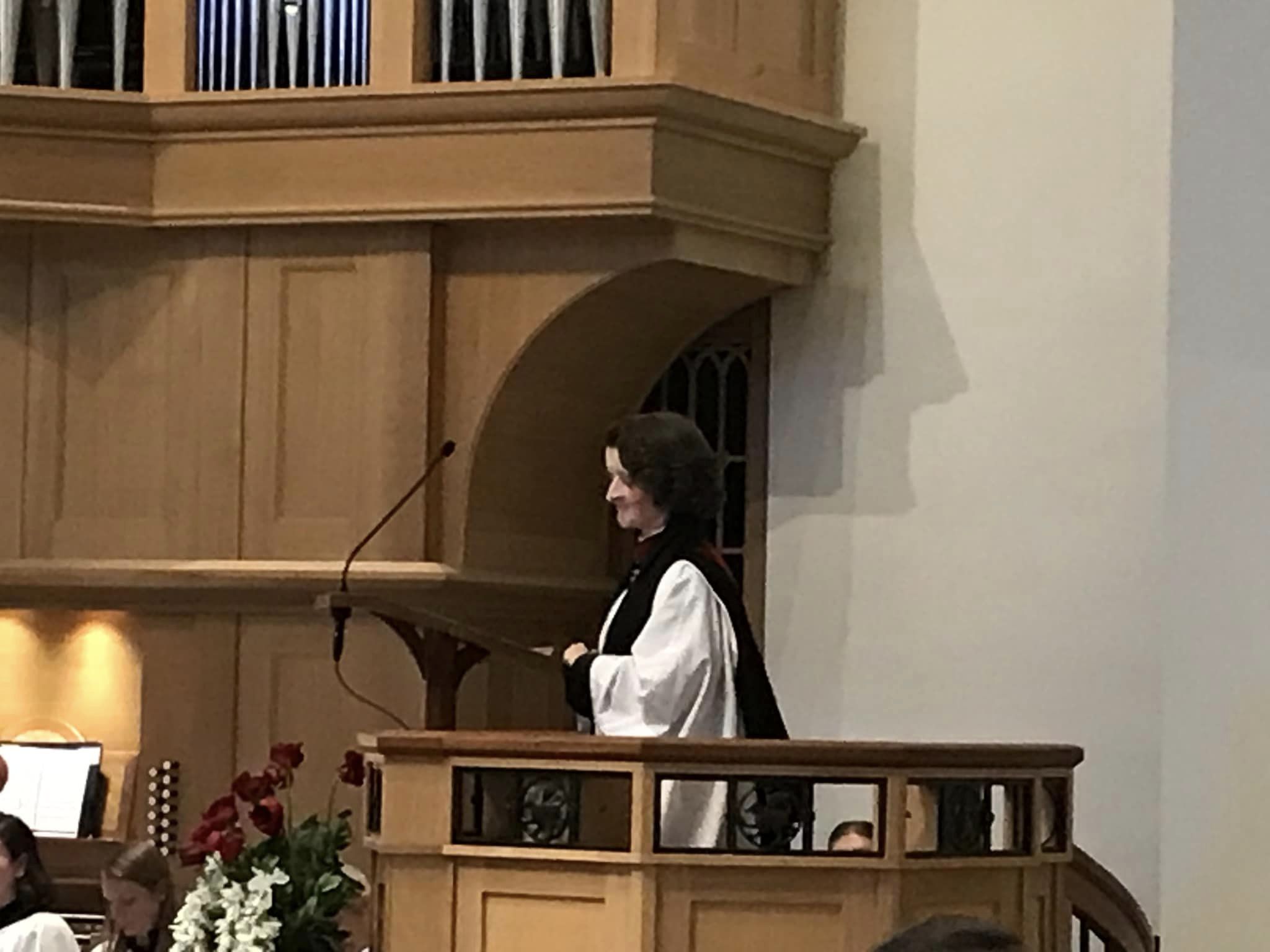
This sermon was delivered to Virginia Theological Seminary on the occasion of our annual Convocation for alumni, faculty and staff, and seminarians.

Photo credit: The Rev. Matthew Tucker

I live in a pretty “purple” district in Southern Virginia.  My Congressman represents a different party than my own, but I make a point to stay on his mailing list as a way to remind him that he represents a politically diverse district.  Every month he sends out polls, and I dutifully respond to them.  But with every survey I find myself frustrated.  My Congressman either has never taken a class in crafting an unbiased survey or he is simply not interested in different opinions.  The questions are always phrased something like, “In your opinion, how bad of a job is our president doing:  terrible, really bad, pretty bad, or I’m not sure.”  Or without any nuance or explanation about the background of the issue, the poll will ask something like, “The Congress wants to pay illegal immigrants who knowingly broke the law hundreds of thousands of dollars.  Should we pay these illegal immigrant criminals, yes or no?”  Or, one of my favorites, “Which of these issues should be the priority of Congress?” (PS, none of the options listed talk about caring for the poor or our neighbor, and there definitely isn’t an “other” category).  But I dutifully take the surveys, hoping my voice is part of my representative’s decision making.

I have been pondering the ministry of Jeremiah and thinking his prophetic ministry is a bit like trying to engage my Congressman.  For those of us not taking Old Testament this semester, Jeremiah is prophesying in a time of political decline.  The northern kingdom, Israel fell to Assyria nearly a hundred years before, and Judah remains in a tenuous situation.  The Assyrians are still in control, but in the course of the book of Jeremiah, Babylon defeats Assyria and takes control of Judah.  There are rebellions against Babylon, in particular by King Jehoiakim who we hear about today, but they are eventually unsuccessful.[i]  Like any good prophet, Jeremiah is attempting to get the people and king to repent and return to the Lord.  And like all people of all time, the people refuse to listen to God.  King Jehoiakim is particularly egregious in this refusal.  In fact, just verses before our reading, the King has his attendant read Jeremiah’s prophetic scroll three or four columns at a time, then cuts those columns off the scroll and throws them in a fire.  King Jehoiakim is not alarmed by the prophecy, and certainly not repentant. 

But here’s the funny part.  In the verses we read today, the Lord tells Jeremiah to rewrite the entire scroll and add in a little final judgment.  Like me, sitting down with yet another poll from my Congressman, he sits down and does the same thing over again.  I have been of two minds about this passage.  On the one hand, and no offense toward the Lord’s prophetic practices and policies, but how many times are we to keep doing the same thing and expecting different results.  As if King Jehoiakim is going to receive the second scroll and say, “Oh, a second scroll?  Okay, I guess I won’t burn this one and will change my ways!”  If this pandemic has taught us anything this pandemic has taught us we cannot keep doing Church the way we always have and expect the Church to thrive (or in biblical terms, to repent and return to the Lord).  This pandemic has made us nimble, agile, creative, and versatile.  This pandemic made us stop thinking about hybrid ministries and digital relevance and demanded we start doing and being those things.  And God help us if our churches just want to “return to normal” after the pandemic – if we just want to write another scroll. 

But as I mentioned, I am of two minds on this passage.  On the other hand, despite what seems like poor strategy on the Lord’s part, God’s covenantal relationship with us has never really made sense.  The entire salvation narrative is about failure after failure on our part as the people of God to listen and respond to the Lord.  Promise after promise, covenant after covenant, even the sending of God’s Son has meant the Lord’s corporate strategy is a case study in what not to do to thrive in business.  But that’s what we love about the Lord, right?  God keeps writing another scroll, God keeps giving another chance, God keeps holding out hope and promise because God’s love is not meted out in a logical, economical way.  Despite all of the innovation which has been entirely life giving during this pandemic, in some ways, what we have offered to a hurting world is the same as what we have always offered:  a community of faith, redeemed by God’s grace, commissioned to love God, self, and neighbor.  Perhaps that is why I am of two minds about this text.  Although this pandemic has not changed who we are and what we offer a broken world, this pandemic has changed how we are.  Our core values as the Episcopal Church have not changed.  But throughout this pandemic we have learned that how we go about living into those core values certainly can, should, and hopefully has changed.  And, as the Genesis writer would say, “…it was very good.”

In this particular season of the Church, many of us are feeling a longing for rest, for relief from constant pivoting, for a sense of normalcy.  Many of us would like to sit down and just write the same scroll over again.  In Jeremiah’s day that second scroll meant suffering and exile, and there would be more than twenty years before the people of God would see God’s promise of restoration realized.[ii]  But I do not think that is the invitation from scripture today.  I do not think the Lord is inviting the Church to write another scroll or fill out another poll.  We have a whole Bible full of examples of how doing the same thing over and over does not lead to the fulfillment of the kingdom of God.  Instead, the invitation from scripture today is to see the patterns of the resistance to love, and find a new way to love.  God is not inviting us to change our “who” or our “what,” but to change our “how.”  Your “how” might be different from mine.  But Jeremiah shows us time and again that the same repeated “how” does not turn hearts.  Our work in this season is to listen to what new “hows” the Holy Spirit is showing us, and then be willing to be vulnerable enough to try them.  Because, Lord knows, we do not need another scroll.  Amen. 


[i] Josey Bridges Synder, “Jeremiah,” The CEB Women’s Bible, (Nashville:  Common English Bible, 2016), 953.

[ii] 953.

Holding on to Joy in Lent…

06 Wednesday Mar 2019

Posted by jandrewsweckerly in Uncategorized

≈ Leave a comment

Tags

Ash Wednesday, Christ, discipline, earthy, holy, identity, joy, kindness, Lent, life, light, love, repent, virtue

IMG_6748

Photo credit:  Jennifer Andrews-Weckerly; reuse only with permission

Last night I had one of the most fun Shrove Tuesday/Mardi Gras celebrations I have ever had.  We had a great crowd, there was a spirit of joy and celebration, the Kensington School hosted an awesome kids’ corner with fun activities, and best of all was the Hickory Neck Talent Show.  I have not laughed so hard and smiled so much in a long time.  I even woke up this morning with an uplifted spirit, the smile still lingering on my face.

While I am so grateful for that blessing, as a priest, it does make entering into Ash Wednesday a bit tricky.  Here I am still coming down from the high of last night, and now I need to enter into a worship service where I tell people to fast, to repent, and to remember their mortality.  It almost feels like emotional or spiritual whip-lash, and I have been struggling this morning to know how to help others with that same abrupt shift.

Where I have landed is that I think the best way to enter into Ash Wednesday and the season of Lent is with that same lingering sense of celebration.  You see, when you have experienced the highs of life, talking about the “lows” of life seems a bit more bearable.  Yes, we are mortal, and yes, we will return to the dust.  But while we are still mortal, we can make this life here on earth one of great joy and love – one of laughter, of community, of togetherness.

I wonder if this might be a way to enter Lent in a healthier way.  Instead of lamenting our sinful nature (and believe me, we do need to lament our sins), perhaps our Ashes today might remind of us the earthy nature of being humans and encourage us to strive for the ways we might live that earthy life in a more holy way.  I plan to do that today by entering into a season of kindness.  I am taking the joy from my community of faith last night and channeling it into forty days of kindness – where my repentance becomes a practice of demonstrating my identity – of living more faithfully the virtue of kindness.  What Lenten discipline are you taking up?  What might be a way for you to joyfully grasp onto this fleeting life and make it a witness to Christ’s light and love?  I can’t wait to hear all about it!!

Ash-Wednesday-1

Photo credit:  https://saintvincents.org/2019/02/25/ash-wednesday-march-6/

Sermon – Isaiah 40.1-11, Mark 1.1-8, A2, YB, December 10, 2017

13 Wednesday Dec 2017

Posted by jandrewsweckerly in Sermons, Uncategorized

≈ Leave a comment

Tags

Advent, busyness, change, God, Good News, Isaiah, Jesus, John the Baptist, manger, prepare, prophecy, repent, repentance, Sermon, way

This Advent, I have been sensing in myself a need to prepare for the Christ Child a little differently.  The busyness of life has me longing for a season of quiet reflection, of anti-consumerism, of less…well…busyness.  In some ways, the church has made accommodations for that desire.  The music in Advent is a bit more muted and quietly beautiful.  The offerings of yoga or even the Blue Christmas service make room for quiet meditation and reflection.  Even my Advent devotion this year of taking daily photos based on a provided word has forced me to look around more intentionally at life.  When I heard Isaiah’s words this week, “Prepare the way of the Lord,” my spirit had been hoping Isaiah’s preparation meant slowing down and creating an inner openness to the Holy Spirit.

Although I am sure Jesus would be all too happy to have me slow down a bit, my Advent longings may be a bit too passive for what Isaiah and John the Baptist are trying to accomplish.[i]  Of course, you can see where I may have gone astray.  Isaiah is speaking to a people in exile:  far from their homeland, oppressed by a foreign power, being forced to assume a foreign culture, God finally speaks a word of comfort to God’s people.  “Comfort, O Comfort my people,” says the Lord to Isaiah.  They are soothing words to a downtrodden people.  They are words of affection to an affection-starved nation.  They are healing words to a broken group of followers.  But those words of comfort are not followed by a cozy bed of meditation and contemplation.  Instead, those comforting words are followed by a call to action, “In the wilderness prepare the way of the Lord, make straight in the desert a highway for our God.”  God is about to do a new thing, but in order to do that new thing, the people of God must prepare the way through repentance.  Now I know we usually reserve repentance talk for Lent, but in this season of preparing for a new thing – of preparing for the Christ Child – the prophet tells the people of God they need repentant hearts.

One of the courses of study for parish priests and counselors is called family systems.  The study of family systems looks at human behavior through the lens of behavior within families, looking at ways families handle conflict, how they engage one another, and how they solve problems.  Patterns we learn in our families are taken into other systems.  One of the main lessons we learn from family systems is that you cannot change the behavior of others; you can only change your own behavior.  But changing your own behavior is not as easy as the change sounds.  Any of us who saw our mother behave like her mother, only to one day see that same behavior in ourselves realizes how hard changing our patterns can be.

When we talk about repentance, that is the kind of deep change we are talking about.  Repentance is not wallowing in guilt, feeling badly about something we said or did (or keep saying or doing).  Repentance is acknowledging our sinfulness and working to change our behavior.  The word “repent,” actually means to turn around; to turn away from sinful behavior and walk another way.  So when John the Baptist recalls Isaiah’s words, saying, “Prepare the way of the Lord,” he’s not saying, unpack your creches, put up the greens, and buy some presents.  Prepare the way of the Lord means making sure your heart is ready for the coming of the Christ Child – a feat you cannot accomplish if your heart is heavy with sin and regret.[ii]

Now do not get me wrong – I have pulled down the boxes of Christmas decorations, hung a wreath, and have purchased some gifts.  Those are honored traditions that bring us great joy, and I believe God wants us to be a people of joy.  But I suspect that if your heart is heavy-laden with the sins of life, or if you are so busy with the busyness of life that you have disconnected from God, your joy this year at the arrival of the Holy Child will not be as deep as your joy could be.

I have met many a church member who loathes the season of Lent for the focus on repentance.  I am sure they would be cringing today by the ways I am squashing Advent too.  But here is the reason why we have to talk about repentance today.  The gospel lesson we read from Mark contains the very first eight verses of Mark.  Mark introduces his gospel with these words, “The beginning of the good news of Jesus Christ, the Son of God.”  The reason John the Baptist is so excited, and is quoting Isaiah in our text today is that he knows what is coming is good news.  And so, when John quotes Isaiah with the words, “Prepare the way of the Lord,” he really means two things.  First, he means do the active work of preparing your heart for the Lord.  Not just the awesome, touchy-feely stuff of centering yourself or finding a quiet space, but the hard stuff of repentance.  And second, John means do the work of sharing the good news.  The work of Advent and the joy of Christmas is not just for us.  When your heart is bursting on Christmas Eve with joy because you did the tough work or repenting and returning to the Lord, don’t you want someone with which to share your joy?   One of the ways we prepare the way of the Lord is to share the good news of God in Christ with others.[iii]

Now I know what you are going to say, “Here she goes again, talking about inviting people to church.”  Or maybe you are thinking, “Yeah, but people who come on Christmas Eve usually only come once a year, so why bother?”  The good news about spreading the good news is that you are likely going to spread that good news in spite of yourself.  You see, when we do the work of repentance, of changing our hearts, minds, and hands to doing the work of God, a renewed spirit is kindled in us, and a deep joy burns in us.  The work of repentance creates in us a clean heart, and renews a right spirit within us.  And when we feel the love of God overwhelming us, we cannot help but let slip to our neighbor, “I know you have a church home, but I just want to share how awesome my experience at church has been lately.  If you ever want to come with me, I would be happy to bring you.”  Or when your friend is expressing his deep sadness and sense of loneliness, you find yourself saying, “I have been there.  But I have to tell you, every time I leave church, something about my encounter with God and community makes me feel less alone.”  Or when a stranger is ranting about how awful the church and Christians have been lately (which, we know some awful things are happening in the name of Christ lately), you find yourself saying, “I totally agree.  That is why I love my church so much – because they show me another way of witnessing to Christ.  I would love to show you sometime!”

I realize you may have been hoping for a word of comfort and permission to quietly prepare your heart for the Christ Child today.  Lord knows I have been longing for that this week too.  But turning my busyness into purposeful preparation:  for repentance and sharing the good news sounds much more fulfilling and life-giving.  The coming of the Christ Child, the fulfillment of the prophecy of Isaiah, is a life-altering event.  Today, the church prepares us for not arriving at the manger with check-lists done, gifts in hand, and arms full of stuff.  Instead, the church prepares us for arrive at the manger with open arms, free of the burdens that are weighing our spirits down, surrounded by others who have similarly prepared, and those who heard a good word from you, and wanted to drop their baggage at the manger too.  Come, prepare the way of the Lord.  Amen.

[i] Karoline Lewis, “Wilderness Preaching,” December 3, 2017, as found at http://www.workingpreacher.org/craft.aspx?post=5018 on December 6, 2017.

[ii] Martin B. Copenhaver, “Homiletical Perspective,” Feasting on the Word, Yr. B, Vol. 1 (Louisville:  Westminster John Knox Press, 2008), 47.

[iii] Richard F. Ward, “Homiletical Perspective,” Feasting on the Word, Yr. B, Vol. 1 (Louisville:  Westminster John Knox Press, 2008), 31.

On Repentance, Joy, and Journey…

06 Wednesday Dec 2017

Posted by jandrewsweckerly in Uncategorized

≈ Leave a comment

Tags

Advent, Christ Child, Jesus, journey, joy, love, prepare, repent, repentance, sinfulness

IMG_7647

Photo by Jennifer Andrews-Weckerly

One of the long-standing debates among clergy and scholars is whether or not Advent is a penitential season or not – a mini-Lent, if you will.[i]  There are arguments both ways, some saying absolutely yes; to prepare our hearts for the birth of Christ, our job is certainly to repent of our sinfulness.  Others who disagree with Advent being a season of penitence argue the season is more about joyful expectation and anticipation, and is distinct from the penitential season of Lent.  Meanwhile others argue that the both Lent and Advent are for both penitence and joy.

I am not sure I have made up my mind about these debates.  What I can tell you is that in the decluttering of my heart in preparation for the Christ Child, and in listening to the lesson appointed each Sunday, I know I am, and the world around me is, in need of some repentance.  As case after case pours in of sexual harassment and abuse, I am aware of how far we have drifted from the ways in which Christ longs for us to treat one another.  From the ways that we eviscerate one another online, or talk behind our neighbor’s backs, I know that we have lost a groundedness in Christ Jesus’ message of love.  From the ways in which we have stormed away from the communion table, I feel how deeply broken we are as a world.  I play a part in not correcting those sins, and sometimes actively participating in them.

And so, this Advent, my preparation feels a bit like a journey.  The first step is going to involve a bit of grief – for every woman or man who felt shamed or silenced by a society who would not affirm that they are created in the image of God, and should never suffer bodily violation; for the loss of an ability to see shades of gray instead of seeing black and white; for the hateful things we say and do to one another.  The second step is going to be some real repentance – not just naming the grief, but claiming my role in the degradation of others.  And then, hopefully, by the time we get to Christmas Eve, I expect to arrive at the manger, not with an armful of gifts, but the open arms of humility, repentance, and renewal.  I may not have words, but I long for the evening when I can bow in front of the Christ Child, rejoicing in the gift of love, forgiveness, and transformation that Jesus is for all of us.  Whether that means this Advent is a season of penitence or not, I am not sure.  All I know is this year, I am grateful for the journey.

[i] https://livingchurch.org/covenant/2016/11/29/is-advent-a-penitential-season/

Sermon – Jonah 3.1-10, Psalm 51.11-18, and Luke 11.29-32, Ecumenical Lenten Worship Series, March 8, 2017

15 Wednesday Mar 2017

Posted by jandrewsweckerly in Sermons, Uncategorized

≈ Leave a comment

Tags

change, ecumenical, God, hero, immature, Jonah, journey, judgment, Lent, listen, neighbor, Nineveh, renewal, repent, repentance, Sermon, sin, temper tantrum, together, witness

I have always loved Jonah’s story.  He is probably one of the most juvenile characters in the Hebrew Scriptures.  When God tells him to go to Nineveh, he runs in the opposite direction.  Only when God makes the seas roar, and he is swallowed by a fish, does Jonah call out for God’s mercy.  Jonah finally submits to God and goes to Nineveh as he is told, but then he throws a temper tantrum at God when God forgives Nineveh.  He is angry God doesn’t punish the city, and so he storms off to pout.  When a bush giving him shade withers, he ramps up his tirade.  God asks if Jonah has any right to be angry, and Jonah, in classic toddler style, whines, “Yes! Angry enough to die!”  You can almost imagine him stamping his foot, pouting his lower lip, and furrowing his brow.

Jonah is easy to make fun of because his behavior is so incredibly immature and self-centered.  We laugh at his adult-sized temper tantrum because we all know adults are too old for that sort of behavior.  But that is what is tricky about Jonah too.  Deep down, in places we do not like to talk about, we know Jonah’s experience all too well.  When we are really honest, we can confess that may or may not have thrown an epic temper tantrum in our adult lives too.  Whether over the reoccurrence of an illness, the death of a loved one, a lost cause, the job we did not get, or the love that was not returned, we have all had our Jonah moments.  Though we publicly all can say, “Silly Jonah, when will he learn?!?”, privately, we all think, “That sounds uncomfortably familiar.  I hope no one noticed my temper tantrum!”

Of course, at the end of the day, Jonah does what he is told – witnesses to the people of Nineveh, as God requests.  But in the drama of Jonah’s story, we often forget one minor, and yet central component of Jonah’s story.  Nineveh is the Rockstar of this story.  Nineveh, for all its sinfulness and shame, has no problem admitting Nineveh is wrong.  When Jonah tells Nineveh the city will be overthrown if Nineveh does not repent and change its ways, the people immediately believe God.  They proclaim a fast, and everyone – adults, elders, and children, put on sackcloth.  Even the king of Nineveh immediately rises from his throne, puts on sackcloth and sits in ashes.  He decrees that everyone in the city – humans and animals – will fast, be covered in sackcloth, and cry out their repentance to God.  He declares, “All shall turn form their evil ways and from the violence that is in their hands.  Who knows?  God may relent and change God’s mind; God may turn from God’s fierce anger, so that we do not perish.”

The king of Nineveh and the people of Nineveh are quite unlike most modern recipients of judgment.  In Nineveh, no one holds a press conference to defend their motives and actions.  No one holds a counter-protest to the judgment.  No one even argues with Jonah or asks, “Are you sure?”  Nineveh is told a cold, hard, ugly truth that exposes their deep sinfulness and grievances, and instead of getting defensive, Nineveh drops everything.  They stop in their tracks and change their ways.  They take the judgment with sobriety and honesty, and they make a change.  Though we like to give Jonah the attention, the real heroes in this story are the king and people of Nineveh.

When Jesus talks about repentance in Luke’s gospel today, and when the Church talks about repentance in the season of Lent, this is the kind of repentance we are talking about.  Jesus basically shares that he is to the people of Israel as Jonah was to the people of Nineveh.  He is their sign that repentance is needed.  The people of God are to use Nineveh as their guide for what true repentance looks like.  Jesus’ instruction and Nineveh’s example come at an opportune time for us.  We have managed to work ourselves into a time of finger pointing and name calling.  Our division is found on the political scene, between denominations of churches, and even in our families.  We have presumed that we are Jonahs and everyone else is Nineveh.  The reality, though, is much scarier.  We are not Jonahs.  We are Ninevehs.  Jesus is the Jonah of our time, calling us into repentance and renewal.  We can follow the model that Nineveh set for us, dropping everything to evaluate our sinfulness and changing our behavior immediately.  We can sit in sackcloth and work to deeply understand the role we play in sinful behaviors.  We can invite our neighbors to sit with us as we both work toward repentance.  That is what Lent is all about.

So how do we repent?  How do we take this time of Lent as a time for intentional, dramatic, meaningful change in our lives?  The psalm appointed for today gives us a few clues.  “Create in me a clean heart, O God, and renew a right spirit within me.  Cast me not away from your presence and take not your holy Spirit from me.  Give me the joy of your saving help again and sustain me with your bountiful Spirit.”  First, we ask God for help.  We ask God for help, because we know our God will enable us to do the work God has given us to do.  The psalm also tells us to bring others into our journey, “I shall teach your ways to the wicked, and sinners shall return to you.”  We not only bring our broken, sinful, hurtful selves to God, we witness our work to others, using our own vulnerability and humility as an entry to shared journey.  And then we sing.  “Deliver me from death, O God, and my tongue shall sing of your righteousness, O God of my salvation.  Open my lips, O Lord, and my mouth shall proclaim your praise.”  We use our mouths to praise our God – a God who can change course, who can see the repentance of God’s people and take away the horror of judgment.

That’s why I am grateful that we are together tonight.  We come to God across denominational differences and we sit together in worship.  We hear the witness of Nineveh tonight, and then we start the work of emulating Nineveh.  First, we hear Jonah and Jesus’ word of judgment, letting God create in us clean hearts and renewing right spirits in us.  Then, we turn to our neighbor, and work on creating a community of repentance, working to love the Lord our God and our neighbor as ourselves.  Finally, we turn to those not gathered here tonight – those who may not have a church home, and we share our witness.  We share our witness of how we have been a people of sin, and how we are hoping to change our ways.  And we ask if they might help us on that journey – not taking the judgment of Jonah out into the world, but taking the repentance of Nineveh out into the world.  Listening to our neighbors, working together for meaningful change, and creating a city that is humble enough to know that God may relent and not let us perish.  God will renew a right spirit within you, will give you the joy of God’s saving help again, and will sustain you with God’s bountiful Spirit.  Thanks be to God!  Amen.

On hope and falling…

29 Friday Jan 2016

Posted by jandrewsweckerly in Uncategorized

≈ Leave a comment

Tags

Christ, cross, Easter, falling, God, hope, Lent, love, rejoice, repent, resurrection, sin, trust

hope2

Photo credit:  http://fscaston.org/events/advent-retreat/

This time of year, clergy and parish offices are in the throes of Lent and Easter planning.  Although the average parishioner will ease their way into the Lenten journey, the clergy and parish office are already ordering supplies for Holy Week and Easter celebrations, having mostly confirmed everything for Lent.  Though that reality may not be a surprise, what you may not realize is how challenging it is to hold two very different seasons in one’s heart and mind with authenticity.  It is hard to plan for Easter when we haven’t journeyed through the forty days of Lent.  It is difficult to jump to the command to rejoice, when we have not yet mourned Christ’s death.

Many of my parishioners will be the first to tell you how much they loathe Lent.  They love the joy of Christmas and Easter, and even enjoy the beauty of Epiphany and the season of Pentecost.  But Lent feels like a season of imposed darkness and gloom.  They do not like the dreary hymns and the long, sad journey and examination of our sinfulness.  My response is always the same:  how can we celebrate at the tomb if we haven’t mourned at the cross?

But as we have done our planning for Easter this year, I realized how insensitive I have been in my question.  The truth is I am only able to sit at the foot of the cross because I am fortunate enough to know what waits on the other side.  The disciples, followers, and family of Jesus did not have that luxury.  Their darkness was real, their fears justified, and their doubts reasonable and expected.  I do not mean to suggest that we “pretend” our way through Lent as some sort of contrived experience in repentance.  Instead, what I realize is that the only way I am able to explore my own sinfulness and depravity so deeply and authentically is because of the promise of and hope in the resurrection.  I am able to fall because I know Christ will catch me.  That does not mean the falling is any less scary.  No one likes to really delve into their brokenness and confess their faults to our God.  But we do so out of the promise of a God who loves us no matter what.

I hope you will explore our Lenten offerings at St. Margaret’s this year and take full advantage of a time for true self-examination and prayer.  Our God and the Church are journeying with you.  You are not alone, and you can trust in the never-failing love of Christ to catch you!

On being good…

11 Friday Dec 2015

Posted by jandrewsweckerly in Uncategorized

≈ Leave a comment

Tags

Advent, Barth, behavior, Christ, church, forgiveness, good, Paul, repent, Romans, sin

Driving home from school this week, my daughter and I talked about some challenges she is having with poor behavior in the classroom.  We talked about some strategies to help her work on it.  I encouraged her to just keep trying.  Exasperated, she said to me, “I am trying.  It’s just so hard being good!”

Her words to me were both funny and profound.  I felt sympathy for this little first grader who is trying her best.  But I also felt an odd sense of relief.  I thought to myself, “I’m so glad I am an adult and don’t have to worry about ‘being good’ anymore!”  Then today, we read the lessons for the feast day for Karl Barth.  The epistle was from Paul’s letter to the Romans (7.14-25).  Paul says, “I do not understand my own actions.  For I do not do what I want, but I do the very thing I hate…For I do not do the good I want, but the evil I do not want is what I do.”  It dawned on me that I was being self-righteous with my daughter.  As adults, we do not ever “grow out of” struggling to be good.  Adults struggle with our sinful nature as much as children do.

Karl Barth knew a little about sinfulness.  During the rise of Hitler, Barth argued that the Church’s allegiance to God in Christ gave the Church the moral imperative to challenge the rule and violence of Hitler.  In fact, when Barth refused to swear an oath to Hitler, he lost his professorship.  One of the greatest theological minds of the twentieth century, Barth argued about sin that the Incarnation was the bridge between God’s revelation and human sin.

Photo credit: http://www.sacristies-of-the-world.com/?tag=advent-wreath

Talking about sin during Advent may seem strange to some.  Most of us are more focused on buying gifts, preparing our homes, and going to parties.  But the reason we have to celebrate in the first place is the nativity of our Lord – that bridge between God’s revelation and human sin.  Even in the first weeks of Advent, we hear from John the Baptist telling us to repent of our sins.  The time of Advent is not the Church’s way of delaying the gratification of Christmas.  Advent is an invitation to prepare our hearts and minds for the Christ Child.  Part of that preparation is examining our own sinfulness – to right our relationship with God, with ourselves, and with one another.  Being “good” is not easy.  But Advent is our reminder to keep trying – even when being good is hard.  My suspicion is that our work of repentance will not only warm our hearts with the forgiveness we receive from God, but also help us to be agents of forgiveness.  Lord knows we’ll need a heap of that too when the holidays come!

Sermon – John 3.14-21, L4, YB, March 15, 2015

19 Thursday Mar 2015

Posted by jandrewsweckerly in Uncategorized

≈ Leave a comment

Tags

beloved, darkness, Divergent, God, insider, Jesus, John 3.16, judgment, light, outsider, repent, scripture, turn

Today we get one of the most beloved passages of Scripture.  Most everyone knows the line, “For God so loved the world that he gave his only begotten Son, that whosoever believeth in him should not perish, but have everlasting life.”  But even for those of us who do not know the words by heart, we have seen the marker “John 3.16” all over – at sporting events, on road overpasses, on tattoos, and on Tim Tebow’s face.  Even Episcopalians, who can rarely quote scripture citations, know this one.

What is funny about the popularity of this scripture verse is that this particular verse is one of the more complicated verses in scripture.  On the surface, the verse sounds full of promise:  God so loved; God so loved the world; God gave; So that believers should not perish; Everlasting life.  All those words sound wonderful.  They make God sound loving and generous.  They make life seem full of promise.  Why would you not want to parade John 3.16 around in celebration?

John 3.16 sounds wonderful until you really start to dissect the verse.  John 3.16 makes God sound loving, generous, and caring.  Until you read that one pesky clause, “everyone who believes.”  So God will love, be generous to, and give everlasting life to anyone in the world – as long as they believe.  But what about those who do not believe?  We all know lots of people who do not believe in Jesus Christ.  They are our neighbors, friends, family members, and classmates [colleagues].  Do we really believe God does not love them too?  All we have to do is read John 3.18 to learn that “those who do not believe are condemned already, because they have not believed in the name of the only Son of God.”

Now I do not know about you, but although this scripture lesson is known worldwide, and is beloved by many, I have never really felt comfortable with the implications of this passage.  I think two things either happen when we really start to look at this passage.  One, by recognizing that we are the “believers” of this passage, we both feel a sense of pride and acceptance and a sense of pity for the non-believers.  We feel bad for the non-believers, but we do not really know how to console them.  So we secretly just feel grateful and blessed, and wipe our hands clean of the non-believers.  They will have to fend for themselves.

The other way that many of us approach this text is that we sweep the verse under the rug.  We know a lot of other verses about God, and those verses tell us of a God whose love is much bigger.  We might imagine that there is hope for all the faiths of the world, and even for those without faith.  We prefer to focus on the part that says, “God so loved the world,” knowing the vast diversity of that world, preferring to imagine that our God is not a judgmental one, but a loving one.  And even if we concede that there might need to be some form of judgment, we will leave that judgment up to God.  We will let the business of who is in and who is out be God’s business, and we will just go on loving everyone anyway.

Either of those ways of thinking – the one where we pity the non-believers or the one where we brush aside the text – ignores the fact that those approaches come from the assumption that we are the insiders in this situation.  As Christians, we know that we believe in Jesus Christ.  So we must be the ones that John is talking about – the ones that God loves and saves, and to whom God gives eternal life.  But the problem with that underlying assumption is that the assumption puts us in a place of comfort, when, in fact, I think John 3.16 is supposed to put us in a place of discomfort.

In John 3.19-20, Jesus says, “…This is the judgment, that the light has come into the world, and people loved darkness rather than light because their deeds were evil.  For all who do evil hate the light and do not come to the light, so that their deeds may not be exposed.”  Instead of sitting on our comfortable “believer” cushion, I think what this passage is really inviting us to do is to recognize how we are in fact the people in the darkness.  We have been talking a lot in this Lent about our sinfulness – our separation from God and neighbor.  Our Lenten disciplines are meant to be ways for us to contemplate our sinfulness, to repent, and return to the Lord.  None of us is spared from being sinful.  We have all fallen victim to pride, envy, and hatred.  We have all had malicious thoughts and done hurtful things.  We have all forgotten about God, making our lives about our own wants and desires.  And I am sure many of us have had something in our lives that we have wanted to hide in darkness.  None of us feel entirely comfortable exposed, being bathed in light.  Like that makeup mirror that is just a little too bright, not many of us are ready to be seen under the bright light.

There is a book and movie series out called “Divergent.”  It is a dystopian, futuristic series that captures what happens when the world destroys itself and the society that is rebuilt to prevent such destruction from happening again.  Though the premise is a bit complicated, one of the pieces about the series I find fascinating is the presentation of one group who believes that the truth is the answer to solving the world’s problems.  So all the members of that particular group must take what is called a “truth serum.”  When they take the serum, they must then be asked a slew of questions before all the members of the group, including extremely personal and private questions.  The idea is that if all your secrets are exposed, there is nothing left to hide behind.  Everyone is on equal footing and no one can hide their true selves.

I imagine the world in that group from the Divergent series as being like the one that Jesus is talking about today.  We are people who would avoid a truth serum – who would avoid the light – because we do not want all of ourselves exposed.  There are some things – those really dark, embarrassing, or shameful things about our lives – that we do not want the world to know.  We like the dark, if for no other reason than we can hide those ugly parts of ourselves there.  In fact, we like keeping a little bit of darkness in our lives.  And I imagine most of us would quite quickly decline a truth serum.

If we can admit that truth – that part of us that prefers there be just a little bit of darkness for us to hide in occasionally – then we might be able to see why John 3.16 is so brilliant.  If we can be humble about our own darkness and our own sinfulness, and approach God in that way, then Jesus’ words are much more meaningful.  For those of us who have a bit of darkness in us, God so loved us that God gave up God’s only Son so that we might have eternal life.  In this way, John 3.16 is refreshing.  When we realize that we are the ones in darkness, John 3.16 does not make us feel self-righteous, pitying others.[i]  Instead, John 3.16 is a harbinger of light.  In fact, John 3.16 calls us into the light with the promise of love, forgiveness, and grace.  Once we get ourselves out of the “insider’s circle” this passage becomes much more redemptive and much more full of hope.  And perhaps that is the point.  Not to make us relieved because we are on the inside looking out, but to make us relieved because we are on the outside looking in – and being beckoned in by our Lord and Savior.  If we can come to see this passage in this light, then I say go ahead and get that tattoo, embroider that wall hanging, and even make that poster for the big game.  Perhaps your artwork will remind you to keep turning from the darkness and turning into the light.  Amen.

[i] This idea shaped by the conclusions made by Paul C. Shupe, “Pastoral Perspective,” Feasting on the Word, Yr. B, vol. 2 (Louisville:  Westminster John Knox Press, 2008), 120.

← Older posts

Recent Posts

  • On the Myth and Magic of Advent…
  • On Risking Failure and Facing Fear…
  • Sermon – Luke 23.33-43, P29, YC, November 23, 2025
  • On Inhabiting Gratitude…
  • Sermon – Luke 20.27-38, P27, YC, November 9, 2025

Archives

  • December 2025
  • November 2025
  • October 2025
  • September 2025
  • August 2025
  • July 2025
  • June 2025
  • March 2025
  • February 2025
  • December 2024
  • November 2024
  • October 2024
  • September 2024
  • August 2024
  • July 2024
  • June 2024
  • May 2024
  • March 2024
  • February 2024
  • January 2024
  • December 2023
  • November 2023
  • October 2023
  • September 2023
  • August 2023
  • July 2023
  • June 2023
  • May 2023
  • March 2023
  • February 2023
  • January 2023
  • December 2022
  • November 2022
  • October 2022
  • June 2022
  • May 2022
  • January 2022
  • December 2021
  • November 2021
  • October 2021
  • September 2021
  • August 2021
  • June 2021
  • May 2021
  • April 2021
  • March 2021
  • February 2021
  • January 2021
  • December 2020
  • November 2020
  • October 2020
  • September 2020
  • August 2020
  • July 2020
  • June 2020
  • May 2020
  • April 2020
  • March 2020
  • February 2020
  • January 2020
  • December 2019
  • November 2019
  • October 2019
  • September 2019
  • August 2019
  • July 2019
  • June 2019
  • May 2019
  • April 2019
  • March 2019
  • February 2019
  • January 2019
  • December 2018
  • November 2018
  • October 2018
  • September 2018
  • August 2018
  • July 2018
  • June 2018
  • May 2018
  • April 2018
  • March 2018
  • February 2018
  • January 2018
  • December 2017
  • November 2017
  • October 2017
  • September 2017
  • August 2017
  • July 2017
  • June 2017
  • May 2017
  • April 2017
  • March 2017
  • February 2017
  • January 2017
  • December 2016
  • November 2016
  • October 2016
  • September 2016
  • August 2016
  • July 2016
  • June 2016
  • May 2016
  • April 2016
  • March 2016
  • February 2016
  • January 2016
  • December 2015
  • November 2015
  • October 2015
  • September 2015
  • August 2015
  • July 2015
  • June 2015
  • May 2015
  • April 2015
  • March 2015
  • February 2015
  • January 2015
  • December 2014
  • November 2014
  • October 2014
  • September 2014
  • August 2014
  • July 2014
  • June 2014
  • April 2014
  • March 2014
  • February 2014
  • January 2014
  • December 2013
  • November 2013
  • October 2013
  • September 2013
  • August 2013
  • July 2013
  • June 2013
  • May 2013
  • April 2013
  • March 2013
  • February 2013
  • January 2013
  • December 2012
  • November 2012
  • October 2012
  • September 2012

Categories

  • reflection
  • Sermons
  • Uncategorized

Meta

  • Create account
  • Log in
  • Entries feed
  • Comments feed
  • WordPress.com

Blog at WordPress.com.

  • Subscribe Subscribed
    • Seeking and Serving
    • Join 394 other subscribers
    • Already have a WordPress.com account? Log in now.
    • Seeking and Serving
    • Subscribe Subscribed
    • Sign up
    • Log in
    • Report this content
    • View site in Reader
    • Manage subscriptions
    • Collapse this bar
 

Loading Comments...