• About

Seeking and Serving

~ seek and serve Christ in all persons

Seeking and Serving

Tag Archives: sacred

On the Myth and Magic of Advent…

10 Wednesday Dec 2025

Posted by jandrewsweckerly in reflection

≈ Leave a comment

Tags

Advent, busy, Christ, Christmas, God, Jesus, life, love, productive, quiet, sacred, schedule, spiritual, stillness

Photo credit: https://christchurchofaustin.org/announcement2/

As a pastor, I am constantly preaching about savoring the quiet anticipation of Advent.  We even offer Advent Lessons and Carols, which has a more contemplative note than its celebratory sibling, Christmas Lessons and Carols.  But in everyday life, I am just as vulnerable as anyone else to the secular chaos in which Advent lives.  I find myself running kids around to obligations and performances, juggling calendar conflicts with all the special holiday offerings, and even add commitments myself because I want to maintain annual traditions.  Nothing about life outside of church feels quiet and centered.

I think is why I was so grateful for the gift of a minimally scheduled Saturday this past weekend.  Both professionally and personally the calendar was mostly clear – I even reserved the TV for watching a basketball game which I rarely can do.  As my daughter and I settled in, she proposed doing a puzzle together – an activity we always say we’ll do but somehow never get around to doing.  And so evolved an afternoon of sports watching, puzzle assembling, and the kind of conversation that can only happen when you make unstructured space for it.  When I got to close of the day, I realized that while a part of me felt guilty for not being particularly “productive” (no catching up on work, no doing household chores, no addressing Christmas cards), I marveled at how spiritually and emotionally productive the day felt with my daughter.

I know finding even moments of quiet anticipation in Advent can feel impossible these days.  There are so many things vying for our attention – many of them quite good and important.  But I wonder if you might be able to carve out some unscheduled time in these weeks left of Advent.  They may have to be in the car on your way to something, or while walking on the treadmill, or saying goodnight to the children.  Maybe it means making your way to church even if you have other invitations. Whenever you can find that sacred space, I promise the life and love of Christ is waiting for you in the stillness.  God is already there.  You are invited to say hello.

Sermon – John 16.12-15, TS, YC, June 15, 2025

18 Wednesday Jun 2025

Posted by jandrewsweckerly in Sermons

≈ Leave a comment

Tags

community, cross, feed, God, grace, Holy Spirit, horizontal, Jesus, love, relationship, sacred, Sermon, Trinity, Trinity Sunday, triune, vertical, work

Most of you know that I grew up the United Methodist Church.  My first meaningful exposure to the Episcopal Church came through an ecumenical mission trip led by the Episcopal Campus minister at my university.  We spent a semester being shaped by Episcopal liturgies, and the community in the rural Honduran village we served was primarily Roman Catholic by tradition.  On one dark night, as we closed a long, physically demanding day in prayer with our team and village members, I watched as a large portion of those gathered crossed themselves at the words, “In the name of the Father, the Son, and the Holy Spirit.”  My weary, dirty, displaced self suddenly felt the urge to cross myself too.  The urge to cross myself was a longing – a longing that brought up the guilt of what my Methodist teammates might think of me suddenly doing something that was decidedly not Methodist – but also a longing for a physical, tangible way to grab onto God – to feel intimately connected and related to God.  I am not even sure I understood what crossing oneself meant, but there was an aching deep in my chest for an action that could make me feel not only related to the trinitarian God we were all worshiping, but also to the hodgepodge collection of people of faith who had gathered.

Today we celebrate Trinity Sunday – the only Sunday in the whole church year focused on a Christian doctrine as opposed to an event or a piece of scripture.  Each of the three years in the lectionary focused on Trinity Sunday attempts to utilize a piece of scripture that somehow relates to the persons of the Trinity, but because the concept of the Trinity is not explicitly articulated in Holy Scripture, each year we just get a taste of this strange doctrine we all profess, even though most of us, even theologians and scholars over the centuries, struggle to articulate.[i]

Given the lack of a “Trinity 101” text in scripture, I am grateful we get this passage from John’s gospel today.  We are still in the Farewell Address of Jesus – that very long speech in John’s gospel that Jesus makes as the disciples gather for their last supper with Jesus that we have been reading from for weeks.  We know this is the long address that is often circular and convoluted in nature.  In this particular piece of Jesus’ address, he is telling them again about the coming of the Holy Spirit, or the Advocate.  Jesus explains how the coming Holy Spirit will share Jesus’ truth, which is, in fact, truth from God.  In this circular explanation of how the disciples will still experience relationship with God, we see something deeply relational between and among the persons of the Trinity. 

As scholar Debie Thomas explains of this text, we “…see that God is communal.  It’s one thing to say that God values community.  Or that God thinks community is good for us.  It’s altogether another to say that God is community.  That God is relationship, intimacy, connection, and communion.  …God is Relationship, and it is only in relationship that we’ll experience God’s fullness.”[ii]  Perhaps that is what I was longing for that dark night in that rural village – relationship.  I was longing for a deeper relationship with God – but equally profoundly, a relationship with fellow people of faith.  Sure, maybe making the sign of the cross is just a gesture.  But in that moment, the gesture was a physical manifestation of the relationship found in the triune God, and found in Christian community.

When we can see that the triune God is community, relationship, intimacy, and connection, something about that convoluted explanation of Jesus begins to click not only about the Trinity, but also about our everyday lives.  If the very nature of God is communal and relational, then our invitation is for our lives to also reflect that triune nature.  That means, when we are here, gathered across differences, across divides, and across diversions, we are doing the sacred work of relationship.  That means when we are out in our community, caring for those in need, using our God-given gifts in our vocations, and loving stranger and loved-one alike, we are doing the sacred work of relationship.  And that means when we following the news to learn more about civic life outside these walls, when we are engaging our political representatives in honest dialogue, and when we are praying for the peace this world needs, we are doing the sacred work of relationship.

That is the beauty of honoring the Trinity today.  Jesus teaches us today that the very nature of God is relational – a relationship that is accessible vertically through our relationship with God.  Jesus also teaches us today that the sacred relationship found among the Trinity is also accessible horizontally through all those made in God’s image – in other words, through every human being God has gifted to us.  Our invitation today is to let that crossing of vertical and horizontal create in us a vehicle of God’s love and grace.[iii]  That longing for relationship is fed here so that you can feed that longing in others.  In the name of the Father, and of the Son, and of the Holy Spirit.  Amen.


[i] David Lose, “Resurrecting the Trinity,” May 23, 2010, as found at https://www.workingpreacher.org/dear-working-preacher/resurrecting-the-trinity on June 13, 2025.

[ii] Debie Thomas, “The Trinity: So What?” June 9, 2019, as found at https://journeywithjesus.net/essays/2251-the-trinity-so-what on June 13, 2025.

[iii] David Lose, “Trinity C:  Don’t Mention the Trinity!” May 17, 2019, as found at https://www.davidlose.net/2016/05/trinity-c-shh-dont-mention-the-trinity/ on June 13, 2025.

Sermon – Luke 2.1-20, CE, YC, December 24, 2024

12 Wednesday Feb 2025

Posted by jandrewsweckerly in Sermons

≈ Leave a comment

Tags

awe, Bethlehem, burdens, Christ Child, Christmas, dystopian, film, gift, hope, Jesus, Joseph, joy, light, Mary, Messiah, sacred, Savior, Sermon, unsteady

Every summer, we hold a film series at Hickory Neck.  This summer, one of the films was movie called Children of Men.  The film is a dystopian film situated in London about a time in the future when the world has become infertile.  The youngest human, aged 18 has just died, schools and playgrounds are abandoned, a pall of grief and depression hangs in the air, and the world has become violent, unpredictable, harsh – with massive detainment camps of refugees and rebels fighting the government militia and civilians alike.  Into this setting, we meet Theo, a man who has lost hope and purpose, and we meet a young woman of color who would normally be in one of those detainment camps, who is secretly carrying the first pregnancy in over 18 years.  Theo’s world is thrown into chaos as he tries to get the young mother to safety so that the child will be able to live freely. 

In a powerful scene near the end of the movie, the mother has birthed her child in a dingy, rat-infested, crumbling room, and Theo needs to get her and the child to the safe haven.  But the crumbling building is overrun with rebels and a battle ensues as the military shows up.  In the din of violence and noise, the baby cries out, and all activity ceases.  Rebels hold their fire as they watch in reverence as the baby is carried down the stairs of the building.  The soldiers outside call for a ceasefire as the high-pitched cries they have not heard in almost 20 years fill the air.  Rebels, civilians, and soldiers alike stand in awe, many reaching out just to touch the baby and mother.  The awed silence is so palpable that even movie watchers hold their breath at this miracle.

I imagine that night from our gospel lesson was a bit like that breath-holding moment in Children of Men.   We know that Mary and Joseph are going to be registered in Bethlehem, but what we can forget is that Mary and Joseph live in a time of occupation – where taxes are extorted, registrations can drive folks from their homes, where rebellion against the state leads to death.  The mass movement of people for the registration creates another layer of chaos, leaving people jockeying for shelter, especially a couple so close to birth, and whose pregnancy is of a dubious nature from the beginning.  Even in the peaceful countryside where shepherds are just doing their work, a chaos of shocking news, a chorus from angels, and the blinding light of the glory of the Lord is shining in their normally darkened pastoral setting. 

And then, just like in that battle scene in the film, the shepherds arrive where the holy family have made due, and a whispered conversation leads to a stillness that makes you hold your breath.  But this stillness is not just about the miracle of life – no this stillness is about so much more – about a savior, the Messiah, who has been promised for generations who finally is here; about a promised peace in a world that has no peace; about promises for justice that Mary has sung about with her cousin Elizabeth, and now seems to be a reality.  Mary is so overwhelmed by the enormity of the moment that all she can do is ponder the words of the shepherds in her heart.

What is so unsettling about the parallels in this secular, dystopian film and the ancient biblical story is not just their similarities.  What is most unsettling is their similarities to our own time.  Our political landscape is just as unstable, conflicted, and threatening.  Our economic, mental, and physical health is just as unsteady.  And for some of us, our home life is a place of even more strain.  In so many ways, having ourselves a merry little Christmas feels like a stretch.  In fact, the very reason we may be here tonight – besides a family member telling us we had to come – is that we long for that moment of awe – that quiet, tremendous, encouraging peace that can only be found at the site of the Christ Child.  We want a word, or a song, or a meal shared that will leave us something to treasure and ponder in our hearts too.

That is what Christmas does.  Coming here tonight is not going to solve all our problems or the world’s problems.  In that movie, as soon as the child is out of sight, bombs and gunfire ramp up dangerously again.  At that manger scene, Herod’s paranoid tyranny means Mary, Joseph, and Jesus will have to flee to Egypt for safety.  And come January, we will have a transition in power in our own country.  But tonight, in this sacred space, we enter into a time of unfiltered joy.  We recall what matters most – the Savior born in a manger whose eventual salvation will give us meaning and purpose.  We lean into those gathered with us tonight – those who are family and friends, those who are fellow church members, and even those whose names we do not know – we lean into one another in this safe space of sanctuary, where none of the darkness outside can touch us – even if only for an hour.  We lay down any burdens on our hearts at the altar as we share a holy meal, fortifying ourselves for what comes next.  And we glorify and praise God, like shepherds who have seen a great light, and whispered holy truths. 

Now unfortunately, that tremendous gift, that sacred life-giving balm, is not without a price.  The price, is that we must leave this place, enter back into the dark of night, and carry on with life back out in the world.  Our invitation is to carry whatever light, whatever hope, whatever small sliver of praise and glory we find this night, and gift it to someone else.  To be like Theo, who refuses to allow the glory of a mother’s child to suffer; to be like shepherds, who share the good news of a Messiah; to be like your neighbor in the chair (pew) beside you, who is already thinking of someone who needs the gift of hope and healing who cannot be here tonight, but whom your neighbor will be sure to gift some of that love and peace to tomorrow.  Christmas is the Church’s gift to you this night.  You are Jesus’s gift to someone else tomorrow.  Amen.

Sermon – Luke 2.8-20, Blue Christmas, December 21, 2024

12 Wednesday Feb 2025

Posted by jandrewsweckerly in Sermons

≈ Leave a comment

Tags

Blue Christmas, Christmas, church, comfort, God, grief, hope, light, paradox, sacred, secular, Sermon, sit, unsettling

Christmas is a funny thing.  Christmas is simultaneously soft and loud, comforting and unsettling, hopeful and demoralizing.  Some of that paradox comes from the Christmas story itself, but some of that paradox comes from our hopes and memories of Christmas verses our lived experience of Christmas.  I remember all the loveliness of Christmases past:  of familiar foods shared, of gifts exchanged, of the aunts and uncles verses cousins football games in our grandparents’ yard.  But as I aged, the veneer wore off:  aunts and uncles divorced, hurtful things were said and done, and older generations began sharing the “behind the scenes” version of our Christmases that I never knew – and wished I didn’t know now.  And, slowly, I began reshaping what Christmas meant for the next generation – with a sense of certainty about what I wanted them to experience and a sense of anxiety that they might someday lose the magic of a once special time. 

We hold this Blue Christmas service every year because somewhere in the midst of shopping, caroling, worshiping, and partying, our world – both the secular one, with Hallmark movies and glossy advertisements, and sometimes even our sacred one, with familiar carols and perfect pageants – our world offers us dissonance.  In the merry making, there is little room for the parts of us that are not merry – whether those parts are due to lingering Christmas grievances, visitations from the grief fairy when we least expect her, economic pressures and worldly anxieties, the open wounds from the brokenness of our country from a nasty political year, or relationships that are broken or are limping along.  The world and even the Church rarely makes space for our inability to fully embrace the merriness of Christmas. 

As I pondered this disconnect this year, I stumbled on a reading from Gertrud Mueller Nelson.  Nelson describes about this time of year – of this season of shortened days and lessened light, “Pre-Christian peoples who lived far north,” she writes, “and who suffered the archetypal loss of life and light with the disappearance of the sun, had a way of wooing back life and hope.  Primitive peoples do not separate the natural phenomena from their religious or mystical yearning, so nature and mystery remained combined.  As the days grew shorter and colder, and the sun threatened to abandon the earth, these ancient people suffered the sort of guilt and separation anxiety, which we also know.  Their solution was to bring all ordinary action and daily routine to a halt.  They gave in to the nature of winter, came away from their fields and put away their tools.  They removed the wheels from their carts and wagons, festooned them with greens and lights, and brought them indoors to hang in their halls.  They brought the wheels indoors as a sign of a different time, a time to stop and turn inward.  They engaged the feelings of cold and fear and loss.  Slowly, slowly, they wooed the sun-god back.  And light followed darkness.  Morning came earlier.  The festivals announced the return of hope after primal darkness.

This kind of success – hauling the very sun back:  the recovery of hope – can only be accomplished when we have the courage to stop and wait and engage fully in the winter of our dark longing.”  Nelson goes on to say, “Perhaps the symbolic energy of those wheels made sacred has escaped us and we wish to relegate our Advent wreaths to the realm of quaint custom or pretty decoration.  Symbolism, however, has the power to put us directly in touch with a force or idea by means of an image or an object – a “thing” can do that for us.  The symbolic action bridges the gulf between knowing and believing.  It integrates mind and heart.  As we go about the process of clipping our greens and winding them on a hoop, we use our hands, we smell the pungent smell that fills the room, we think about our action.  Our imagination is stirred.

Imagine what would happen,” Nelson adds, “if we were to understand that ancient prescription for this season literally and remove – just one – say the right front tire from our automobiles and use this for our Advent wreath.  Indeed, things would stop.  Our daily routines would come to a halt and we would have the leisure to incubate.  We could attend to our precarious pregnancy and look after ourselves.  Having to stay put, we would lose the opportunity to escape or deny our feelings or becomings because our cars could not bring us away to the circus in town.[i]”

In some small way, that is what tonight does.  Tonight, we take the wheel off our cars, and place the wheel in the wreath right here in this little chapel.  We take away our ability to bustle about, and we sit.  We sit in the dark, we sit in our discomfort, and we sit in our un-merriness.  We take time, listening to a story about some shepherds who were similarly uncomfortable in the dark of night, dirty among their sheep, in the fields – doing their daily, maybe sometimes demoralizing, work of shepherding.  We pray, we mark our specific sense of loss or pain with the lighting of candles, and we bless our lack of merriment – we receive permission to tarry for a while in the darkness.  We do that all because we know that after today, the light will start to come a little earlier, will start to last a little longer, and will start to kindle hope in us.  We may not yet be ready to leave this place, glorifying and praising God like those shepherds.  But we are able to receive the gift of this sacred inside time, knowing that light is coming – that days are coming when we, too, will remember joy, and life, and praise.  We tarry here because this is where we also find hope.  That is the Church’s gift to you tonight – space and a tiny little sliver of hope.  Come, gather by the wheel, and tarry a bit longer.  Amen.


[i] Gertrud Mueller Nelson, To Dance With God: Family Ritual and Community Celebration (Mahwah, NJ:  Paulist Press, 1986), 63, as quoted in An Advent Sourcebook, Thomas J. O’Gorman, ed. (Chicago:  Liturgy Training Publications, 1988), 141-142.

On Seeking and Seeing Sacred Ground…

29 Wednesday May 2024

Posted by jandrewsweckerly in reflection

≈ Leave a comment

Tags

barre class, Bible, burning bush, Christianity, church, faith, God, holiness, holy, Jesus, Moses, reverence, sacred, sacred ground, shoes, Spirit

Photo credit: https://medium.com/koinonia/dont-wait-for-a-burning-bush-f8c7435489ae

One of my fitness routines includes attending “barre” – a class that combines yoga, Pilates, and ballet.  When you enter the studio, you remove your shoes and put on special socks to prevent slipping during the class.  You then enter the actual classroom and procure any fitness aides required for the class, such as hand weights, bands, or balls, and proceed to setup up your space at the barre.  I tend to take classes in the 5:30 am hour, so most of the time I am pretty groggy and operating on auto pilot as I prepare my space for class. 

Knowing my routine for class, imagine my surprise the other day when, as I somewhat sleepily entered the classroom, I found myself bowing.  I was immediately shocked and a little embarrassed by my body’s instinctual movement.  As a priest, I bow all the time – as I reverence at the altar, as the processional cross passes me, at certain points in the Creed, or at the name of Jesus in the liturgy.  But I have never reverenced an exercise classroom.

The strange appearance of such an out-of-context movement got me thinking about Holy Scripture.  In Exodus, we hear how Moses receives his call at the site of a burning bush.  When God calls out to Moses amid the flames, God says, “Come no closer!  Remove the sandals from your feet, for the place on which you are standing is holy ground.”[i]  Now I am not sure I would call the barre classroom sacred ground – though the Lord’s name is often called upon, especially during long plank series.  But something about that room made my body respond to its holiness the same way I respond to the holiness of Church.  So how exactly do we define a holy place – or sacred ground?

In the instance of barre class, perhaps what my body was responding to was the way I do find holiness – in the care and compassion of teachers, in the camaraderie of classmates on a shared journey of health and wholeness, in the individual experience at the barre when you feel like you cannot go on and something or someone pulls you through doubt.  Though I think the sacred ground of worship space is unrivaled as a place of encounter with God, the community of Jesus, and the movement of the Spirit, I certainly have found other sacred places – the mountain community where my family gathered every summer with the wider church; the edge of crashing waves, where the vastness of the Creator is palpable; the coffee shop where someone pours out their heart’s burdens to another and blessing is proclaimed.  Perhaps regularly attending Church, with its preserved sacred ground, is what allows us to see and hear God on the sites of sacred ground all around us.  Where are you finding unexpected sacred ground these days?  Where is God inviting you to take off your shoes and give reverence to the mightiness of our God?


[i] Exodus 3.5

Sermon – John 15.9-17, Acts 10.44-48, E6, YB, May 5, 2024

08 Wednesday May 2024

Posted by jandrewsweckerly in Sermons

≈ Leave a comment

Tags

abide, boundaries, circular, hard, Jesus, John, love, messy, repetitive, sacred, Sermon, source, strength, transformative

When I was curate, I served with two other full-time priests.  That meant after about two years, I got used to our very different styles of preaching, but also some of the themes of our preaching.  I remember at one point, my Rector was preaching and I had the distinct thought, “Here we go again.  Another sermon about love!  Ugh!”  I remember being almost irritated thinking, surely there were other topics to preach about.

Sometimes I think we experience John’s gospel in the same way.  John’s gospel is repetitive and circular from the very beginning, “In the beginning was the Word, and the Word was with God, and the Word was God.  He was in the beginning with God.  All things came into being through him, and without him not one thing came into being.”[i]  But John is not the only one who is repetitive and circular – Jesus in John’s gospel is repetitive and circular too.  In the first five verses of John’s gospel today we heard the word “love” eight times.  “As the Father has loved me, so I have loved you; abide in my love.  If you keep my commandments, you will abide in my love, just as I have kept my Father’s commandments and abide in his love.”[ii]  And the funny thing about the gospel today is this is not the first time Jesus talks about love.  As I was reading verse 12, which says, “This is my commandment, that you love one another as I have loved you,” I immediately thought, “Oh, we must be reading the same text we read on Maundy Thursday!”  But you know what?  On Maundy Thursday, we read a passage from two chapters before what we heard today.  The words there are strikingly similar though.  On that night of washing feet, Jesus says, “I give you a new commandment, that you love one another.  Just as I have loved you, you also should love one another.”[iii]

So what is the deal with Jesus talking about love over and over again?  Scholar Karoline Lewis argues that you cannot summarize Jesus in one sentence, so of course we have lots of sentences – even if they are repetitive.[iv]  But I think there is something deeper here.  I think Jesus knew that we, as humans, easily distracted.  “Yeah, yeah, yeah Jesus, I got it.  Love my neighbor! Oh look at that shiny thing over there!”  But even more importantly, I think Jesus knew that love – loving neighbor, loving self, loving God, loving others as Jesus loved is not easy.  Loving as Jesus loves means loving people that others (and even sometimes ourselves) would rather hate.  Loving as Jesus loves means mingling with people that society calls unlovable, difficult, and even evil.  Loving as Jesus loves means seeing dignity and worth in every human being – even when they hurt us, say awful things, or are just so different that they make us uncomfortable.  All we have to do is think about what we have been hearing in the lessons from Acts last week and this week to know that loving means letting people into your circle that you had no intention of letting in – breaking those boundaries that Father Charles talked about last week.  For Peter and the early disciples, that meant Jesus was not just for the Jews, but for Jew and Gentile alike.  And not just as charity, but as a way that transformed the entire community of Jesus followers – such that we find Peter dining and staying with Gentiles – who definitely are not kosher and might even be holding fast to other gods while committing to Jesus. 

So how are we supposed to do this really hard work?  How are we supposed to pull together the strength to love as Jesus loves?  I found comfort in words from scholar Debie Thomas this week.  If you remember, last week we heard the verses from John right before our Gospel lesson today, where Jesus declares he is the vine and we are the branches – he is the vine that we are to abide in.  Debie Thomas says, “My problem is that I often treat Jesus as a role model, and then despair when I can’t live up to his high standards.  But abiding in something is not the same as emulating it.  In the vine-and-branches metaphor, Jesus’s love is not our example; it’s our source.  It’s where our love originates and deepens.  Where it replenishes itself.  In other words, if we don’t abide, we can’t love.  Jesus’s commandment to us is not that we wear ourselves out, trying to conjure love from our own easily depleted resources.  Rather, it’s that we abide in the holy place where divine love becomes possible.  That we make our home in Jesus’s love — the most abundant and inexhaustible love in existence.”[v]

Yes, we will continue to hear about loving others because love is the most important message of Jesus.  And yes, loving will feel nearly impossible at times.  But as Thomas reminds us, “As is so often the case in our lives as Christians, Jesus’s commandment leads us straight to paradox: we are called to action via rest.  Called to become love as we abide in love.  In other words, we will become what we attend to; we will give away what we take in.  The commandment — or better yet, the invitation — is to drink our fill of the Source, which is Christ, spill over to bless the world, and then return to the Source for a fresh in-filling.  This is our movement, our rhythm, our dance.  Over and over again.  This is where we begin and end and begin again.  ‘Love one another as I have loved you.’ ‘Abide in my love.’  These are finally not two separate actions.  They are one and the same.  One ‘impossible’ commandment to save the world.  It’s all about love.”[vi] 

That is our invitation today – to become love and to abide in love.  Perhaps in reverse order:  maybe we need to abide in Jesus’ love in order to know how to love.  But either way, we repetitively and circularly are invited to love – to love as Christ has loved.  Loving will be hard, loving will be messy, loving will be wearying.  But loving will also be beautiful, loving will life-giving, loving will be transformative – certainly of the other, but mostly of ourselves.  We can do that hard, messy, beautiful, sacred work by returning to the source of love and strength.  We can love as Jesus loves because Jesus first loved us.  Amen.


[i] John 1.1-3.

[ii] John 15.9-10.

[iii] John 13.34.

[iv] Karoline Lewis, as explained in the podcast “#963: Sixth Sunday of Easter – May 5, 2024” Sermon Brainwave, April 28, 2024, as found at https://www.workingpreacher.org/podcasts/963-sixth-sunday-of-easter-may-5-2024 on May 2, 2024

[v] Debie Thomas, “It’s All About Love,” May 2, 2021, as found at https://www.journeywithjesus.net/essays/3003-it-s-all-about-love on May 3, 2024.

[vi] Thomas.

On Ferry Rides and God…

01 Wednesday May 2024

Posted by jandrewsweckerly in reflection

≈ Leave a comment

Tags

control, ferries, ferry, gift, God, gratitude, Jesus, moment, presence, productive, sacred, senses, thanks, time, travel

Photo credit: https://www.vdot.virginia.gov/about/our-system/ferries/

Yesterday I attended a meeting that requires riding a ferry to attend.  I have always found the ferry a bit of a nuisance.  If timed incorrectly, one can spend almost thirty minutes just waiting to board the ferry.  But even timed correctly, once upon ferry, one must sit for the twenty-minute ride – certainly progressing toward the destination, but not nearly as quickly as it feels when driving.  Something about the taking the ferry feels like a mandatory suspension of time and progress. 

Knowing that reality, I try to plan ahead – with a call to make, emails to read, or a podcast to finish.  I talked to a fellow traveler who has young children at home who used the twenty minutes for a coveted power nap.  And certainly, when I have traveled with my own children, one has the opportunity to go to the upper deck and take in the wonder of creation – an imposed moment of awe and wonder.

Thinking about the various ways one occupies oneself on the ferry had me thinking about the gift of time.  My method of busying myself on the ferry is certainly one of attempting to master control of the uncontrollable.  That mother of young children saw the gift of time as just that – a blessed gift she had not realized she needed.  And my children remind me that every moment is ours to steward – that productivity might include making room for the sacred too – that the sacred might feed my moments of productivity just as much as powering through times of tangible productivity.

I wonder what moments God is gifting you today.  Sometimes our schedules are so full, we may believe that there is no room for a “God moment.”  But that is the funny thing about God.  God permeates all our moments – being there when we are hustling to make a deadline, there when our child is seeking care and compassion – or even just a ride from practice, there when the aging customer in front of us needs a little assistance, and there when a blue bird flutters by seeking the creation we rarely notice.  How might you adjust your senses today to acknowledge the sacred all around you?  How might you give thanks and gratitude for God’s blessings so easily unnoticed?  My prayer is for your awakened senses to the blessing of God’s presence today.

Sermon – Mark 13.24-37, A1, YB, December 3, 2023

06 Wednesday Dec 2023

Posted by jandrewsweckerly in Sermons

≈ Leave a comment

Tags

Advent, anxious, beauty, children, Christmas, church, discipline, gift, important, Jesus, loud, noise, quiet, sacred, secular, Sermon

I live a very loud life these days.  Whether it’s the morning hustle to get everyone to school, or the evening jockeying for showers, rushed dinners, or one last FaceTime with friends, my house can be a constant source of shh-ing, pleading for less noise, or reminders to close doors to contain volume.  That is not to say that all the noise in our home is unpleasant – there is also the noise of laughter, dance parties, and storytelling.  But if you are looking to set up a yoga mat or trying to meditate, my house is not the place I would necessarily recommend. 

I sometimes blame all the noise in my life on my beloved children.  But the truth is I am as much a cause of the noise as they are.  I am admittedly loud myself – whether barking instructions around the house, singing aloud, or simply talking my husband’s ear off.  But I am not just loud in the house – I am also loud inside my head.  My mind is in constant conversation:  my to-do list, searching for ideas for a blog post, worrying about a sick friend or parishioner, trying to make plans for the weekend, processing a troublesome conversation, or wallowing in guilt for missed exercise or time in prayer.  As loud as my outside world is, my inside world is probably much worse.  Add Christmastime to the mix, and the loudness of my life reaches levels that can be incapacitating.

That is why I love Advent so much.  In the lead-up to Christmas, the outside world bombards us with noise:   Christmas songs on the radio, shopping to complete, parties to attend, gifts to wrap, houses to decorate, gatherings to host, cards to send, and loud relatives or friends to entertain.  In contrast, the Church at this time asks us to do the exact opposite:  slow down, take a breath, light some candles, breathe in the fresh greenery, sing quiet, meditative songs, and worship in the soothing blue of anticipation.  When the outside world is telling us, “Do more, buy more, run more, fuss more, stress more,” the Church says, “Do less, worry less, run less, talk less, be busy less.”  The contrast between the two worlds is like night and day, and at a time of high stress, Advent becomes the Church’s greatest gift to us. 

Into this contrast, we hear words from Mark’s gospel today.  The text says, “Beware, keep alert; for you do not know when the time will come.  It is like a man going on a journey, when he leaves home and puts his slaves in charge, each with his work, and commands the doorkeeper to be on the watch.  Therefore, keep awake– for you do not know when the master of the house will come, in the evening, or at midnight, or at cockcrow, or at dawn, or else he may find you asleep when he comes suddenly.  And what I say to you I say to all: Keep awake.”  Many of us hear this text today with a sense of anxiety – of needing to keep anxious watch for the Lord.  We might imagine the many apocalyptic movies, predictions, and preachers we have witnessed over the years and wonder whether Jesus really does want us to be more alarmed.  Certainly the outside world would have us also be alert and anxious for the coming Christmas. 

But I think the Church is saying something else today.  Instead of an anxious alarm, our gospel lesson sounds like a gentle reminder to me.  Keep awake, for you do not want to miss the quiet beauty of Advent.  Keep awake, for you do not want to miss the gift of time set apart in these four weeks.  Keep awake, for you do not want to miss the lead in to the manger, the dramatic retelling of why the manger is so important, and the grounding for this entire season.[i]  Jesus’ words for us to “keep awake,” are not meant to be one more anxiety to pile on top of a mound of concerns.  Jesus’ words for us to “keep awake,” are meant to help us focus on what is really important. 

So, make a commitment to come to church each Sunday in Advent and spend those Sundays in quiet worship with your church community.  Grab an Advent calendar or devotional to help you more intentionally mark the days leading up to the manger.  Or set up that Advent wreath at home, so that you might bring the quiet candlelight of prayer and meditation to your home.  Whatever the discipline, choose something this Advent that will help you maintain the quiet peace you find here at Church and carry that quiet peace throughout your weeks leading up to Christmas.  My guess is that noise of life will slowly fade into a quiet hum in the background – which is right where it should be.  Amen. 


[i] Lillian Daniel, “Pastoral Perspective,” Feasting on the Word, Yr. B, Vol. 1 (Louisville: Westminster John Knox Press, 2008), 22.

Sabbatical Journey…on Embracing Both-And

06 Thursday Jul 2023

Posted by jandrewsweckerly in reflection

≈ Leave a comment

Tags

both-and, church, college, intellectual, Jesus, Notre Dame, sacred, secular, spiritual

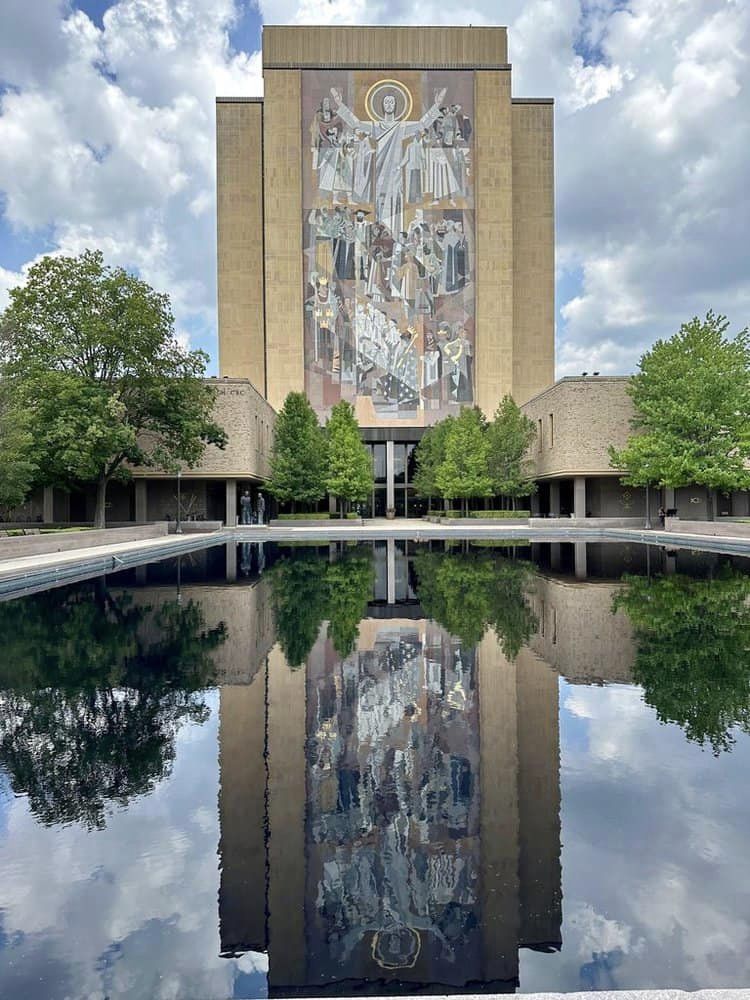
Touchdown Jesus (photo by Emily Liechty; reuse with permission)

In our sabbatical travels today, we met up with friends on the campus of Notre Dame.  None of us knew much about the college except their history of football prowess, their religious roots, and their devoted fans.  But a tour taught us so much about their history and current student experiences.  We learned that about 80% of the current students are Roman Catholic, there are chapels in every dorm, Mass is offered nearly 160 times per week, and we lost count on the number of Marys we saw on campus.  We also learned how many of the art pieces on campus have football references:  Touchdown Jesus, First Down Moses, and Holy Handoff.  But even more intriguing is the equal focus on academics, service, and community.

When I was in college, I quickly realized that being an active person of faith put me in the minority.  Academics were important, as was an active social life.  But religion, despite the prominence of Duke Chapel on campus was sort of an awkward subject.  I found a community among campus ministry, but the idea of chapels in dorms, or regularly offered masses was unimaginable.  Because I was involved in campus ministry, particularly at a university with a Divinity School, I received a balance between faith and intellect.  In fact, that balance is probably what shaped my own call to ministry.  But my experience was certainly not the norm.

Notre Dame seems to have found the art of “both-and.”  Notre Dame is both a religious institution and an institution focused on academic excellence.  Notre Dame has managed to embrace both athletics and the intellect (although, the construction of first stadium had to be funded by the first football coach because the administration thought it was more important to teach young men).  Notre Dame has managed to embrace both religious devotion and self-deprecating humor.

I wonder what lessons the larger Church might take from Notre Dame.  Where might we need a fuller embrace of the “both-and” mentality?  How might we be both fully faithful and fully of the world?  I imagine in order to share the Good News of Jesus in Christ, we might need to hone our ability to embrace the both-and of sacred and secular.


Sabbatical Journey…On Hope and Humanity

29 Thursday Jun 2023

Posted by jandrewsweckerly in reflection

≈ Leave a comment

Tags

baptismal covenant, bitter, connection, dignity, division, God, hope, humanity, Jesus, reverence, sacred

West Yellowstone (reuse with permission)

I often find myself worried about the state of humanity.  Between our bitter American politics – where the art of compromise seems lost, the nasty interpersonal ways we interact with one another (don’t get me started about my local newspaper’s anonymous section), the way we are almost desensitized to mass violence, and the never-ending presence global warfare, I sometimes find it difficult to see hope or redemption for humanity.

But today was not one of those days.  Today was all about community and shared connection.  It started when we drove through Grand Teton to get to Yellowstone.  We had already had our Teton experience but were hoping to get a last view on our way out of town.  But a thick fog fell on the whole area, and my immediate thought was one of sorrow for all the beautiful sights today’s visitors would miss.  Later, at Old Faithful, we sat waiting for about thirty minutes to see the iconic geyser.  Swarms of people were gathered from all over the country and the world.  But when the geyser finally blew, the united gasp and cheers of joy made me feel like the barriers between strangers were immediately leveled.  Finally, at a community theater in West Yellowstone, we enjoyed a musical in a small venue with a variety of people.  With interaction encouraged, kids invited on stage to sing before the show, laughter, and the love of theater, I felt a true sense of connection to the gathered community.

Of course, I am unlikely to see most of the people I spent time with today again.  So, in the strictest definition, I was not building community.  But what was happening was the fulfilling of my baptismal covenant – where we were all respecting the dignity of every human being.  I think we make that promise in baptism because that is the real first step to building community:  respect, and being able to see the sacred in every person created in the image of God.  When we do that, all that hopelessness about humanity fades away.

If you have not looked at someone today with that kind of reverence, I invite you to give it a try.  Maybe you just watch people a little more gently (remembering days when you were “in a mood,” or when parenting was just super hard).  Maybe you offer a hand or an encouraging word.  Or maybe tonight you pray for someone you never actually met but crossed paths with during the course of the day.  I look forward to seeing how Jesus softens your heart and gifts you renewed hope!

← Older posts

Recent Posts

  • On the Myth and Magic of Advent…
  • On Risking Failure and Facing Fear…
  • Sermon – Luke 23.33-43, P29, YC, November 23, 2025
  • On Inhabiting Gratitude…
  • Sermon – Luke 20.27-38, P27, YC, November 9, 2025

Archives

  • December 2025
  • November 2025
  • October 2025
  • September 2025
  • August 2025
  • July 2025
  • June 2025
  • March 2025
  • February 2025
  • December 2024
  • November 2024
  • October 2024
  • September 2024
  • August 2024
  • July 2024
  • June 2024
  • May 2024
  • March 2024
  • February 2024
  • January 2024
  • December 2023
  • November 2023
  • October 2023
  • September 2023
  • August 2023
  • July 2023
  • June 2023
  • May 2023
  • March 2023
  • February 2023
  • January 2023
  • December 2022
  • November 2022
  • October 2022
  • June 2022
  • May 2022
  • January 2022
  • December 2021
  • November 2021
  • October 2021
  • September 2021
  • August 2021
  • June 2021
  • May 2021
  • April 2021
  • March 2021
  • February 2021
  • January 2021
  • December 2020
  • November 2020
  • October 2020
  • September 2020
  • August 2020
  • July 2020
  • June 2020
  • May 2020
  • April 2020
  • March 2020
  • February 2020
  • January 2020
  • December 2019
  • November 2019
  • October 2019
  • September 2019
  • August 2019
  • July 2019
  • June 2019
  • May 2019
  • April 2019
  • March 2019
  • February 2019
  • January 2019
  • December 2018
  • November 2018
  • October 2018
  • September 2018
  • August 2018
  • July 2018
  • June 2018
  • May 2018
  • April 2018
  • March 2018
  • February 2018
  • January 2018
  • December 2017
  • November 2017
  • October 2017
  • September 2017
  • August 2017
  • July 2017
  • June 2017
  • May 2017
  • April 2017
  • March 2017
  • February 2017
  • January 2017
  • December 2016
  • November 2016
  • October 2016
  • September 2016
  • August 2016
  • July 2016
  • June 2016
  • May 2016
  • April 2016
  • March 2016
  • February 2016
  • January 2016
  • December 2015
  • November 2015
  • October 2015
  • September 2015
  • August 2015
  • July 2015
  • June 2015
  • May 2015
  • April 2015
  • March 2015
  • February 2015
  • January 2015
  • December 2014
  • November 2014
  • October 2014
  • September 2014
  • August 2014
  • July 2014
  • June 2014
  • April 2014
  • March 2014
  • February 2014
  • January 2014
  • December 2013
  • November 2013
  • October 2013
  • September 2013
  • August 2013
  • July 2013
  • June 2013
  • May 2013
  • April 2013
  • March 2013
  • February 2013
  • January 2013
  • December 2012
  • November 2012
  • October 2012
  • September 2012

Categories

  • reflection
  • Sermons
  • Uncategorized

Meta

  • Create account
  • Log in
  • Entries feed
  • Comments feed
  • WordPress.com

Blog at WordPress.com.

  • Subscribe Subscribed
    • Seeking and Serving
    • Join 394 other subscribers
    • Already have a WordPress.com account? Log in now.
    • Seeking and Serving
    • Subscribe Subscribed
    • Sign up
    • Log in
    • Report this content
    • View site in Reader
    • Manage subscriptions
    • Collapse this bar
 

Loading Comments...