• About

Seeking and Serving

~ seek and serve Christ in all persons

Seeking and Serving

Tag Archives: sacred

Homily – Advent L&C, A1, YC, December 2, 2018

05 Wednesday Dec 2018

Posted by jandrewsweckerly in Sermons, Uncategorized

≈ Leave a comment

Tags

Advent, breathe, gift, God, grounding, Holy Spirit, Jesus, Lessons and Carols, peace, prepare, sacred, secular, Sermon

This school year, our younger daughter’s preschool offers a weekly yoga class.  She has shown me all sorts of fun poses, but my favorite part is the yoga breathing she is learning.  The first time she showed me, I was so excited.  I have wanted to give my children the gift of cleansing breathing since they were born.  That same breathing had gotten me through each pregnancy in my prenatal yoga classes.  I knew how restorative that kind of breathing could be.  But I was not sure the practice would stick – I mean, how many mellow, breath-controlled preschoolers do you know?  So, imagine my surprise a few weeks ago, when my daughter was in the midst of an epic ramp up and all of a sudden, she stopped and said, “Wait!”  I froze, and watched her close her eyes, take in a deep breath, and slowly let the breath out.  “Do you want to do another one?” I tentatively asked, afraid to spoil the magical moment.  She closed her eyes again, drew in a slow breath, and let the breath back out.  She opened her eyes and smiled at me.  Temper tantrum and tension gone, a renewed, calmed child remained.

I do not know about you, but I find myself longing for the deep calming breaths that Advent can offer us too.  Normally, we as a country take a sacred moment at Thanksgiving, gathering with loved ones, sharing a meal, saying prayers of Thanksgiving.  But we only get the one day – sometimes only a half-day.  Because the retail industry wants us to forget about Thanksgiving, and jump right into Christmas shopping.  They lure us in with sales and deals, and they know we either need to occupy all those loved ones who came into town – or we need to escape them, and so we hit the pavement, get bombarded with Christmas tunes, see trees and towns already decorated, and our minds start to cloud with a huge, percolating to-do list.

But this year, with Thanksgiving earlier in November, we got an extra week – an extra Sunday that was not Advent 1, an extra week before we even entered December, and an extra week to breathe before the chaos really begins.  Our secular calendar seems to finally be in sync with our liturgical calendar – the calendar that tells us to use this season of Advent as a time, not of preparing the hearth, distributing the gifts, and attending the parties, but instead, preparing our hearts, distributing acts of grace, and attending the path leading to the Christ Child.  The secular calendar seems to be inviting us to do the same thing the liturgical calendar invites us to do – to take a breath, to ground ourselves, to breathe in some peace.

That is why we start Advent today with Lessons and Carols.  Lessons and Carols is a service different from other Sundays.  We do not introduce the lessons in the same way.  We hear more music.  We squeeze in moments of silence.  We do not receive the holy meal.  The church offers us this totally different service as a way of saying this season is totally different.  And then, the service walks us through all the ways this season is different.  This season is not just baby Jesus in a manger.  This season is remembering Adam and Eve’s sinfulness, remembering the promises God makes over and over to redeem God’s people, remembering the amazing, terrifying moment when a baby in a womb was the worst and best thing to ever happen, and then to remember that in the child we are anticipating, the kingdom of God comes near.  In order to even consider that grand, sweeping narrative, we have to let go of some things – let go of how we always do things so that we can be graced with the way God is doing things.

That is my hope for you this Advent season.  That you might take a cue from the extra week you just received from the secular calendar and use that week as your grounding for a calmer, more intentional, more life-giving, breathing season.  Breathe in the presence of our God, and breathe out the self-doubt, self-criticism, and self-pity.  Breathe in the coming of the Christ Child, and breathe out the busyness, consumerism, and forced good cheer.  Breathe in the calming, unifying Holy Spirit, and breathe out the sins, disrespect, hurtfulness of yesterday.  You might open your eyes and realize the gift of Advent is way better than any gift you will get this Christmas.  Amen.

On Sacred Listening…

26 Wednesday Sep 2018

Posted by jandrewsweckerly in Uncategorized

≈ Leave a comment

Tags

blessing, conversation, evangelism, faith, God, hear, listen, sacred, share, stories

trh_the_act_of_listening_wide-dbad5dfa36f0cf8f405acaa9ba328c0dc33de9b8-s800-c85

Photo credit:  https://www.npr.org/programs/ted-radio-hour/411697251/the-act-of-listening

Last week and this week, our curate is leading Hickory Neck in a forum on evangelism.  The work of the class is ultimately about sharing and listening to sacred stories.  True evangelism happens not when we tell people what they should believe or that they should come to church with us, but when we listen deeply to people’s stories and reflect where we see the sacred in those stories.

I realize this all may sound a little touchy-feely for many of us, but the truth is, even if you never called it “sacred storytelling and sacred listening,” you have likely experienced the phenomenon.  Think about the last time you encountered someone who was such a good listener you were pouring out your soul to them, without even actively choosing to do so.  Or recall those times when you have shared some of the heavy things on your heart and the listener pointed out where they saw God in the darkness in a way that lightened your entire perspective.  Those holy moments do not happen very often, but when they do, we feel a sense of transformation and the nearness of God.

That’s what evangelism is all about – not a manipulative way of coaxing out stories so that you can convert someone, but a willingness to stand in the fray with people (be it friend, neighbor, or stranger) and wait for God.  That kind of openness is a tremendous gift and privilege – to you, to the other, and to the world.

This past week, I have had the privilege of having lots of conversations – about faith, religion, children, church, and politics.  Some have been with church members, some have been with new acquaintances, and some have been with strangers.  And to a person, in every conversation, I find that I experience more blessing and renewed faith in our God than I even realized I needed.  This week, I invite you into those sacred storytelling and sacred listening opportunities, whether it’s with someone you know or someone you have never met.  I know that sounds scary, but you will be surprised how often someone is willing to share if they know someone is really listening.  If you are willing to accept the invitation, I suspect you will come to church on Sunday with a sense of renewal and restored faith.  I can’t wait to hear your stories!

It’s complicated…

09 Wednesday May 2018

Posted by jandrewsweckerly in Uncategorized

≈ Leave a comment

Tags

balance, divine, God, goodness, honor, Mother's Day, mothers, painful, pastoral, sacred, tension

10

Photo credit:  https://www.shutterstock.com/video/search/child-walking

Every once in a while, I have one of those pastoral fails – those moments when I say something that ends up sounding horribly thoughtless and makes me feel disappointed in myself.  Last week, I was talking to a new mom about the struggles of those first weeks of new motherhood.  I was bemoaning how when my mom left two weeks after my first child was born, I cried for hours, not knowing how to raise a child without her help.  Only hours later did I remember that this person’s mom died many years ago, and how insensitive my story sounded in hindsight.

Motherhood is a bit of a minefield.  Some of us are extremely fortunate to have awesome moms and wonderful relationships with those moms.  Some of us have more strained relationships, others of us have cutoff relationships, some had negligent or hurtful mothers, and many are still grieving our mothers who have passed.  Meanwhile, some of us have had amazing experiences being moms ourselves, while others have longed to have children or have lost pregnancies or children.  Motherhood is so complicated that I sometimes find myself caught off guard by my own unexpected emotional response to motherhood.

For a priest, that is why I dread Mother’s Day.  Mother’s Day is a day where I feel split in half – where I both want to honor the goodness and sacredness of motherhood, and I want to honor ways motherhood can be so painful.  This year, I was blessed by a friend who wrote about how to honor the tensions we find on Mother’s Day.  I leave with you a prayer she references found in Women’s Uncommon Prayers, written by the Reverend Leslie Nipps.  May your Mother’s Day find the balance I long for you to find.

On this Mother’s Day, we give thanks to God for the divine gift of motherhood in all its diverse forms. Let us pray for all the mothers among us today; for our own mothers, those living and those who have passed away; for the mothers that loved us and those who feel short of loving us fully; for all who hope to be mothers someday and for those whose hope to have children has been frustrated; for all mothers who have lost children; for all women and men who have mothered others in any way—those who have been our substitute mothers and we who have done so for those in need; and for the earth that bore us and provides us with our sustenance.  We pray this all in the name of God, our great and loving Mother.  Amen. (p. 364)

On Bringing the Church and World Together…

02 Wednesday May 2018

Posted by jandrewsweckerly in Uncategorized

≈ Leave a comment

Tags

bless, church, community, fellowship, holy, identity, rogation, sacred, service, welcome, world

img_0160

Photo credit:  http://stas.org/en/media/photos/rogation-days-2016-15612

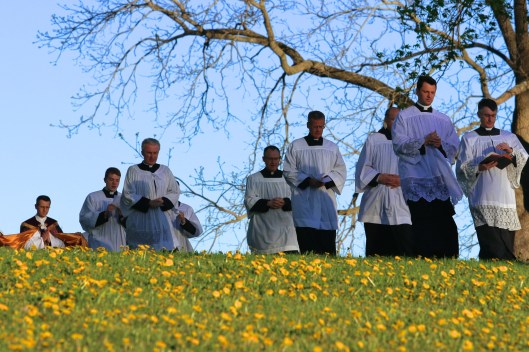
This coming Sunday at Hickory Neck, we will be adding a procession and blessing before our service begins in honor of Rogation Days.  Traditionally, Rogation Days are the three days before Ascension Day during which the litany is said as an act of intercession. In England, Rogation Days were associated with the blessing of the fields at planting, and in the United States they have been associated with rural life, agriculture and fishing, commerce and industry, and the stewardship of creation.[i]  For Hickory Neck, we are using this year’s Rogation Days to give thanks for rainwater collection barrels built for our Community Garden by a Boy Scout in our parish.  We will also bless the Garden, praying for a fruitful harvest for our parishioners and neighbors who use the gardens this year.

What I love about this upcoming event is that it represents a confluence of everything about which the church should be.  Our Community Garden has long been an example of using our property as a way to bless and welcome others.  At the garden, I see strangers become friends, people planting and tending in sacred silence, and the fruits of labor shared with one another.  Meanwhile, it has been a joy to watch our parishioner take leadership of an Eagle Scout project that benefits the church, the community, and his troop.  Watching our parishioner bring his faith community and his service community together has been a tremendous witness to each of us about how to make connections between the various parts of our lives.  And marking Rogation Days with liturgy is the church’s way of making the everyday parts of our lives sacred.  We take the labor of our hands, the fellowship of friends and strangers, the bounty of creation, and we name it all as holy.

Often when people think about church, they think about the building and the people who regularly attend worship services on Sundays.  But the church is much more about what the faith community does outside of the walls of the building, and how the community uses the blessing of its property to bless others.  This Sunday, we celebrate the ways in which we are living into the fullness of our identity, while also challenging ourselves to ever be outwardly-minded in our ministry.  I hope you will join us, but mostly, I hope you will invite a friend as we celebrate the ways in which the blessing of our community flows out into the world!

21463342_1589859034403684_3079109709240303206_n

Rainwater Collection Barrels Installation.  Photo credit:  Paula Simmons.  Permission required for reuse.


[i] Donald S. Armentrout and Robert Boak Slocum, eds., An Episcopal Dictionary of the Church:  A User-Friendly Reference for Episcopalians, “Rogation Days,” as found at https://www.episcopalchurch.org/library/glossary/rogation-days on May 1, 2018.

Sermon – John 2.13-22, Exodus 20.1-17, L3, YB, March 4, 2018

07 Wednesday Mar 2018

Posted by jandrewsweckerly in Sermons, Uncategorized

≈ Leave a comment

Tags

beautiful, bless, body, flesh, God, good, honor, incarnation, Jesus, Lent, ministry, repentance, righteous anger, sacred, Sermon, sinful, temple

Today’s gospel lesson is one of those lessons in Scripture that is so vivid we find looking away difficult.  All four of the gospels have this story, and three of the gospels use this story to convey Jesus’ righteous anger about how the practice around temple worship and obligatory sacrifice has led to monetary abuses.  Matthew and Luke even have Jesus calling the whole enterprise a den of robbers.  The story evokes images of Jesus flipping tables, or in today’s version, swinging around a whip like Indiana Jones.  We often recall this text when looking for evidence of Jesus’ righteous anger at injustice.  We are so familiar with this text we can almost hear the sermon about a call to justice in our heads.

But this week, the gospel has been speaking a different sermon to me.  You see, John’s version of this story is a bit different from the other three gospels.  First, John places this story in a very different place in his narrative.[i]  Unlike the other gospels who place this story toward the end of Jesus’ earthly ministry, John places this incident in the second chapter, right after the miracle in Cana.  And in John’s version, Jesus does not lay into the moneychangers in quite the same way.  Instead of financial injustice, Jesus seems more concerned that those gathered have missed something critical – in the obligatory administering of sacrifices at the physical temple, they have missed the fact that God is no longer tied to the location of the temple – and instead is found in the temple of Jesus’ body.  For John, the incarnation, the word becoming flesh and dwelling among us, is central to the entirety of the good news and in this story specifically.

I realized this week that when I think about the Incarnation, I immediately think of the baby Jesus.  Somehow, like a child you do not see for a few years, my image of Jesus incarnate gets stuck in the manger.  And because the adult Jesus sometimes feels so superhuman, I forget about the earthy, gritty flesh of his body – the body that touches to heal, stoops down to wash feet, eats and drinks with others, cries wet tears, and breathes a last breath of the cross.  In coming to know the Messiah who heals, teaches, brings about justice, and is transfigured before the disciples, I forget the enfleshed Jesus – the human body in which God dwells – the only temple we need to draw nearer to our God.

We are in a season of flesh.  Lent is that season when we experience Jesus in deeply enfleshed ways.  What our disciplines or our practices do for us in Lent is help us remember that we are a people of flesh and our God was willing to take on that flesh to transform our lives.  We do not often talk about the profound reality of an enfleshed God, but I stumbled on a hymn this week that opened up the reality.  Brian Wren’s hymn Good is the Flesh says, “Good is the flesh that the Word has become, good is the birthing, the milk in the breast, good is the feeding, caressing and rest, good is the body for knowing the world, Good is the flesh that the Word has become.”  The hymn goes on to say, “Good is the body, from cradle to grave, growing and aging, arousing, impaired, happy in clothing, or lovingly bared, good is the pleasure of God in our flesh, Good is the flesh that the Word has become.”[ii]  Now I do not know about your own spiritual journey, but I do not think I have ever heard Jesus’ flesh being described so vividly.  The closest I have come has been in imagining the vulnerability of that enfleshed body in the cradle.  But capturing what being enfleshed means for all of life – from cradle to grave – somehow opened up John’s words about the temple of Jesus’ body.  God takes something we often associate with sinfulness – and transforms that flesh into something good.  “Good is the pleasure of God in our flesh,” are powerful words that shift how we experience the fullness of Christ’s humanity.

Once we reconnect with the goodness of God’s flesh – the incarnation of Christ – then we begin to see all of Jesus’ ministry not stuck in a manger but immersed in the flesh of life.  Karoline Lewis reminds us Jesus’ fleshy life was important, “Because a woman at a well, whose body was rejected for the barren body it was, experiences the truth of neither on this mountain nor in Jerusalem; because a man ill for 38 years, his entire life to be exact, whose body has only known life on the ground, is now able to imagine his ascended life; because a man born blind, is then able to see, and to see himself as a sheep of Jesus’ own fold; because Lazarus, whose body was dead and starting to decay, found himself reclining on Jesus, eating and drinking, and with his sisters, sharing a meal once again.”[iii]  Not only is Jesus’ incarnation good, making flesh good, Jesus’ ministry is about blessing, healing, and restoring physical bodies.

Once we connect with the goodness of God’s flesh, and the power of Jesus’ fleshy ministry, we are forced to see something we do not always feel comfortable with – the goodness of our own flesh.  Now I do not know about you, but my experience in church has not been one in which the church tells me how good my body is.  In fact, today’s inclusion of the ten commandments usually reminds me of the opposite – of the myriad ways my body is sinful:  from the words that come out of my mouth, to the ways in which I hurt others and take things with my body, to the ways in which I covet things and other bodies.  And those sins do not even touch the ways in which I learn the message that my body is imperfect – how my body is not the right height or shape or gender, how my body is not fit or strong enough, how my skin color, hair, or nails are not quite the ideal.  But if God takes on flesh and says, “Good is the flesh,” and if that enfleshed God engages in a ministry of blessing flesh, then surely part of what we remember today is how good and blessed our own flesh is – how God made our flesh for good.

Now, here comes the tricky part.  Once we realize “Good is the flesh,” that ministered to the flesh, that our flesh is beautiful and revered, then we are forced to make yet another leap – that the flesh of others is also beautiful.  Those bodies we would like to subjugate, regulate, and decimate are no longer able to be separated from the goodness of God’s flesh or our own flesh.  Barbara Brown Taylor argues in An Altar in the World, “‘One of the truer things about bodies is that it is just about impossible to increase the reverence I show mine without also increasing the reverence I show yours.’  In other words, once I value my own body as God’s temple, as a site of God’s pleasure, delight, and grace, how can I stand by while other bodies suffer exploitation, poverty, discrimination, or abuse?”[iv]

This week, we enter that kind of work.  As we welcome guests through the Winter Shelter, we affirm the goodness of all flesh – of God’s flesh, of our flesh, and especially the flesh of those who have no shelter, who work hard all day but cannot secure housing, who live lives of uncertainty, of insecurity, of scarcity.  Once we recall the incarnation of Christ, the dignity of our own incarnation, our work immediately becomes to honor the incarnation of others.  We certainly accomplish the work of honoring flesh this week through the Winter Shelter.  But as we keep walking our Lenten journey, we will struggle with our bodies.  Even our collect today says, “we have no power in ourselves to help ourselves: Keep us both outwardly in our bodies and inwardly in our souls, that we may be defended from all adversities which may happen to the body, and from all evil thoughts which may assault and hurt the soul.”  But our invitation this Lent is to also struggle with claiming our body as good – and using the goodness of the flesh to bless other flesh.  Our repentance this week is not just of the sinfulness of the flesh, but we repent this week of the ways in which we do not honor how “Good is the flesh that the Word has become.”  Amen.


[i] Joseph D. Small, “Theological Perspective,” Feasting on the Word, Year B, Vol. 2 (Louisville:  Westminster John Knox Press, 2008), 92.

[ii] I found this hymn in the commentary by Debie Thomas, “The Temple of His Body” February 28, 2018, https://www.journeywithjesus.net/lectionary-essays/current-essay?id=1675 as found on March 1, 2018.

[iii] Karoline Lewis, “Body Zeal,” February 26, 2018, http://www.workingpreacher.org/craft.aspx?post=5071 as found on March 1, 2018.

[iv] Thomas.

On Finding the Holy…

28 Wednesday Feb 2018

Posted by jandrewsweckerly in Uncategorized

≈ Leave a comment

Tags

Christ, devotion, discipline, disorder, God, habit, holy, Lent, repentance, rhythm, room, routine, sacred, sinfulness

IMG_9874

“Jesus is Taken Down from the Cross,” by G. Roland Biermann.  Photo taken by Jennifer Andrews-Weckerly at Trinity Episcopal Church, Wall Street.

It was a pretty simple question.  “How is your Lent going?”  What was not simple was my answer.  As a priest, I feel like my answer should have been, “It’s going really well,” followed by a list of things I am appreciating about the season.  But this year, I have been having a hard time finding my Lenten rhythm.  Part of the reason is that I scheduled a brief vacation right at the beginning of Lent, experiencing a powerful Ash Wednesday, but missing the first Sunday in Lent, the beginning of our digital Compline offering, and our first Wednesday night of worship.  Being away also meant that I got off-schedule with our family devotional time at breakfast.  Meanwhile, the book I planned to read with a book group for Lent got lost in the mail and had to be reordered while my fellow readers got ahead of me.  I had expected to re-center at our Lenten Quiet Day, but that had to be cancelled.  And so there I was on Sunday, left with this question about Lent, feeling like my Lent was not really off to a good start.

Part of the challenge for me is that I am a creature of habit.  I like routine and order.  I am able to focus more clearly when life is ordered in a regular pattern.  I think that is why I like Lent so much.  Lent encourages us to find a regular pattern – whether we have given up something daily, we are reading something devotionally each day, or we are praying at a particular time.  Regular services are added, or maybe we just commit to not missing any of the Sundays in Lent.  Regardless of our practice, the whole purpose of Lent is to create a rhythm for six weeks that deepens our relationship with Christ, and draws us out of sinfulness and into repentance and renewal of life.

But the more I thought about the question about how my Lent was going, I realized that perhaps the disorder of my Lent is forcing me to find the holy outside of the construct of patterns.  So, yes, the book I wanted to read did not arrive on time; but its delay meant that I more fully enjoyed my vacation and was not distracted during my “away” time.  Yes, I missed several routine things in the first week of Lent, but I also got to experience some incredible things while away – seeing the Cathedral Church of St. John the Divine for the first time, stumbling into a city-wide Stations of the Cross designed by artists in New York City, finding beautiful religious artwork in churches and art museums, and even unexpectedly enjoying a midday Eucharist with my husband – something that never happens in my normal routine.

This year, I am beginning to think my new Lenten discipline might be finding the holy in the disordered chaos of life.  It means I have to pay attention to the little moments of life where God is trying to break in:  the blessing of a glass of wine with friends, the pure joy of a three-year old laughing, the sacred experience of holding a newborn baby, the power of a hug as someone’s eyes well up with emotions of fear or grief, the sacred invitation into pain as someone texts, calls, or emails what is on their mind.  It is possible that I will regain some semblance of Lenten order as Lent goes on.  But if not, I am feeling especially grateful for the ways in which God is present every day, even when I do not feel like I am making room for God.  So, I suppose my new answer is that my Lent is going really well.  How is your Lent going?

Sermon – Luke 2.8-20, CD, YB, December 25, 2017

10 Wednesday Jan 2018

Posted by jandrewsweckerly in Sermons, Uncategorized

≈ Leave a comment

Tags

birth, Christ, Christmas, contemplate, God, incarnate, Mary, miracle, ponder, quiet, sacred, Sermon, silence, wonder

Eight years ago, while serving as a curate in my first position out of seminary, I experienced Christmas Day worship for the first time.  Though I had often gone to Christmas Eve services before ordination, I suppose it never occurred to me to go to church on Christmas Day.  I was probably still in my pajamas or on the road to see family.  So imagine my surprise when the Rector told me there would be no music at the Christmas Day service.  I was shocked!  After all this time, patiently waiting through Advent music, on the actual day of Christmas, we were not going to hear any music?!?  I threw what some might consider a bit of a temper tantrum, and was told I should talk to the people who normally go to Christmas Day services.

Of course, my Rector knew what she was talking about.  As I talked to Christmas Day attendees, I discovered one universal truth:  they loved the spoken Christmas Day service.  First, they all went to a Christmas Eve service, so they got their carols fix the night before.  Second, they loved the quiet respite in an otherwise chaotic day.  A quiet service on Christmas Day was a godsend.  And third, they loved the Christmas Day service because it was a small, intimate service of what they called the “faithful;” much like what happens when you throw a party at your home and everyone but your close friends go home at the end of the night.  You kick off your shoes, find a warm beverage, and enter into quiet, meaningful conversation with your friends.  Music, in those parishioners’ minds, would have hindered the intimate, contemplative, peaceful vibe they loved.

In a lot of ways, having a quiet Christmas Day service is like taking a cue from Mary in our gospel lesson today.  After the chaos of travel and birthing a child in less than ideal accommodations, after shepherds have seen blinding lights and hear the triumphant chorus of the multitude of heavenly host, when everything quietens down, all that is left is a mother, father, and child, and some shepherds who seem like old friends.  I have always imagined the shepherds bursting through the doors, talking on top of each other to tell the story of the angels.  But I wonder if perhaps the scene was a little different.  Knowing full well the baby has arrived in less than ideal circumstances, and that babies are notorious for crying when disturbed, maybe the shepherds were whispering their intimate tale to the holy family.  Maybe they were those gathered at the end of the party, sharing in quiet, meaningful conversation.

I wonder if this might be true because we get one short line about Mary at the end of our text today, “But Mary treasured all these words and pondered them in her heart.”  Exhausted, fatigued, weary Mary takes the enormity of what has happened:  to her, when Gabriel came to her; with Elizabeth, who further revealed the angel’s proclamation; with Joseph, as he shared his own angelic story; and now with the shepherds who tell of yet another angelic encounter.  Mary takes all the bits of information – all the encounters she is privy to – and ponders them.  She takes a personal moment to sit quietly in the enormity of it all to ponder.  In some ways, she is a mother like anyone else – one who has carried a child in her womb with all the normal doubts and concerns that come from every ache, pain, and discomfort.  But in other ways, she is nothing like other mothers.  She is an instrument – pregnant without her own doing, carrying a child who will be bigger than anything before, and mothering someone who will never fully belong to her, but to the greater world he will soon save.

The funny thing is, pondering is an activity that would hardly ever make an appearance on our Christmas to-do lists.  We have been scurrying about this past month:  decorating homes, sending cards, attending parties, planning liturgies, hosting guests or finding hostess gifts.  We have either been caught up in the joy of the season, reveling in the 24-7 Christmas radio stations, or maybe we have been lost in our grief of all that is not this Christmas season.  Regardless of whether you are off to a Christmas celebration with twenty or more people, or having a quiet day alone or with one other, there is likely to be little true quiet:  our minds are way too noisy for quiet today.

And yet, quiet pondering is exactly what Mary does today.  She takes all the noise and chaos – both outward and inward – and she pauses for pondering.  She hits the pause button on the movie called life, takes a deep breath, and drinks in the miracle of Christ’s birth.  She stops talking, turns off her internal conversation, and listens.  She makes room for God in that rustic, foreign room, with people who are not her own, letting her body and soul contemplate the enormity of the nativity:  God incarnate; Messiah arrived; Eternal life made possible.  The wonder of that moment is enough to silence Mary, giving her much to ponder.

That is our invitation today too.  I know today is the least likely day for a moment of wonder, pondering, and contemplation.  But you are here.  You took a moment away from whatever today will be to sit at the manger with Mary and ponder.  Drink in the miracle of Christ’s birth, the gift of God incarnate.  Stand before our God in holy quiet and reverence as we pray and eat a different meal.  Remember “how God became one of us, remember how Christ still joins us at the Table, remember how we are fed by him in order that we might live as his body in the world.”[i]  These kinds of sacred moments are so rare in life.  Receive the gift of pondering at the manger with Mary today, and take that quiet out into the world with you, giving your heart the gift of true celebration and joy.  Amen.

[i] Kimberly Bracken Long, “Homiletical Perspective,” Feasting on the Word, Yr. B, Vol. 1 (Louisville:  Westminster John Knox Press, 2008), 121.

On Saints and Community…

01 Wednesday Nov 2017

Posted by jandrewsweckerly in Uncategorized

≈ Leave a comment

Tags

All Hallows' Eve, All Saints Day, care, community, connect, feast, God, good, Halloween, joy, sacred, saints, secular

Halloween-trick-or-treat-hours

Photo credit:  kanecountyconnects.com/2016/10/complete-list-of-halloween-trick-or-treat-hours-in-kane-county-communitys-2016/

I have never been one for promoting the spirituality of All Hallows’ Eve.  I have done children’s liturgies before, but I always suspect that the lure of trick-or-treating is too strong to encourage people to fast on October 31st.  As an adult, I have never been that into Halloween either.  I never dress up or throw big parties.  As a parent, I take the kids out, and we have candy to pass out at our home, but besides the promise of candy being around, I do not get too invested in the holiday.

But last night, something powerful clicked for me.  We live in a neighborhood that is very easy to walk with kids, and our youngest is old enough that she is starting really enjoy door-to-door trick-or-treating.  As we walked, I realized something new was happening.  Everyone in the neighborhood was genuinely engaged.  Adults made eye contact with one another, smiling and greeting with a heartiness I had not seen before.  Older members of our neighborhood were delighting in the children, making connections over costumes and candy.  Most of the time, I think of our neighborhood as being the place where we live.  But last night, our neighborhood felt like a community:  a community of people who care about each other, want to connect with each other, and are happy to share a little bit of joy in a sometimes very disappointing world.

Though our neighborhood was doing something entirely secular, there was something sacred about our interactions last night.  Though we were not fasting for All Hallows’ Day, our honoring of each other was a way of preparing me for today’s feast day.  Our connections last night made me realize how connected we are to the saints:  people who seem totally unlike us, whose lives feel disconnected from our own, and yet, whose stories bring us comfort, encouragement, and assurance.  The communion of saints makes us realize how much larger our “community” really is, and how full of goodness and hope it can be.  If you are longing for that kind of connection to the saints, or even a connection to a modern community, I hope you will join us tonight as we celebrate All Saints Day.  Come feast on the holy meal, share a good word, and look into the eyes of those who see you for what you are:  a beautiful child of God to be honored and celebrated!

On Seeing Sacred Moments…

18 Wednesday Oct 2017

Posted by jandrewsweckerly in Uncategorized

≈ Leave a comment

Tags

blessing, church, compassion, fellowship, God, holy, laughter, light, love, moment, outreach, sacred, support, witness, work

In general, my children are pretty typical in many ways – they have their good days and their bad days.  They tattle on each other, try to sneak in a hit or shove, and one will occasionally shout how she “hates her life.”  But then, every once in a while, totally unprompted and seemingly “out of sight,” I will overhear the love, care, and affection they have for one another.  One child will walk over the other who is crying, and she will give a hug and offer reassuring words.  Or the two children will gleefully play with one another without arguing or fussing.  Or best of all, I will hear them laughing pure, innocent laughs together.  In these holy moments, they show me the light of God’s presence, and reveal their best qualities – that they are individuals full of love and compassion.

These last few weeks at our church, I feel like I have been able to see similar holy moments.  We are preparing for our Annual Fall Festival, from which all the proceeds go to support local ministries.  As we lead up to the event, I have seen countless tasks being done by parishioners:  from making up food order forms and staffing tables for pre-orders, from cleaning out closets to pricing and sorting donations, from recruiting donations from local businesses to developing the silent auction booklet, from breaking down our worship space to setting up parking space.  As the weeks and days have gotten closer to our festival, I have seen hard work, commitments of time, generosity of spirit, and joy in participation.  Most of the work could go unnoticed; even those of us who volunteer do not always see all the other work that is happening somewhere else.

But today, I want to say, “I see you.”  I see you, Hickory Neck, giving your cherished time to support the church.  I see you, sharing in fellowship as you work together on projects.  I see you, passionate about your neighbors in need and working a little bit harder.  I see you in holy moments, individually and collectively, and I am so proud of you.  Your laughter together is a sweet, sacred sound.  Your labor is a witness to me and to our community of God’s abundant love for all.  Well done, good and faithful servants!  You are a blessing!!

laughter_625x350_41474366938

Photo credit:  food.ndtv.com/health/10-surprising-health-benefits-of-laughter-1464095

On Chaos, Control, and Connection…

18 Thursday May 2017

Posted by jandrewsweckerly in Uncategorized

≈ Leave a comment

Tags

ambiguity, chaos, control, frustration, God, parenting, relationship, sacred, schedule

Stressed_businesswoman_kieferpix_Fotolia_large

Photo credit:  https://consumeraffairs.com/news/lack-of-control-in-a-high-stress-job-could-cause-you-to-die-younger-101716.html

Last week, my husband went away for five days for a family member’s graduation.  I was thrilled he was able to go, but I always get a bit nervous when I am alone with the children for several days straight.  Part of the anxiety is that managing two children is always tough.  Mornings and evenings are chaotic – just when you think everyone is settled, one child starts screaming.  When you have tucked in the youngest so you can read to the oldest, the youngest keeps getting out of bed.  Even with my husband around, the chaos often feels unmanageable.

The first couple of days after my husband was gone, things went as I suspected.  The children were loud, crazy, and frustrating.  There were lots of timeouts, lots of deep breaths, and lots of lost tempers.  But by day three, I slowly began to loosen up.  I began to realize that there was no way I was ever going to get the children to behave exactly how I wanted, when I wanted, and where I wanted.  And so I started figuring out how to pick my battles, I gave up on my own rigidity around “the schedule,” and I figured out how to shift from toleration to acceptance.  By day four, I was no longer stressed out or anxious.  I was being firm, but having fun; I was letting go of what I couldn’t control; and I was able to appreciate this sacred alone time with the girls.

Part of what took me so long to make that shift in behavior and perspective is that I am someone who likes a sense of control and order.  I get irritated when things do not go as I planned, and I get impatient when things do not happen in a timely, organized manner.  And while some may call it stubborn, I have thought through things and selected what I believe is the best course of action; so, when kids do not want to comply, I get frustrated.  These are, obviously, not the best traits for a parent.  Parenting involves much more agility, creativity, and comfort with ambiguity.

I have begun to wonder if my revelation about my own tendencies and behaviors with my children might also be true about my tendencies and behaviors with God.  How often have I wanted God to behave in a certain way, and could not seem to get God to comply?  How often have I been impatient, frustrated, and irritated with God?  How often have I been rigid in my expectations with God?  This week, I am taking a cue from my children, remembering how much more meaningful, loving, and fun our relationship can be when I let loose of my desire for control.  I suspect the same may be true of my relationship with God too!

← Older posts
Newer posts →

Recent Posts

  • On the Myth and Magic of Advent…
  • On Risking Failure and Facing Fear…
  • Sermon – Luke 23.33-43, P29, YC, November 23, 2025
  • On Inhabiting Gratitude…
  • Sermon – Luke 20.27-38, P27, YC, November 9, 2025

Archives

  • December 2025
  • November 2025
  • October 2025
  • September 2025
  • August 2025
  • July 2025
  • June 2025
  • March 2025
  • February 2025
  • December 2024
  • November 2024
  • October 2024
  • September 2024
  • August 2024
  • July 2024
  • June 2024
  • May 2024
  • March 2024
  • February 2024
  • January 2024
  • December 2023
  • November 2023
  • October 2023
  • September 2023
  • August 2023
  • July 2023
  • June 2023
  • May 2023
  • March 2023
  • February 2023
  • January 2023
  • December 2022
  • November 2022
  • October 2022
  • June 2022
  • May 2022
  • January 2022
  • December 2021
  • November 2021
  • October 2021
  • September 2021
  • August 2021
  • June 2021
  • May 2021
  • April 2021
  • March 2021
  • February 2021
  • January 2021
  • December 2020
  • November 2020
  • October 2020
  • September 2020
  • August 2020
  • July 2020
  • June 2020
  • May 2020
  • April 2020
  • March 2020
  • February 2020
  • January 2020
  • December 2019
  • November 2019
  • October 2019
  • September 2019
  • August 2019
  • July 2019
  • June 2019
  • May 2019
  • April 2019
  • March 2019
  • February 2019
  • January 2019
  • December 2018
  • November 2018
  • October 2018
  • September 2018
  • August 2018
  • July 2018
  • June 2018
  • May 2018
  • April 2018
  • March 2018
  • February 2018
  • January 2018
  • December 2017
  • November 2017
  • October 2017
  • September 2017
  • August 2017
  • July 2017
  • June 2017
  • May 2017
  • April 2017
  • March 2017
  • February 2017
  • January 2017
  • December 2016
  • November 2016
  • October 2016
  • September 2016
  • August 2016
  • July 2016
  • June 2016
  • May 2016
  • April 2016
  • March 2016
  • February 2016
  • January 2016
  • December 2015
  • November 2015
  • October 2015
  • September 2015
  • August 2015
  • July 2015
  • June 2015
  • May 2015
  • April 2015
  • March 2015
  • February 2015
  • January 2015
  • December 2014
  • November 2014
  • October 2014
  • September 2014
  • August 2014
  • July 2014
  • June 2014
  • April 2014
  • March 2014
  • February 2014
  • January 2014
  • December 2013
  • November 2013
  • October 2013
  • September 2013
  • August 2013
  • July 2013
  • June 2013
  • May 2013
  • April 2013
  • March 2013
  • February 2013
  • January 2013
  • December 2012
  • November 2012
  • October 2012
  • September 2012

Categories

  • reflection
  • Sermons
  • Uncategorized

Meta

  • Create account
  • Log in
  • Entries feed
  • Comments feed
  • WordPress.com

Blog at WordPress.com.

  • Subscribe Subscribed
    • Seeking and Serving
    • Join 394 other subscribers
    • Already have a WordPress.com account? Log in now.
    • Seeking and Serving
    • Subscribe Subscribed
    • Sign up
    • Log in
    • Report this content
    • View site in Reader
    • Manage subscriptions
    • Collapse this bar
 

Loading Comments...