
• About

Seeking and Serving

~ seek and serve Christ in all persons

Seeking and Serving

Tag Archives: salvation

Sermon – Luke 24.1-12, EV, YC, April 19, 2025

18 Wednesday Jun 2025

Posted by jandrewsweckerly in Sermons

≈ Leave a comment

Tags

church, Easter Vigil, God, Jesus, love, salvation, Savior, Sermon, story

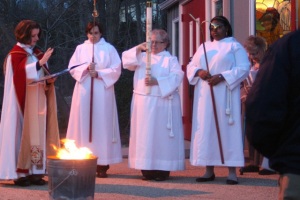
Tonight, we celebrate one of the most ancient, and in many traditions, the most important liturgies of the Church.  This is the festival of the resurrection of our Lord – despite what you may have learned about Easter Sunday.  Tonight is the night that we liturgically mark that shift from Lent and the Passion to our Lord and Savior’s Resurrection.  The church gives us this incredible gift tonight, and our job is to hearken back to an innocent sense of awe as we realize what God does through Jesus Christ.

Luckily the Church helps us hearken back to that innocent sense of awe through the structure of the liturgy.  I like to think the Church’s work in the Easter Vigil as being like that grandfather in the movie The Princess Bride, who visits his sick grandson to read him a fantastic tale.  In that movie, the grandson is skeptical – that in fact his grandfather might be planning to read him a boring or sappy story.  But the grandfather insists that this story is one of the greatest stories ever told – a story that his father read him, that he read to his son, and now, he would read to him, his grandson.

The Church is like that grandfather to us tonight, who gathers up the grandchildren around him, and says, “Let me tell you a story.  This story is greater than any other story you have ever heard.  This story is full of intrigue and surprise, full of the primal elements, full of drama and passion, and full of twists and turns you will not expect.  Do you want to hear the story?”  And before the grandfather can even begin, we, the grandchildren, are waiting with bated breath.

“Once upon a time, before there was time, or people, or even land or sky, the earth as we know the earth was a formless void – filled with watery chaos.  God created the world as we know the world, and proclaimed that creation, ‘good.’  Sometime later, that world fell into sin and God used water to cleanse the whole earth through flood.  To the one person God saved, God promised to never do such destruction again and made a covenant of protection.  Much later, the people of God were fleeing a horrible fate – an awful leader who had enslaved the people.  This time, God once again manipulated the water – both to save God’s people and to destroy those who wished to destroy God’s people.  On the other side of the sea, on dry land, the people rejoiced.  Later, the people fell away from God and although God was grieved, God spoke to the prophet Ezekiel.  God told Ezekiel to reassemble the dry bones of God’s people, and to breathe new life into them.  And the people lived again.  Much later, when the people had become dispersed and disheartened, God proclaimed new hope.  God proclaimed that God would gather God’s people again and would eliminate their despair.

“But after all of that – after creation and floods, after the division of the sea and the giving of new life to old bones, even after promising to save the people – after all of that, yet still the people of God lived in sin and in separation from God.  And, knowing no other way, God did something so unexpected, so wonderful that we could never repay God.  God sent God’s Son to live and breathe among us, to show us the way of faithful living and the way to eternal life.  And as if that were not enough, that same Son was betrayed by his friends, mocked and reviled, and killed on a cross.  That was a dark, painful time – darker and more painful than anything the people had known before.  And so, the people of God did the only thing they knew to do:  they mourned, they hid in fear, and a few brave women went to tend to this precious gift they had been given, making his death as sacred as they knew how. 

“But something amazing happened – something no one ever anticipated.  The Son of Man, the Prince of Peace, the Messiah, Jesus was not there.  And the disciples went from east to west, sharing the sacred and imperishable proclamation of eternal salvation.”

At the end of the film The Princess Bride, the grandfather finishes the book, and tells his grandson to go off to sleep.  The once skeptical grandson hesitantly addresses his grandfather, “Grandpa?  Maybe you could come over and read it again to me tomorrow?”  His grandfather smiles and responds, “As you wish.”  Those words are significant because in the story the grandfather tells, the main characters say, “As you wish,” as their code word for, “I love you.”  Tonight, we too hear the story of our salvation, the great sweeping of our history with our Lord, and the salvific work of our Savior Jesus Christ, and we too find ourselves strangely warmed, longing to perhaps hear the story again.  And to us, the Church says, “As you wish.”  Amen.
Sermon – Isaiah 58.9b-14, P16, YC, August 21, 2022

05 Wednesday Oct 2022

Posted by jandrewsweckerly in Sermons

≈ Leave a comment

Tags

baptism, church, community, darkness, Episcopal Church, faith, Jesus, journey, light, messy, salvation, Sermon, water

Last night, we baptized Becky Breshears in the waters of the Chickahominy River.  When most of us think of baptism, we imagine the baptism of an infant or child, someone for whom godparents make promises to raise in the life of the faith, much like we did with baby Olivia a few weeks ago.  The sacrament of baptism for a child is certainly considered being fully initiated into the family of Christ, but we make pronouncements and promises on behalf of the baptized.  And as the baptized grows up, we continue to shepherd and guide her, answer her questions, and help her claim her faith as her own.  There is an endearing, almost romantic, notion to baptism, full of idealism and hope. 

At least, that seems to be true in Episcopal Churches, where we quite primly and gently pour water from beautiful fonts over the heads of babies – the messiest part being if the water accidently runs into the baby’s eyes.  Of course, adult baptism is totally normal in our tradition too, we just do not do adult baptism as frequently.  When we do adult baptism, we become much more like other denominations, who have always understood baptism to be a mature proclamation of one’s own faith.  In some ways an adult baptism is more exciting because an adult baptism is not about something we hope and pray will develop into a faithful life, but adult baptism is the fully developed proclamation now – a set of pronouncements and promises on one’s own behalf.  An adult baptism is bold, dramatic, and, especially in instances like last night, much messier!

But adult baptism, especially in the Episcopal Church, are not about proclaiming one has her faith life all figured out – that she has some sense of earned clarity and certainty that has led her to baptism, as if baptism is the end of a journey of discernment.  Quite the opposite; baptism is a beginning for Episcopalians.  The baptized does not proclaim she knows all there is to know about faith and salvation.  Instead, the baptized claims that she is starting a new journey with Jesus, with a community of faith who walks with her.  And part of the act of baptism is giving the newly baptized tools to walk that journey.

That’s why I love the lesson from Isaiah today.  Instead of scripture capturing a moment (like a baptism), scripture today tells us what the baptized journey will be like.  Isaiah describes five things that are critical to the life of baptism.  First, the faithful will “remove the yoke from among you” – or in modern language, be an agent of economic liberation for the oppressed, not taking advantage of others.  Second, the faithful will refrain from “pointing the finger,” or take responsibility for one’s own actions, not accusing others but acting to change the self.  Third, the faithful will “refrain from speaking evil,” because “speech, when it is careless or deceitful, can be destructive and injurious.”[i]  Our words have power and are to be used for good.  Fourth, the faithful are to “offer food to the hungry.”  The life of the faithful is a life of self-sacrifice and sharing what we have learned to call our own.  And finally, we are to “satisfy the needs of the afflicted” – not just helping others or solving their problems but letting the disadvantaged “define their own needs and letting them set the criteria for deciding whether our help is effective.”[ii]

What the prophet Isaiah tells us is that as the faithful, we structure our lives differently than the secular, self-interested world might have us live.  That includes honoring even the sabbath – this holy day, not as just a day to go to church (though I hope you all will regularly – either in person or online), but also to be a day of honoring God through letting go of the self and focusing on the Lord and on the cares of those in need.   That’s why in our gospel lesson Jesus’ actions of healing others on the sabbath is so controversial – because Jesus reminds us the sabbath is a day of selflessness, healing, and giving glory to God.

Last night, Becky committed herself to that life, and we, as fellow baptized recommit ourselves this very day, to a life lived differently – a life lived in the light of Christ.  The prophet Isaiah tells us that when we live faithful lives, our light shall rise in the darkness, the Lord will guide us continually, will satisfy our needs in parched places, make our bones strong, and we shall be like a watered garden – a spring – whose waters never fail.  We shall be repairers of the breach, restorers of the streets to live in. 

Earlier I used the language of self-sacrifice.  What the Holy Spirit does in baptism and what the Church tries to continue to do on every sabbath is relocate the self from the center of our universe and place us firmly within a community of faith who cares for one another while placing God in the center of our universe.  When we take that step in baptism or renew the step our parents took for us, and in gathering in weekly worship (whether gathering in person or gathering virtually), we commit not to having this faith thing figured out – but just that we want to live a life where our parched places are always quenched through the living waters of baptism, and where our lives become bigger than they have ever been – where our lives shine the light of Christ in the darkness.  Amen.


[i] Jon L. Berquist, “Exegetical Perspective,” Feasting on the Word, Yr. C, Vol. 3, Supplement for P16 (Louisville: Westminster John Knox Press, 2010), 4.

[ii] Berquist, 4.

Sermon – Genesis 7.1-5, 11-18, 8.6-18, 9.8-13, UJCCM Lenten Series, March 9, 2022

25 Wednesday May 2022

Posted by jandrewsweckerly in Sermons

≈ Leave a comment

Tags

ark, ecumenical, flood, God, history, judgment, Lent, Noah, pandemic, relationships, salvation, salvation narrative, saving, Sermon, transforming

This Lent, we as an ecumenical body in Upper James City County are retelling the “salvation narrative” – or at least that is the fancy phrase we use to describe the body of stories that show us time and again God’s saving deeds in history, and how those stories inform how we understand what will happen on Easter Sunday – how the life, death, and resurrection of Jesus will bring the fullness of redemption.  We started last week with the story of creation – the ways in which God lovingly called the created order good and made us in God’s image.  Tonight, we shift to another of the legendary stories – the story of the flood.

This is a story we know and love:  we use Noah’s ark as artwork in babies’ nurseries, I have Noah’s ark in the form of Christmas ornaments, we even sing songs about how God told Noah to build an “ark-y, ark-y” made of “bark-y, bark-y.”  I think we love this story so much because of the good news at the end.  But before we get to the end, we have to wade through a whole lot of a horrible beginning and middle.  You see, despite the goodness of creation, of the ways in which we were made in God’s image, we humans fall into sinfulness.  We do not hear much of that part of the story tonight.  Despite all the verses we did hear, what we do not hear is how horribly sinful humanity has become in Noah’s time.  This sinfulness grieves God so very much that God set God’s mind to do a terrible, awful thing[i].  Those waters out of which God formed the earth – those waters that God used a dome to separate – separate the waters from the waters, God uses to destroy the beautiful creation God has made.  God removes the dome, and the waters came down from the skies and the waters rise up from the ground.[ii] 

From the beginning of this horrible decision, God makes a choice – a choice to save some life instead of recreating life again[iii].  And so, on that ark that Noah builds, floats the people who will repopulate the earth, and the animals that will restore the created order.  We hear very little in scripture what those days are like[iv]:  the panic of rising waters, the death all around them, the solitude and silence of watery chaos, the noise of a bizarrely filled boat.  We have only our imagination to fill in what those desperate days may have been like. 

In some ways, I think Lent is a lot like those days on the boat.  There is the obvious forty days connection, but more telling is the stark reality of sinfulness and judgment.  Imagining the depravity of those days that would drive God to destroy most of creation is not as hard as we might like to think.  Sometimes, I wonder if God is not similarly grieved by us today.  Here we are after two years of a pandemic where our own country spent more time arguing over the supremacy of personal freedom over the call to love one another.  Here we are, for likely the millionth time debating whether there is such a thing as a just war as we watch civilians and children slaughtered in Ukraine.  Here we are divided by political party, divided by socioeconomic status, divided by race, divided by theology into denominations and faiths.  Here we are, refusing as individuals to love all our neighbors as ourselves, and love the Lord our God.  Lent is our season to float in the lapping waters of our sinfulness, wondering whether we should be on that boat or not.

But here’s the funny story about the flood.  This story is not about you.  This story is not even really about Noah, or the animals God saved, or even the rainbow at the end of the story we like to cling to so desperately.  This story is not about our sinfulness and brokenness and inability to live into the image of God in which we are created.  No, this is a story about God.  Everything in this story that we value, that makes this story a “salvation narrative,” is about God’s actions.  The reason we do not hear all the gory details about the lead-up to the flood – the details that even movies have been made about – is because this is a story about salvation, not judgment – on what God does to preserve creation.[v]

One of the exercises I have done with young adults is to talk about images of God.  We create a safe space where we can talk about those images – not just the ones the church likes us to see – of the shepherd caring for the flock, even at times with a lamb on his shoulders, or of the saccharine-y Jesus’ we hang around that look more like an American Jesus than a Middle Eastern Jesus.  Instead, we try to get real with the youth.  The images they often have are of a foreboding man on a throne, an intimidating father figure, or a judge behind a bench.  And when we adults are honest, our images are pretty similar.  But the images of God in this story, as one scholar writes are “striking:  a God who expresses sorrow and regret; a God who judges, but doesn’t want to, and then not in arbitrary or annihilative ways; a God who goes beyond justice and determines to save some creatures, including every animal and bird; a God who commits to the future of a less than perfect world; a God open to change and doing things in new ways; a God who promises never to do this again.  The story reveals and resolves a fundamental tension within God, emphasizing finally, not a God who decides to destroy, but a God who wills to save, who is committed to change based on experience with the world and who promises to stand by the creation.”[vi]

That’s the funny thing about this story.  The flood seems like a story for Lent because we find ourselves as sinful as Noah’s world, and we know we need to change our ways.  Lent is all about repentance after all – a turning from our sinfulness and returning to God.  But here’s the thing: even after the flood (and let’s be honest, even after this Lent), the people will keep going back to sinning.  I mean, we’re just in chapter nine of Genesis:  there is a whole lot more sinning left in the Old Testament for us to read.  Scholars argue, “The flood has effected no change in humankind.  But [the flood] has effected an irreversible change in God.”[vii]  This salvation narrative tells us more about God than ourselves.  God establishes the covenant with humanity and creation to never flood the earth again.  Certainly, there may be judgment again, but never the kind that annihilates the earth.  That rainbow that we love is not meant to remind us of God’s promise, but to remind God of the covenant – the restraint God promises to keep in the midst of well-deserved judgment.[viii]  Every promise God makes, all the salvation narratives we will hear the rest of this Lent, are made possible by the foundation of the promise God makes to Noah.[ix]

So, if this salvation narrative is not about us, does that mean we get a free pass for Lent?  Not exactly.  The real question for us tonight, based on everything we just learned (or remembered) about God, is “So what?”  Professor Patricia Tull argues, “Scripture says that a good and wise God created us good.  We’re capable of great evil, as the flood story says and as we know every day.  But God means for us to be transformed, just as the flood transformed God’s intentions.”[x]  Lent is our opportunity to mirror God’s transformation of intention.  What in your life this year needs transforming?  What have you been holding on to – a grudge, a hurt, an anger, a self-righteous indignation – needs to be released?  God learned in the flood that God could not change humanity – but God could change God’s relationship with humanity.  Our invitation this Lent is not necessarily to change ourselves, and certainly not to try to change others (which never goes well), but to transform our relationships – our relationship with God, our relationships with others, and even our relationship with ourselves.  Use the watery chaos of this Lent to listen through the noise of animals around you to hear the promise of the rainbow come Easter.  Amen.


[i] Leander E. Keck, ed, The New Interpreter’s Bible, vol. 1 (Nashville:  Abingdon Press, 1994), 394.

[ii] Keck, 392.

[iii] Keck, 394.

[iv] Keck, 389.

[v] Keck, 389.

[vi] Keck, 395.

[vii] Keck, 395.

[viii] Keck, 400.

[ix] Keck, 401.

[x] Patricia Tull, “Commentary on Genesis 7:1-5, 11-18; 8:6-18; 9:8-13,” April 15, 2017, as found at https://www.workingpreacher.org/commentaries/revised-common-lectionary/vigil-of-easter-3/commentary-on-genesis-71-5-11-18-86-18-98-13 on March 9, 2022.

Sermon – John 3.14-21, Numbers 21.4-9, L4, YB, March 14, 2021

17 Wednesday Mar 2021

Posted by jandrewsweckerly in Sermons

≈ Leave a comment

Tags

belief, choice, cross, glory, God, grace, Israel, Jesus, Lent, light, Moses, salvation, Sermon, serpent, sin, transform

Our scripture lessons today offer two contrasts:  a story from the Hebrew Scriptures which might be unfamiliar to you or at least may seem wildly strange, and a story from John’s gospel that is so familiar, you can probably quote a portion of the text if I simply tell you the citation, “John 3.16.”  What is strange about this combination is the unknown, uncomfortable story is a window into the overly familiar, commonplace story.  If we have any hope of understanding either of them, we need to dive into both.

At the point where we join the story from Numbers, God has been infinitely patient with God’s people.  Some might argue too patient.  God has saved God’s people time and again, wresting them from brutal slavery, miraculously helping them flee through the Sea of Reeds, helping sweeten bitter drinking water when they murmured, granting them manna when they complained of being hungry, giving them water out of a rock when they grumbled about being thirsty, offering them birds to eat when they whined of manna-fatigue.  Grace and patience abound with God.  Until this day.  The Israelites throw yet another fit, and God snaps.  This time, God sends poisonous serpents among the people, and many of them die.  When the people beg for help to Moses, God instructs Moses to put a bronze serpent on a pole; if people gaze upon the serpent, they will live.  For a God who asks the people have no idols or gods before God, a serpent on a pole is, quite frankly, just weird.

Meanwhile, we have a super familiar text from John.  “For God so love the world that he gave his only Son.”  We love this verse because the verse reminds of our abundant, loving, graceful God.  Of course, we sometimes gloss over the rest of the troublesome parts of this text.  The rest talks about how Jesus saves the world – as long as the world believes.  Here is where the questions start to pile up for us.  Do we really believe that some people are condemned?  Is God’s love conditional?  What happens if we doubt?  Does that count as not believing?  Can eternal life be given and taken away based on the seesaw of my behavior?  The trouble is if we focus on God’s grace, we can make salvation seem arbitrary, with no essential place for human response.  But if we focus on human faith, we may be in danger of making salvation a human accomplishment, restricting God’s initiative universally.[i]  The only thing that seems to be clear is that God gives us a choice.  When we commit evil deeds, when we deny God through our behavior, when we linger in the darkness, we are making a choice.  And the text tells us today that the consequence of that choice is condemnation.

The answer to so much in these texts seems to lie in verse fourteen of John.  Jesus says, “Just as Moses lifted up the serpent in the wilderness, so must the Son of Man be lifted up, that whoever believes in him may have eternal life.”  As scholar Debie Thomas writes, “In the Old Testament story, God requires the Israelites to look up.  To gaze without flinching at the monstrous thing their sin has conjured.  It’s the thing they have wrought, the thing they fear most, the thing that will surely kill them if God in God’s mercy doesn’t intervene and transform the instrument of pain and death into an instrument of healing and life.  In order to be saved, the people have to confront the serpent — they have to look hard at what harms, poisons, breaks, and kills them.”[ii]  The same seems to happen with Jesus on a cross.  Thomas goes on to say, “In the cross, we are forced to see what our refusal to love, our indifference to suffering, our craving for violence, our resistance to change, our hatred of difference, our addiction to judgment, and our fear of the Other must wreak.  When the Son of Man is lifted up, we see with chilling and desperate clarity our need for a God who will take our most horrific instruments of death, and transform them, at great cost, for the purposes of resurrection.”[iii]

The truth is, I am not sure either of these texts answer some of our basic questions, especially around those of belief.  But tying them together today, we do find an invitation – to change our gaze away from the judgment of others, the wondering about who is in and out, the questions about God’s retribution, and gaze on the cross – the body that reminds us of the goodness of God in spite of our sinfulness, that reminds us of God’s grace in spite of our lack of deserving, that reminds us of God’s unconditional love despite our inability to keep failing.  Our invitation is to take seriously the words of that old hymn, “Turn your eyes upon Jesus, Look full in His wonderful face, And the things of earth will grow strangely dim, In the light of His glory and grace.”  As we continue on the path of Lent toward the cross, today’s texts remind us of where we are going and why.  Our invitation is to look up at the horrible, wonderful truth of what Jesus does in the cross, and stand in the light of his glory and grace.  Amen.


[i] Joseph D. Small, “Theological Perspective,” Feasting on the Word, Year B, Vol. 2 (Louisville: Westminster John Knox Press, 2008), 118.

[ii] Debie Thomas, “Looking Up,” March 7, 2021, as found at https://www.journeywithjesus.net/essays/2944-looking-up, on March 12, 2021. 

[iii] Thomas.

Sermon – Mark 16.1-8, EV, YB, April 4, 2015

15 Wednesday Apr 2015

Posted by jandrewsweckerly in Uncategorized

≈ Leave a comment

Tags

church, Easter Vigil, God, history, Jesus Christ, love, Princess Bride, salvation, Sermon, story

Tonight we celebrate one of the most ancient, and in many traditions, the most important liturgies of the Church.  This is the festival of the resurrection of our Lord – despite what you may have learned about Easter Sunday.  Tonight is the night that we liturgically mark that shift from Lent and the Passion to our Lord and Savior’s Resurrection.  The church gives us this incredible gift tonight, and our job is to hearken back to an innocent sense of awe as we realize what God does through Jesus Christ.

Luckily the Church helps us hearken back to that innocent sense of awe through the structure of the liturgy.  I like to think the Church’s work in the Easter Vigil as being like that Grandfather in the movie The Princess Bride, who visits his sick grandson to read him a fantastic story.  In that movie, the grandson is skeptical – that in fact his grandfather might be planning to read him a boring or sappy story.  But the grandfather insists that this story is one of the greatest stories ever told – a story that his father read him, that he read to his son, and now, he would read to him.

The Church is like that grandfather to us tonight, who gathers up the grandchildren around him, and says, “Let me tell you a story.  This story is greater than any other story you have ever heard.  This story is full of intrigue and surprise, full of the primal elements, full of drama and passion, and full of twists and turns you do not expect.  Do you want to hear the story?”  And before the grandfather can even begin, the grandchildren are waiting with baited breath.

“Once upon a time, before there was time, or people, or even land or sky, the earth as we know the earth was a formless void – filled with watery chaos.  God created the world as we know the world, and proclaimed that creation, ‘good.’  Sometime later, that world fell into sin and God used water to cleanse the whole earth through flood.  To the one person God saved, God promised to never do such destruction again and made a covenant of protection.  Much later, the people of God were fleeing a horrible fate – an awful leader who had enslaved the people.  This time, God once again manipulated the water – both to save God’s people and to destroy those who wished to destroy God’s people.  On the other side of the sea, on dry land, the people rejoiced.  Later, the people fell away from God and although God was grieved, God spoke to the prophet Ezekiel.  God told Ezekiel to reassemble the dry bones of God’s people, and to breathe new life into them.  And the people lived again.  Much later, when the people had become dispersed and disheartened, God proclaimed new hope.  God proclaimed that God would gather God’s people again and would eliminate their despair.

“But after all of that – after creation and floods, after the division of the sea and the giving of new life to old bones, even after promising to save the people – after all of that, yet still the people of God lived in sin and in separation from God.  And, knowing no other way, God did something so unexpected, so wonderful that we could never repay God.  God sent God’s Son to live and breathe among us, to show us the way of faithful living and the way to eternal life.  And as if that were not enough, that same Son was betrayed by his friends, mocked and reviled, and killed on a cross.  That was a dark, painful time – darker and more painful than anything the people had known before.  And so the people of God did the only thing they knew to do:  they mourned, they hid in fear, and a few brave women went to tend to this precious gift they had been given, making his death as sacred as they knew how.  But something amazing happened – something no one ever anticipated.  The Son of Man, the Prince of Peace, the Messiah, Jesus was not there.  And the disciples went from east to west, sharing the sacred and imperishable proclamation of eternal salvation.”

At the end of the film The Princess Bride, the grandfather finishes the book, and tells his grandson to go off to sleep.  The once skeptical grandson hesitantly addresses his grandfather, “Grandpa?  Maybe you could come over and read it again to me tomorrow.”  His grandfather smiles and responds, “As you wish.”  Those words are significant because in the story the grandfather tells, the main characters say, “As you wish,” as their code word for, “I love you.”  Tonight, we too hear the story of our salvation, the great sweeping of our history with our Lord, and the salvific work of our Savior Jesus Christ, and we too find ourselves strangely warmed, longing to perhaps hear the story again.  And to us, the Church says, “As you wish.”  Amen.

Sermon – Luke 24.1-12, EV, YC, March 30, 2013

10 Wednesday Apr 2013

Posted by jandrewsweckerly in Uncategorized

≈ Leave a comment

Tags

Easter Vigil, God, light, liturgy, Messiah, movie, salvation, Sermon, tomb

IMG_3202Our liturgy tonight operates a bit like a movie whose mode of telling stories is in flashbacks.  We start the movie with the scene we just heard.  Several women are gathered around the empty tomb, their mouths agape, and their minds racing.  And then, the flashbacks begin.

Mary the mother of James recalls that ancient story of creation.  That empty tomb reminds her of those words – tohu wabohu – the formless void.  She vaguely remembers what God said about creating humankind in God’s image.  And she hears those words repeated over and over again, “It was good; ki-tov”

Meanwhile, another woman flashes back to when humankind’s sinfulness so angered God that God flooded the earth.  For forty days, Noah knew the nothingness of that empty tomb in front her.  But she also remembers that covenant God made with Noah – that never again will there be a flood to destroy the earth.  Perhaps there is a rainbow in this tomb, and not only the watery floods that she sees.

Joanna looks into that empty tomb and remembers another time her people faced desperation.  She flashes back to the rushing Egyptians who have pinned her people to the Red Sea.  She remembers the panicked screams of her people toward Moses.  She remembers how God saved them then – how God created a way out of no way.  She wonders whether the empty tomb is not unlike that empty seabed – the one that the Israelites used to get to freedom.

Another woman stares into that vacant tomb and she remembers a different tomb.  She remembers the death and hopelessness of those bones in that valley – the thousands of devastated lives.  But then she remembers what God told Ezekiel.  She remembers the rattling of those bones coming together, and the way the breath of God, the ruah of God breathed life into those bones.  She wonders if she hears the faint ruah of God now coming out of that empty tomb.

But Mary Magdalene remembers a different story from Zephaniah.  She hears the words of that song in a fresh way today.  “Sing aloud, O daughter of Zion.”  Is this the day that God will save us?  Can her beloved Jesus be not missing, but raised?  Might Jesus be the one who will restore her fortunes?  She longs for God to be saying to her, “Rejoice and exult with all your heart, O daughter Jerusalem.”  “Please let this empty tomb be an occasion for rejoicing and not for more pain and suffering for my Lord,” Mary Magdalene prayers in her heart.

And then the movie brings us abruptly back to the empty tomb, the sound of silence like so many times before in their history.  The appearance of emptiness threatens their fragile, exhausted psyches.  Their unspoken memories fail to comfort them because they are unable to utter a word of remembrance and assurance to one another.

As outsiders watching this movie, as we watch those looking into the tomb, we begin to connect the various flashbacks.  The answers are there before the angels need to say a word.  God loves us and creates us in God’s image.  And we are not only good – but we are very good – wehineh-tov.  God promises to never destroy us again as God once did.  God promises liberation from oppression.  God promises restoration to our bodies and spirits.  God promises to bring us home.  God promises and God saves us time and again.  And now, with this Messiah who has finally arrived, God saves us once and for all.  What has felt like a defeat is now the reason to rejoice.  The smiles that spread across our faces are exact mirrors of the smiles that spread across the faces of those women at the tomb.  The smiles are smiles that happen as we connect the varied flashbacks, remembering our salvation history, and this final act of salvation through the death and resurrection of our Lord and Savior Jesus Christ.  That tomb is not a formless void, but the holy site where all our salvation narrative culminates.  That empty tomb is in fact not empty at all.  That tomb is full of life.  Tonight is a night for alleluias, for songs of joy, and for dancing.  The light shatters the darkness this night, and we celebrate the greatest victory of all time.  Alleluia! Christ is risen.  The Lord is risen indeed!!

Recent Posts

  • On the Myth and Magic of Advent…
  • On Risking Failure and Facing Fear…
  • Sermon – Luke 23.33-43, P29, YC, November 23, 2025
  • On Inhabiting Gratitude…
  • Sermon – Luke 20.27-38, P27, YC, November 9, 2025

Archives

  • December 2025
  • November 2025
  • October 2025
  • September 2025
  • August 2025
  • July 2025
  • June 2025
  • March 2025
  • February 2025
  • December 2024
  • November 2024
  • October 2024
  • September 2024
  • August 2024
  • July 2024
  • June 2024
  • May 2024
  • March 2024
  • February 2024
  • January 2024
  • December 2023
  • November 2023
  • October 2023
  • September 2023
  • August 2023
  • July 2023
  • June 2023
  • May 2023
  • March 2023
  • February 2023
  • January 2023
  • December 2022
  • November 2022
  • October 2022
  • June 2022
  • May 2022
  • January 2022
  • December 2021
  • November 2021
  • October 2021
  • September 2021
  • August 2021
  • June 2021
  • May 2021
  • April 2021
  • March 2021
  • February 2021
  • January 2021
  • December 2020
  • November 2020
  • October 2020
  • September 2020
  • August 2020
  • July 2020
  • June 2020
  • May 2020
  • April 2020
  • March 2020
  • February 2020
  • January 2020
  • December 2019
  • November 2019
  • October 2019
  • September 2019
  • August 2019
  • July 2019
  • June 2019
  • May 2019
  • April 2019
  • March 2019
  • February 2019
  • January 2019
  • December 2018
  • November 2018
  • October 2018
  • September 2018
  • August 2018
  • July 2018
  • June 2018
  • May 2018
  • April 2018
  • March 2018
  • February 2018
  • January 2018
  • December 2017
  • November 2017
  • October 2017
  • September 2017
  • August 2017
  • July 2017
  • June 2017
  • May 2017
  • April 2017
  • March 2017
  • February 2017
  • January 2017
  • December 2016
  • November 2016
  • October 2016
  • September 2016
  • August 2016
  • July 2016
  • June 2016
  • May 2016
  • April 2016
  • March 2016
  • February 2016
  • January 2016
  • December 2015
  • November 2015
  • October 2015
  • September 2015
  • August 2015
  • July 2015
  • June 2015
  • May 2015
  • April 2015
  • March 2015
  • February 2015
  • January 2015
  • December 2014
  • November 2014
  • October 2014
  • September 2014
  • August 2014
  • July 2014
  • June 2014
  • April 2014
  • March 2014
  • February 2014
  • January 2014
  • December 2013
  • November 2013
  • October 2013
  • September 2013
  • August 2013
  • July 2013
  • June 2013
  • May 2013
  • April 2013
  • March 2013
  • February 2013
  • January 2013
  • December 2012
  • November 2012
  • October 2012
  • September 2012

Categories

  • reflection
  • Sermons
  • Uncategorized

Meta

  • Create account
  • Log in
  • Entries feed
  • Comments feed
  • WordPress.com

Blog at WordPress.com.

  • Subscribe Subscribed
    • Seeking and Serving
    • Join 394 other subscribers
    • Already have a WordPress.com account? Log in now.
    • Seeking and Serving
    • Subscribe Subscribed
    • Sign up
    • Log in
    • Report this content
    • View site in Reader
    • Manage subscriptions
    • Collapse this bar
 

Loading Comments...