• About

Seeking and Serving

~ seek and serve Christ in all persons

Seeking and Serving

Tag Archives: scripture

Sermon – Mark 6.14-29, P10, YB, July 14, 2024

17 Wednesday Jul 2024

Posted by jandrewsweckerly in Sermons

≈ Leave a comment

Tags

death, disciple, Good News, gospel, Herod, Jesus, John the Baptist, Kingdom, politics, scripture, Sermon, terror, together, work

Today’s gospel lesson contains one of those iconic stories that is so vivid the story is seared in our minds.  In short, John the Baptist is decapitated by Herod Antipas who serves John’s head on a platter.  On the one hand, the brutal scene, depicted in art for centuries, is one we prefer to acknowledge and move on.  Certainly, this is a cautionary tale for the prophetic life.  John is now dead, and Jesus takes the reins.  But there is so much more to this story.  There is John’s faithfulness to making a way for the inbreaking of the kingdom – including the criticism of Herod Antipas’ marriage to his brother’s wife.  There is the king’s imprisonment of John mingled with his fascination with John, leaving him sitting at John’s feet enthralled by John’s teachings.  There is the vengeance of Herodias, the criticized wife of Antipas, who manipulates her daughter into asking for John’s head.  There is the proud Herod Antipas who makes ridiculous promises to his daughter and spinelessly agrees to kill John despite his knowing better – just to save face in front of his friends.  This is a story so woven in political and ethical intrigue that we do not like to look too closely for fear of seeing modern-day parallels.

But what is perhaps more intriguing about trying to avert our eyes from this brutal, shameful scene is that John’s beheading is not the first time scripture hands us a story like this.   “The story looks like a reprise of 2 Kings 16-21, the story of Queen Jezebel, the enemy of Elijah.  Just as Jezebel manipulated her husband, King Ahab, so Herodias manipulates Antipas.  Just as Elijah indicts Ahab and Jezebel, so John the Baptizer indicts Antipas and Herodias.”[i]  Furthermore, there are parallels to Esther’s story, whose husband also promises her anything she wants, up to half of his kingdom.  Esther uses her promise for good, able to thwart the villain Haman’s plan to kill off her fellow Jewish brothers and sisters.  Reflecting on the canon of scripture, we cannot avoid the ugly truth that scholar Amy-Jill Levine uncovers:  that “Death at the hands of corrupt authorities is the fate of John, and Jesus, and of countless others who have done the right thing, at the cost of their own lives.”[ii]

So, what do we do with this tale of terror laid at our feet today – a tale told time and time again in scripture?  I am intrigued by scholar Matt Skinner’s instruction look at the disciples.[iii]  In the very last line of our text today, Mark says, “When his disciples heard about [John the Baptizer’s murder], they came and took his body, and laid it in a tomb.”[iv]  If you remember, in the text last week, Jesus was shut down in his hometown and unable to perform miracles, instead sending out the twelve in pairs to cast out demons and to heal the sick.  For Jesus and his disciples, they got back to work.  And if we kept reading Mark’s gospel, in the verses that follow today’s story, we will hear how Jesus and disciples go on about their work, with Jesus miraculously feeding five thousand people.  John’s death is horrific, brought about by evil and sinfulness.  And yet, his disciples boldly come forward and bury his body.  Jesus sees John’s death and must know a similar fate awaits him.  And yet, he and his disciples get back to work, doing the good news of God in Christ.

Stories like John’s beheading are indeed graphic, sobering stories of what awaits those who live in the light of God.  And yet, time and again, Elijah, Esther, John the Baptizer, Jesus, and Jesus’ disciples keep going.  They keep doing the next good thing.  There is part of that model that feels unjust – surely, we should be fighting for justice, standing up to those who abuse power, who manipulate authority, whose self-centeredness and pride promote evil.  We revere plenty of saints who did just that kind of work.  And yet today, in the face of brutality, hopelessness, and injustice, the disciples of John and the disciples of Jesus just keep going.  They keep doing the work of the kingdom.

We are in an unprecedented time of political turmoil.  And in the coming weeks and months, given our diverse political backgrounds in this community, we will likely disagree about what our country can and should be doing.  But what brings us to this common table every week is a commitment to the life and ministry of Christ – the bringing about of a kingdom that is not of this world.  We will need each other – sometimes to figure out what the next best thing is, sometimes for the encouragement to do the next best thing, and always as a reminder that we disciples of Jesus need each other to do the next best thing.  We know from John, Jesus, Elijah, and others that doing the next best thing may end in personal suffering.  But we also know that continuing to do that next best thing helps bring us just a little bit closer to that kingdom here on earth.  We go together.  Amen.


[i] Amy-Jill Levine, The Gospel of Mark:  A Beginner’s Guide to the Good News (Nashville:  Abingdon Press, 2023), 38-39.

[ii] Levine, 42.

[iii] Matt Skinner, “Commentary on Mark 6:14-29,” July 14, 2024, as found at https://www.workingpreacher.org/commentaries/revised-common-lectionary/ordinary-15-2/commentary-on-mark-614-29-6 on July 12, 2024.

[iv] Mark 6.29.

On Children, Questions, and Dignity…

06 Wednesday Dec 2023

Posted by jandrewsweckerly in reflection

≈ Leave a comment

Tags

Advent, baptismal covenant, children, complex, complicated, creation, dignity, faith, God, humanity, image of God, Jesus, questions, respect, scripture, slow down, village

Photo credit: https://www.adl.org/resources/tools-and-strategies/respecting-dignity-words

We have been having lots of “big” conversations around our house the last couple of weeks.  The first happened when my younger child and I went to shop for our Angel Tree gifts – an annual tradition from our church and the Salvation Army.  Our girls tend to prefer to choose someone their age – perhaps because they feel more equipped to imagine what someone their age wants, or because it helps them feel a sense of camaraderie.  This year, the nine-year old we selected ended up being quite different from the nine-year old in our family.  Though the toys she wanted were familiar, the size of clothing needed made it obvious that the two girls could not be more different.  So, in the middle of a store, I found myself having a deep conversation about genetics, systems of poverty, and the blessed nature of all creation.

Later, the conversation turned heavy again.  Something came across the same nine-year old’s radar about Israel and Palestine, and the barrage of questions were endless and increasingly difficult.  We started with why they were fighting, talked about what each side had done, and what the impact of this war has been.  Eventually we got into the murky waters of the religious backgrounds of the warring sides – careful to talk about the interconnectedness of the Abrahamic faiths.  But then came the gut-punch question, “So, who do we want to win?”  Talking about war and peace, death and destruction, and the biblical complicatedness of the Holy Land was not exactly the conversation I was expecting between school, dinner, and various sports practices.

One of the disadvantages of being a “grown up” is we often think we have things figured out:  capable of complicated thought, educated and experienced, we have seen enough of life to understand its complexities and make judgments based on our learnings.  It is one of the many reasons why I am so grateful for the children in our lives – both my own, but also our community’s children.  As part of their village, our work is to responsibly help them see the complicated, often sinful, nature of humanity, and help them love humanity in all its complexity.  In essence, children help us see why one of the main promises in our baptismal covenant is we will respect the dignity of every human being.

As we bustle around the Advent season, tempted to be too busy to handle anything other than our massive to-do lists, I invite you to slow down.  When we run so fast and when our minds are so occupied, we miss the invitations to respect the dignity of every human being:  from our neighbors impacted by poverty, to the frazzled parent just trying to get their children to school, to the person suffering within their body, to the innocent bystanders of war.  Scripture tells us that each person, when they are at their best or their worst, their strongest or their weakest, their most successful or their most failing, are made in the image of God.  Whether we like them or not, Jesus asks us to respect the dignity of that creation every day.  How might you better respect the dignity of the humans around you today?

Sermon – Luke 6.20-31, AS, YC, November 6, 2022

23 Wednesday Nov 2022

Posted by jandrewsweckerly in Sermons

≈ Leave a comment

Tags

abundance, All Saints Sunday, Beatitudes, blessing, Jesus, saints, scripture, Sermon, trying, woe, yikes

Holy Scripture can be a real downer sometimes!  Maybe that sounds petulant, defeatist, or even a little like someone who just wants a saccharine-y Savior, but when I read passages like Luke’s gospel today, I get more than a little discouraged.  In Luke’s Sermon on the Plain, we hear Luke’s version of Jesus’ beatitudes.  They start off encouragingly enough.  Who wouldn’t want blessings for the poor, hungry, weeping, and persecuted?  But then come the woes.  Woe to the rich, those who are full, the laughing, the respected.  Woe to us, really.  I don’t know about you, but I had breakfast this morning, I was able to pay my bills this month (including my pledge), I certainly have received compliments on my work before, and you all know I have laughed recently – my laugh is the one marker that can help you find me in any room!  According to scripture, I am in a lot of woe! 

Of course, sometimes All Saints Day can feel like a day of woe anyway.  From early in the Church’s history, saints were those “persons of heroic sanctity, whose deeds were recalled with gratitude by later generations.”[i]  All Saints Day now is one of the seven principal feast days in the Episcopal Church, and the only one that can be transferred to a Sunday.  All Saints Day is also one of the prescribed days for baptism.[ii]  In other words, we value the life and witness of extremely pious, holy people so much we want the newly baptized to understand that sainthood is the goal. 

The good news is the original Greek may help us find our way out of deflation and into encouragement.  Because of the ways the “Blessed are…”s are paired with the “Woe to”s, we might interpret “woe” to mean “cursed.”  Cursed are those who are rich, have full bellies, are laughing, or are respected.  But that is not exactly what woe means.  According to scholar, Matt Skinner, “In this context, ‘woe’ functions as a sharp contrast to ‘blessed,’ yet the Greek word ouai does not mean ‘cursed’ or ‘unhappy.’  Certainly not ‘damned.’  Like the English word “yikes,” woe is more of an attention-getter and emotion-setter than a clear characterization or pronouncement.  Jesus therefore promises relief to some groups, to those people who suffer in this life.  To others, to folks who find existence rather enjoyable or easy, he cries, ‘Look out!’”[iii]

Another scholar echoes Skinner’s argument, reminding us that Jesus is not so much concerned that people are wealthy, well-fed, have pleasure, or enjoy respect; Jesus is very concerned with how those wealthy, well-fed, pleased, respected people treat the poor.  Amy-Jill Levine reminds us that the disciples are not destitute.  Four of them own boats and one of them is a tax collector.  And the majority of the minor figures in Luke’s gospel are not poor either:  “the ruler Jairus and his wife; the centurion with the sick child, Mary and Martha the householders, the various Pharisees as well as sinners and tax collectors with whom Jesus banquets, Zaccheus the chief tax collector…”[iv]  The existence of resources, blessings, and pleasure are not sinful in and of themselves.  The “woe” or the “yikes” is simply a reminder that what we do with those resources, blessings, and pleasure matters – a lot. 

 I am not sure any of us will ever be called saints in our day.  That is why I love so much how we honor all those faithful departed who have gone before on All Saints Day.  As we tie ribbons or type out names of mothers, brothers, lovers, children, and friends who have gone before, we honor not that they were saints, but perhaps that they were saint-like in their trying.  For all their foibles, the moments where they lacked compassion, where they got caught up in their selfishness, they also taught us how to love abundantly, how to care for others with empathy, and how to find moments of selflessness. 

Jesus’ woes are not meant to send us home with the mantra, “Woe is me!”  Jesus’ woes are meant to be our yikes!  Yikes, look at all the abundance in our lives.  Yikes, look at all the moments of pure joy and laughter.  Yikes, look at the ways others look up to us (even if they cannot verbalize their respect).  When we find ourselves in this life cocooned in goodness, the life of faith, the life of the saints, is to share our abundance, to use our abundance for good, to be agents of abundance in the world.  We will not always succeed.  But, yikes!  Our invitation today is to be saint-like in our trying.  Amen.


[i] Holy Women, Holy Men:  Celebrating the Saints (New York:  Church Publishing, 2010), 664.

[ii] Holy Women, Holy Men:  Celebrating the Saints (New York:  Church Publishing, 2010), 662.

[iii] Matt Skinner, “Commentary on Luke 6:20-31,” November 3, 2019, as found at https://www.workingpreacher.org/commentaries/revised-common-lectionary/all-saints-day-2/commentary-on-luke-620-31-4 on November 5, 2022.

[iv] Amy-Jill Levine and Ben Witherington, III, The Gospel of Luke:  New Cambridge Bible Commentary (Cambridge:  Cambridge University Press, 2018), 177.

Sermon – John 16.12-15, TS, YC, June 12, 2022

05 Wednesday Oct 2022

Posted by jandrewsweckerly in Sermons

≈ Leave a comment

Tags

answers, comfort, God, Holy Spirit, Jesus, preaching, revelation, scripture, Sermon, spiritual journey, Trinity, Trinity Sunday

When I was in seminary, I audited a class entitled, “Living Biblically:  Money, Sex, Power, Violence, and The Meaning of Life,” – perhaps the best title for a class ever.  The class spent the quarter studying Jesus’ words and actions for some clues.  Sadly, I did not leave the class with all the answers.  But the one thing that stuck with me from the class was this:  when looking for answers to “What would Jesus do?” you have to look at not only what Jesus says, but also what he does.  That may obvious, but what we slowly began to realize is that what Jesus says and what Jesus does are often opposites.  So, if you look at what Jesus says, you find some pretty harsh words about how to live life and who is to be judged.  But if you look at what Jesus does, you find him living a much more permissive and forgiving way.  We came to see Jesus as one with high standards, but a low threshold for forgiveness and grace. 

That is why I find our gospel lesson today so comforting.  Our lesson from John is part of Jesus’ Farewell Discourse – his last words during that Last Supper.  After a long discourse, Jesus finally utters these words today, “I still have many things to say to you, but you cannot bear them now.”  You can almost hear the frustration in his voice, as if he is saying, “I wish I could explain everything to you now fully, but I just can’t.”  Despite the sense of incompletion, Jesus promises something better than they could possibly imagine:  the Holy Spirit.  All of the things that they cannot understand now, all of the things Jesus cannot say, will be revealed to them through the Holy Spirit in the years to come.  Though Jesus will be physically absent from them, Jesus will be continually present with them through the Holy Spirit, revealing truth and perhaps even revealing what would Jesus do. 

What I find comforting about this passage is not simply the promise of God’s presence; what I find comforting is that truth is not locked away in some book or some person from two thousand years ago.  Truth is accessible here and now through the Holy Spirit.  We call our scriptures the Living Word because the Holy Spirit enlivens the Word and speaks truth to us, even today.  This is also why we still have the community of faith– because the Holy Spirit creates for us fresh encounters with the revelation of Jesus.[i]  Jesus knew that our changing circumstances would bring new questions and challenges that would require us to think afresh, perhaps even questions about money, sex, power, violence, and the meaning of life, and Jesus promises the Holy Spirit will help us. 

On this Trinity Sunday, I am grateful that we get this passage.  Although we just had a festive celebration of Pentecost with our festive red, the Church is not always great about talking about the Holy Spirit.  We have no problem with the Trinitarian combination “Father, Son, and Holy Spirit,” but the last “person” in that combination is a bit illusive for us.  I think the challenge is that we are a little bit afraid of the Holy Spirit.  We are afraid someone is going to start acting strangely and then claim they are slain in the Spirit.  We are afraid that “the movement of the Holy Spirit” is just code for the movement a particular person or group wants.  We are afraid our worship will become some seventies, hippie version of God to whom we cannot relate.  I know we are afraid, or at least uncomfortable, because I cannot remember the last Episcopalian who began a prayer addressing the Holy Spirit as opposed to God or Jesus.

But this is how I know that the Holy Spirit is still present among us, guiding us to all truth.  One of the primary areas I see the movement of the Holy Spirit is in the practice of preaching.  I always say somewhere between the preacher and the congregation is the Holy Spirit.  Preaching does not work without the Holy Spirit.  I cannot tell you the number of times I have sat down after preaching a sermon and thought the sermon was probably the worst I have ever preached.  But without fail, the sermons I think are the worst often receive positive feedback.  I also cannot tell you the number of times I have gotten into the pulpit with a specific message in mind, only to have a parishioner tell me later about how something I said was so meaningful to them – only I swear I never said what they think I said.  Somehow the Holy Spirit helps the preacher to glean truth, and the Holy Spirit helps the congregation to glean truth.  Those truths may not be the same truths, but they are truths that lead us closer to God – which is what Jesus promises in our gospel lesson.

Of course, revelation does not only come through preaching.  Revelation comes throughout our lives together.  The revelation of the Holy Spirit comes in that friend, coworker, or schoolmate who says something so profound that their words stick with you for weeks, and leads you into deeper prayer.  The revelation of the Holy Spirit comes in Bible Study or in an outreach activity when some experience leaves you with a profound sense of the holy in your life.  The revelation of the Holy Spirit comes in the mouths of our children, who say the most sacred and surprising things that open up new truth in unexpected ways. 

This is why we dedicate an entire Sunday to celebrating the Trinity.  Without the Father, Son, and the Holy Spirit, we would not experience our spiritual journey in the same way.  Perhaps we are not truly comfortable labeling the Holy Spirit in our lives or praying to the Holy Spirit, but that does not mean that the Holy Spirit is not present in our journey – making that journey possible in the first place.  We take today to celebrate the mysterious nature of all three persons who make up the one substance of the Trinity[ii] because only through this relational nature of the Trinity is our faith enlivened and truth revealed.  So today, your invitation is to figure out your invitation.  Perhaps your invitation is to pray with a person of the Trinity that you have been avoiding for a while.  Perhaps your invitation is to listen for the ways that the Holy Spirit is revealing truth to you.  Or perhaps your invitation is to see the movement of the Holy Spirit through others this week.  On this Trinity Sunday, there is no way of avoiding invitation.  The question is which invitation is for you?  Amen.


[i] Eugene C. Bay, “Pastoral Perspective,” Feasting on the Word, Yr. C, Vol. 3 (Louisville: Westminster John Knox Press, 2010), 46.

[ii] Philip Turner, “Theological Perspective,” Feasting on the Word, Yr. C, Vol. 3 (Louisville: Westminster John Knox Press, 2010), 44.

The Grace of Seasons…

01 Wednesday Jun 2022

Posted by jandrewsweckerly in reflection

≈ Leave a comment

Tags

church, faith, God, grief, journey, joy, life, naming, prayer, scripture, season, stability, thanks

Photo credit: Jennifer Andrews-Weckerly. Reuse with permission.

I have been working on some continuing education classes for about a year and a half.  I just had a three week break and during that time was able to quickly read three fluffy novels.  The funny thing is, during that same time, I kept watching friends talk about the most recent book they were reading and feeling jealous, thinking, “I never have time to read!”  But I realized during this break between semesters that I will eventually have time and I do still love to read; this is just a season of life when my reading is a little limited to the academic variety. 

That realization got me thinking about seasons of life.  I remember a season with newborns when I did a ton of reading because I was hooked up to a breast pump for about 2 hours a day.  I remember a season before COVID when I traveled distances for meetings and was able to catch up on podcasts and phone calls, feeling more knowledgeable and caught up on the day’s news.  I remember multiple seasons of parenthood when I thought I would never survive something, only to look fondly upon that season later. 

Our faith journey can be a lot like that too.  We all have seasons – seasons when we feel a bit too busy for regular church attendance (thank goodness for those recorded livestreams!); seasons when everything is clicking and some piece of scripture we read totally connects with something happening in our life; and seasons when we are too angry, sad, or unsure to even engage God in prayer.  The nice thing is when we can recognize that we are in a season, we can remember the hard stuff will not last forever, and good stuff will change and shift into new and different good stuff. 

I do not know what kind of season you are in right now.  Maybe you are in a season of grief, of feeling a lack of control, or in a rut of what feels like failures.  Maybe you are in a season of new life, of exciting possibilities, of new opportunities.  Maybe you are in a season of stability and are hoping nothing rocks the boat.  I invite you to talk about that season with God.  Whether you need to curse the season, give thanks for the season, or plead for a new season, somehow just naming the experience of the season is enough to lift its power and help you see grace in it.  That is my prayer for you today.

On God, Scripture, and Politics…

02 Wednesday Sep 2020

Posted by jandrewsweckerly in Uncategorized

≈ Leave a comment

Tags

abundant, Bible, challenge, covenant, disciple, forgiving, God, love, neighbor, politics, question, reading, relationship, scripture, witness

heart-light-bible_si

Photo credit:  https://www1.cbn.com/teaching/bible-verses-love

This week, our church will finish our summer 90-Day Bible Reading Challenge.  At the beginning of the summer, I wanted to find something we could do as a community.  I was also aware the Bible was being used as a prop and as a symbol for certain political opinions.  I figured if Hickory Neck is helping form faithful disciples who can participate fully in civic life, we should know what is in the Bible – all of it!  And so, we began a reading journey.

The days and nights were long.  Twelve pages a day does not sound like much, but for anyone who got behind (or who like me, is still behind), we learned that twelve daily pages of biblical text was no simple feat.  We journeyed through fun, familiar stories, we drudged through laws and genealogies, we read stories that were repeated in other books.  We asked questions, we struggled with cultural differences, and we found some surprises.  We realized the Hebrew Scriptures (Old Testament) comprises two-thirds of the Bible.  We fell in love with new books, laughed, and found modern parallels to life today.

This summer, I realized the gift of the 90-Day Bible Challenge was not just a reading journey – it was a journey into deeper relationship with God.  The Challenge did not allow us to dive deeply into our questions, particular stories, or even cultural issues.  Instead, the Challenge reminded us of who God is – a loving, forgiving, graceful God, whose commitment to covenantal relationship with God’s people is of utmost importance – even when we fail to be faithful over and over and over again.  In fact, watching the people God fail so many times helps us understand the tremendous depth of God’s love for us.  And seeing that overarching covenantal relationship from God’s perspective inspires in us a desire to reflect that abundant, forgiving, graceful love out in the world.

Thank you, Hickory Neck, for reminding me why the Bible is not a book that is to collect dust on the shelf or to only be consumed in small pieces during Sunday services, but a collection of books that speaks powerfully to this time – in ways that cannot be coopted by political agendas of the day, but whose witness of love does have powerful political consequences.  I am grateful for the reading journey that became a journey into deeper relationship with God and with neighbor.

On Wrestling with Healing…

19 Wednesday Aug 2020

Posted by jandrewsweckerly in Uncategorized

≈ Leave a comment

Tags

Bible, disciple, gift, healing, Jesus, ministry, power, scripture, vocation

healing hands

Photo credit: https://www.womansday.com/life/g25224950/healing-prayers/

This summer, my parish is participating in a 90-Day Bible Reading Challenge.  It’s been a powerful journey and companion during this pandemic time.  One of the lessons we have already learned this summer is reading the Bible at a rapid pace is different than in-depth Bible Study.  You tend to get the big picture of God and the people of faith, see patterns more easily, and catch things by reading the books in order as opposed to hearing snippets, like we do on Sundays.

As we have been reading through Matthew, something caught my attention this time.  From the beginning of Jesus’ ministry, he is constantly healing people.  Not just one or two famous stories we may remember, but constantly healing, sometimes healing whole crowds of sick people.  In chapter ten, when Jesus sends out his twelve disciples, he doesn’t tell them to teach people or preach the gospel.  He gives them authority to drive out evil spirits and to heal every disease and sickness.  Jesus also does a lot of teaching in Matthew, but I was surprised to remember how ubiquitous Jesus’ healing ministry is.

Reading Matthew’s Gospel in a rapid, big-picture way, I have been reminded how much Jesus’ healing ministry makes me a bit uncomfortable.  I am generally comfortable with preaching and teaching, but, as one of Jesus’ disciples, healing is not a power I would ever claim.  Additionally, as modern readers, I think healing and miracles are one of those things that lead to all sorts of questions.  Does Jesus really heal people?  When we think of healing, do we soften the words, making the healing more figurative than literal?  If Jesus heals all those people in his time, what do we do with all the people who are not healed in our time, especially as we face a worldwide pandemic?  Shouldn’t healing just be limited to medical professionals and those gifted with the charism of healing, as opposed to all of us as followers of Christ?

Here’s what I do know.  The healing Jesus does allows individuals to reenter communal life, fully participating in the community, and being restored as an equal.  Also, the healing Jesus does clears the way for those individuals to do good with their lives, not only helping others, but also showing others the way to Christ.  As I think about those who are suffering in our communities, part of the healing that is needed is the healing that will restore them to full participation in life – eliminating poverty, hunger, homelessness, and discrimination of any kind.  Making health care, childcare, affordable food, and affordable housing accessible to all.  We may not have the vocation of physical or mental healing, but we all have the vocation of healing our society, respecting the dignity of every human being, and striving for justice and peace among all people.  Perhaps when Jesus sent out those disciples to heal, they all healed others in the ways they knew how.  But they all went out to heal.  We can go and do likewise – healing this world that needs healing so much!

One “Why” of Church…

22 Wednesday Jan 2020

Posted by jandrewsweckerly in Uncategorized

≈ Leave a comment

Tags

church, community, conflict, creation, faithful, gift, God, intentional, love, meaningful, relationship, sacred, scripture, why?

together-crop

Photo credit:  https://ncchagerstown.org/attendance-membership-and-belonging-at-new-creation/

A few months back, a commenter on my blog asked why people even need to go to church.  I have thought of hundreds of reasons, and could probably write a whole series of posts about that question.  But this week, one of those reasons became very clear to me.  One of reasons being a part of a church community is so important is because being a part of a church community teaches members how to be in meaningful, faithful, sacred relationships with others.

Certainly, scripture teaches us humans are made in the image of God, and that our creation was very good.  Scripture also teaches us to love God, love ourselves, and love our neighbor.  And there is much scripture that teaches us what community means, the value of every person to making the community whole, and what behaviors are needed to be loving people made in the image of God.

Now, I know the Church and her leaders have often failed at living in that specifically Christian way.  But belonging to a church means you are committing to trying to live the life of love intentionally, authentically, and humbly.  The Church is where we learn how to lovingly live through conflict.  The Church is where we learn how to kneel at the altar rail right next to someone who has hurt us, who disagrees with us, who has challenged us, and see the commonality in our outstretched arms, waiting for the healing body of Christ.  The Church is where we learn how to say, “I’m sorry,” “I was wrong,” “I messed up,” and “I forgive you.”  The Church is the place where we can hold the fragility of human experience, the sinful nature of each of us, and the beauty of God’s creation in tension, and experience the depths of love known only through the eyes of Christ.

Maybe Church is not a place like that for you.  For me, the Church makes me a better human being, and a better child of God.  The Church keeps me honest, loves me when I do not deserve it, and molds me into a servant of God who can share that same life-giving, liberating love with others.  I am so grateful to be a part of a church, so honored to be a priest in the Church, and so overwhelmed by the power of love I find powerfully within the community of the Church.  If that is a not a gift you have received, I invite you to my church, anytime.  If that is a gift you have received, I invite you to give thanks to God for God’s gift of the Church to us.  And if you are giving thanks this week for your own church experience, I encourage you to give that gift to someone else.

On Seeing Christ in the Chaos…

08 Wednesday Jan 2020

Posted by jandrewsweckerly in Uncategorized

≈ Leave a comment

Tags

chaos, control, expectations, God, Good News, gospel, holy, Holy Spirit, Jesus, mess, sacred, scripture, story

61002735_2362089520513961_2511345267203112960_o

Photo Credit:  Charlie Bauer; reuse with permission only

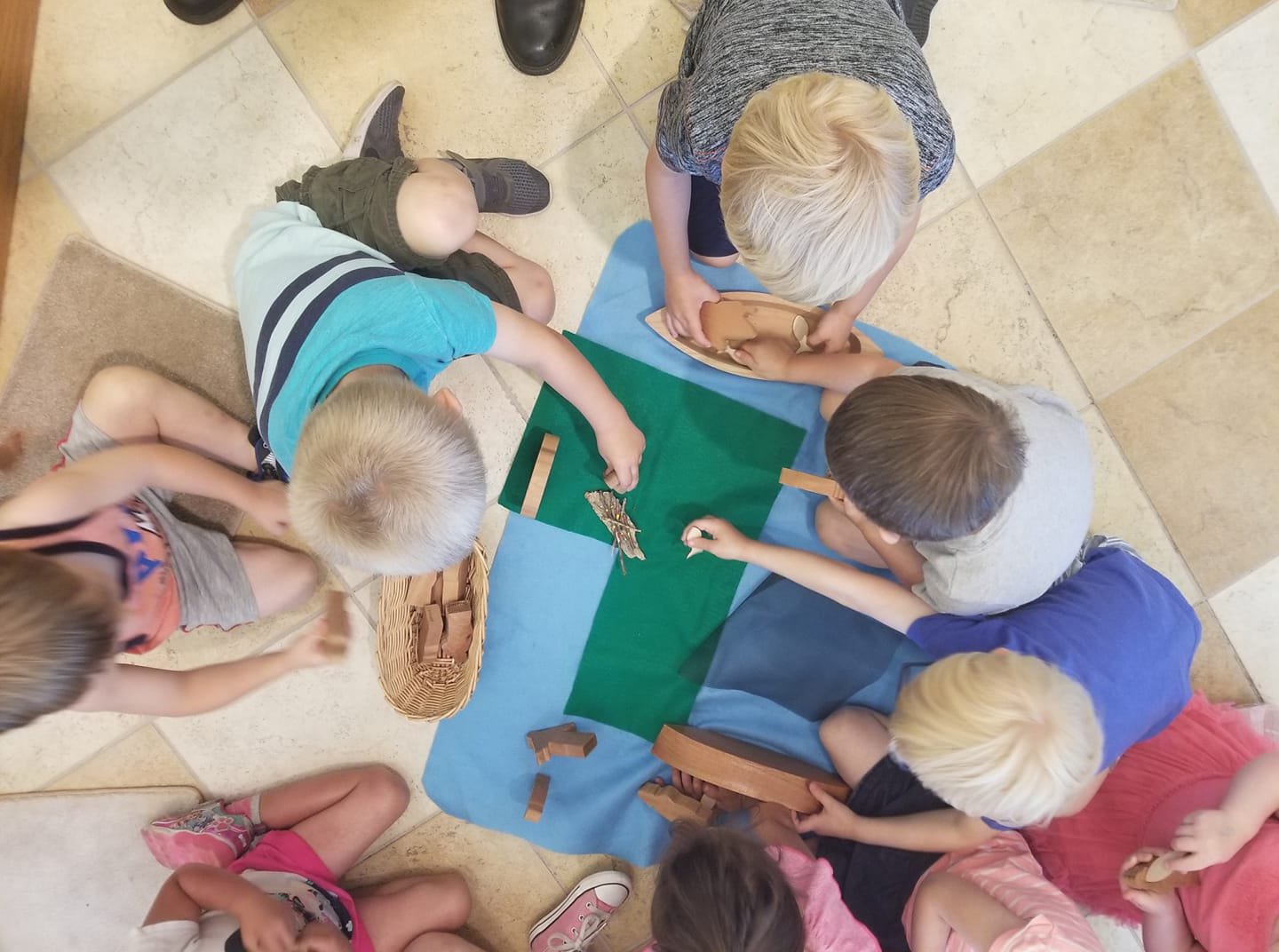
Yesterday at the Godly Play class Hickory Neck offers at The Kensington School, we finally got to tell the Epiphany story – the story of the magi visiting the Christ Child.  As we reviewed the whole story of Advent and Christmas, out came all the figurines of prophets, Mary, Joseph, Jesus, Angels, Shepherds, various animals, and wise men.  Typically, the teacher tells the story quietly, using the figurines, and then we have the kids retell the story, taking turns with the figurines.  And because the class has become so large, we usually have two sets of figurines so we can break into groups.  I would never say the class is perfectly orderly, but it is much more measured than you might imagine with two- to five-year-olds.

But not yesterday.  I’m not sure whether we, the leaders, were off our game, or the kids were still hyped up from returning from break, but the retelling portion of class was utter chaos.  Taking turns fell apart, quiet redirecting failed miserably, and by the time we regrouped to close the class, there was a mass of wooden, sacred figures in a disordered pile.  As we were making our way out, I looked at the pile sadly, grateful that they were all made out of sturdy wood and nothing more destructible, but somewhat disappointed to see such a holy mess.

But as I was thinking about the mess today, I was thinking perhaps my sadness at the chaos was my own “stuff,” having nothing to do with the success of the class.  Too often, we like our Gospel stories neat and tidy.  Too often we tell familiar scriptural stories expecting them to teach specific lessons.  But when we are honest, we know that is not how the Good News works.  The Good News upends worlds, upends social order, and upends our expectations.  Engaging with Jesus is messy work, and sometimes, in the midst of trying to figure out our faith, we end up with a messy rubble in front of us.

I do not know what you are you struggling with today – what things you wish were under control but are actually a mess, or what things you have been expecting from God that just are not how you expected, or what chaos others are making in your life that makes you feel bereft.  What I can tell you is that Christ is there, maybe a bit mired in the chaos too, but there nonetheless.  And sometimes, the mess is just what you need to shake you up and see the movement of God in a new and fresh way.  I suspect things will not turn out as you expect, but then, the Holy Spirit rarely works in ways we expect.  Sending you prayers today, that you might see Christ in the chaos!

Sermon – Luke 16.19-31, P21, YC, September 29, 2019

02 Wednesday Oct 2019

Posted by jandrewsweckerly in Sermons, Uncategorized

≈ Leave a comment

Tags

chasm, Christian, community, corrosive, dignity, goodness, Jesus, judgment, Lazarus, light, money, parable, rich man, scripture, Sermon, stewardship, wealth

I was listening to my favorite preaching podcast this week, which is hosted by three to four seminary professors and scholars.  Usually they spend about a third to half of the podcast talking about the gospel lesson, and then spend the rest of the time on the three other lessons.  But this week, the focus on the gospel was pretty truncated.  In fact, one of the scholars basically said, “If you are looking for some new knowledge or some hidden message in this gospel, there isn’t one.  This one is pretty straightforward.”[i]  After a convoluted, at times ambiguous, lesson last week about a crooked manager who gets praised for his deviousness, this week’s gospel has very little ambiguity.  You can almost hear echoes of Luke’s beatitudes from chapter 6, “Blessed are you who are poor, for yours is the kingdom of God….but woe to you who are rich, for you have received your consolation.”[ii]

We could easily read this parable about the rich man and Lazarus and think, “Wow that rich man really messed up; I am so glad I am not rich so I do not have to worry about that kind of poor behavior.”  But here is the thing:  Jesus is not telling a story about “that guy.”  The fact that Lazarus has a name but the rich man does not gives us a big interpretive tool for this parable.[iii]  This is not a parable about a man who messed up ages ago.  This is a parable for faithful people everywhere who daily must navigate the truth of scripture with the reality of being persons of wealth.  Our very citizenship in this country means that we are people of wealth.  We are the rich man.

So, if we are the rich man, what can we learn from him?  Unlike in our passage a few weeks ago, Jesus is not telling us to give up our possessions so we are no longer rich.  What Jesus is saying is our wealth will make behaving faithfully very difficult.  Later, Luke will tell us behaving faithfully with wealth will make getting into the heavenly kingdom as difficult as getting a camel through the eye of a needle.  Jesus warns us because wealth has a corrosive impact on our lives.  Wealth can make us confuse wants with needs.  Wealth can make us think we somehow deserve wealth – as if we did something to earn favored position in life, instead of blessing coming from the grace of God.[iv]  Wealth can deaden our empathy, turning us inward, slowly turning us into people who avert our eyes in the face of poverty, who dehumanize those in poverty, seeing them as servants instead of equals, who become convinced just being Christians and not living as Christians is enough.

We can see how the rich man in our parable gets there.  We are told his clothing is of fine quality.  He eats sumptuously every day.  He clearly ignores Lazarus, sitting by his gate every day.  We know he actively ignores Lazarus because we find later he knows Lazarus’ name without ever having reached out to him.  Even in his death, the rich man is buried with dignity and care.  Therefore, his behavior in Hades, or Sheol, should be no surprise.  Even in suffering afterlife, the rich man dehumanizes Lazarus.  He regards Lazarus as a servant and messenger who can be ordered around to bring him water or warn his brothers.  When your whole life has been blessed by wealth, slipping into a pattern of forgetting to respect the dignity of every human being is quite easy.

The judgment of the parable is both gentle and direct.  Beloved father Abraham, who gathers Lazarus into his bosom, still sees the humanity in the rich man.  Calling him “child,” he almost sadly has to remind him of his poor earthly behavior.  When the rich man desperately tries to help his living brothers, Abraham finally has to be firmer.  Like the beloved father he is, Abraham draws a definitive boundary.  As the rich man insists his brothers need a personal testimony to change their own wealthy behavior, Abraham reminds the rich man they have already been warned by Moses and the prophets. And if any of us wonder if Abraham is being overly dramatic, we need only catalogue the scripture lessons warning about wealthy behavior:  Exodus 22.21-22, 23.9, Leviticus 19.9-10, 19.33, 23.22, Deuteronomy 10.17-19, 15.1-11, 24.17-18, Amos 2.6-8, Hosea 12.7-9, Micah 3.1-3, Zephaniah, Malachi, Isaiah, Jeremiah, and on, and on, and on.[v]  And Abraham is not even talking about Jesus’ warnings.  Even later letters, like we heard today in the first letter of Timothy, take up the mantle.

So if our very citizenship makes us like the rich man, what can we do to resist the corrosiveness of wealth?  The gospel lesson today seems to suggest three things.  First, one way to combat the seductive lure of wealthy living is to root ourselves in Scripture and Christian community.  One of the things our Discovery Class attendees are learning is how steeped in Scripture Episcopal worship is.  Just by coming to church on Sundays, we hear a large portion of the Bible’s words.  Add in our songs and our prayers, and suddenly we find our liturgy is dripping with the words of Scripture.  Coming to church and hearing hard texts like this one and the ones we have been having for weeks, we find ourselves among a community of people who want to live life differently, and need Holy Scripture and each other to do that.  Of course, reading and praying with scripture and your Prayer Book outside of Sundays doesn’t hurt either.

Second, another way to resist the pull of wealthy living is to spend time examining the chasms in our lives.  Abraham insists Lazarus cannot help the rich man for many reasons; one of those reasons is the great physical, uncrossable chasm between the two realities the men now inhabit.  But that chasm is just a reflection of the chasm that existed on earth too – the rich man’s gate that prohibited connection, help, or even awareness of Lazarus’s suffering and need.[vi]  We create those same chasms, those same gates in our everyday lives too.  We ignore the dilapidated housing we pass on our drives, we allow ourselves to forget the vast number of students on reduced and free lunch in our schools, we choose homes and sidewalks that allow us to avoid the homelessness we meet every winter at the Shelter.  Today’s gospel lesson encourages us to use our eyes to see, really see, the gates we have built and to begin to dismantle them.

Finally, another way we fight the power of wealth is to use the wealth for goodness – to shine our light into the world, as our stewardship team will be encouraging us to do this month.  I know that kind of charge can feel overwhelming – we could give away every cent we have and not heal every Lazarus we meet.  I am not saying we should not use some of our wealth to try – whether we give to the Lazarus in front of us, the non-profits that create support systems for Lazaruses, or, and particularly important, we use our wealth to support this faith community:  the community that teaches us how to be faithful, that brings together the community of support we need to follow Jesus, and that propels us into the world as enlightened people of faith.  As the dishonest steward taught us last week, we can use our corrupting wealth for goodness.  We can use the precarious nature of wealth to be agents of light in the world – to shine our lights as Hickory Neck.

The work will be difficult.  Jesus assures us the work will be hard and shows us that reality in parable after parable.  But we are encouraged today because of the people in this room.  This is a community of people who not only give us a sense of belonging and support, this is also a community of people who have your back in figuring out this whole faithful Christian living thing.  This is a community of people who vulnerably, humbly, and joyfully are willing to walk with you.  We can shine our lights because each person in this room is shining their light too.  Together we can do the work to open gates, dismantle closed doors, and fill in chasms of separation.  Together we can turn the lure of wealth into a tool for goodness.  Together we can show the world another way, shining our lights.  Amen.


[i] Matt Skinner, “Sermon Brainwave #682 – Sixteenth Sunday after Pentecost (Ord. 26),” September 21, 2019, as found at http://www.workingpreacher.org/brainwave.aspx?podcast_id=1180 on September 24, 2019.

[ii] Luke 6.20, 24

[iii] Charles B. Cousar, “Exegetical Perspective,” Feasting on the Word, Yr. C, Vol. 4 (Louisville: Westminster John Knox Press, 2010), 117.

[iv] Fred Craddock, Luke, Interpretation: A Bible Commentary for Teaching and Preaching (Louisville:  John Knox Press, 1990), 196.

[v] Luke Timothy Johnson, The Gospel of Luke, Sacra Pagina Series, vol. 3 (Collegeville:  The Liturgical Press, 1991), 253.

[vi] Skinner.

← Older posts

Recent Posts

  • On the Myth and Magic of Advent…
  • On Risking Failure and Facing Fear…
  • Sermon – Luke 23.33-43, P29, YC, November 23, 2025
  • On Inhabiting Gratitude…
  • Sermon – Luke 20.27-38, P27, YC, November 9, 2025

Archives

  • December 2025
  • November 2025
  • October 2025
  • September 2025
  • August 2025
  • July 2025
  • June 2025
  • March 2025
  • February 2025
  • December 2024
  • November 2024
  • October 2024
  • September 2024
  • August 2024
  • July 2024
  • June 2024
  • May 2024
  • March 2024
  • February 2024
  • January 2024
  • December 2023
  • November 2023
  • October 2023
  • September 2023
  • August 2023
  • July 2023
  • June 2023
  • May 2023
  • March 2023
  • February 2023
  • January 2023
  • December 2022
  • November 2022
  • October 2022
  • June 2022
  • May 2022
  • January 2022
  • December 2021
  • November 2021
  • October 2021
  • September 2021
  • August 2021
  • June 2021
  • May 2021
  • April 2021
  • March 2021
  • February 2021
  • January 2021
  • December 2020
  • November 2020
  • October 2020
  • September 2020
  • August 2020
  • July 2020
  • June 2020
  • May 2020
  • April 2020
  • March 2020
  • February 2020
  • January 2020
  • December 2019
  • November 2019
  • October 2019
  • September 2019
  • August 2019
  • July 2019
  • June 2019
  • May 2019
  • April 2019
  • March 2019
  • February 2019
  • January 2019
  • December 2018
  • November 2018
  • October 2018
  • September 2018
  • August 2018
  • July 2018
  • June 2018
  • May 2018
  • April 2018
  • March 2018
  • February 2018
  • January 2018
  • December 2017
  • November 2017
  • October 2017
  • September 2017
  • August 2017
  • July 2017
  • June 2017
  • May 2017
  • April 2017
  • March 2017
  • February 2017
  • January 2017
  • December 2016
  • November 2016
  • October 2016
  • September 2016
  • August 2016
  • July 2016
  • June 2016
  • May 2016
  • April 2016
  • March 2016
  • February 2016
  • January 2016
  • December 2015
  • November 2015
  • October 2015
  • September 2015
  • August 2015
  • July 2015
  • June 2015
  • May 2015
  • April 2015
  • March 2015
  • February 2015
  • January 2015
  • December 2014
  • November 2014
  • October 2014
  • September 2014
  • August 2014
  • July 2014
  • June 2014
  • April 2014
  • March 2014
  • February 2014
  • January 2014
  • December 2013
  • November 2013
  • October 2013
  • September 2013
  • August 2013
  • July 2013
  • June 2013
  • May 2013
  • April 2013
  • March 2013
  • February 2013
  • January 2013
  • December 2012
  • November 2012
  • October 2012
  • September 2012

Categories

  • reflection
  • Sermons
  • Uncategorized

Meta

  • Create account
  • Log in
  • Entries feed
  • Comments feed
  • WordPress.com

Blog at WordPress.com.

  • Subscribe Subscribed
    • Seeking and Serving
    • Join 394 other subscribers
    • Already have a WordPress.com account? Log in now.
    • Seeking and Serving
    • Subscribe Subscribed
    • Sign up
    • Log in
    • Report this content
    • View site in Reader
    • Manage subscriptions
    • Collapse this bar
 

Loading Comments...