
• About

Seeking and Serving

~ seek and serve Christ in all persons

Seeking and Serving

Tag Archives: scripture

On Disagreement and Hope…

15 Wednesday Mar 2017

Posted by jandrewsweckerly in Uncategorized

≈ Leave a comment

Tags

Bible, Christian, clergy, community, conversation, disagreement, God, hope, interpretation, Jesus, love, protest, relationship, scripture, sexuality, witness

hope (1)

Photo credit:  www.gwinnettpl.org/nine-books-on-hope-in-troubled-times/

Last week, I received an email directed to local pastors from a fellow pastor.  He wanted to draw our attention to the fact that the local elementary schools would be hosting an author whose most recent book features a family with two gay dads.  He was upset that the author had been invited and upset that the school board and principals had not been more upfront about the invitation to the author to parents and the community.  His email was an invitation for the clergy to come together to discuss what we might be able to do to voice our protest.

There were several things that alarmed me in the communication.  First, as a pastor and parent, not only am I not opposed to the author coming, I am quite pleased that a non-heteronormative story is being featured in our schools.  Second, and more importantly, I was concerned about a group of clergy gathering to present to the community the voice of the clergy – as though we are all of one mind.  At first I thought I would email the pastor, and then I thought I should email the schools and board.  But then I realized, no email or letter could fully express my concerns, and that kind of one-sided communication often leads to misunderstanding and assumptions.  And so, I decided to go.

I did not make that decision lightly.  I have many friends and family members who have a very different interpretation of the Bible and the issue of sexuality than me.  I have engaged in some deeply hurtful conversations around those topics, and knew I could be walking into a lion’s den going to the meeting.  But I kept thinking of my goddaughter, raised by two incredibly loving men, who have created a home that is a shining example of Christ’s commandment to love God and neighbor.  And so, I went.

I suspected we were heading for trouble as I listened to people talking before the meeting about how Christian morals are being corrupted by the world.  But when the meeting started, things shifted.  The inviting pastor opened with scripture, and then asked us to pray for God’s guidance and for each member of the School Board.  Out of those prayers came the same words I always use when talking about the wideness of God’s love:  inclusivity, love, transformation, loving neighbor as self, being a witness to Christ’s love.  I was fascinated to see how two opposing opinions could be rooted in the same biblical text and the witness of Christ Jesus.  After our enlightening time of prayer, people began to speak.  Some of the concerns were quite legitimate:  a lack of transparency from the schools and board, a lack of intentional engagement with the parents around the choice of the author, and a lack of clarity around why the decision was made.

Of course, where we differed was in the result we desired.  I braced myself and shared with the group why I was there.  Much to my surprise, no one freaked out, no one condemned me for my different perspective, and no one shut down.  Most of the other pastors and lay leaders were quite clear that they believe that scripture should be interpreted differently than I do, but there was no hate or malice.  We even learned that another pastor in the room shared my viewpoint.

What I came away with from the meeting was a sense of hope.  I have never seen such civility, such Christ-like conversation, as I saw that day.  I have rarely seen people of radically different opinions be able to stay at the table without walking away.  We did not change each other’s minds, but we also did not denigrate or disrespect one another.  Suddenly it hit me:  if we could take that kind of civil, Christ-like engagement out into the world, that would be a much more powerful witness of Christ’s love than pastors simply telling people to love each other without actually doing it.  I could even envision the two groups peacefully gathered at a School Board meeting, calmly presenting our opposing views; not witnesses to whether or not an author should be invited into the schools, but witnesses to what holy conflict and conversation look like.  It was a beautiful image, and a wonderful counter to our current political climate.

Now, I do not know if that image will ever come to fruition.  I do not know if the relationship-building we discussed will ever materialize.  But if nothing else, the meeting taught me that there is hope.  There is hope that God can work in the midst of conflict and disagreement and transform it into something sacred.  There is hope that we as a people can engage with one another respectfully despite our differences.  There is hope that Christ can do infinitely more than we can ask or imagine.
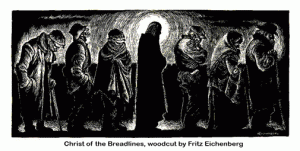
Sermon – Proverbs 31.10-31, Mark 9.30-37, P20, YB, September 20, 2015

23 Wednesday Sep 2015

Posted by jandrewsweckerly in Uncategorized

≈ Leave a comment

Tags

awe, capable, church, companionship, disciples, fear, God, grace, gratitude, humility, Jesus, joy, Lord, Mark, perfection, power, Proverbs, satisfaction, scolding, scripture, Sermon, strength, warrior-like, wife, woman, wonder

There are some Sundays when the scripture lessons appointed for the day are just right.  They speak truth to power or relate to a spiritual crisis in the community.  They shed light on a current event or they give pastoral words to aching hearts.  On those days, I am so grateful for the ways in which I see the Holy Spirit moving through the Church through the vehicle of scripture.  Today is not one of those days.  I read both our Old Testament and Gospel lessons this week, and my first reaction was, “Really?!?  THIS is what we needed to hear this week, God??”

The Old Testament lesson from Proverbs is actually one of my favorites – even though the lesson takes some deconstructing.  This passage is often referred to as the passage about the capable wife.  Now anytime the church starts talking about how women need to be wives and how those wives need to be “capable” I start getting defensive.  The good news is that the title is more the problem than the lesson itself.  The Hebrew word often translated as “capable” is better translated as powerful, strong, or even warrior-like.  This woman is a superhero.  She rises before dawn; manages a staff, ensuring her family has food and security; she purchases property and plants a vineyard with her own hands; she runs a thriving business, providing fine clothing for her family and the community; she is known for her wisdom and is happy and satisfied; and in her spare time, she is a shining example of philanthropy.  When you think about the traditional role of women in the patriarchal society of the time,[i] this woman is on fire.  She is an empowered woman, an equal partner to her husband, and is the master of both her home and her work outside of the home.[ii]  She is like Martha Stewart on steroids.

In the Gospel lesson, we find the disciples struggling yet again.  Jesus meets with the disciples and explains to them his fate.  And instead of asking Jesus what he means, they remain silent because they are too afraid to ask.  Actually, they do not remain silent.  Instead, they start bickering among themselves about who will be first in the kingdom.  I suppose that if the world is going to end, we might be similarly distracted.  But Jesus catches them arguing and shames them into true silence.  Not only does Jesus tell the disciples that they must strive to be last – servants of all; but also, Jesus tells them that in order to be a part of Jesus’ kingdom, they need to welcome children like they would welcome Jesus (which really could be interpreted as welcoming the poor, widowed, or disenfranchised).  So basically, Jesus tells the disciples they are a mess.  Not only are they not listening, they are distracted by their egos, and they are not attending to the one ministry he has called them to do.

So here is the challenge with these two lessons.  Basically, we take from the lessons that we are all too full of ourselves, we are distracted by the wrong things, we are not doing the work Jesus has called us to do.  And if we want to correct all of that behavior, we need to become warrior women and men – Martha Stewarts on steroids, showing everybody how it’s done.  Now I am not arguing that any of those points are not inherently truthful and are not lovely goals toward which we should strive.  What I am arguing is that I just did not want to hear them this week.  Here we are busting our buns to do the massive amount of work needed to pull off the Fall Fair.  Here we are busy kicking off the program year, with teachers preparing lesson plans, the choir readying music, and all our ministries being back on deck.  Here we are putting together last minute receptions for the bereaved, trying to complete a major construction project, and trying to ensure that we have enough funds to run our operations and enough energy to evangelize in our community.  And that is on top of all the work we are doing to get kids back to school, to reconnect with our community commitments after a summer hiatus, to make sure we are still performing well at work, to get our homes tidy and prepared for fall, and to squeeze in some football games.  In the midst of that chaos, the last thing I need to hear from church today is that my priorities are all wrong and that I need to work harder – a lot harder.  Thanks, but no thanks, Holy Scripture!

The good news is that there is good news.  For all the overwhelming work of the warrior-like woman in Proverbs and for all the scolding the disciples receive, the message from both lessons is clear and surprisingly manageable.  In Proverbs, the lesson concludes, “a woman who fears the Lord is to be praised.”  Now this is not the kind of fear we get when we talk about horror films, phobias, or abject worry.  The fear the passage is talking about is “awe, wonder, gratitude, and reverent humility before the Creator.”[iii]  Now fear of the Lord may sound like one more thing to add to the to-do list, but actually, fear is where the lessons are calling us to start.  You see, the disciples lacked a genuine fear of the Lord.  They were afraid in the more traditional sense – of what Jesus was talking about, of what would happen to them, of how they would ensure their own security.  They got wrapped up in themselves.  But if they had been wrapped up in awe, wonder, gratitude, and humility, all of the things Jesus had to instruct them to do would have come more naturally.  If they were in awe of Jesus, they would have easily been able to see how grateful they should be to have a Messiah who would sacrifice himself for them.  If they had been in wonder of Jesus, they would have simply been happy to be called a disciple, without worrying about their place or status.  If they had been full of gratitude, they would have already been welcoming children – and the poor, and the outcast, and the stranger.  The same sort of reversal is true for the warrior-like woman in Proverbs.  All of those amazing things she seems to accomplish in 24 hours happen only because of her reverence for God.  She is not favored because of all that she does.  She is able to do all that she does because she starts in a place of gratitude.  The rest flows easily out of that vantage point.

Today’s lessons are not about scolding us for how we get everything wrong, or about setting some impossible standard of perfection for us.  Instead, today’s lessons are about checking our baseline.  When our baseline is about awe, wonder, gratitude, and humility, we find living into Jesus’ instructions much easier.  When our baseline is about awe, wonder, gratitude, and humility, those astounding to-do lists and projects do not seem like burdens but gifts.  When our baseline is about awe, wonder, gratitude, and humility, church is not only a place we want to be, church is a place to which we are lovingly drawn.  That’s when that piece you were writing about stewardship doesn’t seem scary or even hard.  That’s when those sacred moments happen in Sunday School when a child or teen says something profound that stays with you all week.  That’s when you are up to your ears in stress about the Fair, and something funny – really funny – happens, and you and the other volunteers laugh so hard that you cry.  Holy Scripture today is not directing us down a path of guilt and shame.  Holy Scripture today is inviting us onto that path less travelled – the one that starts with awe, wonder, gratitude, and humility, and ends with grace, joy, companionship, and satisfaction.  I may not have wanted to hear our scripture lessons today.  But I needed to hear them.  My hope is that you can hear them in the spirit in which they were intended too.  Amen.

[i] Brent A. Strawn, “Commentary on Proverbs 31.10-31,” September 20, 2009, as found at http://www.workingpreacher.org/preaching.aspx?commentary_id=390 on September 18, 2015.

[ii] Telford Work, “Theological Perspective,” Feasting on the Word, Yr. B, vol. 4 (Louisville:  Westminster John Knox Press, 2009), 78.

[iii] Kathleen M. O’Connor, “Exegetical Perspective,” Feasting on the Word, Yr. B, vol. 4 (Louisville:  Westminster John Knox Press, 2009), 79.

Sermon – John 3.14-21, L4, YB, March 15, 2015

19 Thursday Mar 2015

Posted by jandrewsweckerly in Uncategorized

≈ Leave a comment

Tags

beloved, darkness, Divergent, God, insider, Jesus, John 3.16, judgment, light, outsider, repent, scripture, turn

Today we get one of the most beloved passages of Scripture.  Most everyone knows the line, “For God so loved the world that he gave his only begotten Son, that whosoever believeth in him should not perish, but have everlasting life.”  But even for those of us who do not know the words by heart, we have seen the marker “John 3.16” all over – at sporting events, on road overpasses, on tattoos, and on Tim Tebow’s face.  Even Episcopalians, who can rarely quote scripture citations, know this one.

What is funny about the popularity of this scripture verse is that this particular verse is one of the more complicated verses in scripture.  On the surface, the verse sounds full of promise:  God so loved; God so loved the world; God gave; So that believers should not perish; Everlasting life.  All those words sound wonderful.  They make God sound loving and generous.  They make life seem full of promise.  Why would you not want to parade John 3.16 around in celebration?

John 3.16 sounds wonderful until you really start to dissect the verse.  John 3.16 makes God sound loving, generous, and caring.  Until you read that one pesky clause, “everyone who believes.”  So God will love, be generous to, and give everlasting life to anyone in the world – as long as they believe.  But what about those who do not believe?  We all know lots of people who do not believe in Jesus Christ.  They are our neighbors, friends, family members, and classmates [colleagues].  Do we really believe God does not love them too?  All we have to do is read John 3.18 to learn that “those who do not believe are condemned already, because they have not believed in the name of the only Son of God.”

Now I do not know about you, but although this scripture lesson is known worldwide, and is beloved by many, I have never really felt comfortable with the implications of this passage.  I think two things either happen when we really start to look at this passage.  One, by recognizing that we are the “believers” of this passage, we both feel a sense of pride and acceptance and a sense of pity for the non-believers.  We feel bad for the non-believers, but we do not really know how to console them.  So we secretly just feel grateful and blessed, and wipe our hands clean of the non-believers.  They will have to fend for themselves.

The other way that many of us approach this text is that we sweep the verse under the rug.  We know a lot of other verses about God, and those verses tell us of a God whose love is much bigger.  We might imagine that there is hope for all the faiths of the world, and even for those without faith.  We prefer to focus on the part that says, “God so loved the world,” knowing the vast diversity of that world, preferring to imagine that our God is not a judgmental one, but a loving one.  And even if we concede that there might need to be some form of judgment, we will leave that judgment up to God.  We will let the business of who is in and who is out be God’s business, and we will just go on loving everyone anyway.

Either of those ways of thinking – the one where we pity the non-believers or the one where we brush aside the text – ignores the fact that those approaches come from the assumption that we are the insiders in this situation.  As Christians, we know that we believe in Jesus Christ.  So we must be the ones that John is talking about – the ones that God loves and saves, and to whom God gives eternal life.  But the problem with that underlying assumption is that the assumption puts us in a place of comfort, when, in fact, I think John 3.16 is supposed to put us in a place of discomfort.

In John 3.19-20, Jesus says, “…This is the judgment, that the light has come into the world, and people loved darkness rather than light because their deeds were evil.  For all who do evil hate the light and do not come to the light, so that their deeds may not be exposed.”  Instead of sitting on our comfortable “believer” cushion, I think what this passage is really inviting us to do is to recognize how we are in fact the people in the darkness.  We have been talking a lot in this Lent about our sinfulness – our separation from God and neighbor.  Our Lenten disciplines are meant to be ways for us to contemplate our sinfulness, to repent, and return to the Lord.  None of us is spared from being sinful.  We have all fallen victim to pride, envy, and hatred.  We have all had malicious thoughts and done hurtful things.  We have all forgotten about God, making our lives about our own wants and desires.  And I am sure many of us have had something in our lives that we have wanted to hide in darkness.  None of us feel entirely comfortable exposed, being bathed in light.  Like that makeup mirror that is just a little too bright, not many of us are ready to be seen under the bright light.

There is a book and movie series out called “Divergent.”  It is a dystopian, futuristic series that captures what happens when the world destroys itself and the society that is rebuilt to prevent such destruction from happening again.  Though the premise is a bit complicated, one of the pieces about the series I find fascinating is the presentation of one group who believes that the truth is the answer to solving the world’s problems.  So all the members of that particular group must take what is called a “truth serum.”  When they take the serum, they must then be asked a slew of questions before all the members of the group, including extremely personal and private questions.  The idea is that if all your secrets are exposed, there is nothing left to hide behind.  Everyone is on equal footing and no one can hide their true selves.

I imagine the world in that group from the Divergent series as being like the one that Jesus is talking about today.  We are people who would avoid a truth serum – who would avoid the light – because we do not want all of ourselves exposed.  There are some things – those really dark, embarrassing, or shameful things about our lives – that we do not want the world to know.  We like the dark, if for no other reason than we can hide those ugly parts of ourselves there.  In fact, we like keeping a little bit of darkness in our lives.  And I imagine most of us would quite quickly decline a truth serum.

If we can admit that truth – that part of us that prefers there be just a little bit of darkness for us to hide in occasionally – then we might be able to see why John 3.16 is so brilliant.  If we can be humble about our own darkness and our own sinfulness, and approach God in that way, then Jesus’ words are much more meaningful.  For those of us who have a bit of darkness in us, God so loved us that God gave up God’s only Son so that we might have eternal life.  In this way, John 3.16 is refreshing.  When we realize that we are the ones in darkness, John 3.16 does not make us feel self-righteous, pitying others.[i]  Instead, John 3.16 is a harbinger of light.  In fact, John 3.16 calls us into the light with the promise of love, forgiveness, and grace.  Once we get ourselves out of the “insider’s circle” this passage becomes much more redemptive and much more full of hope.  And perhaps that is the point.  Not to make us relieved because we are on the inside looking out, but to make us relieved because we are on the outside looking in – and being beckoned in by our Lord and Savior.  If we can come to see this passage in this light, then I say go ahead and get that tattoo, embroider that wall hanging, and even make that poster for the big game.  Perhaps your artwork will remind you to keep turning from the darkness and turning into the light.  Amen.

[i] This idea shaped by the conclusions made by Paul C. Shupe, “Pastoral Perspective,” Feasting on the Word, Yr. B, vol. 2 (Louisville:  Westminster John Knox Press, 2008), 120.

Homily – Hebrews 4.12–16, John Wyclif, October 30, 2014

05 Wednesday Nov 2014

Posted by jandrewsweckerly in Uncategorized

≈ Leave a comment

Tags

alive, challenge, change, comfort, God, homily, John Wyclif, question, scripture

Today we honor John Wyclif.  Born around 1330, John was educated at Oxford.  He served as a parish priest, but spent most of his vocation teaching theology and philosophy at Oxford and was celebrated for his academic achievements.  In 1374, Wyclif defended the Crown during a dispute with the papacy about finances.  This stance gained him a group of powerful patrons who were able to protect Wyclif.  This protected status gave him the freedom to try out his theological views, many of which were at odds with the medieval church.  Many of Wyclif’s ideas became the fodder for the reform movement in the following centuries.  In fact, later reformers like John Hus and Martin Luther acknowledged a debt to Wyclif.

Wyclif’s ideas may not seem radical now, but that is because they are a part of our Anglican identity.  Wyclif believed believers could have a direct, unmediated relationship with God, not needing intervention from the church or a priest.  He believed the national church should be free from papal authority.  He believed scripture should be available in the language of the people – and he translated the Vulgate into English.  He even questioned transubstantiation, which eventually gained him some enemies.

What I love about this feast day for Wyclif is that we get this lovely passage from Hebrews.  The lesson opens up with this line: “The word of God is something alive and active.”  So often we think about Holy Scripture as a static collection of books.  We might try to understand a passage, but often forget that Holy Scripture is alive and active.  Or perhaps we do not forget, but we long for scripture to be static and still, because if Holy Scripture stays the same, we can be comfortable and avoid change.

Once, when I was visiting a friend at Trinity Wall Street, she told me that the clergy have a lot of freedom there.  Because their funding comes from their huge investments, they are not dependent upon pledges for support.  And because they are not dependent upon pledges, they never have to worry about someone becoming upset and taking their pledge away.  I imagine that the clergy are much like Wyclif in his day – free to explore new concepts and ideas, and to challenge the status quo.  We know that when Wyclif did that, the church was transformed – it became alive and active like the Holy Scriptures.  That is our invitation today, too: to consider how our own faith life might become more alive and active, how the Holy Spirit might be working in us in new ways and to jump into the unknown.  Amen.

Homily – Psalm 1, Benedict of Nursia, July 10, 2014

23 Wednesday Jul 2014

Posted by jandrewsweckerly in Uncategorized

≈ Leave a comment

Tags

abundant, Benedict, God, homily, law, meditate, Nursia, Psalm, rule, scripture, space

“Happy are they who delight in the law of the LORD, they meditate on his law day and night.”  The psalmist tells us that those who meditate on the law day and night are like trees planted by streams of water, bearing fruit, with leaves that do not wither – and that everything they do shall prosper.  The image is a rich image – a tree planted near abundant water, with perfect produce and growth.  All we must do is meditate on the law constantly and this water and fruit will be ours – and everything we touch will turn to gold.

It sounds like a wonderful set of promises, and yet the promise hangs on one major task: to meditate on the law night and day.  Now I don’t know about you, but the only time I had to meditate on the law night and day was when I had an Old Testament final in seminary.  Most of us have full, full lives, and meditating on scripture is something we squeeze in  – if we are lucky.  We would love to be like those trees planted by water, and we would certainly love for everything we do to prosper.  But how can we access that kind of blessed abundance in the midst of our everyday lives?

Well, Benedict of Nursia, who we celebrate today, knew a little something about lives of meditation.  Benedict is generally known as the father of Western monasticism.  Born in 480, Benedict was disgusted by the life in Rome, which was overrun by barbarians.  His disapproval of the manners and morals in Rome led him to a vocation of monastic seclusion.  Others joined Benedict and he eventually developed a rule that has been used by religious around the world.  His rule structured the day with four hours of liturgical prayers, five hours of spiritual reading, six hours of work, one hour of eating, and eight hours of sleep.  His rule is intense and probably foreign to most of us, but his rule was also trying to create a life much like that tree in our psalm today.

The good news to me about Benedict’s Rule is that even Benedict does not meditate night and day – at least he gave his followers eight hours to sleep!  But both the psalmist and Benedict know that scripture gives us life.  Our invitation today is to consider how often we create space for God’s word in our lives.  The promise for us is an abundant, prosperous life of fulfillment with our LORD.  We are unlikely to take on Benedict’s Rule, but we can create a rule that fits our lives and invites that stream of water closer.  Amen.

On discomfort…

26 Wednesday Feb 2014

Posted by jandrewsweckerly in Uncategorized

≈ 4 Comments

Tags

discomfort, God, Good News, hypocrite, Jesus, need, neighbor, scripture, uncomfortable

I have regularly told people that when I preach, I am preaching to myself.  I find that my messages often resonate with others, but first and foremost, I make sure they resonate with me.  This has led to me needing to be honest about my faith struggles, to be vulnerable about how I still need to grow, and always seeking how God is speaking in fresh ways to me, calling me into deeper relationship with God.

This Sunday though, I found myself with a profound sense of conviction that I have yet to experience.  My sermon was about Matthew 5.38-48, and can be found here.  But what you would not know is that between our 8 am service and our 10 am service, a neighbor in need stopped by to ask if for financial assistance.  I had spoken with this neighbor before, and helped by covering the neighbor’s rent within the last month.  In general, I am able to help neighbors in similar situations because of my discretionary fund – a fund supported by the church and by contributions when I perform weddings or funerals.  But the fund is not large, and so my general policy is to keep within a certain range for each distribution of funds and to only offer assistance to the same family once every six months.  The idea behind the policy is that this allows me to help more families, and keeps enough monies in the fund for emergencies.  So when this neighbor came on Sunday, asking for further assistance, nowhere near the normal six-month wait period, the case seemed cut and dry to me.  I could not offer him what I would not offer to others.  Instead, I gave the neighbor some referrals for additional help, and we lit a prayer candle and prayed together before the neighbor left.

Courtesy of http://catholicworkeraustin.org/mercy.html

Courtesy of http://catholicworkeraustin.org/mercy.html

But the tricky part was getting back in the pulpit at 10 am.  I had just read aloud Jesus’ words from the gospel lesson, “Give to everyone who begs from you, and do not refuse anyone who wants to borrow from you.”  And I preached about seeing others with God’s loving eyes.  And though I felt like I was preaching the right message, and I know that ultimately I did the right thing with our neighbor, I still felt a little sick to my stomach.  As one who proclaims the Gospel, I felt like a hypocrite.  I remember wondering how if our neighbor had stayed for worship, whether the neighbor would have thought I was a hypocrite too.  And yet, I also felt an overwhelming sense that any kind of exceptions I had made that day would have undermined my ministry in our community.

I still have not come to peace about the situation.  I do not have some clean, clear answer that makes the situation feel resolved or redeemable, even if I still feel I made the right decision.  But in these last days, I have been thinking that perhaps my discomfort is the point.  I try regularly to find the Good News in scripture – to find where the hope might be in seemingly challenging or bad news.  But perhaps this week it is okay if I am just uncomfortable.  Perhaps we all need to dwell in the discomfort that the Gospel creates from time to time – only then can we be more authentic followers of Christ.

Sermon – John 1.1-18, C1, YA, December 29, 2013

08 Wednesday Jan 2014

Posted by jandrewsweckerly in Uncategorized

≈ Leave a comment

Tags

Christmas, God, Holy Family, Jesus, John, Mary, miracle, prologue, Rembrandt, scripture

A couple of days after Christmas, the all-Christmas-music radio stations have switched back to their normal formats.  At local stores, the Christmas rack of cards had been transformed to a rack of Valentine’s Day cards.  In our neighborhoods and among our friends and family, we have switched our greeting from, “Merry Christmas!” to, “Happy New Year!”  The world has moved on from Christmas, and yet, the Church is still dwelling in Christmastide – in fact we celebrate not just one day, but the famous twelve days of Christmas.  Our celebrations continue until those wise men arrive on the 6th, when we transition to Epiphanytide.  Today, after stories of shepherd, angels, and the holy family, we find ourselves not wondering what is next, but instead still pondering what has just happened.

For a reflection on what happens in Jesus’ birth, what better text than John’s prologue?  John takes us out of the stable, and invites us not to just consider the miracle of that holy night, but to consider the miracle of a God who takes on human flesh for us.  And so, instead of telling us about the earthly beginning of Jesus’ life, John takes us all the way back to the beginning of all things – that creative moment when the Word and God are together, making all life come into being.  “In the beginning was the Word, and the Word was with God, and the Word was God.”  The words sound beautiful, and John’s text is rich with meaning and interpretation.  But John’s words are also a little circuitous, repetitive, and a bit difficult to understand without reading them multiple times over.  The familiarity and beauty of the words may be soothing, but the meaning of those words sometimes eludes us.

As I sat pondering these words this week, I found myself drawn again to Rembrandt’s painting, “Holy Family,”[i]  In the foreground of the painting, Mary, who is bathed in light, has a well-worn book, perhaps scriptures, lying on her lap, held in place by one hand, as though she has been reading the book intently.  Her face, however is turned away from the weathered book, as her other hand lifts a blanket that is covering a cradle, revealing a sleeping, contented Jesus.  Behind Mary and Jesus, in much fainter light, Joseph is standing over a piece of wood that he is intently planing.  Meanwhile, in the top left corner of the painting, young cherubim are hovering around the scene with outstretched arms.

What I like so much about the painting is that Mary gives us a clue about how we are to understand John’s beautiful, but convoluted words today.  First, I am intrigued by the way Mary clutches her well-worn book.  In looking at her book’s worn edges, I am reminded of the Bible I used for my Education for Ministry class several years ago.  In EFM, you spend two years reading through the Old and New Testaments.  I remember how my homework for the class instructed me to highlight certain passages in different colors so I could track the different contributors to a text.  I remember writing notes in the margins of passages that stood out, held particular meaning, or raised questions.  I remember certain pages being soiled by the meal I tried to cram in while finishing my assigned reading for a particular session.  That Bible looked like a Bible someone actually lived with as opposed to the clean, commemorative ones I have on many of my shelves.

That is the way I imagine Mary treating her worn book.  As the one who ponders things in her heart, I imagine Mary also ponders scripture in her heart.  I imagine she pours over the texts as she looks for words to explain her experiences with Jesus or as she simply longs for words to describe her feelings toward the God who had done something so tremendous in her life.  As Mary seeks to understand the Word made flesh, perhaps she returns again and again to the words of scripture, trying to discern their meaning.  And given that she is a faithful Jew, she probably also does that pouring over scripture with her faith community, as they seek to always hear God’s word for the people.  Her community probably turns back to that creation narrative over and over again.  Her community probably turns back to the Law of Moses over and over again.  Her community probably turns back to the prophets over and over again.

Given her longing for scriptural insight, Mary likely would have appreciated John’s text today, even though John’s gospel was not written until about 60 years after Jesus’ death.  She would have already known the stories of Luke and Matthew because they are her story.  But our text by John today is an attempt to help all of us understand the magnificence of what happens when God takes on human flesh.  In fact, if Mary had been reading John, I imagine that the last line we hear is what draws her attention away from her well-worn book to look at the Christ Child himself in Rembrandt’s painting.  John writes, “No one has ever seen God.  It is God the only Son, who is close to the Father’s heart, who has made him known.”

Perhaps this text is why Rembrandt depicts Mary’s eyes wandering back to that cradle, her hand pulling back the blanket, and her mind not just worrying like any mother does over an infant, but her mind also worrying about what God is doing in this child of hers.  She wants to do more than read the words on the paper – she wants to read the Word, with a capital “W,” in her life.  She wants to gaze at the Word made flesh, who shines light into that dimly lit room and into the world.  She wants to not only know the Law of Moses, but to know the grace and truth that comes directly from the Word incarnate.

What Rembrandt depicts in his painting is perhaps where we find our invitation from John’s gospel lesson today.  In order to understand John’s language, we too are invited to create our own dialogue between the Word of Scriptures and the Word made flesh.  Studying both Holy Scripture and the Holy Child is how we come to understand challenging texts like John’s gospel.  For some of us, that invitation may seem as muddy as John’s gospel.  But what Mary does in Rembrandt’s painting is available for us today too.  We can “develop a richer, fuller faith by tending both to the Word through words and to the Word made flesh, the Christ who is with us in the sacraments, with us in prayer, with us in our church, with us in our friends, with us in the stranger, and with us in creation, since ‘all things came into being through him, and without him not one thing came into being.’”[ii]

For those of you still wondering what this life pattern still looks like, consider the ways in which we already live into this balance.  When we reach into our pockets a little deeper for those families in our neighborhood who are just struggling to put gas in the car and food on the table, honoring the holy in one another, we then turn back to Holy Scripture that tell us to care for the poor.  When we care for one another in this community, sharing our deepest pains and struggles, we then turn to back to Holy Scripture as we struggle to find words to verbalize our understanding of God in that pain and struggle.  When we come to this table, and consume the body of Christ in the bread, we then turn to Holy Scripture to understand what the Word became flesh means.  We gather today as a community of faith, both clutching the Word in Holy Scripture, and clutching Word in the Christ Child, knowing that we can never fully understand one without the other.  Amen.


[i] C. 1645.

[ii] Thomas H. Troeger, “Homliletical Perspective,” Feasting on the Word, Yr. A., Vol. 1 (Louisville: Westminster John Knox Press, 2010), 193.

Sermon – Luke 21.5-19, P28, YC, November 17, 2013

27 Wednesday Nov 2013

Posted by jandrewsweckerly in Uncategorized

≈ Leave a comment

Tags

God, Hurricane Sandy, Jesus, Precious Lord, prepare, scripture, Sermon, suffering, testimony, Thomas Dorsey, trust, words

“Blessed Lord, who caused all holy Scriptures to be written for our learning:  Grant us so to hear them, read, mark, learn, and inwardly digest them, that we may embrace and ever hold fast the blessed hope of everlasting life, which you have given us in our Savior Jesus Christ; who lives and reigns with you and the Holy Spirit, one God, for ever and ever.  Amen.”[i]  So on this day, when we celebrate Holy Scripture, praying one of my favorite collects, a day that we hear, read, mark, learn, and inwardly digest, imagine my intense dissatisfaction when I opened up the gospel lesson for this week.  I have been reading, marking, learning, and inwardly digesting all week, and this text still makes me uncomfortable.  On this day of celebrating Scripture, who wants to hear of collapsing houses of worship; false prophets that can lead us astray; wars, natural disasters, famines, and plagues; great persecution, including being betrayed by our very own family members?  And what is our reward for all this suffering?  All of this calamity will give us an opportunity to testify.  I do not know about you, but after having my church destroyed, navigating false prophets, fighting disasters, and dealing with persecution, testifying would be about the last thing on my mind.  In fact, I know a few Episcopalians who might even add testifying as one of the major types of tortuous, painful experiences. 

At Diocesan Convention this weekend, we watched a video about the Diocese of Long Island’s response to Hurricane Sandy one year ago.  The video began with news coverage leading up to the storm, during the storm, and immediately after the storm.  I have no idea why, but I found myself tearing up during the coverage.  I had forgotten all of the anxiety and stress that came from that storm.  I forgot about the utter despair and the feelings of helplessness – having friends try to contact me about how they could help, and yet, not even having power to be able to watch the news and see what was going on all around us.  I remember wanting to know what had happened to churches in the areas most impacted by the storm, but the Diocesan offices being crippled by their own lack of power and employees’ inability to get to work.  I remember wanting to help, but not being sure how to do that without electricity ourselves.  I remember being so cold at night without heat, and yet knowing that I was lucky to have an undamaged roof over my head.  I remember anxiously watching my car’s gas gauge approach empty – knowing the panic of gas lines, and how quickly stations ran out of gas.  The video brought all of those emotions bubbling up to the surface. 

But the video also offered a testimony.  After the storm, churches began opening doors for collections, housing, and powering stations.  Teams from churches headed to devastated areas to help demo and begin repairing homes.  Those too far from the action, offered up their space to electrical workers who had volunteered to help, but had been given no place to stay at night.  Our hospital in the Rockaways treated patients for three weeks solely on generator power.  A year later, people are still being helped as they repair homes, find new places to stay, and deal with the emotional ordeal.  In a time of great darkness, the Episcopal Church on Long Island began to find a way out of the darkness and into the light. 

One of the coordinators of the effort from the Diocese said that one of the things the Church had to learn to do was not to go into areas telling them how they were going to help – but instead had to simply show up and ask what people needed.  The representative said that this model made the work and efforts much more chaotic, but in the end, brought about the change that people really needed.  I could hear echoes of today’s gospel lesson in his words.  Jesus says, “Make up your minds not to prepare your defense in advance, for I will give you words and a wisdom that none of your opponents will be able to withstand or contradict.”  This strange gift of being able to testify is made even stranger by Jesus’ words – not only is our gift to testify in the midst of suffering, we are to force ourselves to not even prepare the testimony on the way – no thinking of anecdotes, no making outlines, no trying to even think about what we might say.  We must simply show up and trust that God will give us the words.

One of my favorite hymns is “Precious Lord.”  “Precious Lord,” is one of those songs that I can close my eyes to and just overflow with love and gratitude toward God.  Of course, my favorite version is not the version sung out of the hymnal, but by the great Al Green.  He breathes a life and joy into the song that we can rarely muster in church.  But this week, my appreciation for this favorite song grew infinitely when I heard the story behind the song.  The song was written by Thomas Dorsey.  Born in 1889 in rural Georgia, Dorsey was a prolific songwriter and excellent gospel and blues musician.  As a young man, he moved to Chicago where he worked as a piano player in churches as well as in clubs and theaters.  After some time, Dorsey finally devoted his talent exclusively to the church.  In August of 1932, Dorsey left his pregnant wife in Chicago and traveled to be the featured soloist at a large revival meeting in St. Louis.  After the first night of the revival, Dorsey received a telegram that simply said, “Your wife just died.”  Dorsey raced home and learned that his wife had given birth to a son before dying in childbirth.  The next day his son died as well.  Dorsey buried his wife and son in the same casket and withdrew in sorrow and agony from his family and friends.  He refused to compose or play music for quite some time. 

While still in the midst of despair, Dorsey said that as he sat in front of a piano, a feeling of peace washed through him.  That night, Dorsey recorded this testimony while in the midst of suffering:

Precious Lord, take my hand,

Lead me on, let me stand;

I am tired, I am weak, I am worn;

Through the storm, through the night,

Lead me on to the light;

Take my hand, precious Lord,

Lead me home.[ii]

In the midst of that darkest of times, Dorsey did not sit at that piano with a song all planned out.  In fact, if you had asked him to testify at that moment, he might have railed at the way that God and the world were treating him.  And yet, empty and vulnerable, God filled Dorsey with words that would touch people eighty years later, and would be sung by countless famous people over the years.

In the midst of darkness – of destruction, pain, suffering, persecution, even betrayal by those we love most – God gives us a testimony too.  And even more than a testimony, Jesus promises that we do not even have to prepare this testimony.  God will provide the words and the wisdom when we need them.  Our only mandate today is to hold fast to God in the midst of trials, to remain open to the movement of the Spirit, and to speak those words of truth and wisdom when we feel them spilling out of our mouths.  That time of testimony may not be before some king or governor demanding to hear about our faith.  But our testimony might spill out with a grieving widow or mother, a traumatized victim of natural disaster, or a friend who has felt disenfranchised by the Church.  We cannot prepare the testimony.  We cannot even try to craft a basic testimony story to be ready whenever we need the story.  Jesus tells us to “make up our minds not to prepare.”  This is perhaps one of the hardest challenges Jesus will give us, and yet, as we see in Dorsey’s testimony and the many other testimonies we have heard, when we yield that power to Christ, the real, vulnerable beauty of our story gives life to others and to us.  Amen.


[i] BCP, 236.

[ii] Story of Dorsey take from Nancy Lynne Westfield, “Pastoral Perspective,” Feasting on the Word, Yr. C, vol. 4 (Louisville: Westminster John Knox Press, 2010), 312.

Homily – Psalm 78.3-7, John Henry Hobart, September 12, 2013

26 Thursday Sep 2013

Posted by jandrewsweckerly in Uncategorized

≈ Leave a comment

Tags

faith, God, homily, John Henry Hobart, passion, scripture, story

The portion of the psalm that we read today tells a familiar story from Scripture.  From the beginning of our being a people of God, we have been instructed to tell the story – to pass from one generation to the next the salvation story of our God.  In the early days, before there were written Scriptures, I think it was actually easier.  People communicated through oral histories – the stories were burned in their brains and were as natural and familiar as breathing.  Even once the histories were written down, only a few could read, so the oral histories were essential.

Today we have lost that sure familiarity with Scripture.  It is a rare Episcopalian who can quote Scripture to anyone.  Though we have multiple copies of the Bible lying around, very few of us have ever read the Scriptures cover to cover – and if we have, we are surprised when we hear certain stories.  So given our lack of familiarity with Holy Scripture, it is no wonder that our ability to share the Good News is difficult for us.  We struggle not only to pass along the story to our children, but especially to pass along the story to total strangers.

John Henry Hobart, whom we celebrate today, had no such reservations.  Born in Philadelphia in 1775, John became a priest in 1801.  After serving in Pennsylvania, New Jersey, and Long Island, he was eventually consecrated Bishop of New York in 1811.  In his first four years as Bishop, John doubled the number of clergy and quadrupled the number of missionaries in the diocese.  Before his death in 1830, he planted churches in almost every major town in New York State.  He helped found General Theological Seminary and helped name Hobart College. John revitalized the church, and his zeal was respected by all.

Though John lived more than 200 years ago, his story still speaks to us today.  Along with our scriptural ancestors, these figures invite us to remember with zeal the God who loves us, who gives us life, and who saves us.  John and our ancestors invite us to reignite our passion for Christ and to let that passion overflow without self-consciousness or fear.  Why wouldn’t we want to share the Good News of all that God has done for us?  Our invitation is to remember, reconnect, and revitalize our faith today.  Amen.

Sermon – Acts 16.16-34, E7, YC, May 12, 2013

22 Wednesday May 2013

Posted by jandrewsweckerly in Uncategorized

≈ Leave a comment

Tags

bondage, freedom, Jesus, scripture, Sermon

If we were to break out a flip chart today and create two columns – one for those in bondage and one for those who are free – where would our main characters from Acts go?  At first glance, our “those in bondage” column might start with the slave-girl.  We are not even given her name.  She is simply called the slave-girl.  And we know from the story that she is a double slave – a slave to her owners who use her for money and a slave to the spirit of divination inside her.  Another addition to the “bondage” category might be Paul and Silas.  They are thrown into jail midway through our story, which clearly puts them in the bondage category.  Plus, the slave-girl calls them “slaves of the Most High God.”  The other column in our flip chart is those who are free.  We have several for that column.  There are those who own the slave-girl.  They are free to collect money for someone else’s performance, and they are free to get someone thrown in jail.  The judges who throw Paul and Silas into jail are also free – free to choose who is punished and who is not.  Finally, we might put the jailer into the free column as well.  He is a man with a steady, respectable job, who has power over those in prison.  So in the “bondage” column we have the slave girl, Paul, and Silas.  And in the “free” column we have the owners, the judges, and the jailer.

Most of us would certainly prefer to be in the “free” column on this chart.  The owners of the slave girl obviously have social capital and an income source.  They have influence and power, and up until Paul and Silas come along, they have the comforts of wealth.  The judges also have a great deal of respect and power in the community.  They are charged with keeping order in the community and protecting the community’s way of life.  Their roles in the community are admirable and secure.  Even the jailer has a clear sense of identity and purpose.  He may not have wealth and prestige, but he has a secure job and a sense of clear identity in the community.  He has a role that is understood and a vocation that is stable.  Meanwhile, the slave-girl is nothing like what we hope for ourselves.  Being possessed by a spirit and being owned by another individual do not usually make the top of our lists for happiness and fulfillment.  And in no way do we want to be like Paul and Silas, who not only seem to be homeless rebel-rousers, they also are physically brutalized and imprisoned.

The people in the “free” column are the people we most likely follow in our lives.  We want to be people with more money, with secure sources of income, and with power and influence.  We like independence and not being forced to rely on anyone else.  But we get so caught up in longing for these things in life that we sometimes forget the only desire that will make us whole – the desire for a deep relationship with Jesus Christ.  Even churches get trapped in desiring the wrong kind of freedom.  “If we just had as much money as St. Swithin’s, then everything would be fine.”  But the truth is that this kind of desire is never fulfilled.  Trust me, I have served at St. Swithin’s, and St. Swithin’s has just as many problems and stresses as we do every time budget talks come around.

Of course, like any good Bible story, appearances are not always as they seem.  The truth is that although we might put the slave-girl, Paul, and Silas in the “bondage” column, their true home is in the “free” column.  The slave-girl already knows the truth that no one else can see – that Jesus is the way to salvation.  And when she shouts that long and loudly enough, she is not only freed of her possession, she is free of the bondage of slavery – because her owners can no longer use her as they did before.  Even Paul and Silas, who are locked in jail, are in that “free” column.  What person, after being brutally whipped and thrown into a cold cell, can be found praying and singing praises to God in the middle of the night?  Only someone who is so free of the bondage of this world can be able to praise God in the midst of earthly suffering.

And of course, if those in our “bondage” column are actually in the “free” column, the same is true of those we originally put in the “free” column.  Those owners, who seem to have the earthly freedom of wealth, have actually become slaves to their wealth.  They are so enslaved to that wealth that when their source of income is freed, they lash out, bringing pain and suffering down upon others.  They cannot see the gift of freedom for the slave-girl; they only see the consequences for themselves.  The judges are no freer than the owners.  They are so enslaved to their rigid rules that they cannot see the inherent injustice that the slave-girl has faced for so many years.  Even the jailer is not truly free.  He is so caught up in his identity as a jailer that he is willing to take his life for his job.  He is ready to kill himself for what he thinks is a failure on his part than to see how this job has taken over his sense of identity.[i]

We do this too.  We are enslaved by our economies, our ways of doing things, and our senses of roles.  Think about the last party or gathering you attended.  What is one of the first questions someone asks to get to know a stranger?  “So, what do you do?”  We ask this question because our job or our role in society defines us in some way.  Several years ago, a friend of mine was going through a real low point in life.  She quit her job because she knew the job was not what she was called to do.  But she also had no idea what was next.  She was bold enough to say “no” to the old job, but was left clueless about what would be her next step.  This all happened when she was relatively new to a community, and still had not found a church home.  She confided in me that she had stopped looking for a church home because she got so tired of stumbling through an answer at coffee hour when she was repeatedly asked, “So, what do you do?”

So if we are enslaved by our ways of being, how can we get out of our bondage?  Our first cue comes from Paul and Silas.  Paul and Silas could have easily fled that jail when the earthquake happened.  They could have sped past the jailer, and been focused solely on their own self-preservation.  But we see that there is a peace in Paul and Silas that comes from true freedom.  Instead of weeping and plotting in that cell, they sing and pray to God.  Instead of running when the doors fling open, they ensure that the jailer is okay.  Instead of demonizing the jailer, they offer him baptism.  This is what true freedom looks like.[ii]

How do we get to this true freedom?  The jailer gives us the second cue.  The jailer asks Paul a simple question, “What must I do to be saved?”  In order to be saved, to gain that true sense of freedom, we must ask for help like the jailer asks for help that day.  Whether we ask a friend, a stranger, or God, we must ask for help.  This is not always easy for us.  We will have to risk our pride and we will have to trust others.[iii]  But asking for help is that first step in the journey out of the “bondage” column and into the “freedom” column.

Our invitation today is two-fold.  First, our invitation is to consider the ways in which we have become enslaved – the ways of being that we have assumed that have created a life of bondage.  That recognition leads to our second invitation – the invitation to ask for help, to trust in another to guide us into the freedom that can only come from Christ.  When we do those two things, we can know the peace of freedom that we see in scripture today.  Amen.


[i] David G. Forney, “Pastoral Perspective,” Feasting on the Word, Yr. C, Vol. 2 (Louisville: Westminster John Knox Press, 2009), 526.

[ii] L. Gregory Jones, “Come, Lord Jesus,” Christian Century, vol. 109, no. 16, May 6, 1992, 485.

[iii] Frederick Buechner, as found on http://www.frederickbuechner.com/content/weekly-sermon-illustrations-jailer on May 7, 2013.

← Older posts
Newer posts →

Recent Posts

  • On the Myth and Magic of Advent…
  • On Risking Failure and Facing Fear…
  • Sermon – Luke 23.33-43, P29, YC, November 23, 2025
  • On Inhabiting Gratitude…
  • Sermon – Luke 20.27-38, P27, YC, November 9, 2025

Archives

  • December 2025
  • November 2025
  • October 2025
  • September 2025
  • August 2025
  • July 2025
  • June 2025
  • March 2025
  • February 2025
  • December 2024
  • November 2024
  • October 2024
  • September 2024
  • August 2024
  • July 2024
  • June 2024
  • May 2024
  • March 2024
  • February 2024
  • January 2024
  • December 2023
  • November 2023
  • October 2023
  • September 2023
  • August 2023
  • July 2023
  • June 2023
  • May 2023
  • March 2023
  • February 2023
  • January 2023
  • December 2022
  • November 2022
  • October 2022
  • June 2022
  • May 2022
  • January 2022
  • December 2021
  • November 2021
  • October 2021
  • September 2021
  • August 2021
  • June 2021
  • May 2021
  • April 2021
  • March 2021
  • February 2021
  • January 2021
  • December 2020
  • November 2020
  • October 2020
  • September 2020
  • August 2020
  • July 2020
  • June 2020
  • May 2020
  • April 2020
  • March 2020
  • February 2020
  • January 2020
  • December 2019
  • November 2019
  • October 2019
  • September 2019
  • August 2019
  • July 2019
  • June 2019
  • May 2019
  • April 2019
  • March 2019
  • February 2019
  • January 2019
  • December 2018
  • November 2018
  • October 2018
  • September 2018
  • August 2018
  • July 2018
  • June 2018
  • May 2018
  • April 2018
  • March 2018
  • February 2018
  • January 2018
  • December 2017
  • November 2017
  • October 2017
  • September 2017
  • August 2017
  • July 2017
  • June 2017
  • May 2017
  • April 2017
  • March 2017
  • February 2017
  • January 2017
  • December 2016
  • November 2016
  • October 2016
  • September 2016
  • August 2016
  • July 2016
  • June 2016
  • May 2016
  • April 2016
  • March 2016
  • February 2016
  • January 2016
  • December 2015
  • November 2015
  • October 2015
  • September 2015
  • August 2015
  • July 2015
  • June 2015
  • May 2015
  • April 2015
  • March 2015
  • February 2015
  • January 2015
  • December 2014
  • November 2014
  • October 2014
  • September 2014
  • August 2014
  • July 2014
  • June 2014
  • April 2014
  • March 2014
  • February 2014
  • January 2014
  • December 2013
  • November 2013
  • October 2013
  • September 2013
  • August 2013
  • July 2013
  • June 2013
  • May 2013
  • April 2013
  • March 2013
  • February 2013
  • January 2013
  • December 2012
  • November 2012
  • October 2012
  • September 2012

Categories

  • reflection
  • Sermons
  • Uncategorized

Meta

  • Create account
  • Log in
  • Entries feed
  • Comments feed
  • WordPress.com

Blog at WordPress.com.

  • Subscribe Subscribed
    • Seeking and Serving
    • Join 394 other subscribers
    • Already have a WordPress.com account? Log in now.
    • Seeking and Serving
    • Subscribe Subscribed
    • Sign up
    • Log in
    • Report this content
    • View site in Reader
    • Manage subscriptions
    • Collapse this bar
 

Loading Comments...