• About

Seeking and Serving

~ seek and serve Christ in all persons

Seeking and Serving

Tag Archives: secular

Sermon – Luke 2.8-20, Blue Christmas, December 21, 2024

12 Wednesday Feb 2025

Posted by jandrewsweckerly in Sermons

≈ Leave a comment

Tags

Blue Christmas, Christmas, church, comfort, God, grief, hope, light, paradox, sacred, secular, Sermon, sit, unsettling

Christmas is a funny thing.  Christmas is simultaneously soft and loud, comforting and unsettling, hopeful and demoralizing.  Some of that paradox comes from the Christmas story itself, but some of that paradox comes from our hopes and memories of Christmas verses our lived experience of Christmas.  I remember all the loveliness of Christmases past:  of familiar foods shared, of gifts exchanged, of the aunts and uncles verses cousins football games in our grandparents’ yard.  But as I aged, the veneer wore off:  aunts and uncles divorced, hurtful things were said and done, and older generations began sharing the “behind the scenes” version of our Christmases that I never knew – and wished I didn’t know now.  And, slowly, I began reshaping what Christmas meant for the next generation – with a sense of certainty about what I wanted them to experience and a sense of anxiety that they might someday lose the magic of a once special time. 

We hold this Blue Christmas service every year because somewhere in the midst of shopping, caroling, worshiping, and partying, our world – both the secular one, with Hallmark movies and glossy advertisements, and sometimes even our sacred one, with familiar carols and perfect pageants – our world offers us dissonance.  In the merry making, there is little room for the parts of us that are not merry – whether those parts are due to lingering Christmas grievances, visitations from the grief fairy when we least expect her, economic pressures and worldly anxieties, the open wounds from the brokenness of our country from a nasty political year, or relationships that are broken or are limping along.  The world and even the Church rarely makes space for our inability to fully embrace the merriness of Christmas. 

As I pondered this disconnect this year, I stumbled on a reading from Gertrud Mueller Nelson.  Nelson describes about this time of year – of this season of shortened days and lessened light, “Pre-Christian peoples who lived far north,” she writes, “and who suffered the archetypal loss of life and light with the disappearance of the sun, had a way of wooing back life and hope.  Primitive peoples do not separate the natural phenomena from their religious or mystical yearning, so nature and mystery remained combined.  As the days grew shorter and colder, and the sun threatened to abandon the earth, these ancient people suffered the sort of guilt and separation anxiety, which we also know.  Their solution was to bring all ordinary action and daily routine to a halt.  They gave in to the nature of winter, came away from their fields and put away their tools.  They removed the wheels from their carts and wagons, festooned them with greens and lights, and brought them indoors to hang in their halls.  They brought the wheels indoors as a sign of a different time, a time to stop and turn inward.  They engaged the feelings of cold and fear and loss.  Slowly, slowly, they wooed the sun-god back.  And light followed darkness.  Morning came earlier.  The festivals announced the return of hope after primal darkness.

This kind of success – hauling the very sun back:  the recovery of hope – can only be accomplished when we have the courage to stop and wait and engage fully in the winter of our dark longing.”  Nelson goes on to say, “Perhaps the symbolic energy of those wheels made sacred has escaped us and we wish to relegate our Advent wreaths to the realm of quaint custom or pretty decoration.  Symbolism, however, has the power to put us directly in touch with a force or idea by means of an image or an object – a “thing” can do that for us.  The symbolic action bridges the gulf between knowing and believing.  It integrates mind and heart.  As we go about the process of clipping our greens and winding them on a hoop, we use our hands, we smell the pungent smell that fills the room, we think about our action.  Our imagination is stirred.

Imagine what would happen,” Nelson adds, “if we were to understand that ancient prescription for this season literally and remove – just one – say the right front tire from our automobiles and use this for our Advent wreath.  Indeed, things would stop.  Our daily routines would come to a halt and we would have the leisure to incubate.  We could attend to our precarious pregnancy and look after ourselves.  Having to stay put, we would lose the opportunity to escape or deny our feelings or becomings because our cars could not bring us away to the circus in town.[i]”

In some small way, that is what tonight does.  Tonight, we take the wheel off our cars, and place the wheel in the wreath right here in this little chapel.  We take away our ability to bustle about, and we sit.  We sit in the dark, we sit in our discomfort, and we sit in our un-merriness.  We take time, listening to a story about some shepherds who were similarly uncomfortable in the dark of night, dirty among their sheep, in the fields – doing their daily, maybe sometimes demoralizing, work of shepherding.  We pray, we mark our specific sense of loss or pain with the lighting of candles, and we bless our lack of merriment – we receive permission to tarry for a while in the darkness.  We do that all because we know that after today, the light will start to come a little earlier, will start to last a little longer, and will start to kindle hope in us.  We may not yet be ready to leave this place, glorifying and praising God like those shepherds.  But we are able to receive the gift of this sacred inside time, knowing that light is coming – that days are coming when we, too, will remember joy, and life, and praise.  We tarry here because this is where we also find hope.  That is the Church’s gift to you tonight – space and a tiny little sliver of hope.  Come, gather by the wheel, and tarry a bit longer.  Amen.


[i] Gertrud Mueller Nelson, To Dance With God: Family Ritual and Community Celebration (Mahwah, NJ:  Paulist Press, 1986), 63, as quoted in An Advent Sourcebook, Thomas J. O’Gorman, ed. (Chicago:  Liturgy Training Publications, 1988), 141-142.
Sermon – Mark 13.24-37, A1, YB, December 3, 2023

06 Wednesday Dec 2023

Posted by jandrewsweckerly in Sermons

≈ Leave a comment

Tags

Advent, anxious, beauty, children, Christmas, church, discipline, gift, important, Jesus, loud, noise, quiet, sacred, secular, Sermon

I live a very loud life these days.  Whether it’s the morning hustle to get everyone to school, or the evening jockeying for showers, rushed dinners, or one last FaceTime with friends, my house can be a constant source of shh-ing, pleading for less noise, or reminders to close doors to contain volume.  That is not to say that all the noise in our home is unpleasant – there is also the noise of laughter, dance parties, and storytelling.  But if you are looking to set up a yoga mat or trying to meditate, my house is not the place I would necessarily recommend. 

I sometimes blame all the noise in my life on my beloved children.  But the truth is I am as much a cause of the noise as they are.  I am admittedly loud myself – whether barking instructions around the house, singing aloud, or simply talking my husband’s ear off.  But I am not just loud in the house – I am also loud inside my head.  My mind is in constant conversation:  my to-do list, searching for ideas for a blog post, worrying about a sick friend or parishioner, trying to make plans for the weekend, processing a troublesome conversation, or wallowing in guilt for missed exercise or time in prayer.  As loud as my outside world is, my inside world is probably much worse.  Add Christmastime to the mix, and the loudness of my life reaches levels that can be incapacitating.

That is why I love Advent so much.  In the lead-up to Christmas, the outside world bombards us with noise:   Christmas songs on the radio, shopping to complete, parties to attend, gifts to wrap, houses to decorate, gatherings to host, cards to send, and loud relatives or friends to entertain.  In contrast, the Church at this time asks us to do the exact opposite:  slow down, take a breath, light some candles, breathe in the fresh greenery, sing quiet, meditative songs, and worship in the soothing blue of anticipation.  When the outside world is telling us, “Do more, buy more, run more, fuss more, stress more,” the Church says, “Do less, worry less, run less, talk less, be busy less.”  The contrast between the two worlds is like night and day, and at a time of high stress, Advent becomes the Church’s greatest gift to us. 

Into this contrast, we hear words from Mark’s gospel today.  The text says, “Beware, keep alert; for you do not know when the time will come.  It is like a man going on a journey, when he leaves home and puts his slaves in charge, each with his work, and commands the doorkeeper to be on the watch.  Therefore, keep awake– for you do not know when the master of the house will come, in the evening, or at midnight, or at cockcrow, or at dawn, or else he may find you asleep when he comes suddenly.  And what I say to you I say to all: Keep awake.”  Many of us hear this text today with a sense of anxiety – of needing to keep anxious watch for the Lord.  We might imagine the many apocalyptic movies, predictions, and preachers we have witnessed over the years and wonder whether Jesus really does want us to be more alarmed.  Certainly the outside world would have us also be alert and anxious for the coming Christmas. 

But I think the Church is saying something else today.  Instead of an anxious alarm, our gospel lesson sounds like a gentle reminder to me.  Keep awake, for you do not want to miss the quiet beauty of Advent.  Keep awake, for you do not want to miss the gift of time set apart in these four weeks.  Keep awake, for you do not want to miss the lead in to the manger, the dramatic retelling of why the manger is so important, and the grounding for this entire season.[i]  Jesus’ words for us to “keep awake,” are not meant to be one more anxiety to pile on top of a mound of concerns.  Jesus’ words for us to “keep awake,” are meant to help us focus on what is really important. 

So, make a commitment to come to church each Sunday in Advent and spend those Sundays in quiet worship with your church community.  Grab an Advent calendar or devotional to help you more intentionally mark the days leading up to the manger.  Or set up that Advent wreath at home, so that you might bring the quiet candlelight of prayer and meditation to your home.  Whatever the discipline, choose something this Advent that will help you maintain the quiet peace you find here at Church and carry that quiet peace throughout your weeks leading up to Christmas.  My guess is that noise of life will slowly fade into a quiet hum in the background – which is right where it should be.  Amen. 


[i] Lillian Daniel, “Pastoral Perspective,” Feasting on the Word, Yr. B, Vol. 1 (Louisville: Westminster John Knox Press, 2008), 22.

Sabbatical Journey…on Embracing Both-And

06 Thursday Jul 2023

Posted by jandrewsweckerly in reflection

≈ Leave a comment

Tags

both-and, church, college, intellectual, Jesus, Notre Dame, sacred, secular, spiritual

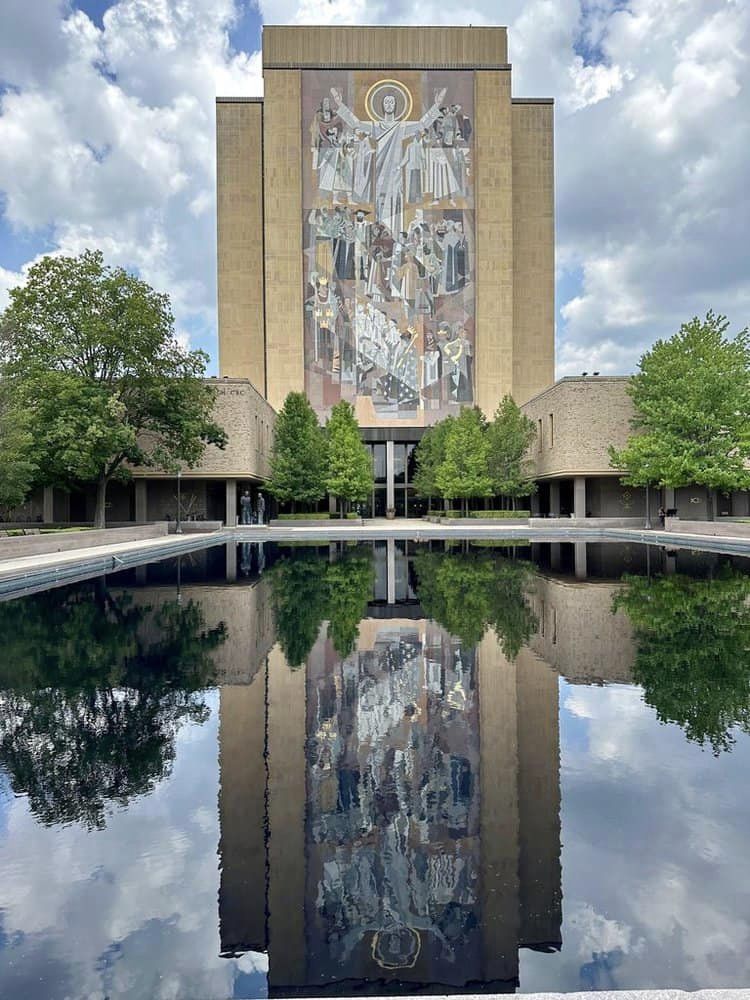
Touchdown Jesus (photo by Emily Liechty; reuse with permission)

In our sabbatical travels today, we met up with friends on the campus of Notre Dame.  None of us knew much about the college except their history of football prowess, their religious roots, and their devoted fans.  But a tour taught us so much about their history and current student experiences.  We learned that about 80% of the current students are Roman Catholic, there are chapels in every dorm, Mass is offered nearly 160 times per week, and we lost count on the number of Marys we saw on campus.  We also learned how many of the art pieces on campus have football references:  Touchdown Jesus, First Down Moses, and Holy Handoff.  But even more intriguing is the equal focus on academics, service, and community.

When I was in college, I quickly realized that being an active person of faith put me in the minority.  Academics were important, as was an active social life.  But religion, despite the prominence of Duke Chapel on campus was sort of an awkward subject.  I found a community among campus ministry, but the idea of chapels in dorms, or regularly offered masses was unimaginable.  Because I was involved in campus ministry, particularly at a university with a Divinity School, I received a balance between faith and intellect.  In fact, that balance is probably what shaped my own call to ministry.  But my experience was certainly not the norm.

Notre Dame seems to have found the art of “both-and.”  Notre Dame is both a religious institution and an institution focused on academic excellence.  Notre Dame has managed to embrace both athletics and the intellect (although, the construction of first stadium had to be funded by the first football coach because the administration thought it was more important to teach young men).  Notre Dame has managed to embrace both religious devotion and self-deprecating humor.

I wonder what lessons the larger Church might take from Notre Dame.  Where might we need a fuller embrace of the “both-and” mentality?  How might we be both fully faithful and fully of the world?  I imagine in order to share the Good News of Jesus in Christ, we might need to hone our ability to embrace the both-and of sacred and secular.


On Ghosts, Goblins, and Community…

03 Thursday Nov 2022

Posted by jandrewsweckerly in reflection

≈ Leave a comment

Tags

affirming, busy, care, community, Halloween, Holy Spirit, hospitality, parenting, sacred, secular, stranger

Photo Credit: https://windows10spotlight.com/images/cd4207053ac7aaa6212c99ef8a230cfb

Sometimes, when parenting children, you tend to operate in a haze.  In trying to harmonize work, family life, and everything else, you can become partially present in the parenting moment.  Halloween can be one of those instances.  In the rush of everyday responsibilities, you need to decorate the house, sweep off the driveway, purchase and prep candy for distribution, ensure your kids have all the costume parts they need (sometimes mending, gluing, pinning them at the last minute, or figuring out how to do their makeup), oh, and find that trick-or-treat bag they want from last year.  There is coordinating with other parents so your kid can walk with their friends, the needed photos, and the constant reminders to say “trick or treat!” and “thank you!” 

Fortunately, the Holy Spirit is always at work, giving us moments of the sacred in even the most hectic secular experiences.  This Monday, I was in that Halloween haze myself, trying to send off my older child, praying she made good choices, and accompanying my younger child, soaking up the chance to enjoy the night with her.  As we made our way from house to house, the sacred was slowly revealed.  I noticed as parents walked with their children, they connected more meaningfully than in our quick hellos at the bus stop and coordinating texts for playdates.  As homeowners emerged from their homes, I watched older adults light up with the chance to interact with children, I saw parents of older children wistfully watch the littles as their older children were too far past this precious time, and I noticed singletons relishing a chance for social interaction.  I was in the midst of community at its finest:  strangers extending hospitality, cross-generation lovingkindness, and deeply felt smiles. 

I know Halloween has pagan roots, and the Church, as it always does, worked to Christianize the day of All Hollows Eve.  We even have some neighbors who do not participate in the ritual of trick-or-treating out of Christian protest.  But when you strip away all the scary characters, fear-inducing movies, and sacrilegious legends, what remains is one of the best of examples of genuine Christian community.  Somehow, political differences fade, generational biases are set aside, and interpersonal anxieties ease, and what remains is an activity that allows for humble, gracious, affirming hospitality and care.

I wonder how we might foster those same sorts of conditions in our Church communities.  My church’s mission is focused on intergenerational ministry.  Sundays often demonstrate those values as intergenerational ministry blooms.  But the experience of trick-or-treating this year has me wondering what more we can do to create space where strangers can enjoy loving, affirming moments of intimacy and care with neighbors.  My prayer is the Holy Spirit works through our busy hazes to reveals those opportunities for all of us.

Sermon – Luke 9.28-36 (37-43), TRS, YC, February 27, 2022

25 Wednesday May 2022

Posted by jandrewsweckerly in Sermons

≈ Leave a comment

Tags

comfort, Elijah, empowerment, Epiphany, escape, Jesus, Moses, sacred, secular, Sermon, Transfiguration, weary

Well, we finally made it.  After a season of epiphanies about Jesus:  from the Magi with gifts, the voice of God at Jesus’ baptism, the water into wine, the fishes bursting from nets, and lessons about life with Jesus from the Sermon on the Plain, we get to the mother of all epiphanies – Transfiguration Sunday.  In this event is everything we need to know about Jesus.  Luke tells us everything starts with prayer – life with Jesus is rooted in prayerful relationship with God.  Then, Jesus’ divinity is revealed as his entire appearance changes, with everything becoming dazzling white.  Moses and Elijah appear, which many argue represents the prophets and the law confirming Jesus’ identity and significance.  We even hear a conversation between the three figures about Jesus’ pending journey to Jerusalem and ultimate departure.  And, as if we needed to know even more about who Jesus is, God comes down in a cloud and says, clear as a bell, “This is my Son, my Chosen; listen to him!”  We can’t get a lesson more epiphanic than this!

This story in Luke is so dramatic, that the lectionary says we can skip the next seven verses.  If you notice in your bulletin, those verses are in parenthesis.  And if I am really honest, as your preacher, I seriously considered eliminating those verses today.  I wanted to stay on that mountaintop with Peter, John, and James.  I want to be overwhelmed by the majesty of the moment, I want to gobble up the crystal clarity of this event, I want to breathe in the confidence of that comes from knowing this is the Messiah, the answer.  I might even want to build those dwellings or booths Peter is talking about for Jesus, Moses, and Elijah.  This is a mountain of wonder, of joy, of understanding, of specialness, of the sacred.  I want to stay here.

But the text is not having such comfort today.  Nope, in Luke, the very next thing that happens after this rich, shocking, full epiphany and the disciples’ stunned silence, is they go back down the mountain and face another person who needs to be healed.  And this is not a simple request for healing, but a report that the man begged Jesus’ disciples to cast out the demon first, but they could not.  So not only do Jesus and his disciples go back to work, but also we learn that the disciples are not very good at the work.  In other words, they have work to do.

Sometimes, when we are tired and weary – and believe me, we have had a lot of tired and weary in the last two years – in those times we slip into the mode of thinking Church is an “escape from” place.  We face illness, and death, and war, and suffering, and poverty, and discrimination, and persecution, and brokenness every single day of the week, and we just want our mini-Easter on Sundays.  We want to climb a mountain, pray with Jesus, and bask in Jesus’ radiance.  And that is okay.  Luke would not tell us so many times in his gospel that Jesus escapes to pray if Jesus’ praying (and our praying) were not important.  But the danger in thinking of Church as an “escape from” place is that we risk not seeing the brilliance of Jesus in all the other days.

A couple of weeks ago, I was at a doctor’s office that serves patients from a broad range of socioeconomic backgrounds.  One such client had arrived for one of the daily walk-in appointments only to be told arriving at 9:00 am meant he had missed the available appointments.  The staff very graciously gave him a list of other places he could try and encouraged him to come back earlier next time.  The client sat there a bit stunned and dejected and I began to avert my eyes to give him some privacy for his grief.  But a minute or so later, an older gentleman came up to him and asked to see the paper the staff had given him.  He proceeded to show the younger man which alternatives were best, and then whispered the secret that although the staff said to come at 7:00 am, the real trick was to arrive by 6:00 am.  The young man’s face slowly relaxed under the loving tutelage of his elder fellow struggler in life.

Luke does not leave us on the mountaintop because Luke knows the danger the artificial divide between the sacred and the secular.  As scholar Debie Thomas warns, “Desperate for the mountain, we miss the God of the valley, the conference room, the pharmacy, the school yard.”[i]  The story of the healing in the valley is the “so what?” of this last grand epiphany story before we head into Lent.  “The story of the transfiguration of Jesus loses its power if [the transfiguration] does not include that moment when Jesus and the disciples come down from the mountain.”  By seeing Jesus differently today, we are enabled to see ourselves and others differently too.[ii]  We are able to see God in an elderly struggling man taking a young struggling man under his wings.  We are able to see God in the way an older child shepherds a younger child to Children’s Chapel.  We are able to see God in our gut-wrenching conversations of the presence of evil in the world and how to navigate war in a way that demonstrates all life is sacred.

This week, our invitation is to take this hour not as an “escape from” but as an “empowerment to” – an empowerment to go out in the world seeing the God of the valley, the God of the medical clinic, the God of the grocery store, the God of the Zoom meeting, and to be agents of God in all those places.  We come from a long line of disciples who were not always good at healing the suffering of this world.  But we enter a season of intentionality in these coming six weeks that will embolden us to keep trying.  We know from this hour of empowerment who Jesus is.  Now we get the chance to show Jesus’ face to others in our everyday lives.  Amen.


[i] Rohr summary about the sacred and the secular and quote from Debie Thomas, “Down from the Mountain” February 19, 2022, as found at https://www.journeywithjesus.net/lectionary-essays/current-essay?id=2944 on February 26, 2022.

[ii] Lori Brandt Hale, “Theological Perspective,” Feasting on the Word, Year C, Vol. 1 (Louisville: Westminster John Knox Press, 2009), 456.

Homily – Advent L&C, A1, YC, December 2, 2018

05 Wednesday Dec 2018

Posted by jandrewsweckerly in Sermons, Uncategorized

≈ Leave a comment

Tags

Advent, breathe, gift, God, grounding, Holy Spirit, Jesus, Lessons and Carols, peace, prepare, sacred, secular, Sermon

This school year, our younger daughter’s preschool offers a weekly yoga class.  She has shown me all sorts of fun poses, but my favorite part is the yoga breathing she is learning.  The first time she showed me, I was so excited.  I have wanted to give my children the gift of cleansing breathing since they were born.  That same breathing had gotten me through each pregnancy in my prenatal yoga classes.  I knew how restorative that kind of breathing could be.  But I was not sure the practice would stick – I mean, how many mellow, breath-controlled preschoolers do you know?  So, imagine my surprise a few weeks ago, when my daughter was in the midst of an epic ramp up and all of a sudden, she stopped and said, “Wait!”  I froze, and watched her close her eyes, take in a deep breath, and slowly let the breath out.  “Do you want to do another one?” I tentatively asked, afraid to spoil the magical moment.  She closed her eyes again, drew in a slow breath, and let the breath back out.  She opened her eyes and smiled at me.  Temper tantrum and tension gone, a renewed, calmed child remained.

I do not know about you, but I find myself longing for the deep calming breaths that Advent can offer us too.  Normally, we as a country take a sacred moment at Thanksgiving, gathering with loved ones, sharing a meal, saying prayers of Thanksgiving.  But we only get the one day – sometimes only a half-day.  Because the retail industry wants us to forget about Thanksgiving, and jump right into Christmas shopping.  They lure us in with sales and deals, and they know we either need to occupy all those loved ones who came into town – or we need to escape them, and so we hit the pavement, get bombarded with Christmas tunes, see trees and towns already decorated, and our minds start to cloud with a huge, percolating to-do list.

But this year, with Thanksgiving earlier in November, we got an extra week – an extra Sunday that was not Advent 1, an extra week before we even entered December, and an extra week to breathe before the chaos really begins.  Our secular calendar seems to finally be in sync with our liturgical calendar – the calendar that tells us to use this season of Advent as a time, not of preparing the hearth, distributing the gifts, and attending the parties, but instead, preparing our hearts, distributing acts of grace, and attending the path leading to the Christ Child.  The secular calendar seems to be inviting us to do the same thing the liturgical calendar invites us to do – to take a breath, to ground ourselves, to breathe in some peace.

That is why we start Advent today with Lessons and Carols.  Lessons and Carols is a service different from other Sundays.  We do not introduce the lessons in the same way.  We hear more music.  We squeeze in moments of silence.  We do not receive the holy meal.  The church offers us this totally different service as a way of saying this season is totally different.  And then, the service walks us through all the ways this season is different.  This season is not just baby Jesus in a manger.  This season is remembering Adam and Eve’s sinfulness, remembering the promises God makes over and over to redeem God’s people, remembering the amazing, terrifying moment when a baby in a womb was the worst and best thing to ever happen, and then to remember that in the child we are anticipating, the kingdom of God comes near.  In order to even consider that grand, sweeping narrative, we have to let go of some things – let go of how we always do things so that we can be graced with the way God is doing things.

That is my hope for you this Advent season.  That you might take a cue from the extra week you just received from the secular calendar and use that week as your grounding for a calmer, more intentional, more life-giving, breathing season.  Breathe in the presence of our God, and breathe out the self-doubt, self-criticism, and self-pity.  Breathe in the coming of the Christ Child, and breathe out the busyness, consumerism, and forced good cheer.  Breathe in the calming, unifying Holy Spirit, and breathe out the sins, disrespect, hurtfulness of yesterday.  You might open your eyes and realize the gift of Advent is way better than any gift you will get this Christmas.  Amen.

On Saints and Community…

01 Wednesday Nov 2017

Posted by jandrewsweckerly in Uncategorized

≈ Leave a comment

Tags

All Hallows' Eve, All Saints Day, care, community, connect, feast, God, good, Halloween, joy, sacred, saints, secular

Halloween-trick-or-treat-hours

Photo credit:  kanecountyconnects.com/2016/10/complete-list-of-halloween-trick-or-treat-hours-in-kane-county-communitys-2016/

I have never been one for promoting the spirituality of All Hallows’ Eve.  I have done children’s liturgies before, but I always suspect that the lure of trick-or-treating is too strong to encourage people to fast on October 31st.  As an adult, I have never been that into Halloween either.  I never dress up or throw big parties.  As a parent, I take the kids out, and we have candy to pass out at our home, but besides the promise of candy being around, I do not get too invested in the holiday.

But last night, something powerful clicked for me.  We live in a neighborhood that is very easy to walk with kids, and our youngest is old enough that she is starting really enjoy door-to-door trick-or-treating.  As we walked, I realized something new was happening.  Everyone in the neighborhood was genuinely engaged.  Adults made eye contact with one another, smiling and greeting with a heartiness I had not seen before.  Older members of our neighborhood were delighting in the children, making connections over costumes and candy.  Most of the time, I think of our neighborhood as being the place where we live.  But last night, our neighborhood felt like a community:  a community of people who care about each other, want to connect with each other, and are happy to share a little bit of joy in a sometimes very disappointing world.

Though our neighborhood was doing something entirely secular, there was something sacred about our interactions last night.  Though we were not fasting for All Hallows’ Day, our honoring of each other was a way of preparing me for today’s feast day.  Our connections last night made me realize how connected we are to the saints:  people who seem totally unlike us, whose lives feel disconnected from our own, and yet, whose stories bring us comfort, encouragement, and assurance.  The communion of saints makes us realize how much larger our “community” really is, and how full of goodness and hope it can be.  If you are longing for that kind of connection to the saints, or even a connection to a modern community, I hope you will join us tonight as we celebrate All Saints Day.  Come feast on the holy meal, share a good word, and look into the eyes of those who see you for what you are:  a beautiful child of God to be honored and celebrated!

Homily – II Cor. 9.6-15, Thanksgiving Day, YA, November 27, 2014

03 Wednesday Dec 2014

Posted by jandrewsweckerly in Uncategorized

≈ Leave a comment

Tags

abundance, God, homily, sacred, secular, share, thankful, Thanksgiving Day

One of the funny things about being a priest is the way that everyday people interact with me.  The funniest experiences occur when people first find out I am a priest.  I love seeing the raised eyebrows or hearing the stammers as someone panics about any inappropriate things they might have said in the first ten minutes of our conversation.  Parties with strangers or our children’s school gatherings are always fun as people try to figure out how they should modify their behavior in front of me.  In fact, many of my single and dating priest friends have avoided the conversation altogether about what they do for a living, hoping that the other person will get to know them for who they are, not just what they do.  There really is a sort of cultural divide that I forget about until I get in one of these situations and then have work with someone to create a sense of comfort and commonality.

That cultural divide is no more obvious than on a holiday like Thanksgiving Day.  Today we gather to celebrate what is mostly a secular holiday.  This day has become a day about an abundance of food, watching parades and football, enjoying fellowship with friends and family, and post-turkey naps.  This is a day of giving thanks for the good things of life, but often in a secular way.  I know many people who have a tradition of going around the table and saying something for which they are thankful.  But those things are usually listed without a mention of God.  In fact, the non-specific nature of gratitude this day is what makes it a perfect day for interfaith groups, like our own Plainview-Old Bethpage Interfaith Group, to celebrate – because we can all recognize in our own different ways our gratitude and thanks.

But for us Christians, this day is a little different.  We may do all the same activities: feast, fellowship, and fun; but we also root those activities in gratitude toward God – the source of all our blessings.  For us, today is not just a day to be grateful for the good things in life, but to be thankful to God for our blessings.  That may sound like semantics, but I think that, especially today, our language matters.  So we can still go around the table listing our blessing, but we also acknowledge that God is the source of those blessings.  We can still enjoy a feast, but we begin our meal in a prayer that thanks God for the bounty of the earth, the hands that touch our meal in its many stages, and for the privilege and pleasure of good food.  We can still watch the game or the parade, but we are grateful to God for the blessing of shelter and the disposable income to afford that television and cable service.  And we can still enjoy the company of friends and family because we know that God blesses us with companions on our journey.

So why does our naming God today matter?  What difference does our calling this a sacred day have to do with anything?  The difference is that when we name God in the midst of blessing, there is a “so what?” attached.  Our epistle lesson says today, “God is able to provide you with every blessing in abundance, so that by always having enough of everything, you may share abundantly in every good work.”  In other words, when we give thanks today, that is not the end of the story.  When we give thanks today, God is well pleased.  And God also expects us to share that abundance with others.  As the epistle says, our blessing is not strictly for us.  Our blessing is given to us so that our blessing might be a blessing to others.

And that is why we mark this day as a sacred day.  Because if Thanksgiving Day is simply a secular day of being grateful, the day begins and ends with us – our experiences, our gratefulness, our happiness.  But if we celebrate Thanksgiving Day as a sacred day, then the day may begin with us, but the day ends with others – our blessings overflowing to bless others.  That is the true abundance of Thanksgiving Day.  The abundance cannot be contained.  In fact, our epistle lesson says that the more we pass along our abundance, the more that abundance grows, “The one who sows sparingly will also reap sparingly, and the one who sows bountifully will also reap bountifully.”  So, go home and enjoy all the blessings of this day – and then share those blessings bountifully.  Amen.

Love and marriage…

06 Wednesday Aug 2014

Posted by jandrewsweckerly in Uncategorized

≈ 1 Comment

Tags

anniversary, church, community, God, love, marriage, sacred, secular, vows

Courtesy of http://www.carbonfiberweddingbands.org/wedding-bands/

Courtesy of http://www.carbonfiberweddingbands.org/wedding-bands/

This week my husband and I celebrated thirteen years of marriage.  A few friends asked me what romantic plans we had, and I found I had to do some explaining.  You see, twelve years ago, on our first wedding anniversary, we found ourselves at an impromptu family reunion.  At the time, we reasoned that we would just celebrate our anniversary some other time.  But a few days later, as we talked about the reunion, we realized something.  Our wedding was a celebration not only of our love and commitment and the covenant we were entering into, but also a celebration of the community who was vowing to hold us to our covenant – to support us, love us, and encourage us in the good and bad times.  In that light, it seemed completely appropriate that we would celebrate our anniversary in the same fashion as we celebrated our wedding – surrounded by the community that holds us accountable to our vows.

Ever since the first anniversary, we have made a point of celebrating our special day with others.  Sometimes the gathering has been large; sometimes quite small.  Sometimes we have celebrated with family, and sometimes we have celebrated with friends.  We have celebrated our anniversary with people who did not even know us when we got married, and we have celebrated with people who knew us before we knew each other.  Each year, the celebration reminds us of the blessing of friends and family in our lives and how we could not grow and thrive in marriage with the support of a lot of others.

What I like about the tradition we have developed is that the tradition pushes against secular expectations.  Secular expectations tell us that we should have a dreamy, romantic night with expensive gifts exchanged (don’t get me wrong – I am all for date nights and presents!).  Secular expectations would tell us that marriage is private.  But that is not what the Church tells us.  Sacred expectations are that marriage is blessed within the context of a community.  Sacred expectations are that the community should ask how marriages are going – not just to gossip or vent, but to continue to live into the vow that the entire community takes to help marriages thrive.

So today, I ask for your prayers: prayers that my husband and I might continue to find joy in one another, might continue to find love and support in our marriage, and might glorify God in our life together.  In return, I lift up prayers today for all my friends who are married:  those who are in those first years of wedded bliss, those who are struggling with all sorts of marital challenges, and those who are just treading water.  I also lift up prayers for those who long to be married, but have not found a partner; for those who have lost their spouses to death; for those who are divorced; and for those who long to be married legally but still live in places where that is not an option.  We are all the community of faith, and we all need one another.  I thank God for all of you today!

Homily – John 6.57-63, Clement of Alexandria, December 5, 2013

13 Friday Dec 2013

Posted by jandrewsweckerly in Uncategorized

≈ Leave a comment

Tags

Clement of Alexandria, experience, faith, gifts, God, homily, Jesus, questions, sacred, secular

Today we honor Clement of Alexandria, priest and philosopher in the mid-to-late second century.  Clement was originally a Greek philosopher who sought truth in many schools until he met Pantaenus, head of a Christian school in Egypt.  Clement later became head of that school and was for many years an apologist for the Christian faith to both pagans and Christians.  His background and abilities helped him to commend Christianity to the intellectual circles of Alexandria.  He had a liberal approach to secular knowledge and his work prepared the way for Origen, one of the most eminent theologians of Greek Christianity.

We honor Clement today because he did what so many of us simultaneously hope to do and fear to do.  We long to share our faith experiences with both the Christians and non-Christians in our lives.  We have had some incredible encounters with God and we want to share that experience with others.  And yet we fear sharing because we worry that people may ask us questions we cannot answer.  We worry we do not have the intellectual acumen of Clement to tie together our experiences in a logical way.

Perhaps we feel a bit like the disciples in John’s gospel today.  As Jesus explains that he is the bread of life meant to be consumed, the disciples complain, “This teaching is difficult; who can accept it?”  Their complaint is not hard to understand – I am sure any of us hearing Jesus’ metaphor for the first time would be especially baffled.  All we need is one hearty experience trying to explain to a child that a wafer is Jesus’ body and we all get a little nervous about this crazy faith of ours.

In the midst of our hesitancy, we find encouragement through Clement.  Clement gives us permission to interweave our sacred and secular worlds.  Clement used his gift – the gift of a brilliant secular mind – to interpret his faith and make it accessible to the faithful and those without faith.  God gives each of us similar gifts too.  God empowers us with “spirit and life,” as Jesus Christ says.  God gives us a unique spiritual journey that can speak truth because ultimately we, too, are a mixture of sacred and secular: who better to interpret this crazy world and our crazy faith than us?  Clement invites us to share our own truths with others – knowing that our truth is a part of the bigger truth of Jesus Christ.  Though we may not have everything figured out, we have experienced enough of God in us, and we have been given gifts to enable us to share that truth with others.  Amen.

← Older posts

Recent Posts

  • On the Myth and Magic of Advent…
  • On Risking Failure and Facing Fear…
  • Sermon – Luke 23.33-43, P29, YC, November 23, 2025
  • On Inhabiting Gratitude…
  • Sermon – Luke 20.27-38, P27, YC, November 9, 2025

Archives

  • December 2025
  • November 2025
  • October 2025
  • September 2025
  • August 2025
  • July 2025
  • June 2025
  • March 2025
  • February 2025
  • December 2024
  • November 2024
  • October 2024
  • September 2024
  • August 2024
  • July 2024
  • June 2024
  • May 2024
  • March 2024
  • February 2024
  • January 2024
  • December 2023
  • November 2023
  • October 2023
  • September 2023
  • August 2023
  • July 2023
  • June 2023
  • May 2023
  • March 2023
  • February 2023
  • January 2023
  • December 2022
  • November 2022
  • October 2022
  • June 2022
  • May 2022
  • January 2022
  • December 2021
  • November 2021
  • October 2021
  • September 2021
  • August 2021
  • June 2021
  • May 2021
  • April 2021
  • March 2021
  • February 2021
  • January 2021
  • December 2020
  • November 2020
  • October 2020
  • September 2020
  • August 2020
  • July 2020
  • June 2020
  • May 2020
  • April 2020
  • March 2020
  • February 2020
  • January 2020
  • December 2019
  • November 2019
  • October 2019
  • September 2019
  • August 2019
  • July 2019
  • June 2019
  • May 2019
  • April 2019
  • March 2019
  • February 2019
  • January 2019
  • December 2018
  • November 2018
  • October 2018
  • September 2018
  • August 2018
  • July 2018
  • June 2018
  • May 2018
  • April 2018
  • March 2018
  • February 2018
  • January 2018
  • December 2017
  • November 2017
  • October 2017
  • September 2017
  • August 2017
  • July 2017
  • June 2017
  • May 2017
  • April 2017
  • March 2017
  • February 2017
  • January 2017
  • December 2016
  • November 2016
  • October 2016
  • September 2016
  • August 2016
  • July 2016
  • June 2016
  • May 2016
  • April 2016
  • March 2016
  • February 2016
  • January 2016
  • December 2015
  • November 2015
  • October 2015
  • September 2015
  • August 2015
  • July 2015
  • June 2015
  • May 2015
  • April 2015
  • March 2015
  • February 2015
  • January 2015
  • December 2014
  • November 2014
  • October 2014
  • September 2014
  • August 2014
  • July 2014
  • June 2014
  • April 2014
  • March 2014
  • February 2014
  • January 2014
  • December 2013
  • November 2013
  • October 2013
  • September 2013
  • August 2013
  • July 2013
  • June 2013
  • May 2013
  • April 2013
  • March 2013
  • February 2013
  • January 2013
  • December 2012
  • November 2012
  • October 2012
  • September 2012

Categories

  • reflection
  • Sermons
  • Uncategorized

Meta

  • Create account
  • Log in
  • Entries feed
  • Comments feed
  • WordPress.com

Blog at WordPress.com.

  • Subscribe Subscribed
    • Seeking and Serving
    • Join 394 other subscribers
    • Already have a WordPress.com account? Log in now.
    • Seeking and Serving
    • Subscribe Subscribed
    • Sign up
    • Log in
    • Report this content
    • View site in Reader
    • Manage subscriptions
    • Collapse this bar
 

Loading Comments...