• About

Seeking and Serving

~ seek and serve Christ in all persons

Seeking and Serving

Tag Archives: see

Sermon – Luke 17.11-19, P23, YC, October 12, 2025

15 Wednesday Oct 2025

Posted by jandrewsweckerly in Sermons

≈ Leave a comment

Tags

blessing, duty, God, gratitude, Jesus, lenses, lepers, see, Sermon, sight, stewardship, Thanksgiving

Several years ago, A.J. Jacobs wrote a book called Thanks a Thousand.  Jacobs had decided that he loved his daily cup of coffee from his local coffee shop so much that he wanted to thank every person who made the cup of coffee possible.  His book journals what started out as that simple premise that became a journey around the world.  You see, he could easily thank the barista he saw every morning.  But then he realized he should thank the owner of the shop for the shop existing in the first place.  From there, he realized the owner had a graphics designer who designed the logo, and there was company that made his coffee cup that carried that logo.  He eventually recalled the beans for the coffee came from somewhere – and there were hundreds of people who moved the beans from tree to harvest to packaging to shipping to storage and to distribution.  And that didn’t include those who made sure the city had clean water that was used to combine beautifully with beans to make his daily beloved cup of coffee.  Each thank you – often received with confusion, surprise, mystification, and occasional delight – led to another individual for Jacobs to thank.  Jacobs had read that the practice of gratitude could change your life, and slowly, he began to find that genuine gratitude made him kinder, happier, and gave him the opportunity to make an impact in the world.  Gratitude helped him to see the world differently.

In our gospel lesson today, ten lepers experience a miraculous healing through Jesus.  Jesus sends the lepers to the priests and they become clean along the way.  But only one of the lepers actually sees that he is healed.  We are told that because he sees, he turns back, praises God, and prostrates himself at Jesus’ feet, thanking him.  Now, to be clear, the other nine lepers do nothing wrong.  In fact, they follow Jesus’ instruction explicitly and enjoy being healed.  The promise made to them is fulfilled.  The tenth leper – a Samaritan of all people – though sees.  And when he returns to give thanks, he is blessed a second time.  David Lose explains, “Jesus concludes his exchange by inviting the man to rise and go on his way and saying that his faith has made him not only physically well, but also whole and, indeed, saved.  That’s part of the complex and multivalent meaning of the Greek root word σoζω (transliterated as “sozo” and pronounced “sod-zo”) Jesus uses.”[i]  That second blessing does not happen though without the act of seeing.

The Samaritan leper experienced a second blessing much like A.J. Jacobs experienced a second blessing.  Once Jacobs began his coffee gratitude journey – thanking all those folks who made that perfect cup of daily coffee – he began to see just like the leper.  His eyes were opened to the powerful work of God by the simple act of gratitude.  Scholars across the centuries have noted how deeply faith and gratitude are linked.  “Karl Barth was fond of saying that the basic human response to God is gratitude – not fear and trembling, not guilt and dread, but thanksgiving.  ‘What else can we say to what God gives us but stammer praise?’ [Barth says.]”  C.S. Lewis “also observed the connection between gratitude and personal well-being.  [He said,] ‘I noticed how the humblest and at the same time most balanced minds praised most:  while the cranks, misfits, and malcontents praised least.  Praise almost seems to be inner health made audible.’”[ii]  The entire enterprise of thanking thousands of people for his cup of coffee was A.J. Jacobs’ attempt to correct his vision so that he might cultivate a healthy practice of faith.

The Stewardship team at Hickory Neck this year has been doing the same thing.  They have been working to help us better see God in this place we keep returning to.  Today you will receive a packet of information meant to engage your vision.  In the packet will be testimonies of how much this community has impacted the lives of your fellow parishioners.  You will find a visual representation of how every dollar is stretched to make possible the goodness we experience here.  You will find an invitation to respond to your own gratitude to Jesus for the many blessings in your faith journey by committing your time, your talent, and your treasure –not out of a sense of duty, but because you have seen goodness here, and gratitude is bubbling out of you.  And in case all those invitations into seeing differently are not enough, our Stewardship team will be bringing back to you the stories of your fellow parishioners in their own words.  Each week, you will be sent videos on what they are calling Motivational Mondays and Faithful Fridays – videos of your fellow parishioners describing how their devotion to generosity has richly blessed their faith journey.

In the coming weeks, you may be tempted to do what the nine lepers do – to dutifully follow Jesus’ invitation to go and be healed – and simply open your stewardship packet and return the commitment card and time and talent form.  And doing so would not be wrong at all – in fact, the Stewardship Team and Vestry would be deeply grateful.  But our invitation from today’s gospel lesson goes a little further than duty.  Our invitation is to put on new lenses – to use the tools Hickory Neck is gifting you to better see the overwhelming blessings from the Spirit and to make tangible our gratitude – “gratitude for the gift of life, gratitude for the world, gratitude for the dear people God has given us to enrich and grace our lives.”[iii]  I cannot wait to hear what you see.  Amen.


[i] David Lose, “Second Blessing,” October 7, 2013, as found at https://www.workingpreacher.org/dear-working-preacher/second-blessing on October 10, 2025. 

[ii] John M. Buchanan, “Homiletical Perspective,” Feasting on the Word, Yr. C, Vol. 4 (Louisville:  Westminster John Knox Press, 2010), 165.

[iii] Buchanan, 169.

On Seeing Christ in Neighbor…

04 Wednesday Dec 2024

Posted by jandrewsweckerly in reflection

≈ 1 Comment

Tags

Advent, Christ, confront, door, grounded, human being, Jesus, neighbor, person, see, stress, task

Photo credit: https://unsplash.com/s/photos/open-door

This week, I realized I was internalizing some stress.  It feels a bit silly upon reflection, but I’ve been in my head about family, work, and personal obligations.  Somehow, we’ve managed to be even more busy than normal this Advent – so much so that I have had to call in favors to help with shuttling children to ensure everyone is able to meet their obligations.  It is entirely a first-world problem to have, and yet it brings with it such mental labor that I find it much harder than normal to be centered and grounded this year.

One of the challenges of being off-center in Advent is that our minds are so filled with the details of life that we fail to notice God’s presence around us.  The mental labor of life can leave little room for sacred whispers.  This Advent, I am using a book of meditations by Dietrich Bonhoeffer as my spiritual practice.  In one meditation, Bonhoeffer says this of Jesus, “He confronts you in every person that you meet.  As long as there are people, Christ will walk the earth as your neighbor, as the one through whom God calls you, speaks to you, makes demands on you.  That is the great seriousness and great blessedness of the Advent message.   Christ is standing at the door; he lives in the form of a human being among us.”[i]

I wonder what appearances of Jesus through others are you missing this Advent?  How might you share some of that mental labor, or what things can you leave undone, so that you can see God more clearly?  My daughter helped me with this one this past week.  We hustled around to purchase Angel Tree gifts for some families our church had adopted.  I asked her to load the donation bags as the final step.  When I put the filled bags into the hallway by the front door, I noticed an extra slip of paper in the bag.  My daughter had made a card to go with her gift.  She had not just seen the purchasing of gifts as a good thing to do.  She thought of the little girl, who needed a coat, who wanted a few toys, who wore a certain size of clothes and shoes.  Where I saw a task, she saw a person – she saw Jesus.  My prayer is that you can see Jesus this week too.


[i] Dietrich Bonhoeffer, God is in the Manger:  Reflections on Advent and Christmas (Louisville:  Westminster John Knox Press, 2010), 2.

On the Busyness of Holy Week…

27 Wednesday Mar 2024

Posted by jandrewsweckerly in reflection

≈ Leave a comment

Tags

church, death, faith, God, hear, Holy Week, Jesus, liturgy, love, resurrection, see, smell, taste, touch

Photo credit: https://www.redletterchristians.org/why-we-want-to-skip-holy-week/

Holy Week is a funny time for liturgical churches.  Growing up in the United Methodist Church, I remember one Sunday (Palm Sunday), we put nails in the cross, and the next Sunday (Easter Sunday), we would put flowers in the same holes where those nails had been.  But services between the two Sundays were rare, if not nonexistent.  Once I became an Episcopalian, a whole world of liturgical wonders opened up.  Each church did Holy Week a little differently, but invariably, there was some kind of worship every night of Holy Week.  There were the traditional Triduum services:  Maundy Thursday, Good Friday, and Easter Vigil.  But then there were a whole variety of others things:  Taizé worship, Compline, Evensong, Healing Services, Tenebrae, Lessons and Carols, Vespers, and even special concerts. 

Among ecumenical clergy, I often get looks of skepticism, as if they wonder why we do that to ourselves (i.e. work so many nights in a row).  They are not wrong (it is certainly taxing), and I also do not promote the kind of martyred attitude many clergy assume while doing it.  For most of us though, there is something deeper happening.  Fellow clergyman Tim Schneck said it best in a recent post, “When you hear clergy strongly encouraging you to attend the services of Holy Week, especially the Great Three Days (Maundy Thursday, Good Friday, the Easter Vigil), it’s not just because they like to see more people in the pews, or it’s good for their egos, or they want parishioners to see how much effort goes into these liturgies.  It’s because they believe in the death and resurrection of Jesus Christ and the transforming power of the Christian faith.  It’s because they love you and want nothing more than for you to have such a moving encounter with our Lord, that it will change your life.  It’s an invitation rooted in profound love, and a recognition that there is literally nothing more important in the entire world than to participate fully as we collectively journey from the Upper Room to Calvary to the Empty Tomb.” 

I know life is full and stressful.  I know in my area, many families are rapidly approaching Spring Break and have a load of things to do to prepare.  But as a pastor – maybe your pastor – I want to gift you this most sacred week for your spiritual journey.  Whether you tune in online or join us in person at my church, let yourself be stirred by liturgies you do not often see, by actions you rarely do, and by music your rarely hear.  In what can easily feel like just another week, make a point to find yourself a church that can stir your curiosity about faith or your longing for meaningful connection or a sense of belonging.  But mostly, know that whatever you can do – even if it’s just Easter, know that there is a place where everyday this week, you can be reminded that you are loved – deeply, profoundly, and unconditionally.  And if you want to hear, taste, smell, see, and touch that love, the Church is waiting for you. 

Sermon – John 9.1-41, L4, YA, March 22, 2020

27 Friday Mar 2020

Posted by jandrewsweckerly in Sermons, Uncategorized

≈ Leave a comment

Tags

blind man, cause and effect, comfort, Coronavirus, faith, God, good, grace, hope, Jesus, journey, light, questions, see, Sermon, sight, sin, suffering, theology

I must confess to you:  I have been dreading talking to you about this text all week.  The presence of cause and effect in this text is overwhelming.  The text says multiple times that the reason the blind man is blind from birth is because he sinned (and since it was from birth, there is the implication his parents sinned, and the blind man is being doubly punished and exists in double sin).  Those gathered insist that Jesus must be sinful too because he does not follow the law – he heals on the Sabbath, and he cannot possibly speak for or act for God as a sinner.  Jesus also says those gathered are sinners for they cannot see God.  Even at the beginning of John’s story, even Jesus says, “Neither this man nor his parents sinned; he was born blind so that God’s works might be revealed in him.”

I have not wanted to preach this text today because I do not at feel comfortable with the cause and effect nature of this text, especially what that cause and effect nature seems to imply about suffering.  Can Jesus really be saying this man was made blind so that God could be revealed?  Is this text saying God causes suffering – pain, disability, ostracizing from community, poverty so deep that only begging will ensure survival?  That concept is a huge hurdle for me because that is not at all my theology of suffering.  And I especially do not like hearing that theology of suffering this week – a week when we are watching the cases of Coronavirus creep up in our country and double in our county and have begun asking the same sorts of questions the people in this passage are asking:  Where is God in this?  Why is God allowing not only this terrible virus to happen, but the accompanying societal upheaval?  Is God causing this suffering for some greater good?  This kind of health crisis pulls at all of us and in our innermost, private places, and makes us wonder, even if we cannot say the words aloud, “Did God have something to do with this virus?”  Or sometimes we find ourselves not embarrassingly asking the question, but boldly shouting at God, “What in the world are you doing?  Why aren’t you here fixing this?  How could you do this?!?”  The absolute LAST passage I want to hear when we are asking these bone-deep theological, desperate questions is a text that seems to imply God causes suffering for God’s own glory.

That is why I am especially grateful for biblical scholars who can journey with us in interpreting scripture.  Biblical Scholar Rolf Jacobson took a look at that same verse that has been nagging me all week, “Neither this man nor his parents sinned; he was born blind so that God’s works might be revealed in him.”  Luckily Jacobson is better at Greek than me.  He explains that the writers of the New Revised Standard Version inserted text into the English translation that simply is just not there.  In the original Greek, the words “he was born blind,” are not there.  Instead of the text saying, “Neither this man nor his parents sinned; he was born blind so that God’s works might be revealed in him,” the text actually says, “Neither this man nor his parents sinned [period].  In order that God’s works might be revealed in him, we must work the works of him who sent me…”  According to Jacobson, Jesus is not saying the man was blind so God could be revealed.  Jesus is saying no one sinned.  But given the situation, God has given his disciples the opportunity to do something good to reveal God’s goodness.[i]  In other words, God does not cause suffering.  But God can use us in the midst of suffering for good.

I don’t know about you, but that has shifted my understanding of this text completely.  All of the arguing about who sinned, what laws you must follow to be holy, and who should be in or out are a distraction.  The same can be true of us.  When we start trying to logic our way through fault, or sin, or blame – even blame on God, we lose our way; we become blind like those gathered and arguing in our text today.  Instead, this text is inviting us to ask different questions.  Instead of whose sin caused this virus, we can ask, “How can I be a force for good in the midst of this virus?”  Instead of why God is doing this or allowing this to happen, we can ask, “Where are the opportunities to see God acting for good in the midst of suffering?”  Instead of where is God in this, we can ask, “Where am I finding moments of God’s grace in this?”  I am not arguing our questions and demands of God are not valid at this time.  In fact, I think our quiet doubt of and our raging anger at God are perfectly normal – and maybe even necessary for honest relationship with God.  What I am arguing is this text is not a reinforcement of our sense of darkness, but instead an invitation into light – an invitation to seeing when we may feel blinded.  My prayer this week is that we stumble into those moments of light this week – that we find those moments of grace upon grace that give us renewed comfort, hope, and faith.  May God bless you in the journey toward the light.  Amen.

[i] Rolf Jacobson, “Sermon Brainwave #713 – Fourth Sunday in Lent,” March 14, 2020, as found at http://www.workingpreacher.org/brainwave.aspx?podcast_id=1240, on March 19, 2020.

Sermon – John 1.29-42, EP2, YA, January 15, 2017

18 Wednesday Jan 2017

Posted by jandrewsweckerly in Sermons, Uncategorized

≈ Leave a comment

Tags

come, disciples, followers, glow, growing edge, Hickory Neck, Jesus, John the Baptist, light, ministry, point, renewal, see, Sermon, strength, witness

A little over a year ago, I got an email from the Search Committee at Hickory Neck, asking me to think about submitting my name for consideration as Rector.  They detailed how they obtained my name and several reasons why I should consider applying.  “Oh, and by the way,” they said, “the deadline is in one week.”  I remember experiencing a wave of emotions from that email.  But the first cogent thought I had next was, “Well, I better go and see what they are all about.”  I spent the next twenty-four hours pouring over the available information.  I could not really explain why, but I knew I wanted to know more.

That is how most of the discernment process went.  In various ways, Hickory Neck kept saying to me, “Come and see.”  And I kept saying, “Okay.”  When confidants would ask what I liked about Hickory Neck, I had a hard time explaining my experience.  All I could say was that something about Hickory Neck was very compelling to me.  With every email, phone call, interview, or visit – I wanted to know more, to see more, to connect more.  Each, “Come and see,” had a note of expectancy, hope, and promise.  And every time I came and saw, I wanted to experience more.

The first followers of Jesus are drawn to Jesus in a similar fashion.  In our gospel lesson today, John the Baptist keeps pointing to Jesus, trying to convince those around him that they have got to go check out this Jesus character.[i]  Three times John basically says, “Come and see this Jesus!”  Jesus himself engages others with a similar invitation.  He asks what the seekers are looking for, and when they answer, Jesus says, “Come and see.”  Jesus does not talk about himself at length, or even really answer the questions of John’s disciples.  He simply invites them to “Come and see.”  One of John’s disciples, Andrew, after going and seeing Jesus, turns and does the same thing – he grabs his brother, and says to him, “Come and see.”  He does not give an elaborate explanation.  He brings his brother to Jesus and shows him so that his brother can see too.

We do the same today through the vehicle of our Annual Meeting.  Now, for many people, the Annual Meeting is code for the boring business of church.  The same thing happens every year:  we elect Vestry members, look at the budget, and hear about the state of the church.  Some years we might actually be interested in the reports – certainly last year we were eager to hear news from our Search Committee.  But most years, the Annual Meeting is sounds about as exciting as the title.

Perhaps the problem is simply the title – perhaps we should call today our Annual Celebration or our annual Come-and-See Party.  Because that is what our Annual Meeting really is:  a chance for us to come together and see the good work that Jesus is doing in our midst.  In 2016 alone, Jesus set our hearts on fire.  There were the obvious things:  new leadership being installed and ordained; good friends and leaders being sent off to new adventures; hungry, cold neighbors using these walls for shelter and protection; children, youth, and adults finding new inspiration, learning, and joy in their journey; curious visitors becoming brothers and sisters in our growing community; monies, food, and supplies being raised and collected for our neighbors in need; homebound members being brought into our midst through our Eucharistic Visitors; new worship experiences that touched our hearts and sparked something fresh in us; social media giving us tools to invite, welcome, and connect with seekers in our community; witnesses that inspired us to live generously and dream new dreams; laughter, tears, and songs bouncing off these walls; and all manner of traffic on our grounds – from people with gardening tools, to people with casseroles and Brunswick stew, to people with beloved pets, to brides and babies in white gowns, to old friends in caskets, to blue grass musicians.  And all of those obvious things do not even touch the not so obvious things:  the faithful parishioners who gather weekly in prayer, meditation, and study; the quiet volunteers who send cards, make calls, and visit hospitals; the parishioners who watch small children so their parents can worship; the women who clean the silver, polish the brass, and arrange the flowers; the men who rearrange furniture, hang greens, and cook meals; the children who teach us, inspire us, and lead us in worship; the youth who lead us in song, who ask hard questions, and call us to authenticity; and the brave who keep bugging their neighbors to come and see Christ at Hickory Neck.

This past year has been a year of incredible, rich, life-giving ministry.  We see that renewed spirit in the wonderful growth in our ministry this year.  Much of what happens at our Annual Come-and-See Celebration will give us the opportunity to do just that – come and see the incredible work Jesus is doing in our community.  And the celebration of the good work of 2016 is inspiring work on our growing edges in 2017.  Today, parishioners will receive time and talent forms to prayerfully consider how Jesus is inviting us to give back to this life-giving parish.  As we look at our budget, we can celebrate how generous giving has helped us grow our staff – and how extended giving will allow us to do even more in 2017.  Seeing the many successes of our engagement in social media, we will be looking at even more ways that our online presence allows us to invite more people to come and see Christ at Hickory Neck.  Celebrating our work in feeding, clothing, and giving shelter to our neighbors will help us consider how we might encounter Christ in new and more meaningful ways with our neighbors in Upper James City County.  With the Holy Spirit blowing behind us, we are filled up with Christ’s light and ready to shine our lights even brighter from this holy hill.

But all that we see and hear today is not just for us.  Just like John the Baptist, and Andrew and Simon Peter, when we see all that Christ is and all that Christ is doing, we cannot keep the good news to ourselves.  We do not need some lengthy explanation or some canned evangelism speech.[ii]  We do not even need to worry about what baggage others might be carrying around about Church.  All we need to do is harness those three words, “Come and see.”  Those powerful words are all we need because the light of Christ is already aglow in our faces when we talk about Hickory Neck.  I know that when I was engaged in the discernment process with the Search Committee, with words failing me, I felt that same glow.  The people, the work, the passion, the life present here fills us up with such light that all we need to do is say, “Come and see,” and others will find their way to the same joy we have found in this community.

Like any Sunday, we come together today, especially on this Annual Meeting Sunday to celebrate all that has been, all that is, and all that is yet to come.  We gather together to celebrate both our successes and our growing edges.  We assemble today to remember what about Jesus draws us in, especially in the context of this community of faith, and then to do our parts to be Johns, Andrews, and Simons, pointing the way for others, and with a twinkle in our eyes, saying, “Come, and see!”

[i][i] Rodger Y. Nishioka, “Pastoral Perspective,” Feasting on the Word, Yr. A, Vol. 1 (Louisville:  Westminster John Knox Press, 2010), 262.

[ii] David Lose, “Epiphany 2A:  A Question, Invitation, and Promise,” January 9, 2017, as found at http://www.davidlose.net/2017/01/epiphany-2-a-a-question-invitation-and-promise/ on January 11, 2017.

Come and See!

11 Wednesday Jan 2017

Posted by jandrewsweckerly in Uncategorized

≈ Leave a comment

Tags

church, come, community, connection, gospel, internet, isolation, Jesus, physical, prayer, see, snow, virtual

This past weekend, Williamsburg was hit with over a foot of snow.  Living in an area without many plows, and serving in a church without a Rectory on the campus, I knew that Sunday services at Hickory Neck would be nearly impossible.  Our parking lot did not get plowed until early Monday morning, and many of our parishioners live on rural roads.  With great disappointment, I cancelled all Sunday services.  But then my husband turned to me with a twinkle in his eye and said, “You should lead Morning Prayer on Facebook Live!”

That night I put together a video to tell people what we were going to do and where they should go to join me in worship.  And on Sunday morning, at 10:00 am, I went live.  By the time we had finished, there were over 60 views.  By the time we got to the end of the day, there were over 300 views.  By Tuesday night, there were over 700 views.  The positive feedback poured in – from our parishioners, from their neighbors, and from dozens of people who were snowed in all up and down the Atlantic coast.

As I have thought about the experience, I realized what a gift technology can be.  Isolated in homes, people were able to come together and pray the same prayers, hear the same readings, confess our sins, lift up our intercessions and thanksgivings, and give glory to God.  So often we talk about the challenge of the church is being tied to the walls of the physical building, not taking the Gospel out in the world.  Our experience on Facebook felt like a little way of getting ourselves out in the world, and sharing the beauty of worship in virtual community.

Of course, I don’t think church can always be expressed in virtual ways.  Being physically present with one another allows us to engage all our senses, to read the body language of someone who is suffering or experiencing joy, and to engage in the holy meal that brings us together despite our divisions.  But the experience certainly made me realize that we can supplement that communal physical experience with communal virtual experiences.  And once you show your neighbor that cool video from your church, then, like Jesus in our Gospel lesson this coming Sunday, you can say, “Come and see!”[i]

come-see

Photo credit:  https://www.queertheology.com/john-1-29-42


[i] John 1.39.

On Festivals and Jesus…

19 Wednesday Oct 2016

Posted by jandrewsweckerly in Uncategorized

≈ Leave a comment

Tags

Fall Festival, festival, fun, hear, Jesus, mission, need, neighbors, outreach, see, speak, witness

castle_hills_fall_festival_2011-9579

Photo credit:  www.emetrotimes.com/come-celebrate-36th-annual-olde-town-conyers-fall-festival

This week, Hickory Neck is hosting its 16th Annual Fall Festival.  Not having seen a Fall Festival at Hickory Neck myself, I cannot give you an endorsement from experience.  But here’s what I can tell you.  The Fall Festival highlights all that is good about Hickory Neck.  Parishioners old and young, newcomers and old-timers, those working and those retired have all chipped in to prepare for the event together.  People volunteered readily, volunteers charged forward with their assigned tasks, leaders recruited with ease, and parishioners have been baking and purging their “attic treasures.”  Church members and friends have been sharing the word with their neighbors, and the grounds are slowly transforming as we prepare for the big event.

Even more impressive to me is that all the proceeds of the Festival are earmarked for Mission and Outreach.  All the hard work going into this event is all for the benefit of our neighbors in need.  The passion poured into this event is as strong as the passion for the ministries we serve.  Just last week, I visited one of our beneficiaries, Avalon Center.  Avalon is an agency working to end domestic and sexual violence by breaking the cycle of abuse through prevention, education, shelter, and support services in the Williamsburg area.  Visiting Avalon and learning about their clients made me remember how easy it is to go about life when your life is not touched by violence, poverty, and suffering.  We could easily close our eyes, ears, and mouths and stay willfully ignorant about our neighbors in need.

But that is not the way of Jesus.   Jesus could always see and hear.  Jesus always spoke for the oppressed.  As we have journeyed through Luke’s gospel this year, we have heard over and over how Jesus sees us – even when we don’t speak.  That is what we are trying to do when we engage in mission and outreach – we are engaging in seeing, hearing, and speaking – in acting on behalf of our neighbor.

So yes, we are going to eat awesome barbeque and Brunswick stew.  We are going to ride on hayrides, bid on auction items, and shop through other’s treasures.  We will laugh, play, and have fun.  But what is tremendously inspiring to me is that all this hard work, all this nourishing fellowship, and all this use of our resources is rooted in walking the way of Christ.  Our work leading up to Saturday, and our work on the day of the festival is all our way of saying we commit ourselves to seeing, hearing, and speaking.  I hope you will join us!

Being on Stick Patrol…

05 Wednesday Oct 2016

Posted by jandrewsweckerly in Uncategorized

≈ Leave a comment

Tags

benefit, cleaning, Jesus, ministry, overlook, play, privilege, see, sticks, teaching, tend

twigs

Photo credit:  www.green-talk.com/spring-gardening-maintenance-tips/

This weekend was the big fall cleanup of our property at church.  We trimmed trees and hedges, put down mulch in flower beds and around trees, cleared out debris, and pulled weeds.  Because I had one of the youngest workers with me that day, we were put on “stick patrol,” clearing out the sticks that had fallen from the enormous trees in the front of the property.  When I first glanced at the area, I was not too worried.  You could see some sticks, but not a large amount.  I remember thinking the project would not take long.  But all too quickly I realized that the more I got down in the grass, the more small sticks I saw.  A scan of the grass from a distance was totally different from getting down in the dirt and seeing what was really there.

I have been thinking about how my quick scan of the grass that day is a lot like living with the benefit of privilege.  I realize that talking about privilege makes many of us anxious.  We feel like we are being blamed for something we cannot control and we can probably name multiple hurdles we have had to overcome in life that do not make us feel privileged at all.

While all of that may be true, one the signs of benefiting from privilege is that we are able to scan the grass without really looking through the blades for sticks.  Just today, on what was an otherwise beautifully wooded drive, I passed by a community of mobile homes, a nursing home, and a domestic violence shelter.  If I had wanted to, my privilege could have allowed me to keep on driving and listening to music without thinking about the poverty and its impact on the individuals and families in the mobile homes.  If I had wanted to, I could have smiled at the lovely sign of the nursing home without thinking about those inside who are homebound, lonely, or sick.  If I had wanted to, I could have driven by the unmarked domestic violence shelter, never once thinking about the emotional, physical, psychological, and spiritual effects of violence on the women and children who live there.  My privilege in life, whether racial, socioeconomic, or age, allows me to scan the grass without seeing the sticks.

Jesus ministry was all about seeing the sticks:  the Samaritan woman at the well, the blind man by the road, the hemorrhaging woman who touched the hem of his cloak, the demoniac on the hill.  Jesus could have easily passed all of these by, staying focused on teaching and preaching.  But Jesus rarely scanned the grass – he was always rooting around for the sticks.  In fact, he was rarely interested in how pretty the lawn looked.  He wanted to tend between the blades.  That is the kind of attention that Jesus invites us into every week.  Jesus invites us to let go of the comfort and satisfaction that comes from scanning the lush lawn, and instead, invites us to get down on our knees, to get dirty rooting around in the blades, and to always hold in tension how our privilege lures us into much more comfortable work.  I look forward to hearing what you find as you cede some of your privilege and start playing in the grass.

The Eye of the Beholder…

28 Wednesday Sep 2016

Posted by jandrewsweckerly in Uncategorized

≈ Leave a comment

Tags

art, busy, Christ, eyes, God, important, intention, museum, perception, presence, see

This summer I had the great pleasure of seeing some great art exhibits.  Though I typically love going to art museums, I rarely make time to go.  Life just gets too busy and other “important” things seem to take precedence.  But what I realized this summer is I should go to art museums more often because the busyness of life easily distracts me from seeing the really important stuff of life.

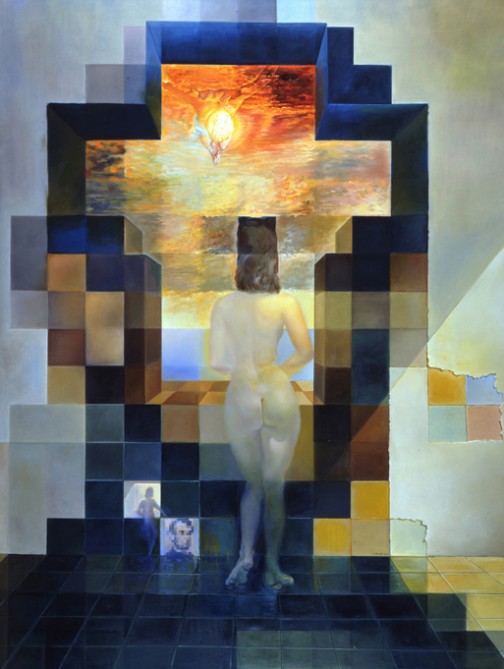
gala-contemplating-the-mediterranean-sea-which-at-twenty-meters-becomes-the-portrait-of-abraham-lincoln-large-orginal-504x669

Photo credit:  http://thedali.org/exhibit/gala-contemplating-mediterranean-sea/

My first art museum jaunt was to the Salvadore Dali Museum in St. Petersburg, Florida.  I did not really know much about Dali, except his iconic melting clocks.  But his work blew me away.  One of my favorite pieces of his is called, “Gala Contemplating the Mediterranean Sea,” 1976.  He plays with images in the painting so that up close you see a cross, and far away, you see a portrait of Abraham Lincoln.  But it wasn’t until I took a picture with my phone that I could see the second image.  His playfulness with visual perception made me wonder if we don’t all struggle with visual perception in life.  We all run around seeing only a portion of reality.  This partial vision and perception means that we are also constantly missing the presence and activity of God in our lives.  Like Dali’s painting, we can miss the presence of Christ when we are too close or too far away to notice our Savior in the world about us.


002-kehinde-wiley-theredlist

Photo credit:  http://theredlist.com/search-image?q=angel

I had a similar experience when visiting the Virginia Museum of Fine Arts in Richmond.  They have an exhibit by Kehinde Wiley that shakes up our senses about who is traditionally featured in portraits.  My favorite piece of his was a gold-leaf icon-like portrait called “The Archangel Gabriel” 2014.  Everything about the Angel Gabriel is unexpected – his clothing, his hair, his jewelry, and his skin color.  But there is also something entirely familiar about him – a gentleness, trustworthiness, and sense of reassurance.  By reimagining ancient depictions of the Angel Gabriel, Wiley reminds us that God does not always appear in the ways and in the people we expect.  I suspect that we often miss God’s presence simply because we are not looking with the eyes of God.

I wonder how common this pattern is for all of us.  How often do we rush past Christ as we rush through life?  This week, I invite you to do what you need to do to slow down and see God at work in the world about you.  Whether you need to go to an art exhibit, take a yoga class, volunteer with one of our outreach ministries, or just take thirty minutes of quiet or prayer, find a way to shake up your busy routine and look with intention to see the ways in which God is active in your life.  I look forward to hearing about what you learn.

Sermon – Luke 7.11-17, I Kings 17.8-24, P5, YC, June 5, 2016

08 Wednesday Jun 2016

Posted by jandrewsweckerly in Sermons, Uncategorized

≈ Leave a comment

Tags

Elijah, eyes, God, heal, Jesus, look, miracles, mundane, see, Sermon, suffering, vision, widow

The scene that day is pretty chaotic.  Two parades collide – a parade of life and a parade of death.[i]  The parade of life includes Jesus and his disciples, high off the sermon on the plain and the healing of the Centurion’s slave, Jesus’ followers are full of hope and optimism.  People are beginning to talk about who this Jesus might be and the enthusiasm is palpable.  Meanwhile, another parade is underway – a widow has lost her only son.  Widows were already at risk in that day due to their lack of financial stability and support from a husband.  Having a child, especially a male child provided a slight assurance that all hope was not lost.  Not only would the son be able to provide for his widowed mother, he is also the legal heir of his father’s inheritance.  But when he too dies, not only does she mourn his loss, but her safety net is totally gone.  She and the mourners with her wail their way to the cemetery.

Two groups full of noise and energy, but their energy could not be more different.  Into this chaotic scene of wails and cheers, people struggling to carry the lifeless body of promise, and people struggling to lay claim on the messenger of hope something tremendous happens.  The text says, “…the Lord saw her.”  That simple phrase may not sound like much.  The Lord saw her.  But surrounded by a growing crowd of faithful, Jesus could have been distracted by the hype.  On a long journey of travel, Jesus could have seen the coming commotion and steered another way.  Or Jesus could have been in deep thought about the next phases of his own journey.  But in the middle of the chaos, as if in a movie that screeches into slow motion, we see Jesus’ eyes lock on the grieving widow and mother.  The noise of the surroundings disappears and all that is important in this moment is that Jesus sees her.

On Memorial Day, my family and I went out for lunch.  We were managing our own little bubble of chaos:  multiple orders; hungry, cranky children; and the looming, necessary nap time.  As I stepped out of our bubble to throw away a pile of trash, I noticed a veteran sitting by himself at the table beside us.  He was silently sitting with his meal, seemingly in moment of deep quiet.  Seeing him almost made me stumble into halted motion.  I wondered what his story was.  I wondered if he was remembering those who had died by his side while he fought for our country.  I wondered if he was one of the veterans who managed to have reentered after war relatively unscathed or whether he was struggling to get by.  I wondered if Memorial Day meant something more to him than Memorial Day meant to me.  But my seeing him and wondering about him was not the same as Jesus.  You see, I was looking at him, but I was not seeing him – not with the same eyes as Jesus.  I couldn’t even get up the nerve to talk to him that day.

That is what is so profound to me about this story in our gospel lesson today:  Jesus’ ability to see the childless widow.  We actually get two very similar stories about widows in our readings today.  But despite the similarities, the contrasts are more informative about what is powerful about Jesus’ encounter.[ii]  In the lesson from first Kings, the widow of Zarephath also loses her only son.  Her son is also revived by Elijah, but the encounters with the widows have a lot of differences.  First, the encounter between the widow and Elijah is passionate.  The widow in that story accuses Elijah of being at fault for her son’s death.  She is outraged and Elijah panics, pleading with God to save the boy and the family from whom he has taken so much.  But the widow in our gospel lesson and Jesus have no such encounter.  The gospel widow does not talk to Jesus and does not plead her case.  She does not blame others around her – in fact, she does not speak at all in the story.  Were it not for Jesus seeing her and stopping the procession, we can only presume this woman would have slipped into dangerous oblivion.

Next, in the Elijah story, Elijah knows the son who dies.  The three have already bonded over the miracle of food.  So Elijah is intimately familiar with how precarious the family’s situation is.  But Jesus does not encounter the widow in his story until her son is already dead and being processed for burial.  Jesus’ saving action then comes not from relationship, but from seeing the grave nature of the widow’s loss.  No one introduces Jesus to the widow, no one whispers to Jesus that the grieving woman is a widow in addition to being a grieving mother – Jesus manages to see all of the complexity of this woman’s life in one glance.

The final contrast to the Elijah story is the healing itself.  Elijah has to stretch himself over the boy three times and cry out to the Lord for help.  His healing requires great effort and exertion.  Meanwhile Jesus simply touches the funeral bier and commands the young man to arise.  The immediate response of the boy sitting up and speaking demonstrates the extent of Jesus’ power.  Healing comes not by a request from God but from Jesus himself.  Jesus is not simply a prophet through whom God speaks – he is the long awaited one who is to come – the Messiah.[iii]

The differences between Elijah and Jesus teach us something about God.  Jesus’ teaches us that God sees us – sees us when we are most vulnerable, without us ever having to speak or ask for help, and is actively compassionate toward us.  Now that reality may leave us wondering today, “Well then why doesn’t Jesus see my suffering and offer me compassion?  I wanted things to go differently for me and they did not.”  That is why I find those words so powerful today.  “Jesus saw her.”  I do not think the story of the widow today is about how Jesus rescues us from our deepest pain and suffering.  This story is about how Jesus sees us when we are suffering and invites us into a similar vision.

“While we wish for signs and wonders, for the parting of the seas, for the lightning bolt of a Damascus road conversion, we risk missing the miracle of the mundane, says Thomas Lynch.  We miss seeing our friends and family who show up when we need them, ‘the ones who have known us all along.’  [Like those friends of the paralytic who lowered their paralyzed friend down to Jesus], or the widow who helped Elijah, these ordinary, obscure, and unsung people…, ‘do their parts to get us where we need to go, within earshot and arm’s reach of our healing, the earthbound, everyday miracle of forbearance and forgiveness, the help in dark times to light the way; the ones who show up when there is trouble to save us from our hobbled, heart-wrecked selves.’”[iv]  Today’s lessons about healing are not meant to make us question why we cannot receive similar healing.  Today’s lessons encourage us to see God in all the tiny miracles around us every day – the miracles that come in less dazzling forms.[v]  To see as Jesus sees.

When we attempt to see with the eyes of Jesus, something shifts dramatically for us.  What is so powerful about seeing as Jesus sees is that Jesus does not see without action.  When Jesus sees he also acts.  Once we have honed our better sense of vision, Jesus’ invitation to us is not just to see with the eyes of compassion, but to use those compassionate eyes for the service of God.  I have already begun to see the ways in which Hickory Neck is a place where that kind of active vision is in place.  You already see that the homeless man does not simply need food or money – you throw in a pair of socks because you know how hard life is without the decency of clean socks.  You already see the indignity of prison and see how a homemade cookie, while seemingly trivial, provides that miraculous glimpse into the tender care of Christ.  You already see how unexpected medical costs can push a struggling family over the edge and how free, compassionate, quality healthcare gives more dignity than we can imagine.  That is our invitation today:  to see the mundane miracles around us every day and to be reinvigorated to see as Jesus sees – with the eyes of compassion and insight that offer tangible, sometimes small acts of compassion to our brothers and sisters who struggle.  My guess is that when we offer that compassion to others, we will see more clearly how we receive that same compassion from Christ every day in similarly small, mundane, and yet profound ways.  Amen.

[i] Gregory Anderson Love, “Theological Perspective,” Feasting on the Word, Yr. C, Vol. 3 (Louisville: Westminster John Knox Press, 2010), 120

[ii] Steven J. Kraftchick, “Exegetical Perspective,” Feasting on the Word, Yr. C, Vol. 3 (Louisville: Westminster John Knox Press, 2010), 117, 119.

[iii] Kraftchick, 121.

[iv] Dan Clendenin, “The Miracle of the Mundane,” May 29, 2016, as found at http://journeywithjesus.net/lectionary-essays/current-essay on June 2, 2016.

[v] M. Jan Holton, “Pastoral Perspective,” Feasting on the Word, Yr. C, Vol. 3 (Louisville: Westminster John Knox Press, 2010), 120.

← Older posts

Recent Posts

  • On the Myth and Magic of Advent…
  • On Risking Failure and Facing Fear…
  • Sermon – Luke 23.33-43, P29, YC, November 23, 2025
  • On Inhabiting Gratitude…
  • Sermon – Luke 20.27-38, P27, YC, November 9, 2025

Archives

  • December 2025
  • November 2025
  • October 2025
  • September 2025
  • August 2025
  • July 2025
  • June 2025
  • March 2025
  • February 2025
  • December 2024
  • November 2024
  • October 2024
  • September 2024
  • August 2024
  • July 2024
  • June 2024
  • May 2024
  • March 2024
  • February 2024
  • January 2024
  • December 2023
  • November 2023
  • October 2023
  • September 2023
  • August 2023
  • July 2023
  • June 2023
  • May 2023
  • March 2023
  • February 2023
  • January 2023
  • December 2022
  • November 2022
  • October 2022
  • June 2022
  • May 2022
  • January 2022
  • December 2021
  • November 2021
  • October 2021
  • September 2021
  • August 2021
  • June 2021
  • May 2021
  • April 2021
  • March 2021
  • February 2021
  • January 2021
  • December 2020
  • November 2020
  • October 2020
  • September 2020
  • August 2020
  • July 2020
  • June 2020
  • May 2020
  • April 2020
  • March 2020
  • February 2020
  • January 2020
  • December 2019
  • November 2019
  • October 2019
  • September 2019
  • August 2019
  • July 2019
  • June 2019
  • May 2019
  • April 2019
  • March 2019
  • February 2019
  • January 2019
  • December 2018
  • November 2018
  • October 2018
  • September 2018
  • August 2018
  • July 2018
  • June 2018
  • May 2018
  • April 2018
  • March 2018
  • February 2018
  • January 2018
  • December 2017
  • November 2017
  • October 2017
  • September 2017
  • August 2017
  • July 2017
  • June 2017
  • May 2017
  • April 2017
  • March 2017
  • February 2017
  • January 2017
  • December 2016
  • November 2016
  • October 2016
  • September 2016
  • August 2016
  • July 2016
  • June 2016
  • May 2016
  • April 2016
  • March 2016
  • February 2016
  • January 2016
  • December 2015
  • November 2015
  • October 2015
  • September 2015
  • August 2015
  • July 2015
  • June 2015
  • May 2015
  • April 2015
  • March 2015
  • February 2015
  • January 2015
  • December 2014
  • November 2014
  • October 2014
  • September 2014
  • August 2014
  • July 2014
  • June 2014
  • April 2014
  • March 2014
  • February 2014
  • January 2014
  • December 2013
  • November 2013
  • October 2013
  • September 2013
  • August 2013
  • July 2013
  • June 2013
  • May 2013
  • April 2013
  • March 2013
  • February 2013
  • January 2013
  • December 2012
  • November 2012
  • October 2012
  • September 2012

Categories

  • reflection
  • Sermons
  • Uncategorized

Meta

  • Create account
  • Log in
  • Entries feed
  • Comments feed
  • WordPress.com

Blog at WordPress.com.

  • Subscribe Subscribed
    • Seeking and Serving
    • Join 394 other subscribers
    • Already have a WordPress.com account? Log in now.
    • Seeking and Serving
    • Subscribe Subscribed
    • Sign up
    • Log in
    • Report this content
    • View site in Reader
    • Manage subscriptions
    • Collapse this bar
 

Loading Comments...