• About

Seeking and Serving

~ seek and serve Christ in all persons

Seeking and Serving

Tag Archives: tension

On Peace, Love, and Conduits…

14 Wednesday Jan 2026

Posted by jandrewsweckerly in reflection

≈ Leave a comment

Tags

chang, change, conduit, conflict, division, faith, grace, Jesus, love, tension, understanding

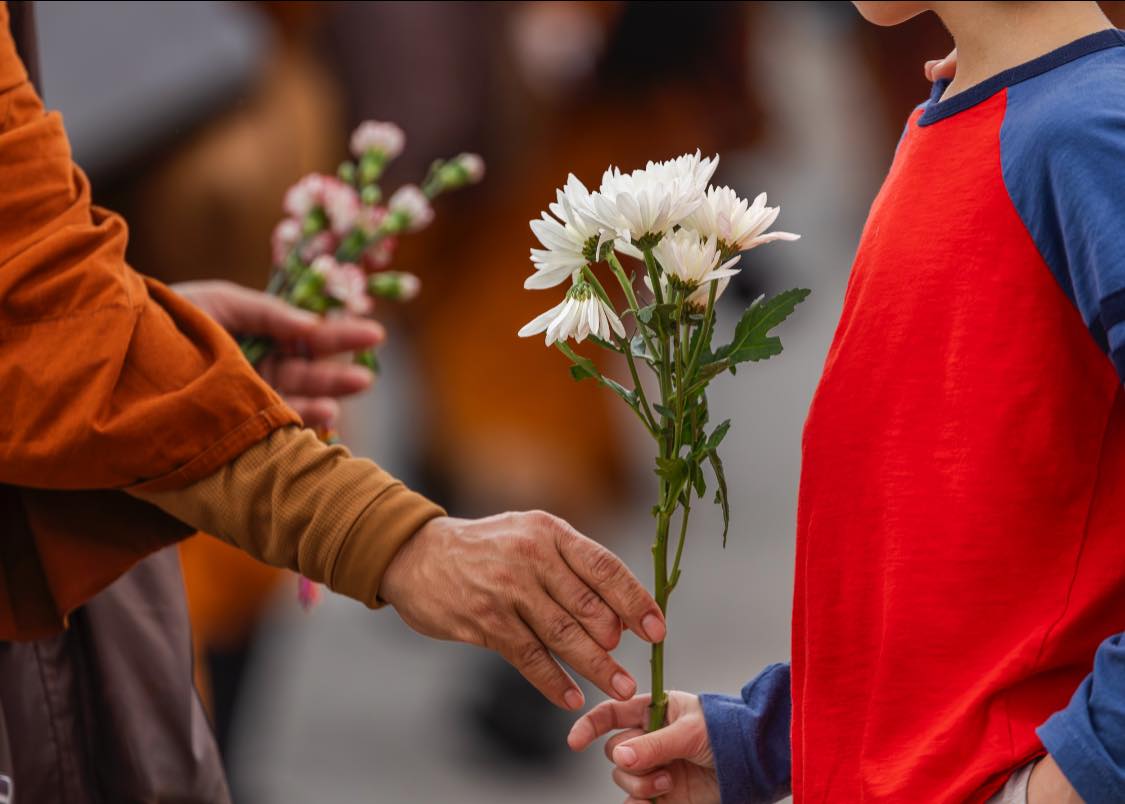
Photo credit: Ken Hicks, as found at https://www.facebook.com/groups/sagingnotaging/posts/25680765434890871/

This past Sunday a parishioner told me about how she had been following the Walk for Peace[i] movement – a 120-day 2,300-mile journey by Buddhist monks walking from Fort Worth, Texas to Washington, DC to raise awareness of peace, loving kindness, and compassion across America and the world.  The parishioner is hoping to see them as they pass a town near us.  I had not heard about the group, and have been fascinated to learn about their journey.  They are not asking for money, do not offer selfies, and ask that no political statements accompany their journey.

Meanwhile, in response to the death of Minneapolis resident Renee Good, the Episcopal Church in Minnesota held an online prayer vigil last night open to the entire country to lament violent immigration enforcement in the Twin Cities area.  Over 3,400 people joined the prayers online, as those gathered offered their fatigue, anger, and heartbrokenness to God.  The bishop in that diocese invited those gathered to “turn the world upside down by mobilizing for love.”[ii]

As I have been thinking about the tumult of theses days and the tensions in our country, I have often felt helpless – as though the division is so deeply embedded and hardening between us that there is little to effect substantive change.  But as I thought about these two groups – simply walking without taking sides, or responding to division with prayer and love – I found myself wondering if I might more intentionally lean into my own faith tradition’s gifts too.

As I was reading about the monks, I saw that the only gift they “allow” in their walk is the gift of flowers.  Later I learned that they receive these flowers as gifts, but then they gift those flowers to people along their walk.  Conceivably, those flowers could be changing hands with people who do not agree on political issues, but who can pass along flowers to one another in gestures of peace. 

This coming Sunday, our church will be honoring Martin Luther King, Jr.’s feast day.  This year, our clergy will be reading excerpts from one of his sermons.  As clergy, we have been amazed at how, decades later, King’s words still resonate powerfully with what feels like problems unique to our generation.  I wonder if his words can be a conduit like those flowers that might pass peace and understanding and grace and love to our community and beyond.  I invite you to consider what conduits might be in your path today, or what conduits you might offer to begin slow, steady change.


[i] https://www.facebook.com/walkforpeaceusa/

[ii] Shireen Korkzan, “Thousands join Episcopal Church vigil to lament violent immigration enforcement actions, unite in pursuing justice,” January 14, 2026, as found at https://episcopalnewsservice.org/2026/01/14/thousands-join-episcopal-church-vigil-to-lament-violent-immigration-enforcement-unite-in-pursuing-justice/

Sermon – Luke 10.25-37, P10, YC, July 13, 2025

24 Thursday Jul 2025

Posted by jandrewsweckerly in Sermons

≈ Leave a comment

Tags

conflict, expansive, familiar, God, Good Samaritan, Jesus, love, neighbor, Sermon, shock, tension

I don’t know about you, but gospel readings like the one we heard today immediately put me at ease.  Episcopalians aren’t particularly known for memorizing scripture, but we do know stories.  And the Good Samaritan is definitely one of the stories we know.  We know these stories so well that we sometimes tune out, maybe imagining, like I did, the time when we were kids and the Sunday School teacher had us dress up and act out the story.  And we are not the only ones.  There are whole churches, charitable organizations, nursing homes, and hospitals named after the Good Samaritan.  We love this simple story about how to be like the Good Samaritan and not like the lawyer, priest, or Levite.

The problem with these familiar stories is that our familiarity dilutes the power of the stories – and perhaps our ability to situate ourselves in the characters of the parable.  Some scholars even try to rename this parable to something like, “Jesus and the Lawyer.”[i]  The lawyer is the first person we miss in this narrative.  We know he is trying to trick Jesus, so he must be bad.  We admit he knows the law, or Torah – to love God and love neighbor.  His second question is where the trouble comes.  The lawyer asks, “Who is my neighbor?”  The question seems simple enough, but the trouble comes from what he doesn’t ask, “Who is not my neighbor?  How much love are we talking here, Jesus?  Can you be specific?  Where can I draw the line?  Outside my front door?  At the edges of my neighborhood?  Along the cultural and racial boundaries I was raised with?  I mean, there are lines.  Aren’t there?”[ii]  And before we get too high on our “I know loving neighbors means loving everyone” horse, think about the last time you got angry about politics and what “those people” are doing or saying. 

Our next issue is pointing the finger at the priest and Levite.  I have heard and read all kinds of explanations about why these two men might have walked on the other side of the road from the dying fellow in need of help.  I have heard people explain that priests and Levites must be careful about ritual purity.  I have heard that as religious professionals they were being upper-class snobs.  I have heard they were late to temple, in a rush to do their jobs.  Unfortunately, according to scholars, none of those justifications work.  The purity laws would not have prohibited these guys from helping – from touching, maybe, but not from helping.  And despite being known leaders in communities, the roles of priest and Levite were mostly inherited, and not a vocation like we know now.  And the text tells us the men are walking away from Jerusalem.  They’re definitely not late for work.  The real problem is simple:  the two men simply do “what is all too ordinary:  [they] fail to act when [they] should.”  In fact, both men were required to attend to the fellow in the ditch, dead or alive.[iii]

Martin Luther King, Jr. on the night before his assassination preached about this parable.  He said, “I’m going to tell you what my imagination tells me. It’s possible that those men were afraid….And so the first question that the priest [and] the Levite asked was, ‘If I stop to help this man, what will happen to me?’…But then the Good Samaritan came by, and he reversed the question: ‘If I do not stop to help this man, what will happen to him?’”  King went on, “If I do not help the sanitation workers, what will happen to them?”[iv]  The real issue with these two men is they only thought about themselves and failed their neighbor.

Now, the final challenge in the parable is the Samaritan.  We all know him as the “Good Samaritan,” but even that nomenclature is problematic.  You see, Samaritans and Jews experienced a great deal of tension.  They have had a long rivalry about where the proper temple is and who has authority.  Just a chapter before in Luke we read about how the Samaritans do not welcome Jesus and the disciples are ready to rain down fire upon the Samaritans.  This does not necessarily mean Samaritans are less influential or wealthy.  This is a tribal feud – an “us versus them” conflict.  And as much as we might identify with the Good Samaritan as the example we always follow, the truth is the Samaritan is not us.  He is the last person you would think of as the “good guy” in Jesus’ day.  We have to hold on to that reality because anyone hearing Jesus’ parable in his day would have been shocked by the introduction of the Samaritan – especially one who behaves much better than “us.”[v]  Scholar Amy-Jill Levine reminds us of the storytelling “rule of three.”  For anyone hearing Jesus’ story, when he talks about a priest, then a Levite, the hearer would have anticipated an Israelite being the third character in the story.  Levine says, “Instead of the anticipated Israelite, the person who stops to help is a Samaritan.  In modern terms, this would be like going from Larry and Moe to Osama bin Laden.”[vi]

So, to help us hear this familiar parable in a fresh way, I want to turn back to scholar Amy-Jill Levine.  Doctor Levine is a Jewish New Testament scholar – and yes, you heard that right – a devout Jew whose career has been in the study of Jesus.  She retells the parable like this:  “I am an Israeli Jew on my way from Jerusalem to Jericho, and I am attacked by thieves, beaten, stripped, robbed, and left half dead in a ditch.  Two people who should have stopped to help pass me by:  the first, a Jewish medic from the Isreal Defense Forces; the second, a member of the Israel/Palestine Mission Network of the Presbyterian Church U.S.A.  But the person who takes compassion on me and shows me mercy is a Palestinian Muslim whose sympathies lie with Hamas, a political party whose charter not only anticipates Israel’s destruction, but also depicts Jews as subhuman demons responsible for the world’s problems.”[vii]

Before we can be Good Samaritans or Good Hamas Members or Good Jews, Jesus is inviting us to get real clear on who our neighbor is.  As scholar Debie Thomas suggests, “Your neighbor is the one who scandalizes you with compassion…Your neighbor is the one who upends all of your entrenched categories and shocks you with a fresh face of God.  Your neighbor is the one who mercifully steps over the ancient, bloodied line separating ‘us’ from ‘them’ and teaches you the real meaning of ‘Good.’”  What shall I do to inherit eternal life?  Do this.  Do this and you will live.”[viii]

I do not know who you are so deeply in conflict with that you have written them off as unacceptable neighbors.  I do not know whose hand you would recoil from if they extended their hand in help.  I do know who you have deemed unredeemable or unforgivable.  But Jesus’ parable is not a safe, cute parable about how to be a good person.  Today’s parable is an invitation to recognize how deeply difficult loving your neighbor is because the definition of neighbor is uncomfortably expansive with Jesus.  And once you concede this parable of the Good Whomever Makes You the Most Uncomfortable, Jesus invites you to love them anyway.  In the same very way that Jesus loves you – unconditionally, bountifully, and full of mercy and grace.  Amen.


[i] Fred B. Craddock, Luke: Interpretation, A Bible Commentary for Teaching and Preaching (Louisville:  John Knox Press, 1990), 149.

[ii] Debie Thomas, Into the Mess & Other Jesus Stories:  Reflections of the Life of Christ (Eugene, OR:  Cascade Books, 2022) 126.

[iii] Amy-Jill Levine, Short Stories by Jesus:  The Enigmatic Parables of a Controversial Rabbi (New York:  Harper One, 2014), 98-101

[iv] Levine, 102.

[v] Thomas, 127

[vi] Levine, 103.

[vii] Levine, 114-115.

[viii] Thomas, 128.

On Pastoring and Motherhood…

08 Wednesday May 2024

Posted by jandrewsweckerly in reflection

≈ Leave a comment

Tags

care, complicated, grace, gratitude, Jesus, love, mother, Mother's Day, mothering, pain, pastor, sorrow, suffering, tension

Photo credit: https://community.thriveglobal.com/remembering-mom-hands-on-mothers-day-loss-support-memories-inspire/

One of the deepest privileges of being a pastor is being gifted with people’s stories.  Sometimes those are stories of great joy:  of new love leading to marriage, of the gift of children, of the excitement of a new vocation.  And sometimes those are stories of deep pain and grief:  of life lost, of hurts deeply experienced, of dreams deflated.  The sum of those stories is uncountable – they are words and emotions that drift in and out of the pastor’s consciousness – the vessel for all that needs to be said and released.  It means that even in the pastor’s moments of greatest joys, there is, at the subconscious level, the treasuring and honoring of deepest pain and suffering.

Normally, I find I am able to hold that reality with tenderness and grace.  But nothing challenges that ability more than holidays that desire to create a forced, well-intentioned experience.  Secular ones, like the approaching Mother’s Day this weekend, are the worst offenders.  On the surface there is nothing wrong with Mother’s Day.  I know countless people who have been tremendous mothers in my life and in the lives of others, who rarely get a thank you, let alone a day of honor.  There is nothing wrong with honoring the mothers in our lives.  The challenge is the sea of complicated feelings that come along with such an effort:  the grief over mothers we have lost, the suffering caused by mothers who were abusive or absent, the pain of those women who wanted to be a mother and never could or who were mothers and who lost their pregnancies or their children, and for the hurt of those relationships between children and mothers that is estranged.  Our much-deserved celebration of mothering is always tainted with the very messy reality of mothering.

For that reason, you will not find me liturgically celebrating Mother’s Day at church.  Instead, I invite you to put on your pastor shoes this Mother’s Day and hold in tension the beloved and the painful this day.  Reach out to friends who have struggled with infertility, lost a pregnancy, or grieve the loss of a child or a relationship with their child.  Reach out to those who had beautiful, healthy relationships with their mothers and now grieve their death every day.  Reach out to those who are mothering figures in your life, even if they never birthed you and give them thanks.  At our church, we quietly offer resources for the complicated nature of the day.  You can find them here, here, and here.  But whatever you do, use this Mother’s Day to “mother in” the love of Jesus, who could see mothers everywhere and honored all of them. 

On Delight and Sabbatical…

06 Tuesday Jun 2023

Posted by jandrewsweckerly in reflection

≈ Leave a comment

Tags

delight, family, friends, God, harmony, intentional, practice, rest, sabbatical, tension

Photo credit: https://www.linkedin.com/pulse/why-you-need-help-schedule-sabbatical-asap-kadi-cole-rn-ms/

Toward the end of my second week of sabbatical, it dawned on me what a different space sabbatical creates from vacation.  The beginning is quite similar:  a flurry of activity, trying to tie up loose ends, ensuring all systems and coverage are in place, and maybe, clearing off your desk.  But at the end of the second week of sabbatical, I noticed a distinction from vacation.  Usually at the end of vacation, even a two-week vacation, tension in my body begins to return.  The wheels in my mind start to churn, even if I know they shouldn’t.  “Work mode” creeps into vacation mode and spoils any deep relaxation I have established.  I was delighted to realize that creep is not happening as I enter week three of sabbatical.

Part of my delight in this realization is how restorative these last two weeks have been.  It’s been such a joy to slow down and reconnect with God, with my family, and with friends.  When I was on retreat at the monastery, I turned off the notifications on my phone, and I was amazed at how much tension released from my body.  In times of quiet, I have been able to stop talking so much, and be more focused on listening:  to God, to my family, to those around me.  And in the differently paced time of sabbatical, I am finding so much love:  finding “space” to remember how powerfully life-giving the loving relationships are in my life.

I am not likely to have twelve weeks of sabbatical again for at least another seven years, which has left me wondering how to hold on to moments of sabbatical time in “real life.”  How might I find harmony between my natural full-speed self and my intentional sabbatical self?  It is my hope in the coming weeks to learn that harmonic practice.  I would love to hear what tricks you have developed for that harmony in your own life!

Sermon – 1 Corinthians 1.10-18, EP3, YA, January 22, 2023

15 Wednesday Feb 2023

Posted by jandrewsweckerly in Sermons

≈ Leave a comment

Tags

invigorated, Jesus, mind, pressure, purpose, Sermon, tension, transformational, united

The following sermon was delivered as the Annual Address at Hickory Neck Episcopal Church.

A few months ago, we had a fellowship event on campus that had a large group of parishioners who did not necessarily know each other.  As we made introductions around the room, I noticed a trend.  People began their Hickory Neck story with a reference to our history:  I came in the Kellett days; I came to Hickory Neck through Father Michael; I started at Hickory Neck about the same time Mother Jennifer did.  As I surveyed the room, I knew there would be parishioners who needed to introduce themselves who had never heard of the previous clergy, let alone how their personalities and ministries were different.  Suddenly, I realized there were going to be people who are a part of the Hickory Neck family whose stories start with, “I joined in the pandemic days.”  I have always bragged about how we are a diverse community politically.  But our diversity is so much bigger than our political differences:  we came here at various historical points, from very different denominational backgrounds, at different stages of life (whether as a young singleton, a new parent, or a new retiree).  Even out of your four affiliated clergy, not one of us is a cradle Episcopalian.

I love then, on this day of our Annual Meeting, that we get this reading from Paul’s first letter to the Corinthians.  When Paul gathered the church in Corinth, he “attempted what scarcely anyone has tried before.  A church composed of rich and poor, Jew and Greek, and slave and free,” with none of the “normal bonds of ethnicity and family that holds a community together.”  As one scholar explains, with such diversity, the factions in Corinth were likely inevitable.[i]  To this unusual combination of people, Paul asks them to be united in the same mind and the same purpose, that everyone be in agreement and there be no division among them.  Anyone who has ever tried to accomplish anything with a group of two or more people knows this request from Paul is endearing, if not laughable.  Bless Paul’s heart!

But having gotten to know the stories of the people in this room, Paul’s encouragement for us to be united in the same mind and purpose is exactly what we are going to be doing in 2023 at Hickory Neck.  We have had an incredible year leading up to this new start.  We have worshiped and learned apart during yet another shutdown, we have gained new members who found us online, we have welcomed longtimers back after a multi-year hiatus, and we have brought along neighbors and friends who just wanted to find a community where they could belong.  We have baptized, married, and buried.  We have celebrated, grieved, and grown.  We have said goodbye and lots more hellos.  And now we find ourselves at the start line of 2023 in a season of vibrancy, of hope, of promise. 

I confess, I am feeling more invigorated and excited about Hickory Neck than I have at any other time in our almost seven years together.  We have an almost entirely new staff:  a staff who is extraordinarily talented, creative, passionate, and fun-loving.  We have a Vestry who is not only a brilliant combination of longtimers and newer members, but also a group who is dedicated to strategic thinking and leadership – not to mention laughter and love.  We have a Sabbatical Team who has thoughtfully and lovingly prepared a twelve-week plan of renewal and community-building activities that will bring health, refreshment, and renewed discipleship to our parish.  And we have some percolating ministries that are going to help us grow our stewardship, evangelism, formation, community engagement, and worship.

One of the things we teach our Vestry about every year is about church-size dynamics.  There is a whole science about behaviors and leadership patterns that are indicative of a church’s size.  A church who is family-sized, with just a few family units is run collectively and where everyone knows everyone else, whereas a corporate-sized parish has a highly structured leadership system and people find a sense of community through smaller groups within the larger system.  In that scientific analysis, Hickory Neck is situated in the most challenging size:  the transitional-sized parish.  We are not so small that everyone knows everyone or that one pastor can be hands on with every member; but we are also not so big that we are in a more complex and large-staffed system.  The reason our size is challenging is because there is always a tension:  a pull to be smaller, and more intimate, and a pull to grow and focus on programming and creating intimacy in multiple small group settings.  That tension has been here throughout my tenure at Hickory Neck, and I feel that tension acutely as we emerge from this pandemic:  where we have the choice to shrink into a more comfortable, manageable size, or to grow into a dynamic, changing size requiring creativity around funding, programming, and invitation.

Living in tension year after year can feel exhausting.  But living in tension can also be transformational.  When carbon is put into tremendous pressure, a diamond emerges.  I think Paul wanted the Corinthians to know that they were under that same kind of diamond-making pressure.  His advice for those hoping to become diamonds?  Be united in the same mind and the same purpose.  And how, might you wonder will the Corinthians (or Hickory Neckers) accomplish such a feat?  According to Paul, by the name of our Lord Jesus Christ.  Whether you found Hickory Neck when children were sitting in the window wells of the Historic Chapel because there was no room elsewhere, whether you were crowded into this newly constructed space with hopes and dreams about where we would go, whether a preschool on our campus meant an encounter with our community, or whether a livestream gave you a peak that made you want more – we are a community united in purpose and mind:  to seek and serve Christ, to make Christ known, to love neighbor as self, to experience belonging and meaning.  In the name of our Lord Jesus Christ, you will be invited into a year of pressure and transformation.  The promise is a diverse community who is ready to emerge with you.  Amen.


[i] James W. Thompson, “Exegetical Perspective,” Feasting on the Word, Yr. A, Vol. 1 (Louisville:  Westminster John Knox Press, 2010), 279.

Sermon – Mark 16.1-8, ED, YB, April 4, 2021

28 Wednesday Apr 2021

Posted by jandrewsweckerly in Sermons

≈ Leave a comment

Tags

alleluia, brief, Easter, God, Good News, Jesus, journey, Mark, pandemic, promise, resurrection, Sermon, spectacular, story, tension

You know how when a group of friends go out for an adventure, and when they come back and try to share the story with you, but you can never quite get “THE story”?  Someone will remember the night happening one way, someone else will add another detail, another person will contradict or question that detail or embellish the story.  You get the gist of what happened, but the exact details may be a bit fuzzy.  

 On Easter Sunday, that is kind of what happens to us.  Each Gospeller – Matthew, Mark, Luke, and John – tells “THE Easter story” a little differently – different characters doing different things.  We know the basics:  the tomb is empty and Jesus is risen from the dead.  But the details make the story different and fresh every year. 

This year, we get Mark’s version.  In that group of friends trying to tell the same story, Mark would be the one known for brevity.  His version would be something like this, “The women went to anoint Jesus in the tomb, like we always do with the dead.  But when they got there, the big rock was already moved, and Jesus was gone.  Some guy was there and said Jesus has been raised.  It was terrifying.”  There are no embellishments to the story – no running around, no pronouncements of the Good News, no disciples doubting women, no victorious preaching.  Just a stunning revelation and news so shocking it leaves people afraid. 

This may not be “THE Easter Story,” as you remember.  But Mark’s version of the Easter story may be exactly the Easter story we need this year.  I do not know about you, but Easter is usually this spectacular day for me.  We journey through Lent, reflecting on our relationship with God.  We trudge through the drama and emotional labor of Holy Week.  Then, on Easter, the alleluias feel well deserved and the joy is hard to contain.  But this Easter, I am not totally there.  This pandemic is still hanging over our heads, our worship is wonderful but not all we know Easter worship to be, and our lives are still in a holding pattern as we work toward herd immunity and even hear talk of cases spiking.  I know this is a day for rejoicing, but there is still so much grief all around us, I am having a hard time fully embracing the alleluias this year.

That emotional tension is why I love Mark’s gospel this year.  The women at the tomb are coming out of a deep grief too.  The only reason they are at the tomb this morning is to do the work grieving people do – tend to the body, handle the practical details, do the things that begin the journey of healing.  So, although the news from the man in white is incredible, the news is unsettling, confusing, and a bit scary.  The women are going to need time to process this mind-blowingly good news before they can rejoice, before they give thanks to God, before they can muster up the nerve to say the good news aloud. 

What I hear in Mark’s gospel are two words of promise for us today.  First, no matter how we receive the Good News of Jesus Christ’s resurrection and triumph over death, the good news is there for us and for all anyway.  Our reaction to the news does not negate the goodness or the radical love and redemption of the resurrection.  Second, the man in white says something seemingly inconsequential that means the world.  He says, “…go, tell his disciples and Peter that he is going ahead of you to Galilee; there you will see him, just as he told you.”  If you remember, Peter denied Christ when Christ needed him most.  But today, the resurrection promise is specific:  go tell his disciples AND PETER…and you will see him.”  No matter if we have been faithful, no matter if we have actively denied Jesus, no matter if we cannot muster a joyful response to the resurrection, we will see Jesus.  The Good News of Jesus is not just for the faithful – the good news of Jesus’ resurrection is for the broken, the sinful, the despondent, and the fearful alike.  And on a day when you may or may not be feeling our alleluias 100%, the Good News is God is with you anyway, loving you and promising to carry you until you are 100%.  Thanks be to God!  Alleluia. 

Sermon – John 13:1-17, 31b-35, MT, YB, April 1, 2021

28 Wednesday Apr 2021

Posted by jandrewsweckerly in Sermons

≈ Leave a comment

Tags

absence, church, digital, dignity, evensong, experts, grief, Holy Week, Jesus, love, Maundy Thursday, pandemic, serve, service, tension

One of the things I have learned over the years is the mixed blessing of offering pastoral care from personal experience.  The mother who lost an adult child both feels gratified to help someone else going through the same situation and angry that she is now an expert in grieving the loss of an adult child.  The man who has been through addiction is honored to help someone else through addition – and yet wishes he were not so personally knowledgeable.  The divorcee talking to a dear friend whose marriage has recently crumbled shares, “Welcome to the club you never wanted to belong to.”

As we started thinking about how to honor Maundy Thursday in a pandemic when many of the things we would normally do on this night are forbidden, we thought the same:  we already know how to do this.  We learned last year that when we cannot experience the intimacy of footwashing, the grief of the last holy meal before Easter, the dimming of the lights, the stripping of the altar, and walking out of this space in silence, turning to a totally different liturgy can create another kind of comfort.  We turn to Evensong in the hopes that another ancient tradition, one the Church celebrates almost everyday in the Cathedrals, Minsters, and colleges of the Mother Church in England, will ease the mourning of yet another loss during this time of pandemic.

But being experts in how to cope in a pandemic – either liturgically, emotionally, or spiritually – does not make the grief any easier.  We still feel the absence of what has been – almost as much as we feel the pending absence of Jesus when we will lay him in a tomb tomorrow.  Having figured out how connect with our community digitally, enjoying seeing people’s names pop up on Facebook, and loving hearing the sounds of our Choral Scholars coming through our TVs and laptops on YouTube, certainly has sufficed in these days – and in fact has brought many people into Hickory Neck who had never experienced Hickory Neck before.  But all of that does not negate our grief that a year later we are still in this liminal time of “not yet.”

So, what do we do with this internal tension that we are not yet where we are going, and certainly not fully who we have been?  I like to look at Jesus in our gospel lesson tonight.  Jesus knew what was coming on this night too.  He knew Judas, his beloved companion on his pilgrimage, was going to betray him.  He knew great tragedy was coming, abandonment by the other disciples would happen, and humiliation, pain, and death were inevitable.  Sitting in the upper room, in the tension of no longer being just a rabbi and not yet the risen Messiah, Jesus could have easily wallowed in grief.  Instead, in that overcrowded, tense upper room, Jesus gets up, takes off his outer robe, and ties a towel around his waist.  In the face of pending doom and tremendous transformation, Jesus bends down, and washes feet.  When the world is in chaos, Jesus does the work of humble service, of respecting the dignity of others, of an everyday deed of loving his neighbor.

We cannot possibly know when church will begin to feel familiar and comfortable.  We do not know which changes we have experienced in the last year will become permanent.  We cannot know the lasting impact of this pandemic on the fabric of our lives.  But we do know what Jesus says tonight.  In the face of the unknown, Jesus says to do two things:  to serve others as he served his disciples and to love one another.  Jesus makes everything quite simple tonight.  In the face of disorienting new realities Jesus says: serve and love. That is our invitation in this most sacred week – when our grief and frustration are sometimes paralyzing, engaging in the work of serving and loving are the actions that will give us strength for the days and weeks ahead.  Amen.

Sermon – Mark 9.2-9, TRNS, YB, February 14, 2021

17 Wednesday Feb 2021

Posted by jandrewsweckerly in Sermons

≈ Leave a comment

Tags

Calvary, disciples, Epiphany, God, Good News, Jesus, joy, Lent, Messiah, mountain, pandemic, Sermon, Son of God, tension, Transfiguration

I do not know about you, but lately, I have found myself at a weird emotional place with this pandemic.  Eleven months ago, the pandemic got so bad, our church buildings closed and our experience as church as we know was forever altered.  Then the rollercoaster began.  Cases went up and down.  Schools were in and mostly out.  Masks were optional, then required, and now even recommended to be doubled.  And then there is the death toll.  We went from a couple of thousand a week to lately as much as 25,000 a week.  The introduction of the vaccine feels like the great white hope.  And yet, just this week I learned of a dear family friend who died a rapid death from the virus.  And we know there will be more death before there is life again.

I think that is why I am struggling this year to find the Transfiguration to be a source of joy.  As I read the familiar words this week, I wanted to be mesmerized – by the dazzling white of Jesus’ clothes, the appearance of none other than the law and the prophets:  Moses and Elijah.   Even God speaks words of revelation to the disciples.  Despite all the wonder and awe on this last of epiphanies in the season of Epiphany, I find myself unable to rally in this epiphanic moment.

The good news is the tension I have been feeling this week might not just be a case of my own emotional journey through this pandemic.  The tension we feel today is intentional on Mark’s part.  If you can remember all the way back in Advent, when we read the very first words of Mark, we read, “The beginning of the good news of Jesus Christ, the Son of God,” Mark tells us right away who Jesus is:  Jesus is the Christ, and Jesus is the Son of God.[i]  First, Mark tells us Jesus is the Christ:  the Messiah, the person the people of God had been awaiting, the victorious redeemer of the people, the mighty restorer of the kingdom of God.  Since that day in December when we heard this brief introduction by Mark, we have been celebrating the Messiah who was born.  Even today, as Jesus’ clothes turn dazzling white, and Elijah and Moses appear, we are filled with anticipation:  this is what we have been waiting for – Jesus the Messiah!!

And yet, somehow in the birth stories, and the epiphanies, and the dramatic healing stories, we forget the other half of Mark’s introduction:  The beginning of the good news of Jesus Christ, the Son of God.  You see, just as Jesus is the Messiah, the Christ, Jesus is equally something else:  the Son of God.  Now the Son of God is not a title of honor so much as a reminder of what will happen to Jesus.  The Son of God is destined to lay down his life for the people of God.  Jesus is the suffering servant we hear about in Isaiah – the one who makes the ultimate sacrifice so that new life might come.

So what does any of this have to do with the Transfiguration?  Pretty much everything.  You see, in this victorious Messiah-like last epiphany moment before we head into Lent, the temptation is for us to linger on the mountain, to stay with the Jesus who makes us feel good, who makes us feel powerful, who makes us feel victorious, who dazzles us with shiny clothes.  That euphoric feeling is not unlike the feelings stirred up by the hope of vaccines – a hope so strong that some governors in our country have lifted pandemic restrictions all together – no more masks, no more distancing, no more waiting.

But as we begin Lent this week, we descend this mountain and walk our way to another mountain – the mountain of Calvary that reminds us of the other truth of Jesus:  that Jesus is the Son of God, sent to redeem us through the darkness of the cross.[ii]   Even on the mountain of Transfiguration, God reminds us of this truth.  God does not shout to the disciples, “Jesus is the Messiah!!”  Instead, God whispers the gentle reminder, “This is my Son, the beloved.”  Even God knows we will want to linger on the goodness of who Jesus is – the brilliance of a Messiah.  But as Mark tells us from the beginning:  Jesus is both the Christ and the Son of God.

This week we will begin the long journey of Lent.  We will reflect on our relationship with Jesus, our failings and faults, and our gifts and goodness.  The work will feel hard and tedious at times, especially clouded by this unrelenting pandemic, and we may prefer to hold on to the Messiah on today’s mountain.  But as we walk from today’s mountain to Good Friday’s mountain, we also hold in tension with Jesus the Christ, Jesus the Son of God.  In our weakness, we find a savior who is also weak.  In our dark days, we find a savior mired in darkness.  In our despairing, we find a savior lost in despair too.  Jesus’ identity as the Son of God gives us as much comfort as Jesus’ identity as the mighty Messiah.  When we hold all of who Jesus is in our hearts, we can be more tender with all of who we are. 

I am grateful to walk the Lenten walk with you.  I am grateful to hear about your struggles and victories, your darkness and light.  I am grateful to be surrounded by a community of people – whether virtually or in person – working through valley of two mountains so that we can come through the redemption of the resurrection.  Today’s Transfiguration Sunday offers us sustenance for the valley, fuel for the work, fire for the renewal.  This is the beginning of the good news of Jesus the Christ, the son of God.  Amen.


[i] This understanding of Jesus’ identity was presented by Thomas P. Long at a lecture on February 9, 2018.

[ii] The idea of framing Lent between two mountains come from Rolf Jacobson, in the Sermon Brainwave podcast, “#768: Transfiguration of Our Lord (B) – February 14, 2021,” February 7, 2021 as found at https://www.workingpreacher.org/podcasts/768-transfiguration-of-our-lord-b-feb-14-2021 on February 10, 2021.

Homily – Luke 22.14-23.56, PS, YC, April 14, 2019

17 Wednesday Apr 2019

Posted by jandrewsweckerly in Sermons, Uncategorized

≈ Leave a comment

Tags

church, death, faithfulness, hope, hopelessness, Jesus, life, Palm Sunday, Sermon, sinfulness, tension

Several years ago, I was visiting a parishioner on her deathbed in the hospital.  We were talking about the things you talk about at the end of life:  the blessings, the memories, the unexpected turns of life.  Whatever fears about death that had been present were long gone.  All that was left was a sense of peace, and a certainty about the eternal life waiting for her on the other side.  I found myself wistful and a little sad, knowing there was nothing I or the doctors could do at that point.  Death was coming.  In the midst of this sacred, serious moment of inevitability, we heard a tinkling noise in the hallway.  Having had a child in a hospital, I knew what the tinkling noise was:  the tinkling sound was the announcement of a new baby being born.  As I explained the noise, the parishioner and I sat in awe – the closeness of life and death were all around us.  We did not have much to say at that point.  The sound of that tinkling just lingered in the room, long after the sound was gone.

I was thinking this week how similar the experience of Palm Sunday is to that hospital room.  We hold in tension so many things today.  We certainly hold life and death in tension:  the joyful celebration of Jesus with palms, and the wailing sorrow of death at the cross of Jesus.  We hold hope and hopelessness in tension too:  the promise of a new king, entering triumphantly, and the despair and finality of Christ on the cross.  We hold faithfulness and sinfulness in tension today:  the bold proclamation of the king who has come in the Name of the Lord, and the shouts of “crucify, crucify him,” just moments later.  Though we might prefer to claim life, hope, and faithfulness, today we must claim death, hopelessness, and sinfulness too.  They are as intertwined as life and death in a hospital.

In some ways, the tension of this day is just what we need in a culture that might like us to jump from the palms to the risen, triumphant Lord.  I am reading Brené Brown’s Dare to Lead this Lent, and one of the hazards to leadership she articulates is numbing.  Numbing can happen in all kinds of ways – through food, work, social media, shopping, television, video games, or alcohol.  The problem with numbing is that we cannot selectively numb emotions.  As Brown says, “if we numb the dark, we numb the light.  If we take the edge off pain and discomfort, we are, by default, taking the edge off joy, love, belonging, and the other emotions that give meaning to our lives.”[i]  When we numb our way through life, we not only suppress the bad stuff; we never get to fully enjoy the good stuff of life.

Today, the Church refuses to allow us to numb.  The Church has us wave palms and sing loudly and smell the sweet smell of victory, with a grin from ear to ear.  And the Church has us listen to the devastation of betrayal, hear the voices of contempt and hatred, and shout for Christ’s death.  Our hearts feel heavy as our minds try to justify all the times we too have betrayed Christ.  We feast as the disciples did on Christ’s body and blood, and we leave in silence as his disciples did from the cross.  Today we feel everything:  life, death; victory, failure; joy, and devastation.  In letting go of our tendency to numb, we open ourselves to the fullness of all that happens on this day.  Only then can embrace the Easter message of resurrection that is to come.  Only when we are fully broken, fully vulnerable, fully present in the tension of this day can we receive the fullness of joy that comes next week.  Only when we are looking into the doorway to death can we understand the depth of joy that comes from the tinkling sound of new life.  So, stay awake with us for just a little while longer.

[i] Brené Brown, Dare to Lead (New York:  Random House, 2018), 85.

It’s complicated…

09 Wednesday May 2018

Posted by jandrewsweckerly in Uncategorized

≈ Leave a comment

Tags

balance, divine, God, goodness, honor, Mother's Day, mothers, painful, pastoral, sacred, tension

10

Photo credit:  https://www.shutterstock.com/video/search/child-walking

Every once in a while, I have one of those pastoral fails – those moments when I say something that ends up sounding horribly thoughtless and makes me feel disappointed in myself.  Last week, I was talking to a new mom about the struggles of those first weeks of new motherhood.  I was bemoaning how when my mom left two weeks after my first child was born, I cried for hours, not knowing how to raise a child without her help.  Only hours later did I remember that this person’s mom died many years ago, and how insensitive my story sounded in hindsight.

Motherhood is a bit of a minefield.  Some of us are extremely fortunate to have awesome moms and wonderful relationships with those moms.  Some of us have more strained relationships, others of us have cutoff relationships, some had negligent or hurtful mothers, and many are still grieving our mothers who have passed.  Meanwhile, some of us have had amazing experiences being moms ourselves, while others have longed to have children or have lost pregnancies or children.  Motherhood is so complicated that I sometimes find myself caught off guard by my own unexpected emotional response to motherhood.

For a priest, that is why I dread Mother’s Day.  Mother’s Day is a day where I feel split in half – where I both want to honor the goodness and sacredness of motherhood, and I want to honor ways motherhood can be so painful.  This year, I was blessed by a friend who wrote about how to honor the tensions we find on Mother’s Day.  I leave with you a prayer she references found in Women’s Uncommon Prayers, written by the Reverend Leslie Nipps.  May your Mother’s Day find the balance I long for you to find.

On this Mother’s Day, we give thanks to God for the divine gift of motherhood in all its diverse forms. Let us pray for all the mothers among us today; for our own mothers, those living and those who have passed away; for the mothers that loved us and those who feel short of loving us fully; for all who hope to be mothers someday and for those whose hope to have children has been frustrated; for all mothers who have lost children; for all women and men who have mothered others in any way—those who have been our substitute mothers and we who have done so for those in need; and for the earth that bore us and provides us with our sustenance.  We pray this all in the name of God, our great and loving Mother.  Amen. (p. 364)

← Older posts

Recent Posts

  • On Sharing the Love…
  • Sermon – Micah 6.1-8, Matthew 5.1-12, EP4, YA, January 30, 2026
  • On Justice, Kindness, Humility, and the Messy Middle…
  • Feast of the Rev. Dr. Martin Luther King, Jr., January 18, 2026
  • On Peace, Love, and Conduits…

Archives

  • February 2026
  • January 2026
  • December 2025
  • November 2025
  • October 2025
  • September 2025
  • August 2025
  • July 2025
  • June 2025
  • March 2025
  • February 2025
  • December 2024
  • November 2024
  • October 2024
  • September 2024
  • August 2024
  • July 2024
  • June 2024
  • May 2024
  • March 2024
  • February 2024
  • January 2024
  • December 2023
  • November 2023
  • October 2023
  • September 2023
  • August 2023
  • July 2023
  • June 2023
  • May 2023
  • March 2023
  • February 2023
  • January 2023
  • December 2022
  • November 2022
  • October 2022
  • June 2022
  • May 2022
  • January 2022
  • December 2021
  • November 2021
  • October 2021
  • September 2021
  • August 2021
  • June 2021
  • May 2021
  • April 2021
  • March 2021
  • February 2021
  • January 2021
  • December 2020
  • November 2020
  • October 2020
  • September 2020
  • August 2020
  • July 2020
  • June 2020
  • May 2020
  • April 2020
  • March 2020
  • February 2020
  • January 2020
  • December 2019
  • November 2019
  • October 2019
  • September 2019
  • August 2019
  • July 2019
  • June 2019
  • May 2019
  • April 2019
  • March 2019
  • February 2019
  • January 2019
  • December 2018
  • November 2018
  • October 2018
  • September 2018
  • August 2018
  • July 2018
  • June 2018
  • May 2018
  • April 2018
  • March 2018
  • February 2018
  • January 2018
  • December 2017
  • November 2017
  • October 2017
  • September 2017
  • August 2017
  • July 2017
  • June 2017
  • May 2017
  • April 2017
  • March 2017
  • February 2017
  • January 2017
  • December 2016
  • November 2016
  • October 2016
  • September 2016
  • August 2016
  • July 2016
  • June 2016
  • May 2016
  • April 2016
  • March 2016
  • February 2016
  • January 2016
  • December 2015
  • November 2015
  • October 2015
  • September 2015
  • August 2015
  • July 2015
  • June 2015
  • May 2015
  • April 2015
  • March 2015
  • February 2015
  • January 2015
  • December 2014
  • November 2014
  • October 2014
  • September 2014
  • August 2014
  • July 2014
  • June 2014
  • April 2014
  • March 2014
  • February 2014
  • January 2014
  • December 2013
  • November 2013
  • October 2013
  • September 2013
  • August 2013
  • July 2013
  • June 2013
  • May 2013
  • April 2013
  • March 2013
  • February 2013
  • January 2013
  • December 2012
  • November 2012
  • October 2012
  • September 2012

Categories

  • reflection
  • Sermons
  • Uncategorized

Meta

  • Create account
  • Log in
  • Entries feed
  • Comments feed
  • WordPress.com

Blog at WordPress.com.

  • Subscribe Subscribed
    • Seeking and Serving
    • Join 395 other subscribers
    • Already have a WordPress.com account? Log in now.
    • Seeking and Serving
    • Subscribe Subscribed
    • Sign up
    • Log in
    • Report this content
    • View site in Reader
    • Manage subscriptions
    • Collapse this bar
 

Loading Comments...