• About

Seeking and Serving

~ seek and serve Christ in all persons

Seeking and Serving

Tag Archives: Thanksgiving

On Blessings and Curses, and Surviving Thanksgiving Meals

23 Wednesday Nov 2016

Posted by jandrewsweckerly in Uncategorized

≈ Leave a comment

Tags

conflict, creation, fall, family, God, gratitude, heart, leaves, mind, prayer, space, Thanksgiving, Thanksgiving Day

Colorful autumn

Photo credit:  www.fluentu.com/french/blog/french-fall-autumn-vocabulary-word-list

For those of you who know me well (or read this blog each fall), you know that I love the changing of the leaves during Fall.  Fall is my favorite season of the year – the cooler weather, the crunch of leaves, and the brilliant reds, yellows, and oranges that take your breath away.  The leaves turned later than usual this year in Virginia, so I have had time to enjoy their beautiful journey until now.  Just this week, a light wind was blowing, and a tree was raining down yellow leaves like a flower girl before the bride.  Some people like to stop and smell the roses.  I like to stop and revel in the beauty of God’s changing leaves.

Watching and being fed spiritually by that beauty this year led us to creating a Thanksgiving Tree at Youth Group this past Sunday.  We took a poster with a bare tree, and then used our post-it notes to cover the tree with things for which we are grateful.  We had five categories, including family, relationships, creation, God, and school/work.  I challenged the group to write down three things in each category – not just a one-word response, but an explanation of their gratitude.  Perhaps 15 notes seemed like overkill to the young adults, but what I was hoping was that the more they thought about the blessings in their lives, the less space the negative would have in their hearts and minds.

That is my prayer for each of you this week as we head into Thanksgiving celebrations.  Though we may have Normal Rockwell images of Thanksgiving Day meals in our minds, and although some of you may actually get that experience, the reality of most meals, especially if spent with family, is that they will include a fair share of conflict.  If you are lucky to avoid talking about politics, some other family drama will surely emerge.  Expecting that conflict, I invite you to start praying your thanksgivings.  If your crazy family promises to bring angst, start praying now about the things that bring you joy about each member of your family.  You may have to dig deep (Lord knows your uncle’s jokes can drive you insane – but maybe you can thank God for predictability with your uncle or for the knowing glances of your cousins).  But my guess is that the more you start looking at your family or friends with the eyes of gratitude, there will be a lot more space in your heart and mind for blessings than curses.

If you can master that practice of thanksgiving prayers throughout one of the more stressful days of the year, perhaps you can carry that prayer practice through the next month.  As you hone that spiritual discipline for the next month, you may find it becomes easier to carry it into the next year.  Given our current climate, we are going to need all the space we can get for blessings. img_3401

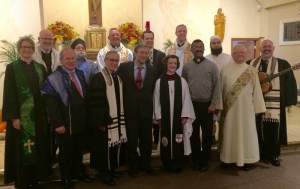
Ecumenical Thanksgiving Homily – Ruth 2.2-9, Matthew 22.34-40, November 20, 2016

23 Wednesday Nov 2016

Posted by jandrewsweckerly in Uncategorized

≈ Leave a comment

Tags

active, Boaz, community, ecumenical, God, gratitude, Great Commandment, homily, Jesus, love, mercy, ministry, neighbor, Ruth, Thanksgiving, worship

When I learned we would be gathering for worship as ecumenical brothers and sisters to celebrate a service of Thanksgiving, I could not have been happier.  But when I realized we would be reading from the book of Ruth, I was thrilled!  Ruth has always held a special place in my heart.  This woman, a complete stranger to our faith, teaches us more about faithful living than most of our ancestors. She marries a foreigner, quickly becoming a widow with no support, following her widowed mother-in-law to a foreign land.  In her abandonment, she pledges allegiance to a God who in many ways has felt absent.  And when they return the foreign land of Bread, and she sees Naomi may not be able to support her, she takes it upon herself to go sweat in the fields, and secure them a livelihood.  She even eventually permanently ensures their security by somewhat scandalously approaching Boaz for not only food, but marriage, and progeny.  Ruth puts all others before herself, and she is faithful to God and her family.  If anyone is a beacon of living into the Great Commandment to love neighbor as self, Ruth is that beacon of light.

But the more I thought about our text today, the more I realized that despite the fact that I love Ruth, we gathered here today are more like Boaz.  You see, we are people of privilege and power.  Though we can certainly name countless people who may have more wealth and influence than we do, most of us know where our next meal is coming from, have a roof over our heads, and have our basic needs met.  Some of us are even comfortable enough to enjoy much more than our basic needs.  In that way, we are much more like Boaz, a man with power and influence, who can use that power for good or for evil.

Boaz has little obligation to Ruth, the foreigner.  He knows she is connected to Naomi, making her adopted family, but allowing her to glean with the other gleaners would have been enough.  He didn’t have to give her tips about how to be safe from the men, give her access to drinking water, feed her his bread at mealtime, and tell his men to make sure she got extra grain to glean.  He did not have to say yes when she asked for his help in taking her in.  He did not have to negotiate with the next-of-kin to have her hand.  Boaz takes God’s command to love neighbor beyond what anyone would expect.

I have been thinking about Boaz as I have been thinking about our ministry together.  Though you may not know about each case, each of the clergy here work with families in need through the use of discretionary or alms funds.  Each church here has ministries that we support – whether food pantries, homeless shelters, elder care, medical clinics, or assistance with basic needs like back-to-school supplies, clothing drives, or holiday support.  And all of us collectively have taken that a step further and agreed to help provide more food assistance by starting up a local food distribution outlet through our partners at House of Mercy.  But just because we do that work does not mean that we do that work like Boaz.

My husband is a social worker in Richmond and he was recently telling me about a client’s experience with a church.  The client reached out to a church for assistance, and instead of pastorally working with the client, the church representative gave them a hard time, wanting to know what poor decisions the client had made that brought them to the church doors.  Now, I know we all screen the clients we help.  We have to be smart about how we help those in need.  But that client experienced a loss of dignity at that church that Boaz never exerts.  In fact, Boaz knows how degrading poverty can be.  He sees Ruth, and knows simply by her gender and foreignness that she is at risk for assault and manipulation.  And so, not only does he help her, but he looks at all those around him and hold them accountable for caring for the disadvantaged too.  He does not act alone in his mercy – he makes his whole community merciful.

As we head into a holiday marked for Thanksgiving, the church invites us to look at our ancestors for the best ways to fulfill Jesus’ Great Commandment.  Want to know how to love God and our neighbors?  Look at our sister Ruth.  Want to know how to show love, dignity, and compassion?  Look at our brother Boaz.  Though many of us spend this time of year reflecting on what we have to be grateful for, the church invites us also to use this time as a time of action.  Our gratitude is not passive.  Our gratitude is active – a call to action to love God and love neighbor.  I know many families who have a tradition of going around the Thanksgiving table, enumerating those things for which they are grateful.  Perhaps this year, our families can also enumerate what we are going to do in response to those things for which we are grateful.  Our ancestors, our Savior, and our faith communities are here to embolden us in that response.  Thanks be to God!

Participating in Gratitude…

02 Wednesday Nov 2016

Posted by jandrewsweckerly in Uncategorized

≈ Leave a comment

Tags

blessed, cycle, generosity, gift, God, grateful, gratitude, note, sacred, thanks, Thanksgiving

thank-you-note

Photo credit:  https://fastcompany.com/3057431/hit-the-ground-running/heres-what-to-write-in-your-thank-you-after-a-job-interview

In honor of Thanksgiving Day at the end of the month, a trend has developed that uses the entire month of November as a month of gratitude.  The practice has several forms:  journaling about at least five things for which you are grateful every day; posting daily on Facebook a note of gratitude; or using Instagram or other outlets to post a daily photo of something for which you are grateful.  The practice is quite spiritually based.  I have had countless spiritual directors who have encouraged me to use gratitude as a discipline for my prayer life – using the end of the day to give thanks for things in life as opposed to our natural tendency to look back at the day and make mental note of all the things that went unaccomplished or were hurtful to ourselves or others.

This past Sunday we gathered our pledges for the upcoming calendar year.  Each year in the Episcopal Church, parishioners are asked to fill out a pledge card, letting the Vestry, or governing board, know how much income can be expected so they can formulate a budget.  The pledge cards certainly serve a practical purpose.  But their use can also serve a deep spiritual purpose.  As I blessed three different baskets of pledge cards on Sunday, I had the thought that each of those baskets were like piles of thank you notes to God – a way of articulating how blessed we are and how grateful we are for the resources we have and our ability to share and support ministry with those resources.  Each card held a story – a story of someone who feels connected to and passionate about Hickory Neck, who has been nurtured and challenged in this place, who has a unique life story, and who has encountered Christ here.  As I thought of the conversations, prayers, and reflections those cards represented, I could not help but smile.  There is something quite beautiful in witnessing the intimate, vulnerable exchange between God and parishioner.  I felt privileged to bless that sacred act.

In the coming weeks, I have the privilege of entering into that sacred space of thanksgiving and gratitude.  I have the task of thanking each pledging member.  When the Stewardship Committee and I first talked about the campaign, we joked about whether my hand would be able to survive writing so many notes.  There may be times my hand actually does get sore, but so far, I am nothing but grateful to be writing those notes.  I have found that writing them has been a tremendous time of blessing – an opportunity for me to pray for each parishioner, to thank God for the gift of them to our community, and to send my blessings upon them.  The “duty” has become an incredible gift that keeps the cycle of gratitude going.

How are you participating in the cycle of gratitude?  In what ways do you cultivate a spirit of generosity, passing your sense of gratitude and blessing on to others?  I look forward to hearing how you are participating in the cycle, and how God is using you to bless others.

Sermon – Luke 17.11-19, P23, YC, October 9, 2016

12 Wednesday Oct 2016

Posted by jandrewsweckerly in Sermons, Uncategorized

≈ 1 Comment

Tags

church, compliment, duty, generously, giving, grateful, gratitude, guilt, Jesus, joy, leper, living, obligation, pledge, practice, praise, Sermon, stewardship, Thanksgiving, transformation, turning

I once knew a man who was impossible to compliment.  Whether you wanted to compliment a job well done or good deed, his response was always the same, “It’s not me.  All the glory goes to God.”  His response always left me feeling like I just offered a present that was rejected.  Of course, I totally agreed with what he was saying – none of us is able to do good without the God who empowers us to do so.  And truly, Jesus was not that great at accepting compliments either, especially if you recall all the times he asked people to keep a healing secret or to just go back to work.  But upon receiving a compliment, a simple, “Thank you,” would not have hurt this man.  After a while, I just stopped trying to praise his work or good deeds.

I think that is why I relate to the nine lepers who do not return to Jesus to give him thanks and praise.  There were ten lepers originally – nine who were Jewish and one who was a Samaritan.  We are not sure why the ten are together – the Jews and the Samaritans were enemies and rarely spent time together.[i]  We are told at the beginning of the text that Jesus was passing through a borderland between Samaria and Galilee, so there is a possibility that then ten men banded together through their disease instead of culture.  You see, both Samaritans and those of Galilee would have been seen as impure due to their leprosy.  Being exiled to the borders of their land, they may have found more in common than divided them.  And so, as a group, they shout out to Jesus for healing – careful not to approach him, of course, which would have been improper in their condition.  Respecting their distance, Jesus does not insist they come forward, but instead tells them to go to the priest to show themselves to be healed.  Along the way, they are healed, but they still would have needed to show a priest in order to be restored to their families and friends.[ii]

The Samaritan among them returns and gives praise to God, but the others do not.  We do not know how their journey unfolds.  Presumably they are faithfully doing what Jesus told them to do – going to the priest for restoration.  Perhaps they give praise to God once the priest restores them.  Perhaps they give praise when they are reunited with their families.  Maybe they even show their praise through helping lepers later.  But that is all supposition.  All we get today is Jesus’ criticism of the nine because they neglect to turn and give God praise and thanksgiving.

I have been reflecting on Jesus’ words this week, and what rubs me the wrong way may be the same thing that rubbed me the wrong way when that man I knew always refused praise.  In both cases, whether Jesus, or the man I knew, there is both implicit and explicit criticism of my own practice of gratitude and thanksgiving.  What irritated me about the man’s responses to me was that they made me feel guilty – that perhaps I was not grateful enough to God for the goodness in my life.  The same thing irritates me about Jesus this week – his judgment of the nine makes me feel guilty about the ways I have walked away healed and not given praise to God.

This week we are kicking off our stewardship season in a campaign called, “Living Generously.”  After the service, you will be receiving a packet of information about how you can support the ministry of Hickory Neck, and a pledge card that we will collect in a celebratory ingathering in just four weeks.  Most preachers would have read the text today and thought, “Yes!  The perfect Stewardship text!”  But the more I sat with Jesus’ words, the more I realized that his words actually bring up feelings of dread rather than joy.  Most people associate stewardship with the same sense of guilt that this reading brings up.  We feel guilted into showing gratitude, and so we guiltily look at our budgets and see if we can increase our pledge this year.

The first time I experienced the concept of pledging was when I started regularly attending an Episcopal Church.  In the churches where I grew up, you never had to tell anyone what you were going to give.  The preacher might have talked about a tithe – ten percent of your income.  But the preacher never wanted you to say exactly what you were going to give.  So when the warden of this church started explaining how he wanted us to pledge, I was aghast.  I remember thinking, “That’s private!  I don’t have to tell you how much I am going to give!”  Now, I knew we would probably tithe that year, but the idea of telling someone else about my giving seemed to go against every cultural norm I knew.  Fortunately, I stayed to hear the rest of the warden’s talk.  He explained that the way the church formed the church’s budget was through the knowledge of what income they could expect.  The Vestry would adjust expenses accordingly and try to get the budget balanced.  My outrage faded as I realized how responsible that model seemed.  Thus began my adult journey into pledging.

But that journey into pledging experienced a transformation about eight years later.  We were at a new church, and the priest asked to hold our pledge cards until a particular Sunday.  We did and the funniest thing happened.  In the middle of the service, a banner appeared.  The banner was processed down the aisle, joyful music started playing, and people started following the banner forward.  We placed our pledge in a basket, and I felt something stirring in me.  The priest blessed the pile of pledge cards, and something about stewardship turned in my heart – the pledging, the monthly giving was no longer an obligation or burden – something to be guilted into.  My pledge was a joyful sign of gratitude – a sign blessed by God and affirmed by the community.  And I have to say – it felt good!

In the gospel lesson today, the text says that the Samaritan turns back to Jesus.  That word for turns back is more than just a physical description – the action of turning back is a sign of deep transformation – a reorienting of the Samaritan’s life from duty to gratitude.[iii]  I do not think Jesus was looking for a guilty admission of thanks from the other nine lepers.  What Jesus is looking for is a transformation of the heart – a turning of one’s life away from obligation and duty to joyful gratitude and thanksgiving.

I was reading this week about a woman with an interesting habit.  Whenever someone asked her how she is – that basic question we always ask and anticipate the answer being, “Fine,” – instead she would say, “I’m grateful.”  No matter what is on her plate – stress at work or school, an illness that kept plaguing her, strife at home – her response is always the same, “I’m grateful.”[iv]  As I thought about her response this week, I realized that her response is probably one that took willful practice.  I am sure there were weeks when she really felt grateful.  But there were also probably weeks when she had to say she felt grateful even if she was not sure what there was to be grateful about.  But slowly, slowly, I imagine the practice cultivated a spirit of gratitude.  A practice like that can do exactly what Jesus wants for us all – a turning of the heart to praise and thanksgiving.  I know I will never be able to shift toward the kind of response that the man I knew always gave, rejecting praise altogether.  But learning to say, “I’m grateful,” might be a way for me to get a little closer to the same sentiment.

What that woman is doing, what Jesus is encouraging, and even what our Stewardship campaign is inviting is not a sense of guilt or burden, but a genuine invitation into a life that turns our heart to gratitude and transforms the way we see the world.  Now that does not mean that every time you write the check to fulfill your pledge you will part from that treasure with a joyful heart.  But that practice is a small invitation, every time, for us to turn our hearts and to see not only the God from whom all blessings flow, but to even see the blessings in the first place.  Jesus is not mad at those lepers because they are ungrateful – he is sad for them because they have denied themselves the gift of transformation.  That is the gift that he and the Church offer us every week – the gift of a transformed heart that can change everything.  For that, I’m grateful.  Amen.

[i] Audrey West, “Commentary on Luke 17.11-19,” October 9, 2016, as found at https://www.workingpreacher.org/preaching.aspx?commentary_id=3029 on October 5, 2016.

[ii] Oliver Larry Yarbrough, “Exegetical Perspective,” Feasting on the Word, Yr. C, Vol. 4 (Louisville: Westminster John Knox Press, 2010), 169.

[iii] Margit Ernst-Habib, “Theological Perspective,” Feasting on the Word, Yr. C, Vol. 4 (Louisville: Westminster John Knox Press, 2010), 166.

[iv] David Lose, “Pentecost 21C:  Gratitude and Grace,” October 3, 2016, as found at http://www.davidlose.net/2016/10/pentecost-21-c-gratitude-and-grace/ on October 5, 2016.

More…

25 Wednesday Nov 2015

Posted by jandrewsweckerly in Uncategorized

≈ 1 Comment

Tags

clergy, God, Good News, interfaith, Jesus, life, love, mercy, ministry, more, Thanksgiving, Transgender, wideness, witness, worship

Every once in a while, I have experiences in ministry when I think, “Well I never would have imagined that happening!”  I admit that the experience is rare.  There is not a lot that surprises me anymore in this line of work.  Though I am relatively young, I still feel like I have seen it all.

But that has not been the case this week.  This week I found myself in two situations I would have never anticipated.  On Sunday night, our parish hosted the Long Island Transgender Day of Remembrance.  I had no role in crafting the liturgy or planning the evening.  I simply offered our space and was asked to give an opening and closing prayer.  In fact, the planning committee warned me that this would not be like a “church service” – so I should not get my hopes up!  But as I sat in my pew, watching testimonial after testimonial, listening to over eighty names of those who were murdered because of their transgender identity, and hearing beautiful music about the wideness of God’s love and the call to love “the other” – I tell you, I experienced “Church.”  You see, Church is supposed to be about worshiping our God who shows mercy and compassion, who calls us to love the outcast and the oppressed, and who compels us to go out and witness the Good News of God in Christ.  Sunday night, I felt like the Good News came back inside and witnessed to me.

Plainview-Old Bethpage Interfaith Clergy, November 24, 2015

On Tuesday night, I participated in my fourth Plainview-Old Bethpage Interfaith Thanksgiving Service.  Every year I find the service moving. I am grateful for a holiday that we can all honor without fear of stepping on each other’s toes.  But as I sat there last night, I became acutely aware of my surroundings.  On my left sat the Mufti from the local Muslim community and on my right sat the priest from the local Roman Catholic parish.  It occurred to me in that moment that the Mufti usually only says prayers with men.  The women pray separately.  And yet, there we were, side by side, giving thanks to God.  It also occurred to me that although the priest has been warm and affirming, his Church does not recognize my ordination as appropriately apostolic – especially given my gender.  And yet, there we were, as equal leaders in our respective communities.  Despite having had long relationships with the fellow clergy leaders, this was the first time I realized how radical our relationships are – to sit next to each other despite profound differences – and yet still be able to praise, lead, and worship together.

Truthfully, I do not know what God is doing this week.  On a basic level, I suspect God is reminding me that I am not even close to having “seen it all.”  But on a deeper level, I also suspect that God is inviting me to go further, to delve deeper, and to see more widely.  Perhaps a disadvantage to my profession is a naïve sense that I have a hold on who this God is that we worship and serve.  This week, God has humbled me by reminding me that God is so much more. As I anticipate celebrating Eucharist on Thanksgiving Day, I expect to approach the Table with keener sense of wonder, gratitude, and awe for the ways in which God is so much more.  What a blessed gift this week has been.  Thanks be to God for being more than I could ask for or imagine!

Sermon – 1 Samuel 1.4-20, 2.1-10, P28, YB, November 15, 2015

19 Thursday Nov 2015

Posted by jandrewsweckerly in Uncategorized

≈ Leave a comment

Tags

anger, God, Hannah, honest, intercession, intimacy, praise, pray, prayer, relationship, Sermon, Thanksgiving, vulnerable

At some point in life, most of us have the experience of having a best friend.  Perhaps we met the person on the playground as a child; maybe we met him in college or at work; perhaps our best friend is a cousin or sibling; or maybe our best friend is our spouse or partner.  Regardless of how we met her, that best friend has seen the best and worst of us.  He has congratulated us when we got a part in the play, when we got a promotion, or when we found new love.  She has consoled us when we failed a test, when our heart was broken, or when a family member died.  He has seen us laugh so hard that we snort or pee in our pants, and he has seen us sob so hard that snot runs down our faces.  She has seen us dressed to the nines, and she has seen us in our stained, ill-fitting sweats.  And our best friend has taken the best and the worst from us too:  we have danced together, yelled at each other, confessed our darkest secrets to each other, and, yes, we have even hated each other at times.  Despite having experienced the very best and very worst of us, we know that she loves us deeply, he always forgives us, and she is always there for us.  The relationship is far from perfect, but the relationship is beautiful.

In many ways, the relationship we have with our best friend is similar to the relationship we have with God.  On our good days, we come to God with our thanksgivings and praise, offering our adoration and humility to God.  On our bad days, we are angry and curse God.  We confess things to God that we confess to no one else:  both those things done and left undone, but also those deep longings and desires that we do not admit to others.  We have cried a thousand tears with God and we have laughed with great mirth.  Although our best friend knows us better than any other human being, God knows even the stuff we are embarrassed or afraid to share with that best friend.  And since our Lord is not human, God’s forgiveness does not know the limits of human forgiveness.  Through the life, death, and resurrection of Jesus Christ, our relationship with other human beings will never quite equal our relationship with God.

Given that intimacy, I am often surprised when people ask me about prayer.  Throughout my ministry I have had people ask me how they should pray, what they should say, or when or where is the best time and place to pray.  I think the challenge is that most of us have some notion of what prayer should look like.  We imagine the pinnacle of brayer being the Zen-like posture of monks in silent prayer.  Or when someone offers a prayer, we assume we should bow our heads, fold our hands, and shush others into silence.  Or when someone asks us to offer the prayer, we scramble to remember common prayer phrases like, “Holy God…Bless us, we pray…you alone are worthy…”  Our prayers sound very little like our everyday speech.  Sometimes, if we are feeling especially uncomfortable, we peek around the room to see what everyone else is doing.  People often ask me how to pray because they do not feel like they are doing it “right,” because their usual method of prayer has become stale or dissatisfying, or because when they pray, God seems far away or even like a stranger.  Or sometimes people come to me about prayer because they are overwhelmed with the suffering of the world:  the poverty, the gun violence, the terror that keeps striking in places like Paris.  How do we pray to God when suffering seems like an endless abyss?

In scripture today, we see Hannah pray twice.  In the first occurrence, Hannah looks nothing like our notions of prayer.  She has been emotionally tortured by Elkanah’s second wife, Peninnah – just like Peninnah does every year when they travel to make their annual sacrifice.  Peninnah is ever fertile and Hannah is barren.  And, probably because Elkanah loves Hannah more, Peninnah throws Hannah’s infertility in her face whenever she can.  Meanwhile, Elkanah is acting like a wounded puppy.  He does not understand why Hannah is so upset – isn’t he enough?  So Hannah escapes to the Temple to pray.  Her prayer is unlikely offered from a pew, while she delicately flips through a prayer book to find some pre-written prayers.  Her prayer is not said reverentially, with a bowed head.  In fact, she does not quietly whisper prayers to God with her eyes closed.  No, when Eli, the temple priest, sees Hannah praying, he accuses Hannah of being drunk in the Temple.  Now I do not know if you have ever been in the presence of a drunken person, but people who are drunk are rarely still and reserved.  No, I imagine Hannah was pacing.  Maybe she was waving her fists at God as the tears spilled down her cheeks.  Maybe there was rage and devastation in her eyes.  The text says that she is silent, but that her lips are moving.  I imagine she was giving God a piece of her mind.  And in fact, the text tells us that she even resorts to bargaining with God – promising to commit his life to the Temple if God gives her a male child.  If Eli thought Hannah looked drunk, the scene could not have been pretty!

The second occurrence of Hannah praying today is found in the Song of Hannah from first Samuel.  Here we see a very different posture of prayer from Hannah.  Instead of ranting and raving in the temple, here we see Hannah giving praise to God for the deliverance of a child.  Hannah is full of gratitude for her own good fortune.  But Hannah’s prayer is bigger than herself too.  She proclaims the Lord to be a liberator – one who frees the oppressed, brings low the privileged, honors the faithful, and cuts off the wicked.  In Hannah’s personal experience with God, she is given a glimpse into the global nature of God.[i]  Hers is revolutionary song because God has heard her prayer and answered her.  We see a very different form of prayer from Hannah the second time than we do from Hannah the first time.

For those of you reading along with A.J. Jacobs’ The Year of Living Biblically, prayer is common topic from the author.  Not a believer himself, Jacobs struggles with prayer.  He does not know what to do or say.  But he feels compelled by the Bible to be in prayer.  One of his spiritual guides suggests that there are four types of prayer – Adoration, Confession, Thanksgiving, and Supplication.[ii]  Jacobs latches on to Thanksgiving at first.  He starts by thanking God for the food that has been prepared, in its many stages.  As he thinks about all the stages – the earth, the farmer, the packager, the person who puts on labels, the grocery stockers, the cashier – his prayer lengthens.  Jacobs also takes on intercessory prayer as a form of prayer – praying strictly for the needs of others.  Jacobs confesses, “It’s ten minutes where it’s impossible to be self-centered.  Ten minutes where I can’t think about my career, my Amazon.com ranking, or that a blog in San Francisco made snarky comments about my latest Esquire article.”[iii]  Slowly, Jacobs’ ideas about and experiences of prayer become transformed.  Prayer is not like what he thought prayer would be like.

That’s the great thing about prayer.  Hannah’s first “drunken” prayer of desperation and self-pity, her second prayer of adoration and revolution, and Jacobs’ ten minutes of intercessions that keep him from being self-centered are totally different.  My prayers in the car on the way to pick up the kids are very different from the prayers our Contemplative Prayer Group offers on Friday nights.  And the prayers of an evangelical pastor, which are accompanied by the creative tinkling of the keyboardist to emphasize and dramatize the preacher’s prayers, are totally different from the chanted prayers of the officiant of Evensong.  There is no single wrong or right way to pray.  And the same person who offers eloquent, beautiful prayers in the day can be the same person who rages against God in the night.

When we allow prayer to be what prayer needs to be, we let go.  Then our prayers become not some preconceived notion of what we think they should be, but become a real conversation between us and the living God.  Whether we are wrapped up in our own suffering, totally ceding our worries to God, or railing at God for the injustice and the inhumanity in this world, something powerful happens in prayer.  Where else can we stomp our feet at God, looking like a drunkard, except at the feet of God?  Ultimately, that is what is most important in our prayer life – being our honest, vulnerable, mercurial selves.  As one priest explains, “…The relationship we’re offered with God is a real one.  A genuine relationship.  The God who made the heavens and the earth wants to know us, and wants us to know [God].  And when we’re excited, we’re to gush out like Hannah breaking out into song.  And when things are falling apart, we’re to gush out like Hannah at Shiloh.”[iv]  God does not care what our prayers look like or even what we say.  God is just glad we show up.  Our invitation this week is to show up.  Amen.

[i] Kate Foster Connors, “Pastoral Perspective,” Feasting on the Word, Yr. B, Vol. 4 (Louisville: Westminster John Knox Press, 2009), 298, 300.

[ii] A. J. Jacobs, The Year of Living Biblically (London:  Arrow Books, 2009), 95.

[iii] Jacobs, 128.

[iv] Rick Morley, “Pouring Out Our Souls – A Reflection on 1 Samuel 1.4-20 & 2.1-10,” November 8, 2012, as found at http://www.rickmorley.com/archives/2052 on November 12, 2015.


Thanksgiving…

26 Wednesday Nov 2014

Posted by jandrewsweckerly in Uncategorized

≈ Leave a comment

Tags

conflict, family, God, grace, love, Thanksgiving

My oldest daughter is precocious.  She is five and she comes from a long line of very head-strong women – at least three generations, but I never really knew the women in the generations above that.  So with two ladies in the house who have strong opinions and strong wills, you can imagine that there tends to be a decent amount of conflict in our house.  Truthfully, I would not have it any other way.  I am happy that my daughter already has a strong sense of self, knows how to articulate her wants and needs, and takes on leadership whenever she can.  Despite that realization, there are moments each day where I just feel exasperated by the struggle, and wish we could just have an easy conflict-free relationship.  I have even wondered at times whether my daughter might be equally frustrated with me, already dreaming of adulthood, when she can be her own woman.

The thing that holds us together is the little moments of grace.  I have taken on the daily habit of whispering a secret to my daughter, “I love you.”  I try to say it at different times, and I especially try to say it after we have had a difficult patch.  Sometimes she guesses the secret before I say it.  Sometimes she rolls her eyes.  But every time, she smiles and the tension breaks.  Lately, I have noticed her doing the same for me.  Not actually saying the words, but giving me small gestures of love.  Just yesterday, we had a parent/child project at school.  We were busy working on it, and I was both trying to complete the project with her and keep her focused.  As we were wrapping up, and she seemed to be off to the next thing, she ran back to me and threw her arms around me for an extended hug.  She did not say anything.  But she didn’t have to.

I have often wondered whether the parent-child relationship is a bit like my relationship with God.  I too long for independence and sense of control, and I certainly have conflict with God from time to time.  But we also have these tender moments where we both express love for one another.  Actually, I think God probably expresses love for me all the time – I just am too hard-headed to hear it.  But it is those tender moments where I acknowledge God’s love for me and I express my love for God that sustain me.

Courtesy of http://oneperfectpie.wordpress.com/tag/fall-pie/

Courtesy of http://oneperfectpie.wordpress.com/tag/fall-pie/

As we celebrate Thanksgiving tomorrow, you may be approaching time with your family or friends who are like family.  And with family can also come conflict.  My prayer for you is that your day might be dotted with those little moments of grace and love:  whether it is an inside joke, a shared moment in the kitchen or while watching the parade, or just a simple wordless hug.  May love, grace, and gratitude outshine all else tomorrow – or at least help you get through the day!  Happy Thanksgiving!

Homily – Interfaith Thanksgiving Service, November 26, 2013

27 Wednesday Nov 2013

Posted by jandrewsweckerly in Uncategorized

≈ Leave a comment

Tags

culture, differences, faith, God, interfaith, praise, sacred, secular, Thanksgiving, Thanksgiving Day

I grew up in the South, where being a person of faith meant you were either a Baptist or a United Methodist.  It was not until well after college that I began to meet and really get to know a few individuals of other faiths – learning about both their cultural and religious experiences.  I even had an interfaith clergy support group back in Delaware – during which much of our time was spent discussing differences and similarities in polity and worship.

So I was thrilled when I heard there was an interfaith group here when we moved from Delaware to Plainview two years ago.  I was looking forward to who would be in the room, and finding an instant support group of fellow persons of faith.  So you can imagine my surprise when I, southerner that I was, went to my first meeting and realized that as a Christian, I was a minority in the room.  I do not think I have ever been in a room of clergy when I felt like there were significant portions of the conversation that I just did not understand – whether it was a particular holiday, a way of doing business, a language barrier, or knowing what to order at Ben’s.  I had always thought that interfaith differences were not that significance – if we are all persons of faith, surely that identity creates enough common ground for us to work together.  But the truth is that among the clergy, and perhaps among you as persons of faith, we are so steeped in our religious identity and culture, that we forget how particular that experience is to us – and how foreign that experience is to others.

That is why I love this service so much.  We have found a holiday that we as Americans can all recognize and celebrate – regardless of our faith background.  And yet, we as a community of faithful people gathered here tonight claim this day not as just a secular day to eat copious amounts and gather with family and friends, or even a day we can all commonly agree upon because we are Americans.  We claim this day as a sacred day – because we know that true thankfulness belongs to God – the source of sustenance and life itself.  In the Episcopal Church, we have a special liturgy set aside for Thanksgiving Day.  I never knew that until I became a priest.  In fact, at my first cure, I remember learning about the service and being totally annoyed, thinking, “What, I have to work on Thanksgiving too?!?”  But after my first Thanksgiving service, I knew why the Episcopal Church had set aside time for worship:  because the world around us tries fill this day with “stuff” other than true thanksgiving.  We slave over food, we fret about misbehaving family members, we jostle for position around the TV for the Macy’s parade or the football game, and some of us even go out shopping, especially as the stores try to lure us out of our homes to spend money.

But the community of faith makes another way for us.  The community of faith says that if we are going to dedicate an entire day to thanksgiving, let’s talk about what giving thanks is really about – to whom we really need to give thanks.  Tonight, we turn to scripture.  The palmist says, “It is good to give thanks unto the Lord, and to sing praises unto Thy name, O Most High.”[i]  We say together, “Praise God!  Bless God’s name!  For God is good; God’s steadfast love, [God’s hesed] is eternal; God’s faithfulness is for all generations.”[ii]

To be honest, praise and thanksgiving is not necessarily something that we are always good at doing.  We are really good at complaining to God, or asking God for things, or worrying to God.  But we often forget to truly praise God, to thank God for God’s abundant love and faithfulness.  I am not sure if our prayers to God tend toward being self-centered or we just are simply a culture who tends to complain or want something from God.  And I am not saying those kind of prayers do not have a time and place.  Our God can take all of that from us and more.  But when we turn our prayers to prayers of thanksgiving, we may be amazed at how we, and all that we are worried about, are transformed.  Centering ourselves in gratitude and thanksgiving puts even the direst of situations in perspective.  We remember not only that God is with us, but we also see those around us differently.  Our hearts grow in love and compassion simply by praising and thanking God.

Of course, there are practical implications to giving thanks to God.  Somehow that annoying uncle or nagging mother seems a lot more lovable when our hearts are rooted in this kind of thanksgiving.  Somehow that fallen soufflé or that dry turkey seems much less important than the fact that we have food at all – let alone shelter, warmth, and electricity.  That is the power of thanksgiving for us as a community of faith.  When we turn to God, from whom all blessings flow, we turn our hearts toward generosity as well.  We find ourselves buying extra food to feed our neighbor.  We find ourselves making time to serve others – whether making peanut butter and jelly sandwiches with our interfaith brothers and sisters, or in some other way.  We find ourselves focusing less on ourselves, and more on the wonderful creation God has given to us – and in turn we find ourselves much more well-taken care of than when we were wrapped up in ourselves.

And so tonight, we set the tone for this national holiday.  We proclaim a true day of Thanksgiving – for the abundance of food, for the privilege of rest, for the blessing of life – but mostly for the God that gives us such life, who cares for us more than we deserve, and who loves us more than we can imagine.  We give thanks for a God beyond our full comprehension or knowing, and we give thanks for the interfaith community who, despite all our differences, collectively reminds us to whom we belong.  May your Thanksgiving holiday be a sacred time with the God who created you, sustains you, and loves you.  Amen.


[i] Ps. 92.1

[ii] Ps. 100.4-5

Sermon – Matthew 6.25-33, Thanksgiving, YB, November 22, 2012

23 Friday Nov 2012

Posted by jandrewsweckerly in Uncategorized

≈ Leave a comment

Tags

anxiety, God, Jesus, Sermon, Thanksgiving, worry

Today is one of those Norman Rockwell days.  We pull out old family recipes, we gather in the kitchen to cook and share in reminiscences.  We watch the Macy’s parade, hoping to sneak a glimpse at The Rockettes.  We map out which football games we will watch.  The table is set in festive ware, and the food is not only delicious, but also brings back the memories of so many other Thanksgiving meals.  We smile, laugh, and our hearts are full of gratitude.  This is the day that the Lord has made.

Or at least that is how we always fantasize Thanksgiving will look.  Instead, we have been scrambling around, making sure we have all the ingredients we need, trying to figure out what to serve to Cousin Sam’s vegan girlfriend.  We worry that Uncle Fred will be as rude and obnoxious as he always is, and whether the kids will get too impatient and cranky before the meal begins.  We worry that the turkey will be dry or that the recipe that we entrusted to our sister will not be as good as Grandma’s.  We struggle to find just the right outfit that is flattering enough for pictures, but comfortable enough for the full belly we will have after the meal.  And quite frankly, having finally mostly recovered from the Hurricane, we have barely had time to turn our thoughts to Thanksgiving, and our nerves are a little frazzled.

So as we rush into Church today, our minds full of to-do lists and worries of the day, what do we hear from Jesus?  “Do not worry about your life, what you will eat or what you will drink, or about your body, what you will wear.  Is not life more than food and the body more than clothing?”  Jesus scolds those who are gathered for that very human experience of anxiety, implying that their worries are rooted in a lack of trust in the God who can just as easily care for birds and lilies as God can care for them.

I have always had a love-hate relationship with this passage.  I discovered this passage as a teen, and have returned to the passage time and again when I felt the waves of anxiety crashing over my head.  The passage is oddly comforting and frustrating at the same time.  The passage has a way of making me feel guilty about my anxiety – as though I should be ashamed of my worries and concerns.  I can almost hear the scolding tenor of Jesus, like a nagging mother.  But like most mothers who know best, the words are simultaneously comforting because I know that they are true at the deepest levels of my being.  I find comfort in these words because they force me out of the mire that is usually self-imposed, and turn my heart to where my heart belongs – to God.

Luckily, we are in good company.  Our modern consumerist society does not make us as different from those in Biblical times as we might think.  Clearly those following Jesus stressed as much as we do about putting food on the table and the latest clothing styles.  In fact, this fear is present throughout scripture.  How many times have we heard that command, “Fear not.”  “The order not to fear is perhaps not only the most reiterated in Scripture, but also the least obeyed.”[i]  What Jesus sees and why Jesus scolds is because Jesus knows that those anxieties pull us away from the work that God has given us to do.  When those doing God’s work get distracted by their worries and fears, they have little time or energy left to actually do God’s work.  This is what Jesus is trying to communicate – to redirect energy from that inner storm of worry, fear, and anxiety, to the productive work of God’s kingdom.  For, as Jesus explains, “Can any of you by worrying add a single hour to your span of life?”  Worry pulls us inward – which is completely the opposite direction that the Church sends us after every Eucharist.

Today, instead of letting myself wallow in guilt or seeing Jesus as a scolding parent, I will think of Jesus as a great yoga instructor.  In yoga, one of the primary goals of the practice is to clear your mind.  Any good yoga instructor will admit that you cannot clear your mind by willing your mind to be clear.  Thoughts and distractions will continue to invade your practice.  The trick is to acknowledge the thought, and let the thought go, returning your focus to your practice.  Uncle Fred worrying you?  Release the fear from your body.  Perfect Thanksgiving meal weighing on you?  Let go of the anxiety from your mind.  Rowdy children and messy dishes stressing you out?  Free your heart to love without limit.  These are the words I imagine Jesus, the yoga instructor, offering us today.  Today is not really about any of those things anyway.  All of those things – food, loved ones, and rest – are gifts from God:  the same God that desires for you to do the work of seeking and serving Christ in others.  The rest is gravy!  Amen.


[i] Jason Byassee, “Theological Perspective,” Feasting on the Word, Yr. A, vol. 1 (Louisville: Westminster John Knox Press, 2010), 406.

Thanksgiving…

22 Thursday Nov 2012

Posted by jandrewsweckerly in Uncategorized

≈ Leave a comment

Tags

God, interfaith, praise, thanks, Thanksgiving, worship

Last night, I joined with the clergy and members of local synagogues, churches, temples, and a mosque to celebrate Thanksgiving.  I have been meeting with the Plainview-Old Bethpage Interfaith Clergy Council for about a year.  In that time, the Christian churches have shared Lenten and Holy Week offerings; the Rabbis and Cantors joined the Christian clergy to celebrate my installation as Rector at St. Margaret’s; and all of us have served side-by-side as we make sandwiches for our local soup kitchen.  But this worship service was the first time I have experienced a joint worship service in a language that would appeal to all of us.

I must admit, I was a little uncertain of whether the service would work.  Although our faith traditions share many core tenets, we as clergy are constantly learning about each other’s faiths and discovering significant cultural differences.  As we processed into the Lutheran church, and as I touched the baptismal water with a rabbi at my side, I was not sure whether we could make the service truly meaningful for all those gathered.

What I found, though, was that in worship, our similarities and our differences made our worship whole.  Our prayers and scripture readings centered my heart in thanksgiving.  Our coming together to praise God for our many blessings made me remember what this National holiday is actually about – at least for those of us who are persons of faith.  Thanksgiving for us is a day set aside to praise God from whom all blessings flow.  Thanksgiving is a day when, no matter what our faith, our prayers are focused on the adoration and praise of God.  Whether it was a cantor’s song, a mufti’s prayer, or a reformed pastor’s blessing, our worship last night was just the centering worship I needed in what has been a chaotic month.

Thank you, interfaith community of Plainview-Old Bethpage.  Thank you for turning my heart to deep thanksgiving, praise, and adoration of the God who sustains me.

A prayer from my tradition:
Accept, O Lord, our thanks and praise for all that you have done for us.  We thank you for the splendor of the whole creation, for the beauty of this world, for the wonder of life, and for the mystery of love.

We thank you for the blessing of family and friends, and for the loving care which surrounds us on every side.

We thank you for setting us at tasks which demand our best efforts, and for leading us to accomplishments which satisfy and delight us.

We thank you also for those disappointments and failures that lead us to acknowledge our dependence on you alone.

Above all, we thank you for your Son Jesus Christ; for the truth of his Word and the example of his life; for his steadfast obedience, by which he overcame temptation; for his dying, through which he overcame death; and for his rising to life again, in which we are raised to the life of your kingdom.

Grant us the gift of your Spirit, that we may know him and make him known; and through him, at all times and in all places, may give thanks to you in all things.  Amen.

-Book of Common Prayer, 836.

Newer posts →

Recent Posts

  • On the Myth and Magic of Advent…
  • On Risking Failure and Facing Fear…
  • Sermon – Luke 23.33-43, P29, YC, November 23, 2025
  • On Inhabiting Gratitude…
  • Sermon – Luke 20.27-38, P27, YC, November 9, 2025

Archives

  • December 2025
  • November 2025
  • October 2025
  • September 2025
  • August 2025
  • July 2025
  • June 2025
  • March 2025
  • February 2025
  • December 2024
  • November 2024
  • October 2024
  • September 2024
  • August 2024
  • July 2024
  • June 2024
  • May 2024
  • March 2024
  • February 2024
  • January 2024
  • December 2023
  • November 2023
  • October 2023
  • September 2023
  • August 2023
  • July 2023
  • June 2023
  • May 2023
  • March 2023
  • February 2023
  • January 2023
  • December 2022
  • November 2022
  • October 2022
  • June 2022
  • May 2022
  • January 2022
  • December 2021
  • November 2021
  • October 2021
  • September 2021
  • August 2021
  • June 2021
  • May 2021
  • April 2021
  • March 2021
  • February 2021
  • January 2021
  • December 2020
  • November 2020
  • October 2020
  • September 2020
  • August 2020
  • July 2020
  • June 2020
  • May 2020
  • April 2020
  • March 2020
  • February 2020
  • January 2020
  • December 2019
  • November 2019
  • October 2019
  • September 2019
  • August 2019
  • July 2019
  • June 2019
  • May 2019
  • April 2019
  • March 2019
  • February 2019
  • January 2019
  • December 2018
  • November 2018
  • October 2018
  • September 2018
  • August 2018
  • July 2018
  • June 2018
  • May 2018
  • April 2018
  • March 2018
  • February 2018
  • January 2018
  • December 2017
  • November 2017
  • October 2017
  • September 2017
  • August 2017
  • July 2017
  • June 2017
  • May 2017
  • April 2017
  • March 2017
  • February 2017
  • January 2017
  • December 2016
  • November 2016
  • October 2016
  • September 2016
  • August 2016
  • July 2016
  • June 2016
  • May 2016
  • April 2016
  • March 2016
  • February 2016
  • January 2016
  • December 2015
  • November 2015
  • October 2015
  • September 2015
  • August 2015
  • July 2015
  • June 2015
  • May 2015
  • April 2015
  • March 2015
  • February 2015
  • January 2015
  • December 2014
  • November 2014
  • October 2014
  • September 2014
  • August 2014
  • July 2014
  • June 2014
  • April 2014
  • March 2014
  • February 2014
  • January 2014
  • December 2013
  • November 2013
  • October 2013
  • September 2013
  • August 2013
  • July 2013
  • June 2013
  • May 2013
  • April 2013
  • March 2013
  • February 2013
  • January 2013
  • December 2012
  • November 2012
  • October 2012
  • September 2012

Categories

  • reflection
  • Sermons
  • Uncategorized

Meta

  • Create account
  • Log in
  • Entries feed
  • Comments feed
  • WordPress.com

Blog at WordPress.com.

  • Subscribe Subscribed
    • Seeking and Serving
    • Join 394 other subscribers
    • Already have a WordPress.com account? Log in now.
    • Seeking and Serving
    • Subscribe Subscribed
    • Sign up
    • Log in
    • Report this content
    • View site in Reader
    • Manage subscriptions
    • Collapse this bar
 

Loading Comments...