• About

Seeking and Serving

~ seek and serve Christ in all persons

Seeking and Serving

Tag Archives: victory

On Companions for the Journey…

31 Wednesday May 2023

Posted by jandrewsweckerly in reflection

≈ Leave a comment

Tags

community, companion, Elizabeth, God, Jesus, journey, joy, Mary, reassurance, relationship, surprise, victory, Visitation, walk

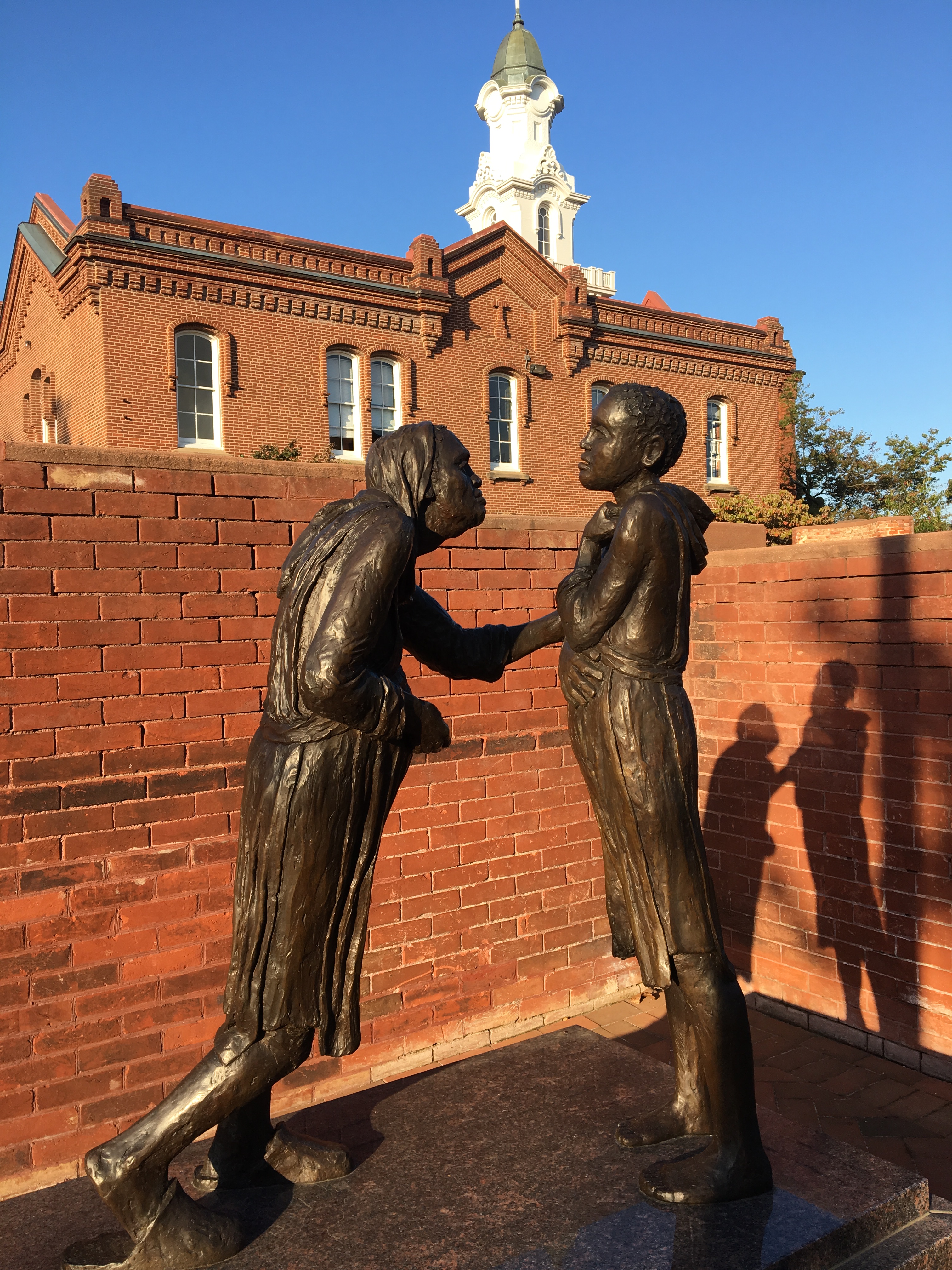
Mary as Prophet by Margaret Parker at Virginia Theological Seminary (photo by Jennifer Andrews-Weckerly; reuse with permission)

Today is the Feast Day of the Visitation – that lovely encounter between Elizabeth and Mary, the mother of Jesus, when they are both unusually pregnant.  You may recall Elizabeth is older, and had likely assumed she would never have children.  Her child would become John the Baptist.  And of course, Mary, officially unwed and a virgin, is now newly pregnant with the son of God.  When the two cousins meet at the Visitation, John leaps in Elizabeth’s womb, and we get the profession of faith that is so familiar to us in the rosary, “Blessed are you among women, and blessed is the fruit of your womb”[i]  Just a few verses later, Mary’s response to Elizabeth is the text we call the Magnificat, or the Song of Mary[ii] – a text sung at Evensongs for centuries. 

As I heard this text retold at the monastery today, I was reminded of how important companions are in our spiritual journey.  I imagine Elizabeth’s pregnancy was full of anxiety – fear that she might lose the precious child in her high-risk pregnancy.  And I imagine Mary’s pregnancy was full of a totally different kind of anxiety – so many social mores to manage, Joseph to worry about, and, well, the whole God-bearing thing.  And yet, only in this meeting of two women do we get two of the richest texts in our tradition.  Sometimes we need earthly companions to help us digest the big stuff that God throws our way.

I wonder who your earthly companions are these days.  I wonder whether you have reached out to them recently with whatever stuff God has been throwing your way.  We are a people made for community and relationship.  We are not meant to walk the journey alone – even though we are perfectly capable of doing so.  But how much more joy, surprise, reassurance, and victory do we experience when we walk together?  May this Feast Day of the Visitation be your invitation to find someone to walk with in this crazy season God has given you.


[i] Luke 1.42

[ii] Luke 1.46-55

Sermon – Luke 23.33-43, CKS, YC, November 20, 2022

23 Wednesday Nov 2022

Posted by jandrewsweckerly in Sermons

≈ Leave a comment

Tags

Christ the King, crucifixion, despair, hope, Jesus, justice, king, leadership, Messiah, Sermon, victory, way

If the foyer of our house is a painting of the crucifixion by an artist from Tanzania.  The painting is hauntingly beautiful, with deep reds, purples, and blacks.  For some reason this week, our younger daughter noticed the painting and asked who the other two men on crosses were.  “Why are there three crosses?  Wasn’t just Jesus on a cross?” she asked.  I offered a short explanation, including why people were crucified in Jesus’ time.  Her rage was immediate.  “That’s not fair!  We should crucify those people who crucified others!”

I confess her reaction was not what I expected and led to a rather pedantic conversation about The Golden Rule.  But the more I thought about her reaction, the more I though she was simply reflecting those base feelings we all have.  In her mind, justice is retribution:  a consequence equal to the offense.  Her reaction is why twenty-seven states still have the death penalty.  In fact, there are whole political science courses on the concept of what constitutes justice. 

That’s why today’s feast day, Christ the King Sunday, is tricky.  The people of Jesus’ day had notions of what a king should be – in particular, what the messianic king should be.  The messianic king was to be about justice – righting the wrongs of a people who have been subjugated by the Romans, establishing power, authority, and control, and running out anyone opposed to the rule of the Lord.  Suddenly why Jesus is on a cross is more obvious – the Messiah whose “triumphal entry into Jerusalem,” instead involves riding into town on a lowly donkey, who seems more focused on healing people than on establishing a new political order, who questions the authority and motives of the religious leaders.  This is why a mocking sign, “King of the Jews” hangs over his head, this is why religious leaders and soldiers are taunting him, this is why a thief condemned to the same fate, hanging in agony, channels his anger toward Jesus.

And yet, here we are, reading this text of seemingly failed leadership while simultaneously celebrating the crucified Christ as the king.  We modern Americans know what successful leadership looks like.  We have spent the last two weeks anxiously awaiting who will control the House and Senate in Congress.  Presidential hopefuls are revealing themselves.  Political pundits have been explaining the consequences of split leadership, and what we can anticipate in the next two years.  Given the chaos of the times, a traditional messianic king might be kind of nice.

But here’s how we know why we prefer Jesus’ version of kingship.  In the midst of this chaos are those two men my daughter saw in that painting.  According to tradition, the one on the right, who defends Jesus, is named Dismas; the one on the left, who insults Jesus, is named Gestas.[i]  Both men are likely political criminals, since crucifixion was reserved for the most extreme political crimes.  And since they are both on a cross, we can imagine that both their political dreams did not come to fruition.  And so Gestas, bitter and angry mocks Jesus.  He’s often called the “bad” or “unrepentant thief,” so we have our cues about how to judge his behavior.  But who among us, especially when our dreams or political hopes have been dashed, is not bitter?

Meanwhile, Dismas is equally defeated.  He does not presume to plead his case to Jesus – he has surrendered his dream.  He asks the only thing left to ask, “Remember me when you come into your kingdom.”[ii]  His plea is a defeated, vulnerable plea.  But here’s where the beauty of Jesus’ version of kingship comes in.  Jesus, as scholar Debie Thomas says, “tolerates the terrible tension between despair and hope, absorbing both into his heart…”  Jesus offers, “a hope so paradoxical, [the hope] transforms our suffering and changes our lives.”  “Today,” he says to Dismas, “You will be with me in Paradise.”[iii]

Today we celebrate the king who remembers us, who hangs “in the gap between our hope and despair…who carries our dreams to the grave and beyond.”[iv]  No matter what is happening in our political lives, Christ the King Sunday invites us to follow this third way of Jesus.  We will not always feel like victors.  In fact, our defeats may be the only thing that help us see the way out of the world’s suffering.  The way is not on gallant horse, flag in hand, proclaiming victory.  Ours is the quiet victory of a man who hangs in the midst of hurts and declares a new way of the cross.  Our invitation is to follow that kind of king.  Because today – today – we can realize the kingdom with Christ our King.  Amen.


[i] Debie Thomas, Into the Mess & Other Jesus Stories:  Reflections on the Life of Christ (Eugene, OR:  Cascade Books, 2022), 184.

[ii] Luke 23.42

[iii] Thomas, 184-185.

[iv] Thomas, 186.

Sermon – Matthew 26.14- 27.66, PS, YA, April 5, 2020

08 Wednesday Apr 2020

Posted by jandrewsweckerly in Sermons, Uncategorized

≈ Leave a comment

Tags

afraid, angry, anxious, change, Coronavirus, disciples, God, grief, hope, Jesus, Lent, Lord, Palm Sunday, promise, rollercoaster, Sermon, turbulent, victory, walk

There is a meme that has been circulating that reads, “This Lent is the Lent-iest Lent I’ve ever Lented.”  Of course, the grammar is intentionally ridiculous, but the meme had the effect of making me want to laugh and cry all at the same time.  Lent is usually when we craft a time of sacrifice and abstinence – a time of purposeful withdrawal from comfort to help us ascetically come closer to God.  But this Lent, we have not needed to craft anything.  Comfort has been ripped away from us, our footing has been upended, and a sense of being bereft has swept over us as our governments have attempted to force us to respect the dignity of every human being through stay at home orders with punitive consequences.  In other words, that daily devotional I started reading in the first week of Lent is buried under a pile of crisis management paperwork.

Because this has been a “Lent-y” Lent, the emotional rollercoaster of Palm Sunday is much more relatable than in most years.  We started out our service singing loud hosanas, feeling the high of the promise of the arrival of a savior-king, and we end with a reading where disciples have deserted and betrayed, the faithful have condemned out of fear and resentment, the leadership have mocked and brutalized, the Chosen One of Israel lies dead in a tomb while the remaining faithful women linger at a distance, fearfully mourning Christ’s death.  In this “Lent-iest Lent we’ve ever Lented,” we are no stranger to the feeling of going from confident security and relative prosperity, to sober, fearful waiting and looking at the tomb that is sealed with finality.  As death and the threat of infection hang around us, we do not need to contrive a sense of deep mournfulness and communal culpability.  We do not need to imagine the feeling of Christ’s death.  From singing hosanas to shouting “Let him be crucified,” we are living the narrative of Palm Sunday today.

Though I would never wish our current reality on us, and though I wish we were having a more man-made experience of Lent, I must confess the confluence of this time with this virus feels appropriate.  We do not have to imagine the grief of sitting by the cross mourning the reality of death – we are already sitting by the cross mourning.  We do not have to imagine being forced from the crowd to take up a stranger’s cross in a violent, turbulent moment – we are already in a turbulent moment in the company of strangers.  We do not have to imagine what feels like the extinguishing of hope and victory – we are already in the midst of clouded hope and unseen victory.

I suppose that is where I find hope today.  We do not need to imagine today.  We are the disciples, afraid and unworthy.  We are the mourning women, anxious and bereft.  We are the religious leaders, angry and discouraged.  None of that may sound hopeful.  But I see hope all around.  I see hope in governor’s wives who can see and speak to truth, warning us and helping us see.  I see hope in disciples who can see their own unfaithfulness and mourn with honesty.  I see hope in Jews who risk reputation and sacrifice personal wealth to properly bury the Christ.  I see hope in a Messiah who wanted to escape certain and necessary death, but dies with dignity and faithfulness to save us.  Though today is a sober day, today is also a day of promise.  The hosannas we say are not in vain.  The songs we sing are not in vain.  The prayers we pray are not in vain.  I have hope that we will come through this unique Lent a changed people – a people more humble about our frailty, a people more sober about the importance of community, a people more astounded by the blessing of a savior.  Even in our physical separation, we walk this holiest of weeks together, we mourn and comfort together, and we hold out hope together.  Today, we walk in the light of the Lord.  Amen.

Sermon – Luke 23.33-43, P29, YC, November 24, 2019

27 Wednesday Nov 2019

Posted by jandrewsweckerly in Sermons, Uncategorized

≈ Leave a comment

Tags

Christ the King, cross, fairness, humility, image, Jesus, justice, king, Mr. Rogers, need, Sermon, victory, want

Fifty-one years ago, Mister Rogers Neighborhood debuted on public television.  Many people criticized the show, saying the show was too slow and too boring to keep children engaged.  For critics, children’s programming needed to be loud, action-packed, full of silly gimmicks, perhaps with a few characters that were made fun of or teased.  Knowing how frenetic young children can be, television producers had decided to mirror young children’s behavior in their television programming.  But not Mr. Rogers.  In the midst of frenetic behavior, Mr. Rogers sought a different environment for his show – something slower and more thoughtful, something kind and engaging, something simple and attentive.  Critics said the show would never last, that Mister Rogers Neighborhood was not what children wanted.

On this Christ the King Sunday, the final Sunday of the Church year, this Sunday of jubilant triumph, we find a similar conundrum.  As we read from Luke’s gospel, we do not find Christ the King on a throne – we find him on a cross, leaders scoffing at him, soldiers mocking him, a criminal deriding him, and a crowd of people just standing there watching.  Nothing about today’s lesson connotes victory or royalty.  Jesus’ critics put a sign over his head that read, “This is the King of the Jews.”  The inscription is written as a declarative statement, but I wonder if there should have been a question mark at the end of that sentence.  This is the King of the Jews?  This is what royalty looks like?  This is what a savior is to you?

Of course, I am not sure the people of God were any surer about what having a king should be like.  The people of God never really had a king until they reached the Promised Land.  They saw the neighboring countries with their armies and their admirable kings, and they wanted one for themselves.  That was their first mistake.  God granted them a king to rule over them, but inevitably, the kings, like all humans, were flawed – some more than others.  Hence, there are four books in the Hebrew Scriptures about the kings who ruled and the judges who tried to correct their behavior.  Most of the kings were corrupted by power, money, and greed.  Many abused the people.  Even the most revered king, King David, was a mess.  He was the one who coveted Bathsheba, slept with her, and then killed her husband when he got her pregnant and realized he would not be able to get away with it.

Having been through a horrible patch of awful kings, the prophets predicted the coming of a Messiah – the king of kings and Lord of lords.  This king would be triumphant and would make the people of Israel dominant at last.  You can imagine that with such a great promise, the people of Israel are not too pleased with the man who finally claimed be the Messiah.  Nothing about Jesus says “king.”  He is nonviolent, hangs out with sinners of all sorts, and travels with a sorry band of misfits.  Even his grand entrance into Jerusalem where he is heralded as a king is not so grand – he rides in on a donkey, for goodness sake!  This could not possibly be the king Yahweh had promised them.

And yet, this is exactly the king God sends.  The Lord, who never wanted God’s people to have an earthly king anyway, makes a king that represents everything that is kingly:  a man who loves the poor and cares for the sick, a man who sees through the pretenses of the temple and calls for authenticity, a man who loves deeply and forgives infinitely.  So why are the people of God not excited about this king?  Why can they not love this countercultural king as much as the king they think they need?

In talking to a William & Mary student a couple of weeks ago, I was reminded of one of the first Political Science classes I took in college called Political Theory.  When we started reading the first book in our Political Theory class, I knew I was in trouble.  We read John Rawls’ A Theory of Justice.  In the book, he presents the best way to create a just political system.  He imagines gathering a random, diverse group of people who are essentially blindfolded about what their lot in life will be.  They have no guarantees about whether they will be old or young, rich or poor, male or female, member of a minority group or not.  In the midst of this blindness, the people gathered are given the task to create a set of rules to govern society.  Rawls’ basic argument is that if those people are truly blind about what their lot in life will be, they will be more likely to come up with a system of governance that is the fairest for all – since no one would want to take a chance on being the one victimized by an unfair system.  Although I appreciated what Rawls was saying, I was immediately annoyed at his argument.  How could we ever recreate a system of justice from scratch, and truly blind anyone enough to create such a system?  The entire premise seemed impossible, and thoroughly frustrating.  Needless to say, my focus in Political Science did not become Political Theory!

That being said, many years later, I think I may finally understand what Rawls was trying to communicate.  Our political system, or even this earthly life in general, is governed by a set of human-made standards that do not look out for the poor, create injustices, and benefit very few.  This is why so many of us get frustrated when we talk about justice or trying to make a difference – we see the system of injustice that fights against us and we can end up feeling helpless.  This is the very injustice that our king – Jesus – comes to fight.  Maybe Rawls saw this too.  Perhaps this world we can only achieve through blindness is the same world Jesus could see through God’s eyes.

In Rawls’ argument, when the blinded people make the rules, and then have their blindfolds removed, some are relieved to be well-off and others are dismayed to see themselves in poverty or at a disadvantage.  But all have some sense of acceptance because the rules they made do not make rich-life as advantageous and do not make poor-life as unbearable.  This is the kind of fairness into which Jesus invites us.  Jesus shows us a world where a humiliated man can look at his persecutors and forgive them.  Jesus shows a world where a man is willing to suffer for the salvation of others.  Jesus shows us a world where even a criminal can see truth in the last hour, can admit his guilt, and turn to Christ for leniency.

This is why we celebrate Christ as King today:  not because he is victorious in putting us in control over others, but because he invites us into a life that evens the playing field – the life of the kingdom of God.  There are certainly going to be days when we wish Jesus would just mount a mighty horse and triumph over evil.  Lord knows, in these days of political strife, of country-wide division and derision, of a time in our country where we say nasty things to one another, and the actions of the other side (whichever side we see as “the other”) are seen as the cause of all our troubles, we could use a Messiah, a king to come in and just “fix it” – to be a decisive, strong, powerful king to clean the slate.  But what Christ the King Sunday invites us to remember is we do not need a king on a throne; we need a king on a cross who enables us to create a world of fairness here and now – a world that is much more similar to the kingdom of God than the kingdom of humankind.

So why do we honor this not-so-kingly king today on the last day of the liturgical year?  I think the very best reason we close one year and prepare to start another with today’s gospel lesson is so that as we can more humbly approach the Christ Child.  If we can imagine ourselves gathered around that manger on that most holy of nights, not eager for vindication, but instead humbled by the path we will all walk with this king, then we enter into Advent with more reverence, less arrogance, and a healthy dose of gratitude.  This king – Christ the King – is the most sobering, challenging, merciful, joyous, steadying king for which we could hope.  He is not the king we always want, but he is certainly the king we always need.  Today we celebrate the wise gift by God of a true King – a king who makes us all better versions of ourselves, who helps us see there are no easy solutions, and who encourages us to embrace justice as fairness, not justice as vindication.  Our invitation today is to take a seat at the foot of the cross, to prepare our place in the hay surrounding the manger, to change out our shoes, to take off our jackets and zip up our cardigans, and to make a calm, quieter space for ourselves to hear how a real king can help us create not the kingdom we may want, but certainly the kingdom we need.  Amen.

Sermon – Luke 24.1-12, ED, YC, April 21, 2019

01 Wednesday May 2019

Posted by jandrewsweckerly in Sermons, Uncategorized

≈ Leave a comment

Tags

celebrate, celebration, church, confusion, doubt, Easter, faith, Jesus, journey, joy, loud, question, quiet, resurrection, Sermon, unbelievable, uncertain, victory

Easter is one of my favorite days in the church year.  I love how no matter whether we come to church every Sunday or if we haven’t been to church in ages, something about Easter draws us to the Church.  I love the celebration:  the Easter outfits, the fragrant flowers, the boisterous music, and the family of faith gathered at the communion table.  I love the sweet feeling of having emerged from the penitential season of Lent, and counting how many times we can say, “Alleluia.”  There is a loudness to Easter, an unbridled joy, a sense of victory.

What is funny about our experience today though is very little of the boldness of this day is present in Holy Scripture.  In fact, Luke tells a story that is quite the opposite of our experience today.  While we sing loud alleluias and hosannas, all of the characters in our gospel lesson today are in a totally different place.  They are mired in grief, lost in confusion, unsure about what has happened to them.  In a quiet, almost mechanical, numb way, the women who have been beside Jesus his entire ministry and were the only ones remaining at his death, come to the tomb in the fog of dawn, to do the work of tending to the dead body.  In their haze, no sense of closure comes.  Instead, more confusion comes.  Not only is the tomb empty, the angelic figures tell them Christ is risen.  The angels remind them Jesus had explained this to them, and things start to make sense.  But when the women return to tell the men, the men are so resigned and defeated, they mock the women.  Peter goes to check out the story, but even he does not come back with profound clarity.  He is lost in amazement – in awed confusion.  This story tells us very little about what this all means, what we should do, or how we should respond.  Very little about the gospel today is loud, triumphant, or jubilant.

Though I have been begging our musician for years now for more sound at Easter – a timpani to accompany the brass – the truth is, I kind of like how our gospel lesson today takes us in another direction.  Much of what we boldly proclaim today – that Christ is risen, his resurrection brings eternal life, and everything we know has changed – is pretty difficult stuff to believe.  Any of you who has spent time around an inquisitive child or a doubtful friend knows how difficult explaining the resurrection can be.  For our rational, twenty-first century selves, the theology of Easter is not only difficult to articulate, Easter is almost unbelievable.  And when we are really honest with ourselves, in the quiet of our own homes, we sometimes have moments when we are not really sure why we believe what we believe about Christ.

That’s why I love today’s gospel.  Today’s gospel reminds us of how unbelievable the resurrection of our Lord really was.  Sure, Jesus had said he would be handed over to sinners, be crucified, and on the third day rise again.  But his words sounded crazy at the time.  Now that Jesus’ words have come true, the women are perplexed, terrified, and rejected when they share their truth.  The men are paralyzed, doubtful, and downright mean.  On this early morning, the followers of Jesus only have their experiences of Jesus, their uncertainty of faith, and their attempts to believe the unbelievable.

To me, that is very good news indeed.  On this day as we sing songs about Jesus’ resurrection, and as we hear Peter preach with certainty in the book of Acts, and as we, with joy, proclaim, “Christ is risen!  The Lord is risen indeed!” our gospel story reminds us faith is a journey full of doubt, questions, and confusion.  We come on this festival day not because we are absolutely certain about Jesus.  We come on this festival day because in our foggy dawns, we have had encounters with the risen Lord – even when we did not know how to articulate the encounters.  We come to this festival day because in our pain, suffering, and questioning about life – we have had moments when something from scripture or our faith life suddenly connected and made sense.  We come to this festival day because even in our doubts, there is some small part of us that cannot extinguish hope, that suspects Christ might have actually changed the world.

On this day, the Church does not want our theological explanations of the resurrection.  On this day, the Church invites us to recall those moments, however fleeting or miniscule, where we have encountered, or suspected we encountered, the risen Lord.  Our bold singing of alleluias only needs that small flicker of hope – or maybe our desire for that flicker of hope.  Our celebrating today only needs our presence – our willingness to be here, encouraged by others walking through the fog.  Our proclamation today that the Lord is risen, only needs our willingness to say the words.  The community gathered here today will do the rest.  We will say with you, “The Lord is risen indeed,” until someday we can all claim the astounding love and grace of our Lord Jesus Christ ourselves.  Amen.

Sermon – 2 Samuel 18.5-9, 15, 31-33, P14, YB, August 9, 2015

14 Friday Aug 2015

Posted by jandrewsweckerly in Uncategorized

≈ Leave a comment

Tags

Absolom, Christ, confession, cross, David, God, guilt, judgment, loser, losing, loss, redemption, sin, tragedy, victory, We Are Marshall, winning

I recently watched the film We Are Marshall.  The film details the true story of a tragedy in 1970 that happened to Marshall University.  After an away football game, most of the team and coaches, as well as several boosters, took a private plane back to the university.  The plane crashed just minutes from landing, killing everyone onboard.  The town was bereft as they mourned their sons, friends, boyfriends, wives, husbands, and teammates.  The University’s Board was set to cancel the 1971 football season, when the few surviving players petitioned to play anyway.  The president was then tasked to find a coach who would be willing to step into this tragic situation – coaching a season that many thought was inappropriate given the deaths, to find enough players when Freshmen were not yet allowed to play per NCAA rules, and to find a supporting coaching staff, including trying to recruit the only assistant coach who had not been on the plane.  The season moves forward and after the first game, which Marshall loses, the head coach and the surviving assistant coach have a heart-to-heart.  The assistant coach explains that the deceased former head coach had always said that the most important thing in football was winning.  And if the current team was not going to win, the assistant didn’t want to coach, because they would be dishonoring the former coach’s memory.  After a long pause, the current head coach confesses that before he came to Marshall, he would have said the same thing:  that winning is the most important thing.  But now that he was there, in the midst of the Marshall community, the most important thing to him was simply playing.

We are a society that glorifies winning.  Not just in sports, but in all of life, we want to be winners.  No one likes to lose because losing, when we are really honest, is not fun.  Of course, we try to teach our children that we cannot always win.  Many a play date argument is settled by the conversation that sometimes we win and sometimes we lose.  We even have a word for being comfortable with losing.  We say we are being “good sports.”  But being a good sport takes work.  We do not like losing.  Losing itches as something deep inside of us – both internally and externally reinforced.  We want to be winners.

Of course no one knows more about losing than King David.  History labels him as a winner, but as we reread his story, we know that David was an intimate friend of losing.  We hear the deep pain of his losing in his final words today, “O my son Absalom, my son, my son Absalom!  Would I had died instead of you, O Absalom, my son, my son!”  We know the pain of losing a child – the sorrow and the grief of that kind of losing.  But David is not just mourning the loss of his child in these words.  He is morning the loss even more deeply because he knows he is indirectly guilty of his son’s death.[i]  If you remember, in the reading we heard last week, Nathan told David that because of his sinfulness with Bathsheba and Uriah that his household will be plagued by a sword.  Through Nathan, the Lord proclaims, “I will raise up trouble against you from within your own house; and I will take your wives before your eyes, and give them to your neighbor, and he shall lie with your wives in the sight of this very sun.  For you did it secretly; but I will do this thing before all Israel, and before the sun.”[ii]

God stays true to God’s judgment.  Between last week’s reading and this week’s reading, David’s family starts to fall apart.  His first child with Bathsheba dies.  One of David’s sons rapes his half-sister.  When David does not punish that son, another son, Absalom, takes action, killing his half-brother.  Absalom then flees, and spends years amassing a revolution against David.  Absalom manages to take Jerusalem, and further humiliates David by sleeping with ten of David’s concubines in front of everyone.  David is forced to battle against Absalom to restore the kingdom, but he does so begrudgingly.  Today we hear David trying to make victory as painless as possible, asking his men to deal gently with Absalom.  But Absalom had made too many enemies in the family and kingdom, and when the time came, he was killed in battle.  Though many saw Absalom’s death as a victory, David knew the truth.  Victory in this case was not winning for David.  Victory was just another reminder of the ways in which David’s life had become about losing – about the painful reminder of his sin hanging over his head.

David reminds us of what we have all learned about losing.  Though none of us like losing, we know losing is a necessary and probably valuable part of life.  You see, losing helps us in many ways.  First, losing reminds us of our finitude.  Though we might like to think we are without limits or we can control everything, losing reminds us of the “futility of our personal striving and the frailty of our existence.”  Second, losing gives us the opportunity to reexamine our goals and outlook on life.  Losing can help us see when perhaps we have become overly self-serving, have developed unrealistic expectations, or we have just become distracted by the wrong things in life.  Finally, losing reminds us that our lives are in need of redemption.  Losing can give us a much-needed opportunity to renew our relationship with God.  As one scholar explains, “In this moment of realization, we are liberated to renew our trust in God’s power and in [God’s] purpose for our lives.”  That does not mean we should give up, stop trying, or be overcome by the fear of losing.  Instead, maintaining our trust in God gives assurance that “ultimately, there is no losing without the possibility of redemption.”[iii]

Think for a moment about the ultimate symbol of our faith – the cross.  The cross is both a symbol of loss and victory.  We always remember the victory of resurrection and redemption, but first, the cross was a symbol of death and defeat.  The cross was a humiliating reminder of the brutal death of the one we insist is the Messiah.  Our main symbol was the symbol of ultimate loss – the place where losers go to lose:  lose their life, their dignity, and their power.  That symbol of being a loser is only redeemed because the Redeemer redeems it.  Of course, we should not be surprised.  Every week, we as a community gather and remind ourselves at how we are losers when we confess our sins.  We kneel down and young, old, male, female, single, partnered, good, and bad confess that we lost.  Every single week we confess how, once again, we have lost.

I sometimes wonder how David coped with the sword in his house.  Sure, he had moments of redemption.  Solomon taking the helm at David’s death was one of the best redemptive moves in his family.  But I wonder, on that deathbed, how all the losing in David’s life weighed on him.  In last week’s lesson, David did what all of us do.  He confessed.  He confessed, “I have sinned against the Lord.”  His confession did not make Absalom’s death any less painful.  But his confession, like ours, is redemptive.  Like David, when we acknowledge and confess our senses of incompleteness, “we are able to be freed from the entrapments of a win/lose culture.  God accepts us despite our failings.  This relationship is not earned; [this relationship] is a divine gift.  Accepted and forgiven, we are liberated to celebrate life.  Affirmed and fulfilled by God, we are released to care for others.  These affirmations point to the redemptive side of failure, to the God who accepts losers.”[iv]

When we wear a cross, or we reverence the cross in church, we reverence both the winning and the losing of the cross.  We honor the ways in which the cross represents not just the loss of Christ, but also the brokenness in each of us – the ways in which we have failed.  Only when we honor that loss can we then hold that cross as a symbol of victory.  That cross becomes a symbol of the ways in which Christ redeems us, but also the ways in which we too made new through our losing.  When we embrace the cross in its fullness of expression, we also recognize the fullness of our lives – the good, the bad, and the ugly.  We know that without the embracing of our losing we can never fully claim the victory of our winning through the cross.  Amen.

[i] Ted A. Smith, “Commentary on 2 Samuel 18:5-9, 15, 31-33” 2009, as found at http://www.workingpreacher.org/preaching.aspx?commentary_id=365 on August 6, 2015.

[ii] 2 Samuel 12.11-12.

[iii] The ideas in this paragraph and the quotes within come from Carnegie Samuel Calian, “Theologizing in a Win/Lose Culture, Christian Century, vol. 96, no. 32, October 10, 1979, 978.

[iv] Calian, 979.

Recent Posts

  • On the Myth and Magic of Advent…
  • On Risking Failure and Facing Fear…
  • Sermon – Luke 23.33-43, P29, YC, November 23, 2025
  • On Inhabiting Gratitude…
  • Sermon – Luke 20.27-38, P27, YC, November 9, 2025

Archives

  • December 2025
  • November 2025
  • October 2025
  • September 2025
  • August 2025
  • July 2025
  • June 2025
  • March 2025
  • February 2025
  • December 2024
  • November 2024
  • October 2024
  • September 2024
  • August 2024
  • July 2024
  • June 2024
  • May 2024
  • March 2024
  • February 2024
  • January 2024
  • December 2023
  • November 2023
  • October 2023
  • September 2023
  • August 2023
  • July 2023
  • June 2023
  • May 2023
  • March 2023
  • February 2023
  • January 2023
  • December 2022
  • November 2022
  • October 2022
  • June 2022
  • May 2022
  • January 2022
  • December 2021
  • November 2021
  • October 2021
  • September 2021
  • August 2021
  • June 2021
  • May 2021
  • April 2021
  • March 2021
  • February 2021
  • January 2021
  • December 2020
  • November 2020
  • October 2020
  • September 2020
  • August 2020
  • July 2020
  • June 2020
  • May 2020
  • April 2020
  • March 2020
  • February 2020
  • January 2020
  • December 2019
  • November 2019
  • October 2019
  • September 2019
  • August 2019
  • July 2019
  • June 2019
  • May 2019
  • April 2019
  • March 2019
  • February 2019
  • January 2019
  • December 2018
  • November 2018
  • October 2018
  • September 2018
  • August 2018
  • July 2018
  • June 2018
  • May 2018
  • April 2018
  • March 2018
  • February 2018
  • January 2018
  • December 2017
  • November 2017
  • October 2017
  • September 2017
  • August 2017
  • July 2017
  • June 2017
  • May 2017
  • April 2017
  • March 2017
  • February 2017
  • January 2017
  • December 2016
  • November 2016
  • October 2016
  • September 2016
  • August 2016
  • July 2016
  • June 2016
  • May 2016
  • April 2016
  • March 2016
  • February 2016
  • January 2016
  • December 2015
  • November 2015
  • October 2015
  • September 2015
  • August 2015
  • July 2015
  • June 2015
  • May 2015
  • April 2015
  • March 2015
  • February 2015
  • January 2015
  • December 2014
  • November 2014
  • October 2014
  • September 2014
  • August 2014
  • July 2014
  • June 2014
  • April 2014
  • March 2014
  • February 2014
  • January 2014
  • December 2013
  • November 2013
  • October 2013
  • September 2013
  • August 2013
  • July 2013
  • June 2013
  • May 2013
  • April 2013
  • March 2013
  • February 2013
  • January 2013
  • December 2012
  • November 2012
  • October 2012
  • September 2012

Categories

  • reflection
  • Sermons
  • Uncategorized

Meta

  • Create account
  • Log in
  • Entries feed
  • Comments feed
  • WordPress.com

Blog at WordPress.com.

  • Subscribe Subscribed
    • Seeking and Serving
    • Join 394 other subscribers
    • Already have a WordPress.com account? Log in now.
    • Seeking and Serving
    • Subscribe Subscribed
    • Sign up
    • Log in
    • Report this content
    • View site in Reader
    • Manage subscriptions
    • Collapse this bar
 

Loading Comments...