
Tags
dependent, God, hospitality, humility, Jesus, love, meal, parable, reverence, Sermon, table, welcome
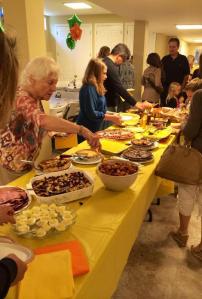
Tables are a funny thing. Tables are where families gather and catch up about how their day was. Tables are where a young adult eats their first solo meal on the plate they got at the local thrift store and where a much older adult gets lost in thought looking at the China pattern their grandmother chose as a new bride. Tables are where friends gather in laughter and storytelling, and where formal introductions are made over so many forks you do not know which one to choose. Tables are where the cool kids, the nerds, or the jocks sit in the cafeteria, and where students ask the terrifying question, “Is this seat free?”
Tables were no less meaningful in Jesus’ day. Much of Jesus’ ministry and the stories we know from Jesus happened around tables. As scholar Debie Thomas describes, “Though the Gospels record [Jesus] receiving and accepting many dinner invitations during the years of his ministry, those mealtime scenes usually ended in drama, provocation, or scandal. Once, a woman of dubious reputation caressed his feet under the table. Sometimes he interrupted a meal to heal sick people on the Sabbath. Often, he ate with dirty hands, shared a table with riff-raff, and drank more than his enemies considered respectable. Worst of all — he said things. Blunt, embarrassing things that no one cared to hear.”[i]
Today’s gospel includes one of those same uncomfortable encounters at a table. Jesus has been invited to dinner by the one of the leaders of the Pharisees – an honor, to be sure. But after watching the other guests jockey for the seats of prestige – those seats closest to the host – Jesus begins to tell a parable – or at least, Luke’s gospel says Jesus tells a parable. What Jesus says sounds more like advice – and his advice, on first glance, sounds oddly manipulative. “When you go to a wedding sit at the lowest-honor seating so that you can be honored when the host insists you move up to the prestigious seat.” Somehow humbling yourself will let you be exalted, but I’m not entirely sure how authentic one’s humility is if they are being humble just to be exalted.
So, then what is going here? Well, Luke’s labeling this as a parable is helpful. Though Jesus does not tell a narrative or story, like we know most parables present, we know by the use of the word “parable” Jesus is speaking directly about something with a deeper level of meaning.[ii] Jesus is not giving social advancement advice. He is calling into question the entire social order and contrasting that social order with the kingdom of God. As scholar David Lose would argue, in this parabolic advice, Jesus is calling all social orders into question, saying that “…these things are not of God. Jesus proclaims here and throughout the gospel that in the kingdom of God there are no pecking orders. None. Zero. Zilch. And while that sounds at first blush like it ought to be good news, it throws us into radical dependence on God’s grace and God’s grace alone. We can’t stand, that is, on our accomplishments, or our wealth, or positive attributes, or good looks, or strengths, or IQ, or our movement up or down the reigning pecking order. There is, suddenly, nothing we can do to establish ourselves before God and the world except rely upon God’s desire to be in relationship with us and with all people. Which means that we have no claim on God; rather, we have been claimed by God and invited to love others as we’ve been loved.”[iii]
I think that realization of the deeper level of what Jesus is saying is why what Jesus says next is even more unnerving. Jesus says the next time you have a meal, not to invite your friends or your family or even your rich neighbor. You are to invite the poor, the crippled, the lame, and the blind. In other words, our tables are meant to be a welcome space to outsiders.
Dan Clendenin tells the story of family wedding. When the young couple got married, “…they wanted to invite their entire church, but budgetary constraints prohibited that. Instead, after the service they had the local police block off the main street in downtown Waco, Texas. Guests danced in the streets and enjoyed refreshments from a Baskins Robbins ice cream cart. The gazebo in the concrete park next to the theatre sheltered the wedding cake. …[The groom] had made friends with a number of homeless men who lived under a bridge. As a pastor [he] would employ these men for odd jobs at his church. ‘Coyote,’ the leader of his homeless friends, came to the wedding in his usual attire of jeans with holes in the knees, a scraggly beard, and unwashed hair. He organized his friends to clean up the streets after the wedding, then sat on the curb with a big smile and smoked a cigar. Another guest was [the bride’s] next door African-American neighbor. The little girl loved to spend time with [the bride], and really wanted to come to her wedding. So the mother, the daughter, and the grandfather all came. The 70 year-old grandfather was soon the center of attraction as he went out on the street and danced to the music. Soon the college girls were vying to dance with him. As passersby strolled by and inquired about what was happening, they too were invited to the wedding. There were guests dressed in their nicest clothes alongside guests who wouldn’t feel at home at a formal occasion. However they dressed, on this occasion every person felt welcomed as an honored guest, just as God himself welcomes us to himself, and invites us to welcome each other.”[iv]
This year, Hickory Neck is planning to launch a third worship service. The dream for that service centers around a table too. The guest list does not really include any of you here (no offense!). We are hoping to create place settings for those who do not have a church home. We do not expect to invite people who are friends, family, or even rich neighbors – though we certainly would not turn them away. And although all our services gather around tables to share the Eucharistic meal, this service will literally be conducted around a dinner table – a table that feeds us physically but also spiritually. Where all sorts of folks can gather, can share in community, can learn about this radically good news of Jesus’ love, and can shape disciples who invite the wideness of God’s kingdom. Like all experiments, I am not sure how the experiment will go. But today’s text reminds me of why we want to center that space around tables.
Of course, endorsing this new ministry doesn’t get us off the hook. We do not leave Jesus’ parable (or parabolic teachings) today with a promise of a ministry that absolves our call to love like God loves. Although Hickory Neck is hoping to model a communal way to live into the gospel, Jesus still offers us a personal invitation to think about our own tables this week. “Jesus asks us to believe that our behavior at the table matters — because [our behavior at the table] does [matter]. Where we sit speaks volumes, and the people whom we choose to welcome reveals the stuff of our souls. This is God’s world we live in; nothing here is ordinary. In this realm, the strangers at our doorstep are the angels.”[v] Our work this week is not quick-fix, one-time work. Our work is the on-going work of welcome, love, reverence, and humility. We do that work one table at a time – and all with God’s help. Amen.
[i] Debie Thomas, “Table Manners,” August 21, 2016, as found at https://journeywithjesus.net/essays/1070-table-manners on August 29, 2025.
[ii] Luke Timothy Johnson,The Gospel of Luke: Sacra Pagina Series, vol. 3 (Collegeville, MN: The Litrugical Press, 1991), 224.
[iii] David Lose, “More Than Good Advice [or] Why Jesus Gets Killed, Pt. 2,” August 22, 2010 as found at https://www.workingpreacher.org/dear-working-preacher/more-than-good-advice-or-why-jesus-gets-killed-pt-2 on August 29, 2025.
[iv] Daniel B. Clendenin, “Jesus Does Dinner: Food for Thought for Guests and Hosts,” September 7, 2007, as found at https://journeywithjesus.net/essays/3637-20070827JJ on August 29, 2025.
[v] Thomas.






 Seeking and Serving