• About

Seeking and Serving

~ seek and serve Christ in all persons

Seeking and Serving

Tag Archives: work

Sermon – Matthew 11.25-30, St. Francis Feast, YC, October 2, 2022

05 Wednesday Oct 2022

Posted by jandrewsweckerly in Sermons

≈ Leave a comment

Tags

animals, blessing, Jesus Christ, light, peace, reconciliation, relationship, rest, sabbath, Sermon, St. Francis, truth, wolf, work, yoke

Today we honor the life of St. Francis of Assisi.  Francis is one of the most popular and admired saints of all time.  Most of us know the highlights of his story:  born the son of a wealthy man in 1182; had a conversion experience and devoted his life to Lady Poverty; shaped monastic and lay devotion; was a friend to all God’s creatures – being known to have preached to the birds.

But the story I like most is the story about St. Francis and the Wolf.  According to legend, there was a wolf that was terrorizing the town of Gubbio, killing and eating animals and people.  The villagers tried to fight back, but they too died at the jaws of the wolf.  Francis had pity on the townspeople and went out to meet the wolf.  When Francis found the wolf, he made the sign of the cross, and said, “Come to me, Brother Wolf.  In the name of Christ, I order you not to hurt anyone.”  In response, the wolf calmly laid down at Francis’ feet.  Francis then went on to explain to the wolf how he was terrorizing the people and other animals – all who were made in the image of God.  The wolf and Francis then made a pact that the wolf would no longer harm the townspeople and the townspeople would no longer try to hurt the wolf.  The two traveled into town to explain the pact they had formed.  The people were amazed as Francis and the wolf walked side-by-side into town.  Francis made the people pledge to feed the wolf and the wolf pledge not to harm anyone else.  From that day on, the wolf went door to door for food.  The wolf hurt no one and no one hurt the wolf; even the dogs did not bark at the wolf.[i]

What I love about this story of St. Francis is that the story is about reconciliation and relationship.  At the beginning of the story the town and the wolf are at an impasse – the wolf is hungry and getting attacked; the people are afraid and are lashing out.  What Francis does for both parties is shock them out of the comfortable.  For the wolf, no one has addressed the wolf kindly – they have either shut the wolf out or actively tried to kill him.  For the people, the wolf has not asked for help – he has simply and violently taken what he needed and wanted.  Francis manages to shock the wolf first – not through violence or force, but with the power of love and blessing.  By giving a blessing in the name of God, Francis is then able to implore the wolf to reciprocate with love.  Francis also manages to shock the village – not with a violent victory, but with a humble display of forgiveness and trust.  By walking into town with a tamed wolf at his side, Francis is able to encourage the town embrace, forgive, and care for the wolf.  Francis’ actions remind both parties that unless their relationships are reconciled, unrest and division will be the norm. 

The funny thing about this story is that the story is pretty ridiculous.  I mean, how many of us go around talking to wild animals, blessing them with the sign of the cross, expecting anything other than being attacked?  We will never really know whether the story is true.  But like any good Biblical story, whether the story is true is hardly the point: the point is that the stories point toward “Truth” with a capital “T.”  What this story teaches is peace and reconciliation only happen through meeting others where they are.  We cannot expect great change unless we are willing to get down in the trenches – to go out and meet that destructive wolf face-to-face.  The other thing this story teaches is relationships are at the heart of peace work.  Only when the wolf and the town begin to get to know each other and begin to form a relationship with one another can they move forward. 

This is the way life is under Jesus Christ.  In our gospel lesson today, Jesus says, “Come to me, all you that are weary and are carrying heavy burdens, and I will give you rest.  Take my yoke upon you, and learn from me; for I am gentle and humble in heart, and you will find rest for your souls.  For my yoke is easy, and my burden is light.”  Jesus’ words have layered meaning.  The first meaning we all catch is that Jesus offers us rest and refreshment.  Jesus encourages us to come to him, to cast our burdens and cares upon him, and to take rest, to take Sabbath in Christ.  Our souls will find peace in Christ Jesus.  The second meaning is that peace in Christ Jesus is not without work.  Jesus does not say come unto me and relax forever in happy retirement.  Jesus says we will still have to take on a yoke – the burden of disciple living.  Luckily, that burden of being Christ’s disciple will not be burdensome – it will be light.  Finally, not only will Jesus make the workload “light,” as in not heavy.  Jesus will also make us “light” – as in lights that shine into the darkness and refuse to allow the shadow to overwhelm.   We become the light when we work for reconciliation in our relationships with others. 

That is why we do a couple of special things today.  First, we ask for blessing on our animals – that God might help our relationship with our pet be one of blessing and light.  Second, we come to Jesus for Sabbath rest – that God might renew us on this Sabbath day, use the rest to fill us with light, and renew our commitment to be agents of reconciliation, gladly putting on Christ’s yoke.  Amen.


[i] Jack Wintz, “St. Francis and the Taming of the Wolf,” as found at https://www.franciscanmedia.org/franciscan-spirit-blog/st-francis-and-the-taming-of-the-wolf on September 30, 2022. 

Sermon – Matthew 11.25-30, Feast of St. Francis, YB, October 3, 2021

06 Wednesday Oct 2021

Posted by jandrewsweckerly in Sermons

≈ Leave a comment

Tags

animals, blessing, burden, creation, easy, God, Jesus, sacred, Sermon, St. Francis, wealth, work, yoke

Occasionally I wander the Hickory Neck property as a way of clearing my head.  I often end up over in the St. Francis Memorial Garden, reveling in the quiet in that remote corner behind the Historic Chapel.  The bucolic scene and the St. Francis statue make me imagine the peaceful walks he took in his journey to commune with God and God’s created order.  The funny thing is our celebrations of St. Francis today are nothing like those peaceful moments.  There is the chaos of the drive-thru, as confused pets worry they are headed toward the dreaded veterinarian or are confused by the people in clerical garb.  There is the hubbub of owners calming pets inside the New Chapel, the curiosity of what unique pets one may see, and the endless giggles and chuckles about unpredictable animals in an enclosed space.  The whole morning is a morning of contrasts.

The contradictions of this day are equally evident in our Gospel lesson.  Our gospel lesson closes with one of our favorite invitations from Jesus, “Come to me, all you that are weary and carrying heavy burdens, and I will give you rest.  Take my yoke upon you … and you will find rest for your souls.  For my yoke is easy, and my burden is light.”  Those words describe a loving, gentle Jesus, who enfolds us in a calm, affirming embrace.  At least, they should.  But if we read the words critically, there is more contrast in them than we might like to admit.  Yes, Jesus taking our heavy burdens and recognizing our weariness is balm for the soul.  But the last time I checked, yokes were not exactly tools for rest.  And even though Jesus promises his yoke is easy, the yoke is still a yoke – a tool for directing, guiding, ensuring productive work is done.  Having listened to the gospels these last weeks, we know this work is anything but light.  In the last few weeks in Mark’s gospel, Jesus told us we would have to take up our cross, suffer, and die; that discipleship would mean being servant of all; and that if our hand or eye were causing us to stumble, we should just cut them off!  That does not really sound like an easy yoke to me!

Part of what we appreciate about St. Francis, and why we celebrate him every year – besides having an excuse to have a day to honor our beloved animals – is St. Francis understood Jesus’ words in a tangible, personal way.  Francis grew up in the life of luxury.  He grew up in a privileged home, lived a life of young adult revelry, and could have easily assumed his father’s wealth in adulthood.  But there were these poor people everywhere he looked around town.[i]  And there was the day everything changed at the church of St. Mary of the Angles[ii], when Francis heard different words from Matthew’s gospel, just a chapter before what we heard today.  Jesus says, “Cure the sick, raise the dead, cleanse the lepers, cast out demons…Take no gold, or silver, or coper in your belts, no bag for your journey, or two tunics, or sandals, or a staff…”[iii]  For Francis, Jesus’ yoke felt light because the yoke of keeping up appearances, the yoke of ignoring the poor to enjoy your own wealth, the yoke of never feeling like you have enough was indeed a heavy yoke.  The yoke of another way – of the way of Jesus – helped Francis reframe his entire life.

That is what we celebrate too.  St. Francis, in his faith conversion, and in his ability to see the sacred in all of God’s creation, saw the truth of our gospel lesson today.  As one scholar explains, “The proper ordering of our relationship to Father and Son can be deemed ‘light’ and ‘easy’ because an improper relationship to them surely makes for a much harder and more restless life!”[iv]  Whether in the pure love between animals and owners, whether in peaceful moments with God’s creation, or whether in today’s gospel lesson and in Francis’ example, our invitation today is to let go of the hard and restless life and to take up the light burden of Jesus’ easy yoke.  The more we practice taking on that yoke, the more we find work that is meaningful, life-giving, and blessed.  And that is a yoke we can all enjoy!  Amen.


[i] Holy Women, Holy Men:  Celebrating the Saints (New York:  Church Publishing, 2010), 622.

[ii] Hilarion Kistner, O.F.M., The Gospels According to Saint Francis (Cincinnati:  Franciscan Media, 2014), 6-7.

[iii] Matthew 10.7-10

[iv] Colin Yuckman, “Commentary on Matthew 11:16-19, 25-30,” July 9, 2017, as found at https://www.workingpreacher.org/commentaries/revised-common-lectionary/ordinary-14/commentary-on-matthew-1116-19-25-30-4 on October 1, 2021.

On Teachers, Nurses, and Grandmas…

07 Thursday May 2020

Posted by jandrewsweckerly in Uncategorized

≈ Leave a comment

Tags

appreciation, blessing, care, Christ, God, grandmother, gratitude, Jesus, light, love, ministry, notes, nurses, pandemic, sacred, teachers, thank you, thankful, vocation, work

thank-you-notes

Photo credit:  https://www.considerable.com/life/etiquette/bring-back-thank-you-notes/

One of the things my grandmother instilled in me from an early age was the importance of thank you notes.  She taught me how to write them, how quickly to send them, and the significance of being a person who reliably sends them.  These days I fear she would be sorely disappointed with how those carefully honed skills have deteriorated over time – not that I do not know how to write them or understand their importance, but how my overflowing plate often means the list of thank you notes to be written makes it to the bottom of my “to do” pile.

That is why I am thankful for the ways in which our country has designated this week as appreciation weeks for two powerful vocations:  teachers and nurses.  Left to my own devices, I regularly forget to show my appreciation for the teachers in our lives.  But this annual week always reminds me that for thirty-five-plus hours a week, teachers are the people who are with my children – teaching them, shaping them into thoughtful citizens, helping them grow into their unique identity, and generally helping them feel loved and valued.  I have always thought of teachers as part of our “village,” who are helping my husband and me raise our children.  And this year, more than ever, I am amazed at the ways teachers are pivoting, learning new technologies, figuring out different ways to engage children in a pandemic, and showing love to our kids while socially distanced.

Likewise, I am grateful for a week to show our gratitude toward our nurses.  My most powerful experience with a nurse was in childbirth.  I had been laboring for the better part of twelve hours when I finally elected to have an epidural.  Everyone left the room, and as I leaned forward for the anesthesiologist, I could not stop shaking – whether from exhaustion or fear, I am not sure.  But the nurse took my arms firmly, looked me right in the eyes, and instilled in me a trust so deep I can still feel it palpably ten years later.  Nurses do this every day – take our lives into their hands, guide us through healing and wellness, and comfort us in ways that build confidence, trust, and care.  And in the midst of this pandemic, they are literally putting their lives on the line to do this often-overlooked work.

I’m not sure this is enough of a thank you note to meet my grandmother’s standard.  But what I can tell you is our teachers and our nurses are doing sacred work every day of the year.  They love us, care for us, and show us the light of Christ every day.  If you have a teacher or nurse in your life, neighborhood, or circle of friends, please be sure to thank them personally for the ways in which they are changing our lives today.  I invite you to return God’s blessing they have been to you back to them.

On the Work of Kindness…

27 Wednesday Mar 2019

Posted by jandrewsweckerly in Uncategorized

≈ Leave a comment

Tags

Acts, challenge, embody, faith, God, intentionality, Jesus, kindness, Lent, radical, time, uncomfortable, work

53283460_2247971941925720_5352232032019677184_o

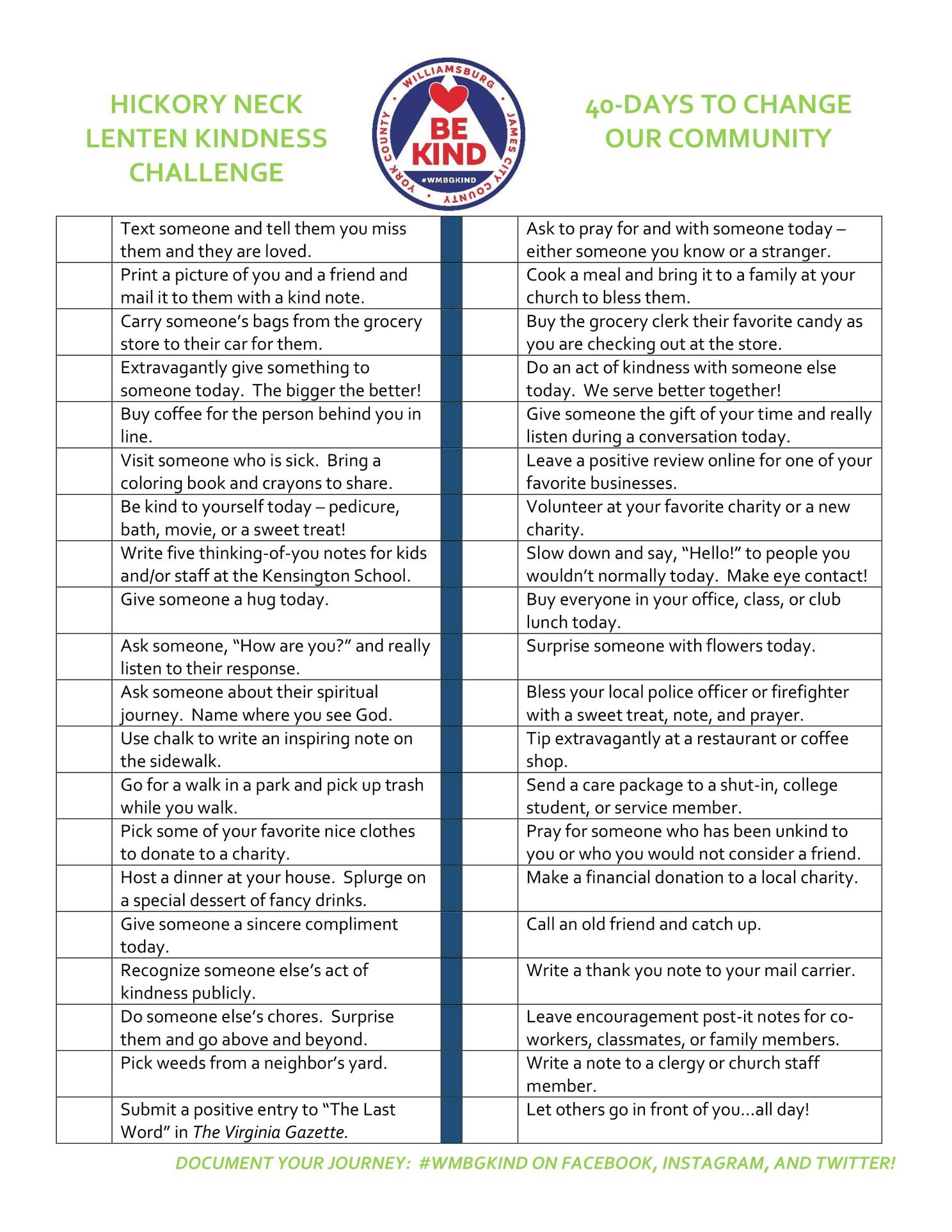
Photo credit:  Hickory Neck Episcopal Church; reuse with permission 

This Lent I decided to join my church in taking up our Lenten Kindness Challenge.  There are forty acts of kindness for the forty days of Lent.  The challenge itself is laid out like a checklist, but we were told we could either do the tasks in order, or pick and choose which acts fit our schedule on a particular day.  I elected to do the latter.  I confess, the kindness challenge began somewhat easily for me.  You see many of the acts of kindness are part and parcel of my job as a priest.  I have visited the sick more times than I can count this Lent.  I have hosted people in my home as part of our new Rector’s Receptions.  I regularly ask people about their faith journey and ask people if I can pray for them.  In some ways, by virtue of my job, I have felt like I am coasting through this kindness challenge.

But about halfway through Lent, I have passed all the “easy” acts, and am now facing all the acts of kindness I skipped because they will take more time or intentionality.  Midway through Lent, this kindness challenge is starting to feel like work – work that will require my time and attention.  On the one hand, I am already dreading the work, trying to figure out when I will have time to write extra notes, or do tasks that are outside of my everyday routine.  On the other hand, I am glad I have hit this point in the kindness challenge.  The work being demanded of me now reminds me that kindness is not just the kindness that we naturally do day in and day out.  Kindness requires something more of us – our time, our forethought, our work.  If it were easy, everyone would be doing it!

This is why I think focusing on kindness is so important for people of faith.  You see, being kind can reference the superficial, polite, everyday way of being that is common for all people – a great thing to be celebrated, but not necessarily the behavior in life that motivates and inspires.  But the kindness people of faith are invited to claim is the kind of kindness we see modeled through God – the kind of kindness we as people of faith embody so that others might see Christ in us.  Jesus was not venerated because he was simply polite – a good Southerner, if you will.  Christ was venerated because he healed the sick, listened to the isolated, and ate meals with the disenfranchised.  The kindness of Jesus was the kind of kindness that made people uncomfortable – that crossed barriers, that pushed people out of comfort zones, and that placed little value on societal norms.  Christ’s kindness was a radical kind of kindness.

I wonder what ways you are being challenged to get a little more radically kind this Lent.  What are things that you can be doing that require more of you than simply being polite?  What are the acts of kindness you can do that will take more time, that will inconvenience you, that might even make you a little uncomfortable?  Perhaps you have already notated which of those challenges are going to be hard for you this Lent.  Or perhaps there are different challenges that are not on our Lenten Kindness Challenge, but are the actions you need take to embody Christ today.  I cannot wait to hear how you are challenging yourself during this second half of Lent!

On Balance and Harmony…

14 Wednesday Nov 2018

Posted by jandrewsweckerly in Uncategorized

≈ Leave a comment

Tags

balance, church, God, harmony, health, life, prayer, spiritual life, wellness, wholeness, work

rocks-balancing-on-driftwood--sea-in-background-153081592-591bbc3f5f9b58f4c0b7bb16

Photo credit:  https://crossfitodyssey.com/sunday-story-balance-vs-harmony/

I recently visited the William & Mary Wellness Center for a presentation on how they help students create a culture of wellness.  After the presentation, someone asked about how to create work-life balance.  The presenter said the Wellness Center does not teach work-life balance, because work-life balance is a myth – something that can never be achieved because we can never perfectly balance our work life and our personal life.  He went a step further to suggest that attempting to achieve work-life balance is quite unhealthy because it places pressure upon us in each arena.  One will never spend an equal amount of time in either arena, and attempts to create a one-for-one balance only create more stress and anxiety.

Instead, what he teaches is work-life harmony.  He knows that we will never achieve, and arguably should never desire, a balance of the two arenas.  But the two arenas can work in harmony in such a way to create a more happy, healthy lifestyle.  As an example, the presenter talked about an orchestra.  If you tried to work on balance within an orchestra, every instrument would sound equally, making for a horrible racket.  But if each instrument plays in harmony with one another – well, then you have a masterpiece!

I have been wondering if the same might be true with our spiritual life.  Now I will be the first admit, I would love to see my parishioners at church every Sunday – partially because I know how healing and life-giving communal worship can be, but also partially because I just like my parishioners so much.  Church is more fun when everyone is there.  But using the harmony model, I think our spiritual life needs a sense of harmony too.  We need to create space for worship, learning, service, and outreach.  We need to find time for fellowship, formation, and evangelism.  We need to be sure we are both being fed and feeding others at church.  But we need to do that in a way that creates harmony in our lives.

Now I imagine some of you are thinking, “Awesome, my rector just said I don’t have to come to church as much so that my life is more in harmony.”  And maybe that is true for you.  But I suspect that the opposite may be true.  My guess is that for many of us, our spiritual life is not in harmony with the rest of life:  we aren’t finding time for formation, for worship, or for service.  The good news is that I am not suggesting you find balance – just harmony.  I remember complaining once to my Spiritual Director that with young children and a busy work life and a desire to be present to my husband, my prayer life was suffering – I just wasn’t praying like I used to.  Gracefully, he suggested that I shouldn’t worry about praying in a certain way – as if only praying the Daily Office everyday is real prayer.  He suggested something much more harmonious in life.  “Perhaps at this stage of life, the best you can expect is a prayer spoken at a stop light, or an exhausted thank you before drifting off to sleep.”  We all struggle with spiritual harmony.  I wonder what solutions are working for you today.  How are you finding harmony with work, life, and God?

On Dreams, Change, and Gratitude…

05 Wednesday Sep 2018

Posted by jandrewsweckerly in Uncategorized

≈ Leave a comment

Tags

baptismal covenant, change, church, community, courage, deferred, dreams, faithfully, Holy Spirit, hope, humility, investment, Jesus, kingdom of God, need, proud, tenacity, Thanksgiving, work

Safe in each others' hands

Photo credit:  http://debragaz.com/2016/10/17/we-can-walk-together/

This week, as the buzz of insects filled the air, the heat reflected off the pavement as the sun rose, and the smell of blooming flowers lingered nearby, I greeted families and watched an age-old tradition of parents dropping off children at school.  Some of the families were rushed, the parents trying to get off to work.  Some families took things more slowly, savoring the goodbye of the day.  Some families were worn down by anxiety and tears – of children and adults.  In the hubbub of greeting these families, reality hit me:  Hickory Neck did it!

You see, over ten years ago, the community of Hickory Neck Episcopal Church had a dream – to turn the blessing of property into a blessing for the community:  meeting a desperate need for childcare in our part of our county.  Countless hours were spent by many church members planning, calculating, and organizing.  It would take a tremendous investment to create a school from scratch, but the passion and vision were there.  Unfortunately, the preparation was complete right before the economic recession hit.  And the dream was deferred.

But the needs did not change – in fact they grew as the presence of young families, especially those transplanted away from extended family, grew in our neighborhood.  Hickory Neck’s dream was what a Search Committee invited me to participate in:  to help them take the dream off the shelf, and live out their baptismal covenant more fully in their particular context.  And so, the work began again.  After months of discernment and honest conversations, we realized Hickory Neck’s dream could still meet the needs of the community.

A year later, on a steamy September morning, I was struck with a sense of awe by the Hickory Neck community.  I have been a part of many congregations, and one thing I have learned is most communities resist change.  They might need change; they might want change; they might even say they are ready for change.  But in the deep recesses of their minds and hearts, they do not really want change.  Change is scary and could disrupt what drew them there in the beginning.  But Hickory Neck is different.  Hickory Neck is a community who has been fluid and flexible, who even when her dream began to morph and change, did not dig in her feet, but instead stepped out into the unknown and said yes to the Holy Spirit.  The humility, boldness, courageousness, creativity, and gumption of Hickory Neck brought me to my knees this week.

I am so proud of our community for trying a brave new way of ministry – one that comes from the congregation, will be nurtured by the congregation, and will eventually feed the congregation.  Though I have helped navigate logistics behind the scenes, the truth is, I feel so incredibly privileged to simply accompany Hickory Neck in the fulfillment of her dream.  In these last two and half years, Hickory Neck has given me hope in the future of the church universal.  If communities of faith can cast a vision that betters the surrounding community, journey through adversity to achieve that dream, and then actually live into that dream faithfully, then I think there is hope beyond measure for the kingdom of God.

A few weeks ago, a county official said to me, “You must be so proud of yourself for doing such good work at Hickory Neck.”  But I shared with him, “No, I’m so proud of Hickory Neck.  They are an inspiration to me every day.”  Today, I thank you, Hickory Neck.  I thank you for your witness of bravery, passion, and hard work.  I thank you for inspiring me to be a better priest.  I thank you for letting me be a part of this fantastic journey, in this fantastic community, doing the fantastic work of Jesus.  I am so proud of what Hickory Neck has already accomplished.  I cannot wait to see where we go next!  Oh, and if you are not already connected to Hickory Neck, I encourage you to stop by.  You are in for an incredible treat.  Don’t worry:  we’ve already saved you a seat!

On Seeing God in the Body…

08 Wednesday Aug 2018

Posted by jandrewsweckerly in Uncategorized

≈ Leave a comment

Tags

body, body of Christ, Christ, church, gift, God, ministry, play, vacation bible school, vocation, witness, work

IMG_2385

Photo credit:  Jennifer Andrews-Weckerly; reuse with permission only

One of the things I learned very early on in my priesthood is I cannot do all the work of the church.  The priest cannot be everywhere, at every event, leading every ministry.  And I have wholeheartedly come to believe that she should not try.  In doing so, the priest disables the ministry of the laity, and to be frank, never gets close to the glory of what can happen when everyone contributes their gifts in ministry to the work of the church.  When Paul talks about the Body of Christ being like parts of the body – where every hand, foot, elbow, and nose are needed to make the Body complete – Paul was talking about the leaders too.  The Body of Christ does not function without all the members.

I have been reminded of this truth this week as I have watched our Vacation Bible School program in action.  Months of planning, organizing, imagining, and executing have come to fruition.  I was given 10 minutes this week for teaching and prayer.  The rest of the time – five days, 15 hours, 900 minutes – has been filled with adults, youth, and even children leading a wonderful week of reflection about where we see God, how we can be helpers in God’s mission, and how we can be God’s hands, changing the world.  It has been a glorious experience to watch fingers strumming guitars, adults comforting children, teens running little ones’ energy out, children holding hands, priests from neighboring churches teaching and praying, and, as I like to imagine, God smiling broadly as God hears us asking God to “kumbaya.”

Part of what is nice about this week is I get to see the work of the Body up close.  I get to see church members flexing their vocational gifts, teaching and showing our kids how much God loves them and how they are now empowered to love others.  But much like my contribution this week is just a small part of the whole, I realize Vacation Bible School week is just a small part of the larger whole.  Every week our parishioners – children, youth, and adults – are living out their vocations every day.  They are teaching children, building homes, healing bodies, fighting fires, studying for tests, and holding each other’s hands as faithful children of God.  There are holy moments every week, every day, every hour, every minute, where we live into the gifts God has given us, and show God’s love to others.  Our witness to Christ does not happen unless we are all doing are part as the Body of Christ.

I wonder where you are seeing God and the work of the Body of Christ today.  At home, at work, at play, we can all see God working through each other.  Our invitation this week is to look for that work, to be a part of that work in our own lives, and to witness where we see that work in others.  My suspicion is once we start doing that work, we will be smiling as God has been smiling this week!

On Seeing Sacred Moments…

18 Wednesday Oct 2017

Posted by jandrewsweckerly in Uncategorized

≈ Leave a comment

Tags

blessing, church, compassion, fellowship, God, holy, laughter, light, love, moment, outreach, sacred, support, witness, work

In general, my children are pretty typical in many ways – they have their good days and their bad days.  They tattle on each other, try to sneak in a hit or shove, and one will occasionally shout how she “hates her life.”  But then, every once in a while, totally unprompted and seemingly “out of sight,” I will overhear the love, care, and affection they have for one another.  One child will walk over the other who is crying, and she will give a hug and offer reassuring words.  Or the two children will gleefully play with one another without arguing or fussing.  Or best of all, I will hear them laughing pure, innocent laughs together.  In these holy moments, they show me the light of God’s presence, and reveal their best qualities – that they are individuals full of love and compassion.

These last few weeks at our church, I feel like I have been able to see similar holy moments.  We are preparing for our Annual Fall Festival, from which all the proceeds go to support local ministries.  As we lead up to the event, I have seen countless tasks being done by parishioners:  from making up food order forms and staffing tables for pre-orders, from cleaning out closets to pricing and sorting donations, from recruiting donations from local businesses to developing the silent auction booklet, from breaking down our worship space to setting up parking space.  As the weeks and days have gotten closer to our festival, I have seen hard work, commitments of time, generosity of spirit, and joy in participation.  Most of the work could go unnoticed; even those of us who volunteer do not always see all the other work that is happening somewhere else.

But today, I want to say, “I see you.”  I see you, Hickory Neck, giving your cherished time to support the church.  I see you, sharing in fellowship as you work together on projects.  I see you, passionate about your neighbors in need and working a little bit harder.  I see you in holy moments, individually and collectively, and I am so proud of you.  Your laughter together is a sweet, sacred sound.  Your labor is a witness to me and to our community of God’s abundant love for all.  Well done, good and faithful servants!  You are a blessing!!

laughter_625x350_41474366938

Photo credit:  food.ndtv.com/health/10-surprising-health-benefits-of-laughter-1464095

Sermon – John 14.15-21, E6, YA, May 21, 2017

24 Wednesday May 2017

Posted by jandrewsweckerly in Sermons, Uncategorized

≈ Leave a comment

Tags

abide, Advocate, Bible Study, hard, Holy Spirit, Jesus, love, Paraclete, promise, relationship, separation, Sermon, sin, work

If you could have any person, living or dead, over for dinner, who would it be?  We have all played the game.  Either you were asked the question at a job interview, you used the question as part of an icebreaker, or you shared the question at the family dinner table as a conversation starter.  The answers are always telling – some would like to have dinner with their favorite celebrity or sports hero; some would love to talk to a famous figure in history, like Martin Luther King, Jr. or Abraham Lincoln; while others would want to have dinner one more time with a loved one who has died.  Invariably, though, someone will give the answer we all get to eventually.  If we could have dinner with any person, dead or alive, we would want to have dinner with Jesus.  We could finally ask Jesus all the answers to our questions!  We could ask Jesus what that one parable means that we can never figure out.  We could ask Jesus what death and eternal life are like.  We could ask Jesus why things are the way they are today and what he plans on doing about them!  The options are endless and the gift of that time with Jesus seems like the gift a magic decoder ring for life.

Except, I am not sure that dinner with Jesus is the best answer to that age-old question about dinner guests.  If you remember, Jesus was not always the easiest to understand.[i]  Think about all those parables that no one understood.  Think about all those times Jesus said something to the disciples that they could not comprehend.  Think about all those times that Jesus was challenged by Pharisees, foreigners, and faithful alike, only to get cryptic, unexpected answers.  Though we like to think we would have understood better than all of those, I suspect that even a modern-day dinner with Jesus would leave us with way more questions than answers.

That’s why I love our gospel passage today.  Jesus is preparing to leave his beloved disciples.  He has gathered them for a last meal, has washed their feet, and is sharing with them all his last instructions and words of wisdom.  The anxiety of his disciples is rising as they start to piece together how Jesus is giving what we now call his “Farewell Address.”  To those anxious, confused, uncertain disciples, Jesus offers a promise.  Jesus says, “I will not leave you orphaned.”  Instead, Jesus will send the Advocate.  Actually, he says, God will send, “another Advocate, to be with you forever.”  The first Advocate is Jesus himself.[ii]  Unlike Jesus, who is limited by time and space, the next Advocate will be with us forever.  The text tells us that the Advocate will abide in us – will actually be in us.  That word, “Advocate,” is alternatively translated as “counselor, comforter, helper, mediator, or broker.”[iii]  The word in Greek is Parakletos or Paraclete, which literally means “to call alongside.”  This Holy Spirit, this second Advocate, is the one who is called to be alongside us.[iv]

In just a couple of weeks we will celebrate the fulfillment of Jesus’ promise today.  The celebration of Pentecost is a significant feast for us because what Jesus promises in his Farewell Address finally comes to fruition.  Not only does the Spirit fill for us a spiritual need, the Spirit also fills for us a practical need.  You see, throughout his final instructions, through both word and deed, Jesus gives the disciples one final instruction – to love.  Jesus wants his followers to embrace, “not an abstract philosophical concept, but the lived reality revealed in the life, relationships, and actions of a simple Nazarene who looks and talks like them and lives simply among them.”[v]

This past week, our Tuesday night Bible Study group invited a Bible Study group from New Zion Baptist Church to join us for a mutual Bible Study.  After having talked quite a lot about race relations here at Hickory Neck, and having watched our country struggle with race, our Bible Study group decided the best thing they could do was to start building relationships with people of color.  Intentionally or not, the group selected 1 Corinthians 13 as their text for study.  Most of you who have been to a wedding will know this text by heart.  “Love is patient, love is kind…”  On and on we hear Paul talk about the characteristics of love – how love is not envious, boastful, or rude; how love does not insist on its own way, and is not irritable or resentful.”  Just like with a wedding, on the surface, the text was quite romantic for what we were trying to do – talk about loving each other and how we could do that as two different communities.  But what we realized as we studied and reflected on the text is the more we talked about love, the less romantic love felt.  Quite the opposite, we realized the love we Christians are called into is hard work.  We talked about how hard being patient and kind are.  We talked about how hard not being irritable or resentful can be, and how often we insist on our own way.  What seemed like a simple text for a simple gathering – an interracial Bible Study on love, suddenly felt anything but simple.  As we shared our stories, we realized not only did we have a massive amount of work to do on ourselves, we would also have a massive amount of work to do if we were even going to attempt to love each other.

That is why Jesus’ promise today, the promise of the one who comes alongside of us, is so incredibly powerful.  Because if the disciples recall the ways that Jesus feeds the hungry, touches lepers, heals the sick, speaks and acts with care and regard toward women, shows compassion and fiercely protests against injustice,[vi] and then realize that Jesus wants them to do the same in his absence, they could indeed become overwhelmed.  They cannot even seem to get through Jesus’ farewell address without one disciple departing to betray him, and the promise of another disciple who will deny him.  How in the world will they manage to master the simple and yet enormous work of love?!?

Toward the end of our Bible Study, as we became more and more sober about the enormity and humbling nature of living a life of love, someone finally stood up and said something quite simple.  He confessed he did not have any answers and perhaps was not sure he could do what Jesus would want for us.  But what he would do is go and have coffee with anyone who was willing.  That’s all.  Coffee.  It was a simple offer, and maybe seemed like nothing on the surface.  But that offer of coffee was profound.  In that offer was an unspoken confession of sin and separation, and a commitment to turn toward love and relationship.  After over an hour of talking about love, that offer of coffee was a commitment to not just talk about love, but to act on love.

I believe the ability of that parishioner to offer coffee came because the Paraclete, the Advocate, the Spirit was abiding in him.  Jesus had not left him an orphan.  Jesus sent another Advocate who empowered him to be an agent of love.  That is the power of the gospel today.  We will never likely get that dinner with Jesus, even though I am not convinced that dinner would help us anyway.  But we do get dinner with the Spirit – everyday, offering us God’s presence and spirit of truth, empowering us to be agents of love.  We get a dinner with our Advocate, who invites us to pull up another chair, so that we can share that love with our neighbor – one coffee at a time.  Amen.

[i] N. T. Wright, John for Everyone, Part 2 (Louisville: Westminster John Knox Press, 2004), 63.

[ii] Linda Lee Clader, “Homiletical Perspective,” Feasting on the Word, Yr. A, Vol. 2 (Louisville:  Westminster John Knox Press, 2010), 491.

[iii] Larry D. Bouchard, “Theological Perspective,” Feasting on the Word, Yr. A, Vol. 2 (Louisville:  Westminster John Knox Press, 2010), 492.

[iv] Karoline M. Lewis, John:  Fortress Biblical Preaching Commentaries (Minneapolis:  Fortress Press, 2014), 191.

[v] Nancy J. Ramsay, “Pastoral Perspective,” Feasting on the Word, Yr. A, Vol. 2 (Louisville:  Westminster John Knox Press, 2010), 492.

[vi] Ramsay, 492.

Sermon – Luke 17.5-10, 2 Timothy 1.1-14, P22, YC, October 2, 2016

05 Wednesday Oct 2016

Posted by jandrewsweckerly in Sermons, Uncategorized

≈ Leave a comment

Tags

apostles, belief, Episcopal, faith, God, head, heart, heritage, identity, increase, Jesus, mothers, pastoral, Sermon, struggle, Timothy, work

One of the funny things about wearing a priestly collar in public is that people tend to tell you way more about their lives than perhaps they should.  As soon as a person realizes you are a priest, the flood gates open and all of a sudden you are the guest on the “Everything You Always Wanted to Know about Church But Were Afraid to Ask!” Show.  I get questions about how one becomes a priest, what being an Episcopalian means, and what kind of Christian I am.  But mostly I get confessions.  People will confess they used to go to church, but once they became an adult, they had a hard time believing everything the church taught them as a child.  People will confess that they were raised in the church, but when a terrible tragedy hit, they felt abandoned by God and could never go back.  People will confess that they miss going to church, but that they always feel like they do not belong when the go to church – that everyone in the church seems to have their lives figured out except them.

What is interesting to me about those conversations with non-church goers or lapsed Christians is that they seem to think that their struggles with faith make them ineligible for church membership.  Perhaps that is true in some denominations in our country.  But one of the primary reason I became an Episcopalian was because the Episcopal Church not only made room for faith struggles, but expected those struggles.  Almost every time I have raised a question about a Biblical text in Bible Study, instead of someone explaining the answer to me, the response is almost always, “Yeah, that is a hard piece of scripture.”  Almost every time I have been with a grieving family who is on the brink of questioning their faith, no one in the room challenges them.  Usually someone says, “I could totally see how you would be doubting God right now.”  And almost every time I have been in a class about theology, the creeds, confirmation, or baptism, someone has asked, “What if I can’t believe that part.”  Never once has that person been told they do not belong if they cannot believe – in fact, usually the person is praised for naming the lack of faith we have all have had at some point in our spiritual journey.

I think that is why today’s Gospel lesson feels so real.  The disciples and apostles have been following Jesus for weeks, and Jesus has been handing them a lot of heavy stuff.  Jesus has told them to give up their possessions, to forgive those who wrong them, to take up their cross.  I cannot imagine anyone looking at the stark life Jesus describes and not calling out, “Increase our faith!”  How else can we be all Jesus wants us to be without increasing our faith?  Surely we have all had those trough moments – in the face of our mortality, at the betrayal of a friend or spouse, in the midst of anxiety and stress – when we too cry out to God, “Increase our faith!”

What might be helpful to do is talk a little about what we mean when we say faith.  Marcus Borg talks about two different kinds of faith:  faith of the head and faith of the heart.  Faith of the head is claiming something about God or the human condition.  This kind of faith is more about what we believe.  When someone says they have lost their faith, they have often lost this faith of the head.  They no longer believe something taught by holy scripture or the church.  In the Episcopal Church, we do not get too upset about this kind of faith struggle.  Instead, we see faith as ever evolving and growing.  Questions are at the root of a deep, mature faith.  Borg would argue that God cares very little about what beliefs are in our heads – if we believe the right things.  Borg knows that you can believe all the right things and still be in bondage, because, “Believing a set of claims to be true has very little transforming power.”[i]

Unlike faith of the head, faith of the heart is a little different, according to Borg.  Faith of the heart is characterized by three things:  trust, fidelity, and vision.  To have faith of the heart is to put a radical trust in God – to rely on God for grounding and safety.  Faith of the heart is also characterized by fidelity – an understanding that we will be faithful in our relationship with God and God with us.  Faith of the heart is finally characterized by vision – a belief that reality is life-giving and nourishing instead of threatening or hostile.  “To live in faith requires ‘a radical centering (of our lives) in God that leads to a deepening trust that transforms the way we see and live our lives.’”[ii]  So when the disciples ask Jesus to increase their faith, they are not necessarily asking Jesus to help them believe certain statements about God to be true (that faith of the head).  Instead, they are asking for faith of the heart – to get help in trusting God, remaining faithful in their relationship with God, and seeing life as God-given and gracious.

Now one would hope that Jesus would hear this request from the disciples and come back with a loving response – a pastoral word of encouragement that makes them feel affirmed in their fears and doubts.  Unfortunately, that is not what Jesus does at all today.  Instead he tells an abrasive story about masters and servants, which is basically Jesus’ way of saying, “You want your faith to increase?  Then get out there and do the work you have been given to do.”  Instead of assuring and coddling the disciples, Jesus sounds more like that old Nike ad that says, “Just do it!”

I do not know about you, but Jesus’ words are not all that comforting today.  I have sat with someone who is overwhelmed by the disappointments of life, and never once did it occur to me to tell them to just go out there and do the work they have been given to do.  I have counseled people who are facing death, divorce, job loss, or shame, and I have not told a single one of them to stop complaining and just get back out in the world doing what God has called them to do.  I myself have had moments when God felt absent, and I probably would have deemed any counsel to “Just do it!” as insensitive or unfair – to just trust that God is there anyway and get back to work.  Where are we supposed to find the strength to be faithful – to trust, to be loyal, to hold on to the vision of God’s goodness – when we feel completely unable to “Just do it!”?

As I struggled with Jesus’ harshness today, I remembered Paul’s second letter to Timothy.  Paul says to Timothy, “I am reminded of your sincere faith, a faith that lived first in your grandmother Lois and your mother Eunice and now, I am sure, lives in you.”  Paul’s words this week help me see how we get back to the work Jesus wants us to do.  In Paul’s encouragement, he is confident that Timothy can “Just do it!” because he knows Timothy’s identity.  Timothy is the grandson of Lois and the son of Eunice.  These women have taught him everything he knows about Jesus.  They have been through the depths of despair themselves, and yet they are faithful witnesses of God.  Timothy is not just a man fighting for faith – Timothy is known by God, and comes from a long line of people who have walked with God.  Timothy’s heritage is a heritage of people who have gone before, who have shown him the way through their lives, and who have encouraged him.  Now, you may be thinking, “Yeah, except my Grandma was a Southern Baptist who disagrees with what I believe, or my Mom stopped going to church ages ago.”  Whether biological or not, we all have grandmothers and mothers of our faith.   Maybe they are friends or fellow parishioners.  Or maybe those mothers and grandmothers are the matriarchs of our faith.  Regardless, we are all rooted in something bigger than us – something with much deeper roots that can ground us when we feel like we are flailing in our faith.

When I first read our gospel lesson this week, I thought we had been cursed with the wrong lessons – especially for those of you who brought friends today.  But the more the lessons unfolded, the more I realized they might be the perfect lessons.  We all struggle with faith – certainly of the head, but more importantly of the heart.  But as Paul reminds us, we come from a long line of people who have gone before who have struggled as we do, and who leaned into their identity as beloved children of God in order to keep putting one foot in front of the other.  We are encouraged today because we have seen the fruit of “Just doing it!”  We have prayed for someone struggling this week.  We have called or visited a friend who needed encouragement this week.  We stood up to a bully this week.   We gave money to support ministry this week.  We did something seemingly inconsequential, but those small, everyday acts of faith are powerful, and they are how we answer Jesus’ call to “Just do it!” – even when we did not think we could.[iii]  Paul and the Church remind us that we can – we can do those acts of faith because we are surrounded by matriarchs and patriarchs who encourage us along the way.  We all have those moments when we just want Jesus to increase our faith.  Today we are encouraged by doing – and eventually our faith increases in spite of us.  Amen.

[i] Marcus Borg, The Heart of Christianity, 30.  Argument about Borg presented by Br. David Vryhof, “Lord, Increase our Faith!” October 7, 2007, as found at http://ssje.org/ssje/2007/10/07/lord-increase-our-faith/ on September 28, 2016.

[ii] Vryhof.

[iii] David Lose, “Pentecost 20C:  Everyday Acts of Faith,” September 26, 2016, as found at http://www.davidlose.net/2016/09/pentecost-20-c-every-day-acts-of-faith/ on September 28, 2016.

← Older posts
Newer posts →

Recent Posts

  • On Redefining Community…
  • On Parenting, Milestones, and Community…
  • Sermon – Acts 2.42-47, E4, YA, April 26, 2026
  • On Seasons of Discernment…
  • Sermon – Luke 24.13-35, E3, YA, April 19, 2026

Archives

  • May 2026
  • April 2026
  • February 2026
  • January 2026
  • December 2025
  • November 2025
  • October 2025
  • September 2025
  • August 2025
  • July 2025
  • June 2025
  • March 2025
  • February 2025
  • December 2024
  • November 2024
  • October 2024
  • September 2024
  • August 2024
  • July 2024
  • June 2024
  • May 2024
  • March 2024
  • February 2024
  • January 2024
  • December 2023
  • November 2023
  • October 2023
  • September 2023
  • August 2023
  • July 2023
  • June 2023
  • May 2023
  • March 2023
  • February 2023
  • January 2023
  • December 2022
  • November 2022
  • October 2022
  • June 2022
  • May 2022
  • January 2022
  • December 2021
  • November 2021
  • October 2021
  • September 2021
  • August 2021
  • June 2021
  • May 2021
  • April 2021
  • March 2021
  • February 2021
  • January 2021
  • December 2020
  • November 2020
  • October 2020
  • September 2020
  • August 2020
  • July 2020
  • June 2020
  • May 2020
  • April 2020
  • March 2020
  • February 2020
  • January 2020
  • December 2019
  • November 2019
  • October 2019
  • September 2019
  • August 2019
  • July 2019
  • June 2019
  • May 2019
  • April 2019
  • March 2019
  • February 2019
  • January 2019
  • December 2018
  • November 2018
  • October 2018
  • September 2018
  • August 2018
  • July 2018
  • June 2018
  • May 2018
  • April 2018
  • March 2018
  • February 2018
  • January 2018
  • December 2017
  • November 2017
  • October 2017
  • September 2017
  • August 2017
  • July 2017
  • June 2017
  • May 2017
  • April 2017
  • March 2017
  • February 2017
  • January 2017
  • December 2016
  • November 2016
  • October 2016
  • September 2016
  • August 2016
  • July 2016
  • June 2016
  • May 2016
  • April 2016
  • March 2016
  • February 2016
  • January 2016
  • December 2015
  • November 2015
  • October 2015
  • September 2015
  • August 2015
  • July 2015
  • June 2015
  • May 2015
  • April 2015
  • March 2015
  • February 2015
  • January 2015
  • December 2014
  • November 2014
  • October 2014
  • September 2014
  • August 2014
  • July 2014
  • June 2014
  • April 2014
  • March 2014
  • February 2014
  • January 2014
  • December 2013
  • November 2013
  • October 2013
  • September 2013
  • August 2013
  • July 2013
  • June 2013
  • May 2013
  • April 2013
  • March 2013
  • February 2013
  • January 2013
  • December 2012
  • November 2012
  • October 2012
  • September 2012

Categories

  • reflection
  • Sermons
  • Uncategorized

Meta

  • Create account
  • Log in
  • Entries feed
  • Comments feed
  • WordPress.com

Blog at WordPress.com.

  • Subscribe Subscribed
    • Seeking and Serving
    • Join 391 other subscribers
    • Already have a WordPress.com account? Log in now.
    • Seeking and Serving
    • Subscribe Subscribed
    • Sign up
    • Log in
    • Report this content
    • View site in Reader
    • Manage subscriptions
    • Collapse this bar

Loading Comments...