• About

Seeking and Serving

~ seek and serve Christ in all persons

Seeking and Serving

Tag Archives: worship

On Food, Tears, and God…

05 Wednesday Jul 2017

Posted by jandrewsweckerly in Uncategorized

≈ Leave a comment

Tags

comfort, community, emotion, familiar, food, God, intimacy, memory, power, relationship, taste, tears, worship

IMG_5249About ten years ago, I traveled with a group of seven seminarians to Myanmar, or Burma.  The purpose was to learn about, develop relationships with, and support the Anglican Church in Myanmar.  I could talk for days about that four-week trip, but one of the experiences that lingered with me was the food.  Part of why the cuisine lingered with me was because each of my three years in seminary we had one or two Burmese students at the seminary.  After the trip, we took to having reunions at a local Burmese Restaurant.  We found the meals reminded us of the flavors of that trip, the food comforted our Burmese friends, and the fellowship kept the experience vivid and meaningful for years to come.

This past weekend I was traveling in the area of my seminary and made a trip to the restaurant for lunch.  I ordered my two favorite, most potent memory-invoking dishes:  mohingar, a fish-based soup, and pickled tea leaf salad.  I had been looking forward to the food for weeks – so much so that I was salivating by the time I pulled into the parking lot of the restaurant.  What I was not expecting was the wave of emotion that accompanied the food.  As the heat of the salad opened my sinuses, I was reminded of multiple episodes on our trip where funny food-related experiences happened – a too-hot pepper eaten, the presentation of tiny birds as an appetizer, an avocado milkshake.  As I sipped the mohingar, the warmth in my belly reminded me of all the times the food, though foreign, was exceptionally comforting – like discovering a comfort food you never knew you missed.  As those memories and feelings emerged, I became overwhelmed and found myself fighting back tears.  The rush of emotions was completely unexpected and disorienting, and I could not be sure whether I was sad or profoundly happy.

I have talked a couple of times about the power of food, taste, and memory (both here and here) to connect with our spiritual life.  But what I realized this weekend (as I tried not to cry into my mohingar) is that food and taste point to the powerful experiences that can happen in faith communities.  For the team that traveled to Burma, the food was a tool for bringing us together and sharing memories.  For our Burmese friends and fellow students, the food was an opportunity to experience intimacy and trust that I do not think would have happened in the classroom alone.  The taste of the familiar dishes were not simply familiar tastes.  They were also tools for creating and sustaining community, and honoring that community through the senses.

This week, we will be starting a new summertime worship service at Hickory Neck.   Though rooted in our Episcopal and Anglican identity, the service is a departure from our Sunday morning services.  We are using different prayers and music; we are settling into a more casual style of worship and preaching; and we are even changing small things like the type of bread we eat for communion.  Part of the changes are certainly meant to shift the sensory experiences of worship.  But another part of the changes is meant to shape community a bit differently – to create a sense of intimacy, familiarity, shared spiritual journey.  I am not sure if pita bread will be able to accomplish all of that, but I hope you will come out and give this new offering a try.  Who knows what memories, relationships, and encounters with God you will create?!19264649_1524550660934522_2960725217281690693_o

The Pilgrimage of Holy Week

13 Thursday Apr 2017

Posted by jandrewsweckerly in Uncategorized

≈ 1 Comment

Tags

Christ, church, God, Holy Week, Jesus, moments, pilgrimage, sacred, Savior, worship

17903433_10155696878822565_4685487522288081020_nIn Holy Week, I like to offer the parishes I serve a service for each night of the week.  It can be labor intensive, and people can feel overwhelmed by the idea of coming every night of a week for church (even if it is only once a year).  But, if you can make it through every night, you find yourself in the midst of a beautiful pilgrimage – an unfolding story and walk with our Savior, Jesus Christ.  This year, we are only three days in, but each night has given me little “God moments.”

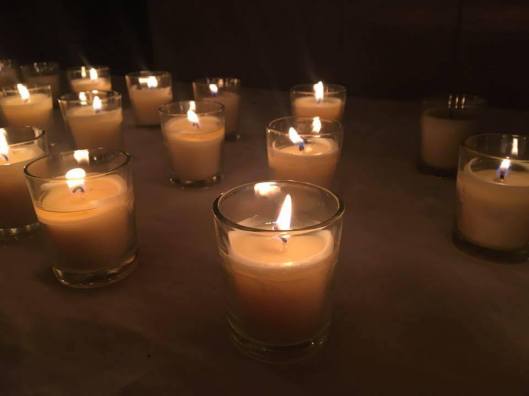
On Holy Monday, my heart was warmed that our community was gathering “virtually” to celebrate compline (evening prayers).  We have been doing it all Lent, but it was a wonderful way to close my evening in my pajamas, knowing that others were on Facebook, praying together with our Curate.  On Holy Tuesday, as I sat in the silence of our Taize service, I was watching the flames of the many lit candles flicker.  Since I knew people had lit the candles with prayer intentions, I imagined each of those flames as a prayer, symbolizing the cares and concerns of each person in the room.  As our silence extended, I imagined the flames represented the prayers and concerns around the world, remembering how our Coptic Christian brothers and sisters must be hurting this week.  It was a powerful, transfixing image.  Then last night, on Holy Wednesday, during our healing prayers, two things happened.  First, my daughter came forward for prayers by me.  Her request was humbling, and the privilege of affirming her and praying with her in that space was incredible.  Second, another local pastor laid hands on me and prayed just the prayer I needed this week.  It was all I could do to hold back the tears.

So, I do not know what the next three days, the Triduum, hold.  But I can promise you there will be many more sacred moments.  If you have a church home, I encourage you to take advantage of their offerings for the rest of the week.  If you do not have a church home, and live in the Williamsburg area, know that you are most welcome.  You can find all our information on our website.  A continued blessed Holy Week for you.  As you ponder your own connection to church, I offer you this video as inspiration for your Holy Week pilgrimage to Lent.  Peace!

Sermon – Isaiah 58.1-12, EP5, YA, February 5, 2017

08 Wednesday Feb 2017

Posted by jandrewsweckerly in Sermons, Uncategorized

≈ Leave a comment

Tags

church, fast, fasting, God, Isaiah, love, need, outreach, relationship, Sermon, serve, worship

In about three and half weeks we will gather in the Historic Chapel for Ash Wednesday services.  In the liturgy for Ash Wednesday, the priest invites us into the “observance of a holy Lent, by self-examination and repentance; by prayer, fasting, and self-denial; and by reading and meditating on God’s holy Word.”  I don’t know about you, but this invitation always makes me a little nervous.  The truth is, I am terrible at fasting.  I have often blamed the issue on low blood-sugar.  But really, I just hate the way not eating makes me feel.  I get cranky, I cannot focus on work, and I just want to crawl into bed.  And what makes fasting worse is that we get scriptural passages that warn us about grimacing while fasting – that we should go so far as to put oil on our faces so that we look shiny and happy during our fasting.

Knowing my utter sense of failure at my inability to engage in the most holy of spiritual practices, I confess that I was secretly pleased to read our text from Isaiah today.  The people of Israel have become quite good at fasting and pious worship.  We are told that day after day the Israelites come to God in worship, delighting to know more about God, and fasting like righteous followers of God.  They even bow down and lie in sackcloth and ashes.  They are the epitome of penitential Lenten worshippers.  Except for one small, teeny, tiny problem.  Despite their devotional fasting and their fervent prayers, God is angry with the Israelites.  You see, while the Israelites are piously engaging in reverent, penitential worship, their hired hands are working under their oppressive orders.  While they have been perfecting reverential bows, there are hungry, homeless, naked, impoverished peoples just outside their doors.  Oblivious, the Israelites complain to God, “Why do we fast, but you do not see?  Why humble ourselves, but you do not notice?”  God’s response is a brutal question:  Why are you here?

In polite Episcopal circles, we do not often ask that question:  Why are you here?  We might ask a visitor a much softer version of that question, “What brings you to Hickory Neck?”  But we almost never ask a regular or long-time church member, “Why are you here?”  I think part of why we do not ask someone else that question is because we are afraid someone will ask us that question.  We are afraid to be asked that question because the question feels like a trick.  If I say I am here because I want peace or comfort, does that make me a passive, self-serving Christian?  If I say I am here because I enjoy the community, does that mean my church is more like a country club than a church?  If I admit that I do not know why I am in church this morning other than a strange longing somewhere deep inside me, does that mean that my worship is superficial or doomed for ambiguity?

The scary part about our anxiety around that question, “Why are you here today,” is that God has a very clear response before we or the Israelites can even answer the question.  God says that if we do not come to worship to be changed, we are doing something wrong.  As one scholar argues, Isaiah’s words today tell us that, “Worship without justice has no value in the eyes of God.”[i]   For Isaiah, a gap has formed between the faithful’s seeking God and God’s ways and their actual way of life.  What Isaiah wants the people to know is that fasting, prayer, and worship are all well and good, but without some connection to the other 167 hours of their week, their worship, their fasting, their relationship with God is hollow.  Now, God is not telling us that worship is inherently bad or self-serving.  As another scholar points out, “worship is the most important thing we do together.  It is the place that forms us into the people of God.  It is the place where we inhale God’s love and grace, so that,” and here comes the important part, “so that we can be sent forth to exhale God’s love and grace in a broken world in need of redemption.”[ii]

One of the things that attracted me to Hickory Neck was the wide variety in styles of worship.  On any given Sunday, I can pray the Prayer of Humble Access in the midst of a quiet Rite I liturgy; I can belt out a praise song that is so familiar I don’t need to look at the words; I can chant the Eucharistic Prayer while the Choral Scholars respond with beautiful, precise, haunting harmonies; or I can sing a version of the Lord’s Prayer that my seven-year old daughter has learned by memory.  I love the variety of expressions of worship here, and love our unique gift that is rare in most parishes.  But variety can be dangerous.  Variety means bringing together people who don’t necessarily revel in the differences.  There will be people who only come to our early service because they find music to be a distraction.  There will be people who only come to the late service because anything other than traditional Anglican music interferes with their worship.  And there will be people who only like the middle service because they can let their hair down and be themselves.  Slowly, what is meant to be the gift of variety becomes a competition for the best – the most holy, most reverent, most relatable, most “of God.”  But what all that comparison leads to is not deeper relationship with God.  That comparison leads us to focus on the worship as an end unto itself, instead of as a means “right relationship.”[iii]

In order to get to the point of fasting or worship, God tells the Israelites to redefine fasting.  Instead of abstaining from food or drink, the fast God desires, “is outreach to those in need, which involves not only feeding the hungry, clothing the naked, and caring for one’s own, but also addressing the attitudes and structures responsible for injustices.”[iv]  In the Episcopal Church, we have codified this redefinition of fasting in our dismissal.  We take all of our prayers, all of learning, all of our confessions, and all of our feasting and we say, “Go in peace, to love and serve the Lord.”  In other words, we give ourselves the beauty of worship, and then remind ourselves of the point of that worship – right relationship with God and our neighbor.  I have often thought the church needs the words of the dismissal painted above the Narthex door, so that as each of us departs this space, we can jump up and slap the words – much life a sports team entering the arena who slaps a slogan or the team name.  Go in peace to love and serve the Lord.

Now some of you may be thinking about this radical redefinition of fasting and this question of why we are here in worship, and be wondering, “Can’t I just give up some food and call it a day?!?  Can’t I just sit in worship and not worry about why I am here?!?”  You may know well that righting relationships with God and neighbor is a lot harder than a day’s worth of sacrificing food or just showing up on Sunday.  But before you get too anxious, listen again to Isaiah’s words about what happens when we enter the kind of fast God prefers, “The Lord will guide you continually, and satisfy your needs in parched places, and make your bones strong; and you shall be like a watered garden, like a spring of water, whose waters never fail.  Your ancient ruins shall be rebuilt; you shall raise up the foundations of many generations; you shall be called the repairer of the breach, the restorer of streets to live in.”  God’s work is never too difficult – exhaling God’s love and grace in a broken world in need of redemption is as easy as breathing in the love and grace we inhale every Sunday.  The promise of God’s blessing is waiting – we just need to breathe.  Amen.

[i] Carol J. Dempsey, “Theological Perspective,” Feasting on the Word, Yr. A, Vol. 1 (Louisville:  Westminster John Knox Press, 2010), 314.

[ii] Andrew Foster Connors, “Pastoral Perspective,” Feasting on the Word, Yr. A, Vol. 1 (Louisville:  Westminster John Knox Press, 2010), 316.

[iii] Dempsey, 316.

[iv] Dempsey, 316.

Ecumenical Thanksgiving Homily – Ruth 2.2-9, Matthew 22.34-40, November 20, 2016

23 Wednesday Nov 2016

Posted by jandrewsweckerly in Uncategorized

≈ Leave a comment

Tags

active, Boaz, community, ecumenical, God, gratitude, Great Commandment, homily, Jesus, love, mercy, ministry, neighbor, Ruth, Thanksgiving, worship

When I learned we would be gathering for worship as ecumenical brothers and sisters to celebrate a service of Thanksgiving, I could not have been happier.  But when I realized we would be reading from the book of Ruth, I was thrilled!  Ruth has always held a special place in my heart.  This woman, a complete stranger to our faith, teaches us more about faithful living than most of our ancestors. She marries a foreigner, quickly becoming a widow with no support, following her widowed mother-in-law to a foreign land.  In her abandonment, she pledges allegiance to a God who in many ways has felt absent.  And when they return the foreign land of Bread, and she sees Naomi may not be able to support her, she takes it upon herself to go sweat in the fields, and secure them a livelihood.  She even eventually permanently ensures their security by somewhat scandalously approaching Boaz for not only food, but marriage, and progeny.  Ruth puts all others before herself, and she is faithful to God and her family.  If anyone is a beacon of living into the Great Commandment to love neighbor as self, Ruth is that beacon of light.

But the more I thought about our text today, the more I realized that despite the fact that I love Ruth, we gathered here today are more like Boaz.  You see, we are people of privilege and power.  Though we can certainly name countless people who may have more wealth and influence than we do, most of us know where our next meal is coming from, have a roof over our heads, and have our basic needs met.  Some of us are even comfortable enough to enjoy much more than our basic needs.  In that way, we are much more like Boaz, a man with power and influence, who can use that power for good or for evil.

Boaz has little obligation to Ruth, the foreigner.  He knows she is connected to Naomi, making her adopted family, but allowing her to glean with the other gleaners would have been enough.  He didn’t have to give her tips about how to be safe from the men, give her access to drinking water, feed her his bread at mealtime, and tell his men to make sure she got extra grain to glean.  He did not have to say yes when she asked for his help in taking her in.  He did not have to negotiate with the next-of-kin to have her hand.  Boaz takes God’s command to love neighbor beyond what anyone would expect.

I have been thinking about Boaz as I have been thinking about our ministry together.  Though you may not know about each case, each of the clergy here work with families in need through the use of discretionary or alms funds.  Each church here has ministries that we support – whether food pantries, homeless shelters, elder care, medical clinics, or assistance with basic needs like back-to-school supplies, clothing drives, or holiday support.  And all of us collectively have taken that a step further and agreed to help provide more food assistance by starting up a local food distribution outlet through our partners at House of Mercy.  But just because we do that work does not mean that we do that work like Boaz.

My husband is a social worker in Richmond and he was recently telling me about a client’s experience with a church.  The client reached out to a church for assistance, and instead of pastorally working with the client, the church representative gave them a hard time, wanting to know what poor decisions the client had made that brought them to the church doors.  Now, I know we all screen the clients we help.  We have to be smart about how we help those in need.  But that client experienced a loss of dignity at that church that Boaz never exerts.  In fact, Boaz knows how degrading poverty can be.  He sees Ruth, and knows simply by her gender and foreignness that she is at risk for assault and manipulation.  And so, not only does he help her, but he looks at all those around him and hold them accountable for caring for the disadvantaged too.  He does not act alone in his mercy – he makes his whole community merciful.

As we head into a holiday marked for Thanksgiving, the church invites us to look at our ancestors for the best ways to fulfill Jesus’ Great Commandment.  Want to know how to love God and our neighbors?  Look at our sister Ruth.  Want to know how to show love, dignity, and compassion?  Look at our brother Boaz.  Though many of us spend this time of year reflecting on what we have to be grateful for, the church invites us also to use this time as a time of action.  Our gratitude is not passive.  Our gratitude is active – a call to action to love God and love neighbor.  I know many families who have a tradition of going around the Thanksgiving table, enumerating those things for which they are grateful.  Perhaps this year, our families can also enumerate what we are going to do in response to those things for which we are grateful.  Our ancestors, our Savior, and our faith communities are here to embolden us in that response.  Thanks be to God!

On Saints, Elections, and God…

09 Wednesday Nov 2016

Posted by jandrewsweckerly in Uncategorized

≈ 1 Comment

Tags

altar, church, election, God, liturgy, messiness, saints, worship

14917060_1270799702976287_658328143983009977_oThis past Sunday, I got to try on one of Hickory Neck’s traditions.  For the past several years, every All Saints Sunday, the congregation has been invited to tie a ribbon on the altar rail in honor of saints who have gone before.  To be honest, before our liturgies started, I was not sure how the liturgical action would go.  I had imagined all sorts of reasons it might be awkward:  I didn’t think our early, reserved worshipers would be that interested; I worried that the ribbons would be messy, making communion at the rail difficult; I wondered if the symbolism would work in our space.  Happily, I was wrong on all accounts.

Instead, the liturgical symbolism was potent.  As I watched countless people kneel at the rail, tying on the ribbons, many with tears streaming down their faces, I realized how easy it is for me to forget the pain of grief that people struggle with every day.  When we see a well-dressed person at church on Sunday, we forget that there is a unique, sometimes painful story underneath appearances.  As I looked at ribbons draped on the altar rail, I imagined the bodies of the saints, draped on the entrance of the heavenly banquet, having given their lives to love and witness.  As my mind struggled with the messiness of the rail, my heart could see the messiness of life, clinging to the very altar where we kneel not just for solace and pardon, but for strength and renewal.  The liturgical action created a beautiful moment that was overwhelmingly powerful.

Today, I woke up to the news of election returns. Being a pastor of a diverse congregation, I know there are hearts that are relieved, hearts that are satisfied, and hearts that are saddened, fearful, and disappointed.  As I process that reality today, I am reminded of those ribbons, dripping from the altar of church.  I am reminded of the saints that have gone before, who have waded through their own times of conflict.  I am reminded of the fact that on Sunday, each worshiper will be bringing a story to the altar that I will never know fully.  I am reminded of the fact that our church offers a rail where we all kneel or stand, in all of life’s messiness, longing for something bigger and with greater meaning than we can give each other in our limited humanity.

As I got ready for the day this morning, my two-year old sat in the floor of our bedroom with some books.  I was still processing that image of All Saints Day when I heard her singing from one of her books.  “He’s got my brothers and my sisters in his hands…he’s got the whole world in his hands.”  Her sweet voice brought me to tears as I realized the deep wisdom in her, perhaps unintended, words.  In this messiness of life, there will be days that are really complicated, confusing, and hard.  But as a person of faith, I also trust that the Lord our God is holding us in God’s hands, tending not just to me, but to my brothers and my sisters.  For today, that is all I can ask for.

world6

Photo credit:  He’s Got the Whole World in His Hands, Kadir Nelson.  Photo found at http://www.walkingbytheway.com/blog/picture-books-for-transracial-adoptive-families/

The Sound of Silence…

07 Thursday Jul 2016

Posted by jandrewsweckerly in Uncategorized

≈ 1 Comment

Tags

brokenness, church, contemplations, Episcopal, God, listen, noise, prayer, Rite I, silence, sinfulness, worship

The-Sound-of-Silence

Photo credit:  advisoranalyst.com/glablog/s015/05/27/jeff-miller-the-sound-of-silence.html

In almost every parish I have served, there has been an 8:00 am, Rite I, spoken service.  The crowd usually is not that large.  Because the service is spoken, it tends to be very quiet and to be the shortest service of the day.  Those who are attracted to the service usually like the language (We use “thee” and “thou” language and the service has a more penitential tone.)  Others like the brevity of the service – appreciating both going to church and having the rest of the day free.  While others like the service because it feels more contemplative and centering.

Though the service is always pretty quiet in whatever Episcopal Church you choose, what I have noticed about the 8:00 am crowd at Hickory Neck is that they tend to be not just prompt, but early.  Every Sunday, at least five minutes before the service begins, everyone is seated and is silent.  Up until this past Sunday, I found the practice unsettling.  On Sundays, I am usually amped up, and ready to jump into liturgical leadership.  As an extrovert, I am chatty, and am used to some lighthearted conversation before the service starts.  So the silence immediately before the service feels discordant with my pent-up energy.

But this past Sunday, I remembered a complaint long ago from a fellow parishioner at the Cathedral where I became an Episcopalian.  She used to complain that the beginning of the service was not meant to be happy hour – she was irritated by the chatter all around her when all she wanted to do was kneel on the prayer cushion in front of her and enjoy a moment of silence before the service began.  Even the bulletin had a comment at the beginning that reminded people that we should respect others’ desire to begin our worship in quiet contemplation and centering prayer.  Though I appreciated the guidance, I never really “got” it – until this past Sunday.

The beauty of five minutes of silence before worship is that you can let go of all the stuff on your to-do list.  The beauty of the five minutes of silence before worship is that you can let go of the pain, worry, anger, or stress that is ever present and present yourself humbly before worship.  The beauty of the five minutes of silence before worship is that you can listen to God instead of talk to God.  As a celebrant, I do not know that I will ever be able to use those last five minutes to center myself (I tend to arrive much earlier at church to find that centering time).  But as one who facilitates worship, I have found myself greatly appreciating the gift of those five minutes for our parishioners.  I could use a good five minutes today to just listen.  In the noise of mass gun violence, terrorism, racism, poverty, and suffering, I am a bit out of things to say to God.  Instead I would rather kneel in silence today and give humanity’s and my own brokenness and sinfulness to God.  What might you offer to God today in that silence?  What do you imagine you might hear in that silence?

More…

25 Wednesday Nov 2015

Posted by jandrewsweckerly in Uncategorized

≈ 1 Comment

Tags

clergy, God, Good News, interfaith, Jesus, life, love, mercy, ministry, more, Thanksgiving, Transgender, wideness, witness, worship

Every once in a while, I have experiences in ministry when I think, “Well I never would have imagined that happening!”  I admit that the experience is rare.  There is not a lot that surprises me anymore in this line of work.  Though I am relatively young, I still feel like I have seen it all.

But that has not been the case this week.  This week I found myself in two situations I would have never anticipated.  On Sunday night, our parish hosted the Long Island Transgender Day of Remembrance.  I had no role in crafting the liturgy or planning the evening.  I simply offered our space and was asked to give an opening and closing prayer.  In fact, the planning committee warned me that this would not be like a “church service” – so I should not get my hopes up!  But as I sat in my pew, watching testimonial after testimonial, listening to over eighty names of those who were murdered because of their transgender identity, and hearing beautiful music about the wideness of God’s love and the call to love “the other” – I tell you, I experienced “Church.”  You see, Church is supposed to be about worshiping our God who shows mercy and compassion, who calls us to love the outcast and the oppressed, and who compels us to go out and witness the Good News of God in Christ.  Sunday night, I felt like the Good News came back inside and witnessed to me.

Plainview-Old Bethpage Interfaith Clergy, November 24, 2015

On Tuesday night, I participated in my fourth Plainview-Old Bethpage Interfaith Thanksgiving Service.  Every year I find the service moving. I am grateful for a holiday that we can all honor without fear of stepping on each other’s toes.  But as I sat there last night, I became acutely aware of my surroundings.  On my left sat the Mufti from the local Muslim community and on my right sat the priest from the local Roman Catholic parish.  It occurred to me in that moment that the Mufti usually only says prayers with men.  The women pray separately.  And yet, there we were, side by side, giving thanks to God.  It also occurred to me that although the priest has been warm and affirming, his Church does not recognize my ordination as appropriately apostolic – especially given my gender.  And yet, there we were, as equal leaders in our respective communities.  Despite having had long relationships with the fellow clergy leaders, this was the first time I realized how radical our relationships are – to sit next to each other despite profound differences – and yet still be able to praise, lead, and worship together.

Truthfully, I do not know what God is doing this week.  On a basic level, I suspect God is reminding me that I am not even close to having “seen it all.”  But on a deeper level, I also suspect that God is inviting me to go further, to delve deeper, and to see more widely.  Perhaps a disadvantage to my profession is a naïve sense that I have a hold on who this God is that we worship and serve.  This week, God has humbled me by reminding me that God is so much more. As I anticipate celebrating Eucharist on Thanksgiving Day, I expect to approach the Table with keener sense of wonder, gratitude, and awe for the ways in which God is so much more.  What a blessed gift this week has been.  Thanks be to God for being more than I could ask for or imagine!

Sermon – Isaiah 6.1-8, TS, YB, May 31, 2015

03 Wednesday Jun 2015

Posted by jandrewsweckerly in Uncategorized

≈ Leave a comment

Tags

experience, forgiveness, God, hem, Holy Spirit, Jesus, repentance, robe, Sermon, theology, Trinity, Trinity Sunday, volunteer, worship

“God sat Sunday in her Adirondack deck chair, reading the New York Times and sipping strawberry lemonade, her pink robe flowing down to the ground.  The garment hem was fluff and frill, and it spilled holiness down into the sanctuary, into the cup and the nostrils of the singing people.  One thread trickled loveliness into a funeral rite, as the mourners looked in the face of death, and heard the story of a life truer than goodness.  A torn piece of the robe’s edge flopped onto a war in southern Sudan and caused heartbeats to skip and soldiers looked into themselves deeply.  One threadbare strand of the divine belt almost knocked over a polar bear floating on a loose berg in the warming sea.  One silky string wove its way through Jesus’ cross, and tied itself to desert-parched immigrants with swollen tongues, and a woman with ovarian cancer and two young sons.  You won’t believe this, but a single hair-thin fiber floated onto the yacht of a rich man and he gasped when he saw everything as it really was.  The hem fell to and fro across the universe, filling space and time and gaps between the sub-atomic world, with the effervescent presence of the one who is the is.  And even in the slight space between lovers in bed, the holiness flows and wakes up the body to feel beyond the feeling and know beyond the knowing…”[i]

I stumbled on Michael Coffey’s poem as I struggled with the idea of how to preach about the Holy Trinity on this Trinity Sunday.  And then I realized something:  we understand theology much more through experience than through reading some heady fourth-century theologian.  The concept of the Trinity is not an easy one to understand.  In fact, the concept is so complicated that most of us try not to think about the Trinity at all.  We simply know the Father, the Son, and the Holy Spirit as truth, and do not worry too much about the details.  That approach is probably fine most of the time – until you have to explain the concept of the Trinity to a child or non-believer.  Trying to explain how God, Jesus, and the Holy Spirit are all the same and yet all distinctly separate is not as simple as it sounds.  Then try to explain how all three are co-eternal and I promise you, you will get looks of confusion.  The questions about how Jesus can be born in a particular time and place and yet be co-eternal with the Holy Spirit and God will make anyone stutter.

I have begun to wonder then if part of why we do not often spend time working through the theology of the Trinity is because we do not necessarily need to think about the Trinity – we simply need to have an experience of the Trinity.  That realization became clearest to me this week as I thought about our lesson from Isaiah.  Now you may be wondering how I found an experience of the Trinity in the Old Testament.  Certainly, we need the fullness of the New Testament to really understand the Trinity.  But we have to remember that the Trinity has always been – remember that word “co-eternal”?  Now I must admit, this notion makes me uncomfortable too – reading a New Testament theology into the Hebrew Scriptures is what a lot of purists call anachronistic – a chronological inconsistency where we juxtapose two different time periods incorrectly.  But given our theological understanding of the Trinity as being co-eternal, many theologians argue that seeing the Trinity in our Isaiah text today is not, in fact, anachronistic.[ii]  If you buy that logic, the song the seraphs sing, “Holy, holy, holy is the Lord of hosts…” reminds us of the old hymn, “Holy, Holy, Holy” which contains the line, “God in three persons, blessed Trinity.”  The seraphs’ song hints at the three persons of the Godhead.  And when God wonders what prophet God will send to the sinful people, God says, “Whom shall I send, and who will go for us?”  That “us,” by many scholars, is considered yet another precursor to the concept of the Trinity.[iii]

But all of that is academic to me.  We can certainly debate whether or not the Trinity is hinted at in the Isaiah reading today.  But what is more important to me is that we get a better understanding of the experience of the Trinity through the Isaiah story.  The story starts with Isaiah seeing the Lord sitting on a throne, with that hem that Michael Coffey describes so vividly in his poem.  The text says the hem of God’s robe fills the temple.  Imagine, as Coffey does, the hem of that robe filling this entire church.  Imagine fabric billowing over the pews, draping over the altar rail, spilling out the front door.  Imagine us stumbling over the enormity of that fabric, getting tangled up in the hem’s folds.  And all of that fabric swirling around us is only the hem of the robe – not the whole robe, but the hem of the robe.  Isaiah’s description is of a God that is larger than life, that is incomprehensible in size and vastness.  Just the tip of God’s garment is larger than the greatest Cathedral and certainly overwhelming in a space like our intimate church.

In fact, the experience of God is so overwhelming, that Isaiah is brought down to his knees in fear – not a simple fear of God, but fear because Isaiah realizes he is woefully sinful and unworthy of being in God’s presence.  He even shouts among the folds of fabric that entangle him, “Woe is me!  I am lost, for I am a man of unclean lips…”  That is the second experiential understanding of the Triune God.  First we are overwhelmed by the Trinity’s vast, mysterious incomprehensibility, and second, we are crippled by the shame of our sinfulness in response.  But then, another profound realization happens.  When Isaiah confesses his sinfulness, the seraph simply touches his mouth with a hot altar coal and Isaiah’s sin is blotted out.  That is the third thing we discover about the Trinity.  Father, Son, and Holy Spirit are quick to forgive a repentant heart.  No Hail Mary’s are necessary.  No Our Fathers.  Forgiveness is swift and full – much unlike human capacity for forgiveness.  Finally, we learn yet another interesting thing about the Trinity.  God-in-three-persons needs us.  The Lord says, “Whom shall I send, and who will go for us?”  There is not strategic plan; there is no preordained conception of who should go.  God does not say, “Isaiah, you shall go and be my prophet,” which is unusual because in most of the call stories we hear, God does call people by name.  But not with Isaiah.[iv]  Here, the Trinitarian Godhead is wondering who in the world will go and be the prophet.  That is what we finally see about the Trinity.  The Trinity openly invites – and according to Isaiah’s response, “Here am I: send me!” we learn that the Trinity inspires people to recklessly volunteer for things they probably shouldn’t.

Of course, when we really think about what we learn about the Trinity in Isaiah: that God is vastly other, inspires repentance, readily gives forgiveness, and causes wanton willingness to serve the Lord, then we begin to see that all of those insights are part and parcel of our own experience of the Trinity every week in worship.[v]  Every week, we start our worship in praise.  We praise God in word, song, and prayer.  We marvel at the vastness of God’s hem as we read and reflect on God’s Word.  We profess our Trinitarian faith in the Creed and then we confess.  Like Isaiah, all that praise, wonder, and realization of God’s enormity pulls us down to our knees as each one of us confesses our unworthiness aloud.  A chorus of voices comes together as we each confess our faults and failings over the past week.  And then, just like a snap, the priest delivers God’s forgiveness.  We are offered the Eucharistic meal, which, like the coal on Isaiah’s lips, wets our lips with forgiveness.[vi]  And when the priest tells us to go out into the world rejoicing in the power of the Spirit, we find ourselves overwhelmed with the words, “Here am I; send me!”  We find ourselves jettisoning ourselves into the world, longing to serve the God whose robe knocks us over and whose meal sets us free.

Michael Coffey’s poem brings us full circle to our Trinity Sunday ponderings.  About God’s robe, Coffey concludes, “…And even as we monotheize and trinitize, and speculate and doubt even our doubting, the threads of holiness trickle into our lives.  And the seraphim keep singing “holy, holy, holy”, and flapping their wings like baby birds, and God says: give it a rest a while.  And God takes another sip of her summertime drink, and smiles at the way you are reading this filament now, and hums: It’s a good day to be God.”[vii]  Amen.

[i] Michael Coffey, “God’s Bathrobe,” as posted on May 31, 2012 at http://mccoffey.blogspot.com/2012/05/gods-bathrobe.html as found on May 27, 2015.  Punctuation and formation changed for ease of preaching.  Original structure found on website.

[ii] Donald K. McKim, “Theological Perspective,” Feasting on the Word, Yr. B, vol. 3 (Louisville:  Westminster John Knox Press, 2009), 30.

[iii] McKim, 28.

[iv] Patricia Tull, “Commentary on Isaiah 6.1-8,” found at https://www.workingpreacher.org/preaching.aspx?commentary_id=2458, May 31, 2015, as found on May 27, 2015.

[v] Kristin Emery Saldine, “Pastoral Perspective,” Feasting on the Word, Yr. B, vol. 3 (Louisville:  Westminster John Knox Press, 2009), 28, 30.

[vi] Melinda Quivik, “Commentary on Isaiah 6.1-8,” found at https://www.workingpreacher.org/preaching.aspx?commentary_id=1284, June 3, 2012, as found on May 27, 2015.

[vii] Coffey.

Homily – John 17.17-23, Isabel Florence Hapgood, June 26, 2014

09 Wednesday Jul 2014

Posted by jandrewsweckerly in Uncategorized

≈ Leave a comment

Tags

Christ, disciples, expression, faith, God, homily, Isabel Florence Hapgood, worship

Today we honor Isabel Florence Hapgood.  Isabel was a lifelong Episcopalian who was a force behind ecumenical relations between Episcopalians and Russian Orthodoxy in the United States around the turn of the twentieth century.  Born in Massachusetts, she was a superior student, with an aptitude for languages.  She mastered Latin, French, Russian, Polish, and Church Slavonic.  She was able to translate subtleties of Russian into English, translating the works of Tolstoy and other greats.  She was also a prolific journalist.  It was travel in the late 1880s in Russia that cemented a lifelong love of Russia – especially the Russian Orthodox Church.  In fact, she loved its great Divine Liturgy so much that she got permission to translate the liturgies into English – work that was well received in Russia and in North America.  Her work for the common life among the Russian Orthodox in North America, her desire for closer relations between Russian Orthodox and Episcopalians, and her making the liturgical treasures of the Russian Orthodox tradition available to the English-speaking world has made her renowned.

Isabel saw what any of us have seen who have traveled.  Sometimes the faith expression of other groups helps us to see God more fully.  When I was in seminary, we were regularly responsible for leading prayers.  We often found ourselves in a section of the library that contained prayer books from around the world.  Popular favorites were from South Africa and New Zealand.  But others were influenced by Celtic worship or even the current English prayer book.  Somehow, other cultures’ liturgies helped us to see God and express our faith even better than we could through our own familiar patterns.

What Isabel and perhaps we were on to is hinted at in our gospel lesson today.  Jesus is praying for the disciples, that they may all be one.  Though I don’t think Jesus was anticipating the development of the church into various denominations, what his prayer hints at is that the Christian faith is one when we recognize Christ in one another – despite cultural and theological differences.

We experience that truth in the Plainview-Old Bethpage Interfaith group here.  Worshipping with other denominations and faiths helps us to see God more fully.  We experience that truth when we travel and worship in other churches and traditions.  Even our own worship is enhanced by our beautiful St. Margaret icon, painted by a Greek Orthodox iconographer.  Our experience of God is at its fullest when we recognize that we are all loved in and through Christ and we all reveal Christ to one another in big ways and small ways.  Amen.

Giving thanks…

27 Wednesday Nov 2013

Posted by jandrewsweckerly in Uncategorized

≈ Leave a comment

Tags

breath, busy, God, quiet, thanks, Thanksgiving Day, worship

At 6:30 this morning, I got a call from the Chair of my Buildings and Grounds Committee.  He was worried about the amount of water we are getting here and asked if I would run over to the church to make sure the undercroft had not flooded overnight (as his basement at home had).  Luckily I was dressed, but our family was in the morning flurry of getting showers, eating breakfast, and making lunches.  I had hoped to sneak over to the church quietly, but as soon as my daughter found out what I was doing, she wanted to go too.  So we rushed to find her shoes and raincoat, I rushed to grab an umbrella, and we ran out the door.  About half-way to the church, I realized I had forgotten the church keys.  As I quickly tried to rush my 4-year old back to the house, I realized that my lack of church keys meant I also had left my house keys inside the house.  Of course, my husband was in the shower.  Needless to say, there was lots of doorbell ringing over the following five minutes.  Ah, the joys of a crazy, scattered priest and mother.

For this and so many other reasons, I am tremendously grateful that my husband suggested we take this Thanksgiving to just have a quiet holiday alone.  As an extrovert, my immediate response to his request was a bit of sadness and wistfulness – Thanksgiving is supposed to be about loud families or friends and yummy food.  But then I remembered how for the last several weekends in a row I have had multiple church commitments, how last week alone I had three night meetings, and how my husband I have felt like ships passing in the night these last several weeks.  I knew the wisdom behind his request, and so we have gathered a much smaller amount of food, and have plans to just be together as a family this weekend.  Well…and maybe clean the house and unpack some baby stuff.  But at least we are doing that together!

Courtesy of http://metropraise.blogspot.com/2012/11/the-history-of-thanksgiving-in-united.html

Courtesy of http://metropraise.blogspot.com/2012/11/the-history-of-thanksgiving-in-united.html

I know for most of you, Thanksgiving is not really about quiet and retreat.  That may feel like a foreign, if not uncomfortable, concept to you.  But even if you are planning to gather with your loud Uncle Joe or your nagging mother-in-law, I hope that you will take a moment to take a little breath, and remember in the quiet what Thanksgiving is really about.  Maybe you invite your family into prayer before the meal, maybe you invite everyone to share something they are grateful for, or maybe you just do your own self assessment of the bounty surrounding you on every side – of food, of shelter, of clothing, of laughter, of a God who loves and cares for you abundantly.  And if that is the only breath of thanksgiving you can afford on that day, then you have taken a sip of the pool of thanksgiving available to you.  And if you are thirsty for more, find a church holding a Thanksgiving Day service, and give yourself an entire hour of this kind of thankfulness.  It may be the greatest gift you give yourself this holiday season.

St. Margaret’s Church celebrates Holy Eucharist on Thanksgiving Day at 10:00 AM.  All are welcome!

← Older posts
Newer posts →

Recent Posts

  • On the Myth and Magic of Advent…
  • On Risking Failure and Facing Fear…
  • Sermon – Luke 23.33-43, P29, YC, November 23, 2025
  • On Inhabiting Gratitude…
  • Sermon – Luke 20.27-38, P27, YC, November 9, 2025

Archives

  • December 2025
  • November 2025
  • October 2025
  • September 2025
  • August 2025
  • July 2025
  • June 2025
  • March 2025
  • February 2025
  • December 2024
  • November 2024
  • October 2024
  • September 2024
  • August 2024
  • July 2024
  • June 2024
  • May 2024
  • March 2024
  • February 2024
  • January 2024
  • December 2023
  • November 2023
  • October 2023
  • September 2023
  • August 2023
  • July 2023
  • June 2023
  • May 2023
  • March 2023
  • February 2023
  • January 2023
  • December 2022
  • November 2022
  • October 2022
  • June 2022
  • May 2022
  • January 2022
  • December 2021
  • November 2021
  • October 2021
  • September 2021
  • August 2021
  • June 2021
  • May 2021
  • April 2021
  • March 2021
  • February 2021
  • January 2021
  • December 2020
  • November 2020
  • October 2020
  • September 2020
  • August 2020
  • July 2020
  • June 2020
  • May 2020
  • April 2020
  • March 2020
  • February 2020
  • January 2020
  • December 2019
  • November 2019
  • October 2019
  • September 2019
  • August 2019
  • July 2019
  • June 2019
  • May 2019
  • April 2019
  • March 2019
  • February 2019
  • January 2019
  • December 2018
  • November 2018
  • October 2018
  • September 2018
  • August 2018
  • July 2018
  • June 2018
  • May 2018
  • April 2018
  • March 2018
  • February 2018
  • January 2018
  • December 2017
  • November 2017
  • October 2017
  • September 2017
  • August 2017
  • July 2017
  • June 2017
  • May 2017
  • April 2017
  • March 2017
  • February 2017
  • January 2017
  • December 2016
  • November 2016
  • October 2016
  • September 2016
  • August 2016
  • July 2016
  • June 2016
  • May 2016
  • April 2016
  • March 2016
  • February 2016
  • January 2016
  • December 2015
  • November 2015
  • October 2015
  • September 2015
  • August 2015
  • July 2015
  • June 2015
  • May 2015
  • April 2015
  • March 2015
  • February 2015
  • January 2015
  • December 2014
  • November 2014
  • October 2014
  • September 2014
  • August 2014
  • July 2014
  • June 2014
  • April 2014
  • March 2014
  • February 2014
  • January 2014
  • December 2013
  • November 2013
  • October 2013
  • September 2013
  • August 2013
  • July 2013
  • June 2013
  • May 2013
  • April 2013
  • March 2013
  • February 2013
  • January 2013
  • December 2012
  • November 2012
  • October 2012
  • September 2012

Categories

  • reflection
  • Sermons
  • Uncategorized

Meta

  • Create account
  • Log in
  • Entries feed
  • Comments feed
  • WordPress.com

Blog at WordPress.com.

  • Subscribe Subscribed
    • Seeking and Serving
    • Join 394 other subscribers
    • Already have a WordPress.com account? Log in now.
    • Seeking and Serving
    • Subscribe Subscribed
    • Sign up
    • Log in
    • Report this content
    • View site in Reader
    • Manage subscriptions
    • Collapse this bar
 

Loading Comments...