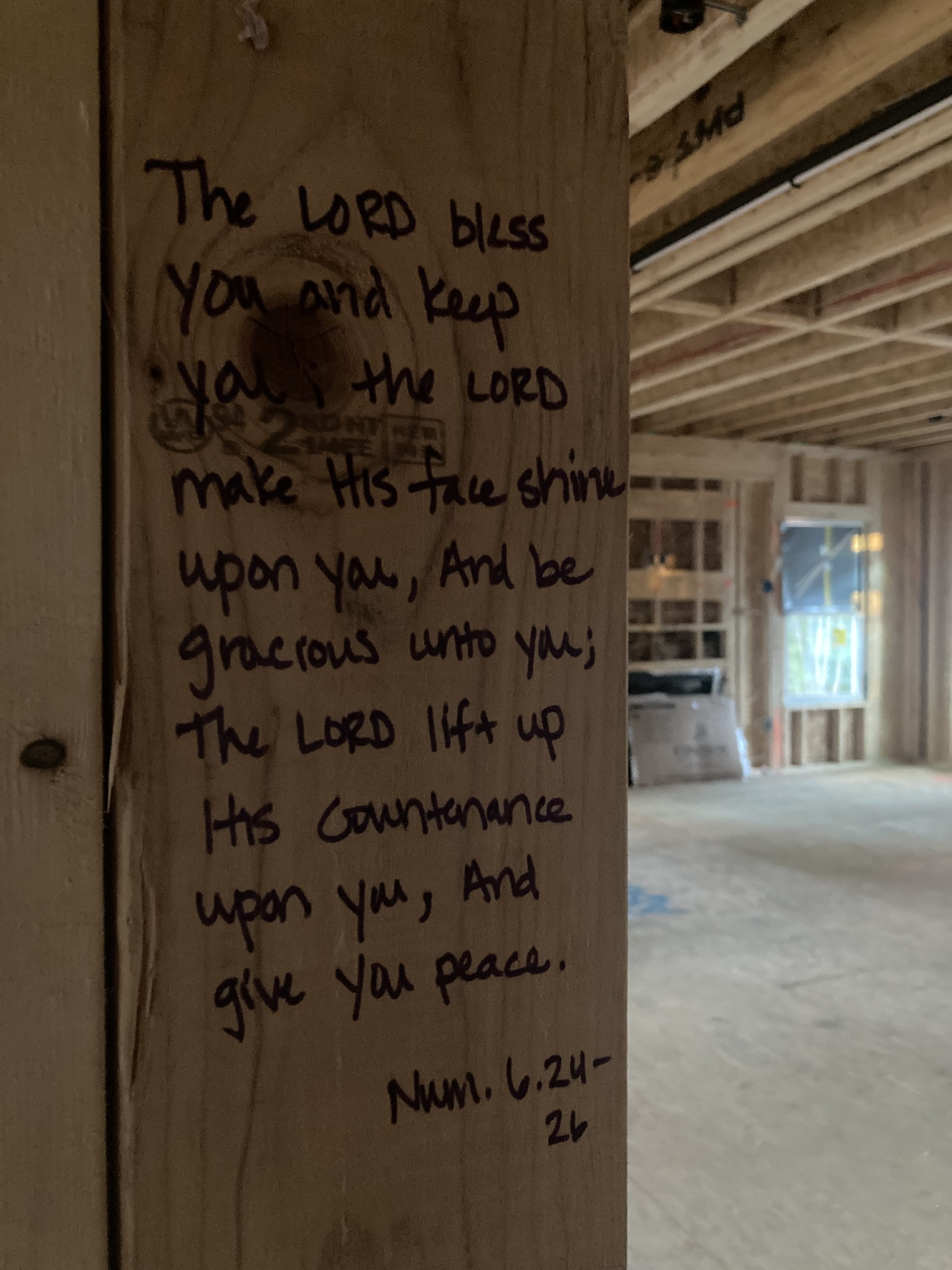
Photo credit: Jennifer Andrews-Weckerly; reuse with permission only.
This week I got a last minute invitation: a friend of our parish is building a new home for their family, and the house is finally framed and closed in. In a matter of days, the drywall will be hung. In that brief window, the friend sent out an SOS to friends of faith – come by and write a scripture verse, a blessing, a prayer, or a book quote on the studs before they are hidden away by drywall, tape, paint, and artwork.
In looking around the house, and all those words of blessing and care, I was thinking about how much a house hides. All those words of blessing will be hidden very soon. But eventually, those walls will also witness life’s sorrows and joys, life’s heartbreaks and cheers, life’s hardships and abundance. Someday, new generations will warm the home with their squeals and laughter. Renovations may be made, new paint may be applied, new pictures may be hung. All that life – from the blessings on the studs, to the skid marks left by forbidden scooters, to the sighs of contentment that linger in the air – all that life, seen and unseen, will create a beautiful breathing container of the abundance of blessing.
As I reflected on those studs, I wondered how often we get to think about our lives in the same way. We can’t really write blessings on the insides of our bodies, but our bodies carry the markers of a sacred life led too. The scar from playing in the old oak tree or from a life-improving surgery, the relationships that grew our heart’s capacity to love, the mentors who inspired our brains to interpret life differently, to the worship that got us out of our bodies enough to see blessing. It is quite easy to treat the body as a vessel to live life or for a home to be a place to sleep, eat, and be cleansed. But neither our bodies nor our homes are that simple. They hold the markers our whole lives.
I wonder how you might honor those vessels today. Maybe, as one of my fitness instructors says, you can thank your body for allowing you to function today. Maybe, you can pause on a stairwell and give thanks for the millions of times feet have tread on those stairs. Or maybe, you look at your body, or your home, and give thanks for signs of God’s presence, grace, and blessing.
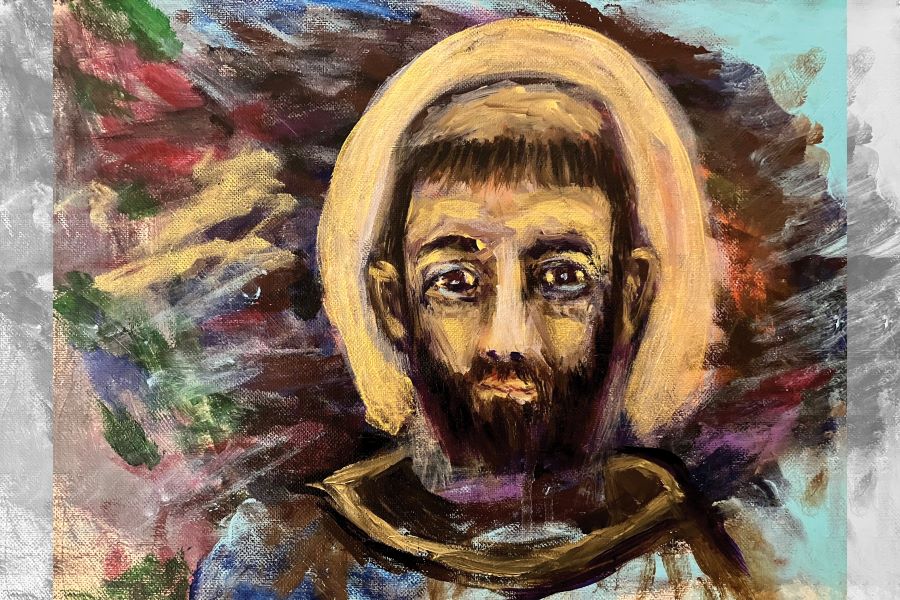
Today we honor the life of St. Francis of Assisi. Though he died 800 years ago this year, Francis is one of the most well-known and beloved saints of all time. Most of us know the highlights of his story: born the son of a wealthy man in 1182; had a conversion experience and devoted his life to Lady Poverty; shaped monastic and lay devotion; was a friend to all God’s creatures – being known to have preached to the birds.
But the story I like most is the story about St. Francis and the Wolf. According to legend, there was a wolf that was terrorizing the town of Gubbio, killing and eating animals and people. The villagers tried to fight back, but they too died at the jaws of the wolf. Francis had pity on the townspeople and went out to meet the wolf. When Francis found the wolf, he made the sign of the cross, and said, “Come to me, Brother Wolf. In the name of Christ, I order you not to hurt anyone.” In response, the wolf calmly laid down at Francis’ feet. Francis then went on to explain to the wolf how he was terrorizing the people and other animals – all who were made in the image of God. The wolf and Francis then made a pact that the wolf would no longer harm the townspeople and the townspeople would no longer try to hurt the wolf. The two traveled into town to explain the pact they had formed. The people were amazed as Francis and the wolf walked side-by-side into town. Francis made the people pledge to feed the wolf and the wolf pledge not to harm anyone else. From that day on, the wolf went door to door for food. The wolf hurt no one and no one hurt the wolf; even the dogs did not bark at the wolf.[i]
What I love about this story of St. Francis is that the story is about reconciliation and relationship. At the beginning of the story the town and the wolf are at an impasse – the wolf is hungry and getting attacked; the people are afraid and are lashing out. What Francis does for both parties is shock them out of the assumptions. For the wolf, no one has addressed the wolf kindly – they have either shut the wolf out or actively tried to kill him. For the people, the wolf has not asked for help – he has simply and violently taken what he needed and wanted. Francis manages to shock the wolf first – not through violence or force, but with the power of love and blessing. By giving a blessing in the name of God, Francis is then able to implore the wolf to reciprocate with love. Francis also manages to shock the village – not with a violent victory, but with a humble display of forgiveness and trust. By walking into town with a tamed wolf at his side, Francis is able to encourage the town to embrace, forgive, and care for the wolf. Francis’ actions remind both parties that unless their relationships are reconciled, unrest and division will be the norm.
The funny thing about this story is that the story is a bit ridiculous. How many of us go around talking to wild animals, blessing them with the sign of the cross, expecting anything other than being ignored at best, and at worst, attacked? We will never really know whether the Gubbio story is true. But like any good Biblical story, whether the story is true is hardly the point: the point is that the stories point toward “Truth” with a capital “T.” What this story teaches is peace and reconciliation only happen through meeting others where they are. We cannot expect great change unless we are willing to get down in the trenches – to go out and meet that destructive wolf face-to-face. The other thing this story teaches us is that relationships are at the heart of peace work. Only when the wolf and the town begin to get to know each other and begin to form a relationship with one another can they move forward.
This is the way of life in Jesus Christ. In our gospel lesson today, Jesus says, “Come to me, all you that are weary and are carrying heavy burdens, and I will give you rest. Take my yoke upon you, and learn from me; for I am gentle and humble in heart, and you will find rest for your souls. For my yoke is easy, and my burden is light.” Jesus’ words have many messages. The first message we all catch is that Jesus offers us rest and refreshment. Jesus encourages us to come to him, to cast our burdens and cares upon him, and to take rest, to take Sabbath, in Christ. Our souls will find peace in Christ Jesus. The second message is that peace in Christ Jesus is not without work. Jesus does not say come unto me and relax forever in happy retirement. Jesus says we will still have to take on a yoke – the burden of disciple living. Luckily, that burden of being Christ’s disciple will not be burdensome – it will be light. In the final message, Jesus tells us not only will he make the workload “light,” as in not heavy; Jesus will also make us “light” – as in lights that shine into the darkness and refuse to allow the shadow to overwhelm. We become the light when we work for reconciliation in our relationships with others. We become light when we walk in the ways of St. Francis.
That is why we do several special things today. First, we ask for blessing on our animals – that God might help our relationship with our pet be one of blessing and light. Second, we come to Jesus for Sabbath rest – that God might renew us on this Sabbath day, use the rest to fill us with light, and renew our commitment to be agents of reconciliation, gladly putting on Christ’s yoke. And finally, we leave this place as agents of light – seeking to bring people together who have not been able to see one another clearly, making ways for peace where peace seems impossible, but becomes possible through Christ Jesus. Amen.