
• About

Seeking and Serving

~ seek and serve Christ in all persons

Seeking and Serving

Author Archives: jandrewsweckerly

Sermon – Matthew 6.1-6, 16-21, AW, YC, February 13, 2013

14 Thursday Feb 2013

Posted by jandrewsweckerly in Uncategorized

≈ Leave a comment

Tags

Ash Wednesday, death, discipline, God, Jesus, journey, Lent, Sermon, sobering

I have been thinking about death a lot lately.  We lost one of our beloved parishioners yesterday, and another parishioner is sick enough that we have been talking about death.  The journeys with those parishioners have made death much more present for me.  Then, last week I was listening to an interview with Oscar-nominee Bradley Cooper who talked about how he nursed his father through to death.  Cooper explained how the death of his father dramatically changed Cooper’s perspective on life – how that last gasp of air by his father was the very moment that Cooper’s entire worldview shifted.  Then, just this weekend I watched a film called 50/50, a dramatic comedy that chronicles the way a 27 year-old deals with a cancer diagnosis that gives him only a fifty percent chance of survival.  At every turn, death seems to be whispering to me.

Part of my job as a priest is to bring a certain sobriety about death as death approaches.  That is not to say that I am a party pooper, but my role is to name the truth that is approaching – earthly death and reunion with our Lord in eternal life.  In fact, the Church is one of the few places left in the world that openly and regularly talks about death.  In a world that encourages anti-aging treatments, who has desensitized us to death as we have moved away from an agricultural lifestyle, and whose medical advances have extended life much longer than before, we learn that death can be conquered and should be fought at all costs.

Pushing against this secular understanding of death, the Church gives us Ash Wednesday.  The Church looks at our flailing efforts to preserve life and as we are humbly kneeling at the altar rail, rubs gritty ash on our heads and says, “Remember you are dust and to dust you shall return.”  There is no, “Don’t worry about death; you’ll be fine!”  Instead those grave words, “Remember you are dust and to dust you shall return,” echo in our heads, haunting our thoughts.  Every year the Church reminds us of the finite amount of time we have on this earth.

This is why I love Lent so much.  The Church dedicates forty days to a time where we cut to the chase and honestly assess our relationship with God.  We take a sobering look at our lives, a sobering look that could be reserved only for the time of death, and we discern what manifestation of sinfulness has pulled us away from God.  Our Prayer Book defines sin as “the seeking of our own will instead of the will of God, thus distorting our relationship with God, with other people, and with all creation.”[i]  Lent is the season when we focus on repentance from our sin – not just a feeling guilty about our sinfulness, but eagerly seeking ways to amend those relationships and turn back toward resurrection living.  What most people get only at the time of death, we are given every year at the time of Lent:  a time of sobering realignment.

This is why we get Matthew’s gospel lesson on Ash Wednesday.  As we begin our sobering Lenten journey, the gospel lesson names disciplines and practices that can help us along the way.  Jesus names those ancient practices that have brought people back to God for ages – giving alms, praying, and fasting.  Each one of these practices has ways of bringing us closer to God by shaking up our normal routines.  Of course, any Lenten practice can have the same effect.  Giving up caffeine, taking on a new fitness regiment, or reconnecting with nature are equally valid ways to shake up our routines enough to notice the ways in which we have become more self-centered than God-centered.  Although Jesus names the disciplines of alms giving, prayer, and fasting, the actual discipline itself is not the issue for Jesus.  The issue is our intentions in our practice.

This is why we hear Jesus labeling so many people as hypocrites in our gospel lesson today.  Jesus is less concerned about what disciplines we assume and is more concerned about the authenticity behind those disciplines.  Jesus is not arguing that private acts are authentic and public ones are inauthentic by nature.  What matters is the desire and motivation behind these practices.  We have all seen this in action.  One of my favorite comediennes jokes about this very behavior in one of her shows.  She talks about how people sometimes use prayer requests as a means of gossip.  In one of her jokes, she has the gossiper of the church inviting people into a prayer circle so that they can pray for someone in the church who just got pregnant, even though the news was supposed to be private.  We all know the kind of hypocritical behavior Jesus is addressing.  This kind of behavior will never get us to the sobriety we need to right our relationship with God and others.

Of course, any kind of practice we take up this Lent can be corrupted.  The giving up of a particular kind of food can be more for weight loss than a connection to God.  The taking up of a volunteer activity can be to fulfill a requirement for something else.  Whatever we do this Lent, that deprivation or incorporation is meant to help us restore our relationship with God, other people, and all creation.  So when we give up a food, instead of glorying in the fact that we lost a few pounds, we can instead see how that food has become an emotional crutch that keeps us from leaning on God and others.  When we take on a new prayer routine, we slowly begin to see how little time we give to God in our daily lives.  Whatever our practice, Jesus is concerned that authenticity be at the heart, so that we can more readily prepare for Good Friday and Easter.[ii]

And so, in order to shake us out of our self-centered, sinful, distant ways, Ash Wednesday gives us death.  Ash Wednesday grittily, messily, publicly reminds us of our death, and then leaves us marked so that we can humbly enter into a Lenten reconnection with God.  Ash Wednesday throws death in our faces so that we can wake up in a world that would have us keep striving for longevity of earthly life instead of striving for intimacy with God here and now.  This Ash Wednesday, our ashes are the outward reminder of the sobering journey we now begin, because only when we consider our own death can we begin to see the resurrection glory that awaits us at Easter.  My prayer is that our journey this Lent is not one of painful guilt, but instead one of glorious reconnection with our creator, redeemer, and sustainer.  Amen.

[i] BCP, 848.

[ii] Lori Brandt Hale, “Theological Perspective,” Feasting on the Word, Yr. C, Vol. 2 (Louisville: Westminster John Knox Press, 2009), 24.

Homily – Luke 4.40-44, Samuel Shoemaker, January 31, 2013

14 Thursday Feb 2013

Posted by jandrewsweckerly in Uncategorized

≈ Leave a comment

Tags

evangelism, homily, Jesus, Samuel Shoemaker

In our gospel lesson today, Jesus experienced the first of many attempts to contain Jesus and his ministry.  After healing many, Jesus goes to a deserted place, to rejuvenate, most likely, but the crowds follow, begging him to stay.  They want to keep Jesus Christ to themselves, to use him as they need.  But Jesus will not stay: “I must proclaim the good news of the Kingdom of God to other cities also …”  Jesus must keep moving, sharing the Good News beyond one particular place.

We do this 2,000 years later.  Though we say we want to grow, we like our small, close-knit community.  We like what Jesus is doing now, and we are not sure how much change we actually want.  Besides, if we are going to grow, we would like people to come to us, not us need to keep moving outside these walls, bringing people in.  Of course, this is not simply a St. Margaret’s problem.  The entire Episcopal Church is in decline because we really struggle with that whole “evangelism” thing.

Samuel Shoemaker, who we honor today, would not have liked our guarded, protective ways – even if we are in good company.  Shoemaker, born in 1893 in Baltimore, was influenced by many evangelical thinkers.  He learned the power of personal evangelism, and during his 16-year tenure in New York City at Calvary Episcopal Church, his church grew exponentially.  He knew the power of personal evangelism and giving authentic witness to one’s faith.  Eventually, Shoemaker started movements of sharing faith in the workplace and ministering to alcoholics through AA.  Shoemaker kept making the “box” of church wider, keeping that same pace of Jesus, who could not be kept by one town or community.

The good news with Jesus and even Shoemaker is that they push us in good ways with results more bountiful than we could imagine.  Yes, Jesus could have stayed in one town forever, and healed and cared for all.  But Jesus Christ also knew he could do more.  Shoemaker could have ministered to those inside the church and not worried about who wasn’t there.  But because he did, the good news and ministries became whole movements in the church.

Our invitation today is to think bigger.  We can make tweaks here and there, but maybe we can think bigger about our ministry and witness here in Plainview.  Who knows which risks will pay off and what changes will lead us to boisterous new life?  We may not know what that will look like in the years to come.  But our invitation is to stay open, to keep moving and to boldly go out into the world with Jesus.  Amen.

Homily – Acts 26.9-21, Conversion of St. Paul the Apostle, January 24, 2013

14 Thursday Feb 2013

Posted by jandrewsweckerly in Uncategorized

≈ Leave a comment

Tags

conversion, homily, Jesus, St. Paul, story

Today we celebrate the conversion of St. Paul the Apostle.  Paul’s story is fresh in many of our minds.  Having read through Acts this fall, we heard his conversion story hundreds of times.  Saul, a brutal persecutor of Christians, has a profound experience with Jesus, and he changes his entire life.  This man who watched Christians be martyred eventually himself becomes martyred for Christ.  His change is dramatic; he totally devotes his life to Christ, especially advocating for the conversion of Gentiles.  That conversion experience for Paul becomes a rock – a story not only that he shares over and over, but that he uses as fuel for his journey.

Now as modern Episcopalians, Paul’s conversion story is intriguing, but not exactly relatable.  Few of us have a story of being converted.  In fact, few of us even have a story of being “saved,” as our Baptist brothers and sisters might call it.  And if we are truly honest, few of us even like to tell our faith story at all, at least not to anyone outside these walls.  Yet this is what Jesus calls us to do in the Gospel lesson today.  Jesus says we will be sent out like sheep among wolves, flogged and dragged before governors because of Jesus.  When we are to speak we are not to worry, because the Holy Spirit will give us the words.  For a people who feel uncomfortable even talking about our faith to others, these are not exactly emboldening words.  And Paul’s talk is not much encouragement!

So where can we find encouragement?  I find encouragement with Paul.  If you remember, Paul had a lot of support.  His Jewish and Roman identity opened a lot of doors and saved him many times.  Also, God gave Paul a story; he did not have to make up a new story every time.  He just told his story – the story he knew best – over and over again.  What Paul did was indeed scary, and we know the many scary moments he faces, but he did those things with some real support from the Holy Spirit.

This is why we can trust Jesus when he says, “Do not worry.”  Our story today is a lot less scary; we may face discomfort talking to others, but not flogging and death.  And we know our story; we have lived a great journey with Jesus.  Maybe we are still figuring it all out, but sometimes honestly sharing that ambiguity will open more people to Christ than certainty will.  So Jesus and Paul encourage us today.  They encourage us to let go of fear and to just start telling our story.  “For it is not you who speak, but the Spirit of your Father speaking through you.”  Amen.

Homily – Matthew 16.13-19, Confession of St. Peter the Apostle, January 17, 2013

14 Thursday Feb 2013

Posted by jandrewsweckerly in Uncategorized

≈ Leave a comment

Tags

celebrate, confession, homily, Jesus, Messiah, St. Peter

I got a little behind posting my homilies from our Thursday Eucharists.  The next few entries will catch us up!

Today we honor the Confession of St. Peter the Apostle:  that moment when Peter declares that Jesus Christ is the Messiah.  Peter is one of my favorite characters in the New Testament, mostly because he is always messing up.  He is the rock on which Jesus will build his Church – he even renamed Peter for this reason.  But Peter is always messing up, sinking in the sea, offering to build tabernacles at the Transfiguration, and denying Jesus Christ three times.

I don’t love that Peter messes up because I am superior to Peter.  I love that Peter messes up because I mess up so much too.  I am always doubting God.  I am always misunderstanding what God is doing.  I am always denying my Lord – in small and big ways.  Somehow, if Peter can do all these things and still be loved by Jesus, maybe there is hope for me.  What I love about today’s feast day, though, is that today celebrates a day when Peter gets it right – no beating up Peter; no making excuses.  Today is a day that Peter gets it, and we the church rejoice.

What is even more redeeming to me is that Jesus declares how Peter achieves this moment of clarity.  “For flesh and blood has not revealed this to you, but my father in heaven.”  Peter does not achieve this clarity or earn it or do it on his own – only through God can he be this clear-headed rock of the Church, declaring, “You are the Messiah.”

This is how we, too, follow the life of Christ and our call in that life.  Only through God, who alone can make us all clear-headed, impassioned lovers of Jesus Christ.  We will continue to mess up, just like Peter, but we will have our moments.  Moments we make God proud, maybe even moments that make the church want to celebrate these proud moments.  Because not only do we celebrate our victories, we celebrate the One who makes those victories possible.  Amen.

Sermon – Luke 9.28-43, TRS, YC, February 10, 2013

13 Wednesday Feb 2013

Posted by jandrewsweckerly in Uncategorized

≈ Leave a comment

Tags

Jesus, mountaintop experiences, Sermon, Transfiguration

In the course of my life, I have moved around a lot.  By the time I was in third grade, my family had lived in four different places.  By the time I was ready to head to college, we had lived in three more.  From college until now, I have lived in five more places.  Having lived in so many new life situations, I have picked up a few tips about integrating into a new community.  One of the most important things to remember is that you only have a few months’ permission to reference how your last community did something.  So sentences that begin with, “At my old school…” or “At my last parish…” have a short lifespan.  For the first few months, people will tolerate and maybe even enjoy these stories because they are a way of learning something about you – what you prefer, what gives you joy, and what you do not like.  But the window for sharing this way does not last long.  When you share in this way for too long, people begin to wonder if you are dwelling on the past, not letting go of your old life and actually joining them in this stage of life.  When they hear you say, “In my last home town…” they now roll their eyes, thoroughly expecting you to tell them how perfect your life used to be and just how lame your – and consequently their – life must be now.  Only after years and years of experience have I developed the keen sense of when the looks of interest and engagement have turned to eye-rolls of impatience.

Of course, this reality is true of every single church.  The longer someone belongs to a church, the more often they can be found saying, “Well, when Father So-and-so was here, we used to…”  Whether the experience was a beloved mission trip, a particularly meaningful spiritual event, or even the old softball team, those events become legend among a parish – and become a sort of measure or even icon of how good life can be in church.  Anything new that happens is measured against this old, significant experience.

This habit can create all sorts of challenges.  For those who lived through the experiences, they become something that we cling to as so good and holy that we cannot open ourselves to something new.  In fact, nothing will ever match up to the memory because we have built up the memory so large in our minds that we probably block out anything negative about the older experience.  This kind of habit is a challenge for newcomers too.  Since the newcomers to church can never relive the event with us, they are forever excluded when someone starts telling these stories.  Sure, they enjoy learning something about the parish through these stories, but eventually they come to see these stories as a reminder of how they are still new, never fully belonging to the group.  Finally, the glorification of these old experiences tends to prevent us from lifting up the incredible experiences that are happening right here and now – hindering us from seeing the sacred experiences in our midst.  And lest anyone think I am picking on the long-timers in church, know that no one is exempt from this tendency; I have even seen children and teenagers catch on to this practice.

This same very experience happens to Peter on the mountain today in Luke’s gospel.  Tired and weary from an exhausting schedule, Peter, John, and James go up the mountain with Jesus to pray – and maybe even get a bit of rest.  In this exhausted haze, they see the glorious transfiguration of Jesus and the appearance of Moses and Elijah.  Blown away, Peter does the first thing that comes to mind – suggests they stay there, building dwelling places for Jesus, Moses, and Elijah.  Surely something this incredible should be held on to and preserved, remembered and treasured.  Peter’s idea is not inherently bad.  Mountaintop experiences are blessed gifts from God, meant to be savored and enjoyed for years to come.

But what Peter reminds us today is that holding on to mountaintop experiences with a desperate clinging does not actually feed us forever.  As one pastor reminds us, “if we build a booth to [those mountaintop experiences], erect a frame around them and enshrine them, we can end up worshiping those moments or memories or persons to the extent that they become a hindrance, a stumbling block or even idolatry – rather than unmerited gift from God and resource for service to others.”[i]

This is one of those lessons that keeps coming back to us.  A few years ago, I was brought into a parish’s mission program to reform and revitalize the mission trips they had been taking to the Dominican Republic.  I immediately recognized all sorts of missing components – preparation and formation before the trip; fundraising that brought others into the experience; and meaningful worship and reflection during the trip, just to name a few.  I pulled from the myriad resources I had gathered from years of doing mission trips, including what I thought was a pretty dynamic daily worship liturgy – one through which I had had a few mountaintop experiences.  So imagine my surprise when half-way through the week, one of the teens approached me and explained that the liturgy was not working.  He wanted something a little more fresh, and had some suggestions if I was open.  I winced, realizing how I had become Peter once again – building a booth around a liturgy, instead of noticing the new ways that the Spirit was moving on that trip.

We have choices about how we respond to the many mountaintop experiences of our lives.  “We can ruin them with ‘if onlys’ (if only I could stay here longer; if only things would never change; if only I could relive that experience).  We can reminisce about our experiences, caressing and massaging them as an excuse to disengage from the world.  Or we can allow them to prepare us for what God calls us to do next.”[ii]  We always have a choice.

The great thing about our gospel text is that the text gives us some clues about what Jesus wants the disciples to do with their mountaintop experience.  The lectionary gives us the choice of ending the gospel lesson at the end of the Transfiguration event, cutting out the next seven verses of Luke’s gospel.  But the story of the Transfiguration loses some of the story’s power if the story does not include the experience of coming down the mountain.[iii]  The text tells us two things.  First, the disciples keep silent about what they see.  They do not run around boasting about the story or lingering there too long.  Instead, they go back down the mountain and continue Jesus’ work of healing.  This is the second thing the text tells us.  Sometimes the best way to share our mountaintop experiences is not to rehash them, but to simply serve those who we encounter, our actions being the greatest way to multiply our mountaintop experience.

As we celebrate our fifty years of ministry in Plainview this year, our gospel lesson today challenges our patterns.  Those moments of baptizing individuals in this building when the walls were not yet finished, of finally obtaining parish status, of bowling leagues, of Cursillo groups, of conquering dark times, and yes, even of welcoming our first female rector – those moments are not moments where we invited to linger today.  Instead, as we look back at the last fifty years, we celebrate those moments not as “the good ol’ days,” but instead as the mountaintop experiences that keep pointing us back down the mountain.  Those experiences remind us of times of great intimacy and joy so that we can continue to name the presence of the sacred in our midst at this moment, and the ways that we are being transfigured everyday.  There will be moments, when like the disciples, we will need to keep silent about those times so that we can go down the mountain and let those moments manifest into the service of God in new and life-giving ways.  Our invitation today is to come down the mountain, celebrating the ways that our mountaintop experiences enable us to see God right here and now.  Amen.


[i] Phyllis Kersten, “Off the Mountain,” Christian Century, vol. 118, no. 5, February 7-14, 2001, 13.

[ii] Kersten, 13.

[iii] Lori Brandt Hale, “Theological Perspective,” Feasting on the Word, Yr. C, Vol. 1 (Louisville: Westminster John Knox Press, 2009), 456.

Save me a seat…

06 Wednesday Feb 2013

Posted by jandrewsweckerly in Uncategorized

≈ Leave a comment

Tags

Holy Spirit, invitation, sacred, space, vulnerability

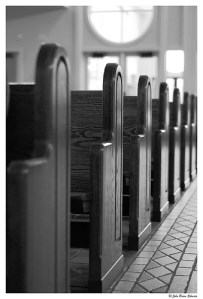
empty pewsYesterday I was reminded of a practice I picked up in seminary.  At VTS, we were required to attend chapel and daily lunch together.  Like any good Episcopalians, seminarians and faculty all had their “regular seats” in chapel.  And like any insecure adolescent, we often had a similar worry at lunch – wanting to make sure we had someone (preferably someone we liked) to sit with at lunch.

With that in mind, by my senior year, I developed a practice that brought much joy to my seminary life.  When I went to chapel, instead of bee-lining my way to a familiar seat with a friend, I would pick a pew and sit by myself.  I was always pleasantly surprised with the result.  Sometimes I ended up sitting alone the entire service – a practice that allowed me to become much more focused on my prayers.  Sometimes the most wonderful friends snuck into the seat beside me just as the service was starting.  Their presence brightened my day and lifted my joyful heart in worship.  And sometimes someone I was not as excited to see would sit beside me.  Inevitably though, we would end up chatting after the service and something about that conversation softened my heart into a much more Christ-like way of loving all my neighbors.

The same was true at lunch.  If all the tables were full, instead of squeezing in one more seat, I would pick an empty table and sit down.  This was the biggest gamble because up to seven people could join you.  Again, sometimes the closest of friends and professors would join me, leading to much laughter and enjoyment; sometimes an odd conglomeration of individuals would join me, leading to intriguing conversations; and sometimes total strangers or even those who I was not so fond of would join me, but the interactions were no less rich, and always opened me up to something new.

So yesterday, at our Diocesan clergy day, I sat in a row by myself.  To be fair, I did sit behind a set of clergy I really like, but I did decline their invitation to squeeze in, just so that I could enjoy my old seminary practice.  And the experience did not disappoint.  I enjoyed a great pew of colleagues with some stimulating conversation after worship.

Driving home, I began to wonder where we make room in our everyday lives.  Where do we leave space for others to join us?  Certainly, this applies to our church pew and coffee hour sitting behaviors, but the question is bigger than that.  Where do I make room for holy interaction with others, talking about my faith, listening to their sacred story?  How do I make room for the movement of the Holy Spirit to act in the open space I create?  This pattern of behavior is not easy or even comfortable.  Making room for others takes intentionality, vulnerability, and a willingness to sit alone until someone else arrives.  I invite you today to ponder where you are leaving space in your life, and how God is already using that space for good.

Sermon – Luke 4.21-30, 1 Corinthians 13.1-13, EP4, YC, February 3, 2013

06 Wednesday Feb 2013

Posted by jandrewsweckerly in Uncategorized

≈ Leave a comment

Tags

Christ-like, Christianity, conflict, God, Jesus, love, reputation, witness

I have been thinking these last couple of weeks that Christianity could really use a new Public Relations campaign: not just the Episcopal Church, or even St. Margaret’s, but Christianity in general.  This past week a receipt from an Appleby’s restaurant was circulated worldwide on the internet.  The receipt was from a table of about ten Christians.  When the waitress picked up the receipt, the automatic 18% gratuity for groups was crossed out, and the tip read “0,” with a note that said, “I give God 10%, why do you get 18?”  The signer signed her name and wrote “pastor,” on the receipt.  I do not know your tipping policies, but most wait staff make well below minimum wage and make up the difference with tips.  So for a pastor to so rudely deny a person their livelihood is embarrassing to all of us.  Now, you may argue this was an isolated incident, but as anyone who has ever waited tables knows, Christians are widely known as being the worst tippers at restaurants.  Even our Wednesday night study group has reflected on the author’s negative experiences with Christians.  This is not exactly a reputation we can be proud of, especially when we are to be caring for the poor – which many wait staff are.

The Church in Corinth was struggling with a similar PR campaign.  We have been hearing the last couple of weeks how the Church there was fighting over who had the best spiritual gifts.  Finally fed up, Paul breaks down the issue at hand.  No matter what gifts a person possesses – speaking in tongues, prophecy, or wisdom – if that person does not have love, they are a noisy gong, or worse, they are nothing.  Paul is a lot like the marketing director who has come in to clean up the Corinthians terrible PR problem.  Love is the answer.  Many of us hear Paul’s words today and we think of the hundreds of weddings where we have heard this text.  But Paul is not really talking about romantic love.  Paul is talking about the way Christians need to behave in order for others to see Christ in us.

Of course, love sounds easy – almost like a cheesy seventies slogan or that Beatles hit, “All You Need is Love.”  But the kind of love Paul is talking about is not easy at all.  The love Paul is talking about is patient; is not envious, boastful, arrogant, or rude; allows others to have their way; is not irritable or resentful.  This kind of love means letting going of the importance of self – which is perhaps one of the most difficult tasks we can accomplish.  We have all seen glimpses of this kind of love in others.  This weekend, our “Movies with Margaret” film was a movie called Saved.  In the film, a girl accidently becomes pregnant, and when she most needs someone who can express Paul’s kind of love, she does not receive that love from the most pious students at her Christian High School.  Instead, the characters who are seen as rebellious heathens are the ones who show Paul’s love most beautifully.  They are the ones who embrace the pregnant girl when she is at her lowest point – when she is lost and utterly alone in her trials.  Those widely acknowledged as un-Christian at her Christian High School are the ones who behave in the most Christ-like way of all:  by showing deep, kind, sacrificial love.

As we slowly begin to wrap our heads around this concept of Paul’s love and how that love might help our own PR campaign, we hit a bit of a snag when we get to our gospel lesson.  Jesus, who has just proclaimed that he is the Messiah in his hometown synagogue, where people are stunned into silence, suddenly is found today speaking so harshly to the synagogue that they angrily rush to throw him off a cliff.  Jesus words do not sound full of love, but instead sound the opposite – rude, arrogant, and irritable.  His anger today may have us wondering if Paul has romanticized Jesus’ life and witness.

The truth is that Jesus’ actions, as harsh as they sound, still exhibit love.  The love Jesus shows is perhaps what we might call “tough love” today.  Despite the fact that the people are outwardly praising Jesus for his words, Jesus sees through their words to their intentions.  The people of Nazareth hear Jesus’ words and wheels start churning.  If Jesus is the Messiah, then they have the honor of being the town that raised him.  And if they have such an honor, then surely they will benefit from all of Jesus’ power and teachings.  Instead of looking on the people of Nazareth with pity, Jesus gets angry.  Jesus knows that his hometown is instantly becoming greedy, wanting to not only keep the Messiah to the people of Israel, but especially to keep him in their own town.  And so Jesus reminds them that God’s love is bigger than them – in fact, God’s redemption will extend to even the Gentiles – Gentiles like that widow at Zarephath in Sidon and Naaman the Syrian.[i]  Jesus’ words sound more like a slap in the face than the patient, kind love that Paul describes.

I have a friend who has many times complained to me about the differences in fighting styles between her and her husband.  She tends to avoid conflict.  Having been raised in a conflict-avoidant household, she totally shuts down in the face of conflict.  Her husband, on the other hand, was raised in a household where conflict was a normal, and sometimes very loud, part of life.  Unlike her busy behavior to squash conflict, he lets the tension build up until he explodes.  Neither of them handles conflict perfectly.  She does not recognize the ways in which she is not loving or caring for him, and so her behavior does often create the slow buildup.  Meanwhile, by not expressing his frustration early on, her husband gets to the point where his only recourse is this last explosion of emotion.  They both could use some work on the Pauline love we hear about today – both needing to be more sacrificial, less irritable, and more patient.  But that work does not eliminate conflict.  In fact, if we really look at what Jesus does in the gospel lesson today, sometimes the deepest love can only happen in conflict.  As one scholar explains, “Sometimes we love our people in the name of Christ, enduring just about everything with them, and sometimes we love them by throwing the Book at them.”[ii]

Paul, Jesus, waitresses, and movies are all pointing us toward a basic reality today.  We are Christians, and as such, we live life differently.  We love differently.  In a culture that says we should be self-centered, boastful, arrogant, and envious, the Church proclaims a different truth.  Living in this love-centered way is not easy.  Sometimes we will have the kind of conflict that Jesus has with his family.  But even in conflict, we hold on to the self-sacrificing love that “bears all things, believes all things, hopes all things, endures all things.”  Why do we strive for this kind of living?  Because people are watching.  We are the PR campaign that our neighbors see when they wonder what Christianity is all about.  As St. Francis of Assisi said, “The deeds you do may be the only sermon some persons will hear today.”  Jesus and Paul invite us to live our lives as sermons that illustrate love – not in the gooey romantic sense, but in the ways that both sacrifice the self, and love through conflict.

The good news is that the rest of our liturgy today gives us the opportunity to reorient ourselves toward love.  In a few moments, we corporately confess the myriad ways we do not show love to our neighbors.  The section of our service that invites us forward for healing is also meant to be a place where we can come forward for healing for ourselves, for our unloving relationships, and our unloving witness in the world.  And finally, at the Eucharistic table, we come not for solace only but for strength; not for pardon only, but for renewal.  This liturgy today can renew and strength you so that your life might be a powerful witness of love and Christian faith.  Amen.


[i] Gay L. Byron, “Exegetical Perspective,” Feasting on the Word, Yr. C, Vol. 1 (Louisville: Westminster John Knox Press, 2009), 311.

[ii] William H. Willimon, “Book ‘em,” Christian Century, vol. 121, no. 2, January 27, 2004, 20.

Full…

30 Wednesday Jan 2013

Posted by jandrewsweckerly in Uncategorized

≈ Leave a comment

Tags

blessing, church, full, God, Holy Spirit

I am having one of those “full” weeks at church this week.  Full weeks can be stressful and overwhelming, but they can also be wonderfully full of grace and blessing.  So far, this week has been the latter.  It started on Sunday.  We had our usual worship services, and both were filled with real energy and life.  Between the services, I trained a new lector – not only reminding me of the blessing of this particular ministry, but also reminding me of the new members here at St. Margaret’s that becoming incorporated into our family.  After the services, I said a few quick hellos at Coffee Hour, and then was off to a Worship Committee Meeting.  I am so grateful for the mirror that this committee provides, helping me to assess what is working and what needs work.  We added two younger members to the committee and their contributions were especially meaningful.  The committee is full of the Spirit and deeply thoughtful about our worship.  Finally, later that night I came back to church for Confirmation Class.  Our six teens and two mentors are an incredible group, with some thought-provoking questions (topics included hell, sin, and judgment, just to name a few).  I left wishing we had more time to keep feeding our young adults.

The fullness continues this week.  Last night, our Cemetery Committee met.  These passionate parishioners and staff continue to amaze me with their thoughtfulness and care.  Their ministry is a vital part of work here in Plainview.  Tonight, I meet with our Study, Sup, and Serve group, who is discussing Nickel and Dimed, by Barbara Ehrenreich.  So far, our discussions have been inspiring, challenging, and thought-provoking.  I cannot wait to see what the group does tonight.  Tomorrow, I meet with our hard-working Wardens, who always find a way to mix business with humor.  They are a blessing to me in my ministry here, and our meetings are truly a joy.  Finally, we will round out the week with our next installment of “Movies with Margaret.”  This week we are watching Saved, a dark, provocative comedy about a high school student at a Christian High School who accidently gets pregnant and how the pregnancy affects her relationships and faith.  I imagine we will all wince from time to time, but also see a lot hope and encouragement.

So, yes, a full week.  Of course, add in a special trip to the train station with my lovely husband today (his car is getting some regular maintenance), and a “treat” at a favorite doughnut shop today with my awesome daughter, and this week is truly full.  Keeping this kind of pace would not be a good a long-term plan.  Rest is a God-given gift too.  But I am grateful that this week feels full in a grace-full way, not in a stressed-out, stretched-thin kind of way.  I can only attribute that to the Holy Spirit surrounding me on every side and carrying me through this week with a sense of joy instead of burden.  Thank you God for the joyful, crazy, full life you have given me this week!  Help me to hold onto that joyful perspective in the coming weeks!

Sermon – Luke 4.14-21, EP3, YC, January 27, 2013

30 Wednesday Jan 2013

Posted by jandrewsweckerly in Uncategorized

≈ Leave a comment

Tags

change, Jesus, Messiah, power, Sermon, words

The word is spreading.  The new rabbi in town is incredible!  He is clearly filled with the Spirit.  He has become quite the sensation in Galilee and everyone expects his appearance in Nazareth to be impressive – what home town would not love to see their son come home and preach a good word?!  Nazareth, expecting to be proud and wowed, sits in the synagogue.  And then it happens – Jesus does not preach a scintillating sermon.  Instead, he finds a bold text – a text from Isaiah that we all know contains the words that the Messiah will use – reads the text, and then he just sits down.  The room is silent.  We all just stare.  The shock is heavy in the room and words fail us all.  Our minds are running amok with questions.  Did he just read that text from Isaiah?  Is he saying he is the Messiah?  Is he the Messiah?  What does this mean?  What does he mean the scripture is fulfilled?  Of course, no one says those words aloud.  We just stare.  We stare in silence.

Words have mighty power in our lives.  As we celebrated the Rev. Dr. Martin Luther King this past week, I have read countless quotes from his life and ministry.  He was a man who knew how to use words powerfully.  In an age where we are barraged by words – in media, in politics, in books – we sometimes forget the power of words.  We tend to skim words, to gloss over them, looking to quickly glean information because we are inundated with words.  In our haste, we forget the power of words.

The catch with words is that words have the power to make both positive change and to get us into trouble.  My grandfather always used to say, never put anything in print that you do not want the world to see.  We have watched these last months how words can cause trouble.  This fall’s political campaign led to many people saying words they regret.  Just in the past two weeks, two big athletes, Lance Armstrong and Manti Te’o, realized the chaos that their words could produce.  Teens every week are terrorized by the words of cyberbullying – with reputations ruined worldwide when seemingly private photos or acts are posted on Facebook for all to see.[i]

This is why that silent synagogue is so powerful today.  Jesus takes words that everyone knows, and he changes them.  The Messiah, the anointed one, has been long awaited:  so long awaited, that I doubt many people still believed the Messiah would come in their time.  So Joe’s boy rolling up into the synagogue and declaring that he is the anointed Messiah is a big deal.  These are words of power and weight – so heavy that the room is completely silent.

Part of the weight of Jesus’ words comes from whom he is claiming to be.  The other part of the weight of Jesus words is interpreting what they mean for the world now.  For Jesus, and for his followers, these words from Isaiah through Jesus become a mission statement of sorts.[ii]  If you remember, in Luke’s gospel Jesus is baptized, goes into the wilderness to be tempted, and this is the first that we really hear from Jesus.  These words are not just bold words – these words will define the entire remainder of Luke’s gospel.  If you were writing one of those fifth-grade book reports, you can almost hear the introduction, “The theme of Luke’s gospel is that Jesus brings good news to the poor, release to the captives, recovery of sight to the blind, freedom to the oppressed, and the year of the Lord’s favor.”  For the rest of this lectionary year we will be hearing stories of Jesus fulfilling these words – good news, release, sight, freedom, favor.  This is what Jesus’ ministry is about.  Jesus takes the words from Isaiah and he changes them.  And through changing them, he changes the world.

A video has been circulating this week called, “The Power of Words.”  In it, a blind man is sitting on a sidewalk, with a cardboard sign that reads, “I’m blind.  Please help.”  As he sits there, two or three of the tens of people who pass by actually drop a coin or two in front of him.  He silently feels for the coin and then puts the coin in his tin can.  Finally a woman sees him and stops.  She silently picks up his sign, turns the piece of cardboard over and writes something else on the sign.  Without a word, she walks away.  In the next several scenes everyone stops and gives the blind man handfuls of coins.  The woman eventually returns, and dumbfounded, the man asks her, “What did you do to my sign?”  She simply replies, “I wrote the same, but different words.”  As she walks away, we see that what she wrote is, “It’s a beautiful day and I can’t see it.”  She took a sign that said, “I’m blind.  Please help,” and she changed the words to, “It’s a beautiful day and I can’t see it.”  The video ends with these words, “Change your words.  Change the world.”[iii]  What the woman in this video does is she takes something we see everyday – a man asking for help, and makes him not so “everyday.”  By changing the words on his sign, she helps all see with fresh eyes.  Suffering and pain no longer seems acceptable simply because of her words.  She changes people with her words

This is what Jesus does in that temple.  He takes words with a certain set of values and meaning, and he changes them.  No longer will good news, release, sight, freedom, and favor be a future dream.  They will change now with Jesus Christ.  So perhaps part of the silence in that synagogue comes from the joyful realization that this liberation might actually happen in their time.  But another part of that silence comes from the implications.  If the Messiah is here, offering liberation from poverty, imprisonment, blindness, and oppression, then that means that the people of God will have to start living like the Messiah is here.  They too will have to work to bring good news to the poor.  They too will have to work to release the captives.  They too will have to care for the blind and the oppressed.  They too will have to honor the year of the Lord’s favor, the Jubilee Year when debts are forgiven, slaves are freed, and lands are left to rest.  Jesus’ words not only change the people of God’s reality, Jesus’ words will change the world, and the people of God’s behavior in that word.  This is big, silence-making news.

Jesus’ words change us too.  We too are left in silence as the weight of Jesus’ words hit us.  If we are to follow Jesus, we too are to be working for the poor, the imprisoned, the blind, and the oppressed.  As that reality waves over us, we too are silenced by the questions.  What does that mean for us?  How will this change my walk with God?  How uncomfortable is this work going to be?  How joyful will this work be?  Pondering these and probably many more questions is a good thing, even more so with Lent on the horizon and the looming of our own Jubilee year here at St. Margaret’s.  With the text ending as the text does today, we are invited to tarry in that silent pondering today.  But know that the pondering is not indefinite.  Jesus’ words hint at the immediacy of the work that is needed.  “Today this scripture has been fulfilled in your hearing.”  So do the pondering you need to do.  But know that Jesus is waiting at the back door, ready for you to join him in the messianic work of good news, release, sight, freedom, and favor.  Amen.


[i] Idea recently confirmed in this piece on NPR: http://www.wnyc.org/shows/rookies/articles/radio-rookies/2012/dec/28/sexual-cyberbullying-modern-day-letter/.

[ii] Ernest Hess, “Homiletical Perspective,” Feasting on the Word, Yr. C, Vol. 1 (Louisville:  Westminster John Knox Press, 2009), 287.

[iii] http://www.youtube.com/watch?v=Hzgzim5m7oU

Sermon – 1 Corinthians 12.1-11, EP2, YC, January 20, 2013

23 Wednesday Jan 2013

Posted by jandrewsweckerly in Uncategorized

≈ Leave a comment

Tags

church, Corinth, diverse, gifts, God, Sermon, spiritual gifts

About two thousand years ago, the Christian community that had formed in Corinth was a diverse group.  There were Greeks and Jews, slaves and free people, men and women, rich and poor.  Their only unifying tie was that they all confessed Jesus as Lord.  And like any good church, they were of a divided mind.  We learn from their correspondence with Paul, that they are particularly divided about what spiritual gifts are to be the most highly valued.  The running argument is that the gift of ecstatic speech is the most important, and those displaying that gift should be given higher importance in the community.[i]  Unable to settle this argument among themselves, they turn to Paul.

Unfortunately for those arguing for singling out the gifted, Paul proclaims a different reality – everyone is gifted.  Simply by proclaiming Jesus as Lord, each person is given a gift.  The gifts may be different, and there will be a diversity of gifts.  This diversity of gifts is necessary for the community, making the community richer and helping the community to see the fullness of God.

Paul’s explanation sounds lovely.  Everyone is special and everyone has gifts.  But truthfully, in the depths of our hearts, we do not really agree with Paul.  We have lived in a cutthroat, competitive world too long to know that not all gifts are really valued equally – not even in the Church.  Sure, some people are gifted teachers, or seem especially spiritual – but what we really need are people skilled in finances.  Or maybe we really value people who are wise or people who are good with technology.  Whatever the thing is that we value, the point is that we rank gifts.  And although we might not want to admit the fact, as modern Americans, we tend to roll our eyes at Paul, seeing his explanation on gifts as cute, but not really helpful if a church is going to succeed.

When I was in college I went to a multicultural church in a small city.  The church was primarily African-American and African, but several Anglos from the community and from the local college joined the dynamic parish.  As the parish grew, we often had conversations about what our diversity meant and how we would negotiate each others’ differences.  But one day, the pastor had an idea that he charged ahead with before really getting buy-in from the church.  He invited two local group homes to bring their residents to church on Sundays.  The residents had mental and physical disabilities, and many of them were in wheelchairs.  Some were more verbal than others, but many of those who were verbal could not form clear words.  You could tell right away that the church members were uncomfortable.  We did not know how to handle the outbursts or the behavior of the group home members.  Luckily, the pastor was much more generous than we were.  He noticed that the outbursts were not random.  In fact, sometimes a yell sounded a lot like an “Amen!”  And so in the church’s customary call-and-response format, the pastor engaged the group home members just like he did the rest of the church members.

That church learned relatively quickly what Paul was trying to teach the members of the church in Corinth.  Whereas the church in Corinth sees its own diversity and wants to begin ranking gifts, Paul is trying to explain that their diversity is their gift.  Every person in that community is needed to make the community whole.  The full range of gifts means that the community is richer and can live out the community’s call more fully.  Without the interpreter of tongues, the speaker of tongues is useless.  The healers heal the community.  The miracle workers help the community see God.  The prophets help send the people out beyond the community.  Only together can they live into the fullness of faith.  Each person is indeed gifted – but not for the sake of personal pride.  The gift’s purpose is to edify the entire community.[ii]

Furthermore, what Paul is also trying to explain is the gifts are not just for the person, or for the community.  The diversity of gifts tells them something about God.  The diversity of gifts gives the community a glimpse into the diversity of God.[iii]  Only when all those diverse gifts are being enfleshed does the community in Corinth begin to get a glimpse into the fullness of God.  Paul knows that understanding God fully is impossible – we are made in God’s image, but we are not God.  Only through the diversity of their diverse Corinth church, and through the diversity of their gifts, do they begin to see a glimpse of the diversity of God.

At that church in college, we had been pretty proud of ourselves.  We were a diverse parish in a community with a rough history of racial discrimination.  But those group home members made us realize we were still not living into the fullness of the body of Christ.  Without those group home members pushing us out of our comfort zone, we were keeping our identity within our own parameters, not God’s parameters.  Truthfully, the presence of the group home members made us wonder who else we were excluding.  We did not need long to look around our community and figure out who we had been excluding.  The apartment complex next to the church was clearly inhabited by many Hispanics, a group not present in our community.  Only once the group home members opened our eyes were we able to see how much we had been limiting God and how much richer we could be if we opened our doors to our neighbors.  One could argue that our group home members had the spiritual gift of prophesy.

So why is Paul’s letter so important to St. Margaret’s?  This past Wednesday, about eight St. Margaret’s parishioners went over to Plainview Reformed Church to make sandwiches for the INN.  Most of us had been there before, and we fell into a quick rhythm.  Some of us were good at scooping – which is a delicate skill because if you use too much, we cannot make enough sandwiches.  Some of us were good at spreading – an important skill if you do not want to tear the bread.  Others were good baggers.  Now bagging a sandwich may sound simple to you, but as the activity leaders kept reminding us, a sandwich bag that is messy on the inside or out sends the message that the sandwiches were made without much thought – or even without much love.  Even the youngest children who put stickers on the sandwich bags had an important role.  Without the sticker, the sandwich is just another sandwich.  With the sticker, the bag says that someone made this sandwich, and personalized the sandwich just for you – because you are special and worthy.  As that interfaith community gathered, with people of all ages, shapes, sizes, and abilities, we were a lot like that community in Corinth.

What Paul’s letter and our sandwich-making this week show us is that only when we all engage in ministry are we fully living into the life of faith.  Only when all our skills are being used are we even able to see a glimpse of the fullness of God.  Our invitations this week are several.  First, Paul invites us to discern our spiritual gifts.  Now, because you work in construction, you might have been roped into serving on the Buildings and Grounds Committee.  Or because you have young children, you might have been recruited to teach Sunday School.  But sometimes, what we do professionally does not translate to a spiritual gift.  Our best teachers, our wisest decision-makers, our most spiritual people of prayer might not do those things professionally or obviously.  Today Paul invites each of us to ponder whether we are using our spiritual gifts for the betterment of this community.  Second, Paul invites us to consider how each person here might help us to better see a glimpse of God.  That means that after church or during coffee hour, we might need to sit with someone we do not normally sit with and have a meaningful conversation.  And yes, you can have a meaningful conversation with a three-year old or a sixteen-year old.  Finally, Paul invites us to consider who is not here, helping us know God more deeply.  I have heard time and again how much we want to grow as a community.  For many of us, that desire is more out of a sense of preservation – we need to grow to continue to be a church here in Plainview.  But I wonder if we might instead begin to think of our growth as necessary for us to more fully see God.  We may know all sorts of people in our everyday lives who do not fit the St. Margaret’s mold.  Those are the people we need to invite to Church.  That neighbor you got to know when we all lost electricity during the Hurricane.  That woman with the purple hair who cuts your hair at the salon.  The waiter at your favorite restaurant who you have come to know.  Until we invite those people, we will not experience the fullness of God’s gifts for us.  The invitations from Paul today abound.  I look forward to hearing how your homework goes!  Amen.


[i] Karen Stokes, “Pastoral Perspective,” Feasting on the Word, Yr. C, Vol. 1 (Louisville: Westminster John Knox Press, 2009), 254.

[ii] Lee C. Barrett, “Theological Perspective,” Feasting on the Word, Yr. C, Vol. 1 (Louisville: Westminster John Knox Press, 2009), 256.

[iii] Troy Miller, “Exegetical Perspective,” Feasting on the Word, Yr. C, Vol. 1 (Louisville: Westminster John Knox Press, 2009), 257.

← Older posts
Newer posts →

Recent Posts

  • On New Clothes and Neighbors…
  • Sermon – Matthew 20.1-16, P20, YA, September 20, 2026
  • On Change and Bread…
  • Sermon – Exodus 14.19-31, P19, YA, September 13, 2026
  • On Realizing Dreams…

Archives

  • September 2026
  • August 2026
  • July 2026
  • June 2026
  • May 2026
  • April 2026
  • February 2026
  • January 2026
  • December 2025
  • November 2025
  • October 2025
  • September 2025
  • August 2025
  • July 2025
  • June 2025
  • March 2025
  • February 2025
  • December 2024
  • November 2024
  • October 2024
  • September 2024
  • August 2024
  • July 2024
  • June 2024
  • May 2024
  • March 2024
  • February 2024
  • January 2024
  • December 2023
  • November 2023
  • October 2023
  • September 2023
  • August 2023
  • July 2023
  • June 2023
  • May 2023
  • March 2023
  • February 2023
  • January 2023
  • December 2022
  • November 2022
  • October 2022
  • June 2022
  • May 2022
  • January 2022
  • December 2021
  • November 2021
  • October 2021
  • September 2021
  • August 2021
  • June 2021
  • May 2021
  • April 2021
  • March 2021
  • February 2021
  • January 2021
  • December 2020
  • November 2020
  • October 2020
  • September 2020
  • August 2020
  • July 2020
  • June 2020
  • May 2020
  • April 2020
  • March 2020
  • February 2020
  • January 2020
  • December 2019
  • November 2019
  • October 2019
  • September 2019
  • August 2019
  • July 2019
  • June 2019
  • May 2019
  • April 2019
  • March 2019
  • February 2019
  • January 2019
  • December 2018
  • November 2018
  • October 2018
  • September 2018
  • August 2018
  • July 2018
  • June 2018
  • May 2018
  • April 2018
  • March 2018
  • February 2018
  • January 2018
  • December 2017
  • November 2017
  • October 2017
  • September 2017
  • August 2017
  • July 2017
  • June 2017
  • May 2017
  • April 2017
  • March 2017
  • February 2017
  • January 2017
  • December 2016
  • November 2016
  • October 2016
  • September 2016
  • August 2016
  • July 2016
  • June 2016
  • May 2016
  • April 2016
  • March 2016
  • February 2016
  • January 2016
  • December 2015
  • November 2015
  • October 2015
  • September 2015
  • August 2015
  • July 2015
  • June 2015
  • May 2015
  • April 2015
  • March 2015
  • February 2015
  • January 2015
  • December 2014
  • November 2014
  • October 2014
  • September 2014
  • August 2014
  • July 2014
  • June 2014
  • April 2014
  • March 2014
  • February 2014
  • January 2014
  • December 2013
  • November 2013
  • October 2013
  • September 2013
  • August 2013
  • July 2013
  • June 2013
  • May 2013
  • April 2013
  • March 2013
  • February 2013
  • January 2013
  • December 2012
  • November 2012
  • October 2012
  • September 2012

Categories

  • reflection
  • Sermons
  • Uncategorized

Meta

  • Create account
  • Log in
  • Entries feed
  • Comments feed
  • WordPress.com

Blog at WordPress.com.

  • Subscribe Subscribed
    Seeking and Serving
    Join 397 other subscribers

    Have a WordPress.com account? Log in now.

  • Seeking and Serving
    View site in Reader
    Manage subscriptionsSign upLog in
    Report this content
    Collapse this bar
Loading Comments...