• About

Seeking and Serving

~ seek and serve Christ in all persons

Seeking and Serving

Author Archives: jandrewsweckerly

Homily – Matthew 24.9-14, Perpetua and her Companions, March 7, 2013

14 Thursday Mar 2013

Posted by jandrewsweckerly in Uncategorized

≈ Leave a comment

Tags

faith, homily, love, martyrs, Perpetua, risky

Today we honor Perpetua and her companions, martyrs at Carthage in 202.  Petpetua was a young widow with a small child and several slaves.  Along with other Christians preparing for baptism, they were arrested when they refused to offer sacrifice to the divinity of the Emperor.  They suffered under miserable conditions in a prison.  But Perpetua had these incredible dreams about heaven that encouraged her in her resolve and her insistence on declaring her Christianity.  She and her companions were put in an arena with a leopard, boar, bear, and savage cow.  Perpetua encouraged them, but eventually all were put to death by a sword.

Our lessons today all warn of a similar fate for us.  Jesus tells his disciples they will be tortured and put to death; hated, betrayed and abused.  We know from people like Perpetua and the disciples that this was the reality for many Christians and for many years.  But today, I think martyrs are always a little hard to relate to.  Who among us in risking our lives by telling someone we are Christian?  Who among us will be tortured for our faith or even for being here in this church today?  The life of a martyr is so foreign that we rarely feel connected.

But I think what Pepetua invites us to do today is to consider the ways that our faith puts us in risky situation:  the racist joke someone makes that we refuse to laugh at because we know all people to be children of God; the gun-control march we walk in because we see the violent ways we have turned on one another and we refuse to allow one more child of God to be killed so that we have the right to accumulate assault weapons.  These may not lead to death or even suffering.  If anything, they may lead to disagreements, exclusion from certain social circles, or embarrassment.

When Perpetua and her companions were being mangled by animals, she stated to her friends, “Stand fast in the faith and love one another.”  In order to truly love one another, we will have to take risks, we will have to face discomfort.  Perpetua died in suffering, but her love of God and love of neighbor never died.  We too can let go of our selves and love God and neighbor, even when it is uncomfortable.  Amen.

Homily – 1 Timothy 4.6-16, Cooper and Wright, February 28, 2013

14 Thursday Mar 2013

Posted by jandrewsweckerly in Uncategorized

≈ Leave a comment

Tags

Anna Julia Haywood Cooper, call, Elizabeth Evelyn Wright, gifts, God, homily

Today we celebrate Anna Julia Haywood Cooper and Elizabeth Evelyn Wright.  Cooper was born in 1859 to an enslaved woman and a white man.  She went on to study at St. Augustine’s, and Oberlin College, and eventually became the fourth African-American woman to receive a doctorate.  She was a teacher who insisted on equal education for African-Americans.  She even served as a college president.  Wright was born in 1872 to an African-American father and a mother of Cherokee descent.  She studied at Tuskegee and worked to form schools for rural black children.  Though she faced much opposition, including arson, she started a college for African-American young people that eventually became Voorhees College.  Both of these women were privileged to receive an education when they did.  But they did not keep this gift to themselves – they worked hard to ensure they brought others with them.

One could imagine that both Cooper and Wright, women highly influenced by the Episcopal Church, might have read the epistle lesson we heard today.  “Do not neglect the gift that is in you … put these things into practice, devote yourself to them, so that all may see your progress. Pay close attention to yourself and to your teaching: Continue in these things, for in doing this you will save both yourself and your hearers.”

Many of us may not have been teachers, professionally, but we have at times neglected the gifts that are in us.  For quite some time, I avoided my call.  I avoided.  I tried substituting other things.  I tried doing good work, just not the work I was given to do.  We all do this from time to time; we neglect the gifts God has given us, because we are afraid of where they will take us or how hard the road will be.  But our epistle reminds us that living into a call is not just for us; it’s for others as well.

Cooper and Wright knew this to be true.  Their work was for others, but their work also fed themselves.  Though we may not be teachers like Cooper and Wright, we learn from them and our epistle that we are all teaching others.  When we neglect the gift in ourselves, others notice.  We have to only think of our most admired friends and saints to know that passion inspires passion.  Just by living into our gifts and vocation, we bless others without even realizing it.  God sees the gifts in you.  Your work is to nurture that gift and live into that gift fully before others.  Amen.

Homily – 1 John 4.13-21, John Henry Newman, February 21, 2013

14 Thursday Mar 2013

Posted by jandrewsweckerly in Uncategorized

≈ Leave a comment

Tags

church, homily, John Henry Newman, love, pope

Today we celebrate the life of John Henry Newman.  Newman was ordained a priest in the Church of England in the 1820s.  He was one of the founders of the Oxford Movement, that movement in the Church of England that sought to get us back to some of our more Roman liturgical heritage.  They were the ones who started what we would call the Anglo-Catholic or High Church movement.  Newman produced many tracts and was an avid scholar, but eventually the church infighting got to him and he left the Church of England to become a Roman Catholic priest and eventually a Cardinal. 

What is interesting is that we get this epistle lesson today about love appointed for Newman’s day: “God is love … we love because he first loved us.  Those who say ‘I love God,’ and hate their brothers and sisters, are liars.”  We often like to focus on the God of love – we say, “it’s all about love.”  But so rarely do we act like it is all about love.  Like the Church of England in the 1800s, we still have denominational infighting.  We have seen how tense things still are in the conversations about a new Pope.  The last couple of weeks, I have heard more trash talk between Romans and Anglicans than I like to admit.

The challenge that Newman and our epistle lesson give us is the challenge to love one another.  The collect for this day says, “God of all wisdom, we thank you for John Henry Newman, whose eloquence bore witness that your church is one, holy, catholic and apostolic …”  We confess this in our profession of faith, but I am not sure we always believe it.  Whatever denomination life has landed us in, Newman and our epistle remind us of the centrality of love.  This is most important in our conversations, our actions, our prayers, and our witness.  The world is not only watching the Roman Catholic Church in this new election of a Pope – the world is watching how all Christians behave, especially toward one another during this process.  For as our epistle says, “those who love God must love their brothers and sisters also.”  Our invitation today is to be a church of love.  Amen.

Soul food…

06 Wednesday Mar 2013

Posted by jandrewsweckerly in Uncategorized

≈ Leave a comment

Tags

fed, food, Jesus, Lent, lenten discipline, soul, spiritual

IMG_1397This year my Lenten discipline has been a lot more ambiguous than in years past.  I have been working on being attentive and more present in my life and in my ministry.  Like I said, ambiguous.  But in some ways, the practice has been quite a blessing.  Instead of busying myself with a practice or suffering through giving something up (and probably complaining about either), this year I have been able to step back and see what is working and what really is not.

The wonderful thing about this practice is the ways in which I see that I am being fed.  At our parish, we have had a series of speakers to prepare us for the construction of a community garden that could feed our neighbors in need.  The speakers have been an incredible blessing to me, showing me the simple ways that we can use our vast property for good, but also the ways that we can be a part of some really incredible ministries that are already thriving.

I also just returned from a great conference that fed me much more than I expected.  So many times in the Episcopal Church we get downhearted about the future of the Church and its leaders.  But I just spent time with about twenty of the Church’s leaders and I was blown away by their passion, intelligence, humility, and enthusiasm.  As opposed to a gathering of competitors (Episcopal priests have a tendency to do this from time to time…), it became a gathering of people truly wanting to learn from one another, to celebrate successes, and learn from failures.  I have not been this hopeful for the Church in a while.  For that I am grateful.

Another source of nourishment this Lent has been the practice of following Lent Madness.  In the first couple of match-ups, I found myself getting indignant when my saints “lost.”  But as the weeks have past, I have found I am worrying less about how many I “win” and how much I am learning.  Last weekend, I was worshiping with a Diocesan group and the lessons for the liturgy were from the feast day of Chad of Litchfield.  Imagine how excited I was to immediately know his story before the Bishop was able to explain it to us.  What was once yet another competition has become a great source of nourishment for me in this Lent.

I hope you are finding sources of nourishment this Lent.  I hope your practices are teaching you something about your relationship with Christ or at least inviting you back into relationship with Christ.  During this season of Lent – a season often marked by fasting – I hope your journey is full of filling nourishment for the soul.

Sermon – Luke 13.1-9, L3, YC, March 3, 2013

04 Monday Mar 2013

Posted by jandrewsweckerly in Uncategorized

≈ Leave a comment

Tags

fig tree, God, grace, Jesus, Lent, mercy, parable, repent, Sermon

We are half way through Lent, and this is the time that we begin to take stock.  But we do not always take stock of ourselves, humbly repenting of the ways we are stumbling with our disciplines.  No, we look at everyone else.  When we ask our fellow parishioners how their Lenten disciplines are going, we are not asking out of Christian love.  We are asking because we hope they are failing more miserably than we are.  We need to hear that someone has lapsed in their practice or given up altogether so that our weak attempts to hold on do not seem so weak after all.  We are a judgmental people, and we rarely offer the forgiveness that we so long to receive.

Jesus knows this as he listens to those gathered around him in our Gospel lesson today.  They are lamenting with Jesus about two groups of people who have recently suffered – the Galileans at the hand of Pilate and those near the tower of Siloam.  “Isn’t it horrible, Jesus,” they seem to be saying.  The insinuation is that those in Galilee and in Siloam must have sinned gravely to receive such suffering.  The assumption was a common one among the people of Israel.[i]  We remember the friends of Job who immediately assumed Job must have done something wrong to deserve his severe suffering.  Those gathered around Jesus are hoping that Jesus will confirm their suspicions – that Jesus will turn the spotlight on the sinfulness of those people, so that they can all shake their heads in judgment.

But Jesus will not take the bait.  Instead, Jesus tells this story:  Once upon a time, there was a fig tree that was not bearing fruit, and had not bore fruit for three years.  Fed up, the vineyard owner decided to cut down the unproductive tree.  But before the vineyard owner could touch the tree, the gardener made one last plea.  The gardener asked for one more year.  In that year, the gardener would dig around the tree, spreading manure at the roots of the tree.  If after a year of such care the tree still did not produce fruit, then the owner could chop down the tree.

The message seems to be clear in Jesus’ parable:  repent, change your ways, and start producing fruit, or you will be slaughtered.  But this interpretation of the parable gets all the parts confused.  The people gathered are not the gardeners begging God, the vineyard owner, for one more year to tend our garden.  That version of the parable would be too simple.  Instead, God is the gardener – the one negotiating grace – and they are the unproductive trees.

I have been thinking about life as the unproductive fig tree all week.  An unproductive tree is still very much alive – the tree goes about the business of breathing in and drinking up nutrients.  The tree is surviving, but not thriving.  But the tree is doing about all the tree can do.  The tree cannot fertilize itself.  The tree cannot aerate the tree’s own soil.  In order for the tree to thrive, the tree is dependent upon the gardener for the kind of care that produces fruit.

This is where I got stuck in the parable.  First, Jesus tells the people to repent; but then, Jesus tells the people that they are immobile trees, incapable of changing anything without the help of a gardener.  As someone who likes who likes to do, to be active, to achieve something, this parable is especially difficult.  If Jesus had just said to repent, I would have had a task to do – a job to accomplish.  Repenting, amending my ways, returning to God are all things I can work on and do.  But being a tree that just stands there, waiting for someone to help her, depending on God’s grace feels a lot less comfortable.

This Lent I really struggled with choosing a spiritual discipline.  I have tried all sorts of practices in Lent in the past:  reading a daily devotional, taking up a prayer practice, creating an exercise routine, or even giving up a foul mouth.  I tend to like the practices that add something to your life, rather than take something away.  But this year, nothing seemed to fit.  I talked to my spiritual director about my quandary, and she suggested something radical.  Instead of taking on something or giving up something, she suggested I just commit to just being more aware.  My busybody nature was totally confused and apprehensive.  But my spiritual director encouraged me to just try – to try spending this Lent, not busying myself with a discipline, but daily taking stock of my life patterns and observing.  This non-practice practice has been the most awkward experience for me.  As a person who needs tangibility, I have been left with this intangible practice.  No checklist to consult, no achievements to track:  just a practice of being, of letting God work on me.

I think what my spiritual director has been trying to get me to live into is the tree identity of our parable today.  In naming ourselves as the tree in Jesus’ parable, we are claiming a couple of things.  First, we are claiming that we are utterly incapable of determining our future.  The tree in the parable is not bearing fruit, and nothing the tree does will help the tree change this status.  The tree cannot try harder or behave differently.  The tree is simply a tree planted where the tree is.  Second, in identifying with the tree, we are claiming that we are dependent upon the gardener.  We are dependent upon the gardener’s mercy – the gardener who lobbies for one more year of trying.  We are dependent upon the gardener for determining the kind of nourishment we will receive.  We do not get to consult the gardener about the type of care we think we need.  We must trust the gardener to do what the gardener does best.

What I like about this parable today is that the parable takes us out of our comfort zones and puts us squarely in God’s hands.  First, by telling the people to repent, Jesus takes the people out of a mode of comparing and judging others and puts the people in the mode of tending to themselves.  His instruction to repent is almost Jesus’ way of saying, “Why don’t you stop worrying about what Pilate did and what the people of Siloam did, and why don’t you take stock of your own stuff.”  And then Jesus takes the wind out the sails of the people even further.  His parable tells them that not only do they need to not worry about what everyone else is doing, they need to realize that even the things that they are doing do not matter – because ultimately they are trees dependent upon God’s grace and mercy to thrive.

Now this may not sound like good news to us, but this is a tremendous word of grace for us today.  In the midst of the season of Lent, that season that we are typically kneading the dough of our lives, trying to get ourselves just right for God, Jesus leaves us with a word of grace.  Jesus’ parable today shifts our energy this week.  Instead of desperately grasping to change and amend our lives, Jesus invites us to let go:  to let go of trying so hard, and to remember the God who lovingly offers to do the work of digging in our soil and spreading smelly manure so that we might bear delicious fruit.

As we have been thinking about gardening this Lent, I have been hearing many stories of your own gardens.  For those of you who garden, you have lived this invitation that Jesus offers.  You have lived through a season where the tomatoes did not make it, where the new crop was not planted in the right place, and where critters have come in and destroyed.  And for those of you who are seasoned at this work, the common phrase I hear from you is, “Ah well, we’ll try again next year.”  This is the kind of letting go that Jesus is inviting us into this week.  This is the kind of trust in God that Jesus encourages.  As we come forward for healing prayers today, an old gospel hymn keeps running through head when I think of Jesus’ parable today.  The chorus says, “Your grace and mercy brought me through.  I’m living this moment because of You.  I want to thank you and praise you too.  Your grace and mercy brought me through.”  In the midst of our Lenten journey, we pause today to recognize the ways in which we are simply trees in God’s garden, dependent upon God’s grace and mercy to get us through.  Thanks be to God!  Amen.


[i] Daniel G. Deffenbaugh, “Theological Perspective,” Feasting on the Word, Yr. C, Vol. 2 (Louisville: Westminster John Knox Press, 2009), 92.


Sermon – Philippians 3.17-4.1, L2, YC, February 24, 2013

25 Monday Feb 2013

Posted by jandrewsweckerly in Uncategorized

≈ Leave a comment

Tags

Christ-like, example, imitate, Jesus, Paul, perfect, Sermon, teacher

When a person is ordained as a priest, they make a series of vows.  One of the scariest ones for me was this question:  Will you do your best to pattern your life and the life of your family in accordance with the teachings of Christ, so that you may be a wholesome example to your people?  The question sounds simple enough:  Will you be an example to others?  But the question is anything but simple.  The question asks whether the priest will shape their lives so that parishioners, neighbors, and the world will understand the teachings of Christ through the priest’s life.  And not only is the priest responsible, the whole family of the priest has to be an example.  So when your three-year old is having a meltdown in Target, and your nerves are shot from a morning of similar tempter tantrums, and your spouse and you have argued about discipline, you and your family are supposed to be emanating Christ in Target.

Of course, the priest is not the only one who is supposed to be living a Christ-like life.  When we are baptized, and every time we affirm our baptismal covenant, those promises we renew are all about living a Christ-like life.  And yet, we rarely walk the walk that we talk.  I think one of the most common retorts to a petulant teen by a parent has been, “Do what I say, not what I do.”  We know the life we are supposed to live – even the life we want to live – and yet we fail miserably at that life everyday.  One of my favorite online videos is a video for Welcome Back Sunday in the fall.  The video talks about the top reasons why people do not come to church.  One of those reasons is that the Church is full of hypocrites.  We know the ways that we feel like hypocrites and the world knows the ways we act like hypocrites.

So, when we read our epistle lesson to the Philippians today, we may be shocked by Paul’s words.  Paul, who has regularly said that followers of Christ should imitate Christ, now says, “Brothers and sisters, join in imitating me, and observe those who live according to the example you have in us.”  Paul’s instruction to imitate him is bold.  Paul does not say, “Do as I say, not as I do.”  Paul says, “Do what I do.”  Modern skeptics that we are, we immediately assume Paul has developed an inflated ego.  We know that telling people to imitate you is the first step toward a nasty fall.  Such a bold claim is setting Paul up for failure – because none of us are perfect.  Paul’s words immediately remind us of the hundreds of clergy who have fallen – who have embezzled, had affairs, abused children, abused alcohol, and have failed to be faithful pastors.  Surely Paul is setting up himself and the many people who are following him for failure.  Why would he do such a thing?

What we lose in our jaded, skeptical, snarky twenty-first century selves is the reminder of how learning and formation have happened for centuries.  Both Jesus, and Paul his disciple, “know that true moral and spiritual formation depends on tutelage under a master – learning to follow the habits and practices of one who has become proficient in a particular trade or skill.  Indeed, this is the precise meaning of the word ‘disciple’:  a learner or pupil.”[i]  In this way, disciples are learning from someone wiser than themselves, and in fact are imitating the teacher’s teacher.[ii]  So when Paul says imitate me, he does not really mean imitate Paul, but imitate Paul, who is imitating Jesus Christ.  Imitate the teacher’s teacher.

What I find comforting then, is that Paul is not saying he is perfect.  He is not boasting about his perfect imitation of Christ, but only encouraging others to imitate Christ as he imitates Christ.  What Paul knows is that our lives are never perfect.  But if we are not imitating something worth imitation, then we are already losing the battle.  And so, Paul’s imitation and our imitation many years later may be rough versions of Jesus Christ, but our imitation is still rooted in that great teacher who taught so many before us.

How we imitate Paul today is a bit more complicated.  We too must find our teachers who point to The Teacher.  The trick is not to think too remotely.  When asked who our role models are, many of us will name famous people of faith – Martin Luther King, Jr. or Mother Teresa.  And those folks will give us much to ponder about our faith life.  But the problem is, sometimes those people are so removed from our lives that they cannot really teach us how to live our lives as Christians.  I did a book study with a group once to prepare us for a prison ministry.  The book was about a woman from California in her fifties who gave up everything and moved into a prison in Tijuana as a nun to become an advocate for the men and families affected by the prison.  She lived in a cell in the prison and she ministered to the guards and the prisoners alike.  She transformed the place into a place of humanity.  She helped everyone equally, and managed to mobilize thousands of Americans to support the desperate needs of the Mexican prison.  Mother Antonia was an amazing role model that we all found incredibly inspiring.  But at the end of the series, one of the group members confessed that despite the fact that she appreciated Mother Antonia, she really would have preferred to have read a book about someone a little more like herself.  Mother Antonia was so dramatically different from her life that she found that instead of being inspired, she was left without a true mentor to imitate.

This is why Paul offers himself up as an example.  Not because he is some stellar example of Christ, but because he is in relationship with those with whom he is talking.  Paul realizes that the most powerful person to learn from is someone right in your community.  “Paul is directing the gaze of the community not toward some type of individual perfection, not even toward the supreme perfection of Christ…but to the realization of Christ’s love within the community itself.”[iii]

So Paul is inviting us to do a couple of things.  First, Paul is inviting to name our own teachers.  One of my favorite set of teachers is a couple I know from college.  When Rebecca and David were married, they bought a home in North Carolina much larger than what they would need.  The house was a fixer-upper, but they had dreams.  Their dream was to make the house into an intentional Christian community that also serves as a transitional house for families.  So, people who are in-between jobs, a woman who is recently divorced, or really anyone the local pastor recommends is welcome to come live in their home.  They have some house rules about sharing work, community meals, and weekly worship.  But Rebecca, David, and their two sons are imitating Christ in this radical lifestyle.  When I am really wondering how to live a Christ-like life, I look at this family and see how far I have to go.

But even Rebecca and David can be a little too removed.  So sometimes I just look at those around me.  I look at the spiritual disciplines of parishioners here.  I look at the ways that you care for those with physical limitations.  I look at the ways you tend to this property or the ways that you serve our neighbors in need.  Much like Paul and his community, we are not perfect.  We too struggle to understand how faith is lived right here in Plainview.  Our engagement in that struggle is what points us toward Christ.

This leads us to our second invitation from Paul – to recognize the ways in which we are all teachers to others.  When you leave this place every Sunday, you are not just Barbara or Bob or Paul.  You are Barbara the Christian from St. Margaret’s.  You are Bob who shows what being a person of faith is all about:  not because you are perfect, but because you are struggling to be like Christ.  That video about why people do not come to church has responses to each person’s fear or hesitancy about Church.  When one person complains that the Church is full of hypocrites, the Christian honestly and humbly says, “And there’s always room for one more.”  That kind of raw honesty is the kind of honesty that leads to trust, that leads to sharing, that leads to opening our doors to others.  That is the kind of honesty that makes others not only want to imitate us, but also to join us.  Paul invites us then to boldly proclaim, “Imitate me,” so that we can figure this journey out together.  Amen.


[i] Ralph C. Wood, “Theological Perspective,” Feasting on the Word, Yr. C, Vol. 2 (Louisville: Westminster John Knox Press, 2009), 62.

[ii] Casey Thompson, “Pastoral Perspective,” Feasting on the Word, Yr. C, Vol. 2 (Louisville: Westminster John Knox Press, 2009), 64.

[iii] Dirk G. Lange, “Homiletical Perspective,” Feasting on the Word, Yr. C, Vol. 2 (Louisville: Westminster John Knox Press, 2009), 65.

Sacred noise…

20 Wednesday Feb 2013

Posted by jandrewsweckerly in Uncategorized

≈ 1 Comment

Tags

children, church, life, noise, thanks

kids-in-church

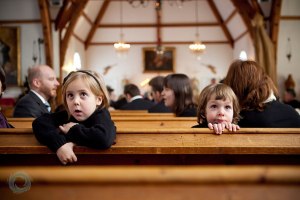
One of my challenges as a priest has been how to encourage parents who are worshiping with their children in church.  I want them to stay in church, but I also want to honor the occasional discomfort of their experience.  Of course, my opinion on this matter has changed dramatically since I became a parent, but what was once distracting noise by children in church has now become the sound of life to me.  A fellow blogger expressed this reality for me quite beautifully here.

But me telling a parent that they are welcome to stay in church does not solve much.  I cannot control the glares or the shh-es from other parishioners.  I cannot control the wave of panic that crashes over a parent when it feels like your child’s noises are as loud as a parade in a library.  I cannot even set an example because I am rarely actually in the pews with my fellow parents.  But I have experienced some of the grace that can happen when people are open to a child in church.  Back in December, I took my three-year old daughter to an ordination at the Cathedral.  She lasted relatively well for the first hour, but then became antsy.  I asked her if we should go after the peace, but she insisted she wanted to stay.  We made it back to the pew, and midway through the bishop’s praying of the Eucharistic prayer, my daughter impatiently asked, quite loudly, “Can I have the body of Christ now?!?”  Everyone around me giggled and I did too.  She broke the tension I had been feeling about her noise.  She probably voiced the fatigue that fellow worshipers around me felt too.  And she showed me that she fully understood what was happening, and was eager to receive the sacrament.  It doesn’t get more awesome than that.

I can’t force parents to stay in church with their kids.  I can’t force parishioners to always be sympathetic or even helpful.  What I can do is continue to hold all parents and children in prayer, thanking God for their presence, and the ways in which they keep me humble.  Thank you, parents, for all that you do to raise our children in the church.  We are blessed by you more than you know and always happy to have you in church.

Sermon – Luke 4.1-13, L1, YC, February 17, 2013

20 Wednesday Feb 2013

Posted by jandrewsweckerly in Uncategorized

≈ Leave a comment

Tags

devil, Jesus, Lent, mistrust, scripture, Sermon, sin, temptation

Having grown up in the mostly Methodist and Baptist South, I grew up a culture that had no problem talking about the devil or Satan.  If you are starting to doubt yourself or are feeling abandoned in some way, a Southerner has no problem declaring, “That’s just the devil trying to pull you away from the Lord.”  My experience in the mid-Atlantic and Northeast, and especially with Episcopalians in those areas, is that people are not as comfortable talking about the devil and labeling the devil’s work in our lives.  I am not sure why we get so skittish talking about the devil.  Even the Great Litany, which we pray this morning, makes us uncomfortable with all its “devil” references.  My suspicion is that our hesitancy is a fear of sounding superstitious or a general lack of understanding or comfort with talking about the devil.  Perhaps we are not even sure the devil exists.  I too find myself in the camp of having a difficult time wrapping my head around the concept of the devil.  But I must also admit that when I have been told that my current troubles were due to the devil meddling in my relationship with God, I have felt better.  There is something quite freeing about naming the devil in the midst of our lives.

Our gospel lesson today highlights why we are so skittish about the devil.  The devil works in the thin space between good and evil.  For example, the three temptations of Jesus from the devil are just ambiguous enough that Jesus could reason his way into responding positively to the devil.  First the devil asks Jesus to turn a stone into bread.  Now if Jesus decides to do such a thing for himself, who is famished from fasting for forty days, we could see his action as self-serving and certainly in line with the devil.  But if Jesus turns the “abundant stones that cover Israel’s landscape into ample food to feed the many hungry people in a land often wracked by famine,”[i] then in good conscience, he might begin to consider the devil’s tempting offer.

Next, the devil tempts Jesus with the power to rule over all the kingdoms of the world.  Now if Jesus decides to take such authority out of a desire for power and greed, we could easily deem his action as rooted in self-serving sin.  But, if Jesus agrees to take that authority so that he can rule the world with justice, then the deal with the devil becomes a bit murkier.  If you remember, at the time of the Gospel, the land is under the heavy hand of Rome.[ii]  Jesus could easily turn their suffering to justice if he accepts the devil’s offer.

Finally, the devil tempts Jesus to prove God’s protective care.  Now if Jesus were jumping from the pinnacle of the temple just to show off how protected he is, then we could judge Jesus to be behaving in a sinful way.  But Jesus is committing to a tremendous journey.  Jesus might like some assurance that God will care for him.  In this light, the request does not seem like that much to ask.

The temptations for Jesus are not unlike the ways that the devil tempts Adam and Eve so many years before.  What the devil does is plant a seed of doubt, making Adam and Eve wonder why God would keep such beautiful fruit from them – why God would keep the truth from them about the tree.  The devil’s work is to constantly keep picking away at trusting relationship with God, fostering mistrust between God and God’s people.[iii]

Several years ago the film Doubt received several Oscar nominations.  The movie explored a Catholic Church and School where the head nun accused the priest of sexual misconduct.  But the story is presented so ambiguously that even by the end of the movie the viewer is not sure if abuse took place or not.  This is that thin place between truth and lies, between trust and mistrust where the devil thrives.  And truthfully, even in the movie, with whom the devil is cooperating is unclear.  This is the danger in all of our lives today – the lines between God’s work and the devil’s work are so close that we have a hard time naming the devil in our lives.

Luckily Jesus’ responses to the devil give us some guidance today.  In each of the three temptations, Jesus leans on his deep understanding of Holy Scripture.  Jesus leans not on his own personal strength, but instead leans on the truths that he learns in the Hebrew Scriptures.  We see how powerful Jesus’ response is because the devil attempts to distort this strength as well.  In the third temptation, the devil quotes scripture himself, trying to lure Jesus back into that thin place.  But Jesus cannot be fooled.  Jesus knows that the devil is using partial scripture citations that can be misleading out of context.[iv]  Jesus knows that a dependence on Holy Scripture will support him in his weakness.

As we begin our Lenten journey, today’s gospel lesson gives us much to ponder.  First, we are invited into a time of pondering how the devil might be acting in the thin spaces between faithfulness and sinfulness, manipulating our mistrust of God for the devil’s gain.  In order for us to understand how the devil might be acting, we will need to first label the ways in which we mistrust God.  If there are areas of our lives which we do not entrust to God: a particular relationship, a job or school decision, something challenging at work or at home, or an uncertain future, these are areas that are most susceptible to the devil squeezing his way into our lives.  Our invitation this week is to spend some time reflecting on the areas of mistrust of God in our lives and to pray for strength to turn those over to God.  Only when we understand where our mistrust is can we begin turning back into a trusting relationship with the God that loves and supports us.

Second, Jesus invites us into a deeper relationship with Scripture this Lent.  We have already seen how Holy Scripture sustained Jesus at his weakest hour.  Whatever your Lenten practice, consider how you might incorporate some additional Scripture reading into your week.  And if that feels too burdensome, you can use today’s Scripture insert and meditate on those four lessons at home.  If you are feeling more adventuresome, you can start praying Morning or Evening Prayer from the Prayer Book at home.  That prayer practice will expose you to a good amount of scripture.  And if you are feeling really adventuresome, you might just pick a book of the Bible and start reading.  You may be surprised at the parallels in scripture and your own life.

The invitations today are many.  In this time of Lent, we are encouraged to enter these forty days knowing that Jesus has been there himself and managed to lean on the God who saves us time and again.  If Jesus can lean on God in his weakness, we can lean on God in our weakness too, even if we are not totally ready to trust God with all of ourselves.  Just admitting that hesitancy is the first step to kicking the devil out of our thin spaces.  Amen.


[i] Sharon H. Ringe, “Exegetical Perspective,” Feasting on the Word, Yr. C, Vol. 2 (Louisville: Westminster John Knox Press, 2009), 47.

[ii] Ringe, 49.

[iii] David Lose, as found on http://www.workingpreacher.org/dear_wp.aspx?article_id=668 on February 15, 2013.

[iv] Darrell Jodock, “Antidote for Temptation,” Christian Century, vol. 112, no. 6, Feb. 22, 1995, 203.

Homily – Ephesians 3.1-7, Mark 16.15-20, Cyril and Methodius, February 14, 2013

15 Friday Feb 2013

Posted by jandrewsweckerly in Uncategorized

≈ Leave a comment

Tags

Cyril, Ephesians, exclusion, Gentiles, gospel, inclusion, Methodius, proclaim

Today we celebrate Cyril and Methodius.  Brothers in the 800s, born in Thessalonica, they are honored as founders of Slavic literary culture and apostles to the southern Slavs.  Adept at languages, they spread the Good News by translating liturgies and Scripture into Slavonic.  One might think their work was universally celebrated, but the brothers faced much opposition.  Although the Pope in Rome supported the brothers’ ministry, Cyril and Methodius received a lot of harassment from German bishops who saw Slavonic as a barbarous language.  Methodius was even imprisoned at one point, accused of heresy, and kicked out of the area; but Methodius just kept coming back.

It is interesting, then that we get Paul’s words to the Ephesians today.  Paul is reminding the Ephesians that he has been advocating for the full incorporation of the Gentiles.  What he has been preaching is that Gentiles are fellow heirs, members of the same body, and sharers in the promise.  We have heard Paul’s plea for Gentiles for ages, but sometimes I think we do not understand the radical nature of Paul’s work. God had a chosen people for a long time; they had been through famines, draught, and homelessness in the desert.  Now, all the laws and customs seems irrelevant in this new reality where Gentiles can join them.

The pattern keeps repeating itself.  The disciples didn’t want newbies distorting what they had so carefully constructed.  Cyril and Methodius faced the same challenge: the established Germans didn’t want these Slavs and their uncivilized lives ruining the Church community.  We do it too.  We exclude all the time:  her hair is too purple; we don’t want them coming in like they own the place; “those” people don’t even speak English.

But our Gospel lesson stops us right there.  “Go into all the world and proclaim the good news in the whole creation.”  All the world, the whole creation – not just people who look, act, talk like us.  Our questions today are many.  Who are we excluding?  Who is missing from this room?  How might we be bold enough to go into all the world and proclaim the good news to the whole creation?  Amen.

Homily – Acts 11.1-18, Cornelius the Centurion, February 7, 2013

15 Friday Feb 2013

Posted by jandrewsweckerly in Uncategorized

≈ Leave a comment

Tags

Cornelius the Centurion, Gentiles, ministry, mutuality, St. Peter

Today we celebrate Cornelius the Centurion.  If you remember from our reading of Acts last year, this story of Peter and Cornelius gets retold multiple times.  Peter has this bizarre dream about a sheet that descends with four-footed animals.  God tells Peter to eat, and Peter resists because it is against his custom to eat animals deemed to be unclean.  But God insists that Peter eat.  After the dream, three men from Caesarea send for him, and Peter meets Cornelius.  Meanwhile, Cornelius had been praying; he was a devout man who feared God, gave to the poor and prayed constantly.  Cornelius was also given a vision to send for Peter.  Through their encounter, Cornelius becomes the first Gentile to be converted to Christianity – a big deal for the spreading of Christianity.

What I like about this feast day is that these lessons are not honoring the feast of St. Peter.  These lessons are not meant to honor the one who allowed the Gentiles “in.”  These lessons honor the Gentile who equally responded to God.  This emphasis dramatically shifts the power dynamic between Peter and Cornelius.  We do not celebrate the act of Jews converting Gentiles, but instead celebrate the movement of the Spirit among the Gentiles.

This distinction is important for us because it impacts so much of our ministry.  Cornelius invites us to redefine our definitions or boundaries around “us” and “them.”  When we do this with service work, the work becomes about us helping others, not about how we mutually grow in the encounter.  When we do this with evangelism, the work becomes about bringing them to us, not about how our “us” is incomplete.

What Cornelius does today is remind us of the experience of mutuality in ministry.  We are invited to be always open to the unexpected ways and in the unexpected people God will work through.  Cornelius invites us to learn the stories of those people we help with our food collections.  Cornelius reminds us that in speaking the Good News, we receive abundantly.  Cornelius reminds us, as he became the Second Bishop of Caesarea, that our lives are enriched by those who we deem as “other.”  Cornelius invites us to, like those in Jerusalem, proclaim: “Then God has given even to the Gentiles the repentance that leads to life.”  Amen.

← Older posts
Newer posts →

Recent Posts

  • On New Clothes and Neighbors…
  • Sermon – Matthew 20.1-16, P20, YA, September 20, 2026
  • On Change and Bread…
  • Sermon – Exodus 14.19-31, P19, YA, September 13, 2026
  • On Realizing Dreams…

Archives

  • September 2026
  • August 2026
  • July 2026
  • June 2026
  • May 2026
  • April 2026
  • February 2026
  • January 2026
  • December 2025
  • November 2025
  • October 2025
  • September 2025
  • August 2025
  • July 2025
  • June 2025
  • March 2025
  • February 2025
  • December 2024
  • November 2024
  • October 2024
  • September 2024
  • August 2024
  • July 2024
  • June 2024
  • May 2024
  • March 2024
  • February 2024
  • January 2024
  • December 2023
  • November 2023
  • October 2023
  • September 2023
  • August 2023
  • July 2023
  • June 2023
  • May 2023
  • March 2023
  • February 2023
  • January 2023
  • December 2022
  • November 2022
  • October 2022
  • June 2022
  • May 2022
  • January 2022
  • December 2021
  • November 2021
  • October 2021
  • September 2021
  • August 2021
  • June 2021
  • May 2021
  • April 2021
  • March 2021
  • February 2021
  • January 2021
  • December 2020
  • November 2020
  • October 2020
  • September 2020
  • August 2020
  • July 2020
  • June 2020
  • May 2020
  • April 2020
  • March 2020
  • February 2020
  • January 2020
  • December 2019
  • November 2019
  • October 2019
  • September 2019
  • August 2019
  • July 2019
  • June 2019
  • May 2019
  • April 2019
  • March 2019
  • February 2019
  • January 2019
  • December 2018
  • November 2018
  • October 2018
  • September 2018
  • August 2018
  • July 2018
  • June 2018
  • May 2018
  • April 2018
  • March 2018
  • February 2018
  • January 2018
  • December 2017
  • November 2017
  • October 2017
  • September 2017
  • August 2017
  • July 2017
  • June 2017
  • May 2017
  • April 2017
  • March 2017
  • February 2017
  • January 2017
  • December 2016
  • November 2016
  • October 2016
  • September 2016
  • August 2016
  • July 2016
  • June 2016
  • May 2016
  • April 2016
  • March 2016
  • February 2016
  • January 2016
  • December 2015
  • November 2015
  • October 2015
  • September 2015
  • August 2015
  • July 2015
  • June 2015
  • May 2015
  • April 2015
  • March 2015
  • February 2015
  • January 2015
  • December 2014
  • November 2014
  • October 2014
  • September 2014
  • August 2014
  • July 2014
  • June 2014
  • April 2014
  • March 2014
  • February 2014
  • January 2014
  • December 2013
  • November 2013
  • October 2013
  • September 2013
  • August 2013
  • July 2013
  • June 2013
  • May 2013
  • April 2013
  • March 2013
  • February 2013
  • January 2013
  • December 2012
  • November 2012
  • October 2012
  • September 2012

Categories

  • reflection
  • Sermons
  • Uncategorized

Meta

  • Create account
  • Log in
  • Entries feed
  • Comments feed
  • WordPress.com

Blog at WordPress.com.

  • Subscribe Subscribed
    Seeking and Serving
    Join 397 other subscribers

    Have a WordPress.com account? Log in now.

  • Seeking and Serving
    View site in Reader
    Manage subscriptionsSign upLog in
    Report this content
    Collapse this bar
Loading Comments...