
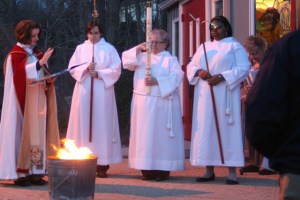
 Our liturgy tonight operates a bit like a movie whose mode of telling stories is in flashbacks. We start the movie with the scene we just heard. Several women are gathered around the empty tomb, their mouths agape, and their minds racing. And then, the flashbacks begin.
Mary the mother of James recalls that ancient story of creation. That empty tomb reminds her of those words – tohu wabohu – the formless void. She vaguely remembers what God said about creating humankind in God’s image. And she hears those words repeated over and over again, “It was good; ki-tov”
Meanwhile, another woman flashes back to when humankind’s sinfulness so angered God that God flooded the earth. For forty days, Noah knew the nothingness of that empty tomb in front her. But she also remembers that covenant God made with Noah – that never again will there be a flood to destroy the earth. Perhaps there is a rainbow in this tomb, and not only the watery floods that she sees.
Joanna looks into that empty tomb and remembers another time her people faced desperation. She flashes back to the rushing Egyptians who have pinned her people to the Red Sea. She remembers the panicked screams of her people toward Moses. She remembers how God saved them then – how God created a way out of no way. She wonders whether the empty tomb is not unlike that empty seabed – the one that the Israelites used to get to freedom.
Another woman stares into that vacant tomb and she remembers a different tomb. She remembers the death and hopelessness of those bones in that valley – the thousands of devastated lives. But then she remembers what God told Ezekiel. She remembers the rattling of those bones coming together, and the way the breath of God, the ruah of God breathed life into those bones. She wonders if she hears the faint ruah of God now coming out of that empty tomb.
But Mary Magdalene remembers a different story from Zephaniah. She hears the words of that song in a fresh way today. “Sing aloud, O daughter of Zion.” Is this the day that God will save us? Can her beloved Jesus be not missing, but raised? Might Jesus be the one who will restore her fortunes? She longs for God to be saying to her, “Rejoice and exult with all your heart, O daughter Jerusalem.” “Please let this empty tomb be an occasion for rejoicing and not for more pain and suffering for my Lord,” Mary Magdalene prayers in her heart.
And then the movie brings us abruptly back to the empty tomb, the sound of silence like so many times before in their history. The appearance of emptiness threatens their fragile, exhausted psyches. Their unspoken memories fail to comfort them because they are unable to utter a word of remembrance and assurance to one another.
As outsiders watching this movie, as we watch those looking into the tomb, we begin to connect the various flashbacks. The answers are there before the angels need to say a word. God loves us and creates us in God’s image. And we are not only good – but we are very good – wehineh-tov. God promises to never destroy us again as God once did. God promises liberation from oppression. God promises restoration to our bodies and spirits. God promises to bring us home. God promises and God saves us time and again. And now, with this Messiah who has finally arrived, God saves us once and for all. What has felt like a defeat is now the reason to rejoice. The smiles that spread across our faces are exact mirrors of the smiles that spread across the faces of those women at the tomb. The smiles are smiles that happen as we connect the varied flashbacks, remembering our salvation history, and this final act of salvation through the death and resurrection of our Lord and Savior Jesus Christ. That tomb is not a formless void, but the holy site where all our salvation narrative culminates. That empty tomb is in fact not empty at all. That tomb is full of life. Tonight is a night for alleluias, for songs of joy, and for dancing. The light shatters the darkness this night, and we celebrate the greatest victory of all time. Alleluia! Christ is risen. The Lord is risen indeed!!
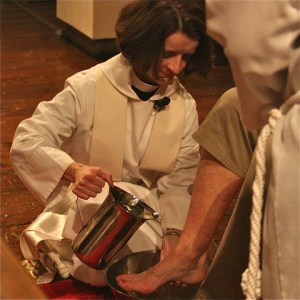 Tonight our actions mirror the actions of our gospel lesson. Like the disciples, we gather around the table. I imagine our potluck meal was not unlike the meal the disciples had with Jesus that night – an intimate meal with friends who feel like family, sharing stories, laughter, and woes. We too are a ragtag team of followers, gathered at a meal, who seek to know our Savior better, and who lean on a community of faith to join us in the journey. As the disciples did that night, we will also have our feet washed. I imagine our discomfort in having our feet washed, and even our wondering what the foot washing means, are not that different from Peter’s struggles. Finally, we too will come to the Eucharistic table. This night was the night that Jesus instituted the sacrament of Eucharist. Like Jesus shared his last meal with the disciples that night, we too receive the sacred body and blood of Christ for the last time until the Easter Vigil.
 When I was in third grade, I had one of those classic rite-of-passage moments. The day started out simply enough. At school, my friend, Buffy, who normally sat right behind me, was out sick that day. On the way to lunch, another friend, Holly, lamented how much she missed having Buffy there. I agreed, but casually mentioned that I was getting more work done because Buffy was not distracting me by talking so much. The comment was a rare, blatantly honest comment about how, although I loved my friend Buffy, Buffy did tend to talk a little too much. That moment of rare, brutal honest cost me dearly. That night, Holly called to tell me how upset Buffy was that I said she talked too much. I was devastated and embarrassed. I could not believe Holly had betrayed my confidence and told Buffy what I said. Now I was forced to call Buffy and figure out how to meaningfully apologize. This was a tall order for a third grader.
 Last week I was officiating a committal service in our cemetery. It had rained the day before, so not only was the ground very soggy, but also the dirt that I use to throw on the casket during the service was a bit wet too – despite the fact that we tried to keep it covered overnight. What I did not realize was just how wet the dirt would be. After I tossed the dirt, my hands we covered with crumbling mud. Despite my efforts to rub the dirt off my hands, my Prayer Book pages got dirty and even the back of my Prayer Book had smudges on it.
 You may not know this about me, but I am not a natural when it comes to silence. As an extrovert, silence feels like it should be filled. When I lead worship that needs a silent moment, I often make myself take a couple of additional breaths before I break the silence, knowing that my own tolerance for silence is much lower than most people’s tolerance. A couple of summers ago, I was a part of parish that covenanted to pray with scripture for twenty minutes a day for ninety days. The idea was that a bulk of that twenty minutes was not meant to be spent talking or analyzing biblical scripture, but to be silent in the presence of God’s word, making room for God’s living Word to speak. As you might imagine, the practice for me was brutally painful. But I learned a lot about myself and my prayer life that summer, and changed many of my practices as a result of the experience.
