• About

Seeking and Serving

~ seek and serve Christ in all persons

Seeking and Serving

Author Archives: jandrewsweckerly

Gratitude adjustment…

10 Thursday Oct 2013

Posted by jandrewsweckerly in Uncategorized

≈ Leave a comment

Tags

discipline, God, gratitude, journey, pledge, prayer, stewardship

Courtesy of http://www.budaao.com/daily-life/add-a-daily-dose-of-gratitude/

Courtesy of http://www.budaao.com/daily-life/add-a-daily-dose-of-gratitude/

This Sunday, we kick off our Stewardship Season.  Our Stewardship Committee has been working hard, reading some great work, exploring some creative ways of expressing our needs, and prayerfully taking steps toward this kickoff.  In the coming weeks, my weekly reflection will be replaced by guest posts from our parishioners, reflecting on how they hope to flourish in faith this Stewardship Season.

The more and more we have prepared for this time, the more and more I have been pondering the practice of gratitude.  I have been thinking about how dominated my prayer is by intercessions and how few thanksgivings I have been offering to God.  I have noticed how grudgingly I write that hefty pledge payment each month – praying that we can still make our other bills instead of thanking God for the gifts with which we have been blessed.  I have been listening to my responses to that age-old question, “How are you?” and been a bit disappointed about how consistently I manage to fit in some complaint about my life.  As I run from one thing to the next, I have found myself more burdened by life than rejoicing in life as a gift.

So I have decided to use Stewardship Season as a mini-Lenten experience.  As we encourage parishioners to prayerfully consider their financial giving, I will be prayerfully implementing gratitude back into my life.  I am committing myself to infusing gratitude into my relationship with God, my relationships with others, and my relationship with myself.  I figure that if I can focus on that work, the conversation I have with my family about our financial pledge might just take on a different tenor.  I am also excited to see what other surprises God has in store for my mini-Lenten Stewardship experience.  I am looking forward to the journey, and hope you will consider yourself duly invited to join me.

Homily – Matthew 11.25-30, St. Francis, October 6, 2013

10 Thursday Oct 2013

Posted by jandrewsweckerly in Uncategorized

≈ Leave a comment

Tags

creator, gift, God, gratitude, homily, Jesus, life, possessions, St. Francis, stewardship, stuff, yoke

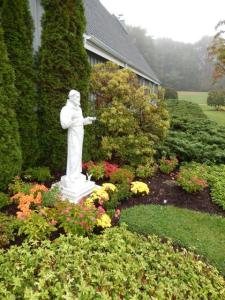
Today we honor the life and work of St. Francis of Assisi.  Francis was born in 1182, and was the son of prosperous merchant.  But later in life, he was moved by the beggars and lepers he saw and decided to devote his life to a life of poverty – despite his father’s intense opposition.  Francis gathered a community together – although his ideal of strict and absolute poverty was so stark that almost no one could maintain the ideal.  But what Francis was trying to get the brothers to see was that “stuff” got in the way of life with Christ.  Once he renounced his “stuff” he was better able to see – see his neighbors’ poverty and suffering.  And giving up his “stuff” allowed Francis to take in a bigger view of God’s creation.  Though we sometimes narrow in on Francis’ love of animals, St. Francis had a much larger sense of the creative God and God’s created world.  Francis reveled in the creator God, who time and again during the creation process saw that, “it was good.”

Our Sunday School children have been working on the creation story this Fall.  They are learning about the vast expanse of interstellar space, as well as this fragile earth, our island home.  They are learning about how God created plants and every living creature.  They are also learning about how we are created in God’s image and we are to be stewards of God’s creation.  They are learning how we are designed for goodness and generosity, and that all of life is a gift – that we do not own any of it.  St. Francis knew this well.  His understanding of life as a gift is why he could give up everything.

But we struggle – we clutch to our resources and we use words like “earned,” and “deserve” and forget words like “gift” and “generosity.”  St. Francis’ life is all well and good, but when we really look at our resources, we more often find our hands clenched around our possessions than our hands openly giving them away.  I invite us to ponder this contrast not to make us feel guilty, but to invite us to live into God’s generosity.  That is what St. Francis wanted too.  He did not want to guilt people, but to welcome people into the freedom of knowing that all we have is gift, and to live a life in celebration of that gift.  Francis had experienced this radical way of living into the people God calls us to be, and he wanted to share that blessing with others.

Our Gospel lesson today gives us some clues about what all this means in practice.  Jesus says, “Come to me, all you that are weary and are carrying heavy burdens, and I will give you rest.  Take my yoke upon you, and learn from me; for I am gentle and humble in heart, and you will find rest for your souls. For my yoke is easy, and my burden is light.”  Those words from Jesus are echoed in St. Francis’ life and witness.  We may not be able to walk around shoeless in the depths of winter like Francis, or even beg for our food, but when we enter into relationship with God with a greater sense of God’s invitation into the life of generosity, we can image and experience the light yoke.  This is the reflection work we will be doing throughout our stewardship season this fall – but Francis and Jesus give us a little preview about what stewardship really looks like.  So take a moment to start today.  Take in the beautiful creation of our property, as its Fall glory begins to unfold.  If you are an animal lover, look at the generous love of your pet.  Look at one another, remembering the vulnerable beauty of each person here – even those who annoy you the most.  Let this wonder and gratitude fill you up – so that you can slip on that light yoke of generosity and live into the goodness that God has created for you and has created you for.  Amen.

On compassion…

05 Saturday Oct 2013

Posted by jandrewsweckerly in Uncategorized

≈ 2 Comments

Tags

compassion, Congress, evangelism, humanity, Jesus, transformation

-Courtesy of http://vividlife.me/ultimate/33329/a-guide-to-practical-compassion/

Courtesy of http://vividlife.me/ultimate/33329/a-guide-to-practical-compassion/

As our Vestry has been exploring the spiritual practice of evangelism, we have been doing some self-work.  This week we focused on the work of compassion.  David Gortner, in Transforming Evangelism, says, “Compassion is not pity, but the recognition of another person’s full humanity, warts and all.”  Our Vestry talked about our experiences of seeing others show compassion, but also how hard compassion can be to express – especially when people hurt us.

Our conversation reminded me of this blog entry I saw recently.  As a Long Island Driver, I totally get this story.  I have been yelled at many a time since moving here – and to be fair, I have expressed my own impatience at times, but hopefully never in such an extreme way.  What I love about this blog post though is that this is the ultimate example of seeing with compassion.  In that moment, that mom was able to see the other driver’s full humanity – in a way that probably Christ sees us every day, but in a way that we rarely take the time to see.  This kind of compassion does not come naturally – especially when someone is yelling expletives in our face.  But when that compassion was shown, both drivers were transformed – transformed by God’s love.

I have been thinking we could all use a little more compassion lately.  As our Congress has derailed an entire section of our economy and as we have been raging about whatever side is not “our side,” I think compassion has been long gone.  I include myself in that omission.  I found myself this week literally yelling at the radio as I heard one of the Representatives explaining why her party is doing the right thing.  And the whole situation makes me so angry that I am not sure I could even sit in the same room with these Representatives as they attempt to find a solution.  But thinking about that driver at Starbucks and thinking about our Vestry’s conversation about compassion, I have been wondering how Christ sees this whole debate.  I have my own sense of what position Jesus would take on all this (though I won’t share that here), but I also know that Jesus is fully capable of loving both sides and seeing the humanity in all the people involved.  Of course, that does not make the situation any easier or my frustration any lessened, but it does take the edge off my raging anger a bit.

Perhaps that small bit is all I can ask for now.  Perhaps that small glimpse into compassion is enough to shift my way of being and interacting with others.  Perhaps that first step is all that Jesus needs to begin the slow conversion of each of us toward a life of compassion.

Homily – Isaiah 60.1-5, John Raleigh Mott, October 3, 2013

05 Saturday Oct 2013

Posted by jandrewsweckerly in Uncategorized

≈ Leave a comment

Tags

gospel, homily, Jesus, John Raleigh Mott, joy, light

Today we celebrate John Raleigh Mott.  John was born in 1865 and was known as an evangelist and ecumenical pioneer.  As a young man he worked with various organizations including the World Student Christian Federation and the YMCA.  He helped organize the International Missionary Conference in 1910 – one of the broadest gatherings of Christians up to that point.  Of Christian mission he said, “It is a startling and solemnizing fact that even as late as the 20th century, the Great Command of Jesus Christ to carry the Gospel to all mankind is still so largely unfulfilled … the Church is confronted today, as in no preceding generation, with a literally worldwide opportunity to make Christ known.”  His work developing the ecumenical movement continued, and in 1946 he received the Nobel Peace Prize for his work establishing and strengthening international organizations that worked for peace. 

What is interesting about John’s comments from the early 1900s is that they seem to ring true 100 years later.  We, too, are not fulfilling Jesus Christ’s command to carry the Gospel to all mankind.  Forget around the world – we don’t even want to talk to our next-door neighbors about Jesus.  We get so caught up in not wanting to offend that we can’t even share the story in our lives that brings us such joy.  So where do we find inspiration despite our fears?

I think our lesson from Isaiah helps with this.  “Arise, shine; for your light has come, and the glory of the LORD has risen upon you … Nations shall come to your light, and kings to the brightness of your dawn.”  We forget that our joy, our story of faith when told honestly and vulnerably, shines before others.  I have seen that light in each of you here as you share your faith stories.  Joy inspires joy, and makes us radiant.  We even hear the same in the Gospel lesson.  The joy from seeing Jesus interact with the widow causes people to spread the word throughout the surrounding area – their joy became a light to the nations.

Joy is why we celebrate John Raleigh Mott, too.  His joy drew people in and propelled him out into the world to share that joy.  John invites us today to remember that same joy in ourselves.  We will find, like him, that as we go out, people also come to us.  Nations shall come to your light – our invitation is to share that light!  Amen.

Sermon – Luke 16.19-31, 1 Timothy 6.6-19, P21, YC, September 29, 2013

05 Saturday Oct 2013

Posted by jandrewsweckerly in Uncategorized

≈ Leave a comment

Tags

boldness, generous, God, Lazarus, other, rich, Sermon

Today’s scripture lessons are a bit uncomfortable.  The gospel and the epistle lesson really hit the rich hard.  We hear that familiar tale of the rich man and Lazarus and we almost sympathize with the rich man.  As he blindly goes about life ignoring Lazarus, we want to shout out to him, “Pay attention to Lazarus!  Take care of the poor!”  Of course, our reaction is much like the rich man’s once he realizes how doomed he really is.  He begs Abraham to send Lazarus or anyone from the dead to warn his brothers.  But Abraham responds with a deafening, “no,” and the silence at the end of the lesson is heart-wrenching.  This stark judgment is only heightened by our Epistle lesson, which boldly proclaims, “The love of money is a root of all kinds of evil.”  The writer does not simply say that wealth can be dangerous, but instead declares that the desire for wealth drives people to ruin and destruction.  There is a little bit of grace at the end of the lesson, which declares that the rich can somehow mitigate this fate by not being haughty, by setting their hopes on God, and by doing good, being rich in good works, generous, and ready to share.  Not all hope is lost, but we are also clear that the rich have a lot to worry about and a lot of work to do.

The biggest challenge about our lessons today though is not just the judgment of the rich, but the fact that we do not think of ourselves as being rich.  We can think of hundreds of thousands of people who are in better financial positions than we are.  Many of our members are struggling to get by – either because of fixed incomes or unexpected situations.  And even if some of us are making all our bills, we still have to watch our budgets – perhaps spending less on leisure, clothing, or the foods that we might like.  The last two parishes I served had a one and two million dollar budget respectively – we could easily look at our budget and the last two years of deficits and say that St. Margaret’s is not a place of rich people.  All you have to do is look around at our come-as-you-are culture, and assume that our parishioners in jeans and t-shirts do not have much money.

Of course, all of this is false.  All of our rationalizations and mind-games can never erase the fact that based on worldwide standards, simply by living in this country, we are rich people.  These lessons are not about “those people.”  These lessons are about us.  That is what makes them so hard.  We secretly want them to be about other people, but at the end of the day, we are the ones in danger of stepping over Lazaruses everyday and we are the ones who must struggle with our own love of money.  We are the rich in today’s lessons.

In the aftermath of the crisis of the Kenyan Westgate Mall Terrorist attack, an article surfaced about the media’s treatment of the crisis.[i]  In the first days of coverage, the mall was described as “being popular with ‘wealthy Kenyans, expatriates, and diplomats.’  It was also referred to as an ‘upscale mall’ ‘frequented by foreigners.’”  On the face of things, the description seemed relatively accurate and harmless.  But what the author of the article noted was that the sentiment that began spreading was that maybe the rich were getting their due, being terrorized in ways that the poor feel terrorized everyday.  But by the second day of reporting, the language started to change.  People began to see that not just the rich were suffering in the attack – ordinary people were being injured and killed too – in fact, even Muslims were being killed, despite the fact that the attack was committed by the so-called Islamist terrorists.  As pictures emerged of Kenyans helping internationals, and Muslims helping Christians, the vulgar labeling of “otherness” had been put to shame by the people’s common humanity and decency.  What I appreciated about this article is how the author saw our tendencies to not see ourselves in the other – how quickly we want to remove ourselves from judgment instead of seeing ourselves in the sinfulness of the world.  What happened in Kenya is not far from what happens every time we open our wallets and decide that we are not the rich man in our gospel or epistle lesson today.

Seeing our own culpability in our lessons today, what can we do from here?  There are two gifts in our scripture lessons today.  First, by watching the story of the rich man and Lazarus unfold, we get the benefit of what the rich man wanted for his brothers.  We are reminded through Abraham that the warnings are all there for us.  Though the rich man’s opportunity for repentance and renewal is gone, ours is not.  We have Moses, the prophets, and even Jesus himself rising from the dead as our reminder that our wealth is gifted to us to use for good.  Second, the hope of the epistle lesson is our hope as well.  We too can be rich in good works, generous, and ready to share.  Even when we feel like we have nothing left to share, all we have to do is remember that our sharing is our active relinquishing of the power that the love of money has over us.

This week, a priest friend of mine was featured in a story in Chattanooga, Tennessee for the bold move his church is taking.  Another church in town erected three 100-foot crosses on their property at the cost of $700,000.  On reflection, my friend and the Episcopal community of faith that he has gathered began to wonder how else they could spend $700,000.  In response, the community established the Southside Jubilee Fund.[ii]  They will raise $700,000 themselves in order to give all the money away.  Considering the call for Jubilee in Leviticus, the requirements for receiving money from the funds will be biblically based – any group doing work feeding the hungry, welcoming the stranger, giving drink to the thirsty, clothing those in need, caring for the sick, loving your neighbor, forgiving your enemies, honoring widows, or healing the land can receive from the fund.  Who knows whether the church will be able to raise the full $700,000, but that kind of boldness is the kind of boldness our epistle lesson calls for today.

We at St. Margaret’s are embarking on some of our spending.  We are finally fixing a long-term water problem that has been plaguing our undercroft.  As we repair the years of damage, mold, and old asbestos tiles, and as we restructure our outdoor drainage, we will also be reconstructing a space that not only holds our social events, but facilitates education and formation for adults and children, welcomes support groups, and perhaps can become used for more community gatherings.  This kind of expense may feel like the expense of the rich – but I actually think this kind of spending is a bit like the kind of spending the epistle encourages.  We will have to be both generous to fund the project, but also use the space for good works and share the space with others.  And if we are really embracing the call to share, perhaps we can consider some sort of matching program – matching the dollars we spend on our building with the dollars we spend on outreach.  That matching might not be dollar for dollar like in Chattanooga, but the invitation for boldness is there.

But the invitation for boldness is not just for St. Margaret’s.  The invitation for boldness is for each one of us here.  I would like us each to take a moment and pull out our wallets.  Look at how much cash you have in there.  I want you to make a mental note of that amount, and then I want you to watch over the coming week or weeks how you spend those dollars.  I want you to watch where the dollars go and what your spending says about your relationship with money.  Even if you cannot be rich in good works, generous, and ready to share those specific dollars, perhaps you can spend the next month watching the ways you do and do not share your other dollars and what that says about the power that the love of money has in your life.  If you find that those dollars are not being used boldly for good works and generous sharing, perhaps you and your family can consider how you might live differently:  how you might, as our epistle says, live the life that really is life.  And as you make those observations, I hope you will share that experience with me and one another – so that we might encourage one another on the journey toward bold living.  Amen.


[i] Charles Onyango-Obbo, “Nairobi Westgate Mall Terror Attack, And The Folly Of ‘Otherness’ – What Al-Shabaab Revealed About Us,” as found at http://nakedchiefs.com/2013/09/24/nairobi-westgate-mall-terror-attack-and-the-folly-of-otherness-what-al-shabaab-revealed-about-us/ on September 26, 2013.

[ii] As found on http://southsideabbey.dioet.org/ on September 25, 2013.

Homily – Psalm 63.1-8, Lancelot Andrewes, September 26, 2013

05 Saturday Oct 2013

Posted by jandrewsweckerly in Uncategorized

≈ Leave a comment

Tags

God, homily, Lancelot Andrewes, passion, seeking, thirst

Today we honor Lancelot Andrewes, Bishop of Winchester in the early 1600s. Andrewes was the favorite preacher of King James I.  His eloquent sermons were admired by many, and known as witty, grounded in Scripture, and exhibiting his massive learning.  Andrewes was a distinguished biblical scholar, and one of the translators for the King James Version of the Bible.  He was dean of Westminster, educating many noted churchmen, including poet George Herbert.  He was also known for his piety, for defending the catholicity of the Church of England, and for generally being a model bishop.

What is challenging for us today is accessing Andrewes as modern readers.  His eloquent sermons were so academic that they make difficult reading for modern people.  I remember reading Andrewes for a theology class in seminary – and though I loved his work, I did have to slow down significantly to read his work. That often happens to us – something gets so academic or heady that we stop reading or listening, cutting ourselves off from the potential for learning.  As a church that praises learning, sometimes we are not always diligent with challenging ourselves beyond our comfort zones.

That is why I love our Psalm lesson today.  The psalmist says, “O God, you are my God; eagerly I seek you; my soul thirsts for you, my flesh faints for you, as in a barren and dry land where there is no water.”  The psalmist knows a kind of pursuit of God that is passionate, all-consuming, if not desperate.  The psalmist longs for refreshment from parchedness, because the psalmist knows how incredibly satisfying finding God can be.

This kind of passion for seeking God is the same passion Andrewes had for God. This is the passion that the psalmist and Andrewes would want for us too.  We may not seek God in the same ways or through the same books or experiences, but the psalmist and Andrewes invite us into a more passionate seeking of God in our lives.  When we say we are a community seeking, serving and sharing Christ, this is the kind of passion with which we do that work.  May your soul thirst for God today.  Amen.

Varieties of gifts…

26 Thursday Sep 2013

Posted by jandrewsweckerly in Uncategorized

≈ Leave a comment

Tags

body, Christ, church, gifts, God, variety

-courtesy of dwellingintheword.wordpress.com

-courtesy of dwellingintheword.wordpress.com

Now there are varieties of gifts, but the same Spirit; and there are varieties of services, but the same Lord; and there are varieties of activities, but it is the same God who activates all of them in everyone.  To each is given the manifestation of the Spirit for the common good.  To one is given through the Spirit the utterance of wisdom, and to another the utterance of knowledge according to the same Spirit,  to another faith by the same Spirit, to another gifts of healing by the one Spirit,  to another the working of miracles, to another prophecy, to another the discernment of spirits, to another various kinds of tongues, to another the interpretation of tongues.  All these are activated by one and the same Spirit, who allots to each one individually just as the Spirit chooses.  For just as the body is one and has many members, and all the members of the body, though many, are one body, so it is with Christ.  -1 Corinthians 12.4-12

This Saturday, our parish is hosting its Annual Fall Fair.  The event is pretty huge.  We start our work as early as the late winter, and the final pieces come into place in this last week.  Everyone has a role – whether it is accumulating items for and assembling raffle baskets, clearing out closets for attic treasures, asking for donations for raffle prizes, making crafts or baked goods for sale, running the food truck, helping with parking, laying out spaces for vendors, coordinating all the vendors, or helping put up signs for the event.  And the list is much, much longer.  Everyone seems to find a role a play, no matter what their age or ability.  It is truly amazing to watch.

Though this last week of preparation can be crazy, what I love watching is the body of Christ at work.  I really see the fullness of gifts in our parish, and I am blown away by the way that everyone offers their varieties of gifts.  It makes me so proud to watch our parishioners work hard together and I cannot wait to see the fruits of their labor on Saturday.

What is especially great about this week is that this week is a microcosm of what life is like every week at St. Margaret’s.  Though I might not see as many people through the office and on the property in a given week, we really do offer all our gifts throughout the year.  Our teachers teach our young children, our graphics designers help with our artistic work, our folks called to prayer and pastoral care pray for our parishioners and visit the sick, our gardeners tend our garden and take the produce to the hungry, and our altar guild prepares the Table.  Without any one of these gifts, St. Margaret’s would not display the fullness of Christ; and at the same time, we are humble enough to know that St. Margaret’s is not yet complete – that we are missing members with gifts that we do not have.  And so, we are always wondering who God will bring through our doors, how chance encounters might enrich our corporate life, and how God is ever inviting us to grow the body of Christ.  We are a community who needs our varieties of gifts – which means we need you too.

Homily – Matthew 24.42-47, Theodore of Tarsus, September 19, 2013

26 Thursday Sep 2013

Posted by jandrewsweckerly in Uncategorized

≈ Leave a comment

Tags

busy, church, God, Jesus, Theodore of Tarsus, vigilance

We’ve all seen the bumper sticker: Jesus is coming – look busy!  We usually chuckle when we see the sticker, but only because our chuckle masks some of our fears.  We know that Jesus will return, and we know that we must account for our lives – that alone can make us afraid.  We also know that we tend to fill our lives with stuff: work, leisure, TV, and general business.  Though our busyness is rarely about living a Christ-like life, we somehow fool ourselves and hope to fool God into thinking our busyness is meaningful.

That is why our Gospel lesson today is so scary.  Jesus tells us to keep awake, to be ready, to be at work – as awake as a man who knows a thief is coming to his house and stands ready to protect his family.  Jesus promises the hour of his return is unknown and so this constant vigilance is required.  And yet, we have no idea how to sustain that kind of vigilance and stamina.

Theodore of Tarsus, Archbishop of Canterbury, seemed to know how to live the life of vigilance with ease.  Born in 602, he became a bishop at age 66 – when most of us are readying for retirement.  A learned monk residing in Rome, Theodore was called to England at a time of plague and strife between the rival Celtic and Rome customs.  But he managed to enter this place, establishing a school where both Irish and English Churches trained; he visited all of England, fostering unity; and he honored traditions of both groups.  He worked tirelessly to organize the Church and died at age 88.

What I like about Theodore’s story is that he shows us not that we should be crazed, vigilant Christians, but that God can use us at any stage of life when we are willing.  Amen.

Homily – Psalm 78.3-7, John Henry Hobart, September 12, 2013

26 Thursday Sep 2013

Posted by jandrewsweckerly in Uncategorized

≈ Leave a comment

Tags

faith, God, homily, John Henry Hobart, passion, scripture, story

The portion of the psalm that we read today tells a familiar story from Scripture.  From the beginning of our being a people of God, we have been instructed to tell the story – to pass from one generation to the next the salvation story of our God.  In the early days, before there were written Scriptures, I think it was actually easier.  People communicated through oral histories – the stories were burned in their brains and were as natural and familiar as breathing.  Even once the histories were written down, only a few could read, so the oral histories were essential.

Today we have lost that sure familiarity with Scripture.  It is a rare Episcopalian who can quote Scripture to anyone.  Though we have multiple copies of the Bible lying around, very few of us have ever read the Scriptures cover to cover – and if we have, we are surprised when we hear certain stories.  So given our lack of familiarity with Holy Scripture, it is no wonder that our ability to share the Good News is difficult for us.  We struggle not only to pass along the story to our children, but especially to pass along the story to total strangers.

John Henry Hobart, whom we celebrate today, had no such reservations.  Born in Philadelphia in 1775, John became a priest in 1801.  After serving in Pennsylvania, New Jersey, and Long Island, he was eventually consecrated Bishop of New York in 1811.  In his first four years as Bishop, John doubled the number of clergy and quadrupled the number of missionaries in the diocese.  Before his death in 1830, he planted churches in almost every major town in New York State.  He helped found General Theological Seminary and helped name Hobart College. John revitalized the church, and his zeal was respected by all.

Though John lived more than 200 years ago, his story still speaks to us today.  Along with our scriptural ancestors, these figures invite us to remember with zeal the God who loves us, who gives us life, and who saves us.  John and our ancestors invite us to reignite our passion for Christ and to let that passion overflow without self-consciousness or fear.  Why wouldn’t we want to share the Good News of all that God has done for us?  Our invitation is to remember, reconnect, and revitalize our faith today.  Amen.

Homily – 1 Peter 4.7-11, Matthew 20.1-16, Gregorio Aglipay, September 5, 2013

26 Thursday Sep 2013

Posted by jandrewsweckerly in Uncategorized

≈ Leave a comment

Tags

Gregorio Aglipay, homily, Jesus, justice, love, sacrifice

Today we honor Gregorio Aglipay, priest and founder of the Philippine Independent Church, a church in full communion with the Episcopal Church and Anglican Communion.  Gregorio was born in 1860 and orphaned at an early age.  He worked as a boy in the tobacco fields during the Spanish Occupation and bore hard feelings toward the Spanish colonists.  He was eventually ordained a Catholic priest, but eight years later the Philippine Revolution began.  At that time the church and state were deeply intertwined, so any revolutionary activity impacted both.  Gregorio sided with the Filipino nationalists and rallied fellow priests to support the revolution.  Of course, he was eventually excommunicated from the Roman Catholic Church, but Gregorio formed a new national church that eventually came into full communion with the Anglican Church.

Gregorio’s story feels very familiar to Americans.  We too have fought against our colonist roots; we too have had to sort out the complexities of church and state, especially as Anglicans; and we even know the stories of people forced to work in the fields.  But those stories are from a long time ago, and many of us distance ourselves from the nastiness of those times.  This is why I find the Epistle lesson and Gospel lesson so interesting today.  Here you have two stories:  one of loving one another and one of a sense of justice.  The two are interrelated: had the early workers seen the late workers through the lens of love, their protest would have been nonexistent.  But the kind of love the epistle asks for is hard:  being hospitable without complaining; serving one another; looking not to oneself, but to God.  This kind of love is the most difficult – something we want to do, but rarely accomplish.

Part of me wonders how much Gregorio embodied this love.  He did revolt against the colonists and Roman Catholic Church – how much love did he really have for them?  But I think where he showed love was through his self-sacrifice.  The easy way would have been not to fight.  The Roman Catholic Church even offered him a bishop’s position with enormous resources at this personal disposal.  But Gregorio understood that true love meant sacrificing himself and the easy way of life for something much harder and scarier.

This is the sacrificial, non-self-serving life Jesus invites us into today.  It will not be easy or clean.  Our only assurance is that if we are all in this loving journey together, the journey is a lot less scary.  Amen.

← Older posts
Newer posts →

Recent Posts

  • On New Clothes and Neighbors…
  • Sermon – Matthew 20.1-16, P20, YA, September 20, 2026
  • On Change and Bread…
  • Sermon – Exodus 14.19-31, P19, YA, September 13, 2026
  • On Realizing Dreams…

Archives

  • September 2026
  • August 2026
  • July 2026
  • June 2026
  • May 2026
  • April 2026
  • February 2026
  • January 2026
  • December 2025
  • November 2025
  • October 2025
  • September 2025
  • August 2025
  • July 2025
  • June 2025
  • March 2025
  • February 2025
  • December 2024
  • November 2024
  • October 2024
  • September 2024
  • August 2024
  • July 2024
  • June 2024
  • May 2024
  • March 2024
  • February 2024
  • January 2024
  • December 2023
  • November 2023
  • October 2023
  • September 2023
  • August 2023
  • July 2023
  • June 2023
  • May 2023
  • March 2023
  • February 2023
  • January 2023
  • December 2022
  • November 2022
  • October 2022
  • June 2022
  • May 2022
  • January 2022
  • December 2021
  • November 2021
  • October 2021
  • September 2021
  • August 2021
  • June 2021
  • May 2021
  • April 2021
  • March 2021
  • February 2021
  • January 2021
  • December 2020
  • November 2020
  • October 2020
  • September 2020
  • August 2020
  • July 2020
  • June 2020
  • May 2020
  • April 2020
  • March 2020
  • February 2020
  • January 2020
  • December 2019
  • November 2019
  • October 2019
  • September 2019
  • August 2019
  • July 2019
  • June 2019
  • May 2019
  • April 2019
  • March 2019
  • February 2019
  • January 2019
  • December 2018
  • November 2018
  • October 2018
  • September 2018
  • August 2018
  • July 2018
  • June 2018
  • May 2018
  • April 2018
  • March 2018
  • February 2018
  • January 2018
  • December 2017
  • November 2017
  • October 2017
  • September 2017
  • August 2017
  • July 2017
  • June 2017
  • May 2017
  • April 2017
  • March 2017
  • February 2017
  • January 2017
  • December 2016
  • November 2016
  • October 2016
  • September 2016
  • August 2016
  • July 2016
  • June 2016
  • May 2016
  • April 2016
  • March 2016
  • February 2016
  • January 2016
  • December 2015
  • November 2015
  • October 2015
  • September 2015
  • August 2015
  • July 2015
  • June 2015
  • May 2015
  • April 2015
  • March 2015
  • February 2015
  • January 2015
  • December 2014
  • November 2014
  • October 2014
  • September 2014
  • August 2014
  • July 2014
  • June 2014
  • April 2014
  • March 2014
  • February 2014
  • January 2014
  • December 2013
  • November 2013
  • October 2013
  • September 2013
  • August 2013
  • July 2013
  • June 2013
  • May 2013
  • April 2013
  • March 2013
  • February 2013
  • January 2013
  • December 2012
  • November 2012
  • October 2012
  • September 2012

Categories

  • reflection
  • Sermons
  • Uncategorized

Meta

  • Create account
  • Log in
  • Entries feed
  • Comments feed
  • WordPress.com

Blog at WordPress.com.

  • Subscribe Subscribed
    Seeking and Serving
    Join 397 other subscribers

    Have a WordPress.com account? Log in now.

  • Seeking and Serving
    View site in Reader
    Manage subscriptionsSign upLog in
    Report this content
    Collapse this bar
Loading Comments...