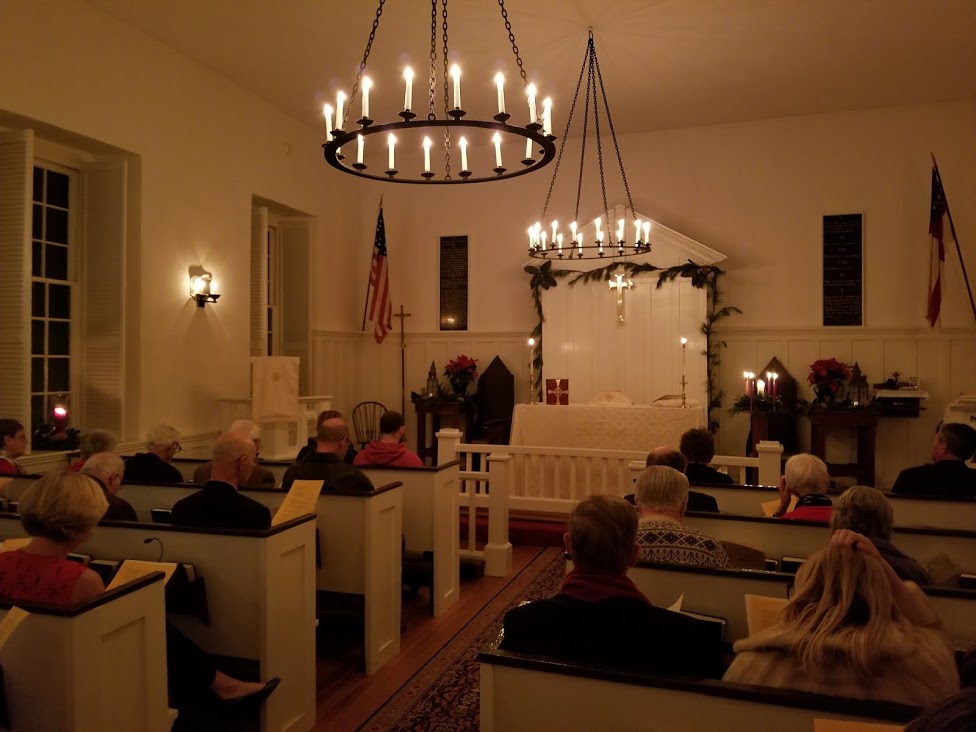
Sermon – 1 Corinthians 1.10-18, EP3, YA, January 22, 2023

Tags

, , , , , , , ,

The following sermon was delivered as the Annual Address at Hickory Neck Episcopal Church.

A few months ago, we had a fellowship event on campus that had a large group of parishioners who did not necessarily know each other.  As we made introductions around the room, I noticed a trend.  People began their Hickory Neck story with a reference to our history:  I came in the Kellett days; I came to Hickory Neck through Father Michael; I started at Hickory Neck about the same time Mother Jennifer did.  As I surveyed the room, I knew there would be parishioners who needed to introduce themselves who had never heard of the previous clergy, let alone how their personalities and ministries were different.  Suddenly, I realized there were going to be people who are a part of the Hickory Neck family whose stories start with, “I joined in the pandemic days.”  I have always bragged about how we are a diverse community politically.  But our diversity is so much bigger than our political differences:  we came here at various historical points, from very different denominational backgrounds, at different stages of life (whether as a young singleton, a new parent, or a new retiree).  Even out of your four affiliated clergy, not one of us is a cradle Episcopalian.

I love then, on this day of our Annual Meeting, that we get this reading from Paul’s first letter to the Corinthians.  When Paul gathered the church in Corinth, he “attempted what scarcely anyone has tried before.  A church composed of rich and poor, Jew and Greek, and slave and free,” with none of the “normal bonds of ethnicity and family that holds a community together.”  As one scholar explains, with such diversity, the factions in Corinth were likely inevitable.[i]  To this unusual combination of people, Paul asks them to be united in the same mind and the same purpose, that everyone be in agreement and there be no division among them.  Anyone who has ever tried to accomplish anything with a group of two or more people knows this request from Paul is endearing, if not laughable.  Bless Paul’s heart!

But having gotten to know the stories of the people in this room, Paul’s encouragement for us to be united in the same mind and purpose is exactly what we are going to be doing in 2023 at Hickory Neck.  We have had an incredible year leading up to this new start.  We have worshiped and learned apart during yet another shutdown, we have gained new members who found us online, we have welcomed longtimers back after a multi-year hiatus, and we have brought along neighbors and friends who just wanted to find a community where they could belong.  We have baptized, married, and buried.  We have celebrated, grieved, and grown.  We have said goodbye and lots more hellos.  And now we find ourselves at the start line of 2023 in a season of vibrancy, of hope, of promise. 

I confess, I am feeling more invigorated and excited about Hickory Neck than I have at any other time in our almost seven years together.  We have an almost entirely new staff:  a staff who is extraordinarily talented, creative, passionate, and fun-loving.  We have a Vestry who is not only a brilliant combination of longtimers and newer members, but also a group who is dedicated to strategic thinking and leadership – not to mention laughter and love.  We have a Sabbatical Team who has thoughtfully and lovingly prepared a twelve-week plan of renewal and community-building activities that will bring health, refreshment, and renewed discipleship to our parish.  And we have some percolating ministries that are going to help us grow our stewardship, evangelism, formation, community engagement, and worship.

One of the things we teach our Vestry about every year is about church-size dynamics.  There is a whole science about behaviors and leadership patterns that are indicative of a church’s size.  A church who is family-sized, with just a few family units is run collectively and where everyone knows everyone else, whereas a corporate-sized parish has a highly structured leadership system and people find a sense of community through smaller groups within the larger system.  In that scientific analysis, Hickory Neck is situated in the most challenging size:  the transitional-sized parish.  We are not so small that everyone knows everyone or that one pastor can be hands on with every member; but we are also not so big that we are in a more complex and large-staffed system.  The reason our size is challenging is because there is always a tension:  a pull to be smaller, and more intimate, and a pull to grow and focus on programming and creating intimacy in multiple small group settings.  That tension has been here throughout my tenure at Hickory Neck, and I feel that tension acutely as we emerge from this pandemic:  where we have the choice to shrink into a more comfortable, manageable size, or to grow into a dynamic, changing size requiring creativity around funding, programming, and invitation.

Living in tension year after year can feel exhausting.  But living in tension can also be transformational.  When carbon is put into tremendous pressure, a diamond emerges.  I think Paul wanted the Corinthians to know that they were under that same kind of diamond-making pressure.  His advice for those hoping to become diamonds?  Be united in the same mind and the same purpose.  And how, might you wonder will the Corinthians (or Hickory Neckers) accomplish such a feat?  According to Paul, by the name of our Lord Jesus Christ.  Whether you found Hickory Neck when children were sitting in the window wells of the Historic Chapel because there was no room elsewhere, whether you were crowded into this newly constructed space with hopes and dreams about where we would go, whether a preschool on our campus meant an encounter with our community, or whether a livestream gave you a peak that made you want more – we are a community united in purpose and mind:  to seek and serve Christ, to make Christ known, to love neighbor as self, to experience belonging and meaning.  In the name of our Lord Jesus Christ, you will be invited into a year of pressure and transformation.  The promise is a diverse community who is ready to emerge with you.  Amen.


[i] James W. Thompson, “Exegetical Perspective,” Feasting on the Word, Yr. A, Vol. 1 (Louisville:  Westminster John Knox Press, 2010), 279.

Sermon – John 1.29-42, EP2, YA, January 15, 2023

Tags

, , , , , , , , ,

In my first position as a Rector, we had a wonderful facilitator for one of our Vestry Retreats.  The first question she asked is for us to tell her what we love about our church.  Everyone thought for a minute and then slowly we shared stories of what brought us to the church, what was meaningful, or what keeps us coming back.  It was a quiet, thoughtful conversation, as people really pondered why we were there.  Then the retreat leader asked us to tell her about the best meal we ever ate.  Well, the mood of the room totally flipped, and people’s faces lit up as they described succulent meals, decadent desserts, and mouthwatering food experiences.  We laughed and delighted in the stories as people gesticulated their enthusiasm and were almost tripping over one another as we remembered other amazing meals we have had.

Once we settled down, the facilitator asked us to note the total difference in our descriptions between what we love about our church and what we love about the best food we ever ate.  The question was not meant to shame us (though we did feel a little sheepish), but to help us see how blocked we sometimes get when talking about our love for our church.  Clearly, we have the capacity to witness – albeit to witness to an amazing meal.  But something about culture mores or maybe a history with a bad evangelism encounter makes us much more reticent to invite others into our joy.

I have been thinking about that hesitancy or inability this week as I read our gospel story today.  Although we always call him John the Baptist, one scholar suggests that in John’s gospel, John the Baptist really should be called John the Witness:  because that’s the emphasis of the fourth gospel – not John’s work of baptizing, but John’s work of witnessing to Jesus’ identity.[i]  In the portion of the fourth gospel we read today, John the Witness is a little like someone raving about the best thing they ever ate.  We are told that after the officials spend time inquiring about John’s identity, the next day, John is found shouting after the approaching Jesus, “‘Here is the Lamb of God who takes away the sin of the world!  This is he of whom I said, ‘After me comes a man who ranks ahead of me because he was before me.’”  John’s cheerleading continues the next day when he sees Jesus again and says, “Look, here is the Lamb of God!”  John is so passionate about Jesus that even John’s followers drop John and follow after Jesus:  a result of which I have to believe John is wholly supportive.

Now I imagine you are sitting there, tensing up a bit, waiting for me to tell you to go get a megaphone and some pom poms because we have some witnessing to do!  The good news is your only partially right.  Here is what I know.  You came here today (either in person or online) for a reason.  Maybe this community helps you find a sense of purpose and meaning.  Maybe this community brings you a sense of comfort and belonging.  Maybe this community is helping you find you way to or enrich your relationship with Jesus.  Whatever the reason, that reason is your witness.  That reason is this beautiful, sacred thing, that when you do not share with others is like refusing to give a gift to others.  I know you may feel awkward, or like you don’t have “holy enough” words, or that you might even be rejected or disdained.  The truth is your words do not even really matter when you are witnessing – what will matter is the way your face transforms when you talk about how this place has impacted your walk with God.  And if using the word witness makes your stomach tense, then use the word invitation.

So, your invitation today is to begin embracing a practice of invitation.  Maybe you have no qualms pulling out that megaphone and pom poms for Jesus like John the Witness.  Maybe you will be you will be like Andrew in our passage today and drag your brother or friend along with you to church with a forceful, “Come on!”  Or maybe your invitation will be as soft as Jesus’ to the new disciples asking questions, who simply says, “Come and see.”[ii]  Someone in your own journey did that for you.  Maybe a long time ago or maybe very recently.  Maybe their words were loud and proud or maybe they were soft and encouraging.  But something in their countenance changed that made you want to see more.  Our invitation today is to share that same light with others, inviting them to come and see this place where you invest your time, your gifts, and your treasure.  Your invitation is to not hoard the gift of this place, but to share the gift of this place and your faith with others.  Amen.


[i] Karline M. Lewis, John:  Fortress Bibilcal Preaching Commentaries (Minneapolis:  Fortress Press, 2014), 27.

[ii] Greg Garrett, “Homiletical Perspective,” Feasting on the Word, Yr. A, Vol. 1 (Louisville:  Westminster John Knox Press, 2010), 265.

On Stories and Invitation…

Tags

, , , , , , , , , ,

Photo credit: https://www.npr.org/2020/10/15/923962314/good-conversations-take-time-and-attention-heres-how-to-have-better-ones

Last night, my younger daughter and I started reading the first book in the Harry Potter series.  I love the series, although I found it later in life.  I never read them as a young adult.  I started them the summer I was serving as a chaplain in a hospital in my early thirties because I needed something to read that was not overly taxing on my emotionally drained self.  Later, I read them while breastfeeding my first child (I spent a lot of time on a pump!), and then again with my first child when she was old enough.  I could not wait to start the series again with my younger child.

But what has surprised me in restarting this adventure is this is not the first attempt.  Normally an avid reader, I thought my daughter would be excited about reading them with me.  And, given my super enthusiasm for the books (and her knowledge that her older sister and I enjoyed them so much), I thought she would be equally enthusiastic.  But every time I mentioned starting them, even making a point at age eight to tell her I though she was finally old enough to enjoy the privilege, she was only lukewarm about the experience.  We even tried this fall to start them, and she just was not that excited.  With a new set of books all her own being gifted at Christmas, I am hoping this is the attempt that will stick!

I have been thinking how much her journey with Harry Potter might be like others’ experiences with churchgoers who just know that you will love their church.  I recognize I cannot speak with authority about never being raised in the Church – although my faith journey has taken me through multiple denominations, I have never not felt a draw to the Church.  But having ministered to many people who are new to the Church or who are simply Church curious from a very guarded distance, I sense that even our most enthusiastic descriptions are not always compelling to someone who has never been a part of Church culture. 

Many people who have seen the Church decline over the years perhaps feel this is an inevitable reality.  I disagree.  I believe the power of shared stories, including shared stories of faith, remains important.  I am not at all advocating for pressured pitches that many of us have been scarred by (I grew up in a very conservative area and was asked if I was saved more times that I can count).  But being willing to share your faith story is as vital as being able to share about the most amazing food you ever tasted:  it’s an exchange in joy, an exchange in life, and exchange in meaning.  The other person may not be moved to start attending your church, but they might just be intrigued enough to keep listening.  Convincing people to come to our church is not our work.  Our work is simply to share our faith journey joy and invite others to come and see.  The rest is the work of the Holy Spirit and will come (or not!) in its own time. 

Sermon – Matthew 2.1-12, EP, YA, January 8, 2023

Tags

, , , , , , , , , , , , , ,

When I first read our Isaiah text today, I had not remembered that Isaiah had predicted kings coming to the Messiah with gold and frankincense.  I was thrilled to see the pairing of Isaiah and Matthew today, thinking of how wonderfully the Old and New Testaments’ stories were being woven together.  And since Matthew is known for emphasizing the idea of Jesus being the fulfillment of the Hebrew Scriptures, I thought we could not have a better invitation today than to “Arise, shine; for your light has come, and the glory of the LORD has risen upon you.”

But the more I read this week, the more I realized that the math is not so simple.  We do not simply get “Isaiah plus Matthew equals fulfillment.”  In fact, the introduction of Isaiah 60 helps us see that Jesus’ story is much more complicated than Jesus’ story appears at first glance.  Isaiah 60 is written about the city of Jerusalem.  About 600 years before Jesus is born, the people of Israel return to Jerusalem after exile, to a ruined city.  To these disheartened peoples, Isaiah writes this poem to encourage them and to predict the ways in which Jerusalem will return to Jerusalem’s former glory.  The poet believes that Jerusalem will be a hub of international trade, becoming once again a prosperous, productive city where, “Nations will come to your light, and kings to the brightness of your dawn.” 

The wise men from the East in Matthew’s gospel likely knew of Isaiah 60.[i]  They journey to Jerusalem because they know about this text, and they bring their gold, frankincense, and myrrh because Jerusalem is where they expect to find this king of peace and prosperity.  But when they finally arrive to inquire of Herod about this new king, Herod panics.  Herod runs to his own advisors, demanding an explanation of Isaiah 60, wanting to hear all about these multitudes of camels and these extravagant gifts.  That is when the story takes a twist.  According to Herod’s chief priests and scribes, Isaiah 60 is not where these wise men should be looking at all.  Instead, the prophecy they seek comes from Micah 5, which says, “And you, Bethlehem, in the land of Judah, are by no means least among the rulers of Judah; for from you shall come a ruler who is to shepherd my people Israel.”[ii]  Herod calls for the wise men, tells them the actual location of this new king, and the rest is history.

What is interesting in this switch within Matthew are the differences between Jerusalem and Bethlehem.  Jerusalem is the city that Isaiah promises will be the thriving, prosperous city – where the king of kings could easily make his home.  And yet, Bethlehem is where the king actually appears.  Not in the thriving, bustling, shiny city, but in a rural, dusty, unpretentious town.  No one expects such a place for their king.  They expect their king to live in the beautiful, prosperous city they have developed, not in some shabby town that does not hold the same prestige as their glorious, revitalized city.

I have been wondering in what ways we too might be like most of the characters in this story – expecting to find greatness in our lives in the obvious places as opposed to in the less likely places.  As we emerge from the pandemic, we find ourselves tentatively trying to return to a sense of normalcy.  But the trauma of these last few years sometimes fills us of with longing about pre-COVID times instead of wondering what our new reality can be.  Yes, the pandemic hurt and continues to hurt many people, sending more people into unemployment, to food pantries, and to government assistance.  But in those supposed glory days before the pandemic, many of us were spending more than we had, assuming lives we could not afford, and forgetting the poor in the process.  In some ways our prosperity gave us permission to forget each other and encouraged us to focus solely on ourselves.  We got lost in the prosperity instead of finding the kind of people that God invites us to be.

What is interesting to me in our story from Matthew is the reaction of the wise men.  They do not scoff at Herod’s insight.  They do not hear about Bethlehem and begin to ponder whether they really want to see this journey through or not.  They, as learned intellectuals and powerful men, do not second-guess Herod’s new interpretation through Micah over Isaiah.  Instead, “rather than hesitate or resist, they reorganize their wealth and learning, and reorient themselves and their lives around a baby with no credentials.”[iii]  The funny thing is that Bethlehem is about nine miles south of Jerusalem.  These men, who have done numerous calculations, a detailed study of prophecies, and have already made a long journey following a star, have missed their mark by nine miles.  Though Herod shares the insight about Micah for personal gain, imagine how different the story would be had Herod’s chief priests and scribes not remembered Micah 5, let alone if the wise men had been too proud not to hear this fresh insight. 

The response of the wise men is one of letting go of one’s own expectations and trusting that God continues to reveal truth that may not be congruent with what hard work and experience would lead one to anticipate.  As one scholar explains, what the wise men learn is that the journey with God is “not about security and prosperity, but about vulnerability, neighborliness, generosity, a modest future with spears turned into pruning hooks and swords of plowshares.”[iv]  The wise men show us that the truly wise are always willing to accept that God may reveal truth that is counter to anything else we know, but that is full of greatness and joy.

Our invitation today is an invitation into the same boldness of the wise men.  Our invitation is to let the vulnerability of Micah disrupt the self-congratulation of Isaiah, realizing that although we might expect God to redeem us in the way we anticipate, granting us favor and privilege, we might instead experience that God redeems us through much more simple, humble ways.  Our invitation is to be bold enough to keep journeying with God, even when we are presented with information that might steer our journey in a direction we never expected or desired.  Our invitation is to remember that nine miles may not be a lot, but nine miles can be the difference between a manipulative, power-hungry king, and a humble, vulnerable king who can transform our lives into ones focused not on ourselves but on our neighbors and the greater good of all of us.  The question for us, both as individuals and as a community of faith, is what dusty road we have been avoiding.  The promise is that the dusty road will lead us to a connection with our Savior, who is so tremendous, that we too will drop everything and pay homage to our King.  Amen.          


[i] Walter Brueggemann, “Off by Nine Miles,” Christian Century, vol. 118, no. 35, December 19-26, 2001, 15.

[ii] Matthew 2.6

[iii] Brueggemann, 15.

[iv] Brueggemann, 15.

On the Blessings of Family – Biological and Chosen…

Tags

, , , , , , , , , , , ,

Graphic Credit: https://www.thecolonygroup.com/introducing-your-children-to-your-family-wealth/

This past week, I spent hours delighting in my children’s relationships with their grandparents, aunts, uncles, and cousins.  Whether it was their uncontained excitement about a sleepover with their aunt and uncle, the deeply contented smiles of grandparents engaging in conversation with our children, the similarly-aged cousins who have never met but act thick as thieves within minutes of time together, or the admiration of the older new favorite “cousin” (a girlfriend who my children are desperately hoping marries into the family – no pressure though!). 

Living relatively far away from our family, I find watching my children with their grandparents and aunts and uncles in person to be a tremendous blessing.  I get to see our children through fresh eyes, watch their behavior transform, and see healthy relationships being forged that are totally separate from their relationship with me.  As our children age, I see how important these separate and special relationships are for all of us:  for me as a parent, for the children as individuals growing into adults, and for the extended family members.  I never lived close to my own grandparents and extended family, so perhaps others experience that blessing all the time.  But as I come off some holiday time with family, I am acutely aware of the importance of these relationships beyond what I and their father can provide.

I am usually quite loathe to call churches “families” because families also bring lots of baggage.  In fact, for some, church provides a safe haven their biological families did not.  However, churches can do what families do when at their best.  Part of why I am so committed to having my own children in church (even though it may appear obligatory as the community’s priest) is because we live so far from our biological families.  I want the elders of our church to dote on my children the same ways in which their grandparents do – in part because I know those relationships are just as life giving for the seniors as they are for the children.  I want the mid-age parents to be the cool aunts and uncles that my children can go to when they are tired of their own mom and dad – in part because those same parents may sometimes feel like parenting failures with their own children but can use the reminder that they are beloved and needed beyond their immediate family.  And I want my children to feel a sense of kinship with the other children of church – the cousins they rarely see, but for whom they can serve as role models at church.  The very intergenerational nature of church is a major reason why church is so important to our lives.

We live in a time when families are often dispersed, where work or service calls us from our extended families, or where, if we are blessed with immediate family nearby, we have neighbors who are not.  That reality became painfully poignant during the pandemic, when our sense of isolation grew, families with children felt unbearable weight as they became teachers, parents, and a little of everything else, and elders missed gathering with their own biological families.  As we emerge from this pandemic, if you have yet to come out of that internalized, isolated state, I invite you to engage (or reengage) with a church community.  It certainly will not be perfect – no community or family is.  But it will be a place of life and light, of encouragement and engagement, and of purpose and pleasure.  You are welcome here!

Sermon – Luke 2.1-20, CE, YC, December 24, 2022

Tags

, , , , , , , , , , , , , ,

When our girls were very small, our favorite book was Goodnight Moon.  We read that book so many times, I could have recited the book to you from memory.  “In the great green room there was a telephone, and a red balloon, and a picture of – the cow jumping over the moon…”  I read to our girls to calm them for bedtime, but truth be told, the cadence of a familiar book calmed me too.  Reading Goodnight Moon for the hundredth time became like taking a deep, steadying breath.

The same thing happened to me this year as I heard tonight’s gospel.  “In those days a decree went out from Emperor Augustus that all the world should be registered…”  As I kept listening, I could feel my body physically relaxing, my breath slowing, and a sense of peace and comfort settling in me. 

In all honesty, the reaction is a bit strange.  Nothing about Luke’s birth narrative is all that soothing.  Governments are forcibly moving people, accommodations are extremely cramped, childbirth in such conditions is anything but luxurious, we are transported to far off fields with the smells and discomforts of tending animals, and angels are sharing wonderful, terrible news, and mysteries are being introduced that delight and terrify.

So why in the world did my body have such a viscerally peaceful reaction to these familiar words despite the discomforting story?  Because Christ’s birth happens in the middle of disruption, chaos, shame, and messiness is perhaps the reason why the story is so comforting.  Our lives have been full of disruption, chaos, shame, and messiness these last few years.  Whether it was the global upending of a pandemic, economic and political upheaval, the denigrating, objectifying, or persecuting of other humans, or something closer to home – like death, divorce, job loss, or even lost sense of purpose, there is something tremendously familiar and contemporary about this story.  Of course, the government is causing disruption and chaos.  Of course, Mary is laying her baby in a manger.  Of course, strange, dirty men are interrupting an exhausted family in the middle of the night.  “Of course!” is the exclamation we have all assumed of late.

The “Of course!” though is not why we are here and is certainly not why my body heaved a sigh of relief.  What causes that relief is the “And…” of our scripture.  And, God came among us in the form of a child.  And, angels came and sang stunning songs of reassurance, promise, and deliverance.  And, strangers became friends and praised and pondered this magnificent God.  We came here burdened with our “Of course!”s.  Maybe the cookies burned before you got here.  Maybe there were some tempter tantrums in the car – or before you even got in the car.  Maybe the storms are cancelling the plans of you or your loved ones. 

And, you are here, hearing a familiar, reassuring story.  And you are among others just like you – who long for peace, comfort, and joy.  And you will be fed at the Eucharistic table, a food more glorious than the best roast beast!  We are here for our “and…” tonight.  But not just for our own sense of peace – we are here for the “and…” that God gives us to take out into the world.  And, hearing the story of the Christ Child reminds us of our bountiful blessings.  And, singing familiar songs reminds us of what really matters in life.  And, having reconnected with a community of believers, we are given a chance to go back out into the world and be harbingers of peace, shepherds of joy, caregivers of love.  That is the gift of this familiar story tonight.  You will likely experience some “Of course!”s on the way home tonight or in the coming days.  But now you have your, “And…”.  Amen.

On the Perfectly Imperfect…

Tags

, , , , , , , , , , ,

Photo credit: Hickory Neck Episcopal Church. Reuse with permission only.

This Christmas will be the first Christmas I am able to spend time with my husband’s family in five years.  We used to travel there more regularly, but about the time we would have visited, the pandemic hit, and here we are years later returning to something that feels comfortingly familiar.  I find a deep sense of relief knowing the familiar faces that will greet us, the warmer temperatures and beautiful landscape that will refresh us, the smells and tastes that will delight us, and the love and acceptance that will overwhelm us.

In some ways, I think attending church on Christmas Eve is a lot like that comforting familiar experience.  We know the lessons we will hear, the songs we will sing, the greenery we will find, and the hospitality we will experience.  In what has been a time of disorientation, suffering, grief, and struggle these last years, nothing feels as enticing as the promise of a warm, welcoming womb in which to gather.

What’s fascinating about the Christmas story and experience is that the first Christmas had little other than a womb in common with our modern experience.  Mary and Joseph are likely still recovering from the rocky beginning to their relationship – nothing like an unorthodox pregnancy to bring on marital strain!  Mary and Joseph also join hordes of their kin in being displaced by the government, only to find accommodations entirely unsuited for childbirth.  Strangers of ill repute show up sharing stories quite unfathomable, inserting themselves into the chaos of that night.  And Mary is left overwhelmed, trying to figure out what is happening to her life.  Why, of all the stories we could hear, is this crazy, disorienting story the one we want to hear year after year?

I suppose, in part, we breathe in a comforting deep breath on Christmas Eve because no matter where our journey has taken us over the last year – or years – knowing the imperfection of that perfect night helps us bless and honor our own imperfection.  Perhaps we revel in Christmas at church because we know that every year, no matter how off-track our lives have become, we have a place where we can go, a family with whom we can journey, and a Savior who is just as vulnerable as we are.  This Christmas, I hope you know there is no imperfection in you that is not perfectly welcome at the Table.  You are welcome here.

Sermon – Matthew 1.18-25, A4, YA, December 18, 2022

Tags

, , , , , , , , , , ,

I have always loved stories and images of Mary and the Christ Child.  Mary is revered around the world, a patron saint to many, an intercessor for others (just think of all the “Hail Mary”s said globally), and a spiritual companion to some.  I remember in the Holy Land visiting a chapel honoring Mary, the mother of Jesus.  The chapel commissioned artists from around the world to depict their unique cultural version of Mary and Child.  The walls are lined with these floor-to-ceiling renderings of the sacred pair.  I was so taken with the images that I now have my own collection of Mary and Child paintings in my office. 

I also remember that same day in the Holy Land, after spending what felt like hours meditating with these stunning paintings, then going down the road to a chapel dedicated to Joseph.  The chapel was much smaller, rather nondescript, and quite frankly, easily forgettable.  The only real memorable thing about the chapel is how distinctly different the Joseph chapel is from the Mary chapel. 

I am struck this year, particularly as we baptize little Melody, how glad I am that we get Joseph’s story this Advent as opposed to Mary’s.  On baptism Sundays with children, we have two realities.  The first reality is the adorable, belovedness of the child, the glossy photos with family and fonts, the perfect hopefulness of initiating a child of God into the family of faith.  We often skim over the second reality.  We will hear right at the beginning of the baptism some questions for the family about renouncing Satan, evil powers of the world, and sinful desires.  I often joke with the family how inappropriate talking about evil seems at a child’s baptism until you remember those painful sleepless nights of new parenting.  But the reason we talk about that second reality is because we are initiating someone into the life of faith, and for those of us who have been at the life of faith for a while, we know the life of faith is not all roses, glossy photos, and cake.  There will be real struggles.

And that is why I love that we start off Melody’s journey with a story about Joseph.  We are told Joseph is a righteous man.  He is devoted to God and lives an ethical life.  He represents reality number one of baptism.  But then, Joseph is presented with reality number two.  When he learns Mary is pregnant before their marriage is consummated, he has three options:  the harsh one would be to have her publicly held responsible, most likely by stoning; the generous one he plans to choose of quietly divorcing her, which saves her life, but will leave her in poverty with child in tow; or the unheard of third one, especially for a righteous man, of marrying her anyway and living forever in scandal.  As one scholar explains, “In choosing Joseph to be Jesus’s earthly father, God leads a righteous man with an impeccable reputation straight into doubt, shame, scandal, and controversy…[God] requires Joseph to embrace a mess he has not created, to love a woman whose story he doesn’t understand, to protect a baby he didn’t father, to accept an heir who is not his son.  In other words, God’s messy plan of salvation requires Joseph – a quiet, cautious, status quo kind of guy – to choose precisely what he fears and dreads the most.  The fraught, the complicated, the suspicious, and the inexplicable.”[i]

I would much rather Melody start her faith journey off with a story that lets her know, honestly and unequivocally, how messy this journey will be.  We have a hint of that messiness in Matthew’s gospel from the beginning.  In the verses before what we heard today, is a long list of Joseph’s forefathers: from Abraham, who almost kills his son Ishmael and twice risks the life and safety of his wife Sarah, to Jacob, the trickster who steals his inheritance and livelihood twice, to David, who steals another man’s wife and has her husband murdered, to Tamar, who pretends to be a sex worker, and Rahab who is one.  The genealogy of Christ is a “long line of broken, imperfect, dishonorable, and scandalous people.”  As Debie Thomas explains, “The perfect backdrop, I suppose, for God’s relentless work of restoration, healing, and hope.”[ii]

That’s what telling Joseph’s story does for Melody and all of us today.  Joseph reminds us that our faith journey will be messy.  Our faith journey will not take us where we think our journey will.  Our faith journey will invite us to love people we never thought we could.  Our faith journey will sometimes seem meaningless or small, like that Joseph’s chapel in the Holy Land.  But as the angel tells Joseph, so the angel of the Lord tells us today, “Do not be afraid.”  Do not be afraid of the messiness of this journey.  Do not be afraid of going where society may deem too messy.  Do not be afraid to love with abandon, even if your loving is not seen by the crowds, or recognized all over the world.  When we come out of the waters of baptism, we walk right into the mess – because the mess of the world is where God is.  And we want to be there too.  Amen.


[i] Debie Thomas, Into the Mess & Other Jesus Stories:  Reflections on the Life of Christ (Eugene, OR:  Cascade Books, 2022), 12.

[ii] Thomas, 13.

On Not Feeling so Merry and Bright…

Tags

, , , , , , , , , , ,

Content Warning:  This post addresses mental illness and death by suicide. 

Yesterday, I received the news that Stephen “tWitch” Boss died by suicide.  I first encountered tWitch on the show So You Think You Can Dance.  He was full of life, talent, and entertainment.  He became beloved, and I was thrilled to see him on other seasons of the show.  Several years later, he joined The Ellen Degeneres Show as her DJ and co-host and later as a co-executive producer.  It seemed the perfect television match as I couldn’t imagine two people fuller of joy.

Perhaps talking about someone in showbusiness seems frivolous, but I can’t help thinking about the contraction of someone who exuded and brought forth so much joy also being one who struggled with mental health.  But that is the danger with mental illness:  so often we think mental illness is obvious.  Mental illness is just as hidden to the naked eye as heart disease or cancer.  Mental illness is just as much of an illness as any other:  requiring treatment, medication, and medical help.  And yet, somehow, we often blame mental illness patients for their illness in ways we would never blame a cancer patient. 

I am especially mindful of tWitch’s death because I can imagine the pressure this time of year places on those with mental illness.  We have been through a tremendously hard and isolating two and a half years, and now that the “most wonderful time of the year” is upon us, we all feel pressure to feel, do, and be certain ways.  Equally tragic to tWitch’s death is the impact of his death on his wife and little children.  I suspect Christmas joy will be quite hard to muster this year for all of them.

That is why I am so grateful for services like our church’s “Blue Christmas” service.  The emotional pressure to feel, do, and be certain ways is at its highest at Christmas time.  We are living up to external pressures to be “merry and bright,” all while experiencing loss, pain, sadness, suffering, loneliness, unfulfilled expectations, and grief.  Some of us are better at putting on our happy faces, but most of us bring to Christmas a whole other set of emotions that we do not talk about in polite circles.  Our Blue Christmas service provides a different circle.  Call it “impolite” if you like, but I find it a most sacred circle of trust where people can lay down their burdens and be reminded that they are not alone.  If you need such a sacred circle, I hope you will join us on December 21 at 7:00 pm (the service will be livestreamed and archived should you need it at another time and/or place).  You do not need to say or do anything while you are here.  We will not ask you any questions about why you are here.  You are simply welcome to the space, to gather in with the Holy Spirit, and to feel a sense of love and acceptance, as we remind you how you are a beloved child of God. 

If you’re thinking about suicide, are worried about a friend or loved one, or would like emotional support, the National Suicide Prevention Lifeline and Crisis Textline is available 24/7 across the United States.  They are available for everyone, free, and confidential.

National Suicide Prevention Lifeline:

(800) 273-8255

Crisis Textline:

Text ASKUS to 741741

On Living into the Dream…

Tags

, , , , , , , , , , , , ,

Photo credit: https://www.cccnz.nz/intergenerational-ministry_cfm/

I served in a parish once whose strategic initiative was to grow the church.  At a leadership retreat, when the facilitator asked us about our intention to grow, a key leader said, “Well we want to grow.  But not too much.”  His words were a shock to my system.  Something I had seen as a common goal that everyone supported and for which I was working suddenly seemed to be in question.  I was left doubting how we could possibly move forward if we were not together in our sense of direction.

When I came to Hickory Neck, I was regaled with stories of this parish’s love for children.  The stories of children sitting in the window wells in the Historic Chapel (before there was a New Chapel), and toddlers crawling under the pews only to be captured and passed back overhead to mom and dad slowly became my stories.  As I learned about our surrounding community, which draws both young families and recent retirees, our collective identity and purpose became clear.  We are a multigenerational church whose entire sense of purpose is bringing together the generations to experience, glorify, and serve God in community.

So, you can imagine my shock recently when I was told that one of our families was made to feel as if they were not welcome at Hickory Neck because their children were too loud.  My dismay was two-fold.  First, I am deeply sympathetic to our families with young children.  That they have their children dressed and in church by the time worship starts is a feat so laudable they should receive gold stars at church.  Despite a desire to bring one’s family to church, I promise you, getting there and staying there is no small feat.  It can be stressful enough to make you wonder why you do it at all.

But second, I could not reconcile something so contradictory to our core values and sense of purpose.  As a church that values hospitality and living fully into its multigenerational identity, we know those things are inherently messy.  But every squeal, cry, and wiggle are the sounds of life for the church.  Every child who is loved in our space comes to know the love of Christ, every parent who is encouraged in our space comes to experience God’s grace, and every surrogate grandma, grandpa, auntie, or uncle who experiences the “noise” of church has the opportunity to know the Holy Spirit.

Claiming an identity is the easy part.  Living that identity is the hard part.  We will all have days where we fail miserably and succeed fabulously.  Just this Sunday, the same day as the other incident, a visitor intimated to me, “You know, I can tell your church really supports young families.  When my children were that age, I found most churches were not welcoming.  Honestly, it made it hard to go to church.”  This week, I encourage us to live into the reality we have claimed and that, most days, others experience.  It will not be easy.  It will be loud, messy, and some days frustrating.  But it will also be heart-warming, sacred, and beautiful.  This is the Christian witness into which we are called.  But we can only achieve it together:  young and old, loud and quiet, energized and exhausted.