On Jesus, Love, Me, and You…

Tags

, , , , , , , , , , , , , ,

After welcoming The Kensington School, an independent child development center, on to the Hickory Neck property, the two communities have sought ways to enter into mutual relationship.  One of those efforts has been offering a voluntary Godly Play class for students of the school.  We began the class in the fall, and have had over 18 children registered for the class.  We recently changed the day of the week the class is offered, and so yesterday, I was finally able to join the class.  The children were full of life and wonder, and I loved to watch them engage in the story.  But probably one of my favorite parts was singing Jesus Loves Me with the children.  They clearly knew the words, and it was fun to sing such a familiar childhood song – so simple and, especially in these days, so profound.

My day carried on like any other adventurous day in ministry, and that afternoon, I celebrated Eucharist at a local retirement home.  We usually sing a few songs, and the chaplain always reminds me that familiar songs are important, as they bring up many fond memories for the residents.  So, without thinking, I chose two, and midway through the final song, I realized I had subconsciously chosen the very song I had sung early that morning – Jesus Loves Me.  The same feelings emerged, especially as many of the retirees in that space are in bodies that no longer do all the things they used to do.  But they can sing about the love of a Savior – that they, even in their weakened states, are loved.

I have been thinking about a couple of things since then.  Hickory Neck has been articulating its mission in Upper James City County, and one of the tenets of our mission is to engage in intergenerational ministry.  Knowing our unique setting – a community comprised predominantly of young families and a large retirement community – our parish seeks to minister to both, and in fact, we believe our ministry will be richer as both young and old walk together in Christ.  Yesterday’s convergence of three and four year-olds singing the same words as ninety-three and ninety-four year-olds made me hopeful about the potential of Hickory Neck’s ministry.

But yesterday’s experience also made me think about all of us in the middle – those of us who are twenty-three and twenty-four to sixty-three and sixty-four; those of us who are busily going about life, trying to do our part to make the world a better place, and trying to find meaning and joy in this world.  For those of us in the middle, I wonder if we might hear the words of a song that seems almost childishly simple as instead something profoundly important about ourselves and our neighbors.  Yes, Jesus loves me.  But, Jesus also loves you.  And, from what I know about Jesus, he especially loves those whom we would like to deem “other,” or as unworthy of God’s love.  Jesus loves them too.  Perhaps we in the middle can take a cue from those at the beginning and those near the end and remember the simple, profound words that can hold us together, and help us love better.

Homily – Luke 10:25-37, P10, YC, July 13, 2019

Tags

, , , , , , , , , , , , , ,

Last Sunday, a group of parishioners gathered to watch Won’t You Be My Neighbor, the documentary about Fred Rogers.  There were countless things I could tell you about this film, but one thing that really grabbed my attention was toward the end.  The film documented a criticism of Mr. Rogers as raising up a generation of people who feel and act entitled.  You see, one of the primary lessons from Mr. Rogers is he loves each individual, just as they are.  No changes are necessary; no fault is too big.  Mr. Rogers loves you just as you are.  You can hear the words of God in Mr. Rogers’ words – God too loves us unconditionally, and certainly loves us better than any human ever could.  However, Mr. Rogers’ critics would argue if everyone is loved just as they are, then surely they do not need to improve, or earn respect, or work hard.  But the film asserts something quite different.  The film asserts without being recipients of unconditional love, individuals cannot be givers of unconditional love.  In other words, to respect the dignity of every human being, one must first learn how sacred one’s own dignity is – one must be shown how she or he is a person with dignity to be respected in order to know how to respect the dignity of others.

That sense of each person having profound, sacred dignity is one of the main lessons of our gospel today.  The Good Samaritan is one of those stories that is so widely known all I need to do is say, “the Good Samaritan,” and we likely already know the story.  We might automatically recall, “Oh, that’s the story Jesus uses to tell us to be like the Good Samaritan – to be kind to others.”  In one sense, our recollection would be true – at the heart of Jesus’ story is a message to be kind to all.  But what that simple summary misses is the finer details to this story.

You see, those two people who separately pass the victim along the road, are a priest and a Levite.  These two people are not just people of faith – they are keepers of the faith.  They know the laws better than most people of faith.  You may have heard over the years the logic that priests or Levites could not risk being defiled by touching the body of the victim, and so that is why they went around the victim.  But the truth is, their avoidance had nothing to do with defilement – they were heading away from the temple and therefore were not in need of ritual purity, and any good priest or Levite knows they were expected to check on this victim; should he be dead, they should help bury him, and should he be alive, they should tend him.[i]  Basically, these are good, trained people of faith, not fulfilling their duty to love their neighbor as themselves.

But perhaps even more significant is the identity of the Samaritan.  The story does not say, a priest and Levite passed, but another faithful Jew came to the victim’s aid.  The story says, a priest and Levite passed, but a man whose people are mortal enemies of people of faith – who has persecuted, defiled, and subjugated people of faith – is the one who helps.  Saying “The Good Samaritan,” is like saying, “The Good Murderer.”[ii]  That this typically hated man is the one who shows mercy, kindness, and love is shocking.  The hearers of Jesus’ story are shocked, and our ears need to be similarly shocked.  Asking us to respect the dignity of every human being is already a monumental task; respecting the dignity of every human being is inconvenient, is humbling, and involves a willingness to be wrong about others.  Respecting the dignity of every human being means being willing to see how the best of the faithful fail at kindness, and how sometimes our worst enemies are better people of faith than we are.

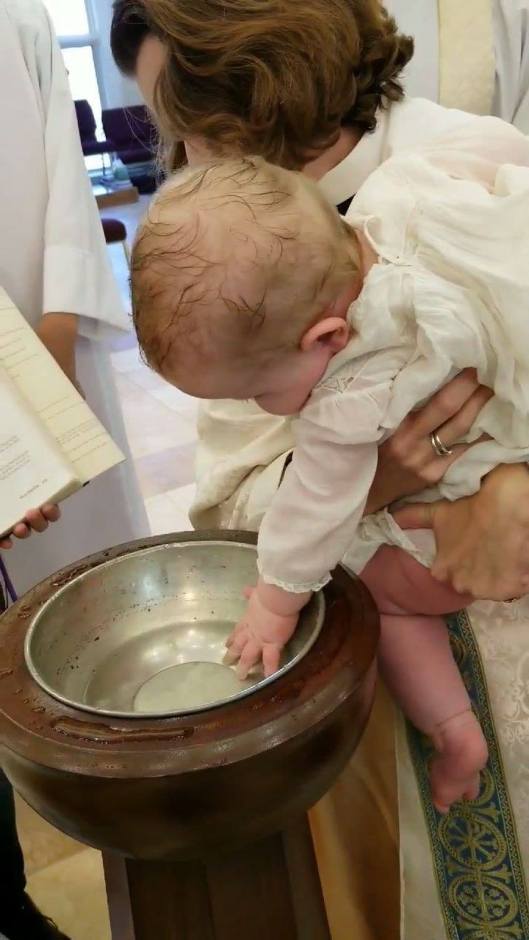
Today we are baptizing a child of God.  Her parents, godmothers, and our community will make promises today – to raise her in the community of faith, to show her to love and respect, to fight for justice and peace, to share the word of God, and to repent when she messes up.  We say those words today as we reaffirm our own baptismal covenants; but sometimes we forget how revolutionary the covenant is.  We are agreeing to teach Selah to live a revolutionary life.  When we say we will teach baby Selah to respect the dignity of every human being, we are saying we will teach her the hard work being inconvenienced and humbled in order to care for others.  When we say we will teach her to love her neighbor as herself, we are saying we will teach her that even her greatest enemies are worthy of love.  When we say we will teach her to repent when she sins, we are saying we will teach her to be willing to admit when people who we have deemed unworthy of love and care show us what true kindness really looks like.

Today, when we hear Christ’s words to “go and do likewise,” we can be encouraged that Jesus empowers us to make some promises.  Today we look at Selah’s precious, innocent face, and we promise to walk with her as she discovers how hard this work of being a faithful follower of Christ really is.  Today, we promise to confess to Selah the times when we have failed to love our neighbors as ourselves.  Today, we promise when those we despise, those who hurt us, those we cast out because they are not like us, those we can no longer see humanity in ask us, “Won’t you be my neighbor,” we will say with Selah, “Yes.  You are my neighbor too.”  Amen.

[i] Amy-Jill Levine, Short Stories by Jesus (New York:  Harper One, 2014), 99-102.

[ii] Levine, 105.

On Neighbors, Kindness, and Baptism…

Tags

, , , , , , , , , , , , , , ,

This weekend our parish’s Faith & Film offering was Won’t You Be my Neighbor, the documentary about Fred Rogers.  My daughter had never seen a documentary before, and I was a bit anxious about her attending for fear she would be bored or the film would be too advanced for her.  Ultimately, it was a risk I was willing to take because although though I knew she had never watched Mr. Rogers, I also knew she would appreciate his message.

But the true test came on the drive home.  As we were riding along, my daughter said, “You know what, Mom?  I think if Mr. Rogers were alive today, he would be a part of WMBGkind.”  Right then, I knew that she got it – that she had been paying attention to the witness of Mr. Rogers and his ministry of teaching children about the dignity of every human being.  That is what kindness is really all about – honoring and respecting the dignity of other human beings – no matter their age, race, ethnicity, gender, sexual identity, socioeconomic status, ability, or even their own ability to show kindness in return.

This Sunday, we are baptizing a baby into the household of God.  As part of that ritual, we will make promises about our own spiritual journey.  We will promise to gather regularly in Christian community, breaking bread and praying together; to resist evil, and repent when we fail; to proclaim the Word of God in word and deed; to seek and serve Christ, loving neighbors as ourselves; and to strive for justice and peace, respecting the dignity of every human being.  We promise to do what Christ asked us to do:  love God, love your neighbor, love yourself.

I love that my daughter is affirming her baptismal identity at Hickory Neck – whether she sees Christian witness through Mr. Rogers or through her Sunday School teachers.  I love that our younger children and older youth are learning how to live into their baptismal identity – whether through nursery care providers or youth group leaders.  And I love that our adults are still learning to live into their baptismal identities – through preaching, teaching, and our children’s witness.  At Hickory Neck, we are working across generations to keep loving God, loving our neighbors, and loving ourselves.  If you are in need of a community to help you claim that same identity and purpose, know that you are always welcome here – won’t you be our neighbor?

46040735_2084113391644910_120194659778560_o

Photo credit:  Hickory Neck Episcopal Church; permission to use required

On Being an American and a Christian…

Tags

, , , , , , , , , , , , ,

Last week, several of the interfaith clergy in our community published a litany for children in detention centers.  They requested clergy leaders read the litany in their homes of worship – not in a special vigil, but in the heart of where weekly prayer and formation take place.  The litany was beautiful, and spoke to much of my own sense of despair about our treatment of children.  But I found myself in a quandary.  You see, my parish is a diverse one.  We pride ourselves on being Christians of varying political opinions who respect one another enough to honor our political differences by kneeling as equals at the Lord’s table.  In order to maintain that sense of respect, I am very careful about how I talk about current events.  My goal is always to preach the gospel of Jesus Christ, with the charge that we should engage in politics with the Gospel always in the forefront.

But the issue of children in detention centers tugs at me at two levels.  On the one hand, this is very much an issue of politics – of how we manage the flow of immigrants and those seeking asylum into our country.  I know our parishioners are of a divided mind on this issue – as is most of the country.  The issue of our borders is vastly layered – were it not so, there would be clear, easy answers to very difficult questions.  In addition to being a political, economical, sociological issue, this is a spiritual one as well.  One’s sense of gratitude for our country’s blessings, one’s baptismal covenant to respect the dignity of every human being, and one’s understanding of Christ’s command to love God and love neighbor collide with the realities of limited resources, stretched budgets, and funding priorities.

On the other hand, these are children.  These are eight-year-olds caring for unrelated infants.  These are nursing teen mothers with no diapers or place to lay their heads.  These are toddlers who have no way to wash their hands or clean their soiled clothing.  I look at my own children, who have every comfort they could ever need, and when I imagine them soiled, hungry, deprived of sleep, and so afraid that the color has drained from their faces, my heart shatters.  I know this issue is truly complicated, and I know that philosophically we as a country need to decide how we will manage the treatment of our neighbors.  But when I am hesitant to pray for the welfare of children in detention because it is politically complicated, I realize I am failing to live the Gospel life.

I cannot say I will ever be able to pray the litany presented by my interfaith brothers and sisters.  Though it is beautiful, it is also politically motivated.  But what I can tell you is, as a pastor and baptized child of God, I am praying for those children, praying for their mothers and fathers, and praying for our own souls as we figure out how to reckon politics and human dignity – how to be Americans and Christians.  Given our country’s history, it would seem those two things fit together easily.  But to be a good American and to be a good Christian both take intentionality, discernment, and prayer.  May God bless us all as we seek to harmonize the two.

On Cultivating Empathy…

Tags

, , , , , , , , , ,

This weekend, I watched the live-action version of Beauty and the Beast with our children.  They have seen the animated version many times, but the differences in storyline in the live version made them feel like they were seeing the story for the first time, no longer trusting the outcome to be the same.  As we watched the film, we were spread across the living room in our favorite watching spots.  At the point where the beast releases Belle to go help her father, the Beast sings a sad song not found in the animated version.  In the midst of the song, my younger daughter jumped up from her seat, her eyes overflowing with tears and ran to jump in my lap.

I was surprised by her strong reaction to the scene, and quickly began to comfort her and ask what was upsetting her so much.  She was devastated Belle might not come back and was weeping for the beast.  We whispered quietly and I tried to reassure her so she could keep watching.  Meanwhile, my older daughter was completely confused by her sister’s reaction.  Perhaps she felt her sister should remember the ending, or maybe she just thought crying over a movie was silly (as she has told me so many a time as I have wiped my own tears at various movies).

Later that night, I talked with my younger daughter about the movie and her reaction.  She said she was glad she had not seen the movie at school because she wouldn’t want her friends to see her cry.  As we talked about her fear, she recalled that I had once told her it was okay to cry when something is really sad.

I have been thinking since that night how we teach our children and what lessons adult internalize about emotions.  I am not suggesting we need to walk around crying all the time, but I do think we have internalized some messaging about how crying connotes weakness instead of a deep sense of empathy.  And the good Lord know we need a lot more empathy these days – for our friends, for our enemies, for strangers.

As I think about Jesus’ ministry, one of the things he always showed was a sense of empathy without boundaries:  for women and the powerless, for the sick and ostracized, for those who are slow to understand, for those who follow rules but forget grace, for those who have let fear and anger harden their hearts.  This week, I invite you to consider where you have lost touch with empathy.  If you need some prodding, I suspect just reading or listening to the news will give you ample opportunity for occasions for empathy.  But I imagine you already know where you have separated yourself from empathy.  It will not be easy work, and others might look at you askance when you show empathy.  But I suspect the more you work on empathy, the more you might receive it in return.


Sermon – 1 Kings 19.1-15a, Luke 8.26-39, P7, YC, June 23, 2019

Tags

, , , , , , , , , , , ,

I remember when I was discerning one of my first calls to a parish, I heard a distinct word of encouragement from God that made me confident I should accept the call.  Or at least I thought I heard a distinct word from God.  Moments and days later, I began to doubt myself.  Maybe the words I heard in my head were my own.  Maybe I imagined the whole thing or, in hoping from a word of clarity, I made up the words myself.  And as soon as I began questioning what I heard, I started questioning the guidance of the words.  Either I was boldly following God’s distinct word to me or I was misguidedly making decisions based on an imagined experience.  Saying yes in that fog of doubt became one of the scariest experiences I have had.

That’s the funny thing about our relationship with God.  Most of the time when we talk about our relationship with God, we talk about the God of love.  But real, vulnerable, authentic experiences with God are scary too.  Whether we are trusting God through a major life crisis, we are taking a new path we are not certain is the right one, or someone challenges our life choices, following God in everyday life is scary.

We see that reality in two of our scripture readings today.  To understand why Jezebel wants to kill the prophet Elijah, we have to recall what happened in the previous chapters.  In an effort to proclaim the supremacy of Yahweh, Elijah challenges the god of Jezebel’s prophets to a duel of sorts.  All day long the prophets of Baal cry out to Baal to reign down fire on a sacrifice and are unable.  Elijah, fully confident in the power of Yahweh, immediately calls down fire, victorious over the prophets of Baal, and then proceeds to slaughter the whole lot.  But Jezebel’s answering threat on Elijah’s life sends him running.  No longer full of prophetic nerve[i], he runs to the wilderness, and asks God to take away his life.  Once so confident in the power of God, Elijah would rather cower in a corner and die.  Even when God’s voice come to him in a word of encouragement, Elijah can only see what is in front of him; in fact, he can only see the limited view he has, not the wider, sweeping view of God’s power to save.   Fear leads Elijah to paralysis.

Meanwhile the Gerasenes are equally scared.  They have developed a system for dealing with the possessed man of their village.  They know when to bind him and when to abandon him.  They know he is dangerous, and unclean, but they have figured out how to keep the town safe.  He is the identified patient of the town – the one who has the “real” problems.  By identifying the demoniac as the patient, no one else has to look at their own demons – the ways in which each of them are “vulnerable to forces that seek to take [them] over, to bind [their] mouths, to take away [their] true names, and to separate [them] from God and from each other.”[ii]  So, when Jesus casts out the impossible demons, and sends them to their death through their herd of swine, and the townspeople find the demoniac healed, clothed, and sitting in his right mind at the feet of Jesus, they do not celebrate or thank God for healing.  Instead they stand afraid of the power of God.  Now the demoniac is healed, they are afraid this Jesus will see their demons or challenge their feigned health.  In response, they do not ask for an explanation, but ask Jesus to leave.  Their fear leads to paralysis too.

To be fair, fear is a natural and sometimes necessary emotion.  Fear helps us develop a healthy sense of preservation.  Fear allows us to make necessarily cautious decisions.  Fear can keep us safe.  But fear can also lead to paralysis, and perhaps more importantly, to a lack of trust.  And when we are talking about God, a lack of trust evolving from fear gets us into trouble.  We start doubting the graciousness we know God intends for us.  We start avoiding the very work that will give us joy and fulfillment.  We start losing our sense of connection to God – who happily emboldens us when we allow God to do so.

We see in Elijah and the Gerasenes’ story the goodness that can happen when we work through our fear.  For Elijah, despite the fact he is terrified and despondent, convinced he would be better off dead, God provides food for him the wilderness – twice!  The angel of God feeds him with food so sustaining Elijah is able to make a forty-day journey.  And despite the fact that Elijah is so afraid he becomes convinced he is all alone in God’s work, God not only speaks to him, but opens up a vision of God’s work that is bigger than Elijah and extends well beyond his lifetime.[iii]  As Elijah slowly loosens his grip on fear, he opens himself up again to God’s guidance, protection, and confidence – even though the guidance, protection, and confidence had been present all along, hidden in the presence of gripping fear, but there nonetheless.

The same is true for the Gerasenes.  Despite the fact the townspeople are fearful of Jesus’ power, Jesus brings about healing anyway.  And knowing the people of Gerasene may continue to be fearful, Jesus has the former demoniac stay behind so he can testify to the salvific work of God.  As scholar Debie Thomas points out, “The story ends with Jesus commissioning the healed man to stay where he is and serve as the first missionary to his townspeople — the same townspeople who feared, shunned, trapped, and shackled him for years.”[iv]  Jesus does not scold, shun, or shame when he is asked to leave.  Jesus keeps holding out hope in the face of fear – Jesus holds hope that the townspeople might be healed like the demoniac is healed.  Jesus loves graciously and expects transformation in the face of hopeless fear.

One of the main tenants of practicing yoga is while you are practicing, you are to clear you mind of thoughts.  I am pretty sure every yoga instructor knows this is an impossible goal, because the other thing one learns in yoga is how to clear your mind once your mind becomes distracted – not if your mind becomes distracted.  There are all sorts of methods, but the primary instruction is to acknowledge the thought and then let the thought go.  In other words, when you catch yourself on the fifth thing on your to do list, you stop yourself by acknowledging you got off track, let the failure go, and try to clear you mind again.  There is no need for judgment, just acknowledgment and release.

That is our invitation today too.  Fear will always be with us.  No matter how strong we are in our faith life, we will sometimes be paralyzed by fear.  But if we can take a cue from yoga by pausing, taking a deep breath, acknowledging our failure in the face of fear, and trying again, perhaps we will be able to release the paralysis fear causes and step boldly back into the path God establishes for us.  Today’s lessons remind us there is encouragement for this work all around us.  There are angels that feed us when we want to give up the fight.  God speaks to us, reminding us how God is working at a much higher level, supporting us in ways we do not even realize we need.  God sends healed messengers to testify to us, to remind us of the ways in which we need healing more than those we have labeled as sick.  In breathing and letting go, we open our eyes in fresh ways to see God all around us acting for good.  And with each breath, and with each relaxing of our grip on fear, God washes over us with grace, kindness, compassion, and love.  Yes, letting go is scary.  But God shows us over and over again how when we let go of our fear, God is there with abundant, wonderful, powerful love.  Amen.

[i] Trevor Eppehimer, “Theological Perspective,” Feasting on the Word, Yr. C, Vol. 3 (Louisville: Westminster John Knox Press, 2010), 148.

[ii] Debie Thomas, “Legion,” June 16, 2019, as found at https://www.journeywithjesus.net/lectionary-essays/current-essay, on June 19, 2019.

[iii] Kathleen A. Robertson Farmer, “Theological Perspective,” Feasting on the Word, Yr. C, Vol. 3 (Louisville: Westminster John Knox Press, 2010), 151.

[iv] Thomas.

On Liturgy, Love, and the Lord…

Tags

, , , , , , , , , , , , , ,

38085329_1940214422701475_4123153700623482880_n

Photo credit:  Hickory Neck Episcopal Church; reuse with permission only.

This past Sunday we celebrated an “Instructed Eucharist,” a worship service in the Episcopal Church narrated to explain how and why we do the things we do in Church.  Though Instructed Eucharists are pretty common in the Episcopal Church, I had never led one myself, and I found I was pretty nervous about how it would go.  I worried the narrative pieces would feel too long and people would start to lose attention.  I worried the worship would feel too disjointed by narration to feel like worship.  I worried the teaching portion would not be particularly meaningful for those gathered.

As in most things, my worries were unfounded.  Many of those gathered shared that the narrative did not make the service too long.  In fact, they were surprised at how seamlessly the narrative flowed, and how engaging the experience was.  Several of those gathered were touched by the parts that are always touching – scripture, music, preaching, the peace, communion, and the dismissal.  And many of those gathered, of all ages, and of all spiritual backgrounds, shared not only did they love the service, but they also learned many new things.

What caught my attention about the feedback was not simply that people liked the experience.  What caught my attention about the feedback was people were excited about worship.  Having learned something about the weekly ritual of worship allowed our worship to shift from the physical (the habits of bowing, kneeling, standing, singing, eating, greeting) to the mental (understanding the theology, history, and spirituality of our worship) to the spiritual (the opening of our bodies and minds creating deeper connection with God).  That kind of excitement is at the heart of what drew most Episcopalians to the Episcopal Church – a ritual that somehow spoke to something deep inside them, and of which they wanted more.  Sometimes that longing could be easily described, but sometimes that longing was too mysterious to capture in words.

If you had that experience this past Sunday, or if you have ever been touched by that mysterious sense of God in the worship within the Episcopal Church, I invite you to share that sense of wonder with someone today.  You may share the first moment you stepped into an Episcopal Church, or a lifetime of practice, or a simple Instructed Eucharist.  Share the wonder and beauty with someone else, and invite them into the same experience that has enlivened your spiritual journey.  And if you have never had that experience in a church before, know you are welcome to join us at Hickory Neck – a place where you can weekly come and participate – whether physically, mentally, or spiritually – in something bigger than yourself, but in something that makes you feel more grounded in yourself – something that allows you to find God within, already there waiting for you, affirmed in the community around you.  You are welcome here.

A Confession and a Call to Action…

Tags

, , , , , , , , , , , , , ,

Over the weekend, a mass shooting happened in Virginia Beach.  Virginia Beach is less than an hour and a half away from Hickory Neck.  Some of our parishioners were colleagues with some of those killed.  There are many Episcopal Churches in Virginia Beach, and I know their priests have been working hard on pastoral care and preparing funerals.  Having a mass shooting so close to home, and certainly within our Diocese, has made this new reality of mass gun violence weightier and more tangible – as if the violence is making its way toward my personal sphere.

On Tuesday, our Bishop joined a worship service at an Episcopal parish in Virginia Beach.  As I thought about the service, I found myself wondering what liturgy they might be using, and how one even constructs a liturgy when you and your community is under such stress.  And then a dreadful thought occurred to me – one that is painful to confess.  I thought, “well, maybe I should develop a liturgy now when I’m not overcome with grief and counseling others, so the liturgy is easily modified for the situation.”

As soon as I had the thought, I crumpled in grief.  This is where I have come.  After years and years of devastating, massive amounts of death, countless pleas for us to change – change something, anything, and sermon after sermon preached about how we must do and be better, I have allowed myself to succumb to inevitability instead of demanding change.  This realization has been sitting with me all week, and it still brings me to tears when I recall my own sense of resignation.

This week, my prayer for us is a bit different.   My prayer for us is that we recommit to working for change.  My prayer is that we not let the sin of indifference or the sense of inevitability paralyze us from being agents of love and change.  My prayer is that we stop letting the sense of powerlessness take away our power.  I do not want to develop a “just in case” liturgy.  I don’t want to have to officiate over such a liturgy.  I want us all to acknowledge that we want to be better, and start doing the hard work of gathering diverse peoples to the table and finding a path forward.  Let’s be the Church – the Church our community needs.

O God, you made us in your own image and redeemed us through Jesus your Son: Look with compassion on the whole human family; take away the arrogance and hatred which infect our hearts; break down the walls that separate us; unite us in bonds of love; and work through our struggle and confusion to accomplish your purposes on earth; that, in your good time, all nations and races may serve you in harmony around your heavenly throne; through Jesus Christ our Lord. Amen.  (BCP, 815)

Flip-Flops and Fresh Looks…

Tags

, , , , , , , , , , , , , , ,

This Sunday, our church is trying something new called “Flip-Flop Mass.”  The concept began with the idea that we wanted to move our “Mass on the Grass” indoors because, let’s face it, even in early June, Virginia is hot and humid.  We also had some rearranging with musical leadership, and we wanted to keep the casual vibe of our outdoor service.  But as we shifted to the idea of an indoor casual mass, the ideas started flowing.  What if we totally rearranged the space?  What if we played with the liturgy and how we interact with Scripture?  What if we not only went casual, but we also went ancient?

What has resulted, after a ton of logistical plans, gathering different supplies, and coordinating with servers, is a worship service like that of the earliest church – an intimate meal around the table reminiscent of the meal between Jesus and his disciples.  I suspect the service will have its fumbles and things we did not anticipate, but I am also hopeful that the service will shift our routine just enough that we thoughtfully reflect on what it is we do on Sundays and what it all means.

Whatever style of church you prefer (and believe me, Hickory Neck manages to artfully offer lots of different styles), I encourage you to join us this Sunday for the adventure.  I suspect whatever you are used to or you prefer, this Sunday will give you the opportunity to engage just differently enough that you experience the elements of worship more powerfully:  the gathering of a community of strangers and friends, seeking a sense of belonging and meaning; a space to wrestle with Scripture, especially when Scripture is sometimes difficult to relate to modern-day life; a fresh way to experience God’s presence, using all of your senses; a place where you can find a renewed sense of purpose and passion for serving the world.  I don’t know about you, but I am thrilled to be invited to experience church with fresh eyes this weekend.

So, grab your flip-flops, grab a dish to share for lunch, grab a friend (or a stranger!), and come to church.  We’ll save you a seat at the table!

Sermon – Acts 16.9-15, E6, YC, May 26, 2019

Tags

, , , , , , , , , , , , , , ,

Before I went to seminary, I participated in a program at my parish called EFM – Education for Ministry.  I know many Hickory Neck parishioners have done the program, but for those of you who are unfamiliar, the program is a four-year program where a small group of people gather and each year study a different topic – Old Testament, New Testament, Church History, and Theology.  When I was taking the class, during one of the scripture years, I was traveling by plane alone and I was sorely behind in my scripture reading.  So I threw my overly large study bible into my bag, planning to use flight time and layover time in airports to catch up on my scripture reading.  Now, I do not know if you have ever thought about taking a huge study bible along with you to an airport, but I would encourage you to think long and hard before you do.  Over the course of the day I found I could barely read in peace.  I had a middle-aged woman chat endlessly about her church and bible studies she had enjoyed.  And of course, there were tons of people who just stared at me warily trying to figure out what my angle was and making sure they had a ready escape just in case.  You would think the lesson from my trip would be, “Take a Bible with you, and see what evangelism opportunities the Bible creates.”  But to be honest, I found myself wanting to never carry a Bible with me again in an airport.

These days, I find wearing a collar has a similar effect.  Just this week, I was in a parking lot and some man approached me about giving money to his ministry.  After I agreed to take some information instead of giving him cash, he asked me what the thing around my neck was.  When I told him I was an Episcopal priest, he gave me a smirk, and kind of grunted as he turned away and looked for his next “customer.”  Most often when I am in my collar, people stare – sometimes discretely, but other times I have to catch their eye before they realize how blatantly they are staring.  Other times – probably my favorite times – people will tentatively ask me if I am clergy and then will ask some really interesting questions, sometimes even asking me for a prayer.

I get to have a lot of God conversations because of my collar.  But when I am in plain clothes, and I imagine for most of us here, finding ways to engage others about faith is trickier.  We certainly could lug around a huge study bible.  We could print up some Hickory Neck gear and either hope people talk to us, or make sure the gear says “Ask me about my church!”  We could get really bold and when we are at the coffee shop put up a little sign that says, “Ask me about Jesus and I’ll buy you a cup of coffee.”  Or we could take the opposite tack, and just hope not only someone will randomly talk to us, but also the conversation will magically shift toward spirituality, church, or God.

Truthfully, when most of us think about evangelism or having spiritual conversations, we kind of wish we could be a little like Paul in our scripture lesson today.  Paul travels from town to town, receives direct instruction from God about where he should go, and when he and his group talk with a group of praying women, one of them – in fact, a prominent, powerful woman of wealth, not only decides to be baptized, but also invites Paul and his group to stay in her home.  When we think about evangelism, or at least the baptismal covenant promise we make to share Good News, we want something similar.  We want God to be super obvious about where we should go and to whom we should speak.  We want to know if the coffee shop, the grocery store, or the brewery will be the place where we can avoid awkwardness and have a meaningful conversation.  We would love to know we are going to talk to a group of spiritually-minded people who are open to what we have to say.  And, secretly, we would be thrilled if whatever conversation we have leads to a total conversion – someone as enthusiastic as Lydia who wants to come with us to church on Sunday.  If Jesus, the church, or our crazy clergy keep insisting that we talk to people in our community and have God conversations, we at least want to be assured we will have as smooth of an experience as Paul.

But that’s the funny thing about Paul’s experience.  Paul does not really seem to know how to handle this evangelism thing much better than us.  In the verses of Acts before our text today, we are told that Paul starts out for Asia, but the Holy Spirit prevents him from going there.  As Paul keeps trying cities on the way to Europe, he finally has a dream where a man from Macedonia implores him to come and help.  But once Paul finally makes his way to Macedonia, the man from his vision never appears.  In fact, Paul and his crew hang out for several days in the city, not seeming to do anything.  Not until the sabbath does Paul seek out people who are already worshiping.  Paul does not approach strangers or people whose faith is unknown to him.  Instead, he finds the familiar – people of his own tradition, praying to God, and there he decides to share his faith.  And although Paul thought he was bringing blessing to others, Lydia is the one who brings blessing to him – offering her home and hospitality, and continuing to do so when Paul gets in trouble with the law (which is a story for next week!).

At the heart of what happens in our story today is what theologian Ronald Cole-Turner calls the “inexplicable convergence of human faithfulness and divine guidance.”  According to Cole-Turner, “Paul would not have been guided to this place at this moment, were he not first of all at God’s disposal, open to being guided, sensitively attuned to being steered in one direction and away from all others.  Lydia would not have arrived at this place or time, had she not first of all been a worshiper of God, a seeker already on her way.  Paul does his part and Lydia hers, but it is God who guides all things and works in and through all things, not just for good but for what would otherwise be impossible.”[i]

That is our invitation today: to be faithful.  To be willing to listen to God, to be willing to speak, even when we worry what others might think of us, and to be willing to listen to and honor the story of others.  That is really all Paul does – rather clumsily, but faithfully.  And we can be faithful in that way – on the golf course, at work or school, at the local eatery, because we know that there will be an inexplicable convergence of our faithfulness with divine guidance.  We can be faithful because we know God will show up.  God will make sure we have that casual conversation that leads to us talking about why in the world we would work so hard to get ourselves and/or our families here every Sunday.  Jesus will make sure that when someone is sharing something vulnerable or painful with us, we will be able to name God’s presence in the midst of their experience.  The Holy Spirit will make sure that when we open our mouths, despite the fact we have no idea what to say, something meaningful will be said.  Divine guidance will be there because of our human faithfulness.  Inexplicably converging, and working for good.  I cannot wait to hear your stories of convergence!  Amen.

[i] Ronald Cole-Turner, “Theological Perspective,” Feasting on the Word, Yr. C, Vol. 2 (Louisville: Westminster John Knox Press, 2009), 476.