A season…

Tags

, , , , , , ,

I was talking to another parent recently about the different phases of childhood.  We both have children who are about five years old, but I also have an infant.  She confessed that having been through the development of her five year old, she could not imagine starting over with all that a baby entails – the diapers, bottles, interrupted sleep, and crying.  I sympathized with her, but I had to admit that my experience was quite different.  With my first child, every phase of development felt big and overwhelming.  I worried and fretted about how to meet each new challenge and how to adjust my life for each stage.  Only once a new phase started could I look back and appreciate what had actually been quite nice about the previous stage.

But with the second child, I am finding not a sense of overwhelmedness, but of familiar joy.  Though these first months have rough moments, I also now know that these first months have parts that are especially easy.  An infant does not need as much entertainment now as a child much older needs.  An infant can be left to her own devices for a short time without having to worry that she will crawl or walk around and get into something.  An infant does not feel irritated by long cuddles – in fact, she quite enjoys them.  Of course, there are many things that are easier at age five than they are at three months.  But what I am finding as a second-time parent is that by knowing how each phase changes your life, for good and for ill, I feel a lot more calm about the transitions and appreciative of the little gifts along the way.

What this second child has gifted me with is the invitation to be present.  She is reminding me that life evolves and changes, and I can either fret about and rigorously prepare for that – or I can simply be present in the moment, enjoying what today has to offer.  She has given life to that passage from Ecclesiastes which says, “To every thing there is a season, and a time to every purpose under the heaven…” (3.1) 

Of course my daughter has opened up this verse to me about parenting, but I know that this verse has truth for each stage of our adult life too.  As I have been praying on this verse, I have been in conversation with God about what season I am in, and what purposes God has for me right now.  That is not an easy conversation.  Many of us are so busy planning and doing, that we rarely take a moment to breathe in this “season,” and thank God for it.  We only have the gifts and challenges of this season of life once.  What purpose has God put you to this season?  How might you find and celebrate the joys of this season today?

Sermon – Romans 7.15-25a, P9, YA, July 6, 2014

Tags

, , , , , ,

Today we are going to do something a little different.  I want you to grab a partner – maybe someone sitting beside you or someone sitting in the row in front of or behind you, and I want you to look at the tags in your shirts or dresses to see where they are made.  And when you are done, I want you to shout out the locations.

One of my favorite musical groups, Sweet Honey in the Rock, is an a cappella women’s group that sings spiritual and political songs.  One of their songs is called “Are My Hands Clean?”[i]  Here are the words:


I wear garments touched by hands from all over the world; 35% cotton, 65% polyester, the journey begins in Central America; In the cotton fields of El Salvador; In a province soaked in blood, Pesticide-sprayed workers toil in a broiling sun; Pulling cotton for two dollars a day.

Then we move on up to another rung—Cargill; A top-forty trading conglomerate, takes the cotton through the Panama Canal; Up the Eastern seaboard, coming to the US of A for the first time; In South Carolina; At the Burlington mills; Joins a shipment of polyester filament courtesy of the New Jersey petro-chemical mills of; Dupont.

Dupont strands of filament begin in the South American country of Venezuela; Where oil riggers bring up oil from the earth for six dollars a day; Then Exxon, largest oil company in the world; Upgrades the product in the country of Trinidad and Tobago; Then back into the Caribbean and Atlantic Seas; To the factories of Dupont; On the way to the Burlington mills; In South Carolina; To meet the cotton from the blood-soaked fields of El Salvador.

In South Carolina; Burlington factories hum with the business of weaving oil and cotton into miles of fabric; for Sears; Who takes this bounty back into the Caribbean Sea; Headed for Haiti this time—May she be one day soon free—; Far from the Port-au-Prince palace; Third world women toil doing piece work to Sears specifications; For three dollars a day my sisters make my blouse.

It leaves the third world for the last time; Coming back into the sea to be sealed in plastic for me; This third world sister; And I go to the Sears department store where I buy my blouse; On sale for 20% discount.

Are my hands clean?[ii]


The point of the song and the point of us thinking about where our clothes come from is that there is a lot more to our everyday living than we can ever imagine.  My shirt being made in Guatemala or the Dominican Republic is just a small piece of the story.  Many hands touch that shirt before I ever purchase the shirt – in fact, even the hands that sell me the shirt have a story.  Somewhere, and some times multiple somewheres, along the way our garments are a part of a bigger story – one that regularly involves injustice, oppression, and poverty.  And through our participation in the process, we become a part of that system of sin.

I remember when I worked for a non-profit that advocated for the people of Guatemala, a story had come out about the Gap and how they were using manufacturers that were what we would call “sweat shops.”  I remember telling my boss that I was thinking of no longer shopping at the Gap, and he asked me why?  I thought my reason would be obvious, but before I could elaborate, he explained that almost every clothing manufacturer was touched by the sinful industry of oppression and injustice.  And if not our clothes, then our food or personal care products could also be perpetrators.  The idea of boycotting one company was pointless to him because a boycott could only make the smallest of dents in an unjust world.

The despair that he created for me that day was like the despair that Paul has in our lesson from Romans today.  “For I do not do the good I want, but the evil I do not want is what I do.”  I know his words are a bit convoluted, but basically, Paul is articulating how hard doing the right thing is – even when we know the right thing to do, we cannot seem to do the right thing.  And that is assuming we know the right thing to do in the first place!

So what are we supposed to do in this messy world of sin, with our sinful participation in that world?  Well, the church invites us to confess.  Every week after we pray, before we partake of the holy, cleansing meal, we confess our sins – known and even those unknown to us (like those injustices caused by simply putting on a shirt today).  And we confess aloud together – so that we know that Mrs. Edith sins, just like Hunter sins, and just like I sin.  And we even admit together that not just our words and deeds are sinful – sometimes our thoughts are sinful too.  We admit that even though we bit our tongues this week, the sinful thought was still there, letting evil creep into our lives.

But after the confession, an incredible thing happens.  We are forgiven.  We are forgiven again, for the millionth time, and invited to the table as a reconciled community.  We are fed together, having fully acknowledged our sinfulness, and recognizing how we all have work to do.  Finally, we are sent out into the world:  to try a little better this week, to care a little more, to long for justice a little more, and to keep trying to seek and serve Christ in all persons.  Our worship and scripture tell us, “no,” our hands are not clean.  But we are blessed by the God who saves us, and we go forth into the world to keep trying.  Amen.

[i] Found at http://www.youtube.com/watch?v=u9sBRnVeUuI on July 3, 2014.

[ii] As found at http://collegeofsanmateo.edu/integrativelearning/learningcommunities/commons/James/AreMyHands Clean.pdf on July 3, 2014.

Homily – Deuteronomy 10.17–21, Matthew 5.43–48, Independence Day, July 3, 2014

Tags

, , , , , , , , , ,

Anticipating the Fourth of July, today we celebrate our Independence Day.  What you may not know is that July 4th is actually a feast day in the Episcopal Church.  The psalms, lessons, and prayer were first appointed for this national observance in the Proposed Prayer Book of 1786.  But at the General Convention of 1789, they were deleted.  Bishop William White pushed for the deletion because he thought it was inappropriate, since the majority of the clergy had been loyal to the Crown.  Bishop White wanted the church to be honest about who the church was, had been, and could be.  Not until the 1928 Prayer Book did the liturgical observance return.

Now I am going to do something today I almost never do – talk politics.  I get very wary when motions of church and state blend.  The idea of honoring our Independence Day in the context of church makes me nervous.  I get nervous because I often find that instead of honoring the Fourth for the freedoms we have, our nationalism becomes about pushing agendas – liberal or conservative ones, and we seem to honor superior power over the blessing of freedom from opposition.

All we have to do is look at our texts today and see how we forget.  Our texts do not talk about superiority or dominance.  The texts talk about loving enemies (like the British over 240 years ago, or any modern “enemy” today).  The texts talk about caring for the orphan and widow, loving strangers, and providing food and clothing to the needy.  If we want to honor our founding fathers, we must strive to, as our collect says, “maintain our liberties in righteousness and peace.”

One of my favorite comedians, Stephen Colbert, once said this: “If this is going to be a Christian nation that doesn’t help the poor, either we have to pretend that Jesus was just as selfish as we are, or we’ve got to acknowledge that He commanded us to love the poor and serve the needy without condition and then admit that we just don’t want to do it.”  I know his words have some satirical sting, depending on your politics, but as we celebrate our independence and our faith fathers and national founders, perhaps the Fourth can become not about what we won, but what we owe – to the poor, the needy, the stranger … and to ourselves and our God.  Amen.


Homily – John 17.17-23, Isabel Florence Hapgood, June 26, 2014

Tags

, , , , , , ,

Today we honor Isabel Florence Hapgood.  Isabel was a lifelong Episcopalian who was a force behind ecumenical relations between Episcopalians and Russian Orthodoxy in the United States around the turn of the twentieth century.  Born in Massachusetts, she was a superior student, with an aptitude for languages.  She mastered Latin, French, Russian, Polish, and Church Slavonic.  She was able to translate subtleties of Russian into English, translating the works of Tolstoy and other greats.  She was also a prolific journalist.  It was travel in the late 1880s in Russia that cemented a lifelong love of Russia – especially the Russian Orthodox Church.  In fact, she loved its great Divine Liturgy so much that she got permission to translate the liturgies into English – work that was well received in Russia and in North America.  Her work for the common life among the Russian Orthodox in North America, her desire for closer relations between Russian Orthodox and Episcopalians, and her making the liturgical treasures of the Russian Orthodox tradition available to the English-speaking world has made her renowned.

Isabel saw what any of us have seen who have traveled.  Sometimes the faith expression of other groups helps us to see God more fully.  When I was in seminary, we were regularly responsible for leading prayers.  We often found ourselves in a section of the library that contained prayer books from around the world.  Popular favorites were from South Africa and New Zealand.  But others were influenced by Celtic worship or even the current English prayer book.  Somehow, other cultures’ liturgies helped us to see God and express our faith even better than we could through our own familiar patterns.

What Isabel and perhaps we were on to is hinted at in our gospel lesson today.  Jesus is praying for the disciples, that they may all be one.  Though I don’t think Jesus was anticipating the development of the church into various denominations, what his prayer hints at is that the Christian faith is one when we recognize Christ in one another – despite cultural and theological differences.

We experience that truth in the Plainview-Old Bethpage Interfaith group here.  Worshipping with other denominations and faiths helps us to see God more fully.  We experience that truth when we travel and worship in other churches and traditions.  Even our own worship is enhanced by our beautiful St. Margaret icon, painted by a Greek Orthodox iconographer.  Our experience of God is at its fullest when we recognize that we are all loved in and through Christ and we all reveal Christ to one another in big ways and small ways.  Amen.

A child of God…

Tags

, , , , ,

I am a regular advocate for children in Church.  I think the practice shapes children at a young age and enlivens worship for the community.  Though distracting to some, the noise of children makes me feel like the church is alive and joyful.  That is why I always encourage parents with young children, because I know from experience that the noises of your own child sound ten times louder than they do to anyone else.  I also know that wrangling little ones can be frustrating some days and other days down-right impossible.  Many a parent has expressed to me that they are glad the sermons are posted online, since they often do not hear it when their little ones are particularly active.  I encourage parents to persevere and even make sure that Sunday School does not bleed into worship time so that our children can be present as gifts to the rest of the congregation.

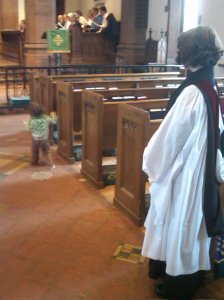
But every once in a while, my own daughter reminds me how my principles do not always coincide with the realities of experience.  This past Sunday, as we were serving communion, my daughter managed to sneak away from her dad, and kneeled next to another parishioner.  When I reverently offered her the host, she abruptly grabbed it from my hand and shoved it enthusiastically into her mouth.  As her parent, my immediate reaction was to be a little embarrassed and to wonder what the other parishioners must think of my parenting skills.  Despite a couple of chuckles, I squashed my embarrassment, and moved on to the next person at the rail.  Later that morning, during the final hymn, my daughter joined me in the aisle as I sang and waited to deliver the morning’s announcements.  As the hymn was wrapping up, she dropped my hand and started shaking her hips in the center aisle, dancing to the hymn with reckless abandon.  Again, my initial instinct was to fret over what parishioners might think about the kind of dancing I was teaching at home.

Later, as I was thinking about the two incidents, several things came to me.  One, I was once again reminded how hard it is to manage children in the context of formal worship.  I am so grateful to the parents who do it every week and who allow us to be blessed by their children.  Two, I realized how hyper aware I am of my role within the church and how that role has some serious implications for my family.  In my ordination vows, the bishop asked me, “Will you do your best to pattern your life and the life of your family in accordance with the teachings of Christ, so that you may be a wholesome example to your people?”  Sometimes, I think that question makes priests and their families feel like they have to be perfect – including in the pew on Sundays.  But what I realized was that my daughter was not shattering our “perfect” image.  She was inviting me to let go of pretenses and be real with our parish.  Being a parent, in fact being a human, is messy, and I do not need to pretend that I somehow have a better hold on being “not messy” simply because I am a priest.

Finally, what I realized on Sunday is that being a “wholesome example” means loving my child in the way that I love all our children at church.  When I could step back from the fact that my child was greedily grabbing Eucharist and dancing a little “inappropriately” in church, I could see the incidents totally differently.  When I could see my child as a child of God, I could see someone who was demonstrating how eager we all should be to receive Christ’s body at the table:  how our longing for Jesus sometimes is downright greedy and aggressive, and grabbing for the bread is a physical way of showing a passionate longing for Christ.  When I could see my child as a child of God, I could see someone who was moved by the Holy Spirit to joyfully dance before the Lord, not unlike David so many years before[i]:  someone who was actually inspired by the music being sung and played, not just dutifully and dispassionately singing the words.  I thought about how her body is a gift from God and how wonderful it was that she was using her body to praise God, even if my uptight-self resisted it.

One of the greatest reasons having children among our midst in church is because they help us get out of ourselves and our need to keep up appearances, and they help us to see the holy in new, exciting, and fresh ways.  So, please keep bringing those little ones.  We all need them to show us the face of Christ.  And for our parents, occasionally they might remind you how they are children of God as much as they are your children as well.

[i] 2 Samuel 6.16

Sermon – Genesis 22.1-14, P8, YA, June 29, 2014

Tags

, , , , , , , , , , ,

One of the great things about the lessons in the summer is that we often get these dramatic stories from the Old Testament.  Last week, we had Hagar and Ishmael’s story.  Today, we have the story of the binding of Isaac.  Both of these stories are the dramatic kind of stories that make us uncomfortable and certainly make many people say, “Well that’s the Old Testament God…not the God that I know.”  We cannot fathom who this God is that “tests” people, deliberately asking them to commit the most heinous of crimes – killing one’s own child.  We are perplexed by Abraham, who upon God’s instruction, simply goes to where God sends him, fully willing to commit this most horrible crime, all the while deceptively luring his child to death.  And poor Isaac – we question how God can expect this test of Abraham’s not to create lifelong psychological scars on Isaac.

The only way I could find my way out of this story this week was to reconsider each character in the text.  I started with God, whose test of Abraham feels more like torture.  I have never felt comfortable with the concept of a god who puts us through tests.  That kind of agency and intervention by God is counter to my understanding of who God is.  I do believe that Satan or the powers of evil regularly test us, and awful things simply happen at times.  But our God is a God who gives us free will – who allows us to make mistakes, but never actively manipulates us in a way that could be labeled as testing.  God does not send us cancer, or take our children, or leave us hungry.

So why does this story say that God “tests” Abraham.  Well, one clue is found in the first sentence.  The story begins with this sentence, “After these things God tested Abraham.”  “After these things,” is not just some transitional phrase like, “In other news…”  Those “things” the story refers to are not insignificant.  If you remember, Abraham has had a circuitous journey, and quite frankly, Abraham has not proved to be very trustworthy so far – constantly taking matters into his own hands, and making a mess of things.  Take, for example, those two times that Abraham’s wife Sarah ended up in a harem in Egypt and Canaan.  Both of those times Abraham lied about Sarah, saying she was his sister, simply to protect himself from being killed by a covetous king.  For a man who trusted God so much that he was willing to leave everything behind, Abraham clearly did not trust God fully enough to take care of Abraham and Sarah.  And so he concocted these horrible lies, forcing Sarah into an awful position – not once, but twice!  Then, of course, there was that time that Abraham did not believe that God would give him children.  So the untrusting Abraham and Sarah got impatient, and decided that Abraham should father a child with Sarah’s handmaid, Hagar.  That fiasco led Abraham’s beloved son being cast out into the wilderness, never to be seen again.  So “these things,” are not insignificant things.  Any of us in relationships with family, spouses, or intimate friends know that trusting someone who betrays your trust over and over again is difficult, if not impossible.

Meanwhile, God is making a pretty big leap of faith in the person of Abraham.  God has already witnessed failure after failure in God’s people – from Adam and Eve to Cain and Abel; from the cleansing of the earth with Noah to the return to sin at the tower of Babel.  And so God takes all that experience with broken covenants and this time attempts to enter into relationship with God’s people through the person of Abraham.  All will be blessed through this one person, the blessing passing through Abraham like a prism, “through which God’s blessing is to be diffused through the whole world.”[i]  So in taking on such a substantial risk, and in seeing Abraham falter many times, a time of testing does not sound so abhorrent after all.  In fact, we begin to see that God is making God’s self pretty vulnerable with Abraham.  And because God grants free will, God cannot know what choices Abraham will actually make.[ii]  The longing for assurance while in a vulnerable position is only natural – one we experience anytime we decide to put ourselves in vulnerable positions with others.

So after coming to some peace with God in this story, I began to pick apart Abraham.  Why does Abraham submit to this test?  He has taken matters into his own hands before, including arguing against killing all the Sodomites.  Why does he submit to God now?  In fact, when God commands Abraham to take Isaac up for sacrifice, Abraham does not protest at all.  The ancient rabbis tried to address this frustration by proposing a little embellishment.  Whenever the rabbis did not understand something in biblical text, they would create a little midrash, or imaginative expansion of the text, to help interpret the text.  So in their retelling of the Genesis story, they create a dialogue between God and Abraham.  In the original text we heard today, all we have are these words:  Take your son, your only son Isaac, whom you love, and go to the land of Moriah…  The midrash changes the story to read like this:  “Take your son,” God says.  “I have two sons,” Abraham replies.  “Your only one,” God says.  “This one is the only son of his mother, and this (other) one is the only son of his mother.”  “The one you love,” God clarifies.  “I love them both,” Abraham argues.  “Isaac,” God finally asserts.[iii]

What the midrash tries to do is highlight what might have been going on inside Abraham – something the story never tells us.  Just because Abraham obeys does not mean that he likes obeying.  We can also surmise some of Abraham’s conflicted feelings in other parts of the story.  We hear how torn he is by the ways that he responds to both God and Isaac.  When God calls upon Abraham, he replies, “Here I am.”  That age-old response to God, hineni, is Abraham’s way of showing deference to God.  But Abraham says those same words to Isaac when Isaac calls to him.  “Here I am, my son.”  You can almost hear the devastation in his voice.  But you also hear a deep sense of respect and love for his son – the same deep respect and love Abraham has for God.  Ultimately, what we see in Abraham is a deep trust that things might work out for the best.  When Isaac asks where the lamb is for the sacrifice, Abraham says, “God himself will provide the lamb for a burnt offering, my son.”  Some might read that as a white lie, told to placate an inquisitive son.  But I like to imagine that Abraham hoped against hope that God would in fact provide a lamb, instead of his son.  In fact, perhaps that is the only thing Abraham has left in this horrible story – a trust that God will act and save his son.

Finally, there is Isaac.  As I read this story this week, my immediate thought was, “Poor Isaac.  He has some serious therapy in his future!”  And perhaps that is true – that Isaac is the innocent lamb, deceived, and almost killed.  In fact, many scholars call this story, “The sacrifice of Isaac,” as opposed to “The binding of Isaac.”[iv]  But there is more to Isaac’s story than meets the eye.  In the story, two times the text says of Abraham and Isaac, “and the two of them walked together.”  We know enough about scripture to know that when something is repeated, that repetition is significant.  The text does not say, Abraham led Isaac or Abraham forced Isaac.  The text says the two walked together.  We do not know how much Isaac knows at this point, but the way that the two walk together suggests a certain equality – as if the two face this test together.  Though we imagine Isaac terrified under his father’s knife, perhaps Isaac allows himself to be bound, facing this test with is father, fully trusting as his father does that God will provide the lamb.

The artwork depicting this story varies widely.  There are frightened pictures of Isaac, anguished depictions of Abraham, and strong angels who forcefully grab Abraham’s raised arm before he can damage Isaac.  But my favorite depiction is one by Peggy Parker.[v]  Peggy’s woodcut shows a bound, but peaceful Isaac, curled up on the altar.  Abraham is lovingly and with grief looking over Isaac, a knife hidden behind his back.  And above them both is a large angel, wings spread widely, arms extended over them both, as if lovingly embracing the father and son.  What I like about Peggy’s rendering is that there is a sense that all three characters are vulnerable, all three characters are pained, and yet all three characters trust their vulnerability with one another.

This is our takeaway today.  This story is tough – I doubt that I will be using the story as a bedtime story anytime soon.  But this story also reveals how hard being in relationship with God is – not just for us and our loved ones, but for God too.  We are all trying to love and trust one another.  And just like in any other relationship, that love and trust is hard work.  But when we understand that each of us in this relationship, fully committing to being vulnerable and trusting each other, somehow we find the courage to take that first step.  And when we take those steps, we do not take them alone and we are not forced.  We take them together, equally sacrificing security in the trust of something much greater with our God.  Amen.

[i] Ellen F. Davis, Getting Involved with God: Rediscovering the Old Testament (Cambridge: Cowley Publications, 2001),60.

[ii] Ellen F. Davis, “Radical Trust,” July 26, 2011 as found at http://www.faithandleadership.com/sermons/ellen-f-davis-radical-trust on June 25, 2014.

[iii] Davis, Getting Involved, 55.

[iv] Kathryn Schifferdecker , “Commentary on Genesis 22.1-14,” as found on http://www.workingpreacher.org/ preaching. aspx?commentary_id=2138 on June 26, 2014

[v] http://www.margaretadamsparker.com/biblical/biblical_abraham.aspx as found on June 27, 2014.

The power of smell…

Tags

, , , , , ,

Last week I was taking a walk for a bit of exercise on my day off.  I was trucking along when all of a sudden a fragrance hit me – the smell of honeysuckle.  I stuttered to a stop just so I could inhale the scent a little longer.  Honeysuckle is one of those scents that takes me back to a happy place in my childhood.  You see, every June when I was growing up, my family would travel to the mountains of North Carolina for the Annual Conference of the United Methodist Western North Carolina Conference.  The conference lasted a few days at the end of the week, but our family would go up on the Monday before and make the week our annual vacation.  Lake Junaluska holds many fond memories for me – canoeing on the Lake, crafts at the childcare center, swimming in the pool, feeding ducks, and in general enjoying the beauty of the property.  All those memories are triggered by the smell of honeysuckle, whose blooming always coincided with Annual Conference, forever connecting the smell with the memories.

Smell has a powerful way of connecting us to memories.  The smell of your favorite food that your mom used to make, the cologne or perfume of your first crush, the scent of baby oil, the aroma of coffee, or the smell of a campfire:  all of these smells have the ability to halt time for us and take us back to a place of warm, fond memories.  The scents conjure up people or places that made us happy and shaped our lives.  Though we rarely hold those memories actively in our everyday lives, a simple scent can bring a smile to our faces as those memories bubble up in our minds.

One of the things that I love about Episcopal Church is the way that the Church engages all the senses:  the sight of the cross, the touch of hands passing the peace, the sound of psalms being chanted, or the taste of communion.  Of course, as someone formed in “high church” worship, incense is the smell I associate with church.  When I was in seminary, I served in a church that used a lot of incense – I could smell it in my hair when I came home, I could smell it in my vestments when I put them on before services, and I could even sometimes smell it when the church was empty and dark, the incense still lingering in the walls.  Anytime I smell incense now, it has a calming effect on me.  Without thinking, I take a deep breath, and somehow am transported to memories of my experience with the holy – at churches, at monasteries, on retreat.  I have considered several times getting a home incense kit for devotions, just to help me connect to those memories.

Though many churches shy away from incense, what I like about incense is that the smell plants in our memories experiences with the holy.  Much like the fond memories of childhood, fond memories of church can help shape us and give us grounding throughout life.  The next time you are in church, I invite you to consider what smells might help ground you throughout the week.  Maybe it is the scent of holy wine, maybe the smell of extinguished candles, or maybe even the smell of weathered pages in a BCP or hymnal.  Whatever the scent, allow its power to reconnect you with God and transport you to a place where you knew God loved you and cared for you beyond measure.

Sermon – Genesis 21.8-21, P7, YA, June 22, 2014

Tags

, , , , , , , , , , ,

Alice sat on her bathroom floor crying.  The bathroom was the only place she felt like she could get a moment of privacy.  Her tears were the release she found for what felt like an impossible juncture.  Last summer things had been okay for Alice.  She was coping with her divorce, and managing to feed and care for her son on her own, despite the fact that her income from cleaning houses was so small.  She had managed to work out some government assistance that gave her enough cushion to keep food on the table and a roof over their heads.  Life was not easy, but life could be a lot worse.

But during the last year, her world began to fall apart.  After a work injury, Alice could not clean houses for months.  Being self-employed meant she had no one to fill in at her houses.  After several months, her customers all got new help.  Because she was not working, her government assistance began to lower.  The assistance programs required that clients work to receive assistance.  Alice could not clean houses because of her injury, and she did not have enough education to qualify for any other type of work.  As the money became more and more scarce, Alice began to fear for her son.  Her son was looking thinner and more sickly each day.  He did not understand what was happening, and his deserved frustration and led her to the bathroom to cry.  Things had gone from bad to worse as Alice feared they would have no food, no home, or that she could lose her son.  All that was left to do was to cry:  to cry tears of sorrow, to cry out to God for mercy.

Hagar knows Alice’s tears.  We remember that Hagar is the handmaid for Sarah, Abraham’s wife, whom Sarah had given to Abraham to take as a wife because Sarah was infertile.  Hagar resented this action, and has already suffered a great deal, grappling with her powerlessness and lack over control over her most private, personal space.  Today the text brings us forward a few years in Hagar’s family.  Hagar’s son Ishmael is growing into a young boy, and Sarah has finally conceived her own son.  The birth of Isaac is a joyous occasion that all of the family celebrates.  But just as Hagar has begun to reclaim her personhood, Hagar suffers again.  Sarah sees Ishmael – the son that reminds her of her infertility, who will not represent the blessed line of Abraham – playing with Isaac – her own son, whom she proudly bore and who will mark the blessedness of Abraham’s line.  Sarah turns to Abraham and tells him to send Hagar and Ishmael away.  Although Abraham is crushed by the idea, God supports Sarah’s decision.  For Hagar, the world is against her.  We hear no words from Hagar as Abraham loads water and bread on her shoulders, gives her Ishmael, and sends her out into the wilderness.

Hagar wanders in the desolate wilderness until she runs out of water.  Looking at her son, whose death she imagines is immanent, Hagar puts him under the shade of a bush and walks away.  She walks away and cries out to God.  She cannot watch the death of her son.  Not after all she has been through.  She cries out to God as her last resort.

The tough part of this story is figuring out why this is happening.  Why would Sarah condemn Hagar and Ishmael to death by having them driven out into the wilderness?  Why would God agree with Sarah, especially when Ishmael’s birth was Abraham and Sarah’s choice in the first place?  Why does Abraham give up his first son so easily, without a word to Hagar?  The grief in this passage feels overwhelming, and we are left pointing angry fingers in multiple directions.

Hagar’s wilderness moment is familiar to us today.  We have those times when we feel like everyone is against us, including God.  The wildernesses of our lives are those desolate, lonely, dark places of wandering.  The wilderness is a scary, stark place of solitude that takes us to the depths of our finitude and forces us into encounters with God.  In the wilderness, we experience God in a way that we cannot not experience God elsewhere.  In the dry desert of suffering, which is scorching by day and frigid by night, with little water, we experience a sense of nakedness and vulnerability that we try to mask in our everyday lives.

Despite the darkness in the Genesis text today, there is also incredible hope for the suffering.  The last third of the text we hear today is filled with God’s action for the afflicted.  First, God hears Ishmael.  The text says “And God heard the voice of the boy.”  This word “to hear” is important on many levels.  In the original Hebrew, Ishmael’s name means “God will hear.”[i]  Already, Ishmael’s name – God will hear – comes to fruition.  God hears Ishmael.  Further, the word “to hear” in Hebrew, shamah, connotes more than physical hearing.  As we have talked about before, “to hear” in Hebrew also means “to understand.”  God understands how Ishmael and Hagar cry out.  God hears and understands their pain.

The second action we encounter at the end of this passage is God making a promise.  The angel of God speaks to Hagar about Ishmael saying, “I will make a great nation of him.”  We know from scripture that God does not make promises lightly with God’s people.  God fulfills God’s promises.  If God says that God will make a great nation of Ishmael, Hagar knows to believe God.  No matter how dire things seem, God makes a promise, and God does not disappoint.

The third action we encounter is that God opens Hagar’s eyes.  The text says that “God opened her eyes and she saw a well of water.”  In the opening of Hagar’s eyes, God allows Hagar to perceive God’s presence and action in her suffering.  God lifts the blindness that suffering and desperation create.  God shows Hagar the gift of life that God provides in the well of water.  God’s gift is abundant, and God reveals the gift when Hagar cannot see.

The fourth and final action is that God is with Ishmael.  The text says, “God was with the boy.”  The verb “to be” is one of the most simple and basic of words.  When applied to God, “to be with” has great meaning.  The text says that in all Ishmael does, in all the experiences Ishmael has, in all that Ishmael’s journey entails, God is with him.  God does not abandon Ishmael.  God does not forget.  God is with him.

I am reminded of one of my favorite Gospel hymns.  The hymn is called “He’s an On Time God.”  The song talks about the ways that God always comes to our need just when we need God.  The refrain goes, “He may not come when you want Him, but He’ll be there right on time.  He’s an on-time God, oh yes He is.”  The song describes the Israelites who crossed the Red Sea just before the Sea collapsed on the Egyptians, the relief of Job’s suffering, and the feeding of the 5,000 by Jesus.  What I love about the song is the booming chorus of singers and the repeated affirmation that God is on time.  Of course, the theology of the song is a little trickier.  I think the song misses something by suggesting that God is not always with us.  But the song is on to something.  I might rephrase the refrain to be something like – suffering may not end when you want it, but you will realize God is with you in the suffering right on time.  In this way, God is an on-time God.

We may not understand God’s actions, or why we suffer, but God is with us.  Hagar is a great gift this week for reminding us about what our relationship with God is like.  Hagar reminds us that we have an active relationship with God.  Hagar shows us that we can cry out to God in our suffering.  Hagar demonstrates to us that God is not a far away god who is removed from our daily lives.  By crying out to God, we reveal our earthy, dynamic relationship with God.

Meanwhile, God’s actions toward Hagar show us that God has a reciprocal relationship with us.  God is active in our lives.  God hears us, understands us, and will act in our lives.  God is with us, all of the time, especially in our suffering.  When we enter into that relationship with God, crying out to God, we let go of notions of distance from God or personal control of our lives.  We allow God to open our eyes so that we can see God’s action in our lives.  By opening our eyes, God shows us the blessings God has for us.  God did not tell Hagar and does not tell us what our blessings will look like.  But there will be blessings.  God will open our eyes to reveal the bounty of blessing for us.  As we enter into that holy, vulnerable relationship with God, allowing our eyes to be opened, we see God’s blessings – right on time.  Amen.

[i] Gordon J. Wenham, Word Biblical Commentary, vol. 2 (Dallas: Word Books, 1994), 88.

Homily – Luke 12.2-12, Bernard Mizeki, June 18, 2014

Tags

, , , , ,

Today we honor the life and work of Bernard Mizeki.  Bernard was born in 1861 in what is now known as Mozambique.  In his teens, he escaped from his native land and fled to Cape Town, South Africa.  There he was converted by Anglican missionaries and baptized.  In 1891, he volunteered as a catechist for the pioneer mission to Mashonaland.  In 1896, an uprising of the native people happened against the Europeans and their African friends, making him a target.  Bernard was warned to flee, but he refused to desert his converts.  He was stabbed to death, but his body was never found, and the site of his burial is unknown.  There is a shrine near the place of his martyrdom, and he is honored as a native martyr and witness.

Bernard must have been familiar with Jesus Christ’s words from Luke’s gospel today.  Jesus is preparing the disciples for a great ordeal.  When Jesus says, “Do not fear those who kill the body …”, Jesus takes the disciples somewhere quite scary.  The disciples will be persecuted, put on trial, and even killed.  In the face of such a serious commitment, Jesus says, “Do not be afraid…the Holy Spirit will teach you what to say.”  Jesus Christ warns the disciples that this will be no easy journey – at least not easy in all the conventional ways.  As long as they can give up their fear of death, persecution, and humiliation, they will be fine.  Not hard at all, huh, Jesus?!?

When we hear Jesus Christ’s counsel today and when we hear of martyrs like Bernard, I am sure most of us tune out.  We are unlikely to face a similar fate in our lives.  And yet, their witness is still strong for us today.  What Jesus and Bernard highlight are those moments of clarity, those moments of utmost importance: when our bodies are wracked with illness and nothing else is clear but our love of God; when a loved one is near death and the holy is all that matters; when an injustice is so grave to us that we cannot sit idly by.  Those are the moments in life that define us, that define our faith and our relationship with God.  Jesus and Bernard remind us that those are the moments where we find true meaning in life – and no matter how scary they seem now, we will not be afraid.  Amen.

Homily – Luke 6.17-23, John Johnson Enmegahbowh, June 12, 2014

Tags

, , , ,

Today we honor the life and ministry of John Johnson Enmegahbowh.  John is recognized as the first Native American priest in the Episcopal Church, serving until his death in 1902.  John was an Odawa Indian from Canada who was raised in the traditional healing way of his grandfather and the Christian religion of his mother.  He came to the U.S. as a Methodist missionary in 1832.  At one point, he tried to flee his missionary work and return to Canada, but was turned back by storms on Lake Superior.  He had a Jonah-like vision with God and got back to work among the indigenous in Minnesota.  He was a man known to consistently support peace, even when it made him enemies.  He helped train deacons for the Episcopal Church and was able to use his understanding of Native traditions to spread Christianity and enrich the mission work of the Episcopal Church.

When I think about John Enmegahbowh’s ministry, I imagine a scene much like the scene from our gospel lesson today.  Jesus comes down to the plain, gathering disciples and a great multitude, and teaches the Good News.  “Blessed are you who are poor…Blessed are you who are hungry now…Blessed are you who weep now…Blessed are you who when people hate you, …exclude you, revile you, and defame you…”  Jesus encouraged those gathered with the good news that life in Christ is different – that there is hope and promise. I imagine John Enmegahblowh thought much like Jesus, gathering downtrodden Native Americans, sharing the Good News with them in a similar fashion.

So what about us, who are not from an indigenous group, and who rarely find ourselves surrounded by a multitude of people?  Jesus’ message to us today is two-fold.  First, Jesus’ message is for us.  Though we may not suffer poverty or hunger, we have all known suffering.  Jesus Christ promises that laughter and joy are ours in the Kingdom of God.  Second, Jesus’ message is for others, to be shared by us.  Jesus and John invite us to be teachers in the ways only we can – through our unique stories, our unique gifts, and in our unique lives.  When we live into that call we will know the experience of being blessed.  Amen.