Homily – Ephesians 3.14-21, Phillips Brooks, January 23, 2014

Tags

, , , , ,

We all have someone in our lives who has brought us a little closer to God.  Maybe it was an outstanding preacher, who opened up a connection between your everyday life and Holy Scripture.  Maybe it was a friend who always could see God moving in the midst of everyday events.  Maybe it was a public figure who seemed to live the life of faith in ways we can only dream to do.  For me, it was my Old Testament professor in seminary.  To be honest, I never really liked the Old Testament; I found it to be full of violence, an unfamiliar God, or even just books that were hard or cumbersome to read.  But then I had this professor, who seemed to come alive with every word in the Old Testament.  She overflowed with passion, joy, insight, and light.  She opened up the Hebrew text in ways I had never understood and made me fall in love with a set of books I had written off as irrelevant.

In some ways, Phillips Brooks, who we honor today, offered that same insight to others of his time.  Born in 1835, Brooks served as a priest in Philadelphia and Boston.  He was a dynamic preacher – in fact, he is often called the greatest preacher of the century.  Though his sermons are engaging to read, many say they don’t capture the warmth and vitality of his delivery – in fact, many say that he spoke to his audience as a person might speak to a friend.  Brooks inspired men to enter the ministry, and was able to appeal to conservatives and liberals alike.  In 1891, he was elected bishop of Massachusetts.  His personality and preaching, along with his deep devotion and loyalty, gave that diocese the spiritual leadership they needed.

The joy for God that Brooks seemed to have sounds a lot like Paul in our epistle lesson today.  Paul says, “I pray that you may have the power to comprehend, with all the saints, what is the breadth and length and height and depth, and to know the love of Christ that surpasses knowledge, so that you may be filled with all the fullness of God.”  What Paul wanted for the Ephesians is the same thing that Brooks wanted for the people of Massachusetts and my seminary professor wanted for that community – a taste of the love, grace, and abundance that can be found in our God.

Perhaps you already know this experience of God.  But if you are looking to reconnect with that experience or find that kind of experience with God for the first time, I invite you to take a look at the people God has already placed around you.  One of them, maybe even a stranger for now, is present already to show you the enormity of love that comes from the Lord our God.  Amen.

Homily – 1 John 4.7–12, Richard Meux Benson and Charles Gore, January 16, 2014

Tags

, , , , ,

Richard Meux Benson was born in 1824, in England.  He was ordained a priest, and eventually, with two other priests, he founded the Society of St. John the Evangelist (SSJE).  SSJE was to be “a small body to realize and intensify the gifts and energies belonging to the whole church.”  SSJE became the first stable religious community for men in the Anglican Church since the Reformation. Branch houses were established in Boston, India and South Africa.  Benson wrote the original SSJE Rule and served as Superior until 1890.

Gore was born in 1853 (almost 30 years after Benson was born).  He, too, lived in England, and served as a priest and later as a bishop.  He founded the Community of the Resurrection, a community for men that sought to combine the rich traditions of religious life with a lively concern for the demands of ministry in the modern world. He was a writer and promoter of liberal Anglo-Catholicism.  He wanted to both 1) make available to the church the critical scholarship of the age, while 2) pricking the conscience of the church and pleading for a focus on the work of social justice for all.

What both Benson and Gore saw was a need for a more intentional Christian community to shape the spiritual lives of the faithful.  Though none of us live in religious orders, we understand the value of being surrounded by a faith community.  I just had a conversation last night with a parishioner about this very issue.  The parishioner ran into another parishioner who has fallen away from the church lately.  The two had a conversation about how easy getting caught up in the rush of life can be.  Finally the active parishioner asked the other, “But how do you do it? How do you encounter God without being active in the life and worship of the church?”

What this parishioner saw, or what Benson, Gore, and the writer of the First Epistle of John saw, is the value of the other in our faith journey with God.  Whether it is the call to social justice by Gore, the invitation to be formed by the faith community by Benson, or simply the reminder to the beloved to love one another, we experience faith within a community.  The community invites us into something bigger than ourselves, and it reminds us that our individual relationships with God are only enriched by partners in the journey.  That does not mean the journey will be easy – living within a community can be messy and full of its own challenges.  But the reward of our shared journey is closeness to God.  As First John says, “If we love one another, God lives in us, and his love is perfected in us.”  Our communities are never perfect, but when we steep ourselves in them, we can better see and serve God.  Amen.

Homily – Romans 12.6-13, Julia Chester Emery, January 9, 2014

Tags

, , ,

Today we honor Julia Chester Emery.  Julia was born in 1852 in Massachusetts.  In 1876, around age 24, she became the Secretary of the Woman’s Auxiliary of the Board of Missions in the Episcopal Church.  Julia served in that position for 40 years, helping the Church recognize its call to proclaim the gospel both at home and overseas.  During her tenure, she visited every Diocese and missionary district within the United States.  She traveled around the world, visiting missions in remote areas of China, in Japan, Hong Kong, the Philippines, and Hawaii.  Her hope was to open up new occasions for service and acceptance of new tasks.  Through her leadership, the Woman’s Auxiliary emphasized educational programs, raised awareness of social issues, developed leadership among women, and created the United Thank Offering.  Julia’s faith, courage, spirit of adventure, and ability to inspire others made her a leader respected and valued by the whole Church.

It was on Julia’s feast day four years ago that I was ordained a priest.  At an ordination, it is difficult to not get caught up in the moment.  Years and years of meetings, tests, obligations, and evaluations made me feel like I could finally relax – and enjoy the fact that the entire assembly finally confirmed that this ministry was my call.  I remember feeling like I was finally wearing the right shoes as I stepped into my new role.

The truth is, we all have a pair of ministry shoes.  Our epistle lesson from Romans confirms this idea.  “We have gifts that differ according to the grace given to us” – prophecy, ministry, teaching, exhortation, giving generously, leading, being compassionate.  The epistle reminds us that all of us are given a ministry; our job is to live into that ministry – to wear those shoes God gave us.  And when we put on those shoes, we are to not lag in zeal; we are to be ardent in spirit and serve the Lord.

The question for each of us is to not only make sure we have on the right shoes, but to keep checking that they are on.  Some of us might prefer to slip on something less comfortable, but also less demanding.  But Romans reminds us today that when we sport those unique shoes, we not only impact others, we impact our own experiences with God, too.  So check those feet, do not lag in zeal, be ardent in spirit, and of course, serve the Lord.  Amen.

Homily – John 20.24-29, Habakkuk 2.1-4, St. Thomas the Apostle, December 19, 2013

Tags

, , , ,

We hear from Thomas several times in the gospels.  When Jesus insists on going to Judea to visit friends in Bethany, Thomas declares, “Let us also go, that we may die with him.” (John 11:16)  At the Last Supper, as Jesus tries to prepare the disciples for his departure, Thomas interjects, “Lord, we do not know where you are going; how can we know the way?” (John 14.5)  And as we hear today, after Jesus’ resurrection, Thomas will not accept the disciples’ account without seeing Jesus’ wounds.  When he finally does see Jesus, he declares, “My Lord and my God.” Thomas was thoughtful, passionate, and loyal.  But Thomas was also skeptical, had doubts, and asked questions.

Though we often refer to Thomas as “Doubting Thomas,” I actually really love Thomas.  His passion is overwhelming and inspiring.  But even more compelling to me are his questions and his doubts.  Thomas feels very real to me: he openly exposes his doubts and questions – something we all have done at some point in our lives, even if we are not as bold as Thomas to admit it.  Thomas shows me how hard believing was even in the presence of Jesus Christ – how much more reassuring to know that our doubts are that much more to be expected.

But perhaps what I love most about the Thomas stories is Jesus’ reaction to him.  Though Jesus may sound like he is scolding Thomas today, Jesus still comes, knowing that Thomas needs reassurance.  When Thomas asked his panicked questions, Jesus also responds pastorally.  Jesus’ relationship with Thomas is even more inspiring to me than Thomas himself.  We find in their relationship a Godhead who is patient, open to question, giving, and kind.  Of course, Jesus pushes Thomas, too – but any good relationship with God involves both challenge and grace.

In some ways, that relationship is revealed in our Old Testament lesson today.  The author says, “I will stand at my watch post … I will keep watch to see what he will say to me, and what he will answer concerning my complaint.”  God responds, “Write the vision; make it plain …”  Through relationship with God, we know that we have a God who responds – maybe sometimes with grace and sometimes with challenge.  But the promise of a responsive God is ours.  Thanks be to God!  Amen.

On touch…

Tags

, , , , ,

Being pregnant is a pretty incredible experience.  I have been so grateful to experience the phenomenon one more time with our second child, and continue to be amazed by the miracle of pregnancy.  Of course, being pregnant comes with a certain set of consequences too.  The funniest for me has been the way that the mother’s body becomes fodder for public consumption.  Not only does there seem to be a constant conversation about my changing body (usually accompanied by comments that would never be acceptable at any other time – like how “enormous” my body is getting); there also seems to be a strange longing to touch the growing belly, even by total strangers.

In general I have mixed feelings about being touched.  Understanding the miracle of pregnancy and the life and hope that it generates, I understand the longing to be connected to that gift.  I am especially patient about this longing when it comes from much older women – women who are long past childbearing age, and who in their advanced age seem to appreciate the gift of life more than those of us who are much younger.  But there is also a strange and somewhat uncomfortable intimacy that comes from having someone touch your belly – something you would never be permitted to at any other stage of life.

So imagine my surprise this past weekend while on retreat when, without permission or warning, a 90-year old Franciscan brother immediately placed his hands on my belly when he discovered I was pregnant.  He broke into a beautiful and meaningful blessing on my pregnancy, my unborn child, and my pending delivery, making the sign of the cross on my stomach.  Though my instinct was to pull away when he first touched me, somehow, his steady hands and his heartfelt blessing held me still.

As the brother pulled away with an encouraging smile, I realized two things.  One, I think we as a people have become incredibly guarded about touch.  We separate ourselves so much through technology and creating appropriate boundaries that, in the end, we sometimes limit touch altogether.  Life can become incredibly lonely and lack intimacy when the basic gift of touch – whether a held hand, a hug, or a reassuring pat – is denied to us as a society.  Two, as a priest, I think our profession has become so guarded about safe church practices that we forget the power of touch in our ministries.  It has never occurred to me to touch another pregnant woman’s belly to bless her – even when she is a longtime parishioner.  Even if the thought had occurred to me, I am sure I would have asked permission, felt self-conscious about the act, and stumbled over my words in my fumbling.  But this Franciscan brother reminded me that part of our job as clergy is to honor and celebrate the intimacy that Christian community creates, and to invite people into that sacred space.  Though I realize there is always a time and place to respect the danger of touch and the harm that it can do, I wonder if out of our caution we have not lost out on opportunities to open up the spaces where God can bless and sanctify all stages of life through the power of touch.  I know there are no simple answers, but having experienced the blessedness of sacred touch, I am grateful for a church that is willing to try to find the balance.

Sermon – Matthew 5.13-20, E5, YA, February 9, 2014

Tags

, , , , ,

Today we are going to try something a little different.  The text that we just heard from Matthew was in the New Revised Standard Version.  The text says, “You are the light of the world.  A city built on a hill cannot be hid.  No one after lighting a lamp puts it under the bushel basket, but on the lampstand, and it gives light to all in the house.  In the same way, let your light shine before others, so that they may see your good works and give glory to your Father in heaven.”  The New Revised Standard Version is lovely, giving us the beautiful metaphor about us being light; and that by shining our light, we allow others to give glory to God.  But sometimes, we hear scripture so often that the language becomes stale.  I can almost imagine the inner monologue of many of us in the room, “Yeah, yeah, yeah, Jesus.  I know the song, ‘This little light of mine.’”  Or maybe you have some mental image of the super chipper, always happy person, whose face seems to radiate light, and whose life seems so perfect that just remaining friends with them is a challenge.

So in order to get you out of your “This little light of mine,” rut, I want you to hear the same text from a paraphrase version of the Bible called The Message.  “Here’s another way to put it: You’re here to be light, bringing out the God-colors in the world.  God is not a secret to be kept.  We’re going public with this, as public as a city on a hill.  If I make you light-bearers, you don’t think I’m going to hide you under a bucket, do you?  I’m putting you on a light stand.  Now that I’ve put you there on a hilltop, on a light stand—shine! Keep open house; be generous with your lives.  By opening up to others, you’ll prompt people to open up with God, this generous Father in heaven.”  Something about this version of Jesus’ words makes me much more excited about the idea of being light.  This version of Jesus is a little like the cool teacher from school, who wants to break it down for you so you can understand and act.

Let’s take the passage line by line.  First Jesus says, “You’re here to be light, bringing out the God-colors in the world.”  We learn two things from this first line.  First, we have a purpose in life – to be light.  If ever you are floundering with who you are or what you are meant to do with your life, Jesus reminds us that we are here to be light.  Second, being light means we will bring out the God-colors in the world.  Just this past week, I have found light in all sorts of fun places:  the sunset catching a wall of tall trees whose limbs were all frozen, making the light sparkle in the sunset; the afternoon sun that shines through our stained glass windows, making a beautiful mosaic of color in the Narthex; the morning sun that peaks through the trees, warming not only my cold body, but also reminding me that there is still hope in the bleak midwinter.  But God-colors are not just experiences with light; they are also the full range of the goodness of God – the red of God’s love, the yellow of God’s mercy, the green of God’s refreshment, the blue of God’s forgiveness, and the purple of God’s grace

So if our purpose is to be light that brings out the God-colors of the world, are we allowed to hold that knowledge and comfort in ourselves?  Not according to Jesus.  Next he says, “God is not a secret to be kept.  We’re going public with this, as public as a city on a hill.”  Now I know we have been talking a lot about evangelism this past year.  We have been talking about sharing our stories with our neighbors, and listening for and naming God in the world.  And for many of us, including me at times, this has made us wary or anxious.  But Jesus words in this paraphrase sound like a hype-man who makes us want to get out there.  We’re going public!  We’re going to get out there, and show some love and light!  I don’t know about you, but this gets me much more excited about Jesus’ metaphor.

So as Jesus gets us hyped up, telling us he wouldn’t dare hide us under a bucket, Jesus gives us a simple task: Shine!  You are already light, a light that points to the beautiful God-colors in the world.  Our only remaining job?  To shine!  Be the light that God created you to be.

Now, you might be wondering, okay, shining sounds simple enough, but what does that really mean?  Jesus gives us more: “Keep open house; be generous with your lives.”  Now certainly generosity means sharing our earthly possessions.  But the kind of generosity Jesus is talking about is also hospitality.  When I was in college, I befriended a campus minister who had a family of five.  They had a guest room downstairs connected to a bathroom.  For as long as I knew her, someone was always in that guest room.  Whether the room was used by a seminarian, a recent college graduate looking for work, or someone doing volunteer service for a year, that room was always in use.  This is what Jesus means when he says to be generous with your lives.  Share that guest room.  Take time out of your day to visit a shut-in or someone who is sick and stay longer than you really want to.  Stop for that person asking for a handout and hear a bit of their story.  Be generous with your life.

And why do we need to do all of this?  Jesus says, “By opening up to others, you’ll prompt people to open up with God, this generous Father in heaven.”  Here’s the funny twist at the end.  Jesus basically says both “it is all about you,” and “it is not at all about you.”  The “all about you” is the need to open up to other.  Maybe for you that means being more vulnerable than feels comfortable.  Maybe for you that means being present with someone you would rather not be present with.  Maybe for you that means trying something that takes you out of your comfort zone.  And why do we have to focus on opening up to others?  That’s the “it’s not all about you” part.  Your opening up to others encourages others to open up to God.  At the end of the day, that is what all of this hype and vulnerability and shining is all about – about helping others to see and know and open up to the God whom we find so incredible.  By putting ourselves out there, we become a doorway for others to God.  What a fine privilege!  So be a light that shines.  Get out in the world.  Keep open house.  Be generous.  Open up to others.  Your work allows the rest of the world “in” on the secret:  because we’re going public!  Amen.

On worry…

Tags

, , , , ,

Last week I went to visit my OB for a checkup.  We began to talk about delivery dates, as I am having a cesarean section with our second child.  The doctor selected a date that is about one week before what I expected.  I left the office totally panicked.  I would need to totally readjust my plan for wrapping things up in the office, I would need to contact the supply priest and make sure the Sunday before was still available, and I would need to talk to my mother about flying out earlier to come help us with our four-year old – just to name a few things on my panic list.  Of course, about an hour later, I realized how silly my panic was in the grand scheme of things.  The truth is that I could go into labor at any point, and any “plans” I had made would be thrown out anyway.  The idea that one week was sending me into such a panic was only confirmation that I still hold on to some false idea about the level of control I exert over my life.

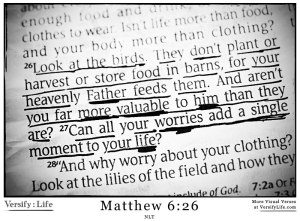
One of my favorite passages of scripture is from Matthew.  “Therefore I tell you, do not worry about your life, what you will eat or what you will drink, or about your body, what you will wear.  Is not life more than food, and the body more than clothing?  Look at the birds of the air; they neither sow nor reap nor gather into barns, and yet your heavenly Father feeds them.  Are you not of more value than they?  And can any of you by worrying add a single hour to your span of life? – Matthew 6:25-27  Although I know the truth of this passage about our relationship between trust and God, I find that I am always returning to it, never fully mastering it.  In fact, I am not even sure that I have partially mastered it.

My only saving grace has been becoming a parent.  I have often joked that God knew what God was doing when God made me a parent.  Perhaps God knew that the only way I would really start to believe that I could trust God was to throw someone in my life whom I have very little control over – a microcosm of the larger world.  That point has been resurfacing several times for me lately.  When school is cancelled because of snow, I have no way of attacking my work in the same way that I would if she were in school.  When the roads become too dangerous for driving on my day off with my daughter (i.e., “errand day”), those groceries that we just cannot live without suddenly become groceries we can live without.  Just today, another school weather-related cancellation day, as I was scrambling around trying to figure out how to busy my daughter while getting a little work done, my daughter asked if she could make Valentine’s Day cards for her classmates.  My immediate thought was, “No, I don’t have time to sit with you and do that.”  But I took a breath and considered her proposal.  One, we would be able to do something together that we would not normally do.  Two, the task would certainly entertain my daughter, which is pretty much golden on a snow day.  Three, making homemade Valentine’s is super cute, and something I never would have made time for otherwise.  So, I exhaled in defeat, and we both gathered the necessary supplies.  And it turns out that making homemade Valentine’s is pretty fun, and can even be a creative outlet for stress reduction.

So today, I am thankful for the God who puts people in my life to force me to be a better person of faith.  I am grateful for God’s awesome and powerful creation, who has certainly taught me a few lessons this winter about the fruitlessness of worry.  And I am blessed by the God who reminds me in small and large ways that I cannot, “worry about tomorrow, for tomorrow will bring worries of its own.  Today’s trouble is enough for today.” – Matthew 6.34

Sermon – Luke 2.22-40, Feast of the Presentation, YA, February 2, 2014

Tags

, , , , , , , , , , ,

Throughout my time in parishes, I have been reminded again and again how different the varied groups are in church.  In one parish I served, the Twenties and Thirties group was struggling because the events that appealed to the single Twenties and Thirties members were not as appealing or convenient for the married Twenties and Thirties members – let alone the ones with children.  At another parish where I served, I remember trying to plan an event for a diverse group of families.  I suggested a particular time of day, keeping in mind the bedtime needs for our new infant.  After much debate, one of the other staff reminded me that families with older children do not need to start bedtime nearly as early as our family did.  I served in one parish that had Holy Eucharist on a weekday at 6:30 am, followed by Bible Study from 7:00 – 8:00 am.  As a sleep-deprived parent of a young child, the arrangement was hideous for me; but for those who worked in the City and needed to be there by 9:00, or for seniors who were up and fed well before 6:30 am, the timing was perfect.  And almost every parish I have been a part of has had youth lock-ins.  It is a special adult who is willing to supervise youth overnight, knowing that they may get little to no sleep, may need to navigate the energy and sexuality of teens, and are willing to be pretty silly and playful when they otherwise would like to be snuggling into a warm, comfortable bed for the night.

That is the funny thing about churches.  Though we all arrive on Sunday on time, relatively speaking, to do the same thing together, we all enter those doors with vast differences.  There are the basic differences – gender, age, marital status, and phase of life.  There are the personality differences – introverts or extroverts; morning or night people; spiritually expressive or quiet and contemplative.  And then there is what we bring in the door with us on any particular day.  Perhaps you just barely managed to dress and wrangle kids into the car to get them here today, probably running out of time to do much tending to yourself to get ready for church.  Perhaps you woke up with aches and pains today, but willed yourself to come anyway.  Perhaps you had a fight with a loved one recently, or even with a fellow parishioner, and you are not even sure if you are in the right mindset for church.  When we take into account all those widely diverse features of any particular gathered group, we begin to see how amazing the idea is that we even gather together at all.

I see a similar dynamic on the day that the holy family went to the temple for purification.  Mary needed to offer sacrifice in thanksgiving for a safe childbirth and sacrifice needed to be offered for Jesus as the firstborn son of the family.[i]  The family has already been through a great ordeal these past 40 days.  They managed to make their way to Bethlehem, had an eventful birth experience in a stable, had strange shepherd visitors, and are now back home.  I imagine at 40 days old, Jesus is still not sleeping through the night, Mary and Joseph are still figuring out this first-time parenting thing, and we can tell from their sacrifice of two turtledoves or young pigeons that the young couple is still struggling financially.[ii]  That this family made it to the temple for this traditional religious experience is a minor miracle.  We all know couples who have been in that stage of life at one point or another.

Meanwhile, we have Simeon.  He is a bit up in age, and has been waiting for a long time for the fulfillment of a promise.  The Holy Spirit had revealed to him that he would not see death until he had seen the Lord’s Messiah.  That means that Simeon has spent a lot of time at the temple, just waiting for that long-anticipated day.  We know that Simeon is righteous and devout, and that the presence of the Holy Spirit is strong in him.  He is a man wise beyond his years, who has been taught to look for just the right thing.  We also know that he is a man of song.  When he finally sees Jesus, he breaks into a song of praise that is now known worldwide, sung at Evensongs and said at Compline or after Eucharists.  We know too that he is not afraid to tell the cold, hard truth, as he warns Mary what hardship is to come her way through her relationship with her son.  We all know a gentleman or two from church who both show forth a Spirit-filled life, yet is never afraid to speak truth – no matter how stinging that truth might be.

Finally, we meet Anna.  Anna is in her eighties.  She has been a widow for about sixty of those years, so we know she has had a rough life.  We also know that she spends every waking hour at the temple, worshiping, praying, and fasting.  Her whole life is centered on being in the temple.  We also learn that Anna is a talker.  When she sees Jesus for the first time, not only does she praise God, but she also talks about the child to anyone who will listen.  Surely we have met that older church gossip, who is always full of church news.

So we have this beautiful scene set before us:  the frazzled young family, struggling both physically and financially to just get by; the wise, righteous older man who is filled with the Spirit, but holds nothing back – not even if maybe he should; and the older prophet whose whole life is at the temple, and who has no problem catching people up on temple news.  In truth the scene is a bit comical.  Though the scene is meant to be another Epiphanytide manifestation of the identity of Jesus Christ, the scene is almost absurd in reality.

As I pondered this scene this week, I could not help to think about our community of faith, and how absurd we probably seem to outsiders.  We have all sorts of parents with children of various ages – many of whom have confessed their own frazzled lives to me on Sundays.  We have teens who struggled to get out of bed to come to church, but who are listening and will ask really hard questions from time to time.  We have empty-nesters who are so overjoyed to have a new lease on life that they are equally likely to be found at some exciting location as they are to be found at church.  We have retirees who are deeply spiritual, who will also give you a piece of their mind.  We have members who love when the guitar team plays and members who avoid church when the guitar team plays.  We have members who will come to every Holy Week service, and other members who are lucky to make it to church on Easter Sunday.

If you look at our wide diversity, you might wonder how in the world we all call the same community home; and yet we all do, and most of us cannot imagine life without this community.  That is the joy of church.  Though that older member might take you to task on something, you also know that they often speak with the love of someone who knows you can take it and you need to hear it.  Though there are Sundays when families feel like the behavior of their children has made their worship experience a complete bust, there are members around you who only get a glimpse of joy that week by being near your child and getting to know their beautiful personalities.  Though that church gossip might frustrate you at times, she is also the same one who has been praying for you and brought you a meal when you were sick.

That is what I love about the text this Sunday and the reality of Church.  Both the text and Church are extremely incarnational – they show us the depths of our messiness, but the beauty that can only emerge from that messiness.  Both show us how no matter how wacky the people are, God shows up, and reveals joy, hope, and grace.  Both show us that no matter how challenging our community might be at times, at its best, our faith community shows us how to better love God, love ourselves, and love our neighbors.  No matter what stage of life we are in, what personality we bring to the table, or what hurdles we overcame to get here today, we need each other because God needs and uses each of us.  For that messy, challenging, incarnate community of faith, I am forever grateful.  That is the good news we celebrate today, and the good news that we invite all our messy, challenging, incarnate friends into as well.  Amen.


[i] Lauren F. Winner, “Simeon’s Faithful Proclamation,” December 26, 2011, as found at http://thq.wearesparkhouse.org/yearb/christmas1gospel-2/ on January 29, 2014.

[ii] William R. Herzog, II, “Exegetical Perspective,” Feasting on the Word, Yr. B., Vol. 1 (Louisville: Westminster John Knox Press, 2008), 167.


Fearfully and wonderfully made…

Tags

, , , , , , ,

I grew up in the South, which means I have a particular perspective about the experience of snow.  When snow was in the forecast, even a little dusting, schools were usually closed, people stayed off the road, and the grocery store shelves were bare.  We did not have the kind of equipment needed for snow removal, so when it snowed, you stayed home.  So, when we first moved to Delaware and there was snow in the forecast, I asked my boss whether the office be closed.  My boss looked at me like I had three heads, and very slowly explained to me (as though I were mentally incompetent) that we would come into work because the roads would be cleared.  I was both reassured by the fact that the roads would be cleared and panicked because I knew how scared I am of driving in the snow.

Eight-plus years of life in Delaware and now two years of life in New York have toughened me up a little, but I still have a healthy fear and dread of snow, in particular for the necessity of driving in it.  The good news is that having a four-year old has reopened for me the joy of snow.  When we see snow now, she wants to go run, roll, and play in it.  She thinks snowballs are hilarious, is very proud of the snow angels she makes, and is a snow cream connoisseur.  She whines about the fact that we haven’t purchased a sled (I know; terrible parent!), and she longs to build a snowman (sadly, this winter’s snows have been accompanied by bitterly cold temperatures, so we have not been able to commit to the time outside needed for snowman-building).

So you can imagine my fascination watching the various responses to snow in the South this past week.  The things I fear about snow have certainly shown their ugly side – cars were abandoned, people needed ten-plus hours to get home, children had to be left at school overnight until parents could safely get to them.  In general, the whole thing seemed like a disaster, with many people pointing fingers of blame.  But at the same time, I have also seen photos of children and adults enjoying a rare joy – sledding in the snow, making snowmen and snow angels, and generally getting wet, cold, and having a blast.  The sharp contrast between joy and desperation has been so vivid in my mind that it is almost hard to grasp.

Meanwhile, another phenomenon has arisen.  Stories have been emerging of people helping each other out of the snow; friends texting, tweeting, and Facebooking about safe places to stay overnight; and teachers staying with children who were totally unprepared for a sleepover at school.  I saw a couple of stories of people who stood by highways, offering sandwiches, cocoa, and cereal to anyone who needed it.

The storm has reminded me of the ways in which God’s creation is both fearfully and wonderfully made.  I see both the awful things that can happen, and the beautiful ways that God’s people rise above.  I see the joy of life that is ready for those willing to find it.  As someone who can be a grouch about the snow and what already feels like an interminable winter, I am grateful for the reminder about the beauty and fun that comes with God’s creation too.  It truly is both fearfully and wonderfully made.

Sermon – Matthew 4.12-23, E3, YA, January 26, 2014

Tags

, , , , , , , , ,

The first time I sensed a call to ordained ministry was in my last year of college.  The sense of call was strong and I felt like I could hear God’s word to me as clear as a bell.  And so what did I do?  I ran the other way…for a long time.  I remember thinking, “Oh, no.  I can’t do that.  How about I choose how I will serve God?”  And so off I went to my first my position after college.  When that was done, I knew the position was not quite the right fit, so I tried something a little closer to what felt like my call.  And of course, within a year or two, that did not quite feel right either.  And so I began to try to figure out how else God might be calling me.  Around and around I went with this game until finally someone just said straight out, “I think you ought to become an Episcopal priest.”  Even with that direct, irrefutable statement from a live person, I still could not say yes.  I took another whole year in discernment before I was finally ready to say yes to God. 

Needless to say, my response to God’s call was nothing like the response of the disciples in today’s Gospel.  Matthew says that Peter and Andrew immediately left their nets and followed Jesus.  Immediately they left.  The Message translation of this verse says, “They didn’t ask questions, but simply dropped their nets and followed.”  I do not know about you, but the idea of following Jesus immediately, and especially following Jesus without asking any questions seems ludicrous to me.  That act of leaving immediately is equally shocking in Jesus’ day too.  The disciples follow Jesus without qualification or questions.  They leave behind their entire profession, which is quite likely a lucrative business at the time.  All of this without any assurances that they will be provided for or have the ability to improve their financial standing by following Jesus.  Finally, following Jesus immediately means leaving behind families.[i]  This last shocker is perhaps the most unsettling because this is all happening in a time when family connections are “a primary source both of identity and honor,” and at a time when caring for one’s parents is “rooted both in cultural custom and in biblical law.”[ii]  This call narrative is as shocking then as the narrative is shocking now.

In our Adult Forum series last week, we talked about discerning God’s call in our lives.  We opened by reading this text from Isaiah 42, “Here is my servant, whom I uphold, my chosen, in whom my soul delights; I have put my spirit upon him; he will bring forth justice to the nations.  He will not cry or lift up his voice, or make it heard in the street; a bruised reed he will not break, and a dimly burning wick he will not quench; he will faithfully bring forth justice.”[iii]  Our class then reread the Isaiah passage, inserting our names in the passage.  So we heard statements like, “Kurt will bring forth justice to the nations,” or “I have put my spirit upon Barbara.”  We realized two things once we put our own names into the passage.  One, when we hear the words, “called to ministry,” we often think of clergy, missionaries, or people from scripture – not everyday people from Long Island.  Second, many of us do not think of ourselves as being called to a ministry.  We may volunteer at church or help out others, but we rarely use “call” language to describe what we do with our time, especially if our secular work does not feel particularly tied to our sacred beliefs.  But then we read the Catechism in the back of the Prayer Book.  The first persons listed as being ministers of the Church are lay persons, and according to the Catechism, the ministry of the laity, “…is to represent Christ and his Church; to bear witness to him wherever they may be; and, according to the gifts given them, to carry on Christ’s work of reconciliation in the world.”[iv]  So not only were we grappling with the idea of being ministers, we were grappling with the idea that those call stories are not just for someone else – we have a call story too.

Once we come around to the idea that we are all called by God, the big question then becomes, can we imagine responding to God’s call immediately like the disciples do with Jesus today?  Do we hear God’s invitation into ministry or a new vocation and immediately drop our nets, without question or delay?  Perhaps a better place to begin is to look back at Matthew’s text and see exactly what Jesus calls those first disciples to do.  Jesus says to follow him and he will make them fishers of people.  I have always read that invitation and basically translated the invitation as Jesus is going to teach them to be evangelists, converting others to Christ.  But as I read this week, I stumbled across a new interpretation of that phrase.  One scholar suggests that inviting the disciples to be fishers of people is an invitation to be in relationship – with Jesus, with each other, and with all the various people they will meet over the next few years, or perhaps even over the rest of their lives. 

If being fishers of people means being in relationship, what does that actually look like?  Exploring Jesus’ relationship with his disciples gives us some clues.  Being fishers of people means “bearing each other’s burdens, caring for each other and especially the vulnerable, holding onto each other through thick and thin, always with the hope and promise of God’s abundant grace.”[v]  Why would Jesus call people into relationship in this way?  Because by calling ordinary people in the midst of their ordinary lives into relationship with the ordinary people all around them, extraordinary things happen. 

So what does that look like here at St. Margaret’s?  In some ways many of us are already fishers of people.  We care for one another in this community, visit one another especially in crisis or illness.  But we also are in relationship with our neighbors – the staff at the local high school who connects us with those in need; our interfaith brothers and sisters as we make sandwiches together for the hungry; the people we meet, both at local ministries, but even our AHRC neighbors as we grow vegetables together.  And the invitation to be fishers of people keeps finding new manifestations here.  Our Outreach Committee is exploring a relationship with a community in Haiti – one facilitated by our relationship with another local parish here in Nassau County.  Though I know many of us are hesitant about international service, imagine what our dropping our nets without question and following Jesus might look like in that relationship.  Meanwhile, as we consider the possibility of a pilgrimage, we consider the ways that we will forge new relationships – with God, with one another, and certainly with people we have never met before.  Even something as simple as our new sponsorship of a Plainview Little League team this year has the potential for being a place to be fishers of people – where we can meet local parents while taking in a game and rooting for our team. 

These very real invitations into new relationships are scary or perhaps seem frivolous to us now.  But the power of Jesus’ invitation to be fishers of people is transformative.  First, accepting the invitation to be fishers of people transforms us.  When we enter into relationships with others, those interactions change us forever.  They help us see God in new ways, they help us reshape our worldview, and they help us to better understand our calling – that ministry that we all have.  Being fishers of people transforms not just us, but also transforms those with whom we are in relationship.  For many years, the staff at AHRC saw St. Margaret’s as distant, if not even inhospitable neighbors.  But now, the staff knows our names, sees new hope in our relationship, and perhaps even sees the love of Jesus through us.  Finally, being fishers of people transforms not just us and those with whom we are in relationship; being fishers of people transforms the kingdom of God here and now.  Our relationships have an impact way beyond the relationships themselves.  Others see the quality of our relationships and they see something intriguing, something inviting, and something inclusive.  Through those relationships, we invite others in, and the kingdom of earth begins to look a lot more like the kingdom of God.  You may not be able to drop your nets immediately today to follow Jesus.  But if you cannot drop them today, know that Jesus’ invitation to follow him is waiting for you and that God will empower you to say yes when you are ready.  Amen.


[i] Troy A. Miller, “Exegetical Perspective,” Feasting on the Word, Yr. A., Vol. 1 (Louisville: Westminster John Knox Press, 2010), 289.

[ii] Judith Jones, “Commentary on Matthew 4.12-23,” as found at http://www.workingpreacher.org/preaching.aspx? commentary_id=1972 on January 23, 2014.

[iii] Isaiah 42.1-3 

[iv] BCP, 855.

[v] David Lose, “Fishers of People,” as found at http://www.workingpreacher.org/craft.aspx?post=3018 on January 23, 2014.