
Tags
anxiety, beautiful, Bonhoeffer, Christ, Christ Child, Christmas, different, discomfort, displacement, Eucharist, familiar, feast, God, Jesus, joy, magnificence, real
This year, Christmas is unlike any other we have experienced. For starters, we are gathered in homes around the globe, perhaps in pjs, on couches, or even bundled up in our beds, instead of being here together, crammed into seats where we may not normally sit, sitting next to friends and strangers, dressed in our Christmas finery. Instead of gathering with large groups of extended family and friends, or traveling great distances, many of us are home alone, only able to see beloved faces on screens or hear familiar voices on phones. Meals may be much smaller, gift exchanging more subdued (if happening at all), and singing is happening in isolation, not in the warmth of this space, where the sound fills not just the room but also our hearts. Operating in the background of all of this is anxiety – fear for the health of ourselves and our loved ones, concern about financial stability, and dread about how much longer this pandemic may press down upon us. Christmas this year is an experience in displacement, discomfort, and dissatisfaction.
And yet, here we are – gathered virtually, hearing the achingly familiar Christmas story, singing the soothing, familiar songs, and eventually participating in the ritual of the Eucharistic feast – even if we receive the feast spiritually. Although this is not at all how I hoped to spend this Christmas, both for us as a community, or even personally with my own family, as I hear the Christmas story again this year, something is different. The displacement of Mary and Joseph, the strain of a long journey, the collective discomfort of being herded against their will, and the anxiety of giving birth with none of the creature comforts of home or health feels strikingly familiar and contemporary. The shock of angels is more palpable when we imagine shepherds going about the daily tasks needed for survival, the sheer ordinariness of working the night shift, and the miraculous happening among the least. Even the experience of intimate conversation between strangers forced together by life is familiar, as we recall the recent conversations we have had with neighbors who, perhaps until this year, we have only spoken to superficially. And Lord knows we have been doing a lot of pondering in our hearts these days. Somehow the rawness of these days cracks open this overly familiar story in ways I could have never expected.
This Christmas, as I was preparing for tonight, I stumbled on a letter from Dietrich Bonhoeffer to his parents. Bonhoeffer was a pastor, theologian, and political activist in World War II Germany. When word of his anti-Nazi activism spread, he was imprisoned for a year and a half. Sitting in that jail cell as Christmas approached, Bonhoeffer wrote to his parents, “In times like these we learn as never before what it means to possess a past and a spiritual heritage untrammeled by the changes and chances of the present. A spiritual heritage reaching back for centuries is a wonderful support and comfort in face of all temporary stresses and strains.” He goes on to say, “I daresay [Christmas] will have more meaning and will be observed with greater sincerity here in this prison than in places where all that survives of the feast is its name. That misery, suffering, poverty, loneliness, helplessness and guilt look very different to the eyes of God from what they do to man, that God should come down to the very place which men usually abhor, that Christ was born in a stable because there was no room for him in the inn – these are things which a prisoner can understand better than anyone else. For a prisoner, the Christmas story is glad tidings in a very real sense.”[i]
We may not have wanted any of this: the discomfort, the dislocation, the anxiety, the suffering, the total upendedness of these days, especially during a holiday that is supposed to be reserved for joy and jubilation. But perhaps the good news for us this Christmas is we get to know the Christmas story in a different way – not in the shiny, pretty way we normally tell the story, but in the raw, gritty, real way we tell the story tonight. We hear, smell, and feel the ordinariness of the room with the holy family: the “sweat; blood; makeshift blankets and diapers; the raw, immediate joy that comes with new life.” But we also hear the unfathomable news of angels through shepherds intruding into that space, beautifully weaving the ordinary and extraordinary.[ii] I know this is not the Christmas any of us wanted. But perhaps in this terrible, awful, beautiful Christmas, we can more profoundly understand the terrible, awful, beautiful thing that happens in the Christ Child this year. And whether we sing with jubilation with angels and shepherds, or ponder these things in our hearts with Mary, perhaps we see the Christ Child in his magnificence for the first time. Amen.
[i] Dietrich Bonhoeffer, Letter to his parents, December 17, 1943, as found in A Christmas Sourcebook, Mary Ann Simcoe, ed. (Chicago: Liturgy Training Publications, 1984), 11.
[ii] Cynthia RL. Rigby, “Theological Perspective,” Feasting on the Word, Yr. B, Vol. 1 (Louisville: Westminster John Knox Press, 2008), 116, 118.







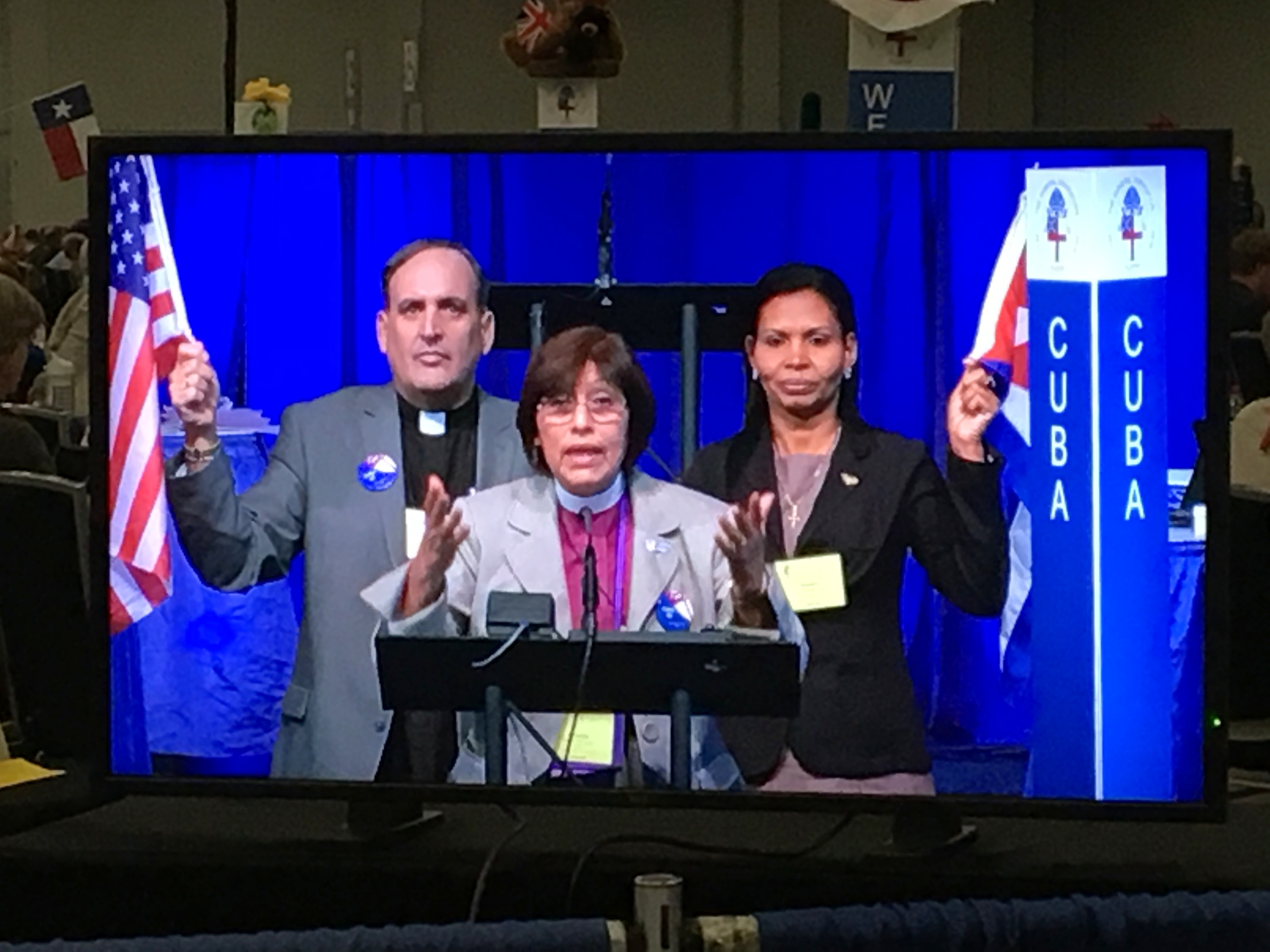 In 1966, in light of the Cuban Revolution and the political response of the United States, the House of Bishops voted to separate from the Diocese of Cuba from the Episcopal Church, leaving it an autonomous diocese without a provincial home. The clergy scattered, some returning or immigrating to the US, but some who remained in Cuba were imprisoned, executed, or disappeared; priests lost their pensions, and they operated in isolation from the Church. Cuba officially requested to be reaffiliated with the Episcopal Church and was given a list of requirements before admission. As of GC79, all of those conditions had been met. However, leading up to the resolution coming to the floor of both the Deputies and Bishops, there was controversy on what it would mean, how this admission might impact the admission of other Dioceses (or their exit), how to affirm already elected bishops (assuming they had not followed the current practices of approval for bishops in the Episcopal Church), among other concerns. In other words, there was a desire to right the wrong done 52 years ago, but some anxiety about the implications of the decision.
 Seeking and Serving