
Tags
anxiety, bishops, change, cheer, concern, Cuba, Episcopal Church, family, General Convention, God, home, House of Bishops, humbling, mercy, reconciliation, right, wrong
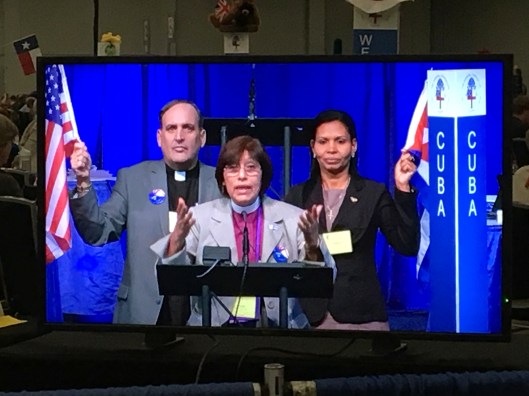 In 1966, in light of the Cuban Revolution and the political response of the United States, the House of Bishops voted to separate from the Diocese of Cuba from the Episcopal Church, leaving it an autonomous diocese without a provincial home. The clergy scattered, some returning or immigrating to the US, but some who remained in Cuba were imprisoned, executed, or disappeared; priests lost their pensions, and they operated in isolation from the Church. Cuba officially requested to be reaffiliated with the Episcopal Church and was given a list of requirements before admission. As of GC79, all of those conditions had been met. However, leading up to the resolution coming to the floor of both the Deputies and Bishops, there was controversy on what it would mean, how this admission might impact the admission of other Dioceses (or their exit), how to affirm already elected bishops (assuming they had not followed the current practices of approval for bishops in the Episcopal Church), among other concerns. In other words, there was a desire to right the wrong done 52 years ago, but some anxiety about the implications of the decision.
As an alternate deputy, I had the leisure of observing either House. On Tuesday, I happened to be observing the House of Bishops when resolution A238 came to the floor. Each testimony pleaded for righting the wrong done by the House of Bishops in 1966. Retired bishop Leo Frade from the Diocese of Southeast Florida spoke passionately about the resolution. As a Cuban American who had been a part of the Church in Cuba, he got quite emotional in his plea for the bishops to do the right thing. When it came time for the vote, the vote was a unanimous approval for readmittance. The entire house – bishops and visitors – exploded. Cheers and clapping filled the room, and the standing ovation lasted several minutes. Unbeknownst to me, the Bishop of Cuba was present and was invited to approach the platform to address the House. Bishop Curry embraced her. The House broke into singing the Doxology.
Bishop Griselda Delgado’s speech was the most humbling. Despite every reason to feel resentful or hurt, Bishop Delgado communicated nothing but forgiveness and reconciliation. “We are family,” she insisted. And although we severed the relationship so many years ago, she insisted, “Cuba never left.” Her sentiments struck me as the exact way that God sees us. When we reject God, God never leaves us. When we abandon God, we do not abandon our familial ties with God. Bishop Delgado’s profound sense of right relationship, reconciliation, and forgiveness brought the House to tears. We did not deserve her mercy, and yet there she was, offering mercy. When Bishop Delgado said, “The Holy Spirit is here,” I knew she was right. In response, Presiding Bishop Curry said, “The Bishop may take her seat at Table 7.” Those words were words of righting a wrong – fully, completely, unconditionally.
The experience the next day was equally powerful in the House of Deputies. They too needed to approve the resolution, and it also passed unanimously. Bishop Delgado spoke there too, but equally powerful was the triangular sign with the word, “Cuba” written on it. It was processed to a table, and the deputies from Cuba were seated in the House of Deputies. “Welcome home,” pronounced President Jennings.
What I loved about the approval of this resolution was seeing how legislation can powerfully effect change. Sometimes, in the weeds of parliamentary procedure, and canonical revisions, one can wonder if all we are doing is navel gazing. But on these days, we watched first-hand the commitment to change, the willingness to boldly repent, and the receiving of mercy. Surely the presence of this Lord has been in this place!
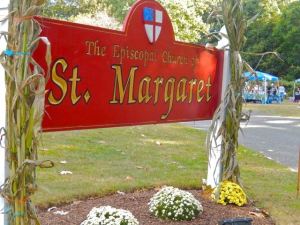 This Saturday our parish has its Annual Fall Fair – a festive gathering with vendors, food, children’s activities, raffles, and other fall merriment. We are blessed with an 11-acre property, so the event is a wonderful way for us to welcome people to our grounds and remind the community that they are welcome here. Having done this event for so many years, most of our parishioners know what needs to be done – signs, publicity, donors, coordinating vendors, setting up the property, making baskets, bringing in donations. The list goes on. But even though we all know what needs to be done, there is usually a bit of anxiety and stress to make sure the event is a success, especially in the week leading up to the event. As someone who can become easily stressed, I totally understand the reaction. Though I am not involved in the execution of the event, I always empathize with our parishioners as the tension builds in this final week.
 This month has been one of those months at church that has been super busy. Three out of four Saturdays have had events, and Sundays have been full too. That alone can be exhausting, as many of us have commiserated. But I was thinking about it today, and the truth is that all of the things we are doing are a big deal. I think that some of our exhaustion is not just because our weekends have been full, but that the things that have been filling our time are emotionally and spiritually significant.
 I have been pondering for the last ten days what to say about the experience of Hurricane Sandy. I think I felt overwhelmed because I knew that my experience was not as bad as thousands of others in our area. My experience felt superficial somehow, as if I did not earn enough credit to have something to say about all of this. But what I realized these last couple of days is that although I cannot speak for places that were utterly devastated by this horrible storm, I can speak for what life has been life for the rest of us, tied to those who are suffering more while suffering ourselves.
 Finally, I have been struck by the overwhelming ways in which this storm has brought out the goodness in others. My parishioners have been running extension cords across the street to share power with others. I observed all of us talking to one another more – learning more of each others’ stories – caring more about the welfare of each other. People without power themselves have bent over backwards to make sure my family was okay. Friends and parishioners have taken us in for hot meals and for washing laundry or for simple camaraderie. People long to help others even when they are suffering. There is a sense of abundance in the face of devastation. There is joy watching a toddler find creative ways to entertain herself. And the outpouring of love from all over the region is even more overwhelming. I have felt like that wall that keeps us from sharing Christ with one another has been decimated, and Christ is found all around us as we love and care for one another.
