• About

Seeking and Serving

~ seek and serve Christ in all persons

Seeking and Serving

Tag Archives: blessing

On Finding Family…

23 Thursday Apr 2020

Posted by jandrewsweckerly in Uncategorized

≈ Leave a comment

Tags

blessing, church, crisis, family, friends, genuine, harm, imbalance, invitation, invite, Jesus, love, rich, unconditional

Better family conversations

Photo credit:  https://www.psychologies.co.uk/five-ways-better-family-conversations

Families are a funny thing.  We are born into them, and have no choice about their makeup.  Some of us are blessed with large or small families that nurture and care for us.  Some us are born into hurtful, abusive families.  And some of us navigate our way as we age, realizing who in our immediate and extended family build us up, and who we can minimize time with or avoid altogether because they do not know how to love us.  As we age, we redefine family – perhaps with friends and lovers who love us better than the family members we were born into, or perhaps with groups of people who understand us and create a sense of “home.”

For some of us, that group is Church.  Now I know churches have been some of the worst offenders – places of pain, abuse, or just meanness.  But Church can also be the family you choose – the place where you are loved unconditionally, feel a sense of belonging, and discover a sense of purpose and meaning.  Church is the place where an unrelated elder can offer care and wisdom you have longed for, where a child teaches you what joy, laughter, and love feel like, and where a once (and maybe still) stranger can pray for you in ways that reaches your soul like never before.  The people of Church can be the vehicle through which we experience the unconditional love of Christ.

What has struck me about this time of separation is how much the separation has made it easier for us to invite people into that family of Church.  Whether a neighbor sharing about their seriously ill parent leads us to invite them to join us for online prayers; whether a friend is struggling with their children and finds our invitation to enjoy online Godly Play or accessible teaching materials; or whether someone who has not been able to step foot on a church property feels less threatened by a Sunday online worship service – we are finding invitation to be a much more organic, genuine experience – because we need that sense of family, we need that love of Christ.

But what has struck me even more deeply has been the shifting dynamic within our Church “family.”  Instead of inviting people “in” to the church, this has been a beautiful time of us being invited “out” – finding how much malleability our family has.  Invitation during this time has not simply been about inviting people into “the family” so that they can experience the blessings we have, but has also been about inviting people into the family because our family is not complete – there are people we did not even know could make us feel whole who we are meeting because Church looks so different right now.  That kind of role reversal can create a sense of imbalance and vulnerability – but it can also create a richer sense of family and loving community.  In our separation from the body of Christ, we are learning just how vast the body of Christ really is.  We may not have been looking for it, or even realized we needed it, but I am grateful for the ways this crisis is growing our family, and expanding the ways we can experience Christ’s love.

On the Blessings of Interdependence…

04 Wednesday Mar 2020

Posted by jandrewsweckerly in Uncategorized

≈ Leave a comment

Tags

blessing, Christ, Christian, community, help, interdependence, Jesus, need, prayer, role reversal

interdependence

Photo credit:  https://bcalmbcorp.com/rising-interdependence-agreements-are-not-so-far-5947ba50d170

This past Sunday was my first attempt to start using my voice professionally after a bout of laryngitis.  My voice was feeling strained after the second service, so I wandered away from coffee hour and back in the nave to reorder my sermon and rest my voice.  As I was there, I noticed the volunteers at the healing altar tidying up their station.  I have never visited the station in my almost four years of ministry here because I am usually administering or assisting with communion at the time they are working.  But as my gaze settled on them, I realized there might be no better time to get some healing prayers.

In receiving the parishioner’s prayers for healing, I began to understand how much I have had to lean on others for help in this illness:  from the deacon to help with pastoral care calls (because I literally couldn’t speak), to the two retired priests who helped lead services I could not have led alone, to the choir who sang a song so powerful it became a healing balm, to the countless parishioners who prayed for me and simply patiently waited for my strength to return, to my own family who kindly trudged through family life with a Magna Doodle board.  As a person whose job is to care for a community of people, it is a strange feeling to not only not be able to do your job, but also to need the kind of care you usually offer to your own community.

I’ve been thinking this week how much we need, and yet rarely get, that kind of role reversal in our lives.  We are all problem-solvers, hard workers, and generally responsible for ourselves in life.  But sometimes, whether through injury, illness, or other obligations, we simply cannot fulfill our responsibilities or expectations, and are left at the mercy of others.  I am convinced that these seasons of need are the only thing that is keeping us in check to thinking we have no need for community.  Being at someone else’s mercy from time to time teaches us how interdependent we truly are – not only upon one another, but upon Christ.

Being a part of a community you can trust with that vulnerable need for mercy is at the heart of the Christian experience.  Without leaning into the community from time to time, we cannot learn how to lean into Jesus – how to come to Christ for help when everything is overwhelming, difficult, or seemingly impossible.  By learning to say, “I need your help,” to other human beings, we train ourselves to do the same with God – to honestly and authentically say to God, “I need your help.”  If you do not have that kind of community in your life, please know that you are always welcome at Hickory Neck.  And if you are a part of our community, and have not yet leaned into to others, know that our interdependence is mutual!  You are needed here!

The Pilgrim’s Way…Day 5

11 Tuesday Feb 2020

Posted by jandrewsweckerly in Uncategorized

≈ Leave a comment

Tags

beautiful, blessing, body, connection, Eucharist, evensong, evocative, God, instrument, intimate, liturgy, music, pilgrimage, power, Salisbury, sound, spiritual, Winchester

84338524_2889910537731854_333793429337145344_n

Photo credit:  Jennifer Andrews-Weckerly; reuse with permission only

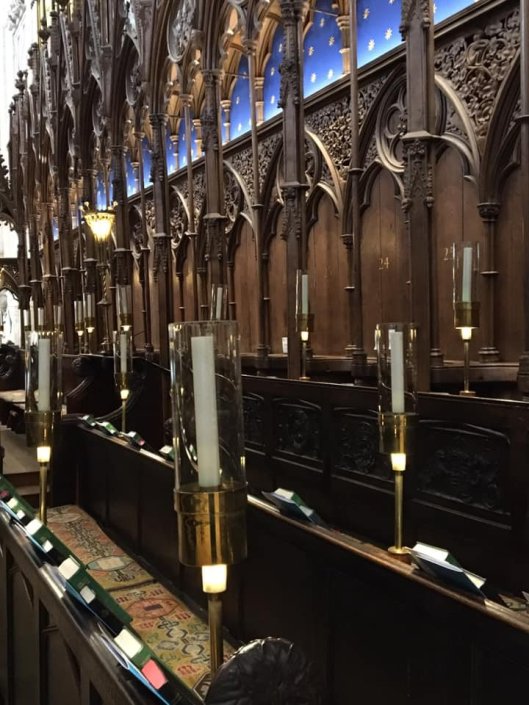
Sixteen pilgrims from Hickory Neck Church traveled to England for 8 days of pilgrimage.  Our focus was on choral music, hearing Evensong or Choral Mass at a Cathedral, Minster, or college everyday.  This is the fifth entry, initially posted on our church Facebook page.  For those of you who do not follow us on Facebook, I am repeating the journey’s daily entries here.  Enjoy!

Salisbury/Winchester

Today, I was struck by the tremendous power of liturgy. We stumbled into a midday Eucharist at Salisbury Cathedral. It was spoken, and the homily was humbly short, but poignant. Then, as the priest set the table, she asked if anyone was a licensed Chalicist. I didn’t volunteer for fear someone else would want to help, and even unsure what the rules were in the Mother Church. But as the priest finished the Eucharistic Prayer, I determined I would just go up and offer to help. As soon as the priest saw my collar, she gratefully handed me the chalice. I found myself profoundly moved: doing something almost innate, but something that also felt foreign in the vast space, in a country not my own. And yet the power of Christ’s meal knows no boundaries. His blood is shed for you, and my body is His instrument.

Later this evening, we attended Evensong at Winchester Cathedral. The Adult singers and boy Chorister’s voices sang in perfection: clean and clear, expressive and moving. Their anthem, Deep River, is the third movement of Michael Tippett’s oratorio about the Nazi government’s violent pogrom against its Jewish population—called Kristallnacht. Pulling from African-American spirituals, this last movement holds a message of hope for the possible healing that would come from Man’s acceptance of his Shadow in relation to his Light. Combining the sound of spirituals and Anglican Choral singing, and the message of justice and reconciliation, I felt all my spiritual worlds colliding, and the words and sounds brought me to tears. I was amazed by how evocative a piece a liturgical music could be. I left Evensong feeling like I had journeyed with God somewhere deeply intimate and profoundly beautiful.

I don’t know if you have had one of those liturgical moments lately. If you are longing for that kind of connection, you are always welcome at Hickory Neck. And if you have found that liturgical blessing, do share it with someone who needs it!

The lyrics for Deep River:

Deep river,
My home is over Jordan.
Deep river, Lord.
I want to cross over into campground.

Deep River,
My home is over Jordan.
Deep river, Lord,
I want to cross over into campground.

Oh, don’t you want to go,
To the Gospel feast;
That Promised Land,
Where all is peace?

Oh, deep river, Lord,
I want to cross over into campground.

86441337_2889910554398519_6456003992475402240_n

Photo credit:  Jennifer Andrews-Weckerly; reuse with permission only

On Birthdays and Blessings…

20 Wednesday Nov 2019

Posted by jandrewsweckerly in Uncategorized

≈ Leave a comment

Tags

big, birthday, blessing, celebrate, God, gratitude, life, little, thankful, ultimate

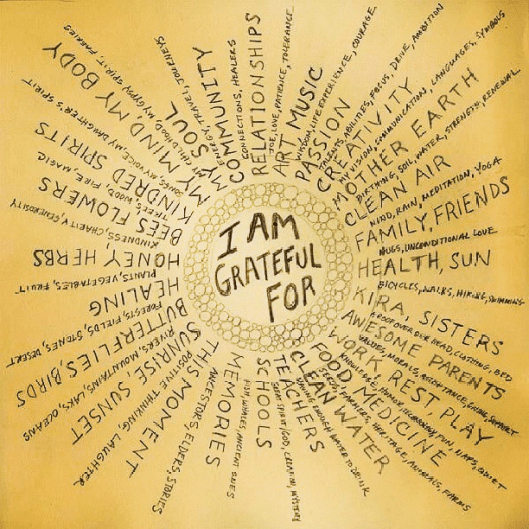
gratitude

Photo credit:  https://www.lupus.org.uk/lupus-trust-uk-news/2019/8/2/qzppdr7brifhgd5i9zi7h8o1ia34i0

My husband and I experience our birthdays very differently.  He is perfectly happy to have a quiet, reserved day, wanting to be acknowledged, but not wanting a lot of attention on him.  I, on the other hand, love have a ton of attention on my birthday – songs, cake, cheers, you name it.  So when my daughter insisted I wear a “It’s My Birthday!” sash yesterday, I only hesitated for a second.  What was funny about the sash was the experience I had wearing it.  The funniest reactions were probably at the bus stop.  I think most of the kids must have parents more like my husband as they seemed surprised I was celebrating.  But one kid in particular asked me, “So are you having a big party with your friends tonight?”  When I replied I was not, her response was, “Yeah, I guess you’re too old, huh?”

It’s funny how a six-year old can make you question your life.  I was suddenly wondering, “Should I have assembled a party?  Should I have found other big ways to celebrate?”  But as the evening closed yesterday, I reflected on what my day of celebration entailed:  a breakfast, including eggs and coffee, my children proudly made by themselves; a lunch in the school cafeteria with my older daughter and her friends; an evening watching my younger daughter’s ballet class – an activity I cherished growing up; a surprise dinner by my husband, fully ready upon our return home; not to mention cards, cupcakes, and endless texts, calls, and social media messages.  It wasn’t a party in the traditional sense, but it did feel like wonderful day of celebrating life – my life here and now.

In the last couple of weeks, I have administered last rites, conducted a funeral, spent several days with my dad who was in the hospital, talked to families dealing with crisis, consoled the bereaved, baptized a baby, and heard people’s life stories for the first time.  When you are that deep in the reality of life, parties or treats no longer seem necessary.  What suddenly becomes important are the ultimate things of life – breath, family, loved ones, intimacy, little life moments.

To help me keep celebrating, I invite you this week, to slow down and look at the blessings all around you.  I know some of you are hurting, some of you are just trying to get by, and some of you don’t have that many stressors right now.  Wherever you are, take a moment today to give thanks to God for all your bountiful blessings – big and very small.  Each breath, each day, each year is a gift.  Tell me where you are feeling grateful.  I’d like to celebrate with you!

Sermon – Luke 14.25-33, P18, YC, September 8, 2019

11 Wednesday Sep 2019

Posted by jandrewsweckerly in Sermons, Uncategorized

≈ Leave a comment

Tags

blessing, community, cost, cross, decisions, discipleship, easy, hard, hate, Jesus, light, possessions, priorities, rainbows, Sermon, sunshine

One of the things I enjoyed about living on Long Island was the directness of communication.  Now do not get me wrong, having been raised in the South, I know all too well that when your mom says, “You’re wearing that?” or if your grandma says, “Don’t you want to wear lipstick?” or if your friend says, “Well those new shoes are utilitarian,” they are not actually saying what they mean.  On Long Island things are much clearer.  Instead you’ll be told, “Don’t wear that,” “Put on some lipstick; I’ll show you which one,” and “Those shoes are awful.”  The words always sting, but at least you know you what people think.

Today’s gospel has me convinced some of Jesus’ relatives were from Long Island.  In these short eight verses, Jesus says if we want to follow him, we will need to sell our possessions, carry our cross, and hate our parents, spouse, children, siblings, and even life itself.  I have to say, on this Rally Sunday, on the day we return to the fullness of Hickory Neck, and we feast and laugh and worship together, I could have used a little more southern-speak from Jesus today.  At least Jesus could have saved the hard sell for Stewardship season!

But as we start putting our calendars together for the fall, as our children sign up for the extracurricular activities, and as we think about what ministries we may want to try at Hickory Neck this fall, I suppose there is no time like the present to get real.  This is a season of hard choices.  I know in our household alone, there were two awesome opportunities for afterschool activities that fell on the exact same time and day.  And so we had to make a hard decision.  As I have mapped out my own calendar, I have realized that there are things I can say yes to and things to which I have to say no.  And on the really tricky days, there are times when our family has to bring in a third adult to help us juggle four people’s commitments.  This is a season of hard choices and consequences.  This is a season of priorities.

I do not actually think Jesus is being harsh today.  I know we sometimes get so used to the inclusive, loving, embracing God that we forget that following Jesus is not all rainbows and sunshine.  Jesus, like our beloved Long Islanders, is not harsh – just honest.  And Jesus is not saying there will be no health, healing, and wholeness; no justice, mercy, and grace; no forgiveness, salvation, and eternal life.  But Jesus is saying those things will cost us.  All those rainbows and sunshine we will receive come at the cost of redistributing wealth, of being faithful even when being faithful gets us ostracized from our social circles, of being intolerant of injustice even if doing so risks our most valued relationships with others.

If we can agree that Jesus is just being honest, understanding why he is setting such a high standard can be helpful.  Starting with one of the trickier things Jesus says today may be best.  Jesus says in the final verse today, “None of you can become my disciple if you do not give up all your possessions.”  Though money is a taboo subject for most people, Jesus talks about money perhaps more than any other subject in scripture.  Jesus talks about money so much because Jesus knows the power money has over us.  Jesus tells us to give up our possessions, to stop worrying about what is mine because my obsession with owning, possessing, or claiming things as my own can make me think ownership is my exclusive, inviolable right.  Jesus knows having possessions can make me think all things are my own:  my money, my time, my comfortable lifestyle, my political or religious beliefs, my closest relationship, my independence.  Jesus knows when I get possessive, I cling to things that are not God, and create habits in myself leading me to smother, not love; to exploit, not steward; to hoard, not appreciate.[i]

On the podcast “On Being,” Rabbi Amichai Lau-Lavie retells an old Talmudic parable.  In the parable there is “a ship that is sailing, and there are many cabins.  And one of the people in the cabins on the lower floor decides to dig a hole in the floor of his cabin, and does so, and sure enough, the ship begins to sink.  And the other passengers suddenly discover what’s going on and see this guy with a hole in the floor.  And they say, ‘What are you doing?’ And he says, ‘Well, it’s my cabin. I paid for it.’  And down goes the ship.”[ii]  What this parable and what Jesus are trying to do is help us see that possessions tempt us to live like the man in the cabin – to believe our ownership negates our relationship to others.  Our possessions can create an obsession with “me, me, me,” with a disregard for the “we” to which we belong as followers of Christ.

Jesus also says in verse 27, “Whoever does not carry the cross and follow me cannot be my disciple.”  Part of Jesus’ cross is a redefining of the “we,” we were just talking about.  If you have read your September Nuggets, our newsletter, you know one of the rallying calls of stewardship this fall is going to be “We are Hickory Neck!”  When I thought about that call, I immediately thought about the movie We Are Marshall.  In the film, the rally call “We Are,” answered vigorously by “Marshall!” is a definitive moment about not letting tragedy overcome goodness – not letting death squash life.  When we start our own rallying, “We are Hickory Neck,” we probably all have things about Hickory Neck that are dear to our heart, that inspire our belonging here, and motivate our involvement here.  One of the things we are doing in the call, “We are Hickory Neck,” is also defining who the “we” is in that call.  In carrying our cross as Jesus invites today, we are not just talking about personal sacrifice.  We are also asking, to whom and for whom we are responsible.  We are widening the circle of “my people,” to consider who the people are we will love, welcome, serve, and for which we would make sacrifices.  We are taking on the task of widening our “we” to be broader and riskier than we have previously embraced.  By taking up our cross, we are saying the whole ship, not just my cabin on the ship, but the whole ship has an irrefutable claim on my life.[iii]

Perhaps the hardest thing Jesus says comes right at the beginning, in verse 26.  Jesus says, “Whoever comes to me and does not hate father and mother, wife and children, brothers and sisters, yes, and even life itself, cannot be my disciple.”  Hate is a strong word – a word we have banned in our home, especially when talking about other family members.  I will not be going home today and telling our children they can pick up that word again.  But I do think Jesus uses a powerful word because the power of discipleship will involve taking on some powerful experiences.  We will need to be willing to hate some things about this life.  We will need to ask which customs, beliefs, or traditions we have inherited we need to renounce in order to follow Jesus.  We will need to look at what baggage we need to abandon, what ties we must loosen, what relationships we must subordinate.  What scholar Debie Thomas says is “Jesus spoke his hard words about ‘hating’ one’s family in a cultural context where the extended family was the source of a person’s security and stability.  Jewish families in first century Palestine were self-sustaining economic units.  No one in their right mind would leave such a unit behind in order to follow a homeless, controversial preacher into some uncertain future.”  What Thomas asks us to consider is what sources of modern-day security and stability we trust more than we trust God.[iv]

So if this is what discipleship looks like, where is the Good News in Jesus’ challenge today?  Why would we do all this hard stuff?  We do all the hard stuff of discipleship because of the rainbows and sunshine.  We give up a sense of possession, we take on crosses, and we renounce things we have loved because we have experienced the rainbows and sunshine of Hickory Neck:  we have experienced life-altering community here; we have experienced love, joy, and blessing we did not know we needed here; we have found purpose, meaning, and value here.  We also take on Jesus’ intense notion of discipleship because we have experienced the rainbows and sunshine of the world around us:  we have experienced the profundity of loving our neighbor as ourselves; we have experienced the blessing of seeing God in someone we thought unworthy of our love; we have experienced being transformed by walking right out of our comfort zones into life-giving discomfort zones.  We accept the invitation of illogical discipleship because of the more cosmic rainbows and sunshine of faith:  of being known and accepted by a loving, living God; of the promise of forgiveness of our most heinous sins; of the reality of eternal life made possible through Jesus’ life, death, and resurrection.  Once we start thinking about the rewards of the life of discipleship, the cost seems surmountable.  Once we look at the depth of Christ’s rainbows and sunshine, letting go of possessions, taking up crosses, and hating the stuff of life that only brings death seems much less scary.  Once we realize we may not be able to do whatever we want to in our cabin, we realize we have a ship full of people ready to hold our hands as we take on the burden of discipleship together – because the burden is easy and the yoke is light.  Amen.

[i] Debie Thomas, “What It Will Cost You,” Journey with Jesus, September 1, 2019, as found at https://www.journeywithjesus.net/lectionary-essays/current-essay?id=2346 on September 4, 2019.

[ii] Amichai Lau-Lavee, “First Aid for Spiritual Seekers,” On Being with Krista Tippet, July 13, 2017, as found at https://onbeing.org/programs/amichai-lau-lavie-first-aid-for-spiritual-seekers/ on September 6, 2019.

[iii] Thomas.

[iv] Thomas.

Sermon – Acts 16.9-15, E6, YC, May 26, 2019

29 Wednesday May 2019

Posted by jandrewsweckerly in Sermons, Uncategorized

≈ Leave a comment

Tags

blessing, community, convergence, conversation, conversion, divine, evangelism, faithfulness, God, guidance, Jesus, Lydia, obvious, Paul, Sermon, spiritual

Before I went to seminary, I participated in a program at my parish called EFM – Education for Ministry.  I know many Hickory Neck parishioners have done the program, but for those of you who are unfamiliar, the program is a four-year program where a small group of people gather and each year study a different topic – Old Testament, New Testament, Church History, and Theology.  When I was taking the class, during one of the scripture years, I was traveling by plane alone and I was sorely behind in my scripture reading.  So I threw my overly large study bible into my bag, planning to use flight time and layover time in airports to catch up on my scripture reading.  Now, I do not know if you have ever thought about taking a huge study bible along with you to an airport, but I would encourage you to think long and hard before you do.  Over the course of the day I found I could barely read in peace.  I had a middle-aged woman chat endlessly about her church and bible studies she had enjoyed.  And of course, there were tons of people who just stared at me warily trying to figure out what my angle was and making sure they had a ready escape just in case.  You would think the lesson from my trip would be, “Take a Bible with you, and see what evangelism opportunities the Bible creates.”  But to be honest, I found myself wanting to never carry a Bible with me again in an airport.

These days, I find wearing a collar has a similar effect.  Just this week, I was in a parking lot and some man approached me about giving money to his ministry.  After I agreed to take some information instead of giving him cash, he asked me what the thing around my neck was.  When I told him I was an Episcopal priest, he gave me a smirk, and kind of grunted as he turned away and looked for his next “customer.”  Most often when I am in my collar, people stare – sometimes discretely, but other times I have to catch their eye before they realize how blatantly they are staring.  Other times – probably my favorite times – people will tentatively ask me if I am clergy and then will ask some really interesting questions, sometimes even asking me for a prayer.

I get to have a lot of God conversations because of my collar.  But when I am in plain clothes, and I imagine for most of us here, finding ways to engage others about faith is trickier.  We certainly could lug around a huge study bible.  We could print up some Hickory Neck gear and either hope people talk to us, or make sure the gear says “Ask me about my church!”  We could get really bold and when we are at the coffee shop put up a little sign that says, “Ask me about Jesus and I’ll buy you a cup of coffee.”  Or we could take the opposite tack, and just hope not only someone will randomly talk to us, but also the conversation will magically shift toward spirituality, church, or God.

Truthfully, when most of us think about evangelism or having spiritual conversations, we kind of wish we could be a little like Paul in our scripture lesson today.  Paul travels from town to town, receives direct instruction from God about where he should go, and when he and his group talk with a group of praying women, one of them – in fact, a prominent, powerful woman of wealth, not only decides to be baptized, but also invites Paul and his group to stay in her home.  When we think about evangelism, or at least the baptismal covenant promise we make to share Good News, we want something similar.  We want God to be super obvious about where we should go and to whom we should speak.  We want to know if the coffee shop, the grocery store, or the brewery will be the place where we can avoid awkwardness and have a meaningful conversation.  We would love to know we are going to talk to a group of spiritually-minded people who are open to what we have to say.  And, secretly, we would be thrilled if whatever conversation we have leads to a total conversion – someone as enthusiastic as Lydia who wants to come with us to church on Sunday.  If Jesus, the church, or our crazy clergy keep insisting that we talk to people in our community and have God conversations, we at least want to be assured we will have as smooth of an experience as Paul.

But that’s the funny thing about Paul’s experience.  Paul does not really seem to know how to handle this evangelism thing much better than us.  In the verses of Acts before our text today, we are told that Paul starts out for Asia, but the Holy Spirit prevents him from going there.  As Paul keeps trying cities on the way to Europe, he finally has a dream where a man from Macedonia implores him to come and help.  But once Paul finally makes his way to Macedonia, the man from his vision never appears.  In fact, Paul and his crew hang out for several days in the city, not seeming to do anything.  Not until the sabbath does Paul seek out people who are already worshiping.  Paul does not approach strangers or people whose faith is unknown to him.  Instead, he finds the familiar – people of his own tradition, praying to God, and there he decides to share his faith.  And although Paul thought he was bringing blessing to others, Lydia is the one who brings blessing to him – offering her home and hospitality, and continuing to do so when Paul gets in trouble with the law (which is a story for next week!).

At the heart of what happens in our story today is what theologian Ronald Cole-Turner calls the “inexplicable convergence of human faithfulness and divine guidance.”  According to Cole-Turner, “Paul would not have been guided to this place at this moment, were he not first of all at God’s disposal, open to being guided, sensitively attuned to being steered in one direction and away from all others.  Lydia would not have arrived at this place or time, had she not first of all been a worshiper of God, a seeker already on her way.  Paul does his part and Lydia hers, but it is God who guides all things and works in and through all things, not just for good but for what would otherwise be impossible.”[i]

That is our invitation today: to be faithful.  To be willing to listen to God, to be willing to speak, even when we worry what others might think of us, and to be willing to listen to and honor the story of others.  That is really all Paul does – rather clumsily, but faithfully.  And we can be faithful in that way – on the golf course, at work or school, at the local eatery, because we know that there will be an inexplicable convergence of our faithfulness with divine guidance.  We can be faithful because we know God will show up.  God will make sure we have that casual conversation that leads to us talking about why in the world we would work so hard to get ourselves and/or our families here every Sunday.  Jesus will make sure that when someone is sharing something vulnerable or painful with us, we will be able to name God’s presence in the midst of their experience.  The Holy Spirit will make sure that when we open our mouths, despite the fact we have no idea what to say, something meaningful will be said.  Divine guidance will be there because of our human faithfulness.  Inexplicably converging, and working for good.  I cannot wait to hear your stories of convergence!  Amen.

[i] Ronald Cole-Turner, “Theological Perspective,” Feasting on the Word, Yr. C, Vol. 2 (Louisville: Westminster John Knox Press, 2009), 476.

On Community, Connection, and Blessing…

16 Thursday May 2019

Posted by jandrewsweckerly in Uncategorized

≈ Leave a comment

Tags

blessing, community, connect, development, God, joy, kind, knowledge, lead, leader, love, people, small, Williamsburg

community-building-for-entrepreneurs

Photo credit:  https://innovationlabs.harvard.edu/events/community-building-entrepreneurs/

One of the things people say about Williamsburg is that it is a small town in the truest sense.  You cannot go too far without running into someone you know – or someone who knows you through someone else.  I find that reality to be true at church all the time.  Someone will come visit the church looking for a church home, and lo and behold, they realize they work (or worked) with a parishioner without realizing they attended Hickory Neck.  Or I will have coffee with a newcomer, and we realize we have friends and acquaintances in common.  In Williamsburg, there really is about two, if not one, degree of separation between most people.

In some ways, that is very good for a pastor.  One of the many things we learn about in seminary is how important it is for clergy to get out in the community, to get to know the people surrounding them – not with the intention of evangelism; more with the intention of being a leader who can authentically lead within their community.  That was one of the major reasons I applied to be in the LEAD Greater Williamsburg program.  The program is a community immersion program for emerging and existing leaders, who also do a community service project for the wider community.  As I approach graduation this week, I am especially grateful for this aspect of the program.

What LEAD taught me affirmed what I learned in seminary – it is so important to understand, know, and appreciate the community within which you do ministry.  As much as I thought I had gotten to know many people in Williamsburg, the monthly classes and my 28 fellow classmates helped me see that there are so many people, companies, and agencies that I did not know.  Maybe some people are okay with that lack of knowledge, but for me, working on that knowledge gap has not only helped me understand my own ministry better, it has helped me fall in love with the community even more.  I am overwhelmed by the diverse, myriad ways that greater Williamsburg residents work to make our community better.  This community is filled with incredible, inspirational people, and I surmise I have only scratched the surface.

Today, my reflection is two-fold.  One, I am filled with gratitude for the amazing opportunity of being in the LEAD program this past year.  Thanks to my classmates for an incredible year of making WMBGkind!!  The blessings abound – from knowledge, to leadership development, to friendships, to joy!  But two, I find myself wanting to connect more, and I would like to invite you to do the same.  Whether you are here in the Greater Williamsburg area, or even in your own hometown, think about someone you have wondered about or admired from afar, and ask them to coffee.  Get to know the people of your community – really know them:  their work, their home life, their fears, and their joys.  My guess is that the more you expand your connection to people in your community, the more you will see ways in which God is inviting you to bring blessing to your community!

God’s Gifts in the Chaos…

19 Wednesday Dec 2018

Posted by jandrewsweckerly in Uncategorized

≈ Leave a comment

Tags

Advent, beauty, blessing, breath, chaos, Christmas, crazy, gift, God, kids, life, moments, relationship, sacred

kids jumping on the bed

Photo credit:  https://www.pinterest.com/pin/214835844696012029/

Every December since our elder child was about two or three years old, the same thing happens.  The anticipation of Christmas turns our children into possessed creatures.  They argue more, act out in school, whine at the drop of a hat, and generally become entirely unpleasant to be around.  No matter how much I try to minimize the excitement of Christmas, the buzz around them is unavoidable, and, ergo, crazy behavior.  I found myself so frustrated the other day with the constant effort to reign them in that I had the distinct thought, “I just wish Christmas was over already!”

But I soon as had the thought, I knew I did not mean it.  You see, despite the mayhem of the season, in these last days of Advent, there are still sacred moments everywhere.  As we read our Advent devotional this week, one of the questions was, “Who are you praying for this Advent.”  My younger daughter immediately said, “I want to pray for all dead people.”  “Oh,” I said, “like whom?”  “Like MeeMaw,” she said.  And despite the fact that they nearly broke half the ornaments that came out of the ornament box, now, every morning, both girls rush to the tree to plug in the lights and find the ornaments that play Christmas tunes or funny sounds, twirling around in their nightgowns to the sounds.  And last week, as they had their Christmas dance performances, I teared up watching them, remembering how very special dance had been to me growing up.

The same can be true in any season.  Whether we are putting our heads down, trying to finish one more project, or absorbed in technology for extended periods of time, or simply fixated on our endless to-do lists, we can achieve a lot, but miss life along the way.  Fortunately, we are blessed with a God who is continually trying to get our attention anyway – who is relentless in pursuing relationship with us.  In these last days of Advent, God invites us to take a deep breath, lift up our heads, and open our eyes to the beauty of the sacred all around us.

Hickory Neck offers us the opportunity to do that over the next several days.  Whether you come to our Blue Christmas service, our last Advent liturgies, Christmas Eve services, or the service on Christmas Day, there will be multiple times to see glimpse of the sacred all around you – ways in which the manger is a window into the greater redemptive work God is doing in the world.  Whether it’s with an encouraging word from our Blue Christmas service, the sharing of memories at an upcoming funeral, or the wedding vows that one couple will renew on Christmas Day (sixty years later!), what we learn is that in the chaos of life, God is gifting us sacred gifts in tiny, momentous ways.  Today, I invite you to receive God’s gifts among the chaos.

Homily – Mt. 11.25-30, St. Francis Feast, YB, October 21, 2018

24 Wednesday Oct 2018

Posted by jandrewsweckerly in Sermons, Uncategorized

≈ Leave a comment

Tags

blessing, easy, healing, homily, hurt, Jesus Christ, light, love, pets, reconciliation, relationship, rest, sabbath, Sermon, St. Francis, village, wolf, yoke

FrancisOfAssisi

Photo credit:  http://thewildreed.blogspot.com/2007/10/st-francis-of-assisi-dancer-rebel.html

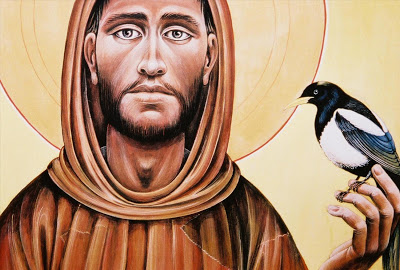
Today we honor the life of St. Francis of Assisi.  Francis is one of the most popular and admired saints of all time.  Most of us know the highlights of his story: born the son of a wealthy man in 1182; had a conversion experience and devoted his life to Lady Poverty; shaped monastic and lay devotion; was a friend to all God’s creatures – being known to have preached to the birds.  But the story I like most is the story about St. Francis and the Wolf.

According to legend, there was a wolf that was terrorizing a nearby town, killing and eating animals and people.  The villagers tried to fight back, but they too died at the jaws of the wolf.  Francis had pity on the people and went out to meet the wolf.  When Francis found the wolf, he made the sign of the cross, and said, “Come to me, Brother Wolf.  In the name of Christ, I order you not to hurt anyone.”  The wolf calmly laid down at Francis’ feet.  Francis then went on to explain to the wolf how the wolf was terrorizing the people and other animals – all who were made in the image of God.  The wolf and Francis then made a pact that the wolf would no longer harm the town and the town would no longer try to hurt the wolf.  The two traveled into town to explain the pact they had formed.  The people were amazed as Francis and the wolf walked side-by-side into town.  Francis made the people pledge to feed the wolf and the wolf pledge not to harm anyone else.  From that day on, the wolf went door to door for food.  The wolf hurt no one and no one hurt the wolf; even the dogs did not bark at the wolf.[i]

What I love about this story of St. Francis is that the story is about reconciliation and relationship.  At the beginning of the story the town and the wolf are at an impasse – the wolf is hungry and getting attacked; the people are afraid and are lashing out.  What Francis does for both parties is shock them out of the comfortable.  For the wolf, no one has addressed the wolf kindly – they have either shut the wolf out or actively tried to kill the wolf.  For the people, the wolf has not asked for help – he has simply and violently taken what he needed and wanted.  Francis manages to shock the wolf first – not through violence or force, but with the power of love and blessing.  By giving a blessing in the name of God, Francis is then able to implore the wolf to reciprocate with love.  Francis also manages to shock the village – not with a violent victory, but with a humble display of forgiveness and trust.  By walking into town with a tamed wolf at his side, Francis is able to encourage the town to embrace, forgive, and care for the wolf.  Francis’ actions remind both parties that unless their relationships are reconciled, unrest and division will be the norm.

The funny thing about this story is that the story is pretty ridiculous.  I mean, how many of us go around talking to wild animals, blessing them with the sign of the cross, expecting anything other than being attacked?  We will never really know whether the story is true.  But like any good Biblical story, or even any good midrash, whether the story is true is hardly the point: the point is that the stories point toward “Truth” with a capital “T.”  What this story teaches is that peace and reconciliation only happen through meeting others where they are.  We cannot expect great change unless we are willing to get down in the trenches – to go out and meet that destructive wolf face-to-face.  The other thing this story teaches is relationships are at the heart of reconciliation.  Only when the wolf and the town began to get to know each other and began to form a relationship with one another could they move forward.

This is the way life is under Jesus Christ.  In our gospel lesson today, Jesus says, “Come to me, all you that are weary and are carrying heavy burdens, and I will give you rest.  Take my yoke upon you, and learn from me; for I am gentle and humble in heart, and you will find rest for your souls.  For my yoke is easy, and my burden is light.”  Jesus’ words have layered meaning.  The first meaning we all catch is that Jesus offers us rest and refreshment.  Jesus encourages us to come to him, to cast our burdens and cares upon him, and to take rest, to take Sabbath in Christ.  Our souls will find peace in Christ Jesus.  The second meaning is that peace in Christ Jesus is not without work.  Jesus does not say come unto me and relax forever in happy retirement.  Jesus says we will still have to take on a yoke – the burden of disciple living.  But luckily, that burden of being Christ’s disciple will not be burdensome – it will be light.  Finally, not only will Jesus make the workload “light,” as in not heavy:  Jesus will also make us “light” – as in lights that shine into the darkness and refuse to allow the shadow to overwhelm[ii]; as in lights that shine on this very Holy Hill where Hickory Neck rests.  We become the light when we work for reconciliation in our relationships with others.

That is why we do so many special things today.  Today, we ask for prayers and then exchange signs of peace – that God might help us reconcile the relationships in our life that need healing.  Today, at our 9:00 am service, we ask for blessing on our animals – that God might help our relationship with our pet be one of blessing and light.  Today, we come to Jesus for Sabbath rest – that God might renew us on this Sabbath day, use the rest to fill us with light, and renew our commitment to be agents of reconciliation, gladly putting on Christ’s yoke.  Amen.

[i] John Feister, “Stories about St. Francis and the Animals,” October 4,2005, as found at https://faith32.livejournal.com/61897.html on October 18, 2018.

[ii] Mel Williams, “Let it go…and rest” Faith and Leadership, July 6, 2014 as found at http://www.faithandleadership.com/sermons/mel-williams-let-it-go%E2%80%A6and-rest  on October 18, 2018.

On Sacred Listening…

26 Wednesday Sep 2018

Posted by jandrewsweckerly in Uncategorized

≈ Leave a comment

Tags

blessing, conversation, evangelism, faith, God, hear, listen, sacred, share, stories

trh_the_act_of_listening_wide-dbad5dfa36f0cf8f405acaa9ba328c0dc33de9b8-s800-c85

Photo credit:  https://www.npr.org/programs/ted-radio-hour/411697251/the-act-of-listening

Last week and this week, our curate is leading Hickory Neck in a forum on evangelism.  The work of the class is ultimately about sharing and listening to sacred stories.  True evangelism happens not when we tell people what they should believe or that they should come to church with us, but when we listen deeply to people’s stories and reflect where we see the sacred in those stories.

I realize this all may sound a little touchy-feely for many of us, but the truth is, even if you never called it “sacred storytelling and sacred listening,” you have likely experienced the phenomenon.  Think about the last time you encountered someone who was such a good listener you were pouring out your soul to them, without even actively choosing to do so.  Or recall those times when you have shared some of the heavy things on your heart and the listener pointed out where they saw God in the darkness in a way that lightened your entire perspective.  Those holy moments do not happen very often, but when they do, we feel a sense of transformation and the nearness of God.

That’s what evangelism is all about – not a manipulative way of coaxing out stories so that you can convert someone, but a willingness to stand in the fray with people (be it friend, neighbor, or stranger) and wait for God.  That kind of openness is a tremendous gift and privilege – to you, to the other, and to the world.

This past week, I have had the privilege of having lots of conversations – about faith, religion, children, church, and politics.  Some have been with church members, some have been with new acquaintances, and some have been with strangers.  And to a person, in every conversation, I find that I experience more blessing and renewed faith in our God than I even realized I needed.  This week, I invite you into those sacred storytelling and sacred listening opportunities, whether it’s with someone you know or someone you have never met.  I know that sounds scary, but you will be surprised how often someone is willing to share if they know someone is really listening.  If you are willing to accept the invitation, I suspect you will come to church on Sunday with a sense of renewal and restored faith.  I can’t wait to hear your stories!

← Older posts
Newer posts →

Recent Posts

  • On the Myth and Magic of Advent…
  • On Risking Failure and Facing Fear…
  • Sermon – Luke 23.33-43, P29, YC, November 23, 2025
  • On Inhabiting Gratitude…
  • Sermon – Luke 20.27-38, P27, YC, November 9, 2025

Archives

  • December 2025
  • November 2025
  • October 2025
  • September 2025
  • August 2025
  • July 2025
  • June 2025
  • March 2025
  • February 2025
  • December 2024
  • November 2024
  • October 2024
  • September 2024
  • August 2024
  • July 2024
  • June 2024
  • May 2024
  • March 2024
  • February 2024
  • January 2024
  • December 2023
  • November 2023
  • October 2023
  • September 2023
  • August 2023
  • July 2023
  • June 2023
  • May 2023
  • March 2023
  • February 2023
  • January 2023
  • December 2022
  • November 2022
  • October 2022
  • June 2022
  • May 2022
  • January 2022
  • December 2021
  • November 2021
  • October 2021
  • September 2021
  • August 2021
  • June 2021
  • May 2021
  • April 2021
  • March 2021
  • February 2021
  • January 2021
  • December 2020
  • November 2020
  • October 2020
  • September 2020
  • August 2020
  • July 2020
  • June 2020
  • May 2020
  • April 2020
  • March 2020
  • February 2020
  • January 2020
  • December 2019
  • November 2019
  • October 2019
  • September 2019
  • August 2019
  • July 2019
  • June 2019
  • May 2019
  • April 2019
  • March 2019
  • February 2019
  • January 2019
  • December 2018
  • November 2018
  • October 2018
  • September 2018
  • August 2018
  • July 2018
  • June 2018
  • May 2018
  • April 2018
  • March 2018
  • February 2018
  • January 2018
  • December 2017
  • November 2017
  • October 2017
  • September 2017
  • August 2017
  • July 2017
  • June 2017
  • May 2017
  • April 2017
  • March 2017
  • February 2017
  • January 2017
  • December 2016
  • November 2016
  • October 2016
  • September 2016
  • August 2016
  • July 2016
  • June 2016
  • May 2016
  • April 2016
  • March 2016
  • February 2016
  • January 2016
  • December 2015
  • November 2015
  • October 2015
  • September 2015
  • August 2015
  • July 2015
  • June 2015
  • May 2015
  • April 2015
  • March 2015
  • February 2015
  • January 2015
  • December 2014
  • November 2014
  • October 2014
  • September 2014
  • August 2014
  • July 2014
  • June 2014
  • April 2014
  • March 2014
  • February 2014
  • January 2014
  • December 2013
  • November 2013
  • October 2013
  • September 2013
  • August 2013
  • July 2013
  • June 2013
  • May 2013
  • April 2013
  • March 2013
  • February 2013
  • January 2013
  • December 2012
  • November 2012
  • October 2012
  • September 2012

Categories

  • reflection
  • Sermons
  • Uncategorized

Meta

  • Create account
  • Log in
  • Entries feed
  • Comments feed
  • WordPress.com

Blog at WordPress.com.

  • Subscribe Subscribed
    • Seeking and Serving
    • Join 394 other subscribers
    • Already have a WordPress.com account? Log in now.
    • Seeking and Serving
    • Subscribe Subscribed
    • Sign up
    • Log in
    • Report this content
    • View site in Reader
    • Manage subscriptions
    • Collapse this bar
 

Loading Comments...