• About

Seeking and Serving

~ seek and serve Christ in all persons

Seeking and Serving

Tag Archives: change

Sermon – Luke 6.27-38, EP7, YC, February 24, 2019

27 Wednesday Feb 2019

Posted by jandrewsweckerly in Sermons, Uncategorized

≈ Leave a comment

Tags

change, commands, discipleship, God, hard, intentional, Jesus, kindness, love, loving kindness, mercy, Sermon, shelter, sickness, symptoms, system

Last week, we joined the entire community of Williamsburg in performing acts of kindness.  When we issued the charge two weeks ago to go out and perform three acts of kindness, the reactions were pretty wide-ranging at Hickory Neck.  Several parishioners addressed me with concern, “I have to do three?  Can’t I just do one act before next Sunday?”  Other parishioners took on the challenge with gusto – with several parishioners plotting out what they were going to do before they even got back to the parking lot.  While other parishioners noted during the week and the days afterwards how shockingly easy the challenge was.  “I felt silly writing down my acts of kindness.  I mean, I do acts of kindness every week,” shared one parishioner.

I am not sure which perspective was predominant, but I can tell you that Hickory Neck performed over 100 acts of kindness that week.  There were some simple acts:  holding doors for strangers, paying people compliments, and writing thank you notes.  Some were a little more labor intensive:  volunteering at a food pantry, helping out at your child’s school, going through your closet to donate clothes.  Others showed some real effort:  listening to a stranger who seemed to need a friend, making Valentines for the whole class – even the kids you do not like, visiting someone in the hospital – even though you hate hospitals.

Now I know several parishioners who thought our challenge was a bit silly or who felt uncomfortable with the idea of drawing attention to our own good works.  Surely we should just be doing acts of kindness every week.  But for those of you who jumped in with both feet, my hope is that you got a tiny glimpse into what can happen when you start living out kindness more intentionally:  your whole way of being starts to shift.  When you do acts of kindness, the more opportunities for additional kindness seem to appear.  The more you think about kindness, the more you start to notice kindness all around you.  And the more you engage in kindness, the more your whole demeanor shifts – from one of staying in your lane, attending to your daily routine, to lifting up you head and noticing how you can shift the community around you.

That seismic shift is what Jesus is talking about in Luke’s gospel today.  Many of us hear the instructions from Jesus as a list of commands or a checklist of duties:  love your enemies, do good to those who hate you, bless those who curse you, pray for those who abuse you; do not judge, do not condemn, forgive, and give.  If we look at today as a list of commands from Jesus, then we might as well consider this week as Week Two of an acts of kindness challenge – except this time, Jesus asks us to do acts of kindness for those to whom showing kindness is the hardest.  When we read Jesus’ words like a weighty list of to-do items, this gospel feels just that – full of weight and guilt with no promise of hope or encouragement.  And part of what Jesus is saying is just that:  showing kindness is actually pretty hard when we show kindness to those who are hardest to love.  We do not mind showing kindness to friends, and we do not even really mind showing kindness to strangers.  But asking us to show kindness to those who we actively dislike or to those who have hurt us?  Now Jesus is pushing us way out of our comfort zones!

At the beginning of February, the Greater Williamsburg area kicked off a commitment to becoming a community of kindness with a rallying event.  The former Mayor of Anaheim, California, Tom Tait, who had run on a campaign of kindness, was the keynote speaker.  Mayor Tait talked about his time on City Council in Anaheim, how part of his work felt like a game of whack-a-mole.  Each month, some crisis or community problem would arise – violence in the community, the prevalence of drugs, problems in the public schools.  And the City Council’s response felt like trying to whack at the problem to temporarily knock the problem out.  But those solutions never really made a deep impact.  What Mayor Tait saw was all those problems were like symptoms – symptoms of a city that was facing an internal sickness.  The only way to heal the internal sickness was to commit as a city to transform its entire way of operating.  Mayor Tait believed transformation would occur by committing to kindness.  To many, the idea sounded a little too pie-in-the-sky.  But once elected, Mayor Tait was forced to try to live out the reality of kindness.  With every decision, every major action, the community wondered together what would reflect kindness.  And slowly, the illness in the system began to heal.  Kindness was not a Band-Aid, but a system-altering antidote to a host of problems.

In a lot of ways, that is what Jesus is talking about today.  Yes, the things Jesus is talking about are commands – a list of ways to be kind, even to the persons to whom being kind is most difficult.  But Jesus is not just talking about commands.  As one scholar describes, “Jesus isn’t offering a set of simple rules by which to get by or get ahead in this world but is inviting us into a whole other world.  A world that is not about measuring and counting and weighing and competing and judging and paying back and hating and all the rest.  But instead is about love. Love for those who have loved you.  Love for those who haven’t.  Love even for those who have hated you.  That love gets expressed in all kinds of creative ways, but often come through by caring – extending care and compassion and help and comfort to those in need – and forgiveness – not paying back but instead releasing one’s claim on another and opening up a future where a relationship of …love is still possible.”[i]

What Jesus is doing is trying to, “inculcate, and illustrate, an attitude of heart, a lightness of spirit in the face of all that the world can throw at you.”  We are to assume this new way of being because “that’s what God is like.  God is generous to all people, generous…to a fault:  [God] provides good things for all to enjoy, the undeserving as well as the deserving.  [God] is astonishingly merciful…”  As N. T. Wright adds, “…this list of instructions is all about which God you believe in – and about the way of life that follows as a result.”[ii]  When we take Jesus seriously, and embrace this new way of being, the way of kindness that leads to love, life can be “exuberant, different, astonishing.  People [will] stare.”[iii]

In a lot of ways, what Jesus does to today is saying, “I see your week of kindness, and I raise you to life of loving-kindness.”  In other words, keep going.  Now, fortunately for us, Hickory Neck has set up the perfect set of circumstances for you to try on this new life of loving-kindness.  Tonight, we open our doors to strangers.  Tonight, we open our doors to some people we will find easy to love, and some people that will make us uncomfortable.  Tonight, we open our doors to some late nights, really early mornings, and hard labor.  But tonight, we also open our doors to a new way of being – a way of opening ourselves to live exuberantly, differently, astonishingly – to live like God.

Now I know one week (or even the one shift or duty you signed up for at the Winter Shelter, or even the financial contribution you made) may not change the world necessarily.  Jesus is talking about a seismic change in the way we live our lives every day.  But the Winter Shelter is a pretty good start.  And the good news for you, is Lent is coming, and we’ve set up all kinds of tools for you to embrace this way of loving-kindness.  Instead of a week of kindness, we have a whole 40-day kindness challenge.  We have a devotional set of readings that reflect on kindness, story, and scripture for forty days.  We will be studying kindness in scripture.  Hickory Neck has assembled the tools to help you not just try simple deeds for a week, or not just try the hard stuff of relationship with the homeless for a week – but instead to try on a new way of being – to take on the way of God.  Part of what Hickory Neck is all about is empowering discipleship – empowering you to go out into the world and live as faithful witnesses of Christ.  This is what discipleship is all about.  And Hickory Neck is here to help – to walk with you, to lift you up when you fall, to hold your hand in the hard parts, and to revel in the joy of watching love win.  We cannot wait to enter in to this most sacred time of loving-kindness with you!  Amen.

[i] David Lose, “Epiphany 7 C:  Command or Promise?” February 22, 2019, as found at http://www.davidlose.net/2019/02/epiphany-7-c-command-or-promise/ on February 22, 2019.

[ii] N.T. Wright, Luke for Everyone (Louisville:  Westminster John Knox Press, 2004), 73-74.

[iii] Wright, 74.

Hope in the New Year…

02 Wednesday Jan 2019

Posted by jandrewsweckerly in Uncategorized

≈ Leave a comment

Tags

calendar, change, God, Holy Spirit, hope, Jesus, New Year, possibility, resolution

hopearmsraisedskycreditShutterstockcom

Photo credit:  https://www.beliefnet.com/inspiration/articles/god-can-turn-your-hurt-into-hope.aspx

I am not really a New Year’s resolution kind of person.  I am not really sure why.  Part of my resistance may be observing how fleeting the resolutions are for most people.  Part of my resistance may also be that the New Year happens so close after Christmas, a season where I am usually wiped out from an intense month of church work, with little creativity or energy for a new routine.  Or maybe my resistance is related to how cold it is in January, leaving me wanting to stay home and nest as opposed to getting out to try something new.

Truthfully, I am much more motivated by Lent to make significant changes in my life.  I like that Lenten disciplines are more spiritual in nature.  I like that Lenten disciplines are done in community, so I find much more accountability in my church community for whatever discipline I have assumed.  And I also like Lenten disciplines because they are for a contained amount of time – forty days always seems more tenable than a whole year!

But this year, something about the calendar year changing has been more motivating.  Opening up a new calendar feels quite freeing – as if there are twelve months of a clean slate for me to write the story of this year.  There are new adventures to be had, new relationships to build, new experiences to savor.  Somehow, 2019 seems full of possibility in a way that I have not felt before this year.  Perhaps having a restful Christmastide helped, or maybe visiting with family has opened my eyes to the many blessings in my life.  Regardless, despite all that is wrong in the world these days, I am feeling full of hope for all that can be for 2019.  I have a sneaking suspicion that God is up to something new for us and I cannot wait to see what it is!

What about you?  How are you entering this new year?  How are these 364 days in the new year speaking to you?  Where do you hear the Holy Spirit speaking hope to you?  I cannot wait to hear what new things God is doing in your life, what ways to Spirit is whispering light in your ear. Share with me or with a friend what glimmers of hope you are experiencing this year, and then let that hope start to burn in your heart.  Nothing is more powerful than our hope in Christ Jesus!

Homily – Ruth 3.1-5, 4.13-17, P27, YB, November 11, 2018

14 Wednesday Nov 2018

Posted by jandrewsweckerly in Sermons, Uncategorized

≈ Leave a comment

Tags

acceptance, Armistice Day, baptism, Boaz, change, covenant, dignity, God, gun violence, honor, life, Naomi, respect, Ruth, sanctity, Sermon, veterans

My intention today had been to talk about Emersyn, whose baptism we will celebrate today, and the gift that she is giving us through her baptism.  When we baptize someone into the family of faith, we also take time to remember our own baptismal covenant.  We remember the promises we make about how we will live our lives, promises we just renewed last week at another baptism.  One of our promises is to respect the dignity of every human being – to respect human life.

We respect human life because we learn to do so in Holy Scripture.  Today, Ruth, Naomi, and Boaz teach us how to respect life.  If you remember, Naomi is a widow who has not only lost her husband and her two sons, but who is left shepherding two foreign daughters-in-law; she is so shattered, she asks people to call her Mara, which means bitterness, instead of Naomi, which means pleasantness.  Ruth, one of those daughters-in-law, is equally bereft; having married into a foreign family, widowed herself, she pledges allegiance to a people who point out her foreign identity at every turn – in fact, she is regularly called, “Ruth, the Moabite from Moab” – or in common language, “Ruth, the foreigner from a foreign land (a land the people hated, by the way).  Boaz is an upright man, put into a precarious situation by Naomi, who sends Ruth to lay at his feet so that he might serve as their redeemer.  But despite the fact life is hard, life brings sorrow, and life treats us like a hated foreigner, Ruth, Naomi, and Boaz respect the dignity of each other.  They respect life.

We need people like Emersyn, Ruth, Naomi, and Boaz because we have been doing a pretty horrible job of respecting life lately.  In just the past two weeks, we have had four “soft target” attacks in our country.  “Soft targets” are attacks that happen in simple, everyday life – where people are having a cup of coffee, celebrating with friends over food and drink, picking up groceries, or worshipping in their house of worship.  In the last two weeks, 27 people were slain in soft target areas:  Two shoppers were gunned down in a Kroger parking lot in Kentucky; Eleven people were gunned down while worshiping in a synagogue in Pittsburgh; Two women were gunned down in a yoga studio in Florida; and twelve people were gunned down in a bar in California.[i]  We can pray for the victims, and attempt to find motives behind shootings, and even bemoan the mental health system.  But until we are willing to make concrete changes, we as Americans disrespect life.  We as Christians fail to respect the dignity of every human being when we do nothing to change our culture of acceptance around gun violence.

Our Veterans helped us understand this failure many years ago.  One-hundred years ago, this day was marked not as Veterans Day, but as Armistice Day – the day we were able to stop a war, to stop aggression, to stop the denigration of life on both sides.  Armistice Day was a day to honor the end of World War I, but perhaps even more powerfully, Armistice Day was a day to honor the dignity of every human being.  On that day, after 8.5 million soldiers had been killed, 100,000 of which were American, you could see the sheer joy in people’s faces as they flooded the streets, realizing death would be no more – that human life would be honored once more.[ii]

Today we have the opportunity to celebrate too.  We have the opportunity to honor and respect the sanctity of life – the life of beautiful baby Emersyn, the lives of our Veterans, and the lives of those shattered by unrestrained gun violence.  The question is whether we will accept the invitation.  Scholar Cameron Howard says in the book of Ruth, we do not experience God in the story as some divine physical presence, as a booming voice from heaven, or as a visible mover of events; instead, we experience God through the characters in the book – God is revealed to the world through the actions of the characters of Ruth, Naomi, and Boaz.[iii]  The world is not that much different today.  The world needs to see God through us too.  Emersyn needs to see God through us.  Our community, state, and nation need to see God through us.  The growing population of those scarred by gun violence need to see God through us.  The only question remaining is whether we will say “yes,” to the invitation, or at least, “I will with God’s help.”  I promise God’s help is waiting for you when decide to respect the dignity of every human being through your actions, revealing God’s presence in the world.  Amen.

[i] Eliott C. McLaughlin, “This is the 4th ‘soft target’ Attack in 2 Weeks,” November 8, 2018, as found at https://www.cnn.com/2018/11/08/us/soft-targets-thousand-oaks-bar-shooting/index.html on November 9, 2018.

[ii] Alexis Clark, “In Photos Unpublished for 100 Years, the Joy of War’s End on Armistice Day,” The New York Times, November 9, 2018, as found at https://www.nytimes.com/2018/11/09/world/europe/armistice-day-100th-anniversary-photos.html on November 10, 2018.

[iii] Cameron B.R. Howard, “Commentary on Ruth 3:1-5; 4:13-17,” November 11, 2018, as found at http://www.workingpreacher.org/preaching.aspx?commentary_id=3890 on November 8, 2018.


On the Sanctity of Life…

31 Wednesday Oct 2018

Posted by jandrewsweckerly in Uncategorized

≈ 1 Comment

Tags

change, complicit, God, goodness, holy, image of God, life, mass shooting, sacrifice, stewardship

Life-Is-Sacred-Main-881x496

Photo credit:  https://bigvalleygrace.org/life-is-sacred/

This past Sunday, I was assigned to be the preacher.  I had done my research and preparation, I had incorporated the theme from our stewardship campaign which would be culminating on Sunday, and I had finished the sermon by Saturday morning.  By that evening though, I found out there had been another mass shooting, this time at a synagogue in Pittsburgh.  This one was particularly heart-wrenching because it was at a place of worship, committed by someone who explicitly wanted to persecute people from the Jewish faith – my brothers and sisters.  So, on Saturday night, I had the age-old question of a preacher:  do I need to change my sermon?

Ultimately, I decided to mark the event liturgically with our prayers, but not address the incident in my sermon.  I could not preach about it because I was not ready.  Something about this incident hit me differently, but I could not yet articulate it.  And one of my homiletics professors always told me if you are going to preach something pastorally sensitive, make sure you have carefully constructed your sermons to pastorally address the issue.  And I just wasn’t there.

But in the days since the massacre, and after having a few conversations with parishioners about their frustration that I didn’t mention it, I am finally beginning to be able to articulate why this particular mass shooting is so upsetting.  The problem for me with this shooting was not that it occurred in a place of worship.  Despite the fact that I think those places are sacred places, gunmen and those with bombs have long desecrated houses of worship.  The problem for me was not that the shooting was anti-Semitically motivated.  Christians have long been complicit in anti-Semitism and if we are going to get upset about a shooter, we need to be equally upset about our own culpability in not rooting out that sin.  The problem for me is that this mass shooting was the final straw in helping me see that we as a country, and more importantly, we as a Church, have become complicit with the devaluing of all life – that same very life we claim to be made in God’s image, and created in goodness.

That accusation may feel harsh for you, as you are not likely a person who has ever committed violence with firearms on another person.  But until we as a society, and we as Church, decide that human life is sacred, these incidents will never stop.  The Oklahoma City Bombing happened weeks before I graduated from high school.  The Columbine High School massacre happened weeks before I graduated from college.  Essentially, for my entire adulthood, our country and our Church has not been willing to definitely say, “No, this is not who we will be.  We will make concrete changes so that this doesn’t happen again.”  And so it keeps happening.   At colleges, in schools, at workplaces, in homes, and in houses of worship.  To African-Americans, to immigrants, to the LGBTQ community, to Jews, Christians, and Muslims.  To teachers protecting students, to police officers protecting innocents, to mothers protecting children.  Yes, I am outraged that eleven beautiful children of YHWH were murdered senselessly in their most sacred place of worship.  But I am also outraged that we as a people are unwilling to do something about it.  We are so scared of losing, of sacrificing, of giving up something that we do nothing.  We become complicit, unable to hear from a mother who lost her kindergartener and say, “This will not happen again.”  And so it does.  Again, and again, and again.  Because this is who we are.  In our unwillingness to change, we have become a country who does not value life, who does not stand up for what is sacred, who does not see God in every human being.

My dear readers, I implore you, please take this day or this week or this month to do better.  I know it is hard, and compromise is nearly impossible in our current political climate, and you deserve certain rights.  But when the Lord our God created us in God’s image, God said that it was very good.  Our job while on this earth is to protect that goodness – even if it means not winning, sacrificing, and giving up some things.  Because until we are willing to make a change – any change – this is our reality.  This is our America.  This is our norm.  I don’t want that.  And I suspect you don’t either.  So, crawl with me.  Creep with me.  Scratch with me to make our way back to that blessed place where we hold life as sacred, where we stand in the light with all our brothers and sisters and see the holy in each one of them, where we can look at another person, no matter what political views they have, and say, “it is very good.”  And then help us to live into that goodness.

On Dreams, Change, and Gratitude…

05 Wednesday Sep 2018

Posted by jandrewsweckerly in Uncategorized

≈ Leave a comment

Tags

baptismal covenant, change, church, community, courage, deferred, dreams, faithfully, Holy Spirit, hope, humility, investment, Jesus, kingdom of God, need, proud, tenacity, Thanksgiving, work

Safe in each others' hands

Photo credit:  http://debragaz.com/2016/10/17/we-can-walk-together/

This week, as the buzz of insects filled the air, the heat reflected off the pavement as the sun rose, and the smell of blooming flowers lingered nearby, I greeted families and watched an age-old tradition of parents dropping off children at school.  Some of the families were rushed, the parents trying to get off to work.  Some families took things more slowly, savoring the goodbye of the day.  Some families were worn down by anxiety and tears – of children and adults.  In the hubbub of greeting these families, reality hit me:  Hickory Neck did it!

You see, over ten years ago, the community of Hickory Neck Episcopal Church had a dream – to turn the blessing of property into a blessing for the community:  meeting a desperate need for childcare in our part of our county.  Countless hours were spent by many church members planning, calculating, and organizing.  It would take a tremendous investment to create a school from scratch, but the passion and vision were there.  Unfortunately, the preparation was complete right before the economic recession hit.  And the dream was deferred.

But the needs did not change – in fact they grew as the presence of young families, especially those transplanted away from extended family, grew in our neighborhood.  Hickory Neck’s dream was what a Search Committee invited me to participate in:  to help them take the dream off the shelf, and live out their baptismal covenant more fully in their particular context.  And so, the work began again.  After months of discernment and honest conversations, we realized Hickory Neck’s dream could still meet the needs of the community.

A year later, on a steamy September morning, I was struck with a sense of awe by the Hickory Neck community.  I have been a part of many congregations, and one thing I have learned is most communities resist change.  They might need change; they might want change; they might even say they are ready for change.  But in the deep recesses of their minds and hearts, they do not really want change.  Change is scary and could disrupt what drew them there in the beginning.  But Hickory Neck is different.  Hickory Neck is a community who has been fluid and flexible, who even when her dream began to morph and change, did not dig in her feet, but instead stepped out into the unknown and said yes to the Holy Spirit.  The humility, boldness, courageousness, creativity, and gumption of Hickory Neck brought me to my knees this week.

I am so proud of our community for trying a brave new way of ministry – one that comes from the congregation, will be nurtured by the congregation, and will eventually feed the congregation.  Though I have helped navigate logistics behind the scenes, the truth is, I feel so incredibly privileged to simply accompany Hickory Neck in the fulfillment of her dream.  In these last two and half years, Hickory Neck has given me hope in the future of the church universal.  If communities of faith can cast a vision that betters the surrounding community, journey through adversity to achieve that dream, and then actually live into that dream faithfully, then I think there is hope beyond measure for the kingdom of God.

A few weeks ago, a county official said to me, “You must be so proud of yourself for doing such good work at Hickory Neck.”  But I shared with him, “No, I’m so proud of Hickory Neck.  They are an inspiration to me every day.”  Today, I thank you, Hickory Neck.  I thank you for your witness of bravery, passion, and hard work.  I thank you for inspiring me to be a better priest.  I thank you for letting me be a part of this fantastic journey, in this fantastic community, doing the fantastic work of Jesus.  I am so proud of what Hickory Neck has already accomplished.  I cannot wait to see where we go next!  Oh, and if you are not already connected to Hickory Neck, I encourage you to stop by.  You are in for an incredible treat.  Don’t worry:  we’ve already saved you a seat!

GC79: Reconciliation in Real Time

20 Friday Jul 2018

Posted by jandrewsweckerly in Uncategorized

≈ Leave a comment

Tags

anxiety, bishops, change, cheer, concern, Cuba, Episcopal Church, family, General Convention, God, home, House of Bishops, humbling, mercy, reconciliation, right, wrong

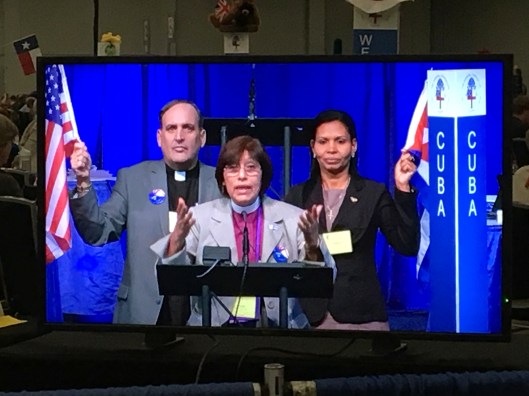
IMG_1927In 1966, in light of the Cuban Revolution and the political response of the United States, the House of Bishops voted to separate from the Diocese of Cuba from the Episcopal Church, leaving it an autonomous diocese without a provincial home.  The clergy scattered, some returning or immigrating to the US, but some who remained in Cuba were imprisoned, executed, or disappeared; priests lost their pensions, and they operated in isolation from the Church.  Cuba officially requested to be reaffiliated with the Episcopal Church and was given a list of requirements before admission.  As of GC79, all of those conditions had been met.  However, leading up to the resolution coming to the floor of both the Deputies and Bishops, there was controversy on what it would mean, how this admission might impact the admission of other Dioceses (or their exit), how to affirm already elected bishops (assuming they had not followed the current practices of approval for bishops in the Episcopal Church), among other concerns.  In other words, there was a desire to right the wrong done 52 years ago, but some anxiety about the implications of the decision.

As an alternate deputy, I had the leisure of observing either House.  On Tuesday, I happened to be observing the House of Bishops when resolution A238 came to the floor.  Each testimony pleaded for righting the wrong done by the House of Bishops in 1966.  Retired bishop Leo Frade from the Diocese of Southeast Florida spoke passionately about the resolution.  As a Cuban American who had been a part of the Church in Cuba, he got quite emotional in his plea for the bishops to do the right thing.  When it came time for the vote, the vote was a unanimous approval for readmittance.  The entire house – bishops and visitors – exploded.  Cheers and clapping filled the room, and the standing ovation lasted several minutes.  Unbeknownst to me, the Bishop of Cuba was present and was invited to approach the platform to address the House.  Bishop Curry embraced her.  The House broke into singing the Doxology.

Bishop Griselda Delgado’s speech was the most humbling.  Despite every reason to feel resentful or hurt, Bishop Delgado communicated nothing but forgiveness and reconciliation.  “We are family,” she insisted.  And although we severed the relationship so many years ago, she insisted, “Cuba never left.”  Her sentiments struck me as the exact way that God sees us.  When we reject God, God never leaves us.  When we abandon God, we do not abandon our familial ties with God.  Bishop Delgado’s profound sense of right relationship, reconciliation, and forgiveness brought the House to tears.  We did not deserve her mercy, and yet there she was, offering mercy.  When Bishop Delgado said, “The Holy Spirit is here,” I knew she was right.  In response, Presiding Bishop Curry said, “The Bishop may take her seat at Table 7.”  Those words were words of righting a wrong – fully, completely, unconditionally.

The experience the next day was equally powerful in the House of Deputies.  They too needed to approve the resolution, and it also passed unanimously.  Bishop Delgado spoke there too, but equally powerful was the triangular sign with the word, “Cuba” written on it.  It was processed to a table, and the deputies from Cuba were seated in the House of Deputies.  “Welcome home,” pronounced President Jennings.

What I loved about the approval of this resolution was seeing how legislation can powerfully effect change.  Sometimes, in the weeds of parliamentary procedure, and canonical revisions, one can wonder if all we are doing is navel gazing.  But on these days, we watched first-hand the commitment to change, the willingness to boldly repent, and the receiving of mercy.  Surely the presence of this Lord has been in this place!

Getting on the Ride…

10 Wednesday Jan 2018

Posted by jandrewsweckerly in Uncategorized

≈ Leave a comment

Tags

adventure, change, community, dream, excitement, exciting, fear, God, Holy Spirit, inviting, ministry, new, ride, rollercoaster, thrill

the-dragon

Photo credit:  https://www.legoland.com/california/legoland-california/rides-and-attractions/park-areas/castle-hill/rides/the-dragon/

On our family vacation last week, we visited an amusement park.  My eight-year old was finally at the age where she could try some more ambitious, if not scary, rides.  Watching her experiment with her fear and curiosity was fascinating.  Before most rides, she was completely enthusiastic and daring.  But waiting in line seemed to rattle her confidence.  Several times, we almost bailed completely.  In fact, one of my favorite pictures of her was taken right before she boarded a particularly scary ride (one even I was too scared to try!).  In the picture, her eyes are like saucers and her eyebrows are raised as she clutches her father’s hand.  But for the rest of the trip, she raved about that particular ride and almost cried when she realized she could not ride the rollercoaster one more time.

I was thinking this week that adults are not that dissimilar from my daughter when it comes to something new and exciting.  There is a part of us that cannot wait to try something new, and there is a part of us that is terrified about the experience, imagining in our minds the countless things that could go wrong or that might happen.  As with any change, we have the option to get on the ride and experience the thrill of something new, or we have the option to play things safe, and step out of line.  I suspect there are times when getting out of the line is the best option.  But more often, I suspect we miss out on adventure and new life when we don’t just step onto the ride.  Too often we forget that we can get on the ride and still say, “I am glad I tried it.  And now I will never do that again!”

Last night, the James City County Board of Supervisors approved a special use permit for the Kensington School to put a second location on the property of Hickory Neck Episcopal Church.  Hickory Neck has been dreaming about creating a school on our property for about ten years.  We kept deferring the dream because we were not sure we could both build and run a school.  But this past year, the Holy Spirit intervened, and we discovered that the Kensington School was looking to open a second location in our neighborhood.  God seemed to be inviting us to finally step onto a thrilling, albeit a bit scary, ride.  We have been standing in line for a while, getting more and more excited about what God can do through Hickory Neck.  Last night, the Board’s approval was our last step before boarding the ride.

Like with any change, this new phase of ministry will be full of exciting, wonderful things we never expected, and some challenging, hard things we never expected.  Part of our work is trusting the same Holy Spirit that has been guiding us thus far will continue to guide and lighten our path.  Some of us may be wide-eyed, with eyebrows raised about what is coming next.  But I suspect in a year or so, most of us will be thrilled that we said yes to the Holy Spirit, and agreed to try to be a force for change for our community.  I am here, with you, Hickory Neck – holding your hand and ready for the adventure!

Sermon – Isaiah 40.1-11, Mark 1.1-8, A2, YB, December 10, 2017

13 Wednesday Dec 2017

Posted by jandrewsweckerly in Sermons, Uncategorized

≈ Leave a comment

Tags

Advent, busyness, change, God, Good News, Isaiah, Jesus, John the Baptist, manger, prepare, prophecy, repent, repentance, Sermon, way

This Advent, I have been sensing in myself a need to prepare for the Christ Child a little differently.  The busyness of life has me longing for a season of quiet reflection, of anti-consumerism, of less…well…busyness.  In some ways, the church has made accommodations for that desire.  The music in Advent is a bit more muted and quietly beautiful.  The offerings of yoga or even the Blue Christmas service make room for quiet meditation and reflection.  Even my Advent devotion this year of taking daily photos based on a provided word has forced me to look around more intentionally at life.  When I heard Isaiah’s words this week, “Prepare the way of the Lord,” my spirit had been hoping Isaiah’s preparation meant slowing down and creating an inner openness to the Holy Spirit.

Although I am sure Jesus would be all too happy to have me slow down a bit, my Advent longings may be a bit too passive for what Isaiah and John the Baptist are trying to accomplish.[i]  Of course, you can see where I may have gone astray.  Isaiah is speaking to a people in exile:  far from their homeland, oppressed by a foreign power, being forced to assume a foreign culture, God finally speaks a word of comfort to God’s people.  “Comfort, O Comfort my people,” says the Lord to Isaiah.  They are soothing words to a downtrodden people.  They are words of affection to an affection-starved nation.  They are healing words to a broken group of followers.  But those words of comfort are not followed by a cozy bed of meditation and contemplation.  Instead, those comforting words are followed by a call to action, “In the wilderness prepare the way of the Lord, make straight in the desert a highway for our God.”  God is about to do a new thing, but in order to do that new thing, the people of God must prepare the way through repentance.  Now I know we usually reserve repentance talk for Lent, but in this season of preparing for a new thing – of preparing for the Christ Child – the prophet tells the people of God they need repentant hearts.

One of the courses of study for parish priests and counselors is called family systems.  The study of family systems looks at human behavior through the lens of behavior within families, looking at ways families handle conflict, how they engage one another, and how they solve problems.  Patterns we learn in our families are taken into other systems.  One of the main lessons we learn from family systems is that you cannot change the behavior of others; you can only change your own behavior.  But changing your own behavior is not as easy as the change sounds.  Any of us who saw our mother behave like her mother, only to one day see that same behavior in ourselves realizes how hard changing our patterns can be.

When we talk about repentance, that is the kind of deep change we are talking about.  Repentance is not wallowing in guilt, feeling badly about something we said or did (or keep saying or doing).  Repentance is acknowledging our sinfulness and working to change our behavior.  The word “repent,” actually means to turn around; to turn away from sinful behavior and walk another way.  So when John the Baptist recalls Isaiah’s words, saying, “Prepare the way of the Lord,” he’s not saying, unpack your creches, put up the greens, and buy some presents.  Prepare the way of the Lord means making sure your heart is ready for the coming of the Christ Child – a feat you cannot accomplish if your heart is heavy with sin and regret.[ii]

Now do not get me wrong – I have pulled down the boxes of Christmas decorations, hung a wreath, and have purchased some gifts.  Those are honored traditions that bring us great joy, and I believe God wants us to be a people of joy.  But I suspect that if your heart is heavy-laden with the sins of life, or if you are so busy with the busyness of life that you have disconnected from God, your joy this year at the arrival of the Holy Child will not be as deep as your joy could be.

I have met many a church member who loathes the season of Lent for the focus on repentance.  I am sure they would be cringing today by the ways I am squashing Advent too.  But here is the reason why we have to talk about repentance today.  The gospel lesson we read from Mark contains the very first eight verses of Mark.  Mark introduces his gospel with these words, “The beginning of the good news of Jesus Christ, the Son of God.”  The reason John the Baptist is so excited, and is quoting Isaiah in our text today is that he knows what is coming is good news.  And so, when John quotes Isaiah with the words, “Prepare the way of the Lord,” he really means two things.  First, he means do the active work of preparing your heart for the Lord.  Not just the awesome, touchy-feely stuff of centering yourself or finding a quiet space, but the hard stuff of repentance.  And second, John means do the work of sharing the good news.  The work of Advent and the joy of Christmas is not just for us.  When your heart is bursting on Christmas Eve with joy because you did the tough work or repenting and returning to the Lord, don’t you want someone with which to share your joy?   One of the ways we prepare the way of the Lord is to share the good news of God in Christ with others.[iii]

Now I know what you are going to say, “Here she goes again, talking about inviting people to church.”  Or maybe you are thinking, “Yeah, but people who come on Christmas Eve usually only come once a year, so why bother?”  The good news about spreading the good news is that you are likely going to spread that good news in spite of yourself.  You see, when we do the work of repentance, of changing our hearts, minds, and hands to doing the work of God, a renewed spirit is kindled in us, and a deep joy burns in us.  The work of repentance creates in us a clean heart, and renews a right spirit within us.  And when we feel the love of God overwhelming us, we cannot help but let slip to our neighbor, “I know you have a church home, but I just want to share how awesome my experience at church has been lately.  If you ever want to come with me, I would be happy to bring you.”  Or when your friend is expressing his deep sadness and sense of loneliness, you find yourself saying, “I have been there.  But I have to tell you, every time I leave church, something about my encounter with God and community makes me feel less alone.”  Or when a stranger is ranting about how awful the church and Christians have been lately (which, we know some awful things are happening in the name of Christ lately), you find yourself saying, “I totally agree.  That is why I love my church so much – because they show me another way of witnessing to Christ.  I would love to show you sometime!”

I realize you may have been hoping for a word of comfort and permission to quietly prepare your heart for the Christ Child today.  Lord knows I have been longing for that this week too.  But turning my busyness into purposeful preparation:  for repentance and sharing the good news sounds much more fulfilling and life-giving.  The coming of the Christ Child, the fulfillment of the prophecy of Isaiah, is a life-altering event.  Today, the church prepares us for not arriving at the manger with check-lists done, gifts in hand, and arms full of stuff.  Instead, the church prepares us for arrive at the manger with open arms, free of the burdens that are weighing our spirits down, surrounded by others who have similarly prepared, and those who heard a good word from you, and wanted to drop their baggage at the manger too.  Come, prepare the way of the Lord.  Amen.

[i] Karoline Lewis, “Wilderness Preaching,” December 3, 2017, as found at http://www.workingpreacher.org/craft.aspx?post=5018 on December 6, 2017.

[ii] Martin B. Copenhaver, “Homiletical Perspective,” Feasting on the Word, Yr. B, Vol. 1 (Louisville:  Westminster John Knox Press, 2008), 47.

[iii] Richard F. Ward, “Homiletical Perspective,” Feasting on the Word, Yr. B, Vol. 1 (Louisville:  Westminster John Knox Press, 2008), 31.

On Cars and Change…

27 Wednesday Sep 2017

Posted by jandrewsweckerly in Uncategorized

≈ Leave a comment

Tags

car, change, God, grief, Holy Spirit, ideas, life, new, old, relationship with God, sad, season, time

to-everything-there-is-a-season-orlando-espinosa

Photo credit:  https://orlandoespinosa.wordpress.com/2015/12/09/to-everything/

This weekend we got a new car and traded in my old car.  My old car was fifteen years old and had almost 180,000 miles.  We would have kept the car longer, but there were too many expensive fixes to make repairing the car worth the car’s value.  Normally, people get pretty excited about a new car – all the old dents and scratches are gone, and in my case, I can now be certain I won’t be break down on the highway.  But mostly I have been a bit sad about having to get rid of the old car.  That car helped us get through three rounds of graduate school, four moves, multiple jobs, the birth of two children, and was only six months younger than our marriage.  The car survived endless road trips, commutes to work, and at one point was our shared car until we got a second car.  Although the car had started making me anxious with all its repair needs, I felt like I was saying goodbye to a good, faithful friend.

As I have been reflecting on that experience, I have been thinking my experience with my old and new car is similar to how we all experience change.  Most of us know that change in inevitable, and yet most of us do not like change.  Even if the thing we are changing from is good for us, we miss the old quirks, patterns, and sense of regularity.  And the further out of the familiar we get, the more epic the memory of what once was becomes.  This is often the point at which people begin to refer to the “good ol’ days,” or “the way things used to be.”  Whatever the new change is will rarely seem as good as the old standard.

I have been feeling that way about my new car.  Sure, it is more reliable, it has fewer things peeling, sagging, or just broken, and it is more sporty, shiny, and colorful.  But I am finding I am not yet sold.  The new car just does not feel like it fits yet.  Observing my feelings about my car has been especially helpful for me as I think about all the times I have introduced change at church.  Sure, whatever changes I have introduced are usually for the good, and most often, become the new “way we have always done it.”  But falling in love with the new change takes time.  It does not happen overnight.

Perhaps this may be a good way we can approach our relationship with God.  The Holy Spirit is God’s agent of change.  She is always whispering new ideas, blowing new people into our lives, and breathing life into our imaginations.  Listening to the movement of the Holy Spirit is exciting, fun, and invigorating.  But boldly following the Holy Spirit also needs to involve tending to the grief of letting go of the what the Spirit was doing before.  The writer of Ecclesiastes says, “For everything there is a season, and a time for every matter under heaven.”  I wonder what seasons are passing away in your life, and what new times are arriving for you.  My prayer for you is that you be able to appreciate the season you are in, let go of the seasons that have passed, and embrace the seasons that are yet to come.  I know the Holy Spirit is doing good things in you.  I cannot wait to walk with you in the twists and turns!

On the Legacies we Leave…

26 Wednesday Jul 2017

Posted by jandrewsweckerly in Uncategorized

≈ Leave a comment

Tags

action, change, dignity, immorality, indignation, legacy, Monticello, righteous, sin, slavery, Thomas Jefferson

IMG_5640This past weekend, my husband and I took a trip to Monticello.  Before I tell you much about my experience, I must confess that I am not a Thomas Jefferson scholar by any means.  I knew his role as a founding father, how revered he is – especially in this part of the country, and more recently, that he was likely the father of several children through a slave he owned.  Though my knowledge was admittedly superficial, that combination of information left me wanting to know more about this prominent man in American history.

Knowing the role Jefferson played in history and his relationship to Sally Hemings, I was surprised to learn Jefferson had written quite a bit about the immorality of slavery.  He found the practice of slavery and the slave trade to be an abomination; and yet, he also found extracting himself from the institution to be insurmountable in his generation.  As I listened to Jefferson’s revolutionary words, I felt myself becoming angry.  If Jefferson was so incensed by the system, feeling morally convicted, why didn’t he do something about it?  Why didn’t he work for change?

Now, I know the counterarguments.  Of slave owners, Jefferson was one of the less brutal ones.  Jefferson was a product of his day – an entire nation and economy caught up in and dependent upon the institution of slavery.  But despite those acknowledgments, I felt frustrated.  Of all the amazing legacies Jefferson left, and with the brilliant mind he had, why not more action against slavery?  And if he could not affect systemic change, why not at least change the system at Monticello, freeing and hiring the slaves he owned?

Luckily, my righteous indignation only lasted a few minutes.  In the midst of my anger at Jefferson, a deeper truth hit me like a ton of bricks.  I realized I am leaving a legacy around the issue of race too.  When relatives look back at my life hundreds of years from now, what will they say about my inaction around racial reconciliation?  Will they look at the violence against and degradation of African-Americans in the twenty-first century and say, “Why didn’t she do more?  If she believed in the dignity of every human being, why didn’t affect change?”  It would be easy to leave Monticello or any discussion about slavery feeling a sense of moral superiority.  Instead, I invite you to join me in reflecting upon our complicity with the sin of racism in our own day, considering how we might change our own legacy.

← Older posts
Newer posts →

Recent Posts

  • On Redefining Community…
  • On Parenting, Milestones, and Community…
  • Sermon – Acts 2.42-47, E4, YA, April 26, 2026
  • On Seasons of Discernment…
  • Sermon – Luke 24.13-35, E3, YA, April 19, 2026

Archives

  • May 2026
  • April 2026
  • February 2026
  • January 2026
  • December 2025
  • November 2025
  • October 2025
  • September 2025
  • August 2025
  • July 2025
  • June 2025
  • March 2025
  • February 2025
  • December 2024
  • November 2024
  • October 2024
  • September 2024
  • August 2024
  • July 2024
  • June 2024
  • May 2024
  • March 2024
  • February 2024
  • January 2024
  • December 2023
  • November 2023
  • October 2023
  • September 2023
  • August 2023
  • July 2023
  • June 2023
  • May 2023
  • March 2023
  • February 2023
  • January 2023
  • December 2022
  • November 2022
  • October 2022
  • June 2022
  • May 2022
  • January 2022
  • December 2021
  • November 2021
  • October 2021
  • September 2021
  • August 2021
  • June 2021
  • May 2021
  • April 2021
  • March 2021
  • February 2021
  • January 2021
  • December 2020
  • November 2020
  • October 2020
  • September 2020
  • August 2020
  • July 2020
  • June 2020
  • May 2020
  • April 2020
  • March 2020
  • February 2020
  • January 2020
  • December 2019
  • November 2019
  • October 2019
  • September 2019
  • August 2019
  • July 2019
  • June 2019
  • May 2019
  • April 2019
  • March 2019
  • February 2019
  • January 2019
  • December 2018
  • November 2018
  • October 2018
  • September 2018
  • August 2018
  • July 2018
  • June 2018
  • May 2018
  • April 2018
  • March 2018
  • February 2018
  • January 2018
  • December 2017
  • November 2017
  • October 2017
  • September 2017
  • August 2017
  • July 2017
  • June 2017
  • May 2017
  • April 2017
  • March 2017
  • February 2017
  • January 2017
  • December 2016
  • November 2016
  • October 2016
  • September 2016
  • August 2016
  • July 2016
  • June 2016
  • May 2016
  • April 2016
  • March 2016
  • February 2016
  • January 2016
  • December 2015
  • November 2015
  • October 2015
  • September 2015
  • August 2015
  • July 2015
  • June 2015
  • May 2015
  • April 2015
  • March 2015
  • February 2015
  • January 2015
  • December 2014
  • November 2014
  • October 2014
  • September 2014
  • August 2014
  • July 2014
  • June 2014
  • April 2014
  • March 2014
  • February 2014
  • January 2014
  • December 2013
  • November 2013
  • October 2013
  • September 2013
  • August 2013
  • July 2013
  • June 2013
  • May 2013
  • April 2013
  • March 2013
  • February 2013
  • January 2013
  • December 2012
  • November 2012
  • October 2012
  • September 2012

Categories

  • reflection
  • Sermons
  • Uncategorized

Meta

  • Create account
  • Log in
  • Entries feed
  • Comments feed
  • WordPress.com

Blog at WordPress.com.

  • Subscribe Subscribed
    • Seeking and Serving
    • Join 391 other subscribers
    • Already have a WordPress.com account? Log in now.
    • Seeking and Serving
    • Subscribe Subscribed
    • Sign up
    • Log in
    • Report this content
    • View site in Reader
    • Manage subscriptions
    • Collapse this bar

Loading Comments...