• About

Seeking and Serving

~ seek and serve Christ in all persons

Seeking and Serving

Tag Archives: Christian

Sermon – Luke 10.1-11, 16-20, P9, YC, July 6, 2025

24 Thursday Jul 2025

Posted by jandrewsweckerly in Sermons

≈ Leave a comment

Tags

Christian, delight, ethics, evangelism, faith, God, harvest, identity, Jesus, journey, joy, plentiful, politics, Sermon, share, work

This past week has been a jumbly mess of feelings around my identity as an American Christian.  I probably could have buried my head in the sand about most of the mess and just ate my hamburger and watched the fireworks and called it a day.  But I happen to have an eleven-year-old in my house who asks lots of questions, officially making head-in-the-sand living virtually impossible.  Instead, we spent time in conversation about the intersection of politics and Christian ethics in the caring for the poor and sick and the responsibilities of those with wealth.  Later, we had to talk about my discomfort with the man on his loudspeaker preaching salvation to Colonial Williamsburg visitors – that not all followers of Jesus believe the same things.  Our conversations reminded me that knowing in my head that not all Christian values being publicly proclaimed are my Christian values, and having actual conversations with others about that difference are two very different things.

I think that is why today’s gospel lesson is so unnerving.  By chapter ten of Luke’s gospel, Jesus has already sent out the twelve on an evangelism mission.  Today, we pick up where Jesus commissions seventy to do the same.  In other words, this is when being followers of Jesus starts getting real.  Jesus does not sugarcoat the mission or even make an appealing pitch.  First Jesus tells them that the “harvest is plentiful, but the laborers are few.”  So basically, there is so much work to be done that the seventy are going to be overworked and overstressed.  Next Jesus tells them, “I am sending you out like lambs into the midst of wolves.”  I imagine the seventy begin to panic with questions about who these wolves are and whether their own lives are at stake.  Then Jesus tells them, “Carry no purse, no bag, no sandals; and greet no one on the road,” explaining they are to be dependent upon the hospitality of others.  If they are not worried about working conditions already, this last bit of information might set them on edge.  Basically, Jesus sends them out with nothing – no safety net, no creature comforts, and no guarantees.  The seventy are terrified and starkly vulnerable; and we, thousands of years later, are either equally wary or totally dismissive.

I remember many years ago talking with a clergy colleague who did a lot of consulting on evangelism.  She tells a story of how she was studying with a professor whose specialty was church growth, and her assignment for her thesis was to go to a local coffee shop and start talking to people about their faith.  The first week she went to the coffee shop, but was too terrified to talk to anyone.  When her professor asked her how it went, she totally lied.  She made up some story about having good conversations with folks.  This charade continued for weeks.  Each week she would go to the shop, but be unable to take that first step.  And each week, she would lie to her professor about trying.  Finally, guilt won over, and she took a small step forward.  She made a little sign out of a folded piece of paper that read, “Talk to me about church, and I’ll buy you a cup of coffee.”  She sat nervously, petrified of what would happen.  Eventually a woman came up to her and said, “I’d like to talk to you about church, but I’ll buy the cup of coffee for you.”  The following conversation was transformative for them both, and the professor, who knew all along she was lying, was proud to see her finally make progress.

Like there was good news for my colleague, so there is good news for the seventy.  Although Jesus does send the seventy out in a very vulnerable way, he does not send them alone.  Jesus sends them in pairs.  Having a partner offers all sorts of security in the midst of their vulnerability.  As David Lose says, “When one of them falters, the other can help.  When one is lost, the other can seek the way.  When one is discouraged, the other can hold faith for both for a while.  That is what the company of believers does – we hold on to each other, console each other, encourage and embolden each other, and even believe for each other.”[i]

Second, Jesus promises the seventy that the harvest is plentiful.  Jesus does not tell the seventy that they are responsible for preparing the harvest – that is God’s work.  Their work is simply to gather the harvest.[ii]  This distinction is pretty tremendous because Jesus is saying that people are ready for his message.  Jesus does not tell the seventy that they will need to go out and convince people of the message.  Instead, he tells them that there are people who will already be receptive and are simply waiting for the seventy to gather them.

Finally, we hear that after this scary commission – as lambs among wolves, of walking over snakes and scorpions, and of being utterly reliant on the hospitality of strangers – the seventy return with joy.  This thing Jesus asks them to do does not leave them bereft or exhausted or even discouraged.  The seventy return delighted in what has happened to them; not because they did something, but because of the work that God did through them.[iii]

This gospel lesson has good news for us today as well.  Despite our hang-ups about the commission, at the end of the day, this story is about our own call to share our experience of God’s grace with others – especially in these identity-challenging times.  When we think about this text in those terms, the language starts to shift.  When Jesus says we are to go out for the harvest, and that the harvest is plentiful, mostly Jesus is telling us that in our world today, people are eager for a word of Good News.  Even if they say they are not religious, or they do not normally talk about God, Jesus assures us today that there are many people who want to hear your story of gratitude about all that God has done in your life.  And when Jesus says the kingdom of God is coming near, he is not asking us to go to Market Square and grab a megaphone.  Mostly he is telling us to stop delaying and get out there.  The kingdom being near is his way of saying the time for sharing is now, even if your sandwich board is more like a folded piece of paper inviting others to coffee and conversation.  Finally, when Jesus tells us to cure people, we might consider the ways that our faith has been a salve for us.  Surely in your faith journey, at some point your relationship with God has gotten you through something tough and has returned you to wholeness.  The worlds needs the salve of the Good News now more than ever.

And just in case you are not sure about all of this, I want to give you a little encouragement.  I once gave some homework to one of my Vestries.  They were to go to a local gas station or shop and ask for directions to our church.  One of our Vestry members was shocked to find that the grocery clerk was able to give her perfect directions to our church.  The Vestry member found out that she lives in the neighborhood across the street, though she had never actually been inside our doors.  Another Vestry member was chatting with a different grocery clerk about the amount of blueberries she was purchasing.  The Vestry member explained that they were for Church.  The clerk proceeded to ask her which Church and even said she might come by one Sunday.  Even I had an encounter at the local gym.  I was stretching and a gentleman approached me who I had seen several times.  He said that he had seen me in a church t-shirt the last time I was at the gym and he wondered what my affiliation was with church.  In the conversation that followed, I learned that he had once attended our church and that he might consider coming back for a visit.

Though the language of this gospel might make us evangelism-wary, politically-exhausted Episcopalians nervous, the truth is Jesus is simply inviting us to share the Good News of God’s grace in our lives.  He promises that we do not have to do the work alone – we always have good partners here at Hickory Neck.  He promises that people are ready to hear our words – we all have a story of goodness about our faith journey here the world needs to hear.  And he promises that there will be joy – we will all find surprising delights in this journey of sharing.  Our invitation is to be a laborer in the plentiful harvest.  Amen.


[i] David Lose, “The Greater Gift,” July 1, 2013, as found on http://www.workingpreacher.org/craft.aspx?post=2617 on July 5, 2025.

[ii] David J. Lose, “Homiletical Perspective,” Feasting on the Word, Yr. C, Vol. 3 (Louisville: Westminster John Knox Press, 2010), 217.

[iii] Richard J. Shaffer, Jr., “Pastoral Perspective,” Feasting on the Word, Yr. C, Vol. 3 (Louisville: Westminster John Knox Press, 2010), 218.


Sermon – Matthew 5.17-19, UJCCM Ecumenical Service, March 26, 2025

18 Wednesday Jun 2025

Posted by jandrewsweckerly in Sermons

≈ Leave a comment

Tags

Christian, dignity, ecumencial, follow, Jesus, love, new, political, Sermon, subversive, witness

Several years ago, I was in a Bishop Search process.  Ordinarily, I do not recommend the process – in fact, I often actively discourage the process, because in our Episcopal tradition, the search is very public, exacting, and takes a toll on your parish, even when they are cheering you on and supporting you.  But if I enjoyed anything from the experience, I enjoyed the opportunity to take a wider look at the Church – a wider look at this endeavor we are all undertaking, called being Christian.  One of those defining identity moments happened in one of the public interviews.  A church member at one of the local churches said to me, “Our current bishop is very active politically.  Would you as a bishop continue that political activity, or would you focus on following Jesus?” 

Now we all know that the county our ecumenical group is situated in is decidedly “purple” politically.  I haven’t really asked your clergy about your individual churches, but I know Hickory Neck is also a very “purple” congregation – I often joke that if you took a look at the bumper stickers in our parking lot you would wonder how in the world we peacefully worship every Sunday.  In fact, my own church members have often heard me say that we don’t preach politics, we preach Jesus.

The trouble with that dichotomy is that although Jesus was not a democrat or a republican, he was inherently political.  He lived and breathed in a politically loaded time – something with which we are very familiar.  And although he may not align with our current political parties in the United States, his actions and words have political ramifications on how we live as Christians. 

Now why in the world, on this Wednesday right in the middle of Lent, in the middle of our beloved peacefully ecumenical gatherings would I bring up something divisive?  Well, I blame Jesus.  The gospel lesson we just heard from Matthew is only three verses long.  But in order to understand what is going on, we need to step back just a bit to recall where we are in Matthew’s gospel.  Chapter five of Matthew starts with the beatitudes, and is just the beginning of what we call the Sermon on the Mount – Jesus’ sort of treatise on how to be a Christian – or even more clearly, the answer to “What would Jesus do?”  So, Jesus sits down for an extra long sermon (or at least long for Episcopal standards – I know some of your traditions love a good 30-minute to hour-long sermon!).  He starts with those beloved beatitudes, letting us know where true blessing lies.  He then moves on to talk about being salt and light as disciples in the world.  And then he talks about the law in the portion we heard tonight.

Before we get too far, we have to remember that conversations about the law (not the Roman law, but the very law we heard about in Deuteronomy tonight) – conversations about the law needs to be very careful.  Many a scholar has tried to use this passage to argue the supersessionism of the Chrisitan Church over the Jewish people – as though by Jesus saying he came to fulfill the law that now Christians supersede the Jewish people as God’s chosen.  Jesus has been confusing followers for centuries by this statement – theologians as distinguished at Thomas Aquinas tried to separate the types of law, arguing that we need to follow the moral law, but not the juridical or ceremonial law of the Old Testament.[i]

That is not what Jesus is arguing in these three short verses.  Jesus never intended to bifurcate the faithful in such a way.  Just like Jesus was not saying be a republican or be a democrat, Jesus is saying be a person of faith.  In the verse following what we read today, Jesus says, “For I tell you, unless your righteousness exceeds that of the scribes and Pharisees, you will never enter the kingdom of heaven.”  Just like in our day, the faithful of Jesus’ day lived in a politically charged time.  As Stanley Hauerwas explains, “…too often Israel sought to be faithful in a manner that would not challenge the powers, and in particular the power of Rome.  The Pharisees quite understandably tried to observe the law without that observance being recognized as subversive to those who ruled them.”  Like in our day, they were not claiming a particular party, but claiming the faith.  Not preaching politics, but preaching Jesus.

But here’s the problem with that way of life – and quite frankly, the dichotomy that the person in that interview asked me about.  The kingdom of God cannot avoid being subversive.  We know this because Jesus was so subversive that he was crucified – because instead of “…violently overthrowing the old order Jesus creates a people capable of living in accordance with the new order in the old.”[ii]  What does that mean exactly?  Stanley Hauerwas tells us that fulfilling the law means creating a way of life that is unlike the world.  That way of life is voluntary:  you cannot be born into it, but can only join by repenting and freely pledging allegiance to its king (Jesus).  And the next generation is not automatically admitted – every member joins of their own volition.  Two, that way of life creates a mixed community:  racially, religiously, economically.  And finally, that way of life is, well, a new way of life.  Jesus, “…[gives] them a new way to deal with offenders – by forgiving them.  He [gives] them a new way to deal with violence – by suffering.  He [gives] them a new way to deal with money – by sharing it.  He [gives] them a new way to deal with problems of leadership – by drawing upon the gift of every member, even the most humble.  He [gives] them a new way to deal with a corrupt society – by building a new order, not smashing the old.  He [gives] them a new pattern of relationship between man and woman, between parent and child, between master and slave, in which [is] made concrete a radical new vision of what it means to be a human person…”[iii]

I do not know what your Lenten discipline has been this year.  Given the weight of the political environment, the anxiety floating around in the atmosphere, and the sense of radical challenge, doing things like giving up chocolate or screen time or meat has not felt, well, meaty enough for me this year.  I think part of the challenge has been the sober, somber nature of Lent has felt so congruent with the sober, somber nature of everyday living these days.  Perhaps why Lent feels so heavy is because I can see no way to answer that dichotomy of a question, “Will you be political or will you follow Jesus?” 

I do not think our invitation tonight is to leave this place planting our red or blue flags.  In fact, our invitation might just be carrying our purple flags out of this space while helping others see and experience Jesus.  The new way of life that Jesus laid out for us – of forgiving, suffering, sharing, empowering, building, relating – is not unique to one political party.  Our invitation is to support that new way of life through Jesus in all political parties – republican, democrat, independent, or whatever else you may be feeling tonight.  That new way of life is so subversive that members of your own party may challenge you, and like a Pharisee, you may want to be a Christian while not rocking the boat.  But following Jesus means rocking the boat.  Following Jesus means loving neighbors, caring for the less than, respecting the dignity of others.  Following Jesus means sometimes following him out of the boat into some scary, stormy waters.  But if we can sit together in this room – as Presbyterians, Methodists, Lutherans, Episcopalians, Baptists, Mennonites, Roman Catholics, and Disciples of Christ – surely we can step into those waters together outside of this room, witnessing another way…together.  Amen.


[i] Stanley Hauerwas, Matthew: Brazos Theological Commentary on the Bible (Grand Rapids:  Brazos Press, 2006), 65.

[ii] Hauerwas, 67.

[iii] Hauerwas, 67-68.

Sermon – Luke 9.28-43, TRS, YC, March 2, 2025

05 Wednesday Mar 2025

Posted by jandrewsweckerly in Sermons

≈ Leave a comment

Tags

Christian, church, division, Elijah, follow, formation, identity, Jesus, Lent, love, mission, Moses, prayer, Sermon, spiritual, Transfiguration

As I spend time with parishioners, staff, clergy leaders, and folks outside the community one common question keeps emerging, “What do we do?”  As we watch divisions deepen – something that seemed impossible given how deeply divided we already were, and as we watch a dismantling of how our country has operated for ages, and as we argue about what is best for our country, I have heard us asking, wondering, struggling with that question, “What do we do?”  The question is mirrored in the story of the transfiguration in Luke’s gospel today too.  Sleepy disciples who are supposed to be praying with Jesus on top of a mountain are jolted into alertness upon seeing Jesus in dazzling brightness, talking with long-gone Moses and Elijah, saying something about Jesus departing.  John and James are stunned into silence, but Peter answers his own question of “What do we do?” by proposing they build some dwellings – for surely remaining here in God’s glory is what he thought they should do.

Though we tease Peter about his not fully “getting it” when we wonder what we should do, I find myself mimicking Peter these days.  When I am asked, “What do we do?” my immediate and probably over-simplified answer is “follow Jesus” – not follow Republicans or follow Democrats; not follow supporters or follow opposers; not follow these Christians or follow those Christians.  Simply follow Jesus.  The problem with my answer of following Jesus is that the answer is so simple the answer leaves us with more questions than actual answers. 

That is why I am so grateful for Luke’s gospel today.  What this passage from Luke’s gospel does is tell us that following Jesus means, One, “…we must be clear about our identity;” two, be “resolute in our mission;” and three, be “intentional in our spiritual formation.”[i]  So, clear on our identity, focused on mission, and intentional about our spiritual formation.  Let’s dig in to this passage to find more clarity.

To follow Jesus, we need to be clear about our identity.  As scholar Jeffery Tribble argues, in Luke’s gospel, “The transfiguration bears witness to the identity of Jesus Christ.  By God’s action in the transformation itself and in the words of the voice of heaven, a theological statement is made.  Jesus Christ is declared to be the Chosen Son of God.  The disciples heard the declaration:  ‘Listen to him!’  The Christ event – his incarnation, passion, death, resurrection, ascension, gift of the Holy Spirit, and promised second coming – is the defining script for our local performances of the gospel.”[ii]

So what does that mean?  What is our identity here at Hickory Neck?  We define that identity using the acronym HNEC.  H stands for Hospitality:  We are committed to creating an environment where all experience an on-going sense of welcome, acceptance, and belonging.  Our hospitality is responsive to the unique needs of each generation, creating a community of mutuality, respect, dignity, and connection.  N stands for Nurture:  We are committed to nurturing the unique ministry of every individual so they can fully realize their baptismal covenant and participate in the life of the church, using their God-given gifts both within and outside the parish.  E stands for Engagement and Evangelism:  We are committed to responding to the needs of the wider community, sharing the love of Christ with our neighbors, and shining Christ’s light in the world.  And C stands for Curiosity:  While cherishing our particular history and Anglican identity, we are committed to being open to the movement of the Holy Spirit, being playful with one another and the wider community, while taking joy in one another.  So, our identity is about hospitality, nurture, engagement, and curiosity. 

So, being clear first about our identity, we must secondly be resolute in mission.  The transfiguration reveals the redemptive mission of Jesus Christ.  With Moses’ presence pointing to the exodus event and the communal responsibly to teach the statutes and ordinances, and with Elijah’s presence pointing to the end times, Jesus’ work of continued redemption is clear.  As Tribble says that “…in the transfiguration event Jesus is clear about his mission, which continues the redemptive work of God from the exodus through the end times.”[iii]

What about us, then?  Hickory Neck actually has a mission statement.  The mission statement reads, “We foster a loving, welcoming Christian Community with a uniquely intergenerational approach to worship, fellowship, and formation, helping us to develop a relationship with God and each other.  Nourished in community, we share the love of Christ Jesus by caring for each other, serving neighbors in need, and seeking justice and peace for all people.”  If I had to “make it plain,” I would use these eight words, “Love inside these walls, love outside these walls.”  When we are puzzling our way through what we should be doing in these profound times, our mission is simple:  love inside these walls and love outside these walls.  Now I know that sounds very pie in the sky – I have been known to roll my eyes a few times when someone says, “It’s all about love!”  But here’s the thing:  no matter what political or theological view you have, I can guarantee you that someone in this room disagrees with you.  How will you love them?  And when you are out in the world, all kinds of policies and moves are being made that may feel like they do not matter because they do not impact you directly – at least not yet.  How will you make sure that you and we as wider community are making sure love reigns?  There is a lot happening outside these walls that are done in the name of the redemptive Christ.  Your work is to discern which of those activities are actually following the identity and mission of the Jesus we are talking about this very day.

And that leads us to the third thing we invited to do to follow Jesus:  to be intentional in our spiritual formation.  I don’t know if you noticed, but Jesus took James, John, and Peter up that mountain not to heal, or to work, or even to witness the transfiguration.  Jesus brought them up to pray.  Whether in this passage or in the many verses to come, we know from holy scripture that “throughout his ministry Jesus was faithful in spiritual disciplines that would bring him into the presence of his Father.”[iv]

Tribble reminds us that “Professing faith in Christ in one thing, but living our Christian faith requires greater depth and breadth in our spiritual formation.”[v]  If we are in fact a congregation that doesn’t preach politics but instead preaches Jesus, then our work collectively is to know Jesus.  That means if you are not already in Bible Study, or reading scripture at home, or listening to a podcast about scripture, now is the time to dust off that book (or app) and get going.  That means if you are not one who is too comfortable with prayer, or only use prayer when you have an emergency, now is the time to start flexing your prayer muscles – whether you work your way through the Book of Common Prayer, whether you set aside daily time for prayer, or whether you start using those prayer beads, now is the time to step away with Jesus in prayer.  I remember reading about a conversation between His Holiness the Dalai Lama and Archbishop Desmond Tutu in which the two of them were competing about who got up the earliest for prayer.  Both of these deeply spiritual men knew that the only way they could do any good work was to deepen their spiritual formation.

The good news is that we are heading into a season in the church where all of this work is enriched, supported, and encouraged.  In the season of Lent, we are encouraged to be intentional about our spiritual formation.  In Lent we work to become very clear about our identity.  In Lent we become resolute in our mission.  If you are feeling that overwhelming sense of “What do I do?” in these times, the Church invites you to follow Jesus.  The Church invites you to be focused on identity, mission, and formation.  And this Church specifically creates the structure for you to do just that.  Your invitation is to join us!  Amen.


[i] Jeffery L. Tribble, Sr., “Pastoral Perspective,” Feasting on the Word, Yr. C, Vol. 1 (Louisville:  Westminster John Knox Press, 2009), 452.

[ii] Tribble, 452.

[iii] Tribble, 454.

[iv] Tribble, 454.

[v] Tribble, 456.

Sermon – Matthew 18.15-20, P18, YA, September 10, 2023

20 Wednesday Sep 2023

Posted by jandrewsweckerly in Sermons

≈ Leave a comment

Tags

avoidance, Christian, church, community, conflict, conflict resolution, discipleship, gift, Jesus, reconciliation, relationship, Sermon, transform, witness

I have been looking forward to this Sunday for weeks!  Although we just had our post-sabbatical gala last night, there are still several parishioners who I expect to see for the first time in months today.  Our staff finally reunited for the first time since sabbatical began this week.  Our choir is back in action at the 10:00 am service and our Sunday School and Adult Formation teams are doing open houses today.  Our Parish Life Committee has brewed up fresh coffee – which is no small feat after transforming the New Chapel for last night’s festivities.  Church members have been inviting friends to join them for church, or maybe you yourself decided today was the day to search for a new church home – either in person or online.  I have felt the anticipation building as this has day approached. 

Into my excitement to kick off a new program year, to invite people to engage in their faith journey, and to share an invitation to others to discover the beauty of this vibrant community, what does the gospel lesson from Matthew offer us?  A text about fighting within the church.  Jesus does not just admit that sometimes, every once in a while, people in the church might experience conflict.  No, Jesus goes into great detail about what to do when you face conflict in the church:  embrace conflict directly, repeatedly, and publicly.  To those of us who were raised in the South, or at least to those of us who were raised in conflict-avoidant families, this text is our worst nightmare!  And this is certainly not the joyful text I was looking for when anticipating this festive day.

Part of what bothers us about this text from Holy Scripture is many of us come to church looking for a break from the conflict that surrounds our everyday life.  Whether we experience conflict in our families, conflict in our workplaces, schools, or service organizations, or conflict in our political lives, the last thing we want to do when we come to church on Sundays is deal with more conflict.  A friend of mine once confessed to me that he was thinking about leaving his current church home over a conflict within the church.  We were both young adults, on our own for the first time since college, and we had images in our minds about what church should be and what we wanted from our church communities.  But instead of bucolic communities of peace, harmony, and justice, we were both finding churches riddled with conflict and disunity.  As we were talking about his frustration, my friend finally confessed, “When I go to church, I just want everyone to get along.  I go to church to escape what is going on in my everyday life, not relive it!”

Now, I could spend the next hour deconstructing his complaint, but there is something powerful at the heart of his complaint, and perhaps at the heart of our own experience of church.  When we talk about church as being like a family, or being like home, what we really mean is we want a place that is a bit unlike our families or homes.  We want a place that is always happy, loving, nurturing, sometimes challenging, but more often comforting.  When we think about the warm, fuzzy feeling we have, the feeling we find at a place like Hickory Neck, the last thing we think is, “Man, I love the way we handle conflict at church!” 

Unfortunately, that is exactly what our text is inviting us to do – to celebrate the way that the church teaches us to fight – or to phrase it a little differently, how the church teaches us to deal with conflict in healthy ways.  In order to get to the point where we can see the gift of healthy conflict resolution as a good thing, we need to do a few things.  First, we need to get to the point where we can embrace the inevitability of conflict in the church community.  For some of us, that is not a big hurdle.  For others of us, the assumption of conflict is difficult.  Perhaps you were raised in a family who treated conflict as something to be avoided at all costs.  Or perhaps you grew up in an environment where conflict was so aggressive you created patterns of conflict-avoidance later in life.  Regardless, if we have come to see conflict as the enemy, accepting the inevitability of conflict is going to be our first task.  In Matthew’s gospel today, Jesus says, “For where two or three are gathered in my name, I am there among them.”  But what he implies is that when two are three are gathered in his name, there will be conflict.  Jesus himself is so sure there would be conflict that he develops a whole conflict management plan.  So, repeat after me, “Conflict is unavoidable in church.” 

Now that you are accepting the unavoidable, the next thing we need to do is honor the gift of conflict management Jesus gives us in scripture today.  For those of us who are conflict avoidant, Jesus’ conflict management plan is going to seem daunting.  The good news is scholars agree with you.  Many of the scholars who have written about this text say the step-by-step instructions do not necessarily need to be read as a step-by-step guide to solving conflict within a church.[i]  What is most important is what the instructions convey:  conflict in the church is not to be ignored, hidden, or buried.  Theologian Stanley Hauerwas has this to say about conflict, “[Jesus] assumes that conflict is not to be ignored or denied, but rather conflict, which may involve sins, is to be forced into the open.  Christian discipleship requires confrontation because the peace that Jesus has established is not simply the absence of violence.  The peace of Christ is nonviolent precisely because it is based on truth and truth-telling.  Just as love without truth cannot help but be accursed, so peace between the brothers and sisters of Jesus must be without illusion.”[ii] 

As Christians, Jesus wants us to behave differently.  Jesus wants us to be truthful with one another.  Jesus wants us to deal with one another face-to-face instead of talking behind each other’s backs.  Jesus wants us to work on reconciliation of relationships instead of letting hurt and pain fester and erode relationships.  For Jesus, being right or wrong is much less important than being in relationship.  Being in right relationship, keeping the family together is much more important.[iii]  Jesus wants us to repeat after him, “Conflict is not the enemy.  Letting conflict ruin relationships is the enemy.”

Finally, once we have accepted the inevitability of conflict, and once we have agreed to value relationships over the avoidance of discomfort, we are ready to embrace the gift of our gospel lesson today – and perhaps even claim that this might be the perfect lesson for a Kickoff Sunday.  If you came to church to escape conflict or enter some bubble of blissfully ignorant happiness, Hickory Neck is probably not the right place for you.  But, if you came to Hickory Neck to learn how to transform conflict into something holy, then you may have just found a real home – not a home based on illusion, but a home based on truth, dignity, and respect.  When you accept the inevitability of conflict and the value of meaningful relationship, you receive the tools to work through conflict and land in the reality of reconciliation. 

But here is the best part of Jesus’ Conflict Resolution Class today.  If we can stay on the journey through conflict to reconciliation, gaining the tools that this community has to offer us, then we as a community create something much more powerful than can be contained in these walls.  We create a witness for our community.  We create disciples capable of not only working through conflict within the community, but also capable of modeling reconciliation beyond our community.  Anyone who has read a headline in our country in the last several years knows that our country needs more models for healthy conflict engagement.  That is what Jesus offers us today:  tools to work on our own issues around conflict, tools to become a loving, honest, and reconciling community, and tools to teach reconciliation beyond these walls.  Jesus has promised to be with us as we do our work.  In fact, Jesus is here with us now as we anxiously try to step on that path toward reconciliation.  So, repeat after me, “Conflict is a blessing my church teaches me to embrace.  Thank you, Jesus, for the blessing of conflict and the promise of reconciliation.  Help me to share that gift with others.”  Amen. 


[i] David Lose, “Pentecost 14 A – Christian Community,” September 6, 2017, as found at http://www.davidlose.net/2017/09/pentecost-14-a-christian-community/ on September 8, 2023.

[ii] Stanley Hauerwas, Matthew:  Brazos Theological Commentary on the Bible (Grand Rapids:  Brazos Press, 2006), 165-166.

[iii] Barbara Brown Taylor, The Seeds of Heaven: Sermons on the Gospel of Matthew (Louisville:  Westminster John Knox Press, 2004), 88-89.

Sermon – John 13.31-35, Acts 11.1-18, E5, YC, May 15, 2022

25 Wednesday May 2022

Posted by jandrewsweckerly in Sermons

≈ Leave a comment

Tags

baptism, belonging, challenging, Christian, communion, Episcopal Church, evangelism, General Convention, Holy Eucharist, Holy Spirit, hospitality, identity, Jesus, love, membership, Peter

Every three years, the entire Episcopal Church gathers for what is called General Convention.  Eight lay and ordained people from every diocese in the Episcopal Church and all the bishops gather in two houses to pass legislation that will govern the whole of the church.  Issues range widely, from authorizing new liturgies, to promoting social justice issues, to human resources issues for clergy and lay staff, to who will guide and govern the church.  One topic that is coming around again this year is whether the Episcopal Church should remove the baptism requirement for the reception of Holy Eucharist.  Even though practices range pretty widely, technically the canons of the Episcopal Church reserve communion for those who have been baptized.  The issue is highly contested, has been written about widely, and I could spend a whole hour teaching on this topic.  At the heart of the debate are issues of belonging, identity, hospitality, and evangelism.

 As I have watched some of the initial debate heat up in the Episcopal Church, I marvel at how, as much as the Church has changed over the years, much remains the same.  After Jesus’ ascension, and as the disciples and apostles began to spread the Good News far and wide, Peter and the other disciples begin to debate the issue of membership – whether uncircumcised Gentiles could become full members of the body of Christ without being circumcised.  In our reading from the Acts of the Apostles, we hear the story of how the apostles call Peter in and question his fellowship with uncircumcised Gentiles.  Peter launches into a story about a vision he had and what God said to him about “membership” in the body of Christ.  After hearing Peter’s testimony, there is silence.  The weight of such a change hovers in the silence – issues of belonging, identity, hospitality, and evangelism hanging in the air.

So much about this story today is human.  Time and time again, from the beginning of time, we have debated who is in and who is out.  There are benign ways and malicious ways of defining those boundaries, but ultimately those boundaries help us know who we are so we understand who we are not.  We agree to a set of behaviors and activities every time we reaffirm our baptisms.  Clubs and civic groups have criteria for admitting members.  Colleges have criteria for who can be a student, and what can get you expelled.  Even retirement communities have rules about what age you can be before you can move into the community.  But the malicious ones are trickier.  Redlining is a practice that has kept people of certain races and ethnicities from owning homes in certain areas.  Women are unable to serve as ministers in certain faith traditions.  LGBTQ identifying individuals were denied the same spousal rights and parenting rights as straight individuals.  The question becomes how do we define who we are and what we are about without harming or maligning others?

Some have argued Jesus gives us the answer in John’s gospel today.  Jesus says, “I give you a new commandment, that you love one another.  Just as I have loved you, you also should love one another.  By this everyone will know that you are my disciples, if you have love for one another.”  The instructions sound simple enough.  Our Presiding Bishop preaches nothing but the gospel of love.  But the instruction to love one another so people will know we are disciples does not make the issue of membership simple.  I love my Jewish and Muslim brothers and sisters but that does not make them Christian any more than their love of me makes me Jewish or Muslim.  I remember in seminary an interfaith dialogue between our Episcopal Dean and a Muslim leader in the community.  When they were establishing the ground rules for the conversation, the Muslim leader said, “We both enter into this conversation with deep respect for one another.  But for either of us to say that we are not trying to recruit the other would be a lie.  Of course I want you to become a Muslim:  I would not be a good Muslim if I did not think being a Muslim was the right path.  The same is true for you.  If you are not trying to convert me, I would wonder about the ferocity of your faith.”

What the texts do today is invite us into a challenging space.  By telling us to love one another, Jesus is not telling us that love denies who we are.  Likewise, by the disciples arguing about who can be Christians and who cannot, and coming to a conclusion that the Holy Spirit is doing something new does not mean that the disciples are diminishing their identity or the identity of the community.  Peter does not water down the gospel.  He simply invites the disciples to reconsider who could ascribe to that gospel.  What these two texts do together is remind us that loving one another means both holding fast to the gospel, while trusting the Holy Spirit enlivens the gospel.  The two texts together remind us that loving one another means we can be both generous and orthodox.  The two texts together remind us that loving one another means we can say yes and no, and find a gracious gray area where love abides.  What Jesus simply asks is that in the silence of the question – the silence that stood between Peter and the disciples before they made a decision – we allow love to do love’s work, so that our discernment of the Spirit can flourish.  Amen.

Sermon – Job 14.1-14, HS, YB, April 3, 2021

28 Wednesday Apr 2021

Posted by jandrewsweckerly in Sermons

≈ Leave a comment

Tags

Christian, church, community, disciples, drama, faith, Holy Saturday, hope, Jesus, Job, liturgy, pandemic, preparation, quiet, redemption, Savior, Sermon, silence, sorrow

Up until last year, I had not remembered that there was a liturgy in our Prayer Book for Holy Saturday.  I had always thought it was Maundy Thursday, Good Friday, Easter Vigil on Saturday night (which is basically just Easter), and then Easter Sunday.  But when the pandemic hit last year, we realized doing a virtual Easter Vigil just would not work – there is so much reading, singing, doing things by candlelight, and the drama of being huddled together that we had to let the Liturgy wait until we could gather again.  So instead, we turned to this tiny liturgy, whose entire content is listed on one page of the Book of Prayer Book.

Still in a pandemic a year later, I found myself curious about this liturgy we are entering once again.  The truth is, the earliest accounts of Holy Week observances had no liturgies for Holy Saturday, with the exception of private use of the daily office.[i]  Instead, this day has simply been known as the “quietest day of the Christian year.”[ii]  That the church has not always gathered on Holy Saturday and that Christians might see this day as a day of quiet makes a lot of sense.  The Church says so much this week – from our waving of palms last Sunday, to our gathering around the upper room table to wash feet and share bread, to devastating betrayals of Jesus, to the vivid walk toward the cross, to the finality of the closed tomb.  We almost need a day of quiet to let the drama sink in and wrap our heads around what this week means.

But I suspect if your life is anything like mine or most Americans, we are not sitting quietly in our homes from 3:00 pm on Friday until Easter morning.  Instead, we are filling the time with preparations – tending to all the things we did not do while we were attending church this week:  dying eggs, entertaining children, stuffing Easter baskets, prepping Easter day meals, cleaning the house, or just having fun.  There is nothing inherently wrong about those things, but this year, of all years, I am grateful for a Holy Saturday liturgy.  With this last year of suffering through a pandemic and reflecting on our broken humanity’s inability to eliminate racism or mend civil discourse, even with the rise of vaccines, I find our country is in a Holy Saturday kind of time.  We have been through a tumultuous experience and are not yet healed. 

That is why I like having Job as a companion today.  Job’s words are stark.  As Job sits in the ashes of his sorrows, having lost his children, his livelihood, and his support system, he describes the brutality of life.  He talks about how trees have hope – even when cut down, they can sprout again, and new life can be born out of death.  But not so with humans, he argues.  No, when their bodies lay in the ground, there is nothing but death.  Job captures the essence of this day.  There is a similar finality at the door of Jesus’ tomb this day.  All the hopes and dreams, all the joys and blessings, all the promises of new life are sealed away in a tomb.  And after such a violent death and the threat for those who followed Jesus, there is no wonder why the Church has considered this a quiet day.  Unlike the quiet waiting of Advent, when the church is brimming with expectation and bustling around in preparation for Christ’s birth, today is a day of silence devoid of restorative peacefulness.  As one scholar says, “The waiting of Advent is like having warm bread in the oven.  By contrast, the air of Holy Saturday smells more like stale smoke, as though something essential was burned the day before.”[iii]  As our lives are not yet pandemic free, and as threats of spikes in cases emerge, we know that kind of waiting all too well.

And yet, in the very last verse of today’s reading, the despondent Job says something totally counter to everything else he has said.  “If mortals die, will they live again?” Job asks.  For someone who has boldly proclaimed the finality of human death, his question is a question that only a person of faith can ask – a question that reveals the tiniest bit of hope still left in Job.  Job communicates in this question a truth we people of faith hold dear:  no matter how bad the suffering, no matter how prevalent the experience of dread and doom, no matter how deep the failures of humanity seem to run, there is always hope.  The disciples and community surrounding Jesus Christ do not know that hope yet.  But as followers of Christ 2000 years later, we now stake our entire identity on the risen savior. 

So yes, receive the gift of stale smoke this day.  Sit in ashes with Job and mourn all in your life that feels dead.  Take time in this busyness of life for some uneasy silence.  Name all those who have been lost due to disease and violence.  But keep asking the questions.  Hold on to the hope, however infinitesimally small that God can indeed redeem us – us as individuals, us as country, us as Church.  Holding the two in tension is difficult – we want to rush to Easter and forget all that has happened.  But letting the power of all that has happened speak to us today will allow us to know the astounding power of resurrection much more deeply tomorrow.  Job, Jesus, and this faith community here will pull up a chair and sit with you by the ashes until we can reap with tears of joy tomorrow.  Amen.


[i] William Joseph Danaher, Jr., “Theological Perspective,” Feasting on the Word, Yr. B, Vol. 2 (Louisville:  Westminster John Knox Press, 2008), 310.

[ii] Christina Braudaway-Bauman, “Pastoral Perspective,” Feasting on the Word, Yr. B, Vol. 2 (Louisville:  Westminster John Knox Press, 2008), 312.

[iii] Braudaway-Bauman, 312

Sermon – Matthew 28.16-20, TS, YA, June 7, 2020

17 Wednesday Jun 2020

Posted by jandrewsweckerly in Sermons, Uncategorized

≈ Leave a comment

Tags

Christian, connect, Coronavirus, danger, disciples, engage, Episcopal, God, Great Commission, Jesus, love, pandemic, protest, relationship, Sermon, witness

We have had a week.  For most of us, the Coronavirus alone would be enough – the suffering of those infected, the over 100,000 deaths in our country from the virus, the economic hardship on our communities, and the chafing reality of staying distanced from one another.  But in the midst of a pandemic, our country has also exploded with civil unrest as we grapple with the death of another man of color under the hands of a police officer.  We have witnessed daily peaceful protests, violent, destructive rioting, unsettling debates about the extent of national executive power over state’s rights, renewed conversations about systemic racism, and vivid images of police officers and National Guard members trying to balance their genuine support for the content of the protests with needing to keep crowds safe.  And whether he meant to our not, by the aggressive clearing of peaceful protesters in order to take a photograph in front of an Episcopal Church with a Bible in hand, our President has forced Episcopalians and all Christians to take a hard look at what being a Christian means and what Christian witness looks like.  Like I said, it has been a week.

At the end of a week like this, I had been hoping for a comforting word from scripture – maybe something about the Good Shepherd, or some pastoral scene of Jesus gathered in loving community.  Instead, our gospel lesson today from Matthew is the Great Commission – the very last words of Matthew’s gospel – which are not words of comfort and rest, but words of sending out.  Jesus says, “Go therefore and make disciples of all nations, baptizing them in the name of the Father and of the Son and of the Holy Spirit, and teaching them to obey everything that I have commanded you.”  These are not words of retreat and rest.  In these last words of Jesus, Jesus sends us out into the world, encourages us to do work that requires relationship-building, listening, and teaching.[i]  These are words of engagement, witness, and connection.

I do not know about you, but I was not ready to hear these words today.  The idea of venturing out in public still feels fraught with danger in this time of pandemic.  The idea of witnessing Christ’s love, particularly with our brothers and sisters of color, feels fraught with danger because of the volatility and justified anger of many of the protestors.  The idea of relationship building required in the act of “making disciples” feels fraught with hypocrisy as our brothers and sisters of color remind us how deeply our own racism runs.  When Jesus says, “Go!” to us today, I find myself hesitating at the door.  Go how?  Go where?  Go to whom?

So how do we go?  The good news is that Jesus tells us how we will go.  After the words of the Great Commission, Jesus says, “And remember, I am with you always, to the end of the age.”  We can cross that threshold because Jesus is with us – always – to the end of the age.  And where shall we go?  Jesus says we should go to all the nations.  In other words, everyone needs God’s message of love and hope.  The good news today is going to the nations is, surprisingly, still possible.  Even in this pandemic’s limitations on our movement, we can still share God’s love – in our prayers from home, in our words to our neighbors, in our letters to elected officials, in our public witness on social media, and in our calls of support to police officers trying to do the work of reconciliation in their own sphere.  And to whom shall we go?  To our neighbors of color who need our support, to our political opponents (and yes, I recognize those opponents are different for each of us) who need us to stay engaged in honest, calm, productive relationship, to our political allies, who need us to not be an echo chamber, but need us to hold up a mirror to ensure we are actually sharing truth with love.

I know many of you may be thinking, “I can’t.  Even with Jesus’ promise to be with me, I just can’t.  It’s too hard.”  But here’s what I can tell you:  you already are.  I watched this week as over twenty parishioners reclaimed the gospel message of love on the front porch of our historic chapel.  I watched this week as many of you offered up your prayers – for peace, for understanding, for love.  I watched this week as many of you joined peaceful protests – witnessing Christ’s love for all.  I watched this week as many of you searched for reading materials – whether you were looking for books and articles about race, or whether you were ordering your Bibles to join in our 90-day Bible Reading Challenge, looking for ways to hone your ability to make disciples, to build relationships.  Jesus’ Great Commission today may feel like more work instead of the salve you were hoping for today.  But I can tell you the fact that you are already living the Great Commission in your own way, with your own gifts, and your own abilities, is your salve today.  Keep going.  Keep building relationships.  Keep witnessing God’s love.  It’s not too hard – because Jesus is with you always, even to the end of the age.  Amen.

[i] Thomas G. Long, Matthew (Louisville: Westminster John Knox Press, 1997), 326.

On the Blessings of Interdependence…

04 Wednesday Mar 2020

Posted by jandrewsweckerly in Uncategorized

≈ Leave a comment

Tags

blessing, Christ, Christian, community, help, interdependence, Jesus, need, prayer, role reversal

interdependence

Photo credit:  https://bcalmbcorp.com/rising-interdependence-agreements-are-not-so-far-5947ba50d170

This past Sunday was my first attempt to start using my voice professionally after a bout of laryngitis.  My voice was feeling strained after the second service, so I wandered away from coffee hour and back in the nave to reorder my sermon and rest my voice.  As I was there, I noticed the volunteers at the healing altar tidying up their station.  I have never visited the station in my almost four years of ministry here because I am usually administering or assisting with communion at the time they are working.  But as my gaze settled on them, I realized there might be no better time to get some healing prayers.

In receiving the parishioner’s prayers for healing, I began to understand how much I have had to lean on others for help in this illness:  from the deacon to help with pastoral care calls (because I literally couldn’t speak), to the two retired priests who helped lead services I could not have led alone, to the choir who sang a song so powerful it became a healing balm, to the countless parishioners who prayed for me and simply patiently waited for my strength to return, to my own family who kindly trudged through family life with a Magna Doodle board.  As a person whose job is to care for a community of people, it is a strange feeling to not only not be able to do your job, but also to need the kind of care you usually offer to your own community.

I’ve been thinking this week how much we need, and yet rarely get, that kind of role reversal in our lives.  We are all problem-solvers, hard workers, and generally responsible for ourselves in life.  But sometimes, whether through injury, illness, or other obligations, we simply cannot fulfill our responsibilities or expectations, and are left at the mercy of others.  I am convinced that these seasons of need are the only thing that is keeping us in check to thinking we have no need for community.  Being at someone else’s mercy from time to time teaches us how interdependent we truly are – not only upon one another, but upon Christ.

Being a part of a community you can trust with that vulnerable need for mercy is at the heart of the Christian experience.  Without leaning into the community from time to time, we cannot learn how to lean into Jesus – how to come to Christ for help when everything is overwhelming, difficult, or seemingly impossible.  By learning to say, “I need your help,” to other human beings, we train ourselves to do the same with God – to honestly and authentically say to God, “I need your help.”  If you do not have that kind of community in your life, please know that you are always welcome at Hickory Neck.  And if you are a part of our community, and have not yet leaned into to others, know that our interdependence is mutual!  You are needed here!

Sermon – Luke 16.19-31, P21, YC, September 29, 2019

02 Wednesday Oct 2019

Posted by jandrewsweckerly in Sermons, Uncategorized

≈ Leave a comment

Tags

chasm, Christian, community, corrosive, dignity, goodness, Jesus, judgment, Lazarus, light, money, parable, rich man, scripture, Sermon, stewardship, wealth

I was listening to my favorite preaching podcast this week, which is hosted by three to four seminary professors and scholars.  Usually they spend about a third to half of the podcast talking about the gospel lesson, and then spend the rest of the time on the three other lessons.  But this week, the focus on the gospel was pretty truncated.  In fact, one of the scholars basically said, “If you are looking for some new knowledge or some hidden message in this gospel, there isn’t one.  This one is pretty straightforward.”[i]  After a convoluted, at times ambiguous, lesson last week about a crooked manager who gets praised for his deviousness, this week’s gospel has very little ambiguity.  You can almost hear echoes of Luke’s beatitudes from chapter 6, “Blessed are you who are poor, for yours is the kingdom of God….but woe to you who are rich, for you have received your consolation.”[ii]

We could easily read this parable about the rich man and Lazarus and think, “Wow that rich man really messed up; I am so glad I am not rich so I do not have to worry about that kind of poor behavior.”  But here is the thing:  Jesus is not telling a story about “that guy.”  The fact that Lazarus has a name but the rich man does not gives us a big interpretive tool for this parable.[iii]  This is not a parable about a man who messed up ages ago.  This is a parable for faithful people everywhere who daily must navigate the truth of scripture with the reality of being persons of wealth.  Our very citizenship in this country means that we are people of wealth.  We are the rich man.

So, if we are the rich man, what can we learn from him?  Unlike in our passage a few weeks ago, Jesus is not telling us to give up our possessions so we are no longer rich.  What Jesus is saying is our wealth will make behaving faithfully very difficult.  Later, Luke will tell us behaving faithfully with wealth will make getting into the heavenly kingdom as difficult as getting a camel through the eye of a needle.  Jesus warns us because wealth has a corrosive impact on our lives.  Wealth can make us confuse wants with needs.  Wealth can make us think we somehow deserve wealth – as if we did something to earn favored position in life, instead of blessing coming from the grace of God.[iv]  Wealth can deaden our empathy, turning us inward, slowly turning us into people who avert our eyes in the face of poverty, who dehumanize those in poverty, seeing them as servants instead of equals, who become convinced just being Christians and not living as Christians is enough.

We can see how the rich man in our parable gets there.  We are told his clothing is of fine quality.  He eats sumptuously every day.  He clearly ignores Lazarus, sitting by his gate every day.  We know he actively ignores Lazarus because we find later he knows Lazarus’ name without ever having reached out to him.  Even in his death, the rich man is buried with dignity and care.  Therefore, his behavior in Hades, or Sheol, should be no surprise.  Even in suffering afterlife, the rich man dehumanizes Lazarus.  He regards Lazarus as a servant and messenger who can be ordered around to bring him water or warn his brothers.  When your whole life has been blessed by wealth, slipping into a pattern of forgetting to respect the dignity of every human being is quite easy.

The judgment of the parable is both gentle and direct.  Beloved father Abraham, who gathers Lazarus into his bosom, still sees the humanity in the rich man.  Calling him “child,” he almost sadly has to remind him of his poor earthly behavior.  When the rich man desperately tries to help his living brothers, Abraham finally has to be firmer.  Like the beloved father he is, Abraham draws a definitive boundary.  As the rich man insists his brothers need a personal testimony to change their own wealthy behavior, Abraham reminds the rich man they have already been warned by Moses and the prophets. And if any of us wonder if Abraham is being overly dramatic, we need only catalogue the scripture lessons warning about wealthy behavior:  Exodus 22.21-22, 23.9, Leviticus 19.9-10, 19.33, 23.22, Deuteronomy 10.17-19, 15.1-11, 24.17-18, Amos 2.6-8, Hosea 12.7-9, Micah 3.1-3, Zephaniah, Malachi, Isaiah, Jeremiah, and on, and on, and on.[v]  And Abraham is not even talking about Jesus’ warnings.  Even later letters, like we heard today in the first letter of Timothy, take up the mantle.

So if our very citizenship makes us like the rich man, what can we do to resist the corrosiveness of wealth?  The gospel lesson today seems to suggest three things.  First, one way to combat the seductive lure of wealthy living is to root ourselves in Scripture and Christian community.  One of the things our Discovery Class attendees are learning is how steeped in Scripture Episcopal worship is.  Just by coming to church on Sundays, we hear a large portion of the Bible’s words.  Add in our songs and our prayers, and suddenly we find our liturgy is dripping with the words of Scripture.  Coming to church and hearing hard texts like this one and the ones we have been having for weeks, we find ourselves among a community of people who want to live life differently, and need Holy Scripture and each other to do that.  Of course, reading and praying with scripture and your Prayer Book outside of Sundays doesn’t hurt either.

Second, another way to resist the pull of wealthy living is to spend time examining the chasms in our lives.  Abraham insists Lazarus cannot help the rich man for many reasons; one of those reasons is the great physical, uncrossable chasm between the two realities the men now inhabit.  But that chasm is just a reflection of the chasm that existed on earth too – the rich man’s gate that prohibited connection, help, or even awareness of Lazarus’s suffering and need.[vi]  We create those same chasms, those same gates in our everyday lives too.  We ignore the dilapidated housing we pass on our drives, we allow ourselves to forget the vast number of students on reduced and free lunch in our schools, we choose homes and sidewalks that allow us to avoid the homelessness we meet every winter at the Shelter.  Today’s gospel lesson encourages us to use our eyes to see, really see, the gates we have built and to begin to dismantle them.

Finally, another way we fight the power of wealth is to use the wealth for goodness – to shine our light into the world, as our stewardship team will be encouraging us to do this month.  I know that kind of charge can feel overwhelming – we could give away every cent we have and not heal every Lazarus we meet.  I am not saying we should not use some of our wealth to try – whether we give to the Lazarus in front of us, the non-profits that create support systems for Lazaruses, or, and particularly important, we use our wealth to support this faith community:  the community that teaches us how to be faithful, that brings together the community of support we need to follow Jesus, and that propels us into the world as enlightened people of faith.  As the dishonest steward taught us last week, we can use our corrupting wealth for goodness.  We can use the precarious nature of wealth to be agents of light in the world – to shine our lights as Hickory Neck.

The work will be difficult.  Jesus assures us the work will be hard and shows us that reality in parable after parable.  But we are encouraged today because of the people in this room.  This is a community of people who not only give us a sense of belonging and support, this is also a community of people who have your back in figuring out this whole faithful Christian living thing.  This is a community of people who vulnerably, humbly, and joyfully are willing to walk with you.  We can shine our lights because each person in this room is shining their light too.  Together we can do the work to open gates, dismantle closed doors, and fill in chasms of separation.  Together we can turn the lure of wealth into a tool for goodness.  Together we can show the world another way, shining our lights.  Amen.


[i] Matt Skinner, “Sermon Brainwave #682 – Sixteenth Sunday after Pentecost (Ord. 26),” September 21, 2019, as found at http://www.workingpreacher.org/brainwave.aspx?podcast_id=1180 on September 24, 2019.

[ii] Luke 6.20, 24

[iii] Charles B. Cousar, “Exegetical Perspective,” Feasting on the Word, Yr. C, Vol. 4 (Louisville: Westminster John Knox Press, 2010), 117.

[iv] Fred Craddock, Luke, Interpretation: A Bible Commentary for Teaching and Preaching (Louisville:  John Knox Press, 1990), 196.

[v] Luke Timothy Johnson, The Gospel of Luke, Sacra Pagina Series, vol. 3 (Collegeville:  The Liturgical Press, 1991), 253.

[vi] Skinner.

On Neighbors, Kindness, and Baptism…

10 Wednesday Jul 2019

Posted by jandrewsweckerly in Uncategorized

≈ Leave a comment

Tags

baptism, Christian, church, community, covenant, dignity, Episcopal Church, God, identity, Jesus, justice, kind, kindness, love, neighbor, welcome

wont-you-by-my-neighbor

Photo credit:  https://www.92y.org/event/won-t-you-be-my-neighbor

This weekend our parish’s Faith & Film offering was Won’t You Be my Neighbor, the documentary about Fred Rogers.  My daughter had never seen a documentary before, and I was a bit anxious about her attending for fear she would be bored or the film would be too advanced for her.  Ultimately, it was a risk I was willing to take because although though I knew she had never watched Mr. Rogers, I also knew she would appreciate his message.

But the true test came on the drive home.  As we were riding along, my daughter said, “You know what, Mom?  I think if Mr. Rogers were alive today, he would be a part of WMBGkind.”  Right then, I knew that she got it – that she had been paying attention to the witness of Mr. Rogers and his ministry of teaching children about the dignity of every human being.  That is what kindness is really all about – honoring and respecting the dignity of other human beings – no matter their age, race, ethnicity, gender, sexual identity, socioeconomic status, ability, or even their own ability to show kindness in return.

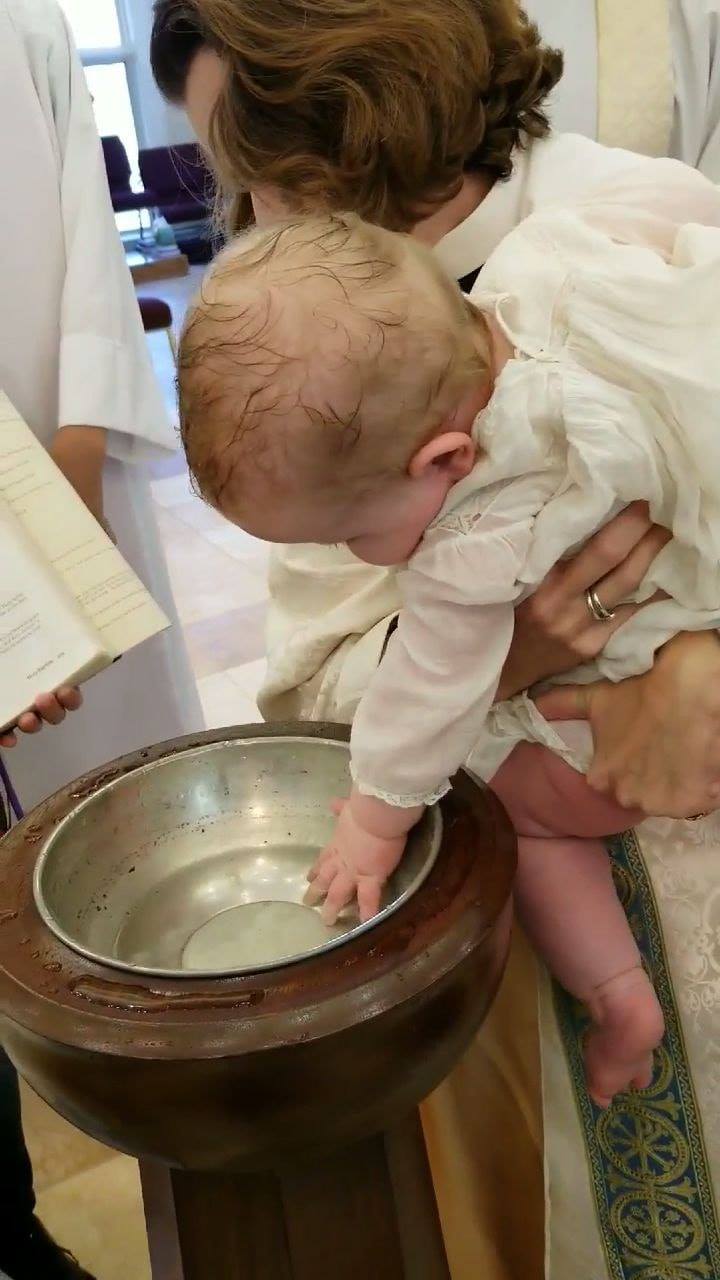
This Sunday, we are baptizing a baby into the household of God.  As part of that ritual, we will make promises about our own spiritual journey.  We will promise to gather regularly in Christian community, breaking bread and praying together; to resist evil, and repent when we fail; to proclaim the Word of God in word and deed; to seek and serve Christ, loving neighbors as ourselves; and to strive for justice and peace, respecting the dignity of every human being.  We promise to do what Christ asked us to do:  love God, love your neighbor, love yourself.

I love that my daughter is affirming her baptismal identity at Hickory Neck – whether she sees Christian witness through Mr. Rogers or through her Sunday School teachers.  I love that our younger children and older youth are learning how to live into their baptismal identity – whether through nursery care providers or youth group leaders.  And I love that our adults are still learning to live into their baptismal identities – through preaching, teaching, and our children’s witness.  At Hickory Neck, we are working across generations to keep loving God, loving our neighbors, and loving ourselves.  If you are in need of a community to help you claim that same identity and purpose, know that you are always welcome here – won’t you be our neighbor?

46040735_2084113391644910_120194659778560_o

Photo credit:  Hickory Neck Episcopal Church; permission to use required

← Older posts

Recent Posts

  • On the Myth and Magic of Advent…
  • On Risking Failure and Facing Fear…
  • Sermon – Luke 23.33-43, P29, YC, November 23, 2025
  • On Inhabiting Gratitude…
  • Sermon – Luke 20.27-38, P27, YC, November 9, 2025

Archives

  • December 2025
  • November 2025
  • October 2025
  • September 2025
  • August 2025
  • July 2025
  • June 2025
  • March 2025
  • February 2025
  • December 2024
  • November 2024
  • October 2024
  • September 2024
  • August 2024
  • July 2024
  • June 2024
  • May 2024
  • March 2024
  • February 2024
  • January 2024
  • December 2023
  • November 2023
  • October 2023
  • September 2023
  • August 2023
  • July 2023
  • June 2023
  • May 2023
  • March 2023
  • February 2023
  • January 2023
  • December 2022
  • November 2022
  • October 2022
  • June 2022
  • May 2022
  • January 2022
  • December 2021
  • November 2021
  • October 2021
  • September 2021
  • August 2021
  • June 2021
  • May 2021
  • April 2021
  • March 2021
  • February 2021
  • January 2021
  • December 2020
  • November 2020
  • October 2020
  • September 2020
  • August 2020
  • July 2020
  • June 2020
  • May 2020
  • April 2020
  • March 2020
  • February 2020
  • January 2020
  • December 2019
  • November 2019
  • October 2019
  • September 2019
  • August 2019
  • July 2019
  • June 2019
  • May 2019
  • April 2019
  • March 2019
  • February 2019
  • January 2019
  • December 2018
  • November 2018
  • October 2018
  • September 2018
  • August 2018
  • July 2018
  • June 2018
  • May 2018
  • April 2018
  • March 2018
  • February 2018
  • January 2018
  • December 2017
  • November 2017
  • October 2017
  • September 2017
  • August 2017
  • July 2017
  • June 2017
  • May 2017
  • April 2017
  • March 2017
  • February 2017
  • January 2017
  • December 2016
  • November 2016
  • October 2016
  • September 2016
  • August 2016
  • July 2016
  • June 2016
  • May 2016
  • April 2016
  • March 2016
  • February 2016
  • January 2016
  • December 2015
  • November 2015
  • October 2015
  • September 2015
  • August 2015
  • July 2015
  • June 2015
  • May 2015
  • April 2015
  • March 2015
  • February 2015
  • January 2015
  • December 2014
  • November 2014
  • October 2014
  • September 2014
  • August 2014
  • July 2014
  • June 2014
  • April 2014
  • March 2014
  • February 2014
  • January 2014
  • December 2013
  • November 2013
  • October 2013
  • September 2013
  • August 2013
  • July 2013
  • June 2013
  • May 2013
  • April 2013
  • March 2013
  • February 2013
  • January 2013
  • December 2012
  • November 2012
  • October 2012
  • September 2012

Categories

  • reflection
  • Sermons
  • Uncategorized

Meta

  • Create account
  • Log in
  • Entries feed
  • Comments feed
  • WordPress.com

Blog at WordPress.com.

  • Subscribe Subscribed
    • Seeking and Serving
    • Join 394 other subscribers
    • Already have a WordPress.com account? Log in now.
    • Seeking and Serving
    • Subscribe Subscribed
    • Sign up
    • Log in
    • Report this content
    • View site in Reader
    • Manage subscriptions
    • Collapse this bar
 

Loading Comments...