• About

Seeking and Serving

~ seek and serve Christ in all persons

Seeking and Serving

Tag Archives: church

On Giving Voice to Joy…

01 Wednesday May 2019

Posted by jandrewsweckerly in Uncategorized

≈ Leave a comment

Tags

articulate, child, church, embarrassed, fulfilled, invite, Jesus, joy, longing, worry

How-should-you-pray-Pray-with-Joy

Photo credit:  https://www.triumph30.org/2018/01/11/mastering-the-art-of-joy/

Although I was working this past Sunday, my family elected to take a much-needed post-Holy Week/Easter Sunday break.  I explained the details to our younger daughter on Saturday night, and she threw a fit.  “But I’ll miss Sunday School…and the bread and wine…and the Peace…and Children’s Chapel!”  The more she thought about what she would miss, the more upset she got.  Her disappointment was both heart-breaking and heart-warming.  As a priest, I always hope my children will find meaning in church.  But as a PK (preacher’s kid) myself, I also am fully aware that sometimes you sit in church because that’s part of your role.  Hearing our younger child long for the “stuff” of church filled my heart with joy.

Fortunately, that joy is not limited to PKs.  I talked to another parent on Sunday whose family had been traveling the last couple of weeks.  She relayed that when she told her preschooler that today was a church day, he jumped up a down throughout the house singing, “It’s church day!  It’s church day!”  Combine that with the faces of our children that light up when they reach the altar rail to receive communion, and I know that Hickory Neck is doing something right.  Our teachers and worship leaders are making a big impact – but so is each member who makes them feel welcome, included, and invaluable.

The funny thing is, I think the adults at Hickory Neck feel the same way.  I’m not sure most of them are jumping up and down on Sunday mornings (at least not without coffee), but as I have met and talked with members over the last year, there is a common thread in those conversations:  parishioners come to Hickory Neck each week because they long to be there.  For some, the feeling is easily attributable:  the comfort of music or communion, the connection with fellow church members, or the invitation to step into prayer with others.  For others, they may not even understand why they are drawn to church; they just know they want to be there – something intangible draws them in.

Sometimes I think our inability to articulate our joy and fulfillment we find at church is what holds us back from inviting others to join us.  Perhaps we worry about what negative experiences someone has had and we don’t want to deal with wading through the dark side of church.  Perhaps we worry that we will not explain the experience well enough for someone to want to join us.  Or perhaps we are embarrassed, worried that we will seem more like a child filled with joy than an adult with a persuasive invitation.  Today, I invite you to think about what it is at church that brings you joy – what keeps you coming back every week, and then share an invitation (to Hickory Neck, or to your own church home).  I’ll be sharing some of my joy with you at our Rector’s Forum on Sunday.  I would love to hear yours too!


Sermon – Luke 24.1-12, ED, YC, April 21, 2019

01 Wednesday May 2019

Posted by jandrewsweckerly in Sermons, Uncategorized

≈ Leave a comment

Tags

celebrate, celebration, church, confusion, doubt, Easter, faith, Jesus, journey, joy, loud, question, quiet, resurrection, Sermon, unbelievable, uncertain, victory

Easter is one of my favorite days in the church year.  I love how no matter whether we come to church every Sunday or if we haven’t been to church in ages, something about Easter draws us to the Church.  I love the celebration:  the Easter outfits, the fragrant flowers, the boisterous music, and the family of faith gathered at the communion table.  I love the sweet feeling of having emerged from the penitential season of Lent, and counting how many times we can say, “Alleluia.”  There is a loudness to Easter, an unbridled joy, a sense of victory.

What is funny about our experience today though is very little of the boldness of this day is present in Holy Scripture.  In fact, Luke tells a story that is quite the opposite of our experience today.  While we sing loud alleluias and hosannas, all of the characters in our gospel lesson today are in a totally different place.  They are mired in grief, lost in confusion, unsure about what has happened to them.  In a quiet, almost mechanical, numb way, the women who have been beside Jesus his entire ministry and were the only ones remaining at his death, come to the tomb in the fog of dawn, to do the work of tending to the dead body.  In their haze, no sense of closure comes.  Instead, more confusion comes.  Not only is the tomb empty, the angelic figures tell them Christ is risen.  The angels remind them Jesus had explained this to them, and things start to make sense.  But when the women return to tell the men, the men are so resigned and defeated, they mock the women.  Peter goes to check out the story, but even he does not come back with profound clarity.  He is lost in amazement – in awed confusion.  This story tells us very little about what this all means, what we should do, or how we should respond.  Very little about the gospel today is loud, triumphant, or jubilant.

Though I have been begging our musician for years now for more sound at Easter – a timpani to accompany the brass – the truth is, I kind of like how our gospel lesson today takes us in another direction.  Much of what we boldly proclaim today – that Christ is risen, his resurrection brings eternal life, and everything we know has changed – is pretty difficult stuff to believe.  Any of you who has spent time around an inquisitive child or a doubtful friend knows how difficult explaining the resurrection can be.  For our rational, twenty-first century selves, the theology of Easter is not only difficult to articulate, Easter is almost unbelievable.  And when we are really honest with ourselves, in the quiet of our own homes, we sometimes have moments when we are not really sure why we believe what we believe about Christ.

That’s why I love today’s gospel.  Today’s gospel reminds us of how unbelievable the resurrection of our Lord really was.  Sure, Jesus had said he would be handed over to sinners, be crucified, and on the third day rise again.  But his words sounded crazy at the time.  Now that Jesus’ words have come true, the women are perplexed, terrified, and rejected when they share their truth.  The men are paralyzed, doubtful, and downright mean.  On this early morning, the followers of Jesus only have their experiences of Jesus, their uncertainty of faith, and their attempts to believe the unbelievable.

To me, that is very good news indeed.  On this day as we sing songs about Jesus’ resurrection, and as we hear Peter preach with certainty in the book of Acts, and as we, with joy, proclaim, “Christ is risen!  The Lord is risen indeed!” our gospel story reminds us faith is a journey full of doubt, questions, and confusion.  We come on this festival day not because we are absolutely certain about Jesus.  We come on this festival day because in our foggy dawns, we have had encounters with the risen Lord – even when we did not know how to articulate the encounters.  We come to this festival day because in our pain, suffering, and questioning about life – we have had moments when something from scripture or our faith life suddenly connected and made sense.  We come to this festival day because even in our doubts, there is some small part of us that cannot extinguish hope, that suspects Christ might have actually changed the world.

On this day, the Church does not want our theological explanations of the resurrection.  On this day, the Church invites us to recall those moments, however fleeting or miniscule, where we have encountered, or suspected we encountered, the risen Lord.  Our bold singing of alleluias only needs that small flicker of hope – or maybe our desire for that flicker of hope.  Our celebrating today only needs our presence – our willingness to be here, encouraged by others walking through the fog.  Our proclamation today that the Lord is risen, only needs our willingness to say the words.  The community gathered here today will do the rest.  We will say with you, “The Lord is risen indeed,” until someday we can all claim the astounding love and grace of our Lord Jesus Christ ourselves.  Amen.

The Power of Showing Up…

17 Wednesday Apr 2019

Posted by jandrewsweckerly in Uncategorized

≈ Leave a comment

Tags

anxious, beauty, church, comfort, expectation, gift, God, grace, Holy Week, kids, nervous, pilgrimage

IMG_7849

Photo credit:  Jennifer Andrews-Weckerly; reuse with permission only

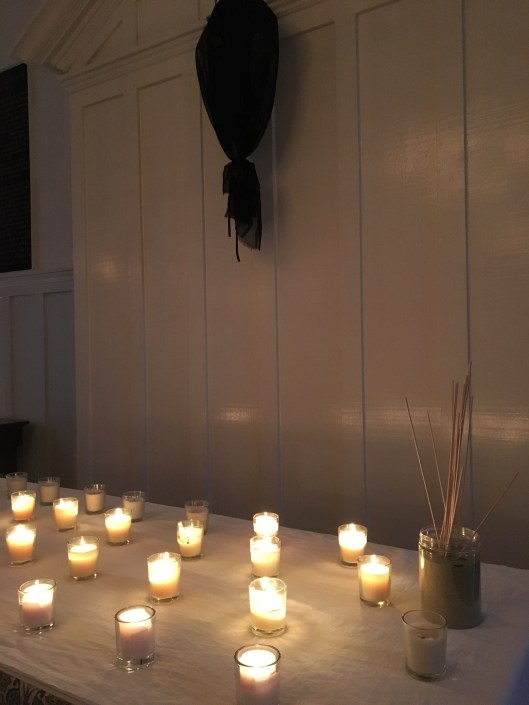
Most of you know that Holy Week is my favorite week of the year.  I love the way the week feels like a virtual pilgrimage, walking us from Jesus’ entry into Jerusalem, to his last meal with the disciples, to his trial and crucifixion, to his death and resurrection.  Each daily liturgy gives us the opportunity to experience that journey in unique, meaningful ways.  Knowing my passion for this week, my family is gracious every year with my absences from family life that week.  But this year, my husband had an evening work conflict he could not miss, and so I had some options for that night’s service.  I could skip the service – I was not serving that night, and was not physically needed.  I could hire a baby sitter, using some date-night reserves.  Or I could take the girls with me to the quiet service with long periods of silence, knowing how difficult it would be for them after a long day of school.

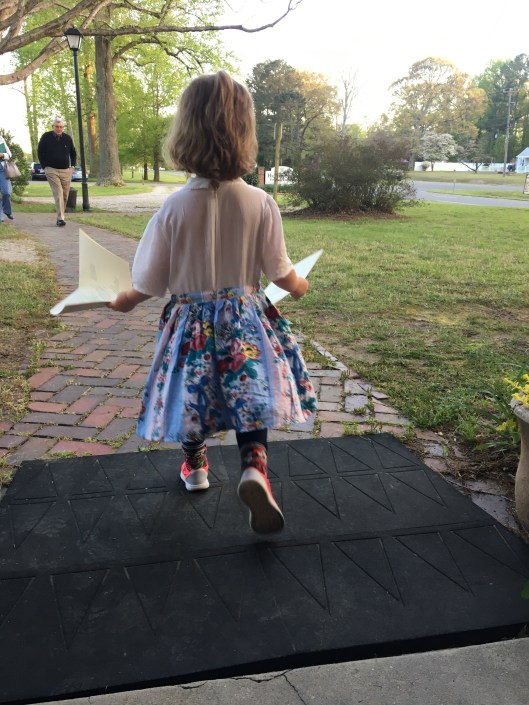
After much waffling, I decided to try bringing the kids with me.  I really wanted to be there for my own spiritual journey, and I hoped the kids might get something out of the experience.  I prepped the kids endlessly so that they would respect the periods of silence and the experience of those attending.  All in all, for their ages, the girls did amazingly well.  There were certainly a few too many wiggles and distracting noises, but for the most part, they were well-behaved.  I, on the other hand, was a ball of nervous energy.  I know how much I have reveled in the silence of that service and I really did not want to ruin that experience for anyone else.  I found myself so anxious about it, that I realized I didn’t get to experience the service in the way I traditionally do.

But here’s what did happen.  In the midst of trying to prevents disagreements, and minimize crinkling of papers, I was still able to sing and pray the words of the songs.  In the midst of desperately trying to keep kids at whisper-levels, I was able to catch snippets of scripture that hung in my ears and mind.  In the midst of impatient children, I was able to hear my children singing along and see my kids embrace participation – whether in lighting candles, handing out bulletins, or praying at the altar.

Here’s the thing about Holy Week services:  there are a lot of them, and you might not think you are mentally or spiritually ready for them.  You might be curious about some of the services, but are not sure your kids could handle them.  Or you might be thinking you are too tired this week to get anything out of the services.  No matter what is going on with you this week, I promise that if you can get yourself to Church, God will find you.  It may not be in the way you expect, you may not be able to be present as fully as you like, and you might not be convinced it is worth it.  But I promise you, if you figure out a way to get to Church this week, God will break through the chaos of life and whisper a word of comfort, and give you a glimpse into God’s grace and beauty.  My guess is that if you open yourself up to the liturgies of this week, you might just figure out how to carry those lessons into the rest of the Church year too.  The community is gathered this week and welcomes you, wherever you are on your journey, and especially when you do not feel like you have much to offer.  Holy Week is a gift the Church offers to you.  Your invitation is to just show up.

IMG_7836

Photo credit:  Jennifer Andrews-Weckerly; reuse with permission only

Homily – Luke 22.14-23.56, PS, YC, April 14, 2019

17 Wednesday Apr 2019

Posted by jandrewsweckerly in Sermons, Uncategorized

≈ Leave a comment

Tags

church, death, faithfulness, hope, hopelessness, Jesus, life, Palm Sunday, Sermon, sinfulness, tension

Several years ago, I was visiting a parishioner on her deathbed in the hospital.  We were talking about the things you talk about at the end of life:  the blessings, the memories, the unexpected turns of life.  Whatever fears about death that had been present were long gone.  All that was left was a sense of peace, and a certainty about the eternal life waiting for her on the other side.  I found myself wistful and a little sad, knowing there was nothing I or the doctors could do at that point.  Death was coming.  In the midst of this sacred, serious moment of inevitability, we heard a tinkling noise in the hallway.  Having had a child in a hospital, I knew what the tinkling noise was:  the tinkling sound was the announcement of a new baby being born.  As I explained the noise, the parishioner and I sat in awe – the closeness of life and death were all around us.  We did not have much to say at that point.  The sound of that tinkling just lingered in the room, long after the sound was gone.

I was thinking this week how similar the experience of Palm Sunday is to that hospital room.  We hold in tension so many things today.  We certainly hold life and death in tension:  the joyful celebration of Jesus with palms, and the wailing sorrow of death at the cross of Jesus.  We hold hope and hopelessness in tension too:  the promise of a new king, entering triumphantly, and the despair and finality of Christ on the cross.  We hold faithfulness and sinfulness in tension today:  the bold proclamation of the king who has come in the Name of the Lord, and the shouts of “crucify, crucify him,” just moments later.  Though we might prefer to claim life, hope, and faithfulness, today we must claim death, hopelessness, and sinfulness too.  They are as intertwined as life and death in a hospital.

In some ways, the tension of this day is just what we need in a culture that might like us to jump from the palms to the risen, triumphant Lord.  I am reading Brené Brown’s Dare to Lead this Lent, and one of the hazards to leadership she articulates is numbing.  Numbing can happen in all kinds of ways – through food, work, social media, shopping, television, video games, or alcohol.  The problem with numbing is that we cannot selectively numb emotions.  As Brown says, “if we numb the dark, we numb the light.  If we take the edge off pain and discomfort, we are, by default, taking the edge off joy, love, belonging, and the other emotions that give meaning to our lives.”[i]  When we numb our way through life, we not only suppress the bad stuff; we never get to fully enjoy the good stuff of life.

Today, the Church refuses to allow us to numb.  The Church has us wave palms and sing loudly and smell the sweet smell of victory, with a grin from ear to ear.  And the Church has us listen to the devastation of betrayal, hear the voices of contempt and hatred, and shout for Christ’s death.  Our hearts feel heavy as our minds try to justify all the times we too have betrayed Christ.  We feast as the disciples did on Christ’s body and blood, and we leave in silence as his disciples did from the cross.  Today we feel everything:  life, death; victory, failure; joy, and devastation.  In letting go of our tendency to numb, we open ourselves to the fullness of all that happens on this day.  Only then can embrace the Easter message of resurrection that is to come.  Only when we are fully broken, fully vulnerable, fully present in the tension of this day can we receive the fullness of joy that comes next week.  Only when we are looking into the doorway to death can we understand the depth of joy that comes from the tinkling sound of new life.  So, stay awake with us for just a little while longer.

[i] Brené Brown, Dare to Lead (New York:  Random House, 2018), 85.

On Finding and Creating Sabbath…

13 Wednesday Mar 2019

Posted by jandrewsweckerly in Uncategorized

≈ Leave a comment

Tags

church, creative, everyday, God, Holy Spirit, intentional, intentionality, moments, reconnect, rest, sabbath, space, time

IMG_5288

Photo credit:  Elizabeth Shows Caffey; reuse with permission only

“So what do you actually do on your Sabbath?”  It’s a question I have received many times.  Usually, I think people want to make sure I am resting and reenergizing.  Or maybe they are imagining what they would do with a Sabbath day.  Or, maybe just the word “Sabbath” is a little too churchy and weird, and so they are trying to figure it out – does it just mean “day off”?

The truth is, usually my Sabbath day is just that – a day off where I do the same stuff everyone else does on their day off.  I run errands, clean the house, try to go to an exercise class, go to a doctor’s appointment, get my hair cut, or, if I’m lucky, get a nap.  I do not think a single Sabbath has consisted of me “sitting around all day and eating bonbons,” as many have asked.  Luxuriating may happen for an hour, but that is rare, and it never extends to a whole day.  And although I do try to take care of my physical well-being, I can rarely be found praying, meditating, or studying all day.

But this past Monday and Tuesday, I converted my Sabbath to a true Sabbath.  I got away with four other clergy friends, and we took a true Sabbath – not answering work emails (for the most part), not tending to the laundry, not running errands, but just relaxing, sharing stories about our ministries, talking about our dreams, reflecting on our relationships, and even exchanging ideas about leadership.  Of course, there was also yummy food, lots of laughter, sleeping in, and balancing a nice long hike with some comfy time on the couch.  But because we stepped away from the everyday stuff of life and work, we all actually reconnected with the intention of Sabbath – of taking time apart to reconnect with God, with others, and with ourselves.

Now, I know how hard finding true Sabbath time can be.  Lord knows, I am not sure when the last time my “Sabbath day” felt like this much of a Sabbath.  But I suspect that there might be ways that we can create little moments of Sabbath in our lives.  Maybe it’s putting down technology for a few hours.  Maybe it’s mixing up the family’s routine to spend unstructured time together.  Maybe it is neglecting that “to do” list for a few hours to read, pray, or connect with God, others, and/or ourselves.  You will have to be creative to find it – you may even have to just claim it by turning off all stimulation in the car so that the ten minutes of alone time you get is dedicated to Sabbath.  Regardless of the restrictions on your time, Sabbath is actually about intentionality – intentionally creating little blocks of time set apart.  It takes work, but when you intentionally make that space, not only are you restored, and your relationships enriched, but also, you may be able to finally hear the Holy Spirit’s whisper.  I cannot wait to hear about your creative creations of Sabbath, and the new ways your spirit is renewed!

On Awkwardness and Grace…

27 Wednesday Feb 2019

Posted by jandrewsweckerly in Uncategorized

≈ Leave a comment

Tags

awkward, beauty, church, God, grace, guest, hard, homeless, identity, Jesus, love, privilege, purpose

handshake-2009195_640

Image credit:  https://rimland.org/tag/homeless/

This week our church is hosting our community’s Emergency Winter Shelter.  Every day for a week, from about 6:30 pm to about 8:30 am, we welcome up to twenty-five guests into our church.  This week is a banner week for our church community.  It is the week in the year where everything we say about discipleship and being witnesses for Christ’s love becomes a reality.  The week is so important that we try to engage parishioners of all ages, and we partner with other churches and local schools to make the week happen.  This is the week where we boldly proclaim our identity and live it with integrity.  This is the week where Christ can say about us, “I was hungry and you gave me food, I was thirsty and you gave me something to drink, I was a stranger and you welcomed me…”[i]

You would think with that kind of buildup, and that clear sense of purpose, every moment we are hosting our guests would be this beautiful, enlightened, perfect moment.  While there are certainly beautiful moments, what I noticed about our Winter Shelter week is that it is much more awkward that you might imagine.  Up to twenty-five individuals gather together, with unique stories that brought them to this moment of vulnerability and need, and they create a make-shift place of protection for few hours with about twenty volunteers who mostly do not need to worry about where the next meal is coming from or where they will rest their heads.  What do you talk about over a shared meal?  How do you connect with someone who is bone tired from working, hustling to get to the shelter, and worried about what is next?  How do you overcome the very obvious fact that the worlds you are both operating in are diametrically different?

The answers are not super glamorous.  When you invite yourself to sit at a table with homeless men and women, sometimes the conversation is superficial, and sometimes things are said that rock your world and remind you of how much privilege you really have.  When you long for a human connection with someone who is bone tired, sometimes the most you get is a smile; but more often what you get is a reality check about how brutal homelessness can be, and how many other awful things may be present in their lives.  And as you long to overcome the barriers of the two worlds you live in, part of what you have to do is let go of the idea that you can, remembering why Jesus once said it is harder for a person of wealth to get into the kingdom than a camel to fit through the eye of a needle.  Winter Shelter Week is hard and awkward because the experience forces us to examine our lives, acknowledge our privilege, and be honest about the amount of work we still have to do.

The good news in all the awkwardness and difficulty is that God’s grace is all around.  Providing shelter for a week matters.  Acknowledging the humanity of one another matters.  And that we are even trying matters.  God takes our best intentions, and our humbling week, and grants us moments of beauty:  from the almost five-year old who insists on saying goodnight to every guest before going home to bed – and the gracious responses of guests; to the teenager who has the courage to say an extemporaneous blessing over the food, when traditional prayers do not seem to work; to the community – both guests and hosts – who rallies together to protect the physical well-being of all the guests.  When Jesus talked about welcoming in strangers and feeding and quenching other’s thirst, he did not warn us how hard it would be.  I suspect he knew that the grace we would exchange in the mutual vulnerability would be reward enough.

[i] Matthew 25.35

On Kindness and Holy Healing…

06 Wednesday Feb 2019

Posted by jandrewsweckerly in Uncategorized

≈ Leave a comment

Tags

baptism, body, church, community, faith, God, healing, holy, Jesus, kindness, Mayor Tait, symptom, wholeness, Williamsburg

KINDlogo_final-01This past Friday, our LEAD Greater Williamsburg Class launched our kindness initiative.  About 200 people from Williamsburg, James City County, and York County gathered to learn how they could commit to kindness.  One of the highlights was keynote speaker former Mayor Tom Tait.  Mayor Tait served for many years on City Council in Anaheim, California.  He described his work with City Council as a game of “Whack-a-Mole,” where they were constantly trying to snuff out “symptoms,” whether they be drug abuse, homelessness, or violence.  What he slowly came to realize was this model of treating the symptoms was not getting to the root of the problem – the fact that the whole body was sick.  And so, he ran for Mayor on a campaign of kindness.  He believed kindness would transform the entire body, or system, in such a way that the symptoms would go away – because the entire body would learn to operate in a healthier way.

After the event, as I spoke with clergy about the theology of kindness, we came to a few conclusions.  First, we agreed that embodying kindness is one way that people of faith can embody God – the same God that is regularly described as showing loving-kindness, or hesed, in Hebrew.  Our acts of kindness help us to show forth and experience God in our community.  But as we talked about Mayor Tait’s analogy, we realized that showing kindness gets to the root of Jesus’ work.  Jesus was often seen healing what may be seen as symptoms – leprosy, blindness, hemorrhaging.  But what Jesus was really doing was healing entire systems.  Each healed person was restored to wholeness in the community, with no barriers to full membership in the community.  Christ was concerned about the presenting symptoms and suffering of individuals – but what his work was really about was restoring the entire body to wholeness.

The kindness campaign #WMBGkind is an incredible movement because it seeks to do just the same thing – transform our entire community from one that can be divided or cynical, to being a community transformed to wholeness through kindness.  As members of the faith community of Greater Williamsburg, we have an opportunity to be leaders in that transformative work:  because we were commissioned through our baptism to be agents of healing and wholeness, because we can be a powerful witness of God’s love through our kindness, and because, as members of the “body” of our community, we will be transformed too.  This Sunday at Hickory Neck, you will be invited into this commitment to kindness – or as we as persons of faith would call it, into doing acts consistent with our baptismal identity.  I look forward to seeing you then, as we work toward transforming our community, one act of kindness at a time!

Sermon – 1 Corinthians 12.12-31a, EP3, YC, January 27, 2019

30 Wednesday Jan 2019

Posted by jandrewsweckerly in Sermons, Uncategorized

≈ Leave a comment

Tags

affirm, body, church, community, convict, Corinthians, essential, gifts, honor, incomplete, needed, Paul, rejoice, Sermon, spiritual

Last week, Paul talked to us through his first letter to the Corinthians about spiritual gifts.  He talked about how there are a variety of gifts, and although they are all different, they are all activated by God.  As Charlie talked about this lesson last week, he encouraged us to reflect on our own spiritual gifts, and then to use that discernment to determine how we might support the ministries of Hickory Neck.  In fact, today we will gather our Time and Talent forms, blessing our discernment and our offering of those spiritual gifts.

If the portion of Paul’s letter last week affirmed that we all have gifts, the portion of Paul’s first letter to the Corinthians we hear today tells us how the use of our gifts within the church is not just a nice thing to do – like bringing someone flowers.  No, today Paul explains to us the sharing of our gifts is critical to the operation of the church as an organism.  In other words, without each of us giving our gifts to the church, the whole church either limps along as an incomplete body or does not function at all.

Any of us who have had an injury or are currently suffering through a portion of our body not working knows how this works.  A couple of weeks ago, my hands got really dry and a little crack developed on my thumb.  Literally, the crack was about an eighth of an inch in size.  And yet, it was one of the most painful experiences.  Over the next few days, I realized the pain wasn’t going to stop and the cut wasn’t going to heal until I put on a Band-Aid.  The first challenge is figuring out how to make the Band-Aid stick when the cut is not on a flat surface.  Then, of course, do you know how hard keeping the thumb dry to maintain a Band-Aid is?  Suddenly, you find you are washing your hands and your face in super awkward contortions – sometimes electing to use only one hand while washing your face, or giving up altogether so you can help give a bath to your little one.  And once you have the Band-Aid on your thumb, you do not have the same kind of grip on things like jars and bottles you are opening.

This drama is the same for any part of us that is damaged.  We never realize how important one of our body parts is until we lose or have limited use of the part.  For a brief period of time, once the body part is healed, we find ourselves thanking God for our thumb, or kidney, or heart.  But we are a pretty forgetful people, and eventually, we stop thanking God for the incredible parts of our body.  We walk, eat, talk, ponder, laugh, exercise, and breathe without thinking about all the tiny parts needed to make those functions possible in the first place.  Everyday, we could easily pray through hundreds of parts of our bodies, thanking God for each part that works.  And yet, I know very few healthy people who engage in such thanksgiving and gratitude.  Even folks who were once ill or injured seem to forget the painful reminders of not being whole once wholeness is restored.

Paul uses the classic metaphor of the body to help the Corinthians see that the body of the faithful is no different.  Once the community has done a spiritual assessment, once those Time and Talent forms are turned in, we are not done.  We do not take those forms and say, “Okay, we got an usher, someone willing to adopt a church garden, a Sunday School teacher, and someone to make meals.  We did not get someone to operate the sound system, or deliver welcome baskets to newcomers, or help layout the newsletter.  Ah well, we’ll be fine.”  Paul knows we cannot operate the body of Christ this way in the same way that anyone with a broken toe or someone with fluid in their lungs or ears cannot operate at full capacity.  As Paul familiarly says, “The eye cannot say to the hand, ‘I have no need of you,’ nor again the head to the feet, ‘I have no need of you.’”[i]

Paul’s letter today reminds of a few things.  First, we are not fully honoring our own bodies when we do not offer our gifts to the church.  When I was trying to figure out what I wanted to be when I grew up, I tried out many things.  I remember a Marketing department tried to convince me that I would be a great asset to their team.  And, I probably would have been pretty good at the work and the team did seem to have a lot of fun.  I remember how I loved working at a Food Bank and my awesome boss, even though most of my fellow volunteers were not people of faith.  I remember being thrilled when I landed at a Habitat for Humanity affiliate, serving a good cause, talking about our faith, even praying at staff meetings.  And yet, something still felt unbalanced.  And so the church became my playground.  I learned how to lead Morning Prayer, I fumbled my way through an adult bible study, and they even convinced me to co-lead the Middle School class!  What Paul would remind seekers like you and me is the church is the place where we can find a sense of wholeness by using all the parts of our bodies.  The church may be the place where the teacher by weekday brings his gifts to the Sunday School classroom on Sundays; or the church may be the place where the teacher by weekday finds her gifts are better utilized organizing a portion of the Winter Shelter.  The Church is the place where our head and our hands, our bodies, are affirmed.

The second thing Paul’s letter does is remind us how essential each person in the body is.  When other ancient writings used the metaphor of the body, they used the metaphor to determine social or political status; whomever was the head had power over the hands, feet, and legs.[ii] [iii]  Not so with Paul.  Paul says the head is just one part of many.  In fact, those parts we often forget about are usually the essential missing link to powerful ministry.  So, you may have been at home this week thinking, “Meh!  Hickory Neck has nine toes, they will be fine without me.”  Today, Paul asserts ministry does not work without you – whether you are the pinkie toe or the big toe!  Not all of us are great lectors, are handy with a wrench, or are tech savvy.  But we are all good at something – and when that “something” is not offered, the body of Hickory Neck is not whole.  Each of us, even the littlest one who goes to the nursery on Sundays, or the homebound member who rarely gets to join us, has an ability to make us better.  In fact, Paul might argue that those two individuals should have the highest honor in the community.  In other words, even if you do not think you have a gift special enough to give, the church needs you.[iv]  Hickory Neck is not whole without your offering.

The final thing Paul’s letter does is a little more subtle.  Even when all of us fill out our Time and Talent forms, and even when we make that stretch and agree to lead Children’s Chapel, take communion to a parishioner, or help with marketing, Hickory Neck will still not be complete.  There will always be parts of the body that are not operating at full capacity because not everyone is here yet.  This is why whenever a newcomer decides to become a member, we encourage them to look over the Time and Talent form – even if they join at a time well past stewardship season.  Each new person who enters through our doors has something new and fresh to teach us – something we as the community of Hickory Neck were missing until that fateful day you walked through our doors.  But if each new person makes us more whole, that means there are a lot of other holes in our body from all the people we have not yet invited into our fold.  For every neighbor, friend, and stranger who was looking for wholeness and yet we did not invite to church, our community suffers.  For every person whose socioeconomic status, skin color, or sexual orientation is not like ours that we did not invite to church, our community suffers.  For every person who is not my age, does not have my physical or mental abilities, or does not agree with my politics that we did not invite to church, our community suffers.  When we read Paul’s letter and when we look at our Time and Talent forms this week, we will invariably see the people we forgot to invite to church who would make us so much better as a community.

Today’s word from scripture is both affirming and convicting.  Paul wants us to know that each us has the capacity for wholeness when we use all the gifts God gives us.  Paul wants us to know that our Church needs us, in all our unique, odd, loveliness.  Paul wants us to know that the Church is the place where everyone has a place.  But Paul also wants us to know that we are not done.  We have sometimes not affirmed our own beautiful selves, we have sometimes held back our gifts from the church, and we have sometimes avoided welcoming in the very people who would make Hickory Neck a fuller version of her fantastic self.  Our invitation this week is to say yes:  say yes to honoring our own bodies with all their fabulous gifts; say yes to trying new adventures at church that will bless us in ways we cannot imagine; say yes to inviting a person who we might not even consider compatible with our image of who Hickory Neck should be.  Paul promises God will arrange the body so that we can all rejoice together.  Amen.

[i] 1 Corinthians 12.21

[ii] Lee C. Barrett, “Theological Perspective,” Feasting on the Word, Yr. C, vol. 1 (Louisville:  Westminster John Knox Press, 2009), 278.

[iii] Troy Miller, “Exegetical Perspective,” Feasting on the Word, Yr. C, vol. 1 (Louisville:  Westminster John Knox Press, 2009), 279.

[iv] Raewynne J. Whiteley, “Homiletical Perspective,” Feasting on the Word, Yr. C, vol. 1 (Louisville:  Westminster John Knox Press, 2009), 283.

On Gifts and Giving…

23 Wednesday Jan 2019

Posted by jandrewsweckerly in Uncategorized

≈ Leave a comment

Tags

challenge, Christ, church, encounter, gifts, God, Holy Spirit, listen, ministry, new, passion, talent, time, volunteer

etno-garden-plitvice-lakes-team-building-ruke

Photo credit:  https://www.plitvice-etnogarden.com/team-building/

As every year of ordained ministry passes, I become more grateful for my work before ordination.  For about six years, I was the Director of Volunteer Services for a Habitat for Humanity affiliate in Delaware.  Coordinating over 2000 volunteers a year, a major part of my job was helping people find just the right volunteer position based on their gifts.  Most volunteers that came my way expected that volunteering at Habitat meant wielding a hammer.  And sometimes that was true.  But sometimes you were hanging drywall, or painting, or putting down flooring.  Sometimes you weren’t doing construction work at all.  Volunteers were needed in the office, partnering with families as they worked on their sweat equity hours and financial training classes, helping raise funds, and serving on the Board.  Sometimes the gifts of a person were a perfect match for what we needed, and sometimes volunteers wanted to try something totally out of their comfort zone.  Figuring that out took time, listening, and a little bit of experimenting.

The same is true in churches.  We all come to church with many gifts, and sometimes those gifts are just what is needed:  the elementary music teacher who takes on the pageant, the architect who takes on property management, the financial planner who serves on the endowment board.  But sometimes, church is where we want to find and use other gifts:  the engineer who is also great relating with kids, the military officer who is also great with technology, or the construction worker who is a fantastic listener and discernment partner.  And sometimes, the things we think we would never be able to do we discover we can do through service at church.

This week at Hickory Neck, we are spending some time discerning our gifts and how we might use them to build up the church.  For some, this is a time to renew our passion for a current ministry we serve, and rededicate ourselves to making that ministry more powerful.  For others, we need a break from serving in one capacity, and want to try something new.  For others, we have yet to commit to serving the church and are nervous to step forward.  What the church reminds us during this time of connection is each of us has gifts, and the church is better when we gift those talents and our time to the church.  The church knows that when we give of that time and talent, we get so much more back.  We learn, we grow, we make new friends, and we come closer to God.  Whether it’s picking up sticks on a cleanup day, making meals for the homebound or new parents, or editing a newsletter, in those activities we have holy encounters with Christ.

I cannot wait to hear how you will give of yourself this year at Hickory Neck.  I cannot wait to hear how you are challenging yourself, and listening to the whisper of the Holy Spirit.  I cannot wait to hear in the coming year the ways in which you bump into God, even in the most unlikely places.  When each of us tends to our gifts and our journey at Hickory Neck, the community as a whole benefits.  We all get a bit closer to God when we simply show up and use our gifts.  I look forward to hearing about your journey in time and talent this year!

Sermon – Luke 4.7-18, A3, YC, December 16, 2018

19 Wednesday Dec 2018

Posted by jandrewsweckerly in Sermons, Uncategorized

≈ Leave a comment

Tags

asking, bully, call, calling, church, clergy, fair, God, John the Baptist, light, love, loving kindness, share, simple, spiritual gifts, unique, vocation

Today we are honoring the beginning of Bob Gay’s diaconal ministry with Hickory Neck.  We do not arrive at this day lightly.  Bob and his family had to discern if coming out of retirement was what God was calling him to do.  Bob had to confirm that call with church leaders, church members, and Diocesan staff.  Bob had to prayerfully consider what a diaconal ministry at Hickory Neck would look like and how that ministry might be different than at other churches.  And today, Bob and our community make commitments to not only support his call, but also recommit to our own senses of call.  Though our celebration of Bob’s ministry may feel brief in relation to all we do today, the gravity of what we do in and through Bob is serious.

Although I am thrilled to honor Bob’s new ministry among us, sometimes these types of days can leave us with the impression that “calling,” is something that happens to those with collars – people are called to be priests, deacons, and bishops.  Sometimes we are willing to expand the notion of calling to certain helping professionals – people are called to be nurses, social workers, fire fighters, and teachers.  But we get a little tripped up imagining being called to be other things – a lawyer, an engineer, a stay-at-home parent, an investment banker, or a business owner.  And when we are younger, we almost never hear people saying we are called to be a student, a babysitter, a friend, or a sibling.  We might think we are good at some of those things, or we enjoy those jobs or roles, but we do not always say we are “called” to do them.

I met a retired priest once, and he said his greatest joy in retirement was in helping parishioners experience God on Mondays.  In partnership with the clergy of his church, his “calling” in retirement was to set up what he called “Sunday-Monday Appointments” with church members.  He would go visit members of Church on Mondays in their places of employment and talk about where they see God in their everyday life – how they make the connection between what they do on Sundays and what they do on Mondays.  Those conversations are meant to help the parishioners name how they experience “calling” in their work place.  For some parishioners, that conversation is quite easy.  But for others, that conversation is much more difficult.  Many of them have never had a priest visit them at work, and they have certainly never prayed aloud at the end of a meeting at work.  When the retired priest asks them about their Sunday-Monday connection, sometimes he finds parishioners do not really have a connection.  Those two days feel very separate in their minds.

Part of what is challenging in claiming that we are “called” to a role outside of church is we feel intimidated declaring what God would want us to do outside of church.  We imagine something a bit like what happened to those around John the Baptist in our gospel lesson today.  We do not like the idea of being called a “brood of vipers.”  We do not like the idea of being told our ancestry does not matter – that being a descendant of Abraham does not hold sway with God.  We do not like hearing about repentance, or axes lying at the root of trees who do not bear fruit.  Perhaps if we had been one of those gathered around John the Baptist, we might have simply concluded that the whole baptism thing was not for us.  Baptized living sounds hard as John describes baptism.

But before we get too far down the path of defeatism, something interesting happens in our gospel story.  Instead of walking away with their heads hung low when John starts calling them broods of vipers, the crowd asks a question, “What then should we do?”  After being called broods of vipers, you might expect the eccentric John to tell them to sell all their possessions, eat insects, and live in rags.  Instead, John says something quite simple, “Whoever has two coats must share with anyone who has none; and whoever has food must do likewise.”  Basically, John says, share your stuff when you have more than you need.  That is all:  share your stuff.  We can tell John’s answer is pretty benign because the tax collectors jump in, “Teacher, what should we do?”  They ask because although the others get off pretty easy, the tax collectors know they are in a bit of hot water, resembling broods of vipers more than they might like to admit.  But John is mild again, “Collect no more than the amount prescribed for you.”  In other words, John says, “Just do your job fairly.”  The soldiers are emboldened now too, asking, “And we, what should we do?”  John gives them an easy out too, “Do not extort money from anyone by threats or false accusation, and be satisfied with your wages.”  That one is pretty basic too:  appreciate what you have, and don’t be a bully.

What scholar David Lose appreciates “is how mundane, if not downright obvious, John’s admonition proves.  I mean, this is not rocket-science; indeed, [John’s admonition] is the logic of the classroom and playground most of us first heard in kindergarten: share, be fair, don’t bully.  But if somewhat obvious, [John’s admonition] is at least also within their reach.  John does not tell the crowds to join him out in the wilderness, he does not ask the tax-collectors to abandon or betray Rome, and he does not urge soldiers to a life of pacifism.  Instead, he points them to the very places in which they already live and work, love and laugh, struggle and strive, and suggests that these places are precisely where God calls them to be, where God is at work in them and through them for the sake of the world.”[i]

This month in our Sunday Forum series we are talking about our spiritual gifts.  We are hearing diverse voices talk about what gifts each of us have and how we can use those gifts in our various callings.  The idea is not simply to discover what gifts we have so that we can use them in the world; the idea is also to name how we are already using our gifts in the world, and to understand the use of those gifts out in the world and within this community as our calling.  You know as well as I do that some of us are called to teach children, some to read scripture in worship, some to advise the church about financial decisions, some to plan parties, and others to find and stop leaks in water pipes.  And some of us are not called to do any of those things.  But each of us has spiritual gifts unique to ourselves, and each of us are invited to use those gifts in the church and the world.  Those spiritual gifts can be as simple as the fidelity of a parent or spouse, the attentiveness of a friend, the hard work of an employee, the honesty of an employer, the steadfastness of a volunteer, the generosity of participating in an outreach ministry, or the compassion of visiting the sick or homebound.[ii]

What Bob’s new ministry and John’s invitation in our gospel lesson today do is not send us home thinking we must be ordained or be some crazy wilderness prophet to be faithful to God and live out our calling.  What we do liturgically and hear scripturally today is remember that the connection from Sunday to Monday matters.  The things we do in our everyday lives are opportunities to stop seeing work, home, school, and community as simply work, home, school, and community, but instead as our mission field – as the places where we live out the calling we discern here on Sundays.  And if we are not certain what that calling is, the crowd surrounding John encourage us to ask the same question they ask, “And me, what should I do?”  I promise the answer will not be overwhelming.  The answer will be simple:  show God’s loving-kindness in the workplace, at home, at school, and in the community; be Christ’s light in the grocery store, on the playground, with your loved one, and with the stranger; share the Holy Spirit’s love while driving, while emailing, while eating, and while playing on a team.  Our job each Sunday is to keep asking, “And me, what should I do?” and then trust on Monday the answer will be unique to our gifts, within our reach, and fulfilling beyond measure.  Amen.

[i] David Lose, “Advent 3C:  Beyond Scolding,” December 11, 2018, as found at http://www.davidlose.net/2018/12/advent-3-c-beyond-scolding/ on December 14, 2018.

[ii] Lose.

← Older posts
Newer posts →

Recent Posts

  • On Sharing the Love…
  • Sermon – Micah 6.1-8, Matthew 5.1-12, EP4, YA, January 30, 2026
  • On Justice, Kindness, Humility, and the Messy Middle…
  • Feast of the Rev. Dr. Martin Luther King, Jr., January 18, 2026
  • On Peace, Love, and Conduits…

Archives

  • February 2026
  • January 2026
  • December 2025
  • November 2025
  • October 2025
  • September 2025
  • August 2025
  • July 2025
  • June 2025
  • March 2025
  • February 2025
  • December 2024
  • November 2024
  • October 2024
  • September 2024
  • August 2024
  • July 2024
  • June 2024
  • May 2024
  • March 2024
  • February 2024
  • January 2024
  • December 2023
  • November 2023
  • October 2023
  • September 2023
  • August 2023
  • July 2023
  • June 2023
  • May 2023
  • March 2023
  • February 2023
  • January 2023
  • December 2022
  • November 2022
  • October 2022
  • June 2022
  • May 2022
  • January 2022
  • December 2021
  • November 2021
  • October 2021
  • September 2021
  • August 2021
  • June 2021
  • May 2021
  • April 2021
  • March 2021
  • February 2021
  • January 2021
  • December 2020
  • November 2020
  • October 2020
  • September 2020
  • August 2020
  • July 2020
  • June 2020
  • May 2020
  • April 2020
  • March 2020
  • February 2020
  • January 2020
  • December 2019
  • November 2019
  • October 2019
  • September 2019
  • August 2019
  • July 2019
  • June 2019
  • May 2019
  • April 2019
  • March 2019
  • February 2019
  • January 2019
  • December 2018
  • November 2018
  • October 2018
  • September 2018
  • August 2018
  • July 2018
  • June 2018
  • May 2018
  • April 2018
  • March 2018
  • February 2018
  • January 2018
  • December 2017
  • November 2017
  • October 2017
  • September 2017
  • August 2017
  • July 2017
  • June 2017
  • May 2017
  • April 2017
  • March 2017
  • February 2017
  • January 2017
  • December 2016
  • November 2016
  • October 2016
  • September 2016
  • August 2016
  • July 2016
  • June 2016
  • May 2016
  • April 2016
  • March 2016
  • February 2016
  • January 2016
  • December 2015
  • November 2015
  • October 2015
  • September 2015
  • August 2015
  • July 2015
  • June 2015
  • May 2015
  • April 2015
  • March 2015
  • February 2015
  • January 2015
  • December 2014
  • November 2014
  • October 2014
  • September 2014
  • August 2014
  • July 2014
  • June 2014
  • April 2014
  • March 2014
  • February 2014
  • January 2014
  • December 2013
  • November 2013
  • October 2013
  • September 2013
  • August 2013
  • July 2013
  • June 2013
  • May 2013
  • April 2013
  • March 2013
  • February 2013
  • January 2013
  • December 2012
  • November 2012
  • October 2012
  • September 2012

Categories

  • reflection
  • Sermons
  • Uncategorized

Meta

  • Create account
  • Log in
  • Entries feed
  • Comments feed
  • WordPress.com

Blog at WordPress.com.

  • Subscribe Subscribed
    • Seeking and Serving
    • Join 395 other subscribers
    • Already have a WordPress.com account? Log in now.
    • Seeking and Serving
    • Subscribe Subscribed
    • Sign up
    • Log in
    • Report this content
    • View site in Reader
    • Manage subscriptions
    • Collapse this bar
 

Loading Comments...