• About

Seeking and Serving

~ seek and serve Christ in all persons

Seeking and Serving

Tag Archives: community

On the Power of Pancakes…

01 Wednesday Mar 2017

Posted by jandrewsweckerly in Uncategorized

≈ 4 Comments

Tags

community, dignity, feast, homeless, humanity, Jesus, meal, normal, pancakes, parish, profound, Shrove Tuesday, simple

pancakes

Photo credit:  https://stpauls-exton.com/event/shrove-tuesday-pancake-supper/

Last night we had our annual Shrove Tuesday Pancake Supper at Hickory Neck Episcopal Church.  In some ways, the evening was just like every other year:  pancakes, sausage, and cake were in abundance, people donned their beads, and festive music was in the air.  But this year there was one big difference.  We shared the evening with some special guests.  You see, we signed up to host a week of our community’s emergency winter shelter – but without checking the liturgical calendar.  So, we had two options – invite our guests to join us, or find an alternate location for our festivities.  The decision was not an easy one.  We talked for months about the theology of hospitality and service.  We talked about the realities of life for our guests, who are often tired and usually want to get some sleep as soon as possible.  We talked about privacy, fellowship, and discomfort.  In the end, we decided sharing the evening was the most authentic, hospitable way forward, not being entirely sure how the evening would go.

In my mind the evening had two potential outcomes.  The first one I imagined was of a typical middle school dance – the girls on one side of the room and the boys on the other, neither being bold enough to get out there and dance.  I worried that our guests would feel awkward or put on the spot to socialize.  I worried that our parishioners would feel uncomfortable and would avoid contact with our guests.  The other outcome I imagined was a profound evening, where guests and parishioners would mingle with ease, where deep conversations would be had, and where God would be palpably present.  In that scenario, we would see God in the faces of each other, and we would be deeply transformed.

The reality of the evening was neither of my scenarios came to fruition.  Luckily, no one behaved awkwardly or made anyone feel uncomfortable.  But there was also not a sense of deep transformation last night.  Instead, the evening was simple, authentic, and real.  Some of the guests and parishioners kept to themselves or stuck with those like them.  Some of the guests and parishioners shared in conversation over the feast.  Children played with parishioners and guests alike, serving as a great equalizer.  Jokes and laughter were shared, a meal was had in relaxed community, and the evening ended with the goodbyes of old friends.  The only thing profound about the evening was that it was profoundly normal.

As I reflect back, I suppose that is the best outcome we could have had.  Jesus sat with all sorts of people over meals, not necessarily to have contrived, poignant encounters, but to serve as an equalizer with people who were not treated equally.  Jesus knew the power of food to move people toward honoring the dignity of every human being.  That is what we did last night.  We had fun, we feasted until we could feast no more, and we honored our baptismal covenant by seeking and serving Christ in every person, loving our neighbor as our self, and respecting the dignity of other human beings.  Not bad for a Shrove Tuesday Pancake Supper!

On Cuisine and Community…

15 Wednesday Feb 2017

Posted by jandrewsweckerly in Uncategorized

≈ 3 Comments

Tags

church, comfort, comfort food, communion, community, cuisine, Eucharist, feast, fellowship, food, God, journey, recipe, strength, sustenance

mac-and-cheese

Photo credit:  whoneedsacape.com/2016/10/italian-mac-cheese/

This weekend, I made a family recipe from my husband’s grandfather.  Though Grandpa Gray is no longer with us, somehow, making this recipe for the first time in a long while flooded me with all kinds of memories.  You see, Italian Mac was the family’s favorite dish – the ultimate comfort food.  One year, I finally asked for the recipe and stayed with Grandpa Gray in the kitchen while he made it.  Now, as I look at the words of the recipe, I can hear his beautiful voice in the words.  As I crush the herbs as he instructed, I can imagine his worn hands doing the same thing.  As our house fills with the aromas of Italian Mac and garlic bread, I can remember the smell of his house.  As I sip the red wine that the recipe suggests I pair with the meal, I can recall the comforting sound of his laughter.

Food has a special power.  Whenever I have been on mission trips, food has created intimate connection.  In Honduras, we all took turns helping the women of the village cook for our team.  After ten minutes of attempting to grind corn, we were all laughing at how much stronger the women were than the men who were lifting bricks to build the church.  On my second visit to Costa Rica, I wanted to learn how to make the beans and rice we ate regularly.  The women were surprised that I was willing to get up early with them and learn.  After that morning, our relationship shifted.  In Myanmar, giggles and laughter ensued as we tried new foods and our hosts appreciated our boldness.

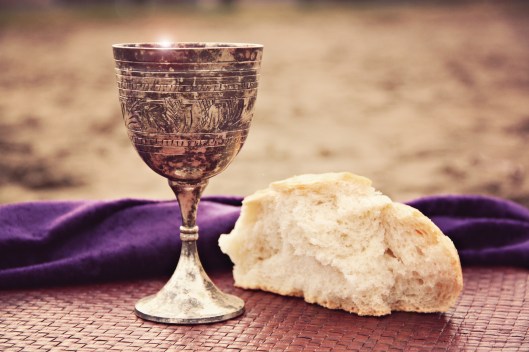
The same is true of the Eucharist.  I have been in churches that use grape juice and a small cube of pasty, crunchy “bread.”  I remember the splendor of the sweet Hawaiian bread used at another church.  I remember the first time I had real wine at communion, and the way that it burned down my throat, lighting a new fire in me.  Whether baked bread, bland wafers, or store-purchased pita bread, each texture and flavor imprints in my mind the church, the community, the spiritual place where I was at the time.  Even this weekend, at my goddaughter’s baptism, my own daughter commented on the “yucky” communion bread they had.  I would have just said it was dense, but that dense texture will linger in my mind as my reminder of our celebration.

Holy Eucharist is the comfort food of Church.  That is why I love being a part of a sacramental church that has Eucharist every Sunday.  But the Church offers other comfort foods as well.  The pancakes we eat every Shrove Tuesday remind me of years of fellowship and laughter – with communities all over the East Coast.  The Brunswick Stew of the Fall Festival at Hickory Neck will always remind me of warmth and community.  There are those dishes at every potluck that you search for, knowing the comfort it will bring.  And of course, there is the Sunday morning coffee – a staple of hospitality and grace.  If you have been missing a sense of community and comfort, I hope you will make your way to Church this week and join us in the feast that not only comforts us, but also strengthens us for the journey.  God has given us great work to do – but God has also given us the sustenance we need for the road ahead.

lords-supper-church-stock-photos

Photo credit:  stthomasnorwalk.com/religious-ed/sacraments/Eucharist

Come and See!

11 Wednesday Jan 2017

Posted by jandrewsweckerly in Uncategorized

≈ Leave a comment

Tags

church, come, community, connection, gospel, internet, isolation, Jesus, physical, prayer, see, snow, virtual

This past weekend, Williamsburg was hit with over a foot of snow.  Living in an area without many plows, and serving in a church without a Rectory on the campus, I knew that Sunday services at Hickory Neck would be nearly impossible.  Our parking lot did not get plowed until early Monday morning, and many of our parishioners live on rural roads.  With great disappointment, I cancelled all Sunday services.  But then my husband turned to me with a twinkle in his eye and said, “You should lead Morning Prayer on Facebook Live!”

That night I put together a video to tell people what we were going to do and where they should go to join me in worship.  And on Sunday morning, at 10:00 am, I went live.  By the time we had finished, there were over 60 views.  By the time we got to the end of the day, there were over 300 views.  By Tuesday night, there were over 700 views.  The positive feedback poured in – from our parishioners, from their neighbors, and from dozens of people who were snowed in all up and down the Atlantic coast.

As I have thought about the experience, I realized what a gift technology can be.  Isolated in homes, people were able to come together and pray the same prayers, hear the same readings, confess our sins, lift up our intercessions and thanksgivings, and give glory to God.  So often we talk about the challenge of the church is being tied to the walls of the physical building, not taking the Gospel out in the world.  Our experience on Facebook felt like a little way of getting ourselves out in the world, and sharing the beauty of worship in virtual community.

Of course, I don’t think church can always be expressed in virtual ways.  Being physically present with one another allows us to engage all our senses, to read the body language of someone who is suffering or experiencing joy, and to engage in the holy meal that brings us together despite our divisions.  But the experience certainly made me realize that we can supplement that communal physical experience with communal virtual experiences.  And once you show your neighbor that cool video from your church, then, like Jesus in our Gospel lesson this coming Sunday, you can say, “Come and see!”[i]

come-see

Photo credit:  https://www.queertheology.com/john-1-29-42


[i] John 1.39.

Homily – Luke 2.15-21, Holy Name, YA, January 1, 2017

05 Thursday Jan 2017

Posted by jandrewsweckerly in Sermons, Uncategorized

≈ Leave a comment

Tags

alone, community, dependence, elders, Good News, Holy Name, homily, independence, Jesus, Joseph, Mary, need, share, shepherds

Our gospel today picks up where we left off a little over a week ago.  On Christmas Eve, we heard how Mary and Joseph journeyed to Bethlehem to be registered.  We learned of how there was no room for them in the inn, and how they ended up delivering little Jesus, the savior of the world, in a room designated for animals.  Exhausted, they placed him in a manger, in bands of cloth, making the best of an awful situation.  We also learned of some unsuspecting shepherds who experienced an angelic encounter.  An angel appeared to them in the fields and told them of the messiah who had been born, where they could find the messiah, and what they could look for – that manger and those bands of cloth.

Today we pick up where we left off.  The angels leave, and the shepherds decide to check out the story.  They visit with Mary and Joseph, confirm the story, and then share their experience with the tired couple.  We are told Mary treasures the words, but ponders them too.  She is clearly still figuring all this out.  Meanwhile, the shepherds go back to work, praising God.  And Mary and Joseph go back to work too – following the circumcision customs, but perhaps, more importantly, following through with what they were asked to do – naming Jesus as the Angel commanded.[i]

What I love about this story is that no one acts alone.  Mary gets the bizarre news of her pregnancy alone, but then her cousin Elizabeth affirms her and confirms the good news.  Shepherds are minding their business when the angels appear to them.  They could have stayed at home that night, but they go and share the news.  Mary and Joseph go on a scary journey that seems to be making one bad turn after another.  But then shepherds come and give them a good word.  Even the naming of Jesus takes place in community – at least a rabbi or priest comes and performs the naming right, knowingly or not, naming the child the same name the angel gave Mary – Jesus, or “Joshua, meaning salvation”[ii].

Going at things alone is part of our contemporary mindset.  We place a value on people being able to fend for themselves.  The number one goal of parents is to teach their children independence.  And Lord knows we hear a lot of, “I do it by myself!” at our house these days.  In and of itself, independence is not a bad thing.  We have gifts and talents of which God expects us to be good stewards.  But going at life alone can have the opposite effect of what we think.  By glorifying independence we forget the inherent dependence we all have.  If nothing else, we are certainly dependent upon our Lord and Savior, without whom nothing would be possible.  But Jesus teaches us that community is equally important.  Jesus was never a lone ranger in his ministry. He understood the people of faith to be a community – to need each other for learning and understanding.  Unlike what the world might have us believe, life is not all about independence.  Quite the opposite, we need each other in this crazy journey of faith – to learn from each other, to challenge each other, to support each other, and cheer each other on when we get weary.

As our children and I were reading our Advent and Christmas devotional this week, we learned about Simeon and Anna, whose story comes in the verses just following the passage we read today.  If you remember Simeon and Anna are elder members of the faith, living and working in the temple when Jesus is to be presented.  The devotional asked us what elderly people we know and what they teach us.  I was surprised to hear my seven-year old jump in with all sorts of idea about what our elders teach us.  She said that our elders have lived a lot longer and so they have a lot to teach us about the world.  She said they can help teach the children how to live and what they can do in the world.  When I asked the question about what our elders teach us, I had expected the standard, “I don’t know.”  Instead, I got a response that showed a great deal of insight into how much we need each other – young and old, rich and poor, male and female, liberal and conservative – if we are going to survive in this journey of faith and life.

All the parts of our Christmas story are a bit like a puzzle.  Each piece is important in its own right, but once you put the pieces together, the puzzle reveals something much more valuable.  Though the parts we hear about during Christmastide are some of our favorite parts, they are just pieces in the puzzle.  The story of Jesus would not be complete without angelic appearances, shared stories between cousins, and tired, weary people sharing good news together.  Mary would have nothing to treasure and ponder without the ragtag community that has gathered around her.

The same is true for us.  Our Christmas story is a beautiful story.  But unless we share the story in community, unless we share our story in community, we only get a partial glimpse into the good work Christ is doing in our lives.  We need each other to encourage and support each other in the faith journey.  We need each other to interpret God’s movement in our lives, and to teach us wisdom.  We need each other in those moments of treasuring and pondering our own story.  Today we give thanks for the tremendous community of faith who help us in our journeys toward Christ.  Thanks be to God!  Amen.

[i] Fred B. Craddock, Luke, Interpretation:  A Bible Commentary for Teaching and Preaching (Louisville:  John Knox Press, 1990), 36-37.

[ii] Craddock, 36.

Ecumenical Thanksgiving Homily – Ruth 2.2-9, Matthew 22.34-40, November 20, 2016

23 Wednesday Nov 2016

Posted by jandrewsweckerly in Uncategorized

≈ Leave a comment

Tags

active, Boaz, community, ecumenical, God, gratitude, Great Commandment, homily, Jesus, love, mercy, ministry, neighbor, Ruth, Thanksgiving, worship

When I learned we would be gathering for worship as ecumenical brothers and sisters to celebrate a service of Thanksgiving, I could not have been happier.  But when I realized we would be reading from the book of Ruth, I was thrilled!  Ruth has always held a special place in my heart.  This woman, a complete stranger to our faith, teaches us more about faithful living than most of our ancestors. She marries a foreigner, quickly becoming a widow with no support, following her widowed mother-in-law to a foreign land.  In her abandonment, she pledges allegiance to a God who in many ways has felt absent.  And when they return the foreign land of Bread, and she sees Naomi may not be able to support her, she takes it upon herself to go sweat in the fields, and secure them a livelihood.  She even eventually permanently ensures their security by somewhat scandalously approaching Boaz for not only food, but marriage, and progeny.  Ruth puts all others before herself, and she is faithful to God and her family.  If anyone is a beacon of living into the Great Commandment to love neighbor as self, Ruth is that beacon of light.

But the more I thought about our text today, the more I realized that despite the fact that I love Ruth, we gathered here today are more like Boaz.  You see, we are people of privilege and power.  Though we can certainly name countless people who may have more wealth and influence than we do, most of us know where our next meal is coming from, have a roof over our heads, and have our basic needs met.  Some of us are even comfortable enough to enjoy much more than our basic needs.  In that way, we are much more like Boaz, a man with power and influence, who can use that power for good or for evil.

Boaz has little obligation to Ruth, the foreigner.  He knows she is connected to Naomi, making her adopted family, but allowing her to glean with the other gleaners would have been enough.  He didn’t have to give her tips about how to be safe from the men, give her access to drinking water, feed her his bread at mealtime, and tell his men to make sure she got extra grain to glean.  He did not have to say yes when she asked for his help in taking her in.  He did not have to negotiate with the next-of-kin to have her hand.  Boaz takes God’s command to love neighbor beyond what anyone would expect.

I have been thinking about Boaz as I have been thinking about our ministry together.  Though you may not know about each case, each of the clergy here work with families in need through the use of discretionary or alms funds.  Each church here has ministries that we support – whether food pantries, homeless shelters, elder care, medical clinics, or assistance with basic needs like back-to-school supplies, clothing drives, or holiday support.  And all of us collectively have taken that a step further and agreed to help provide more food assistance by starting up a local food distribution outlet through our partners at House of Mercy.  But just because we do that work does not mean that we do that work like Boaz.

My husband is a social worker in Richmond and he was recently telling me about a client’s experience with a church.  The client reached out to a church for assistance, and instead of pastorally working with the client, the church representative gave them a hard time, wanting to know what poor decisions the client had made that brought them to the church doors.  Now, I know we all screen the clients we help.  We have to be smart about how we help those in need.  But that client experienced a loss of dignity at that church that Boaz never exerts.  In fact, Boaz knows how degrading poverty can be.  He sees Ruth, and knows simply by her gender and foreignness that she is at risk for assault and manipulation.  And so, not only does he help her, but he looks at all those around him and hold them accountable for caring for the disadvantaged too.  He does not act alone in his mercy – he makes his whole community merciful.

As we head into a holiday marked for Thanksgiving, the church invites us to look at our ancestors for the best ways to fulfill Jesus’ Great Commandment.  Want to know how to love God and our neighbors?  Look at our sister Ruth.  Want to know how to show love, dignity, and compassion?  Look at our brother Boaz.  Though many of us spend this time of year reflecting on what we have to be grateful for, the church invites us also to use this time as a time of action.  Our gratitude is not passive.  Our gratitude is active – a call to action to love God and love neighbor.  I know many families who have a tradition of going around the Thanksgiving table, enumerating those things for which they are grateful.  Perhaps this year, our families can also enumerate what we are going to do in response to those things for which we are grateful.  Our ancestors, our Savior, and our faith communities are here to embolden us in that response.  Thanks be to God!

Sermon – Luke 12.13-21, P13, YC, July 31, 2016

03 Wednesday Aug 2016

Posted by jandrewsweckerly in Sermons, Uncategorized

≈ Leave a comment

Tags

accountability, barn, community, financial management, God, greed, Jesus, money, relationship, rich, rich toward God, self-centeredness, Sermon, wealth

One of the last things that happens when you graduate from seminary is the staff from the Church Pension Group comes to talk to you about money management.  They help you understand how retirement funds work for clergy, encourage you to make sure you are doing some additional savings and investment planning, and remind you that, like tithing, how you manage your finances is a witness to your congregation for being good stewards.  That lesson is reiterated each year, as the priest is encouraged to be a smart investor through email reminders.  We even go to a wellness conference a few times over the course of our ministry to make sure we are tending to our financial wellness in addition to vocational, spiritual, and bodily wellness.  The lesson to clergy again and again, is to be good stewards of our financial resources.

So imagine my discomfort with the parable from Jesus today.  At first glance, this is a story about smart financial investments.  A man has a bumper crop – the land produces so abundantly he cannot fit the excess crops into his current barns.  Knowing that the land is fickle, maybe even having taken some notes from our ancestor Joseph who prevented a seven-year famine by stockpiling during a seven-year boon, the man decides he will just have to build a bigger barn to hold all the extra crops.  Quite frankly, his actions do not sound that far off from what any investment counselor who might tell us to do – store the excess away so that when a rainy day comes, or even when retirement comes, we can still “eat, drink, and be merry.”  All in all, his logic sounds pretty spot-on to me.

Here is the kicker though:  the day the newly enlarged barn is finished is the same day that the man will die.  All those plans, hopes, and dreams for a secure retirement are gone.  He never gets to enjoy the fruits of his labor.  He never gets to retire in comfort.  He never gets to eat, drink, and be merry.  Our immediate reaction to this tragedy might be to proclaim how life or God is not fair.  But into our disappointment, Jesus says, “So it is with those who store up treasures for themselves but are not rich toward God.”

In these last words from Jesus, Jesus takes the wind out of our sails.  Jesus reminds us that being a good steward of our resources means lots of things:  being smart with our money, saving for times of famine, giving to the church, and caring for our neighbor.  But most importantly, being a good steward of our resources is not just about sound financial practices.  Being a good steward of our resources is also managing our relationship with our money – and more specifically, managing our relationship with God in relation to our money.

Now some of you may be thinking, “Here she goes.  She’s going to tell me how I need to give more money to the church to right my relationship with God.”  No need to get too anxious today.  I do not think Jesus is looking for a specific action today – as if to say, “Do not be like the man with the barns.  Give your full ten percent to the church and all will be well.”  No, what Jesus is trying to do is help us see that our relationship with money matters.  Unlike a polite dinner guest, Jesus never shies away from talking about money.  He is constantly warning us about the potential of riches to corrupt our relationship with God.  So the answer to what the rich man should do may not be a clear-cut formula, but we get some obvious clues about what Jesus means about being rich toward God.

Going back to the story is particularly helpful.  The most obvious thing that we see happening in the parable is that the wealthy man has become completely self-absorbed and ego-centric.  Listen again to the words of the parable, “And he thought to himself, ‘What should I do, for I have no place to store my crops?’ Then he said, ‘I will do this: I will pull down my barns and build larger ones, and there I will store all my grain and my goods. And I will say to my soul, ‘Soul, you have ample goods laid up for many years; relax, eat, drink, be merry.’”  The list is long:  What should I do?  My crops, my barns, my grain, my goods, my soul.  All the words of the wealthy man are self-referential.[i]  Nowhere does he talk to God.  Nowhere does he talk to his family or a trusted friend.  Nowhere does he consult his property manager, or the local priest.  He never praises God for the abundance.  He never acknowledges that the land has provided.  He never even considers sharing his abundance.  He is self-interested, self-protecting, and self-centered.  And all of that focus on the self comes from a relationship with money and with God that is out of whack.

So how do we avoid the slippery slope that leads to self-centeredness and greed, luring us to constantly redefine how much is “enough”?  What exactly is being rich toward God?  Jesus tells us the answer to our quandary throughout Luke’s gospel.  As one scholar explains, “Being rich toward God entails using one’s resources for the benefit of one’s neighbor in need, as the Samaritan did (10:25-37).  Being rich toward God includes intentionally listening to Jesus’ word, as Mary did (10:38-42).  Being rich toward God consists of prayerfully trusting that God will provide for the needs of life (11:1-13, 12:22-31).  Being rich toward God involves selling possessions and giving alms as a means of establishing a lasting treasure in heaven (12:32-34).”  In other words, “Life and possessions are a gift of God to be used to advance God’s agenda of care and compassion, precisely for those who lack resources to provide for themselves.”[ii]

Last year, while serving on the board of the Episcopal Ministries of Long Island in New York, we were surprised by a bequest of about 1.3 million dollars.  The bequest came from a woman who had seemed to be of little consequence.  Each year she had probably given the charitable group about $25 a year.  We assumed that was about all she could do.  So when the gift came in, we were stunned.  After some prayerful discernment, we elected to put one million into our endowment, to ensure that we could keep helping ministries on Long Island.  But the three hundred thousand would be for us to try new and innovative ministries – and luckily for us, there was already a proposal on the table that we thought we could not afford:  a food truck that would take food around to the homeless in Brooklyn, and maybe even host a social worker and or nurse.  I do not know what sort of life this woman led or how she managed her money.  But even in death, her richness toward God was obvious to us all.

The challenge of Jesus this week to be rich toward God is not just a challenge for self-centered men of means.  Though we may be tempted to finger-point, Jesus and we know that money has the power to corrupt all of our relationships with God.  And unfortunately, the consequences are not limited to our relationships with God – our ability to live lives rich toward God impacts our neighbors too.  The good news is that we have a community of faith sitting right next to us who can be our support system as we work to turn our hearts and our riches to God.  Now I know we all value being respectful dinner guests, but this time, we are going to need to follow Jesus’ lead.  In order to really turn our hearts and riches toward God, we are going to need to start talking with our friends about the place of money in our lives and in our relationship with God.  We are going to need to talk about our struggles and failures.  And we are going to need to celebrate our victories and successes.  We are basically going to need to become a giant support group for becoming rich toward God.

I once heard about a “congregation who invited families to not buy any unnecessary new thing for six months in order to break the culturally-induced habit of trying to buy happiness.  But they didn’t just invite people to do this, they formed a culture in which they supported each other.  They read and talked about a common book on abundant life, they kept in touch via small groups and email, they shared where they were succeeding and struggling and what they were learning.  In short, the formed a community so that they could stand against the all-too-human and culturally supported belief that if we just had a little more we’d be happy.”[iii]

I do not know what model or what goals are going to work for each of you.  But I do know that just by our very citizenship in this country, we face more temptation toward greed than in probably any other country.  If we are going to follow Jesus, to avoid a life of self-centeredness, and claim a life of being rich toward God, we are going to need each other.  Whether you want to form a small group or just find a trusted friend, this is the important work Jesus invites us into today.  My guess is that building up a community of support that is rich toward God will create much more opportunities to eat, drink, and be merry, than any bigger barn could ever give us.  Amen.

[i] Audrey West, “Theological Perspective,” Feasting on the Word, Yr. C, Vol. 3 (Louisville: Westminster John Knox Press, 2010), 312.

[ii] Richard P. Carlson, “Exegetical Perspective,” Feasting on the Word, Yr. C, Vol. 3 (Louisville: Westminster John Knox Press, 2010), 315.

[iii] David Lose, “What Money Can and Can’t Do,” July 29, 2013, as found at http://www.workingpreacher.org/craft.aspx?post=2668 on July 27, 2016.

Putting Paint to Canvas…

27 Wednesday Jul 2016

Posted by jandrewsweckerly in Uncategorized

≈ Leave a comment

Tags

art, calendar, church, collaborate, community, masterpiece, ministry, mission, paint, priorities

paintbrush

Photo credit:  www.colortheorypainting.com/color-theory-blog/

This past winter, my church at the time held a “Paint Nite,” as a fundraising event.  As someone who has very little artistic skill, I was skeptical that I would come away with anything of worth.  Just sitting in front of the blank canvas seemed daunting.  When we took our first strokes to prepare the canvas for more color, I was convinced I would ruin the whole thing.  But as our teacher for the night slowly guided us through the exercise, breaking down each step of the process, the blank canvas slowly transformed.  First, into blocks of color; then with odd shapes inserted here and there; and finally, a picture emerged.  When I finished for the night, I sat back and thought to myself, “That’s not actually all that bad.”  As I looked around the room, all of our once blank canvases were transformed into unique, yet similar, works of art.

In some ways, that is the work of Hickory Neck this summer.  Committee leaders and Vestry liaisons have been gathering these past couple of months to prepare for our Vestry’s retreat/workday on Saturday.  Each Vestry member is assigned to be a liaison to a ministry area of the church and has been asked to assemble a calendar of the work each ministry area would like to do this year.  The Vestry and clergy will come together on Saturday to put that work together on a blank calendar and see what work of art emerges.

To some, working on calendars for a whole day may sound dull.  But I am convinced that our work this Saturday is important work for the life of the community.  By taking a holistic look at our calendar, we get a sense of our priorities, our strengths, and our challenges.  Instead of each ministry area doing what they do in isolation, we can step back and look at the fuller tapestry of life at Hickory Neck and discern whether the picture our calendar presents is the image we really want.  This is exciting work, full of possibility and potential.

I ask that you hold our Vestry in prayer this weekend as we do this collaborative work.  If you have already spent time working with your Vestry liaison, reflecting on goals and plans, thank you for the work you have already done.  If your ministry area has not yet had a chance to offer your dreams and goals with your Vestry liaison, please reach out to them this week.  This weekend we will be painting a beautiful picture together and I look forward to sharing the masterpiece with each of you as we kickoff our program year in September.  Great things are already happening at Hickory Neck.  Your Vestry and clergy are excited to make that work even better!

Sermon – Romans 5.1-5, John 16.12-15, TS, YC, May 22, 2016

25 Wednesday May 2016

Posted by jandrewsweckerly in Sermons, Uncategorized

≈ Leave a comment

Tags

activity, attention, community, disciples, doctrine, faith, God, grace, grow, guide, heresy, Holy Spirit, Jesus, learn, love, seminary, Sermon, suffering, theology, Trinity, Trinity Sunday, world

In seminary one of my favorite professors was our theology professor.  I did not like her because of the subject she taught.  In fact, her class was one of the classes that gave me the most headaches as I struggled to understand theological arguments.  Instead, what I liked about her was the way that she taught.  She had a dizzying intellect, and yet she had the ability to gently make you feel like you were not an idiot.  Someone in class would ask a question, trying to get their head around a theological concept.  Her soft response would be, “Oh, yes, yes, I could see how you might get to that conclusion.  So-and-so also argued that heresy in the fourth century.”  Or she might answer, “Oh yes, that heresy is one of the church’s favorite,” and then go on to explain how the church struggled to counter the heresy.  What I loved about her responses was she let you know that although you clearly did not understand the theological concept, you were not the first person to struggle to understand and you will not be the last.  Struggling to understand and articulate a cogent theological concept without slipping into a heretical argument is a basic part of being a Christian.

What I loved about the pastoral nature of my professor’s responses was she understood that being able to articulate a definition of God is incredibly difficult.  More important to her than you getting that articulation correct was your engagement with the concept.  Perhaps she understood that theologians for centuries have tried to do the same thing – define who God is and what God means.  That may be why she never seemed bothered by our heresies – because she knew that her role, and in fact the role of the church, is to be involved in the ongoing endeavor of naming God’s activity in our world.[i]  That is the same work that we do every year on the feast of Trinity Sunday – embracing the endeavor of naming God’s activity in our world.

To help us in that endeavor, we get two great pieces of scripture today.  In our gospel lesson from John, Jesus tells the disciples that the Spirit will guide the disciples into all truth.  Jesus’ promise to the disciples tells us those closest to Jesus, those who have been sitting at Jesus’ feet, learning truth from the source, are still going to need help.  The disciples, who will be commissioned to go out into the world to share the Good News, will not do that work alone.  The Spirit will go with them, helping them to continue to learn and grow into the fullness of faith.

I was recently invited to come to Sunday School for a little round of “stump the priest.”  I laughed at the title, but inside I was thinking, “What if they ask a question that really does stump me?!?”  Luckily, a cooler head prevailed.  The truth is they probably will stump me – several times over.  But that will give us a chance to talk about how the Spirit guides us into all truth – in childhood, in young adulthood, and into our older years.  But more importantly, I hope that we get the chance to talk about how the community of faith is a vital part of that learning of all truth.  We are certainly dependent on the Spirit, but we are also dependent on each other, because the Spirit so often speaks to us through people and the words of those around us.[ii]

That is one of the things I love most about being in the Episcopal Church.  The Episcopal Church has always been a place where ambiguity is okay.  As David Lose explains, “…being part of being a Trinitarian community [means] striving to be a place that knows it doesn’t have all the answers, and so consequently makes space for conversation and values those who bring different voices and experiences into its midst.  Conversation, valuing difference, being inclusive – these things aren’t easy, but genuine community, while challenging, is also creative, productive, and enriching.”[iii]

The other great piece of learning today comes from our reading in Romans.  On the surface, this piece of scripture has always troubled me.  Paul’s claim that suffering produces endurance, endurance produces character, and character produces hope, has always sounded a little dismissive about suffering.  But I do not think Paul meant for this formula of suffering leading to hope was not meant to be prescriptive, but descriptive.[iv]  In other words, he is not saying those who are suffering should be grateful.  What he is saying is those who are suffering have the opportunity to not waste the pain.  Peter Steinke says, “We ‘waste’ suffering if we gloss over, deny, avoid, or neglect its message…. If, however, we can learn from pain, [pain] is not wasted but a source of life and health.”[v]  My suspicion is that Paul is trying to capture what we learn from our gospel lesson today.  Even in the midst of suffering the Holy Spirit and the community of faith can guide us into all truth.

I have been a part of parishes that have a communal component to their premarital counseling.  In addition to meeting with the priest, each engaged couple is partnered with a married couple in the parish for mentoring.  One would think that the married couple’s job is to tell the engaged couple how to do everything and give them advice.  But more often, the couples end up talking about how hard marriage is, what struggles they have dealt with, and how they got through the suffering.  The relationships between the mentors and the mentees often last well beyond the wedding.  When done with honesty, vulnerability, and compassion, the couples realize that they gain strength from one another and find a place where they can go when they are looking for truth and guidance.

Our gospel and epistle lessons today weave together an understanding of the Trinity that is both vertical and horizontal.[vi]  Vertically, we learn that our understanding of God is ever changing and dynamic – much like God is ever changing and dynamic.  I think that is why my professor was so open to us stepping into and out of heresies and doctrine.  She knew that every Christian had to take that journey of steps and missteps.  But I think she also understood that truth was ever evolving and that the Spirit was with us in that journey.  She was not worried about us because, “…a critical characteristic of faith is an ever-striving and dynamic making sense of God.  The Trinity [cannot] be the only way to get God.  [That theology] is as limited and finite as our humanity.  [The theology of the Trinity] is one attempt of the church to articulate the being of God in a particular time and place.”[vii]  We will continue to walk toward truth in our own time and place too.

Horizontally, our lessons teach us that we find our way to that truth the Spirit is showing us through the vehicle of those around us – both those in the church, and those outside our walls.  I cannot count the number of times I have learned something profound about God by someone who never harkens the door a church.  Our job is to pay attention:  pay attention to the way that God is using others to show us more about God; pay attention to the ways God invites us to interpret our sufferings with others; pay attention to those who are struggling toward truth along with us.  We will surely step into heresy now and then.  But we will also step into God’s love and grace through the guidance of the Holy Spirit and those around us.  Amen.

[i] Karoline Lewis, “Trinity Talk,” May 15, 2016, as found on http://www.workingpreacher.org/craft.aspx?post=4648 on May 18, 2016.

[ii] David Lose, “Trinity C:  Don’t Mention the Trinity,” May 17, 2016, as found on http://www.davidlose.net/2016/05/trinity-c-shh-dont-mention-the-trinity/ on May 18, 2016.

[iii] Lose.

[iv] Richard L. Sheffield, “Homiletical Perspective,” Feasting on the Word, Yr. C, Vol. 3 (Louisville: Westminster John Knox Press, 2010), 39.

[v][v] Sheffield, 41.

[vi] Lose.

[vii] Lewis.

Sermon – Acts 16.9-15, E6, YC, May 1, 2016

06 Friday May 2016

Posted by jandrewsweckerly in Sermons, Uncategorized

≈ Leave a comment

Tags

blessing, change, church, community, conversation, evangelism, God, growth, hear, Holy Spirit, listen, new, Paul, prepare, Sermon, together, work

One of the things that the Search Committee, Vestry, and I all talked about during our time of discernment was church growth.  Now church growth is a loaded topic because inherent in the conversation are a lot of assumptions.  One assumption is that we can talk about church growth without talking about change.  Many churches say they want to grow, but what they mean is that they want to find fresh meat for volunteer positions and new pledgers for the budget.  But inherent in church growth are not just bodies to fill out needs:  church growth means incorporating new people who will have new ideas, new dreams, and new ways of doing things.  The second assumption when we talk about church growth is that we can go about church growth passively.  In other words, as long as we have a good website, we have good programs, a shiny new Rector, and we are nice to people once they arrive, we will grow.  While those things are important and necessary, those things do not fully address how we get people to step on our property, how we encourage people to come back after a first visit, or how we incorporate newcomers fully into the life and ministry of the church.  The final, and my personal favorite, assumption is that church growth is done by the Rector.  The Rector can certainly help lay the foundation of a strong system of invitation, welcome, and incorporation.  But the primary way that church growth happens is through Church members inviting others to church.

All that is to say that my response to the Search Committee and Vestry went a little like this:  I am more than happy to give Hickory Neck all of the infrastructure Hickory Neck needs to grow; but Hickory Neck is going to have to work, be open to change, and get real comfortable with talking about their faith in the neighborhood.  Now I know many of you may be sitting here right now, cursing the Search Committee and Vestry for signing you up for some hard, scary work ahead.  But let me let you in on a little secret:  church growth (or evangelism, if we are feeling really sassy) is not that hard or scary.  That is the great thing about the readings from the Acts of the Apostles during Eastertide:  they are all about the growth of the church.  Last week we heard about how Peter began to understand that God was calling him to share the Good News with the gentiles.  Today, we hear about how Paul is diverted to Europe to share the Good News with the people of Macedonia.

Many of us get a little uncomfortable talking about apostles spreading the Good News because the stories about Peter and Paul seem strange and foreign.  They involve dreams or visions in which God tells them what to do.  They involve going to foreign lands to talk with strangers.  And they sometimes involve, as we will hear next week, getting arrested and sent to jail.  Most of us hear these familiar stories and assume that the stories do not really apply to us because they are historical, ancient stories.  But after the drama of being diverted to a foreign land and searching for a place to join with sympathetic people, what happens to Paul in our text today is not actually all that foreign or unrelatable.  The story tells us that on the Sabbath day, Paul and his companions go find where faithful people are gathered and simply start talking.  The text does not say that Paul gives a presentation about the merits of converting to Christianity.  The text does not say that Paul leads a worship service, with music and the holy meal.  The text simply says that Paul sits down among those gathered, and starts talking.  While Paul is talking, a woman in the group, Lydia, who we understand from the text is an independent woman of wealth[i], overhears what Paul is saying and is so compelled by what Paul says that she and her household are not only baptized, but insist that Paul and his companions come stay with her during their stay in Philippi.

Soon after I became a rector for the first time, I realized I had a lot to learn about church growth.  I read books, poured through research, and talked with experts in the field.  One of my favorite conversations about church growth was with a friend who does church consulting on growth.  In her formation, she had a professor who insisted as part of her training that she needed to go out into town and just start talking to people about Jesus.  She was terrified.  For the first few weeks of class, my friend, now a priest, lied to her professor.  Each week he would ask her how the project was going, and she would tell him that the project was going well.  Finally, the professor called her bluff and insisted that she immediately go somewhere and do her assignment.  So my friend went to a coffee shop, wrote on a piece of paper, “Talk to me about Jesus and I will buy you a cup of coffee,” and then set up her laptop in the hopes that no one would take her up on the offer.  Much to her chagrin, a patron came up to her and said, “I’ll talk to you about Jesus, but I’ll buy the coffee.”  The conversation that ensued was full of the stranger’s story – about how she used to go to church, how she still believes, how the church hurt her, but how she still misses having a church community.  My friend listened to the story, honored the stranger by acknowledging how hard her journey had been, and then did the one thing that is key when talking about church growth.  My friend acknowledged where she saw the presence of God in this stranger’s journey.  And, for good measure, my friend told her that if she ever wanted to try church again, she knew a great place that might just work.

That is the funny thing about church growth.  Church growth happens through real people having real conversations in real time.  Paul sits down with a bunch of women and starts talking.  My friend sat down with a stranger and listened and reflected back on the stranger’s journey.  That is the same invitation that I will be giving us to do over and over again in my time here at Hickory Neck:  that we start having real conversations with real people in real time.  Now I know what some of you may be thinking.  First, you may be thinking, “I cannot believe the Search Committee and Vestry decided to hire this priest who is going to make me do this!”  Second, you may be thinking, “I have no idea how to have real conversations with real people in real time!  What does she expect me to do?  Start talking to strangers at the coffee shop, on the golf course, and at the Little League game?”

Before you get too anxious, I want to give you a little piece of comfort from scripture.  In Peter’s story last week, in Paul’s story today, and in the texts coming up next week and at Pentecost, we learn that all of these encounters happen with the Holy Spirit going before, making a way for the encounter to happen.  In today’s story, Paul has no intention of going to Macedonia.  In fact, in the verses we did not read today, Paul and his crew actually had plans and made attempts to go to other places, but their plans were thwarted by the Holy Spirit.  Finally, Paul has a vision that he was supposed to go to Macedonia.[ii]  Once he and the group decide to follow that vision, everything becomes smooth.  Their travel is not thwarted, they easily find their way to Philippi, they stumble onto a group of women who are believers, and out of nowhere, just through conversations about faith, Lydia steps up and not only desires baptism, she demands that Paul and his company accept her hospitality.  That is the reality about growth:  yes, growth involves putting ourselves out there to have hard conversations, and yes, growth involves being vulnerable and uncomfortable, and yes, growth will even involve change to us personally and to our community as a whole.  But God shows us through the story of scripture, that the Holy Spirit is ever before us, making the way smooth.  When our intentions are simply to share our story, to listen to the stories of others, and to honor the ways in which God is already active and blessing us, then the rest flows smoothly.

We are probably going to be talking about church growth a lot in the years to come.  We will talk about how to grow, we will make changes that will create a strong foundation for invitation, welcome, and incorporation, and we will get out there and talk to our neighbors.  But at the heart of all that work is the promise that the Holy Spirit is ever before us, making the way smooth, calming our nerves so that God can work in spite of us, and showing us how our holy conversations will be a source of blessing to us as much as those conversations are a blessing to others.[iii]  We will do this work together:  you, me, and the Holy Spirit.  The work will be hard, scary, and beautiful.  The work will be a blessing to us all and allow us to be a blessing to this community.  We can do this work together, because the Holy Spirit goes before us.  Amen.

[i] David G. Forney, “Pastoral Perspective,” Feasting on the Word, Year C, Vol. 2 (Louisville:  Westminster John Knox Press, 2009), 476.

[ii] Brian Peterson, “Commentary on Acts 16:9-15,” May 5, 2013, as found at http://www.workingpreacher.org/preaching.aspx?commentary_id=1627 on April 27, 2016.

[iii] Peterson.

The Power of Prayer…

10 Thursday Mar 2016

Posted by jandrewsweckerly in Uncategorized

≈ Leave a comment

Tags

alone, community, faith, God, love, power, pray, prayer, saints

praying-hands1

Photo credit:  internationalhouseofprayernorthwest.org/event/praying-for-our-police-december-31st-200-300pm/

One of the major components of my vocation is living a life of prayer.  I am constantly offering up prayers for my parishioners, my family, and my friends.  I am regularly praying for the oppressed, the hungry, and those suffering around the world.  I pray for those in leadership in our country and around the world.  And even if the average stranger or acquaintance feels a little uncomfortable talking about religion with me, they have no issues asking me to pray for them.  Prayer is part and parcel of my life and work.

But as much as I pray, for others and even myself, I rarely ask others to pray for me.  I am not sure why really.  Maybe I feel like people are busy or God knows what I need.  Regardless, I don’t tend to solicit prayers.  But this past month has involved a lot of upheaval.  I am transitioning between jobs, and the prayer concerns seem endless.  My current parish has been sorting through their own grief and anxiety about the change.  My future parish has been preparing to receive me and handling logistics on their end.  And my family is juggling everything:  from the emotional toll of the transition, to buying our first home, to finding a new job for my husband, and finding new schools and childcare for our children.

So this week, I finally asked for prayer.  I asked a colleague group of mine and some close friends to pray.  The response was immediate and overwhelming.  Sharing the burden seemed to lessen the burden.  Feeling connected to a community of support gave me comfort and strength.  And thinking about their prayers made me realize there are other people praying too.  My current parish has a prayer group that is praying for us.  My future parish has a weekly prayer they are offering for me, my family, and for them.  Even my mom’s Bible Study group is praying for us.  And that probably does not even count the myriad other people who are praying for me without me realizing it.

As I marveled in the community of saints lifting me up in prayer this week, I realized maybe that is part of the power of prayer:  prayer reminds us that we are not alone.  When we join in prayer with others, we remember that we are not on our own in this life.  The vast web of prayer gives us a tiny glimpse into the enormous love of our God for us.  This week I am grateful for the reminder of the power of a prayerful community.  I encourage you to reach out to your own communities if you are in need of prayer.  And if you are feeling less needy this week, then reach out to someone else who might need your prayers.  We are not alone and we need each other.

← Older posts
Newer posts →

Recent Posts

  • On the Myth and Magic of Advent…
  • On Risking Failure and Facing Fear…
  • Sermon – Luke 23.33-43, P29, YC, November 23, 2025
  • On Inhabiting Gratitude…
  • Sermon – Luke 20.27-38, P27, YC, November 9, 2025

Archives

  • December 2025
  • November 2025
  • October 2025
  • September 2025
  • August 2025
  • July 2025
  • June 2025
  • March 2025
  • February 2025
  • December 2024
  • November 2024
  • October 2024
  • September 2024
  • August 2024
  • July 2024
  • June 2024
  • May 2024
  • March 2024
  • February 2024
  • January 2024
  • December 2023
  • November 2023
  • October 2023
  • September 2023
  • August 2023
  • July 2023
  • June 2023
  • May 2023
  • March 2023
  • February 2023
  • January 2023
  • December 2022
  • November 2022
  • October 2022
  • June 2022
  • May 2022
  • January 2022
  • December 2021
  • November 2021
  • October 2021
  • September 2021
  • August 2021
  • June 2021
  • May 2021
  • April 2021
  • March 2021
  • February 2021
  • January 2021
  • December 2020
  • November 2020
  • October 2020
  • September 2020
  • August 2020
  • July 2020
  • June 2020
  • May 2020
  • April 2020
  • March 2020
  • February 2020
  • January 2020
  • December 2019
  • November 2019
  • October 2019
  • September 2019
  • August 2019
  • July 2019
  • June 2019
  • May 2019
  • April 2019
  • March 2019
  • February 2019
  • January 2019
  • December 2018
  • November 2018
  • October 2018
  • September 2018
  • August 2018
  • July 2018
  • June 2018
  • May 2018
  • April 2018
  • March 2018
  • February 2018
  • January 2018
  • December 2017
  • November 2017
  • October 2017
  • September 2017
  • August 2017
  • July 2017
  • June 2017
  • May 2017
  • April 2017
  • March 2017
  • February 2017
  • January 2017
  • December 2016
  • November 2016
  • October 2016
  • September 2016
  • August 2016
  • July 2016
  • June 2016
  • May 2016
  • April 2016
  • March 2016
  • February 2016
  • January 2016
  • December 2015
  • November 2015
  • October 2015
  • September 2015
  • August 2015
  • July 2015
  • June 2015
  • May 2015
  • April 2015
  • March 2015
  • February 2015
  • January 2015
  • December 2014
  • November 2014
  • October 2014
  • September 2014
  • August 2014
  • July 2014
  • June 2014
  • April 2014
  • March 2014
  • February 2014
  • January 2014
  • December 2013
  • November 2013
  • October 2013
  • September 2013
  • August 2013
  • July 2013
  • June 2013
  • May 2013
  • April 2013
  • March 2013
  • February 2013
  • January 2013
  • December 2012
  • November 2012
  • October 2012
  • September 2012

Categories

  • reflection
  • Sermons
  • Uncategorized

Meta

  • Create account
  • Log in
  • Entries feed
  • Comments feed
  • WordPress.com

Blog at WordPress.com.

  • Subscribe Subscribed
    • Seeking and Serving
    • Join 394 other subscribers
    • Already have a WordPress.com account? Log in now.
    • Seeking and Serving
    • Subscribe Subscribed
    • Sign up
    • Log in
    • Report this content
    • View site in Reader
    • Manage subscriptions
    • Collapse this bar
 

Loading Comments...