• About

Seeking and Serving

~ seek and serve Christ in all persons

Seeking and Serving

Tag Archives: control

On the Risk of Anticipation…

12 Wednesday Mar 2025

Posted by jandrewsweckerly in reflection

≈ Leave a comment

Tags

anticipate, anticipation, control, dance, God, good, Holy Spirit, impact, Lent, movement, planner, spiritual

Photo Credit: https://www.pinterest.com/pin/tango–761882461966749050/

So, what does a Dancing with the Williamsburg Stars competitor do after the competition?  Well, in my case, you get back in the studio!  Before the competition even began, I already knew I wanted to keep dancing.  I was having such a great time stretching my mind and body learning new things that I knew it was a good physical, and spiritual, discipline I wanted to maintain. 

Now, you may be wondering how in the world ballroom dancing can be categorized as a spiritual discipline.  The truth is, I encounter the sacred in ballroom dance all the time.  I talked about it once before HERE.  This week, as I started my first post-competition class, we went back to basics, learning the rumba and cha-cha.  There’s a certain humbling that comes with learning a new dance that I had forgotten from when I started months ago.  As we progressed through the class, I felt like I was slowly getting the hang of the technicalities – that is, until we started turns.  At one point, my instructor said, “Stop anticipating!”  He reminded me that he would show me where to go, but if I anticipated what he was going to do next, I would mess up our unique dance.

Those two words have been rattling around in my head.  Stop anticipating.  You see, I am a planner by nature.  Anticipation is my jam.  I am constantly thinking ahead, wondering about decision trees and the potential impact of each branch.  I like thinking about the larger system and strategically guiding my parish in our next steps.  So, the idea of stopping anticipation seems anathema. 

But the more I thought about it, every good thing that has come about in my ministry was nothing I actually anticipated.  In my current parish, I might have conducted a needs assessment with the community, listened to my parish’s desires, and researched a particular new ministry.  But what I didn’t anticipate was an outside group needing space to do the exact ministry we were contemplating.  I might have envied other parishes with digital ministries, but what I never anticipated was a worldwide pandemic that would launch my church’s own digital ministry.  I might be dreaming with my parish about alternative revenue streams and the repurposing of our spaces, but what I didn’t anticipate was three conversations that fell into my lap in the course of three weeks about potential partnerships.  When I finished the planning and stop anticipating, God happened each time.

I wonder in what ways your anticipation is blocking the movement of the Holy Spirit.  In what ways are you anticipating a left-hand turn, only to discover, God is over the to right, ready for you, if you can just stop anticipating?  For those of you who are lifetime planners, I know this is hard spiritual work.  Perhaps this Lent, you can join me in my prayer, “Lord, help me stop anticipating.” 

Sermon – Mark 6.1-13, P9, YB, July 7, 2024

17 Wednesday Jul 2024

Posted by jandrewsweckerly in Sermons

≈ Leave a comment

Tags

change, control, Episcopal Church, fresh, God, growth, Holy Spirit, Jesus, lane, limit, movement, new, Philadelphia Eleven, Sermon, uncomfortable

I realized recently that one of things I often say when I am asked how my family is doing is to offer a halfhearted compliment, “Everyone is staying in their lane.”   I think I started adopting that minimum standard, “staying in your lane,” because I have learned over the years how little control I have as a parent.  I may not be able to control what things my kids are interested in, I may not be able to control how well they perform in school, and I may not be able to control how they handle interpersonal relationships.  But if each family member is “staying in their lane,” then that means I have at least controlled their meddling with one another, their active misbehavior, or their making a scene anywhere else. 

That is what seems to be bothering the folks in Jesus’ hometown of Nazareth – Jesus is not staying in his lane.  At the beginning, there seems to be a modicum of respect for what Jesus is teaching in the synagogue – they compliment the wisdom he seems to have gained and the healing acts he has performed.  But the compliments end there.  Then the questions begin.  Where did he get this wisdom?  Isn’t he the carpenter’s son?  Isn’t he the son of Mary – a question dripping with criticism, as you would usually only refer to someone’s parentage through the father, not the mother.[i]  In other words, the people of Jesus’ hometown are basically saying, “Stay in your lane, Jesus!”

Passages like this can be so tempting for us.  We read about Jesus’ hometown and think, “Those silly folks from Nazareth!  They cannot see what God is doing right in front of them!”  As if “those” people and finger pointing is what the gospel calls for.  But when we start wagging our fingers at “those” people, we forget one kernel of truth about scripture:  we are always “those” people.”  Anytime something someone does in scripture makes us uncomfortable or sanctimonious, scripture is speaking straight to “us” not “those people.”  So, the people of Nazareth aren’t the only ones telling Jesus to stay in his lane.  We tell that to Jesus all the time.  When the Holy Spirit is calling us try a new ministry that feels daunting, we are tempted to tell Jesus to stay in his lane and let us do things our way.  When Jesus puts people in our lives that push us out of our comfort zones, we grumble to Jesus to stay in his lane and stop sending us prophets – I mean, annoying people.  When we hear that still, quiet voice speaking truth to us in places we like to keep in a box, we cut Jesus some nasty side-eye and tell Jesus to stay in his lane.

But as scholar Debie Thomas says, “The call of the Gospel is not a call to stand still.  It is a call to choose movement over stasis, change over security, growth over decay.”[ii]  Just last Sunday, we started a movie series about changemakers.  Last week, the film was The Philadelphia Eleven, the story of the unsanctioned ordination of the first eleven women in the Episcopal Church.  The vitriol of the bishops, clergy, and lay people who were opposed to those women’s ordination was shocking to the ears.  From the clergy person who stated with confidence, “Women can be anything they want – except a priest in God’s holy church.”  From the woman who lamented the ways those women had violated what God calls women to be and do in the world.  To the bishops held a public, scathing trial of the three male bishops who dared to ordain the first eleven.  The Philadelphia Eleven had waited time after time for the Episcopal Church to change – to chose growth, change, and movement instead of decay, security, and stasis.  And when the church refused to let these women out of their lane, the stepped out of their lane anyway.

Scholar Thomas concludes, “The scandal of the Incarnation is precisely that Jesus doesn’t stay in his lane.  God doesn’t limit God’s self to our small and stingy notions of the sacred.  God exceeds, God abounds, God transgresses, God transcends.  The lowly carpenter reveals himself as Lord.  The guy with the tainted birth story offers us salvation.  The hometown prophet tells us truths we’d rather not hear… [Jesus] will call out to us, nevertheless, daring us always to see and experience him anew.”[iii]  Our invitation today is let Jesus out of his lane in our life:  to not hold his lane as sacred, and to open ourselves to the ways his transgression of lanes is helping us to experience Jesus in new and fresh ways.  Maybe we do that in weekly worship, opening ourselves through song, prayer, and scripture to fresh experiences of God.  Maybe we come to the film series or Bible study this summer to see where God is exceeding, abounding, transgressing, and transcending.  Or maybe we let go of whatever boundary we are holding here at Hickory Neck to see what happens when we ask Jesus to please cross out of his lane.  The promise for us is a fresh experience of Jesus in our own day, time, and place.  Amen.


[i] Efrain Agosto, “Exegetical Perspective,” Feasting on the Word, Year B, Vol. 3 (Louisville:  Westminster John Knox Press, 2009), 215.

[ii] Debie Thomas, “Hometown Prophets,” June 27, 2021, as found at https://www.journeywithjesus.net/essays/3058-hometown-prophets on July 5, 2024.

[iii] Thomas.

Sermon – 1 Samuel 8.4-20, 11.14-15, Mark 3.20-35, P5, YB, June 9, 2024

19 Wednesday Jun 2024

Posted by jandrewsweckerly in Sermons

≈ Leave a comment

Tags

control, faith, family, God, Holy Spirit, invite, Jesus, king, love, parent, Sermon, trust

This morning, we get two powerful stories from scripture.  In our story from first Samuel, we hear the story of how the people of Israel come to demand a king to rule over them instead of God and God’s appointed judges and prophets.  They figure if they have a king like the other nations, then they’ll never have to worry about their safety and security.  A king will defend them in a way that looks familiar – like the other nations – than a way that feels like trusting a God you cannot see.  Of course, Samuel warns them – you pick a king and the king will take your daughters and sons into his service, will steal your land and produce as his own, will take your property and use it to his own benefit, will basically enslave you (not unlike the days in Egypt).  But the people insist none of that matters – as long as they have a king like everyone else.

Meanwhile, in Mark’s gospel, Jesus has been healing people, driving out demons, saying some things, and generally making a raucous.  Here, two groups insert themselves – the scribes, who try to claim Jesus is possessed by a demon himself, and his family, who are concerned he has lost his mind and want to restrain him.  Jesus is so frustrated by their behavior, especially of his mother and brothers that he loudly states, “Who are my mother and my brother?”  In other words, he denies his very own family because they cannot see the truth in what he is doing.  In these two stories – of the Israelites wanting a king and of Jesus’ family demanding he behave in a certain way, we have people thinking they know better than God – taking matters into their own hands thinking they know how things should be.

I was talking to another parent recently about how parenting is probably the hardest job of all the vocations I have – particularly as a person who likes to imagine she has a modicum of control in her life.  In the beginning, although parenting is physically exhausting, parenting is also manageable in a way that is not so obvious.  For those infants and young children, you have a lot of control – what the child will eat and drink, what the child will wear, when the child will rest, where the child can go.  But as the child ages, they make more and more of the decisions – what they will wear, where they will go, with whom they will spend time.  This is, of course, how parenting should be – the raising up of an independent child.  But the more your child becomes independent the more you realize how the younger years were the “good ol’ days” – the days where you felt like you were in control (or at least convinced yourself you had more control than you probably did).  Parenting feels like the ultimate test for those of us who like a sense of control.

But the truth is, the ultimate test for those of us who like a sense of control is being a person of faith – following a God whose logic sometimes feels illogical, following a savior who says and does things that really push our buttons, and following a Spirit who takes us places we really do not want to go.  And so, we find ourselves, much like the Israelites, accepting slavery, abuse, and the loss of freedom just to get those things we think will make us happy and whole.  We find ourselves, like Mary and Jesus’ brothers, bossing around God, insisting God behave in ways that make us feel comfortable.  Instead, God tells them and us to trust – to trust that God will provide leaders who will guide us in the ways of justice and truth; to trust that even the things we cannot understand will lead to good; to trust that even though we cannot know what God knows, our wholehearted trust in the will of God is all that matters.

So how do we do that?  How do we, people of free will, in a country of democracy where “we the people” make decisions, in a time when choices are boundless and we must make them, how do we become people of trust – people of faith?  Well, I like to go back to that story of Jesus in a crowded room from Mark’s Gospel today.  Scholar Debie Thomas says, “…I can’t help but imagine what it must have felt like to be inside the house with Jesus that day.  I know intimately and well, as perhaps you do, the hunger to belong, to have someone safe and loving to belong to.  Regardless of our circumstances, we all know what it’s like to yearn for someone who can hold all of who we are, and love us still, without flinching.  That’s exactly what Jesus does for the crowds that day. He invites them in, he asks them to stay, and he makes them family. 

Yes, Jesus divides the house, and that process hurts.  But he doesn’t divide [the house] to make us homeless.  He divides [the house] to rebuild it.  To make [the house] more spacious, more welcoming, and more beautiful.  The Spirit of God is neither insane nor evil; the Spirit completes the good work he begins.  His will be a house of healing for the whole world.”[i]

Holy Scripture today is not inviting us to become some mindless, fluff who walk around without aim or purpose just “trusting that God will work everything out.”  God did give us freewill, and God does want us to use that freewill for good.  But what the Holy Spirit is trying to remind us of is that we do not have the whole story.  We cannot see the way in which Jesus is rebuilding the house.  We cannot fully know the feeling of being inside that home where true healing may be.  We cannot understand the fullness of the implications of our desires – which seem reasonable and justified to us.  But what we can see and know and understand is that Jesus is building a house of healing for the whole world.  And if we can stop trying to parent God, we can start beginning to see that God is constantly doing a new thing and inviting us into the family.  We just do not get to be the parent in that family.  And that is a very good thing indeed.  Amen.


[i] Debie Thomas, “A House Divided,” June 3, 2018, as found at https://www.journeywithjesus.net/essays/1805-a-house-divided on June 5, 2024.

On Ferry Rides and God…

01 Wednesday May 2024

Posted by jandrewsweckerly in reflection

≈ Leave a comment

Tags

control, ferries, ferry, gift, God, gratitude, Jesus, moment, presence, productive, sacred, senses, thanks, time, travel

Photo credit: https://www.vdot.virginia.gov/about/our-system/ferries/

Yesterday I attended a meeting that requires riding a ferry to attend.  I have always found the ferry a bit of a nuisance.  If timed incorrectly, one can spend almost thirty minutes just waiting to board the ferry.  But even timed correctly, once upon ferry, one must sit for the twenty-minute ride – certainly progressing toward the destination, but not nearly as quickly as it feels when driving.  Something about the taking the ferry feels like a mandatory suspension of time and progress. 

Knowing that reality, I try to plan ahead – with a call to make, emails to read, or a podcast to finish.  I talked to a fellow traveler who has young children at home who used the twenty minutes for a coveted power nap.  And certainly, when I have traveled with my own children, one has the opportunity to go to the upper deck and take in the wonder of creation – an imposed moment of awe and wonder.

Thinking about the various ways one occupies oneself on the ferry had me thinking about the gift of time.  My method of busying myself on the ferry is certainly one of attempting to master control of the uncontrollable.  That mother of young children saw the gift of time as just that – a blessed gift she had not realized she needed.  And my children remind me that every moment is ours to steward – that productivity might include making room for the sacred too – that the sacred might feed my moments of productivity just as much as powering through times of tangible productivity.

I wonder what moments God is gifting you today.  Sometimes our schedules are so full, we may believe that there is no room for a “God moment.”  But that is the funny thing about God.  God permeates all our moments – being there when we are hustling to make a deadline, there when our child is seeking care and compassion – or even just a ride from practice, there when the aging customer in front of us needs a little assistance, and there when a blue bird flutters by seeking the creation we rarely notice.  How might you adjust your senses today to acknowledge the sacred all around you?  How might you give thanks and gratitude for God’s blessings so easily unnoticed?  My prayer is for your awakened senses to the blessing of God’s presence today.

Sermon – Genesis 17.1-7, 15-16, Mark 8.31-38, L2, YB, February 25, 2024

15 Friday Mar 2024

Posted by jandrewsweckerly in Sermons

≈ Leave a comment

Tags

abundant, blessing, control, covenant, God, independence, Jesus, Lent, parent, parenthood, resistance, Sermon, trust

I remember in those first months of parenthood, an older mom and educator shared a bit wisdom with me.  “Remember, that your primary job as a parent,” she told me, “is to foster the independence of your child.”  At the time, her advice seemed a little strange – nothing about making the child feel loved, or reading to them every night, or creating safe space:  just fostering independence.  What I did not realize at the time was how incredibly difficult and grueling the work of fostering independence would be.  For starters, fostering independence in your children means giving up control – something I tend to like having.  And as if that is not hard enough, fostering independence means being the victim of your children’s own desire for control.  I cannot tell you the number of times I have been walking in my house muttering the words, “I am raising independent children.  I am raising independent children.  I am raising independent children.”

I think why this aspect of parenting is so tricky for me is parenting gets to the heart of one of the eternal struggles we have in life – and certainly with God:  our desire for control.  So, we should not at all be surprised to discover that during Lent, that is what both our Old Testament and our Gospel lessons are about:  ceding control.  We can start with Abraham’s story.  This is actually the third time Abraham has been promised a son – or at the beginning of our text, he is still Abram, not Abraham.  But we’ll get to that later.  Abram struggles like we do with control.  When he and Sarai are not pregnant at 75, or 86, or now 99 years old, he’s pretty sure God is not going to make good on God’s promise.[i]  So, Abram takes matters into his own hands and has a child with Hagar, Sarai’s servant, hoping he can make Ishmael the inheritor of God’s promise.  Abram and Sarai just could not trust and cede control to God about becoming pregnant themselves, especially since God’s promise is so ludicrously abundant.  In fact, in the verse immediately following what we read today, we are told Abraham falls on his face and laughs at God.  That is how ludicrously abundant God’s promise is for progeny. 

Of course, Peter is not much better when he needs to trust Jesus.  Jesus tells the disciples in Mark’s gospel that he will suffer and die to fulfill his role as the Messiah.  But Peter, and quietly the other disciples[ii], physically grabs Jesus and rebukes him.  The things Jesus is saying are not the way Peter or the others expected a Messiah to function for good.  As one scholar explains, they signed on for a crown, not a cross.[iii]  But Peter’s grasping rebuke of Jesus is about as literal of resistance as one can get:  an utter unwillingness to cede control of how salvation through the Messiah will work.  And so, Jesus says those stingingly harsh words, “Get behind me Satan!  You are thinking not as God thinks, but as human beings do.”[iv]  Peter and the disciples are no better at trusting and ceding control to God than Abraham is.

In some way or another, I think most of our Lenten disciplines, most of the sinfulness that we are praying about or working on in Lent is rooted in this very issue: our issues with control and trusting in God.  We are so deeply rooted in the American ethic of working hard, achieving your goals, of pulling yourself up by your bootstraps and realizing your own destiny that we leave very little space for God in our lives.  We love being endowed with free will, so the notion that we should just trust God or even give up control to God feels like a fool’s errand.  Having this ethic deeply seeded in our core identity, we, as one scholar argues, arrogantly “assume that we know what must be done, so that even a word from Jesus himself cannot dissuade us.  Blinded by our prejudices, presuppositions, and preconceptions of the way things must be, we would not be convinced otherwise, even were someone to rise from the dead!”[v]

Before we get slapped in the face five weeks from now, when Jesus actually rises from the dead, how might we begin to take a harder look at the illogical nature of our resistance to God?  I like to turn toward Abraham.  I’m going have you do what they do in my mom’s evangelical church, and turn back to the Word of scripture found in your bulletin, and grab a pen (or at least a pen in your imagination).  We’re going to look back over that text and literally or mentally circle every word of abundance in this Genesis text.  We find words like, “exceedingly numerous,” “multitude of nations,” “multitude of nations,” (again) “exceedingly fruitful,” “nations,” “kings,” “throughout their generations,” “everlasting covenant,” “offspring after you,” “bless,” “rise to nations,” “and “kings of peoples.”[vi]  Abram turned Abraham may not have much to say in how this covenant with God will unfold.  But everything we read about this covenant is not just blessing, but abundant blessing.  This covenant is oozing with generosity and indulgence.  The abundance of God’s covenant is embarrassingly, overwhelmingly over the top.  Even Abram’s name change is a marker of this abundance.  The Hebrew for Abram is “father;” the Hebrew for Abraham is “father of a multitude.”[vii]

I do not know what you are holding back from God these days.  I do not know where your lack of trust in God is making you grasp onto a sense of control, as though you know better than the Almighty.  But our texts today are inviting us to let go of the death grip on the way we think things should be, and to make space for the ways God is showing us how things can be.  We will not get our say in the matter necessarily – no amount of struggle will make things better.  But the promise is that when we give our lives over to Christ – when we put our trust in the God whose covenants are not just okay – or even pretty good – but are shockingly, unimaginably abundantly awesome, we are promised very good things indeed.  Some of those good things will be so good we find them laughable.  But that is just because our imagination and our abilities to produce abundant goodness are not like God’s.  But God gifts them to us anyway.  Our invitation is to open our hands and receive them.  Amen.


[i] Barbara Brown Taylor, “Homiletical Perspective,” Feasting on the Word, Yr. C, Vol. 2 (Louisville: Westminster John Knox Press, 2009), 51.

[ii] Jouette M. Bassler, “Exegetical Perspective,” Feasting on the Word, Yr. C, Vol. 2 (Louisville: Westminster John Knox Press, 2009), 71.

[iii] W. Hulitt Gloer, “Homiletical Perspective,” Feasting on the Word, Yr. C, Vol. 2 (Louisville: Westminster John Knox Press, 2009), 71.

[iv] NAB, NJB translations as provided by Bassler, 71.

[v] Gloer, 71.

[vi] This notion of abundance in the text presented by Karoline Lewis in “#950: Second Sunday in Lent – Feb. 25, 2024,” Sermon Brainwave Podcast, February 18, 2024, as found at https://www.workingpreacher.org/podcasts/950-second-sunday-in-lent-feb-25-2024 on February 23, 2024.

[vii] W. Sibley Towner, “Exegetical Perspective,” Feasting on the Word, Yr. C, Vol. 2 (Louisville: Westminster John Knox Press, 2009), 55.


Sermon – Mark 8.27-38, P19, YB, September 12, 2021

15 Wednesday Sep 2021

Posted by jandrewsweckerly in Sermons

≈ Leave a comment

Tags

control, cross, God, Jesus, Messiah, Peter, relationship, Sermon, suffering, trust, understanding

Our Gospel lesson today is pretty harsh.  We read with sympathetic ears for Peter:  partly because, objectively speaking, Jesus is being rude.  But we are also sympathetic because we can identify with Peter more than we might like to admit.  Peter has decided that he knows what being a Messiah is, that Jesus is that same Messiah, and that Jesus is not acting how he should.[i]  So he rebukes Jesus in front of everyone.  Peter’s desire to control Jesus makes sense.  His life has been out of control since the moment he left his boat to follow this crazy man.  Trying to control Jesus is the natural response of someone desperate for some normalcy.  For Peter, Jesus being the conquering Messiah will validate Peter’s decisions – but only if Jesus acts in accordance with the definition of a Messiah.  If Jesus starts redefining the concept of Messiah, Peter will be left floundering, his life spinning even further out of control than his life already feels.  Anyone who has been paying attention during this pandemic knows what having little control over life around you feels like.

One of my favorite book and film series is Harry Potter.  In the first movie, while trying to save the Sorcerer’s Stone, the main characters, Harry, Hermione, and Ron, fall into a pit.  At the bottom of the pit is a bed of vines that cushions their fall.  But they soon find that the vines are magical vines, which start weaving themselves around Harry and the others’ bodies.  The more they struggle, the tighter the vines wrap around their bodies.  Hermione remembers from class that the only way to escape one these plants is to totally relax your body – to surrender.  She relaxes, and her body sinks into the bed of vines, disappearing.  Harry and Ron freak out, but Hermione shouts from below that they just need to relax and they will reach the floor.  Harry listens to Hermione and relaxes his body and is also sucked in and released.  Ron, however, totally loses his cool.  He completely panics, and thrashes about so much that the vines wrap themselves around his screaming mouth.  After losing the battle of trying to convince Ron to relax, Hermione has to use a special spell to get the plant to release him. 

Sometimes I think our relationship with God is a lot like Ron’s relationship with that strange plant.  We are creatures who want to be in control.  We want to control how our careers develop, what our relationships will be like, our plans for retirement, and the timing of major life events.  Although we are rarely successful, we try to control other people too – our family members, our friends, our co-workers.  And most of all, we try to control God.  We see this desire most readily in our prayer lives – we ask God for things, we pray for specific solutions to our problems, and we get angry with God when things do not go our way.  We rarely say those words that Jesus says, “Not my will but yours be done.”[ii]  And even more rarely do we sit in prayer with God and just listen.  When we examine our relationship with God, we are more likely to find our hands grasping tightly for control than to find ourselves with open hands, willingly ceding control to God.[iii]

The unfortunate thing about our desperate need for control is that we miss what God is trying to do in our lives – just like Peter.  By being so controlling with Jesus, Peter is unable to really hear Jesus, and unable to understand the radically wonderful way that Jesus will not only redefine the concept of the Messiah, but will do so much more than the expected Messiah could do.  But that is not the scariest part.  The challenge for us today is not just the ceding of control; the challenge is when we finally cede control with Peter, there is more to the story.  In our gospel lesson, Jesus tells us that once we understand what a Messiah really is, we too must behave like a Messiah.  We too must follow the way of Christ – the way of the cross that leads to death.  That cross up there over our altar, the one that we hang everywhere, including around our necks, is not just a symbol for what Christ did for us.  That cross is a symbol for the life that we take up too.  The cross is not simply Jesus’ cross, but the cross is our cross. 

But, if we can trust Jesus, trust God, if we can relax our bodies in those tangled vines that are trying to squeeze the life out of us, we might just fall into the place where we need to be.  We might just realize that taking up our cross does not only lead to suffering; taking up our cross also leads to a glorious life of greater joy than we can imagine, and salvation beyond our wildest dreams, where death and suffering have no power over us.  When we move our hands from being tightly closed fists of control to open hands of trust and acceptance, we create space for God to rest in our hands, to show us the way.  The other side of those tangled vines of our desire for control is a glorious place.  All we have to do is let go and let God.  Amen.


[i] Martha L. Moore-Keish, “Theological Perspective,” Feasting on the Word, Yr. B, vol. 4 (Louisville: Westminster John Knox Press, 2009), 70.

[ii] Luke 22.42. 

[iii] Patrick J. Wilson, “Cross Culture,” Christian Century, vol. 111, no. 5, Feb. 16, 1994, 165.

Sermon – John 10.11-18, Psalm 23, E4, YB, April 25, 2021

28 Wednesday Apr 2021

Posted by jandrewsweckerly in Sermons

≈ Leave a comment

Tags

belonging, children, control, Good Shepherd, intimacy, Jesus, love, mutuality, parent, relationship, respect, Sermon, sheep, shepherd, vulnerable

As a new parent, I struggled during the toddler years – those years when the child is first asserting their will, realizing they want to be in control too.  And so, after trying calm coaxing and verbal reasoning, I eventually honed the art of muscling:  I realized I was stronger than my toddler, so I could just sweep them up and carry on doing what I knew we needed to do anyway.  Sometimes the swooping was playful, swinging the child around or letting them hang upside-down.  But more often, it was just a strong, steady sweep – getting us out of the grocery store during a meltdown, getting us out of the house and into the car for an appointment, getting us away from the television.  But that kind of parenting only works for so long – approximately as long as you can physically lift a flailing child, which for me, was not that long.  That is when parenting gets real.

I have been thinking a lot about the Good Shepherd this week, and the similarities between shepherding and parenting.  As children, or more aptly, as sheep, we want a shepherd who will take care of us.  The words from today’s psalm and John’s gospel lay out the idealized caregiver:  The Lord is my shepherd; I shall not be in want[i]; the good shepherd lays down his life for the sheep.[ii]  When we think about what we want from God, especially after a long year-plus of a pandemic, of political divisiveness, of struggling with the institution of racism, we want a God who will cradle us in, and love and protect us unconditionally.  I suspect that is why so many churches have paintings, stained glass windows, and statues of Jesus carrying a perfectly clean, cute little lamb on his shoulder.

I confess, I do not know enough about shepherding, but even from watching the lambs in Colonial Williamsburg, I can assure you, those lambs are not perfectly clean and well-behaved.  There is something about our saccharine-filled images of the Good Shepherd that feel unrealistic to me.  As much as I want to crawl in the lap of a loving, protective Jesus, something about our images of the Good Shepherd does not quite capture reality.  This week, I watched a YouTube video of a man trying to rescue a sheep.  There was this long narrow ditch alongside a road, and the sheep’s hind end was hanging out of the ditch.  A man, carefully using his strength, managed to grasp the sheep’s legs and pull the sheep free.  The freed sheep bounded away from him, bouncing gracefully toward freedom – of course until he bounded back over the ditch toward the other side of the road, jumping head-first, right back into the ditch.  In your imagination, you can almost hear the deep, audible sigh of frustration by the man who had just helped him.

I think that is why I like verse 14 of John’s gospel so much, “I am the good shepherd.  I know my own and my own know me.”  The shepherd knows how to love unconditionally; but the shepherd also knows all our “conditions”:  the times when we stubbornly do things our way, the times when we refuse wisdom and jump right back into trouble, the times when we project our anger and frustration on others.  And the sheep know the shepherd:  the times when the shepherd will try to reason with us instead of muscling us to do the shepherd’s will, the times when the shepherd forgives us when we confess our sins, the times when the shepherd sighs deeply in disappointment at our refusal to lie down in green pastures.  There is an intimacy to that relationship, as one scholar describes, a “mutual recognition and a mutual belonging together.”[iii] 

Our invitation this week is an invitation into that mutuality and intimacy.  The invitation is not an invitation into a snowy-white, paternalistic, cradling love.  The invitation is into a messy, complicated, but respectfully intimate relationship where we are known, and we know our shepherd.  Through this real, honest, vulnerable place we find strength to then go back out into the world, allowing “the Shepherd’s voice to speak through us as we reach out to the lost and hurting we encounter on the way,”[iv] sharing the love of the risen, shepherding Jesus that has saved us from many a ditch!  Amen.


[i] Psalm 23.1

[ii] John 10.11

[iii] Stephen A. Cooper, “Theological Perspective,” Feasting on the Word, Yr. B, Vol. 2 (Louisville:  Westminster John Knox Press, 2008), 448.

[iv] Nancy R. Blakely, “Pastoral Perspective,” Feasting on the Word, Yr. B, Vol. 2 (Louisville:  Westminster John Knox Press, 2008), 452.

On Shifting Sands and Drishtis…

19 Thursday Nov 2020

Posted by jandrewsweckerly in Uncategorized

≈ Leave a comment

Tags

balance, control, family, focus, God, goodness, grace, imbalance, Jesus, love, pandemic, parenting, power, sand, weary, yoga

Photo credit: https://www.yogajournal.com/yoga-101/pillars-of-power-yoga-using-drishti-on-and-off-the-mat

When you are doing balancing postures during yoga, one of the skills you learn early on is developing a drishti, or a focal point.  The idea is the more you focus your gaze on one fixed object, the more your body steadies itself.  I am not entirely sure why or how finding a drishti works, but I know from experience that a very wobbly body in a balancing posture is quickly steadied once focused on a drishti.  It is a strange sensation, but when the drishti is engaged, the gaze of the eyes has complete power over the entire body, creating a sense of self-possession, control, and power.

I was talking to a fellow parent this past week and when we talked about parenting during a pandemic, I told her I felt like I was standing on shifting sand.  Just when I would start to figure out a rhythm or start to feel like I had some modicum of control over family life, things would change – whether the formal arrangement with hybrid learning, the changing of teachers mid-quarter, or even my own child’s changing ability to adapt and thrive.  Just when I feel like our family is finding our balance, something makes us wobbly all over again.  That kind of uncontrolled imbalance, of attempting to stand on shifting sand leaves the body weary and fatigued.

But as I have been thinking about pandemic parenting and my learning in yoga, I’ve begun to wonder if what this wobbly parent might need is a pandemic drishti.  For some parents that might mean focusing on the blessing of your children – so that no matter what tempter tantrum they are throwing today, what argument you are having as a family, or what door they have slammed, you focus not on the anger and frustration of the scene immediately in front of you, but on the love you have for your child (even if it’s only the love you see when they are fast asleep).  For me, my drishti is the love of God surrounding us on every side:  the one who loves me when I fail as a parent, the one who loves my child as they receive another setback in expectations, the one who loves each of us when all we can see is the heat of anger and frustration in one another.  Once I focus on God’s love of us, slowly my demeanor starts to shift, my balance starts to return, and my steadiness strengthens.

This week, I encourage you to claim your pandemic drishti.  Whether you focus on God’s lovingkindness, the grace of our Lord Jesus Christ, or the ever-present blessing of the Holy Spirit, take whatever time you need to shift your gaze on God.  My guess is the more you practice steading your gaze on the goodness of God, the more your wobbling, weary body will feel grounded in goodness too.  We cannot control the shifting sand of these times.  But we can control our steady gaze in the face of a storm.

Sermon – Matthew 16.21-28, P17, YA, August 30, 2020

02 Wednesday Sep 2020

Posted by jandrewsweckerly in Sermons, Uncategorized

≈ Leave a comment

Tags

control, cross, follow, God, Jesus, life, listen, love, Messiah, pandemic, Peter, resurrection, Sermon, suffering

I have to tell you, I have been dreading this gospel text all week.  We are in a season of life that feels completely out of our control:  whether we direct our attention to the looming presidential election in just ten weeks, the fires and hurricanes bearing down on our neighbors, the impending start of a new school year – whose daily schedule is still unclear, or the ever pervasive global pandemic and the way the pandemic has disrupted our physical, emotional, spiritual, and financial lives.  Even planning this year’s church calendar with our Vestry this past month felt like a game of pin the tail on the donkey – as we tried to guess where our lives would be in two, four, or even six months.

As experts in living an out-of-control life, we can totally understand Peter’s actions in our gospel lesson today.  An impending sense of doom and the anxiety-provoking lack of control lead Peter to rebuke Jesus, declaring vehemently that Jesus must never experience the great suffering and death Jesus predicts for himself.  Peter, who literally two verses before this text is praised for his bold proclamation of Jesus’ identity as the Messiah, is severely scolded by Jesus.  “Get behind me, Satan!” Jesus yells.  Peter, who has just been called the rock on which Jesus would build his Church, is now a stumbling block, getting in the way of Christ’s mission.  We understand Peter’s actions though.  When Peter declares Jesus the Messiah, he means a triumphal, redeeming Messiah, not one heading to death.  Peter’s Messiah is not supposed to behave this way, and Peter will not stand idly by and let his Messiah self-destruct.

Our tendency is to look at Peter and shake our heads.  Poor Peter – always getting things wrong:  sinking in the water when walking to Jesus, misunderstanding what Messiahship means, getting confused at the Transfiguration, insisting he will never abandon Jesus at the end.  But we have to be really careful with Peter because Peter is not that much different than each of us.  We have all had those instances where we rebuked God for one reason or another.  We too have faced hurricane forecasts and have rebuked God.  As we have watched our political life crumble, we have rebuked God.  As colleges close, mandated technology gets delayed two weeks after school starts, and school schedules are still unknown, we have rebuked God.  As friends are infected, lose jobs, or die from the pandemic, we have rebuked God.  Like Peter, we too have yelled out, “God forbid it!”  We have seen the darkness and pain looming ahead and have desired with every inch of our being to stop the suffering.

And yet, suffering is what Jesus predicts for all of us.  Jesus says, “If any want to become my followers, let them deny themselves and take up their cross and follow me.  For those who want to save their life will lose it, and those who lose their life for my sake will find it.”  Jesus’s words make us very uncomfortable and confuse our notions of a loving, grace-filled God who beckons us to come to God when we are weary.  We hear these words about suffering, recalling all of the pain in our lives – the loss, the heartache, the loneliness – and we cannot imagine that God plans for us to suffer in these ways.  Predestined suffering does not fit our understanding of who God is.  And yet, here we are with Jesus’ words today.

What helps me with this text is to go back to Peter.  What is interesting about Peter’s rebuking of Jesus is that he seems to rebuke all of what Jesus says without actually listening to all of what Jesus says.  Jesus says he, “must go to Jerusalem and undergo great suffering at the hands of the elders and chief priests and scribes, and be killed, and on the third day be raised.”  Peter hears the suffering and the killing part and seems to totally miss the part about being raised on the third day.  If Peter had been listening, he would have heard the good news imbedded in Jesus’ words.  He would have heard the promise of resurrection, the promise of everlasting life, the promise of resurrection life for all of us.  Yes, the road will be dark and painful – maybe even unbearable – but there is goodness at the end of that road.  God’s promise of salvation, of resurrection on the third day, is good news for Peter.  Suddenly Jesus’ scolding of Peter seems much more justified.

The invitation for us today the same:  to listen.  Listen to the entirety of what Christ is saying to us.  If we get lost in the words about suffering and death, then we become like Peter.  Now I am not arguing Jesus is encouraging us to go recklessly surfing in this hurricane of life.  Instead, Jesus is inviting us into a life that matters – a life lived not inwardly guarding our own comfort, but a life that lets go of control, not worrying about the cost for self, but a life that is poured out for others.  We can enter into that ambiguous place because God promises us that even if our lives end in the process, God has more life in store for us.  Jesus’ invitation to take up our crosses is not an invitation into death, but an invitation into life.[i]  This week, boldly take up your cross; knowing that on the third day, Christ will be raised.  Resurrection life awaits!  Amen.

[i] Barbara Brown Taylor, The Seeds of Heaven: Sermons on the Gospel of Matthew (Louisville: Westminster John Knox Press, 2004), 80.

On Seeing Christ in the Chaos…

08 Wednesday Jan 2020

Posted by jandrewsweckerly in Uncategorized

≈ Leave a comment

Tags

chaos, control, expectations, God, Good News, gospel, holy, Holy Spirit, Jesus, mess, sacred, scripture, story

61002735_2362089520513961_2511345267203112960_o

Photo Credit:  Charlie Bauer; reuse with permission only

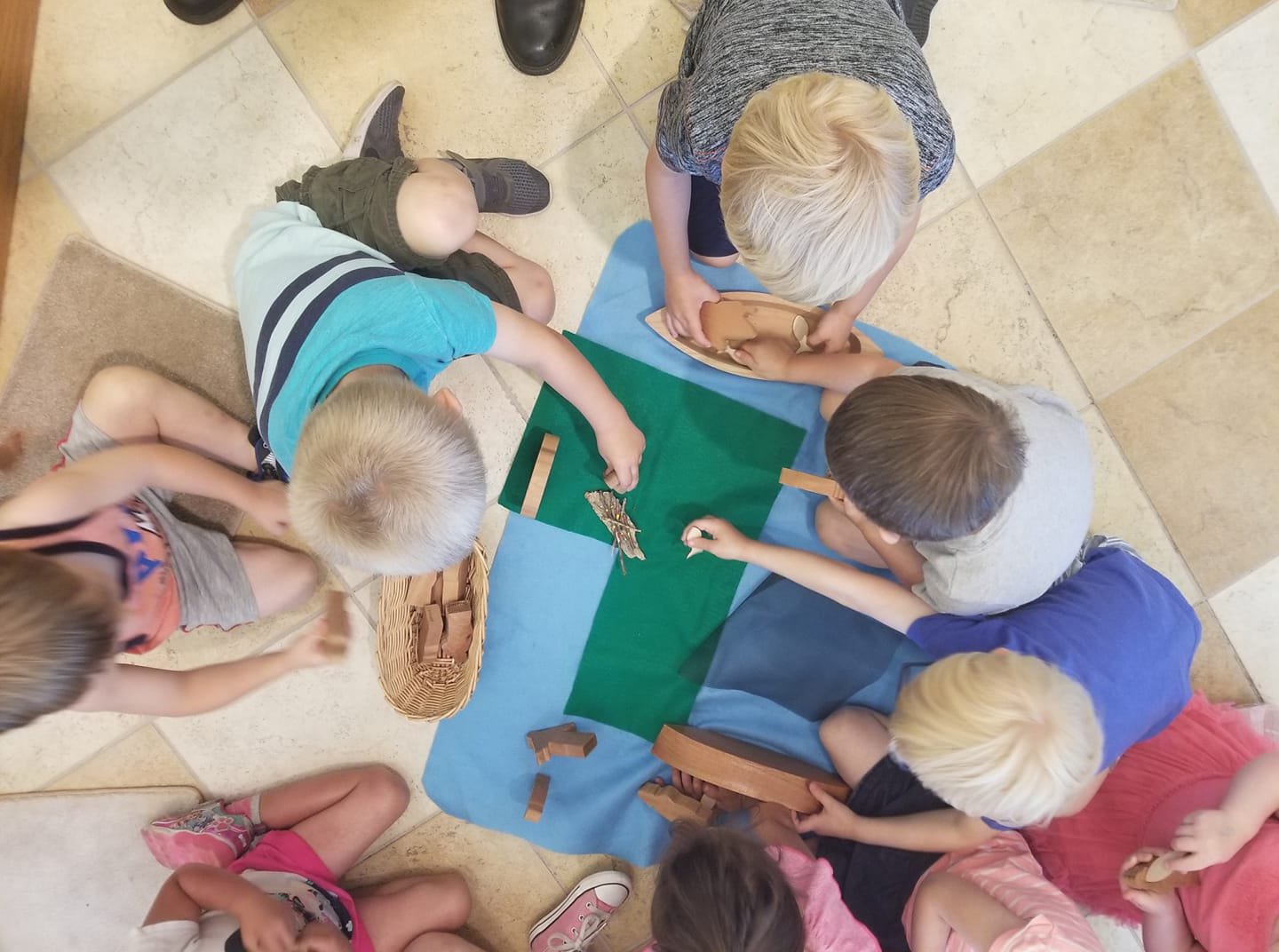
Yesterday at the Godly Play class Hickory Neck offers at The Kensington School, we finally got to tell the Epiphany story – the story of the magi visiting the Christ Child.  As we reviewed the whole story of Advent and Christmas, out came all the figurines of prophets, Mary, Joseph, Jesus, Angels, Shepherds, various animals, and wise men.  Typically, the teacher tells the story quietly, using the figurines, and then we have the kids retell the story, taking turns with the figurines.  And because the class has become so large, we usually have two sets of figurines so we can break into groups.  I would never say the class is perfectly orderly, but it is much more measured than you might imagine with two- to five-year-olds.

But not yesterday.  I’m not sure whether we, the leaders, were off our game, or the kids were still hyped up from returning from break, but the retelling portion of class was utter chaos.  Taking turns fell apart, quiet redirecting failed miserably, and by the time we regrouped to close the class, there was a mass of wooden, sacred figures in a disordered pile.  As we were making our way out, I looked at the pile sadly, grateful that they were all made out of sturdy wood and nothing more destructible, but somewhat disappointed to see such a holy mess.

But as I was thinking about the mess today, I was thinking perhaps my sadness at the chaos was my own “stuff,” having nothing to do with the success of the class.  Too often, we like our Gospel stories neat and tidy.  Too often we tell familiar scriptural stories expecting them to teach specific lessons.  But when we are honest, we know that is not how the Good News works.  The Good News upends worlds, upends social order, and upends our expectations.  Engaging with Jesus is messy work, and sometimes, in the midst of trying to figure out our faith, we end up with a messy rubble in front of us.

I do not know what you are you struggling with today – what things you wish were under control but are actually a mess, or what things you have been expecting from God that just are not how you expected, or what chaos others are making in your life that makes you feel bereft.  What I can tell you is that Christ is there, maybe a bit mired in the chaos too, but there nonetheless.  And sometimes, the mess is just what you need to shake you up and see the movement of God in a new and fresh way.  I suspect things will not turn out as you expect, but then, the Holy Spirit rarely works in ways we expect.  Sending you prayers today, that you might see Christ in the chaos!

← Older posts

Recent Posts

  • On the Myth and Magic of Advent…
  • On Risking Failure and Facing Fear…
  • Sermon – Luke 23.33-43, P29, YC, November 23, 2025
  • On Inhabiting Gratitude…
  • Sermon – Luke 20.27-38, P27, YC, November 9, 2025

Archives

  • December 2025
  • November 2025
  • October 2025
  • September 2025
  • August 2025
  • July 2025
  • June 2025
  • March 2025
  • February 2025
  • December 2024
  • November 2024
  • October 2024
  • September 2024
  • August 2024
  • July 2024
  • June 2024
  • May 2024
  • March 2024
  • February 2024
  • January 2024
  • December 2023
  • November 2023
  • October 2023
  • September 2023
  • August 2023
  • July 2023
  • June 2023
  • May 2023
  • March 2023
  • February 2023
  • January 2023
  • December 2022
  • November 2022
  • October 2022
  • June 2022
  • May 2022
  • January 2022
  • December 2021
  • November 2021
  • October 2021
  • September 2021
  • August 2021
  • June 2021
  • May 2021
  • April 2021
  • March 2021
  • February 2021
  • January 2021
  • December 2020
  • November 2020
  • October 2020
  • September 2020
  • August 2020
  • July 2020
  • June 2020
  • May 2020
  • April 2020
  • March 2020
  • February 2020
  • January 2020
  • December 2019
  • November 2019
  • October 2019
  • September 2019
  • August 2019
  • July 2019
  • June 2019
  • May 2019
  • April 2019
  • March 2019
  • February 2019
  • January 2019
  • December 2018
  • November 2018
  • October 2018
  • September 2018
  • August 2018
  • July 2018
  • June 2018
  • May 2018
  • April 2018
  • March 2018
  • February 2018
  • January 2018
  • December 2017
  • November 2017
  • October 2017
  • September 2017
  • August 2017
  • July 2017
  • June 2017
  • May 2017
  • April 2017
  • March 2017
  • February 2017
  • January 2017
  • December 2016
  • November 2016
  • October 2016
  • September 2016
  • August 2016
  • July 2016
  • June 2016
  • May 2016
  • April 2016
  • March 2016
  • February 2016
  • January 2016
  • December 2015
  • November 2015
  • October 2015
  • September 2015
  • August 2015
  • July 2015
  • June 2015
  • May 2015
  • April 2015
  • March 2015
  • February 2015
  • January 2015
  • December 2014
  • November 2014
  • October 2014
  • September 2014
  • August 2014
  • July 2014
  • June 2014
  • April 2014
  • March 2014
  • February 2014
  • January 2014
  • December 2013
  • November 2013
  • October 2013
  • September 2013
  • August 2013
  • July 2013
  • June 2013
  • May 2013
  • April 2013
  • March 2013
  • February 2013
  • January 2013
  • December 2012
  • November 2012
  • October 2012
  • September 2012

Categories

  • reflection
  • Sermons
  • Uncategorized

Meta

  • Create account
  • Log in
  • Entries feed
  • Comments feed
  • WordPress.com

Blog at WordPress.com.

  • Subscribe Subscribed
    • Seeking and Serving
    • Join 394 other subscribers
    • Already have a WordPress.com account? Log in now.
    • Seeking and Serving
    • Subscribe Subscribed
    • Sign up
    • Log in
    • Report this content
    • View site in Reader
    • Manage subscriptions
    • Collapse this bar
 

Loading Comments...