• About

Seeking and Serving

~ seek and serve Christ in all persons

Seeking and Serving

Tag Archives: disciple

Sermon – John 18.1-19.42, GF, YC, April 19, 2019

01 Wednesday May 2019

Posted by jandrewsweckerly in Sermons, Uncategorized

≈ Leave a comment

Tags

broken, community, cross, darkness, disciple, find, God, Good Friday, humanity, identity, incomplete, Jesus, lost, passion, prayer, Sermon, sin

When I was in college, I would occasionally find myself sitting in the back of the enormous Chapel.  Sometimes I do not even remember actively choosing to go inside the Chapel.  Somehow my body seemed to know I needed something before my brain did.  The cavernous, quiet building rarely had large crowds.  Or maybe my late-night study sessions meant I was there after everyone had left.  Regardless, I would find myself on a hard, wooden pew, just sitting there.  I am not sure I was there praying necessarily.  At least not in the traditional sense.  More often I was sitting there in desperation.  Sometimes I was at the end of a semester, completely overwhelmed and feeling incapable.  Other times, I was feeling a deep sense of loneliness, despite being surround by tons of friends and classmates.  Other times, I simply felt lost, not sure about my purpose or what in the world God was doing with my life – if God was even there at all.  But mostly, when I sat on those pews, surrounded by magnificent beauty and architecture, I felt a profound hole in my heart.  That Chapel was sometimes the only place I could go and be honest about my profoundly weak humanity.

I think worshiping on Good Friday is a little bit like that.  Unlike other times of worship, we do not usually come to this service looking for praise and joyful singing.  Instead, this day is a day where we willingly come to acknowledge and honor those parts of our lives where we feel a profound sense of brokenness, sinfulness, and incompleteness.  We read Scripture that speaks to our deepest pain and suffering.  We say prayers that address the fullness of need for ourselves and the world.  And we venerate the cross – staring at the object that brings into sharp focus our weakness and humanity, and our need for something bigger than ourselves.

On a day like today, I am grateful for John’s Passion Narrative.  All the Passion Narratives from the gospels tell a similar story – the last moments of Jesus’ time with the disciples, his trial and crucifixion, and his death.  And despite the fact that the story in all four gospels is heart-wrenching, something about John’s version digs deeper – shines a light into those dark places we prefer to keep hidden from the light of day.  But in John’s gospel, there is nowhere to hide.  We experience a deep sense of being bereft of our own sinfulness as the sins of those in our narrative mirror our own.  These are not just the common, everyday sins of life.  The sins of the characters today are the sins of denying our very own identity.

Often when we talk about Judas, we think of his failure as a thing he did to Jesus.  But Judas’ sin goes deeper than betrayal of Jesus.  Judas denies his very discipleship.  After all those years of following Jesus, trusting the salvific work of the Christ, believing and proclaiming Jesus’ Messiahship, Judas denies his discipleship by no longer following and instead trying to control the work of God.  You see, Judas follows Jesus because he believes Jesus is starting a political revolution – is becoming the conquering Messiah.  Jesus is not living into that identity as much as Judas wants, so Judas gives Jesus a push.[i]  But when Judas brings all of those soldiers to the intimate place where he discovered his identity as a disciple, we see how deep Judas’ sinfulness goes.  The garden had been a home for the disciples – where they had gathered regularly, in intimate community.  To bring those soldiers there – to the place that defined his own discipleship – is the marker not of an indiscretion, but of a complete denial of who he is.  In John’s gospel, the last appearance of Judas is not of remorse, or suicide, or judgment of Judas.  John simply says, Judas stands “with them.”  With them is not just a physical location; with them is a theological one.  By seeking to control Jesus, by walking away from relationship with Christ, and by standing against Jesus in the very place of intimate identity-making, Judas takes a new identity.  He denies his discipleship, and instead stands with them.[ii]  And as much as we might want to judge Judas, we all know that there have been times when we were fed up with God, and decided to take matters into our own hands.  The more we think we know better, the further we step away from following Christ, denying our own identity in Christ.  The more we seek control, the further we step away from our intimate relationship with Jesus, and instead stand with someone or something else.

Peter denies his identity in a slightly different way.  When we read John’s gospel, we can easily conflate John’s version with the versions from Matthew, Mark, and Luke.  In those gospels, Peter is asked whether he knows Jesus.  His response is he does not know the man.  But in John’s gospel, the question to Peter is different.  He is not asked if he knows Jesus, but whether he is Jesus’ disciple.  To say, “I am not,” is not just a denial of knowledge.  Peter is denying his very identity.  As Karoline Lewis asserts, “In the Gospel of John…Peter’s denial is not of Jesus but of his own discipleship.  …To deny discipleship is to deny one’s relationship with Jesus and the intimacy that makes Jesus and his followers virtually inseparable.  Peter does not deny Jesus, but denies being a disciple.”[iii]  Because we live in a time when we are rarely asked about our identity as people of God, we think of ourselves as immune to Peter’s temptation or somehow incapable of such identity denial.  And in some ways, we may be right:  our denial of identity is not usually as straightforward as Peter’s.  But that doesn’t mean we do not regularly reject our identity.  In small, everyday ways, we find ourselves making accommodations that fracture our intimacy with Christ – decisions that we can rationalize at the time, but when we look back realize have become of slow pattern of denying whose we really are.  And before long, we get so far from discipleship that no one even knows we are Christ’s disciple.

But the denials of identity are not just limited to Christ’s disciples.  Even the religious authorities lose themselves in their attempt to squash the Jesus movement.  The leaders of the faith community are so convinced that Jesus is wrong, they negotiate with a secular leader to get what they want.  And when Pilate, who knows what they want is wrong, pushes them to recognize they are wrong, the religious authorities say something that seems innocuous enough.  But saying, “We have no king but the emperor,” is the ultimate denial of their identity as a people of God.  The people of faith, who were once freed from a king over them, who journeyed forty years, claiming God as their king, who have an everlasting covenant with God, deny the covenant to get what they want.  By claiming the emperor, they deny their very identity.  The people of God, who are about to prepare the Passover feast – the feast that celebrates their release from Pharaoh, “embrace a latter-day Pharaoh whose overthrow the Passover is intended to celebrate.”[iv]  Although we like to demonize the chief priests, we too have pledged loyalties to things other than God.  Perhaps not as dramatically as the religious authorities, but we have all known those moments when a declaration slipped out of our mouths that we later come to realize was denial of everything we claim to be.

On this most holy of days, we can journey so far into the darkness of humanity, of the ways we deny our very own identity, that we can walk out of this beautiful historic chapel feeling lost – having received no encouragement for our bereft hearts.  But I do not think the point of Good Friday is to walk with us into the darkness without giving us a sliver of light to hold onto in these next hours.  Though our reading ends with the finality of Jesus in a tomb, where we are better left is at the foot of the cross.  At the foot of the cross is where we find identity again.  At the foot of the cross, we find a new community being formed.  Jesus gives his mother to the beloved disciple; and to the beloved disciple, he gives his mother.  In other words, Jesus creates a community of mutual care – a new family, a place of forming identity in Christ, even as Christ is departing.[v]  The very reason we gather in community on Good Friday is because we need this group gathered here – this group gathered at the foot of the cross – to bring us back from the denials of our identity, and help us reclaim whose we are.  Today is certainly a day for claiming how deep our own betrayal of God is, but today is also a day of claiming a community who can help us walk back.

I think that was what I was doing all those years ago in college as I sat on those cold, hard pews of the Chapel.  I knew I was lost, that my angst was not just the anxiety of tests and deadlines, but was a much deeper angst about identity.  And although that Chapel was mostly empty, that Chapel reminded me of all the times I had gathered in sacred spaces with the community of the faithful.  Even when the Chapel was empty, the Chapel was somehow a reminder of the mothers and brothers who gathered with me at the foot of the cross.  The only difference today is you do not have to imagine a community gathered with you at the cross.  We are right here with you.  We are struggling right along with you on this journey called discipleship.  Together, starting at the foot of the cross, we will find our way.  Amen.

[i] Jim Green Somerville, “Pastoral Perspective,” Feasting on the Word, Yr. C, vol. 2 (Louisville:  Westminster John Knox Press, 2009),300, 302.

[ii] Karoline M. Lewis, John (Minneapolis:  Fortress Press, 2014), 218-219.

[iii] Lewis, 222.

[iv] C. Clifton Black, “Theological Perspective,” Feasting on the Word, Yr. C, vol. 2 (Louisville:  Westminster John Knox Press, 2009),303.

[v][v] Lewis, 229.

On Discipleship and Decisions…

04 Wednesday Jul 2018

Posted by jandrewsweckerly in Uncategorized

≈ 1 Comment

Tags

decisions, disciple, discipleship, Episcopal, Episcopal Church, General Convention, identity, Jesus, prayer

Members sing during a church service during the General Convention of the Episcopal Church in Salt Lake City

Photo credit:  https://religionnews.com/2015/07/02/episcopal-church-expansive-inclusive-thanks-gay-marriage-votes-commentary/

Today, I am traveling to Austin for the General Convention of the Episcopal Church.  General Convention meets every three years and is a bicameral legislature that includes the House of Deputies and the House of Bishops, composed of deputies and bishops from each diocese. During General Convention, deputies and bishops consider a wide range of important matters facing the Church.  Some years the issues have a huge impact (examples include the ordination of women and members of the LGBTQ community, as well as same-sex marriage).  Other years, General Convention works on important issues that are less flashy.  Regardless of the news cycle, the work of General Convention is about continuing to define who and whose we are, and making sure our work reflects our identity.

I am attending this year as an alternate clergy deputy for the Diocese of Southern Virginia.  My work is to support the eight clergy and lay deputies and our bishops, helping them make important decisions, and filling in when breaks are needed.  The official meetings take place July 5-13, but there are already many committee meetings happening.

In talking to a clergy colleague about my participation in General Convention he asked me, “Why in the world did you volunteer?”  I have been thinking (and laughing) about that question, and after reflection, I realized why I was so interested in serving.  One of the things I preach about a lot is about identity – understanding it, naming it, living into it.  In the current climate of the United States, our identity as disciples of Jesus is an anchor.  But just saying we are disciples without critically examining our lives through that lens does little good.  For me, being a part of General Convention is a way of participating in the work of honing our identity as Episcopalians, and where applicable, helping us to better live into that identity.

I look forward to serving the broader church, our Diocese, and ultimately my parish through this work.  This kind of work creates the space for making us all better, and I am hopeful about what the week can bring.  I ask your prayers for the General Convention over the next many days.  Like any family, parish, Diocese, or church who tries to come to consensus across differences, we will need your prayers to listen deeply, speak intentionally, and make decisions thoughtfully and prayerfully.  I look forward to sharing this experience with you!

On Holiness and Heroes…

27 Wednesday Jun 2018

Posted by jandrewsweckerly in Uncategorized

≈ Leave a comment

Tags

baptism, Christ, discern, disciple, Episcopalian, ethics, fantasy, foundational, God, identity, Jesus, morals, purpose, superheroes

Wonder Woman

Photo credit:  https://www.themarysue.com/no-boys-allowed/

This Sunday we begin our summer film series at Hickory Neck called “Faith and Film.”  When I announced to our parish that this year’s theme would be superheroes, I got some raised eyebrows.  My suspicion is that for those of our parish who have not already blocked out the next five Sunday evenings, their raised eyebrows are because superhero movies may seem frivolous, superficial, or even violent.  On the surface, I can understand the suspicions.  For a long time, I though superhero films dabbled a little too much in escapism and fantasy.  And there is certainly some of that component to the films – who doesn’t enjoy what filmmakers can do with computer graphics these days?!

But at the heart of these films is something much more significant.  Each film seems to asks deep, defining questions.  What kind of person are you going to be?  What morals or ethics will rule your life?   What things are of ultimate significance in your life?  What responsibility do you have for the world and people around you?  These questions are not frivolous questions.  When someone dons a Captain America hat or a Wonder Woman shirt, they are not just celebrating a fun, fictional hero – they are also celebrating a moral way of life.

I cannot imagine anything more relevant to a disciple of Jesus than discerning and making decisions about your life that reflect your morals and ethics.  As Episcopalians, we look to our baptismal covenant for that definition.  It defines five core elements:  1) continuing in the apostles’ teaching and fellowship, the breaking of the bread, and the prayers, 2) resisting evil, and, whenever we fall into sin, repenting and returning to the Lord, 3) proclaiming by word and example the Good News of God in Christ, 4) seeking and serving Christ in all persons, loving our neighbor as ourselves, and 5) striving for justice and peace among all people, and respecting the dignity of every human being.[i]

These days, as our current political climate challenges us on more and more specific issues, I cannot imagine a better topic than to talk about what defines us and our behavior, and then recommitting to that identity and purpose.  The good news is that if you are able to make it to all five movies, the following Sunday (August 5), we will be renewing our baptismal covenants as we baptize a child of God – an event where we all commit to being superheroes in the life of Christ.  I hope you will join us for this fun, sometimes frivolous, but mostly foundational journey.

[i] Book of Common Prayer, 304-304.

Sermon – 1 Samuel 17.1a, 4-11, 19-23, 32-49, P7, YB, June 24, 2018

27 Wednesday Jun 2018

Posted by jandrewsweckerly in Sermons, Uncategorized

≈ Leave a comment

Tags

armor, bold, Christ, confident, cynical, David, disciple, dispassionate, Eucharist, faith, faithfulness, fear, God, Goliath, identity, love, politics, Sermon, skeptical, table, trust, underdog, vulnerable

This summer, our Faith and Film series is all about superheroes.  I was never a huge fan of superheroes growing up.  I liked Superman and Batman nominally, sported a pair of Wonder Woman Underoos as a kid, but in general wasn’t really into superheroes and certainly not into comic books.  But a few years ago, I stumbled into the film, The Avengers, and found myself curious about the back stories of all these superheroes.  That began a deep dive into multiple films, many of which you can see this summer.  The first one, Captain America, is a classic story of the little guy overcoming.  Steve Rogers, a literal little guy with a bad case of asthma, wants to enlist in the US Army during World War II so badly, but his health and height disqualify him.  Impressed by his tenacity, Steve gets recruited into an experimental program to be medically turned into a Super Soldier.  There begins his journey of the little man taking on the big man of Nazi Germany.

Most of us enjoy a good story of the little man overcoming.  That’s why the story of David and Goliath is so epic in our memory.  This little kid, totally untrained, completely unarmed (with the exception of some rocks and a sling), and certainly the underdog to the 9 feet 6 inches[i] of Goliath, David is the prototypical little man.  And yet, with the entire Philistine army staring them down, with a giant taunting them for forty days, and with the ominous threat of defeat, no one else is willing to step forward.  The giant, covered in over 126 pounds of armor, and holding huge weapons like the spear whose iron head weighs fifteen pounds[ii], utilizes his own brand of psychological warfare.[iii]  In the end, that dry river bed between the two armies is not just a valley of separation, but a “chasm of fear.”[iv]  And yet, somehow, the teenage shepherd boy steps forward to fight – the little man, the underdog, makes his move.

But unlike a typical underdog, David does not need science, or a lucky break, or some trick.  What David needs has nothing to do with him.  Instead, what he needs is God.  No one in the Israeli camp has mentioned God at this point in the story.  Saul has tried to overcome the chasm of fear with the promise of riches and even his own daughter’s hand in marriage.  And yet, the entire army of Israel can only see how mismatched they would be against the ultimate warrior.  But David sees things differently.  Having fought lions and bears to save his sheep, David knows he can fight Goliath too.  But not because he is a mighty warrior – but because Yahweh delivered David then too.  Even Saul, God’s formerly appointed king, has forgotten God.  But not David.  David is first to speak Yahweh’s name in almost forty verses of text.[v]  When David faces Goliath, he invokes God’s name, recalling with the name the entire memory of Yahweh’s deliverances of Israel in the past.  David knows that he does not need the conventions of human warfare, but only the God of Israel.[vi]

This week, I have been thinking what a ridiculous sermon that is:  all we need is God.  If all we needed was God, we wouldn’t be in such a political mess, totally unable to compromise, hear each other, and work for the common good.  If all we needed was God, that cancer diagnosis, that lost job, that lost pregnancy, or that lost relationship would not have felt so devastating.  If all we needed was God, we would have figured out a way to both secure our borders and humanely treat those fleeing injustice and seeking asylum.  In saying all we need is God, we sound like a bunch of hippies singing the great Beatles song, “All You Need is Love.”  As modern pragmatists, we know better – we know letting go and letting God is what you say – but not what you do.

So how do we turn ourselves from being skeptics, cynics, and dispassionates to seeing all we need is God?  Well, first we have to define a few things.  What is happening in David’s story should not be a surprise.  If you remember a few weeks ago, when the people broke their longstanding covenant with God, asking for a king like the other nations, God gave them Saul.  And Saul was just that – like the other nations, fighting battles with weapons of other nations.  So when David offers to fight, Saul does what a conventional leader would do – arm David with the conventions of war.  He tries to weigh down David with his armor, hoping against hope that there might be a modicum of protection against the Philistine.  Saul is a ruler like the other nations have.  The contrast between Saul and David then becomes a contrast between trusting conventional means and the means of God.[vii]  Saul has become ruled by fear instead of faith.

The way we pull ourselves out of being skeptical, cynical, or dispassionate is not by rallying behind the idea that we are the little man – the underdog David or Captain America, just waiting to be empowered by God.  The way we put to bed our skepticism, cynical thoughts, or dispassionate feelings about all the things in life overwhelming us is to recall the faithfulness of God.  When David says, “All you need is love,” he does not mean all you need is people giving hugs to one another.  What he means is, all you need is to remember the faithfulness of God – especially when we are not faithful at all!  In his speeches to Saul and Goliath, David is recalling the salvation narrative – the stories of God’s faithfulness for generations.  His trust is actually pretty bold too, considering the current king Saul’s appointment represents the breaking of covenant between God and the people.  But David trusts even a broken covenant can be overcome.  David claims his identity as a child of God and knows his identity is all he needs to fight the worst this world has to offer.

This past week, as politics and religion got dragged together in front of camera crews, I slowly began to realize that we are in a David moment.  We can keep doing what we have been doing – keeping our faith out of politics, putting politics in a box that we especially do not open on Sundays, or we can start realizing that we can never put our faith in a box.  The bond that we have as Episcopalians and especially within the hugely politically diverse community that is Hickory Neck is extremely fragile.  Our fragility is why I rarely talk about politics among the community.  I value our ability to come to the Eucharistic Table in spite of our difference over just about anything else.  But that high value on the common table can come at a cost – the cost is never talking about what being a people of God means – what being a disciple of Christ and being an American means.  In order to protect that common table, I have put on 126 pounds of brass armor, and taken up a spear whose head weighs fifteen pounds.  Instead, today David invites us to shed the ill-fitting armor, and just walk in the clothes God gave us (and maybe a few stones).

I am not saying once we shed man-made armor we will suddenly know what immigration policies are the best.  But what I am saying is until we take on God’s armor, until we recall all those times when God has delivered us, when God has turned chasms of fear into paths of faithfulness, until we remember that we have a distinct identity as children of God and disciples of Christ, we will not be able to take on the Goliath issues of our day.  Stripping down to David-like clothing, we are able sit down comfortably, to see each other more honestly, to be in relationship more authentically, to gather at this table – not just trying to avoid banging our heavy armor into each other, barely able to make eye contact because of our heavy helmets, but actually brushing the skin of elbows with one another, looking deeply into the eyes of the chalice bearer serving you Christ’s blood, and offering the hand of Christian friendship as we rise from the altar rail together.  We can do all those things because God is faithful.  We can do all those things because God has delivered us before.  We can do all those things because we are Christ’s disciples – and that is what we do through God.  We may be underdogs, and we may be vulnerable in a world that is happy to deploy psychological warfare, but we are united and empowered by the love of God.  Our invitation is to step trustingly, boldly, confidently into that love.  Amen.

[i] William P. Brown, “Exegetical Perspective,” Feasting on the Word, Supplemental Essays for Year B, Batch 2 (Louisville:  Westminster John Knox Press, 2012), 4.

[ii] Richard F. Ward, “Homiletical Perspective,” Feasting on the Word, Supplemental Essays for Year B, Batch 2 (Louisville:  Westminster John Knox Press, 2012), 4.

[iii] Walter Brueggemann, Interpretation:  A Biblical Commentary for Teaching and Preach, First and Second Samuel (Louisville:  John Knox Press, 1990), 131.

[iv] Ward, 2.

[v] Brueggemann, 130.

[vi] Brueggemann, 132.

[vii] Brueggemann, 131.

On Politics, Priests, and Prayer…

20 Wednesday Jun 2018

Posted by jandrewsweckerly in Uncategorized

≈ 4 Comments

Tags

American, Bible, Christian, communion, dignity, disciple, diversity, Episcopal Church, Eucharist, Good News, gospel, Jesus, policy, politics, prayer, priest, scripture, table

lightstock_99088_medium_david_needham

Photo credit:  https://www.lebanonfbc.org/ministries/power-prayer-pop

One of the hardest parts of being a priest is creating a community in which we can talk about the Gospel of Jesus Christ, hold widely varying political opinions, and yet still gather at the Eucharistic Table – elbow to elbow, as the imperfect, but beloved body of Christ, determined to stay in community.  I say that the work is difficult because I have seen how fragile this work really can be.  During my priestly formation at seminary, congregations and Dioceses were walking away from that common table over the issue of human sexuality.  Although I was proud of what the Episcopal Church did at the time, I also deeply mourned the loss of diversity at the Table – the creation of a more homogenous Church than a Church who was devoted to staying in the tension while honoring the Gospel.

Because of my high value of the uniting force of the Eucharistic Table, my priesthood has taken a slightly different shape than I might have imagined in my early twenties.  If you had asked me then about the primary role of the priest, I might have argued the role of prophet – decrying injustice and leading the people of faith to a more just world.  But as I aged, and as I served diverse parishes, I began to see the role of prophet is one of many roles, one that needs to be used judiciously so as not to alienate parishioners and create an exclusive community of like-minded people.  And so, my priesthood has been marked with great caution around politics.  While many of my colleagues will beat the drum for justice, I find myself trying to carefully walk with my diverse congregations as we discern together how to interpret politics in light of the Gospel – not in light of Democrats or Republicans, but in light of the witness of Jesus Christ.  That doesn’t mean I don’t have strong political opinions; it just means that I try to take focus off the politician or political issue of the moment and try to create disciples who can see and follow Christ.

That being said, this past week, the issue of what is happening to families seeking asylum on our southern border, and the separation of children from parents as a punitive, purportedly deterring action has shifted my normal practice – not because I changed my mind about politics and the Church, but because two agents of our government utilized Holy Scripture to justify those actions.  Here’s the thing:  if this were just another issue where we are divided about policy, where we had a debate about the extents to which we value national security over other values, I would have happily encouraged our parishioners to be faithful Christians in dialogue.  But when Attorney General Jeff Sessions invoked Holy Scripture to justify separating children from parents, he stepped into my area of authority, leaving me no other option but to speak.

Now I could layout a Biblical defense against the small portion of Romans 13 that Attorney General Sessions quoted, giving you the context of the chapter, giving you the verses immediately following what he quoted as a counter to his argument.  I could quote to you chapter and verse for countless other scripture lessons that tell us to love one another, respect the dignity of other human beings, care for the outcast and alien, tend the poor, and honor children.  I could also tell you about how that same bit of scripture was used to justify slavery, Nazis, or apartheid in South Africa.  But the problem with a scripture quoting war is that no one wins.  What is more important is what we know of the canon of Scripture:  that our God is a God of love, that Jesus walked the earth showing us how to be agents of love, healing, and grace, and that the Holy Spirit works through us today to keep spreading that love.

Knowing what I know about the Good News of God in Christ, in my baptismal identity as one who seeks and serves Christ in all persons, respecting the dignity of every human being, I cannot stand idly by or be silent when the Holy Scriptures of Christians are being used to justify political actions that are antithetical to our Christian identity.  As a priest, I invite you this week, especially when a governmental leader is invoking our faith, to reflect on how the Gospel of Christ is informing your view on this issue.  Not as a Republican and not as a Democrat, but as a follower of Christ.  Fortunately, prominent politicians on both sides of the aisle seem to be coming to agreement on this issue – a rarity these days – but also an example to Episcopalians who hold a high view of coming to the Eucharistic Table across our differences.  I am not saying we need to agree on this – in fact, I suspect we will not.  What I am asking is that you live into your identity as a disciple of Christ, as an agent of love, and then respond in conversation, in political advocacy, and in worship as one holding in tension both our American and Christian identities.  I support you in this difficult, hard work.  I love you as you struggle.  I welcome you to the Eucharistic Table.

On Peter, Paul, and Michael…

23 Wednesday May 2018

Posted by jandrewsweckerly in Uncategorized

≈ 1 Comment

Tags

church, disciple, Episcopal, Good News, Jesus, Jesus Movement, love, power, Presiding Bishop Michael Curry, Royal Wedding, Sermon

In seminary, each third-year student preaches a “senior sermon” in front of the entire seminary.  It’s a bit nerve-wracking because seminarians and priests are a pretty tough crowd.  Add that on top of professors who have molded you for three years, and the pressure is pretty intense.  I remember talking to a professor about my nerves and he assured me, “Well, you know what the old hymn says:  If you cannot preach like Peter, if you cannot pray like Paul, you can tell the love of Jesus and say, ‘He died for all.’”

That hymn to which he was referring is, “There is a Balm in Gilead,” which is the same hymn that Presiding Bishop Michael Curry quoted in his sermon at the Royal Wedding.  Of course, preaching after Bishop Curry the next day felt equally daunting.  Lord knows, I cannot preach like Peter, and I certainly cannot preach like Bishop Curry.  But as I was thinking about it, I think what people have loved so much about Bishop Curry’s preaching at the Royal Wedding is:  1) he was authentically himself (which is obviously a bit different culturally from those gathered in the royal family, but his authenticity was infectious), 2) he was passionate about the love of Jesus and its ability to change the world, and 3) he gave the world a glimpse of what is so awesome about the Episcopal Church – a Church who understands the radical power of love and brings together people from all walks of life to thoughtfully, willfully, beautifully engage in doing powerful work in the world through love.

What has been fascinating to me about Bishop Curry’s sermon and the way it has been described as “stealing the show,” is that Bishop Curry was just doing what the Episcopal Church does every Sunday, at every wedding, and at every funeral – we worship God in the beauty of holiness, we teach those gathered, and we equip them to go out into the world sharing the good news of God in Jesus Christ.  What Bishop Curry’s success does is embolden us to live into our identity as disciples of Christ and members of the Episcopal Church.  I suspect you have talked to someone about Bishop Curry’s sermon in the last few days.  How about instead of just marveling about Bishop Curry’s talent as a preacher, you use this event to talk to someone about how you are inspired to be a follower of Jesus?  Keep it authentic:  “He was awesome, wasn’t he?  He reminds me of my church and the amazing things we are doing to harness the power of love.  I’d love to show you!”

What Bishop Curry did on Saturday at the Royal Wedding was be himself – a member of the Jesus Movement, sharing the Good News of God in Christ.  Your invitation is to be yourself and do the same.  You may not preach like Peter, and you may not pray like Paul.  But you can tell the love of Jesus, and say, “He died for all.”  I can’t wait to hear about your adventures!!

17426137_10155645675302565_2278358373496741633_n

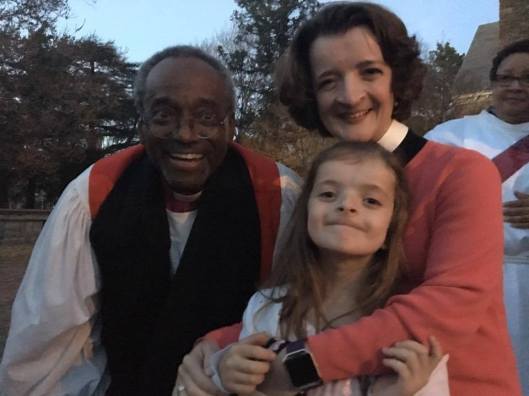
With Presiding Bishop Curry in 2017, Photo credit:  Jennifer Andrews-Weckerly (use only with permission)


Sermon – Mark 1.14-20, Jonah 3.1-3, 10, EP3, YB, January 21, 2018

24 Wednesday Jan 2018

Posted by jandrewsweckerly in Sermons, Uncategorized

≈ Leave a comment

Tags

adventure, brothers, call, community, disciple, discipleship, faithful, follow, God, gospel, immediately, Jesus, John, Jonah, journey, Mark, moment, Nathaniel, Sermon

What is fun about our lessons from last week and this week is we get two different gospellers’ versions of Jesus’ first call to the disciples.  Last week, in John’s gospel, we got that great story of Philip and Nathaniel.  When Philip is asked to follow Jesus, he runs to find Nathaniel.  They have this great conversation about whether anything good can come from Nazareth.  Nathaniel reluctantly comes, and when he finally speaks with Jesus, he is amazed at what Jesus knows about him.  In the midst of community, conversation, and collaboration, both Philip and Nathaniel are able to say yes to Jesus’ invitation to discipleship.  On the other hand, Mark’s gospel paints a very different picture of the calling of the disciples.  Mark tells us Jesus passes two sets of brothers by the seashore, and instructs them to follow him.  Both sets of brothers drop what they are in the middle of doing.  In fact, the second set of brothers wordlessly abandon their father to follow Jesus.  No conversations or discernment; no collaboration or goodbyes.  In Mark’s gospel, Jesus invites, and disciples drop everything immediately and go.

I do not know about you, but I am actually in the John camp when we are talking about discipleship.  As an extrovert, I tend to process things aloud.  I need to talk through a problem with others to figure out what the best option might be.  I like to get input from others, using them as sounding boards to make sure my decision will have a positive impact.  I like to marinate on the feedback, pray a bit, share my leanings with a confidant or two, and then act.  So the idea of Nathaniel hemming and hawing, expressing his initial doubt with Philip, and then challenging Jesus when he seems to have some insight about Nathaniel seems totally relatable to me.  I need conversation, community, and collaboration, especially if I am going to drop everything important in life and follow someone in a new direction.

In some ways, I may even be closer to Jonah when we are talking about discipleship.  We hear only a small part from Jonah’s riveting story today, but what we might all remember is Jonah is a terrible follower of God.  The first two chapters of Jonah are filled with Jonah saying “yes” to God, and then totally running in the opposite direction.  He even endangers some total strangers when he boards a boat in the opposite direction of Nineveh.  He needs to be swallowed by a large fish, facing death and shame before he is willing to do what God has asked Jonah to do.

Many of you have heard this before, but my own call narrative was neither immediate nor direct.  When I first sensed a call to ministry in college, I avoided it.  I figured, maybe I could just volunteer for a year instead.  I loved working at a Food Bank that year, but figured, maybe I should work at a faith-based non-profit instead.  That would certainly count as serving God, right?!?  And then, when that did not feel totally right, I started to look at going to school – not for a Masters in Divinity, but maybe to study theology.  You know, try to learn about God, but not to be a minister.  Even when my priest suggested ordination it took me another whole year of talking to other people, reading countless books, prayer, and going on retreat before I could say yes.  Clearly, my identification with Nathaniel and Jonah is not unfounded.

But today’s lessons are nothing like my tendencies.  The portion of Jonah that we get today does not highlight any of Jonah’s dramatic avoidance and foibles.  Instead, when Jonah offers the shortest sermon ever, “Forty days more, and Nineveh shall be overthrown,” immediately, the people of Nineveh believe God, proclaim a fast, and everyone – everyone great and small – puts on sackcloth.  To understand the significance of this response by Nineveh, we need to remember that Nineveh is no saint.  They are a great kingdom of people who have been oppressing God’s chosen for ages.  They are tyrants, powermongers, and bullies.  No one scares Nineveh.  And yet, with Jonah’s sermon of judgment, they stop immediately, take on a fast, and repent of their ways.  No debates, no town hall meetings, no consultation with the king.  In fact, in the verses we do not read today, the king even proclaims that the livestock need to be put in sackcloth.  The repentance of Nineveh is total and immediate.

We see the parallels in Mark’s gospel today.  The two sets of brothers we read about, Simon and Andrew and James and John sound very similar.  They are both in the fishing industry, they are both working on nets, and they both respond immediately to Jesus’ invitation to follow him.  But there are some subtle differences that make their stories even more powerful.  You see, Simon Peter and Andrew are fishing from the shore with leaded nets.  They are fishermen, but not very wealthy ones.  Meanwhile James and John are from a higher socioeconomic status.  James and John have a boat and hired workers.  They are fishing by dragnet method, which means they are able to harvest much larger catches.[i]  Their father is also mentioned, which likely means their family has been at this business for generations.  And yet, despite the fact that James are John are in the midst of a long-standing, thriving business, both James and John and Simon Peter and Andrew have the same response to Jesus.  They drop everything immediately and go.

I wonder when you have similarly acted with immediacy to God’s call on you.  The moments do not have to be as dramatic as walking out of the classroom, office, or house without a word to anyone.  Maybe they were moments around giving to the church or a cause.  Maybe they were moments when you offered help to a stranger, knowing full well you were going to be late to your next engagement.  Maybe you called a Congress member or State Representative because your faith could no longer tolerate inaction on an issue.  Maybe you heard the volunteer sexton was retiring, and you said, “Here I am.”  Or maybe your immediacy was in getting out of bed one day and finally stepping in the doors of a church – because you needed a community to help you figure out this voice that was calling you to something new.  At some point all of us hear Jesus say, “Follow me.”

Now you may be sitting there thinking, “I have never said yes to that voice,” or “Most of the time I feel like a failure in following Jesus.”  The good news is that you are not alone.  Despite the fact that Simon Peter, Andrew, John, and James all behave exemplary today, we know as we read more of Mark’s gospel, that these are the same men who will fail time and again in their faith.  These are the same men who will deny Jesus, will argue about feeding five thousand people, will try to hold on to Jesus, and will vie for favor with Jesus.  Yes, today, they say yes immediately and they drop everything they have ever known and step out and follow Jesus.  But tomorrow they stumble, and keep stumbling their entire journey with Christ.

What our texts remind us of today is, as one scholar puts it, “Becoming a faithful Christian disciple takes both a moment and a lifetime.”[ii]  We are not going to feel emboldened to follow Jesus every day.  We are not going to abandon our families and our way of life every day.  There will be moments, hard days when we need courage and reassurance.  On those days, we can remember the moments when we said yes and answered the call.  We can recall with encouragement, on those days when we do not feel very faithful, the days when in fact we were entirely faithful.  And if we are struggling to hold onto those “yes” moments, we remember that we are called in community.[iii]  Whether the entire city of Nineveh was acting together, or disciples were called in pairs, our ability to answer God faithfully is usually done within the context of community – within a group of people who can remind us of our faithful days, and let us go when we need follow.  We are not alone in this adventure of following Jesus.  And that is good news!  Amen.

[i] Daniel J. Harrington, ed., The Gospel of Mark, Sacra Pagina Series, vol. 2 (Collegeville, MN:  The Liturgical Press, 2002), 76.

[ii] Elton W. Brown, “Pastoral Perspective,” Feasting on the Word, Year B, Vol. 1 (Louisville: Westminster John Knox Press, 2008), 286.

[iii] Karoline Lewis, “You are Never Alone,” January 14, 2018, as found at http://www.workingpreacher.org/craft.aspx?post=5044 on January 18, 2017.

On Parenting and Other Failures…

23 Wednesday Aug 2017

Posted by jandrewsweckerly in Uncategorized

≈ Leave a comment

Tags

children, Christian, disciple, encouragement, failure, faith, faithful, God, hope, Jesus, love, parent, parenting, Peter

I have never really thought of myself as a very good parent.  I am constantly finding myself in the midst of parenting and thinking, “I really could be handling this much better.”  In looking back, I can see countless ways in which I escalated a situation instead of deescalated, in which I got stuck in wanting control instead of fostering independence, or in which I simply lost my cool.  Parenting sometimes brings out the worst in me, and on the really bad days, I feel like I am failing pretty miserably at the whole endeavor.

I feel that way about my faith sometimes too.  I know all the ways I am called to serve God and to be a faithful disciple.  But I often find myself failing.  For as many times as I can be like an insightful Peter, more often I am like the Peter who is sinking into the sea, trying to control what Jesus does, or putting myself in front of the gospel.  Reading about modern saints, or people who are making a difference with their life only makes me more aware of my many failings to live as a faithful Christian.

The good news is that children, and other people, often give us glimpses of hope and encouragement.  The other day, I was stirring from a nap with my youngest (who refuses to nap now unless you nap with her).  As she was waking up, she smiled at me and said, “You can be my best friend, Mommy.”  A few nights ago, my oldest requested to start using the same shampoo, conditioner, and soap that I use, instead of her 3-in-1 tear-free wash we have been using.  I sighed out of irritation, and asked her why.  She said, “Because I want to be like you, Mommy.  Except for your short hair!”

I laughed on both occasions, but both comments reminded me that for all the times I fail, there is still love.  For all the ways in which I mess up this parenting thing, there are glimpses of times when I managed to get it a tiny bit right.  I think the same is true for our faith life.  For all the ways we are horribly imperfect, we also have glimpses of powerful faithfulness.  I encourage you to listen to those around you to hear those little comments that will encourage you on your journey.  And then I invite you to straighten up, take a deep breath, and get back in there.  God is doing amazing things through you.  I can’t wait to hear all about it!!

Dad Teaching Daughter Electrical Engineering

Photo credit:  www.quoteambition.com/best-encouraging-quotes-words-encouragement/

On the Power of Hospitality…

02 Wednesday Aug 2017

Posted by jandrewsweckerly in Uncategorized

≈ 1 Comment

Tags

church, community, disciple, Episcopal, faith, gift, hospitality, invite, kingdom of God, powerful, radical, share, welcome, witness

Hospitality

Photo credit:  www.riversouthbay.org/my-river/opportunities/hospitality-team

As a priest, it is pretty rare that I get to sit in the pew, let alone worship in or experience another church’s community.  But last week I had the opportunity to do that in two very different, but blessed ways.  The first was taking my children to Vacation Bible School (VBS) at a local Disciples of Christ church.  The church is one of our ecumenical partners, and I had preached there during a pulpit exchange last Lent.  Our children had requested attending VBS, but our shared Episcopal offering was at a time we could not do.  So off to the Disciples of Christ church we went.  As we ate dinner each night, and as the kids ran off to crafts, music, teaching, and play, and as I sat in on the adult class, I felt like a guest in a wonderful house of hospitality.  I watched as within just a week, the church members fell in love with our children, giving them hugs and high fives, teaching them powerful lessons about how they are made for a purpose and that God is always in their corner.  It was a wonderful gift to be welcomed as strangers and sent off as fellow disciples in Christ.

The other experience was quite different.  A gentleman who had worked for the cleaning company we use at our church passed away unexpectedly a few weeks ago.  His church hosted the funeral, and I attended the service on Sunday.  The funeral was admittedly a difficult one.  Lonnie had experienced a rough road in life – from the loss of family, addictions, homelessness, imprisonment, recovery, and new life.  I only knew his story superficially, having been introduced to him through one of our parishioners who was a mentor of his.  But what I witnessed was a community of faith who completely embraced Lonnie in every way – loving him fully, accepting him as he was, incorporating him into the life of the church, welcoming him into their homes, and being active agents of his recovery and faith life.  They offered me a powerful witness about what Christ-like relationship looks like.

I come out of those experiences with two distinct conclusions.  First, I have a renewed appreciation for my own faith community.  Though I learned powerful lessons last week, I also developed a renewed love for Hickory Neck and our distinct work in furthering the kingdom in the greater Williamsburg area.  My experience reminded me of what radical hospitality can feel like as a recipient and made me want to offer it more.

Second, I am impressed with the broad range of expressions of faith in Williamsburg, and I am grateful that there is a place where anyone can find a church home.  The witness for Jesus is strong in this community.  I suspect that the more we appreciate our collective witness, the stronger our individual witness will become.  If you have not invited a friend or acquaintance to church lately, I encourage you to do so.  Experiencing the gift of Christian hospitality, community, and formation at Hickory Neck is not a gift to keep to ourselves.  That gift can be life changing!

On Baseball, Community, and Church…

12 Wednesday Jul 2017

Posted by jandrewsweckerly in Uncategorized

≈ Leave a comment

Tags

baseball, church, community, disciple, God, Good News, Little League, Lord, love, meaning, ritual, serve, support

baseball kids

Photo credit:  newprovidencepal.org/baseball/

This summer we have had the joy of supporting both a friend’s and a parishioner’s little league baseball teams.  Not having boys myself, it has been a long time since I watched a little league game.  In fact, after the first game we saw, I shared with my husband that I could not imagine giving up so much family time for one member’s extracurricular interest.  He understood my hesitation, but invited me to look around.  You see, with all those mornings, afternoons, and evenings at the baseball field; with the ritual of packing chairs, canopies, and ice chests; and with the repeated gathering of parents and siblings, slowly, slowly a community is formed.  Parents learn about each other’s lives, siblings convert boredom into adventures, and guests are quickly made to feel welcome with a shared chair, beverage, or joke.

What those teams, especially travelling teams, have done is create a community.  They have created a group of people who know each other’s stories, who share wins and losses together, and who slowly learn to talk more than just baseball – but life!  They have created a community where kids do not just have one set of parents – they have a whole community of moms, dads, and siblings.  They have created a community that revolves around ritual, memory-making, and maybe even meaning-making.  In many ways, those teams have created something similar to what Church creates.  Church too creates a multigenerational community – where every elder is a grandma, and every adult can parent children.  Church too creates a community where wins and losses are shared together, where stories are known, and companionship is created.  Church too revolves around ritual, memory-making, and meaning-making.

Church creates community, but uses that creation for a different purpose.  The community of Church nurtures, forms, offers comfort, and creates community, but almost as a side-benefit to the main work we do.  Our purpose is to shape disciples for sharing and living the Good News of God in Christ.  So, while we are loved and supported in the community, we are loved and supported so that we can go out into the world to love and support others.  While we share stories, wins, and loses, we also go out to listen to others’ stories, naming where we see God acting in their lives.  While we participate in ritual, making memories and meaning, that same ritual sends us out to love and serve the Lord in the world.  We may come for the community Church creates.  But we stay because that community demands we be much more.

Today I am grateful for our many communities.  In fact, I think we all need more than just Church communities to keep us grounded in the world God created.  But if you haven’t been to church in a while, I invite you to give it a try.  You may find even more than you were looking for!

← Older posts
Newer posts →

Recent Posts

  • On the Myth and Magic of Advent…
  • On Risking Failure and Facing Fear…
  • Sermon – Luke 23.33-43, P29, YC, November 23, 2025
  • On Inhabiting Gratitude…
  • Sermon – Luke 20.27-38, P27, YC, November 9, 2025

Archives

  • December 2025
  • November 2025
  • October 2025
  • September 2025
  • August 2025
  • July 2025
  • June 2025
  • March 2025
  • February 2025
  • December 2024
  • November 2024
  • October 2024
  • September 2024
  • August 2024
  • July 2024
  • June 2024
  • May 2024
  • March 2024
  • February 2024
  • January 2024
  • December 2023
  • November 2023
  • October 2023
  • September 2023
  • August 2023
  • July 2023
  • June 2023
  • May 2023
  • March 2023
  • February 2023
  • January 2023
  • December 2022
  • November 2022
  • October 2022
  • June 2022
  • May 2022
  • January 2022
  • December 2021
  • November 2021
  • October 2021
  • September 2021
  • August 2021
  • June 2021
  • May 2021
  • April 2021
  • March 2021
  • February 2021
  • January 2021
  • December 2020
  • November 2020
  • October 2020
  • September 2020
  • August 2020
  • July 2020
  • June 2020
  • May 2020
  • April 2020
  • March 2020
  • February 2020
  • January 2020
  • December 2019
  • November 2019
  • October 2019
  • September 2019
  • August 2019
  • July 2019
  • June 2019
  • May 2019
  • April 2019
  • March 2019
  • February 2019
  • January 2019
  • December 2018
  • November 2018
  • October 2018
  • September 2018
  • August 2018
  • July 2018
  • June 2018
  • May 2018
  • April 2018
  • March 2018
  • February 2018
  • January 2018
  • December 2017
  • November 2017
  • October 2017
  • September 2017
  • August 2017
  • July 2017
  • June 2017
  • May 2017
  • April 2017
  • March 2017
  • February 2017
  • January 2017
  • December 2016
  • November 2016
  • October 2016
  • September 2016
  • August 2016
  • July 2016
  • June 2016
  • May 2016
  • April 2016
  • March 2016
  • February 2016
  • January 2016
  • December 2015
  • November 2015
  • October 2015
  • September 2015
  • August 2015
  • July 2015
  • June 2015
  • May 2015
  • April 2015
  • March 2015
  • February 2015
  • January 2015
  • December 2014
  • November 2014
  • October 2014
  • September 2014
  • August 2014
  • July 2014
  • June 2014
  • April 2014
  • March 2014
  • February 2014
  • January 2014
  • December 2013
  • November 2013
  • October 2013
  • September 2013
  • August 2013
  • July 2013
  • June 2013
  • May 2013
  • April 2013
  • March 2013
  • February 2013
  • January 2013
  • December 2012
  • November 2012
  • October 2012
  • September 2012

Categories

  • reflection
  • Sermons
  • Uncategorized

Meta

  • Create account
  • Log in
  • Entries feed
  • Comments feed
  • WordPress.com

Blog at WordPress.com.

  • Subscribe Subscribed
    • Seeking and Serving
    • Join 394 other subscribers
    • Already have a WordPress.com account? Log in now.
    • Seeking and Serving
    • Subscribe Subscribed
    • Sign up
    • Log in
    • Report this content
    • View site in Reader
    • Manage subscriptions
    • Collapse this bar
 

Loading Comments...