
• About

Seeking and Serving

~ seek and serve Christ in all persons

Seeking and Serving

Tag Archives: election

Sermon – 1 Kings 17.8-16, P27, YB, November 10, 2024

13 Wednesday Nov 2024

Posted by jandrewsweckerly in Sermons

≈ Leave a comment

Tags

afraid, blessing, church, consecration, drought, election, Elijah, enough, God, promise, Sermon, stewardship, trust, widow of Zarephath

On this Consecration Sunday, the day we offer and celebrate our gifts to support the ministry of this beloved community, the lectionary seemingly delivers the perfect text – the widow’s mite.  One might guess the lectionary shapers designed the lectionary just for a day like today – so that the sermon might be a nice a tidy story about how you too might give sacrificially.  But that story – and that sermon – are not our gift today.  After the tumultuous election week we have had, our gift lies with another widow – the widow of Zarephath from the first book of Kings. 

The widow of Zarephath is both a woman and widow, and as you know by now, that makes her doubly vulnerable in Elijah’s day.  In fact, although our translation says she is a widow, the original Hebrew actually adds, “…the word ‘woman’ in apposition before ‘widow.’  Verse 9 could literally be translated as, “Rise and go to Zarephath, which belongs to Sidon, and dwell there.  Look, I have commanded a woman, a widow, to sustain you.”[i]   The widow is also the mother of a child who is dependent upon her, so she has needs beyond her own.  If we read a bit further in Kings, we learn she is not normally poor – even as a widow, she owns a home that is large enough for an upper chamber.[ii]  And, we know she lives in Sidon, which means she is a foreigner, and that she likely worships Baal.

But to fully understand this widow we have step back even further.  The reason Elijah wanders into Sidon needing food is because he is fleeing Queen Jezebel, another Sidonian woman who has convinced King Ahab to build temples to Baal, and who threatens to kill Elijah.  So, we already see two different treatments of Elijah by two different Sidonian women.[iii]  But the other big piece of information is there is a drought in the land – and the lack of water means a threat to life – in fact, any poverty the widow of Zarephath faces is because the drought has dried up the food supply.  But drought also has theological significance in this story.  “…the condition of drought is the result of the Israelite King Ahab’s disobedience.”[iv]  As Old Testament Scholar Ellen Davis explains, “Overall, from a biblical perspective, the sustained fertility and habitability of the earth, or more particularly of the land of Israel, is the best index of the health of the covenant relationship.”[v]  In other words, if there is a drought, the people of God have really messed up!

Now sometimes stories from the Bible feel so foreign, that even with context like we just learned, we do not really feel like we can relate.  But if we really think about the widow of Zarephath and her context today, we find much more relatability than we might like to admit.  We certainly know the reality of people of means suffering financially.  In fact, a recent story from Forbes said that over 75% of Americans are living paycheck to paycheck.[vi]  That’s a lot of folks eking out a living with last bits of grain and oil.  We also know something about fighting about authority and ultimate values – where we put our trust.  I would say the dramatically different reactions to the election this week are a classic example – from people who are relieved by the election results to people who feel so marginalized they do not feel like they can even stay in relationship with their neighbors.  Our church too is living donation to donation – with the annual threat of budget deficits – and is now facing the reality of what being a politically diverse community means – how we will not just respect differences but how we will actively serve Christ as one.  I think we are all too familiar with what being in a theological drought is all about.

So, what happens to this woman widow in Zarephath?  As she faces the ludicrous request of Elijah to feed him when she is literally about to feed her son and herself their last meal before they die of starvation, Elijah says, “Do not be afraid.”  I confess, when I first read those four words this week, “Do not be afraid,” I was pretty upset.  That’s God’s answer to this theological drought we are in?  This hurting, deeply divided, seemingly irreparable place?  Do not be afraid?!?  Now, the good news is I stayed in the text.  As I kept studying, I stumbled on a commentary in which Professor Robert Wall said, “‘Do not be afraid,’ is not meant to comfort one facing death but rather to inspire confidence that [Elijah’s] God keeps promises of salvation made.”[vii]  Elijah’s God keeps promises of salvation made.  And as if to support the good professor’s insight, Elijah goes on to say in the text, “For thus says the LORD the God of Israel:  The jar of meal will not be emptied and the jug of oil will not fail until the day that the LORD sends rain on the earth.”[viii]  God never says the jar will be overflowing or we will have so much we will need a second jug.  But God does say we will have enough.

Those words from Elijah, those words that often introduce an oracle of salvation[ix], are words for us too.  Do not be afraid.  I know those four words may feel impossible for some of us today.  Many of you have already told me about your literal fears:  either your fears about the economy before the election or your fears for your rights and dignity after the election.  But those four words are our promise today – that God keeps promises of salvation made.  Like Elijah promises the widow, so God promises to you today that your jar of meal will not be emptied and your jug of oil will not fail until the day that the LORD sends rain on the earth.  So, even in our fears, we make promises to the church about what time, talent, and treasure we can share to ensure our ministries remain vibrant and thriving.  In our fears, we keep coming to church and engaging with neighbors who differ from us more meaningfully than we did before.  In our fears, we trust in our God, no matter what civic leaders are in place.  Because our jar will not be emptied and our jug will not fail, we can trust that we will have enough – enough for ourself, enough for our neighbor, and enough for the church.  We can say yes, just like the widow of Zarephath on the verge of death.  We can say yes.  Do not be afraid.  Amen.


[i] David G. Garber, Jr, “Commentary on 1 Kings 17:8-16,” Working Preacher, November 10, 2024, as found at https://www.workingpreacher.org/commentaries/revised-common-lectionary/ordinary-32-2/commentary-on-1-kings-178-16-9 on November 8, 2024.

[ii] Denise Dombkowski Hopkins, “Exegetical Perspective,” Feasting on the Word Supplemental Essays, Year B, Batch 4 (Louisville:  Westminster John Knox Press, 2012), 6.

[iii] Hopkins, 4.

[iv] Garber.

[v] Ellen F. Davis, Scripture, Culture, and Agriculture: An Agrarian Reading of the Bible (New York: Cambridge University Press, 2009), 8, as quoted by Garber.

[vi] Emily Batdorf , “Living Paycheck To Paycheck Statistics 2024,” Forbes Advisor, April 2, 2024 as found at https://www.forbes.com/advisor/banking/living-paycheck-to-paycheck-statistics-2024/?fbclid=IwY2xjawGcVSVleHRuA2FlbQIxMAABHSkGQLYo1Mye_ETSWURRZckm0B5EKB226F-g1znt-H6_s6kt5j5eFvxjvw_aem_OKcSGHZduH78GmIJSrYAZw on November 8, 2024.

[vii] Robert W. Wall, “Theological Perspective,” Feasting on the Word Supplemental Essays, Year B, Batch 4 (Louisville:  Westminster John Knox Press, 2012), 3.

[viii] 1 Kings 17.14.

[ix] Ronald J. Allen, “Considering the Text: Week Six, Twenty-Fifth Sunday After Pentecost, 10 November 2024”  Center for Faith and Giving, as found at centerforfaithandgiving.org, 41.

Sermon – Proverbs 31.10-31, P20, YB, September 22, 2024

02 Wednesday Oct 2024

Posted by jandrewsweckerly in Sermons

≈ Leave a comment

Tags

anxiety, capable woman, community, creator, election, God, grace, king, partnership, powerful, president, Sermon, strength, together

As the presidential election approaches in just about six weeks, I have spoken with many of you about a rising sense of anxiety and despair.  One of the things I have noticed about the last three presidential elections is that we have kind of gotten lost – so caught up in big personalities and dramatic events that we have lost sight of one core question in elections:  what do we need in a president to create a just country that reflects the priority of love.

Since I always tell our community that I do not preach politics – just Jesus – I thought I would turn to scripture this week for guidance.  I started with the daily office.  On Wednesday, I came across Psalm 72.  The psalm begins, “Give the king your justice, O God, and your righteousness to a king’s son.  May he judge your people with righteousness, and your poor with justice.  May he defend the cause of the poor of the people, give deliverance to the needy, and crush the oppressor.”  “Yes,” I thought, “This is the president we need.  After all this debate and controversy, this is the kind of president I want.”  Then I kept reading.  The more I read about this noble king, the more the king sounded a lot like Jesus.  Finally, a truth seeped through – this year, as I am considering my choice for President, I have not been looking for an actual person.  I have been looking for a savior; and that is not fair to any human being.  Any person running for president is going to be flawed.  And we already have a Savior – we do not need another one. 

Then I turned to our Old Testament lesson for today: the so-called “capable woman” from Proverbs.  I spent some time with this text when I was writing my thesis in seminary, so I am always drawn to this familiar text.  But the more I read about this woman this time, the more inadequate I felt.  She makes clothes, rises before dawn to feed her family, manages a staff, purchases a field, and plants a vineyard by herself.  She in an entrepreneur, selling her wares for good money.  She cares for the poor, and is a wise teacher.  She does all this and is happy.  As a priest, mother of two, and a wife, I feel woefully inadequate next to the capable woman.  In fact, in Hebrew, the word to describe her is not really “capable” per se.  The word, hayil, is a word that means much more than capable.  Hayil is primarily used in the Old Testament to describe men of great power, valor, and strength.  Hayil is a term for powerful warriors.  In fact, this Proverbs woman and Ruth are the only women in the Old Testament to earn the title normally reserved for men.  The Proverbs woman is not just capable; she is a woman of strength and power.  She is a superwoman. 

The challenge with these two images – the righteous king and the powerful woman – is that neither of these labels feels attainable.  For women, the Proverbs woman of power is especially loaded.  Many of us long to be a woman of hayil.  We want to be a woman who can do everything – work outside the home, manage our finances, care for a home and family, maintain a healthy relationship with God, have power and honor in our lives.  This is the challenge of the modern woman – society is opening doors for us to do everything – to work, to raise a family, to be successful.  But the reality is that we either kill ourselves trying to do everything, or we feel horribly guilty for our many failures.  Unlike celebrities, who seem to manage family, fame, and face with ease, we feel overwhelmed and woefully inadequate.  In fact, as I was pondering preaching this text this week, I stumbled across a quote from one seminary professor.  She writes, “Many of you will conclude this text is too much a minefield and steer clear, with good reason.”[i] 

Of course, today is not just a sermon for the women in our community.  Men often feel the same sense of being overwhelmed by trying to do everything.  Forget the kingly imagery from the Psalm.  There is often pressure for men to be financially stable, and if you have a family, to provide for them.  There is now an expectation that men play a role in the rearing of children and doing housework, being involved in the community, and caring for the upkeep of your home.  As I have read parenting magazines over the years, I have seen story after story of men trying to navigate the modern family’s expectations of playing both traditional and nontraditional male roles.  And for the man and woman running for President, expecting a “just king” or a “capable woman” places incredibly unfair expectations on either candidate.

So, what do we make of this woman of hayil in Proverbs today?  Like the King in Psalm 72, I wonder if the woman in Proverbs is perhaps not a particular human, but an ideal.  All the practices of the woman of strength are practices that we should strive to embody – we are to be industrious, using the talents that God has given us for the good of ourselves and others.  We are to work hard and to care for the poor and needy.  We are to use our words wisely, and shape the next generation to love kindness and walk humbly with God.  And most of all, we are to fear the Lord.  Fear in this sense is not the kind of fear that cowers from God, but that holds the Lord in awe, marveling at the majesty of God, rooting our lives in that sense of wonder, gratitude, and reverent humility before the Creator.[ii]  But mostly, this text is a reminder that we do not put these expectations just on presidents – these are expectations, or ways of life, for each of us.

The good news is that we do not strive for the ideal of hayil alone.  Perhaps a better image for us today is not a single woman of hayil, but a community of hayil.  This text from Proverbs is not inviting us to be all things to all people, but instead is inviting all men and women to consider together what the tasks of a family, church, or community are, and to consider the ways we can share in those tasks together.[iii]  When we focus on only one woman, we miss that this text encourages us to think about the partnerships between men and women in the work of the community.  This text is not a beautiful hymn to one human woman, but is a lesson about interdependence, partnership, and the contours of community.[iv]

That’s what excites me about Hickory Neck.  We are on a journey to become a woman, a community, of hayil.  I see you using your time, talent, and treasure to help in the ways that you are most gifted.  I see you praying for one another, especially when one of us looks particularly overwhelmed or stressed.  I see you looking beyond our doors about the way we can individually and collectively care for our neighbors in need.  I see you leaning into our creativity to make a path forward in a new reality.  In this moment, Hickory Neck is living as the woman of hayil.

Of course, we still have work to do – we are still accomplishing the ideal as a community.  A priest friend of mine had a set of triplets in her parish.  She knew that the mother could not manage all three alone – one person only has two arms!  So, the priest arranged for a rocking chair in the narthex to help ease the babies’ tempers.  There were older women in the congregation who, within seconds of a cry, would swoop up one of the babies and rock the child in the side aisle, without the mother having to even ask for help.  There were men who caught the crawling babies under pews and returned them to their mother.  And mostly, there were patient parishioners, who would focus through the cries of the children to hear the sermon without complaint.  We too can offer this grace to one another.  Whether there is a parent with a child who could use some help, whether there is a parishioner who needs a hand to get to the communion rail, or whether we offer prayers for someone who we notice is struggling this week, we are a community who can exemplify the holy partnership we see in scripture today.  We can acknowledge that our work is best accomplished together because our shared labor expresses faith, hope, and love in ways that build us up and bring us together.  We can all be that woman of hayil, that superwoman for the wider community, but only if we do the work together.  Amen.


[i] Amy Oden, https://www.workingpreacher.org/commentaries/revised-common-lectionary/ordinary-25-2/commentary-on-proverbs-3110-3, September 23, 2012, as found on September 20, 2024. 

[ii] Kathleen M. O’Connor, “Exegetical Perspective,” Feasting on the Word, Yr. B, vol. 4 (Louisville: Westminster John Knox Press, 2009), 79.

[iii] H. James Hopkins, “Homiletical Perspective,” Feasting on the Word, Yr. B, vol. 4 (Louisville: Westminster John Knox Press, 2009), 77.

[iv] Hopkins, 79.

Sermon – Acts 1.15-17, 21-26, E7, YB, May 16, 2021

26 Wednesday May 2021

Posted by jandrewsweckerly in Sermons

≈ Leave a comment

Tags

apostles, bishop, discernment, disciples, election, Episcopal, God, goodness, grace, Holy Spirit, Jesus, prayer, Sermon, trust, will

I have sometimes daydreamed about the experience of liturgical freedom:  picking and choosing the scripture for a given Sunday (particularly when I need to address a specific issue), praying an extemporaneous prayer on a Sunday to address a certain topic in the church, or drafting our own liturgical experience to address a particular need.  However, as crazy as the idea may sound, I more often find freedom within our Episcopal constraints than within the endless possibilities of what could be. 

This past week was a classic example.  Last Sunday, totally unaware of the announcement I would be making on Tuesday, Bob preached about the invitation of the Resurrection being an invitation into discernment – discernment about what each of us needs to do to bring about the kingdom here on earth.  On Tuesday night, our regularly scheduled Discover Class topic, which was scheduled months ago, was focused on the structure and leadership model of the Episcopal Church, including who bishops are and how they are elected.  Then today, we get this lesson from the Acts of the Apostles in which Peter and the other apostles are attempting to replace the twelfth spot Judas left open through his death.  All that daydreaming about constructing our spiritual experiences went out the window this week when I remembered the Holy Spirit does a much better job at constructing those experiences than I ever could!

To say that this portion of the Acts of the Apostles is a divine gift is not necessarily because we happen to be talking about a bishop’s election this week just as the apostles are talking about an election of sorts.  In fact, what the apostles are doing is the opposite of an election.  No one asks Matthias or Justus to go through an interview process or offer their vision of leadership for the next decade.  Instead, their criteria are pretty simple.  First, the replacement should be someone who knows Jesus personally.  Second, they want to honor their ancestral roots in the twelve tribes of Israel – eleven apostles will not suffice.[i]  Third, their decision is rooted in prayer.  And finally, their decision is based on trust in the will of God.  Nowadays, we might think the casting of lots is a little too random and could lead to a poor appointment of leadership – I mean when was the last time we selected a Rector, Warden, or Committee Chair by flipping a coin?  But according to New Testament scholar Kathy Grieb, the casting of lots is “an ancient biblical practice for determining God’s will…”[ii]

Hearing about all the coincidences in our last week, from talking about discernment, to the structure of the Episcopal Church, to the selection of the last apostle, may be intriguing or even amusing, but may also leave you asking, “So, what?  What does all of this have to do with me or my experience of Hickory Neck, or even more broadly, with Jesus?”  As I have reflected on these coincidences – or as Carl Jung referred to them as instances of “synchronicity” or “meaningful coincidence”[iii] – I see an invitation for all of us from Peter.  First is an invitation to recall our identity.  We are a community whose historic identity has been about weathering change – whether it was the identity crisis created by the Revolutionary War, the replacement of a faith community by schools and hospitals for over a century, to reclaiming and expanding our land to become a church again, to surviving a global pandemic.  The possibility of a change in clergy – a very small possibility at that – does not alter the fact that we are a community rooted in Jesus’ love, shining our light on this Holy Hill for almost three centuries.  Second is an invitation into prayer:  prayer for the Hickory Neck Community, prayer for your Rector, and prayer for the Diocese of Iowa and the other candidates.  Our hurt, our frustration, our fear, and our joy can be left at the feet of Christ in prayer.  When given the space, prayer can do much more than we can imagine.  And finally, our invitation this week is to trust in God.  We may not always like what God does – I am pretty sure the apostles would much rather have not been trying to figure out a leadership model in Jesus’ absence.  But we do know that God is faithful, and, in time, God leads us to goodness and grace.  I do not know where the next couple of months will lead us.  But I do know if we can stay rooted in our identity, in prayer, and in our faith in God, we will come out stronger disciples for Jesus, strengthened to take on whatever “meaningful coincidences” the Holy Spirit throws our way.  Amen.


[i] Noel Leo Erskine, “Theological Perspective,” Feasting on the Word, Year B, Vol. 2 (Louisville: Westminster John Knox Press, 2008), 528.

[ii] A. Katherine Grieb, “Exegetical Perspective,” Feasting on the Word, Year B, Vol. 2 (Louisville: Westminster John Knox Press, 2008), 531.

[iii] Carl G. Jung, Synchronicity: An Acausal Connecting Principle (Princeton:  Princeton University Press, 2012), 44, as cited at https://artsofthought.com/2020/05/30/carl-jung-synchronicity/ on May 14, 2021.

Sermon – Matthew 25.31-46, P29, YA, November 22, 2020

17 Thursday Dec 2020

Posted by jandrewsweckerly in Sermons

≈ Leave a comment

Tags

Christ the King, crisis, election, God, Good News, Jesus, mend, pain, pandemic, peace, Sermon, Thanksgiving, weary

Once upon a time, “there was a cobbler who lived alone in his shop with one window that looked out on the street.  His wife and children had all died and he asked God, “Holy One why have you so long delayed your coming?  I have almost given up hope in seeing you.  Please come to my humble shop this day and show me your face.”

Outside on the street the cold winter brought snow.  Through his window he saw a beggar who shivered in the cold.  The cobbler invited the beggar into the shop to warm him and offer a meager meal from his shrinking larder.  The beggar thanked him and left.

As the day passed, a few customers came with repairs they needed for their shoes and harnesses.  A young boy sought shelter from the cold and snow.  The child’s feet were wrapped in old dirty rags and stuffed with paper.  Into the shop he invited the boy.  After making him some warm milk and a sandwich from the little food he had he went to his closet and found a pair of shoes that [had] belonged to his son.  He fit the shoes to the boy.  Grateful, the boy left with a promise to return to visit him.

It was approaching dusk and the cobbler despaired of a visit from the Lord.  A woman with her young babe appeared in front of the window.  She was dressed in a thin piece of cloth and she looked as if she might freeze to death.  The cobbler invited her into his shop.  Wary of the old man, she hesitated at the door, but feeling the warmth within she stepped across the threshold.  The cobbler made her some tea and went to his closet to find a heavy woolen cloak that [had] belonged to his wife.  Giving her the cloak the woman thanked him and after he shared the rest of his larder with her, she left with the child.

The sun descended and left the cobbler bereft.  “Why didn’t you come and visit me today,” the cobbler asked?  There was a voice that spoke to him in his humble shop:  “But I did come to you.  When you invited in the beggar, the boy, and the mother and her child, I was there with you.  In each of their faces you looked into my eyes.”[i]

I don’t know about you, but the last eight months have been exhausting.  Every week I look at the lessons and newspaper and hope for some good news – some glimpse of the face of Jesus.  But every week, the news somehow seems worse.  This week has been no different, with suffering hitting us at both the macro and micro levels.  Our country is in an existential crisis about the Presidential election.  Although many commentators seem to think things will work out, at question is the very foundation of democracy – elections where the votes of the people matter and where the peaceful, respectful exchange of power can happen.  We have managed to successfully do this for over two hundred years, and somehow, this year we cannot seem to hold to our founding principles.  Meanwhile, on the micro level, we are approaching a national holiday of Thanksgiving – a holiday characterized by the gathering of peoples around a table, not unlike our own Eucharistic feast.  And yet, flights are being cancelled, car keys are being put down, and painful calls of cancellation are being made.  Once again, this pandemic is crushing our rituals, forcing us to stay apart from one another.

So, when I picked up the Biblical texts for today, remembering this is Christ the King Sunday, I could not have been more relieved.  I am ready for the shepherd of Ezekiel who seeks out the lost, binds up the wounded, and feeds us on the good pasture – all while destroying the fat sheep and feeding them justice!  I am ready for the Psalmist’s invitation to bow down before the Lord our Maker – the king above all gods, the one in whose hands are the caverns of the earth, the heights of the hills, the sea, and the dry lands!  I want to hear the beauty of the song, King of Glory, King of Peace.  I want a god who will take all of this away – the strife, fighting, suffering, weariness, and make everything better.  I want to see Christ the King!

But nothing is ever easy with Jesus.  When we call out for Jesus, Jesus tells us in the gospel today that he is already here – here with us when we feed the hungry, sate the thirsty, welcome the stranger, clothe the naked, and visit the sick and imprisoned.  To our wearied selves, who just want a victorious king to fix things, our king reminds us today that relief is not found in power grabs and punishments.  As the founder of The Catholic Worker, Peter Maurin, once explained, the social policy Jesus gives us for the renewal of the world is works of mercy.[ii] 

Our lives right now are upended.  Even doing the literal work of the cobbler from that story may not seem possible in these times of social distancing.  But the good news we hear today is peace will not come from powerful, political overpowering.  Peace and relief in these times will come from loving the vulnerable, tending the weak, serving those suffering more deeply than we can imagine.  Like the cobbler in his grief, we may not be able to see those in need in this pandemic.  But they are there, with us, every day.  And it is there, we will see the face of Jesus.  There, God will soothe our pain.  There, the Holy Spirit will mend our weariness.  There is our peace.  Thanks be to God. 


[i] Leo Tolstoy, “Martin the Cobbler,” as retold by Bob Stuhlmann in “Goat Cheese And Starfish: For November 23, 2014,” posted on November 18, 2014, as found at http://storiesfromapriestlylife.wordpress.com/2014/11/18/goat-cheese-and-starfish-for-november-232014/ on November 20, 2020.

[ii] Stanley Hauerwas, Matthew:  Brazos Theological Commentary on the Bible (Grand Rapids:  Brazos Press, 2006), 212.

Sermon – Leviticus 19.1-2, 15-18, Matthew 22.34-46, P25, YA, October 25, 2020

05 Thursday Nov 2020

Posted by jandrewsweckerly in Sermons

≈ Leave a comment

Tags

Bible, election, faith, generosity, giving, God, image of God, Jesus, Leviticus, love, neighbor, pandemic, relationship with God, Sermon

This summer when we were doing our 90-Day Bible Challenge, many of our readers dreaded reading Leviticus.  We read all the fun stories of Genesis and Exodus, and then for chapter after chapter of Leviticus we had to read about how to make sacrifices, what numerical formula to use for different kinds of worship of God, the differences between burnt offerings, grain offerings, fellowship offerings, sin offerings, guilt offerings.  All the momentum of reading came to a screeching halt.  In fact, a seminarian once said of Leviticus, “I never realized I could fall asleep on a treadmill until I did so while trying to read Leviticus.”[i]

For the most part, our wariness of Leviticus is warranted.  But the reading we get from Leviticus today is from the chapter that likely helps us understand why all the other monotony is so important.  You see Leviticus focuses on how to be in right relationship with God.  All those repetitive instructions are meant to do what our reading today finally gets to:  to tell us we can be holy because God is holy.  All those instructions about worship are meant to enrich our relationship with God – to help us see what being holy before the Holy One looks like.  But this particular chapter does not just focus on that vertical relationship with God.  Chapter nineteen of Leviticus introduces something new – our horizontal relationship with one another.  You shall love your neighbor as yourself.  This too is what holiness looks like.

Of course, this should sound familiar.  In our gospel lesson today, when Jesus is asked what commandment is the greatest, Jesus pulls from his Jewish roots and the lessons of Hebrew Scriptures.  “You shall love the Lord your God with all your heart, and with all your soul, and with all your mind,” a text straight out of Deuteronomy, and, he says, “You shall love your neighbor as yourself,” a text straight out the Leviticus text we read today.  As people of faith, we balance the vertical and the horizontal – one cannot be true, full, or authentic to one without the other. 

That concept is so simple, our eyes can begin to glaze over like all readers of Leviticus.  Love God, and love neighbor – got it!  Simple enough.  But there is nothing simple about this summary of the law and prophets.  All we need to do is look around us and see how hard these commands are.  Seven months into a pandemic, with cases rising again, our nation in political upheaval around issues of racial injustice, and a national election that has us so divided we cannot even conceive of loving anyone who advocates for the “other” candidate – whichever the other one is for you.  With each passing month of this pandemic, coming to God in reverence and praise sometimes feels impossible because all we feel is anger, frustration, and fatigue towards God – not holiness.  And forget about loving our neighbors – unless, of course, we mean loving our neighbors who agree with us, who are willing to bash the other side with us, who have done enough discernment to know our political position is the holy one.  As each day gets us closer to this election, Leviticus’ words about not slandering others, not seeking vengeance or bearing grudges, makes loving all our neighbors seem impossible.

So what do we do?  With all these feelings of impossible holiness, do we give up or stop trying?  In facing these feelings, Barbara Brown Taylor says, “Made in the image of God, human beings share in God’s holiness.  God has placed within them what they need to do God’s will.  God has furthermore placed them in communities of support, giving them teachings to guide them in their life together.  Wherever sinfulness comes from and whatever drives [sinfulness], [sinfulness] is less fundamental to human nature than holiness.  People can be sinful, but the Lord their God is not sinful.  People can be holy, for the Lord their God is holy.”[ii]   All the things that feel impossible now – loving God fully (despite our misgivings) and loving our neighbors fully (the ones we actually love and the ones we love to hate) is possible because we are made in the image of God – we share in God’s holiness.

I think that is why I am so grateful we are in stewardship season right now.  As we gather financial commitment cards today, we are claiming something about the resources God has given us.  We are taking our resources and investing them in our vertical relationship with God and our horizontal relationship with one another and our neighbors beyond these walls.  We commit to giving not because we are capable of generosity alone – we give because our God and this community inspire faith-filled generosity.  We look at a world that seems impossibly flawed and messy and say, “Yes.  I am holy because the Lord my God is holy.  My giving is a sign of my sharing in God’s holiness.”  Giving may not feel easy in this time of upheaval, in this time of economic turmoil, but giving is our way of saying, “I cannot do this alone, but with this community I am committing to faith-filled generosity.  I trust Hickory Neck will walk with me as I claim my holiness.”  Even though we are scattered, even though some of us are visiting this campus today, either for a quick drive-thru or a full service, and some of us cannot be here until a vaccine is available, we celebrate the holiness of one another today, the holiness of our God, and the holiness of our neighbors – all our neighbors.  Only in seeing that holiness can we be liberated to live lives of faith-filled generosity.  Amen.


[i] Kathryn M. Schifferdecker, “Commentary on Leviticus 19:1-2, 15-18,” October 25, 2020, as found at https://www.workingpreacher.org/preaching.aspx?commentary_id=4626 on October 22, 2020.

[ii] Barbara Brown Taylor, “Homiletical Perspective,” Feasting on the Word, Year A, Volume 4 (Louisville:  Westminster John Knox Press, 2011), 195, 197.

Sermon Luke 21.5-19, Isaiah 65.17-25, P28, YC, November 13, 2016

23 Wednesday Nov 2016

Posted by jandrewsweckerly in Sermons, Uncategorized

≈ Leave a comment

Tags

church, disagree, diversity, election, Episcopal Church, ethics, God, Jesus, kingdom of God, kingdom of man, love, Messiah, politics, Sermon, vote

One of the things you will learn about me as we grow together is that I generally avoid politics in the pulpit.  I avoid talking about politics because one of the blessings of the Episcopal Church is that we represent a wide range of political viewpoints.   Though some would like to categorize our church as liberal because of some of our national Church decisions, our membership is diverse.  Most of the time our diversity is a gift.  Our diversity means that we cannot become an echo chamber, always preaching to the proverbial choir.  We will have differences of opinion, we will argue and debate about how scripture is applied in modern life, and we will be forced to agree to disagree when we come to the table each week.  We are one of the rare denominations who walk that fine line well, and that ability is one of the things I love about the Episcopal Church.

The curse of our diversity means that we will rarely be on the same page about an issue on any given Sunday.  That reality is most glaringly obvious on a Sunday like this one:  the first Sunday after one of the most contentious elections in modern history.  As I step into this pulpit today, I am aware that there are people in this room who feel like we made a good decision on Tuesday – a decisive vote to do business differently on a national level.  I am aware that there are people in this room who are gravely disappointed by the decision we made on Tuesday.  They feel a range of emotions, including sadness, disappointment, hurt, anger, fear, and threat.  I am also aware that there are people in this room who do not put too much credence in what happened Tuesday.  They may have voted, but they did not feel like there were any good options, and so they were resigned to be dissatisfied with whatever the outcome would be.

The trouble with our scripture lessons from Luke and Isaiah today is that they tempt us to conflate what has happened in our political sphere this week with the kingdom of God.  Teaching at the Temple, Jesus predicts the destruction of the Temple.  When asked when this will take place and what the signs will be, Jesus’ answer is dire.  He warns of false prophets; wars and insurrections; nations rising up against each other; earthquakes, famines, and plagues; betrayals by family and friends; and personal arrests and persecutions.  Conversely, Isaiah prophesies of the coming kingdom:  where there will be no weeping or distress; people will live into old age; people will stay on their land and their fruits will prosper; and the wolf and the lamb will feed together.  We could look at these two worlds – the world of destruction and judgment and the world of the peaceful kingdom and easily say, “Well because my candidate won or lost, we will be dealing with either the day of doom or the day of the peaceful kingdom.”  The scripture today tantalizingly tempts us to look at these last five days and say with either dread or joy, “The kingdom of God has come near.”  But I would argue that that kind of conflating is not only false, but also ascribes too much power to humans.

Eight years ago, I voted for Barak Obama.  I remember feeling like he could bring us into a new era.  He talked about hope, and I felt filled with a sense of hope and renewal.  He made a lot of promises, many of which felt in line with what I would call gospel living.  When he took office, I remember holding on to that sense of hope.  I should not have been surprised years later when I became disappointed with some of Obama’s decisions.  My idyllic sense of hope began to deflate, and I remember several people talking about how disappointed they were – as if Obama was a false prophet or failed messiah.  As soon as that rhetoric surfaced, I realized the fatal flaw of my vote of confidence in Obama.  I had placed Obama in the role of Messiah – someone who would bring about the reign of God.  Suddenly, I realized how unfair, and quite frankly, unchristian, that expectation was.  Obama would never be the Messiah I wanted because I already had a Messiah.  No president could ever represent Christ effectively, because we only have one Messiah.  Not until I had that realization was I able to see politics a little differently.  Though I strongly encourage us all to be involved in the political life of our country, and I also strongly encourage us to use our Christian ethics as a moral compass in electing officials, I am also keenly aware that no political servant can ever be a messiah, because every political servant is a flawed human, just like you and me.  Likewise, I am also ever more aware that Jesus was not a Democrat or a Republican, because political parties are made up of flawed human beings with flawed abilities to fully represent the gospel of Jesus Christ.

So where does that leave us?  Are we supposed to step back from political activism if the political system is inherently flawed?  Scholars have debated this issue for centuries.  In their book Resident Aliens, Stanley Hauerwas and Will Willimon argued that Christians should be in the world, but not of the world.  They argued that, “The Confessing church does not take as its primary aim the transformation of the world through the political route of the State.  Instead, [the Church] seeks to transform the world by creating a counterculture of people who live under the reign of Jesus.  In this counterculture ‘people are faithful to their promises, love their enemies, tell the truth, honor the poor, suffer for righteousness, and thereby testify to the amazing community-creating power of God.  The confessing church has no interest in withdrawing from the world, but it is not surprised when its witness evokes hostility from the world’ (46).  In doing so this counterculture church becomes the people of the cross, demonstrating God’s love for the world.  The most ‘effective’ thing the church can do is to become the ‘actual creation of a living, breathing, visible community of faith’ (46) in a hostile world.”[i]

Here is what I know:  the kingdom of man is not like the kingdom of God.  I say that not as an excuse to hide in a bubble, but as a salve for our wounded spirits when we see how far apart the kingdom of man can be from the kingdom of God.  We could leave church today with our hands thrown up in the air, feeling like the two are different and there is nothing we can do to change it.  But that is not what Hauerwas, Willimon, or even Jesus want from us today.  In Jesus’ prediction of doom and personal persecution, Jesus also says something simple and almost comical.  He says, “This will give you an opportunity to testify.”[ii]  Our political system is not perfect.  We are not a perfect country.  We hurt each other and we suffer at the hand of one another.  But that lack of perfection and the presence of hurt is no excuse to not work on bringing about the kingdom of God here on earth.  The prophecy of Isaiah is not some pie-in-the-sky dream about what happens when we die.  The coming of Jesus meant the inbreaking of the kingdom here on earth.  In Christ’s absence, our work is turning this kingdom of man into the kingdom of God.  The vision from Isaiah is just that:  a vision for us to align our steps, and to do our work.  The vision of Isaiah is not a Republican vision or a Democrat vision.  The vision of Isaiah is the vision of God:  of taking “the original creation that the Divine called good,” and “transforming that creation into something new.”[iii]

After this contentious election, I would love to tell you that everything will be okay – that God will magically make things right.  But Jesus tells us today that he needs us to do our work.  When Jesus tells those gathered that they will have the opportunity to testify, he also tells them, “make up your minds not to prepare your defense in advance; for I will give you words and a wisdom that none of your opponents will be able to withstand or contradict.”[iv]  Things will be bad before the kingdom of God reigns over the kingdom of man.  Our political systems are not capable or perhaps even interested in bringing about the reign of God.  That work is ours to do.  But Jesus promises that he will be with us, giving us the words as we work, empowering us to right the ills of this world, strengthening us for work of kingdom making.  And you are in the right place this morning to prepare yourself for that work.  Today and every Sunday we offer you the chance to cry out to God, to confess your own complicity with sin, to learn and be formed into a disciple of Christ, to be strengthened with the holy meal, and then to get back out there in the work of bringing about the kingdom of God.  If you need to linger today a little longer at the altar rail, with your anger or your grief at what happened this week, by all means do it.  If you are emboldened by what happened this week, then take that sense of victory and turn it into kingdom work.  But before you leave today, remember that each of us, in all our diverse opinions and experiences are needed to testify and help each other testify.  We need each other and our Messiah, the Christ.  He will give us the words when the time comes so that we can create a world where the lion and the lamb feast together.  Amen.

[i] Steven Kopp, “Book Summary: Resident Aliens by Stanley Hauerwas,” August 21, 2015, as found at https://slasherpastor.wordpress.com/2015/08/21/book-summary-resident-aliens-by-stanley-hauerwas/ on November 11, 2016.  The page numbers are page citations from Hauerwas and Willimon’s book.

[ii] Luke 21.13.

[iii] Mary Eleanor Johns, “Pastoral Perspective,” Feasting on the Word, Yr. C, Vol. 4 (Louisville: Westminster John Knox Press, 2010), 290.

[iv] Luke 21.14-15.

On Saints, Elections, and God…

09 Wednesday Nov 2016

Posted by jandrewsweckerly in Uncategorized

≈ 1 Comment

Tags

altar, church, election, God, liturgy, messiness, saints, worship

14917060_1270799702976287_658328143983009977_oThis past Sunday, I got to try on one of Hickory Neck’s traditions.  For the past several years, every All Saints Sunday, the congregation has been invited to tie a ribbon on the altar rail in honor of saints who have gone before.  To be honest, before our liturgies started, I was not sure how the liturgical action would go.  I had imagined all sorts of reasons it might be awkward:  I didn’t think our early, reserved worshipers would be that interested; I worried that the ribbons would be messy, making communion at the rail difficult; I wondered if the symbolism would work in our space.  Happily, I was wrong on all accounts.
Instead, the liturgical symbolism was potent.  As I watched countless people kneel at the rail, tying on the ribbons, many with tears streaming down their faces, I realized how easy it is for me to forget the pain of grief that people struggle with every day.  When we see a well-dressed person at church on Sunday, we forget that there is a unique, sometimes painful story underneath appearances.  As I looked at ribbons draped on the altar rail, I imagined the bodies of the saints, draped on the entrance of the heavenly banquet, having given their lives to love and witness.  As my mind struggled with the messiness of the rail, my heart could see the messiness of life, clinging to the very altar where we kneel not just for solace and pardon, but for strength and renewal.  The liturgical action created a beautiful moment that was overwhelmingly powerful.

Today, I woke up to the news of election returns. Being a pastor of a diverse congregation, I know there are hearts that are relieved, hearts that are satisfied, and hearts that are saddened, fearful, and disappointed.  As I process that reality today, I am reminded of those ribbons, dripping from the altar of church.  I am reminded of the saints that have gone before, who have waded through their own times of conflict.  I am reminded of the fact that on Sunday, each worshiper will be bringing a story to the altar that I will never know fully.  I am reminded of the fact that our church offers a rail where we all kneel or stand, in all of life’s messiness, longing for something bigger and with greater meaning than we can give each other in our limited humanity.

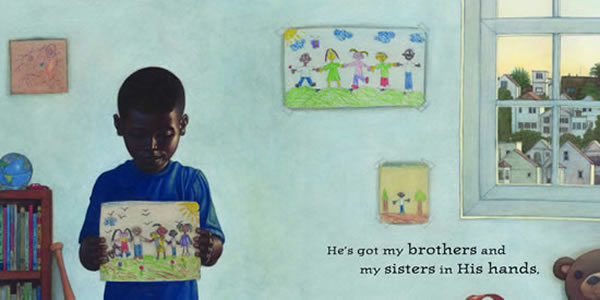
As I got ready for the day this morning, my two-year old sat in the floor of our bedroom with some books.  I was still processing that image of All Saints Day when I heard her singing from one of her books.  “He’s got my brothers and my sisters in his hands…he’s got the whole world in his hands.”  Her sweet voice brought me to tears as I realized the deep wisdom in her, perhaps unintended, words.  In this messiness of life, there will be days that are really complicated, confusing, and hard.  But as a person of faith, I also trust that the Lord our God is holding us in God’s hands, tending not just to me, but to my brothers and my sisters.  For today, that is all I can ask for.

world6

Photo credit:  He’s Got the Whole World in His Hands, Kadir Nelson.  Photo found at http://www.walkingbytheway.com/blog/picture-books-for-transracial-adoptive-families/

Recent Posts

  • On the Myth and Magic of Advent…
  • On Risking Failure and Facing Fear…
  • Sermon – Luke 23.33-43, P29, YC, November 23, 2025
  • On Inhabiting Gratitude…
  • Sermon – Luke 20.27-38, P27, YC, November 9, 2025

Archives

  • December 2025
  • November 2025
  • October 2025
  • September 2025
  • August 2025
  • July 2025
  • June 2025
  • March 2025
  • February 2025
  • December 2024
  • November 2024
  • October 2024
  • September 2024
  • August 2024
  • July 2024
  • June 2024
  • May 2024
  • March 2024
  • February 2024
  • January 2024
  • December 2023
  • November 2023
  • October 2023
  • September 2023
  • August 2023
  • July 2023
  • June 2023
  • May 2023
  • March 2023
  • February 2023
  • January 2023
  • December 2022
  • November 2022
  • October 2022
  • June 2022
  • May 2022
  • January 2022
  • December 2021
  • November 2021
  • October 2021
  • September 2021
  • August 2021
  • June 2021
  • May 2021
  • April 2021
  • March 2021
  • February 2021
  • January 2021
  • December 2020
  • November 2020
  • October 2020
  • September 2020
  • August 2020
  • July 2020
  • June 2020
  • May 2020
  • April 2020
  • March 2020
  • February 2020
  • January 2020
  • December 2019
  • November 2019
  • October 2019
  • September 2019
  • August 2019
  • July 2019
  • June 2019
  • May 2019
  • April 2019
  • March 2019
  • February 2019
  • January 2019
  • December 2018
  • November 2018
  • October 2018
  • September 2018
  • August 2018
  • July 2018
  • June 2018
  • May 2018
  • April 2018
  • March 2018
  • February 2018
  • January 2018
  • December 2017
  • November 2017
  • October 2017
  • September 2017
  • August 2017
  • July 2017
  • June 2017
  • May 2017
  • April 2017
  • March 2017
  • February 2017
  • January 2017
  • December 2016
  • November 2016
  • October 2016
  • September 2016
  • August 2016
  • July 2016
  • June 2016
  • May 2016
  • April 2016
  • March 2016
  • February 2016
  • January 2016
  • December 2015
  • November 2015
  • October 2015
  • September 2015
  • August 2015
  • July 2015
  • June 2015
  • May 2015
  • April 2015
  • March 2015
  • February 2015
  • January 2015
  • December 2014
  • November 2014
  • October 2014
  • September 2014
  • August 2014
  • July 2014
  • June 2014
  • April 2014
  • March 2014
  • February 2014
  • January 2014
  • December 2013
  • November 2013
  • October 2013
  • September 2013
  • August 2013
  • July 2013
  • June 2013
  • May 2013
  • April 2013
  • March 2013
  • February 2013
  • January 2013
  • December 2012
  • November 2012
  • October 2012
  • September 2012

Categories

  • reflection
  • Sermons
  • Uncategorized

Meta

  • Create account
  • Log in
  • Entries feed
  • Comments feed
  • WordPress.com

Blog at WordPress.com.

  • Subscribe Subscribed
    • Seeking and Serving
    • Join 394 other subscribers
    • Already have a WordPress.com account? Log in now.
    • Seeking and Serving
    • Subscribe Subscribed
    • Sign up
    • Log in
    • Report this content
    • View site in Reader
    • Manage subscriptions
    • Collapse this bar
 

Loading Comments...