• About

Seeking and Serving

~ seek and serve Christ in all persons

Seeking and Serving

Tag Archives: faithful

Sermon – 1 Samuel 3:1-20, Psalm 139:1-5, 12-17, 1 Corinthians 6:12-20, John 1:43-51, EP2, YB, January 14, 2018

17 Wednesday Jan 2018

Posted by jandrewsweckerly in Sermons, Uncategorized

≈ Leave a comment

Tags

call, church, discipleship, faithful, Jesus, reaction, relation, relationship, revelation, Sermon

As we celebrate our Annual Meeting and another year of ministry in Jesus Christ through Hickory Neck, we could not have received a better set of lessons.  Today’s lessons are all about discipleship – what being a disciple of Jesus means for us today.  Our lessons tell us discipleship involves relation, revelation, and reaction.

What we first learn about discipleship is relation – that our work as disciples cannot happen without being related to one another.  In Samuel’s almost comical call story, inexperienced Samuel would never have understood that God was trying to speak to him unless he had been in relationship with Eli – his mentor and guide in the life of faith.  Similarly, skeptical Nathaniel would have likely never believed that Jesus could be the Messiah had enthusiastic Philip not said to him, “Come and see.”  Even our lesson from first Corinthians, which perhaps embarrassingly talks about fornication and prositution, shows us that how we relate to others matters – how we use our marvelously made bodies with others matters.

This past year of discipleship at Hickory Neck has similarly and importantly been about relation.  Whether we were talking about race through film, books, or testimony; whether we were sharing a festive meal or taking the holy meal to our homebound members; whether we sharing our stories of giving at Stewardship parties or sharing our faith journeys in confirmation class; whether we were discerning how to modify worship at Hickory Neck or talking with community leaders about how Hickory Neck could address wider needs of our community; whether we were preparing for a quiet day of reflection in Lent or whether we were preparing to welcome a new community onto our property – whatever we did this year, we did so in relation to others.  At Hickory Neck, long-timers and newcomers alike are needed when we are discerning the call of God on our common life.  At Hickory Neck, when changes big and small are being made, we do so with the input of others – both inside and outside of the community – to ensure our discernment is reflective of our related nature through Christ.  At Hickory Neck, we experience God most when we relate to one another through deep, meaningful, vulnerable relationships that rely on trust in one another and on our Lord and Savior, Jesus Christ.  We are Samuels who cannot discern God’s voice without Elis, and we are Nathaniels, who cannot believe what we are hearing without Philips.  Our discipleship is impossible without relation.

After relation, the second thing we learn from our lessons today about discipleship is revelation.  When skeptical Nathaniel responds to Philip’s invitation to come and see, and he meets Jesus, he asks Jesus how Jesus knows him.  Jesus responds, “I saw you.”  Likewise, upon the third interruption of Eli’s sleep, Eli finally realizes that Samuel is not sleepily confused; Eli realizes God is trying to speak to Samuel.  Furthermore, when Eli sees Samuel the next morning, his insistence on knowing what God said to Samuel reveals his own sin and his own coming punishment.  Even Paul’s letter to the Corinthians reveals to them how important their bodies are.  When the psalmist says God created us, knit us together, and we are marvelously made, Paul understands that those wonderful bodies God made are meant to be used for the glory of God.

The more we committed to our relationships at Hickory Neck over this past year, the more we began to experience revelation through those relationships.  When our Tuesday night seekers group invited our brothers and sisters from New Zion Baptist Church to a joint Bible Study, all sorts of beautiful, hard revelations were experienced that night.  When our liturgical task forces worked to define and discern what God was doing at Hickory Neck through worship, we discovered new and beautiful ways we could honor the abundant liturgical variety found in these walls.  When an outstanding mortgage was weighing on our budget or when longtime givers moved on from Hickory Neck, we realized how our giving could impact change at Hickory Neck.  And our budding relationship with the Kensington School has been full of revelation by the Holy Spirit – from sensing within the Vestry that the time had come to think again about a school, to discerning with community leaders that a school was indeed needed, to responding immediately when Charlie got word that Kensington was looking in our neighborhood, to developing a relationship so strong that Kensington would choose to come to Hickory Neck as opposed to another location, God used our relationships to reveal new, different possibilities for ministry.

In some ways, relation and revelation might be the easy parts of discipleship.  The harder part is that third part of discipleship:  reaction.  When Paul writes that letter to the Corinthians, Paul is able to say some hard things about the ways his friends are using their bodies.  The Corinthians could have used that revelation to linger in shame or guilt.  But Paul has a different idea. “Glorify God in your body,” Paul says.  Paul calls the community to change.  When Philip shares his experience with Jesus with Nathaniel, Philip’s story is not an idle tale.  “Come and see,” Philip says.  Philip issues an invitation to action.  And when Eli counsels Samuel what to do about the voice he keeps hearing, Samuel needs to say the words, “Speak for your servant is listening.”  In each of these stories, when something dramatic is revealed through relationship, true discipleship means answering with reaction – doing something in response.

This past year, Hickory Neck has embraced this last part of discipleship with vigor.  When our neighbors needed shelter this past winter, even when our community would have preferred to keep our treasured tradition of a Mardi Gras party, we opened our doors and found new ways to celebrate and care for one another and the wider community.  When we realized that our neighbors were longing for relationship with Christ and our welcome on Sunday mornings was not enough, we developed new ways to invite others to church, and new ways to help newcomers feel more connected once they found their way to Hickory Neck.  When we realized how deep and wide the stain of slavery on our nation was, we welcomed a stranger from Ghana into our home, and found a new friend and a deeper commitment to dealing with our own demons.  When we found new ways to use our property – either through new worship experiences, creating space for community leaders to offer healing yoga to our neighbors in need, or agreeing to step into a rapidly moving process of welcoming a school – we prayed, pondered, and wondered – but eventually said yes.

As I looked back on this year in preparation for our Annual Meeting, I was overwhelmed by the faithful discipleship of Hickory Neck.  We have taken to heart the steps of relation, revelation, and reaction, and said yes time and again.  Being in relation to one another is not easy – look at how hard our country is struggling to stay in relationship with one another.  And yet, the Hickory Neck community takes the uncomfortable and is unwavering.  Welcoming revelation is also not easy – holding up a mirror to our behavior can be scary.  And yet, the Hickory Neck community embraces that vulnerability with boldness.  Being willing to react is not easy either – answering the call to come and see, or saying, “Here I am,” involves strength and commitment.  And yet, the Hickory Neck community trustingly takes on the challenge, and acts with passion and vigor.  I cannot fully express to you how incredibly proud I am of you for all that you have done this year for the sake of the Gospel.  Your discipleship has been an inspiration to me, as I seek each day to faithfully serve Christ as his disciple too.  Of course, the work of discipleship is never done – we will continue to need to commit to the work of relation, revelation, and reaction.  But for today, in this moment of reflection and celebration, know that you are doing good work in the name Christ, glorifying God in your bodies.  Well done, good and faithful servants.  I feel privileged to work alongside you!

On Generations of Generosity…

25 Wednesday Oct 2017

Posted by jandrewsweckerly in Uncategorized

≈ Leave a comment

Tags

abundance, celebration, church, commitment, compassion, faithful, future, generations, generosity, giving, God, journey

KonstantinChristian_ChildParent_Generosity

Photo credit:  https://www.psychologytoday.com/blog/the-athletes-way/201510/small-acts-generosity-and-the-neuroscience-gratitude

This past week, my daughter and I were out shopping for a birthday gift for a friend.  As we were doing the self-checkout, the computer asked us if we would like to donate to charity.  I quickly tapped “no,” and my daughter was incensed.  “Don’t you want to help, Mommy?!?”  As we walked back to our car, I explained how we do help others.  She seemed incredulous, so I detailed our charitable giving, starting with what we give to the church.

Though she seemed mildly satisfied, our conversation made me realize a couple of things.  First, I could stand to have more explicit conversations with our children about our giving to church.  We already talk about budgets, treats, and how we spend money otherwise.  I realize now that our eldest may be ready to understand the commitment we make to church too.  Second, my daughter’s initial indignation is really good thing.  Her frustration with me reveals a sense of compassion and generosity that I was not sure she had fully developed.

This Sunday in church, we are celebrating lots of things.  We are celebrating the 100th anniversary of the consecration of our historic church.  After hundreds of years of our church being used as a school and hospital, a faithful community gathered once again in 1917 for the original purpose of the building – to worship the Lord in the beauty of holiness.  We are also celebrating the paying off of our mortgage on our newest worship space.  After one final push this summer, and years of generosity before, we are able to be debt free!  We are also celebrating In-Gathering Sunday: a day where we offer our pledge cards for blessing.  These pledge cards indicate our commitment to the upcoming year of ministry, and reflect our journey toward generosity.

As these three celebrations combine into one day, I am ever aware of Hickory Neck’s own journey to generosity.  From the faithful who worked to reestablish our church after years of dormancy, to the faithful who saw a vision of a more modern, spacious place of worship just over ten years ago, to the faithful who see the new things budding at Hickory Neck and want to be a part of that growing community, we are a community who has always been on a journey to generosity.  I am grateful for the chance to celebrate together, especially for the ways in which our celebration is an example for the future generations who are also being shaped into faithful servants of compassion and generosity.  From the past and present, and into the future, I see God’s abundance all around us!

Sermon – Exodus 16.2-15, Matthew 20.1-16, P20, YA, September 24, 2017

27 Wednesday Sep 2017

Posted by jandrewsweckerly in Sermons, Uncategorized

≈ Leave a comment

Tags

abundance, complain, deserve, fairness, faithful, generosity, God, gratitude, Jesus, laborers, loyal, parable, scripture, Sermon, whine

This week in Discovery Class, we did a review of Holy Scripture.  We talked about how many years writing the Bible took, the content in each section, the types of literature we find in scripture, and what scripture reveals about us as God’s people.  Our homework was to study today’s gospel lesson, being sure to read the text immediately before and after the text we hear today as a way of helping us interpret the passage.  That tip was especially telling in today’s Old and New Testament lessons

In our lesson from Exodus last Sunday, we heard the story of the parting of the Sea of Reeds.  We heard of that dramatic moment where God allows the Israelites to pass through on dry land, but destroys the Egyptians as the waters return.  The last line in last week’s lesson from Exodus is, “Israel saw the great work that the Lord did against the Egyptians.  So the people feared the Lord and believed in the Lord and in his servant Moses.”  Today, the first sentence from our Exodus reading is, “The whole congregation of the Israelites complained against Moses and Aaron in the wilderness. The Israelites said to them, ‘If only we had died by the hand of the Lord in the land of Egypt, when we sat by the fleshpots and ate our fill of bread; for you have brought us out into this wilderness to kill this whole assembly with hunger.’”  Israel’s groaning and complaining today are much more grievous when we read the great heights of their praise and faithfulness last week.

Likewise, in our gospel lesson today, we hear the familiar story of the generous landowner, who gives the same wage to those who work an hour and those who work all day in the broiling sun.  We can read this passage, and criticize the envious, hardworking laborers for their lack of gratitude.  But the power of the story is heightened when we realize immediately before Jesus’ parable, Peter interrupts Jesus’ teaching and basically says, “But what about us?  We left everything behind and we have been following you.  What’s in it for us?”  And right after Jesus’ parable, the mother of James and John approaches Jesus and basically says, “Listen, if it’s not too much trouble, can my boys sit at your right and left hand in the kingdom?”  So, when Jesus says to Peter, “many who are first will be last, and the last will be first,” and when the landowner says to the workers, “the last will be first, and the first will be last,” what do you think Jesus is trying to address?[i]

I do not know about you, but both of these texts have left me pretty uncomfortable this week.  Watching the Israelites go from faithful, obedient, loyal followers, to whiny, unappreciative, complaining messes hits a little too close to home.  Admittedly, part of me cringes at this text because we have been hammering home the importance of gratitude with our own children.  No sooner is the ice cream cone finished before the complaint comes that we never do anything nice for them.  But as much as we fuss at them, we know the same is true for us.  We are great at praise and thanksgiving to God – when things are going well.  When seas are parting, and enemies are defeated, our God is awesome.  But when we cannot seem to make ends meet, when our loved one is sick again, or when our relationships are falling apart, gratitude is the last thing on our lips.  We find ourselves in what one scholar calls the “spiritual wilderness of ingratitude.”[ii]  We cringe at these readings because we are no more masters at gratitude than our children are.

What both of these lessons do, ever so brutally, is lure us in with stories about abundant, underserved generosity, and put under a microscope our deeply buried discomfort with abundant, underserved generosity.  Part of the reason we are uncomfortable is because God’s generosity often bumps up against our notions of fairness.[iii]  I do not know if we understand the concept of fairness innately or if we are taught fairness by our community, but somewhere along the line, we learn the concept of fairness and apply the concept with exacting scrutiny.  I remember when I was a child and wanted a treat, my dad would make my brother and me share the treat.  One child was allowed to split the treat in half, but the other child got to pick which half he or she wanted.  You can imagine how precise my cuts became when looking at that cookie.

But our notions of fairness evolve over time.  One could take that same cookie and give a slightly larger half to the older child since they are bigger.  Or one could take that same cookie and give the slightly larger half to the child who was better-behaved.  Or one could give the larger half to the one who was physically weaker and needed more nourishment.  There are all sorts of ways to determine fairness.  But God’s measure, in both the Hebrew and Christian Scriptures seems to be that everyone receives God’s generosity despite worth or effort – or even the showing of gratitude.

Take our lesson from Exodus.  The people have clearly approached mutiny.  Their love for God is buried in their physical hunger and their self-centered greed.  But instead of punishing the Israelites, God lavishes them with all they need.  God gives them bread every day and meat every night.  In fact, God even gives them a double portion on the eve of the Sabbath so that they can observe the Sabbath without having to work for their food.  The feast is not a rich feast of wines and marrow, but their feast is gloriously generous and enough.

The same is true in Jesus’ parable.  Yes, the landowner has a weird way of putting the day-long workers in the awkward position of watching his generosity, but ultimately, the landowner gives everyone enough.  He gives the wage he promised to the day-long workers – a wage that will fill them and their families for days.[iv]  But he also gives the same wage to the hour-long workers.  Sure, they did not deserve the wage, but the same wage that feeds the other workers feeds them too.  The landowner is gloriously generous and gives enough.[v]

I have been wondering all week where these texts leave us:  maybe a bit guilty, perhaps a bit convicted, and definitely “last” in the pecking order Jesus describes.  But what I realized this week is both in Exodus and in Jesus’ parable, perhaps being last is not all that bad.  You see, Jesus does not say, “The last shall be first, and the first shall be ejected.”  No, Jesus says, “the last will be first, and the first will be last.”  So even on our worst Israelite days, when we are moaning and complaining about the very God who miraculously saved us, or even on our worst vineyard days, when we are complaining about an unfair, albeit generous, owner, we are still not ejected.  We are not taken out of God’s generosity; we are not stripped of our blessing.  We may be last, but we still have enough.  Our abundantly generous God takes care of us when we deserve God’s care and when we do not.  Our abundantly generous God gives us enough when we think God’s generosity is fair and when we do not.  Our abundantly generous God loves us whether we embrace God’s generosity or we do not.

I cannot promise we will ever get in line with God’s generosity.  I am not sure we will ever be cured of our sense of fairness or even our ill-conceived notions that we could earn God’s generosity.  But what I can tell you is that we are not alone.  Our people thousands of years ago did not master God’s generosity.  The disciples two thousand years ago did not master Christ’s generosity.  And I suspect we will not either.  But every week, we try.  Every week we continue on our journey toward generosity – seeing God’s generosity in ourselves and others – being inspired to try again.  I am not sure we will ever be first in line.  But the good news is we get to stay in line – which means there is always room to try again.  Our generous God will make sure we have enough until then.  Amen.

[i] Barbara Brown Taylor, The Seeds of Heaven: Sermons on the Gospel of Matthew (Louisville:  Westminster John Knox Press, 2004), 100-102.

[ii] Deborah A. Block, “Homiletical Perspective,” Feasting on the Word, Supplemental Essays, Year A  (Louisville:  Westminster John Knox Press, 2011), 2.

[iii] Taylor, 103.

[iv] Amy-Jill Levine, Short Stories by Jesus: The Enigmatic Parables of a Controversial Rabbi (New York:  Harper Collins, 2014), 224.

[v] Block, 4.

On Parenting and Other Failures…

23 Wednesday Aug 2017

Posted by jandrewsweckerly in Uncategorized

≈ Leave a comment

Tags

children, Christian, disciple, encouragement, failure, faith, faithful, God, hope, Jesus, love, parent, parenting, Peter

I have never really thought of myself as a very good parent.  I am constantly finding myself in the midst of parenting and thinking, “I really could be handling this much better.”  In looking back, I can see countless ways in which I escalated a situation instead of deescalated, in which I got stuck in wanting control instead of fostering independence, or in which I simply lost my cool.  Parenting sometimes brings out the worst in me, and on the really bad days, I feel like I am failing pretty miserably at the whole endeavor.

I feel that way about my faith sometimes too.  I know all the ways I am called to serve God and to be a faithful disciple.  But I often find myself failing.  For as many times as I can be like an insightful Peter, more often I am like the Peter who is sinking into the sea, trying to control what Jesus does, or putting myself in front of the gospel.  Reading about modern saints, or people who are making a difference with their life only makes me more aware of my many failings to live as a faithful Christian.

The good news is that children, and other people, often give us glimpses of hope and encouragement.  The other day, I was stirring from a nap with my youngest (who refuses to nap now unless you nap with her).  As she was waking up, she smiled at me and said, “You can be my best friend, Mommy.”  A few nights ago, my oldest requested to start using the same shampoo, conditioner, and soap that I use, instead of her 3-in-1 tear-free wash we have been using.  I sighed out of irritation, and asked her why.  She said, “Because I want to be like you, Mommy.  Except for your short hair!”

I laughed on both occasions, but both comments reminded me that for all the times I fail, there is still love.  For all the ways in which I mess up this parenting thing, there are glimpses of times when I managed to get it a tiny bit right.  I think the same is true for our faith life.  For all the ways we are horribly imperfect, we also have glimpses of powerful faithfulness.  I encourage you to listen to those around you to hear those little comments that will encourage you on your journey.  And then I invite you to straighten up, take a deep breath, and get back in there.  God is doing amazing things through you.  I can’t wait to hear all about it!!

Dad Teaching Daughter Electrical Engineering

Photo credit:  www.quoteambition.com/best-encouraging-quotes-words-encouragement/

On Sports, Story, and the Spirit…

19 Wednesday Jul 2017

Posted by jandrewsweckerly in Uncategorized

≈ Leave a comment

Tags

challenge, conversation, faith, faithful, fun, hope, Jesus, journey, movie, power, race, racial reconciliation, sports, story

banner-top-basketball-960x275-960x275

Photo credit:  coachcarter5.blogspot.com/p/plot-summary.html

This summer, our church was looking to do two things:  we wanted to offer a “light” educational series that adults could enjoy and we wanted to continue our conversation about racial reconciliation.  One might think those two goals do not go together.  But we were not to be deterred.  We settled on the option of watching movies that were about racial reconciliation.  Movies are certainly fun, but the topic still wasn’t capturing the “fun” or “light” criteria.  Then the idea hit us:  sports movies!  Sports movies allow us to be entertained, while sneaking in powerful stories of hope, challenge, and encouragement.

The model has worked even better than I suspected.  Our first two movies have been 42: The Jackie Robinson Story and The Blind Side.  The last two movies are Coach Carter and Invictus.  We were able to feature four sports:  baseball, football, basketball, and rugby.  Each week we have been able to cheer on teams, laugh at comical moments, and pause with discomfort when truth broke through.  Our conversations have been rich – each movie bringing up parallels in our own stories – about race, about respecting the dignity of every human being, and about our journey with faith.

I think what has made that work is each movie is based on a true story.  We did not make that connection when planning the film list, but it has been a powerful surprise.  Unlike a fictional film, which could be dismissed as romantic, overly simple, or unrealistic, these movies show us real people, trying to live faithful lives on and off the field.  Their stories have been encouraging us to do likewise – examine how we are living faithful lives on and off the field.  Ultimately, I think that is the only way we are going to make our way toward racial reconciliation:  sharing our stories and listening to others’ stories.  It would be easy to do otherwise; to keep our heads down and ignore what is happening in the world about us.  But these stories invite us into another way of being.

The invitation of our Faith and Film series this week is for us to find ways to engage outside of the theater.  Maybe you start by telling someone about this awesome movie you just saw.  Or if you are feeling more confident, maybe you simply talk to a friend or coworker – either of your race or another – and start with a confession, “I watched this movie and it has made me think about [insert your thoughts here].  What is your experience with that?”  Using the movie or your own story allows you to do what Jesus did all the time – engage people where they are through the power of story.  I believe reconciliation starts there:  one story at a time.

On Remembering Roots…

29 Wednesday Mar 2017

Posted by jandrewsweckerly in Uncategorized

≈ Leave a comment

Tags

Campus Ministry, Christ, church, college, community, disciple, discipleship, faithful, formation, fun, Jesus, leadership, love

842x347-WELS-CampusMinistry

Photo credit:  https://wels.net/serving-you/christian-life/campus-ministry/

Last night, as a member of our Diocesan College Ministry Commission, I visited Canterbury at William & Mary.  We had some time with both the students involved in the Episcopal Campus ministry and with the Campus Minister.  It is a vibrant ministry, with a lot of passion and enthusiasm around service, worship, and discipleship.  Canterbury is a place where they can ask questions of their faith, become leaders, serve their community, and forge deep friendships.  They are doing the work began in their baptism, continued in their confirmation, and now affirmed as adults.

As I listened to the students and Campus Minister, I was flooded with a host of memories from my own experience in Campus Ministry at Duke.  Although I was involved in the Wesley Fellowship, the models are quite similar.  Wesley was the place where I came into my own faith, where I engaged my intellect in partnership with professors at the Divinity School, where I first discovered the power of mission trips, and ultimately, where I began to feel a sense of call to ordained ministry.  Wesley created disciples – encouraging us to find a local church community, fostering a personal spirituality, developing deep Christian friendships, and exploring the implications of my faith.  Most of my friends from Wesley took a year or more to volunteer or live in intentional Christian community.  Today, most of the alumni I know are clergy, lay leaders, non-profit workers, social services providers, and are raising up a new generation of faithful disciples.

When I was in college, I thought Wesley was doing something revolutionary.  The community certainly articulated its faith a little differently than my home churches had.  But more than that, we created an intimate, trusting, challenging space that fed me and informed my life path.  As I thought about that experience and the experience of the Canterbury students at Williams & Mary, campus ministry does exactly what Church does – or should do.  We are forming people into faithful disciples, who want to learn and grow in their faith, who want to find ways to serve God and live out their baptismal covenant, who want to develop the deep bonds of Christian community, and who want to have some fun while they are at it!

As a pastor, I often get caught up in the programmatic and administrative work of Church.  I want to create a community that offers the things necessary to produce faithful disciples.  What last night reminded me of is that I need to remember to look around and enjoy what we are creating too.  If you have been looking for a community that can help you find meaning and purpose, can help you grow in unexpected ways, can help you connect with others on the spiritual journey, and can embolden you to live a life full of the love of Christ, come join us at Hickory Neck.  And if you are already a member, invite a friend into this rich experience.  There is good news to share!

Sermon – 1 Kings 18.20-39, Galatians 1.1-12, Luke 7.1-10, P4, YC, May 29, 2016

01 Wednesday Jun 2016

Posted by jandrewsweckerly in Sermons, Uncategorized

≈ Leave a comment

Tags

comfort, confession, discomfort, faithful, friend, God, Jesus, need, Sermon, Spirit, temptation, truth, witness

The older I have become, the more solid my support system has become.  Over time, I have figured out in which friendships to invest my time, and which friendships, while fun, are not necessarily nourishing.  I know which friend to call when I need fashion advice and which friend to call when I need major life decision advice.  I have learned which friend to find when I want to be comforted, and which friend to find when I need to be discomforted.  The discomforting friend is probably the most valuable one any of us has.  That is the friend who will tell you the brutal, ugly, harsh truth – not to be mean to you but to save you from going down a dark path, to snap you out of a rut, or to help you get your act together.  Of course, sometimes we avoid that friend like the plague because we are not ready to hear the truth.  But when we feel ourselves slipping away, when we feel drawn in by temptation, or when we simply feel incapable of doing the right thing, we know we can trust that friend to hold us accountable to being the best version of ourselves – the version God created us to be.

This morning, the lectionary seems to be filled with discomforting friends.  In First Kings, we hear about the ultimate showdown with the prophets of Baal and Elijah, the prophet of the Lord.  The story is dramatic, with Baal’s prophets comically trying to rain down fire to prove Baal’s power, and Elijah showing them up by demonstrating the Lord’s triumph.  But we quickly learn that Elijah is one of those discomforting friends when he says to the people of God, “How long will you go limping with two different opinions?  If the Lord is God, follow him; but if Baal, then follow him.”[i]  Desperate for rain in a three-year drought, the people of God have begun to hedge their bets.  They figure they can worship both Baal and the Lord.  But Elijah will not let them be so divided.  Either they trust in the Lord their God, or they do not.

If Elijah sounds harsh, you should hear Paul this morning.  Paul starts his letter to the Galatians with a traditional greeting, but we can tell from his lack of thanksgiving for the community, that some harsh words are about to come.[ii]  After a quick introduction, Paul cuts to the chase, “I am astonished that you are so quickly deserting the one who called you in the grace of Christ and are turning to a different gospel…”[iii]  At the heart of the issue is whether Gentile converts must adhere to Jewish laws.  The Galatians want to narrow the wideness of the gospel, while Paul wants to expand the reach of the gospel.  So angry and defiant is Paul that he practically shouts, “If I were still pleasing people, I would not be a servant of Christ.”[iv]  In other words, Paul has no interest in soothing feelings in Galatia.  He is only interested in correcting behavior and preserving the abundance of the gospel.[v]

And if Elijah and Paul were not harsh enough this morning, Jesus rounds us out with a scathing indictment of the faithful.  A centurion, a Roman solider, and sometimes enemy of the people of God, sends a message to Jesus.  Despite the fact that he is not Jewish, he sends word to Jesus twice – first, asking Jesus to heal his sick slave, and second, insisting that Jesus not make the journey, but only speak a word of healing from afar.  The text tells us that Jesus, who is very rarely reactive, is “amazed,” and criticizes the faithful of God by saying, “I tell you, not even in Israel have I found such faith.”[vi]  If we think about who is gathered around Jesus, we are not just talking about some delinquent followers.  Jesus says in front of disciples and everyone that none of them has had the same dedication and faith in Jesus as this outsider.  Jesus has no problem being brutally honest about the people’s lack of faith and trust in Jesus.

If you were hoping for a nice, affirming set of lessons today, a time set apart with that friend who always encourages and affirms you, you picked the wrong Sunday.  We might have guessed the brutal honesty was coming when we prayed our collect today.  The collect says, “O God, your never-failing providence sets in order all things both in heaven and earth: Put away from us, we entreat you, all hurtful things, and give us those things which are profitable for us…”[vii]  In other words, we prayed God would not be that comforting friend today – but would be the discomforting friend that we need.

Now you may be sitting here wondering what kind of discomfort I will be dishing out today.  Or you may be wondering on what issue I think we need work.  The good news is that I do not have such a charge today.  I suspect that you already know where you need discomfort.  Your discomfort may need to be from Elijah, who warns about putting idols before God – putting your trust and hope in places and things that will not satisfy.  Or maybe your discomfort needs to come from Paul, who warns about putting restrictions on the wideness of God’s mercy.  Or maybe your discomfort needs to come from Jesus, who can point to non-believers who seem to trust God more than you.  You alone know how the Spirit is speaking to your need for discomfort.

However, even though you alone know how the Spirit is speaking to your need for discomfort, you are not alone in needing that discomfort.  One of my favorite parts of our liturgy is the confession.  One, I find the confession immensely centering because every week, one phrase or part of the confession jumps out at me – whether something I have done or left undone is nagging me; whether I have sinned against God or my neighbor; or whether I have just strayed that week.  Even though we say the confession every week, the confession never ceases to unsettle me.  Two, I find the confession comforting because of all the voices that join me in the confession.  I love hearing young and old voices, male and female voices, and voices with every accent imaginable confessing the same failings that I confess.  The power of that communal act is always humbling and comforting.

Now I know I told you that you should not have come to church today if you were looking for comfort.  But the truth is, I find all the discomfort today wildly comforting.  Whether we are pushed by our discomforting witnesses in scripture, whether we are jolted by something in our communal confession, or whether we realize that we need to call our best discomforting friend immediately after church, I find the reminder that I am not the only one who needs discomfort comforting today.  I am comforted because I know after the discomfort comes, something akin to a fire is lit inside me.  The discomfort is usually just what I need to reinvigorate my walk with Christ and sharply focus on where God is calling me to be.  If that is not good news, I do not know what is.  Amen.

[i] 1 Kings 18.21.

[ii] Audrey West, “Commentary on Galatians 1:1-12,” May 29, 2016, as found at http://www.workingpreacher.org/preaching.aspx?commentary_id=2882 on May 25, 2016.

[iii] Galatians 1.6.

[iv] Galatians 1.10.

[v] Dan Clendenin, “No Other Gospel,” May 22, 2016, as found at http://www.journeywithjesus.net/essays/977-no-other-gospel on May 26, 2016.

[vi] Luke 7.9.

[vii] BCP, 229.

Embracing joy…

03 Wednesday Jun 2015

Posted by jandrewsweckerly in Uncategorized

≈ Leave a comment

Tags

Christ, church, constructive criticism, encouragement, faithful, health, Holy Spirit, improvement, joy, review, servant

Our Vestry and Parish just completed a Mutual Ministry Review – a time to reflect on the health of our congregation and to strategize about how to move toward greater health and wholeness.  There was a lot of positive feedback in the survey indicating the ways in which we have grown and changed for the better in the last three years of ministry together.  And of course, there was plenty of constructive criticism about what we can do to make our ministry together better.  Some of the feedback included things we could do quite easily, and some of the feedback will take longer to address.  But the Vestry was energized to make those changes and move toward wholeness.

Like with any feedback though, we quickly lost sight of all that is going well.  We lingered only for a moment on the good and positive work God is fostering among us, and we immediately dug in with the work we needed to do to improve.  Although I am super proud of our Vestry’s desire to dig in and do some of the dirty work of improvement, I want to take a moment to remind our whole parish of the need to prayerfully lift up the goodness in our midst.  Without being rooted in gratitude for all the goodness God has brought us, my fear is that we will be overwhelmed by the burden of improvement and not steadied by the encouragement of the Holy Spirit.

I was reminded of that lesson this Sunday.  This Sunday the Vestry started working on prioritizing our improvement work and making goals and deadlines for ourselves.  The work is important and necessary, but I must admit our spirits were a bit heavy.  But just thirty minutes before our meeting, in the context of worship, we honored all of our children and teachers who had participated in Sunday School, Rite 13, and Adult Formation this program year.  The transept was overflowing with people.  Because we use a rotation model for Sunday School, we had over 10 teachers and shepherds this year.  We had three teachers for Rite 13, and five teachers for adult formation.  For a parish with a relatively small average Sunday attendance, those numbers are tremendous.  And that does not include all the children who were present!  It was a glorious sight and a testimony to the good work we are doing to form us into a community that is seeking Christ.  Well done, good and faithful servants!!

Photo credit: http://urfamilies.org/full-of-joy-in-the-lord/

Photo credit: http://urfamilies.org/full-of-joy-in-the-lord/

My encouragement to all of us this week is to hold on to that moment.  Hold on to that image of a full transept of people who have spent the last year deepening their relationship with Christ, and marvel at the good work that the Spirit is doing at St. Margaret’s.  And give yourselves a pat on the back for the ways in which you have committed yourselves to being faithful builders of the Kingdom of God.  There will always be work to do, but my hope is that we can see the joy behind the work we do.  Because there is a lot to be joyful about!

Shaking up normal…

01 Wednesday Oct 2014

Posted by jandrewsweckerly in Uncategorized

≈ Leave a comment

Tags

Christian, church, faithful, holiday, holy days, Jewish, normal

I grew up in the rural South, where there was not a whole lot of diversity.  Though I knew about the Jewish faith, I did not really know any practicing Jewish people growing up.  It wasn’t until adulthood that I became friends with a practicing Jewish person.  She took me to her synagogue, made me latkes, and talked to me about her experience of faith.  When I got to seminary, the study of Hebrew broke open that world even further, and suddenly I found myself exposed to my Jewish heritage as a Christian.  But nothing really prepared me for my experience here in Plainview, NY, which has a moderately large Jewish population.  I may have learned Hebrew and studied about Jewish people, but I had yet to live among a modestly large Jewish population.  When I first went to the interfaith clergy group, I found that the fellow Christians and I were in the minority among eight other rabbis and cantors.  I quickly realized how little I knew, and kept having to ask questions.  The rabbis and cantors have been ever patient and helpful.

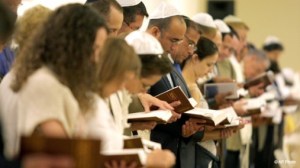
Our parish is located right next door to one of the larger synagogues in Plainview.  On the high holy days, the synagogue uses our parking lot, and the lot is flooded with cars.  In the past couple of years, I have enjoyed watching the people of faith flock to the temple, as they honor their holy days.  As a person who loves Holy Week, I love to see another faith tradition alive with honoring their holy days.

Courtesy of http://mthollywood.blogspot.com/2012/09/rosh-hashanah-jewish-new-year.html

Courtesy of http://mthollywood.blogspot.com/2012/09/rosh-hashanah-jewish-new-year.html

But this year, since my oldest child is now in public school, I realized that the schools are closed for Rosh Hashanah.  If I am being honest, my first thought was not about honor and respect.  My first thought was the dread of having to secure childcare while I kept working.  But as the faithful came in and out of our parking lot that day, and as my kindergartener asked all sorts of questions, I began to see things from a different perspective.  I structure much of my life around the church calendar – Christmas, Lent, Easter.  My vacation plans and workload are all connected to these holy days.  I realize only now how strange my honoring of those days might be to non-Christians, who also have to work out childcare and the disruption of what is just another day in December or the spring.

This week, I am grateful to my Jewish brothers and sisters for reminding me of how self-centered I can be, and for pushing me out of my comfort zone.  My guess is that my faith-keeping is not just unusual to them, but may be unusual to all un-churched persons.  Even my southern United Methodist mother finds all our Episcopal rituals and observances a little over the top.  I note this because I think we can all become caught up in our own “normal” and forget the ways that our normal can seem strange or be downright alienating.  My hope is that this observation makes us all a little more self-aware, a bit more intentional about how we share our Christmas and Easter joy when the time comes, and a lot more attuned to the ways that we can make our own faith traditions accessible, inspiring, and intriguing to our neighbors outside our walls.

Homily – 1 Peter 5.1-4, George Herbert, February 27, 2014

06 Thursday Mar 2014

Posted by jandrewsweckerly in Uncategorized

≈ Leave a comment

Tags

call, faithful, George Herbert, God, homily, priest, service

Today we honor George Herbert, a priest and poet in the church.  Herbert was born in 1593 to a well-connected family in England.  Though he flirted with politics, he eventually turned to the church, becoming a priest age 33.  Two things are notable about Herbert.  First he is well-known for his poetry, some of which became hymns.  He influenced many other poets, as his poems moved people on issues of prayer and the spiritual life.  Herbert was also well known for his devotion and service to others.  His approach toward life and ministry inspired many.  In fact, his words, “Nothing is little in God’s service,” remind Christians again and again that everything in daily life, small or great, can be a means of serving and worshiping God.  When talking about his poetry, Herbert seemed to meld the two passions when he wrote about his poems as being “a picture of the many spiritual conflicts that have passed betwixt God and my soul, before I could submit mine to the will of Jesus my master, in whose service I have found perfect freedom.”

What Herbert reminds us of today is the sacred nature of all our calls.  Sometimes, we do not feel comfortable using “call” language for what we do on an everyday basis.  In fact, we read passages like the one from first Peter, and we presume that only clergy, or “elders,” have a call.  Though first Peter is talking about how a spiritual leader should lead, we cannot assume we are exempt from similar instructions.  In fact, I might argue that the call that each of you live out in the world is far greater than the call I live in my position.  You have the much together jobs of witnessing in everyday life without such clear markers of faith and devotion like a collar.  And you have the ability to reach way more people that I could ever hope to because unlike what many people assume about me, you are actually “normal.”

What first Peter and George Herbert would both like us to see is that all of us have kingdom work to do, and our aim is to do that work faithfully and with enthusiastic hearts.  Herbert only lived to be 40 years old, and yet one of the things we honor is the way in which he was a faithful, humble, enthusiastic priest – not a bishop, or martyr, or leader of some great movement.  He was just a parish priest who knew that nothing is little in God’s service.  As we celebrate his passion for everyday life and everyday call, we too are emboldened by knowing that fulfilling our calls is not “little” in God’s service.  Amen.

Newer posts →

Recent Posts

  • On the Myth and Magic of Advent…
  • On Risking Failure and Facing Fear…
  • Sermon – Luke 23.33-43, P29, YC, November 23, 2025
  • On Inhabiting Gratitude…
  • Sermon – Luke 20.27-38, P27, YC, November 9, 2025

Archives

  • December 2025
  • November 2025
  • October 2025
  • September 2025
  • August 2025
  • July 2025
  • June 2025
  • March 2025
  • February 2025
  • December 2024
  • November 2024
  • October 2024
  • September 2024
  • August 2024
  • July 2024
  • June 2024
  • May 2024
  • March 2024
  • February 2024
  • January 2024
  • December 2023
  • November 2023
  • October 2023
  • September 2023
  • August 2023
  • July 2023
  • June 2023
  • May 2023
  • March 2023
  • February 2023
  • January 2023
  • December 2022
  • November 2022
  • October 2022
  • June 2022
  • May 2022
  • January 2022
  • December 2021
  • November 2021
  • October 2021
  • September 2021
  • August 2021
  • June 2021
  • May 2021
  • April 2021
  • March 2021
  • February 2021
  • January 2021
  • December 2020
  • November 2020
  • October 2020
  • September 2020
  • August 2020
  • July 2020
  • June 2020
  • May 2020
  • April 2020
  • March 2020
  • February 2020
  • January 2020
  • December 2019
  • November 2019
  • October 2019
  • September 2019
  • August 2019
  • July 2019
  • June 2019
  • May 2019
  • April 2019
  • March 2019
  • February 2019
  • January 2019
  • December 2018
  • November 2018
  • October 2018
  • September 2018
  • August 2018
  • July 2018
  • June 2018
  • May 2018
  • April 2018
  • March 2018
  • February 2018
  • January 2018
  • December 2017
  • November 2017
  • October 2017
  • September 2017
  • August 2017
  • July 2017
  • June 2017
  • May 2017
  • April 2017
  • March 2017
  • February 2017
  • January 2017
  • December 2016
  • November 2016
  • October 2016
  • September 2016
  • August 2016
  • July 2016
  • June 2016
  • May 2016
  • April 2016
  • March 2016
  • February 2016
  • January 2016
  • December 2015
  • November 2015
  • October 2015
  • September 2015
  • August 2015
  • July 2015
  • June 2015
  • May 2015
  • April 2015
  • March 2015
  • February 2015
  • January 2015
  • December 2014
  • November 2014
  • October 2014
  • September 2014
  • August 2014
  • July 2014
  • June 2014
  • April 2014
  • March 2014
  • February 2014
  • January 2014
  • December 2013
  • November 2013
  • October 2013
  • September 2013
  • August 2013
  • July 2013
  • June 2013
  • May 2013
  • April 2013
  • March 2013
  • February 2013
  • January 2013
  • December 2012
  • November 2012
  • October 2012
  • September 2012

Categories

  • reflection
  • Sermons
  • Uncategorized

Meta

  • Create account
  • Log in
  • Entries feed
  • Comments feed
  • WordPress.com

Blog at WordPress.com.

  • Subscribe Subscribed
    • Seeking and Serving
    • Join 394 other subscribers
    • Already have a WordPress.com account? Log in now.
    • Seeking and Serving
    • Subscribe Subscribed
    • Sign up
    • Log in
    • Report this content
    • View site in Reader
    • Manage subscriptions
    • Collapse this bar
 

Loading Comments...