• About

Seeking and Serving

~ seek and serve Christ in all persons

Seeking and Serving

Tag Archives: God

Sermon – Lk. 16.1-13, P20, YC, September 22, 2019

25 Wednesday Sep 2019

Posted by jandrewsweckerly in Sermons, Uncategorized

≈ Leave a comment

Tags

ambiguity, black and white, dishonest, Episcopal Church, glorify, God, gray, Jesus, money, place, power, relationship, Sermon, via media, wealth

In seminary I took a class about Reconciliation, and one of the requirements of the class was to lead a Bible Study at the local jail.  Our team of four Episcopalians waltzed into the jail, prepared with study notes, a lesson plan, and as much of an air of confidence as we could muster.  Not very long into the Bible Study, though, we realized we were in trouble.  You see, many of us had been drawn to the Episcopal Church because the Episcopal Church embraces the via media, or the middle way; we are a church that affirms the sacredness of the gray over the black and white.  But an inmate has no time for gray.  Their whole lives are governed by black and white, right and wrong.  The rigidity of life in jail is applied to Holy Scripture as well.  Most of the inmates were either perplexed by our suggestion of any ambiguity or gray in Scripture, or simply thought we were wrong.  Fortunately, our professor had come along.  After about forty-five minutes of debate and disagreement, our professor quietly spoke.  He invited the men to reflect on life where they were from, the complexities of the street, racism, and poverty.  If life at home was so layered, ambiguous, and complicated, surely Scripture could be too.  I am not saying my professor made any great strides in the debate around the literal interpretation of Scripture, but I believe he may have opened a window for some of the inmates.

I think today’s Scripture lesson is a bit like that jail classroom.  At first glance, this could be considered a text that is black and white.  The final verse of our gospel says, “No slave can serve two masters; for a slave will either hate the one and love the other, or be devoted to the one and despise the other. You cannot serve God and wealth.”  There is no gray in Jesus’ words.  Either we choose God or we choose money.  And based on the fact God is one of our two options, there is no ambiguity about which of these options we should choose.  But here is the problem with trying to assert this passage of scripture is black and white.  Whereas as the end of the passage Jesus seems to be saying we must choose God or money, in the parable, Jesus seems to be saying something else.

If you recall, in the parable, we have a poorly-behaving manager.  The manager has squandered away the master’s money.  When he is caught, the manager takes a good look at himself and admits some honest truths – he is not capable of doing manual labor and he is too embarrassed to beg for money.  Having been honest about who he is, he connives his way into a solution:  he will engender goodwill among his neighbors by doing financial favors for each of them – forgiving portions of their debts in the hopes that they will sometime very soon return the favor.  Both the master and Jesus recognize the shrewdness or wisdom in the manager’s behavior because the manager uses his wits to get out of a devastating position.  In verse nine, the text says, “I tell you, make friends for yourselves by means of dishonest wealth so that when it is gone, they may welcome you into the eternal homes.”

This is where things get confusing.  At first, Jesus seemed to be clearly saying money is evil and we must choose God over money.  But when Jesus says to “make friends for yourselves by means of dishonest wealth,” Jesus seems to be claiming money can sometimes be one of those gray areas of life; in fact, money can be used as a means to an end.  Now, we all have varying philosophies about money.  Some of us manage to care very little about money, with money holding very little power over us.  Some of us struggle with money, sometimes remembering how money can be used for good, but most times feeling like money creates stress and anxiety in our lives that we cannot seem to shake.  And others of us become narrowly focused on money – either in how we can acquire more or what ways we can spend and enjoy money more.  What Jesus knows we often forget is money is inherently “dishonest.”  Money creates systems of injustice and hierarchies of power; money can destroy marriages and friendships; and money can be the ruin of many a person.  So when Jesus says to make friends through dishonest wealth, he does not mean to become a dishonest people; he means money inherently lures us into dishonesty, and we can either throw our hands up in the air in resignation and a refusal to be associated with that dishonesty, or we can use that dishonest wealth as a means to something much more important – relationship with others.

One of the things I like to do when I am struggling with a challenging Biblical text is to look at other translations to see if I can make more sense of Jesus’ words.  This week, I found the most help from a translation called, The Message.  Now as ample warning, The Message is a very contemporary paraphrase of the Bible, which takes a lot of theological liberties that I am often uncomfortable with; however, I also find that the language from the paraphrase opens up the biblical text enough for me to start seeing the text with fresh eyes.  The Message translates Jesus words in this way:  “Now here’s a surprise:  The master praised the crooked manager!  And why?  Because he knew how to look after himself.  Streetwise people are smarter in this regard than law-abiding citizens.  They are on constant alert, looking for angles, surviving by their wits.  I want you to be smart in the same way—but for what is right—using every adversity to stimulate you to creative survival, to concentrate your attention on the bare essentials, so you’ll live, really live, and not complacently just get by on good behavior.”

What Jesus is trying to say to us today is layered, and very much lives in the gray of life.  First, money has a corrupting force in our lives.  As I mentioned a couple of weeks ago, Jesus talks about money incessantly in scripture, from telling people to give away all their money, to scolding people about storing up their money in larger barns, to reminding people not to stress about money, to this odd text about money.  As Luke concludes today, Jesus tells us that we cannot serve God and money, because of the all-consuming way money can corrode our relationship with God.

Second, we cannot escape money.  Money is a part of our everyday lives, and as we all know is necessary for functioning – for food, for shelter, for clothing, for comfort, for ministry.  Even those monks and nuns who take on a vow of poverty still rely on the money of others for support.  Money, with all its potential for corruption, is inescapable in our lives.

Finally, once we understand the power and place of money in our lives, Jesus reminds us that when we are wise, keeping God at the center, we can use money as a means to goodness in our relationship with God and with one another.  The manager “transforms a bad situation into one that benefits him and others.  By reducing other people’s debts, he creates a new set of relationships based not on the vertical relationship between lenders and debtors (rooted in monetary exchange) but on something more like the reciprocal and egalitarian relationship of friends.”[i]   This kind of work is not about charity per se, but about making friends.[ii]

Many years ago, there was a commercial circulating around the internet.   In the video, a boy is caught red-handed trying to steal a bottle of medicine and a soda.  A woman is berating him in front of a marketplace, wanting to know why he would take these things.  He confesses that the items are for his mother.  A local merchant steps forward, and hands the woman a handful of money to cover the cost of the stolen items.  The man then quietly asks the boy if his mother is sick.  When the boy nods yes, the merchant has his daughter also bring a container of vegetable broth and other items, and sends the boy on his way.  The next clip of the commercial shows the merchant thirty years later, still working in his shop.  He collapses and is taken to the hospital.  The daughter becomes completely overwhelmed as the medical bills add up, even selling the shop they had once run together.  As she is found crying near her father’s bedside, she finds a revised copy of their medical bill.  The amount due is zero.  We find out through the video that the doctor who forgives the bill is that same boy who stole medicine thirty years ago.  He writes at the bottom of the bill, “All expenses paid thirty years ago with three packs of painkillers and a bag of veggie soup.”[iii]

Jesus knows how money corrupts our world.  To be sure there is no ambiguity about the place money takes when talking about God.  We are to choose God.  But Jesus also knows that we can shrewdly utilize our money as a tool to create relationships that glorify God.  This is Jesus’ invitation for us today:  to examine how our relationship with dishonest wealth can be used for goodness.  Jesus affirms for us this week that the way into the black and white, the right and wrong of life, might just be through the path of gray.  Amen.

[i] Lois Malcolm, “Commentary on Luke 16.1-13,” as found on http://www.workingpreacher.org/preaching.aspx? commentary _id= 1783 on September 18, 2013.

[ii] Thomas G. Long, “Making Friends,” Journal for Preachers, vol. 30, no. 4, Pentecost 2007, 55.

[iii] As found at https://www.youtube.com/watch?v=XADBJjiAO_0 on September 20, 2019.

On Stories, Remembering, and Healing…

11 Wednesday Sep 2019

Posted by jandrewsweckerly in Uncategorized

≈ Leave a comment

Tags

darkness, dignity, God, heal, honor, human being, intimacy, kindness, light, love, people, power, pryaer, reclaim, remember, respect, September 11, share, story

Story Corps

Photo credit:  https://storycorps.org/discover/september-11th/

Today marks the eighteenth anniversary of September 11, 2001 – a fateful day in the United States.  Even eighteen years later, this is a day where we as a country remember – remember where we were that day, remember the people who were touched by tragedy that day, remember how a single day could transform a nation and the world.  This day hangs heavy in our consciousness each year, the weight never quite lifting even with the passage of time.

I think part of why this day is so heavy for us as a people is because of the people this day touched.  Certainly, we could look at the death toll, and recall the names of the almost 3,000 people who died that day, most without the opportunity to say goodbye to their loved ones.  But September 11’s reach went beyond those who died.  The ripple of that day is mind-blowing:  those who were physically injured, those who were bereaved, those who were supposed to be in those buildings and somehow life’s circumstances kept them away, those whose health continues to be poor from living nearby or helping with the cleanup efforts, those who walked for hours fleeing danger, those who made hard decisions that day – some leading to life and some leading to death.

Four years after that fateful day, NPR’s StoryCorps launched their September 11th Initiative.  A program built around having people tell their stories, StoryCorps launched an effort to record the stories of that specific day – of the man who traded shifts that day and whose mentor died because he had volunteered to take his shift; of the man who consoled his wailing two-year old and had to wait four months before his wife’s body was finally identified; to the woman who sifted through bones and debris in a hanger months later, trying to help people find closure; to the airline employee who checked in the terrorists that day at the gate; the father who lost both sons, one a firefighter and one a police officer, in the line of duty that day.  Every story, every single one is gut-wrenching and tear-evoking.  And every one gives a tiny glimpse into the magnitude of the ripple effect this one day had on all of us.

This day, I invite you to honor September 11 with stories.  Talk to your neighbors, friends, and strangers about their experiences.  Listen to stories like the ones on StoryCorps.  Read whatever stories you can find.  When we engage in one another’s stories, we engage in honoring the dignity of every human being, something we pledge to do in our baptismal covenant.  We allow the depth of this day to do something to us.  And somewhere in that intimacy of story, we begin to hear an invitation – an invitation to honor life today.  Whether it is an act of kindness (maybe even the kindness of simply asking someone to tell their story), or whether it is a time of prayer to honor all that has been, or whether it is a commitment to reclaiming love so that hatred can never win in such a powerful way as it did that day.  May our stories help us connect to the cosmic story of a God who loves us and gives us light in the darkness.

On the Why of Church…

04 Wednesday Sep 2019

Posted by jandrewsweckerly in Uncategorized

≈ 5 Comments

Tags

attend, belonging, church, community, God, habit, hope, invite, Jesus, journey, love, meaning, purpose, worship

67066969_10157939010987565_1287447765877522432_n

Photo:  Hickory Neck Episcopal Church; reuse with permission only

I spent the last almost three weeks on vacation.  It was a time relaxation, refreshment, and restoration.  It was a time of unplugging, unwinding, and uninterrupted space.  It was a time of sabbath.  And because most Sundays I am in church, I experienced not going to church.  On Sundays, it turns out lots of people are eating brunch, exercising, spending time with their families, enjoying nature, working, or just enjoying a good read.  And for a couple of weeks, I did just that.

The weeks away got me thinking:  why do we go to church on Sundays, when there are so many other things we could be doing?  As I contrasted the time of not going to church with my years of going to church, I realized I go to church for so many reasons – some big and some small.  The big ones may be obvious.  I want to connect with, learn about, and feel loved by God.  I want a sense of community, where I belong and am known.  I want a sense of purpose rooted in Jesus’ command to love God, self, and neighbor.

The small ones are less obvious.  I love the beauty of the people in church:  the elders laughing heartily, children and their looks of wonder and their awesome questions, people caring for the needs of others when they think no one is looking.  I love the power of music:  from the familiar song that takes me back to fond place, to the unfamiliar song with a lyric that blows my mind, to the transcendent way harmonizing voices can bring me to tears for some unknown reason.  I love the little moments:  when an invitation to prayer reminds me of a hurting loved one, when sharing the peace with someone with whom I have had hard feelings dissolves all tension, when the burn of the communion wine down my throat lingers for several minutes – as if Christ is not ready to leave me yet, when the light shines just so on the cross, reminding me once again of the big stuff of Church.

Going to Church every week gives me a sense of belonging – to God and to other people, gives me a sense of meaning in a world that is often confounding, and gives me a sense of hope.  Maybe you have gotten out of the habit of going to Church, for a hundred little and good reasons.  If so, I invite you to shake things up this week and try Church again.  Maybe you left the Church in hurt or never really were introduced to Church.  If so, I invite you to consider stepping in the doors and giving the Church a chance to share Christ’s love with you.  Or maybe you go to Church every Sunday, but things have begun to feel stale.  If so, I invite you to take a deep breath, sit in a different place, or simply allow yourself to be surprised by the Holy Spirit.  I invite you to my Church this week – for some of the reasons here, for your own reasons, or for reasons unknown to you.  I will be there with open arms, ready to introduce you to a group of awesome people, on the same journey to know our awesome God.

On Grace, Love, and Humor…

14 Wednesday Aug 2019

Posted by jandrewsweckerly in Uncategorized

≈ Leave a comment

Tags

attention, beloved, God, grace, health, humor, Kingdom, love, pattern, push, sick, unconditional, vacation, well

FeverFighters

Photo credit:  https://www.unitypoint.org/livewell/article.aspx?id=f76749ae-debc-43f3-8168-7969460772cf

One of the things I typically do before a vacation is frantically try to get as much done as possible, working late nights until basically throwing my weary self into a car before letting myself slip into vacation mode.  I run hard partly because I want to have as much done before I leave as possible, setting others up for success; but I run hard partly because I know the to-do list will be even bigger when I return.  The down side to this model is I sometimes push so hard part of my vacation is recovering from the cold I catch in wearing my body down.

But this week, something comical happened.  I had been toying with working on my day off to make sure everything got done before vacation.  And then, days before, my daughter got a fever.  For those of you familiar with childcare, you know a child has to be 24-hour fever free to return to care.  Not only did her fever not ease on my day off, the fever didn’t break until the next day – leaving me precious little time to accomplish my to-do list.

At that point, I just started chuckling.  God has a tremendous sense of humor – and a somewhat mischievous way of getting my attention.  After years of the repeated pattern, if I was unwilling to change my behavior, something stepped in my way (a fever, namely) to force me to break the pattern.  Suddenly, all that stuff that just had to get done would have to wait.  The abruptness was frustrating, and I still squeezed in a few things between videos and meals, but my usually hidden, under the surface high-stress levels just could not continue.  However, it is hard to be frustrated when the roadblock is a red-cheeked, clammy little one who just wants to cuddle and falls asleep at strange times.

I began to wonder yesterday how I might be more measured with my own health and the generosity of a God who loves our hard work for the kingdom, but also loves us unconditionally.  What are some of the patterns you find yourself falling into that disregard the reality that you are made in God’s image and are loved unconditionally?  How might you receive that grace more gracefully this week?  In what ways is God inviting you to shift that grimace to a smirk to a smile?  My hope for you this week is you allow God’s love to wash over you, breathe in God’s unconditional grace, and then share that love with someone else who is pushing so hard they forgot their belovedness too.

Sermon – Isaiah 1.1, 10-20, P14, YC, August 11, 2019

14 Wednesday Aug 2019

Posted by jandrewsweckerly in Sermons, Uncategorized

≈ Leave a comment

Tags

action, blame, change, do something, God, guilt, hypocritical, injustice, innocent, love, meaning, renewal, Sermon, serve, strength, worship

One of the topics in Confirmation Class is how the Episcopal Church interprets and talks about Holy Scripture.  Confirmands are often surprised to hear the labels “Old Testament” and “New Testament” are not helpful labels.  Instead of calling the first portion of Holy Scripture the “Old Testament,” we call that portion the “Hebrew Scriptures.”  We make that change for two reasons.  One, we want to remind ourselves that the Christian Scriptures do not eliminate the importance of the Hebrew Scriptures – as if the “new” testament makes the “old” testament obsolete.  Two, the use of the “old” can connote irrelevance.  Neither of those things being true, we try to reframe our language.

Today’s Hebrew Scripture reading is a classic example of how our language can taint our interaction with Scripture.  Many of us hear the words of Isaiah and the judgment of Israel’s worship, and we slip into “they” language.  They are being as sinful as Sodom and Gomorrah – the same people who “had pride, excess of food, and prosperous ease, but did not aid the poor and needy.”[i].  Their worship, their sacrifice of animals, is meaningless to God.  Their prayers will be ignored by God.  They have blood on their hands.  The shifting of audience is easy enough for us; not being a community that offers sacrifices anymore, this piece of Scripture really can feel like an “old” testament.

That’s why I like one scholar’s rereading of this passage.  He argues we need to reframe today’s passage in our modern context.  Instead of condemning ancient practices, he rereads the text for the modern church as God saying thus:  “I hate your worship.  Your prayers make me sick.  I loathe your music.  Your sermons are a sacrilege.  Who asked for your offerings?  Your Holy Communion stinks.  I want none of it.”[ii]  I do not know about you, but that rewording made this passage come alive in ways “old” texts never do.  Suddenly, God is not talking about them; God is talking about us – our worship, our actions, our behavior.  With new ears for this text, God is not criticizing outdated, foreign practices – God is criticizing the thing we are right in the midst of: our worship, our music, our prayers, our communion, this very sermon!

Hearing this passage as a modern reading shook me up this week.  All week I have been pondering our worship – the primary marker of our identity.  Does our communion stink?  As I thought about the sacred meal this week, I could imagine how communion could be so rote communion loses its meaning.  But then I began to think about my experience with communion.  As a priest, I receive communion two to three times on a Sunday – sometimes more.  Despite that repetition, something about the physicality of communion keeps communion fresh.  Sometimes the wafers are stale, making them hard to swallow; sometimes the bread is dry and crumbly, making a huge mess around the altar; sometimes, especially by 11:15, my breakfast is so far gone that eating communion feels like a desperate attempt to ease the rumbling in my empty stomach.  The same happens with the wine:  sometimes the wine burns going down; sometimes the wine soothes a dry throat; sometimes I wish I could take a long draw of wine to wash down the gluten-free wafer that is stuck in my teeth.  Those experiences may sound silly or trivial, but I find God in every one of them:  How often have I longed for God the way I long for food when I am hungry?  How often have I cursed the mess of life before realizing Jesus makes our life messy?  How often has something from church or a word from God nagged at me like a wafer that scraped my throat on the way down.

I like thinking about those physical-spiritual connections in Eucharist because they do what God is challenging us to do in Isaiah today.  God is not saying worship is inherently bad.  The sacrificing of animals, the prayers, the offerings were all thing the community of God had been instructed to do.  There are whole books of the Bible that laboriously detail how to do these things, thoughtfully making concessions for those lacking the resources to make the recommending offerings.  God is not saying God hates the festivals, is repelled by their sacrifices, and will ignore their prayers because God finds them archaic or brutal or wrong.  God’s fervent and harsh criticism of their worship is the hypocrisy of their worship.  In verse fifteen, God says, “I will not listen; your hands are full of blood.”  What God is pointing out is the irony of their worship. Here they are, their hands covered in the blood of the sacrificed animals – what should be a pure, sacred offering to God for the blessings of this life.  But what God sees is different blood:  their raised hands are not simply covered in the holy blood of sacrifice; their raised hands are covered in the blood of the oppressed, the orphan, the widow.  God, rather bluntly, says, “Do not come to me with the pretense of humility and righteousness when nothing about your life is righteous.  Do not come to me as though you are pure and sanctified, when I see you covered in the blood of the innocent you trampled on the way into the temple.”

In the aftermath of two more mass shootings last weekend, the cities of Dayton and El Paso gathered in vigil, in prayer, and in conversation.  In Dayton, the governor offered the kind of speech one usually offers in times such as these – a sense of condolence, an encouragement to come together in mutual support, an acknowledgment of grief.  But the residents of Dayton were not having that speech this week.  As the governor was speaking, someone in the crowd shouted, “Do something!”  The governor continued his speech, and two more voices cried out the same call, “Do something! Do something!”  The governor maintained his cool and kept going with his scripted speech, but within moments, the crowd was chanting in one voice, “Do something!” so loudly the governor’s speech was completely inaudible.  Perhaps reflecting the tenor of a nation who is emotionally exhausted by the repeated trauma of mass shootings, the people of Dayton broke.  No longer content to receive prayers and idle words, the people of Dayton demanded the governor do something to change their reality.

I think that is what God is really upset about in our scripture lesson today.  God is not bored by their worship or saying the acts of worship of the Israelites are inherently bad.  What God is saying is their worship is invalidated by their actions outside the temple.  The people of God cannot do evil, ignore injustice, forget the oppressed, shun the orphaned, and leave the widowed behind while still seeking refuge in God.  God wants us to do something.  In fact, in verse seventeen, God says, “Learn to do good.”  We can pray all we want, we can mourn mass violence, we can even criticize politicians about their lack of action.  But God is looking straight into our eyes today and saying, “I am glad you are here and I love you.  But you need to do something.”  And if we are unclear about what that something is, God tells us right here in Isaiah:  cease doing evil, do good, seek justice, rescue the oppressed, defend the orphan, plead for the widow.  When tragedy strikes, when the world feels like the world is falling apart, when we feel helpless or overwhelmed by the evil of this time, God says your worship of God is odious unless you are doing something.

Now I do not want you to leave today thinking this service is meaningless.  Quite the contrary, “worship is essential for us and requires of us an awed and candid engagement with God that is life giving, community transforming, and world altering.”[iii]  What would be meaningless is for you to go through the motions, or for you to seek solace only, and not strength; pardon only, and not renewal.  The prayers, your offering, our music, the sacred meal are meant to empower us to go out in the world and do something.  I know that can be scary.  I know you may be thinking, “well, I have very strong opinions about guns and what our country should be doing.”  But I also know the people I have spoken to on both sides of the issue do not want the slaughter of innocents.  To that, God offers us encouragement.  God says in verse eighteen, “Come now, let us argue it out.”  God does not want you to run away from the evil of the world, but to dive in and figure out a way to do something.  God wants you to engage because God knows you can.  In fact, God says, “though your sins are like scarlet, they shall be like snow; though they are red like crimson, they shall become like wool.”  God does not hate our worship; but God does not tolerate our worship when our worship is void of action – when we forget the dismissal of our deacon, to go in peace, to love and serve the Lord.  Today, God invites us to wash the blood of the innocent off our hands, and to go out and do something:  to go in peace, to love and serve the Lord.  Amen.

[i] Ezekiel 16.49.

[ii] Paul Simpson Duke, “Homiletical Perspective,” Feasting on the Word, Yr. C, Vol. 3 (Louisville: Westminster John Knox Press, 2010), 319.

[iii] Duke, 321.

On the Need for Mirrors…

07 Wednesday Aug 2019

Posted by jandrewsweckerly in Uncategorized

≈ 7 Comments

Tags

advocacy, anger, baptismal covenant, blame, broken, evil, God, God's word, guilt, immigration, judgment, justice, race, shame, values

mirror-reflection-loriental-photography

Photo credit:  https://fineartamerica.com/featured/mirror-reflection-loriental-photography.html?product=art-print

This weekend I was at the pool with our children.  We had the pool to ourselves for a while until a group of kids joined us toward the end of our time.  A few minutes after their arrival, the lifeguard called break, in keeping with the regularly scheduled breaks.  The new kids were justifiably disappointed, but what happened next was not justifiable.  About five minutes into the break, one of the teenagers starts ranting loudly about why a lifeguard should need a break – claiming his job was not all that hard.  She then asked the lifeguard directly how much longer the break would be.  The lifeguard did not seem to totally understand her question (our lifeguards are usually international students here for the summer), and she spoke to him as if he were a child.  I found my anger rising.  Her taunting behavior continued after the break, and another teenager joined her in disrespecting the lifeguard with audible side comments, and ignoring his instructions about safety.  The lifeguard finally blew the whistle, saying the pool was closed, and everyone would have to leave.

Fortunately, we were on our way out already, as the teenagers’ behavior had angered me so much that I was no longer having fun.  The lifeguard apologized profusely on our way out, and I reassured him that I totally supported his decision, given how disrespectful the other guests were being.  As we walked home, my children asked me why I was so mad.   I explained part of my anger – that we never disrespect others the way those teens did, and their behavior made me mad.  But what I didn’t share was I suspected the teens’ behavior was also related to the lifeguard’s ethnicity.  With tensions around race and immigration these days, I suspected the teen felt she was superior in some way to this man, and I wondered why.

But mostly, I was mad at myself.  As the night wore on, I felt nauseated about the fact I had said nothing to that teenager.  Though my body language probably reflected disdain for her behavior, I said nothing to defend the lifeguard.  The more I thought about it, the more I wished I had approached the teen and talked to her about her inappropriate behavior.  In reflection, I could not figure out why I said nothing to her; I just knew I was ashamed by my inaction – so ashamed, I have felt it for days.

As a country and community, I have heard many conversations about how our government is broken and the other side (whomever we view as the other side) is leading us into evil.  This weekend I began to wonder if, instead, we are the ones who are broken.  We have lost the very values we claim in our baptismal covenant – to respect the dignity of every human being, to strive for justice, and to seek and serve Christ in all persons.  I wholeheartedly support advocacy work and protest movements when we see injustice.  But this week, I humbly ask you to join me in the work on ourselves – to shift from being people outraged by injustice and to start doing justice; to shift from being hearers of God’s Word, to being doers of God’s Word; to turn our criticism of others to a constructive criticism of ourselves.  Next time you hear me complaining about the degradation of our morals or values, please ask me what I am doing about it.  I promise to do the same for you in return.  Let’s get started!

On the Infertilities of Life…

31 Wednesday Jul 2019

Posted by jandrewsweckerly in Uncategorized

≈ Leave a comment

Tags

calling, church, community, God, healing, infertility, limitless, limits, meaning, share, spiritual, story, struggle

tree-of-life

Photo credit:  https://cbsipandpaint.com/event/tree-of-life/

One of things I am working on this summer is helping our parish leaders plan our fall Women’s Retreat.  In interviewing guest facilitators, one of the facilitators talked about the scriptural theme of infertility.  Having some amazing people in my life who are or have struggled with infertility over the years, I immediately connected with the idea.  But the facilitator expands the definition of infertility as being unable to do the thing you felt you were created to do.

As I have been thinking about this expanded definition of infertility, I have seen that spiritual struggle all around me.  Certainly, I have been aching for those who struggle with literal infertility, knowing what a crushing experience that can be.  But I have also seen that same sense of infertility happen vocationally for people who really thought they would end up in a certain career, only to find their restrictive geography, their family responsibilities, or their inability to take on the time or financial commitment needed to pursue their dream making them unable to do the thing they felt created to do.  As our diocese is looking at electing a new bishop, I am aware that all four of the current candidates have discerned they feel created to serve in this new role, and yet only one of them will be invited into that ministry.

But infertility strikes us in other ways too.  This week I was listening to Kate Bowler’s podcast Everything Happens, and she and her guest were talking about palliative care and mortality.  The two of them talked about how one of the disadvantages of our American culture is a sense of limitless – that we can do anything we want in life.  And what both of them has seen, as a person in recovery from cancer, and a palliative care doctor, is the falsehood, or even the sinfulness, of the notion of limitlessness.  When we think we can do anything our heart desires, we are inevitably disappointed when our bodies, our mortality, or other things outside our control, throw limits around our dreams.  Part of their work has been helping people work through the sense of infertility that comes from that experience, and helping them find hope, healing, and new meaning in life.

As I have been thinking about literal and figurative infertility, I have been wondering whether sharing those stories might be a part of the healing process.  Something about naming the struggle and sharing the journey has power to not only help you move toward invitations to new vocations, but also has the power to encourage others to name their infertilities, destigmatize them, and transform them into something else that can be lifegiving.  If you are looking for a safe place to do that, I invite you to join our community of faith – a place where wounded souls are heard, broken hearts are mended, and new paths are celebrated.  You are not alone.  We would be honored to walk with you.   I suspect we need you as much as you may need us.

Sermon – Luke 11.1-13, P12, YC, July 28, 2019

31 Wednesday Jul 2019

Posted by jandrewsweckerly in Sermons, Uncategorized

≈ Leave a comment

Tags

authentic, disciples, God, honest, Jesus, language, Lord's Prayer, power, pray, prayer, real, relationship, Sermon, teach, vulnerable

One of the practices highly recommended to clergy is having a spiritual director.  My director is a professor I had in seminary.  He is wise and insightful, and always helps me not only see the bigger picture, but also see goodness in what sometimes feels like darkness.  But perhaps my favorite thing about him is the way he prays.  You would think with such a spiritual, learned man, his prayers would be profound and flowery – worthy of the kind of prayers we find in our own Prayer Book.  But instead, his prayers are the opposite.  They are awkward and fumbling.  You can hear long pauses in them as he struggles to articulate what he wants to say to God.  He uses everyday language, rarely capturing the phrases we normally hear in prayers.  The first several times I heard him pray, I was admittedly a little disappointed and, when I’m really being honest, a bit judgmental.  But in time, I began to see his prayers differently.  His prayers may not be artfully constructed or perfectly paced, but his prayers are never canned or artificial.  His prayers may not be theologically intricate, but his prayers are honest, vulnerable, and capture the deep profundity of whatever you have just shared.  His prayers are not pretty, but they are real and raw – more real than most prayers I have heard.

Of course, I am not the first person to wonder, worry, or wander through prayers.  Today, the disciples ask a simple favor of Jesus, “Lord, teach us to pray.”  The disciples at this point have seen Jesus pray many times.  They see how good he is and they see how important prayer is in his life.  In fact, in Luke’s gospel, Jesus is regularly found in prayer.[i]  They watch Jesus enter into prayer with God for months, and they long to be able to do that too.  And so they come to Jesus, and they vulnerably submit their request:  teach us to pray.

Their request is full of implications.  First is the admission that they do not have the first idea about what they are doing.  Maybe they learned some prayers in temple, or maybe their parents prayed with them.  But they realize in watching Jesus that they do not actually know how to pray themselves.  Not really.  Second, they see a real connection between Jesus and God that somehow is revealed in Jesus’ prayer life.  Perhaps they see how prayer strengthens him in his weakness and how he is more vulnerable with God than even with them.  They long for that kind of connection with God too, but still, they are not sure how the whole thing works.  Finally, a deeper implication is at hand in the disciples’ request.  Perhaps they are not only asking Jesus how to pray, but also wanting to know what is actually happening in prayer.  Perhaps they have tried praying on their own – for an illness, for a new job, for a broken relationship – but the prayer did not work.  They want Jesus to teach them the right way to pray so that the results they desire are fulfilled.

And so, Jesus responds.  Jesus gives them the ultimate prayer – the prayer we call The Lord’s Prayer.  The prayer Jesus gives them is so beautiful and powerful, that two thousand years later, people who never go to church seem to know this prayer.  This is the prayer we pray when we pray the rosary, when we end our days, and at the end of every Eucharistic Prayer.  This is the prayer we pray when we have no other words.  This is the prayer we teach our children to pray and we sing in our own unique Hickory Neck way.

But if you look at Luke’s version of this prayer, the prayer sounds a little more like one of the prayers my spiritual director might pray.  As one scholar says, “Pious convention has conditioned most of us to repeat this prayer so quietly and reverentially that we fail to recognize how we are risking an aggressiveness incommensurate with bourgeois manners.”[ii]  In other words, the Lord’s Prayer is kind of pushy.  There is no flowery language or even polite deference or usage of the word “please.”  Instead, Jesus just tells us to ask for a bunch of stuff:  give us, forgive us, lead us, deliver us.  And every week or even every day, we say the same words – give us, forgive us, lead us, deliver us.  And if we keep reading Luke’s gospel, after the prayer, we hear Jesus saying that our prayerful life with God is akin to being a pushy friend who through their shameless relentlessness[iii] is able to get a friend up out of bed in the middle of the night.

So why in the world do we teach our children this prayer when the prayer is so flagrantly pushy?  Next week Ella and Charlie will be receiving their First Holy Communion.  First Communion is not really the norm in the Episcopal Church.  As a priest, I first encountered First Holy Communion on Long Island, where the Episcopal Church was highly influenced by the Roman Catholic tradition.  Though the Episcopal Church’s theology is that any baptized person can receive communion, some families prefer their children to understand what Holy Communion means before receiving instead of learning to understand communion through experience.  There really is no wrong way to approach Eucharist, but if we are to do a First Holy Communion, one of the things we require candidates to do is learn the Lord’s Prayer.  In part we do that so that there is at least one part of the Eucharistic service they have memorized and in which they can fully participate.

But there is another reason we have candidates learn the Lord’s Prayer.  We want candidates to learn the Lord’s Prayer because the Lord’s Prayer teaches us about what our relationship with God is like.  Our relationship with God is not flowery or picture perfect.  We  may have moments of poetic beauty with God, but when our relationship with God is at its deepest, we cry ugly, full-bodied tears, we rage about injustice – both personal and in the world, we confess our shame and sorrow for the awful things we sometimes do, and we laugh and rejoice with the kind of dancing we would only do in the confines of our homes.  We do not use language with God containing the formality of language we use with strangers; we use language with God we would use with a friend who knows all our foibles and loves us anyway.  All of that is not to say the poignant prayers of the Prayer Book cannot inspire faithfulness; they can and do.  But we teach the Lord’s Prayer to our children so they know we can say unsure, vulnerable, real words to God.

That is what Jesus is really teaching the disciples.  Jesus does not tell the disciples to “ask, and it will be given you; search, and you will find; knock, and the door will be opened for you,” because he is saying prayer is a vending machine for our every wish.  Jesus tells us to ask, search, and knock, because prayer and our relationship with God is active and relational.  As one scholar asserts, Jesus teaches us the Lord’s Prayer because he wants his disciples to know, “prayer is not a meek, contrived, and merely ‘religious’ act; [prayer] is the act of human beings who know how hard it is to be human.  Real prayer cannot be faked.  [Real prayer’s] only prerequisites are sufficient self-knowledge to recognize the depths of our need, and enough humility to ask for help.”[iv]

This week, I invite you to take a cue from Jesus’ own relationship with God.  Maybe you will start with a prayer like my spiritual director’s – one that does not lead with preplanned words, but instead tries to authentically say the words on your heart; not a structured collect, but a raw conversation with God.  Jesus gives you permission to ask for those things you need, the forgiveness you desire, the protection you long for, and the deliverance you seek.  Jesus invites you to just be you – to be a human with the God who loves you and made you in God’s image.  And if all that fails, then you can say the Lord’s Prayer.  You can rest in the assurance that although Jesus’ prayer sure sounds pretty, his prayer is one of the most honest ones you can offer – the small step you can take in connecting back to your Lord and your God.  Amen.


[i] James A. Wallace, “Homiletical Perspective,” Feasting on the Word, Yr. C, Vol. 3 (Louisville: Westminster John Knox Press, 2010), 289.

[ii] Douglas John Hall, “Theological Perspective,” Feasting on the Word, Yr. C, Vol. 3 (Louisville: Westminster John Knox Press, 2010), 288, 290.

[iii] Wallace, 291.

[iv] Hall, 290.

On Looking for Miracles…

24 Wednesday Jul 2019

Posted by jandrewsweckerly in Uncategorized

≈ Leave a comment

Tags

behavior, change, community, feeding, generosity, God, hoarding, miracle, prayer, security, selfishness, sharing, St. Peter, substance

St. Peter

Photo Credit:  https://www.imdb.com/title/tt0366777/mediaviewer/rm1454393856

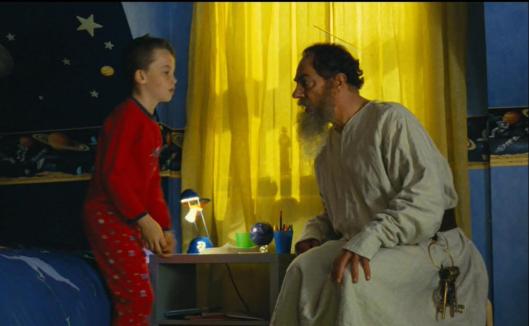
This past Sunday, our parish gathered to watch the film Millions (2004).  The film tells the story of two brothers who accidentally come into the possession of a bag with cash, and what they each want to do with the money.  The younger brother, still reeling from their mother’s death, regularly has visions of and conversations with saints, where he discusses the moral issues of how to handle the money.  My favorite scene is between the younger brother and St. Peter.  As St. Peter is talking to him about miracles, he tells him about the Feeding of the Five Thousand story.  But this Peter’s version is a little different than the one we all know.

In the film, Peter says what actually happened that day was not really a miracle.  A boy showed up with some sardines to share with the hungry crowd, and Jesus had the disciples pass them around.  But when each person received the plate, they did not take any, because they had been hiding a stash for themselves.  So, each person took their own stash out, and ate that food instead.  Some people even had a little extra, and so they added a small amount to the plate.  Peter argues there was no magic because the food did not actually multiply.  But as he talks the story through, he confesses perhaps a miracle did happen – the miracle of people sharing their food; the miracle of a once stingy people, hoarding their own food, to a tentatively generous people, willing to share.

What St. Peter was cheekily alluding to was a miracle not of substance, but of changed behavior.  Though the scene is meant to be playful, I have been thinking about that distinction ever since.  We are in a time of stingy hoarding; perhaps humans always are.  But in the face of our selfishness, I often find myself praying for a miracle – for God to act dramatically to change these awful patterns in our society.  But perhaps the miracle we need today is not a miracle of substance, but a miracle of changed behavior.  Perhaps we need little boys with plates of shared sardines to inspire us to let go of our own death grips on security, and open up our hands and hearts to generosity.   Perhaps when we open up, others will see works of miracle in our simple changes of behavior.

What are you hoarding this week on which you can loosen your grip?  Who are the children you have been ignoring who have something inspirational to share with you?  How might you slowly begin to let go of your posture of inward protection and look around your community to see who might need you and your open arms?  I invite you to be open to a miracle of changed behavior this week, and to let me know what ripple effects you see.  Maybe St. Peter is right about us, even today!

Homily – Luke 10:25-37, P10, YC, July 13, 2019

17 Wednesday Jul 2019

Posted by jandrewsweckerly in Sermons, Uncategorized

≈ Leave a comment

Tags

baptism, baptismal covenant, covenant, dignity, faith, God, Good Samaritan, Jesus, kindness, Mr. Rogers, neighbor, sacred, Samaritan, Sermon, unworthy

Last Sunday, a group of parishioners gathered to watch Won’t You Be My Neighbor, the documentary about Fred Rogers.  There were countless things I could tell you about this film, but one thing that really grabbed my attention was toward the end.  The film documented a criticism of Mr. Rogers as raising up a generation of people who feel and act entitled.  You see, one of the primary lessons from Mr. Rogers is he loves each individual, just as they are.  No changes are necessary; no fault is too big.  Mr. Rogers loves you just as you are.  You can hear the words of God in Mr. Rogers’ words – God too loves us unconditionally, and certainly loves us better than any human ever could.  However, Mr. Rogers’ critics would argue if everyone is loved just as they are, then surely they do not need to improve, or earn respect, or work hard.  But the film asserts something quite different.  The film asserts without being recipients of unconditional love, individuals cannot be givers of unconditional love.  In other words, to respect the dignity of every human being, one must first learn how sacred one’s own dignity is – one must be shown how she or he is a person with dignity to be respected in order to know how to respect the dignity of others.

That sense of each person having profound, sacred dignity is one of the main lessons of our gospel today.  The Good Samaritan is one of those stories that is so widely known all I need to do is say, “the Good Samaritan,” and we likely already know the story.  We might automatically recall, “Oh, that’s the story Jesus uses to tell us to be like the Good Samaritan – to be kind to others.”  In one sense, our recollection would be true – at the heart of Jesus’ story is a message to be kind to all.  But what that simple summary misses is the finer details to this story.

You see, those two people who separately pass the victim along the road, are a priest and a Levite.  These two people are not just people of faith – they are keepers of the faith.  They know the laws better than most people of faith.  You may have heard over the years the logic that priests or Levites could not risk being defiled by touching the body of the victim, and so that is why they went around the victim.  But the truth is, their avoidance had nothing to do with defilement – they were heading away from the temple and therefore were not in need of ritual purity, and any good priest or Levite knows they were expected to check on this victim; should he be dead, they should help bury him, and should he be alive, they should tend him.[i]  Basically, these are good, trained people of faith, not fulfilling their duty to love their neighbor as themselves.

But perhaps even more significant is the identity of the Samaritan.  The story does not say, a priest and Levite passed, but another faithful Jew came to the victim’s aid.  The story says, a priest and Levite passed, but a man whose people are mortal enemies of people of faith – who has persecuted, defiled, and subjugated people of faith – is the one who helps.  Saying “The Good Samaritan,” is like saying, “The Good Murderer.”[ii]  That this typically hated man is the one who shows mercy, kindness, and love is shocking.  The hearers of Jesus’ story are shocked, and our ears need to be similarly shocked.  Asking us to respect the dignity of every human being is already a monumental task; respecting the dignity of every human being is inconvenient, is humbling, and involves a willingness to be wrong about others.  Respecting the dignity of every human being means being willing to see how the best of the faithful fail at kindness, and how sometimes our worst enemies are better people of faith than we are.

Today we are baptizing a child of God.  Her parents, godmothers, and our community will make promises today – to raise her in the community of faith, to show her to love and respect, to fight for justice and peace, to share the word of God, and to repent when she messes up.  We say those words today as we reaffirm our own baptismal covenants; but sometimes we forget how revolutionary the covenant is.  We are agreeing to teach Selah to live a revolutionary life.  When we say we will teach baby Selah to respect the dignity of every human being, we are saying we will teach her the hard work being inconvenienced and humbled in order to care for others.  When we say we will teach her to love her neighbor as herself, we are saying we will teach her that even her greatest enemies are worthy of love.  When we say we will teach her to repent when she sins, we are saying we will teach her to be willing to admit when people who we have deemed unworthy of love and care show us what true kindness really looks like.

Today, when we hear Christ’s words to “go and do likewise,” we can be encouraged that Jesus empowers us to make some promises.  Today we look at Selah’s precious, innocent face, and we promise to walk with her as she discovers how hard this work of being a faithful follower of Christ really is.  Today, we promise to confess to Selah the times when we have failed to love our neighbors as ourselves.  Today, we promise when those we despise, those who hurt us, those we cast out because they are not like us, those we can no longer see humanity in ask us, “Won’t you be my neighbor,” we will say with Selah, “Yes.  You are my neighbor too.”  Amen.

[i] Amy-Jill Levine, Short Stories by Jesus (New York:  Harper One, 2014), 99-102.

[ii] Levine, 105.

← Older posts
Newer posts →

Recent Posts

  • On Politics, Football, and Love…
  • On Sharing the Love…
  • Sermon – Micah 6.1-8, Matthew 5.1-12, EP4, YA, January 30, 2026
  • On Justice, Kindness, Humility, and the Messy Middle…
  • Feast of the Rev. Dr. Martin Luther King, Jr., January 18, 2026

Archives

  • February 2026
  • January 2026
  • December 2025
  • November 2025
  • October 2025
  • September 2025
  • August 2025
  • July 2025
  • June 2025
  • March 2025
  • February 2025
  • December 2024
  • November 2024
  • October 2024
  • September 2024
  • August 2024
  • July 2024
  • June 2024
  • May 2024
  • March 2024
  • February 2024
  • January 2024
  • December 2023
  • November 2023
  • October 2023
  • September 2023
  • August 2023
  • July 2023
  • June 2023
  • May 2023
  • March 2023
  • February 2023
  • January 2023
  • December 2022
  • November 2022
  • October 2022
  • June 2022
  • May 2022
  • January 2022
  • December 2021
  • November 2021
  • October 2021
  • September 2021
  • August 2021
  • June 2021
  • May 2021
  • April 2021
  • March 2021
  • February 2021
  • January 2021
  • December 2020
  • November 2020
  • October 2020
  • September 2020
  • August 2020
  • July 2020
  • June 2020
  • May 2020
  • April 2020
  • March 2020
  • February 2020
  • January 2020
  • December 2019
  • November 2019
  • October 2019
  • September 2019
  • August 2019
  • July 2019
  • June 2019
  • May 2019
  • April 2019
  • March 2019
  • February 2019
  • January 2019
  • December 2018
  • November 2018
  • October 2018
  • September 2018
  • August 2018
  • July 2018
  • June 2018
  • May 2018
  • April 2018
  • March 2018
  • February 2018
  • January 2018
  • December 2017
  • November 2017
  • October 2017
  • September 2017
  • August 2017
  • July 2017
  • June 2017
  • May 2017
  • April 2017
  • March 2017
  • February 2017
  • January 2017
  • December 2016
  • November 2016
  • October 2016
  • September 2016
  • August 2016
  • July 2016
  • June 2016
  • May 2016
  • April 2016
  • March 2016
  • February 2016
  • January 2016
  • December 2015
  • November 2015
  • October 2015
  • September 2015
  • August 2015
  • July 2015
  • June 2015
  • May 2015
  • April 2015
  • March 2015
  • February 2015
  • January 2015
  • December 2014
  • November 2014
  • October 2014
  • September 2014
  • August 2014
  • July 2014
  • June 2014
  • April 2014
  • March 2014
  • February 2014
  • January 2014
  • December 2013
  • November 2013
  • October 2013
  • September 2013
  • August 2013
  • July 2013
  • June 2013
  • May 2013
  • April 2013
  • March 2013
  • February 2013
  • January 2013
  • December 2012
  • November 2012
  • October 2012
  • September 2012

Categories

  • reflection
  • Sermons
  • Uncategorized

Meta

  • Create account
  • Log in
  • Entries feed
  • Comments feed
  • WordPress.com

Blog at WordPress.com.

  • Subscribe Subscribed
    • Seeking and Serving
    • Join 395 other subscribers
    • Already have a WordPress.com account? Log in now.
    • Seeking and Serving
    • Subscribe Subscribed
    • Sign up
    • Log in
    • Report this content
    • View site in Reader
    • Manage subscriptions
    • Collapse this bar
 

Loading Comments...